Original Meaning
True Conversion Should Make a Difference (3:1 – 8)
VERSE 1 OPENS with the word “remind,” a gracious but insistent way in which Titus can reinforce teaching that the Cretans have already heard. It may also serve as a marker between chapters 2 and 3, with the teachings on personal relationships in chapter 2 possibly being newer to the church. Paul’s “reminder section” deals with the theme of good works with a particular focus on the world of unbelievers. Note verse 3, where he not only affirms the grace of God in our conversion, but labors to identify our pre-Christian state with that of others yet unconverted.
The proper attitude toward the secular “rulers and authorities” is submission, obedience, and readiness “to do whatever is good.” The fact that obedience is mentioned separately from submission indicates that not all submission requires obedience (Eph. 5:22 may be an example of this). One’s civic obligations to secular authority are a staple in ancient “household codes.” Being “ready to do whatever is good,” Hanson observes, “almost a cliché”1(note the importance of this theme in the Pastorals: 1 Tim. 2:10; 5:10, 25; 6:18; 2 Tim. 2:21; Titus 2:7, 14; 3:8, 14).
The examples that follow in verse 2 include refraining from slandering others, being peaceful (lit., “not fighting”), being considerate (a requirement of elders in 1 Tim. 3:3; see also Phil. 4:5), and showing genuine “humility” to all people. The noun for “humility” (praütes) conveys the idea of gentleness as well as humbleness. This is a characteristic worth attention because it is both taught by and embodied in our Lord Jesus (Matt. 5:5; 11:29; 21:5; 2 Cor. 10:1) and is urged in such passages as Galatians 5:23; Ephesians 4:2; Colossians 3:12.
Verse 3 is joined to the preceding by the word gar (“for,” untranslated in NIV). In other words, this section provides foundational or exemplary information pertinent to verses 1–2. The reason for this may not immediately be apparent, since verses 1–2 simply give instructions about functioning well in society. Underneath, however, is the fact that a first-generation Christian, like those still not Christians, can live disfunctionally. These instructions are, therefore, far from being mere moral platitudes. They indicate a contrasting life to that in society around them.
The next word in verse 3 is pote (“once"; NIV, “at one time”); it is paired with hote (“when”) in verse 4. This is a before-and-after pattern (cf. also Eph. 2:11, 13; 5:8; Col. 1:21–22). The next words, “we too,” serve to identify the Christians’ preconversion experience with that of those around them in Crete. The effect of all this is to keep the Christians humble (cf. Titus 3:2), to offer hope to the present unbelievers, and to allow the use of strong words describing the unbelievers, since these characteristics had at one time been true of the converts: “foolish” (see Rom. 1:14), “disobedient” (see “obedient” in Titus 3:1), “deceived” (see 1 Tim. 4:1; 2 Tim. 3:13), and “enslaved.” The reference to slavery directs attention to the identity of the masters, which are “all kinds of passions and pleasures,” as well as to the character degeneration that this involved: “malice,” “envy,” “hated,” and “hating.”
Fee observes that while grammatically verse 3 provides a reason for the appeal made in verses 1–2, it is like a “vice” list in its form.2 Likewise in its form verses 1–2 look like a “virtue” list.3 Given this structure, it is natural to look for corresponding positive and negative characteristics. This cannot be demonstrated at each point, but certainly the good attitude to others that verses 1–2 encourage has a terrible counterpart in the last part of verse 3.
The descriptive words in verse 3 reveal several facts about unbelievers. Being “foolish” is being without understanding, in a state of folly—a deliberate, rebellious choice, and not the state of a person merely lacking intelligence. This not only recalls the unbelieving fool of Psalm 14:1; 53:1, the people who lack the wisdom of God throughout Proverbs and Ecclesiastes, and those whom God calls “fool” in Luke 12:20, but also those described in Romans 1:21 and its context. The “disobedient” likewise reject God’s sovereignty over them. Those who are “deceived” are led astray by Satan (cf. 2 Tim. 3:13; cf. 1 Tim. 4:1 [“deceiving spirits”]). We know from 2 Corinthians 4:4 and 11:2 that Satan is active in blinding people and deceiving Christians (2 Cor. 11:3). Thus, these unbelievers reject God’s wisdom and lordship, deceived by Satan and enslaved by their own passions and pleasures. Their attitude toward others is an natural outcome of this spirit.
Verse 4 provides the kind of gracious interruption found in Ephesians 2:4: “But God, being rich in mercies, because of his great love with which he loved us” (lit. trans.). In Ephesians 2 the great operative words are mercy, love, grace, and kindness. They reappear here in a different order: kindness, love, mercy, and grace. In both passages God “saved” us. In Ephesians he raised us up and seated us with Christ in the heavenly realms; here he washes us, renews us, justifies us, and gives us “the hope of eternal life” (Titus 3:7). The Ephesians passage concludes with the call to good works—the same emphasis that concludes this passage in (v. 8).
The following diagram may be useful in conceptualizing the relationships of the clauses and phrases in this section:
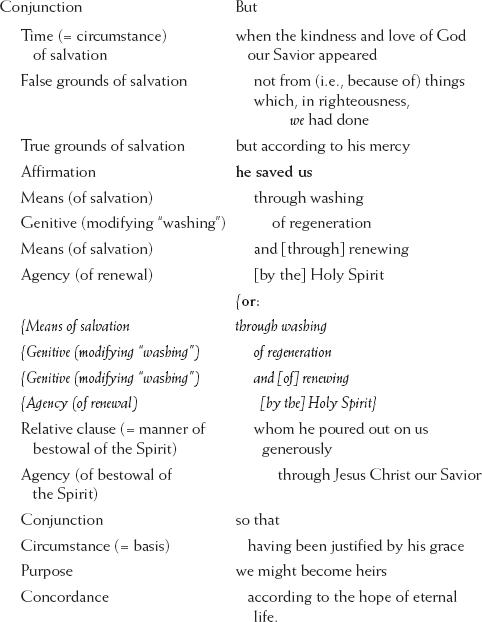
The first clause in verses 4–7 is, as noted above, temporal. Using the distinctive terminology of the Pastoral Letters, the verb used in this clause is epiphaino (trans. “appeared”). And like 2:11, where the same verb occurs, it does not directly feature Christ as the subject, but rather refers to him obliquely. Thus, what has appeared is “the kindness and love of God our Savior,” just as in 2:11 it was “the grace of God that brings salvation.” In the previous passage the appearing motif occurs again with “our God and Savior, Jesus Christ” as the subject. Paul’s emphasis is not only on the coming of Christ as Savior but also (1) on the merciful, gracious work of salvation and (2) on the fact that this was God’s work, using once again the characteristic reference to God as Savior (see also 1 Tim. 1:1; 2:3; 4:10; Titus 1:3; 2:10). The word for “kindness” conveys more than just goodness; it includes the idea of benevolence.
The next two phrases in the Greek structure are prepositional phrases modifying the main verb of the sentence, “he saved.” The first phrase expresses what we may call false grounds. The basis on which God saved us is not the good things we have done (lit., “not out of works that we did in righteousness”). An emphatic “we” appears at the end of that phrase, stressing that it is not our doing (compare Eph. 2:8–9). The second prepositional phrase stands in strong contrast to the first, introduced by the strong adversative conjunction alla; it indicates the true grounds on which God saves us: “his mercy.”
The next word is the main verb, “saved,” in the simple aorist tense, indicating the basic fact of that completed work. Paul then cites the means by which God has accomplished this. The use of the Greek genitive after the preposition dia (“through”) is significant here and not entirely easy to understand. Illustrating this by grouping the English words together by hyphens, one can read it “through-washing-of-regeneration and renewal-of-Holy-Spirit.” In this reading, the washing is characterized by regeneration or perhaps produces it, and the renewal is accomplished by the Holy Spirit or perhaps comes from the Holy Spirit as a source.
These phrases can also, however, be understood as “through washing of regeneration-and-renewal of-the-Holy-Spirit.” In this reading the regeneration and renewing are both functions of the washing. In either case it is difficult to separate the regeneration (a word used more in the Greco-Roman world than in Scripture, though see Matt. 19:28, NIV “renewal”) from the washing.
The theological question is whether this teaches baptismal regeneration. On the one hand, on reading this from a Christian point of view it is hard not to think of baptism, and this was true especially in the early centuries, when ritual was a larger part of church life than it is now. On the other hand, it is not necessary to take the word “washing” as identical to and solely referring to baptism. Baptism can be understood as the visible form of washing without removing the fact that the Spirit and the Word cleanse us on the basis of the blood of Christ shed on the cross. If one takes the two genitive nouns (“rebirth” and “renewal”) along with the “washing,” this is grammatically and theologically permissible, but must not be allowed to minimize the fact of the further modifying genitive phrase (“by the Holy Spirit”). We might say that the means of salvation are: the washing (represented by but not identical to baptism), the regeneration, and the renewing, while the agents of the renewing are the Holy Spirit and Jesus Christ our Savior, through whom the Spirit has been so generously poured out on us.
The purpose of this process includes one further circumstance that can be considered as further modifying “saved” (in sense although not grammatically) or else as modifying “we might become heirs” (v. 7), namely, “having been justified by his grace.” The overall point is clear: The purpose of God’s mercy, grace, and kindness in our lives is “so that” we may be heirs of God, a concept closely linked to our having the “hope of eternal life” (cf. Rom. 8:16–17 and context).
The “trustworthy saying” referred to in verse 8 is one of the so-called “faithful sayings” in the Pastoral Letters.4 It is not always easy to tell which words in the context are the “faithful saying” that Paul is quoting. In this case it is probably verses 4–7. Normally, the trustworthy sayings contain expressions uncharacteristic of the works attributed to Paul.5 In this case such language is sprinkled throughout verses 4–7. Note too that what follows (vv. 8–11) does not have the structure of a quotation.
As noted earlier, the latter part of verse 8, in common with Ephesians 2:8–10, sets out the importance of good works for those who have experienced God’s grace. One may have expected that Paul would then state that these things are to the glory of God or to the benefit of believers, but instead he makes the broad statement that they are excellent (cf. Titus 2:7, 14; 3:14) and profitable for everyone. Once again the apostle shows a concern for the world around him.
Several emphatic words are worth noting in verse 8: “to stress” (i.e., to strongly maintain, an exercise of Titus authority), “be careful,” and “devote themselves to” (denoting being concerned about or caring for something).
Bridging Contexts
REPEATED THEMES IN the Pastorals. Someone writing another commentary in this series mentioned to me how difficult it is when writing the Original Meaning, Bridging Contexts, and Contemporary Significance not to repeat the same things. That is, of course, natural to this format because in essence what is taught in the text is true both in principle across contexts and specifically in our own world. But when studying the Pastorals, this repetition is multiplied because of these three letters tend to repeat the same theme: In passage after passage sound doctrine must be accompanied by a godly life. Yet in this section Paul says, “I want you to stress these things, so that those who have trusted in God may be careful to devote themselves to doing what is good” (v. 8). If Paul stresses these themes, so should we.
The section begins with a reminder to be subject to and to obey rulers and authorities. That, of course, is not new to Paul’s writings (see esp. Rom. 13:1 — 10). This little paragraph in Titus moves the reader from the requirements of specific governmental regulations to having a humble Christian attitude in all social relationships. The steps in between are not necessarily in any logical sequence, put rather pick up sample elements of Christian attitudes to others. Doing good, not slandering people, being peaceable in relationships, and being considerate to others keep us from self-congratulation for the mere observance of law.
There is an implied contrast between the Christian who seeks to express the love that is the goal of God’s law and the person who cannot even be subject and obedient to secular authorities. One can perhaps picture a wealthy Scrooge conferring with his accountant and tax attorney, looking for loopholes in the law that will save him taxes, in contrast to a businessman or woman who gives away as much as possible to help those in need.
Looking to the mercy of God. Having said that, Paul launches into another list, this time describing life before Christianity in highly negative terms. He focuses on disobedience to regulations, enslavement by personal passions, and hostile behavior to other people. This list is easier to accept because Paul includes himself as an example of pre-Christian behavior, but it does raise the question as to how severely one should characterize those who are not yet believers. After all, while we know that “all have sinned and fall short of the glory of God” (Rom. 3:23), it is also true that God has not left humanity without standards or without the remnants of morality and kindness. Christians are not the only ones who volunteer for charitable service. While it can be said that there is at least a little selfishness even in the things people do for others, unbelievers are capable of heroic sacrifices for the good of others.
C. S. Lewis once dealt with the question as to why some non-Christians are nicer than Christians. Postulating a Christian woman he calls “Miss Bates,” who “may have an unkinder tongue than unbelieving Dick Firkin,” he says the question is “what Miss Bates’s tongue would be like if she were not a Christian.” Further, “Dick’s placid temper and friendly disposition…result from natural causes which God himself creates.”6 As regards behavior, this is the substance of verses 3–8, though Lewis was dealing more with character and personality. No one can be saved by natural goodness, and those who have “trusted in God” should do “what is good,” and that includes “Miss Bates’s” use of her tongue.
There is a touch of sarcasm, though probably not intended, in Paul’s words in 3:5 that God saved us “not because of righteous things we had done.” Since this immediately follows the description of the miserable behavior of non-Christians, it is clear that such people cannot claim “righteous things” as a basis for salvation. But in the larger context, and especially recalling such passages as Philippians 3:4–6, where Paul describes his own religious accomplishments before conversion, the significance of this passage becomes more clear. Religious people can do bad things, and evil people can do good things. For any of us to be saved requires the mercy of God.
Titus 3:3–8 and Ephesians 2:1–10 manifest a point-by-point similarity. Both deal with the sinful life before salvation (cf. Eph. 2:2–3), the intrusion of God’s love (cf. 2:4–5), God’s saving of us not by our good works (cf. 2:8–9), and our having been raised to new life and hope, with the desired result that we devote ourselves to “good works” (2:10) and do “what is good” (Titus 3:8). In Ephesians Paul shows us the heavenly perspective on the purposes of God in the church, in that the good works are related to that display of God’s wisdom made known to supernatural beings (Eph. 3:10–11). In Titus doing good is related to the display of a changed life over against the character of opponents of the gospel.
Warnings about divisive people—again. A number of problems surface in the Pastoral Letters that we find difficult to understand today. These include “genealogies” and “quarrels about the law” (Titus 3:9). But the lasting principle is not the nature of these controversies (though that is sometimes important) but the fact that they breed controversy and arise from divisive intentions. The point of verses 9–11 is not so much to identify and correct wrong doctrine as it is to silence the divisive person. Some churches have painfully come to the realization that a wrong-headed advocacy for truth can be as destructive as a sincerely held minor error. This is not to ignore the seriousness of heresy or the fact that the Pastorals are dealing with evil-minded heretics. But this passage in particular has to do with those who are divisive in their intentions, “warped and sinful.”
We can gain some perspective on this by noticing that in 1 Corinthians 5:9–11, when Paul talks about the kinds of people with whom Christians must not associate in the church (e.g., the immoral, the greedy, idolaters, drunkards, and swindlers), he inserts the verbally abusive person (kjv “railer”; NRSV “reviler”; NIV “slanderer”) into this list. Every pastor knows the threat that such people can be to the life of the church. Unfortunately, a pastor may tolerate such behavior, not facing it squarely until it is directed to the staff or perhaps directly to that pastor.
Contemporary Significance
“DOING GOOD” in our neighborhoods. Verses 1 and 8 both speak of doing good. It would be useful if Christians could periodically sit down together to discuss how they can do good and better represent the Lord in their own communities. While there will always be stock figures such as the town drunk, the heartless creditor, and the seductive prostitute, nuances of evil change from place to place and from generation to generation. Rather than the small neighborhood groups of a church simply praying for one another’s problems or debating eschatology, they can make immense strides in their community witness if they talk together about the spiritual climate in their neighborhoods and how they may better implement the gospel of Christ in their lives.
Surely there are not only distinctive ways to witness in different communities, but distinctive ways in which to be a witness. The story of a changed life has immense power to turn people to Christ. But that life must be genuinely changed not only as regards the cessation of sin but also in the performance of good. Ephesians 4:28–29 tells us that the thief must not only stop stealing but must do “something useful with his own hands, that he may have something to share with those in need.” The person with a foul mouth should not only stop saying such things but must say what is “helpful for building others up according to their needs, that it may benefit those who listen.” It is this kind of good that is going to make for an effective witness (cf. Titus 3:8). Every community has its own set of needs, problems, crises, and opportunities that call for specific Christian responses; “these things are excellent and profitable for everyone.”
Dealing with the dark side. Every pastor dreads certain aspects of ministry. Grieving with those in the valley of death and those recently bereaved is often both a precious privilege and a heavy experience. But one of the most difficult tasks is working with church leaders in the confrontation of strong-headed divisiveness (v. 10). This sometimes occurs low key, gradually grinding away at love and unity. But sometimes it is open to the view of the whole community.
A 1998 segment on the CBS TV program 48 Hours focused on the conflict between a gospel-preaching minister and a fundamentalist preacher who was having an affair with the evangelist’s wife. The hiring of a hit man (who was actually an undercover agent) to kill the fundamentalist resulted in the imprisonment of the other minister. What impressed this viewer (along with sadness and embarrassment) was the intransigence of the adversaries and the apparent disregard by allegedly Christian ministers of the very theme we have been observing in the Pastorals: sound doctrine blended with godly living before the outside community. Intransigence can characterize anyone—from heretic to minister. The godly pastor must face such people with all the wisdom, patience, and boldness described in verses 9–11. Freedom from heresy does not mean freedom from controversy. How a church and its pastors handle this may affect the church’s witness for years to come.
The controversies and divisiveness that call for strong action on the part of Christian leaders (vv. 9–10) require a rare blend of humility and authority, of love and uncompromising admonition. The stronger the reputation of a church and its leaders for expansive love, integrity, and civility in demeanor, the more effective will be their vigorous insistence on doctrinal purity. If Jesus had had a reputation as a hard-liner devoid of compassion, his resolute opposition to error and sin would have seemed more like the outburst of a pathological faultfinder than the justified outrage of a holy prophet and compassionate Savior.
1. Hanson, Pastoral Epistles, 189, cites one example. It is not clear how frequently he has found this “cliché” use.
2. Fee, 1 and 2 Timothy, Titus, 202.
3. See C. G. Kruse, “Virtues and Vices,” in DPL, 962–63, for a brief survey of New Testament ethical lists and alleged backgrounds, along with a bibliography.
4. See 1 Tim. 1:15; 3:1; 4:9; 2 Tim. 2:11; see the comments on 1:15 and the major work on the subject, Knight, The Faithful Sayings in the Pastoral Letters.
5. See Knight, Pastoral Epistles, 347–49, for evidence.
6. C. S. Lewis, Mere Christianity (New York: Macmillan, 1943), 116–64.
Original Meaning
Final Words About Controversies (3:9 – 11)
As IN 2:11–14 Paul’s exhortation here has a negative as well as positive side. In contrast to this strong affirmation of doctrine and life, there are things to be avoided (v. 9). The handling of controversies is an important matter in the Pastoral Letters (see 1 Tim. 1:4, 7; 6:4; 2 Tim. 2:23 and comments). The reason given here for avoiding them is that they are “unprofitable and useless.” In 2 Timothy 2:23 the reason is because stupid arguments produce quarrels, which are contrary to the attitude a servant of the Lord should have in trying to win others. Here in Titus the uselessness of controversy relates to its ineffectiveness in changing others. Therefore, after a couple of warnings (Titus 3:10), Titus is to have “nothing to do” with that person.
The words “you may be sure” (v. 11) introduce the reason why this person should be rejected: the individual’s own hopeless nature. This does not mean that grace is never extended, for the person has already had a second chance (v. 10; cf. Matt. 18:15–17). It has been established that this “divisive person” cannot be redeemed. He is not only “warped and sinful,” but he has also condemned himself, so the responsibility is not on Titus.
Bridging Contexts
REPEATED THEMES IN the Pastorals. Someone writing another commentary in this series mentioned to me how difficult it is when writing the Original Meaning, Bridging Contexts, and Contemporary Significance not to repeat the same things. That is, of course, natural to this format because in essence what is taught in the text is true both in principle across contexts and specifically in our own world. But when studying the Pastorals, this repetition is multiplied because of these three letters tend to repeat the same theme: In passage after passage sound doctrine must be accompanied by a godly life. Yet in this section Paul says, “I want you to stress these things, so that those who have trusted in God may be careful to devote themselves to doing what is good” (v. 8). If Paul stresses these themes, so should we.
The section begins with a reminder to be subject to and to obey rulers and authorities. That, of course, is not new to Paul’s writings (see esp. Rom. 13:1 — 10). This little paragraph in Titus moves the reader from the requirements of specific governmental regulations to having a humble Christian attitude in all social relationships. The steps in between are not necessarily in any logical sequence, put rather pick up sample elements of Christian attitudes to others. Doing good, not slandering people, being peaceable in relationships, and being considerate to others keep us from self-congratulation for the mere observance of law.
There is an implied contrast between the Christian who seeks to express the love that is the goal of God’s law and the person who cannot even be subject and obedient to secular authorities. One can perhaps picture a wealthy Scrooge conferring with his accountant and tax attorney, looking for loopholes in the law that will save him taxes, in contrast to a businessman or woman who gives away as much as possible to help those in need.
Looking to the mercy of God. Having said that, Paul launches into another list, this time describing life before Christianity in highly negative terms. He focuses on disobedience to regulations, enslavement by personal passions, and hostile behavior to other people. This list is easier to accept because Paul includes himself as an example of pre-Christian behavior, but it does raise the question as to how severely one should characterize those who are not yet believers. After all, while we know that “all have sinned and fall short of the glory of God” (Rom. 3:23), it is also true that God has not left humanity without standards or without the remnants of morality and kindness. Christians are not the only ones who volunteer for charitable service. While it can be said that there is at least a little selfishness even in the things people do for others, unbelievers are capable of heroic sacrifices for the good of others.
C. S. Lewis once dealt with the question as to why some non-Christians are nicer than Christians. Postulating a Christian woman he calls “Miss Bates,” who “may have an unkinder tongue than unbelieving Dick Firkin,” he says the question is “what Miss Bates’s tongue would be like if she were not a Christian.” Further, “Dick’s placid temper and friendly disposition…result from natural causes which God himself creates.”6 As regards behavior, this is the substance of verses 3–8, though Lewis was dealing more with character and personality. No one can be saved by natural goodness, and those who have “trusted in God” should do “what is good,” and that includes “Miss Bates’s” use of her tongue.
There is a touch of sarcasm, though probably not intended, in Paul’s words in 3:5 that God saved us “not because of righteous things we had done.” Since this immediately follows the description of the miserable behavior of non-Christians, it is clear that such people cannot claim “righteous things” as a basis for salvation. But in the larger context, and especially recalling such passages as Philippians 3:4–6, where Paul describes his own religious accomplishments before conversion, the significance of this passage becomes more clear. Religious people can do bad things, and evil people can do good things. For any of us to be saved requires the mercy of God.
Titus 3:3–8 and Ephesians 2:1–10 manifest a point-by-point similarity. Both deal with the sinful life before salvation (cf. Eph. 2:2–3), the intrusion of God’s love (cf. 2:4–5), God’s saving of us not by our good works (cf. 2:8–9), and our having been raised to new life and hope, with the desired result that we devote ourselves to “good works” (2:10) and do “what is good” (Titus 3:8). In Ephesians Paul shows us the heavenly perspective on the purposes of God in the church, in that the good works are related to that display of God’s wisdom made known to supernatural beings (Eph. 3:10–11). In Titus doing good is related to the display of a changed life over against the character of opponents of the gospel.
Warnings about divisive people—again. A number of problems surface in the Pastoral Letters that we find difficult to understand today. These include “genealogies” and “quarrels about the law” (Titus 3:9). But the lasting principle is not the nature of these controversies (though that is sometimes important) but the fact that they breed controversy and arise from divisive intentions. The point of verses 9–11 is not so much to identify and correct wrong doctrine as it is to silence the divisive person. Some churches have painfully come to the realization that a wrong-headed advocacy for truth can be as destructive as a sincerely held minor error. This is not to ignore the seriousness of heresy or the fact that the Pastorals are dealing with evil-minded heretics. But this passage in particular has to do with those who are divisive in their intentions, “warped and sinful.”
We can gain some perspective on this by noticing that in 1 Corinthians 5:9–11, when Paul talks about the kinds of people with whom Christians must not associate in the church (e.g., the immoral, the greedy, idolaters, drunkards, and swindlers), he inserts the verbally abusive person (kjv “railer”; NRSV “reviler”; NIV “slanderer”) into this list. Every pastor knows the threat that such people can be to the life of the church. Unfortunately, a pastor may tolerate such behavior, not facing it squarely until it is directed to the staff or perhaps directly to that pastor.
Contemporary Significance
“DOING GOOD” in our neighborhoods. Verses 1 and 8 both speak of doing good. It would be useful if Christians could periodically sit down together to discuss how they can do good and better represent the Lord in their own communities. While there will always be stock figures such as the town drunk, the heartless creditor, and the seductive prostitute, nuances of evil change from place to place and from generation to generation. Rather than the small neighborhood groups of a church simply praying for one another’s problems or debating eschatology, they can make immense strides in their community witness if they talk together about the spiritual climate in their neighborhoods and how they may better implement the gospel of Christ in their lives.
Surely there are not only distinctive ways to witness in different communities, but distinctive ways in which to be a witness. The story of a changed life has immense power to turn people to Christ. But that life must be genuinely changed not only as regards the cessation of sin but also in the performance of good. Ephesians 4:28–29 tells us that the thief must not only stop stealing but must do “something useful with his own hands, that he may have something to share with those in need.” The person with a foul mouth should not only stop saying such things but must say what is “helpful for building others up according to their needs, that it may benefit those who listen.” It is this kind of good that is going to make for an effective witness (cf. Titus 3:8). Every community has its own set of needs, problems, crises, and opportunities that call for specific Christian responses; “these things are excellent and profitable for everyone.”
Dealing with the dark side. Every pastor dreads certain aspects of ministry. Grieving with those in the valley of death and those recently bereaved is often both a precious privilege and a heavy experience. But one of the most difficult tasks is working with church leaders in the confrontation of strong-headed divisiveness (v. 10). This sometimes occurs low key, gradually grinding away at love and unity. But sometimes it is open to the view of the whole community.
A 1998 segment on the CBS TV program 48 Hours focused on the conflict between a gospel-preaching minister and a fundamentalist preacher who was having an affair with the evangelist’s wife. The hiring of a hit man (who was actually an undercover agent) to kill the fundamentalist resulted in the imprisonment of the other minister. What impressed this viewer (along with sadness and embarrassment) was the intransigence of the adversaries and the apparent disregard by allegedly Christian ministers of the very theme we have been observing in the Pastorals: sound doctrine blended with godly living before the outside community. Intransigence can characterize anyone—from heretic to minister. The godly pastor must face such people with all the wisdom, patience, and boldness described in verses 9–11. Freedom from heresy does not mean freedom from controversy. How a church and its pastors handle this may affect the church’s witness for years to come.
The controversies and divisiveness that call for strong action on the part of Christian leaders (vv. 9–10) require a rare blend of humility and authority, of love and uncompromising admonition. The stronger the reputation of a church and its leaders for expansive love, integrity, and civility in demeanor, the more effective will be their vigorous insistence on doctrinal purity. If Jesus had had a reputation as a hard-liner devoid of compassion, his resolute opposition to error and sin would have seemed more like the outburst of a pathological faultfinder than the justified outrage of a holy prophet and compassionate Savior.
1. Hanson, Pastoral Epistles, 189, cites one example. It is not clear how frequently he has found this “cliché” use.
2. Fee, 1 and 2 Timothy, Titus, 202.
3. See C. G. Kruse, “Virtues and Vices,” in DPL, 962–63, for a brief survey of New Testament ethical lists and alleged backgrounds, along with a bibliography.
4. See 1 Tim. 1:15; 3:1; 4:9; 2 Tim. 2:11; see the comments on 1:15 and the major work on the subject, Knight, The Faithful Sayings in the Pastoral Letters.
5. See Knight, Pastoral Epistles, 347–49, for evidence.
6. C. S. Lewis, Mere Christianity (New York: Macmillan, 1943), 116–64.