Original Meaning
Churches in Asia (1:4a)
“ASIA” WAS A common designation for the Roman province of western Asia Minor (modern western Turkey), where Christianity was flourishing by the end of the first century. A governor of Bithynia (in northern Turkey) early in the second century even complained to the emperor that the pagan temples were being forsaken because Christians were spreading so quickly.1 But other strengths of the churches did not exempt them from the need for a message from God, whether warning them of further suffering (2:10) or summoning them to deeper holiness (2:14–16).
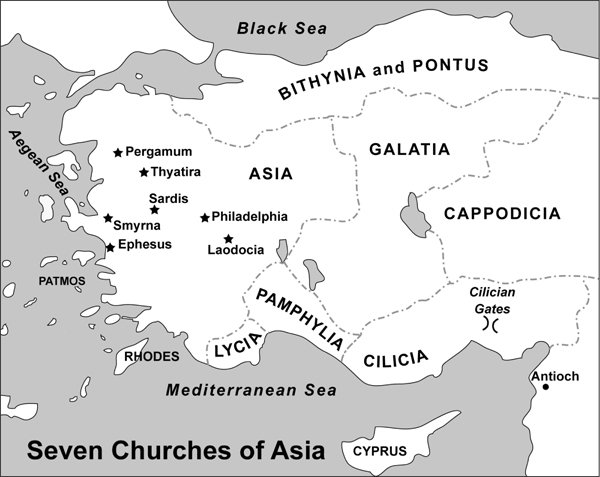
Churches had spread throughout the province of Asia and were not limited to the cities mentioned in Revelation (Acts 19:10). But John writes to the most prominent and strategic seven cities in the region, from which word would quickly spread to outlying areas. The leading council of Asiarchs (Acts 19:31, “officials of the province”) met each year in a succession of seven cities, which are exactly the same seven cities to which John writes—except that John replaces Cyzicus, far to the north, with the more centrally located Thyatira.2 Ephesus, the first city he mentions, was the most important city in the province, but also the first of the seven cities to which a messenger from Patmos, just forty to fifty miles away in the Aegean Sea, would have come.
Because John did not have seven secretaries to whom he could have dictated the book simultaneously, and because it would have to be recopied by hand, he did not start with seven copies of the book, one for each of the churches (although people in the churches may well have copied it down after it arrived). John’s messenger probably carried the scroll from one congregation to another until all seven had heard the call to awaken that Christ had sent them.
Meanwhile, word would spread from these seven churches; for instance, other important cities, like Hierapolis, Trallis, and Magnesia, were actually on the same road that messengers would likely follow to bring the Revelation to the seven churches.3 More important, each of the churches was strategically located to reach various populations in Asia. From Pergamum one could reach the northern coastal areas; from Thyatira, the inland area to the northeast and east; from Sardis, the broad central Hermus Valley; from Philadelphia, upper Lydia; from Laodicea, the Lycus Valley and central Phrygia; from Smyrna, the lower Hermus Valley and the north Ionian coasts; and from Ephesus, the Cayster and lower Maeander Valleys and its own metropolitan area.4 The seven churches thus would spread the message to all of Roman Asia.
Bridging Contexts
MISINTERPRETATIONS OF Revelation 1–3. This passage has raised various interpretive issues for modern readers, especially in circles heavily influenced by some popular prophecy teachers. One issue raised by the older view is that the seven churches are symbolic. To be sure, most of Revelation belongs to a mixture of apocalyptic and prophetic genres, some of whose symbols have proved more difficult to fathom than others; letters, however, are usually a different kind of literature. Most apocalyptic writings used pseudonyms for their authors and did not explicitly address a particular audience. But Revelation is different, framed as a letter.36 That it is a letter to specific first-century churches suggests the degree to which we should interpret the symbolism of this book in light of symbols these churches would have understood.
Some early dispensationalists have interpreted the seven churches of Asia (1:4) symbolically as seven “church ages,” or stages of church history, though few hold this view today.37 For a number of reasons, this line of interpretation is no more feasible than allegorizing the churches addressed in Paul’s letters. (1) Abundant evidence suggests that Revelation addresses seven literal church communities, including items of local color that fit each of the seven letters (see comments on the letters).
(2) A map shows that Revelation addresses the seven churches in the very sequence that a messenger from John, arriving first in Ephesus near the sea, would travel to each of the cities listed, presumably along the main roads of Asia (see the Introduction). The average distance between each city was about thirty to forty-five miles.38
(3) Only a forced reading of church history (regularly revised with the passing of time) has allowed this interpretation.
(4) Finally, if Revelation requires the completion of seven church ages before Jesus’ return, then in most centuries of church history Christians had no right to expect the imminent return of the Lord! This would be a curious conclusion for advocates of the seven church ages view, most of whom vehemently emphasize the imminence of Christ’s return.
Modern doctrinal agendas. Another danger in reading biblical texts is that we read our modern doctrinal agendas into them. For instance, some writers have sought to distinguish a pretribulational rapture from a posttribulational second coming by arguing that Jesus “comes in the clouds” at the Rapture (cf. 1 Thess. 4:17) but touches down on earth at the Second Coming (Zech. 14:4). Whatever one’s view of that doctrine, an argument based solely on such a distinction inevitably fails. Most of the texts about Jesus’ return in judgment do not mention the detail of him landing on earth; further, most of the texts about Jesus’ coming with clouds refer plainly to his coming visibly to the entire world, as here (1:7; cf. Dan. 7:13; Mark 13:26; 14:62).39 Nor ought we to read other modern doctrinal controversies into texts that were not written to address them. John writes not as a modern theologian but as a prophet and pastor, encouraging suffering believers and exhorting complacent ones.
Does this passage speak to today? But if we seek to approach this passage on its own terms, how relevant does it prove for today? If John emphasizes Jesus’ triumph over death (1:5) and God’s sovereign rule over history (1:8) to encourage believers threatened by a hostile Roman government, does his message have anything to say to modern readers one and a half millennia after Rome’s fall?
That question is not difficult to answer. All believers face death (Heb. 9:27), and all witnessing believers face opposition of some sort (2 Tim. 3:12). Jesus’ words come as an encouragement to us in our various personal trials that God has a plan larger than the details that we can see, and that we fit into his plan for history, the goal of which is a people who will constitute a kingdom and priests.
Such words especially set our corporate sufferings as the church in broader perspective. Apart from the eyes of faith, no one could have guessed that the struggling Christian movement would have outlived the mighty Roman Empire. Likewise, apart from the eyes of faith, who would have guessed a century ago that believers in the Two-Thirds World would easily outnumber believers in the West? Or that the Berlin Wall would have fallen? Or that apartheid would have died in South Africa without a civil war?40
Today’s persecutors of the church are often different, but the principle is the same. Radical Islamic regimes in Iran41 and especially the Sudan42 have martyred many Christians, but knowing the Lord of history summons us to look beyond the present to God’s ultimate plan. Because much of Revelation is most relevant to believers experiencing or anticipating state persecution, it reminds us of our participation in the universal body of Christ and invites us to pray with faith for our suffering brothers and sisters, as we would hope they would do for us when our time comes (Matt. 24:9).
Contemporary Significance
MISSION STRATEGY AND church reality. That the book was sent first to the most strategic cities of Asia Minor, trusting that its message would spread from there (1:4), invites us to think strategically in our plans to spread God’s message to our communities and the world. We should think as strategically as possible as we mobilize believers for world missions,43 develop strategies for serving our communities,44 organize target-group evangelism,45 and so forth.
Yet our vantage point in history may also allow us to draw an additional application that would have been less clear in John’s day. When Revelation was written, Christianity flourished in western Turkey, but over the centuries each of these churches gradually succumbed to pressures until the last was virtually stamped out by Islam. The regions where the early church was strongest (Turkey, Syria, and North Africa) are now Islamic strongholds.
Yet by and large it was the church rather than Islam that destroyed the church; Muslim invaders simply mopped up after them. In North Africa, Christianity weakened itself through internal doctrinal and ethnic divisions, heresies, and the insensitivity of Byzantine and Latin Christians to local culture. Nubia remained a richly Christian African culture until its growing weakness in both missions and Christian education led to its collapse to Islam in the fourteenth through the sixteenth centuries.46 The disunity of the church led to the demise of a glorious Eastern Orthodox culture before Islam.47 Regions relatively barren of the gospel two centuries ago are now flourishing with the gospel, while parts of the Western world struggle to maintain a Christian voice. Lampstands can be moved from their place (2:5), and this should serve as a warning to believers in various parts of the world today: We dare not take our role in God’s plan for granted. When part of the church abandons its mission, God will raise up others to fulfill it.
Assurance of God’s help and presence. More important to the point of the book is the God who assures his people of help in their troubles. Because Revelation addresses some churches that were experiencing or were on the verge of impending suffering, it emphasizes the sufficiency of their keeper. The title of the one “who is, and who was, and who is to come” frames this paragraph (1:4, 8), encompassing all the other titles in it. As George Caird puts it, this elaboration of Exodus 3:14 “sets the church’s coming ordeal against a background of God’s eternity, but it also brings God down into the arena of history. He is Lord of past, present, and future.” Yet the sequence is also important: The past and future are embraced in God’s eternal present.48 Christians can be assured because, as one early Christian hymnist observed, God saw the end clearly at the very beginning (Odes Sol. 4:12, 14). God saw our own generation and all the martyrs of history at the same time; the church of all ages is part of his plan, and we are part of a purpose that is bigger than us individually and which will not fail.
Suffering Christians, such as those in Smyrna and Philadelphia and many today, need reminders of God’s great compassion for them; sometimes when we suffer we do not feel as if the sovereign God loves us, unless we can recognize his sharing our suffering in the cross. The assurance of Jesus’ love (1:5) goes deeper than mere words. Just as a husband and wife should practically demonstrate their love as well as announcing, “I love you,” so the New Testament portrays Christ’s love for us as intimately bound up with his sacrifice for us (1:5; Rom. 5:5–9). God’s love in the familiar verse John 3:16 is in the aorist tense, which may suggest a concrete past demonstration of his love coinciding with the time he “gave” his Son (on the cross, 3:14–16).
In my times of deepest brokenness, when no sophisticated theological argument could comfort me, my deepest assurance of God’s love has been to look at the cross and remember that God himself has shared my pain with me. Revelation 1:5 uses the present tense, “loves,” perhaps because the suffering church here needs assurance that God’s love for them continues, that he has not forgotten them.
Christ’s freeing believers from their sins reminds them of the distinction between themselves and the world system that persecutes them or lures them to compromise. Although verb tenses in Revelation are not always consistent, the tense of “freed” may well point to a decisive, past liberation from sin.49 We do not gradually relinquish our sins to make ourselves acceptable to God; Jesus liberates us into a new life at the new birth (John 3:3–5). Whether we immediately translate all of that transformation into behavior depends on the degree to which we embrace by faith the transformation Christ himself has accomplished in us in that new birth (Rom. 6:11). But as much of John’s first audience may have understood, suffering does seem to help the process (1 Peter 4:1).
God has everything under control. That God is both beginning and end, that he is eternal, invites us to remember that nothing can happen to us apart from his plan. That God judges sinful nations is a recurrent biblical principle, a principle that inevitably includes our own nation. But while such judgments can appeal to our sense of God’s justice and holiness, they also can unnerve us, because we are part of the same world that is shaken by his judgment. Yet biblical principles are no less emphatic in their assurance: God has everything under control.50 This message, too, accords with a strand of hope that runs through the whole of Scripture. Judgment is coming, but God will watch over his servants (Gen. 19:16; cf. Hab. 2:4); even at the hands of their enemies, nothing can overtake them apart from God’s purposes (Matt. 10:28–31; 1 Peter 2:15; 3:17; 4:19).
Calling God “Alpha” and “Omega” and the one “who is, and who was, and who is to come” shows just how “Almighty” God must be (1:8). Because of the properties of recently discovered particles, many late twentieth-century physicists have argued for the necessity of at least nine dimensions at the creation event, not simply the four we experience. The creation event involved all those dimensions and necessarily originated with a source outside those dimensions. This discovery is just one reminder that God our Creator is bigger than space and time, and no point in the history of the universe—whether beginning or end—is ever inaccessible to him.51 The concept of an all-powerful supreme deity exists in many traditional religions, generating awe as in the Bible.52 But the Bible reminds us of God’s power not only to generate awe, but also that this all-powerful God is our Father, who cares for us.
Remembering that God is Lord of history puts our lives in perspective. No situation we encounter takes God by surprise. Many of Israel’s contemporaries told stories in which one side could lose a battle while their patron deity slept;53 Elijah mocked the prophets of Baal with their own traditions that Baal might be sleeping or out chasing women (1 Kings 18:27); but Israel’s God neither slumbers nor sleeps (Ps. 121:3–4)! Rare will be the community, the congregation, or the individual working for God who is not faced with difficult challenges to faith—the death of loved ones, obstructions in what one feels is God’s plan, setbacks in preaching the gospel. Yet in the scope of God’s entire plan, we are assured that he will work these situations for our good (Rom. 8:28), even if sometimes that working focuses primarily on ultimately conforming us to Christ’s image (8:29).
Original Meaning
Jesus the Deliverer (1:5–6)
JOHN PROVIDES THREE titles that describe Jesus’ person in 1:5 and three statements about his work in 1:5–6. Each of Jesus’ titles in 1:5 provides special encouragement to a suffering church: Jesus had testified (and so suffered like many of John’s first audience), had risen from the dead (a promise of hope to that audience), and now reigns (an assurance against their persecutors).
Jesus is the “faithful witness,” who provided the ultimate witness of the Father (John 3:11) and stood faithful in his witness when on trial before Pilate (1 Tim. 6:13). Because he is the “faithful and true witness” (Rev. 3:14), believers can depend on his promises (Prov. 14:5, 25); in fact, he fulfills a divine role (Jer. 42:5).15 But more important here, Jesus provides the perfect model for Christians who will bear witness for him (Rev. 19:10) and suffer for that witness (17:6).16 Thus the only named martyr in the book of Revelation is likewise called a “faithful witness” (2:13).
That Jesus is the “firstborn from the dead” recalls a standard early Christian way of expressing the fact that Jesus was the first person to rise from the dead (Col. 1:18; Heb. 1:6; cf. Rom. 8:29), but was especially relevant to Christians who might soon face death for his name. Most Jewish people expected all the righteous dead to rise at the end of the age (Dan. 12:2); the early Christians believed that Jesus had actually inaugurated that future event in the midst of history (thus they preached “in Jesus the resurrection,” Acts 4:2). As the “firstborn,” Jesus’ resurrection was the guarantee that his dead followers would also be raised (1 Cor. 15:20)—hence they had nothing to fear, even from death itself (see also Rev. 1:18). In Jewish teaching, angels hostile to Israel’s interests ruled the nations,17 but here Jesus rules over the kings of the earth. The language alludes to Psalm 89:27, where God’s “firstborn” rules over the other “kings of the earth.” To believers suffering under agents of mighty Caesar, this title of Jesus would encourage them indeed!
As John lists three titles of Jesus in 1:5, he also lists three works of Jesus in 1:5–6 (though not quite parallel grammatically): He “loves us”; he “freed us from our sins”; and he “made us … a kingdom and priests.” Jesus’ love for us is expressed in his death on our behalf, as elsewhere in the New Testament (John 3:16; Rom. 5:5–8; Gal. 2:20). This assurance of Christ’s love would encourage the suffering believers among John’s readers; his death also provides an example for those called to join in the Lamb’s sacrifice on behalf of God’s mission in the world (Rev. 6:9).
In declaring that Jesus made us a “kingdom and priests,” John reminds his audience that salvation is not just what God saves us from (our sins, 1:5), but what he saves us for—for a destiny as his agents and worshipers (1:6). Exodus 19 reminded Israel that they were to be holy, or separate to God, and that they were God’s special and treasured possession (Ex. 19:5–6). But that passage especially declared that Israel’s mission was to be a kingdom of priests (19:6). Like other early Christian writers (1 Peter 2:9), John applies this title and mission to all believers (Rev. 1:6; 5:10; 20:6), who have been grafted into the heritage of Israel. For John’s audience, such an application is no small matter: Many are probably Jewish believers expelled from their synagogues for faith in Jesus (see comment on 3:8–9). Jews were exempt from worshiping the emperor, but some were accusing Christians of being no longer Jewish, hence subject to reprisals for their failure to worship Caesar (see the Introduction). By reaffirming that his audience remained attached to Israel’s heritage, John encourages them of the rightness of their claims.
John adapts the wording slightly: a kingdom and priests (1:6).18 Although a “kingdom” normally meant a ruler’s right to reign (Ps. 145:11–14), it sometimes meant the people over whom he reigned (105:13), and in this case the word implies delegated authority, as when Adam and Eve ruled creation for God (Gen. 1:26–27). This kingdom will “reign” with Jesus (Rev. 5:10; 20:6), as in the biblical promises (Dan. 7:22, 27).19
Their title as “priests” is also significant. The Qumran community saw its own mission as priestly, and its community included many priests.20 But the sort of priesthood John means here is a spiritual priesthood like that of ancient Israel as a whole (cf. Isa. 61:6). As priests Jesus’ followers will offer worship (Rev. 4:10–11; 5:8–10; cf. 22:3) and offerings, both the incense of prayer (5:8; 8:4) and the sacrifice of their own lives (6:9).21
After John expresses his prayer for grace and peace from the triune God, he pauses to offer a doxology of praise to Jesus (1:6). (This is not surprising behavior for a writer who is part of the priesthood he just mentioned.) Whereas traditional Jewish texts praised God the Father, here the praise is apparently directed toward Jesus (cf. also Rom. 9:5), the one who died for us (Rev. 1:5) and made us priests to his Father (1:6).22
Bridging Contexts
MISINTERPRETATIONS OF Revelation 1–3. This passage has raised various interpretive issues for modern readers, especially in circles heavily influenced by some popular prophecy teachers. One issue raised by the older view is that the seven churches are symbolic. To be sure, most of Revelation belongs to a mixture of apocalyptic and prophetic genres, some of whose symbols have proved more difficult to fathom than others; letters, however, are usually a different kind of literature. Most apocalyptic writings used pseudonyms for their authors and did not explicitly address a particular audience. But Revelation is different, framed as a letter.36 That it is a letter to specific first-century churches suggests the degree to which we should interpret the symbolism of this book in light of symbols these churches would have understood.
Some early dispensationalists have interpreted the seven churches of Asia (1:4) symbolically as seven “church ages,” or stages of church history, though few hold this view today.37 For a number of reasons, this line of interpretation is no more feasible than allegorizing the churches addressed in Paul’s letters. (1) Abundant evidence suggests that Revelation addresses seven literal church communities, including items of local color that fit each of the seven letters (see comments on the letters).
(2) A map shows that Revelation addresses the seven churches in the very sequence that a messenger from John, arriving first in Ephesus near the sea, would travel to each of the cities listed, presumably along the main roads of Asia (see the Introduction). The average distance between each city was about thirty to forty-five miles.38
(3) Only a forced reading of church history (regularly revised with the passing of time) has allowed this interpretation.
(4) Finally, if Revelation requires the completion of seven church ages before Jesus’ return, then in most centuries of church history Christians had no right to expect the imminent return of the Lord! This would be a curious conclusion for advocates of the seven church ages view, most of whom vehemently emphasize the imminence of Christ’s return.
Modern doctrinal agendas. Another danger in reading biblical texts is that we read our modern doctrinal agendas into them. For instance, some writers have sought to distinguish a pretribulational rapture from a posttribulational second coming by arguing that Jesus “comes in the clouds” at the Rapture (cf. 1 Thess. 4:17) but touches down on earth at the Second Coming (Zech. 14:4). Whatever one’s view of that doctrine, an argument based solely on such a distinction inevitably fails. Most of the texts about Jesus’ return in judgment do not mention the detail of him landing on earth; further, most of the texts about Jesus’ coming with clouds refer plainly to his coming visibly to the entire world, as here (1:7; cf. Dan. 7:13; Mark 13:26; 14:62).39 Nor ought we to read other modern doctrinal controversies into texts that were not written to address them. John writes not as a modern theologian but as a prophet and pastor, encouraging suffering believers and exhorting complacent ones.
Does this passage speak to today? But if we seek to approach this passage on its own terms, how relevant does it prove for today? If John emphasizes Jesus’ triumph over death (1:5) and God’s sovereign rule over history (1:8) to encourage believers threatened by a hostile Roman government, does his message have anything to say to modern readers one and a half millennia after Rome’s fall?
That question is not difficult to answer. All believers face death (Heb. 9:27), and all witnessing believers face opposition of some sort (2 Tim. 3:12). Jesus’ words come as an encouragement to us in our various personal trials that God has a plan larger than the details that we can see, and that we fit into his plan for history, the goal of which is a people who will constitute a kingdom and priests.
Such words especially set our corporate sufferings as the church in broader perspective. Apart from the eyes of faith, no one could have guessed that the struggling Christian movement would have outlived the mighty Roman Empire. Likewise, apart from the eyes of faith, who would have guessed a century ago that believers in the Two-Thirds World would easily outnumber believers in the West? Or that the Berlin Wall would have fallen? Or that apartheid would have died in South Africa without a civil war?40
Today’s persecutors of the church are often different, but the principle is the same. Radical Islamic regimes in Iran41 and especially the Sudan42 have martyred many Christians, but knowing the Lord of history summons us to look beyond the present to God’s ultimate plan. Because much of Revelation is most relevant to believers experiencing or anticipating state persecution, it reminds us of our participation in the universal body of Christ and invites us to pray with faith for our suffering brothers and sisters, as we would hope they would do for us when our time comes (Matt. 24:9).
Contemporary Significance
MISSION STRATEGY AND church reality. That the book was sent first to the most strategic cities of Asia Minor, trusting that its message would spread from there (1:4), invites us to think strategically in our plans to spread God’s message to our communities and the world. We should think as strategically as possible as we mobilize believers for world missions,43 develop strategies for serving our communities,44 organize target-group evangelism,45 and so forth.
Yet our vantage point in history may also allow us to draw an additional application that would have been less clear in John’s day. When Revelation was written, Christianity flourished in western Turkey, but over the centuries each of these churches gradually succumbed to pressures until the last was virtually stamped out by Islam. The regions where the early church was strongest (Turkey, Syria, and North Africa) are now Islamic strongholds.
Yet by and large it was the church rather than Islam that destroyed the church; Muslim invaders simply mopped up after them. In North Africa, Christianity weakened itself through internal doctrinal and ethnic divisions, heresies, and the insensitivity of Byzantine and Latin Christians to local culture. Nubia remained a richly Christian African culture until its growing weakness in both missions and Christian education led to its collapse to Islam in the fourteenth through the sixteenth centuries.46 The disunity of the church led to the demise of a glorious Eastern Orthodox culture before Islam.47 Regions relatively barren of the gospel two centuries ago are now flourishing with the gospel, while parts of the Western world struggle to maintain a Christian voice. Lampstands can be moved from their place (2:5), and this should serve as a warning to believers in various parts of the world today: We dare not take our role in God’s plan for granted. When part of the church abandons its mission, God will raise up others to fulfill it.
Assurance of God’s help and presence. More important to the point of the book is the God who assures his people of help in their troubles. Because Revelation addresses some churches that were experiencing or were on the verge of impending suffering, it emphasizes the sufficiency of their keeper. The title of the one “who is, and who was, and who is to come” frames this paragraph (1:4, 8), encompassing all the other titles in it. As George Caird puts it, this elaboration of Exodus 3:14 “sets the church’s coming ordeal against a background of God’s eternity, but it also brings God down into the arena of history. He is Lord of past, present, and future.” Yet the sequence is also important: The past and future are embraced in God’s eternal present.48 Christians can be assured because, as one early Christian hymnist observed, God saw the end clearly at the very beginning (Odes Sol. 4:12, 14). God saw our own generation and all the martyrs of history at the same time; the church of all ages is part of his plan, and we are part of a purpose that is bigger than us individually and which will not fail.
Suffering Christians, such as those in Smyrna and Philadelphia and many today, need reminders of God’s great compassion for them; sometimes when we suffer we do not feel as if the sovereign God loves us, unless we can recognize his sharing our suffering in the cross. The assurance of Jesus’ love (1:5) goes deeper than mere words. Just as a husband and wife should practically demonstrate their love as well as announcing, “I love you,” so the New Testament portrays Christ’s love for us as intimately bound up with his sacrifice for us (1:5; Rom. 5:5–9). God’s love in the familiar verse John 3:16 is in the aorist tense, which may suggest a concrete past demonstration of his love coinciding with the time he “gave” his Son (on the cross, 3:14–16).
In my times of deepest brokenness, when no sophisticated theological argument could comfort me, my deepest assurance of God’s love has been to look at the cross and remember that God himself has shared my pain with me. Revelation 1:5 uses the present tense, “loves,” perhaps because the suffering church here needs assurance that God’s love for them continues, that he has not forgotten them.
Christ’s freeing believers from their sins reminds them of the distinction between themselves and the world system that persecutes them or lures them to compromise. Although verb tenses in Revelation are not always consistent, the tense of “freed” may well point to a decisive, past liberation from sin.49 We do not gradually relinquish our sins to make ourselves acceptable to God; Jesus liberates us into a new life at the new birth (John 3:3–5). Whether we immediately translate all of that transformation into behavior depends on the degree to which we embrace by faith the transformation Christ himself has accomplished in us in that new birth (Rom. 6:11). But as much of John’s first audience may have understood, suffering does seem to help the process (1 Peter 4:1).
God has everything under control. That God is both beginning and end, that he is eternal, invites us to remember that nothing can happen to us apart from his plan. That God judges sinful nations is a recurrent biblical principle, a principle that inevitably includes our own nation. But while such judgments can appeal to our sense of God’s justice and holiness, they also can unnerve us, because we are part of the same world that is shaken by his judgment. Yet biblical principles are no less emphatic in their assurance: God has everything under control.50 This message, too, accords with a strand of hope that runs through the whole of Scripture. Judgment is coming, but God will watch over his servants (Gen. 19:16; cf. Hab. 2:4); even at the hands of their enemies, nothing can overtake them apart from God’s purposes (Matt. 10:28–31; 1 Peter 2:15; 3:17; 4:19).
Calling God “Alpha” and “Omega” and the one “who is, and who was, and who is to come” shows just how “Almighty” God must be (1:8). Because of the properties of recently discovered particles, many late twentieth-century physicists have argued for the necessity of at least nine dimensions at the creation event, not simply the four we experience. The creation event involved all those dimensions and necessarily originated with a source outside those dimensions. This discovery is just one reminder that God our Creator is bigger than space and time, and no point in the history of the universe—whether beginning or end—is ever inaccessible to him.51 The concept of an all-powerful supreme deity exists in many traditional religions, generating awe as in the Bible.52 But the Bible reminds us of God’s power not only to generate awe, but also that this all-powerful God is our Father, who cares for us.
Remembering that God is Lord of history puts our lives in perspective. No situation we encounter takes God by surprise. Many of Israel’s contemporaries told stories in which one side could lose a battle while their patron deity slept;53 Elijah mocked the prophets of Baal with their own traditions that Baal might be sleeping or out chasing women (1 Kings 18:27); but Israel’s God neither slumbers nor sleeps (Ps. 121:3–4)! Rare will be the community, the congregation, or the individual working for God who is not faced with difficult challenges to faith—the death of loved ones, obstructions in what one feels is God’s plan, setbacks in preaching the gospel. Yet in the scope of God’s entire plan, we are assured that he will work these situations for our good (Rom. 8:28), even if sometimes that working focuses primarily on ultimately conforming us to Christ’s image (8:29).
Original Meaning
Concluding Promise and Affirmation (1:7–8)
JOHN’S INTRODUCTORY WORDS climax in a promise before concluding with another affirmation of God’s eternality (1:8): Jesus is coming (1:7). That Jesus would return in the clouds (probably of divine glory) reflects Daniel 7:13; that those who pierced him would see him and mourn reflects Zechariah 12:10. Because the language of Matthew 24:30 reflects the same texts, it is likely that John here echoes an earlier saying of Jesus.23 The “peoples [lit., tribes] of the earth” may reflect the organization of local citizens in the cities of Asia, where they were divided into tribes; Philadelphia, for instance, had seven.24 No assurance could better encourage suffering believers than the knowledge that Jesus will come to set matters right, and the church’s oppressors will have to acknowledge the wrong they have done to God’s servants. It is not altogether clear from Revelation 1:7 whether the “mourning” implies repentance (cf. 11:11–13) or—more likely in the case of the Gentiles implied here (cf. Matt. 24:30)—fear (Rev. 6:16), but the note of vindication is unambiguous.
Finally, John confirms once again that all history is in God’s hands—the future as well as the present (1:8); thus, his people need not fear as if something will happen to them apart from God’s plan. The title “the Alpha and the Omega,” like the one “who is, and who was, and who is to come,” indicates God’s eternality, that all of history from beginning to end is the same to him. Greeks sometimes used symbolic letters to describe their deities,25 but John uses the first and last letters of the Greek alphabet to describe God as the “first” and the “last”; some Jewish writers used the first and last letters of the Hebrew alphabet (Aleph and Tav) to make the same point.26 In both cases the writers allude to the book of Isaiah, where God declares that he is both the first and the last (Isa. 41:4; 44:6; 48:12). Pagans also might recognize that “the first” depicts a supreme deity,27 or even used “the first and the last” in this manner;28 but Jewish people in particular described God as first and last,29 as well as the “beginning and the end of all.”30
God not only is Lord over time, but he rules the entire universe: he is pantokrator, “Almighty,” a common title for God in this book (1:8; 4:8; 11:17; 15:3; 16:7, 14; 19:6, 15; 21:22; elsewhere in the New Testament only at 2 Cor. 6:18). Jewish texts written in Greek regularly use this title for God;31 later rabbis continued to employ the equivalent Hebrew and Aramaic terms.32 Some Roman writers also describe the supreme deity in the equivalent Latin title.33 But in the old Greek stories most widely told, deities often appeared pathetic. Such deities could be captured and interrogated by mortals, or proved unable to protect a mortal relative;34 their power was a far cry from that of the living God of ancient Israel.
For Christians suffering under Caesar, the autokrator or emperor,35 knowing that they served the “Almighty” must have provided strength. Caesar might rule citizens of an empire in limited ways, but God rules the cosmos; and God, who is the beginning and the end, will guide the course of history long after Caesar’s death and the cremation of his body in Rome.
Bridging Contexts
MISINTERPRETATIONS OF Revelation 1–3. This passage has raised various interpretive issues for modern readers, especially in circles heavily influenced by some popular prophecy teachers. One issue raised by the older view is that the seven churches are symbolic. To be sure, most of Revelation belongs to a mixture of apocalyptic and prophetic genres, some of whose symbols have proved more difficult to fathom than others; letters, however, are usually a different kind of literature. Most apocalyptic writings used pseudonyms for their authors and did not explicitly address a particular audience. But Revelation is different, framed as a letter.36 That it is a letter to specific first-century churches suggests the degree to which we should interpret the symbolism of this book in light of symbols these churches would have understood.
Some early dispensationalists have interpreted the seven churches of Asia (1:4) symbolically as seven “church ages,” or stages of church history, though few hold this view today.37 For a number of reasons, this line of interpretation is no more feasible than allegorizing the churches addressed in Paul’s letters. (1) Abundant evidence suggests that Revelation addresses seven literal church communities, including items of local color that fit each of the seven letters (see comments on the letters).
(2) A map shows that Revelation addresses the seven churches in the very sequence that a messenger from John, arriving first in Ephesus near the sea, would travel to each of the cities listed, presumably along the main roads of Asia (see the Introduction). The average distance between each city was about thirty to forty-five miles.38
(3) Only a forced reading of church history (regularly revised with the passing of time) has allowed this interpretation.
(4) Finally, if Revelation requires the completion of seven church ages before Jesus’ return, then in most centuries of church history Christians had no right to expect the imminent return of the Lord! This would be a curious conclusion for advocates of the seven church ages view, most of whom vehemently emphasize the imminence of Christ’s return.
Modern doctrinal agendas. Another danger in reading biblical texts is that we read our modern doctrinal agendas into them. For instance, some writers have sought to distinguish a pretribulational rapture from a posttribulational second coming by arguing that Jesus “comes in the clouds” at the Rapture (cf. 1 Thess. 4:17) but touches down on earth at the Second Coming (Zech. 14:4). Whatever one’s view of that doctrine, an argument based solely on such a distinction inevitably fails. Most of the texts about Jesus’ return in judgment do not mention the detail of him landing on earth; further, most of the texts about Jesus’ coming with clouds refer plainly to his coming visibly to the entire world, as here (1:7; cf. Dan. 7:13; Mark 13:26; 14:62).39 Nor ought we to read other modern doctrinal controversies into texts that were not written to address them. John writes not as a modern theologian but as a prophet and pastor, encouraging suffering believers and exhorting complacent ones.
Does this passage speak to today? But if we seek to approach this passage on its own terms, how relevant does it prove for today? If John emphasizes Jesus’ triumph over death (1:5) and God’s sovereign rule over history (1:8) to encourage believers threatened by a hostile Roman government, does his message have anything to say to modern readers one and a half millennia after Rome’s fall?
That question is not difficult to answer. All believers face death (Heb. 9:27), and all witnessing believers face opposition of some sort (2 Tim. 3:12). Jesus’ words come as an encouragement to us in our various personal trials that God has a plan larger than the details that we can see, and that we fit into his plan for history, the goal of which is a people who will constitute a kingdom and priests.
Such words especially set our corporate sufferings as the church in broader perspective. Apart from the eyes of faith, no one could have guessed that the struggling Christian movement would have outlived the mighty Roman Empire. Likewise, apart from the eyes of faith, who would have guessed a century ago that believers in the Two-Thirds World would easily outnumber believers in the West? Or that the Berlin Wall would have fallen? Or that apartheid would have died in South Africa without a civil war?40
Today’s persecutors of the church are often different, but the principle is the same. Radical Islamic regimes in Iran41 and especially the Sudan42 have martyred many Christians, but knowing the Lord of history summons us to look beyond the present to God’s ultimate plan. Because much of Revelation is most relevant to believers experiencing or anticipating state persecution, it reminds us of our participation in the universal body of Christ and invites us to pray with faith for our suffering brothers and sisters, as we would hope they would do for us when our time comes (Matt. 24:9).
Contemporary Significance
MISSION STRATEGY AND church reality. That the book was sent first to the most strategic cities of Asia Minor, trusting that its message would spread from there (1:4), invites us to think strategically in our plans to spread God’s message to our communities and the world. We should think as strategically as possible as we mobilize believers for world missions,43 develop strategies for serving our communities,44 organize target-group evangelism,45 and so forth.
Yet our vantage point in history may also allow us to draw an additional application that would have been less clear in John’s day. When Revelation was written, Christianity flourished in western Turkey, but over the centuries each of these churches gradually succumbed to pressures until the last was virtually stamped out by Islam. The regions where the early church was strongest (Turkey, Syria, and North Africa) are now Islamic strongholds.
Yet by and large it was the church rather than Islam that destroyed the church; Muslim invaders simply mopped up after them. In North Africa, Christianity weakened itself through internal doctrinal and ethnic divisions, heresies, and the insensitivity of Byzantine and Latin Christians to local culture. Nubia remained a richly Christian African culture until its growing weakness in both missions and Christian education led to its collapse to Islam in the fourteenth through the sixteenth centuries.46 The disunity of the church led to the demise of a glorious Eastern Orthodox culture before Islam.47 Regions relatively barren of the gospel two centuries ago are now flourishing with the gospel, while parts of the Western world struggle to maintain a Christian voice. Lampstands can be moved from their place (2:5), and this should serve as a warning to believers in various parts of the world today: We dare not take our role in God’s plan for granted. When part of the church abandons its mission, God will raise up others to fulfill it.
Assurance of God’s help and presence. More important to the point of the book is the God who assures his people of help in their troubles. Because Revelation addresses some churches that were experiencing or were on the verge of impending suffering, it emphasizes the sufficiency of their keeper. The title of the one “who is, and who was, and who is to come” frames this paragraph (1:4, 8), encompassing all the other titles in it. As George Caird puts it, this elaboration of Exodus 3:14 “sets the church’s coming ordeal against a background of God’s eternity, but it also brings God down into the arena of history. He is Lord of past, present, and future.” Yet the sequence is also important: The past and future are embraced in God’s eternal present.48 Christians can be assured because, as one early Christian hymnist observed, God saw the end clearly at the very beginning (Odes Sol. 4:12, 14). God saw our own generation and all the martyrs of history at the same time; the church of all ages is part of his plan, and we are part of a purpose that is bigger than us individually and which will not fail.
Suffering Christians, such as those in Smyrna and Philadelphia and many today, need reminders of God’s great compassion for them; sometimes when we suffer we do not feel as if the sovereign God loves us, unless we can recognize his sharing our suffering in the cross. The assurance of Jesus’ love (1:5) goes deeper than mere words. Just as a husband and wife should practically demonstrate their love as well as announcing, “I love you,” so the New Testament portrays Christ’s love for us as intimately bound up with his sacrifice for us (1:5; Rom. 5:5–9). God’s love in the familiar verse John 3:16 is in the aorist tense, which may suggest a concrete past demonstration of his love coinciding with the time he “gave” his Son (on the cross, 3:14–16).
In my times of deepest brokenness, when no sophisticated theological argument could comfort me, my deepest assurance of God’s love has been to look at the cross and remember that God himself has shared my pain with me. Revelation 1:5 uses the present tense, “loves,” perhaps because the suffering church here needs assurance that God’s love for them continues, that he has not forgotten them.
Christ’s freeing believers from their sins reminds them of the distinction between themselves and the world system that persecutes them or lures them to compromise. Although verb tenses in Revelation are not always consistent, the tense of “freed” may well point to a decisive, past liberation from sin.49 We do not gradually relinquish our sins to make ourselves acceptable to God; Jesus liberates us into a new life at the new birth (John 3:3–5). Whether we immediately translate all of that transformation into behavior depends on the degree to which we embrace by faith the transformation Christ himself has accomplished in us in that new birth (Rom. 6:11). But as much of John’s first audience may have understood, suffering does seem to help the process (1 Peter 4:1).
God has everything under control. That God is both beginning and end, that he is eternal, invites us to remember that nothing can happen to us apart from his plan. That God judges sinful nations is a recurrent biblical principle, a principle that inevitably includes our own nation. But while such judgments can appeal to our sense of God’s justice and holiness, they also can unnerve us, because we are part of the same world that is shaken by his judgment. Yet biblical principles are no less emphatic in their assurance: God has everything under control.50 This message, too, accords with a strand of hope that runs through the whole of Scripture. Judgment is coming, but God will watch over his servants (Gen. 19:16; cf. Hab. 2:4); even at the hands of their enemies, nothing can overtake them apart from God’s purposes (Matt. 10:28–31; 1 Peter 2:15; 3:17; 4:19).
Calling God “Alpha” and “Omega” and the one “who is, and who was, and who is to come” shows just how “Almighty” God must be (1:8). Because of the properties of recently discovered particles, many late twentieth-century physicists have argued for the necessity of at least nine dimensions at the creation event, not simply the four we experience. The creation event involved all those dimensions and necessarily originated with a source outside those dimensions. This discovery is just one reminder that God our Creator is bigger than space and time, and no point in the history of the universe—whether beginning or end—is ever inaccessible to him.51 The concept of an all-powerful supreme deity exists in many traditional religions, generating awe as in the Bible.52 But the Bible reminds us of God’s power not only to generate awe, but also that this all-powerful God is our Father, who cares for us.
Remembering that God is Lord of history puts our lives in perspective. No situation we encounter takes God by surprise. Many of Israel’s contemporaries told stories in which one side could lose a battle while their patron deity slept;53 Elijah mocked the prophets of Baal with their own traditions that Baal might be sleeping or out chasing women (1 Kings 18:27); but Israel’s God neither slumbers nor sleeps (Ps. 121:3–4)! Rare will be the community, the congregation, or the individual working for God who is not faced with difficult challenges to faith—the death of loved ones, obstructions in what one feels is God’s plan, setbacks in preaching the gospel. Yet in the scope of God’s entire plan, we are assured that he will work these situations for our good (Rom. 8:28), even if sometimes that working focuses primarily on ultimately conforming us to Christ’s image (8:29).