

Author: Ezekiel
Audience: Jews who were taken captive to Babylonia in 597 bc
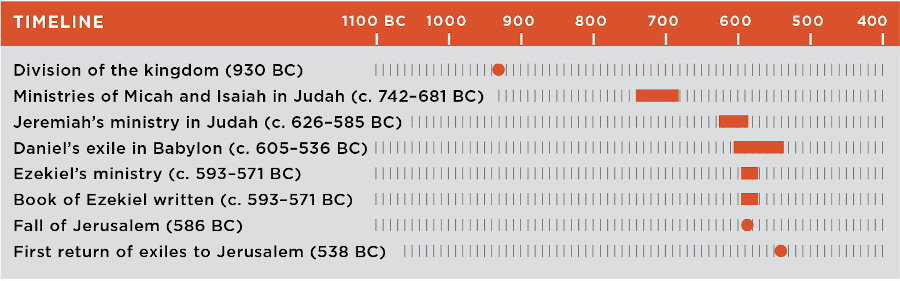
Date: Between 593 and 571 bc
Theme: God’s presence is the key to life.
Introduction
Background
Ezekiel lived during a time of international upheaval. The Assyrian Empire that had once conquered the Syro-Palestinian area and destroyed the northern kingdom of Israel (which fell to the Assyrians in 722–721 bc) began to crumble under the blows of a resurgent Babylonia. In 612 the great Assyrian city of Nineveh fell to a combined force of Babylonians and Medes. Three years later, Pharaoh Necho II of Egypt marched north to assist the Assyrians and to try to reassert Egypt’s age-old influence over Canaan and Aram (Syria). At Megiddo, King Josiah of Judah, who may have been an ally of Babylonia as King Hezekiah had been, attempted to intercept the Egyptian forces but was crushed, losing his life in the battle (see 2Ki 23:29–30 and note on 23:29; 2Ch 35:20–24).
Jehoahaz, a son of Josiah, ruled Judah for only three months, after which Necho installed Jehoiakim, another son of Josiah, as his royal vassal in Jerusalem (609 bc). In 605 the Babylonians overwhelmed the Egyptian army at Carchemish (Jer 46:2), then pressed south as far as the Philistine plain. In the same year, Nebuchadnezzar was elevated to the Babylonian throne and Jehoiakim shifted allegiance to him. When a few years later the Egyptian and Babylonian forces met in a standoff battle, Jehoiakim rebelled against his new overlord.
Nebuchadnezzar soon responded by sending a force against Jerusalem, subduing it in 597 bc. Jehoiakim’s son Jehoiachin and about 10,000 Jews (2Ki 24:14), including Ezekiel, were exiled to Babylonia, where they joined those who had been exiled in Jehoiakim’s “third year” (see Da 1:1 and note). Nebuchadnezzar placed Jehoiachin’s uncle, Zedekiah, on the throne in Jerusalem, but within five or six years he too rebelled. The Babylonians laid siege to Jerusalem in 588, and in July, 586, the walls were breached and the city plundered. On Aug. 14, 586, the city and temple were burned.
Under Nebuchadnezzar and his successors, Babylonia dominated the international scene until it was crushed by Cyrus the Great of Persia in 539 bc. The reign of the house of David came to an end; the kingdom of Judah ceased to be an independent nation; Jerusalem and the Lord’s temple lay in ruins (see Lamentations).
Author
What is known about Ezekiel is derived solely from the book that bears his name. He was among the Jews exiled to Babylonia by Nebuchadnezzar in 597 bc, and there among the exiles he received his call to become a prophet (1:1–3). He was married (but his wife died; see 24:15–18), lived in a house of his own (3:24; 8:1) and along with his fellow exiles, though confined to Babylonia, had a relatively free existence there.
He was a member of a priestly family (see note on 1:3) and therefore was eligible to serve as a priest. As a priest-prophet called to minister to the exiles (separated from the temple of the Lord with its symbolism, sacrifices, priestly ministrations and worship rituals), his message had much to do with the temple (see especially chs. 8–11; 40–48) and its ceremonies.
Ezekiel was obviously a man of broad knowledge, not only of his own national traditions but also of international affairs and history. His acquaintance with general matters of culture, from shipbuilding to literature, is equally amazing. He was gifted with a powerful intellect and was capable of grasping large issues and of dealing with them in grand and compelling images. His style is often detached, but in places it is passionate and earthy (see chs. 16; 23).
More than any other prophet (more even than Hosea and Jeremiah) he was directed to involve himself personally in the divine word by acting it out in prophetic symbolism.
Occasion, Purpose and Summary of Contents
Though Ezekiel lived with his fellow exiles in Babylonia, his divine call forced him to suppress any natural expectations he may have had of an early return to an undamaged Jerusalem. For the first seven years of his ministry (593–586 bc) he faithfully relayed to his fellow Jews the stern, heartrending, hope-crushing word of divine judgment: Because of all their sins, Jerusalem would fall (chs. 1–24). The fact that Israel was God’s covenant people and that Jerusalem was the city of his temple would not bring early release from exile or prevent Jerusalem from being destroyed (Jer 29–30). The only hope the prophet was authorized to extend to his hearers was that of living at peace with themselves and with God during their exile.
After being informed by the Lord that Jerusalem was under siege and would surely fall (24:1–14), Ezekiel was told that his beloved wife would soon die. The delight of his eyes would be taken from him, just as the Lord had decreed that the delight of his eyes, Judah, would be taken from him. Ezekiel was not to mourn openly for his wife, as a sign of the Lord’s resolve to judge his people (cf. 7:22). Ezekiel was then directed to pronounce a series of judgments on Ammon, Moab, Edom, Philistia, Tyre, Sidon and Egypt (chs. 25–32). The day of God’s wrath would soon come, but not on Israel alone.
Once news was received that Jerusalem had fallen, Ezekiel’s message turned to the Lord’s consoling word of hope for his people—they would experience revival, restoration and a glorious future as the redeemed and perfected kingdom of God in the world (chs. 33–48).
Date
 Since the book of Ezekiel contains more dates (see chart) than any other OT prophetic book, its prophecies can be dated with considerable precision. In addition, modern scholarship, using archaeology (Babylonian annals on cuneiform tablets) and astronomy (accurate dating of eclipses referred to in ancient archives), provides precise modern calendar equivalents.
Twelve of the thirteen dates specify times when Ezekiel received a divine message. The other is the date of the arrival of the messenger who reported the fall of Jerusalem (33:21).
Having received his call in July, 593 bc, Ezekiel was active for 22 years, his last dated message being received in April, 571 (29:17). Since the “thirtieth year” of 1:1 (see note there) refers to Ezekiel’s age at the time of his call, his prophetic career exceeded a normal priestly term of service by two years (Nu 4:3). His period of activity coincides with Jerusalem’s darkest hour, preceding the 586 destruction by 7 years and following it by 14.
Themes
True life is found only in the presence of God, the source of life. With graphic imagery, picturesque language, symbolic acts and powerful words, Ezekiel’s prophecies showed God’s people that the slow death they were experiencing was a natural consequence of their gradual but relentless turning away from the One who gives life.
In his visions, Ezekiel saw something alarming: God’s presence was leaving the temple (8:3–4; 9:3; 10:4, 18–19; 11:22–23). The consequences of God leaving the temple were disastrous to contemplate. When God withdraws his presence, life departs as well. Ezekiel had experienced firsthand the displacement and discouragement, the chaos and death that resulted from the lack of God’s presence. He pleaded with his people to turn back to the source of life. But they refused to listen. Without God in their midst, death, destruction and exile quickly followed. Even after the fall of Jerusalem, Ezekiel continued to prophesy. Through him God reminded his chastened people that life is found in him alone. Though they had rejected him and experienced his judgment, they could still have life in him. Though apart from him they were nothing more than dry bones (ch. 37), when they returned to him God could yet make their dry bones come to life.
Even as God’s people were experiencing the consequences of their rejection of him, their gracious and merciful God was encouraging them with prophecies of restoration to life. And that life in God’s presence is so abundant that it extends beyond simple return from exile to another, future day. In symbolic language Ezekiel describes a future place where God will dwell that would exude life. This place will teem with fish and animals, and fruit trees of all kinds will grow and produce abundant fruit. From this new place of God’s presence, described in terms of a new temple, life-giving and life-healing water would flow (47:1–12). The book ends with an emphatic statement underscoring the source of this rich life: The Lord is there (48:35). See also Theological Significance below.
Literary Features
The three Major Prophets (Isaiah, Jeremiah, Ezekiel) and Zephaniah all have the same basic sequence of messages: (1) messages against Israel, (2) messages against the nations, (3) consolation for Israel. In no other book is this pattern clearer than in Ezekiel (see Outline).
Besides clarity of structure, the book of Ezekiel reveals symmetry. The vision of the desecrated temple fit for destruction (chs. 8–11) is balanced by the vision of the restored and purified temple (chs. 40–48). The God presented in agitated wrath (ch. 1) is also shown to be a God of comfort (“THE LORD IS THERE,” 48:35). Ezekiel’s call to be a watchman announcing divine judgment (ch. 3) is balanced by his call to be a watchman announcing the new age to follow (ch. 33). In one place (ch. 6) the mountains of Israel receive a prophetic rebuke, but in another (ch. 36) they are consoled.
Prophetic books are usually largely poetic, the prophets apparently having spoken in imaginative and rhythmic styles. Most of Ezekiel, however, is prose, perhaps due to his priestly background. His repetitions have an unforgettable hammering effect, and his priestly orientation is also reflected in a case-law type of sentence (compare 3:19, “If you do warn the wicked . . . ,” with Ex 21:2, “If you buy a Hebrew servant . . .”).
The book contains four major visions (chs. 1–3; 8–11; 37:1–14; 40–48) and 12 symbolic acts (3:22–26; 4:1–3; 4:4–8; 4:9–11; 4:12–14; 5:1–3; 12:1–16; 12:17–20; 21:6–7; 21:18–24; 24:15–24; 37:15–28). Five messages are in the form of parables (chs. 15; 16; 17; 19; 23).
Theological Significance
Other prophets deal largely with Israel’s idolatry, with their moral corruption in public and private affairs and with their international intrigues and alliances, upon which they relied instead of on the Lord. These prophets announce God’s impending judgment on his rebellious nation but speak also of a future redemption: a new exodus, a new covenant, a restored Jerusalem, a revived Davidic dynasty, a worldwide recognition of the Lord and his Messiah and a paradise-like peace.
The contours and sweep of Ezekiel’s message are similar, but he focuses uniquely on Israel as the holy people of the holy temple, the holy city and the holy land. By defiling its worship, Israel had rendered itself unclean and had defiled temple, city and land. From such defilement God could only withdraw and judge his people with national destruction.
But God’s faithfulness to his covenant and his desire to save were so great that he would revive his people once more, shepherd them with compassion, cleanse them of all their defilement, reconstitute them as a perfect expression of his kingdom under the hand of “David” (34:23–24), overwhelm all the forces and powers arrayed against them, display his glory among the nations and restore the glory of his presence to the holy city.
Ezekiel powerfully depicts the grandeur and glory of God’s life-giving presence (see Themes) and his holiness, which he jealously safeguards. The book’s theological center is the life associated with God’s presence and the death associated with its withdrawal. This central theological focus is evident from the time in which God must withdraw from the defilement of his covenant people to the culmination of his grand design of redemption. The message of Ezekiel, which is ultimately eschatological, anticipates—even demands—the life-giving presence of God in Jesus Christ, revealed and proclaimed by the NT.
Ezekiel powerfully depicts the grandeur and glory of God’s life-giving presence and his holiness. The book’s theological center is the life associated with God’s presence and the death associated with its withdrawal.
Outline
I. Messages of Judgment Against Israel (chs. 1–24)
A. Ezekiel’s Inaugural Vision (chs. 1–3)
1. Overwhelming display of the glory of the Lord (ch. 1)
2. Ezekiel’s call to be a prophet (2:1—3:15)
3. Ezekiel’s call as watchman (3:16–21)
4. Restraints on Ezekiel’s prophetic ministry (3:22–27)
B. Symbolic Acts Portraying the Siege of Jerusalem (chs. 4–5)
1. Ezekiel’s symbolic siege of Jerusalem (ch. 4)
2. God’s razor of judgment at work (ch. 5)
C. Messages of Divine Judgment (chs. 6–7)
1. Doom for the mountains of Israel (ch. 6)
2. The end has come on the land (ch. 7)
D. Corruption of the Temple and Its Consequences (chs. 8–11)
1. Idolatry in the temple (ch. 8)
2. Judgment on the idolaters (ch. 9)
3. God’s glory departs from the temple (ch. 10)
4. God’s sure judgment on Jerusalem (11:1–14)
5. Those in exile to be restored (11:15–21)
6. Conclusion (11:22–25)
E. Ezekiel Symbolizes the Exile of Jerusalem (ch. 12)
1. An exile’s baggage (12:1–16)
2. Anxious eating (12:17–20)
3. The imminence of judgment (12:21–28)
F. Messages Concerning God’s Judgment on Judah (chs. 13–24)
1. False prophecy condemned (chs. 13–14)
a. Condemnation of the false prophets (ch. 13)
b. Condemnation of the idolaters (14:1–11)
c. No mediators can turn back God’s judgment (14:12–23)
2. Imagery for Israel under judgment (chs. 15–19)
a. Jerusalem compared to a piece of burnt vine (ch. 15)
b. Jerusalem allegorized as an adulterous wife (ch. 16)
c. Allegory of two eagles and a vine (ch. 17)
d. The one who sins will die (ch. 18)
e. Lament over the fall of Jerusalem’s kings (ch. 19)
3. Final days for Judah (chs. 20–24)
a. Apostate Israel purged and renewed through judgment (20:1–44)
b. Babylonia, God’s sword of judgment (20:45—21:32)
c. The sins for which Jerusalem is judged (ch. 22)
d. Jerusalem and Samaria allegorized as adulterous sisters (ch. 23)
e. Jerusalem cooked over the fire (24:1–14)
f. The death of Ezekiel’s wife symbolizes Jerusalem’s fall (24:15–27)
II. Messages of Judgment Against the Nations (chs. 25–32)
A. A Prophecy Against Ammon (25:1–7)
B. A Prophecy Against Moab (25:8–11)
C. A Prophecy Against Edom (25:12–14)
D. A Prophecy Against Philistia (25:15–17)
E. A Prophecy Against Tyre (26:1—28:19)
1. Tyre’s destruction announced (ch. 26)
2. A lament over Tyre (ch. 27)
3. A prophecy against the king of Tyre (28:1–19)
F. A Prophecy Against Sidon (28:20–26)
1. Punishment for Sidon (28:20–24)
2. Restoration for Israel (28:25–26)
G. A Prophecy Against Egypt (chs. 29–32)
1. Egypt a doomed monster (29:1–16)
2. Egypt a payment to Nebuchadnezzar (29:17–21)
3. Laments over Egypt (30:1–19)
4. The pharaoh’s arms are broken (30:20–26)
5. The pharaoh a felled Lebanon cedar (ch. 31)
6. Lament over the pharaoh (32:1–16)
7. The pharaoh consigned to the realm of the dead (32:17–32)
III. Messages of Consolation for Israel (chs. 33–48)
A. Renewal of Ezekiel’s Call as Watchman (33:1–20)
B. Jerusalem’s Fall Reported and Its Remnant Condemned (33:21–33)
C. The Lord to Be Israel’s Shepherd (ch. 34)
D. A Prophecy Against Edom (ch. 35)
E. Israel’s Complete Restoration Announced (ch. 36)
F. Israel’s Dry Bones Revived and Unity Restored (ch. 37)
1. Israel’s dry bones restored to life (37:1–14)
2. Again one nation under one King (37:15–28)
G. The Great Battle of the Ages (chs. 38–39)
H. The New Order for Purified Israel (chs. 40–48)
1. The temple area restored (40:1–47)
2. The new temple (40:48—42:20)
3. God’s glory returns to the temple (43:1–12)
4. Restoration of the altar of burnt offering (43:13–27)
5. Restoration of the priesthood (ch. 44)
6. Restoration of the theocratic order (chs. 45–46)
7. The river of life from the temple (47:1–12)
8. The boundaries of the land (47:13–23)
9. The distribution of the land (48:1–29)
10. The twelve gates of the new city (48:30–35)

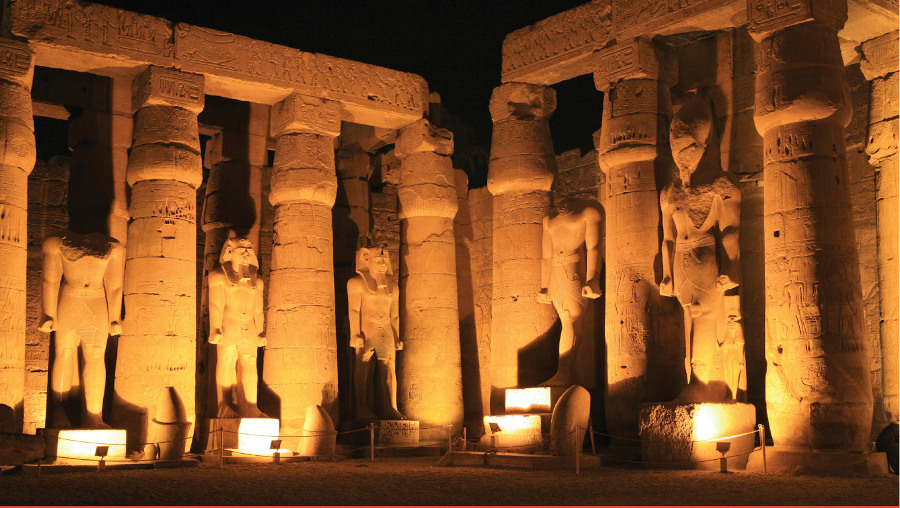
Luxor Temple at Thebes, Egypt. Ezekiel 30:14 predicts the destruction of Thebes by Nebuchadnezzar.
© iStock.com/WorldWideImages
Dates in Ezekiel
Reference | Year | Month | Day | Modern Reckoning | Event |
1. 1:1 | 30 5 “At the end of seven days” | 4 — | 5 5 | July 31, 593 bc | Inaugural vision |
2. 8:1 | 6 | 6 | 5 | Sept. 17, 592 | Transport to Jerusalem |
3. 20:1–2 | 7 | 5 | 10 | Aug. 14, 591 | Negative view of Israel’s history |
4. 24:1 | 9 | 10 | 10 | Jan. 15, 588 | Beginning of siege (see also 2Ki 25:1) |
5. 26:1 | 11 | — | 1 | Apr. 23, 587 to Apr. 13, 586 | Prophecy against Tyre (see note on 26:1) |
6. 29:1 | 10 | 10 | 12 | Jan. 7, 587 | Prophecy against Egypt |
7. 29:17 | 27 | 1 | 1 | Apr. 26, 571 | Egypt in exchange for Tyre |
8. 30:20 | 11 | 1 | 7 | Apr. 29, 587 | Prophecy against Pharaoh |
9. 31:1 | 11 | 3 | 1 | June 21, 587 | Prophecy against Pharaoh |
10. 32:1 | 12 | 12 | 1 | Mar. 3, 585 | Lament over Pharaoh |
11. 32:17 | 12 | — | 15 | Apr. 13, 586 to Apr. 1, 585 | Egypt dead |
12. 33:21 | 12 | 10 | 5 | Jan. 8, 585 | Arrival of first fugitive |
13. 40:1 | 25 | 1 | 10 | Apr. 28, 573 | Vision of the future |
“fourteenth year after the fall of the city” |
Go to the Charts Index.