
The Time Between the Testaments
The time between the Testaments was one of ferment and change—a time of the realignment of traditional power blocs and the passing of a Near Eastern cultural tradition that had been dominant for almost 3,000 years.
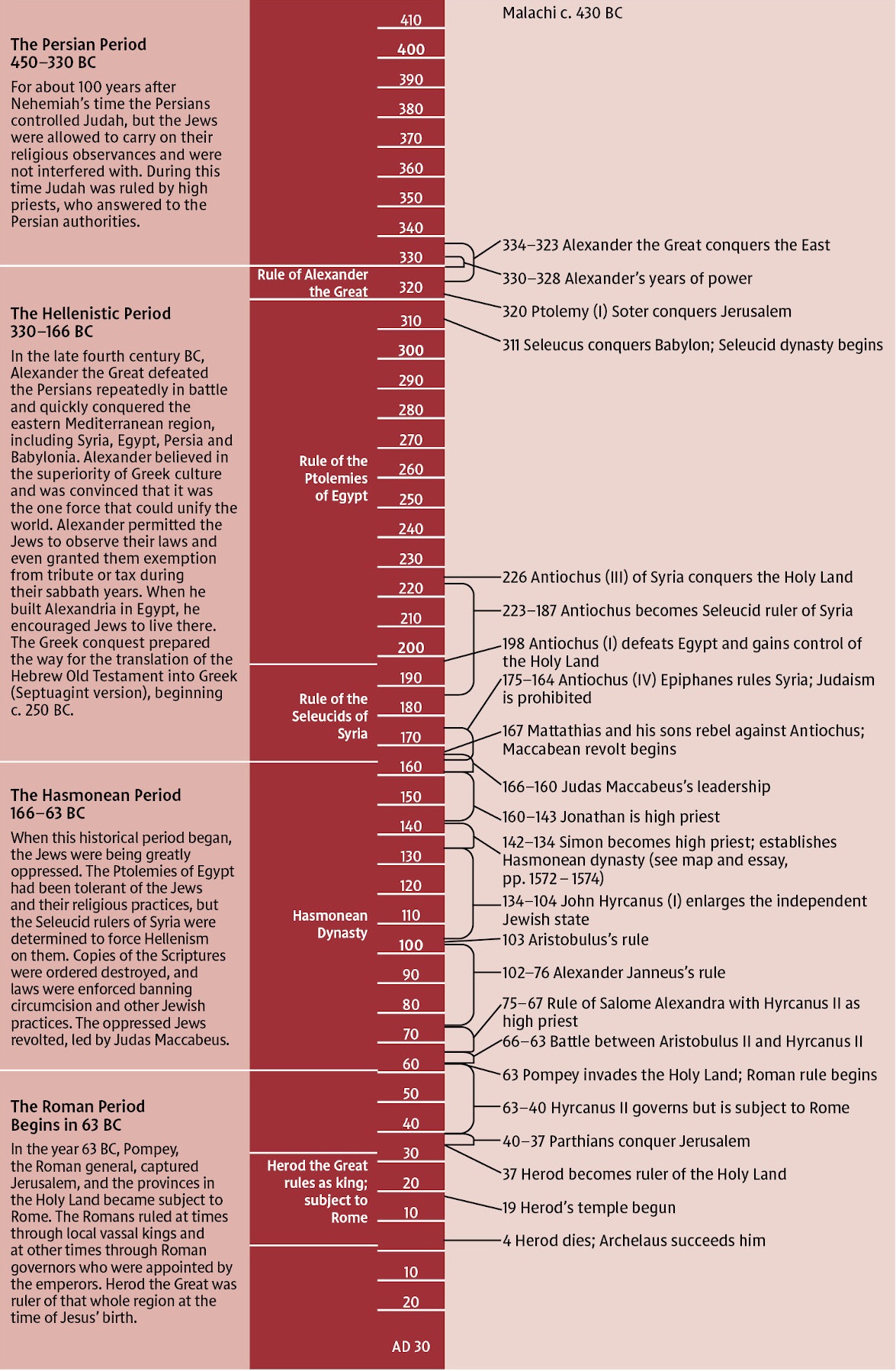
In biblical history, the approximately 400 years that separate the time of Nehemiah from the birth of Christ are known as the intertestamental period (c. 430–5 bc). Sometimes called the “silent” years because of the absence of prophetic revelation, they were anything but silent in terms of historical significance and cultural change. The events, literature and social forces of these years would shape the world of the NT.
History
With the Babylonian exile, Israel ceased to be an independent nation and became a minor territory in a succession of larger empires. Very little is known about the latter years of Persian domination because the Jewish historian Josephus (c. ad 37–100), our primary source for the intertestamental period, all but ignores them.
With Alexander the Great’s acquisition of the Holy Land (332 bc), a new and more insidious threat to Israel emerged. Alexander was committed to the creation of a world united by Greek language and culture, a policy followed by his successors. This policy, called Hellenization, had a dramatic impact on the Jews.
At Alexander’s death (323 bc) the empire he won was divided among his generals. Two of them founded dynasties—the Ptolemies of Egypt and the Seleucids in Syria and Mesopotamia—that would contend for control of the Holy Land for over a century.
The rule of the Ptolemies was considerate of Jewish religious sensitivities, but in 198 bc the Seleucids took control and paved the way for one of the most heroic periods in Jewish history.
The early Seleucid years gradually moved away from the tolerant practices of the Ptolemies, culminating in the intolerance of Antiochus IV Epiphanes (whose title means “God made manifest” and who ruled 175–164 bc), who attempted to consolidate his fading empire through a policy of radical Hellenization. While a segment of the Jewish aristocracy had already adopted Greek ways, many Jews were outraged.
Antiochus’s atrocities were aimed at the eradication of Jewish religion. He prohibited some of the central elements of Jewish practice, attempted to destroy all copies of the Torah (the Pentateuch) and required offerings to the Greek god Zeus. His crowning outrage was the erection of a statue of Zeus and the sacrificing of a pig in the Jerusalem temple itself.
Opposition to Antiochus was led by Mattathias, an elderly villager from a priestly family, and his five sons: Judas (called “Maccabeus”—probably meaning “hammerer”), Jonathan, Simon, John and Eleazar. Mattathias destroyed a Greek altar established in his village, Modein, and killed Antiochus’s emissary. This triggered the Maccabean revolt, a 24-year war (166–142 bc) that resulted in the independence of Judah until the Romans took control in 63 bc. The decisive event in Jewish memory was the reclaiming and purification of the temple in 165 bc (exactly three years after its desecration), which led to an annual festival mentioned in the NT as the Feast of Dedication (Jn 10:22) and still celebrated today as Hanukkah (“Dedication”).
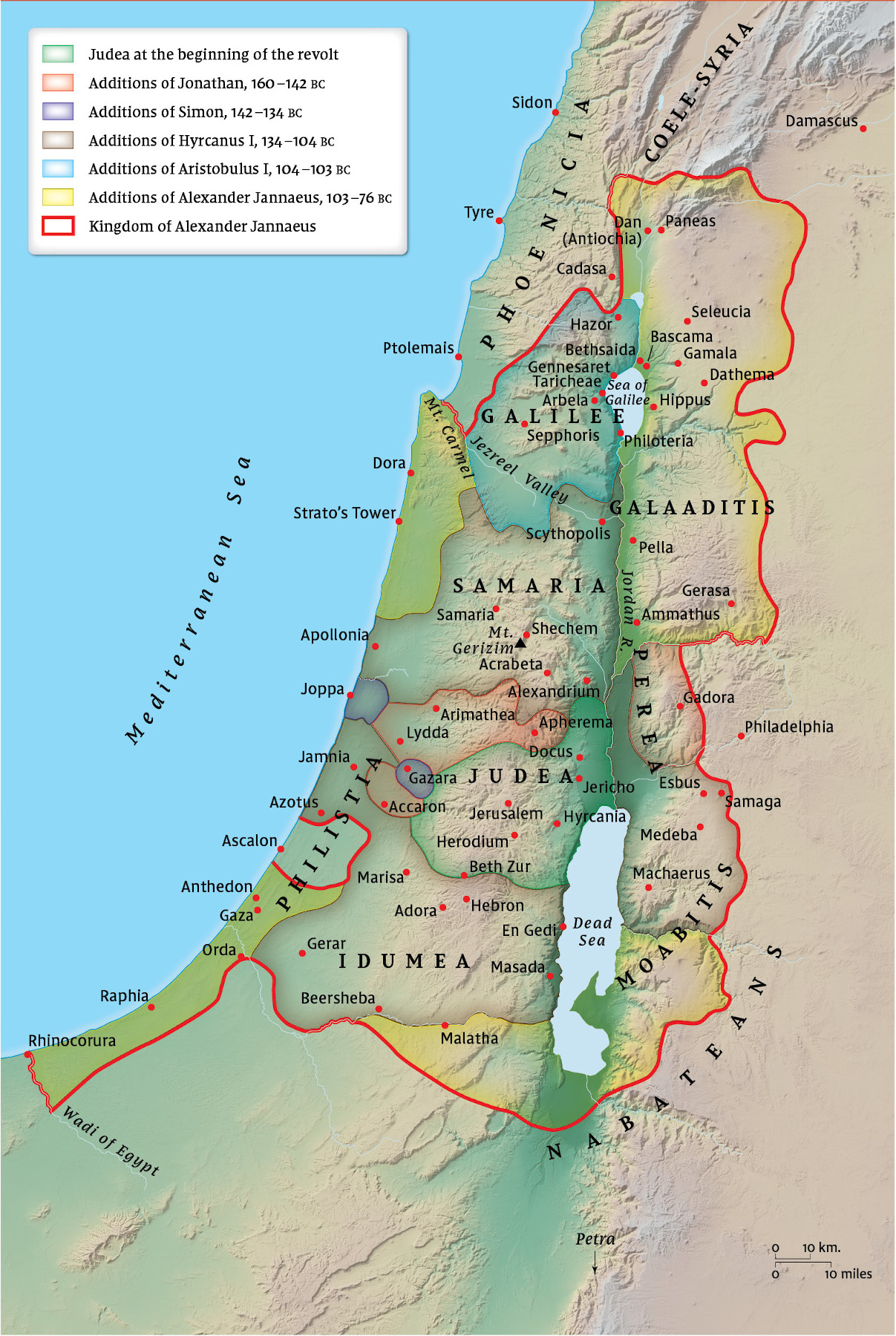
The victory of Mattathias’s family was a hollow one, however. With the death of his last son, Simon, the Hasmonean dynasty they founded soon evolved into an aristocratic, Hellenistic regime sometimes hard to distinguish from that of the Seleucids. During the reign of Simon’s son, John Hyrcanus, the orthodox Jews who had supported the Maccabees fell out of favor. With only a few exceptions, the rest of the Hasmoneans supported the Jewish Hellenizers. The Pharisees were actually persecuted by Alexander Jannaeus (103–76 bc).
The Hasmonean dynasty ended when, in 63 bc, an expanding Roman Empire intervened in a dynastic clash between the two sons of Jannaeus, Aristobulus II and Hyrcanus II. Pompey, the general who subdued the East for Rome, took Jerusalem after a three-month siege of the temple area, massacring priests in the performance of their duties and entering the Most Holy Place. This sacrilege began Roman rule in a way that Jews could neither forgive nor forget.
Literature
During these unhappy years of oppression and internal strife, the Jewish people produced a sizable body of literature that both recorded and addressed their era. Three of the more significant literary collections are the Septuagint, the Apocrypha and the Dead Sea Scrolls.
Septuagint. Jewish tradition says that 72 scholars, under the sponsorship of Ptolemy Philadelphus (c. 250 bc), were brought together on the island of Pharos, near Alexandria, where they produced a Greek translation of the OT in 72 days. From this tradition the Latin word for 70, “Septuagint,” became the name attached to the translation. The Roman numeral for 70, LXX, is used as an abbreviation for it.
Behind that tradition lies the probability that at least the Torah (the five books of Moses) was translated into Greek c. 250 bc for the use of the Greek-speaking Jews of Alexandria. The rest of the OT and some noncanonical books were also included in the LXX before the dawning of the Christian era.
The Septuagint quickly became the Bible of the Jews outside the Holy Land who, like the Alexandrians, no longer spoke Hebrew. It would be difficult to overestimate its influence. It made the Scriptures available both to the Jews who no longer spoke their ancestral language and to the entire Greek-speaking world. It later became the Bible of the early church. Also, its widespread popularity and use contributed to the retention of the Apocrypha by some branches of Christendom.
Apocrypha. Derived from a Greek word that means “hidden,” Apocrypha has acquired the meaning “false,” but in a technical sense it describes a specific body of writings. This collection consists of a variety of books and additions to canonical books that, with the exception of 2 Esdras (c. ad 90), were written during the intertestamental period. They include historical narratives, novels, psalms, proverbs, prayers, apocalyptic literature and even a short epistle. Their recognition as authoritative in Roman and Eastern Christianity is the result of a complex historical process.
The limits of the Hebrew canon of the OT, also accepted by most Protestants today, were very likely established by the dawn of the second century ad. In spite of disagreements among some of the church fathers as to which books were canonical and which were not, the Apocryphal books (which were included in the Septuagint) continued in common use by most Christians until the Reformation. During this period most Protestants decided to follow the original Hebrew canon, while Rome, at the Council of Trent (1546), and more recently at the First Vatican Council (1869–1870), affirmed the larger “Alexandrian” canon that includes the Apocrypha.
The Apocryphal books have retained their place primarily through the weight of ecclesiastical authority, without which they would not commend themselves as canonical literature. There is no evidence that Jesus or the apostles ever quoted any Apocryphal works as inspired Scripture. The Jewish community that produced them did not consider them canonical, and the historical surveys in the apostolic sermons recorded in Acts completely ignore the period they cover.
There is little of theological value in the Apocryphal books that cannot be found in canonical Scripture. Nonetheless, this body of literature does provide a valuable source of information for the study of the intertestamental period.
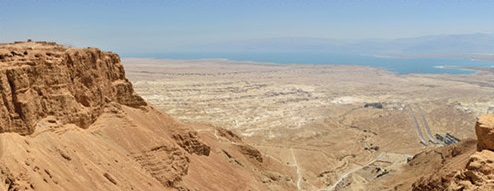
 Dead Sea Scrolls. In the spring of 1947 Arab shepherds chanced upon a cave in the hills overlooking the southwestern shore of the Dead Sea that contained what has been called the greatest manuscript discovery of modern times. The documents and fragments of documents found in a group of such caves, dubbed the “Dead Sea Scrolls,” included OT books, a few books of the Apocrypha, apocalyptic works, pseudepigrapha (books that purport to be the work of ancient heroes of the faith) and a number of books peculiar to the sect that produced them.
Approximately a third of the documents are biblical, with Psalms, Deuteronomy and Isaiah—the books quoted most often in the NT—occurring most frequently. One of the most remarkable finds was a complete, 24-foot-long scroll of Isaiah (see photo).
The Scrolls have made a significant contribution to the quest for a form of the OT texts most accurately reflecting the original manuscripts; they provide copies more than 1,000 years closer to the time of originals than were previously known. The understanding of biblical Hebrew and Aramaic and knowledge of the development of Judaism between the Testaments have been increased significantly. Of great importance to readers of the Bible is the demonstration of the care with which many of the OT texts were copied, thus providing objective evidence for the extraordinary preservation of those texts.
Social Developments
The Judaism of Jesus’ day was, to a large extent, the result of changes that came about in response to the pressures of the intertestamental period.
Diaspora. The Diaspora (dispersion) of Israel, begun in the exile, accelerated during these years until a writer of the day could say that Jews filled every land and sea.
Jews outside the Holy Land, cut off from the temple, concentrated their religious life in the study of the Torah and the life of the synagogue (see below). The missionaries of the early church began their Gentile ministries within the Diaspora, using the Greek translation of the OT (the Septuagint).
Sadducees. In the Holy Land, the Greek world made its greatest impact through the party of the Sadducees. Made up primarily of aristocrats and priests, they held a majority on the Sanhedrin and exerted great influence in temple affairs. Because of their position, the Sadducees had a vested interest in the status quo.
Relatively few in number, they wielded disproportionate political power and controlled the high priesthood. They rejected the ultimate authority of all religious writings except the Torah, and therefore any doctrine (such as resurrection from the dead) not found in those five books.
Synagogue. During the Babylonian exile, Israel was cut off from the temple, divested of nationhood and surrounded by pagan religious practices. The nation’s faith was threatened. Under these circumstances, the exiles turned their religious focus from what they had lost to what they retained—the Torah and the belief that they were God’s people. They concentrated on the law rather than nationhood, on personal piety rather than sacramental rectitude and on prayer as an acceptable replacement for the sacrifices denied to them.
When they returned from the exile, they brought with them this new form of religious expression, as well as the synagogue (its center), and Judaism became a faith that could be practiced wherever the Torah could be carried. The emphases on personal piety and a relationship with God, which characterized synagogue worship, not only helped preserve Judaism but also prepared the way for the Christian gospel.
Pharisees. Pharisees strove to reinterpret the law, and their center of influence was the synagogue. They built a “hedge” around the law—expanding upon its requirements to help people apply it in a world that had changed drastically since the days of Moses. Although they were comparatively few in number, the Pharisees enjoyed the support of the people and influenced popular opinion as well as national policy. They were the only party to survive the destruction of the temple in ad 70 and were the spiritual progenitors of rabbinic Judaism.
Essenes. An almost forgotten Jewish sect (but referred to by Philo and Josephus) until the discovery of the Dead Sea Scrolls, the Essenes were a small, separatist group that grew out of the conflicts of the Maccabean age. Like the Pharisees, they stressed strict legal observance, but they considered the temple priesthood corrupt and rejected much of the temple ritual and sacrificial system. Though they are mentioned by several ancient writers, the precise nature of the Essenes is still not certain, though it is widely held that the Qumran community that produced the Dead Sea Scrolls was probably an Essene group.
Because they were convinced that they were the true remnant of Israel, these Qumran sectarians had separated themselves from Judaism at large and devoted themselves to personal purity and preparation for the final war between the “Sons of Light and the Sons of Darkness.” They practiced an apocalyptic faith, looking back to the contributions of their previous leader, known as “Teacher of Righteousness,” and forward to the coming of two Messiahs: a priestly one from the line of Aaron and a royal one from the line of David. In the Jewish War of ad 66–73, the community at Qumran was destroyed, and the Essenes dropped from history.
Attempts have been made to equate aspects of the beliefs of the Qumran community with the origins of Christianity. Some have seen a prototype of Jesus in their “Teacher of Righteousness,” and John the Baptist’s apocalyptic message and desert lifestyle have parallels with those at Qumran. Most of these parallels, however, are superficial, and there is no hard evidence of direct contact between either Jesus or John and the Qumran community (see photos).
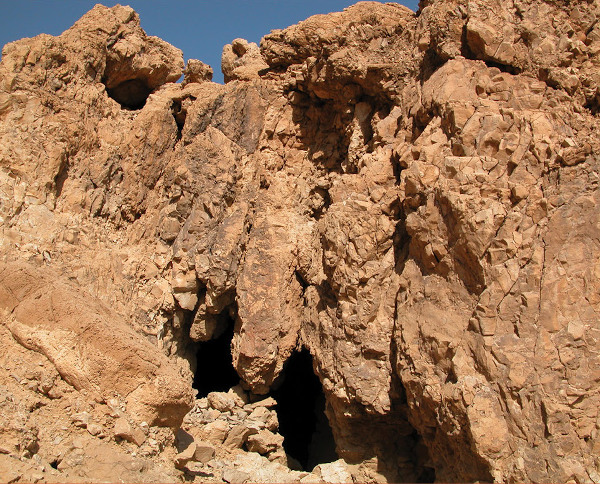
Qumran Cave 1
Todd Bolen/BiblePlaces.com
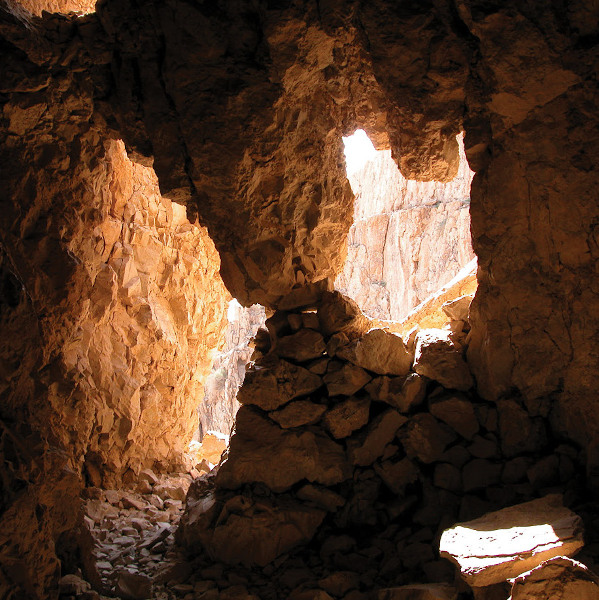
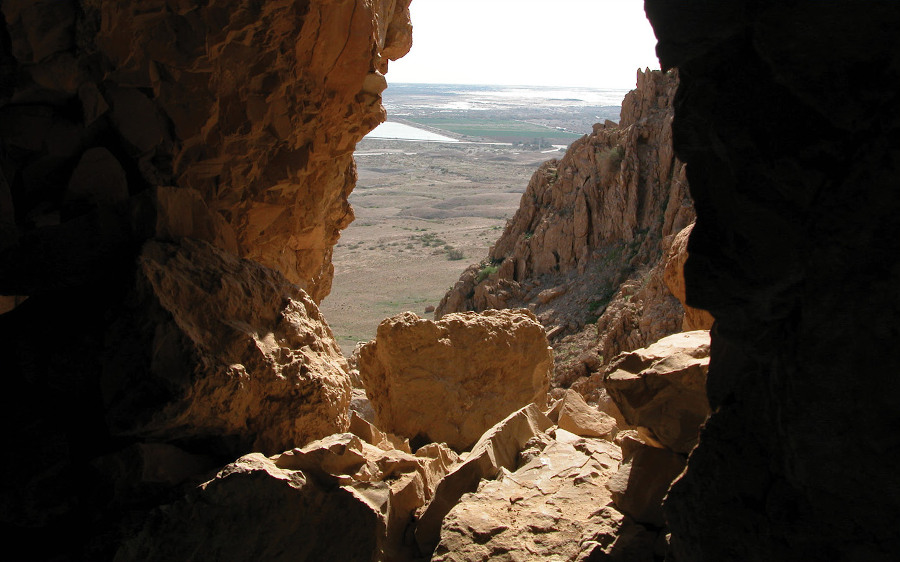
Qumran Cave 1 was discovered in 1947, the first of eleven caves near Qumran in which the Dead Sea Scrolls were found. In this cave were seven scrolls: the Manual of Discipline, War of the Sons of Light and the Sons of Darkness, Thanksgiving Scroll, Isaiah A, Isaiah B, Genesis Apocryphon, and Habakkuk Commentary. This view (above) from the interior of Cave 1 shows the proximity of Qumran to the Dead Sea, which can be seen in the distance.
Todd Bolen/BiblePlaces.com
Go to the Articles Index.
Foreign Domination of Israel (722 bc–ad 135)
Old Testament Period | The Assyrian Empire (722–605 bc) |
The Babylonian Empire (605–539 bc) | |
The Persian Empire (539–334 bc) | |
Intertestamental Period | The Macedonian-Greek Empire (334–166 bc) • Alexander the Great (334–323 bc) • Ptolemaic Domination (323–198 bc) • Seleucid Domination (198–166 bc) |
Jewish Independence (166–63 bc) • The Maccabees • The Hasmonean Dynasty | |
New Testament Period | The Roman Empire (63 bc–ad 135) • The Herodian Dynasty • Roman Governors • Destruction of Jerusalem (ad 70) • Second Revolt Ends the Jewish State (ad 135) |
Adapted from Four Portraits, One Jesus by Mark L. Strauss, p. 95. Copyright © 2007 by Mark L. Strauss. Used by permission of Zondervan.
Go to the Charts Index.
The Maccabean-Hasmonean Period
Seleucid Kings | Jewish Leaders | Ptolemaic Kings | |||
Seleucus I (Nicator) | 321–281 | Ptolemy I (Soter) | 323–285 | ||
Antiochus I (Soter) | 281–261 | ||||
Antiochus II (Theos) | 261–246 | Ptolemy II (Philadelphus) | 285–246 | ||
Seleucus II (Callinicus) | 246–225 | Ptolemy III (Euergetes) | 246–222 | ||
Seleucus III (Soter) | 225–223 | Ptolemy IV (Philopator) | 221–205 | ||
Antiochus III (the Great) | 223–187 | Ptolemy V (Epiphanes) | 204–180 | ||
Seleucus IV (Philopator) | 187–175 | Ptolemy VI (Philometor) | 180–145 | ||
Antiochus IV (Epiphanes) | 175–163 | Mattathias Judas | 166 166–160 | ||
Antiochus V (Eupator) | 163–162 | ||||
Demetrius I (Soter) | 162–150 | Jonathan | 160–143 | ||
Alexander Balas | 150–145 | Ptolemy VII (Neos Philopator) | 145 | ||
Demetrius II (Nicator) | 145–139 | Simon | 143–135 | Ptolemy VII (Neos Philopator) | 145 |
(Antiochus VI [Epiphanes Dionysus]) | 145–142 | Ptolemy VIII (Euergetes II or Physcon) | 145–116 | ||
Antiochus VII (Sidetes) | 139–129 | John Hyrcanus I | 135–104 | ||
Demetrius II (Nicator) | 129–125 | ||||
Antiochus VIII (Grypus) | 125/4–113 | Ptolemy IX (Soter II or Lathyrus) | 116–110 | ||
Antiochus IX (Philopator Cyzicenus) | 113–111 | ||||
Antiochus VIII (Grypus) | 111–95 | Aristobulus | 104–103 | Ptolemy X (Alexander) | 110–109 108–88 |
Seleucus VI | 95–54 | Alexander Jannaeus | 103–76 | ||
Antiochus X (Eusebes) | 94–83 | Ptolemy IX (Soter II or Lathyrus) | 88–80 | ||
Tigranes, King of Armenia | 83–69 | Salome Alexandra | 76–67 | Ptolemy XI (Alexander II) 80 (20 days) | |
Ptolemy XII (Philopator Philadelphus Neos Dionysus or Auletes) | 80–51 | ||||
Antiochus XIII (Asiaticus) | 69–65 | Hyrcanus II Aristobulus | 67 (3 months) 67–63 | Cleopatra VII | 51–30 |
Taken from The Zondervan Encyclopedia of the Bible: Vol. 4 by Moisés Silva, p. 13. Copyright © 2009 by Zondervan.
Go to the Charts Index.