Job
Book Outline
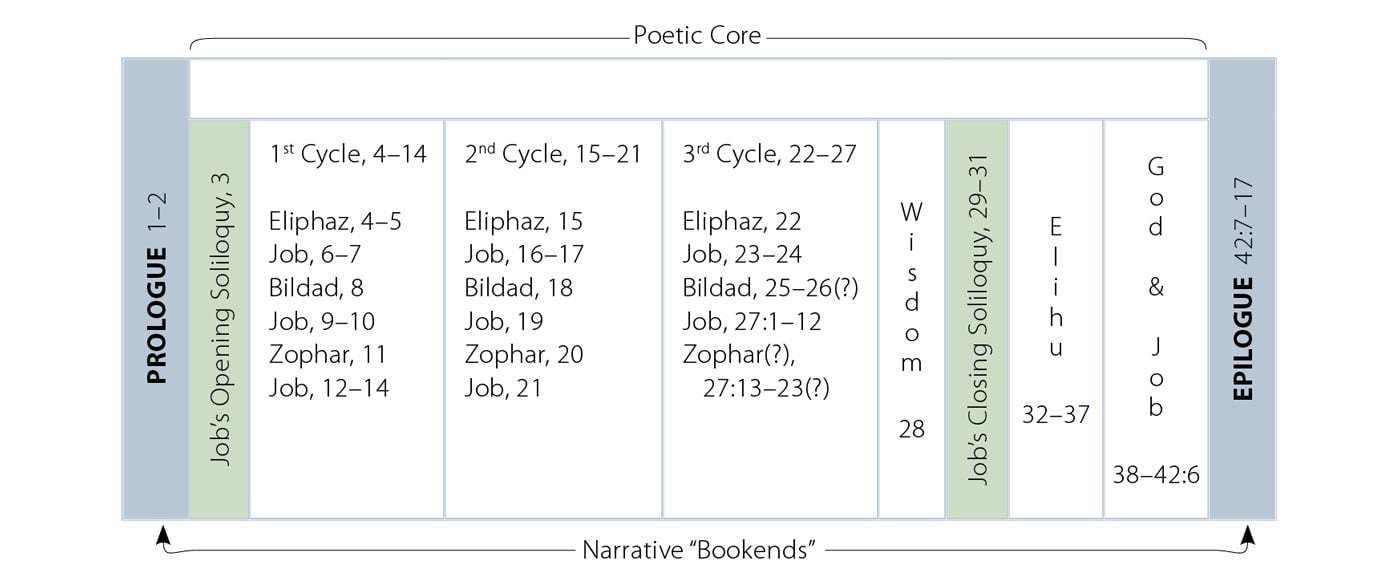
Commentary Outline
1. Prologue and Epilogue (1:1–2:13; 42:7–17)
2. Job’s Opening Soliloquy (3:1–26)
3. Three Cycles of Dialogue (4:1–14:22; 15:1–21:34; 22:1–27:23)
A. Eliphaz’s Words (4–5; 15; 22)
B. Bildad’s Words (8; 18; 25–26)
C. Zophar’s Words (11; 20; 27:13–23?)
D. Job’s Words (6–7; 9–10; 12–14; 16–17; 19; 21; 23–24; 27:1–12)
4. Wisdom: Where Is It? (28:1–28)
5. Job’s Closing Soliloquy (29:1–31:40)
7. God’s Speeches (38:1–41:34) with Job’s Responses (40:3–5; 42:1–6)
Introduction
On the surface, the book of Job is a simple story: Job, a pious man, is struck down in the prime of life. He and his friends strive to understand the reasons for his calamities. God appears and Job is restored.
Dig deeper, though, and one quickly understands why this book commands the attention it does among scholars, clerics, and interested readers. Crosscurrents, complexities, ambiguities, and contradictions play out. It soothes and it frustrates. Sitting squarely within the biblical corpus of wisdom literature, the book is, in part, a counterpoint to the theology of piety and sin developed in Proverbs, represented in the words of Job’s friends. We encounter biblical point/counterpoint in substantive fashion.
We enter now into the world of Job, the literary work and the character. Here in the introduction, the path ahead is first to recognize that literature like Job had company. We will then consider the book’s interpretive hurdles, and, in light of some of those hurdles, consider how one may make sense of the final form we encounter in the Bible.

Mesopotamian Parallels
We should not be surprised to encounter Job-like literature outside of Job. Suffering is universal, and contemplating unexpected suffering in the face of believing that one has faithfully lived out the will of a deity is clearly Mesopotamian. Though Job shares similarities with some Mesopotamian literature, comparisons to the entirety of Job do not stand.
An important characteristic blossoms when one looks at the dialogues in Job and the Mesopotamian parallels. Sophistication and high literary art are seemingly found within an author’s ability to revisit and to recraft a point into many elaborations, much like musical variations on a theme. Yes, there is development, to be sure, but repetition lies at the core.
Sumerian. “Man and His God,” or “Sumerian Job” (COS 1.179:573–75), is the earliest Mesopotamian example to explore social and physical suffering among the pious. The demons Namtar and Asag play a role in the suffering of a virile young man. Only after the man affirms that “never has a sinless child been born to its mother” (line 104), and at the city gate publicly declares his sins (line 115), does he receive restitution. Accepting this sufferer’s prayer, the god fully restores him “to joy” and protects him with guardian spirits. Sumerian Job, in the end, then, embraces a traditional or orthodox understanding of retributive theology (that the good prosper and the wicked are punished). This tale lacks dialogue, so robustly used within biblical Job, telling its story through monologue and the narrator’s voice. Unlike biblical Job, this tale offers no challenge to traditional retributive theology.
Akkadian. “Dialogue between a Man and His God” (COS 1.151:485) is the earliest known Akkadian exploration of human suffering, coming from the Old Babylonian period, circa 1800–1600 BC. Its fragmentary nature shrouds our understanding, but it clearly explores a man suffering illness who is eventually restored by divine favor.
From the Kassite period, circa 1600–1200 BC, comes the “Poem of the Righteous Sufferer,” known also from the words of the opening line as Ludlul bel nemeqi (“I Will Praise the Lord of Wisdom”) (COS 1.153:486–92). Throughout the poem, we hear in monologue the voice of the sufferer, Shubshi-meshre-Shakkan, a prosperous gentleman. The opening line is truly apropos. Praise opens and closes his tale, and nothing undermines genuine adoration. Shubshi-meshre-Shakkan loses status, respect, and his wealth. His body, racked with pain, wastes away from debilitating disease and acute affliction. His calamity is punishment from the god Marduk, who later restores him fully. A story line of praise-calamity-restoration-praise does not include the rhetoric of protesting innocence found in Job.

The Babylonian “Poem of the Righteous Sufferer” (also called Ludlul bel nemeqi) from the library of Ashurbanipal (seventh century BC)
“A Sufferer’s Salvation” (COS 1.152:486) is a fragmentary Akkadian text (Ras Shamra 25.460) that comes from the city-state of Ugarit, near the shores of the Mediterranean in Syria, in the Late Bronze Age (ca. 1550–1200 BC). In a similar vein to the “Poem of the Righteous Sufferer” (or, Ludlul bel nemeqi), a protagonist—a single voice—is afflicted, then brought back from the brink of death by Marduk, a cause for grateful praise: “I praise, I praise, what the lord Marduk has done. . . . He thrust me away, then gathered me in, He threw me down, then lifted me high” (lines 29, 38–39).
The Babylonian Theodicy (COS 1.154:492–95), a text from circa 1100–1000 BC with a later Seleucid-era (after 300 BC) commentary found in Sippar, near Babylon, is usually regarded as the closest parallel to Job’s poetic core (3:1–42:6). In form, the Babylonian Theodicy is a dialogue between one sufferer and one friend. The sufferer shuns established understanding, rejecting the idea that god rewards the good and punishes the transgressor. The sufferer’s own life verifies his claim. From youth, “with prayer and supplication” he pursued the will of god, yet he suffers. The friend resolutely affirms the long-standing tradition the sufferer shuns. In content, Job (particularly chapters 3–27) and the Babylonian Theodicy share similar rhetoric, yet on the whole they are really quite dissimilar. Most agree that the Theodicy and Job share little beyond a common intellectual pursuit scholars call Wisdom tradition, known among their respective societies.
Date
To speak of a date for a book within the Hebrew Bible is not without complexity. First, by date, does one mean the origin of a story? Or does one mean the date of a book’s final composition—that is, the form that draws from, compiles, or edits earlier oral or written stages and is preserved, essentially, in extant manuscripts like the Dead Sea Scrolls or Masoretic Text?
Stories can be fluid. At any one cross section in time, they may have different versions, diverse storytellings. Further, as they travel down through time, they may change, embracing different details. One sees such difference clearly within the pages of the Christian canon. (1) Second Timothy 3:8 names the Egyptian magicians who combat Moses: “Just as Jannes and Jambres opposed Moses . . .” Nowhere, though, does the Hebrew Bible mention these names. The magicians are anonymous (Exod. 7:11, 22). The Damascus Document, however, mentions “Jannes and his brother” rising up against Moses (5:17–19), and Targum Pseudo-Jonathan cites both names (Exod. 1:15). (2) Jude matter-of-factly talks about a dispute between Michael and the devil over Moses’s body (Jude 9). You will read no such detail in the Hebrew Bible, but the dispute is attested in later literature, including Clement of Alexandria (Fragments on the Epistle of Jude), Origen (On First Principles 3.2.1), and Pseudo-Oecumenius at Jude 9. Stories can have multifaceted lives, and for Job we must keep these questions and issues particularly in mind.
Rabbinic and early Christian voices speak to a wide range of suggested dates. The discussion of rabbinic voices in Baba Batra 15a–b of the Babylonian Talmud is illustrative. One opinion holds that Job lived in the time of Jacob and married Dinah, his daughter. Rabbi Joshua ben Levi ben Lahma believed that Job was contemporary with Moses. Another says, “The span of Job’s life was from the time that Israel entered Egypt until they left it.” Raba said that Job lived in the time of the spies. Rabbi Nathan opined that Job “was in the time of the kingdom of Sheba,” basing his claim on “the Sabeans attacked” (Job 1:15). The Sages placed him in the time of the Chaldeans (Job 1:17). Rabbis Johanan and Eleazar both stated that Job was among those who returned from the Babylonian exile, living in Tiberias. Rabbi Joshua ben Korhah situated Job in the time of Ahasuerus (Persian). One rabbi even suggested, “Job never was and never existed, but is only a typical figure.” Early Christian scholarship, in essence, echoes the rabbinic voices.
Scholarship from the last century to the present generally favors a range from the sixth through fourth centuries BC. Let us consider the data.
Early Date. Job’s world, fashioned within the text, points to a hoary antiquity, a time similar to, if not before, the world of the patriarchs encountered in the pages of the Bible. Job’s wealth is measured in large part by his possessions—animals and servants (1:3; 42:12; cf. Gen. 12:16; 32:5–6). Rather than the later shekel, the monetary unit is the qesitah (42:11; Gen. 33:19). Job offers sacrifice without the intervention of a priestly class. His life span exceeds those of the patriarchs. Never do we read explicitly of events and notions important to an Israelite: Abraham, exodus, conquest, or exile. Never do we encounter the thought of monarchy, the temple, or the prophets. Admittedly, several of these characteristics could be linked not to chronology but to geography. The story does begin, after all, “In the land of Uz there lived a man whose name was Job.”
The name Job seems to occur in cognate languages in the second millennium BC and thus is an “old” name (see commentary on 1:1–5). Close variants are found in the Egyptian Execration texts (early second millennium), at Mari (eighteenth century), at Alalakh (both eighteenth and fifteenth centuries), and at Ugarit (fourteenth century).
The prophet Ezekiel lists three names that apparently had become synonymous with “righteousness”: Noah, Daniel, and Job. The prophet envisions a country’s devastation by beasts then sword then plague (Ezek. 14:15–19). In this context, God, through Ezekiel, utters, “Even if these three men—Noah, Daniel and Job—were in [the country], they could save only themselves by their righteousness” (Ezek. 14:14), and “even if Noah, Daniel and Job were in it, they could save neither son nor daughter. They would save only themselves by their righteousness” (Ezek. 14:20). The context suggests that these men shared a righteousness that saved even their children. Though this is not an unimportant issue, our focus here will remain on these names as insight into dating.
At first blush, with the biblical canon in mind, all three can qualify as “righteous.” Noah and Job are explicitly declared so (Gen. 6:9; Job 1:1). Daniel, the character in the biblical book by the same name, is not explicitly declared righteous, but one could argue that his disposition and behavior qualify him for such a label. Of the three, Noah is clearly a figure of righteousness placed in antiquity, Job perhaps so, given the world in the text; Daniel certainly is not, given his life in exilic Babylon.
But life, culture, and literature never occur in a vacuum. For many decades now, scholars have increasingly understood Daniel to be someone else. The city of Ugarit introduced the world to another Daniel, found in the Legend of Aqhat (COS 1.103:343–56), a story written roughly between 1550 and 1200 BC. Spelled with precisely the same consonants as Ezekiel’s Daniel (the spelling in the book of Daniel has an additional consonant), Daniel is a pious and respected man known for his just verdicts at the city gate. That this is the Daniel whom Ezekiel has in mind is further suggested by Ezekiel 28:3. Here Ezekiel speaks against Tyre, for which Ugarit was a cultural ancestor: “Are you wiser than Daniel?” Most scholarship now understands that Ezekiel drew on three ancient characters of renown, Job being among them.
These features suggest an early origin and perhaps a long-standing story or at least portions of one. Other elements, however, point to a later time.
Late Date. Identifying concepts and morpho-syntactic linguistic determiners in the narrative bookends (1:1–2:13; 42:7–17), Avi Hurvitz has argued that the form of the story as we have received it likely could be no earlier than the exile (sixth century BC) (Hurvitz, 30). These same linguistic characteristics are not present in the poetic core (3:1–42:6). The core presents its own linguistic conundrums that make definitive statements elusive. Further, one must be cautious because any one language is not uniform at any one moment in time. Any assertion that this or that feature is here and not there must be expressed tentatively. With that in mind, the overall evidence seems to suggest that the poetic core (or portions of it) is earlier than the narrative prose as we have it.
Most commentators point to the presence of the Adversary (Hebrew hassatan, which in Job is not a personal name but a noun, satan, with the definite article, ha) as a nod to the postexilic period. We will take up this topic in more detail below in the commentary, under 1:6–12.
The “Chaldeans” (1:17) may indicate a later date. As a people, they first appear textually in the ninth century BC, living in the southern Euphrates-Tigris basin and toward Elam. In time, the Bible will use the label as a synonym for the Neo-Babylonian Empire and region associated with Nabopolassar and Nebuchadnezzar. In Job, Chaldeans are marauders. Are they one and the same? We cannot know for sure. When they “appear” in the ninth century, they are well established. We can therefore assume a vibrant prehistory. That said, the ubiquitous use of “Chaldean” throughout the Bible for a first-millennium-BC people and region and as an anachronism when it refers to Ur of the Chaldeans (Gen. 11:31) may well be echoed in Job.
“Sabeans” (1:15) and “Sheba” (6:19) might express first-millennium-BC realia. Though different in the NIV, the words are identically spelled in Hebrew (sheba). In Job 1:15 sheba attacks, carrying off Job’s herds. Job 6:19 parallels the “caravans of Tema” with the “merchants of sheba.” Controlling trade, particularly in the eighth to fifth centuries BC, Tema sat on a major artery known as the “incense road,” which united the region of sheba in southwest Arabia with Syria and the Mediterranean. The sheba in Job might be this southwest Arabian region. Equally plausible is that the story has in mind the vicinity of Wadi-Esh-Shaba in northwest Arabia, two hundred miles south of Tema. Marvin Pope believes that this northern sheba is mentioned by Assyrians Tiglath-Pileser III and Sargon II (mid to late eighth century BC); the “Saba,” allied with Arabs, appear to be border raiders in the Assyrian annals (Pope, 13).
Job, then, in its canonical form, complete with narrative bookends and poetic core, nods to second- through mid-first-millennial phenomena that are packaged, in part, in language of the exilic or postexilic world. Do we have an early story with updated features or a late story with a created, archaized, patriarchal-like world, scrubbed of subsequent history? Ezekiel 14 suggests that Job the character had a long-standing tradition, but that is not the same as saying the story as we encounter it in the Bible and that tradition are precisely one and the same.
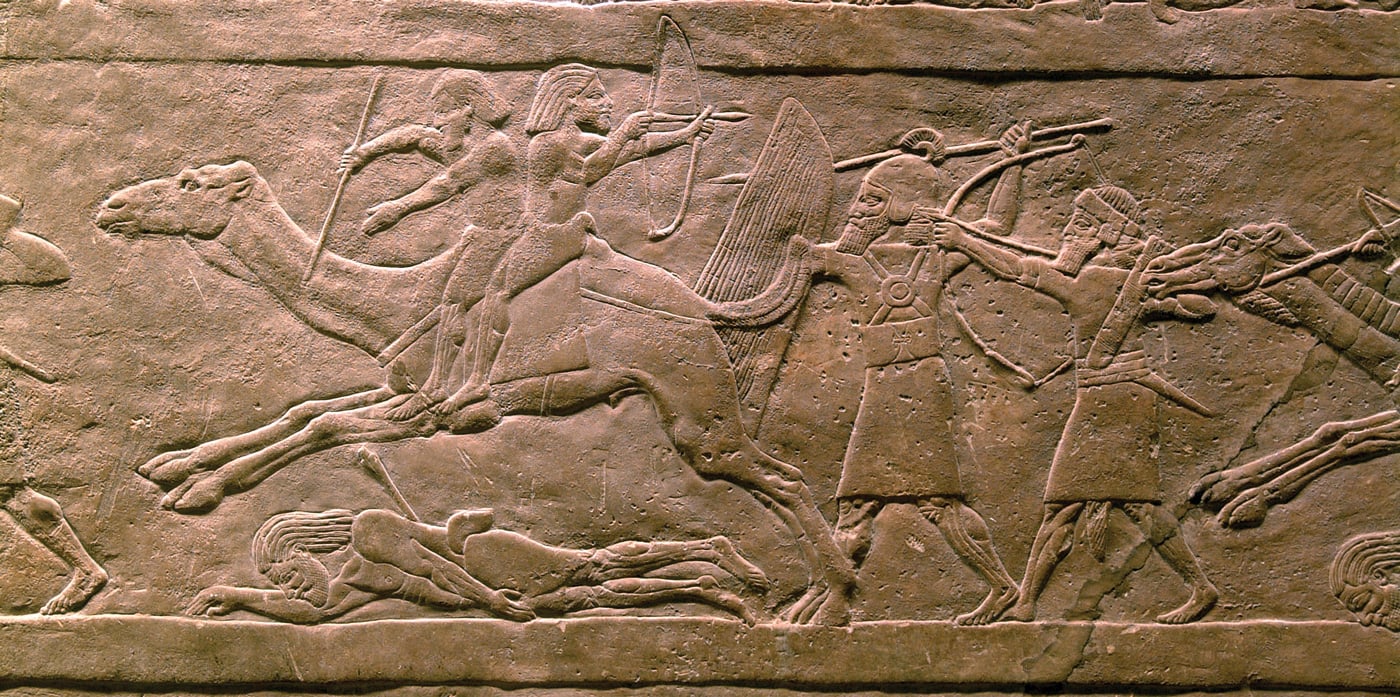
Assyrian soldiers pursue Arabs fleeing on their camels in this relief from the North Palace at Nineveh (645–635 BC).
Composition
The journey to Job’s becoming a biblical book is important, extremely complex, and shrouded in uncertainty. We would do well to ponder two underlying methodological principles when considering composition and sources. The first is to separate fact from hypothesis. The second—Occam’s razor—is that hypotheses should not be multiplied beyond necessity. Job, in its extant, canonical form is one book, all together. That is fact. Burden of proof resides among the ranks of hypotheses that argue for compositional stages, and the voice of “hypothesis” should be humble and wary. However, naïveté about process is equally unwelcome.
Over the course of the past century, a consensus grew among scholarship that Job developed in stages. (1) An “original” Job was an oral story about a pious man. Elements of the current bookends are the only remnants of this early story. A now-missing middle exists no more but likely had three friends speaking critically of God, with Job refusing to utter anything unkind. (2) Keeping the bookends, a more ambitious story line explored the notion of Job challenging God’s treatment of him while three friends affirmed traditional wisdom. A wisdom poem (28), Job’s final soliloquy (29–31), and a speech by God (38:1–42:6) were inserted after the dialogues and before the epilogue. (3) Perhaps perceived as a more decisive refutation of Job, the Elihu character was next introduced (32–37).
“Job-by-stages” does have merit as a way of understanding some of Job’s vexations, which we will discuss more fully below, under “Structure.” The present bookends and poetic core appear dissonant. The friends recite well-affirmed traditional proverbial wisdom, yet they are scolded. Job becomes increasingly impatient and short with God, yet Job is fully exonerated. The Adversary appears in the prologue but is then hooked off the stage, never again seen or mentioned. Elihu, a fourth friend, is entirely overlooked in the epilogue. An understandable response has been to proffer a story developed by insertions and deletions by many hands over time. A century’s prominence on compositional elements, however, was increasingly affirmed for what it was: an emphasis that shortchanged the fact that, whatever its compositional history, Job has a final, canonical form that must be taken seriously.
Structure
The relationship between Job’s narrative bookends—the prologue (1–2) and epilogue (42:7–17)—and its poetic core (the rest of the book) is arguably complex, some might say strained. Notwithstanding works that argue for Job’s overall unity, Bruce Zuckerman’s following words summarize well the bulk of understanding among scholarship:
The book of Job therefore appears to be at odds with itself; and however one may attempt to resolve its contradictory nature, the result never seems to be quite successful. Like oil and water, the Prose Frame Story and the Poem naturally tend to disengage from one another despite all efforts to homogenize them. (Zuckerman, 14)
David Clines offers one of the more sobering reflections on the whole of Job.
The book of Job has an unequalled power to compel in its readers a suspension of disbelief. We cheer its hero on even though we know that he labours under a huge misapprehension, believing he is being declared a heinous sinner by God even while we know that God is counting him his boast. That suspension of disbelief on the level of the plot has its analogy on the level of its ethics, in that a book that is fundamentally concerned with cosmic morality has embedded in it at key moments deeply troubling ethical difficulties.
What is truly amazing about the book is that for the most part its readers do not even notice that there are any ethical problems. Whole volumes devoted to the book of Job rhapsodize about its theological depth and its grand vision of the governance of the universe without a glance at the act of gross divine injustice against Job that is the springboard of the whole drama—the unprovoked and unjustifiable assault of heaven upon Job’s person and property. And that is just one of the several ethical problems the book raises. (Clines 2004, 248–50)
For all its grandeur, Job offers some difficult, nagging questions. (1) Why, really, does Job go through the suffering he does? (2) Why does Job have to be kept in the dark about the reasons for his suffering? (3) Why does God respond in the overpowering fashion he does? (4) Why does the book, at the end, apparently reaffirm the principle of retribution, against which Job has fought but for which the friends have argued (Clines 2004, 233–50)?
In similar vein, as we visit the bookends versus the poetic core, we encounter, so it seems, somewhat disparate stories. If we emphasize the bookends, the story of Job is a testing of the motivation behind the protagonist’s blameless behavior. The prologue centers on the Adversary and a contest: can a human love God for God’s sake alone? Is it devotion, without qualification, to God regardless, or is it devotion as a means to be and remain prosperous? Two rounds of calamity later, Job has not sinned “by charging God with wrongdoing” (1:22) or “in what he said” (2:10). In the epilogue, the Adversary is gone, the three consoling friends are chided, and Job is reinstated. The curtain can close.
If, however, we accentuate the poetic core, the story flirts with skepticism and explores whether the upright and the wicked get expected consequences. Job maintains that he is pious; the friends, including Elihu, argue that Job’s calamities demonstrate that he is not. Job, the almost-silent, serene, and patient transforms into Job, the boisterous and impatient. Job feels victimized throughout by God and unable to have a hearing. Job’s words in chapter 24, in fact, argue that prosperity among those who act unjustly or violently verifies that God is derelict in addressing injustice. God, of course, finally does appear but seemingly will have none of it, effectively shutting Job down. “Who is this that darkens my counsel with words without knowledge?” (38:2). “Would you discredit my justice? Would you condemn me to justify yourself?” (40:8). God, throughout his speeches, emphasizes chaos and the myopia of human understanding, justifying neither Job nor the friends.
But let’s explore more closely the whole and specifically the shift from poetic core to final bookend. God indicts only three friends, Eliphaz, Bildad, and Zophar: “I am angry . . . because you have not spoken of me what is right, as my servant Job has” (42:7). This creates tension. First, God has earlier rebuked Job. Second, although the friends are declared wrong, they are correct about the doctrine of retribution. Job is innocent, and he is rewarded! It is as they have argued. The righteous prosper.
The desire for a neat, unified message is understandable. A univocal text, theologically, seemingly affirms the notion of God-as-Author who speaks consistently throughout the whole of Scripture. Philosophically, such a text supports a supposition that truth is best communicated by logical, noncontradictory propositions. But univocality is not universally justified. It is not found in biblical parallel historical accounts, not in the message of Proverbs versus Ecclesiastes, and not in Job.
What do we make of Job as a whole? How do we go forward understanding the final casting of this book?
Brevard Childs offers an important framework. (1) Though Job has component parts, they interact with each other, begging for a holistic treatment, and (2) any interpretation of the holistic treatment must keep the tensions (Childs, 543–44).
In recent years, Mikhail Bakhtin has influenced biblical studies, particularly his notion of “polyphony,” rooted in his perception that human experience has both centrifugal and centripetal forces. One force thrusts us out, encountering ever more variety, ever different voices, ever more complexity. Another force gathers one in, highlighting sameness and unity. Life is polyphonous. For Bakhtin, Dostoevsky’s literary art achieved a polyphonic ideal. Wayne Booth offers the following insight about Dostoevsky, through Bakhtin’s eyes:
[Dostoevsky] genuinely surrenders to his characters and allows them to speak in ways other than his own. Heroes are no longer diminished to the dominating consciousness of the author; secondary characters are no longer encompassed by and diminished to their usefulness to heroes—or to the author. Characters are, in short, respected as full subjects, shown as “consciousnesses” that can never be fully defined or exhausted, rather than as objects fully known, once and for all, in their roles—and then discarded as expendable. . . . In the finest fiction, the author’s technique will not be marshaled to harmonize everything into a single unified picture and to aid the reader to see that picture. (Bakhtin, xxii–xxiii)
Time may likely show that Bakhtin has been oversummoned among biblical scholars, but Job—the literary work—and polyphony are not incompatible colleagues. Carol Newsom aptly observes, “No one voice can speak the whole truth. Rather, the truth about piety, human suffering, the nature of God, and the moral order of the cosmos can be adequately addressed only by a plurality of unmerged consciousnesses engaging one another in open-ended dialogue” (Newsom 2003, 24). In polyphony, authors, readers, and characters do not “give up holding passionately to claims of truth. But such positions are held in humility, as one engages in the discipline of seeing how one’s position appears from the perspective of another” (Newsom 2003, 262). Indeed, among the other members of wisdom literature, the divergence between the respective voices of Proverbs and Ecclesiastes on life demonstrates further the interaction of multiple voices. In Job we should likely not go searching for tidy univocality. Rather, we should experience Job for its mirror reflection on calamity’s untidiness. We should note the processes of processing tough circumstances.
Therein do we find a core value of this book. It is not primarily addressing whether the innocent suffer or why they do, though it speaks to these. And we do not encounter definitive, all-encompassing insight into God’s relationship with suffering. Rather, the book, again, mirrors what a God-fearing innocent—at least this paradigmatic innocent—does when tragedy strikes. The book’s greatest value is the insight and evaluative contemplation that arises from looking in on Job’s uneven actions and the polyphonous words and ideas he hears and he himself speaks. The focus is on Job and his journey.
Synopsis
| (Job 1–2) |
Blameless, upright, and full of wealth, Job has family, flock, and health. A deity’s boast, a challenger’s dare: “Job’s virtue will crumble, just lay him bare!” Challenge accepted, calamity rife, nothing left but ailing life. Three friends arrive, in mournful silence, days and nights, no words, in alliance. |
| (3) | “Curse my birth!” Silence is broken. |
| (4–27) |
Counsel by friends, in turn, is spoken, “Upright don’t perish, their lives, not nightmarish.” Diffident, defiant, on they natter, indignant becomes their chatter. |
| (28) |
Exhausted with friends and his stigma, ponder does Job on wisdom’s enigma, |
| (29–30) | gladness past and present-day sadness, |
| (31) | a court to boast his lack of badness. |
| (32–37) |
Voice for God, brash Elihu offers insight he’s sure the friends have not proffered. |
| (38–42:6) |
Voice of God roars and expresses He understands all world’s processes. Behemoth, Leviathan, creatures of chaos; Humans crave order, they think they’re the bosses. But order and chaos are life’s forces. Job sits silent, God’s voice he endorses. |
| (42:7–17) |
Three friends are indicted, Job with new life, united, restored, completely a-righted. |
This commentary does not explore the book chapter by chapter. Every reader can experience the book in that fashion. Rather, we have focused on sections and characters, attempting to present to the reader a vista that sees the whole of them in a less fractured setting than the setting in the story. This context will then complement a chapter-by-chapter reading.
1. Prologue and Epilogue (1:1–2:13; 42:7–17)
A significant poetic story plays out between these two bookends, but few doubt a close connection between Job’s prologue and epilogue, and for good reason. Both are composed in prose, stitched throughout with similar thread. (1) When speaking with the Adversary, God speaks of Job as “my servant Job” (1:8; 2:3). When speaking to the three friends, God uses precisely the same phrase four times (42:7–9). (2) “A foolish woman” is Job’s indictment of his wife’s response (2:10); folly is in view in Job 42:8. (3) The banquetlike gathering in the epilogue (42:10–11) has the thread of similar feasting in the prologue (1:4–5). (4) Sympathy and comfort recur (2:11; 42:11). (5) The number of livestock is precisely doubled in the epilogue (1:3; 42:12).(6) A baseline of the number of children is in mind in both (1:2; 42:13). From another angle, in the introduction, under “Composition” and “Structure,” we have already rehearsed some of the arguable dissonance between the bookends and the poetic core, uniting even further the former. With fear of oversimplification, we can say that much of the dissonance arises from Job’s carte blanche reinstatement, which accords more with the moral world of the narrative than with the poetic core. The ending clashes with the complexity developed in the poetic core.
But we embrace the advice of Childs, mentioned above: though Job has component parts, they interact with each other, begging for a holistic treatment, and any interpretation of the holistic treatment must keep the tensions (Childs, 543–44). Whatever the path to the form of Job we now have, the epilogue serves as denouement. For the narrative story of the bookends, the epilogue offers a rather simple, smooth, expected reversal of fortune. For the whole of Job, it creates, as we have said now several times, unexpected dissonance with many details. Incongruity notwithstanding, one commonly and understandably encounters efforts to soften or explain it away in a vein similar to “in the end, we are invited to interpret [Job’s blessing] as arising of God’s freedom enacted toward Job” (Janzen, 267).
If one embraces the dissonance—keep in mind the polyphony that permeates the story—the whole book explores the various aspects of the complex matrix of suffering and divine-human relationships. “The dissonance both recognizes and refuses the reader’s desire for closure to the story and a definitive resolution of the issues it has raised” (Newsom 1996, 634). A reader is thrown toward more contemplation about the book’s issues. The story is merely a morsel for a reader’s thought process, not a full meal.
A. Prologue (1:1–2:13). 1:1–5. The scene: Earth. Here we are introduced to Job and his exemplary piety, which even embraces actions on behalf of family.
Job’s name (Hebrew iyyob) appears to be not uncommon. W. F. Albright suggested, from cognate evidence from the second millennium BC, that iyyob should be seen as a Hebrew form traceable to an earlier Semitic form ayyabu, a sentence name meaning, “Where (is) father?” (Albright, 226). Robert Gordis suggested that the name is linked to a single root, ʾyb “to hate,” suggesting a meaning of “hated” or “persecuted one” (Gordis 1978, 10). J. Gerald Janzen embraced both, arguing that “word-plays through secondary etymology are a common device in biblical narrative” (Janzen, 34). Historical evidence supports Albright’s analysis more strongly, but it is not impossible that, secondarily, the very name iyyob/Job teases out the main character’s predicament.
Evidence places Uz, Job’s homeland, in two different spots. (1) A locale near Edom is supported by several texts. Jeremiah mentions the kings of Uz immediately after mentioning Egypt and just before mentioning Philistine cities, Edom, Moab, Ammon, then Phoenicia (Jer. 25:19–22). Lamentations places Edom and Uz in parallel (Lam. 4:21), and, in the often eponymous nature of the Genesis narrative, one of the sons of Dishan, an Edomite chieftain, is Uz (Gen. 36:28). (2) Other texts support a location northeast of Israel. Genesis 10:23 and 1 Chronicles 1:17 claim Uz as a son of Aram, thus associating Uz with the Arameans. In Genesis 22:21, Uz is the firstborn of Abraham’s brother Nahor and is thus affiliated with Upper Mesopotamia (“Nahor” appears as a geographical entity in the Mari letters of the early second millennium BC). One likely cannot reconcile the evidence. But a nod to the book’s genre and place within wisdom literature may tip the scales toward Transjordanian Edom. Job is the greatest among “all the people of the East” (Hebrew qedem; 1:3). In praise of Solomon’s wisdom, we are told that it surpassed a people known for their great wisdom, “the [people] of the East (Hebrew qedem; 1 Kings 4:30). Lamentations’ parallelism of Edom and Uz suggests that Uz is a poetic referent associated with Edom. Perhaps it is fitting, then, that biblical Job lives in and around Edom, a region of Qedem, a home of legendary wisdom.

The Transjordanian region of Edom, one possible location for Uz, Job’s homeland
Job as “blameless,” “upright,” a God-fearer, and one who “shunned evil” (1:1) connects the book strongly with Proverbs. Proverbs 2:7; 2:28; and 28:10 speak of the blameless and the upright, using the very same words. Proverbs 3:7 admonishes the reader, again with the same vocabulary, to “fear the Lord and shun evil” (see also Prov. 14:16; 16:6). Job is an exemplary model of the proverbial ideal. Job’s status is a foundation to the problem explored by the book: the suffering of one who has fulfilled wisdom’s expectations of proper behavior. Job’s “regular custom” (1:5) of ritual purification and sacrificing burnt offerings serves as an explicit example of Job’s piety.
In verse 5 we are introduced to an interesting authorial feature related to the Hebrew root brk, which the storyteller uses seven times in Job. The author forces the reader to negotiate between the root’s primary meaning, “bless” (1:10, 21; 42:12), and an opposite meaning, “curse” (1:5, 11; 2:5, 9). A meaning for this root is also found outside of Job (1 Kings 21:10, 13). Thought a euphemism, the antithetical meanings in Job draw attention—one has to stop and decide on the meaning.
The numbers related to Job’s possessions hint at the storyteller’s craft. Seven sons and three daughters are “paralleled” by seven thousand sheep and three thousand camels. Sons numbering seven appears to be a cultural concept of blessing or a full complement of male progeny (1 Sam. 2:5; Ruth 4:15).
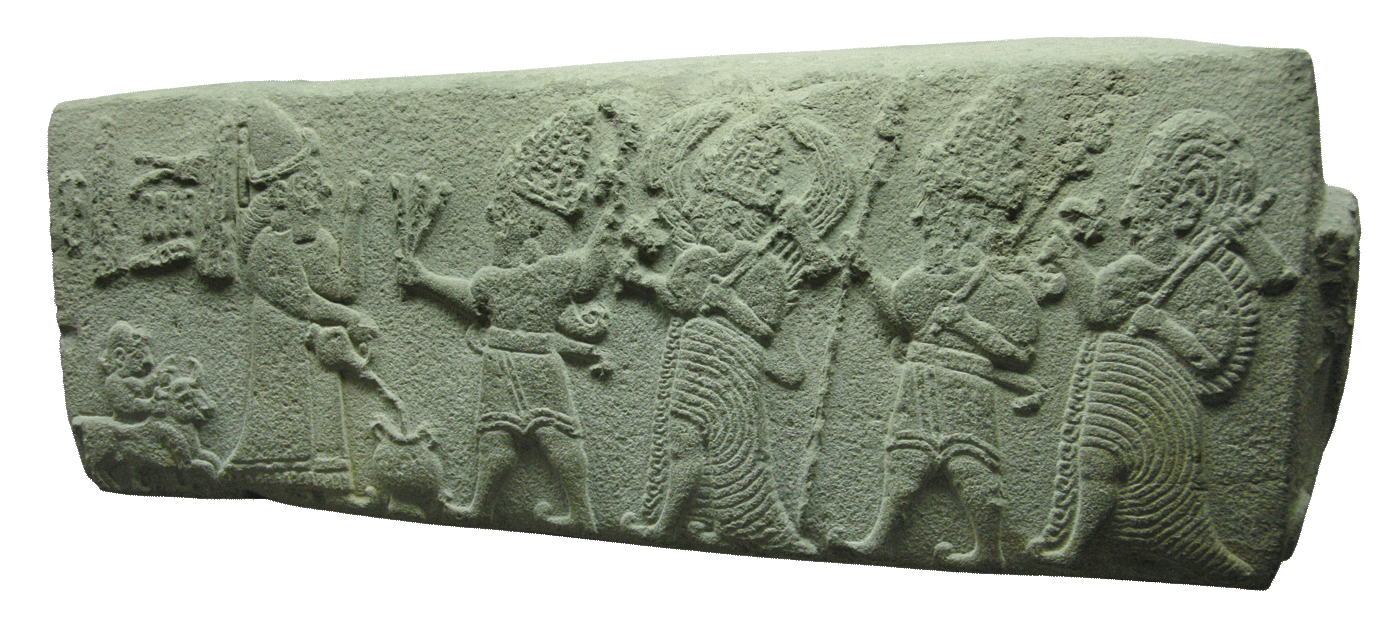
This procession of four gods on a Neo-Hittite orthostat is similar to images featuring the gods gathering for a divine council.
1:6–12. The scene: the heavens. Amid an assembly of divine beings, the Adversary and God consider Job’s behavior. Contemplating the Adversary’s challenge about Job’s motivations, God agrees to allow Job to be tested.
A council composed of divine beings is on the stage here. NIV’s “angels” too easily misdirects the modern reader. The idea of a divine council of deities is systemic throughout the ancient Near East. As but one example, the ancient West Semitic deity El presided over such a council (COS 1.86:241–74). A divine council underlies other texts in the Hebrew Bible (1 Kings 22:19–23; Isa. 6:1–8; Ps. 29:1; 82:1, 6; 89:5–7; Dan. 7:9–14), though the NIV’s translation of the passages arguably shrouds, at times, the Hebrew’s rhetoric and affinities with the cultural parallels.
One of the members of the heavenly council, “Satan” (so NIV) arrives with other members to present himself to the celestial ranks and to report on his affairs. “Satan,” however, is not here a name but a role (as evidenced by the use in Hebrew of the noun satan, “accuser, adversary,” with the definite article [hassatan]). The Adversary here is a skeptic or realist who has a good read on human nature in general. The concept of “satan” is certainly not uniform and shows development. A satan has the function of a “messenger” sent by Yahweh to impede Balaam (Num. 22:22, literally “a messenger of Yahweh placed himself in the way as a satan to [Balaam]”). The satan increasingly becomes an adversarial being in postexilic biblical writing (after 539 BC). In Zechariah 3:1–2, hassatan is rebuked by a messenger of Yahweh. In 1 Chronicles 21:1 satan is apparently for the first time a personal name and a being responsible, in the Chronicler’s mind, for standing against Israel and inciting David. To read into Job the much-later and present theological notions of Satan as the devil is to misunderstand this Joban character. One commentator has tried to capture the idea by British parliamentary parlance: His Majesty’s Loyal Opposition (Janzen, 262). In Job, the Adversary appears to be in the habit of patrolling the earth looking for indictable behavior. In this scene, he stands within the heavenly council to report his findings.
Preemptively, through a rhetorical question, God himself boasts of Job in precisely the same terms as the narrator, “blameless and upright.” The Adversary, with insight into normative human nature, responds with rhetorical questions of his own, focusing on Job’s motivation: “Does Job fear God for nothing? Have you not put a hedge around him?” Removing the protection would expose Job as no paragon of piety. God accepts the challenge. His role may be exonerated by pointing out that the Adversary is the true agent of Job’s destruction. Though true, the view is likely overly optimistic and guilty of hand-washing. God and the Adversary, at the end of the day, have joined hands and together will see Job ruined (see further comments below under 2:1–7a).
1:13–22. The scene: Earth. Four reports describe the systemic ruin of Job’s property and children.
A joyous day ends with unspeakable calamity. After describing a cheerful day of feasting, the narrative introduces four messengers bringing news of four catastrophic events. The rhetoric is formulaic and repetitive. Human predators and what most likely are natural events alternate as the destructive agents.
Sabeans attack, carrying off oxen and donkeys. “Fire of God,” most likely lightning, consumes the sheep. Chaldeans sweep away the camels, and a “mighty wind” collapses Job’s oldest son’s house. In each episode, individuals called nearim (literally “young ones”) are killed. In the first three, nearim are “servants.” In the fourth, translated as “them” (1:19), they are Job’s sons and daughters.
Job lies ruined. He tears his outer robe and shaves his head, typical expressions of grief and mourning (Gen. 37:29; Isa. 15:2; Jer. 7:29; COS 1.86:268 = actions of ʾIlu when he hears of Baʿlu’s death in the Ugaritic Baʿlu myth). He falls to the ground and “worships,” the common word for obeisance before divinity (Gen. 24:26) and royalty (1 Sam. 24:9). His words express a cultural proverbial expression of human fate (Eccles. 5:15): “Naked I came . . . naked I will depart.” The proverbial idiom is followed by a religious one, which orients the events around the activity of God: “The Lord gave and . . . has taken away.” In expressing “may the name of the Lord be praised,” Job has contradicted the Adversary. Yet, in somewhat teasingly ironic rhetoric, Job has also fulfilled the Adversary’s prediction. The Hebrew root brk (translated as “be praised”; see comments on 1:1–5) is once again at play here. In Job 1:11, the Adversary claimed that Job would brk God—“curse” God. Here Job does brk God, but in light of the narrator’s assessment of Job’s actions in verse 22, Job clearly has “blessed” him.
2:1–7a. The scene: the heavens. We are whisked up again to the assembly of divine beings in council, where, in almost precise repetition of the previous heavenly scene, God and the Adversary contemplate Job.
One can imagine God reveling somewhat in his dialogue with the Adversary. Begrudgingly, the latter must agree with God that Job, devastated by the turmoil of the previous scene, has nevertheless maintained his “integrity” (from the same Hebrew root as “blameless”; cf. 1:1), his spotless character (2:3). It is possible to see confident gloating through the last few words of verse 3: “You incited me against him to ruin him without any reason.” In the Hebrew, the term is a recurrence of the Adversary’s own term at the opening of his rhetorical question in Job 1:9 (“Does Job fear God for nothing?”). But unlike its initial use in the Adversary’s mouth, the term can also denote “in vain” (Mal. 1:10 RSV; cf. Ps. 109:3, “without cause”). God could well be celebrating that it was in vain that the Adversary set in motion the events that transpired. He lost.
More plausibly, though, and more troublingly for the reader, one likely encounters God’s implicit admission that the Adversary was successful first in that he incited God to ruin Job and second in that it was “without any reason”; that is, it was gratuitous or undeserved. If correct, we view an increasingly darker underbelly to this book. Not only has God agreed to allow Job to suffer once “without any reason,” but he is about to agree to yet another round.
The Adversary is quick with his next challenge, this one against Job’s own person. “Skin for skin,” because of its enigmatic terseness, is a phrase that has received much attention. As with most interpretation, the immediate textual environment is vital: “A man will give all he has for his own life” (2:4). The words and the context suggest that the Adversary, in effect, is saying that a person will give anyone else’s skin to save their own (Gordis 1978, 20). Struck with physical ailments, Job will curse (Hebrew root brk; see comments on 1:1–5) God, or so the Adversary boasts.
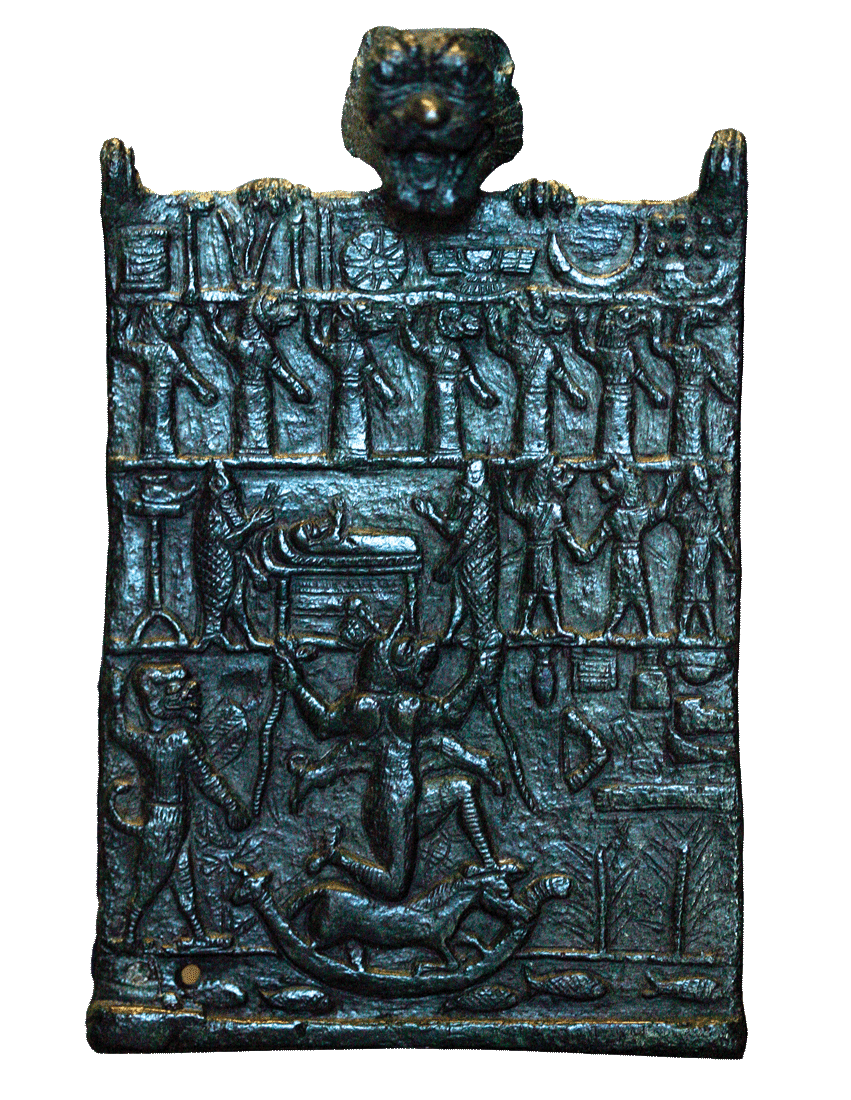
Illness and the activity of the gods were closely linked in the ancient world. This Neo-Assyrian amulet depicts Lamashtu (the large figure standing on the donkey), who was believed to cause many illnesses. The amulet would be placed above the bed of a sick person to call on the gods for healing.
2:7b–10. The scene: Earth. The Adversary afflicts Job’s body. Job responds to his wife’s presence and words, and he is affirmed as one who “in all this, did not sin.”
Job’s affliction has received much attention; commentators have understandably taken on the role of physician and attempted to provide a diagnosis. Whatever the disease, it is one that affected his skin and, more important, one that likely evoked the stigma of divine displeasure. Job’s disease is one with which God promises to curse the Israelites if they fail to obey the covenant (Deut. 28:35). The narrative of a fragmentary Aramaic text from the Dead Sea Scrolls, known as the Prayer of Nabonidus (4Q242/4QPrNab ar), describes how the Babylonian king was afflicted by this same disease. Only after a Jewish exile forgives his sins and instructs him to pray to “God Most High” is the king healed.
Job’s wife enters, focusing on her husband’s “integrity,” the same word affirmed by God above in Job 2:3. The wife’s words are rich—and ambiguous. Job’s wife may believe that holding on to integrity is now a futile act. It no longer pays out the dividend of “the good life.” But, given the self-conscious exploration of the book and the arguments of the soon-to-arrive friends, his wife may be setting a theme similar to that of the friends: “Why are you holding on to your own, self-centered integrity that has you falsely clinging to the notion that you are pious? Calamity undermines your claims of piety! Curse [Hebrew root brk] God, and then you will die!” Her motivation is also unclear. Her words could be callous indifference (as they are widely understood to be)—just die! Or she could be offering loving compassion—death would have to be a better condition for him than the present misery.
The Septuagint expands the wife’s presence, giving her more to say. Her words there remind the reader of cultural realities. She herself has grievously suffered. Her children, of course, are gone. But her income, her status, her reputation—because of her cultural dependency on her husband—are gone as well.
The Hebrew expression underlying the narrator’s affirmation of Job’s character is literally that Job does not sin “in/with his lips.” This led the rabbinic commentator Rashi to suggest that Job does sin, not with his lips but in his heart or thoughts. Though this is intriguing, it is better to keep in mind that the omniscient storyteller has carefully woven Job’s blamelessness and uprightness throughout the story so far. The expression at hand should not serve as a new hedge to Job’s blameless character. That said, Janzen does compare the differences between Job’s first response (1:20–22) and his second here, arguing that Job’s initial stalwart confidence in God, God’s ways, and himself has eroded (Janzen, 51–55). If so, we may see an editorial nod in producing the final, canonical version of Job. Already in the narrative prologue, we may see a patient Job transforming into the increasingly impatient Job of the poetic core.
2:11–13. The scene: Earth. Three friends arrive and in silence sit with Job, mourning.
Most believe that Job’s three friends are geographical neighbors. Underlying NIV’s “sympathize” is a Hebrew word that refers to a motion of nodding the head as an expression of commiseration. Sympathy so deep as to be devoid of words, expressible only through this movement, is understandable here. One may note the use of three and seven again (see 1:1–5). Three friends sit silent for seven days and nights.
B. Epilogue (42:7–17). The scene: Earth. God scolds Job’s three friends, demanding that they offer sacrifices and that Job pray on their behalf. That action complete, Job is restored, blessed again with possessions, family, and a long life to enjoy them.
An entire poetic story has played out since the last scene in the prologue (2:11–13). We now encounter the only scene of the epilogue. God’s words, particularly his affirmation about Job, to the three friends carve out a chasm between this scene and the poetic dialogue. If one feels compelled to harmonize, it is hard to imagine how to do so successfully. God asserts, “You have not spoken of me what is right, as my servant Job has” (42:7–8). The Hebrew word nekonah underlies NIV’s “what is right,” a term that denotes “correct.” How does one mesh God’s praise that Job has spoken “what is right” with his earlier rebuke that Job has spoken “words without knowledge” (38:2), which Job acknowledges later in his response to God (42:3)? One scholar, in fact, is compelled to say that in “Job’s speeches can be found examples of some of the most anti-Yahwist sentiments of which we have any record in literature (9:15ff.) . . . [filled with] . . . audacity, defiance, and self-righteousness” (Polzin, 184). God’s praise fits well with the bookends-only story line (1:1–2:13; 42:7–17), where Job’s actions and words are a model of an acquiescent, soft-spoken affirmation of God’s ways. But we do encounter a hurdle in that same story line when we consider the friends. They speak no words in it. The final “cut” of Job, though, envisions friends uttering God-censurable words. Most agree that Job, no matter what the proposed stages, had that component. Beyond that, disagreement quickly arises. What appears clearest is that both Job and the friends have indeed spoken, that God comments on those characters here in the epilogue, and that scholars have left us with two general paths to follow. One path strives to harmonize; the other does not.
Efforts to harmonize vary. (1) God, in his final praise, is hereby declaring that Job, despite vitriolic and seemingly contrary-to-God moments, is free from blame. Job’s words are nekonah because they are “truth,” “correct and consistent with the facts”; that is, they “correspond with reality . . . devoid of dissembling and flattery” (Habel, 583). (2) Even in his accusations, Job “has truly identified the fact that his terrible trials have transpired within God’s world, a world for which God may properly and finally be held responsible” (Janzen, 264). (3) God is focusing on the correct elements within Job’s words, particularly Job’s “denying that sin is always punished with affliction and his holding fast to his innocence” (Pope, 350). (4) Job has spoken to God directly, not just of/about God, as the friends have done (Phillips, 41). (5) Job has been genuinely groping for truth, never turning his back on God. The friends’ reductionistic theology, which underpins their counsel to confess sin in order to return to prosperity, would have led Job away from God and truth (Carson, 378–79). (6) Finally, in our representative samplings, no disharmony is even acknowledged (Dhorme, 648).
The other path celebrates the dissonance as purposeful and meaningful. God requires that the friends take seven bulls and rams to Job, who is to offer the animals as burnt sacrifices on his friends’ behalf and then to pray. The number of animals is large and is somewhat reminiscent of the sacrifice of seven bulls and seven rams on seven altars in the Balaam story (Num. 23:1, 4, 14, 29–30). The effect of all this is seen in God’s words to the friends: “I will accept [Job’s] prayer and not deal with you according to your folly” (42:8). The NIV’s translation leads the reader to see that the friends have somehow, somewhere in the story, committed folly. But we may be missing one of the most striking, and troubling, instances in the Hebrew Bible of attributing human feelings to God. We must consider two things: the structure of the utterance and the behavior in mind. (1) The words underlying Job 42:8 are a common idiom in the Hebrew Bible: “do x with y,” where y is a person or entity and x is the behavior or concept, such as “loving-kindness,” or “a morally reprehensible act” (Hebrew nebalah). Earlier, for example, Job has uttered, literally, “life and loving-kindness you have done with me” (10:12). God, in Job 42:8, literally says, “[I will] not do with you all a morally reprehensible act.” (2) The behavior or concept here in Job 42:8, nebalah, many times throughout the Hebrew Bible refers to morally repugnant conduct (Gen. 34:7; Deut. 22:21; Josh. 7:15; Judg. 19:23; 20:6, 10; 2 Sam. 13:12; Jer. 29:23). Are the friends being accused of morally shocking behavior? If so, what is it? No quorum unites commentators on what it would be. Another direction is to consider that God, in a didactic, wisdom story, is musing hypothetically about his own behavior. God does not want to commit nebalah against the friends, and Job’s actions will appease God. In fact, one recent reading of Job argues that the story has earlier shown God guilty of nebalah when he granted the Adversary’s requests to devastate an innocent man. In the epilogue, God is here putting a restraint in place for himself from further nebalah. Job has remained the constant one: an innocent intercessor in the beginning, an innocent intercessor at the end (Guillaume and Schunck, 457), though, as we will see, one who has not understood the bigger picture. One can understand some translators’ and commentators’ inclinations to see the friends as having acted with nebalah, but one must embrace an unprecedented understanding of the idiom—not impossible, but probably not the most prudent given the data.
When Job prays on behalf of the friends, God restores Job with twice as much as before. Brothers, sisters, and former friends all make their way to comfort and console him, each one giving him “a piece of silver” and a gold ring.
Job’s flocks are doubled (1:3; 42:12), reparation elsewhere in the Hebrew Bible for one who has lost property through theft or a negligent trustee (Exod. 22:4, 7, 9). A new family of “seven sons and three daughters” is born to Job, the same as in the beginning (1:2). The Hebrew word for “seven,” however, is considered by many to be a dual form: seven-twice, that is, fourteen. The Targum of Job, in fact, uses that very number. One may note that in 1 Chronicles 25:5, Heman, King David’s seer, is given fourteen sons and three daughters “through the promises of God to exalt him.” If this is all correct, Job’s sons are doubled but his daughters are not. A conventional answer to this disparity is that, with culture in mind, males were a blessing while females were usually not an index of status and wealth. In fact, daughters could be a source of worry and concern (Sirach 26:10–12; 42:9–11). That said, the story of Job focuses on the daughters and their extraordinary beauty and makes the point that Job “granted them an inheritance along with their brothers.” A final gesture of Job’s bounty is his length of life. Over the course of 140 more years, Job is able to see his descendants down to the fourth generation. Living to see one’s children’s children (two generations) is already a blessed life (Ps. 128:6). Job, again, has doubled that.
So the epilogue of this story in its present form within the Masoretic Text produces dissonance. The affirmation that Job has spoken “what is right” calls out to the reader to consider again what Job has in fact said: God is derelict in addressing injustice (Job 24). God’s Job-silencing speeches argue that order and chaos are the full experience of life. Human arrogance that expects order is what God dismantles. Chaotic forces have played havoc on Job. Yet God, in a sense, has unleashed them by allowing the Adversary to act. With a subtle nod of restoring Job to double his former life, God may actually be “owning up.” Job receives reparation a thief or negligent trustee must pay out. Is this simply coincidence? And the friends have repeatedly urged Job to understand the world in ways that the epilogue verifies. For Eliphaz, as an example, God “injures, but his hands also heal” (5:19), just as the epilogue shows. As mentioned above, a reader is thrown toward more contemplation about the book and its message—a teasing morsel, not a completed meal.
2. Job’s Opening Soliloquy (3:1–26)
The silence among the array of characters at the end of the prologue is shattered. The outburst is striking. Here, psychologically, Job moves from silence to give voice, in the company of others, to his calamity. Out of his anguish, Job curses his existence, focusing primarily on the day of his birth. Imagery of light and darkness, day and night weaves the soliloquy together. His outcry is beyond a response to his friends. It flows from the calamities that have befallen him. His sorrow, pain, and confusion fumble about together as raw emotion. None of the prologue’s detached, sterile setting has seeped in. Because of language similar to the Psalter’s own laments, the psychological and interpretive effects of Job’s words convey a suffering typical of all humanity, though extreme. Yet in Job the reader is somewhat of a voyeur. The psalmists’ laments, often through generality, draw a reader in, and both share the despair. Though most recognize and understand Job’s emotion, the precise details of his calamity serve as a small hedge, keeping distance. Like Job’s friends, we look on and overhear his words, and they are not quite ours.
Job’s soliloquy here and the one later in chapters 29–31 frame the three cycles of dialogues between Job and the friends.
3:1–10. The narrator tells us that Job opens his mouth to curse (the Hebrew root here is not brk, used in the prologue; see comments on 1:1–5), literally, “his day.” In Job’s soliloquy, we discover quickly that “his day” is about his origins: the day of his birth, the night of his conception. The NIV’s wording of 3:3, which has in mind only a birth, diminishes Job’s brilliant interplay. His words fade skillfully between the day of his birth and the night of his conception (3:3a: day; 3:3b: night; 3:4–5: day; 3:6–10: night). Day and night both merge and separate. The day of birth is, of course, different from the night of conception, yet both this day and night compose a day, the particular “day” that is the sum total of his creation. God’s first words in the cosmos’s creative process were “let there be light” (Gen. 1:3). About his own “creative” process, his birth, Job wails “That day—let there be darkness!” (3:4; NIV “may it turn to darkness”), a potent exclamation and a fitting curse for a day.
Given cultural parallels, one could expect in Job 3:8 something to do with “sea” in a poetic line that also has “Leviathan.” In fact, “sea” does occur in the NRSV of Job 3:8 (cf. NIV note). From Ugaritic texts, Leviathan is one of several monsters associated with deified sea, that is, Yammu. They are forces of chaos. The Hebrew text is teasing in this respect. The Hebrew Masoretic Text has literally “cursers of day” (orere yom), but many prefer a conjectural emended reading, “cursers of sea” (orere yam), thus giving a translation like “Let the Sea-cursers damn it [the night], those skilled to stir Leviathan” (Pope, 26). All this has the advantage of well-known mythological connections found in ancient Levantine cultures—those on the eastern Mediterranean seaboard—and in the Hebrew Bible (Ps. 74:13–14; Isa. 27:1), since it too is a product of Levantine people. But perhaps the word purposely plays with the early audience. The choice of yom (“day”) for an expected yam (“sea”) blends the expected mythological imagery with the storyteller’s poetic examination of “day.” The audience “gets it.”
3:11–19. This section begins with “why.” Job’s attention shifts away from cursing “his day” to focus on questioning why he could not have died at birth. If such were the case, he would now be “asleep and at rest” (3:13). We have here a portal into the then-cultural concept of afterlife. Sheol—the word is not explicitly mentioned—the resting place of all who have died, is a preferable place to be. His wish balances extremes. Sheol’s dreadfulness is diminished; Job’s misery is heightened. Sheol here is little more than a peaceful realm where human status and rank are equalized—Job desires it! But Sheol elsewhere is a dark (Job 10:21–22; 17:13), snatching-away (Job 24:19), entangling, destructive enemy (Ps. 18:4–5)—Job prefers this? His present life is truly miserable.
Job’s train of thought is first to question rhetorically why life-sustaining persons had to be present at his birth (3:11–13). If they had not been there, he would be in peaceful rest in the company of now-dead kings and rulers. In death, the infant and the great, the wicked and the weary, the captive and the slave, share rest.
Why Job focuses on kings and rulers is somewhat of a mystery. Their “footprint” on earth may rival Job’s own precalamity presence. To use the most substantive among human dwellers as examples of life’s transience and futility is fitting. Their buildings now lie in ruin, their wealth left behind.
The last few verses (3:17–19) hone in on what Job desires most at this moment: peaceful rest from a baneful existence. The wicked, the weary, captive, slave, small, and great, now dead, all enjoy what Job wishes. The wicked have no more turmoil, the weary enjoy ease, and the captive lies deaf to the insults and demands of the slave master. They are all free.
3:20–26. “Why” opens this new section, which focuses on the plight of a sufferer, here and now on earth, before the grave. The nostalgia in the previous verses of what might have been gives way to what is.
Light reappears, still unwanted. Earlier, Job desired darkness (3:3–10). Now, in third-person point of view, a shift away from first person, Job explores how light torments the tormented. Why then does God provide it, Job rhetorically poses. The imagery of treasure hunters taps into the frenetic adrenaline rush of discovered treasure and is powerful in Job’s mouth for describing a sufferer’s hunt for death. But efforts are frustrated. Death does not come, and light floods in.
Shifting back to the first-person point of view, Job soberingly describes his own pain (3:24–26). Sighs are his food; groans are his water. His fears are realized. Rest—a theme throughout his soliloquy—is all he desires, yet his final words are painful: “but only turmoil,” literally “but agitating trouble has come.”
3. Three Cycles of Dialogue (4:1–14:22; 15:1–21:34; 22:1–27:23)
Job has no idea how true his last few words are. He has spoken them of his past. He will soon discover that they anticipate his future. The frustrating dialogues with the friends lie ahead—agitating trouble has indeed come.
Eliphaz, Bildad, and Zophar will by and large collectively affirm a traditional doctrine of divine retribution: God rewards good and punishes evil. Job will declare his innocence. The friends will increasingly grow frustrated with Job. Job will progressively become agitated with them and with God. The tension that arises from listening in on the characters cannot be resolved by omnisciently declaring the friends wrong and Job correct. Rather, we experience firsthand through their respective words the complexity of understanding suffering and the diversity of response to it. Polyphony is at play, mirroring real life.
Is this section truly a dialogue? Are the participants really responding to each other? A fairly widespread scholarly consensus says no. At the very most, the consensus concedes enough of an interaction for the sides to become irritated with what is being said.
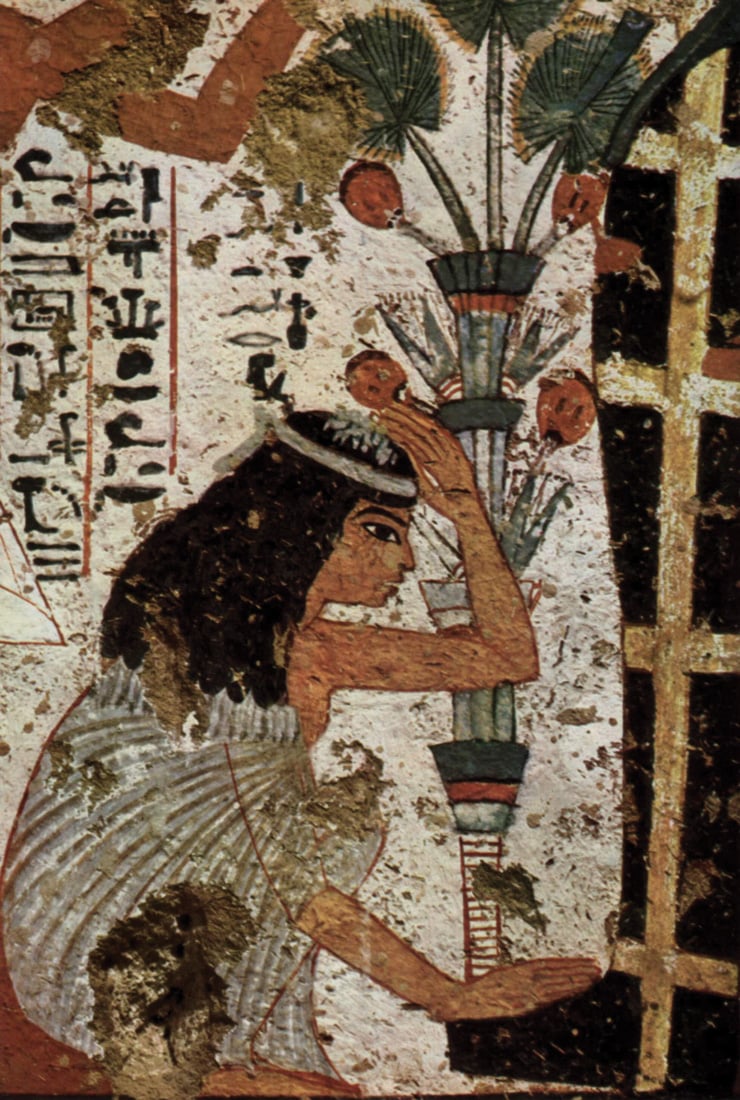
Job’s friends sprinkled dust on their heads to demonstrate their grief over his condition (Job 2:12). This practice was known in Egypt as well, as depicted in this painting of a woman putting dust on her head in mourning (tomb of Nebamun, ca. 1350 BC).
The conversation does not sustain a point-by-point debate, and one does walk away from the dialogues feeling that the participants have largely talked past one another. This is understandable, given the very different starting points. Job cannot begin where the friends do because he does not fit their paradigm.
The consensus is chiefly true, but it appears to be overstated. The first several verses of each speech arguably acknowledge past comments of other characters. In Job’s first response to Eliphaz, for example, one feels the pathos welling up within Job over the discord between his life’s reality and Eliphaz’s counsel (Job 6–7). The same can be said for Job’s reaction to Bildad and Zophar. Such features do interweave the dialogues, with the strongest stitching being disagreements or counterpoints. And once again the interweaving features of dialogue are found primarily in the opening verses of each speech. In the dialogues one does not find a parry matching every thrust, but fencing sabers are drawn and do touch.
In the main, however, the dialogues speak to a level beyond the characters sitting together. They constitute a disputation that explores, more globally, traditional ideology on misfortune. Job-as-sufferer and friends-as-advisors serve as vehicles to a conversation of grander scale. Wisdom literature is exploring itself.
Does each of the three friends have a distinct personality? Consensus asserts that Eliphaz is more distinct than the other two. Assessments of him as the oldest and most urbane are typical. Many see Bildad and Zophar together as less courteous and less tactful than Eliphaz, and some make Zophar much less restrained than Bildad.
Does each represent a particular point of view? Here things get a bit more muddled. Even those who argue for distinct perspectives argue them primarily from the first cycle. Whatever may be true from the first round of speeches becomes increasingly cluttered in the second and third rounds. With this important caveat in mind, and drawing primarily from the first round of speeches, one can nevertheless draw some generalities.
Eliphaz, firmly grounded in the principle of retribution, as are all three friends, grants a higher level of piety to Job than the other two (4:6) and, drawing on that, offers more consolation and encouragement. Bildad is certain that the wicked set their own misfortune because the world operates on God-ordained principles. Job’s children are an example of that rule at work. Zophar, more certain of Job’s sin than the other two, focuses on Job’s miserable circumstances as the foundation to denounce him for sin that, because of his calamity, he surely has committed. His intent seems more to frighten Job into repenting of those sins (Job 21). As the dialogues continue, the friends’ voices seem to merge almost into a collective character set against Job. The words of the friends narrow down to their communal undergirding that retribution befalls the sinful. Nearing the end of the dialogues, even Eliphaz, a champion for some level of Job’s piety, is frustrated: “Is not your wickedness great? Are not your sins endless? . . . Submit to God and be at peace with him; in this way prosperity will come to you” (22:5, 21). Traditional proverbial wisdom, personified through Eliphaz, Bildad, and Zophar, is affirmed: the pious are rewarded, the impious are not; indeed, they are afflicted. But Job cannot embrace this wisdom, and neither can the omniscient reader. Eliphaz, Bildad, and Zophar, through their parroting of traditional human wisdom, register wisdom’s failure to penetrate fully into and make sense completely of human suffering.
We will say more below (under “Job’s Words”) about Job’s character throughout the dialogues. Suffice it to say here that he is on a journey, one that revisits a couple of prominent themes while at the same time moving forward in thought and understanding.
The dialogues through the first two cycles establish a symmetry: friend followed by Job. In the third cycle, however, the symmetry is disrupted, particularly after the final Eliphaz-Job interchange (22:1–24:17). From there, the text as we have received it shows the following characteristics.
- The content of Job’s reply to Eliphaz in 24:18–25 abruptly begins to sound like any of the three friends.
- Bildad’s third speech is very short (25:1–6) and lacks a customary direct response to Job, typical of his first two (8:2–7; 18:2–4).
- Job’s reply in 26:2–4 is grammatically a second-person address, “you,” and specifically second-person singular. Hebrew makes a clear distinction in its grammar between second-person singular and plural. Until now, though, Job generally responds to a friend by using second-person plural forms. The Hebrew reader understands that Job has all along been saying “y’all,” as it were, in response to a single friend’s words. There are a few exceptions (12:7–8), but the plural is statistically the preference. Job, then, if we follow the received text, somewhat uncharacteristically addresses the friend here as singular. However, when a friend refers to Job in the second person, each generally uses singular forms, as expected (an exception is Bildad in 18:2–4).
- In the middle of Job’s reply to Bildad (Job 26), the narrator interjects, “And Job continued his discourse” (27:1), and does so again at Job 29:1, a point again where Job seemingly has been speaking all along. Up to now, the narrator has interjected only to change speakers and has used different wording, “Then x replied.”
- Zophar has no third speech.
Most scholarship rearranges, in some fashion, the contents of Job 24:18–27:23. Clines has charted an array of proposals for the puzzle (2006, 629). How does one go forward through the maze?
Measured against two previous cycles, the third exhibits a different pattern and rhetoric, at times at odds with expectations. These are good grounds to question exactly what it is we have received. Do we have a corrupted text, a play with misplaced lines? If we do, we have no clear evidence from the earliest renditions. The Targum of Job, the Septuagint, and manuscripts display no reorientation.
If one affirms the text as is, without changes, one is also affirming the empirical over the hypothetical. A host of reconstruction, after all, may create a text that never existed except in the minds of scholars. Without changes, interpreters argue the following. Bildad’s short speech and Zophar’s absence accurately reflect the exhausted, frustrated state of the arguers. The rhetoric in Job’s mouth of ideas that have been spoken by the friends is either straightforward citation or sarcastic parroting.
Preferring empirical evidence over hypothetical should not easily be pushed aside. But the cumulative weight of the characteristics we rehearsed above about the “post-Eliphaz” material in the third cycle warrants, in our opinion, some reassignment. We go forward with utmost caution and without entrenched conviction, but we think the following represents a helpful direction.
- Though sometimes Job 24:18–25 is reassigned to a friend, Job is still speaking here, in line with the Masoretic Text. We understand the grammatical mood of the language not to be declarative, as the NIV translates, but optative (that is, a hypothetical projection or wish of a situation or condition; see NJPS). Job wishes that God undid the wicked; he is not declaring it so.
- Bildad’s second speech constitutes all of Job 25–26. Further, we are inverting Job 26:2–4 and Job 25:2–6, thus putting his speech into the following order: 25:1; 26:2–4; 25:2–6; 26:5–14 (Clines 2006, 618–41). In this reassignment, Bildad addresses Job, in the initial portion of a speech, in second-person singular rhetoric, which the friends have done in the previous cycles. This avoids the dilemma of why, if one keeps Job 26:2–4 in Job’s mouth, he would shift to singular person address when he has previously statistically preferred the plural. The narrator at Job 27:1 informs the reader that Job is now about to speak. Here, and at Job 29:1, the narrator uses different wording: “Job continued his discourse.” Something unique is going on, but what? At Job 29:1, though Job has been speaking since 27:2 according to the Masoretic Text, scholarship, with few exceptions, sees Job 28 as an interlude, an independent poem about wisdom interjected between the dialogues and Job’s closing soliloquy (Job 29–31). For Job 29:1, one might argue that the different phrasing is a nod—perhaps from the literary narrator but more likely from an editor—that we are turning from something “non-Joban” (the wisdom poem) to Job. The same phrase in Job 27:1 could be a similar nod: something “non-Joban” (Bildad’s speech) to Job. Why we should encounter new phrasing is unclear, but I suggest that the dilemma of editors bumping up against what always was or what had become an opaque, problematic story has had a hand.
- Job’s response to Bildad is Job 27:1–12, which follows the Masoretic Text’s assignment.
- Zophar actually does appear in the third cycle, though not introduced. Job 27:13–23 is assigned to the third friend.
A. Eliphaz’s words (4:1–5:27; 15:1–35; 22:1–30). Eliphaz is likely the eldest. Deference to age underpins the story of Job. Elihu’s opening words, after he has heard the three cycles of speeches, make it clear that the three friends are older than he (32:6–9). Of the three friends, Eliphaz appears most conciliatory toward Job. Job is not wicked. Far from it, Job is righteous; but, as with all humanity, Job cannot be perfect. The calamity Job is experiencing is divine discipline for something untoward. All humanity must deal with something of this sort. Job needs only to address the imperfection and move on. Though Eliphaz becomes harsher through the cycle of speeches, he remains the most encouraging and grants the most to Job. Even when frustrated to the point of declaring Job’s sins as “endless” (22:5), Eliphaz’s redemptive intent beckons Job to “submit to God and be at peace with him” (22:21).
4:1–5:27: First cycle. Eliphaz seems intent on encouraging Job here, drawing from self-proclaimed experience and a quiver full of rhetorical devices: parable, proverb, vision report, beatitude, doxology, and exhortation. Everyone, he offers, is guilty of some error. Suffering is divine discipline (5:17–19) that addresses human impurity. It is those who repent and acknowledge God who are blessed and free from calamity. Job is still alive, and this is testimony that Job is still redeemable. God is ready to heal (5:18). But Eliphaz cannot accommodate a righteous person, one with no known or unknown sin, experiencing calamity. For all of Eliphaz’s experience and understanding, then, Job’s true situation remains impossible in Eliphaz’s worldview. That worldview leads Eliphaz to offer words of encouragement that are, in fact, bitterly cruel to Job:
“Where were the upright ever destroyed?” (4:7);
“[A fool’s] children are far from safety, crushed in the court without a defender” (5:4);
“You will know that your children will be many” (5:25).
Words meant to support Job and sustain the dogma behind them actually indict the cruelty of Eliphaz’s—traditional wisdom’s—narrow dogma. Eliphaz’s words, seemingly an effort to reflect on suffering, are more appropriately read as an attempt to silence the words of a sufferer thought by a nonsufferer to be unacceptable and harsh.
4:1–6. Eliphaz first acknowledges Job’s fragile condition before expressing his own need to speak. Verifying what we know already about Job from the prologue, Eliphaz wants Job to consider his past good works, his own words of encouragement to others. Job needs now to hear his own advice. Job, in Eliphaz’s mind, has lost sight of who he is, who he was. In rich imagery, Eliphaz hones in on Job as one who has shored up, who has supported, but now falters and grows weary. Drawing from the past will buoy Job. It is in 4:6 that we encounter the bedrock of Eliphaz’s theology: pious reverence confidently invites God’s favor. The phrase translated “your piety” is particularly meaningful. Eliphaz says literally, “your reverence” (Hebrew yirah). One of the core tenets of biblical wisdom is reverence (yirah) for Yahweh. The phrase and the concept permeate the wisdom books. Proverbs, the “guidebook,” as it were, for the theological perspective of the friends, develops precisely how, in the practice of life, the reverence (yirah) of the Lord is the beginning of wisdom and knowledge. No Hebrew-speaking audience can miss encountering the word yirah here and understanding the very pointed, powerful theological underpinning.
4:7–11. If 4:6 expresses the bedrock of Eliphaz’s theology, 4:7–11 is the first stratum of development. Job, Eliphaz is certain, only needs to reflect on “truth”: “Who, being innocent, has ever perished? Where were the upright ever destroyed?” (4:7). Eliphaz draws deeply from his world experience. A lifetime of observation can only verify for Eliphaz the veracity of his theology. Eliphaz articulates his insight lushly, with figurative imagery drawn from agriculture (4:8–9) and the animal kingdom (4:10–11). Fields planted with evil produce evil, and they are scorched by hot desert winds—“the breath of God.” Lions are commonly a metaphor for the wicked (Prov. 28:15; Ps. 17:12; 35:17). The wicked are lions with broken teeth, without food, and with cubs vulnerably scattered. In short, the impious do not thrive, they perish. The irony here, and it will continue to build throughout Eliphaz’s speeches, is that the depth of Eliphaz’s world experience, from which he draws so deeply to console Job, is still too shallow to allow for a Job.
4:12–21. We continue to encounter Eliphaz’s wealth of experience. Eliphaz relies further on knowledge derived from an auditory night vision, similar to that of a prophet. He describes the details of its onset (4:12–16), then recites the words he received from some unidentifiable “form” that spoke with “hushed voice” (4:17–21). In this additional stratum of Eliphaz’s theology, a central point of the vision’s message is that no human is fully or perfectly just. Eliphaz, as a voice of traditional wisdom, helps us see that though the dyad of the just and the wicked is firm, things are not so pristinely straightforward. The pious, then, as wisdom envisions them, can expect some of the misfortune fully reserved for the wicked. The implication for Job, therefore, is to (re)embrace this truth, to repent of what all humans share. In so doing, Job will end his temporary downturn of fortune, an effect rooted in his own human imperfection. The voice of the amorphous presence builds its case on a familiar rhetorical device: minor to major, or “how much more?” First, the voice’s rhetorical question is almost banal—a mortal more righteous, more pure than God?! On the heels of the resounding rhetorical no comes the minor example of servants and angels (4:18) followed by the major example of humans (4:19–21). If God places no trust in his inner circle, how much more humanity. At face value, the apparition’s voice, which Eliphaz has embraced, paints a rather hopeless picture for humanity (4:20–21). Is Eliphaz here affirming that achieving wisdom is impossible, despite all the contrary rhetoric of the wisdom tradition? No. Rather, one should use the weight of wisdom tradition as a counterbalance. It is easy for any reader, any interpreter to overparse, overliteralize what could be seen as a candidate for rhetorical flourish and hyperbole to make a point. Here the driving point is a disparity in purity between God and mortal. The point is made!
5:1–7. Eliphaz, through his initial rhetorical question, states that Job has no one among the heavenly realms to answer him (5:1). Job’s circumstances are part of the human condition. Reciting a proverb (5:2), Eliphaz admonishes Job not to continue to play a role best played by the fool (5:3–5). He continues to draw on his experience in such matters (5:3). Job must understand that suffering is not natural (5:6); indeed, suffering is brought on by humans themselves (5:7). This last verse is the heart of Eliphaz’s consolation here. Job should not feel victimized by outside forces. Something within Job’s human condition is responsible.
5:8–16. Job must acknowledge the human-originated cause behind his plight and appeal to God. Eliphaz, if he were in Job’s shoes, would certainly make a case to the deity (5:8). Eliphaz offers a doxology (5:9–16) of rather stereotypic language, affirming God as an adjuster of moral and social order, so that, in the end, “injustice shuts its mouth.”
5:17–27. A beatitude (5:17a)—“blessed is . . .”—begins Eliphaz’s final words to Job in this speech. He has amassed imagery to affirm God as sustainer in the middle of calamity (5:19–23) and in its aftermath (5:24–26). His final exhortation affirms the veracity of his well-examined words, again a nod to experience. Job must now simply apply them to himself.
15:1–35: Second cycle. Eliphaz, in response to Job’s argumentative stance, reprimands Job through a flurry of rhetorical questions and bold statements. Age is thematically important in Eliphaz’s words here (15:10, 17–18), for it—with its twin of wisdom—outweighs Job’s understanding of reality. We recognize, with more clarity, that Eliphaz believes that Job’s rhetoric is undermining the very core of established, and for Eliphaz, correct religion (15:4). The long run of words about the wicked (15:20–35) is not Eliphaz’s description of Job, but it likely serves as cautionary. Eliphaz, throughout his three speeches, sees Job not as an impious, sin-permeated person. Job, at his core, is righteous but suffers at the moment from disciplinary calamity. Job has done something wicked but is not wicked. For Eliphaz, Job’s failings are that he seems unwilling to recognize that all humanity is contaminated (15:14) and, further, that he is not responding to his suffering in a manner befitting someone who should know better. Job’s own words and his rage against God (15:13) convict Job (15:6).
15:1–16. Opening each point with rhetorical questions, Eliphaz challenges Job’s right, in light of the latter’s words, to speak as a wise man (15:2–6). Eliphaz claims that he and the friends have the reliable authority of age-tested wisdom on their side (15:7–10), shaming Job for his rage-filled words (15:11–13) and pointing out once again the intrinsic crookedness within humanity. We hear the echo of yirah (NIV’s “piety” in 15:4), spoken earlier by Eliphaz (see comments on 4:2–6), and, like an echo, what we hear again is not quite what we heard first. In Eliphaz’s first speech, Job’s piety, his yirah or reverence for God, was to be his confidence for a hopeful future. Job, now through his blustering “rage,” undermines yirah. Eliphaz’s claim that age-old wisdom is on his side begins with his rhetorical question to Job, “Are you the first man ever born?” (15:7). Eliphaz likely does not have in mind Adam of the Genesis account. Eliphaz’s “first man” is “born” “before the hills” with access to God’s council. Eliphaz is likely alluding to a cultural mythological tale, remnants of which possibly undergird Ezekiel’s depiction of the king of Tyre (Ezekiel 28), and are found in Psalms, Philo, the Apocrypha, the Midrash, the gnostics, and the patristic writings (Gordis 1936, 86). Eliphaz’s point is clear: Job is arrogant. Age and communal consensus are the pillars of wisdom and understanding. How dare one lone mortal take these on, and do so by rejecting soft-spoken divine consolation with raging outbursts (15:11–13). Eliphaz again draws from his first speech (4:17–19) to reiterate that no human is perfect (15:14–16). Job has been declaring himself innocent (9:21; 13:23). Eliphaz has been listening. “What is man, that he could be pure,” is Eliphaz’s rebuttal in 15:14, attempting to break through Job’s entrenchment.
15:17–35. Eliphaz again highlights experience, introducing his focus on the plight of the wicked by declaring that his insight is not his; it is the collective voice of sages throughout time (15:17–20). In the balance of his speech he describes the miserable life of the wicked, who “shakes his fist at God and vaunts himself against the Almighty” (15:25). Though Eliphaz likely has not placed Job among the wicked as he envisions them, lines that imply fist-shaking and taking on God are surely meant as strong admonition. The wicked suffer torment, distress, and ruin, and receive it in full before their time (15:32). Prosperity that the wicked may enjoy is short-lived. Eliphaz’s last few words (15:35) respond in part to something Job has said. In Job’s last speech of the first cycle, he has claimed that God is behind life’s destructive forces (12:14–25). Eliphaz will hear none of that: the wicked, not God, “conceive trouble and give birth to evil” (15:35).
22:1–30: Third cycle. Finishing up his last speech in the second cycle, Job has flatly denied the principle of retribution. Eliphaz, urbane statesman, is pushed to the edge. Job is entrenched; he is immovable. He must be convinced of his guilt. God derives no benefit from wise and righteous mortals; he gains nothing from blamelessness. Job’s yirah (NIV’s “piety” in 22:4; see comments on 4:2–6) certainly would not bring rebuke. Thus, for Eliphaz, Job must see that his calamity is payment for sin, which he now boldly details (22:6–11). Eliphaz accuses Job of inappropriately challenging God (22:13–14), a path that leads to sure ruin (22:15–20). Eliphaz leaves Job with a final appeal: “Submit to God” (22:21). Though his words are harsh, the humane side of Eliphaz dimly shines through. How could it not be a good thing for Job to submit everything in his life to God? He wishes the best for Job. Only Job and we, the elevated reader, know that such an act now would be arguably dishonest for Job. In Job’s words ahead, he will insist on a hearing to present his case to God.
22:1–11. Eliphaz again opens a speech with a flood of rhetorical questions. The first two couplets focus on human righteousness’s having little meaningful effect on God (22:2–3). The second two couplets address Job, making the point that he is with sin (22:4–5). A no is the response to the first three couplets, but a resounding yes is Eliphaz’s expectation for the last, “Is not your wickedness great? Are not your sins endless?” (22:5). Earlier Job has begged God to tell him where he has gone wrong (10:2; 13:23). In God’s absence, Eliphaz steps in, providing the particulars. With gusto and terminology typical of a prophet, Eliphaz lays out sins before Job. And they are damning: (1) exploitation (22:6) and (2) inhumane treatment of the destitute (22:7–8) and those especially under God’s watch, the widow and orphan (22:9). Has Eliphaz seen Job behave this way? No, Job could not have really committed these sins and be declared blameless by God himself. In a later speech, Job explicitly denies a self-constructed similar list (Job 31). Is Eliphaz maliciously libeling Job? Perhaps, but more likely, no. For Eliphaz, God unbiasedly punishes the wicked. Job is being punished. Job must be wicked. Considering the gravity of Job’s “punishment,” Eliphaz offers a list of sins Job might have committed.
22:12–20. Job has earlier turned a truism about God’s great knowledge on its head to argue that no rational principle separates those who receive blessing and those who receive despair (21:22–26). Eliphaz wants to reclaim Job’s God-disparaging comments (22:13–14), laying out that such a course leads assuredly to ruin (22:15–18). In the end, the righteous win the day (22:19–20), because of God.
22:21–30. Thus, Eliphaz continues, “Submit to God . . . accept instruction from his mouth.” Only if Job returns to the Almighty can he be assured of restoration. Prosperity will return, and one’s course of action will be accomplished because of harmony with God (22:27–28). Eliphaz’s last words are ironic. The efficacy of the righteous allows them to deliver those who are not innocent. In Job 42:8, Job will intercede for Eliphaz and his friends.
B. Bildad’s words (8:1–22; 18:1–21; 25:1–26:14). Bildad grants less piety to Job than does Eliphaz and appears a bit more patient than Zophar. Bildad argues, at first, with comparison. Job is alive, his children are not. He urges Job to sift through his life to make sure that he is free of the guilt that has taken his children’s lives (8:4–6). Bildad develops a plant metaphor to teach Job the truth that the impious wither (8:11–19), though, for a season, they sometimes flourish (8:16–19). Bildad is certain that the wicked receive the judgment they deserve (18) and that God is in charge of a predictable world order (25–26).
8:1–22: First cycle. Unlike Eliphaz, Bildad’s first response to Job acknowledges nothing laudable. Suffering is punishment. Job is suffering, ergo, he is being punished. With a mixture of reprimand and instruction, Bildad wishes Job to understand that long-standing wisdom (8:8–10) affirms the principle of retribution. The death of Job’s children illustrates the point (Job 3–4), as do plants that wither without water (8:11–15) or are torn out by the roots (8:16–19).
8:1–7. Job’s words in response to Eliphaz counter a long-standing “rule”: suffering is punishment. To Bildad, Job is a “blustering wind.” Bildad likely is not being sarcastic but is acknowledging the destructive force of Job’s howling words. There is order, a God-ordained order, by which life operates. Bildad’s rhetorical questions in Job 8:3 flow out from that understanding, which Bildad will develop later in Job 26:5–14. God does not pervert justice; he does not pervert doing what is right. The combination of the Hebrew words in parallelism and the concepts they have in mind is at the very core of God’s nature, extolled throughout the Psalms (72:2; 89:15; 97:2) and among the prophets (Hos. 2:19; Amos 5:24). To illustrate the point that God does what is right, Bildad throws Job’s children at him. When they “sinned against [God], he gave them over to the penalty of their sin” (8:4). Like Eliphaz (5:8, 17–26), Bildad calls on Job to supplicate the Almighty (8:5) and offers the hope of a bright future (8:7). Once pure and upright, Job will experience God’s protection (8:6).
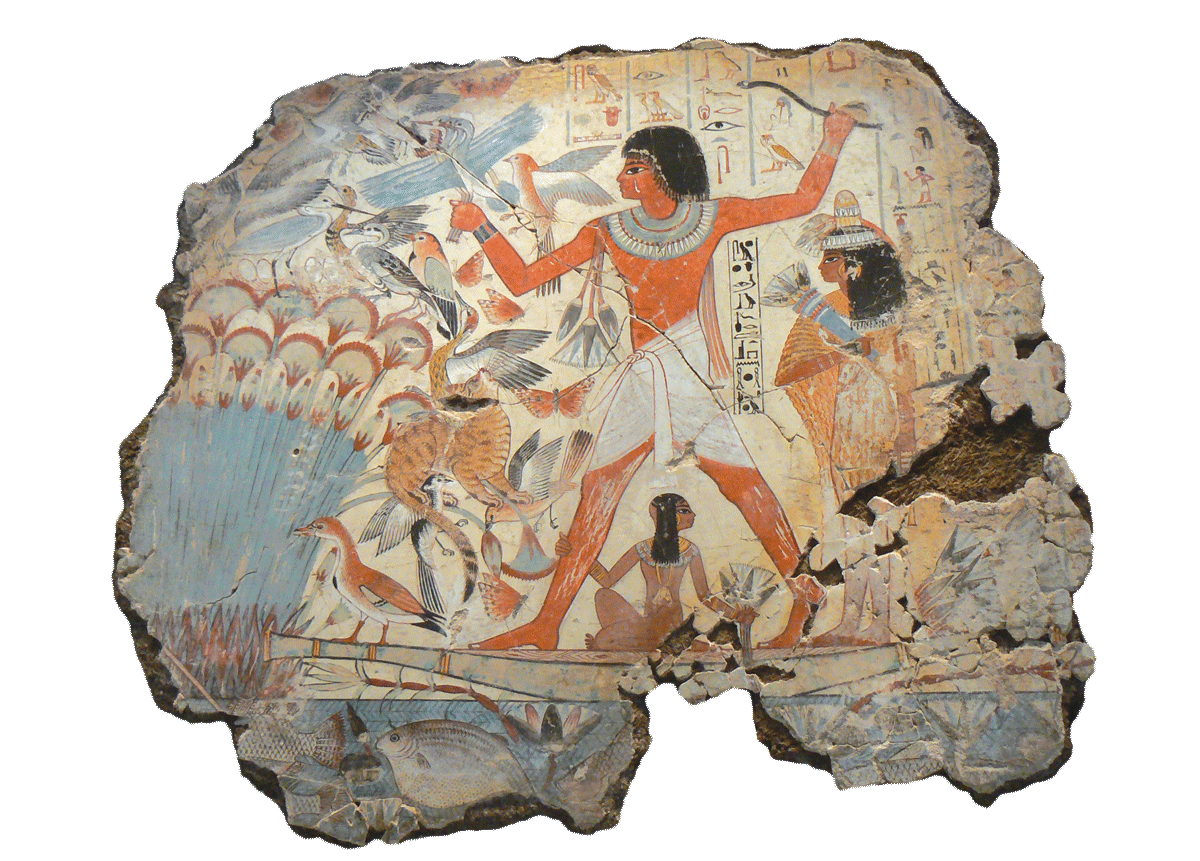
Papyrus plants commonly grew in marshes along the Nile (cf. Job 8:11), as illustrated in this Egyptian painting of a hunt (tomb of Nebamun, ca. 1350 BC).
8:8–10. Eliphaz was the first to appeal to experience, primarily his own (4:8, 12–21; 5:27). Having heard Eliphaz draw on personal experience and having seen Job remain unimpressed, Bildad implores Job to heed experience based on long-standing ancestral tradition. He may well have in mind even the primordial (Deut. 4:32). Job must pay attention to the ages.
8:11–19. This section is not without its interpretive hurdles. What is clear is that Bildad first draws on the image of a withering, water-starved papyrus plant to illustrate the outcome for the impious (8:11–13). But does the next plant imagery (8:16–19) offer a second illustration of the plight of the wicked (Clines 1989, 209–10) or a contrast with the first, describing the enduring nature of the blameless despite a harsh environment (Gordis 1978, 521; Newsom 1996, 402–3)? In favor of the latter is a textual environment where Bildad is contrasting fates (8:4, 20–22). Contrasting the blameless and the wicked with tree imagery is used in Psalm 1 and Jeremiah 17:5–8. Verse 19, an extremely abstruse verse, must be saying, for this interpretation, that the plant survives: “such is the plant’s joy, that from the dust later it will sprout.” The ambiguity of the Hebrew text allows for this. The NIV understands the imagery as a second illustration of the wicked. Though the wicked appear at times to thrive in good conditions (8:16) or when otherwise they should not (8:17), they will be uprooted (8:18) and the area overgrown with other, desirable plants (8:19). If this second interpretation is correct, Bildad seems to have aspects of Job’s life in mind. Wealth and prestige were but for a season. Children are now uprooted, and Job himself will likely be uprooted if he does not return to God.
8:20–22. Here Bildad clearly articulates what his rhetorical questions had in mind in Job 8:3: God does not reject the blameless or strengthen the evildoer. Echoing his earlier plea to call on God to correct the wrong (8:5–7), Bildad, in traditional psalmlike rhetoric and categories, addresses Job directly and again affirms the possibility of a bright, restored future with enemies gone.
18:1–21: Second cycle. Bildad continues to dislike what he’s been hearing. He finds Job insulting. Bildad, with rich imagery, hammers his point that the wicked receive the judgment they deserve.
18:1–4. Bildad, having opened his first speech with “How long?” (8:2), begins his second speech with a similar but more emotive form: “How much more must we listen to insulting speechifying?” Bildad feels belittled by Job’s persistent responses and is sure that Job considers his friends stupid. Bildad addresses Job not with Hebrew second-person singular forms but with plural, a one-time anomaly here—all the friends elsewhere use the singular when they talk directly to Job. Clines lists no fewer than eleven possibilities for this phenomenon (Clines 1989, 409–10). As in his first speech (8:3), Bildad, through rhetorical questions, expresses his outrage over Job’s position, one that insanely would dismantle universal order (8:4). Job clearly considers himself overly important and is overstepping.
18:5–19. Bildad turns his attention fully to the wicked and their ultimate demise, a core value of his universal moral structure. His imagery, in part, taps into light and its absence (18:5–6), entrapment (18:7–10), and scorched earth (18:15–19). Is Bildad describing Job? No and yes. To the extent that Job’s calamity is rooted in impiety, yes, but Bildad’s words focus beyond the mere man to the grander vista of all humanity. The light of the wicked will darken (18:5–6), a common proverbial concept (Prov. 13:9; 20:20; 24:20). The stride of the wicked is hobbled, and their legs lead them into an array of traps (18:7–10). The shortened, lumbering gait makes the wicked particularly susceptible to the myriad of entrapments Bildad mentions—no less than six ways for the lower body to be ensnared.
Bildad then explores death’s assault on and appetite for the wicked (18:11–14). The word “terrors” hedges in this section (18:11, 14). Understanding the Hebrew of verses 12–13 is difficult and allows a different rendering than the NIV’s translation. Pope translates: “The Ravenous One confronts him, Calamity ready at his side. He eats his skin with two hands, First-born Death with both his hands” (Pope, 132; similarly Habel, 280). Bildad likely has in mind common Levantine mythological motifs. In the Baʿlu myth among the Ugaritians living on the northern Levantine coast in the second millennium BC, the god Mot (literally “Death”; the related Hebrew word is used in 18:13) is a ravenous eater, consuming by “double handfuls” (COS 1.86:264–65). Speaking to the goddess ʿAnatu, Mot later boasts, “I went searching. . . . There were no humans for me to swallow, no hordes of the earth to swallow . . . [and then] I met up with Mighty Baʿlu, I took him as (I would) a lamb in my mouth, he was destroyed as a kid (would be) in my crushing jaws” (COS 1.86:270). For Bildad, death devours not Baʿlu but, in similar fashion, the wicked.
Scorched earth and obliteration are Bildad’s next themes (18:15–19). Fire and sulfur burn down the safe haven of the wicked. Sulfur, of course, renders land infertile (cf. Deut. 29:23), the case here with roots and branches withering. The wicked are obliterated from the earth, banished to darkness, with complete extinction.
18:20–21. Bildad steps back and views the scene through the eyes of the global observer. The geographical merismus of “west” and “east” expresses the totality of human existence, much as “heaven and earth” express totality of everything known. The words of Bildad’s summary (18:21) are either his own or his own as expressed through the global observers. The wicked are judged, devastatingly so.
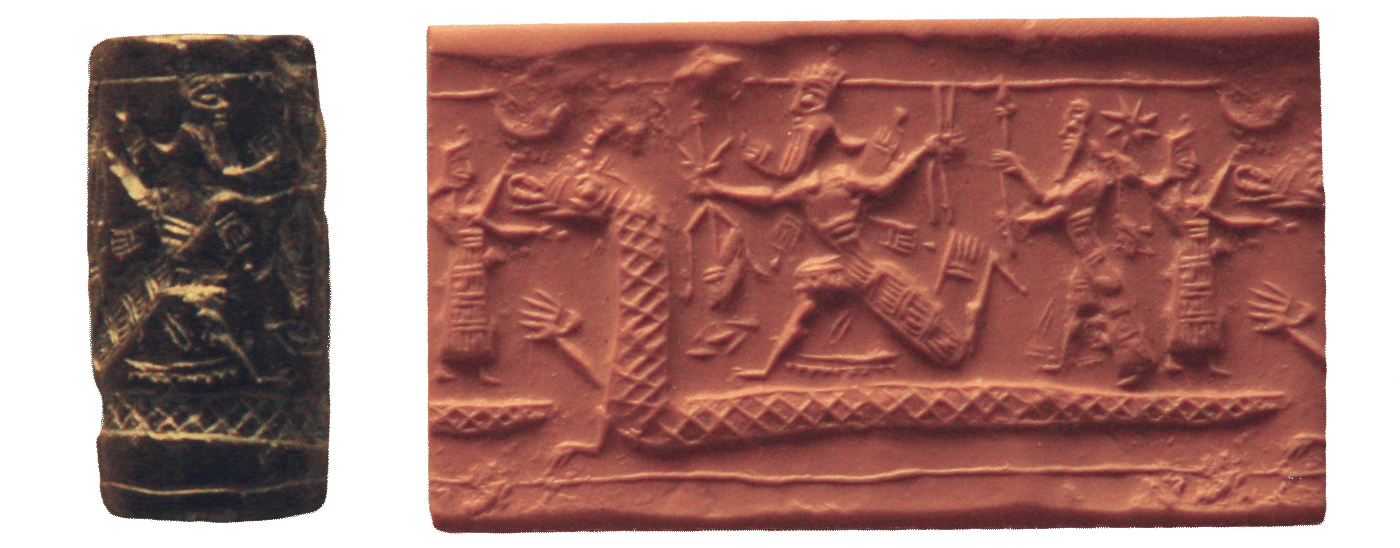
This Neo-Assyrian cylinder seal may illustrate the creation epic, in which the gods fight the chaos monster Tiamat.
25:1; 26:2–4; 25:2–6; 26:5–14 (?): Third cycle. 25:1. We have rehearsed above under “Three Cycles of Dialogue” the reasons for the reassignment of these texts to Bildad. Bildad has just heard Job cry out for a hearing before God himself. There Job would be vindicated, but, Job complains, God is inaccessible and ineffective, if not negligent. The wicked thrive. Job closes with a wish that God would undo the wicked (24:18–25). To those words of Job comes Bildad’s last reply: God is in absolute charge of a predictable world order. Job wishes to stand before God himself? Impossible! No human is pious enough. Awe and dominion belong to God; no maggot human can stand up to that. Bildad would have Job deny human worth and affirm that unflinching absolute power lies at the core of divine essence (Clines 2006, 640).
26:2–4. Eliphaz, early on, was the first to praise Job for his past help and counsel (4:3–6). Bildad, having heard Job undermine traditional understanding and now indict God for cosmic negligence, shakes his head in disbelief. “How is it possible that this man ever helped the powerless and offered sound advice? How is it that he utters what he does?”
25:2–6. Bildad now crafts his theme: the dominion, awe, and order of God. The second line of his thesis statement (25:2b) is literally “maker of peace in his heights.” The NIV has understood this terse, somewhat cryptic line correctly, though the ideas behind it are too easily overlooked. The idea of deities involved in conflict, especially with forces like chaos, is an ancient Near Eastern and biblical backbone. Chaos, as a concept, is in mind here, since Bildad alludes to creation “nothingness” (26:7; NIV “empty space”; the same Hebrew word is used in Gen. 1:2 [NIV “formless”]) and Rahab (26:12–13). Rahab is a chaos monster set among ancient cultural mythologies where creation forces defeat chaos. Leviathan is another such monster, as are Yammu and Tehom. The latter is alluded to in Genesis 1:2 as the “deep” (Hebrew tehom, “primeval sea”) and is cognate with Babylonian Tiamat, the personified primeval ocean that Marduk defeats in the Babylonian creation epic, Enuma Elish. At Ugarit, Yammu (the god of the sea), along with other chaos monsters, is defeated by Baʿlu or ʿAnatu (COS 1.86:248–49). God himself has defeated such forces (Gen. 1:2 and the Genesis creation account as the triumph of order; Isa. 51:9–10; Ps. 89:9–10). This is Bildad’s primary point in the balance of his speech. After painting the canvas with cosmic battle and victory, Bildad turns his attention to Job. Does Job really plan to confront God, this being who defeated chaos and who established world order? Will Job really declare his innocence? The very claim itself, coming from a mortal, is an affront to order and proper understanding. Unthinkable.
26:5–14. Bildad continues to expound on God’s awe and his dominion, particularly over forces of chaos. Bildad first looks down to the netherworld (26:5–6). Sheol (NIV’s “Death” in 26:6) itself cannot escape. There the “dead” tremble. The Hebrew term for “dead” (26:5) here refers to the shadowy dead who reside in Sheol, situated, in the mind of the Hebrew culture, at the bottom of the sea (26:6; Ps. 88:6–7; Jon. 2:2–6). Isaiah uses the term to refer to heroic dead kings (Isa. 14:9). Though Bildad likely has the general inhabitants of Sheol in mind, we could also expect the additional overlay of past heroic figures. Even they quiver. Having looked down below, Bildad looks toward the famous mythic mountain Zaphon, which underlies the NIV’s “northern skies” (Hebrew tsapon). Zaphon is indeed geographically north of Israel, but Bildad’s imagery here is more complex. Mount Zaphon, which lies about thirty-seven miles north of ancient Ugarit, was the long-standing home of Baal and the divine assembly. It was the seat of power. The Hebrew Bible, in Psalms particularly, takes imagery from neighboring cultures and supplants the former deities, for example, with Yahweh as supreme God. Human experience commonly takes cultural icons—established, meaningful ways to understand something—and adapts them. Bildad appears to be saying that God has stretched out Zaphon over chaos (NIV “empty space,” 26:7; cf. Gen. 1:2, “formless”). As Zaphon represents a seat of authority and rule, so God has stretched out dominion over chaotic forces. Additionally, “earth” (26:7), his creation, triumphs over chaos. The pair, Zaphon and earth, seems to be a merism similar to “heaven and earth.”
God has control over rain clouds, life-giving waters that subdue the chaotic powers of destruction (26:8). In Job 26:9, it is unclear whether God covers the “full moon” or his “throne.” The Masoretic Text reads “throne” (Hebrew kisseh), but many suggest, including the NIV, reading “full moon” (Hebrew keseh). Given the underlying concept of Zaphon, Bildad is here saying that God shuts off from view his throne, spreading his clouds over it (so NJPS). God’s base of operation, as it were, is hidden from humanity. The cosmological understanding behind Job 26:10–11 is opaque. The clearest concept is the “pillars of heaven” (26:11), which are likely the great mountains that hold up the sky, known in Akkadian as “the foundations of heaven.” Bildad now turns to the epic battle that most ancients considered at the heart of order and chaos (26:11–13). God has subdued (not NIV’s “churned up”) the sea (Hebrew yam), Rahab, and an elusive serpent. We have already noted the well-known mythologies underpinning these words. One should not avoid seeing the connection between yam here and Yammu at Ugarit (see commentary on 3:1–10). Rahab and serpentine creatures are additional chaotic forces. Isaiah has similar concepts in mind when he says that Yahweh will punish Leviathan, the serpent of the sea (Hebrew yam; Isa. 27:1). Bildad concludes (26:14) that the great cosmic plain he has just described is but the “outer fringe,” the “faint whisper” of what God can do.
C. Zophar’s words (11:1–20; 20:1–29; 27:13–23?). All three friends share a core assumption about Job: he is guilty of sin. But beyond that, they do differ. In the first cycle, Eliphaz grants Job’s suffering as but a hiccup in a near perfect life. Bildad would have Job focus on the moral lesson of Job’s children: they are dead; Job is not. Job is therefore more pious than they but still has within him impurity, which he must address (Job 18). Zophar is straight to the point: sin—so much sin, in fact, that God has even forgotten some of it (11:6). Job must repent of his sin; he then will be restored (Job 11). The wicked have no profit in their endeavors and suffer an inescapable end (Job 20), which Zophar explores further in his third speech (27:13–23).
11:1–20: First cycle. Zophar has a scathing rebuke for Job (11:2–3). He, unlike Eliphaz, after all, has heard more things said by the time he takes his turn. He indicts Job’s self-assessment as a “flawless” person. Job is myopic, Zophar contends, for if God were to respond, Job would hear of the vast depths of wisdom that he obviously has not yet seen. Job would recognize that he is so flawed that God himself has forgotten some of Job’s sin (11:4–6). God is limitless, encompassing all, giving him a vantage point nothing else shares. From that point, God recognizes deceit in humanity, and, to an extent, he sees it in Job (11:7–12). Zophar finishes his speech by reassuring Job that if he expunges the sin within him, he will be restored, made secure again, resting in safety (11:13–19), unlike the wicked (11:20).
11:1–6. “When words are many, sin is not absent, but he who holds his tongue is wise” (Prov. 10:19). Such a traditional proverbial outlook seems to underpin Zophar’s first words to Job (11:2). This generic “truth” he then applies specifically to Job. Job’s prattle, insisting on his innocence, may silence lesser men but not Zophar (11:3–4). If God could speak, he would show Job how shortsighted he is (11:5). Zophar insists that God’s actions toward Job have been tempered by restraint (11:6). Zophar may not here expect that God will indeed appear, but Job increasingly desires an appearance. Remarkably and ironically, when God later does break into the conversation, much of what he says echoes Zophar’s expectations—a display of power and a taunt of Job’s limited understanding.
11:7–12. Zophar develops his theme of secrets and mysteries. On the whole this section has buried within it the kernel of God’s later speeches. Both probe the limitless boundaries of God and his knowledge: higher than the heavens, deeper than Sheol, longer than the earth, wider than the sea (11:7–9). Job, then, must recognize that if placed before the Almighty, he would find that God perceives all and easily ferrets out the deceitful (11:10–11). A case may fall short on human evidence, but God’s evidence will be copious. Zophar then quips out what surely is a clever witticism complete with Hebrew alliteration (11:12), though precisely what it says and what Zophar means by saying it is not entirely clear. The saying contemplates, literally, a “hollow” person’s ability to become learned. After this, things get muddy. One option is that such a person will become wise only when a wild ass is born a human being (NJPS). The NIV represents another direction: that a witless person will no more become learned than a wild donkey will be born to a human. At first glance, Zophar seems to mean that he believes Job incapable of true wisdom. Yet Zophar’s following words encourage Job to pursue the right path (11:13–20). In context, then, Zophar appears to be challenging Job not to be a hollow man.
11:13–20. Zophar’s instruction to Job now follows. If Job can learn from Zophar’s words, he is well on the road away from hollowness. Job must direct himself toward God and expunge all iniquity (11:13–14). With that done, brighter days lie ahead—a response to Job’s imagery at the end of his previous speech in Job 10:22. Restoration and rest are around the corner (11:15–19). But, for the wicked, only their last dying breath awaits them (11:20).
20:1–29: Second cycle. The second cycle of the friends’ speeches has depicted the fate of the wicked. For Eliphaz, that image is what Job is not; Job is not wicked at the core (Job 15). For Bildad, that fate may lie ahead for Job. Bildad’s disturbing depiction of the disastrous end to the wicked seems to trace out a trajectory meant to correct Job’s path (Job 18). For Zophar, that picture is what Job cannot avoid without serious change. In his second speech, Zophar recites conventional words on the fate of the wicked. Hearing no words of remorse yet from Job, Zophar is sure this fate is what lies ahead. He paints a bleak picture, arguably the bleakest among the friends. Zophar first explains his need to respond (20:2–3). He then joins in on the chorus of aged experience (20:4; compare 8:8–10; 15:7–10) to contribute his insights. The wicked are but a flash who suffer utter destruction (20:5–11). With imagery drawn from gastronomy, Zophar concocts the dish of evil’s self-destroying poison (20:12–23). He then draws from imagery of sword and disaster to highlight the unavoidable end that awaits the wicked (20:24–28). His summation is clear: all this happens to the wicked by the hand of God (20:29).
27:13–23 (?): Third cycle. We have rehearsed above under “Three Cycles of Dialogue” the reassignment of these texts to Zophar. Chapters 24–27 are, as we mentioned above, muddled and at face value somewhat out of step with the previous cycles. As it is, Zophar has no third speech, and Job utters words that sound like Bildad’s and Zophar’s. I place this section, warily, within Zophar’s mouth. If indeed he is speaking, we do not hear the customary introductory direct, second-person confrontation. Rather, we hear almost an echo of his previous discourse with imagery very similar to that found in Job 20:24–28. The devastating end of the wicked comes by sword, plague, destruction of home, and terror. Job’s own calamity involved a few of these. Such allusions, and Job’s pain, cannot be underestimated.
D. Job’s words (6–7; 9–10; 12–14; 16–17; 19; 21; 23–24; 27:1–12). Within the first cycle (Job 4–14), Job at first highlights his anguish, his desire to be crushed (6:9), and his displeasure with his friends’ counsel (6:14–23). Job cannot envision a return to happiness (7:7). Headed to the netherworld of Sheol, he is confused as to why God should pay so much attention to humans in general and Job in particular. Job, however, begins to flirt with the idea of a court case with God himself (9:3–4, 19) but quickly muses on the absurdity of a human dealing with the divine (9:32). God is powerful and overwhelming. Insistent on his rightness, Job expresses the shame he lives under, preferring never to have left the womb, an echo from his soliloquy (Job 3). Reacting to charges of guilt by all three friends, Job insists that nonhuman witnesses would attest to his guiltlessness (12:7–9). The real culprit is God, who is powerful and who abuses the world with that strength (12:14–25). Job revisits the notion of working out a case against God (13:13–28) but ends the first cycle focused on the desperation of the human condition, that humans die and reside in Sheol without help (Job 14).
In his first speech of the second cycle, Job graphically details his mistreatment by God (Job 16–17) and yet again looks to a courtroom, becoming increasingly passionate about it. Job speaks of having a witness in heaven, ready to testify on high (16:19). Indeed, this vindicator, this kinsman-redeemer (19:25), will take his place should Job fall to the grave (16:18, 22; 19:26). Job, however, would much rather confront God in person (19:26b–27), a thought he sets aside in his last speech, where he returns to contemplate how the wicked prosper (Job 21).
Job, at the start of the third cycle (Job 22–27), returns to the court case, no longer focusing on a vindicator. Job now insists on seeing God to set out his own case, but he soon despairs. God, he declares, is unfindable (23:8–9). His assertion is no glowing affirmation of God’s sovereignty. Job’s pain is profound. Whatever God wishes, he will do (23:13). Humans be cursed, or at least humans who suffer injustice be cursed, for God, right under his nose, allows success for the wicked (Job 24). This state of affairs verifies that God is derelict in addressing injustice. Until his death, Job will nevertheless maintain his integrity and blamelessness (27:1–12).
6–7; 9–10; 12–14: First cycle. 6:1–7:21. Job will not be silent, and he certainly does not embrace the advice that Eliphaz, with good intention, has offered and suggested he take (5:27). Job first focuses on his plight (6:2–13). He is weighed down with unbearable misery, shot through with God’s poisonous arrows. Job is on his last gasp. He wants to die. Indeed, more in line with the way Job feels about God, he wants God to crush him, to complete the job he started.
Job turns to address his friends, spiritedly throwing accusations at them (6:14–30). He has expected comfort and sympathy; he has received none. Though only Eliphaz has spoken, Job condemns them all for turning their backs on expected loyalty (NIV’s “devotion,” Hebrew hesed). By doing so, they forsake “the fear [pious reverence] of the Almighty”—a very telling statement out of Job’s mouth. This bond should be the foundation of acceptance and support, but frightened by Job’s plight, they accuse him of wrong. Job wants none of it: “Be so kind as to look at me. Would I lie to your face?” (6:28). Job is innocent. The friends should affirm this.
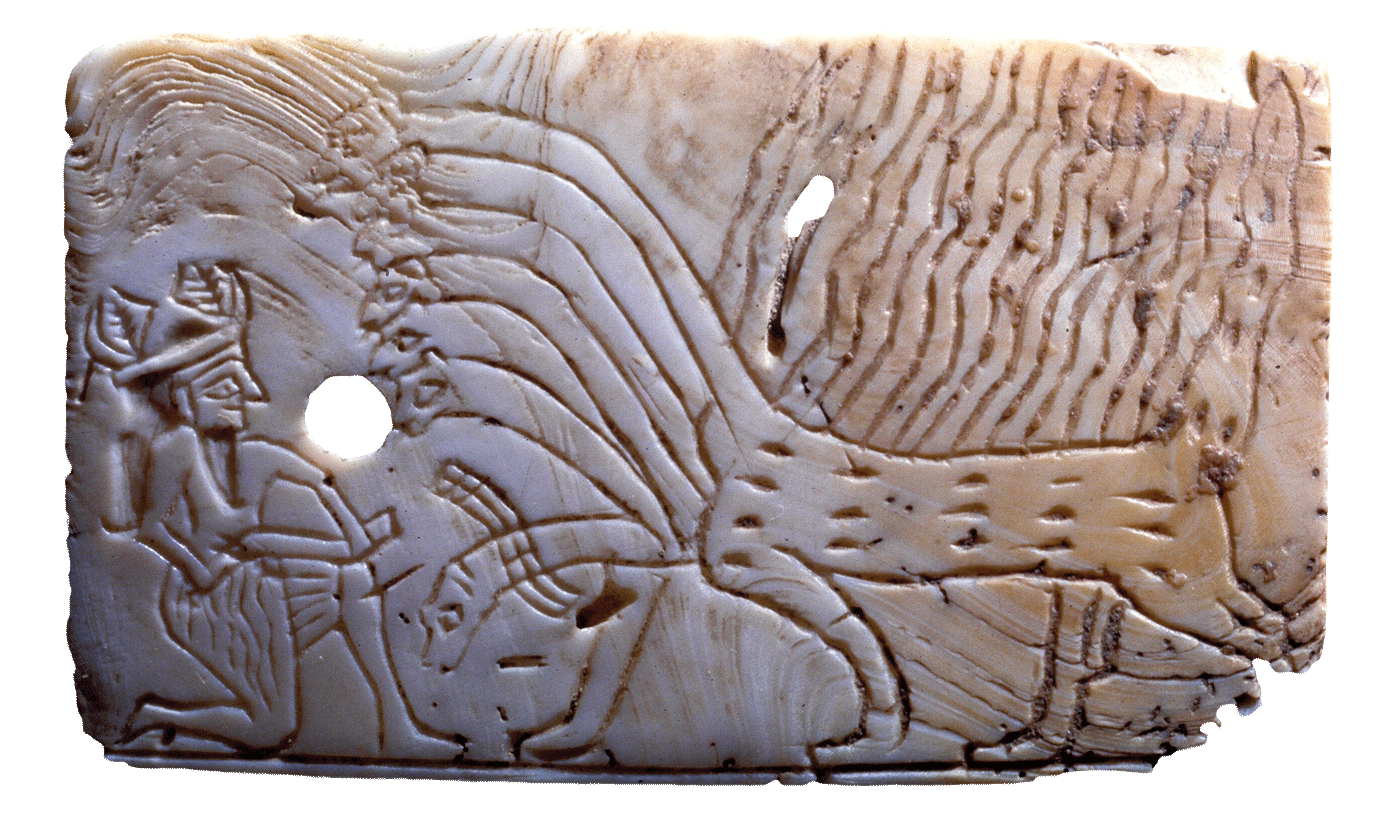
On this inscribed shell, a Mesopotamian god faces a seven-headed monster, one of the chaos monsters related to the sea in ancient Near Eastern mythology.
Job now turns his attention toward God, ruminating on what it is to be a human and his own place as one (7:1–21). Forced labor and hired labor (7:1–2) are the lots of humanity, and his own life drags on through such unsatisfied emptiness (7:3–5). Time, on one hand, may halt, yet he also considers how it swiftly flashes by. This too is his life, a breath quickly over (7:6–10). The stranglehold of futility and mortality forces Job to cry out to God in complaint, asking a fundamentally important theological question (7:11–21): why does God concern himself with humanity? Job revisits the common ancient Near Eastern notion of cosmic battle among divinities (7:12; cf. 3:8). He asks whether he is the “sea” (Hebrew yam) or “the monster of the deep” (Hebrew tannin). At Ugarit, divinized chaos creatures Yammu and Tannin, precise cognate parallels, are defeated. Job’s point is clear. Job is thoroughly unimportant, he is no chaos monster. Why should God be taking him on as though he were? Why is a human worth God’s time? Why does God look so intently on such an impotent figure within the cosmos? Why, if a human should sin, can God not easily forgive?
9:1–10:22. In reply to Bildad, Job’s rhetorical question about a mortal being right before God (9:2) holds the spark of the fire that will increasingly consume Job’s mind (9:2–13). Here he ignites the idea of standing before God in court (9:3), but he quickly lets the flame die down, overwhelmed by the disparity between human and divine (9:4–13). In hymnlike doxology, with motifs paralleled elsewhere in the Bible or the ancient Near East, Job explores the destructive (9:5–7) and creative (9:8–10) omnipotence of God.
A lawsuit with God is impossible. For Job, God is both judge and enemy (9:14–24). There is no higher court, yet this one who hears cases also overwhelms and crushes. God is an oppressive presence, destroying both blameless and wicked, mocking the despair of the innocent. This judge of judges is guilty of subverting justice among humanity, blinding justice in a land filled with wickedness.
Job turns to himself, contemplating how swiftly the days of a life pass and how joyless his are (9:25–35). He then returns to the nagging thought of court. Job truly is a moth to a flame. Job is disadvantaged, condemned guilty by God, frightened silent by his terror. If only there were someone else who could arbitrate justly, Job could speak and defend his innocence. But such is not the case.
Miserable circumstances give a voice to Job (10:1–7). He boldly announces what he will say to God. Through three fields of questioning, Job tries to peel back the motives behind God’s treatment of him. Is God pleased by defrauding his creation (10:3)? Does God have another perspective of right and wrong, different from humans (10:4)? Does God live under a constraint of mortality, a brevity of his own life, that he is so quick to target Job (10:5–7)?
Job is himself a creation of God (10:8–17). Why would God seek so hard now to destroy him? God’s intent all along, despite showering favor in the past (10:12), was to create a being to be scoured for sin (10:13–14). Job highlights his affliction and God’s aggression.
Overwhelmed with despair over a God he believes responsible for willful barrages and attacks, Job echoes earlier thoughts (10:18–22). He wishes he had never been born, but having been born, he wishes God would turn away, to grant Job a moment of joy before he slips away into the gloom and shadow of death.
12:1–14:22. Job’s final speech in the first cycle, divided into three chapters in the Hebrew Bible, can also be split into two major sections: Job addresses his friends (12:2–13:19), and Job addresses God (13:20–14:22).
Job is sharply sarcastic toward his friends as he opens his mouth (12:2–13:19). Oh, yes, they understand everything! But Job is no dolt. He knows no less than others. He seems to recognize that, from others’ point of view, his situation has turned him into a laughingstock. Contempt quickly replaces respect among those who witness the fall of a respected person (12:5). Job further digs at his friends’ notion that they know more than he (12:7–10). In parody Job parrots their style and counsel, even using second-person singular deixis (“you” singular), which the friends use when they speak to Job. Job parodies their argument: even simpleminded animals know that God is judging you, Job. Job continues his platitudes by reciting what appears to be a well-known proverb (12:11). Elihu too will quote this saying (34:3), which also appears in similar form in Sirach 36:24. As the palate (NIV “tongue”) discriminates between what is tasty and what is not, so the ear judges and assesses the arguments it hears. The point of the proverb, uttered within its contexts, is to invite the hearer to agree with the speaker. The friends, of course, are being attacked by Job’s parody of them: agreeable voices speaking from age and the ages (12:11–12). Having caricatured his friends’ counsel, Job turns to hymnic rhetoric, with a negative spin (12:13–25). Through the language of doxology—praise to God and his ways—Job cuts away at the traditional wisdom that lies at the heart of his friends’ counsel. Job’s own voice and nonsatirical comment is heard in Job 13:1–2, which is best linked with what has been said in chapter 12. Job’s eyes and ears have encountered all this knowledge and wisdom, and forming an inclusio, Job repeats what he said earlier: what you know, I know; I am not inferior to you (13:2; 12:3). Yet, for Job, this brand of wisdom does not account for his situation. His is different, and no small part in the issue is that the friends misrepresent God and his ways (13:3–19). The friends smear Job with lies (13:4), but based on Job’s following comments, the lies are not so much about Job as about God (13:7–12). Job believes he is speaking honestly about God, and emboldened by his belief that the friends speak deceit, he demands that they remain silent. He, meanwhile, is ready to appear in court.
Job now addresses God directly (13:20–14:22). A day in court is possible for Job if God would withdraw his overpowering, oppressive presence. In a less intimidating, more neutral courtroom, there Job presents his case. “What wrong have I committed? Why do you treat me the way you do?” Job’s legalese fades as we encounter his words in 14:1–22. Job’s query about God’s treatment of him has blossomed into contemplation on the desperation of the human condition, that one eventually dies and resides without help in Sheol. Sheol here is not the comfort that it was to Job earlier (3:13–19; 7:8–9), a place where he will rest and be far from God. Sheol is now the problem because Job wishes at present to confront God. Sheol will deny Job that satisfaction. We face imagery of Job’s impotence in relation to God. Humanity is a fragile flower (14:2). Though human hope be cast as a mountain, God embodies all the forces that erode it to nothing (14:18–22). Does the very image of human hope as a substantial geological feature shed light on Job’s psychological disposition, his own growing tenacity to get at God, his own hope? Perhaps so, for Job will thunderously continue to insist on meeting up with God. Yet he clearly holds this hope in tension with his perception of a God who, through death and the underworld, is separated and alienated from humanity.
16–17; 19; 21: Second cycle. 16:1–17:16. Eliphaz has just argued that Job is arrogant in his rejection of conventional wisdom, that it is the wicked who suffer torment, distress, and ruin and receive it in full (15:32). Job’s opening remarks (16:1–6) ridicule his friends: “Will your long-winded speeches never end?” (16:3). He too, if he were in their shoes, could say the same things they say, but now that he recognizes the devastation of his life and his exception to the rule, he would be more encouraging than they. His friends are no friends.
Job’s alienation from the traditional response about calamity is potently seen in his address now directly to God (16:7–17). Job takes up, understandably, a lament similar to his opening soliloquy (Job 3). In rhetoric similar to that of Lamentations 3:1–20, Job describes himself as a persecuted and oppressed man. The persecutor, the enemy, is God himself. This powerful lament is painted onto the canvas with images of aggression drawn from beasts, swords, arrows, and warfare.
But, at a point where lament is elsewhere known to re-embrace God, rediscover hope, and extol God’s goodness (Lam. 3:21–39), Job cries out, as though in court, for his blood to be avenged and for an advocate to vindicate him (16:18–21). Job is in no frame of mind to make nice.
His urgency is rooted in his assessment that he has little life yet to live, and once dead he will never again have an opportunity to face God (16:22–17:16). In these verses Job expresses the one thing about which he is certain—his death. His words convey hopelessness mixed with criticism for his friends and the view they express.
19:1–29. Though Job seems to jab right back at Bildad by opening with Bildad’s own first words from his previous speech, “How long” (19:2; cf. 18:2; NIV does not reflect the precise repetition in the Hebrew), Job, as is now the pattern, has all the friends in mind (19:1–6). The friends continue to grieve, humiliate, and abuse Job. The friends’ abuse, however, is matched by God himself (19:7–12). Job, again using figurative images of assault (cf. 16:7–17), utters a lament of God’s mistreatment of him.
As Job continues his lamentation, the shift from figurative language now arguably to nonfigurative lays out another level of pathos (19:13–20). He is literally without family, friends, and household. He is in reality repulsive to look at. Once an elder commanding respect through the East, he is scorned now even by children. Job’s point is that he is truly pitiful (19:21–22). God himself has struck him down. Why then should the friends persist in their insatiable quest of maligning Job?
We encounter here one of the most well-known and cited of Joban passages (19:23–29), its popularity contributing one more layer to the many layers of encumbrances that surround it. The text itself is difficult. A “Christianization” of the text has led to notions of Christ as Redeemer. The NIV’s capitalized spelling of “Redeemer” reflects that line of thinking and plays no small role in perpetuating it. Christian interpretation, further, has found here “proof” for bodily resurrection. But there is another way to view these verses. Job has become increasingly frustrated that he has no access to defend his case before God, a theme heard in his last speech (16:18–17:16). There as well, Job has teased out the notion of a witness in heaven, an advocate (16:18–21). To that thought, to that wish for a supporter on high, Job now adds a belief that, should he die without facing God, his “kinsman-redeemer” (Hebrew goel; NIV “redeemer”) will take his case and confront God. The goel—an Israelite sociological phenomenon—is a near relative whose role is to assist a family or family member in dire straits. Whether the distress was lost property (Lev. 25:25–28), murder of a family member (Deut. 19:6–12), or lack of progeny (Deut. 25:5–10), the goel was to correct the situation. This “family advocate,” this “righter of wrongs,” is what Job has in mind. The identity of this goel is not clear, but a more important aspect is the goel ’s function. In Job 19:25–26a, Job states his confidence that his goel is alive and ready to take up Job’s cause in the (likely) event of Job’s death. Job’s preference, though, is expressed in 19:26b–27. Job, while still alive (NIV’s “in my flesh”), would rather stand before God to defend himself. The NJPS captures these lines well:
But I know that my Vindicator lives;
In the end He will testify on earth—
This, after my skin will have been peeled off.
But I would behold God while still in my flesh,
I myself, not another, would behold Him;
Would see with my own eyes:
My heart pines within me.
Job has been developing this thought about an advocate. These verses are the strongest expression we hear from him. Job hereafter will never again mention such a figure. Here on out, when Job returns to the courtroom with God (Job 23; 31), he speaks only of wanting to be in front of God. Though he is confident that his case will be heard in court one way or another, Job yearns for a face-to-face confrontation!
21:1–34. In the second cycle of speeches, the friends have focused on how the wicked are treated according to their tradition-inspired insight. Job, up to now, has focused on his own dire circumstances and his wish to confront God directly. Here he turns to the topic his friends have been addressing. But his voice is a counterpoint: the wicked prosper!
Job addresses his friends with an appeal to listen (21:2–6). The thoughts he is about to articulate are bold and shocking. They undermine the moral order as it is understood by conventional wisdom, the position of Job’s friends. Job himself trembles at the implications.
The wicked live on in prosperity (21:7–16). They live to old age, seeing generations of children. They are secure, never feeling God’s judgment. They enjoy life thoroughly and consciously reject God and God’s ways. God does nothing.
What tradition affirms as a rule Job offers as exception (21:17–21). For tradition, even if in one generation a wicked person does not receive full retribution, the next generation will. But Job will have none of that. His prayer is that the wicked should receive punishment here and now. Even if the doctrine of retribution were true, it would be irrelevant, for death is the great equalizer (21:22–26). In death everyone experiences the same fate. Everywhere it is common that evil prospers in life and enjoys reputation in death (21:27–34). This is universally true, claims Job. One simply needs to ask the traveler.
23–24; 27:1–12: Third cycle. 23:1–24:25. Job’s previous speech (Job 21), where he challenged conventional wisdom, was a pause from the crescendo of his desire to stand before God. In these chapters, Job returns to the elusive courtroom.
Job has earlier expressed his confidence in a vindicator (16:18–21) or kinsman-redeemer (19:23–29) to prosecute his case after his death. But Job wants none of that now (23:2–7). Perceiving no activity on God’s end, Job realizes that he must be the one to track down God. But whether Job goes east, west, north, or south, he cannot find him (23:8–12). Though God is hidden from Job, Job confidently asserts that God is nevertheless well aware of him. God knows full well that Job is guiltless despite God’s treating him as though he were not. To Job’s mind, however, God does whatever he pleases (23:13–17). Job’s words are not a glowing affirmation of God’s wonderful omnipotence. Job feels hopeless, terrified of this being and the treatment Job has received from him.
Job has focused on himself as an inhabitant of a moral world where God has gone missing. He turns now to consider the many others who suffer and cry out for justice (24:1–17). In his previous speech (Job 21), Job’s point was that prosperity among the wicked is proof of a God-abandoned, topsy-turvy moral world order. Here his proof is the way the wicked are able to prey successfully on the poor and powerless. The examples Job amasses are not about religious apathy or syncretistic worship. God’s abdication is proved through a myriad of heinous acts of social injustice and social oppression.
Verses 18–25 are sometimes reassigned to one of Job’s friends. Those who understand the verbal mood as declarative (a declaration that God undoes the wicked) consider these verses to be out of step with Job’s disposition and more akin to the attitude of the friends. But the grammatical mood of the language is not declarative, as the NIV translates; rather, it is optative (a hypothetical projection or wish; see NJPS). Job continues to speak here. He is not declaring that God undoes the wicked but wishing that God would. Having painted a canvas with bloodred strokes of injustice and criminality, Job attempts in these verses to paint a serene landscape as he wishes it would be. But that landscape is not a reality. His final words that boast the truth of his viewpoint are a defiant challenge to his friends.
27:1–12. Job continues in the vein of his words in 23:8–12. Through a series of oaths, Job defends the integrity and veracity of his position. He is right and righteous and is therefore unwilling to agree with his friends’ position. Job launches an imprecatory attack on any enemy who would continue to assail him and ends his speech intent on instructing his friends on God’s ways, criticizing them for their “meaningless talk,” or nonsense.
4. Wisdom: Where Is It? (28:1–28)
The reader encounters here magnificent literary art, but there is no consensus on how it interacts with the book as a whole. At face value, of course, this chapter is a continuation of Job’s speech, but therein lies the dilemma. The contrast of this chapter when compared to what Job has been saying and what he will shortly say (Job 29–31) is striking. Does it belong better in the mouth of one of the friends? The common reply is no, for it seems to lack their characteristic rhetoric and the focus on retributive justice so interwoven within their responses.
The suffering Job, with his wife and a friend standing nearby (sarcophagus of Junius Bassus, AD 359)
By all accounts it appears to be a self-contained reflection on wisdom and where one may find it. The impasse between Job and his friends has increasingly heightened. One wonders whether the storyteller is here sending down a sounding to find our bearings. None of the characters has yet found wisdom. We have seen firsthand the limitations of human understanding. The storyteller therefore embarks, in Greek choruslike fashion, on a contemplative musing about wisdom.
The poem opens by considering earth’s precious metals and stones and the valiant attempts of humans to mine them (28:1–11). The human quest to extract earth’s valuable nuggets serves as a foil for the rest of the poem, which explores human failure, in contrast to God’s success, to mine wisdom. Verses 12–27 form two parallel structures: 28:12–19 and 28:20–27. Each unit opens with essentially the same rhetorical question (28:12, 20), followed by a declaration that neither humanity (28:13, 21) nor deified cosmic realms (“deep,” “sea,” “destruction/Abaddon,” and “death”; 28:14, 22) can locate and dig out wisdom. The first unit then explores how wisdom cannot be bartered for the earth’s wealth (28:15–19). The second unit, in contrast, affirms God’s access to wisdom, encountered first in the act of creation (28:23–27).
The reflection ends (28:28) with the most traditional of clichés (Prov. 1:7; 3:7; 9:10). What is the point at this moment in the story? Norman Habel offers insight (Habel, 392–93). The cliché surely cannot be the final word to Job’s dilemma, for “reverence” (Hebrew yirah; see commentary on 4:2–6) toward God has not given Job, in this instance, insight to understand his crisis. The friends have maintained, particularly Eliphaz in Job 4:6, that pious reverence (yirah) confidently invites God’s favor. Not only has Job vigorously argued against the traditional understanding, but he himself has teasingly admitted his rejection of traditional reverence of God (6:14). Job is not buying the cliché.
The cliché, further, echoes the opening line of Job (1:1). There Job “feared God and shunned evil.” In Job 28:28, the fear of the Lord is wisdom and to shun evil is understanding. But clearly neither reverence of God nor shunning evil protected Job or gave him insight into his predicament. In fact, Job’s following words (Job 29–31) rehearse the life of a man who shunned evil but has received it in immeasurable quantity. Thus the storyteller seems to offer up the cliché as a foil. The traditional cliché is not acceptable to Job. Piety and avoidance of evil have not resulted in wisdom and understanding. Job has wanted and will continue to want justice and direct access to God.
5. Job’s Closing Soliloquy (29:1–31:40)
After Eliphaz, Bildad, and Zophar’s contributions to the story, Job longingly recalls the good days of old (29) as contrast to his present social and physical maladies (30), strongly insisting on his innocence (31).
29:1–25. Job recalls grand days of his past. He recounts his flawless conduct and God’s constant favor. We journey with Job, this honored and revered figure, as he moves from his family circle (29:2–6), outward to his seat among the nobles at the city gate (29:7–11), to his fatherly care for the marginalized within his society (29:12–17). He anticipated a long, full life (29:18–20), devoted to enhancing life for others (29:21–25).
30:1–31. Having listened in on Job’s self-assessment of days gone by, the reader is now in a position to understand more clearly Job’s social, psychological, and physical suffering. Job turns to his present, awful circumstances, structured rhetorically through the repetition of “now” (30:1, 9, 16) and “surely” (30:24). Job speaks with layered pejoratives against those at the bottom of the social order who now have nothing but derisive contempt for him: young lads born to the dogs of society, banished like thieves, huddled in underbrush, eating broom root (30:1–8). Their contempt for Job has led to mistreatment (30:9–15), and Job laments the painful atrophy of body and life (30:16–19). Job cries out to God, declaring him cruel and savage (30:20–23) and expressing his disbelief that such evil could befall him (30:24–31).
31:1–40. Job now turns to defend his position with a testimony of integrity similar to those found in Egyptian mortuary texts, where the deceased, speaking to Osiris and other gods, lists offenses that the deceased has not committed. Job’s integrity is seen through the transgressions he is not guilty of committing. He expresses a series of oaths grouped by topic. The form throughout is a variation on “If a has done b, may c happen to a” (for example, 31:7–8). The first group of oaths focuses on sexual ethics (31:1–12), the second on social justice (31:13–23), the third on avoiding misplaced loyalty (31:24–28), and the fourth on offenses that would erode social fabric, such as gloating over an enemy’s misfortune or failure to extend hospitality to a stranger (31:29–34). Job metaphorically signs this writ of oath (31:35), wanting nothing less than a hearing with God himself (31:35–37). Job has done nothing wrong. And, as if adding a postscript of yet one more thing just remembered, Job utters his last oath centered on ecological stewardship (31:38–40). Job’s speeches end here.
This chapter helps to validate further what Job knows about himself and what the reader knows through the narrator: Job is a pious man of honor. The values that Job upholds are also values that God holds dear. The reader can see this common ground between Job and God, one that could serve for reconciliation and resolution. But God does not choose that path, leaving the reader with a story line that “challenges many of Job’s assumptions about God and the relationship between God and the world” (Newsom 1996, 551).
Elihu? Has he been here the whole time? He is not one of the three friends introduced in the prologue, and he is not mentioned in the epilogue. Yet from his own words he has been nearby and listening in, remaining silent in the presence of men older than he. But now he can no longer restrain himself.
We have seen above under “Composition” that many think the Elihu character is a late insertion. Not mentioned earlier or later by the narrator, and not acknowledged by human characters or God, Elihu admittedly has the earmarkings of a surgical insertion. Be that as it may, he is alive and well in the version before us, and we must reckon with him and his words at this juncture.
Elihu, as a character, is young, brash, self-important, and dogmatic. Many find him quite unlikable. Elihu, as a speaker in the story, though, stands as a Janus-like figure, facing back to comment on what has been said, and facing forward, anticipating some of God’s rhetoric. Elihu pushes back against the four. Suffering is not always caused by sin, argues Elihu against the theology of Eliphaz, Bildad, and Zophar. Rather, through two means—dreams and illness—God can speak to humanity to guide them along a better path. Turning slightly to Job, Elihu does not accept the former’s claim that God is unjust. And turning in the opposite direction to face what is about to come, Elihu speaks of God’s mystery, unknowable motives, and ways in creation and nature. In comparison, Job is powerless and ignorant. Elihu’s final description of theophany heralds God’s entrance into the story at Job 38.
7. God’s Speeches (38:1–41:34) with Job’s Responses (40:3–5; 42:1–6)
The polyphony in the words and ideas that have cut across the respective characters’ monologic points of view grinds nearly to a halt with God’s thunderous voice. Job finally gets to stand before God. The wish is granted. But, teasingly, this will be no dialogic interchange. This is monologue. God has a different set of values, other premises than those held by Job. God’s barrage of questions, though in the form of an invitation to dialogue, are here rhetorical and meant to silence, the outgrowth of confronting one whose words are “without knowledge” (38:2).
Commentator upon commentator explores the conundrum of whether God’s speeches engage Job’s arguments, and if so, how. Has God really answered? If he has answered, has he answered in full or suitably? Job is certainly, in a sense, left speechless. Is that because he has heard a satisfying response or because he has been crushed into silence?
38:1–38: God. God appears out of the storm to confront Job. God will be doing the talking now, the accumulative effect of which is overwhelming. The rhetorical “Who?” “Where?” “Have you?” “If you know, tell me,” pound at Job. Does Job truly understand the cosmos: earth’s structure (38:4–7); the forces of the sea (38:8–11); dawn (38:12–15); the depths of the sea and the gates of death (38:16–18); light and darkness (38:19–21); storm (38:22–30); the movement of constellations (38:31–33); the control of weather (38:34–38)?
38:39–39:30: God. Abruptly God turns his attention to wild animals: lion (38:39–41); mountain goat and deer (39:1–4); wild donkey (39:5–12); ostrich (39:13–18); war horse (39:19–25); hawk and eagle (39:26–30). Understanding the ways of such creatures is beyond the human.
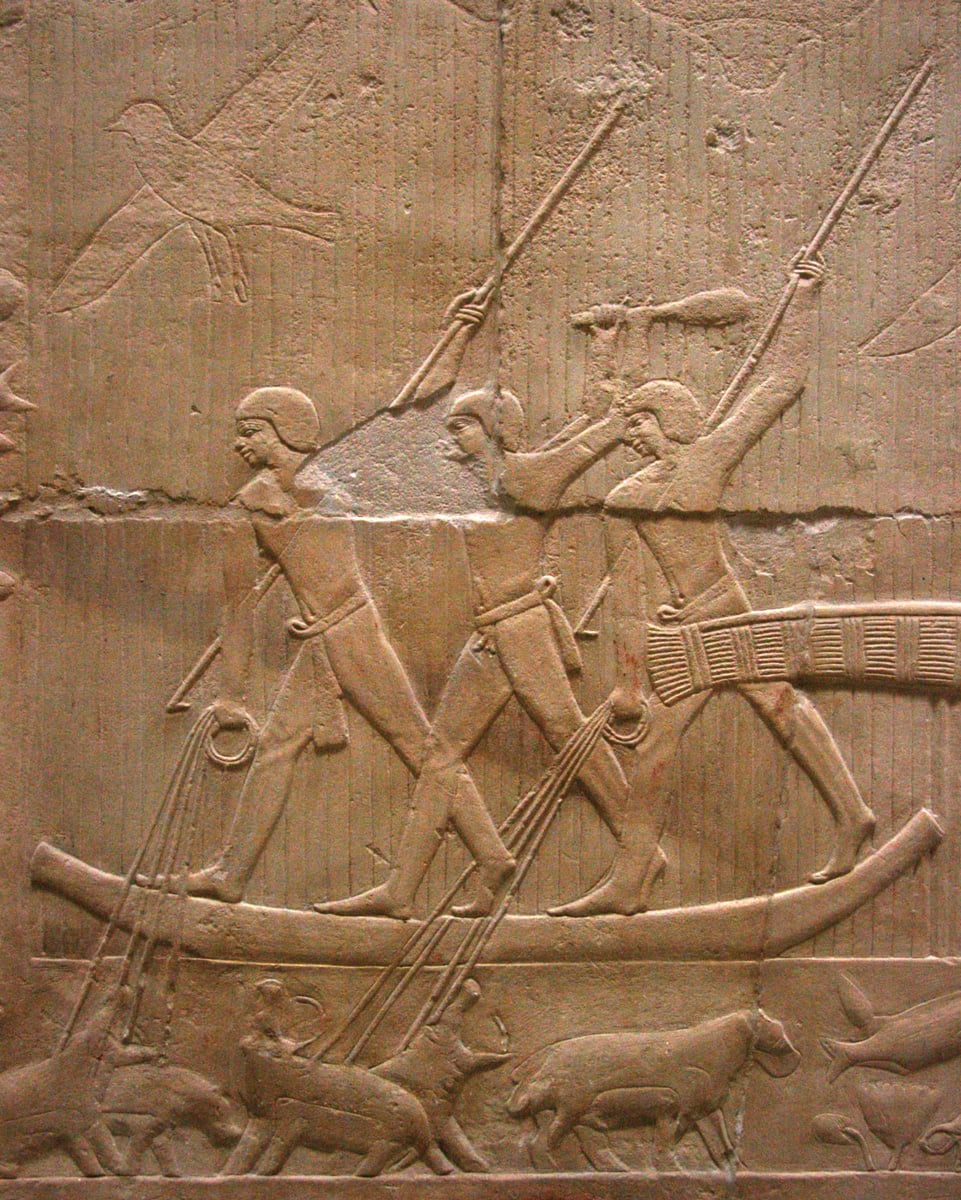
Hippopotami on an Egyptian relief (tomb of Ka-Gemni, Saqqara, 6th Dynasty). The Behemoth in Job 40 may be a hippopotamus.
40:1–2: God. God has held the cosmos and wildness of nature under the light of scrutiny to explore the mystery beyond human understanding. God now demands an answer from Job.
40:3–5: Job. One might expect the disputation to begin here in earnest. Job has wanted this moment to stand and to plead his case before God. Four words are all Job needs to signal his complete and utter withdrawal (40:4). The white flag of surrender is buoyed by the action of clapping his mouth shut with his hand.
40:6–14: God. God’s second speech begins with a challenge. Job is again told to brace himself in the face of what will be a second wave. God, through the rest of his speech, will again direct Job to consider animals. But here they are two great creatures, one of land and one of sea: Behemoth and Leviathan.
40:15–24: God. In form, Behemoth (Hebrew behemot) is nothing more than a plural of the Hebrew word for “animal” (behemah). Yet, from Job’s context, this is a beast and one that is particularly powerful and awesome. The storyteller may well have crafted this word specifically for this story. From the description, Behemoth may be a hippopotamus, connected in Egypt with the deities Seth and Horus. Behemoth may also be a water buffalo or related to the bull figures so prominent in Mesopotamia. Or Behemoth may be a literary fiction, drawing from well-known imagery but representing a sort of everybeast of a type that complements Leviathan. Behemoth, a creation of God, as is Job (40:15), is a primordial beast of calm repose, approachable only by its Maker. God’s query whether one can catch it provides the segue to the next creature.
41:1–34: God. Can Job catch Leviathan? Likely not a crocodile, Leviathan is a creature of epic mythic presence (see commentary on 3:1–10). Leviathan is a wild, chaotic force, and, whereas Behemoth evoked images of repose, Leviathan is fierce, fearless, menacing, and violent. God ends his second speech by describing this beast as one who looks down on all who are arrogant and proud (41:33–34). This is shocking to the common conception that Leviathan, as chaos, is to be thwarted and defeated. Here the creature is celebrated for its well-deserved pride.
42:1–6: Job. Job can do nothing but confess his unworthiness and lack of understanding. But Job’s last words (42:6) are anything but clear. Job may be saying any of the following, and choosing one over the other depends on how one understands God’s speeches and Job’s reaction:
- I despise myself and repent (sitting) on dust and ashes—an act of humbleness (so NIV);
- I take back/retract myself (my words) and repent on dust and ashes;
- I now reject and forswear dust and ashes—Job now rejects his symbols of mourning;
- I retract my words and have changed my mind about dust and ashes—Job has changed his mind now about the human condition;
- I retract my words and am comforted about dust and ashes—Job is at peace with the human condition;
- I recant and relent being but dust and ashes—being human and not God he thus now understands that he must recant (so NJPS) (Newsom 1996, 629).
What does one make of these speeches? Just how is God answering Job? Newsom’s insight is worth our time (Newsom 2003, 239–41, 252–56). God and Job are vastly different. Their respective understandings of reality are worlds apart. Therein lies a problem. Job’s voice, especially in his closing soliloquy (Job 29–31), and God’s speeches stand in contrast to each other, perhaps in contest with one another. The space and territory each occupies affects their respective outlooks. (1) Even though God has not appeared to Job, Job nevertheless views God as looking in on him and humanity (31:4, 6, 14–15). God is “with” Job, though not physically. But God abolishes the notion that Job is truly with God (“Where were you?” 38:4). God purges Job from attendance at and knowledge associated with the foundations of the cosmos. Job is not close to God. (2) God’s and Job’s spaces are vastly different. Job’s sphere has centered on his family, his friends, his land, and his place in society. God’s space, in his speeches, has reached to the remotest portions of the cosmos: earth’s foundations, primordial sea, gates of death, and storehouses of weather.
The accumulative weight of God’s focusing on the wild and the chaotic is also key. The friends and Job, ironically, have both affirmed moral order, though in different ways. The friends are rooted deeply in the traditional paradigms of order related to punishment and reward. Job’s view of moral order underpins his cry to confront God with charges of derelict behavior. Job has expectations, rooted in his understanding of God’s orderly nature. God, rather, highlights the feral and chaotic. God crescendos to Leviathan, the epitome of chaos. Throughout, God appears not to be condemning or engaged in thwarting these forces. Disconcertingly, he seems to be celebrating them.
We are left at the very end with God, Leviathan, and Job. Perhaps we should see the latter two as antithesis, each representing but one aspect of the totality of existence. Neither order nor chaos alone is the full image. Most telling is the celebration of Leviathan’s pride (41:33–34), the very last words of God. Leviathan is not here humbled. Job is! Job’s pride has been addressed and dismantled. That pride, as Newsom has argued, characteristic of all humanity, is the expectation of and demand for order (Newsom 2003, 252). Job, in his last full speech where he rehearsed his days of orderliness compared to his present chaos (Job 29–31), voices the human drive for order, control, and safety, particularly for those close to us—the motive behind Job’s sacrifices on behalf of his family. His, and ours, is a passion to thwart or deny the tragic. The expectation, now seen as the arrogance, that everything should be orderly and go well underlies the crushing devastation one feels at the catastrophic, the appalling, the dreadful, and the awful. The image of Leviathan—the uncontrollable—exposes the human self-deception about order. Order and chaos are antithetic complements of existence. They are opposites, yet they are complete-ments. Job falls silent. He understands this now.
Herein is irony. Zophar, early on, argued that if God could speak, he would show Job how shortsighted he is, how atrophied his understanding of universal truth is (11:5). Of course, Zophar expects God to bring Job around to the friends’ understanding of truth. But Zophar’s view is every bit as gaunt as Job’s. All the friends have missed the mark, measured by God’s words. God’s condemnation of them is understandable. They have understood only the orderly side of life.
When Job finishes his last word, the storyteller moves to the epilogue (see commentary on prologue), and, as mentioned before, we encounter dissonance. Both Job and friends have spoken from half-full perspectives, and Job has earlier claimed that God is derelict about injustice (Job 24). Yet the friends are rebuked, and Job is exonerated. Why this is so is not crystal clear. The bookends alone give us a story arguably more simple. The bookends with the poetic core throw complexity our way.
It is understandable to feel frustrated. We leave the book uncertain why a heavenly dare had to be so cruel to Job and why the book, in its epilogue, reaffirms the principle of retribution, for which the friends have argued, against which Job has fought, and which God has declared an atrophied understanding of life. The book and its insights elude neat tidiness. We want clear answers, ready answers in life, and we especially want them from the Bible. But the elusive answer is biblical, seen elsewhere in the parable, particularly as used by Jesus, and the riddle (e.g., Prov. 1:6).
With the whole book in mind, the return to order in the face of God’s contemplation and celebration of the wild and chaotic severs monologic understanding of the book. There is chaos, and there is order. Both forces play out. But taking a clue that only the “Maker” can approach the chaotic force that is Behemoth (40:19), the book acknowledges that God somehow stands beyond the grip of such forces.
Think about Job and ourselves as readers. Consider where we were in our respective understandings at the beginning of the story. We have journeyed far. And though the book has decided on a “happy ending,” that is not the sum total. The journey through competing polyphonic ideas and ideals that remain in tension has Job and us leave as different people.
Select Bibliography
Albright, W. F. “Northwest-Semitic Names in a List of Egyptian Slaves from the Eighteenth Century B.C.” Journal of the American Oriental Society 74 (1954): 222–33.
Bakhtin, Mikhail. Problems of Dostoevsky’s Poetics. Theory and History of Literature 8. Translated and edited by Caryl Emerson. Minneapolis: University of Minnesota Press, 1984.
Carson, D. A. “Mystery and Faith in Job 38:1–42:16.” In Sitting with Job: Selected Studies on the Book of Job. Edited by Roy B. Zuck. Grand Rapids: Baker Books, 1992.
Childs, Brevard S. Introduction to the Old Testament as Scripture. Philadelphia: Fortress, 1979.
Clines, David J. A. Job 21–37. Word Biblical Commentary. Nashville: Thomas Nelson, 2006.
———. “Job’s Fifth Friend: An Ethical Critique of the Book of Job.” Biblical Interpretation 12 (2004): 233–50.
———. Job 1–20. Word Biblical Commentary. Dallas: Word, 1989.
Dhorme, E. A Commentary on the Book of Job. Translated by Harold Knight. London: Thomas Nelson and Sons, 1967.
Gordis, Robert. The Book of Job: Commentary, New Translation, and Special Studies. Moreshet 2. New York: Jewish Theological Seminary of America, 1978.
———. “The Significance of the Paradise Myth.” American Journal of Semitic Languages and Literatures 52 (1936): 86–94.
Guillaume, Philippe, and Michael Schunck. “Job’s Intercession: Antidote to Divine Folly.” Biblica 88 (2007): 457–72.
Habel, Norman C. The Book of Job. Old Testament Library. Philadelphia: Westminster, 1985.
Hurvitz, Avi. “The Date of the Prose-Tale of Job Linguistically Reconsidered.” Harvard Theological Review 67 (1974): 17–34.
Janzen, J. G. Job. Interpretation. Atlanta: John Knox, 1985.
Newsom, Carol A. The Book of Job: A Contest of Moral Imaginations. New York: Oxford University Press, 2003.
———. “The Book of Job: Introduction, Commentary, and Reflections.” In The New Interpreter’s Bible. Edited by Leander E. Keck. Vol. 4. Nashville: Abingdon, 1996.
Phillips, Elaine A. “Speaking Truthfully: Job’s Friends and Job.” Bulletin for Biblical Research 18 (2008): 31–43.
Polzin, Robert. “Framework of the Book of Job.” Interpretation 28 (1974): 182–200.
Pope, Marvin H. Job: Introduction, Translation, and Notes. Anchor Bible. Garden City, NY: Doubleday, 1973.
Zuckerman, Bruce. Job the Silent: A Study in Historical Counterpoint. New York: Oxford University Press, 1991.