The Letters and Revelation
The Letters
The letters of the New Testament (twenty-one in all) were written by Paul, John, Peter, James, Jude, and the anonymous author of Hebrews. (For hypotheses concerning the authorship of Hebrews, see the commentary introduction to that letter.) These letters were written over a span of approximately fifty years, the bulk of them during the years of Paul’s active ministry (roughly AD 48–65). The known writers were all close associates of Jesus, with the exception of Paul, who argues for his place among them on the basis of his intimate knowledge of Jesus, his personal encounter with the risen Christ, and the instruction he received directly from the Lord. This, he felt, qualified him to be classed as one of the apostles, equal in authority and rank to the original twelve—including Peter, James, and John, the “inner circle” of those appointed by Jesus. In a poignant story in Acts 9, Paul tells about first meeting the apostles following his conversion. In Acts 15 (and Galatians 2) we read about the matured Paul now standing shoulder to shoulder with them.
These letters deal with the life of the church, and usually with its problems. A problem would arise, local solutions would fail, and so help would be sought from an acknowledged authority. Or perhaps one of the apostles would hear of a problem and write to correct it. Consequently the letters contain advice on difficulties in all areas of life—personal, ethical, doctrinal, liturgical, social, ecclesiastical, financial.
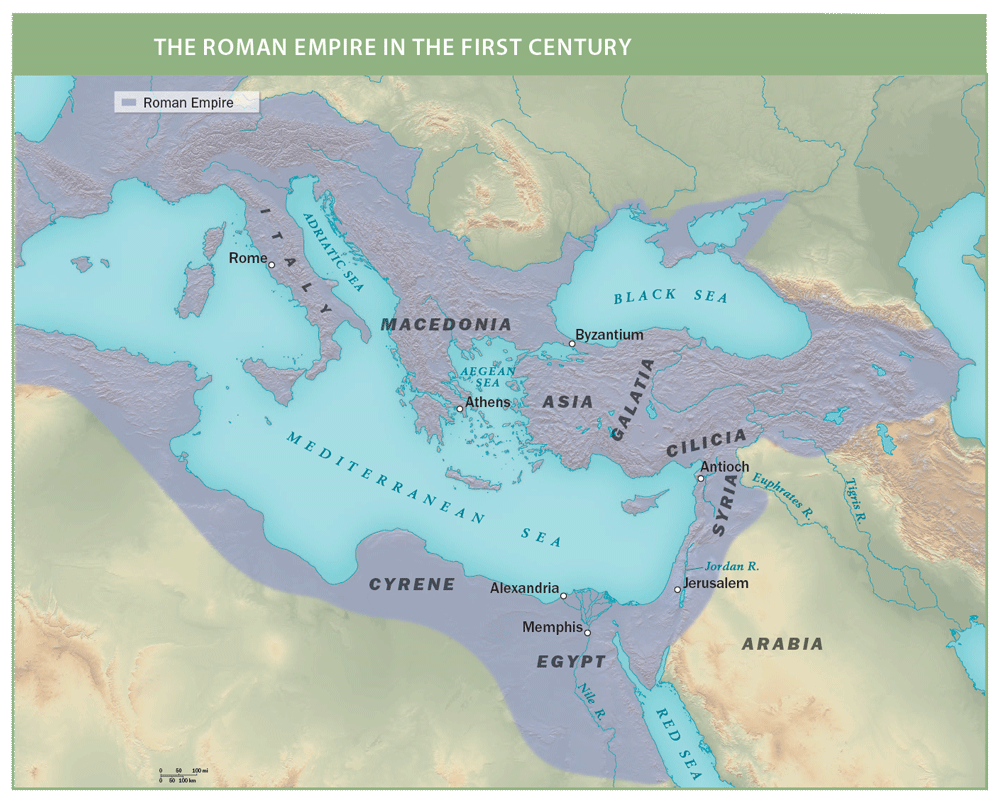
Because the New Testament letters were written to address specific questions, they contain little, if any, systematic thought. It is not that a systematic understanding did not lie behind the answers given, but the letters were not written as short treatises on systematic theology. The letters give us a glimpse of the actual lives and problems of the first Christians. We are thus able to see how the first generation of believers lived, and we are challenged to apply their insights to our own situation.
When we read these letters we need to think carefully about how we should employ them for our lives today. In some cases, the letter is describing some practice in the church that we simply do not use anymore. For instance, in 2 Timothy 2 Paul tells women not to braid their hair. As the commentary will explain, what is important here is not the braids but what they might mean in the culture of Paul’s world. Therefore we must be alert that when a New Testament letter is describing a certain practice, it may simply be that Paul is trying to answer a problem in his ancient context using ancient forms. On the other hand, there are times when Paul is prescribing practices or beliefs that he considers to have a universal applicability. So, for instance, in Galatians 3:28 Paul is firm about how in the church there should be no discrimination.
The challenge for us today is to discern what teachings of Paul are culturally descriptive and what teachings are universally prescriptive. For example, in 1 Corinthians 11:10–15 Paul argues that women should wear head coverings and long hair while men should wear short hair. Are these specific rules for us to follow today? Some people say yes, while others disagree. Commentary writers and theologians have wrestled with these questions for centuries, and we will see these debates within the pages that follow.
Revelation
The book of Revelation concludes the writings of the New Testament. It was put at the end because it looks beyond the confines of its own place in history into the future and to what God is yet to accomplish in and for his people. The other New Testament books also have this forward look, but they arise out of a specific context. So the Gospels look backward to Israel and to Jesus as the fulfillment of Israel’s hopes. They also look at Jesus’s life as he lived it at that time, and the Gospel writers are careful to locate it precisely in the days of Herod or Augustus or Pontius Pilate. The book of Acts and the Letters tell us of church life as lived by the early believers in Rome, Greece, or Asia Minor. Sometimes they are so specific that two quarreling individuals are mentioned by name (for example, Phil. 4:2).
The book of Revelation stands above history as well as in it. The great central vision of chapters 4 and 5 depicts the awesome throne of God as the central focus of the universe. History is important and time flows on, but always as the outworking of the will of the one whose eyes are like a flame of fire. God rules above the ages and will accomplish his purposes in this age and in the age to come.
Revelation ends with the extraordinary vision of the New Jerusalem, where heaven and earth have become one and where God is all in all. This is the grand future event toward which all creation moves and which concludes the New Testament. Its reassurance is profound: God will be victorious despite the apparent powerlessness of his people and the soaring power of those who oppose him. The arrival of Jesus-in-power at the end of the book describes the great final drama of human history that began in the book of Genesis. God’s creation—so spoiled by human sin, so loved by God beyond measure—now is re-created and renewed.