Romans
Outline
A. Sender, Address, and Salutation (1:1–7)
B. Thanksgiving and Petition (1:8–15)
C. Theme of the Letter (1:16–17)
2. The Gospel as the Power of God for Salvation to Everyone Who Has Faith (1:18–15:13)
A. The Justification of Sinners on the Basis of Faith in Jesus Christ (1:18–5:21)
B. The Reality of Justification by Faith in the Life of the Christian (6:1–8:39)
C. The Reality of Justification by Faith in Salvation History (9:1–11:36)
D. The Reality of Justification in the Christian Community (12:1–15:13)
A. Paul’s Missionary Work and Future Travel Plans (15:14–33)
Introduction
Paul’s letter to the Christians in the city of Rome is not only his longest letter but also arguably his most influential. While we do not know whether it achieved its purposes among the followers of Jesus who lived in the capital of the Roman Empire, we do know that for many Christians throughout the centuries, reading and understanding this letter proved life changing and, in some cases, history changing.
Date and Historical Context
Paul provides information that helps us situate the letter in its historical context. He informs the Roman Christians that he has brought to an end his work as a pioneer missionary among Gentiles in the eastern regions of the Mediterranean (15:18–23). He intends to visit them in Rome on the way to Spain, where he wants to open up a new region for the proclamation of the gospel (15:23–24, 28–29). Before coming to Rome, something he has wanted to do for some time (1:13), he will first travel to Jerusalem in order to hand over the funds that were collected in the churches he established in Macedonia and Achaia (15:25–28). He asks the Roman Christians to pray for him as he travels to Jerusalem, as both his safety and the acceptance of the collection funds are uncertain (15:30–32).
Paul wrote his letter to the Christians in Rome in the winter and early spring of AD 56–57 while staying in Corinth. After he completed his missionary work in Ephesus, where he had worked from AD 52 to 55 (Acts 19), he visited the churches in Macedonia and Achaia (Acts 19:21). He stayed in Corinth for three months (Acts 20:2–3), waiting for shipping on the Mediterranean Sea to resume in the spring (Acts 20:3), as he wanted to be in Jerusalem for the day of Pentecost (Acts 20:16). Paul’s host during this time was Gaius (Rom. 16:23), presumably the same Christian whom he baptized when he established the church in Corinth (1 Cor. 1:14).
Audience
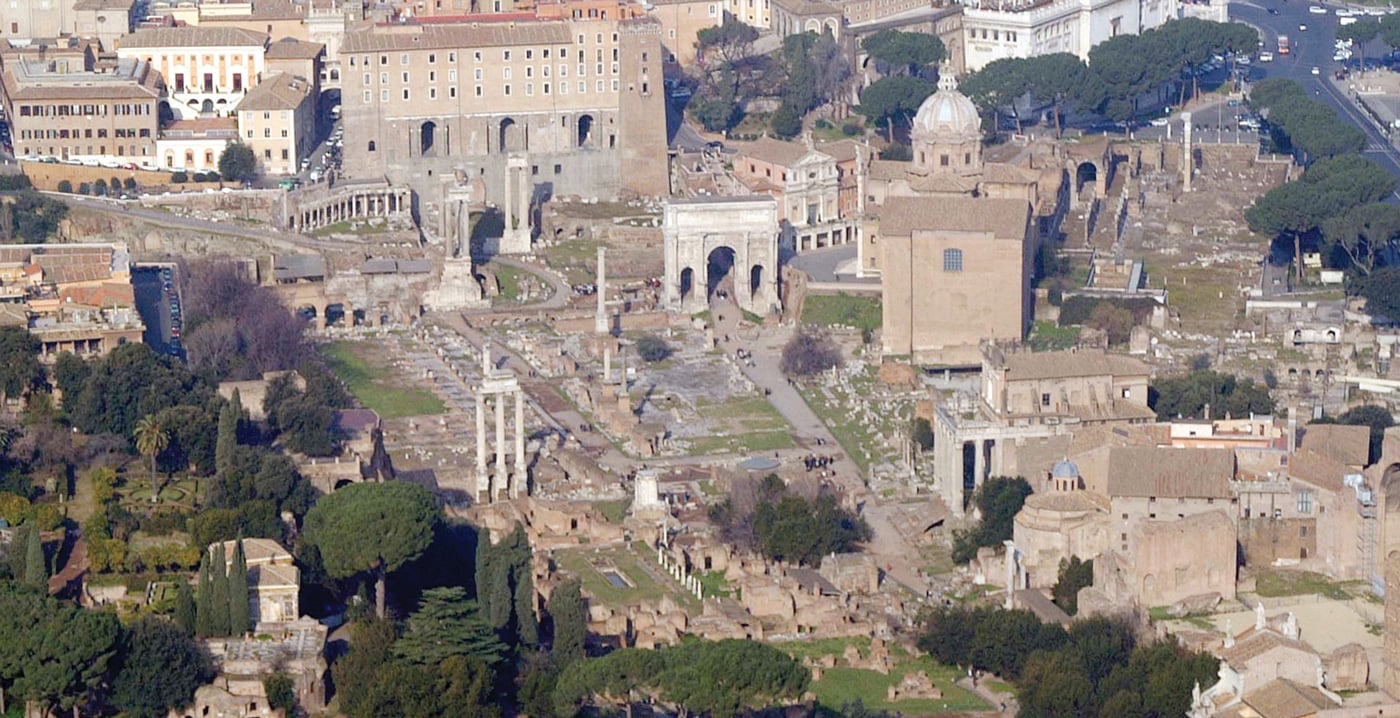
The addressees of the letter are the Christians in the city of Rome (1:6–7). The history of the church in the capital of the Roman Empire is known only in broad outline. Scholars agree that the origins of the church in Rome are connected with Jews living in Rome who were converted to faith in Jesus as Messiah. The questions of when and where Roman Jews first came into contact with the gospel of Jesus Christ have been answered in different ways. Jews of Rome who visited Jerusalem on the occasion of the Feast of Pentecost in AD 30 could have met Peter and the other apostles, been converted to faith in Jesus the Messiah, and taken the message of Jesus back to Rome. Luke mentions “visitors from Rome” among the pilgrims at Pentecost (Acts 2:10). Jews of Rome could also have come into contact with Jewish Christians in other cities in the eastern Mediterranean at an early date, perhaps in Antioch in Syria. Peter might have traveled to Rome when he left Jerusalem because of the persecution instigated by Herod Agrippa I in AD 41/42 (Acts 12:17).
By the early 40s, there were Jewish Christians in Rome. The Roman historian Cassius Dio mentions an edict of Claudius issued in AD 41 intended to quell unrest in the Jewish community of Rome, commanding the Jews to adhere to their ancestral way of life and not to conduct meetings (Cassius Dio 60.6.6). This edict probably presupposes missionary activity of Jewish Christians in the synagogues of the city of Rome. The existence of Jewish Christians in Rome is probably the background for another edict of Claudius. In AD 49 the emperor ordered the expulsion of the Jews from Rome. Suetonius reports measures undertaken by Claudius against men of foreign birth, pointing out that “since the Jews constantly made disturbances at the instigation of Chrestus, he expelled them from Rome” (Claudius 25.3–4). The disturbances were probably provoked by the missionary outreach of Jewish Christians who preached Jesus as Messiah (Greek christos). Luke reports that in Corinth Paul met the Jewish couple Aquila and Priscilla, who had recently come from Italy because “Claudius had ordered all Jews to leave Rome” (Acts 18:2). Paul arrived in Corinth in AD 50, just after the expulsion of the Jews from Rome.
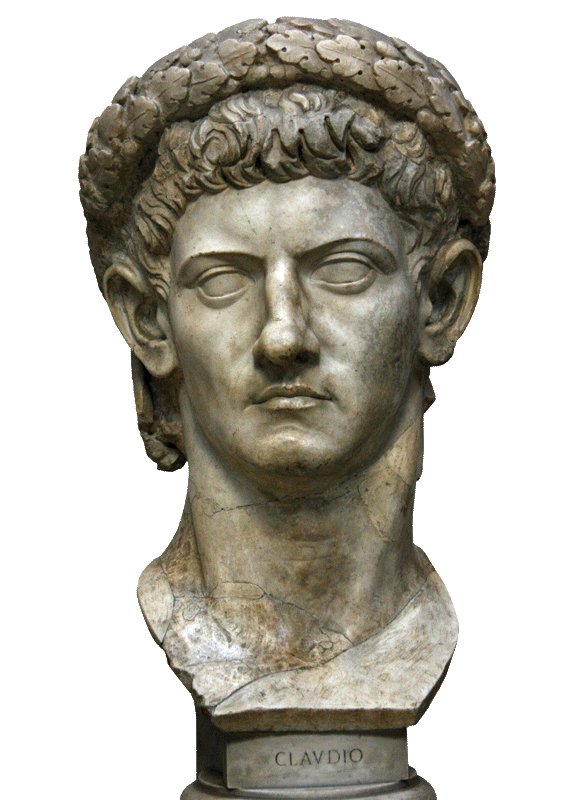
The Roman emperor Claudius (AD 41–54). His expulsion of Jews from Rome greatly affected the social matrix of the Roman church.
When Paul wrote to the Roman Christians in AD 56/57, seven years had passed since Claudius’s edict of AD 49. By this time some of the expelled Jews had returned to the city, including some of the Jewish Christians who had had to leave, such as Aquila and Priscilla (Acts 18:2; Rom. 16:3). However, the expulsion of the Jews must have changed the composition of the church membership considerably. While the church originated among Jewish believers, and probably had a majority of Jewish believers before AD 49, it had become a predominantly Gentile church by the time Paul wrote his letter. This is also suggested by Paul’s argument in Romans 11:17–24.
Why did Paul write to the Roman Christians? The answer to this question needs to take into account Paul’s goal to recruit the Christians in Rome for his plan to begin missionary work in Spain (15:24). As a letter of introduction to the Christians in Rome, Paul’s letter is rather long—Cicero’s letters range from 22 to 2,530 words, Seneca’s from 149 to 4,134 words, while Paul’s letter to the Romans has 7,111 words (in the Greek text). We also must take into account that Paul was about to visit Jerusalem, where he would meet traditionalist Jewish Christians who believed that Gentile followers of Jesus should submit to Jewish law and to circumcision. The questions about the gospel he preached are the same questions that were controversial during the previous two decades, in which he had been active as a missionary. Paul thus wrote a long letter in which he provided a synthesis of the gospel of Jesus Christ he had been preaching. He had been called by God on the road to Damascus to proclaim the crucified and risen Lord Jesus Christ among the Gentiles (Gal. 1:15–16). The fundamental convictions that Jesus Christ is the only source of salvation for both Gentiles and Jews (Rom. 1:16) and that Jesus Christ unites Jews and Gentiles in the one new community of the followers of Jesus (Gal. 3:28) are central elements of what Paul calls the “truth of the gospel” (Gal. 2:5, 14). These convictions raise questions about several matters: (1) how Jewish Christians should view Gentiles (and Gentile Christians) and how Gentile Christians should view Jews (and Jewish Christians); (2) the sin of Gentiles and the sin of Jews; (3) God’s condemnation of sinners and God’s salvation, which is now available to all through Jesus the Messiah; (4) the validity of the Mosaic law; (5) God’s righteousness in terms of the reality of everyday life; and (6) God’s righteousness in the context of the reality of his promises to Israel and of Israel’s rejection of the Messiah. As Paul wrote to the Roman Christians, he wrote a synthesis of the gospel of Jesus Christ, which he had preached for many years.
Commentary
Paul begins his letter with an epistolary opening, which was customary for Greek Hellenistic letters (1:1–7), and an introductory section, in which he expresses thanksgiving to God, indicates the reason for writing the letter, and describes the background for his planned visit to Rome (1:8–15). In 1:16–17 Paul succinctly summarizes the main theme of the letter.
A. Sender, address, and salutation (1:1–7). The first word, typical for ancient letters, is the name of the sender. Paul introduces himself with his Latin name, Paul(l)us (Greek Paulos), which could be his personal name or his nickname; his Hebrew name was Saul (see Acts 7:58; 8:1, 3; 9:1, 4; 13:9). Paul underlines three realities that explain who he is. (1) Paul is a “slave” (NIV “servant”) of Jesus Christ; his life totally belongs to Jesus Christ, to whom he thus owes total allegiance. (2) God called him to be an apostle who carries the gospel to others (Gal. 1:15–16; 1 Cor. 15:5–7). Paul’s call to devote his entire life to serving Jesus Christ coincided with his conversion on the road to Damascus (Acts 9:1–19). It was God’s gracious and effective call that brought him to faith in Jesus Christ and that caused him to work as an apostle. Paul is an apostle of Jesus Christ (see 1 Cor. 1:1; 2 Cor. 1:1), an envoy called by God to work on behalf of Jesus Christ, to whom he belongs. (3) Paul has been “set apart”—that is, consecrated and commissioned “for the gospel of God.” The message he proclaims is the “good news” (Greek euangelion, generally translated as “gospel”) of God’s revelation in Jesus Christ for the salvation of Jews and Gentiles.
The reference to “the gospel of God” prompts Paul to describe the message he proclaims in 1:2–4. (1) The gospel, which has been promised by God through his prophets (1:2), is God’s revelation in Jesus Christ, the fulfillment of God’s promises, and authenticated by Scripture. (2) The gospel of God concerns Jesus Christ (1:3–4; most scholars assume that Paul quotes an early Jewish Christian creed, which would explain why Jesus’s death is not mentioned). (3) As far as Jesus’s human nature (literally “flesh”) is concerned, he is of royal messianic descent (literally “born from the seed of David”). Jesus fulfills Old Testament promises and Jewish expectations (2 Sam. 7:16; Isa. 11:1, 10; Jer. 33:14–18; Psalms of Solomon 17:21). (4) Jesus was declared to be “Son of God in power”; that is, he was installed in the messianic office as God’s Son who is invested with God’s power (Ps. 2:7). (5) Jesus’s resurrection from the dead marks the beginning of the new age of God’s Spirit, who gives life and holiness (Ezek. 37:1–14). (6) Jesus the Messiah is Lord (Greek kyrios), exalted by God to be the ruler of the world.
The reference to Jesus Christ then prompts Paul to add a description of his apostolic ministry in 1:5–6. (1) He has received the grace of being an apostle through the mediation of the risen and exalted Lord Jesus Christ. The plural “we” is a writer’s plural, not a reference to all Christians; the structure of the epistolary prescript (“a to b, greetings”) clarifies that Paul still describes himself as the sender. (2) The goal of his work as God’s envoy is to lead Gentiles to faith in the gospel and thus to faith in God himself and in his Son Jesus the Messiah and Lord. (3) Faith in the one true God and in his Son Jesus Christ involves, by its very nature, obedience—loyalty to God’s sovereignty and submission to God’s will. (4) The scope of his missionary work is focused on polytheists, pagans who worship other deities (Rom. 11:13–14; Gal. 2:8–9). The Roman believers live among “all the Gentiles” and thus belong to the sphere of his divine apostolic commission.
The addressees are described in 1:7. They live in the city of Rome. They are loved by God. They have been called by the holy God of Israel. They are holy on account of the holiness of God, who both charges and enables them to live holy lives (1:7a). In the light of what Paul will say about human beings in 1:18–3:20, the statement that the recipients are “loved by God” expresses the miracle of salvation.
The epistolary opening ends with the salutation (1:7b). Paul transforms the ordinary Greek greeting, chairein (“greeting”; cf. Acts 15:23; 23:26; James 1:1), into a vehicle of blessing upon the Roman believers and a summary of his most central concerns. He blesses them with “grace” (charis), reminding them of the undeserved love of God revealed in Jesus Christ, which provides access to God for sinners who do not deserve it (3:24). He blesses them with “peace” (eirēnē; Hebrew shalom), the traditional Jewish greeting, which here in the context of “grace” refers to the peace with God that God himself has granted those who believe in Jesus Christ (5:1–11). The power to grant the content of the blessing derives “from God our Father and from the Lord Jesus Christ.”
B. Thanksgiving and petition (1:8–15). Paul first expresses his thanksgiving to God (1:8), praying to God “through Jesus Christ.” He continues to worship the one and only God, the God of Abraham and Israel. At the same time he is convinced that “now,” when God’s righteousness has been revealed in Jesus Christ (3:21–22), God can be approached only through faith in Jesus the Messiah.
In 1:9–12 Paul mentions the reasons for writing the letter. He solemnly asserts that he writes as a missionary who serves God, whose service is dependent on and made effective by the Spirit of God, whose sphere of service is the proclamation of the gospel of Jesus the Son of God, and whose service includes unceasing prayers for the churches (1:9). He informs his readers that he has been asking God for some time to make it possible to visit Rome, while acknowledging his uncertainty as to when and how his plans might be carried out (1:10). He longs to meet the Christians in Rome, and he is confident that God would use his presence in the Roman congregation to consolidate their obedience (1:11) and to encourage them in their faith, and he is certain that he would be encouraged and strengthened himself (1:12). But he recognizes that the fulfillment of his wishes has not been God’s will so far (1:10). Paul the missionary strategizes future movements and projects, Paul the pastor desires to strengthen the believers in Rome, and Paul the believer prays that God would allow him to carry out his plans, while Paul the theologian rests assured that God’s sovereign will determines what actually happens.
In 1:13–15 Paul describes the background for his plans. He reiterates the fact that he has repeatedly made plans to visit the Christians in Rome, plans that he has been unable to carry out since his missionary work has kept him in Asia Minor and in Greece (1:13; obstacles to following through with missionary plans are mentioned in Acts 16:6–7). The “harvest” that he intends to reap in Rome includes the strengthening of the faith of the Roman Christians (1:11–12, 15), one of the main features of apostolic service besides leading unbelievers to faith in Jesus Christ. According to 15:24, 28, Paul wants to visit the Roman Christians in order to involve them in his mission to Spain. This is most likely the “fruit” of 1:13 (NIV “harvest”; cf. 2 Cor. 11:8–9; Phil. 4:14–19). He asserts that he has been commissioned to proclaim the gospel to all people (1:14): to the Greeks, that is, to the elites of the Greco-Roman world; to the non-Greeks (barbaroi, from which the English word “barbarian” is derived), that is, to the people who have no Greek culture and do not speak Latin, the uncivilized whom the elites despise; to the wise, that is, those who are formally educated; to the foolish, that is, the uneducated and the uncultured, capable of mischief and incapable of contributing to the welfare and progress of humankind. He preaches to all people.
C. Theme of the letter (1:16–17). Paul summarizes that his letter explains the gospel that he has preached in the past and that he will preach in Rome and in Spain. He asserts that he is not ashamed of the gospel (1:16). Paul knows from experience that the gospel is an embarrassing message because it is “the message of the cross” (1 Cor. 1:18). The message about a Jewish man who was executed by Roman authorities by crucifixion and yet who is, on account of his death, the messianic Savior of the world is a cause for revulsion to Jews and foolish nonsense to Gentiles (1 Cor. 1:23). Paul is not ashamed of the gospel because it is the power of God for salvation.
Paul summarizes in 1:16–17 the following convictions about the gospel of God concerning Jesus the Messiah. (1) The gospel has power; that is, it achieves what it promises. The gospel is effective, as it is the very power of God that convinces people of the truth of the “message of the cross.” This means for Gentile believers among his readers that the emphasis on wisdom that characterizes orators is replaced by the effectiveness of the message about Jesus. (2) The gospel effects salvation. It rescues human beings from the wrath of God that consigns sinners to judgment (1:18–32; 5:9; 8:1). It restores the glory of God, which sinful human beings lack since Adam’s rebellion (3:23; cf. 5:3; 8:23, 30); it integrates the Gentile believers into the people of God in fulfillment of God’s promises to Abraham (4:11–12); it establishes peace with God and access to his grace (5:1–2); it leads to the reality of the personal experience of God’s love (5:5); it secures the gift of the Holy Spirit (5:5; 7:6; 8:1–11); and it causes the believer’s adoption into God’s family (8:15–17). (3) The power of the gospel is effectively experienced by people who believe—that is, by people who come to faith in God’s revelation in and through Jesus Christ. (4) The gospel is the power of God, who saves people irrespective of their ethnic background, “first to the Jew, then to the Gentile [literally “Greek”].” (5) The ongoing proclamation of the gospel reveals “the righteousness of God” (1:17). This expression describes God’s action by which he brings people into right relationship with him. This means that God fulfills his covenant promises (cf. Isa. 46:13; 51:5–8; 62:1–12; Jer. 23:5–6). This means that God brings Jews and Gentiles into obedience to the lordship of Jesus Christ. This means that God graciously grants unrighteous sinners the status of being righteous (forensic, imputed righteousness). This means that God reconciles sinners with himself and believing Jews and Gentiles with each other. This also means that God leads the justified sinner to live a life of faith and obedience. The passive voice (“is revealed”) clarifies that it is God himself who justifies sinners and who renders missionary work effective. The righteous status that God grants to the sinner is by faith alone (“through faith”), which is the purpose of God’s plan of salvation (“for faith”; NIV “by faith from first to last”). Paul quotes Habakkuk 2:4 to confirm the truth that God’s righteousness can be attained only on the basis of faith.
2. The Gospel as the Power of God for Salvation to Everyone Who Has Faith (1:18–15:13)
A. The justification of sinners on the basis of faith in Jesus Christ (1:18–5:21). In the first main section of the letter, Paul explains the gospel as the saving revelation of God’s righteousness, which justifies sinners, whether pagans or Jews (1:18–3:20), on the basis of faith in Jesus Christ (3:21–5:21).
1:18–3:20: God’s wrath against Gentiles and Jews. Paul begins his exposition of the gospel with a statement concerning the revelation of God’s wrath on account of human sinfulness (1:18), followed by a description of the nature of human sin (1:19–23) and the consequences of sin (1:24–31), thus confirming the legitimacy, the severity, and the scope of God’s judgment (1:32). He then argues why Jews are not exempt from the revelation of God’s wrath (2:1–3:20).
1:18–32. Paul now answers the questions implicit in 1:16–17: Why has God manifested his righteousness in the gospel of Jesus Christ? Why can salvation be appropriated only through faith? The description of human sinfulness begins with the assertion that God’s wrath, which brings judgment and condemnation, “is being revealed from heaven.” In the Old Testament, wrath is God’s response to sin (Exod. 15:7; 32:10–12; Num. 11:1; Jer. 21:3–7); it should not be confused with capricious or irrational passion. The prophets link God’s wrath with a future day of judgment (Isa. 13:9, 13; Zeph. 1:15, 18; 2:2–3; 3:8; Dan. 8:19). The object of God’s wrath is the universal failure to respect and honor the glory of God, and the universal reality of the violation of the standards of right conduct. People demonstrate their wickedness in the suppression of truth, universally refusing to acknowledge the truth about God the Creator, and they refuse to live according to God’s standards. Paul asserts that the reality of God’s anger is made manifest in the present (“is being revealed”). The gospel reveals the culpability of humankind and the consequences of unrighteousness, visible in the intellectual and moral decadence of human society.
In 1:19–23 Paul confirms the divine verdict of verse 18. The presupposition of sin is the knowledge of God, who has revealed himself to humankind (1:19–20a). What can be known about God is his power and divine nature; these are invisible realities, but they are manifest in the works of creation (cf. Sirach 17:1–9; Wisdom 13:1–9; Philo, On the Creation of the World 8–9). Contemporary philosophers regarded this argument as plausible (cf. Cicero, On the Nature of the Gods 1.18, 44, 105; 2.44, 153). Paul’s formulation “what may be known about God” is deliberately careful: the works of creation reveal God’s eternal power and divine nature but not necessarily his intervention in history. Because humankind has seen God’s power and divine nature in the works of creation, nobody has an excuse for suppressing this truth (1:20b). The reason why God reveals his wrath against the godlessness and the wickedness of the human race is the universal refusal to acknowledge God (1:21–23). People refuse to give God the Creator the glory that he deserves, and they refuse to be grateful to God for his good gifts (1:21a).
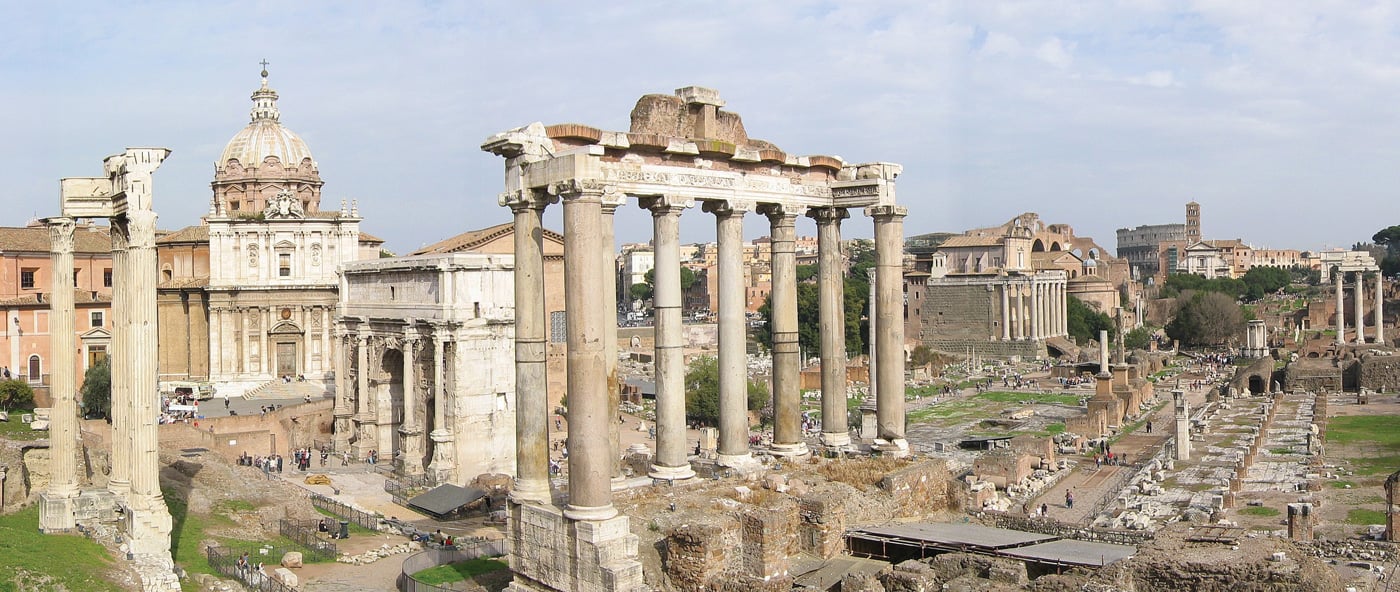
The Roman Forum contained many temples devoted to pagan worship. The columns in this photograph mark the remains of the following temples (from left to right): in the left foreground, the Temple of Vespasian and the Temple of Saturn; in the right background, the Temple of Antoninus and Faustina, the Temple of Vesta, and the Temple of Castor and Pollux.
The result of this twofold refusal is unfolded in five statements that explain the present manifestation of God’s wrath. (1) Human thinking has become “futile” and doomed to self-deception because people do not adequately take into account the reality of God (1:21b). (2) Human existence has become disabled and distorted in all its intellectual, emotional, and physical dimensions (1:21c). (3) Human beings have a distorted and illusory self-image, as their claims to wisdom fail to recognize the truth that they have become fools (1:22). Some see here an echo of Adam’s fall (Genesis 3): when he sought superior knowledge in ways that contradicted what he knew of the Creator, he was reduced to hiding, to shame, to lame excuses, and to an existence outside the glorious presence of God. (4) Human beings exchanged the glory of God for the copy of an “image” (1:23a). Instead of acknowledging God in worship and actions, they preferred the copy of a copy, an image twice removed, a distortion even of the proper form of the creatures that pagan idols depict. While Paul thinks here primarily of the pagans who worship idol images, his language also echoes the incident of the golden calf when the Israelites “exchanged their glorious God for an image of a bull, which eats grass” (Ps. 106:20). (5) People produce and then worship images that are likenesses of human beings and of animals (1:23b). They worship self-made creatures instead of the Creator (cf. the satire against the idol manufacturers in Isa. 44:9–20). The readers of Paul’s letter were surrounded by examples of the idolatrous veneration of humans, birds, four-legged animals, and serpents, which were depicted in altars, temples, and statues, as well as in art and architecture and on coins.
God’s reaction to the suppression of the truth is described in 1:24. God handed over the human race to the control of their own desires. They are thus forced to suffer the consequences of their willful distortion of the truth about God. The result of human beings left to their own resources is polluted behavior, which separates them from God, whom they have dishonored through idolatry, and which dishonors their own bodies through sexual perversions. In 1:25–27 Paul elaborates on the nature and the consequences of sin. As people venerated creatures rather than the Creator, they exchanged the truth about God for a lie. The suppression and distortion of the truth of God is intentional, not an inadvertent mistake. In 1:25 Paul interrupts his description of idolatry by a prayer in which he thanks God for the blessing of creation. The “amen” invites the readers to concur and join him in praising God. In 1:26–27 Paul explains for the second time God’s response to humankind’s assault on his honor and dignity. God delivered them up to dishonorable passions. When people reject God and worship a self-made substitute, they will also violate the divinely created order for humankind. The exchange of God the Creator for the worship of images of creatures results in the exchange of natural sexual relations with unnatural sexual relations among women and among men (homosexuality). God created man and woman, male and female (Gen. 1:27) to become “one flesh” (Gen. 2:24). Paul’s language (“unnatural,” “inflamed,” “lust,” “shameful”) denies same-sex relationships any decency or dignity. (The question whether homosexuality is a genetic disposition or a “natural” and personal tendency does not come into view; Paul would surely argue that just as other patterns of sinful behavior—such as malice or deceit—represent natural predispositions or personal preferences, the decisive question is not what people prefer and what their natural or genetic “makeup” is but whether God regards it as transgression of his will.)
In 1:28–32 Paul mentions for the fifth time humankind’s suppression of the truth about God (after 1:18, 21, 23, 25). After people have assaulted God, they assault each other. Failure to acknowledge God leads to a mind that is worthless, not because it is uninformed or uncultured (which could be rectified through education), but because it perversely rejects truth about God and truth about nature. This is why people do things that are improper (1:28). The following catalog, which lists twenty-one types of evil behavior and characteristics of unrighteous people (1:29–31), explains that these evils are not described as problems of every individual but as the collective reality and experience of the human race. Paul concludes this depressing albeit realistic description of the human condition with a final affirmation of corporate and individual accountability (1:32).
2:1–16. Jewish readers agree with Paul’s indictment of humankind in the previous paragraph. However, Jews believed that they had a privileged position before God. In 2:1 Paul shifts his style to employ diatribe, interacting with a dialogue partner. This interlocutor is not imaginary, since Paul had conversations with pious Jews who would have emphasized their exemption from God’s judgment on account of their status as members of God’s covenant people (cf. Wisdom of Solomon 15:2–3: “Even if we sin we are yours, knowing your power, but we will not sin, because we know that you acknowledge us as yours. For to know you is complete righteousness”). Paul does not clarify immediately the Jewish identity of his discussion partner (cf. Nathan’s conversation with David in which the indictment, “You are the man” [2 Sam. 12:7], comes only later in the encounter). Paul initially addresses critics of the Gentiles in general. He asserts that those who condemn the Gentiles are doing the very same things they are doing. In 2:2 Paul asserts that what he says of God’s judgment is in accordance with the facts: God judges those “who do such things” (1:19–32).
In 2:3–4 Paul refutes the objection that the connection between human wrongdoing and divine judgment does not apply to Jews. The rhetorical questions in 2:4 are designed to demonstrate to the Jewish critic of Gentile sinners his false assumptions. Pious Jews may indeed rely on God’s kindness in delaying his judgment (“forbearance”), and they know about the importance of repentance. But they make the mistake of having little regard for the scope of God’s kindness in view of the hopeless condition of humankind, unaware that they need as much repentance as the Gentiles do. In verse 5 Paul takes up verse 1 and explains why pious Jews are not exempt from judgment, despite the warning of Deuteronomy 10:16. They have failed to recognize that they have a hard and impenitent heart, a condition that will result in God’s condemnation. In verse 6 Paul quotes the scriptural principle that God’s judgment will be according to people’s deeds (Ps. 62:12; Prov. 24:12; cf. Isa. 3:10–11; Jer. 17:10; Hos. 12:2). Jesus and the early Christians accepted this principle (Matt. 7:21; 16:27; 25:31–46; 2 Cor. 5:10; Col. 3:24–25; 1 Pet. 1:17; Rev. 2:23; 20:12–13; 22:12). The implication is that God has no favorites who are exempt from the application of this principle on the day of judgment. God treats all human beings the same—condemning sinners on judgment day as a result of their sinful acts, and saving sinners on judgment day on the basis of their faith in Jesus who died for their transgressions.
In 2:7–11 Paul clarifies the “doing” that leads either to eternal life or to eternal condemnation. He speaks not simply of a broad principle, or hypothetically, as some have argued. Paul explains the real eternal destinies of real people, whether they are Jews or Greeks (2:10). He asserts that people who persevere in good works seek glory and honor and immortality; these are the personal benefits of those for whom God’s glory and honor are priorities—they will receive eternal life (2:7, 10). Paul will clarify in verses 28–29 the identity of these people: they are Christian believers, in whom the promises of the prophets regarding obedience to God’s law, empowered by the Spirit, have been fulfilled. In contrast to people who do good works and who receive from God eternal life, there are people who are selfish, who disobey the truth, and who are won over by unrighteousness; their destiny is God’s wrath and judgment in the future and anguish and distress in the present (2:8–9a). All of this is true both for Jews and for Greeks because God the judge is impartial (2:11). The phrase “first for the Jew” (2:9b) clarifies the target of Paul’s argument: the assumption of pious Jews is that they have privileges with regard to the day of judgment; this claim collapses in view of God’s impartiality.
In 2:12–16 Paul introduces the law into the discussion for two reasons. The law records God’s standards for the last judgment, which has been the topic since 1:18; and pious Jews appealed to the law as God’s good gift that distinguished them from the pagans and that guaranteed their salvation. Paul argues that what determines the outcome of God’s judgment is not the possession of the law as such but the sinfulness of people (2:12). Pagans who do not have the law will be condemned for their sin “apart from the law.” Jews who live with the law (literally “in the law”) yet disobey the law with their actions will be judged by the law. For the Jews who have heard the law read and explained in the synagogues, this means that they are deemed to be righteous in God’s judgment only if they have actually been obedient to the law (2:13).
For Gentiles who do not have the law this means that, if they carry out the law, they will be justified on the day of judgment (2:14–15). Paul states the following about these Gentiles: (1) They “do not have the law by nature”; that is, they are not Jews, who have the law as a birthright, but Gentiles, who have never had the Mosaic law (NIV “who do not have the law, do by nature things required by the law” assumes a natural law that Gentiles obey; but this is not what Paul means). (2) They do “things required by the law”; that is, they show a comprehensive fulfillment of the law, thus fulfilling the conditions for justification. (3) They are “a law for themselves”: even though they have not received the law as the Jews did, they obey its requirements and are thus considered to embody the law. (4) The first witness that testifies on their behalf for their justification on the day of God’s judgment is their new heart, which is inscribed with the requirements of the law, promised in Jeremiah 31:31–34 for the time of the new covenant. (5) The second supporting witness is their conscience, perhaps to be understood in terms of the assurance from the presence and the work of the Holy Spirit in their lives (cf. Rom. 9:1). (6) The third supporting witness is “their thoughts,” which are no longer subject to condemnation by God (as in 1:21) but constitute a defense for them, as their transformed hearts and their consciences are in accord with God’s verdict. (7) This demonstration will take place in the future, on the day when God will judge humankind through Jesus Christ—that is, in view of the question of how Jews and Gentiles have responded to the gospel of Jesus Christ. Note that Paul makes similar statements about the Christian believer’s obedience to the law in 2:25–29 and in 8:3–4. Paul does not simply accuse Israel of sin; as he points to the fulfillment of God’s covenant promises, he seeks to provoke the Jews to jealousy (cf. Rom. 11:13–14).
2:17–29. Beginning in 2:17, Paul takes up the objections of his Jewish dialogue partner, who argues that Israel’s covenant status places Jews in a different position from that of the Gentiles. Paul insists that the Jewish covenant privileges, which he does not deny (3:1–2; 9:4–5), do not exempt them from God’s judgment. In verses 17–24 Paul evaluates the claim that the Mosaic law constitutes a fundamental advantage of Jews over Gentiles. First, he cites the claims of his Jewish dialogue partner (2:17–20). (1) He proudly calls himself a Jew, identifying himself with the beliefs, rites, and customs of the adherents of Israel’s Mosaic and prophetic tradition. (2) Jews rely on the law in the sense that it gives them comfort, support, and contentment. (3) Jews boast in God; that is, they are confident their special relationship with God will vindicate Israel on the day of judgment. (4) Jews know the will of God, as God has revealed in the law the proper ways in which his people should conduct themselves in everyday life. (5) Jews approve of what is superior; they know what really matters since they have been instructed in the law. (6) Pious Jews are convinced they are a guide to the blind (cf. Isa. 42:6–7), probably a reference to the attitude of many Jews that Israel has been called to be a leader of other nations (Josephus, Against Apion 2.291–95; Philo, On the Life of Abraham 98; Matt. 15:14; 23:16, 24). (7) Jews are convinced they are a light to those who are in darkness since they have been given the light of the law (Ps. 119:105). (8) Jews are instructors of the foolish; they can provide moral guidance to the Gentile world. (9) Jews are teachers of children—that is, the Gentiles who have an immature grasp of the will of truth. (10) Jews have “the embodiment of knowledge and truth” in the law, which explains the confidence expressed in verses 19–20—what the philosophers and the religions of the world long for and claim to offer, the Jews possess in the law.
In verses 21–24 Paul confronts the Jewish boast with reality. He first asks a series of four rhetorical questions. The (implied) positive answer to these questions explains “the same things” (2:1), which Jews practice but condemn in the Gentiles. Paul asserts that the Jews fail to teach themselves what they teach others. Just as the Gentiles will be condemned because of their idolatry and immorality (1:18–32), so Israel as a nation is subject to the same condemnation because of the three transgressions of stealing, adultery, and robbery of pagan temples. These charges are based on the Decalogue (Exod. 20: 4–5, 14, 15; Deut. 5: 8–9, 18, 19). The charge of temple robbery could refer to actual plunder of pagan temples (cf. Josephus, Jewish Antiquities 4.207) or to the use of objects taken from pagan shrines (in violation of Deut. 7:25–26). All three transgressions were certainly rare among the Jewish people. But Paul’s accusation is not out of the ordinary when we compare it with charges of the prophets (Isa. 3:14–15; Jer. 7:8–11; Ezek. 22:6–12) and of Jesus (Matt. 23:1–39; Luke 11:39–52) and with Jewish literature of the time (Psalms of Solomon 8:8–14; Philo, On the Confusion of Tongues 163; Testament of Levi 14:4–8; Damascus Document 6:16–17). Paul does not target all Jews as individuals; rather, he addresses the Jewish claim that Israel has a privileged position over the Gentiles on account of her possession of the law. He argues in the proposition of verse 23 (which should not be understood as a question) that even though Israel takes pride in the law, she dishonors God by breaking the law. The empirical fact that there are Jews who do what the law forbids proves that Jews are just as guilty before God as Gentiles. The Jewish claim to covenant privileges is contradicted by the reality of Jewish actions. Paul argues, using the quotation from Isaiah 52:5, that just as Israel’s disobedience in the past brought shame on God and the exile on Israel (cf. the larger context in Isa. 50:1–3), so now the Jewish people dishonor God by their disobedience.
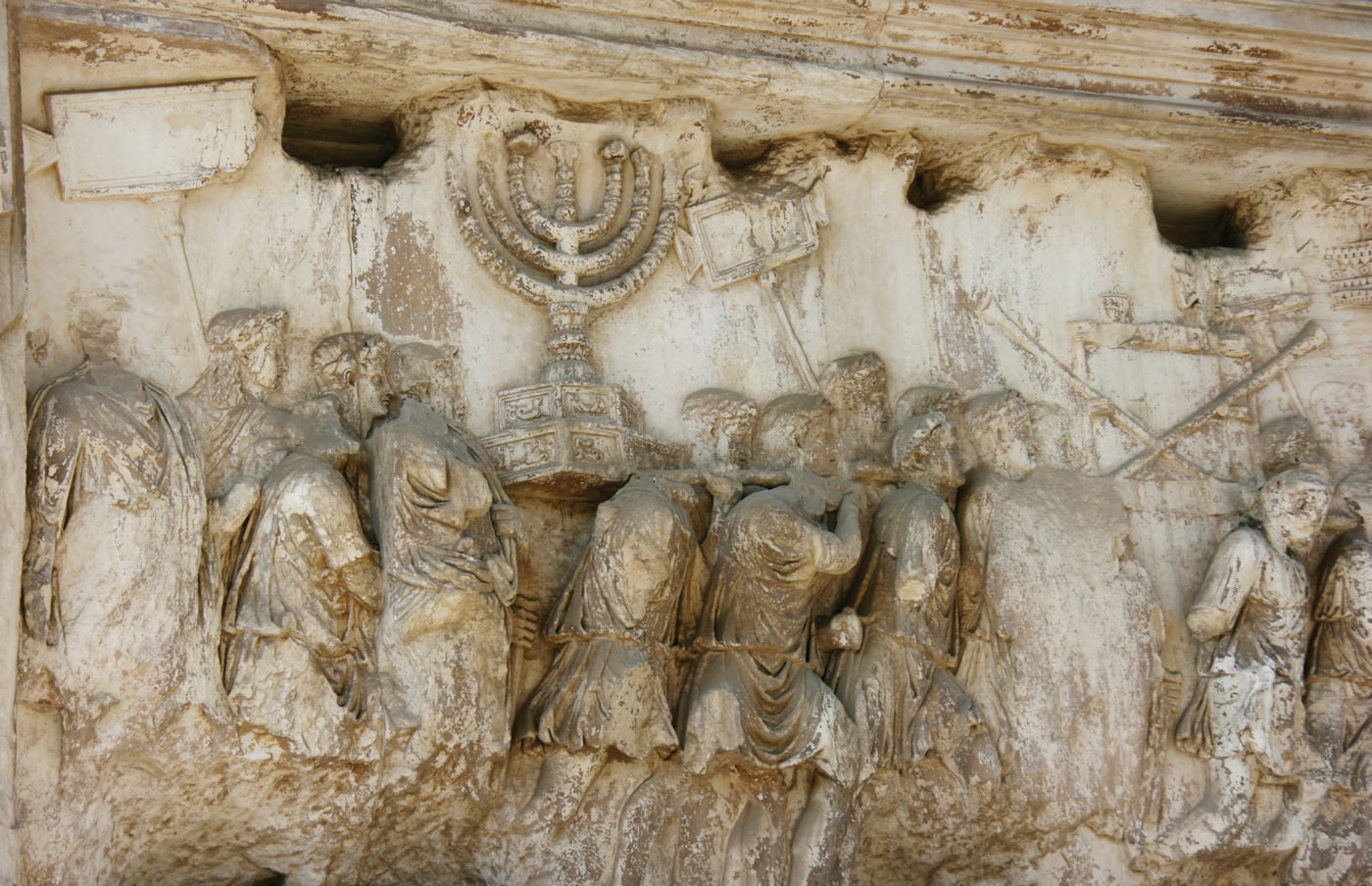
In the ancient world, when a nation and therefore its gods were conquered, its temples were stripped of their wealth and precious things (cf. Rom. 2:22). This relief from the Arch of Titus shows men returning from the destruction of Jerusalem, carrying the spoils of war, particularly the contents of the Jewish temple (notice the menorah).
In 2:25–29 Paul takes up the significance of circumcision, the mark of the covenant that was of central importance for Israel’s self-understanding (Gen. 17:9–14). Paul does not deny the value of circumcision for the Jewish people but insists that it has value in the context of the final judgment only “if you observe the law” (2:25a). The criterion in God’s court on judgment day is not the possession of the mark of circumcision but obedience to the law. Jews who break the law become non-Jews (2:25b). In verses 26–29 Paul shows again (cf. 2:14–15) how Gentiles (who believe the gospel of Jesus Christ) have become members of the people of God. When uncircumcised Gentiles keep the just requirements of the law, they will be reckoned as circumcised (2:26), as legitimate members of God’s people. There is a reversal that will become manifest on the day of judgment. The Gentile believers who are physically uncircumcised but keep the law will condemn the Jews who possess the law and have the mark of circumcision but break the law (2:27). Jews can forfeit their covenant relationship with God through wickedness, and non-Jews can be reckoned as members of God’s (new) covenant people through their obedience. In verses 28–29 Paul describes the identity of these uncircumcised (non-Jewish) yet obedient people: they are incognito Jews (not “outwardly” but “inwardly”) who have a circumcision of the heart, that is, who have experienced God dealing with their most basic spiritual problems. The circumcision of the heart was known in the Old Testament (Deut. 10:16; Jer. 4:4; 9:25–26; Ezek. 44:9); its reality was expected for the future (Deut. 30:6), in the time of the new covenant (Jer. 31:31–34), when God would place his Spirit in the hearts of his people (Ezek. 36:26–27), resulting in the removal of all uncleanness, in a new heart and a new spirit, and in full obedience to God’s statutes. Paul asserts that this reality has arrived: Gentiles have received this true, inward circumcision of the heart, not because they have followed the written letter of the law, but because God has given them the promised Holy Spirit. They are true members of God’s people, not because of the verdict of others, but because they have God’s approval (“praise”).
3:1–8. Paul knows that his argument in chapter 2 will provoke objections from Jews. He is willing to air these objections since he is dealing with serious questions, which have immense implications for the understanding of God, of salvation, and of who belongs to God’s people.
In 3:1–4 Paul notes objections which insist that the privileges of the Jews cannot have been annulled. When the question is raised, “What advantage, then, is there in being a Jew, or what value is there in circumcision?” (3:1), Paul has to grant that his dialogue partner has a point (“Much in every way!”)—Jews have indeed an advantage over Gentiles. The reason for this answer is Paul’s belief that the Jews have been given God’s authentic self-revelation (3:2; the phrase “first of all” implies further privileges, which Paul will list in Rom. 9:4–5). The second argument of Paul’s Jewish opponents, in verses 3–4, links the premise of Israel’s divine election with Paul’s argument in 2:17–29. The question is raised of whether the unfaithfulness of some Jews nullifies God’s faithfulness to Israel. Paul protests against the suggestion that he holds such a view (see commentary on 9:1–11:36). He agrees with the theological principle his Jewish dialogue partner cites, quoting Psalm 51:4. God’s truth is the reliability of his faithfulness, which stands in contrast to the falseness and sinfulness of every human being (the latter fact has been Paul’s concern since 1:18).
In 3:5–8 Paul allows his opponent to voice the objection that his teaching turns God into an unrighteous judge and leads into libertinism. This is a direct attack on Paul’s theology, which, if it can be sustained, has two serious consequences. In the first part of this attack (3:5–6) the opponent summarizes the opinion of Paul with a seemingly blasphemous proposition. The statement “our unrighteousness brings out God’s righteousness more clearly” implies the apparently logical inference that if sinners by their unrighteousness provoke God to manifest his righteousness (God forgives sinners), then God cannot punish sinners for their unrighteousness. This argument is designed to draw out the conclusion that, if Paul is correct, God’s righteousness stands in contradiction to God’s judgment of wrath; in other words, if Paul is right, God is unjust. Parenthetically, Paul apologizes that he utters such a blasphemous thought. His answer to this attack against his theology is another vehement protest. The inference that his opponent suggests is totally absurd since God is the judge of the world. If his opponent were correct, it would lead to the further inference that God cannot be the judge of the world, which is an absurd suggestion.
The second part of the attack (3:7) intensifies the objection of verse 5 by relating it to verse 4—Paul’s theology is blasphemy because he holds that lying to God (which is what sinners do) provokes not God’s wrath but a demonstration of his truthfulness, which increases his glory. If this is the case, why are sinners still condemned as sinners? The implication is stark: if there is no difference between the righteous (the Jews) and sinners, any judgment must become meaningless. The final and decisive part of the attack (3:8) consists in the accusation that Paul has a blasphemous ethic. The dialogue partner argues that if Paul is correct, one might as well do evil so that good may come. If there is no theological possibility of a divine judgment, the ethical difference between good and evil becomes void. For Paul, at least for the time being, such a conclusion marks the end of any meaningful discussion: “Their condemnation is just!” The conclusion of the opponent is blasphemy since it turns the faithfulness of God’s righteousness and the severity of God’s wrath into a wicked farce. Paul will explain his answer to the questions of 3:1–8 in reverse order in chapters 6–8 and in chapters 9–11. After a further explanation of the sinfulness of the Jewish people in 3:9–20 and an exposition of the revelation of God’s righteousness in Jesus Christ as the solution to the plight of humankind in 3:21–5:21, Paul expounds the reality of God’s righteousness in the lives of Christian believers (6:1–8:39) and the reality of God’s righteousness in the present and future history of Israel (9:1–11:36).
3:9–20. Paul summarizes his conclusion from chapter 2: Jews are not at all better off than the Gentiles, since both Jews (2:1–29) and Gentiles (1:18–32) are guilty of sin. They are “all under the power of sin”; that is, both Gentiles and Jews are controlled by the power of sin evident in their present behavior as well as in their destiny in God’s judgment, in which nobody has any excuse. In 3:10–18 Paul provides biblical evidence for his assertion that Jews have no advantage over Gentiles because they are sinners. In verses 10–12 he quotes Psalm 14:1–3 to confirm that the Jewish people are not righteous, as they disregard God. Psalm 14 laments the oppression of the righteous in Israel by evildoers within Israel (who say that “there is no God”). In verses 13–15 Paul shifts his attention from the abandonment of God to the wrongs done to the neighbor, citing a series of eight pronouncements against enemies of biblical authors. In verses 13–14 he cites Psalms 5:9, 140:3, and 10:7 for sins of human speech—deadly deceit, poison, cursing, and bitterness. In verses 15–18 he cites Isaiah 59:7–8 (Prov. 1:16), Isaiah 59:8, and Psalm 36:1 for sins of human conduct—murder, destruction, strife, and rejection of God.
In 3:19–20 Paul concludes his indictment of sinners. Verse 19 confirms that Paul has been addressing Jews in the preceding series of Old Testament quotations. It is Jews who are “in the law” (not “under the law,” as NIV translates). Since 1:18 Paul has silenced “every mouth” by proving that the whole world is accountable to God. He established in 1:18–32 the sinfulness of the Gentiles, which needed no further proof. He established the sinfulness of the Jews in 2:1–3:18, against the objections of a Jewish dialogue partner whom he sought to silence with phenomenological and biblical evidence. Paul concludes in 3:20 with an allusion to Psalm 143:2 and perhaps Genesis 6:12, asserting that final justification by God does not take place on the basis of obedience to the works prescribed by the law. No “flesh” (NIV “no one”) has the ability to obey the law. In 8:3–4 Paul will argue (as he did in 2:13–14 and in 2:25–29) that the Spirit provides for the Christian believer the power to fulfill the law. The law may have indeed provided various mechanisms for the atonement of sin; note the burnt offerings and the sin offerings described in Leviticus 1 and 4–5 (cf. Exod. 34:7; Num. 14:18–19). These provisions of the law can no longer compensate for sin, because God has provided a new place of atonement, as Paul will argue in the next section (3:21–5:21). Paul informs Jews who continue to rely on the law that the law merely leads to the knowledge of sin (3:20). In the new messianic age, in which the promised new covenant has become a reality, the law cannot justify sinners; it can only reveal their actions and efforts as sin.
3:21–5:21: God’s saving righteousness for Gentiles and Jews. Paul describes how God “now”—at the time when Jesus the Messiah came—declares sinners justified as a result of Jesus’s atoning death (3:21–31). Faith in Jesus Christ creates the universal people of God, consisting of Jews, the ethnic descendants of Abraham, and of Gentiles, the families of the earth whom God wanted to bless through Abraham (4:1–25). Jews and Gentiles who believe in Jesus Christ have peace with God, the hope of sharing the glory of God, the love of God, and the Holy Spirit (5:1–11). God’s triumph over sin in and through Jesus Christ solves once and for all the fundamental problem of the power of sin, which, since the fall of Adam, brings condemnation and death on humankind (5:12–21).
3:21–26. Paul explains the revelation of God’s saving righteousness through faith in Jesus Christ in two parts. In verses 21–26 he explains the significance of God’s action in the death of Jesus Christ, providing atonement for sins and redemption. In verses 27–31 he describes the universality of justification by faith in Jesus Christ, which corresponds to the universality of the sinfulness of humankind described in 1:18–3:20.
Paul begins in 3:21 with the fundamental assertion, “But now apart from the law the righteousness of God has been made known.” The phrase “but now” marks a contrast between the time of Gentile idolatry and immorality and God’s provision of righteousness for sinners, a contrast between Jewish efforts to find salvation through the law in the old covenant and the revelation of God’s righteousness in the new covenant. God’s saving action took place apart from the law, independently of the Mosaic law, both for Gentiles who do not have the law and for the Jews who do not obey the law. The disclosure of the righteousness of God is God’s act of saving Gentile sinners and Jewish lawbreakers. God saves the ungodly and the disobedient, the very people who assaulted his glory and who did not obey his will. Paul clarifies that this new reality is scriptural: the Law and the Prophets bear witness to it (cf. Rom. 1:2; 4:1–25; 9:25–33; 10:6–13; 15:8–12). The gospel of God concerning Jesus Christ that Paul proclaims is the fulfillment of God’s promises for the new covenant; it is not a new religion.
In 3:22–26 Paul explains the revelation of the saving righteousness of God as follows. The means of salvation is not the law but trust in Jesus the messianic Savior—faith in Jesus Christ (3:22). The Greek phrase, literally “faith of Jesus Christ,” has a rich meaning. Some interpret the phrase in terms of the “faith” that Jesus himself had (subjective genitive); in other words, Jesus was faithful to accomplish the work that God had given him. Others interpret it in terms of Jesus Christ as the source of faith (the Greek genitive of source); that is, Paul writes about the faith given by Jesus Christ. The traditional interpretation sees Jesus Christ as the object of the faith of the sinners (objective genitive): Paul references the sinners’ faith in Jesus Christ (see NIV).
The scope of salvation is universal (“to all”), without distinction between idolatrous polytheists and pious Jews, open to all who believe. The target of salvation is sinners (3:23), people whose behavior suppresses God’s truth and ignores God’s will, people who have lost the glory of living in God’s presence (a reference to Adam’s fall; in Apocalypse of Moses 21:6, Adam accuses Eve, “You have deprived me of the glory of God”). The nature of salvation through faith in Jesus Christ is justification (Greek dikaioō), God’s acquittal of the sinner who faced condemnation on the day of judgment, but who now is declared righteous and thus set right with God (3:24). The manner of salvation is that of a free gift. The motivation of salvation is God’s grace (charis), the undeserved love of God. The means of salvation is also redemption, deliverance from the hopeless human condition of 1:18–3:20. “Redemption” sometimes refers to a ransom that has been paid (cf. 1 Cor. 6:20; 7:23; also Mark 10:45); many see an allusion to the Old Testament motif of redemption in a new exodus, a new covenant, and a new creation (Isa. 43:14–21; 48:20–21; 52:1–2; Ezek. 20:33–38; Hos. 2:14–23). The facilitation of salvation is bound up with Jesus the Messiah. It is in and through Jesus’s death and resurrection that the new epoch of salvation has been inaugurated and that both idolatrous pagans and lawbreaking Jews are delivered from sin and death. In 3:24, Paul uses for the first time in Romans the phrase “in Christ Jesus” (which occurs over eighty times in his letters), which describes the “location” or sphere of God’s intervention in the history of humankind for the salvation of sinners.
The locale of salvation is the cross, where Jesus Christ became the new place of God’s atoning presence (3:25). The Greek term hilastērion (NIV “sacrifice of atonement”) is best understood against the background of its Old Testament usage, where it designates the gold plate on the ark of the covenant in the Most Holy Place (Exod. 25:17–22), above which God was thought to be present and where blood was sprinkled on the Day of Atonement to cleanse the temple from sin and thus to facilitate the atonement for Israel’s sins (Leviticus 16; cf. the reference to “blood” in 3:25). Some interpreters translate hilastērion as “propitiation,” a term that describes the elimination of God’s punitive wrath; others translate it as “expiation,” which emphasizes the removal of sin. The concepts of propitiation and expiation proceed from a more general Hellenistic understanding of the term hilastērion, which may well have been how Paul’s sentence would have been understood by new Gentile converts who heard this passage read in the congregation. Paul emphasizes the consequences of Jesus’s death for God’s wrath (1:18–32), for humankind’s sinfulness (1:18–3:20), and for the power of sin (3:9). Jesus’s death redeems the unrighteous from God’s wrath, cleanses sinners from sin, and breaks the power of sin. Because Jesus is the sinless sacrifice and dies in the place of sinners, the sinners live. The phrase “God presented Christ” describes Jesus’s death as a public manifestation of God’s grace. Jesus died in public, in full view of the citizens of Jerusalem.
The effects of Jesus’s death are appropriated “by faith” in Jesus Christ (3:25–26)—that is, by responding with trust and confidence. Another effect of salvation is the demonstration of God’s righteousness; God demonstrated his righteousness by providing Jesus as the sacrifice that fulfills the terms of his covenant with Israel. A further effect of Jesus’s death is the final, ultimate forgiveness of sins. While in the past God’s forbearance left the sins committed beforehand unpunished, Jesus’s sacrificial death was God’s final answer to the problem of sin, which the sacrificial system of the law was not.
3:27–31. In 3:27, Paul returns to the theme of Jewish boasting, drawing out what implications God’s saving action in the sacrificial death of Jesus Christ has for the Jews’ reliance on election (circumcision) and obedience (the law) as the basis for their expected vindication in God’s judgment. He asserts that this boasting is made impossible (3:27). The question, “Because of what law?” should be understood in the sense of “What kind of understanding of the law is involved when we argue that the Jewish boasting is excluded?” Paul argues that when Jews understand the law as commanding obedience through works, which leads to justification on the day of judgment, the sequence “works → obedience → justification → boasting” is confirmed. If the law is understood in the context of faith (in the revelation of God’s saving righteousness through Jesus Christ, 3:21–26), now faith being the means of justification, the sequence is “faith → justification.” This means that the pattern that leads from works to boasting is abandoned. In verse 28 Paul contrasts two ways of justification: sinners are justified on the day of judgment by faith in Jesus Christ without the involvement of the law (Paul’s conviction); or sinners are justified by works prescribed by the law (the Jewish conviction). Paul has argued in 2:1–3:20 that the latter is not possible. The truth that justification before God is not by obedience to the law applies not only to Jews (who do not obey the law) but also to Gentiles (who do not have the law).
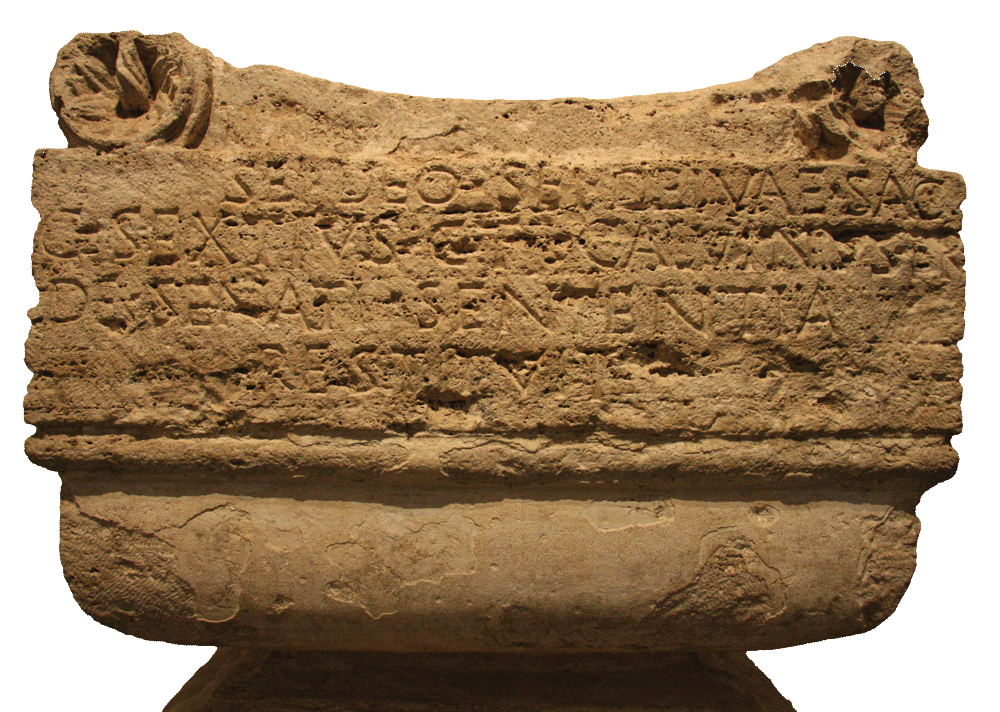
While the Jews believed there was only one God (Rom. 3:30), the Gentiles came from polytheistic backgrounds. This altar to an unnamed god found on Palatine Hill in Rome (at the Velabrum) may have been part of the early city of Rome. The inscription reads in part, “Whether to a god or goddess sacred.” It was believed that if the protecting deity was not named, the city could not be conquered.
In verses 29–30 Paul gives a theological argument for his conviction. God’s final solution to the problem of the reality of sin among Gentiles and among Jews is not justification through obedience to the law, because then only Jews could be saved (since only Jews possess the law). This is an unacceptable position since God is not only the God of the Jews but also the God of the Gentiles. The truth is that “there is only one God” (3:30). This formulation reflects the basic confession of Jewish monotheism (Deut. 6:4). Since there is only one God, there can be only one means of justifying sinners. This is what Paul has argued in 3:21–26, read in the context of 1:18–3:20: members of God’s covenant people (the circumcised Jews) are justified before God by faith in Jesus Christ, and idolatrous polytheists (the uncircumcised pagans) are justified “through that same faith” (3:30).
Paul asks in verse 31 whether his assertions about Gentile sinners and Jewish sinners, about circumcision and the law, and about God’s revelation of righteousness in Jesus Christ appropriated by faith nullify the law. He assures that this is not so (“By no means!” [NIV “Not at all!”]). He does not abolish the law; rather, he “upholds” the law. Later passages show what Paul means: those who accept by faith the revelation of God’s saving righteousness in Jesus Christ will keep the law, which contains God’s holy, just, and good commandments (7:12). Believers in Jesus Christ encounter the law no longer as the law of sin and death—that is, as sinners who face eternal condemnation—but as the law of the Spirit of life in Christ Jesus—that is, as people who have received the Spirit of the new covenant and who have been given new hearts (8:2–4).
4:1–25. Paul links his rejection of boasting (3:27–31) with Abraham, whom he describes as the fundamental paradigm for God’s people, the prototype of justification for both Gentiles and Jews. Paul argues in 4:1–16 that Abraham was justified by God not on the basis of works but on the basis of faith. Abraham was regarded as the first converted Gentile (from Ur of the Chaldeans, Gen. 15:7) and as the first Jew who was circumcised and received God’s covenant (Genesis 15; 17). Contrary to the traditional Jewish understanding of Abraham, Paul argues that Abraham, as the Jews’ ancestor according to the flesh (4:1; NIV “our forefather”), discovered that he was not justified on the basis of his works. His works provided him with claims for boasting before human beings “but not before God” (4:2).
Paul reestablishes the sequence of faith → justification → obedience for Abraham, reading Genesis 15:6 (quoted in 4:3) in the light of Genesis 12:1–4 (and not in the light of Genesis 17 and 22, where he proves his obedience by “works”). When Abraham was justified, he was an ungodly idolater who had no “works” God could reward (4:4–5). God justified the Abraham who believed, not the Abraham who “worked.” This is also true with regard to David, whose sins were forgiven and who was reckoned by God as righteous apart from works (4:6–8, quoting Ps. 32:1–2). The blessing of justification God pronounces on sinners such as David is valid not only for Jews such as David but also for Gentiles such as Abraham before his circumcision (4:9–12). Abraham’s circumcision was the “seal of the righteousness” God granted him on account of his faith in God’s promises (4:11a). Abraham is thus the ancestor of the new people of God: the ancestor of the uncircumcised Gentiles who have come to faith and who are graciously granted righteousness by God on the basis of this faith (4:11b), and the ancestor of the circumcised Jews who have come to faith (in God’s saving revelation in Jesus Christ; cf. 4:21–22). In verses 13–15 Paul explains that God’s promise to Abraham regarding his blessing for the families of the earth—he was promised that he would be “heir of the world” (4:13; cf. Gen. 12:3)—was not fulfilled through the law. When Israel had the law, the promise that the nations would be blessed was not fulfilled. If the law encounters sinners, it can only bring God’s wrath, which is particularly true for Gentiles, who do not have the law.
In 4:16–25 Paul provides a profile for the authentic faith of the people who belong to God’s (new) covenant, using Abraham the converted Gentile as the prototype of all his offspring (4:16). Abraham is the father of all who have faith, whether we are Jews (“those who are of the law”) or Gentiles (“not only”). Authentic faith trusts in God’s promise (4:16, 21) and in God’s power to create life out of nothing (4:17), defying human expectations (4:18), overcoming temptation to resort to human efforts (4:19) in the face of human impossibilities, growing by standing the test of unbelief (4:20), giving all glory to God. Paul concludes in 4:24–25 by linking saving faith with the almighty God, who raised Jesus from the dead, and with the work of Jesus the Lord, who died to accomplish the forgiveness of sins and who was raised from the dead in order to make the justification of sinners possible.
5:1–11. After the blessing of justification for sinners (3:21–31), and after the blessing of the Gentiles’ becoming members of God’s new covenant people (4:1–25), Paul mentions in 5:1–2a another consequence of the revelation of God’s saving righteousness through Jesus Christ: peace with God. The godless and disobedient sinners of 1:18–3:30 have been granted peace with God, as they have come to faith in God and in his work of salvation in Jesus Christ. In verse 2 Paul clarifies that this peace is not a subjective feeling of peacefulness in the soul but the objective fact that God’s wrath has been removed through Jesus’s death and that sinners have now been granted access to God’s grace, that is, to the realm in which God’s redeeming love for sinners reigns (cf. 4:21). Having excluded boasting (3:27; cf. 2:17), Paul now introduces boasting again, redefined by God’s grace, which justifies sinners. If boasting is indeed a basic factor of human existence, expressing the grounds of human confidence, Paul’s exposition in 5:2b–11 is fundamental for understanding the life of the Christian believer.
Paul speaks about three boasts. (1) Christians have confidence in the hope of sharing the glory of God (5:2b). They exult in the hope that the glory of God, which has been forfeited as a result of sin (3:23), will be finally and fully restored on the day when believers will be in God’s presence.
(2) Christians have confidence in their sufferings (5:3), because suffering for the sake of the gospel leads to endurance, which in turn develops Christian character, which in turn bolsters the hope of sharing the glory of God (5:3–4). This chain (hope → suffering → endurance → character → hope) is the basis for Paul’s assertion that “hope does not put us to shame” (5:5). The believer’s hope is unshakable because the grace of God, which grants this hope, is the power of the love of God. In verses 5–8 Paul explains the love of God. Sinners who have come to faith in God’s saving righteousness through Jesus Christ have received from God not wrath but love. God’s love is a gift of the Holy Spirit, who is the effective presence of God in the hearts of believers, a gift which demonstrates that they will be spared on the day of judgment, guaranteeing that their hope will not turn out to be an illusion. God granted his saving love at a time when the believers were helpless and ungodly sinners. The effective demonstration of God’s love was in the past, when the miracle happened that Jesus Christ died for people who were neither righteous nor good but enemies (5:7, 10). Jesus’s death guarantees the demonstration of God’s love in the future day of judgment, when God will justify believers on account of the death of Jesus, who has been raised from the dead to life at the right hand of God.
(3) Christians have confidence in God himself. This boast is based on the work of Jesus Christ and is the result of the sinner’s reconciliation, which they enjoy now, in the present (5:11).
5:12–21. This section concludes the first major part in Paul’s letter, while preparing for the second part, in which Paul explains the reality of the revelation of God’s saving righteousness in the life of believers. In this section, Adam stands for the sinfulness of all humanity (1:18–3:20), while Jesus Christ stands for God’s solution to the problem of the human condition (3:21–5:11). In 5:12 Paul sets up a contrast between two men. One man is responsible for sin in the world, resulting in death, which has spread to all people. Death is described as an unnatural state: it was not originally part of the world; it entered God’s creation through Adam (whose name means “man”). Death is both physical and spiritual (cf. 5:16, 18, the reference to condemnation). When Adam sinned, he was separated from God’s immediate presence (Genesis 3). Adam is responsible for the presence of sin in the world, and he is responsible for the presence of death.
The phrase “because [eph’ hō] all sinned” (5:12) has provoked much discussion with regard to the connection between Adam’s sin and the sinfulness of people born after Adam. Some relate the Greek phrase eph’ hō to the law (all have sinned on the basis of the law), to death (death was the result of all sinning), or to “one man” (“in Adam all sinned”; interpreted in this manner by Augustine and the Latin Vulgate, this is the classical text for the doctrine of original sin). Most interpret the phrase as a causal conjunction (all people die “because all people have sinned”), some as consecutive (“with the result that all people have sinned”). Paul’s concern is with original death. Adam’s sin brought about a situation in which all people are separated from God and thus suffer death, and in which every human being without exception commits sins. The causal connection between Adam’s sin and his death is repeated in the experience of all human beings: since nobody escapes the reality of sin, nobody escapes the reality of death. People are sinners because they sin (1:18–3:20), and they are sinners because they are Adam’s descendants living in the time after Adam’s rebellion against God.
Paul interrupts his contrasting comparison (“just as”) at the end of verse 11 (until 5:18). He needs to clarify the significance of the law, which the Jews regard to be God’s answer to the problem of sin. In 5:13–14 Paul addresses the relationship between sin and death in the time from Adam to Moses. He argues that sin existed in the world before the law was given, which is proven by the fact that the people who lived in the time between Adam and Moses died (death being the consequence of sin, 5:12). During this time, sin was not charged against anyone’s account, the computation of the charge being death. Sin existed, but it could not be quantified and punished as transgression of the law. It was rebellion against God, albeit not in terms of breaking the Mosaic law, even if people did not violate a specific commandment, as Adam did. The point is that Adam provided a type of “the one to come”—Jesus Christ, the “second Adam” (1 Cor. 15:47–48). Adam is a pattern because he is the representative of the old epoch. He is the man who inaugurated the history of the human race as a history of idolatry and disobedience. His fate reveals the effective universality of sin. Before Paul explains that Adam prefigured Jesus Christ in his universal effectiveness for salvation (5:18–19), he clarifies in 5:15–17 the dissimilarity between Jesus Christ and Adam. The gift of justification through Jesus Christ cannot really be compared with the transgression of Adam. While the death of “the many” (all people) is the result of Adam’s disobedience, the effect of Jesus’s action is not the consequence of a human deed but the gift of God’s unmerited grace (5:15). The reality of justification cannot really be compared with the sin of Adam. The effective power of God’s saving justification granted to sinners who have committed countless sins is incomparably greater than the power of sin that resulted from a single transgression of one human being (5:16). While the descendants of Adam are controlled by the power of death, believers who belong to Jesus Christ receive the gift of grace, which they experience as righteousness and as dominion over the power of sin and death in this life and in the life to come (5:17).
In 5:18–19 Paul completes the contrasting comparison between Adam and Jesus Christ. Adam’s sin led to the condemnation of every single human being, while Jesus’s righteous act, his obedience to God’s will on the cross (and throughout his life), leads to the justification of sinners who receive the life they have lost because of their sin (5:18). The phrase “justification and life for all people” cannot mean that every single human being is saved as a result of Jesus’s death (which is what the doctrine of universalism teaches). Paul does not argue that the groups affected by the action of Adam and of Christ are coextensive. The character of Jesus’s obedience is universal in the sense that it affects all people who belong to him—that is, everybody who receives the gift of God’s grace (5:17), who acknowledges Jesus as Lord (5:11), who is “in Christ” (3:24; 6:11; 8:1), just as Adam’s disobedience is universal in the sense that it affects all people who belong to him, in other words, all his biological descendants. Verse 19 restates and explains verse 18: Adam’s disobedience resulted in the sinfulness of humankind, while Jesus’s obedience resulted in God’s saving righteousness being extended to sinners. Paul’s conclusion in 5:20–21 clarifies again the role of the law and summarizes God’s purposes in the history of salvation. The Mosaic law was added to the already-existing nexus between sin and death, with the result that the trespass increased (5:20). The “excess” of sin, which the law caused, is the specific definition of sin as transgression of the will of God revealed in the law and the condemnation of the sinner who is punished with the death sentence on the day of judgment. As sin did its work with universal effectiveness, God’s grace proved all the more powerful. The “excess” of grace, which results from Jesus’s obedience, is the cancellation of the guilty verdict, which sin, multiplied on account of the existence of the law, pronounced against the sinners. Thus the history of humankind, seen as history governed by God, is a history of salvation in two stages. The time when sin ruled, consigning people to death, is followed by the time when grace rules, extending to sinners righteousness and eventually eternal life, on account of the work of Jesus Christ our Lord (5:21).
B. The reality of justification by faith in the life of the Christian (6:1–8:39). In the second main section of the letter, Paul explains the reality of God’s saving righteousness in the life of the Christian (6:1–8:39). Believers in Jesus Christ cannot possibly trivialize sin, since they have been freed from the slavery of sin (6:1–23). There has been a fundamental change from tolerating sin to being in the Spirit and living according to the will of God (7:1–8:17). While believers suffer in the present world, they suffer in hope (8:18–30), assured of their ultimate triumph on account of the love of God (8:31–39).
6:1–23: The new life of true righteousness. Paul argues that while sin has not yet been eliminated as a present reality, believers in Christ who have been declared righteous do not regard sin as something insignificant, because they have understood the implications of their conversion. When they came to faith they were united with Christ, who died because of sin and who was raised from the dead (6:1–14). The fact that believers are “not under the law but under grace” does not mean they tolerate sin. Rather, they have been freed from the slavery of sin, with the result that they are consistently devoted to righteousness and holy living (6:15–23).
6:1–14. In 6:1 Paul repeats the sacrilegious proposition of his Jewish dialogue partner (3:8), but as a question put forward by the justified sinner of 3:21–5:21. The suggestion that believers might continue to sin in order that grace may increase may have been an objection to Paul’s theology voiced by Jews or by Jewish Christians. The objection is based on a false inference—namely, that Paul’s teaching regarding the justification of sinners by God’s grace implies that an increase in sin (which God forgives) leads to an increase in grace (God can forgive more sins). The question of the reality of God’s saving grace in real life is of the highest importance for Christian believers. This is the reason why Paul raises this question, and why he answers it in the course of chapters 6–8, addressing Christians directly (not indirectly through a conversation with a dialogue partner). In 6:2 Paul protests against the suggestion that the reality of God’s righteousness saving sinners by grace encourages people to go on sinning (“By no means!”). He answers the question of verse 1 with the assertion that believers in Jesus Christ, who died for sinners, will not continue to live in sin because they have “died to sin”—and dead people cannot sin.
In 6:3–10 Paul gives a theological explanation; in 6:11–14 he gives an ethical explanation. He begins in 6:3 with a reminder of a theological truth he expects the Roman Christians to know already. Faith in Christ establishes a union with Christ with respect to his death. While English versions translate the verb in verse 3 as “baptize,” for speakers of the Greek language the term baptizō does not mean “baptize”—i.e., “to use water in a rite for the purpose of . . . establishing a relationship with God”—but “to put or go under water,” as it is used for a ship that sinks, for a flooded city, or metaphorically for people who are immersed in debt (see BDAG, 164). Paul asserts that sinners who have come to faith were “immersed into” the Messiah Jesus, which means that they share his fate. (At the same time, believers would have been reminded by Paul’s formulation of their immersion in water when they had come to faith in Jesus and became members of the congregation of believers.) Jesus is a representative figure—the Messiah, who is the second Adam and whose obedience affects those who belong to him (5:12–21). Since Jesus died on the cross—the place where God was graciously present to atone for their sins—their immersion into Jesus Christ is an immersion into his death. Faith in Christ therefore establishes a union with Jesus the Messiah that causes the believer’s participation in his death (and resurrection, 6:5). If Paul’s readers understood the apostle to refer to baptism, he would want to clarify that the union with Christ does not become a reality through water baptism understood as a purely ceremonial event but through faith in Jesus as the crucified Messiah and Savior (Rom. 1:16–17; 3:22, 25–28, 30; 4:5, 9, 12; 5:1). Participation in the death of Jesus the Messiah means participation in his burial (6:4). Paul mentions burial because it confirms that death has occurred (1 Cor. 15:3–4).
Paul goes on to argue that since faith in Jesus Christ establishes a union with his death, it likewise establishes a union with his resurrection. As Jesus was raised from the dead through the glorious power of God the Father, so believers participate in his resurrection, which enables them to live a new life. And this is the reason why they cannot sin deliberately or live carelessly. The newness of the life of the Christian believers is the new life of the Spirit (7:6), the life of the new creation (2 Cor. 5:17; Gal. 6:15), the life of the new humanity (Eph. 2:15). Verse 5 explains: believers are united not only with Jesus’s death but also with Jesus’s resurrection. While the verse speaks of the believer’s future resurrection, Paul asserts that believers are enabled to live a new life on account of the power of God, which was manifested in Jesus’s resurrection and is at work in their lives by virtue of their union with Christ.
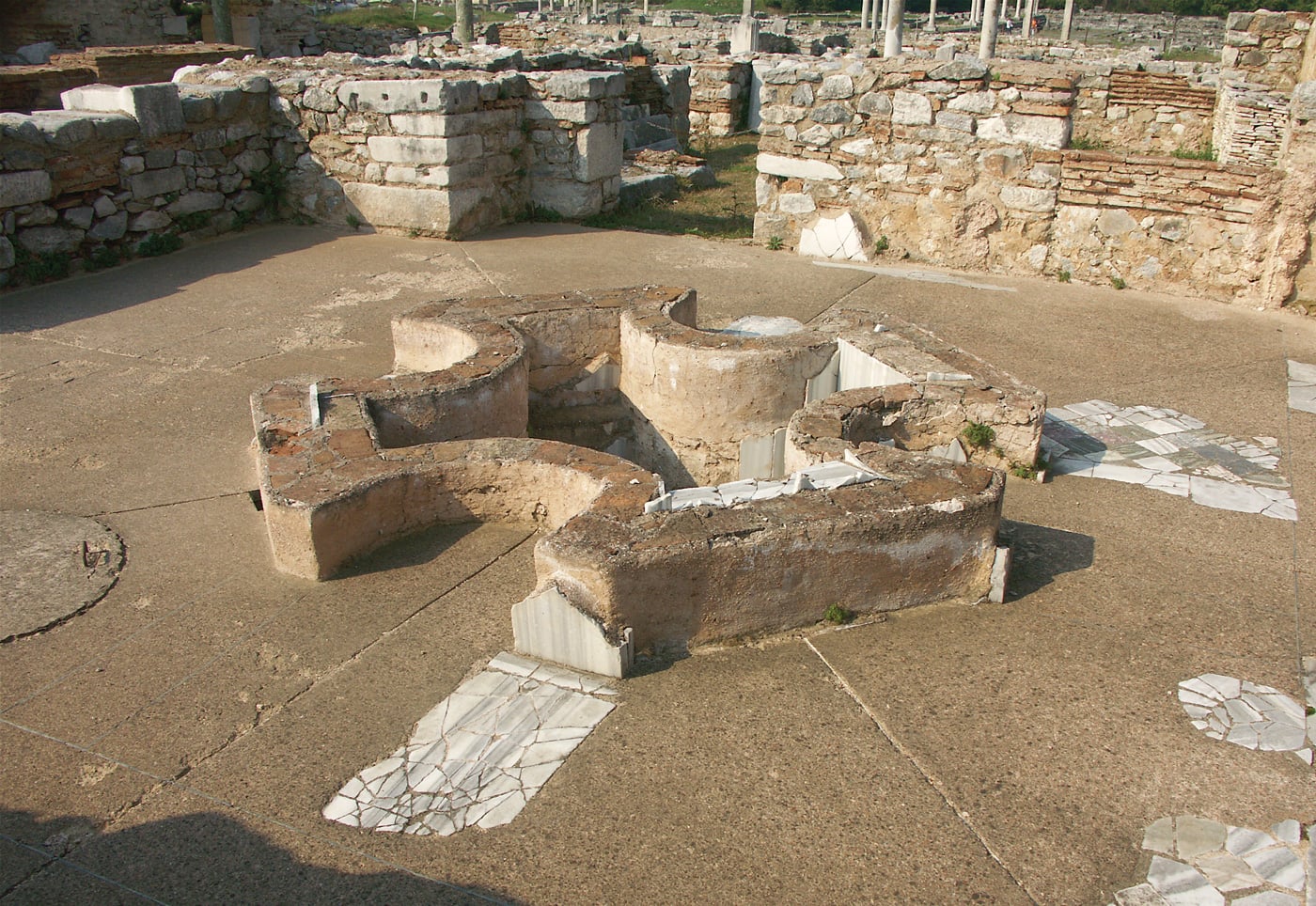
Baptistery from a sixth-century-AD church at Philippi. Paul says in Romans 6:3, “Or don’t you know that all of us who were baptized into Christ Jesus were baptized into his death?”
Paul restates in 6:6–10 what he said in verses 3–5, explaining why Christians cannot continue sinning. Since union with Christ is a union with his death, it is a union with Jesus’s crucifixion (6:6). Since Jesus died on the cross for the sins of Adam’s descendants (“our old self”), believers have been crucified with Christ by virtue of their union with the second Adam. The purpose of Jesus’s death and the purpose of the believer’s union with him is the destruction of the “body ruled by sin,” the liberation from the power of sin that has enslaved Adam’s descendants (1:18–3:20). Verse 7 explains why believers cannot be slaves to sin: dead people are no longer controlled by the power of sin, which means that believers who have been identified with Jesus’s death and who died when Jesus died have been freed from the enslaving power of sin and its consequence, which is God’s condemnation. This does not mean that Christians can no longer sin. We are united with Jesus’s death and resurrection, but the resurrection of our body is still in the future. Believers have been freed from sin and its consequences, but they are not yet free from temptation, or from the possibility of sinning, or from the reality of committing sins. But sinning is not the state of affairs that believers consider to be normal and acceptable. In verses 8–10 Paul explains what the believer’s union with Jesus’s resurrection means. As they are incorporated into Christ’s death, they will live with him in the future of God’s ultimate triumph over death (6:8). The reason is that Christ, whom God raised from the dead, will not die a second time (6:9), which means that those who are united with Christ’s death will not die a second time either. Death no longer has any power over Jesus, and thus death no longer has power over believers, as their death has already taken place (on the cross). Verse 10 explains why the power of death has been canceled: when Jesus died, he “died to sin”—that is, to break the power of sin, which owns sinners by imposing the death sentence (5:21; 7:9–11, 15–20). As the power of sin has been broken once for all, the risen Christ lives for the glory of God.
In 6:11–14 Paul explains his assertion in 6:2, that believers have died to sin and thus cannot go on sinning, with regard to the behavior of Christians in everyday life. Believers who are incorporated into Christ must consider themselves dead to sin and thus ready and enabled to live for the glory of God (6:11). This is possible as a result of the reality of being “in Christ Jesus.” It is as the result of their union with Christ that they participate in the liberation from the power of sin through Jesus Christ and in the newness of life he lives for the glory of God. They must recognize that they are no longer controlled by sin, which always results in death. Now God is their master. The implications of this new reality are spelled out in verses 11–12. Believers must not allow sin and desire for sin to take over again. Paul acknowledges that sin can be tempting, that both temptations and acts of sin continue to be possibilities for believers, and that both sin and temptations are not ideas but realities that affect the person of the believer (and his body, which continues to be mortal, i.e., weak and finite). This is why Paul formulates an imperative—since Christ triumphed over sin and death, believers in Christ must not allow themselves to come under the enslaving power of sin again, as their union with Christ’s resurrection enables them to resist sinful desires. Since sins are committed by the members of the human body, Paul challenges the believers not to allow their bodies to promote wickedness (6:13). They must realize that they have been promoted from death to life, that they placed themselves at the disposal of God, and that they must use their bodies to promote righteousness. Paul promises that sin will no longer rule over the believers (6:14). Since Christ has broken the power of sin, those who are united with him cannot be controlled by sin (and its consequence, which is death). Sin can no longer be their lord, because they belong to the Lord Jesus Christ. Believers in Jesus Christ are “not under law”—they are not exposed to the death sentence of the Mosaic law, which condemns sinners. Rather, they are “under grace”—their life in the present and their life in the future are determined by the grace of God, who has forgiven their sins through Jesus Christ.
6:15–23. In verse 15 Paul restates the question of verse 1, suggesting that some might argue that living under grace gives permission to sin. Paul forcefully rejects such a conclusion and explains its fallacy in 6:16–18, emphasizing that there are only two options: obedience to sin or obedience to righteousness. Believers should know that they are slaves of the master whom they obey, which is either sin or God (6:16). If sin controls people, the result is death, eternal separation from God (Gen. 2:17; 3:24). If obedience to God controls people, the result is righteousness, the grace of God’s gift through Jesus Christ, and life in the presence of God. Paul’s thanksgiving (6:17) clarifies that believers do not occupy neutral ground in the battle between sin and righteousness. They were once enslaved to sin (1:18–3:20). Since they accepted the teaching of the apostles—the preaching of the gospel of God—and came to faith in Jesus Christ, they have become obedient to God. It was God himself who caused them to become obedient in their hearts to the gospel. It was God who liberated them from the power of sin and its death sentence and subjected them to the power of righteousness (6:18). When Paul uses the language of slavery with regard to God and righteousness, he speaks in human terms (6:19). In their past life, the believers were slaves to uncleanness and lawlessness. In their present new life they can and must be slaves to righteousness, which results in sanctification. They are committed to the process of becoming more and more holy, as God is holy. Christian believers have no choice: they either sin or they decide to live according to the will of God. There is no middle ground. People are either subject to the tyranny of sin and lacking in righteousness (6:20), not getting any benefit from their impure and wicked activities, which eventually result in God’s death sentence (6:21), or people are subject to the lordship of God, liberated from the power of sin, with the benefit of a holy life and the confidence that they will have eternal life (6:22). Being slaves to sin has no advantage, while obedience to God and his righteousness yields the fruit of sanctification. Paul expresses this alternative in his concluding statement. The “wages of sin”—the compensation paid by sin for services rendered—is death, eternal separation from God. The free gift given by God is eternal life, made possible on account of the work of Jesus the Messiah and Lord.
7:1–8:17: From flesh to Spirit. Paul explains in this section the change in ownership of human beings, who are owned either by sin or by Jesus Christ (which is his argument in 6:15–23 for the assertion that believers cannot go on sinning). After a succinct introduction (7:1–6) he explains that, before their conversion, believers were ruled by sin and death (7:7–25). As the result of their being united with Christ, they are ruled by the Spirit of life, who helps them to live according to the will of God (8:1–17).
7:1–6. Paul begins with a reference to the legal principle of Jewish law: the law is binding on a person only during the lifetime of that person; once the person has died, he or she is free from the stipulations of the law (7:1). Paul illustrates this principle with the law of marriage. The law binds a married woman to her husband (according to Jewish law, women cannot divorce their husbands). In the case that her husband dies before she does, she is no longer bound to her husband (7:2). On the one hand, this means that if she lives with another man while her husband is alive, she will be identified and punished as an adulteress (7:3). On the other hand, if her husband dies, she is free from the law concerning her husband and thus free to marry another man. The death of her husband releases the wife from the marriage bond and allows her to have relations with another man without these relations being classified as adultery.
Paul concludes from the legal axiom that the law has authority over a person only as long as the person lives and that believers who are united with Jesus’s death and who have therefore died are freed from the normative power of the law (7:4). The death of Jesus results in the death of the believers as they are incorporated into Christ. They have died to the law—as they have died in Christ, the law no longer has power over them. Christ’s death broke the power of the law, which, when it encountered sin (which it always does), resulted in death. As believers in Christ have died to the law, they no longer belong to the law, and thus they are free to belong to someone else, namely, to God. As a result of their incorporation into Christ, whom God has raised from the dead, believers experience the power of resurrection in their lives, allowing them to bear fruit for God.
This reality is explained in verses 5–6. Before their conversion, believers lived in the “flesh” (Greek sarx). This means that their physical existence was conditioned by opposition to God and thus determined by sin—indeed, by “sinful passions,” which were manifest in the actions of their body, resulting in condemnation (7:5). Paul’s assertion that the sinful passions were “aroused by the law” was provocative for Jews, who believed that the role of the law was to curb sin, not to stimulate sin. Paul will explain in verses 7–11 what he means. When the fundamental self-centeredness of human beings encounters the law, which formulates God’s will and which demands unconditional love for God and neighbor, the sinful ego reacts and asserts itself; and thus sinful passions are stimulated and sinful actions ensue. The phrase “but now” marks the change of ownership that has taken place (7:6). Believers have died with Christ; they are thus freed from the condemning power of the law. They have been released from being slaves of the law, which controlled their destiny as sinners. They are no longer governed by the “letter” of the law (NIV “the written code”), which pronounced the death sentence (cf. Gal. 3:13; 2 Cor. 3:6). Rather, believers are slaves (NIV “we serve” puts it mildly) in the newness of the Spirit. Their life changed ownership from belonging to the law (resulting in death, on account of the reality of sin) to belonging to Jesus Christ (resulting in new life, on account of the reality of the resurrection). This new reality is conditioned by the revelation of God’s righteousness through Jesus Christ, by the presence of the Holy Spirit, by the fulfillment of the promises that in the new covenant God’s Spirit will give to God’s people the desire and the ability to keep the statutes of the law (Jer. 31:31–34; Ezek. 36:26–27). Paul explains 7:5–6 in the next two sections: the old life in the flesh (7:5) is explained in 7:7–25, and the new life in the Spirit (7:6) is explained in 8:1–17.
7:7–12. Paul next describes the rule of sin. The assertion in verse 5 (and the statements in 3:19–21; 5:20) may suggest to some readers that the law itself is sin (7:7). Paul energetically rejects such a conclusion. He explains his “By no means!” (RSV, ESV; NIV “Certainly not!”) in verses 7–12: since the law condemns sinners and consigns them to death as the consequence of their sin, the law belongs on God’s side and is thus opposed to sin. The problem is sin, not the law. Paul recounts the history of the encounter between the “I” and sin.
The identity of the “I” (Greek egō) is disputed. The main interpretations are autobiographical (Paul recounts his own experience), salvation-historical (Paul describes the experience of Israel), related to Adam (Paul recounts the experience of Adam), universal (Paul reflects on the experience of humankind). In view of the structure of Paul’s argument in chapters 7–8 (as suggested by 7:5–6) in the context of his argument since 1:18, it is not plausible to assume that he would write a long text about his personal experience. Nor is it plausible to assume that Paul is describing the experience of Jews only, considering that he has indicted both Gentiles and Jews for sinful disobedience (1:18–3:20), that he outlined God’s solution of the problem of the sinfulness of both Jews and Gentiles in 3:21–5:21, and that he has described the reality of God’s righteousness in the lives of both Gentile and Jewish believers since 6:1. It is best to combine the interpretation linked with Adam and the universal interpretation—all people without exception, all of Adam’s descendants, both Jews and Gentiles, are subject to sin. Thus, Paul describes in this passage the encounter between human beings and the reality of sin, with the narrative of Adam’s fall (Genesis 3) in the background.
The history of the “I” begins with the knowledge of sin (7:7). Knowledge of sin is possible only in the context of the law. Paul explains verse 5—the sinful passions became effective when “I” became acquainted with the desire for what was forbidden. The commandment “You shall not covet!” (Exod. 20:17) is not only the tenth commandment; it also points to God’s prohibition of eating from the Tree of the Knowledge of Good and Evil in the Garden of Eden (with the punishment of death in case of noncompliance; Gen. 2:17; 3:3, 11). And it points to the biblical truth that uncontrolled desire is the manifestation of human self-centeredness and self-worship, and thus idolatry. As desire is operative in sin, the law is operative in the commandment not to covet. As “I” encountered the law in the commandment not to covet, and as “I” did not obey this commandment, “I” made the acquaintance of sin. This “coming” of the law cannot refer to the Mosaic law, since people knew about sin before Moses (5:13–14); it refers to the story of Adam in the Garden of Eden, whose story is told as the story of all human beings.
In 7:8–11 Paul describes how sin came from outside to the “I.” Appearing as a personified being, Sin used the existence of the commandment as an opportunity to produce the desire for what is forbidden, which then became a base of operations for sin (7:8). The statement “apart from the law, sin was dead” formulates a principle that explains the function of the law. When there is no law or commandments, sin is inactive and powerless. God’s enemy was able to attack Adam and Eve in Eden only because there was the commandment of Genesis 2:17. The potent power of Sin is death (7:9), an effect that takes place only when there is a law that represents the will of God and that thus defines what constitutes rebellion against God, the consequence of which is death. The time when “I” was alive in absence of the law (7:9) is the time in Paradise before the fall, when everything was “very good” (Gen. 1:28–31; 2:7–15), the time before the arrival of the commandment of Genesis 2:16–17. The great reversal in the history of the “I” happened “when the commandment came,” which was used by sin to spring to life (7:9). The result of the encounter with the law, which was (mis)used by the sin of covetous self-absorption, was the death of the “I” (7:10). Human beings lost the life they had before this encounter. This result of the encounter is ironic, because the commandment that had been given to promote and protect life (Gen. 2:17; cf. Lev. 18:5; Deut. 30:15–20) in fact resulted in death of the “I.”

The Fall of Man by Hendrik Goltzius (1558–1617). Paul’s discussion of sin and the law in Romans 7 echoes his thoughts about the fall of Adam and Eve developed in Romans 5.
Paul explains that the cause of the death of the “I” was not the commandment but Sin, which used the commandment for its own purposes (7:11). Sin’s mode of operation is described with the word “deceive,” which takes up Genesis 3:13, where Eve laments that the serpent has tricked her. When we interpret Genesis 3 not only as the story of the fall of Adam and Eve but also as the fundamental narrative of human existence, we see that sin deceives in three ways. (1) Sin distorts the divine commandment by emphasizing seemingly negative aspects of God’s will. (2) Sin lets humans believe that disobedience against God’s commandment will not be punished with death. (3) Sin uses God’s own law to cast doubt on the goodness of God and thus on the very identity of God, seeking to provide a reason for preferring self-determination over subjection to God. Genesis 3 demonstrates that the strategy of sin worked: Adam and Eve were deceived, as they believed the serpent; rather than improving their situation through their self-asserting action, they were driven from Paradise.
Paul highlights the deception of Sin with the statement that “I” was killed as a result of my doing what Sin suggested “I” do—to desire what God has forbidden and to actively disobey God (7:11). Paul formulates his preliminary conclusion as an answer to the objection of verse 7—the law is holy since it is the law of God, who is holy (7:12). To eliminate any doubt about what he means, Paul clarifies that he does not speak in generalities: the commandment, the voice of the law in its specific stipulations, is also holy. Paul pushes further: the commandment is not holy in some general sense; it is righteous because it formulates God’s demands, which lead his people to righteousness, keep them from harmful and fatal desires, and thus protect them from sin. And it is good because it represents God’s goodwill, which preserves and promotes life.
7:13–25. Paul clarifies the role of the law (which is good) and the character of sin (which deceives). He repeats the objection of verse 7: if the law is good, and if the law pronounces the death sentence, then the law is responsible for my death (7:13). Paul’s protest clarifies again that it is not the law but the operation of sin that is responsible for my death. Paul shows that the divine purpose regarding the function of the law (after the encounter between the “I” and sin) is twofold. (1) The law reveals sin as sin. It proves that sin misuses God’s good gift of the law. It uncovers sin’s deception of human beings. It shows that following the desires suggested by sin leads to death, not to the fulfillment of the promises made by sin. (2) The law increases sin “beyond measure” (NIV “utterly”). As the law unmasks sin with regard to the consequences of sinning, the true character of sin is demonstrated—it always leads to death.
In verses 8–11 Paul has described how sin came from the outside, successfully subduing the “I.” In verses 14–23 he describes the historical reality of the “I,” which now belongs to sin and which is controlled by the death sentence of the law—a reality that is the effect of the history of verses 8–11 for humankind. Paul begins in 7:14–16 by describing the “I” as occupied by sin, as the place of conflict between sin and the law, between “what I want” and “what I do.” The statement “the law is spiritual” (7:14) emphasizes the divine origin of the law in God’s Spirit. However, God’s holy law with its just and good commandments does not have the intended effect in human beings. Since “I” belong to the sphere of the flesh, which opposes God, I am a slave living under the control of sin, helplessly doing what sin tells me to do. The conflict between the law, which has been usurped by sin, and the “I” is a conflict inside human beings—between what “I” want and what “I” do. This is an uncanny and sinister conflict, since “I” understand what “I” want, but “I” do not understand that “I” do what “I” hate (7:15). As God’s creature made in God’s image, “I” want to do the good that God reveals (and the law demands) and refrain from the evil that the law prohibits. Human beings, created by God, who is good and holy, feel aversion when they do the evil and impure things that the law prohibits. The voice of their guilty conscience confirms that the law is good (7:16).
In 7:17–20 Paul demonstrates that in the conflict between the “I” and sin, it is sin that dominates. “I” discover “sin living in me,” as in a house (7:17). As human beings have been created in God’s image, it is a grotesque situation that sin has established itself as a squatter, managing human beings who have been created in God’s image. “I” am forced to acknowledge that “good itself does not dwell in me” (7:18). Human existence in the “flesh” or “sinful nature”—the life in opposition to God and his will—is not good, as humans were before the fall. “I” realize that I have only myself to blame: I know what is right, but I cannot do it. Doing good remains theory; doing evil is reality. Despite recognizing what is good and wanting to do it, we practice the evil in which we do not want to be involved (7:19). This historical reality demonstrates that my actions are not controlled by me but by sin, the occupying force controlling the “I” (7:20). The only freedom that “I” have is the freedom to sin.
The final description of the human predicament, in 7:21–23, reveals a contrast within the law itself. As the law has been usurped by sin, manipulated in pronouncing the death sentence rather than promoting life, “I” find this law active in my experience, unable to do good, but very much capable of doing evil (7:21). Having been created in God’s image, “I” delight in God’s law “in my inner being,” which has not yet moved into action (7:22). However, I find “in the members of my body” (NASB; i.e., in my actions) that, rather than being obedient to the law, “I” am obedient to sin. The law of God has been manipulated by sin—when the law encounters sin, it pronounces the death sentence. Thus the law of God has become “another law,” a law misused by sin that leads to death rather than to life (7:23).
The desperate cry “What a wretched man I am!” in 7:24 expresses the hopelessness of the human condition. “I” am controlled by sin and realize that my human body is owned by death. As a sinner “I” will suffer the death penalty stipulated by the law. The despondent question in verse 24 acknowledges that human beings cannot save themselves. In 7:25a Paul gives the answer to the question in verse 24—God himself has solved the problem of the sinful human condition through Jesus Christ our Lord for all the people who acknowledge the crucified and risen Jesus Christ as Savior and sovereign Lord. Romans 7:25b is a concluding summary of 7:14–24. Created in God’s image, human beings want to serve God and obey his law. But as people who live in the flesh—that is, in opposition to God on account of their sinful actions—they are condemned to serve the law, which has been usurped by sin and which they therefore encounter as law that pronounces the death sentence.
8:1–17. After Paul has described the tragic and hopeless situation of human beings who live in opposition to God and his holy law, he now turns to a description of the life of Christian believers who are ruled by the Spirit of life, who helps them live according to the will of God. In 8:1–4 Paul explains his exclamation of thanksgiving in 7:25, elaborating what he has said in 7:6. Believers who have been incorporated into Christ and who have thus been freed from the control of the law, which leads to death, are enabled to fulfill the law through the power of the Spirit. Verse 1 reminds the readers that believers who are “in Christ Jesus” are not under condemnation because they have died with Christ (Rom. 6:1–11), who atoned for their sins through his death (3:21–31). In verses 2–4 Paul describes the liberation from the tragically miserable situation of 7:7–24. God’s condemnation, pronounced in the death sentence of the law, was canceled because God’s Spirit freed believers from “the law of sin and death” (8:2)—that is, from the consequences of the law, which, when it encounters sin, leads to death (Rom. 7:13–23). The liberation God granted through his Spirit on account of the death and resurrection of Jesus Christ brought about a change in the law. The condemning law, which posted sin to the account of sinners, controlling their lives as an existence leading to death, has become the law of the new covenant, whose effect is determined by God’s Spirit and that thus promotes and protects life.
God did what the law could not accomplish. When the law encountered human beings, who lived in opposition to God, it was unable to help the sinners, as it had to pronounce the death sentence (8:3). God saved human beings from their hopeless predicament when he sent Jesus, whose mission it was to die as a sin offering for the atonement of sins, into the world. The death of Christ, who died for sinners, marks God’s condemnation of sin and its power over human existence. The result of Jesus’s death and resurrection is the fulfillment of the law by believers who are “in Christ Jesus” and who are thus no longer dominated by the power of humankind’s opposition to God (the “flesh”) but by the power of God’s Spirit (8:4). The passive verb (“might be fulfilled in us”; KJV, RSV) indicates that the obedience of the believers is the work of God, through the power of the Holy Spirit.
In 8:5–8 Paul describes two modes of existence. There are people who are dominated by opposition to God (the flesh), and there are people who are dominated by the presence of God in their lives (the Spirit). People’s lifestyle and values indicate to which group they belong (8:5). There is a stark contrast between the destinies of the two groups. People who are controlled by the values of living in opposition to God march toward eternal death. People who live in the power of the Holy Spirit have eternal life and peace with God, as the condemnation of God’s judgment has been removed (8:6). People whose values are controlled by the flesh are hostile to God—they do not submit to the will of God revealed in the law; they cannot keep the law; and thus they cannot please God (8:7–8).
The application in 8:9–11 emphasizes the following four truths. (1) Believers are not in the flesh, as their values and lifestyles are no longer determined by the secular world, which opposes God. (2) Believers are “in the Spirit” as their values, lifestyles, and actions are determined by the Spirit of God, who lives in them and dominates their personality after sin, the squatter that has occupied human beings (7:17), has been evicted. The Spirit of God is the Spirit of Christ—that is, the Spirit of the new covenant, which has been inaugurated by the saving work of Jesus Christ—whom believers have received. (3) The presence of the Spirit has transferred believers from being owned by sin to being owned by Jesus Christ. (4) The presence of the Spirit, due to the presence of Christ in believers’ lives, guarantees that they will not be burdened forever with their mortal bodies. The Spirit they have been given is a life-giving Spirit, who will grant them eternal life on account of God’s saving righteousness and on account of the resurrection of Christ through the power of God.
The exhortation in 8:12–13 challenges Christians to grasp their new existence “in the Spirit” as ethical obligation. They have been liberated from the slavery of the values and actions of a life lived in opposition to God (8:12), an existence in which death was the inevitable result (8:13a). Since they have been transferred to the gracious dominion of Jesus Christ, who has given them the Spirit of God, who is holy, they will and they can and they must resist and extirpate the sinful impulses of the body, with the result that they will obtain eternal life (8:13b). The battle against temptation and sin is the responsibility of the believer, while the reason for the victorious outcome is the power of the Holy Spirit.
Paul explains in 8:14–17 that God’s Spirit bears witness to the believers that they truly belong to God’s people. People who inherit eternal life belong to God’s family; they are “children of God” (8:14). And people who are children of God are people who are led by God’s Spirit. Being led by the Spirit does not refer to guidance in decision making but to the determination by the Spirit of the believer’s values, lifestyle, and actions. The passive form of the verb emphasizes again that the primary force in Christian obedience is the Spirit of God. The Spirit whom the believers received when they came to faith in Jesus Christ is a Spirit who generates a new obedience in their hearts (8:15). People who have come to faith in Jesus Christ and who have received God’s Spirit have been adopted into God’s family, both Jews and Gentiles. The community of the Christian believers functions as God’s adopted son when they are united with Jesus Christ the Son of God. This new reality is celebrated in prayer as believers praise God for their status as adopted sons and daughters.
The exclamation “Abba!” (8:15) expresses the dynamic intimacy and closeness of the believer’s relationship with God. The Aramaic word means “father” and was used by Jesus when he addressed God his Father (Mark 14:36). Believers have the assured confidence that God is their loving Father (rather than their judge who condemns) because the Spirit bears witness together with their own spirit that they are God’s children (8:16). Just as children are heirs of their father, Christians are “heirs of God” since they are “co-heirs with Christ” (8:17). The reality of the union between believers and Jesus Christ makes them “heirs of God”—they will inherit everything that God has promised, the supreme benefit being life in the very presence of God. The assertion at the end of verse 17 is surprising only at first sight: the condition of receiving God’s inheritance in the glory of God’s new world is faithfulness and perseverance in suffering. Christians are not there yet; they still live in a world where the flesh exerts influence through temptation to sin. Believers suffer until they experience future glorification.
8:18–39: Suffering in hope and ultimate triumph. In the concluding section of his description in chapters 6–8 of God’s saving righteousness through Jesus Christ in the lives of the believers, Paul reflects first on believers’ suffering in the present (8:18–30) and then on the triumph of God’s grace in the future (8:31–39).
8:18–30. Paul points out that believers’ present suffering is nothing in comparison with the future glory that awaits them (8:18). Paul knows that the life of a Christian is often accompanied by suffering—the distress of everyday living, the pain of illnesses, and the afflictions of discrimination and persecution resulting from being a follower of Jesus Christ. But these sufferings seem insignificant, and thus bearable, when we see them in the light of the glory of God’s new world, which he will usher in before long.
Paul explains in 8:19–23 that the sufferings of believers should be understood in the context of a fallen creation in which distress, pain, and death are part and parcel of human existence (Gen. 3:14–19). Since Adam’s fall, creation is no longer “very good” and waits for restoration and perfection. The promised consummation of God’s salvation is not a restoration of paradise, however, but the glorification of the children of God in a new heaven and a new earth (8:19). Creation changed as it was impacted by the futility of human existence, which became the dominating reality on account of Adam’s sin. The present state of creation is distressful, but there is hope because God promised the restoration of a perfect world (8:20). One day, when believers in Jesus Christ will be glorified as God’s children in the consummation, creation will be liberated from being subject to the control of decay and corruption (8:21). At the moment, creation is suffering pain, waiting for the birth of God’s new world (8:22).
As human beings are part of creation, they participate in the distress and the pains of creation. This is true for Christian believers as well (8:23), precisely because they have the Spirit of God, who has given them insight into the causes of the distress of creation and into the deadly consequences of sin, which affects creation. Believers express their frustration with the present corrupting state of affairs by groaning “inwardly”—they are very much aware of what is going on, but they do not go around complaining to others. The presence of the Spirit does not distance believers from creation. On the contrary, the Spirit draws them into an even closer solidarity with creation, as they know that its restoration is connected with the consummation of their own salvation in the future. The presence of the Spirit is the “firstfruits” of the consummation, God’s pledge that believers will indeed share the glory of Jesus Christ the Son of God, with the redeemed bodies of God’s new and perfect world (1 Cor. 15:35–57). The anguished cry of Romans 7:24, in which the groaning of 8:23 finds expression, is answered in verse 23 with reference to the glory of the future consummation.
In 8:24–27 Paul elaborates on the situation of the believer. The salvation of believers is a reality because of the effect of the atoning death of Christ. But the physical completion of their salvation has yet to come. Believers are saved in hope (8:24). This hope stands in contrast to seeing, as it is directed toward the invisible reality of God’s perfect world. This means that, as believers live in hope, they wait patiently for the consummation (8:25). Believers are not alone, even though they live in a world darkened by sin, waiting for God’s future to arrive. They have God’s Spirit, who helps them in their weakness (8:26). Here, weakness is not the fact that believers can still be tempted by sin but the inability to pray as they should be praying. Since believers have not yet seen what they will inherit as co-heirs of Christ, they do not fully know what terms like “salvation,” “freedom,” “glory,” and “adoption as God’s children” mean with reference to the unseen reality of God’s new and perfect world. Christians experience salvation as “firstfruits” only (8:23), with the full harvest yet to come. Christians speak the language of hope. Even when they pray they do not use a language that truly corresponds to the glory and majesty of God. But God’s Spirit helps believers to pray, as he translates their prayers into words that correspond to the glory of God (8:26–27).
Paul concludes in 8:28–30 by emphasizing that all things that may happen to believers, including the sufferings of the present time, assist their “good” (their salvation). This is a fact because those who love God have been called according to God’s purpose (8:28). Nothing can harm believers; everything helps them on their path to future glory. Believers who love God are the people whom God has called in accordance with his gracious decision to save sinners. God’s gracious decision to save sinners is succinctly explained in two steps in verse 29: God elected sinners to be saved, and God predestined the goal of the election of sinners. This goal is the glorification of the believers—they will share the glorious form of Jesus Christ, the risen Son of God, and live as members of God’s family. Sinners whom God predestined to share the glory of the risen Jesus Christ have been called by God to come to faith in Jesus Christ (8:30). As they responded to this call with faith, sinners received the unmerited gift of God’s righteousness. And it is these justified sinners who will be glorified by God in the glorious future of his new world. This does not mean that believers in Jesus can live in any way they please, however, since their ultimate salvation is guaranteed; this is why Paul exhorts believers to “continue to work out your salvation with fear and trembling” (Phil. 2:12).

The Circus Maximus, designed for the great chariot races in Rome, could seat about sixty thousand people. It became the site where many Christians were put to death for their faith. Nevertheless, Paul promises that nothing—not “trouble or hardship or persecution or famine or nakedness or danger or sword”—can separate us from the love of Christ (Rom. 8:35).
8:31–39. Paul now speaks of the future triumph of the believers. He begins with a rhetorical question: “If God is for us, who can be against us?” The implied answer underlines the conviction that God is for us. This is a basic summary of the good news of the revelation of God’s saving righteousness for sinners, which Paul has been describing since Romans 3:21. The central assertion of the gospel is the certainty that God is “for us”—a reality that became effective for the salvation of sinners when he sacrificed his own Son for all of us in the incarnation and death of Jesus Christ (8:32). The consequence of the fact that God gave his Son into death for sinners is the guarantee that he will give to those who have identified with Jesus Christ “all things”—everything else necessary for the consummation of salvation and the attainment of his glory. In verses 33–34 Paul explains the conviction that nobody can be against us. He describes the future trial in God’s court of law, in which a potential enemy might bring charges against believers. God and Christ appear as the believer’s advocates whose actions render the accusations null and void. Because God is the judge who pronounces believers in Jesus Christ to be righteous, having canceled their guilt and the death sentence of the law, there is nobody left who could effectively accuse God’s children. Because Christ has taken believers’ sins upon himself, and because he is at the right hand of God on account of his resurrection from the dead, interceding for all who have come to faith in him, there is nobody left to condemn the sinner. Romans 8:33–34 thus confirms the truth of 8:1.
In 8:35–39 Paul explains further why believers cannot be condemned on the day of judgment. He asks whether there is anyone or anything that might separate believers from the love of Christ—that is, from the love that Jesus Christ has for sinners, for whom he died on the cross and whom he protects through intercession before the throne of God (8:35). Powers that might separate believers from Jesus, with the result that they would be exposed to God’s condemnation after all, are trials and experiences of suffering such as hardship, distress, persecution, famine, lack of clothing, peril, or mortal danger in war. Such trials are prophesied for the tribulation of the last days (Mark 13:8; Rev. 6:8). The quotation from Psalm 44:22 serves as confirmation that the people of God will indeed experience suffering and distress, which always characterize the lives of the righteous (8:36). Paul emphasizes that suffering and distress, particularly suffering that results from believers’ faith in Jesus Christ, cannot separate them from Christ. On the contrary, suffering in union with Christ leads to glorification with Christ, to a triumphant victory, which means infinitely more than merely the end of suffering (8:37).
In the last two verses of the central section (chaps. 6–8) of his letter, Paul celebrates the believers’ triumph over life and death as a result of their connection with the love of God in the Lord Jesus Christ. The power of the love of God and of Jesus Christ guarantees not only victory over suffering and tribulation but also, and in a much more fundamental sense, victory over all forces that oppose God in this world (8:38–39). There is no power that can separate the believer, who is loved by God and protected by Christ, from God’s final and glorious salvation—not even death, the most powerful force and the last enemy of believers (1 Cor. 15:26); not life in the flesh, which lives in opposition to God and seeks to entice believers to yield to temptation and sin; not demonic powers, which control the world, which has rebelled against God; not hostile forces that seek to control the earth; not hostile forces that seek to control the heavenly world; not supernatural beings of any kind. Paul asserts that since the hostile powers are part of God’s creation (8:39), they are controlled by the power of God, who has triumphed over the mighty power of death through Christ’s death and resurrection. Because believers are “in Christ Jesus,” whom they acknowledge as Lord, they participate in God’s triumph over the powers of evil, and they participate in God’s triumph over sin and death. This is the reason why believers are assured of their glorification in the consummation of God’s new world (8:30)—they have experienced God’s love, they trust in Jesus the Messiah, and they are obedient to Jesus the Lord. Christian believers are justified sinners who join the praise of God’s grace in the midst of the suffering and the distress of a sinful world.
C. The reality of justification by faith in salvation history (9:1–11:36). In the third main section of his letter, Paul explains the reality of justification by faith in salvation history, raising the question of Israel’s rejection of the gospel. As the Jews have rejected the gospel, has God then rejected Israel (cf. Rom. 11:1)? After he emphasizes his intense concern for the salvation of the Jews (9:1–5), Paul first shows that the suggestion that the Jews’ unbelief proves that God has failed to keep his promises to Israel is false (9:6–29). Second, Paul argues that the responsibility for Israel’s unbelief lies with the Jews themselves, who insist on attaining righteousness through the law while rejecting Jesus the Messiah (9:30–10:21). Paul then rejects the conclusion that God has totally rejected Israel. There are indeed Jews who are believers, and Jews will continue to find salvation through faith in Jesus Christ in the future (11:1–32).
9:1–5: Paul’s intercession for Israel. The present unbelief of the Jewish people pains the apostle to the utmost, a fact that Paul underscores with the solemn affirmation that he speaks the truth and that he does not lie (9:1). Paul emphasizes that the Jews’ unbelief grieves him greatly (9:2). The cause for his grief is implied in verse 3 and apparent from Paul’s argument in the larger context. His intense concern for the salvation of the Jews is expressed in verse 3 in dramatic fashion. Paul asserts that if it could lead to the salvation of his people, he would wish to be cursed and thus cut off from Jesus Christ (cf. 10:1). Paul’s wish is similar to Moses’s plea after the Israelites reject Yahweh and worship the golden calf (Exod. 32:32). He knows that such a wish cannot be fulfilled (cf. Rom. 8:35–39). The object of his intense sorrow is his unbelieving brothers, his fellow Jews, the “Israelites” (9:3–4). The theological significance of the Jews’ refusal to believe in Jesus Christ becomes obvious in verses 4–5. Since Israel was God’s chosen people, who had privileges that the Gentiles did not possess, Israel’s unbelief raises the question of God’s covenant faithfulness (9:6).
Paul mentions nine characteristics that constitute Israel’s privileges. (1) They are Israelites; that is, they bear the name of honor that God gave to Jacob (Gen. 32:38–39). (2) They received the adoption; they are God’s “firstborn son” (Exod. 4:22; Deut. 14:1; Hos. 11:1). As Abraham’s descendants, Jews have a unique, special relationship with God. (3) They have glory, the manifestation of God’s weighty presence in their midst, focused on the tabernacle and later the temple (Exod. 29:43–45; 40:34–35; 1 Kings 8:1–13). (4) They have the covenants, God’s commitments in the time of Abraham (Gen. 15:1–21), Isaac (Gen. 26:4–5), Jacob (Gen. 28:4, 13–14; 35:11–12), Moses at Sinai (Exod. 19:5), Joshua (Josh. 8:30–35), David (2 Sam. 23:5), Josiah (2 Kings 23:3), and Nehemiah (Neh. 9:1–10:39). (5) They have the law; they received the revelation of God’s holy, good, and just will. (6) They have the “worship” (NIV “temple worship”)—that is, access to God through the sacrificial system (Exod. 12:25–26; Josh. 22:27). (7) They have the promises God made to Abraham, Isaac, and Jacob, to Moses and to David and to other leaders of Israel, including the promises concerning salvation and eternal life. (8) They have the fathers, the patriarchs, the leaders of God’s people since Abraham. (9) The Messiah comes from Israel, representing the fulfillment of the promises God made to the fathers. Paul ends this enumeration of Israel’s privileges with a doxology directed at Jesus the Messiah (correct, e.g., is NIV: “the Messiah, who is God over all, forever praised!”; cf., with different punctuation, NRSV: “the Messiah, who is over all, God blessed forever,” which is less likely).
It should be noted that Paul links the attributes of 9:4–5 with believers in Jesus Christ, whether they are ethnic Jews or converted Gentiles. Not all Israelites truly belong to Israel; rather, it is the children of the promise, those who believe as Abraham believed (Romans 4), who count as true descendants of Abraham (9:6–8). Believers in Jesus Christ have received God’s Spirit, who grants them “adoption” into God’s family as God’s children (8:14–15, 23; cf. Gal. 4:5–7; Eph. 1:5). As a result of faith in Jesus Christ, the glory of God, which humankind has lost, is restored to all who believe (3:23–24; 5:1–2; 8:17–21). Believers in Jesus Christ experience the benefits of the new covenant (8:3–4; cf. 2 Cor. 3:6; Eph. 2:12). Believers have access to God on account of the saving work of Jesus Christ, worshiping God in everyday life (5:1–2; 12:1–2). The promises given to Abraham are fulfilled in all people who believe as Abraham believed (4:16; 15:8–9). Gentile believers are also counted among Abraham’s descendants (4:16). Believers in Jesus acknowledge him as Messiah, whether Jews or Gentiles, while unbelieving Jews do not know him; this is perhaps the implied reference in the statement in 9:5 that “from them is traced the human ancestry of the Messiah.” This does not mean that Israel’s privileges have been transferred to “the church” (conceived of as consisting of Gentile believers). But these privileges do not guarantee the salvation of all Jewish people. Paul wants them to be saved, but this means that they must come to faith in Jesus Christ.
9:6–29: God’s righteousness in the history of salvation. Israel’s unbelief does not mean that the word of God has failed. God’s promises for Israel have not been canceled, as the examples of Isaac and Jacob demonstrate. Being authentic descendants of Abraham is not determined by birth but by the sovereign will of God, who cannot be accused of being unjust, as he is the Creator. The basic assertion Paul confirms in the following discussion is verse 6: God’s promises for Israel have not been abrogated.

The veneration of Abraham in Judaism was long-standing by the era of Paul. This structure in Hebron (West Bank), originally built by Herod the Great, is said to be the location of the burial of Abraham, Isaac, and Jacob. Underground tombs exist beneath the building, but they have not been excavated.
9:6–13. Paul argues first that it is God’s free election that determines true membership in Israel. The word of God has not been rendered invalid. The word of God is the word of the sovereign God who elects whom he chooses, a reality that characterized already the beginning of Israel’s history at the time of Abraham, Isaac, and Jacob. The point is that “not all who are descended from Israel are Israel” (9:6), and not all Abraham’s descendants are “Abraham’s children” (9:7a). In 9:7b–9 Paul proves this to be the case first with reference to the example of Isaac. From the two sons of Abraham (born of two different mothers), God chose Isaac, not Ishmael, as the person for whom his promise of offspring was fulfilled (Gen. 21:12). This means for the purpose of God’s election that biological descendants of Abraham are not automatically children of God. Rather, it is God’s promise that causes some of Abraham’s natural descendants to be God’s children (9:8). This is confirmed by Genesis 18:10, 14—Isaac was the promised son, not Ishmael (9:9). Paul’s second proof, in 9:10–13, is the example of Jacob. From the two sons of Isaac (born of the same mother as twins), God chose Jacob, not Esau. Not all the sons of Isaac were sons of God’s promise. The fact that God chose Jacob over Esau, the second-born over the firstborn—even before they were born—illustrates the purpose of God’s election. Being loved by God is not dependent on works but on the gracious will of God, who calls individuals to be his people (9:11–12). The word of promise by which God made his choice is Genesis 25:23, confirmed by Malachi 1:2–3 (quoted in 9:12–13).
9:14–29. Second, Paul argues that it is God’s free mercy that makes people members of the true people of God. In 9:14–21 Paul repudiates the conclusion that God is unjust because he seems to act in an arbitrary manner. This objection (9:14) follows naturally from what Paul has argued: if God elects people to be his children without regard for birth and merit—without regard for affiliation with Israel—does this not call into question God’s covenant faithfulness? Is God not unjust? Paul dismisses this objection. God, who elects some and hardens others, is the sovereign Creator of the world. Paul’s argument again proceeds in two stages. First, the freedom of God’s mercy revealed to Moses (Exod. 33:19) demonstrates that affiliation with God’s election is the result of God’s mercy, not the result of human desire or effort (9:15–16). Second, the freedom of God’s power and judgment visited on Pharaoh (Exod. 9:16) demonstrates that history is the work of God’s sovereign omnipotence (9:17–18). God grants mercy to some, while he decides to harden the hearts of others. The objection of verse 14 is restated in verse 19: if God hardens whom he chooses, he has no right to judge anyone, because nobody can resist God’s will. Paul counters with a fundamental theological truth: human beings are not competent to question God (9:20). Paul confirms this truth with the parable of the Creator and the creature (Isa. 29:16; 45:9). God is the almighty Creator; human beings are his creatures. It is absurd when creatures accuse their Creator. In verse 21 Paul confirms the same truth with the parable of the potter and the clay (cf. Jer. 18:6). The potter has full control over the clay; the vessels he fashions cannot complain.
The application of this truth, in 9:22–29, is compelling. As God has acted in the past with complete sovereignty in his election of people, so he has chosen believers in Jesus Christ in the present. God’s actions with regard to the “objects of his wrath” are linked with the unbelieving Jews: God has endured them with much patience, but they have been made for destruction (9:22). In Romans 1:18–3:20 Paul demonstrated that God’s wrath against the Jewish people (as against the polytheists) is not arbitrary but the consequence of their own actions of disobedience. God’s actions with regard to the “objects of his mercy” are linked with believers: God elected them for the glory of eternal life in the future, with the goal that the riches of God’s glory are being proclaimed in the present (9:23). In verse 24 Paul identifies the “objects of [God]’s mercy” with “us”—that is, with believers in Jesus Christ, whether Jews or Gentiles. The final application of this truth in 9:25–29 confirms the reality of divine election with the authority of Scripture—Hosea 2:25 and 2:1 announced God’s calling of the Gentile believers (9:25–26); Isaiah 10:22–23 and Isaiah 1:9 announced Israel’s restriction to a remnant that will be saved (9:27–29).
9:30–10:21: Israel’s resistance to God’s righteousness. After evaluating God’s responsibilities, Paul addresses the responsibility of Israel. The reason for Israel’s unbelief rests squarely with Israel. The Jewish people insist on attaining righteousness through the law, rejecting Jesus Christ, while Gentiles believe in Jesus and thus receive righteousness (9:30–33). Israel’s zeal is misguided, ignorant of the fact that God now grants righteousness through faith in Jesus Christ the Lord, who fulfills the ultimate purpose of the law and who is the end of the law (10:1–13). Israel has no excuse for her unbelief, as God has indeed sent messengers who proclaimed the good news of God’s saving righteousness through Jesus the Messiah and Lord, a message that should have caused the Jewish people to hear and to come to faith (10:14–21).
9:30–33. Paul first comments on the Gentiles. They did not participate in the pursuit of righteousness, which God accepts by means of the law, because they did not have the law. And yet they have attained righteousness—through faith in Jesus Christ (9:30). The situation of the believing Gentiles is contrasted with the situation of the unbelieving Jews. The members of God’s people according to the flesh (Israel) who pursued righteousness by observing the law did not attain righteousness. The reason for this failure is that they did not fulfill the law (9:31). Paul explains in verse 32: Israel insisted on expunging the curse of the law through observance of the law’s stipulations rather than accepting God’s righteousness by faith in Jesus Christ, as the Gentiles did. They thus stumbled over “the stone” promised by God, which is Jesus, the promised Savior (quotation of Isa. 28:16 and Isa. 8:14). Israel has rejected the stone that God placed in Zion, laying a foundation for a new “temple” (the new place of worship in the new covenant). The reason for Israel’s exclusion from salvation is unbelief in Jesus Christ, who brings God’s promised salvation (cf. Rom. 3:21–26; 10:4) and in whom all people are to trust, both Jews (Israelites) and Gentiles.
10:1–13. Paul asserts again that he desires and prays for the salvation of his fellow Jews (10:1; cf. 9:1–3). In 10:2–5 Paul explains why the Jewish people need salvation. He attests that they are zealous for God (10:2). They are passionately determined to do God’s will and defend God’s honor (cf. Elijah, 1 Kings 19:10, 14). But their zeal is “not based on knowledge” since they do not recognize that God revealed his righteousness in Jesus the Messiah. Paul was himself, before his conversion, extremely zealous (Gal. 1:14); he had a zeal for God’s honor that manifested itself in his persecution of the followers of Jesus (Phil. 3:6). The tragedy is that, even though the Jewish people are eager to worship God and do his will, they have not accepted the truth that God grants righteousness through the death and resurrection of Jesus the Messiah. They continue to establish and maintain righteousness through obedience to the law. Because God’s righteousness now comes through faith in Jesus Christ, the righteousness they achieve through the law is their own righteousness and not God’s righteousness (10:3). In 10:4 Paul reiterates how salvation is achieved in light of God’s new revelation. Since God now grants righteousness through faith in the crucified and risen Jesus Christ, the righteousness he accepts on the day of judgment no longer comes through the law but through the Messiah. It is in this sense that Christ is the end (Greek telos) of the law (10:4). Another thought is present as well: the righteousness that was the goal (telos) of the law now comes through faith in Christ. Jesus Christ is both the end of the law (as a means of acquiring righteousness) and the goal of the law (as a description of the righteousness that God demands and accepts). Righteousness is granted to “everyone who believes”—but only to those who believe, whether they are Jews or Gentiles.
In 10:5–13 Paul confirms this truth through scriptural quotations. The principle of righteousness that comes through the law depends on obedience (10:5). Moses said that Israelites who obey the law will live (Lev. 18:5). The principle of righteousness that comes through faith depends on Jesus the Messiah (10:6–8). The Messiah has come, and he is present in the gospel that is being preached, as promised by the Scriptures (Deut. 9:4; 30:11–14; cf. Ps. 107:26). Jesus the Messiah has taken the place of God’s revelation (Deut. 30:1–20) as well as the place of divine wisdom (cf. Baruch 3:29–30 on Deut. 30:1–20)—both were gifts God had given to Israel. The word of God that brings God’s saving righteousness is the word of faith in Jesus Christ, which Paul proclaims (10:8). In verses 9–10 Paul explains the meaning of the expression “the word [that] is near you” in Deuteronomy 30:14 for believers in Jesus the Messiah. Saving faith, which receives God’s righteousness as a gift, involves a twofold confession (10:9). The confession by mouth is the affirmation that the crucified, risen, and exalted Jesus is Lord (Greek kyrios). The confession by heart is the affirmation that God raised Jesus from the dead and thus vindicated him as the place of God’s atonement for the sins of Jews and Gentiles (Rom. 3:25). The reference to the heart implies that Paul does not speak of the recitation of a creedal formula in Christian worship but of the deep persuasion of individual sinners who have come to faith in Jesus Christ and whose life is determined by God’s gracious gift. In verses 11–13 Paul describes the new epoch of salvation through faith in Christ. Scripture confirms (Isa. 28:16; cf. Rom. 9:33) that it is believers who appear as righteous people before God (10:11). This principle has universal validity. The new order of salvation in which faith in Jesus the Messiah leads to righteousness applies both to Jews and to Greeks (Gentiles) since Jesus Christ is the Lord of all people who believe in him (10:12), a truth confirmed by Joel 2:32 (10:13).
10:14–21. Paul proceeds to survey possible explanations for Israel’s unbelief that may excuse the Jewish people from culpability. In 10:14–17 he surveys the process of the proclamation of the gospel. The Christian confession presupposes faith in Jesus Christ; faith in Jesus Christ presupposes hearing the message about Jesus Christ; hearing about Jesus Christ presupposes preachers; preaching presupposes preachers who have been sent by God, which according to Isaiah 52:7 and Nahum 2:1 is a necessity (10:14–15). Paul argues that the Jewish people have no excuses (10:16). Israel has not believed the gospel despite the fact that preachers and God’s message have reached the Israelites. This disbelief was prophesied by Isaiah, who lamented the fact that Israel had not believed the message of the suffering and the exaltation of the servant of the Lord (Isa. 53:1). Paul’s summary in verse 17 asserts that saving faith comes from the apostolic message, a message specifically about the Messiah and his death and resurrection. In 10:18–19 Paul asks a series of questions that may exonerate Israel. Perhaps Israel has never had a chance to hear the word of God. Paul dismisses this explanation of Israel’s unbelief. Israel has indeed heard, because the words of God’s messengers have been heard in the entire world (Ps. 19:5). Another explanation for Israel’s unbelief may be that they did not comprehend the message they heard. Paul dismisses this explanation as well. The Jews have not only heard the message about Jesus the messianic Savior but also have indeed understood the message. The problem of Israel is that they are not obedient. Paul confirms that the Jewish people have understood the message of Jesus Christ with two witnesses, Moses (quotation of Deut. 32:21) and Isaiah (quotation of Isa. 65:1–2). Israel’s rebellion against the Lord was (in Moses’s days) and is (today) answered by God with a provocation to jealousy—he called a new people from among the Gentiles who have understood God’s revelation (10:19). As in the prophecy of Isaiah, God is found by the Gentiles who did not ask for him (10:20). As in the days of Isaiah, God has extended an invitation to Israel that was rejected (10:21). It is Israel’s fault alone, not God’s, that the Gentiles have attained God’s saving righteousness while Israel has failed to do so. The knowledge that Israel lacks (10:3) is due to their unwillingness to accept the apostolic message as God’s word of salvation.
11:1–32: The salvation of Israel. Paul points out that it would be wrong to conclude that God has rejected Israel and that Jews cannot find salvation. There is a remnant of Jews who have come to faith (11:1–10). More importantly, Israel’s unbelief has caused the gospel to be proclaimed among the Gentiles, whose experience of God’s saving grace is meant to make Israel jealous (11:11–24), prompting Jews to repent and to find salvation as well, in fulfillment of God’s promises (11:25–32).
11:1–10. In view of Paul’s argument that only Israel is to be blamed for their failure to believe in God’s revelation of saving righteousness through Jesus the Messiah (chaps. 9–10), the conclusion that God has rejected Israel (11:1) might seem plausible. Paul rejects such a conclusion. First, there are descendants of Abraham who have heard, understood, and accepted the gospel of Jesus Christ. Paul mentions himself as a case in point (11:1). The fact that he has received God’s saving righteousness proves that God has not rejected his people (11:2). Paul uses the words of Psalm 94:14 and 1 Samuel 12:22 to make this point, which he highlights with a reference to the unmerited love of God for his covenant people. Second, God has maintained a remnant of believing Israelites whom he reserved for himself by his electing grace. Paul mentions Elijah and the seven thousand faithful Israelites who did not abandon Yahweh as a case in point (11:2–4; 1 Kings 19:10, 14). The conclusion is formulated in 10:5–6. God in his grace has chosen a remnant. It was always only a remnant of Israelites who remained faithful to God, and the salvation of this remnant is due to God’s election, which is a gift. In other words, the reason why some Jews receive God’s saving righteousness through faith in Jesus the Messiah is that God has graciously chosen them to be a part of his (new) covenant people. “Works” (obedience to the law) do not save the Jewish people in the new epoch of the Messiah Jesus.
The consequences for Israel are spelled out in 11:7–10. The nation as a whole has not attained the salvation that the Jewish people have been seeking. God’s chosen remnant has found salvation, while God has hardened the rest (11:7). The truth that God hardened the majority of Jews is explained as conforming to the pattern of God’s dealings with Israel in the past. Paul cites from all three parts of the Hebrew canon: from the Torah in verse 8 (Deut. 29:3), from the Prophets in verse 8 (Isa. 29:10, the phrase “spirit of slumber” [KJV; NIV: “spirit of stupor”]), and from the Writings in verses 9–10 (Ps. 69:23–24). Moses asserts that the people of Israel do not see and hear the word of God; they do not keep the law and thus face God’s judgment of exile. There is, implicitly, hope for future redemption; Moses speaks of a time when God will bring Israel back from exile, a time when he will circumcise their heart so that they will love the Lord their God with all their heart and soul (Deut. 30:6). The reference to the “spirit of slumber” suggests that there may be an awakening in the future. Paul refers to David in verses 9–10 to make the point that, as David once pronounced a curse on his enemies, so now Jesus the Son of David, the crucified and risen Messiah, a stumbling block for Jews (cf. 1 Cor. 1:23), brings judgment on unbelieving Israel. The “table” of the Jews (11:9) may be a reference to the table fellowship of pious Jews, which excluded the Gentiles (and Jewish sinners); what they failed to see and understand was that the revelation of God’s saving righteousness through Jesus Christ has created a new people, consisting of believing Jews and believing Gentiles, with a new table at which Jesus’s death and resurrection are remembered (1 Cor. 10:21).
11:11–24. Paul asks whether Israel’s failure to believe in the gospel of Jesus the Messiah means that Jews have fallen from their state of election (11:11a, reformulating 11:1). In 11:11b–15 he explains why he rejects the conclusion that Israel’s failure is permanent. Two arguments are important. First, Israel’s disobedience has resulted in the salvation of the Gentiles (11:11). In Paul’s ministry, the rejection of the gospel by local Jews often resulted in his turning to Gentiles, among whom a greater number of people believed (cf. Acts 13:45–48; 18:6; 28:24–28). Second, the salvation of the Gentiles is meant to provoke Israel to jealousy (11:11).
Paul explains these two arguments in verses 12–14. First, if Israel’s fall leads to the salvation of the Gentiles, the salvation of Israel cannot be excluded as a possibility (11:12). God has not given up on the Jewish people—they are “Israel” and will be saved if and when they come to faith in Jesus as Israel’s Messiah and Savior. Second, Paul’s ministry also aims at the salvation of Israel (cf. 1:16). The salvation of the Gentiles is meant to provoke a yearning for salvation among the Jewish people so that some of them might be saved (11:13–14). Paul hopes that unbelieving Jews will become jealous when they see what happens when Jews (the remnant) and Gentiles come to faith in Jesus Christ, forming communities in which the new covenant people of God live together, with their lives transformed by the power of the Holy Spirit (expected to be poured out in the age to come). The unbelieving Jews would then realize that the followers of Jesus Christ have something they want but do not have and thus be provoked to acknowledge the truth of the revelation of God’s saving righteousness through Jesus Christ. The ground for this hope is expressed in verse 15—if Israel’s rejection of the gospel contributed to the reconciliation of the “world” (Greek kosmos; here, the Gentiles) with God, then the acceptance of the gospel by an increasing number of Jews will lead to an even more astounding benefit—the climactic event of the resurrection of the dead, which is expected at the juncture of this age and God’s new world.
When Paul imagined the people of God as an olive tree (Rom. 11:17), he was drawing on one of the most familiar images in Israel. This ancient tree (with new shoots) is found east of Jerusalem at the Church of All Nations.
In 11:16–24 Paul applies these truths to the assembly of Gentile believers and Jewish believers. The example of the dough of the first-fruit offering, which renders the whole lump holy (11:16; Num. 15:17–21), demonstrates that Israel as a whole is consecrated to God on account of the election of the patriarchs and the promises given to them. The same point is made with the example of the roots and the branches (Jer. 11:16). If the roots of Israel (the patriarchs) are holy, then the branches are holy as well. All who belong to God’s people participate in the election of the patriarchs. God has not totally rejected ethnic Israel. There will be more Jews who will come to faith in Jesus Christ and become members of the people of God’s new covenant. In 11:17–21 Paul restates the illustration of the roots and the branches in terms of an allegory of the olive tree and wild shoot. The olive tree is Israel (Jer. 11:16–19; Hos. 14:6–7); the wild shoots are the Gentiles. The Gentile believers—probably the majority in the church in Rome at the time—must not boast over the unbelieving Jews; such boasting establishes a reverse national righteousness, which comes under the same verdict as Israel. If God removed some branches (unbelieving Jews) from the olive tree (Israel), and if God grafted wild shoots (the Gentile believers) into the olive tree, then they have no reason to boast (11:17–18). Without the promises given to Abraham, God would not have admitted the Gentiles into his people. The decisive factor in the removal of the branches (the unbelieving Jews) and in the grafting in of the wild shoots (the believing Gentiles) is the Jews’ unbelief on the one hand and faith and God’s unmerited grace on the other hand (11:19–20). Faith leading to salvation excludes (ethnic) arrogance. The only proper response to what God has been doing is to stand in awe before God. Arrogance, which is unbelief, provokes God’s judgment.
Paul summarizes his exhortation for Gentile believers in 11:22–24. God’s kindness and severity are not possessions that can be taken for granted. God’s kindness rests on the Gentile believers only if and when they acknowledge him. If they reject God’s kindness, they will experience God’s severity (11:22). There is always the possibility that Jews will come to faith in Jesus Messiah and will be grafted back into the olive tree, “if they do not persist in unbelief,” because nothing is impossible in view of God’s power (11:23). If God could graft wild shoots into the olive tree, then he can graft the original branches back into the olive tree (11:24). Gentile Christians who think that the unbelief of the Jewish people excludes them forever from God’s saving grace, which is granted through Jesus Christ, are mistaken.
11:25–32. Paul now proceeds to explain the mystery of Israel’s salvation. He begins by underlining the significance of the following explanation of God’s sovereignty, warning the Gentile believers not to be proud (11:25). The “mystery” that Paul refers to is not a particular secret that only he knows and now reveals. Rather, it is a reference to the divine plan of salvation, which has been hidden but which God now has revealed to his people (cf. Dan. 2:18–19, 27–30; Dead Sea Scrolls, Rule of the Community 3:22–23; 11:3–5; 1 Enoch 103:2; 104:10–12; for Paul see 1 Cor. 15:51; Eph. 1:9; 3:3–4, 9; 5:32; 6:19). The mystery is not a new revelation that Paul has received as he writes chapter 11 and that contradicts his exposition in chapters 9–10. Paul’s exposition of God’s plan of salvation in 11:25–26 focuses on three elements.
First, God has hardened a part of Israel (11:25). At present there are Jews who have refused to come to faith in Jesus the Messiah and who have not received God’s salvation. This assertion is consistent with 9:27; 11:7, 14, 17. Paul’s statement implies that God has not rejected the Jewish people as a whole as a result of Israel’s failure to believe in Jesus the Messiah.
Second, the period of hardening comes to an end when the “full number of the Gentiles” has come in. The hardening of the Jewish people lasts until all Gentiles have been converted whom God elects to save by grace (11:25).
Third, the salvation of “all Israel” takes place in this manner (the Greek phrase kai houtōs is modal, meaning “and so” or “and in this manner”).
Most commentators interpret the term “Israel” here as a reference to ethnic Jews. If this is correct, Paul asserts that “all Jews” will be saved. This can hardly mean “all Jews/Israelites throughout history” because it seems unlikely that Paul thinks the hardening is reversible (9:18, 21–23; 11:1–10). The suggestion that there is a separate path to salvation for Jews and for Gentiles, with the former being saved at the end through their faithfulness to the (old) covenant and their obedience to the law, is impossible in view of Paul’s burning desire for the Jewish people to be saved (9:1–3; 10:1), which happens when they no longer stumble over Jesus the Messiah (9:32–33). Most suggest that “all Israel will be saved” means that there will be a large-scale conversion of Jews to faith in Christ at the end, with the word “all” referring to “Israel as a whole, as a people whose corporate identity and wholeness would not be lost even if in the event there were some (or indeed many) individual exceptions” (Dunn, 681). A strong minority position disagrees and argues that “all Israel” refers to believing Jews and believing Gentiles who have been integrated into the one people of God’s new covenant on account of God’s grace through Jesus Christ. (For this comprehensive meaning of “Israel” as designation of the people of God consisting of Jewish and Gentile believers in Jesus, see Gal. 6:16.) These commentators point out that there is no indication that “all” should be restricted to “many”; that the expression kai houtōs refers back to Paul’s conviction that the conversion of Gentiles is the means by which Jews are provoked to jealousy, resulting in more conversions among the Jewish people; that Paul emphasizes that both Gentile and Jewish believers are true Jews who are truly circumcised (2:28–29; cf. Phil. 3:3) and thus the “Israel of God” (Gal. 6:16); and that Paul links the privileges of ethnic Israel (9:4–5) with Gentile believers.
These main plausible interpretations that have been suggested all have a difficult element. Either “all” is reduced to “many,” or “Israel” in verse 26 is given a different meaning than in verse 25. Either the timing of Israel’s conversion is emphasized (after the last Gentile has been converted), while the phrase kai houtōs, which expresses a process, is downplayed, or the manner of the conversion of Jews is emphasized, while the meaning of “until,” which expresses timing, is downplayed. Since all three elements of the mystery are already occurring—Jews are obtuse regarding the gospel, Gentiles are being converted, the Gentile mission has led to more conversions among the Jewish people—we should be cautious in describing definite stages in God’s plan of salvation. There can be no doubt that Paul wants Jews to be saved now and that he reaches out to the Jewish people in his missionary work. Whether or not there will be a large-scale conversion of Jews in the future before the end does not change Paul’s eagerness to evangelize in the synagogues of the cities in which he works as a missionary.
In 11:26–27 Paul provides scriptural confirmation from Isaiah 59:20–21 and Isaiah 59:21a + 27:9 (with allusions to other Old Testament passages). The first citation explains the means by which Jacob’s ungodliness is removed. This will happen through the deliverer who comes from Zion; in other words, through Jesus Christ (11:26). Those who see in verse 25 a reference to a future conversion identify the coming of the deliverer with the risen Lord Jesus who comes “from Zion,” who returns from the heavenly Jerusalem at the end of the present age. Those who see a reference to a process that takes place in the present and that culminates in future conversions of Jews identify the coming of the deliverer from Zion with the coming of the historical Jesus, on account of whose death in Jerusalem God grants redemption to Jews and Gentiles. The context of the Old Testament passages suggests that the new covenant, to which believing Gentiles and believing Jews belong, is not a covenant with a national righteousness but the promised covenant in which the problem of sin has been solved once and for all, something that the law could not do. This is why the going out of the law to the nations has been replaced by the coming of the deliverer. The second citation (11:27) emphasizes God’s covenant that removes Israel’s sins, recalling the promise of a new covenant in Jeremiah 31:31–34.
Paul’s summary of God’s plan of salvation in 11:28–32 begins with the assertion that, “as far as the gospel is concerned,” the Jews are God’s enemies, thus allowing the Gentiles to receive the chance to hear the gospel (11:28; cf. 11:11–12). Gentile believers should note that the Jews, as God’s chosen people, are loved by God because of the promises given to the patriarchs (11:16–17). God’s gracious gifts (9:4–5) and God’s call to salvation cannot be revoked; this means that the Jewish people are not hopelessly lost. God’s call is his effective call that justifies the godless (see the call of Abraham and Israel; Gen. 12:1–3; Deut. 7:6–7). In verses 30–31 Paul explains the mystery of verses 25–26, focusing on salvation. The Gentiles presently receive God’s mercy; the time of disobedience was followed by a time of mercy due to the disobedience of the Jewish people, which brought the Christian missionaries to the Gentiles (11:30). The Jews are presently disobedient for the sake of extending mercy to the Gentiles, but the time of disobedience is followed by a time of mercy (11:31). If the last clause in verse 31 (“in order that they too may now receive mercy as a result of God’s mercy to you”) explains the phrase “and in this way all Israel will be saved” in verse 26, then Paul asserts that Israel receives salvation in the same manner in which Gentiles receive salvation—as mercy, if they do not persist in unbelief (cf. 11:23). Israel will receive God’s mercy “now”—through the process in which the Gentiles receive salvation, which causes Jews to become jealous, which in turn leads them to faith in Jesus Christ. Paul concludes in verse 32 with the statement that God’s saving action involves the inclusion of both Jews and Gentiles in the sin of disobedience (cf. Rom. 1:18–3:20) as well as in God’s mercy (cf. Rom. 3:21–5:11). The basic characteristic of salvation history is the justification of the godless as the work of God’s sovereign grace.
11:33–36: Praise of God’s righteousness. The prospect of ever more Gentiles and Jews coming to faith in Jesus Christ prompts Paul to erupt in praise of God’s righteousness. The first stanza (11:33) consists of two exclamations. Paul first praises the depths of God’s riches (the salvation he grants to pagans and Gentiles), the depth of God’s wisdom (his justification of sinners), and the depth of God’s knowledge (his actions in salvation history). Then Paul praises God’s mysterious actions. God’s judgments are unsearchable, as he grants righteousness to the unrighteous. God’s ways are inscrutable, as his mercy elects Jews and Gentiles to form the people of his new covenant. The second stanza (11:34–35) formulates three rhetorical questions, which take up the terms of verse 33 in reverse sequence. Nobody has comprehended the mind of God (Isa. 40:13a); nobody has advised God (Isa. 40:13b); nobody has ever given anything to God (Job 41:3). The third stanza (11:36) expresses the glorious sovereignty of God the Creator and Savior. Everything is from God since he is the cause of the old and the new creation; everything is through God since he is the power of the old and the new creation; and everything is to God since he is the goal of the old and the new creation. The paragraph ends in verse 36 with a doxology praising God’s glorious majesty, inviting the Christians in Rome to respond with “Amen.”
D. The reality of justification in the Christian community (12:1–15:13). In the fourth main section of his letter, Paul returns to the reality of the life of the followers of Jesus. He expounds further on the believers’ obedience, based on the power of love, in various areas of everyday life. The life of the believer is a life of self-sacrifice for God (12:1–2), made possible as a result of the ministry of the gifts of grace (12:3–8) and as a result of the reality of love (12:9–21). Christians continue to have obligations to civic authorities (13:1–7). They fulfill the law through love (13:8–10). They are motivated to be obedient to the Lord Jesus Christ by the imminent arrival of God’s new world (13:11–14). Paul exhorts the believers in Rome not to quarrel about matters related to food (14:1–12). Everyone should be willing to renounce their freedom out of love for fellow believers (14:13–23), following the example of Jesus Christ (15:1–6), motivated by the fulfillment in the present of God’s promises to the patriarchs (15:7–13).
12:1–2: Total commitment to God. Paul has formulated exhortations for believers throughout chapters 5–11. The beginning of verse 1 signals that here begins a longer section in which he draws out some of the consequences of the gospel for everyday living. He begins with the fundamental charge that believers in Jesus Christ must consecrate their whole person (here designated as “body”) to God. That believers yield their entire life to God is a “reasonable act of worship” (NIV “true and proper worship”), the appropriate response to the mercies God extends to sinners. This total commitment is the “sacrifice” that believers offer to God, a reality in which they are alive (cf. Rom. 6:11, 13; 8:13) and holy (cf. Rom. 1:7; 11:16). They are thus acceptable to God again since his wrath has been removed and the failure to properly worship God (1:25) has been reversed through Jesus Christ. Worshiping the living and holy God in a life committed to holy living entails distance from the values of an unholy world where humankind is spiritually dead as a result of sin (cf. Rom. 7:10–11). Since the age to come penetrates into the present evil age due to the revelation of God’s saving righteousness through Jesus Christ, the worship of Christians who live out the logic of the gospel in everyday living involves resistance to the values and thought patterns of the secular world, transformation of their values as God’s Spirit renews their thinking, and discernment of the will of God for their everyday living.
12:3–13:14: The community of believers. Paul’s exposition of the life of the believers and of the Christian community focuses on the church as the body of Christ (12:3–8), on love as the criterion of behavior (12:9–21), on believers’ obligation to civic authorities (13:1–7), on the fulfillment of the law (13:8–10), and on the urgency of the present time in view of Christ’s return (13:11–14).
12:3–8. Paul begins his discussion of life in the community of believers with an affirmation of his apostolic authority—what follows is not his personal opinion but the will of God. He urges believers to base their self-esteem not on secular values (such as social position, wealth, influence) but on the one faith God has given to every believer (12:3). The identity of Christians is not tied to one’s personal preferences but to faith in Christ. The church is not an assembly of individuals who have their own personal interests, values, and claims but a corporate entity that can be compared with the human body, which consists of many members but is a unified whole (12:4–5). The identity of this body and the function of its members are determined by Jesus Christ (cf. 1 Corinthians 12; Eph. 4:1–32). Being a Christian is not a private affair but links the believers with fellow believers in a larger body, in which everyone serves the whole by serving one another. In verses 6–8 Paul lists seven gifts that God in his grace has given to the believers and with which they serve other believers. They are prophecy (spontaneous revelations received from God for the benefit of the believers; cf. 1 Cor. 14:29–33), serving, teaching, encouraging, sharing, leading, and acts of mercy. Since there is overlap between the gifts (the last three gifts all constitute “service”), Paul does not describe a clearly defined set of ministries. This is confirmed by the diversity of the list of spiritual gifts in 1 Cor. 12:8–10, 28–30; 13:1–3, 8; 14:6, 26. Paul’s point is that believers should respond to the promptings of God’s grace in active participation in the fellowship of Christians, serving with humble and openhearted commitment to one another while maintaining the unity of the faith.
12:9–21. Paul clarifies in 12:9–13 that the diversity of believers and their ministries can constitute one body only if their lives are controlled by love (cf. 1 Corinthians 13). The gifts of the Spirit are functions of the body, while love determines how the members of the body function. Love is the esteem and affection believers have for each other as a result of having been saved by God’s love (Rom. 5:5, 8; 8:39) and Christ’s love (Rom. 8:35). Since all good gifts can be manipulated and devastated by human beings, Paul emphasizes that the love God has poured into our hearts (5:5) must be kept genuine, protected from evil, and focused on what is good, as an expression of affection and esteem for the other believers (12:9–10). The basic attitude and behavior of Christians must be determined by diligent discipline and earnest eagerness, by an enthusiastic spirituality, by the consistent commitment to serve Christ as Lord, by rejoicing in view of the hope of sharing the glory of God, by patient endurance in suffering, by perseverance in prayer, by helping to alleviate the practical needs of other believers, and by providing hospitality in their homes for strangers (12:11–13).
In 12:14–21 Paul moves from the internal relationships of believers within the congregation to the relationship with their secular contemporaries. The criterion of love applies not only to believers’ behavior in the church but also to their behavior in general. If they are discriminated against and persecuted, the proper response is to bless, not to engage in payback or to take actions that are evil (12:14, 17, 19, 21). Since Gentile Christians have no official permission to meet regularly, Paul advises that Christians avoid trouble. These exhortations are not simply tactical, however. They are themes of Old Testament and Jewish tradition (Exod. 23:4–5; Prov. 20:22), and more specifically, the application of Jesus’s teaching (cf. Matt. 5:44; Luke 6:27–28; for 12:18 cf. Mark 9:50; Matt. 5:9). Paul knows that life, including the life of Christians, is not free of trouble. He thus commands that believers have genuine empathy with others, whether they suffer or whether they have success (12:15). He calls believers to live in harmony with one another, which is possible if they banish pride, if they associate with people held in low esteem (as Jesus did and commanded; see Matt. 5:3–5; 11:29; 18:4; 23:12), and if they abandon feelings of superiority (12:16). Paul knows that it may not always be possible to live at peace with every person (12:18), as the hostility of people who reject the gospel is all too often an unfortunate reality. If they suffer from their neighbors, they must leave matters in the hands of God, who will repay any injustice on the day of judgment (12:19). However, Christian believers do not simply endure suffering passively. They seek to transcend it by doing good to their oppressors, extending hospitality and kindness (12:20; Prov. 25:21–22). The heaping of “burning coals on [the] head” is probably a reference to God’s judgment (cf. 2 Sam. 22:9, 13; Job 41:20–21; Ps. 140:10; Prov. 6:27–29; Ezek. 24:11); believers’ loving behavior toward their enemies increases the enemies’ guilt, which God will judge. Paul ends with the command not to let the evil that others inflict control them but to courageously commit to do good so that evil may be overcome (12:21).
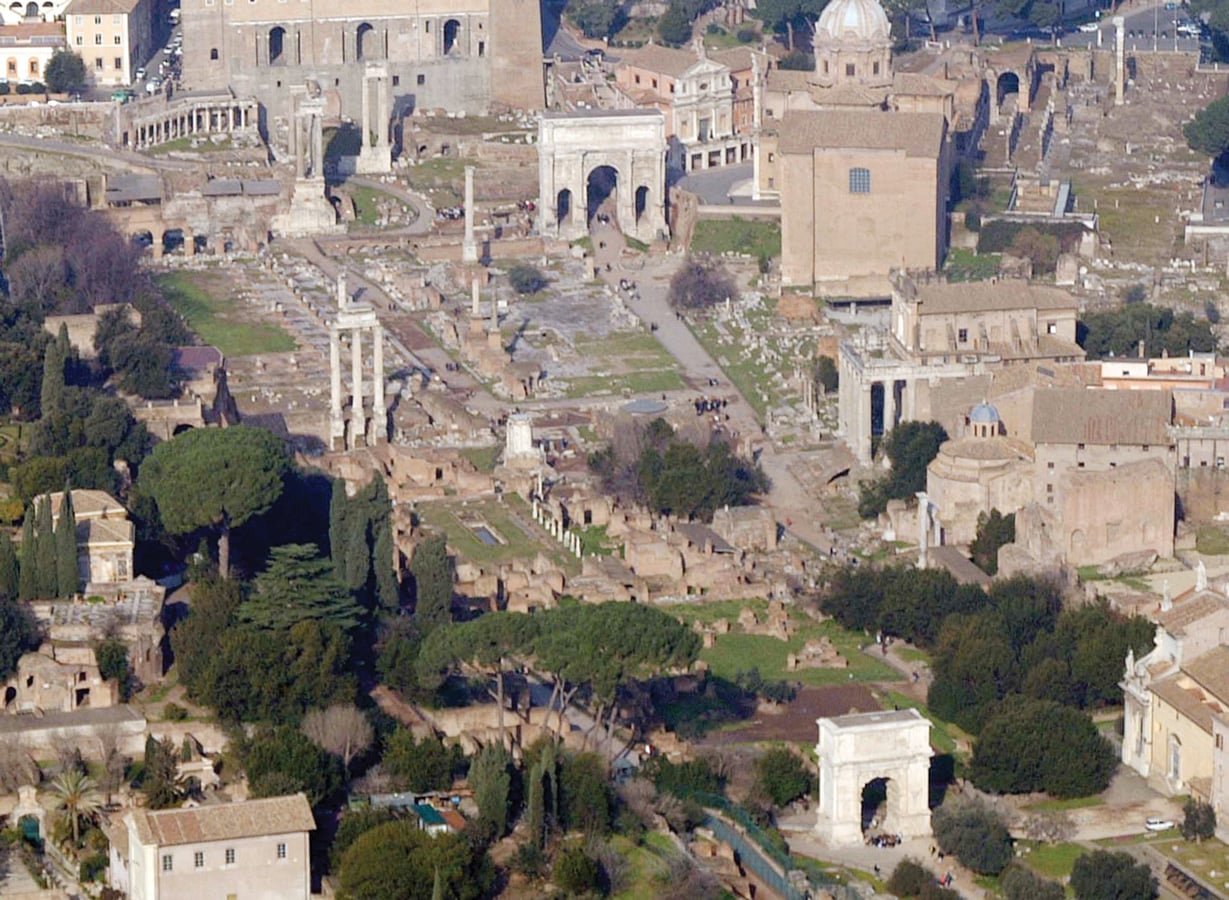
In Romans 13:7, Paul tells Roman believers to pay to governing authorities whatever is due them, whether revenue or honor. The Roman Forum, seen here, was the main commercial thoroughfare in ancient Rome as well as the center for religious and political affairs.
13:1–7. Paul turns to exhortations regarding behavior toward the ruling civic authorities. This is the next logical step after the directions for behavior toward fellow believers (12:9–13) and the directions for behavior toward unbelievers (12:14–21), including those who persecute Christians. Paul gives three commands (13:1, 5, 7). (1) Believers must be “subject” to official government authorities; in other words, believers obey the edicts, rules, and regulations issued by government officials. (2) Believers are faced with the “necessity” to submit to state authorities. (3) Believers must pay taxes; this is a specific example of submission to civic authorities.
In 13:1–5 Paul explains that the basic reason why Christians must submit to the authorities is the biblical truth that God has ordained and appointed all governing authorities (13:1; cf. Prov. 8:15–16; Isa. 45:1–7; Dan. 4:17, 25, 32). It follows that anyone who resists the divinely appointed authorities resists God himself and will incur God’s (and the rulers’) judgment (13:2). The divine institution of governing authorities is reflected in the fact that they promote good conduct and punish bad conduct (13:3–4). When they fulfill this function, they are “God’s servants.” (And when they don’t, such as the Roman emperors who persecuted Christians, they are still accountable to God.) The praise for good behavior (13:3) is the public commendation of people who made extraordinary contributions to the city (e.g., financing of public works). Such commendations were recommended by the city magistrates and then inscribed in stone (honorary inscriptions). The sanction for bad behavior is punishment, meted out by police officials and other governmental powers. (In Egypt police officers are referred to as “sword-bearers.”) Because it is God who institutes the authorities, obedience is a matter of theological principle. It is motivated not only by fear of being punished but also by the concern for a good conscience (13:5).
In antiquity, the vast majority of people were powerless. Paul does not address the possibilities that citizens have in a participatory democracy, and he does not address the problem of secular states that explicitly or implicitly reject any notion of the rulers’ responsibility toward God (which both the Greeks and the pagans recognized). Paul is realistic, which is why he does not mention the Zealot option, which only ten years later led to the Jewish revolt against Roman rule and resulted in untold suffering and the destruction of Jerusalem in AD 70. The application of the principle of 13:1 is spelled out in 13:6–7 with regard to the payment of direct and indirect taxes (tribute and custom tax). These taxes must be paid, as they are demanded by the ruling authorities, whom God has instituted. The background of this astonishingly specific example is probably the unrest in the city of Rome at the time, caused by the increase in direct and indirect taxes under Nero. With the last two obligations—respect and honor—Paul returns to his admonition to acknowledge the legitimate jurisdiction of the divinely instituted governing authorities.
13:8–10. Paul returns to love as the fundamental criterion of behavior. Loving others—being actively concerned for others, having affectionate regard for and interest in others—is an obligation (13:8a). The people to be loved are Christians, but also the neighbor who is the enemy (12:14, 17, 21). The reason and motivation for loving others is given in verses 8b–10. Believers who love others have fulfilled the law; they have properly done what the law asks (Rom. 8:4; cf. Matt. 5:17–20). The commandments of the law, which establish human relationships—no adultery, no murder, no stealing, no envious desires (cf. Exod. 20:13–17; Deut. 5:17–21)—are summed up in the commandment to love others as much as one loves oneself (Lev. 19:18, the most frequently cited passage of the Pentateuch in the New Testament; see Matt. 5:43; 19:19; 22:29; Mark 12:31; 12:33; Luke 10:27; Gal. 5:14; James 2:8). Paul does not reduce the law to one single commandment; he formulates the substance of proper obedience to the will of God.
13:11–14. While the admonition to submit to governmental authorities and to pay taxes suggests that, in many ways, life goes on for Christians as it always has, Paul points out that the expected return of Jesus Christ is near. Final salvation is closer than it was a few years ago (13:11); the day of the revelation of God’s glory and the day of God’s judgment is near (13:12). Christians know that the last days have arrived (cf. Gal. 4:4; 1 Cor. 10:11; Heb. 1:1–2; 9:26; James 5:9; 1 Pet. 1:20). The nearness of the end, which is the beginning of the glorious inheritance of believers, who are united in Jesus Christ, should motivate them to live by the power of God, who raised Jesus from the dead. The present reality is described as night, works of darkness, and the evils of excessive feasting, drinking bouts, sexual promiscuity, violation of all bounds of what is socially acceptable, quarrels, jealousy, and the tendencies of the flesh. Christians live in the context of this reality, which they must confront (cf. 12:1–2). Paul calls them to be wide awake, to stop being involved in the evil practices and traditions of pagan society, to do battle with temptation and sinful values and lifestyles, to live honorably and transparently (“as in the daytime”), to be transformed by their union with Jesus Christ, who is Lord.
14:1–15:13: Unity in diversity. The believers in Rome are “holy people” (1:7), but they also have problems. In the final paragraph of his exhortation, Paul addresses the conflict that exists between believers who regard the Christian faith as an essentially Jewish movement and believers who do not pay attention to distinctive Jewish traditions—that is, between Jewish Christians and Gentile Christians (cf. 15:7–9). The critical debate is not about whether Gentile Christians must be circumcised (as in Galatians 2–4) or about the question of whether Christians can dine in pagan temples and eat food sacrificed to idols (as in 1 Corinthians 8–10). The controversy concerns dietary practices (14:2, 21) and the observance of certain days (14:5–6). Paul’s discussion highlights, again, the nature of the people of God as the community of the new covenant, in which the old distinctions between Jews and Gentiles are no longer relevant. The controlling principle is not the specifics of obedience to the law but the reality of God’s love, which believers need to apply to relationships within the church (14:15; cf. 12:3, 9–10, 14–17, 21; 13:8–10).
14:1–12. In his discussion of the divisions between the “weak” and the “strong,” Paul first argues that Christians who are weak in their faith (14:1) must stop condemning their fellow believers who are less scrupulous (14:3–5, 10, the strong of 15:1) because only God himself has the right to judge (14:10–12). Believers whose faith is weak place their trust in certain dietary practices: they eat only vegetables (14:2), they do not drink wine (14:21), and they observe certain days (14:5). They were Jewish believers (and Gentile Christians influenced by Jewish traditions) who practiced the dietary laws and who observed certain days (including probably the Sabbath). Eating meat and drinking wine are not prohibited in the law. However, Jews could eat only meat that was kosher, in other words, slaughtered according to the rules of the law (Israelites may not eat blood; cf. Deut. 12:15–16). When Claudius evicted the Jews from the city of Rome in AD 49, the Jewish slaughterhouses were probably shut down, prompting Jews who remained in the city (and Jews who later returned) to refrain from eating meat altogether in order to avoid any unclean meat. As wine may have been offered in ritual libations in pagan temples before it was sold in the market, a scrupulous observance of the law led some Jews to refrain from drinking wine altogether (cf. Daniel and his friends, Dan. 1:3–16; 10:3). Paul argues that those who observe these practices must not condemn those who do not, and that those who eat and drink anything must not despise those who have religious scruples regarding matters related to diet. Paul does not refrain from giving his opinion: those who have scruples concerning food or the observance of certain festival days are weak in their faith.
Paul emphasizes five concerns. (1) Believers must not judge each other, because only God judges people (14:10–12). (2) Believers must not despise others, because God has welcomed all believers (14:3, 10). (3) Believers must be convinced that the details of their personal behavior honor Jesus Christ the Lord and express their thankfulness to God (14:5–6), acknowledging that they are accountable to God (14:12). (4) Believers can have differences of opinion, which should be tolerated (14:1, 5–6; evidently the Jewish Christians did not argue that the observances they practiced were necessary for salvation and should be followed by “nonobservant” Christians as well). (5) The identity of Christian believers is not tied up with diet and religious holidays but with the Lord Jesus Christ, who died for sinners and who was raised from the dead. This means that believers who are united with Jesus Christ in his death and resurrection seek to please God in all things, having been liberated from the fundamental human sin of setting their own priorities and constructing their own values (14:8–9).
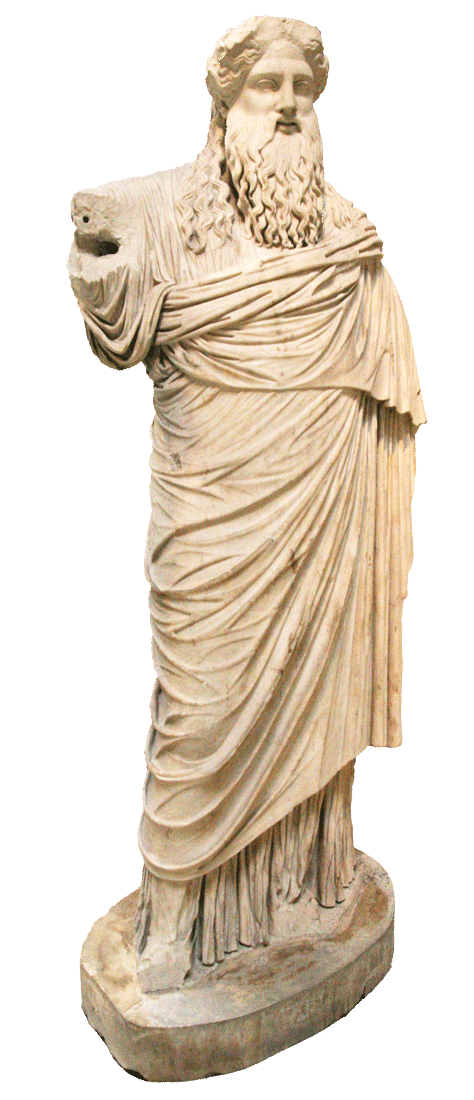
Marble statue of Dionysus (AD 40–60), known as Bacchus in Roman mythology, who was the god of wine and agricultural activity. Some Jewish Christians refused to drink wine because it might have been a libation offering in the pagan temples. Paul’s criterion to refrain from drinking is when it may cause another believer to stumble (Rom. 14:21).
14:13–23. Second, Paul discusses renouncing one’s freedom out of love. He argues that Christians who are strong in their faith have the responsibility not to damage the believers who continue to adhere to Jewish legal practices in the area of dietary law and Sabbath observance. Paul agrees theologically with the strong: no food, no beverage, no day of the calendar is ritually unclean (14:14, 20). They are right in believing that the kingdom of God, which has been inaugurated with the coming of Jesus Christ, is not linked with food and drink but established and present in righteousness, peace, and joy in the Holy Spirit (14:16–17). The strong have faith before God (14:22). However, they threaten to damage the weak, who could stumble and lose their footing (14:13), be injured and ruined (14:15), be destroyed and fall (14:20), take offense (14:21), and be condemned (14:23). This happens if the strong eat and drink what the weak cannot eat or drink, thinking that such behavior makes them unclean (14:14). Paul refers to what happens when Gentile Christians share meals with Jewish Christians who still keep the dietary laws (for Christian meals cf. 1 Cor. 11:17–34). The behavior of the strong causes the weak to follow their example and eat food their faith does not allow them to eat. They consume food they regard as unclean, thereby violating their faith, a fact that damages them, as they are convinced that they have rebelled against the will of God (14:15). As a result of the damage that their faith repeatedly suffers in these situations, they doubt (14:23). Doubt is incompatible with faith (cf. Rom. 4:19–21), and everything that is not done from faith is sin (14:23).
Even though Paul implicitly challenges the weak to have a faith that is strong (he calls them “weak” and agrees with those who eat and drink anything), he calls on the strong to change their behavior. His straightforward command, eventually formulated in verse 21, is not to eat meat or drink wine or do anything else that causes the Jewish believers to injure their faith. He asks them to resolve not to be a stumbling block for the weak (14:13), to show love for their fellow believers (14:15), to make sure that their behavior does not become grounds for irreverent comments about the gospel (14:16–17), to serve Christ and be acceptable to God (14:18), to act in such a manner that peace is maintained and that the fellowship of believers is being built up (14:19), and to keep the faith they have to themselves “before God” (14:22 NASB, NRSV; i.e., not to force their convictions on the weak, and to eat and drink what they wish in the privacy of their homes).
Paul mentions fundamental criteria for Christian behavior: acting out of love for fellow believers as a manifestation of God’s love for justified sinners (14:15; cf. 5:5, 8); evaluating the importance of differences of personal behavior in the light of the righteousness God has given to sinners, in the light of the peace that Jesus Christ has obtained for believers, and in the light of the joy of the Holy Spirit (14:17); safeguarding the continued growth of the church (14:19; cf. 1 Cor. 14:1–5); and respecting the “work of God” (14:20), which is the faith of all believers, and the existence and the unity of the church.
15:1–6. Before Paul concludes his discussion of the controversy between the strong and the weak in 15:7–13, he reminds believers of the basis of their Christian identity. In verses 1–2 Paul summarizes the primary responsibility of the strong. Those who are strong in the faith can and must accept the scruples of the weak as their own burden (cf. Gal. 6:2) by not eating and drinking what the weak cannot eat and drink. They must not insist on indulging their personal self-interest. They must endeavor to give pleasure to their fellow Christians. They must keep in mind the purpose of being a body of believers, which is the continued growth of all Christians. In verses 3–4 Paul explains the main reason for his advice to the strong: Jesus is their example. Jesus the Messiah did not live to please himself. Rather, he denied himself by submission to God’s will, which took him to the cross (cf. 2 Cor. 8:9; Phil. 2:5–8). Psalm 69:9 confirms this: as the righteous person who is devoted to the Lord (69:10) is insulted by his enemies and also by his own family (69:8, 28), so Jesus was despised by the Roman authorities and by the Jewish leadership. In the same manner, as the Messiah was willing to be insulted for God’s honor, the Gentile believers should be willing to give up the focus on their personal interests. They should be willing to be ridiculed by their pagan friends and neighbors who will despise them if they follow Jewish scruples in the area of food and drink. Paul asserts in verse 3 that the Scriptures are crucial for understanding both Jesus Christ and their own identity, because the Scriptures give the believers comfort in the midst of their trials, which result in hope (cf. Rom. 5:1–5; 8:25). Paul ends with a prayer wish in which he prays for the unity of the strong and the weak (15:5–6). This is a unity expressed in Gentile believers and Jewish believers living together, which requires perseverance and encouragement; the constant orientation by Jesus, the crucified and risen Messiah; and the desire to honor God with one voice.
15:7–13. Paul summarizes the section on the controversy between the strong and the weak, and at the same time, he concludes the main body of the letter. In verse 7 he asserts that mutual acceptance and unity are fundamental values for two reasons: all believers have been accepted by Christ, with whom they are united by faith; and the glory of God is the primary concern and reality of those who honor the Creator, as he must be honored by his creatures, who live in his presence. In verses 8–9 Paul explains how Christ accepted both Jews and Gentiles. Christ came as a servant for the Jews who waited for messianic salvation (Rom. 2:1–3:20); Jesus’s death and resurrection have brought the salvation that confirms the promises of salvation given to the patriarchs (9:1–11:36). Since God’s promises to the fathers included the families of the earth, the Gentiles also have benefited from the coming of Jesus Christ; they needed salvation, as they had rebelled against God in their assault on his glory (Rom. 1:18–32); they have received salvation on account of God’s mercy, as have the Jews (3:21–5:21), with the result that they honor and glorify God. The truth of God, which has been abused by pagans and by Jews (Rom. 1:18, 25; 2:8; 3:7), has been vindicated through Jesus the Messiah. The promise given to the fathers has been fulfilled (Rom. 2:25–29; 4:9–22; 9:4, 8–9); the Gentiles have received God’s mercy (1:16–17; 3:21–31; 9:15–18; 11:30–32); the failure of humankind to honor God (1:21) has been reversed. The following quotations from Psalm 18:49 // 2 Samuel 22:50, Deuteronomy 32:43, Psalm 117:1, and Isaiah 11:10 confirm God’s promise that both Gentiles and Jews together would honor and glorify God. In his second prayer wish (after 15:5–6) Paul prays that the God who gives hope will fill both Jewish and Gentile believers with joy and peace, both of which result from faith (15:13). And he prays that the joy of the Lord and peace with God may result in an abundance of hope, which is the present desire for the future reality of life in the immediate presence of God (Rom. 5:2). The hope of sharing the glory of God, and the Christian life in general, is sustained not by the personal efforts of believers but by the power of the Holy Spirit.
Paul concludes his letter with information about his travel plans (15:14–33), recommendations of Phoebe (16:1–2), greetings to co-workers in the Roman churches (16:3–16), and an admonition with regard to dangers facing the churches in Rome (16:17–20). The letter ends with additional greetings (16:21–24) and a doxology (16:25–27).
A. Paul’s missionary work and future travel plans (15:14–33). Paul describes his missionary work as focused on outreach to pagans. This is the reason why he wants to visit the churches in Rome, whom he hopes to involve in the mission to Spain, which he is planning.
15:14–21: Paul’s missionary work. The apostle assures the Roman Christians that his long and, on occasion, bold letter does not question their spiritual maturity nor their independence. They are indeed capable of instructing one another (15:14–15). He writes to them because of the missionary commission he has received from God. Paul describes his missionary work as follows. (1) His calling and his work as a missionary are gifts from God, not the result of his will or ambition. (2) He is a servant who acts as directed by Jesus Christ, his superior authority. (3) He has been directed to focus his proclamation of the gospel on the pagans. (4) His missionary work is an act of sacrifice in which the converted Gentiles are offered as a sacrifice pleasing to God. (5) This priestly ministry takes place not in a sacred space (in a temple) but in the world, and it abandons the religious distinctions between Jews and Gentiles. (6) The goal of his missionary work is the conversion of pagans, who become acceptable to God. As they accept the saving righteousness of God through Jesus Christ and become obedient to the will of God, they glorify God, as they always should have done. (7) The process of missionary ministry is word and deed, both oral proclamation and hard work. (8) The power that makes his missionary proclamation effective is Jesus Christ and the power of the Holy Spirit. (9) Signs and wonders (which include conversions, healings, speaking in unlearned languages) testify to the presence of God in his ministry. (10) Paul has preached the gospel in a circle from Jerusalem to Illyricum. If we trace Paul’s movements on an ancient world map—he preached in Jerusalem, Syria (Damascus, Arabia/Nabatea, Antioch), Cilicia, Galatia, Asia, Macedonia, Achaia, and apparently Illyricum (perhaps the travels described in Acts 20:1–3)—he moved in a circle from Jerusalem in a northerly, then westerly direction toward Rome and Spain. (11) Paul had decided at some point that he would work as a pioneer missionary in cities and regions where no missionaries had preached before, rather than help consolidate churches that others had established.
15:22–33: Paul’s travel plans. Paul asserts that there are no places left in the regions of the eastern Mediterranean in which pioneer missionary work needs to be done (15:23). Paul’s comment in 1 Corinthians 9:5, on the missionary travels of the other apostles, who take their wives along, and on the churches mentioned in Revelation 1:11, illustrates that there was much more missionary work in progress than Luke describes in the book of Acts. Paul plans to begin pioneer missionary work in Spain (15:24, 28). He informs the Christians in Rome that he wants to visit them, as he hopes that they will assist him, probably with logistical help—funds, information, letters of introduction, escorts, perhaps translators.
Paul informs the Roman believers that, rather than traveling from Corinth (from where he writes his letter) to Rome directly, he will first visit Jerusalem (15:25–28). In the churches of Macedonia and Achaia (and also Asia; see the list of Paul’s travel companions in Acts 20:4), he has organized a collection for the poor Christians in Jerusalem. The Christians in Judea apparently still suffered from the effects of a severe famine in AD 46–48 (cf. Acts 11:27–30; Gal. 2:10). Paul gives more details about this collection in 1 Corinthians 16:1–4 and 2 Corinthians 8:1–9:15. Paul reports that the churches in Macedonia and Achaia gave joyfully, and he asserts that it was at the same time their duty to help the poor Christians in Jerusalem on account of the blessings they have received from them (15:27). Paul may have believed that the gifts he brought from the Gentile Christians to Jerusalem fulfilled Old Testament promises that the nations would bring their wealth to Zion (Isa. 2:2–3; 45:14; 60:5–17; 61:6; Mic. 4:1–2, 13). He may also have hoped that this demonstration of the Gentiles’ inclusion into the people of God would provoke unbelieving Jews to jealousy and prompt them to come to faith in Jesus the Messiah. Paul anticipates that his visit to Jerusalem will not be easy (15:30–31). He expects fierce opposition from unbelieving Jews, and he does not rule out the possibility that traditionalist Jewish Christians might reject gifts from Gentile Christians. He asks the Christians in Rome to pray that his life may be preserved. This prayer was answered. Despite several assaults on his life during his visit (Acts 21:26–36; 23:12–35), he survived, although only by being taken into custody by the Roman authorities. He asks the Roman Christians to pray that the gifts of the Gentile churches may be accepted, a prayer that may have been answered (see Acts 24:17). Paul ends by praying for the Roman Christians, asking God, who is the source of peace, to be with every one of them (15:33).
B. Greetings (16:1–24). Paul’s greetings relate to Phoebe, co-workers who are presently in Rome, dangers facing the church, and further co-workers and friends.
16:1–2: Recommendation of Phoebe. Phoebe is a Christian sister who serves as a worker in the church in Cenchreae, one of the two ports of Corinth. The use of the Greek word diakonos does not suggest menial service only. Paul often uses it for missionary preaching and pastoral teaching (1 Cor. 3:5; 2 Cor. 3:6; 6:4). He asks the Roman Christians to welcome her as a fellow believer and to assist her in any matter in which she needs help. Some suggest that Paul has asked Phoebe to organize the logistical details of the mission to Spain and that he asks the Roman Christians to support her in these efforts. This is not impossible, given the fact that Phoebe was evidently wealthy: she had been a benefactor to Paul and to other Christians, which means that she had provided financial help to missionaries.
16:3–16: Greetings of co-workers and other believers. In the longest list of greetings in any of his letters (16:3–16), Paul greets twenty-six individuals and at least five house churches. These greetings express the affection that Paul has for his former co-workers and other believers in Rome, resulting from the new life they share. (Note the frequent “in Christ” or “in the Lord.”) Many of the believers in Rome he knew personally. Some had been his co-workers for many years (e.g., Priscilla and Aquila). The list illustrates why Paul can be confident that there are experienced believers in the churches in Rome who can instruct the Christians responsibly and competently (15:14). The inclusion of eight women, whom Paul acknowledges with joy and thanksgiving, illustrates the importance of the ministry of women in the early church. The presence of Greek, Latin, Roman, and Jewish names and the presence of the names of slaves and freedmen (e.g., Ampliatus, Asyncritus, Junia, Tryphosa, Tryphena) attests to the cultural and social diversity of the house churches in Rome. The house churches met in the homes of Priscilla and Aquila (16:5), Aristobulus (16:10), Narcissus (16:11); the “brothers and sisters” in verse 14 and “the Lord’s people” in verse 15 probably represent two further house churches.
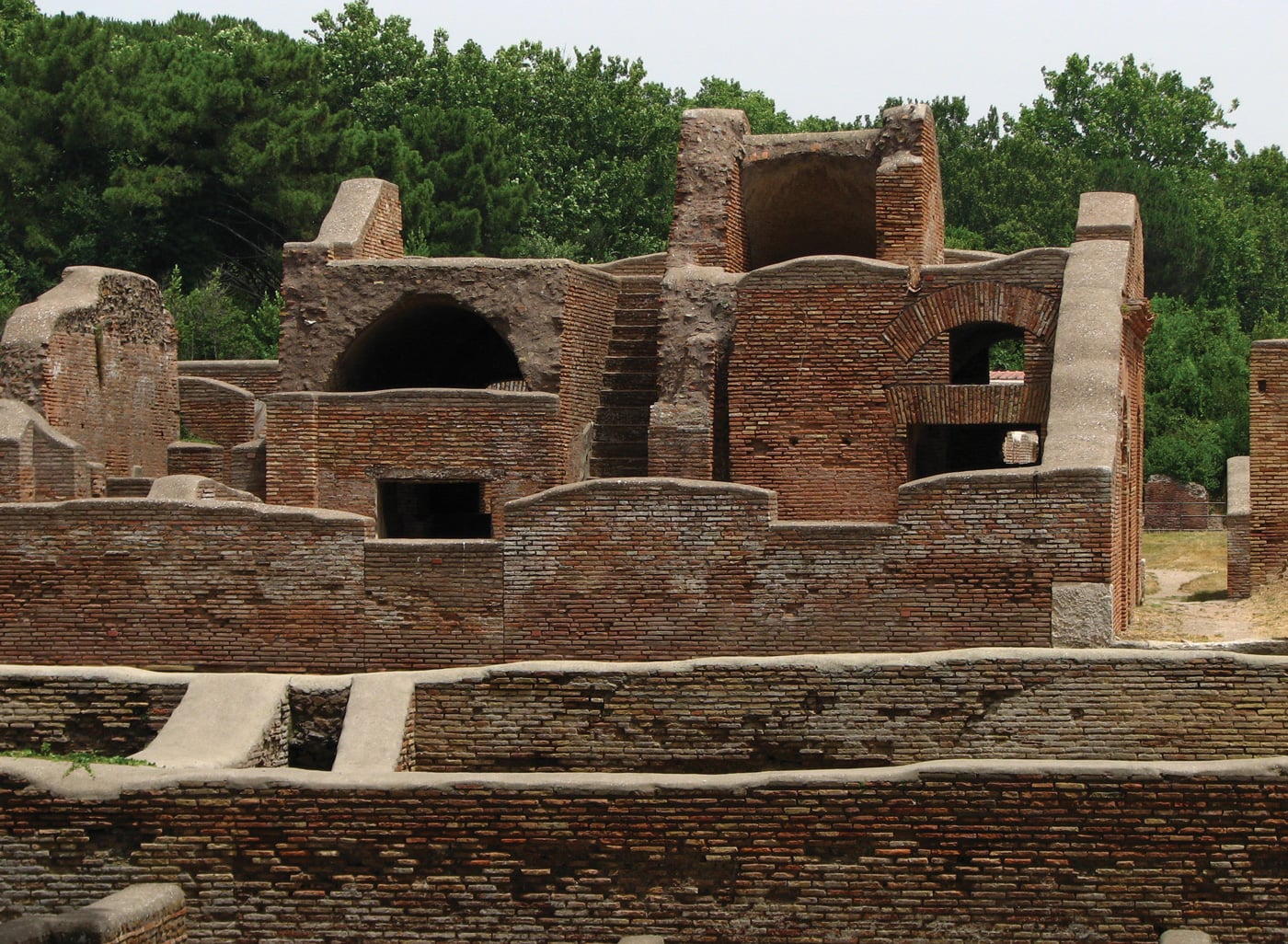
These buildings in Ostia Antica, the ancient port city of Rome, were likely insulae (apartments). The Roman house churches greeted by Paul in Romans 16 may have met together in homes similar to these.
Believers greeted each other by kissing (16:16; cf. 1 Cor. 16:20; 2 Cor. 13:12; 1 Thess. 5:26; 1 Pet. 5:14), a sign of familial affection—probably not only in church but also when they met in public. This was a potent expression of the transforming power of the gospel, particularly when wealthy believers greeted Christian slaves. Paul sends greetings from “all the churches of Christ” (16:16)—that is, from all the churches that he has established and that know and support his ministry. This greeting expresses the universal scope of the gospel and the unity of the believers that results from the truth of the gospel.
16:17–20: Postscript: Dangers facing the church. Paul adds a postscript, perhaps in his own hand (cf. Gal. 6:11; Col. 4:18). He urges the believers to watch out—that is, to identify and evaluate people who cause dissensions and who question the gospel, and to keep away from them (16:17). These people are not interested in Jesus Christ. They are absorbed with their own appetites, and their smooth talk and eloquence can easily detract from the truth of the gospel (16:18). There is no agreement on the identity of these troublemakers. Probably Paul provides a general warning based on Jewish traditions that warn of apostasy and on his own experience (cf. 1 Cor. 1:10–17; 2:1–5; 2 Cor. 11:5–6; Phil. 3:19; Col. 2:4). He knows that the Roman Christians have become obedient to the gospel, which is cause for joy and at the same time the basis from which they can identify and avoid evil teachings (16:19). He assures them that the influence of Satan in the world in general, and in the activities of troublemakers in particular, will be short-lived because God will soon consummate his victory over the serpent (Gen. 3:15). The benediction in verse 20 prays for a continued experience of what they already have: grace from God, who has given them peace.
16:21–24: Additional greetings. Final greetings to the Christians in Rome are conveyed by co-workers in Corinth, prominent among them Timothy, who had worked with Paul in Macedonia, Achaia, and Asia. Paul had dictated the letter to Tertius, who was a secretary (16:22) and was perhaps one of the slaves of Gaius, Paul’s host (16:23). Both send their greetings, indicating that they are both Christian believers and thus part of God’s universal family and also of Paul’s mission. Erastus, “the city’s director of public works” or city treasurer, is probably the same Erastus who is mentioned in an inscription acknowledging his benefaction that paid for the pavement in front of the theater, given in gratitude for being appointed to the aedileship, a municipal office with wide-ranging administrative duties.
C. Final doxology (16:25–27). The letter concludes with a doxology, which ascribes glory to God. The long sentence summarizes the central themes of Paul’s letter: the power of God (1:16), the gospel Paul proclaims (1:1–6; 2:16), the message of Jesus the Messiah (1:3, 9; 3:21–31), the nature and the consequences of the gospel as the mystery God promised in the prophets and that he has now revealed (1:16–17; 11:25), the importance of the Scriptures (1:2; 3:21), the present time (“now”) as the time in which God saves Jews and Gentiles (3:21–5:21), the obedience to the will of God the Creator and the merciful Savior among Jews and Gentiles (1:5; 6:1–8:39), the wisdom of God’s revelation of saving righteousness (1:18–5:21; 9:1–11:36), and the work of Jesus the Messiah, whose death atones for the sins of humankind and whose resurrection grants new life to pagans and Jews (3:21–8:39). These truths and realities confirm that all the glory of all the ages belongs to God. The “Amen” emphasizes Paul’s commitment to these truths and invites the Roman Christians to join in the praise of God the Creator and the Savior.
Select Bibliography
Cranfield, C. E. B. Romans: A Shorter Commentary. Grand Rapids: Eerdmans, 1985.
Dunn, James D. G. Romans. 2 vols. Word Biblical Commentary. Dallas: Word, 1988.
Fitzmyer, Joseph A. Romans. Anchor Bible. New York: Doubleday, 1993.
Moo, Douglas J. Encountering the Book of Romans. Grand Rapids: Baker Academic, 2002.
———. The Epistle to the Romans. New International Commentary on the New Testament. Grand Rapids: Eerdmans, 1996.
Osborne, Grant R. Romans. IVP New Testament Commentary. Downers Grove, IL: InterVarsity, 2004.
Schreiner, Thomas R. Romans. Baker Exegetical Commentary on the New Testament. Grand Rapids: Baker Academic, 1998.
Seifrid, Mark A. “Romans.” In Commentary on the New Testament Use of the Old Testament. Edited by G. K. Beale and D. A. Carson. Grand Rapids: Baker Academic, 2007.
Stott, John. Romans: God’s Good News for the World. Downers Grove, IL: InterVarsity, 1994.
Stuhlmacher, Peter. Paul’s Letter to the Romans. Louisville: Westminster John Knox, 1994.