Introduction
Overview
The books of 1 and 2 Samuel are named after the prophet Samuel, who serves as the last judge of Israel and who anoints both Saul and David to be kings of Israel. The books thus provide a transition between Judges, with its underlying argument for the unifying nature of a monarch, and 1 and 2 Kings, which tell the story of the Israelite monarchy. Originally 1 and 2 Samuel were one book, a unity attested by the earliest existing copy, the larger Samuel scroll among the Dead Sea Scrolls (4QSama), which partially preserves the text from what we know as 1 Sm 1:11 to 2 Sm 24:20. Jewish tradition continued to treat the books as one until the fifteenth century; this is most easily seen in the Masoretic marginal notes, which mark 1 Sm 28:24 as “half of the book by verses.” At the same time, the division between 1 and 2 Samuel is natural enough, since 1 Samuel ends with the death of Israel’s first king, Saul, leaving 2 Samuel to focus on the reign of David. The division into two books occurred already in antiquity, likely due to space concerns; it was first divided by the translators of the Greek OT (Septuagint), who referred to the two as the books of 1 and 2 Kingdoms. The Latin Bible (Vulgate) called these books 1 and 2 Kings and the books that followed, 3 and 4 Kings.
It is worth noting that the story of David does not end in 2 Sm 24 but continues through 1 Kg 1, and his death is not mentioned until 1 Kg 2:10–11. Thus, not only is the division between 1 and 2 Samuel artificial, but the entirety of Joshua–Judges–Samuel–Kings reads, in their final forms at least, as a single, four-volume work that tells the story of the Israelite history in Canaan, from entrance to exile. Moreover, all four contain themes and explicit textual links to the book that apparently gave the historian of the final work his focus: Deuteronomy. It is thus important that as sensitive readers we bear in mind that with 1–2 Samuel we are stepping into the middle of an ongoing story. So, while Samuel, Saul, and David take center stage in this work, the central characters of the larger story are the Lord and Israel.
The Argument of 1–2 Samuel
In asking what 1–2 Samuel is about, we must remember that history writing, whether ancient or modern, is never simply about recording the facts. Instead, a historian chooses which facts to include, orders them, and sometimes even dresses them up. This is done in order to make an argument about some person, event, or period in history—that is, to explain why something happened or to explain a person or event’s larger significance. The challenge with the biblical history writings is that it is often difficult to reconstruct enough of the historians’ settings to be able to identify accurately the specific underlying arguments in their books. Even so, it is helpful to ask oneself as one reads a book like 1–2 Samuel, Why is this event included? or, Why is it told this way?
As a whole, 1–2 Samuel describes two critical transitions in the story of Israel’s beginnings: from charismatic judges to prophets and from tribalism to monarchy. Each shift revolves around three or four figures. Eli, Samuel, Gad, and Nathan represent the shift from judge to prophet; Samuel, Saul, and David move Israel from a loose tribal association to centralized governance in the form of a dynastic monarchy. Within this overarching context of transition, one issue stands at the center and drives the historian’s argument: kingship.
Many scholars nowadays assert that the historian’s use of sources, some that were antimonarchy and others that were promonarchy, have left a confusing mix of narrative voices in the final book. Indeed, there is no doubt that both views can be discerned in the book, but if we assume a skillful historian behind the end product, we need not take the tension simply as a remnant of a complex compositional background; rather, the tension was more likely a deliberate rhetorical strategy, allowing the historian to maintain two stances at once: as a political pragmatist the historian recognizes both the fact of the monarchy’s existence and that a monarchy provides a long-term solution to deal with outside threats (so also Judges); as a theological idealist the historian balks both at the challenge the monarchy makes to God’s kingship and the authority of the prophets and at the power of the monarchic authority to corrupt the king and so lead Israel astray (so also 1–2 Kings).
Even the early chapters, before a king is mentioned, contribute to the argument about monarchy: on the one hand, oppression by the Philistines implicitly picks up the argument at the end of Judges—Israel suffers chaos because there is no king (cf. Jdg 17:6; 18:1; 19:1; 21:25); on the other hand, the victory of the Lord over the Philistine god Dagon in 1 Sm 5 suggests that if the Israelites had just been loyal, their divine King would have provided peace for them. This issue of kingship hovers just below the surface of the entire narrative in the form of three questions: (1) Will Israel continue to recognize the Lord as its true king, even though they now have a human monarch? (2) Who has greater authority, prophet or king? and (3) Who will be the next monarch?
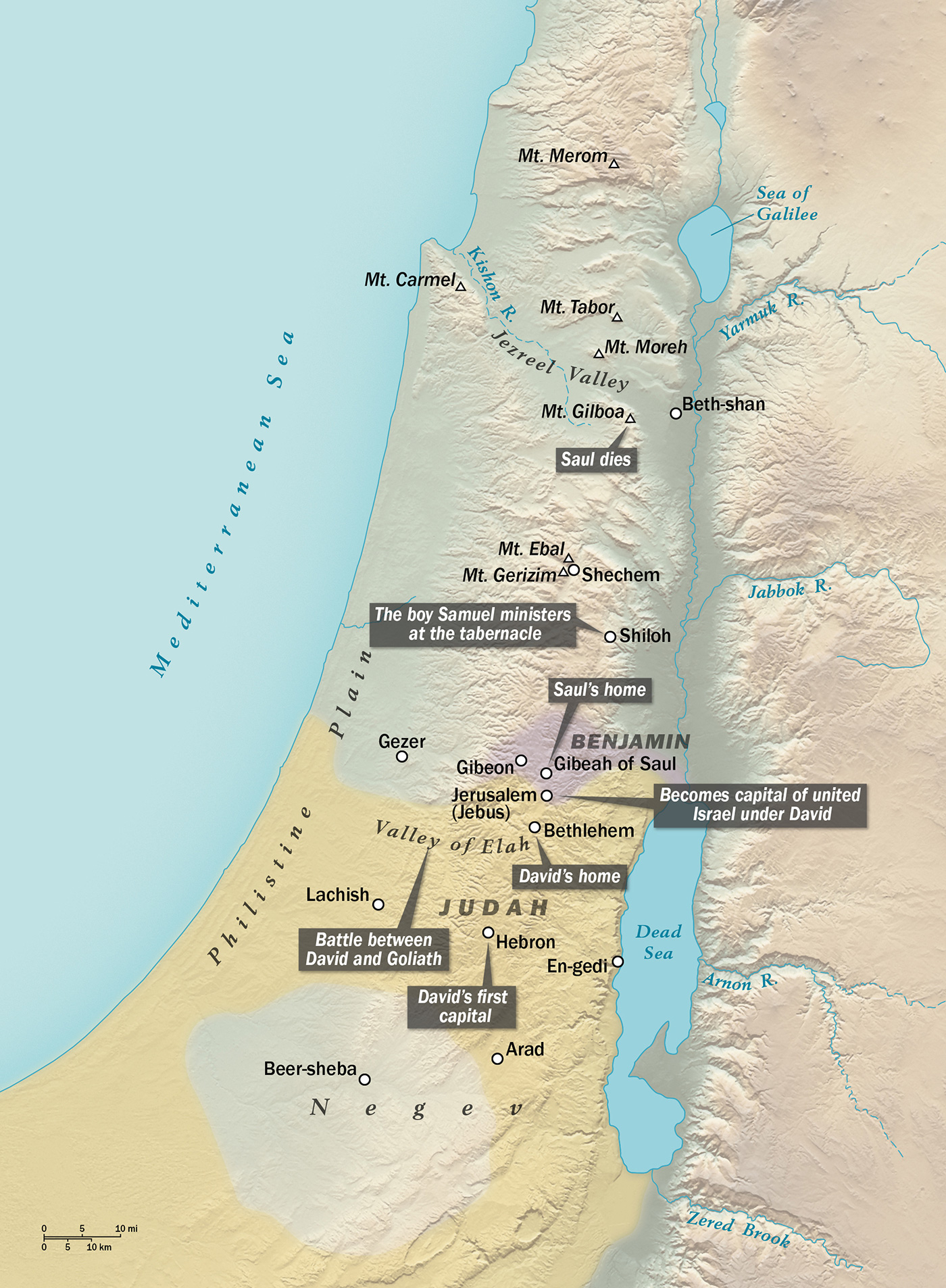
The Promised Land in the Time of Samuel
Human versus divine monarch. Fundamental to the historian’s view is the belief that God as the divine King deserves the loyalty and worship of his people and that he also demonstrates his power to the nations. The request for a human king is thus seen as a rejection of the Lord—both his ability to protect his people and, to some degree, his authority. Typologically and theologically the request for a king mirrors the Israelites’ request at Sinai that Moses receive the Ten Commandments on their behalf—in both cases, the people elect to place a barrier between themselves and the Lord. It is thus not surprising that the historian views the institution of the monarchy with disappointment and suspicion.
Nowhere does the juxtaposition of anti- and promonarchy voices come out more clearly than in 1 Sm 8–12—the chapters that describe the monarchy’s origin (see the table below). The first and last episodes in this sequence present Samuel and the people in a discussion about the merits of a monarchy, and both render the judgment that it is, at its core, a rejection of the Lord as Israel’s king. As bookends to the entire sequence, 1 Sm 8:1–22 and 12:1–25 ensure a negative evaluation of the establishment of the monarchy. The middle episode (1 Sm 10:17–27), in which Samuel summons the people to Mizpah for the official selection of Saul, is also a negative evaluation of the monarchy. Not only does Samuel remind the people that they have been disloyal to the Lord by asking for a king, but their future king is found hiding among the supplies! It is an ignominious start for the monarchy.
In contrast, the second episode (1 Sm 9:1–10:16) asserts that the monarchy will be used by God for Israel’s deliverance. Moreover, the fourth episode (1 Sm 11:1–15) illustrates this benefit, with Saul’s first victory as the newly chosen king. Thus the historian has used both positive and negative stories about the institution of the Israelite monarchy. The positive stories reflect the recognition that being united under a central leader has great benefit. Throughout the ancient Near East, kings were responsible for maintaining justice and hearing legal cases, and 1–2 Kings on occasion depicts a ruler deciding such cases. The negative stories reflect the historian’s distrust of monarchy as an institution of power and wealth that can deter obedience to the command of the Lord (a view echoed in Dt 17:14–17). These stories also reflect the historian’s view that Israel’s choice of a king was first and foremost a rejection of the Lord as their king and military leader (1 Sm 8:7; 10:19), and, second, a rejection of Samuel (1 Sm 8:8). Why is the rejection of Samuel important to the historian? Because it reflects a fundamental tension in the hierarchy of authority between king and prophet.
Evaluations of the Monarchy in 1 Samuel 8–12
| Evaluation | Summary | |
| 8:1–22 | − | Israel demands a king. God instructs Samuel to comply. |
| 9:1–10:16 | + | Saul chosen and anointed. |
| 10:17–27 | − | Saul presented as king. |
| 11:1–15 | + | Saul delivers Jabesh-gilead from the Ammonites. |
| 12:1–25 | − | Samuel entreats the people to follow the Lord. |
Prophet versus king. A second kingship-related thread in the stories of Samuel and Saul and David, Gad, and Nathan is the prophetic challenge to monarchic decisions. The common view throughout the ancient Near East was that the king served as the deity’s vice-regent, thus assuming a close alliance between the king and the deity. This alliance is described in this book (2 Sm 7:14) and elsewhere (Pss 2:7; 89:27–28) using adoption and the father-son relationship as metaphors. The relationship between prophet and king that is unfolded in Samuel, however, undercuts that view: for the historian, the prophet stands between the Israelite king and the Lord, so that a prophet like Samuel can even replace a sitting king by anointing a new one. This superiority of the prophet is strikingly portrayed in a story about David escaping one of Saul’s attempts to kill him (1 Sm 19:18–24). This bizarre episode draws on the fact that one of the characteristic behaviors marking prophets is that they fall into ecstatic states. In this story not only do all of Saul’s messengers begin to prophesy, but even Saul himself falls into a prophetic frenzy when they approach Samuel’s encampment. The prophetic aura functions almost like a force field to keep Saul and his servants at bay, demonstrating the true power of prophet versus king.
As much as 1–2 Samuel is a history of the rise of the Israelite monarchy, it is a history of the dominance of prophets over kings. It expresses prophetic misgivings about kings and their tendencies—above all, their tendency to ignore the word of God through the prophet in preference for the desires of the people. And at each step it shows the prophet Samuel and, to a lesser extent, his prophetic successors, Nathan and Gad, in charge of the flow of events, anointing kings, limiting their powers, and dismissing them from office when they refuse to yield to the divine word announced by the prophet.
The historian’s shaping of the key episodes, from the choice of Saul to both Nathan’s and Gad’s rebukes of David, reflects his deep preference for the priority of prophets over the institution of the king. It is a theologically driven preference for the less institutionalized office of the judge and the highly charismatic office of the prophet that seems to lie behind the negative evaluation of kings that permeates this narrative of the rise of the monarchy. The role of the prophet is considered superior to that of kings, based on the pattern of Moses as the prophet par excellence in Dt 18.
Who shall rule? Finally, a question that becomes agonizing is that of succession. David is anointed in 1 Sm 16 but is not installed as king of Judah in Hebron until 2 Sm 2 and, finally, as king of all Israel in Jerusalem until 2 Sm 5. It thus takes twenty-one chapters to answer if and how David will actually succeed Saul.
After David becomes king, God promises that David’s family will remain the royal family forever and his descendants will follow him on the throne. This promise later figures into the development of an expectation for an “anointed one” (Messiah) from the line of David to deliver the Jewish people from the oppression of foreign rule. Yet the promise does not ensure a smooth transition of power, and David himself witnesses struggles over who will succeed him. He endures an outright rebellion by one son, Absalom (2 Sm 13–20), and, if we look ahead to 1 Kg 1–2, wrangling between two more sons, Adonijah and Solomon, which ends fatally for Adonijah. Typologically, there are parallels between Moses and David in that Moses also faced rebellion, had his authority challenged (even by his brother and sister), and faced the issue of succession. Similarly, David’s story, including its continuation into 1–2 Kings, mirrors some elements of the patriarchal narratives in Genesis. For Genesis, an ongoing issue is who will carry on the promise made to Abraham and whether the successor is or will become worthy; this topos finds expression in Samuel-Kings and the historian’s evaluation of each king against the model of David, who, like Abraham, is an imperfect first recipient of his respective promise.
Title and Authorship
The book is named 1–2 Samuel not primarily on the basis of authorship but on the centrality of the figure of Samuel in the first half of the work: his birth is narrated in the first chapter and his death is reported in 1 Sm 25:1. Even so, it appears that early interpreters took the association to indicate authorship—at least for the first half of the work, up to Samuel’s death. There are tantalizing hints that Samuel (or perhaps his followers) left a set of traditions. In 1 Ch 29:29 there is an interesting reference to “the Events of the Seer Samuel, the Events of the Prophet Nathan, and the Events of the Seer Gad.” Like Samuel, Nathan and Gad were prophets who were closely associated with David. Gad accompanied David during his years as a fugitive from Saul (1 Sm 22:5), and Nathan was the one who ministered to David throughout his reign (2 Sm 7:2; 12:1). Thus it is possible that the traditions mentioned by the writer of 1–2 Chronicles overlap with or perhaps lie behind 1–2 Samuel, much like the Book of Jashar that is mentioned as a source in 2 Sm 1:18. Perhaps the historian who finalized 1–2 Samuel made use of several earlier sources, although it must be stressed both that most such theories are all but impossible to prove and that it matters little for the interpretation of the final form, the received biblical book.
Structure and Composition
Structurally, the book can be divided into four sections based on thematic emphases: 1 Sm 1–15 (Samuel and Saul), 1 Sm 16–2 Sm 8 (the rise of David), 2 Sm 9–20 (David’s reign), and 2 Sm 21–24 (epilogue). The first section describes the transition from the period of the judges to the monarchy and includes a number of stories about the ark of the covenant. In the second section, we are told about David’s rise to the throne and how his dynasty is established. The third section is sometimes called the “Succession Narrative” or “court history” of David. Linked with 1 Kg 1–2, these chapters trace the rivalry among David’s sons as they vie for the right to succeed him as king. That these perceived thematic sections align with the historian’s intended flow is affirmed by four summaries that act as transitional markers: 1 Sm 7:15–17, for Samuel as a judge; 1 Sm 14:47–52, for Saul’s reign; 2 Sm 8:15–18, for David’s reign; and 2 Sm 20:23–26, listing David’s officials.
Though it may be useful to read the book in the four parts mentioned above, the unity of the work as a whole should not be overlooked. One example of the intentionality of the final structure is the use of poems to mark the beginning (Hannah’s song in 1 Sm 2), the middle (David’s elegy for Saul and Jonathan in 2 Sm 1:19–27), and the end (David’s song in 2 Sm 22 and David’s last words in 2 Sm 23).
The events described in these books cover a period of approximately 130 years, from the birth of Samuel around 1100 BC to the end of David’s reign in circa 970 BC. David reigned 7 years over Judah and 33 years over all Israel (2 Sm 5:4–5) from circa 1010 to 970 BC, but the length of Saul’s reign is unclear. Apparently the text of 1 Sm 13:1 became damaged or was miscopied by scribes, because both Saul’s age when he became king and the length of his reign are uncertain. Similarly, the length of Samuel’s tenure as a prophet and judge can be only approximated, although from 1 Sm 8:1, 5 we learn that Samuel is an old man when the people ask him to select a king for them.
In all likelihood, the material in 1 Samuel is arranged in chronological order, but this is not always the case in 2 Samuel. For example, the establishment of the Davidic covenant (2 Sm 7) may have occurred after the military victories described in 2 Sm 8, because 2 Sm 7:1 says that “the LORD had given him rest on every side from all his enemies.” Likewise, the victories over the Ammonites and Arameans discussed in 2 Sm 10 may be either an elaboration of the battles described in 2 Sm 8:3–12 or a completely different set of earlier engagements. Perhaps the lack of chronological order may be partly explained by the theory that 2 Sm 7 and 8 conclude the “apology of David.”
The final four chapters of 2 Samuel are regarded as an epilogue, partly because of their uncertain chronology. The account of the Gibeonites’ revenge against the family of Saul is given in 2 Sm 21, but it probably preceded the revolt of Absalom (2 Sm 15–18). In 2 Sm 16:7–8 a descendant of Saul named Shimei curses David for shedding the blood of the family of Saul, and this may very well be a reference to the executions David permits in 2 Sm 21. At the end of 2 Sm 21 the author describes four battles against the Philistines, which are not likely in chronological order. The chronological issues notwithstanding, the epilogue serves as a transition between Samuel and Kings: the final episode describes David’s purchase of the location that will eventually become home to Solomon’s temple.
Date
As with the issue of literary sources or traditions, so too the date of the book remains greatly disputed. Some scholars continue to treat the materials in 1–2 Samuel as a sort of running history contemporaneous with the events described; that is, the narratives were composed during or soon after Samuel, Saul, and David lived. In this view, even if a later editor combined earlier materials, the earlier sources were left largely intact. Although the lives of the figures themselves (since we assume that they did indeed exist) provide the logical earliest date of composition, references like “Israel and Judah” (1 Sm 17:52; 18:16) and “the kings of Judah” (1 Sm 27:6) suggest that a more likely earliest date lies after the division of Solomon’s kingdom into north and south had taken place, perhaps in the late tenth century BC. The opposition faced by Solomon and his son and successor Rehoboam would have furnished a likely occasion for a vigorous defense of David’s dynasty such as we have in 1–2 Samuel and 1 Kings.
But the historicity of the figures in the book and the date of the book’s writing are not necessarily connected. While recent archaeological finds suggest that more of “biblical” Israel existed in the tenth century than a few recent scholars are willing to admit, it is also legitimately possible to push the date quite a bit further away from the tenth century. If 1–2 Samuel is of a piece with 1–2 Kings and since the last edition of Kings belonged to the exile (the accession of the Babylonian king Evil-merodach (Awel-marduk) in 561 BC is mentioned in 2 Kg 25:27), it is only logical that the received form of 1–2 Samuel took shape some four hundred years removed from David. A work that, on the one hand, celebrates King David and provides a future hope for the monarchy by means of God’s promise to David and that, on the other hand, carries a warning about the havoc wreaked by the inevitable sins of monarchs fits the needs and reality of an exilic context.
There are numerous historical, political, and theological contexts that could lie behind 1–2 Samuel and the historian’s purposes. Unfortunately in a work like this there is not necessarily a direct link between the historian—who is unnamed—and the content, as there is in, for example, some of the prophetic books, such as Micah or Haggai. Thus, the explicit connections that we find in some books between the text and the historical context are missing or extremely subtle. While it can be beneficial to investigate how the book might have fit into various contexts, all but the hints in the text itself (see above on the book’s argument) have been lost to us. Thus, strong assertions about setting and purpose should be received with some suspicion. The only hard fact is the text as we have it, and the most significant context is that the book was ultimately intended for inclusion in Scripture.
Outline
1. A Period of Transition (1 Sm 1:1–15:35)
A. Eli and Samuel (1:1–7:17)
B. The Early Years of Saul’s Reign (8:1–15:35)
2. David’s Rise to the Throne (1 Sm 16:1–2 Sm 8:18)
A. David’s Fame (16:1–17:58)
B. David’s Struggles with Saul (18:1–27:12)
C. Saul’s Final Battle (28:1–31:13)
D. David Unifies Judah and Israel (2 Sm 1:1–5:25)
E. David Established as King (6:1–8:18)
3. David’s Successes and Failures (9:1–20:26)
A. David’s Success (9:1–10:19)
B. The Turning Point (11:1–12:31)
C. Rebellion (13:1–20:26)
4. Epilogues (21:1–24:25)
A. The Gibeonites’ Revenge (21:1–14)
B. Victories over the Philistines (21:15–22)
C. David’s Song (22:1–51)
D. David’s Last Words (23:1–7)
E. David’s Mighty Men (23:8–39)
F. David’s Census (24:1–25)