Introduction
Overview
The book of Isaiah plays an important role in the Bible, in essence connecting the history of Israel that culminated with the fall and destruction of Jerusalem (Gn 12–2 Kg 25) with the coming of the Messiah (pointing toward the NT). Yet Isaiah goes beyond this by also addressing the worldwide (cosmic) problem of sin introduced back in Gn 3–11. That is, the world has a problem with sin (Gn 3–11), and Israel has a problem with sin (Gn 12–2 Kg 25). Isaiah provides an answer for both problems. In his view of the messianic future deliverance, God regathers the scattered, alienated Gentiles of Gn 10–11 and unites them with the regathered, restored Israel.
Most of Isaiah’s message is repeated throughout the OT Prophets. This basic prophetic message can be synthesized to three basic themes: (1) You (Judah/Israel) have broken the Mosaic covenant; repent! (2) No repentance? Then judgment! (3) Yet there is hope beyond the judgment for a glorious, future restoration, both for Judah/Israel and for the nations.
Throughout the book, Isaiah stresses justice and righteousness, both as a characteristic of God and the coming Messiah, but also as a standard for God’s people. Isaiah also stresses the importance of trusting in God during difficult times. The Lord, Isaiah underscores, is sovereign and the one who controls history.
Isaiah the Prophet
Little is known about the prophet Isaiah other than that he loved Jerusalem, freely associated with Judah’s kings, was married, and had two children. The name Isaiah means “Yahweh Is Salvation.” His name and the names of his sons—Shear-jashub (“A Remnant Will Return,” 7:3) and Maher-shalal-hash-baz (“Speeding to the Plunder, Hurrying to the Spoil,” 8:2–3)—were symbolic to the nation (8:18). These three names capture the essence of the book: (1) the Lord is the source of salvation; (2) the Lord will spare a remnant for himself; and (3) the Lord’s judgment is certain to come.
The prophet’s relationship to the royal house of David has been a subject of speculation. The prophet moved easily into and out of the palace and had access to the king. He was respected by Ahaz and Hezekiah. Though this relationship does not prove that Isaiah was of royal lineage, it is clear that he held a respected position in the court. The tradition of Isaiah’s royal lineage cannot, however, be demonstrated. Isaiah was, nevertheless, very familiar with court protocol and life in Jerusalem. He was respected in the court of Jerusalem even when he criticized the ruling classes.
Isaiah’s father, Amoz, is not to be identified with the prophet Amos, who ministered a generation earlier in the northern kingdom. The spelling of these two names is different both in Hebrew and in English. Isaiah was a highly educated man who lived mainly in Jerusalem. He ministered to God’s people roughly from 742 to 700 BC in an era of great political tumult.
What little is known about Isaiah’s death is derived from extrabiblical sources. There are several traditions that, when taken together, strongly suggest Isaiah may have suffered martyrdom under Manasseh, who succeeded Hezekiah.
Isaiah was a “son of Jerusalem.” The book is full of Isaiah’s love and concern for the city. He believed the city was representative of the people as a whole.
Clearly Isaiah was well acquainted with the city of Jerusalem, the temple (1:11–15), the ways of the rich, and the suffering of the poor. Because of his love for Jerusalem, he never delights in the messages of doom to the city and her inhabitants. He pictures the city as a “shelter” in a vineyard (1:8), and he gratefully speaks about God’s mercy and desire to call a remnant who will return to Jerusalem after the exile and share in the joy God has prepared for the city and her population:
Then be glad and rejoice forever
in what I am creating;
for I will create Jerusalem to be a joy
and its people to be a delight. (65:18)
Even though it is nowhere clearly stated where Isaiah was born and raised, all indications point to a man who knew the city of Jerusalem, walked in it, and loved it as the city God had chosen in which to establish his name and glory.
Historical Context
The beginning of Isaiah’s ministry can be dated by the reference to Uzziah’s death (ca. 740 BC) in 6:1. Under Uzziah, Judah gained remarkable economic achievements (2 Ch 26:6–15) and made an attempt to reassert itself as a political power. Following Uzziah’s death, Judah would be cast into the midst of a stream of international developments that would leave it a vassal state of the Assyrian Empire. During his ministry, Isaiah witnessed the fall of Aram (Syria) and Israel as well as the desolation of Judah by the Assyrians.
Succeeding Uzziah, Jotham (750–732 BC) ruled a nation that was materially strong but corrupt in values and apostate in adherence to the Lord. Hosea and Amos had condemned the excesses of wealth and injustice in the north, and Isaiah brought the same condemnation against the southern kingdom. Jotham died in peace while the Assyrian fist was being raised toward Aram, Israel, and Judah. Tiglath-pileser III (“Pul” in 2 Kg 15:19) subjugated cities lying on the route from Nineveh to Damascus. When Jotham died, the handwriting was on the wall.
A king who plays a more prominent role in the book of Isaiah is Ahaz. He ruled over Judah from 732 to 716 BC. Though Ahaz was not the kind of man to seek a prophet’s counsel, God sent him a word of encouragement through Isaiah (chap. 7).
Second Chronicles enumerates a list of objectionable practices instituted by Ahaz and explains the idolatrous practices and the reason for Ahaz’s international troubles (2 Ch 28:2–8). The book of Isaiah presents Ahaz as a man imprudent in political affairs. The alliance of Rezin, king of Aram, and Pekah, king of Israel, was intended to create a buffer against the expansionist drive of Assyria. In order to accomplish this, the allied kings needed Ahaz to join their confederacy. When he refused, Rezin and Pekah marched against Ahaz, intending to dethrone him and to set up a king in Ahaz’s place who would be sympathetic to their political scheming (2 Kg 16:5; Is 7:6). Ahaz was greatly disturbed about the Syro-Ephraimite alliance. Into this context, Isaiah brought God’s word. Isaiah challenged Ahaz not to fear their power and instead to look to God’s presence in Jerusalem as the strength of Judah. Ignoring God’s word, Ahaz looked for a political solution and asked Tiglath-pileser of Assyria to help him (2 Kg 16:7). Tiglath-pileser swiftly reacted to the threat on the western front. In 734 BC he marched through Phoenicia as far as Philistia, conquering as he went. In the following years he invaded Judah, which was reduced to a vassal state. Ahaz went to Damascus to celebrate Assyria’s victories, and while there he saw an altar, a replica of which he constructed and set up in the temple court (2 Kg 16:10–16).
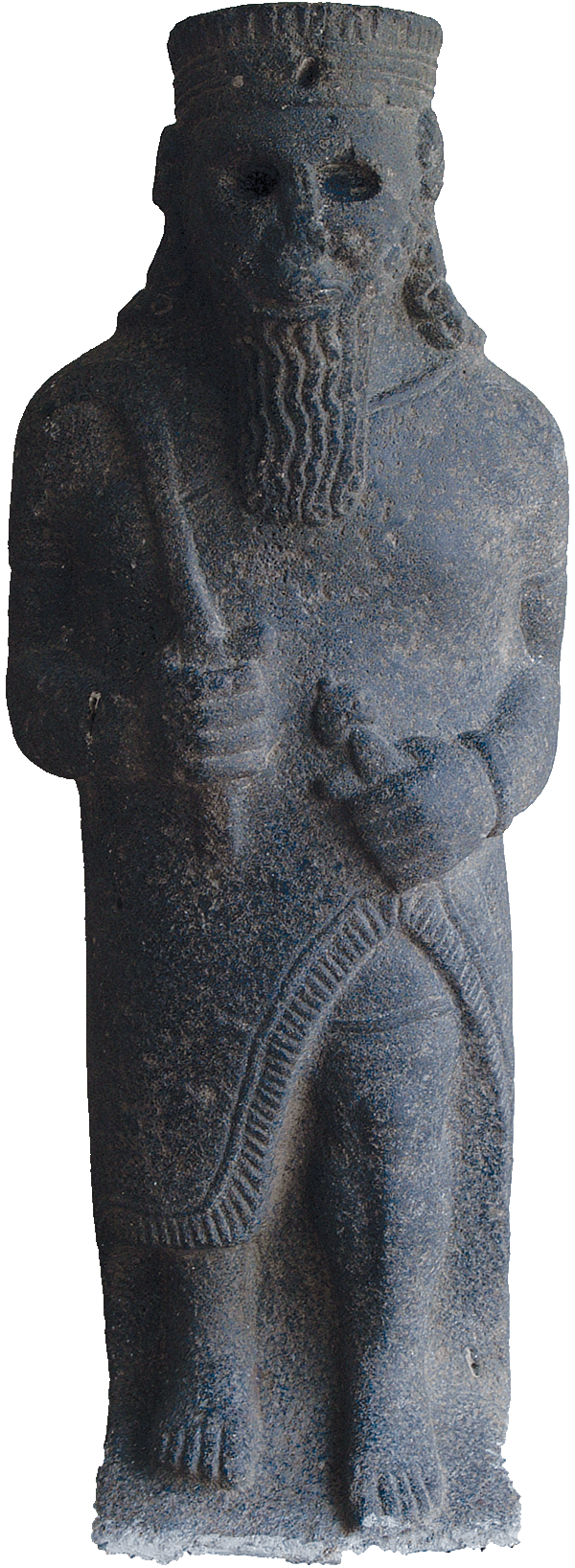
A Hittite idol. Isaiah accuses Israel and Judah of worshiping idols.
© Baker Publishing Group and Dr. James C. Martin. Courtesy of the Adana Museum.
Ahaz’s son Hezekiah was a godly king who sought counsel from the prophet Isaiah in times of national and personal tragedy. He ruled from 715 BC until his death, in 686 BC. During his rule he instituted many reforms (2 Kg 18:4, 22), including the celebration of the Passover (2 Ch 30). He witnessed the fall of Israel, which was overrun by the Assyrians when Hoshea refused to pay tribute to them. Shalmaneser IV began the campaign, and his successor, Sargon II, destroyed Samaria and exiled her population in 722 BC. Assyria’s hegemony in the Syro-Palestinian region grew. In 711 BC, Sargon descended on Ashdod in Philistia because it was thought Ashdod had conspired against Assyria (Is 20:1). At Sargon’s death (705 BC), Sennacherib took over. He faced an immediate coalition of Egypt, Philistia (except for Ekron), Babylon, and Judah (2 Kg 18:7), organized by Hezekiah. The southern king had hoped that the time had come to throw off the hegemony of Assyria, believing that Judah had the power to lead the conspiracy. This rebellion was quick to spark the anger of Sennacherib. On his way to Judah, he put down various rebellions in Mesopotamia, Phoenicia, and Philistia. His forces moved through Judah and may have taken as many as forty-six cities (some of which may be listed in Is 10:28–32 and Mc 1:10–16). As Sennacherib approached Jerusalem, Hezekiah attempted to pacify Sennacherib’s anger by sending him an abundance of tribute (2 Kg 18:13–16). Despite Hezekiah’s attempt to divert the Assyrian forces, Sennacherib’s march toward Jerusalem continued.
Finally, Sennacherib besieged Jerusalem. Hezekiah was locked in Jerusalem, surrounded by Assyrian forces. He had prepared well for the siege, but the Assyrians had the fortitude to wait for the surrender of Jerusalem. However, as Hezekiah and Jerusalem trustfully waited, the Lord intervened miraculously to deliver Jerusalem from the grasp of the Assyrian forces (2 Kg 19:35–36).
Literary Features
As far as literary style, the prophet Isaiah is a master of the Hebrew language. He knows how to express himself well and has a distinctive literary quality in his writing.
First, Isaiah uses rich vocabulary. Many of Isaiah’s words are unique, occurring only once or just a few times in the whole Hebrew Bible. Both Isaiah’s extensive vocabulary and his choice of expression show his ability to use the Hebrew language in a highly poetic style with a variety of parallel forms.
In addition to variety in vocabulary, the book’s brilliant and imaginative descriptions of war and of social and rural life, such as the parable of the vineyard in chapter 5, demonstrate Isaiah’s familiarity with these areas of Israelite society. Isaiah is a gifted preacher who knows exactly how to use the right illustration as he communicates God’s revelation.
Many literary devices were available to him in the Hebrew literary tradition: personification, metaphor, simile, wordplay, alliteration, song, and satire. If one compares Isaiah with a book like 1 Samuel, the difference in style becomes apparent. Isaiah captures the imagination with his use of various images, his sentences flowing one into the other, the tightly knit imagery demonstrating Isaiah’s intimate familiarity with the world in which he lived.
Critical commentaries on Isaiah divide the material into three major divisions: chapters 1–39 are thought to have come from the eighth-century prophet Isaiah; chapters 40–55 from a sixth-century prophet known as Deutero- (or Second) Isaiah; chapters 56–66 from a fifth-century source known as Trito- (or Third) Isaiah. However, three arguments may be advanced in support of the unity of Isaiah.
First, early Jews and Christians, such as Jesus and the apostles, held to the unity of Isaiah. Whenever they quoted from the book of Isaiah, whether from the beginning or the end, they always referred to the prophet Isaiah. The Gospel of John has an interesting passage that combines two quotations from Isaiah, and each comes from a different section. John comments on the unbelief of the people at Jesus’s time by referring to Is 53:1 and on the effect of their unbelief by appealing to Is 6:10. In this instance, one quotation comes from Is 1–39 and another from Is 40–66, yet both of them are introduced as the words of Isaiah: “This was to fulfill the word of Isaiah the prophet” (Jn 12:38) and “Isaiah also said” (Jn 12:39). So whether in the first or second part of Isaiah, the whole of the prophecy is seen as being the work of one author: Isaiah.
Second, many of the dissimilarities between the critical divisions of Isaiah can be explained by a change in subject matter. The first division emphasizes the Lord’s coming judgment on all flesh, whereas the latter part of the book of Isaiah emphasizes the comfort and consolation given to the remnant, for whom God still has a future. In fact, the second section begins with these words: “‘Comfort, comfort my people,’ says your God” (40:1). The theme of comfort is characteristic of most of the chapters in the second division. Though there may be some indication of judgment, the main message is one of comfort.
Moreover, even though the emphasis in the first part is on judgment, there is also a message of restoration. A brief comparison of two sections on the restoration (35:7–10 and 43:19–21) reveals a number of common elements: water, the road, animals, and the statement that the people of God do not have to be afraid. The shift in emphases also serves as an explanation for the dissimilarities in vocabulary and theme.
Third, despite some dissimilarities between the three divisions, there is wide recognition of similarities linking the three. The “blindness” and “deafness” terminology (6:9–10; 32:3; 35:5; 42:18–20; 43:9), the Jerusalem theme (1:27; 36:2; 40:2; 66:13), the expression “Holy One of Israel” (1:4; 41:14; 60:14), and the “highway” theme (35:8; 40:3) are examples of common links recognized between the three sections.
Theological Themes
The scope of the book takes us beyond Isaiah’s days to the new heavens and the new earth. The book unfolds God’s plan for the redemption of his people. The meaning of Isaiah’s name, “Yahweh Is Salvation,” reveals the purpose of the book.
The message of the gospel is found throughout the prophecy, and as a matter of fact the prophet concludes with it. “‘For just as the new heavens and the new earth, which I will make, will remain before me’—this is the LORD’S declaration—‘so your offspring and your name will remain. All mankind will come to worship me from one New Moon to another and from one Sabbath to another,’ says the LORD” (Is 66:22–23). Salvation is not to be limited to Israel only, for Isaiah speaks also to Gentiles.
Outline
1. Prophecies against Judah (1:1–12:6)
A. Judgment and Comfort: Part One (1:1–2:5)
B. Judgment and Comfort: Part Two (2:6–4:6)
C. Judgment (5:1–30)
D. Isaiah’s Call (6:1–13)
E. Crisis in Perspective (7:1–8:22)
F. The Messiah (9:1–7)
G. The Wrath of God (9:8–10:34)
H. The Branch from Jesse (11:1–16)
I. Songs of Praise (12:1–6)
2. Oracles against the Nations (13:1–23:18)
A. Babylon (13:1–14:23)
B. Assyria (14:24–27)
C. Philistia (14:28–32)
D. Moab (15:1–16:14)
E. Damascus and Israel (17:1–14)
F. Cush (18:1–7)
G. Egypt (19:1–20:6)
H. Babylon, Edom, and Arabia (21:1–17)
I. Jerusalem (22:1–25)
J. Tyre (23:1–18)
3. The Apocalypse of Isaiah (24:1–27:13)
A. God’s Judgment (24:1–23)
B. The Redemption of God’s People (25:1–26:6)
C. A Prayer for God’s People (26:7–21)
D. Deliverance of Israel (27:1–13)
4. Oracles of Woe (28:1–33:24)
A. Ephraim (28:1–29)
B. Ariel (29:1–24)
C. Foreign Alliances (30:1–33)
D. Judgment and Hope (31:1–32:20)
E. Distress and Help (33:1–24)
5. Cataclysmic Judgment (34:1–17)
6. The Day of God’s Glory (35:1–10)
7. Hezekiah (36:1–39:8)
A. Challenge and Deliverance (36:1–37:38)
B. Hezekiah’s Illness (38:1–22)
C. Envoys from Babylon (39:1–8)
8. The Beginning of Restoration (40:1–48:22)
A. Prologue (40:1–11)
B. Disputations (40:12–31)
C. Deliverance (41:1–44:23)
D. The Lord’s Sovereignty (44:24–47:15)
E. Proclamation of Restoration (48:1–22)
9. Reconciliation and Restoration (49:1–55:13)
A. The Servant of the Lord (49:1–13)
B. Zion’s Surprise (49:14–21)
C. Israel’s Restoration (49:22–26)
D. Sin and Obedience (50:1–11)
E. Everlasting Salvation (51:1–52:12)
F. The Suffering Servant (52:13–53:12)
G. The New Covenant (54:1–17)
H. Assurance (55:1–13)
10. The Glory and Responsibility of Zion (56:1–66:24)
A. Response to Redemption (56:1–8)
B. Unfaithful Leaders (56:9–57:2)
C. Unfaithful People (57:3–13a)
D. The Future of God’s People (57:13b–21)
E. True Religion (58:1–14)
F. Responsibility (59:1–21)
G. The Glory of Zion (60:1–62:12)
H. The Day of Vengeance (63:1–6)
I. A Prayer for God’s People (63:7–64:12)
J. God’s Response (65:1–25)
K. Judgment and Restoration (66:1–24)