What Happened between the Two Testaments?
When we open the NT, a considerable amount of time has elapsed since the words of Malachi. Four centuries have passed. The OT story ends with the prophets explaining the profound crisis of Israel’s catastrophic exile and the hope that will come when God revisits and redeems their history. This is precisely the dramatic setting that sets the stage for the Judaism we meet in the NT.
After the Israelites returned to Judea following the Babylonian exile (538 BC), Jerusalem was rebuilt under the able leadership of Nehemiah and Ezra. Nevertheless, prophets such as Malachi called Israel to remain faithful to its covenant with God and to promote justice among its people (Mal 4:1–2).
As the Jews returned to their homeland, they brought new ideas that would later influence the life of Judaism. During the exile they adopted the popular use of Aramaic, a language similar to Hebrew. By the first century this would be the common language of life in Israel and was likely Jesus’s native tongue. Until the temple was rebuilt, the Jews also had to come to terms with practicing their faith without the temple and sacrifice. Faith was expressed through study, obedience, and prayer. This was possibly the origin of the synagogue, which began as a gathering of Jews who debated the Scriptures, prayed, and formed community centers. When the Jews rebuilt the temple, these village-based gathering places continued to flourish. We see this community innovation throughout the NT.
A major and permanent shift came to Israel’s history in the fourth century BC with Alexander the Great (356–323 BC). His first aim was the defeat of the Persians, which he accomplished through major battles from 334 to 332 BC. He freed Greek cities, defeated Persian outposts, and “liberated” provinces that had lived under Persian rule. However, he never released them to be free: they now lived under Greek rule.
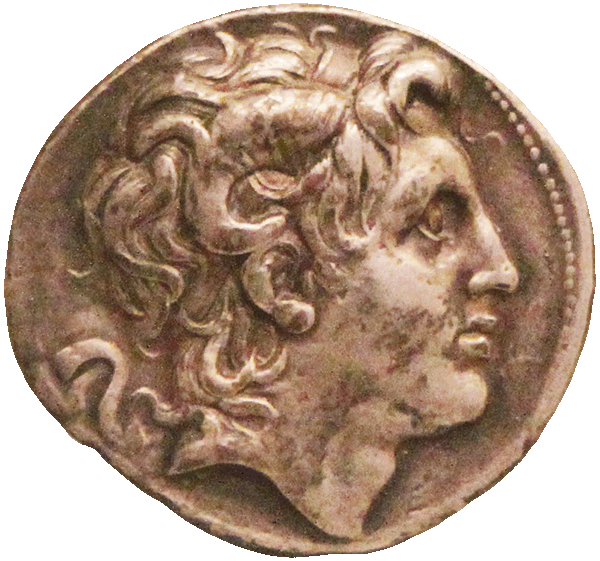
Coin depicting Alexander the Great
Whereas the conquering empires of the east permitted the Jews to retain their cultural and religious identity, the coming of Greek culture—or Hellenism—in the fourth century would make a permanent mark on Israel’s life. Greek culture was missionary by nature, sweeping up new peoples and converting them to a new, “modern” way of life. In the eastern provinces like Judea, the promises of Hellenism were intoxicating. Judaism soon found itself enticed to join the wider western Mediterranean world for the first time.
While Alexander and his successors were committed to conquest, their greatest legacy was this rapid spread of Hellenism to the lands they conquered. Above all was the spread of Greek, which became the new language of a new world that was uniting the cultures of Mesopotamia, Egypt, and the Mediterranean. The sustaining influence of Greek culture would dominate the eastern Mediterranean for almost nine hundred years and end only with the coming of Islam in the seventh century AD. Greek would naturally become the language of the early Christian communities and the language of the NT.
The greatest threat to Jewish life in this era was the gradual assimilation to Hellenistic culture. Greek theaters offered dramatic arts that were foreign to Jewish life. Gymnasium guilds enlisted young men at eighteen to join their social and athletic centers, where sporting events were practiced nude. Jewish beards and flowing robes were replaced with broad-rimmed hats, short togas, and high-laced sandals. Indeed, Hellenistic life was eroding traditional Jewish culture. Jews began to use common Greek (or Koiné Greek) as their native language. This meant that the Hebrew Scriptures were no longer understandable in the Greek-speaking synagogues. Soon the NT itself (written at least primarily by Jews) would be penned in Koiné Greek.
Throughout the Hellenistic period, the fledgling Roman Empire was expanding to the east. Two prizes were in its sights: Egypt and Syria. Egypt was famous for its wealth, its academies, and its agricultural produce. Roman galleys would eventually ferry huge stores from Egypt back to Rome. Syria was the second prize. As gateway to the valleys of the Euphrates, Syria and its powerful city Antioch stood at the crossroads. The Roman Empire therefore devised a plan to claim these prizes.
One of Rome’s most celebrated commanders in the first century BC was Pompey the Great (106–48 BC). He led Rome’s campaign into the eastern Mediterranean. After he took Syrian Antioch, Judea was his next strategic goal. In 63 BC Pompey climbed the Judean mountains and took the city of Jerusalem. He organized the country under Roman rule, named it Judea, appointed his own high priest, stationed over nine thousand troops in the region, and then left.
For the next century and more, Judea lived under Roman control. Jewish aristocratic families tried to leverage power with Roman help, and occasionally Rome permitted the rise of “Jewish kings” such as Herod the Great (see Mt 2:1). Roman governors often ruled the country on Rome’s behalf. In the Gospels, we meet one of them: Pontius Pilate, the Roman ruler who crucified Jesus. [Alexander’s Successors and the Maccabees]
When we open the pages of the NT, we are amid a story of political oppression and intrigue. Roman armies occupy the land. Jewish regional princes exert local control. Tax collection strips Judea of resources that are then transferred to Rome. And local Jewish resistance is everywhere. Jewish desire for God’s intervention is growing. A once dormant idea—that God would send his anointed messenger, the Messiah—is now alive and well. The emperor is claiming divine rights (“son of god” is on his coins), and he has declared that Rome’s power has established a worldwide “peace” (the pax Romana).
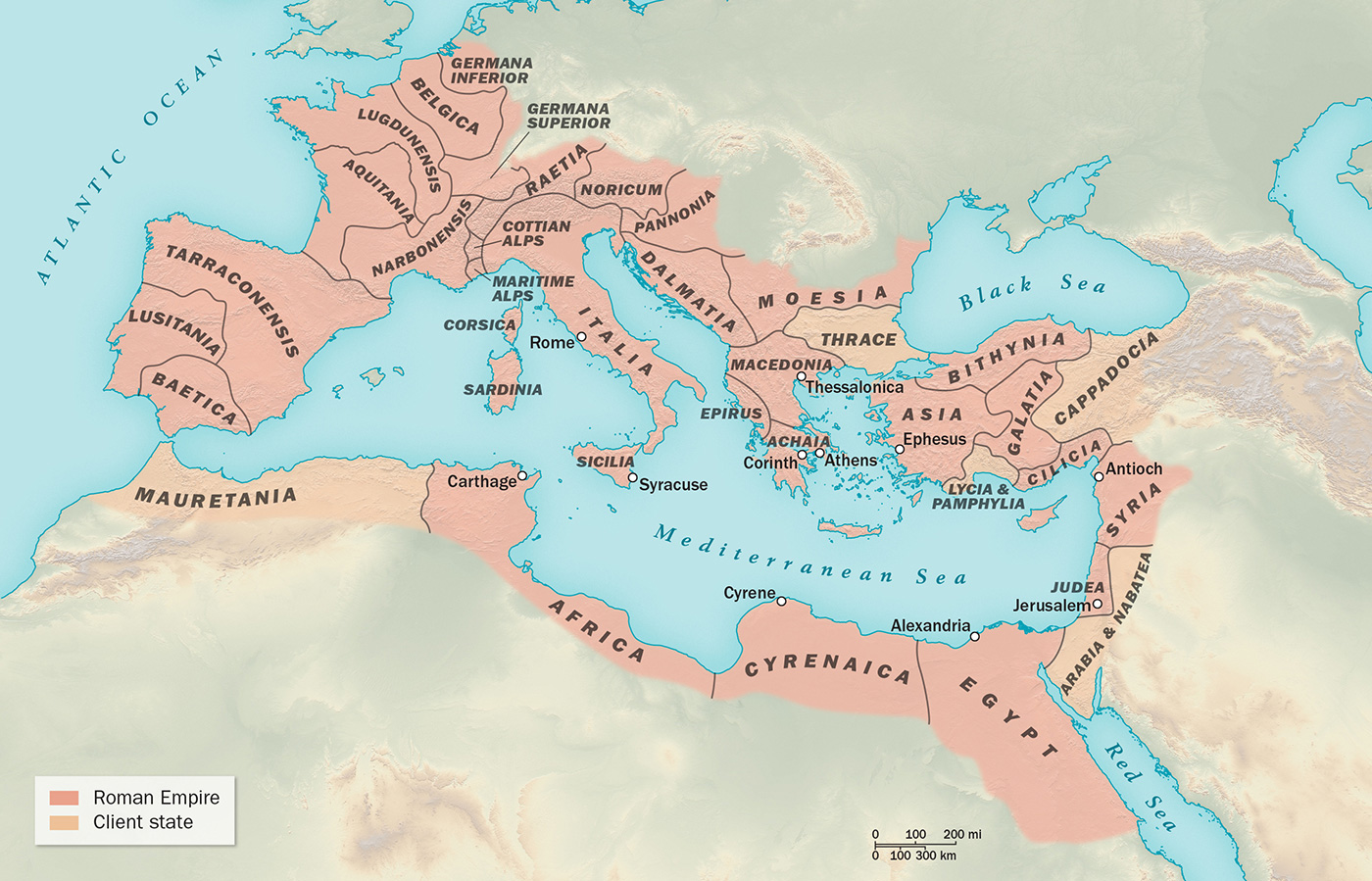
The Roman Empire in the First Century
Into this mix of politics and religious fervor, Jesus is born. When angels announce how his coming offers peace among people (Lk 2:14), any Roman would see the awkward comparison with Emperor Augustus. And when at his birth Jesus is hailed “king of the Jews” (Mt 2:2), Herod the Great, Rome’s local proxy king, is angered. When Jesus announces the inauguration of the “kingdom of God” (Mk 1:15), those who broker the power of kings and kingdoms for Rome would wonder if a dangerous rival has just entered the stage of Jewish history. Jesus is all of these—and none of these—but his coming announces a shift in Jewish and world history that has never been reversed.