The New Testament
Introduction
The NT is a collection of twenty-seven books that were gathered together and, in time, used alongside the OT by the early church. Written in Greek during the first century AD, the NT writings comprise four divisions: four Gospels telling the story of Jesus; the book of Acts, which records the history of the early church; a series of letters from writers such as Paul and Peter; and the book of Revelation.
Because Jesus was the full and final revelation of God, the early Christians treasured those things that were said by and about him, and as a result the books we call Gospels arose. Gospel writing began early, and apparently several such attempts were made, as Luke, who wrote one himself, says (Lk 1:1–4). With care, the church accepted our four Gospels as authoritative, no doubt because they could be traced back in some fashion to those who had actually been with Jesus and represented the heart of apostolic teaching. In this way the authority of Jesus was extended to those books that were written about him and contained his remembered sayings.
Jesus’s authority was conferred during his lifetime to a specially chosen group of twelve followers called apostles (see Mt 10:1–4). Because they were to continue the work of Jesus after his death and resurrection, their lives—and to a certain extent their words—were recorded. The book of Acts is a follow-up to what Jesus began to do and teach while he was on earth (Ac 1:1); it is a record of what Jesus continued to do and teach through his church as it was guided by the Holy Spirit under the direction of the apostles.
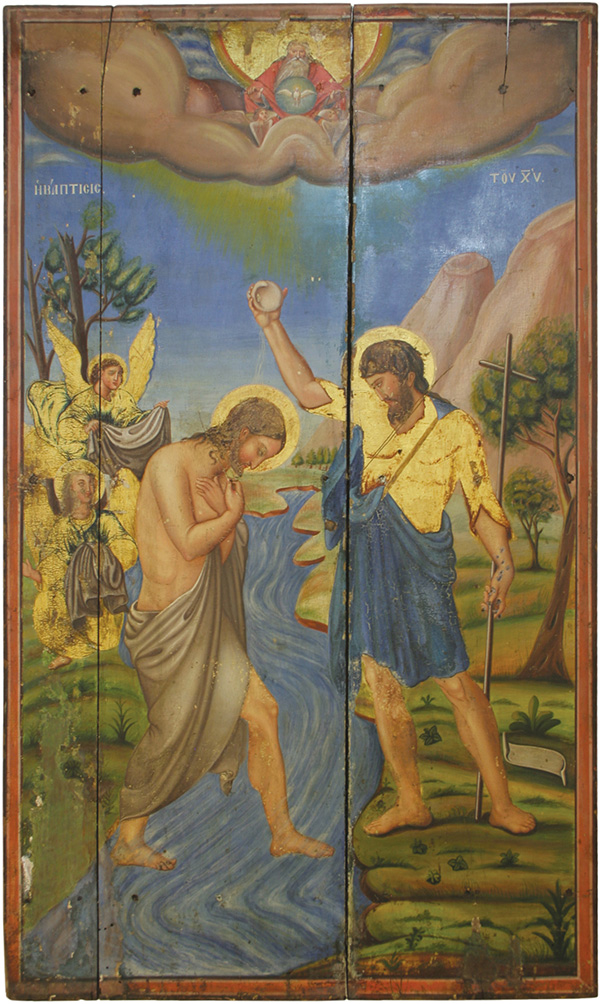
Wood panel depicting the baptism of Jesus. The NT proclaims that God’s promised Messiah has arrived in Jesus Christ.
© Baker Publishing Group and Dr. James C. Martin. Courtesy of the Turkish Ministry of Antiquities and the Antalya Museum.
Acts tells of how the gospel spread from Jerusalem ultimately to Rome, the capital of the Roman Empire at that time. This was accomplished through the efforts of the earliest apostles and disciples, who spread the gospel widely. Most of their stories remain untold, but some, such as the missionary work of Peter, were celebrated. Eventually a Jewish rabbi named Saul (also called Paul) was converted, discipled, and sent out as a missionary. His three extensive trips and final journey to Rome are described in some detail in the book of Acts.
Paul was counted as an apostle by the church even though he was not one of the Twelve. His acceptance was based on a direct call from Jesus himself that Paul received while on the road to Damascus; the experience is described three times in the book of Acts (Ac 9:1–6; 22:1–16; 26:12–18). Paul wrote many letters to the Gentile churches he founded; these letters were used for instruction by Paul’s converts. Along with the other writings, they were collected and considered authoritative. Some scholars think that the gathering of these letters led to the formation of the NT. In any event, the growing collection was used as God’s Word by the church.
In addition, the NT contains letters from a variety of other Christian leaders. In most cases, these are public letters written to churches about their beliefs and their efforts to form communities representing Christ. For this reason these writings are often called general letters. Here we find the letters of Peter, James, Jude, and John. The book of Hebrews early on was included in the collection of Paul’s Letters, but a number of scholars, both ancient and modern, consider the author to be anonymous. So, for convenience it may be considered a general letter. These letters tell us of Christian life in the outposts of the Roman Empire. Life is depicted as difficult and challenging but supported by the grace of God in Christ.
The book of Revelation is in a class by itself. It is a triumphant book that promises God’s presence during the present suffering of his people and the ultimate victory of God at Christ’s return. For Christians living during a period of severe opposition and persecution, it was a potent encouragement. For Christians living under parallel conditions today, it is the same.
The teaching of the NT is based on the fundamental teachings of the OT. The idea of a personal God, who is Creator, Sustainer, and Redeemer; the responsibility of humanity to pursue moral behavior; the need for redemption from sin; the ultimate triumph of God over the evil forces of this world—these ideas come from the OT.
Yet the NT moves beyond the OT framework in significant ways. The NT proclaims one foundational idea: God’s promised Messiah has arrived among us in Jesus Christ. And spinning out from that one idea is a whole host of new ways of thinking about ourselves, God’s efforts in the world, and our tasks. The NT implies that in some ways the OT has been eclipsed. A new covenant has been born. But the OT is never dismissed. The OT still forms the background of our thinking and remains an invaluable source for understanding God.