The Gospels and Acts
Introduction
The Gospels
The NT properly begins with a small collection of books known as the Gospels. The Gospels contain the essence of the gospel—the good news—which is the life, death, and resurrection of Jesus Christ. Each of the Gospels has a different character or set of interests. Mark is the shortest Gospel. Matthew may well have read Mark’s Gospel and decided to fill out the story. Luke pursued his own research (see Lk 1:1–4) and pulled in yet more material. Thus, we note that Matthew, Mark, and Luke (the Synoptic Gospels) are quite similar and in some cases tell the same stories. These writers were aware of one another’s Gospels and in some cases borrowed stories from each other’s works. The Gospel of John, on the other hand, is different. Most of John’s Gospel (about 92 percent) cannot be found in the other three. John had his own profound relationship with Jesus, and in his book he tells stories of remarkable insight and inspiration that are unparalleled.
These books are not “lives of Jesus” or biographies in the modern sense. What they are designed to give us is the essence of what we need to know about Jesus as the Son of God and Savior of the world. Mark’s Gospel, for instance, focuses over half of its verses on the last week of Jesus’s life. This means that the Gospels’ primary focus is on the disclosure of what Jesus’s saving mission was and the facts surrounding the accomplishment of that mission. Clearly the center of Jesus’s teaching was the “kingdom of God” that he inaugurated. And the center of Jesus’s activity was his great sacrifice on the cross. The earliest form of the gospel message was that Christ died for our sins, was buried, was raised on the third day, and appeared to his followers (1 Co 15:3–8). The Gospels fill that out by adding the events surrounding his birth and early life, his teachings, his ministry of healing, his trip to Jerusalem, and the events of his last days.
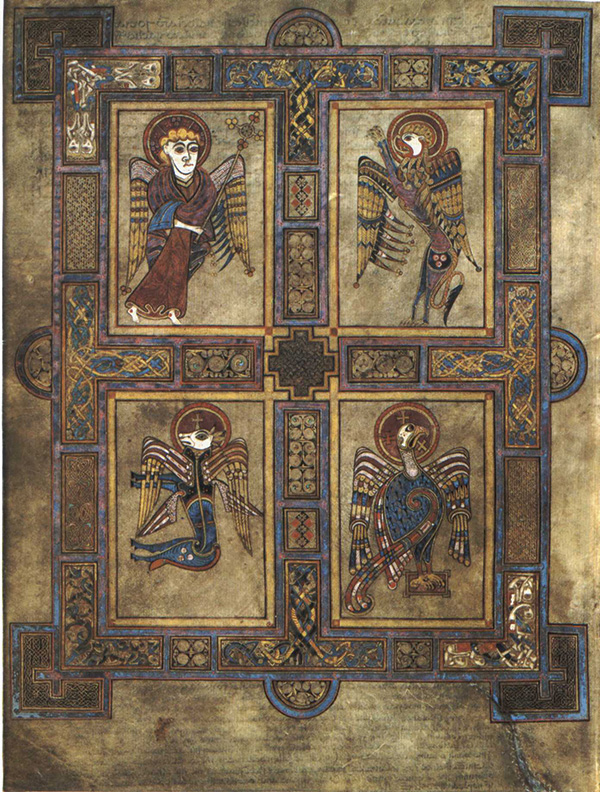
The church has long recognized the individual character of the four Gospels. Each Gospel and its writer came to be associated with a different character that fit its emphasis. The Book of Kells, an illuminated Gospel book from the ninth century AD, depicts Matthew as a man, Mark as a lion, Luke as an ox, and John as an eagle.
is public domain. Courtesy of Wikimedia Commons.
From the very beginning people had a good deal of interest in Jesus’s life, and soon they wrote many small volumes to explain who he was. Some volumes contained authentic material; others, no doubt, were written to prove some point or other. In order to preserve the truth of what was remembered about Jesus, and under the guidance of the Holy Spirit, the four Gospels we now have were written, eventually gathered together by the church, and given a special place in its corporate life. These particular books commended themselves to the earliest believers as being of supreme value and were retained as different and indispensable pictures of Jesus as God’s Son and our Savior.
Matthew describes Jesus as the new Moses, the fulfiller of Israel’s hopes, the true Messiah, and the light of the world. Mark depicts Jesus as the divine servant of God who does God’s will, even unto death. In Luke, Jesus is presented as the ideal man, son of Adam, and the fullest embodiment of God’s will for human beings. John’s Gospel is a theologically nuanced book designed to show Jesus’s true nature as fully divine and fully human. These four points of view combine to give us a composite picture of Jesus as God and man, Servant of God and Savior of all.
Acts
In the NT the book of Acts follows immediately after the four Gospels. The Gospels present the life of Jesus; the book of Acts invites us to read about the lives of Jesus’s followers. Luke, the author of the Third Gospel, also wrote the book of Acts. Luke was a friend of Paul and therefore recorded in great detail the life of this great disciple of Jesus. But Luke also tells us about the wider mission of the resurrected Jesus in the world. If in the OT Israel was committed to establishing its life within the borders of the Holy Land, Acts boldly announces that this agenda is now gone: Jesus is making claim on the entire earth. His kingdom knows no border, no ethnicity, no nationality. The message of Jesus is not provincial—it is universal.
The book of Acts belongs together with the Gospels. Combined they give us an account of Christian beginnings—Jesus and his church. Acts picks up where the Gospels leave off and carries us through those turbulent early days while Christianity is being established and believers are yet a tiny minority. But from these persecuted, beleaguered few comes a power that will conquer the world in the form of God’s saving truth. In the days after the crucifixion, the huddled, fearful group of Jesus’s followers becomes a band of fearless leaders in the spread of the gospel, speaking boldly in prominent cities around the Roman Empire: Antioch, Ephesus, and even Rome.