Introduction
Overview
First Thessalonians is devoted to encouragement and instruction about how to live in light of the return (or parousia) of the Lord Jesus. Paul mentions Christ’s return near the end of every chapter in this letter (1:10; 2:19; 3:13; 4:13–18; 5:23).
Occasion, Purpose, and Content
After Paul had traveled onward from Athens to Corinth, Timothy rejoined him (Ac 18:1, 5), bringing good news about the church in Thessalonica (1 Th 3:6–8). The Thessalonians were indeed standing firm and exhibiting the virtues of genuine Christianity: faith, love, and steadfastness, the product of hope (1:3). The letter explodes with the thanksgiving and joy Paul has experienced upon receiving this good news (3:9–10).
Paul wrote 1 Thessalonians at this point with a variety of purposes in mind, the first being to thank God for the faith of the Thessalonians (1:3; 2:13; 3:6–10). Paul was at a difficult point in his own ministry while in Corinth, so the good report about the Thessalonians encouraged him greatly (3:7; Ac 18:9–10; 1 Co 2:3).
Second, the document was a defense of the sincerity and pure motives of Paul and his companions and an explanation about why they did not return to the church after leaving so abruptly. As evidence of his genuine love, Paul explains his attempts to return (2:17–18), how Timothy was then sent and was prevented from reaching them (3:1–5), and how Paul desired to return to the congregation and prayed to that end (3:6, 10). Under this reading, 2:1–12 should be understood as a defense of the character of the apostles’ ministry. Some scholars, however, understand this section as showing their character as moral examples that the Thessalonians should imitate.
Much of what Paul writes about the second coming of Jesus comes from Jesus’s own teachings about this topic (see Mt 24–25; Mk 13).
Third, the epistle encourages the Thessalonians as they face hostility from the other inhabitants of the city. The apostles explain that suffering is part of the Christian life (3:3–4) and that in their sufferings they “imitate” the churches of Judea (2:14–16), the apostles, and the Lord himself (1:6). Paul recognizes their firmness in faith (1:3; 3:8) and that in their sufferings the Thessalonians have even become an example for other congregations (1:7). At the same time, the letter emphasizes God’s wrath (1:10; 2:14–16; 5:9). The time of God’s judgment, the day of the Lord, will come, and those who assail the church will not escape (5:1–11).
Fourth, the letter responds to questions the Thessalonians put to Paul, possibly via a letter that Timothy conveyed (see 1 Co 7:1). The church had asked about fraternal love (4:9–12), the destiny of the dead in Christ (4:13–18), and when the day of the Lord would come (5:1–11).
Fifth, not all the news from the church was good. While the Thessalonians had learned basic Christian morality (4:1–2), there were serious lapses regarding sexual purity (4:3–8). In addition, some were not working, acting as dependent clients. The epistle addresses this issue, which needed to be emphasized more forcefully when Paul wrote 2 Thessalonians (1 Th 4:11–12; 5:14; 2 Th 3:6–15). Some had rejected prophetic utterances in the church (1 Th 5:19–20), and the Thessalonians were not responding properly to their new leadership (5:12–13).
Authorship
In 1 Th 1:1 Paul appears as the author of the letter alongside his associates Silvanus and Timothy (see also 2:18). From antiquity, the church has regarded the letter as authentic and not pseudonymous. What role did Silvanus and Timothy play in composing the letter (1:1)? The letter uses the first-person plural instead of the singular throughout, save in three passages (2:18; 3:5; 5:27; cf. 2 Th 2:5; 3:17) where Paul underscores his own perspective. Silvanus and Timothy helped found the church and may have served as joint authors, a known practice in the ancient world (cf. Ac 15:23–29).
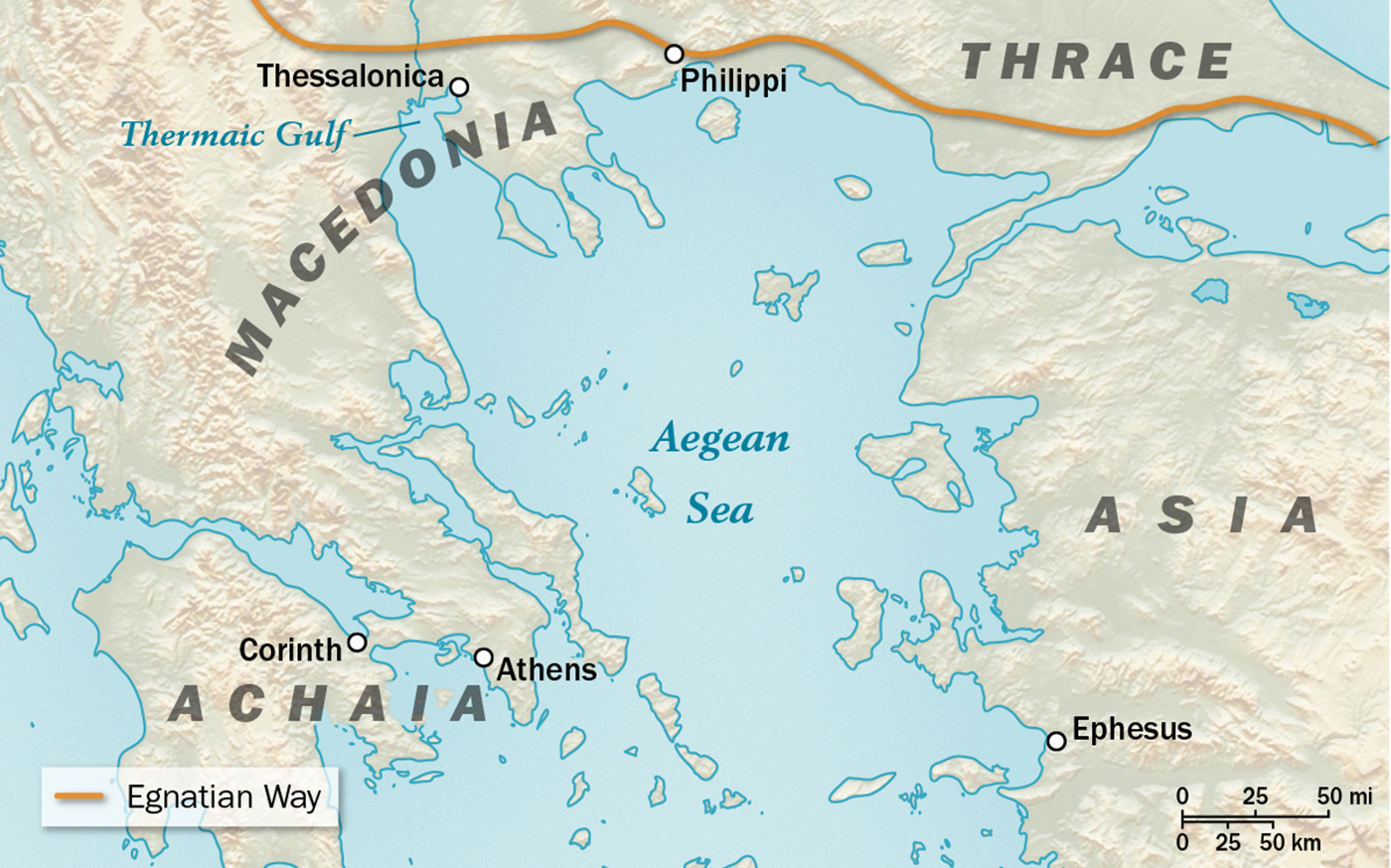
The Location of Thessalonica
Date
Paul and his associates composed 1 Thessalonians when Timothy came to Corinth from Thessalonica (1 Th 3:2, 6; Ac 18:5). Paul was in Corinth during the reign of Claudius (AD 41–54; see Ac 18:1–2) and when Gallio was the proconsul (Roman governor) of Achaia (Ac 18:12–17). Gallio took his post on July 1 of AD 51 (as indicated in an inscription from Delphi) and stayed in the city for just under a year. Paul was tried before him and then remained in the city for some time (Ac 18:18). Paul’s total visit lasted eighteen months (Ac 18:11). If the movement against Paul began when Gallio was named proconsul, and if Paul left sometime later around the end of AD 51, we estimate that he arrived in the city near the start of AD 50. Not long after that, Timothy arrived, and Paul wrote 1 Thessalonians, making this one of the earliest of Paul’s letters that have survived.
Outline
1. Epistolary Greeting (1:1)
2. Opening Thanksgiving: The Coming of the Gospel and Its Reception (1:2–10)
A. Faith, Love, and Hope (1:2–3)
B. The Coming of the Gospel and Its Reception (1:4–10)
3. The Body of the Letter (2:1–5:22)
A. The Gospel Arrives in Thessalonica (2:1–3:13)
B. The Apostolic Instruction: The Life That Pleases God (4:1–5:22)
4. Final Prayer, Greetings, and Blessing (5:23–28)
A. Prayer for Sanctification (5:23–25)
B. Call to Greet and Read to One Another (5:26–27)
C. Final Blessing (5:28)