Introduction
Overview
Paul had earlier warned the Ephesian elders that false teachers from their own group would distort the truth and lead people astray (Ac 20:30). According to 1 Tm 1:3–7, that is exactly what happened. The problem in Ephesus was false teaching (1 Tm 1:3, 7; 6:3–5), and the elders were responsible for teaching (1 Tm 3:1–7; 5:17–25). In other words, the church in Ephesus was being threatened by some of its own leaders. Paul writes 1 Timothy to stop the false teaching and to teach the church how to conduct itself. [False Teachers in the Early Church]
Authorship and Date
The letters to Timothy and Titus, called the Pastoral Epistles (or Pastoral Letters), raise questions about the legacy of the apostle Paul. Evangelical scholars and some mainstream conservative scholars believe these writings provide Paul’s own ideas and applications for the next generation of church leaders. Other mainstream scholars tend to think the Pastorals came from the second or third generation of the Pauline movement and represent a falling away from Paul’s original vision.
All of the Pastorals show a distinctive writing style, marked by a smoother flow of sentences and less complicated grammar. They were also written to individuals rather than churches, which may account for some of the stylistic differences. Much of the vocabulary is also unique, which may indicate that it was penned by another author or perhaps rather that Paul used a different scribe for these letters. A third of the Pastorals’ vocabulary does not appear in the earlier writings of Paul. Words otherwise not used in the NT occur at the rate of about four to five per page in the earlier letters but at the rate of about thirteen per page in the Pastorals. Some of this vocabulary is common to Greek moral and theological writings. Worthy of mention are the following: “godliness/piety,” “appearance” (instead of Paul’s more characteristic “presence”), and “healthy/sound.” Jewish writers like Philo of Alexandria, aiming at a Greek readership, had already begun using many of the terms that distinguish the Pastorals from Paul’s earlier letters.
It is interesting to note that Luke (Paul’s traveling companion, lone associate during the writing of 2 Timothy, and author of Luke-Acts) shares much of this vocabulary, lending support to the possibility that Luke assisted Paul with these letters. Two examples of this are illustrative: First, Paul’s earlier letters denounce “greed” (1 Co 6:10; 1 Th 2:5), but the Pastorals and Luke denounce “love of money” (1 Tm 6:10; 2 Tm 3:2; cf. Lk 12:15; 16:14). Second, of the other NT writers, only Luke (“the beloved physician”) uses the Greek term from which we get “hygienic” to refer to the spiritual aspect of Jesus’s healing ministry (Lk 5:17; 15:27); the Pastorals use the same term to stress that doctrine should be not merely correct but also “healthy” or “sound” (1 Tm 1:10; 2 Tm 4:3; Ti 1:9; 2:1).
The Pastoral Epistles (1 Timothy, 2 Timothy, and Titus) offer insight into how the early church was organized for ministry.
Although the Pastorals show some differences from Paul’s earlier letters, the early church received them, almost unanimously, as being written by Paul. The single curiosity from the early church is the Pastorals’ apparent exclusion from the earliest manuscript of Paul’s Letters, the Chester Beatty Papyrus 46 (ca. AD 200). We will treat the Pastoral Epistles as Paul’s own explanation of his main theological values.
Occasion and Audience
Paul wrote 1 Timothy to help instruct Timothy in dealing with the problems present in Ephesus. False teachers were threatening the integrity of the church, and Paul’s instructions to Timothy direct him in how to deal with this situation. Paul also addresses issues in the organization and leadership of the church with particular attention to their worship gatherings and the character of the church’s leaders. It is likely that Paul is also addressing the network of churches in Ephesus rather than a single church since believers met together in homes in smaller gatherings rather than in a larger “congregational” format. The false teachers have both doctrinal and behavioral challenges that Paul addresses in the letter.
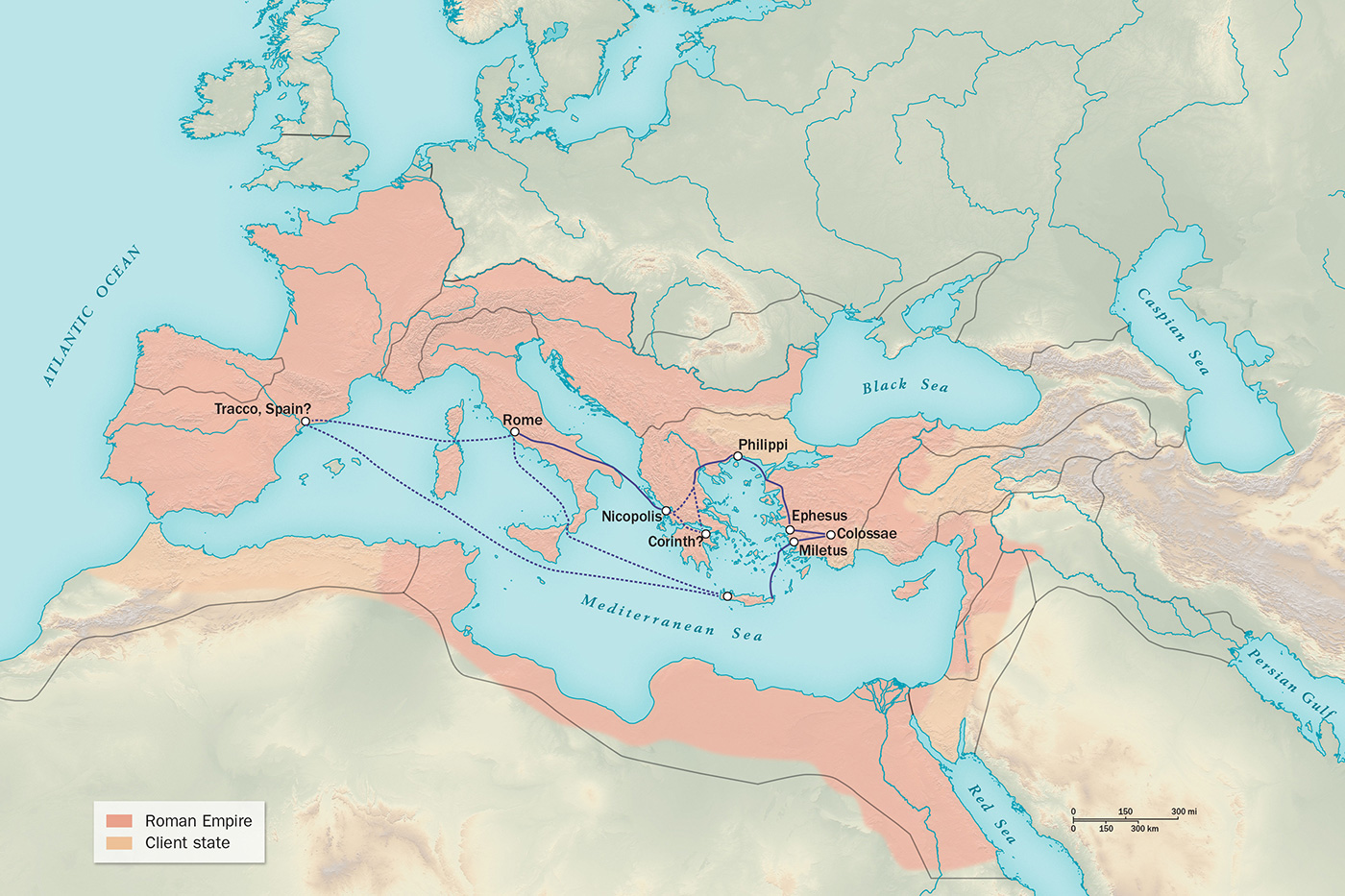
Reconstructing Paul’s Later Travels
The latter half of the book of Acts (Ac 13:1–21:14) outlines Paul’s first three missionary journeys. The book of Acts concludes with Paul awaiting trial in Rome. A complete narrative of Paul’s life following those events does not exist, but based on statements in Paul’s Letters (particularly 1 Timothy, 2 Timothy, and Titus), a rough sketch can be drawn. The journey, beginning with a departure from Rome around AD 62, may have included a stop in Spain (Rm 15:24–28), but it likely did include stops in Crete and Nicopolis (Ti 1:5; 3:12), Ephesus (1 Tm 1:3), Philippi (Php 2:23–24; 1 Tm 1:3); Colossae (Phm 22), Miletus (2 Tm 4:20; and possibly Corinth as well), and a final return to Rome (2 Tm 1:17), where Paul likely was executed around AD 66–68. Assuming Paul did not backtrack on his journey, a likely route of travel can be sketched as shown.
Outline
1. Salutation (1:1–2)
2. Law and Grace (1:3–20)
A. Love over Law (1:3–7)
B. The Point of the Law (1:8–11)
C. Paul as Trophy of Grace (1:12–17)
D. What Is at Stake (1:18–20)
3. Prayer and Worship (2:1–15)
A. The Prayer of All for All (2:1–7)
B. Men and Women at Worship (2:8–15)
4. Leadership (3:1–13)
A. Overseers or Bishops (3:1–7)
B. Deacons (3:8–13)
5. True and False Religion (3:14–5:2)
A. True Religion (3:14–16)
B. False Religion (4:1–5)
C. Timothy’s Responsibility for True Religion (4:6–5:2)
6. Widows, Elders, and Slaves (5:3–6:2)
A. Widows and Female Benefactors (5:3–16)
B. Elders (5:17–25)
C. Slaves and Masters (6:1–2)
7. Money and Wealth (6:3–19)
A. False Teaching and Love of Money (6:3–10)
B. What Makes Timothy Wealthy (6:11–16)
C. How the Wealthy Can Invest (6:17–19)
8. Closing Admonition: Opposing Spurious “Knowledge” (6:20–21)