Exodus
1. FROM BONDAGE TO FREEDOM (1:1–15:21)
The events in Exodus must be read against the backdrop of Joseph’s words to his brothers: “God sent me ahead of you to establish you as a remnant within the land and to keep you alive by a great deliverance” (Gn 45:7). Initially Israel flourished in Egypt, but ruthless oppression by a new dynasty is the crucible in which their suffering prepares them for deliverance. God visits them in that suffering, using a fearful Moses to confront the systemic evil of polytheistic Egypt, represented by Pharaoh.
A. Connection with the past (1:1–7). The explicit naming of the sons of Jacob echoes the words of Gn 46:8, “These are the names of the sons of Israel who came to Egypt,” and abbreviates what follows there. Likewise, the reference to seventy descendants echoes Gn 46:27.
After the death of Joseph the Israelites were extraordinarily prolific; five verbs are reminiscent of Gn 1, “The Israelites were fruitful, increased rapidly, multiplied, and became extremely numerous so that the land was filled with them” (1:7). Even the passive form of the last clause suggests that their presence was overwhelming and potentially threatening.
B. Oppression of Israel (1:8–22). 1:8–14. Fearing that the growing number of Israelites will join the enemies of Egypt in the event of war and leave the country, the king determines to deal “shrewdly” with them (1:9–10). Ironically each phase of his plan is a failure. The Israelite slaves were a necessary part of the Egyptian economy (14:5); their efforts were invested in public projects and were represented in the store cities and hard field labor. These descriptions are consistent with Egyptian evidence in which foreign slaves are depicted in the arduous process of making bricks (1:13–14).
1:15–16. The two midwives are named (1:15), while Pharaoh is not. Not only is this ironic; it also fits with patterns in Egyptian texts. No names are appended to the title Pharaoh until the tenth century BC.
When the first phase of harsh labor fails to control the number of Israelites, Pharaoh commands the Hebrew midwives to kill newborn boys when they observe them, literally, “on the stones” (1:16), possibly referring to two stones positioned for the actual birth process. The expression may also imply that Pharaoh expects the midwives to do a prenatal examination, a practice within the technical expertise of ancient Egypt, and kill the unborn children they determine to be male.
1:17–21. Shiphrah and Puah are likely representative of a larger group of midwives, members of what was a prestigious profession in ancient Egypt. Fear of God motivates them to disobey the king of Egypt, preserve the lives of the infants, and present the matter to Pharaoh in a less-than-truthful fashion (1:17–19). This is the first recorded instance in the Bible of civil disobedience in the face of an immoral law. In return God blesses these women with families, an example of the measure-for-measure justice evident throughout the Scriptures (1:20–21).
1:22. The third phase of Pharaoh’s scheme is outright infanticide. Pharaoh’s determination to exterminate Hebrew boys in water will be repeated in just measure as the Egyptians meet their end in water.
C. Birth, preservation, and preparation of Moses (2:1–25). 2:1. The parents of Moses, Amram and Jochebed (6:20), are both of the tribe of Levi.
2:2–4. The extreme measures taken to deal with newborn Israelite males were relatively recent at the time of Moses’s birth because Aaron is three years his elder (7:7). Miriam is old enough to watch the basket into which their mother puts Moses after she can no longer hide him. When she puts her son into the Nile it is in keeping with the edict, with the added protection of a basket (literally, an “ark,” 2:3).
2:5–10. It is possible that Jochebed lodged the basket in a side channel of the Nile, knowing that was where Pharaoh’s daughter would be bathing. Even though the boy is recognized as a Hebrew child (2:6), Pharaoh’s daughter defies the decree, accepts Miriam’s bold offer to find a nurse for him (2:7), and adopts him as her son (2:10a). There is evidence from the Eighteenth Dynasty of bringing foreign princes to be trained in Pharaoh’s court. Nevertheless, in the context of the official policy toward the Israelites, these actions are extraordinary. The name that Pharaoh’s daughter gives to Moses has both Hebrew and Egyptian connotations (2:10b; see the CSB footnote). Mosheh is a Hebrew participle suggesting his being “drawn out” of the water and also his “drawing” the people out of Egypt. In Egyptian it means “son” or “born” and is related to several names of the Eighteenth Dynasty. Thutmose, for example, would mean “son of the god Thoth.”
The Hebrew word tebah (“basket” or “ark”) is used only of the basket in which Moses is placed on the Nile (Ex 2:3) and of Noah’s ark (Gn 6:14–16). Each craft saves the life of a critical servant of God from the destructive force of water.
As his mother nurses him, Moses develops a strong and profound sense of his identity as a Hebrew (2:9). Moses is educated in the court of Pharaoh (Ac 7:22). This means acquiring the ability to write, likely access to literary works, and the knowledge of “court etiquette” that will serve him well in the future confrontations with Pharaoh.
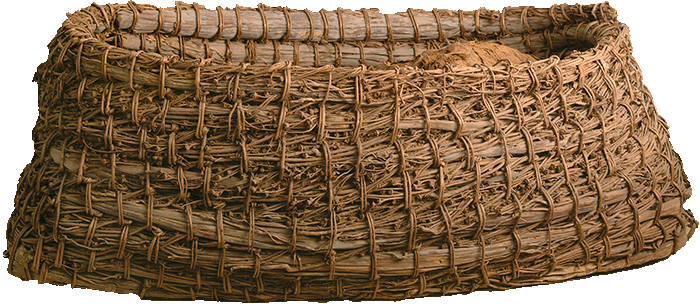
A papyrus basket from ancient Egypt, probably similar to the basket used by Moses’s mother (Ex 2:3)
2:11–22. After Moses kills an Egyptian and it becomes known, he flees to the wilderness of Midian (2:11–15). There he gets married and shepherds his father-in-law’s sheep for forty years. Contrary to all appearances this aspect of Moses’s training and experience is indispensable, as he learns the terrain and the precious water sources of the Sinai Peninsula and gains skills necessary for leading recalcitrant groups. Although the wilderness is barren and forbidding, it is where God chooses to reveal himself both to Moses and later to God’s covenant people. The name of Moses’s son, Gershom, is telling; it speaks of his sense of alienation, both in his current circumstances and from his Hebrew and Egyptian identities (2:22).
2:23–25. With the death of Pharaoh there is potential for instability; the outcry of the enslaved Israelites may reflect this sociopolitical development (2:23). Instead of the government responding, however, it is God who hears, who remembers his covenant, who sees, and who knows (2:24–25). And God will work through this unlikely fugitive. Because it was established practice for a new pharaoh to release captives and allow fugitives to return, Moses is able to reenter the court.
D. Moses’s call and commissioning (3:1–4:17). 3:1–10. The call of Moses is a radical break from everything that has gone before. Moses is shepherding Jethro’s flocks near Horeb, the mountain of God, when the burning bush attracts his attention (3:1–3). The Hebrew word for “bush” (seneh) appears in the Bible only five times and sounds similar to “Sinai.” Fire is formless, powerful, luminous—a perfect means of representing God. Although the messenger appears in the flaming bush, it is the Lord who speaks with Moses (3:4); the messenger has nothing to say.
God identifies himself as the God of the covenant with Abraham, Isaac, and Jacob (3:6) and declares he has “come down” to deliver his people because he sees, hears, and knows their suffering (3:7–8). Although God’s promise of the land flowing with milk and honey was never part of the descriptions of the land in Genesis, here it comes as an invitation to the enslaved people. Most likely the “milk” refers to goats’ milk and the “honey” was from dates.
3:11–12. Moses raises a series of objections because he understands the dangerous and apparently impossible nature of his calling. Each of God’s responses presses him toward an altered perspective. The dialogue unfolds with terse questions from Moses and expansive responses from God.
When Moses initially asks, “Who am I?” (3:11), God’s response redirects Moses’s attention from the intimidating prospect of Pharaoh to the ultimate goal of worshiping God (3:12). The promise of a sign confirming that God has sent him is a challenge; it will not be manifested until the completion of the entire enterprise. Nevertheless, when the people finally worship God on the mountain, they are indeed no longer serving Pharaoh—the Hebrew word for “worship” and “serve” is the same (see the CSB footnote).
3:13–15. Ostensibly on behalf of the Israelites, Moses next asks, in effect, Who are you? Who will be authorizing this demonstration of massive civil disobedience? At the same time, since his own new vocation is dependent on God’s presence, it is also important for him to know who God is (3:13). In response God reveals the essence of his covenant name and his intention to fulfill the covenant promise regarding the land. “I AM WHO I AM,” or “I WILL BE WHO I WILL BE” (see the CSB footnote; 3:14), follows directly on 3:12, “I will certainly be with you.” Repetition of the verb form confirms that the Lord is the eternally self-existent and sustaining source of all that is, entirely sufficient for all past, present, and future trials and triumphs. He is God of the fathers, God of the people in bondage, and God of the continuing covenant (3:15). (On the name “LORD,” see the article “The Two Primary Names for God in the Old Testament.”) [The Two Primary Names for God in the Old Testament]
3:16–22. The Lord promises that the elders of Israel will listen to Moses and together they will request permission from Pharaoh to go for three days to offer sacrifices in the wilderness to the Lord, the God of the Hebrews (3:16–18). It would not have been unusual for a group of slaves to make a pilgrimage to a shrine. Nevertheless the king of Egypt will send them forth only after God’s wonders have been performed in their midst (3:19–20). God further promises that the Egyptians will be favorably disposed to give valuable articles to the departing Israelites (3:21–22).
When Jesus declares in Jn 8:58, “Before Abraham was, I am,” he is identifying with the name of God revealed to Moses in the burning bush episode, “I AM” (Ex 3:14).
4:1–9. In spite of hearing God’s plan for the entire enterprise, Moses is still fearful of the Israelites’ incredulous response (4:1). Thus God demonstrates two signs as witnesses. As the first sign, Moses’s staff becomes a snake when he casts it to the ground, and it returns to its natural state when he puts out his hand to take it up again (4:2–5). The second sign is the appearance and subsequent removal of a skin disease on his hand (4:6–8). Skin disease ominously signifies punishment for disobedience. Finally, if the people do not believe the first two signs, Moses is to pour Nile water onto dry ground and see it become blood, a preview of the first plague (4:9).
4:10–12. Unconvinced, Moses returns to his own perceived inadequacy, claiming, “My mouth and my tongue are sluggish” (4:10). While this appears to contradict Stephen’s witness in Acts that Moses was “powerful in his speech and action” (Ac 7:22), Moses has been out of the Egyptian court for forty years. Stephen’s perspective represents Moses’s activities throughout the entire process of leaving Egypt. After Moses first addresses Pharaoh and apparently fails, he raises the issue again, stating twice that he is literally “uncircumcised of lips” (Ex 6:12 [see the CSB footnote], 30). God reminds Moses that he is the creator of all human abilities and impediments (4:11) but promises his presence with Moses as he speaks (literally, “with [his] mouth,” 4:12 [see the CSB footnote]).
4:13–17. Even though Moses stubbornly begs God to send someone else (4:13), God continues with his intention to use Moses, indicating that Aaron will be his mouthpiece (4:14–15). Providentially, in the context where Pharaoh considers himself a deity, for Moses to operate through a spokesperson-prophet for whom he would be “as God” (4:16; cf. 7:1) will raise his level of credibility in the court.
E. Return to Egypt (4:18–31). 4:18–21. As Moses is en route to Egypt (4:18–20), the Lord declares that his signs and wonders will parallel the hardening of Pharaoh’s heart (4:21). (See the article “Hardening Pharaoh’s Heart” later in Exodus.) God’s hardening and Pharaoh’s responsibility in hardening his own heart are inextricably interwoven. Three Hebrew words are used here for “hardening”: hazaq, “to strengthen” (e.g., 4:21; 7:13, 22; 8:19); qashah, “to be difficult or hard” (7:3; 13:15); and kabed, “to be heavy” (7:14; 8:15, 32; 9:34; 10:1).
The form of hazaq in God’s initial statement that he will harden Pharaoh’s heart (4:21) suggests God’s direct involvement and the recurrence of Pharaoh’s rejection. As the signs commence, Pharaoh’s heart is described as strong (hazaq) and heavy (kabed), and the first plague only strengthens (hazaq) Pharaoh’s heart (7:13–14, 22). The Lord continues to harden and strengthen Pharaoh’s heart in the last plagues before the death of the firstborn and as Pharaoh changes his mind after Israel departs (14:4, 8). Under God’s sovereign design Pharaoh’s choices determine the continuing pattern of his life. This tragic and complex process is the context for Paul’s comments in Rm 9:16–18, as he wrestles with the implications of God’s sovereignty.
4:22–23. Pharaoh has exalted himself above humans in his assumption of deity and in his treatment of Israel as subhuman; thus God deprives him of his free will and binds him in rebellion, making him subhuman. Pharaoh’s refusal to free Israel, God’s firstborn (4:22), results in the slaughter of the Egyptian firstborn (4:23), another instance of measure-for-measure justice.
4:24–31. There is a thematic link between this mention of firstborn and the next puzzling incident (4:24–26). The Lord encounters Moses on the way back to Egypt, threatening to kill “him” (either Moses or the firstborn son) because Moses has not circumcised his son (4:24). Even though Zipporah, his Midianite wife, knows the proper action, her epithet suggests revulsion on her part. Nevertheless she immediately circumcises her son (4:25). While her repeated charge that Moses is a “bridegroom of blood” is cryptic (4:26), there are several possible symbolic connections to consider. The sign of the covenant with Abraham is circumcision, and those who are not circumcised will be cut off, just as the foreskin is cut off (cf. Gn 17:14). When Moses fled from Egypt forty years prior, he may have intentionally rejected the practices that defined him as an Israelite. Since he is the chosen deliverer of God’s people, his failure to live up to the covenant stipulations threatens both his immediate family and the larger covenant family descended from Abraham. To make that right involves the shedding of blood. Further, the matter of protecting the Israelite firstborn in Egypt will also involve shedding the blood of a Passover lamb. The rabbis of late antiquity repeatedly affirmed the connection between the blood of circumcision and that of the Passover sacrifice.
F. God of Israel versus the gods of Egypt: the initial request (5:1–6:1). God’s command to “let my people go” recognizes the Hebrews’ demeaned status as state slaves, entirely subjugated to Pharaoh (5:1). Later, in response to his arrogant declaration that he does not recognize the Lord and will not send Israel out to worship the Lord (5:2), Pharaoh is told, “You will know that I am the LORD” (7:17).
Increasing the workload of the people is an insidious move to turn the Israelites against Moses (5:6–21). In brick-making the requisite straw is a binding agent; when it decays, the released acid makes the material more plastic and prevents shrinking and cracking. The Israelites’ situation deteriorates, but there is a purpose: instead of sanctioning a temporary journey into the desert, Pharaoh will drive the Israelites out, and the mighty hand of God will accomplish the task (5:22–6:1). Notably, however, the purposes of God are accomplished through difficult and bitter experiences.
G. Covenant Lord and his ministers (6:2–30). 6:2–5. Moses has complained that God has done nothing; this is God’s response to Moses. Now Israel will know from experience that God is the covenant Lord, about to redeem them and give the Sinai covenant. Exodus 6:3 implies that the patriarchs did not know the name Yahweh (“the LORD”; see the CSB footnote) even though it appears in Genesis. The verb “to be known” appears in other passages with connotations of experiencing revelation. While God did reveal himself by the name Yahweh to the patriarchs, the full implications of that name were not yet evident. The name “God Almighty” (El-shaddai) appears in Gn 35:11 just after God reiterates Jacob’s name change to Israel and restates the covenant promises as given to Abraham and Isaac. Continuity is established with Genesis, and at the same time God’s declaration here changes the identity and future of Israel as his community. Genesis contains a wider variety of divine names, but from this point in Exodus onward, the names El and El-shaddai are used infrequently except in poetic texts.
6:6–13. The expression “outstretched arm” (6:6) was used by Eighteenth-Dynasty pharaohs to express their conquering arm. The promise that the Lord will redeem Israel with an “outstretched arm” indicates that the Lord will demonstrate his superiority over Pharaoh.
6:14–30. The partial genealogy (6:14–25), focusing on Levi (6:16), establishes the position of Moses and Aaron. Jochebed’s name means “The Lord Is Glory” (6:20). She is the first person in the biblical text to carry a name including part of the divine name. The wife of Aaron, Elisheba, is from the tribe of Judah, thus uniting the priestly and royal lines (6:23). Genealogies, such as this one, were significant indicators of continuity, life, and vitality.
H. Moses and Aaron confront Pharaoh (7:1–13). 7:1–7. Because Moses will be as God to Pharaoh, and Aaron will be Moses’s spokesperson, this encounter will unfold with Moses being Pharaoh’s “equal” (7:1–2). Egypt considered Pharaoh divine, eternal, and in control of the elements of nature, all of which will be overturned by the “signs and wonders” (7:3b). The declaration “Thus saith” (“This is what the LORD says” [e.g., 7:17]), also used in Egyptian texts, indicates to Pharaoh that he is being challenged by the deity of the Hebrews. God will harden Pharaoh’s heart (7:3a) so that, even in the face of tremendous miracles, he will reject the word of God. God will deliver his people from Egypt with “great acts of judgment” (7:4), and Egypt will indeed know who the Lord is (7:5). [Hardening Pharaoh’s Heart]
7:8–13. The initial confrontation in this cosmic battle pits Aaron’s staff against Egyptian religious symbols. The shepherd’s crook was symbolic of Pharaoh’s sovereignty, and the cobra was goddess of Lower Egypt. The cobra worn on Pharaoh’s headdress was designed to terrify enemies and affirm Pharaoh’s power. When Aaron flings down his staff and it becomes a serpent, swallowing the staffs of the Egyptians (7:10–12), it is more than supernatural one-upmanship; it is a stunning demonstration that God is attacking and disordering the very fabric of Pharaoh’s realm.
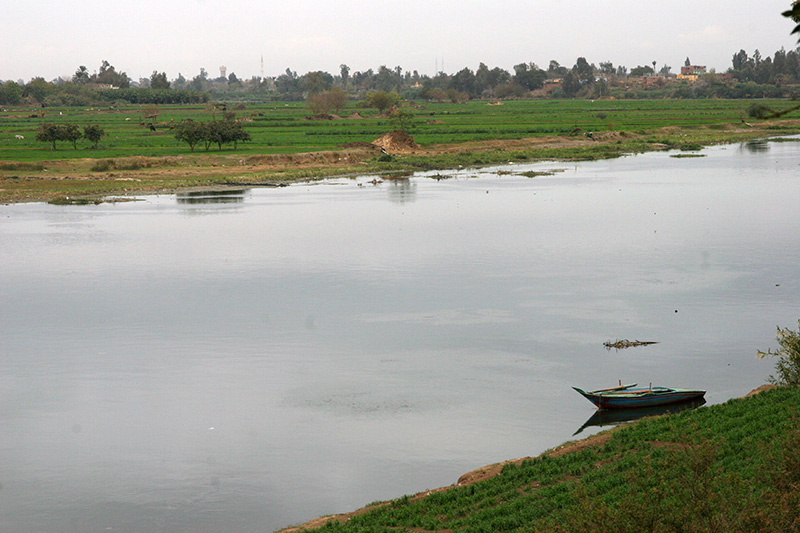
The Nile River had agricultural and religious significance for Egypt and was connected with the god Osiris.
Pharaoh’s court included magicians and sorcerers, most likely members of the priestly caste and teachers of wisdom. There is evidence of Egyptian magical practices that involved turning staffs into snakes (Westcar Papyrus). The initial signs performed by Moses and Aaron are imitated by those who dabble in the arts of magic and deception and who appeal to the darker supernatural powers that keep the people in blindness. The root of the Hebrew word translated “by their occult practices” (7:11) implies “to enwrap or envelope,” suggesting secrecy. Because the magicians are able to effect the same supernatural demonstrations, this first sign appears ambiguous, contributing to the hardness of Pharaoh’s heart (7:13).
I. Nine plagues (7:14–10:29). 7:14–25. When Aaron strikes the water of the Nile with the staff, all of it turns bloodred, bringing death (7:20–21). The idiomatic use of “blood” to indicate color is evident in Jl 2:31 and 2 Kg 3:22. This strikes at the heart of Egypt’s economy and religion. Agricultural productivity depended on rich alluvial deposits on the floodplains. Ironically the Nile was considered to be the lifeblood of Osiris, god of the underworld, who brought new life after each inundation. There is blood in every place where water collects, even in the “wooden and stone containers” (7:19), perhaps idolatrous objects. The river, canals, and ponds are affected by the flowing surface waters of the Nile as it floods. Further inland, where the water percolates through soils, they could dig for potable water (7:24). Water was a precious resource in Egypt, and Pharaoh fails to control its provision. Worse yet, when his magicians reproduce the same miracle, they contribute to further devastation of his people just to make a point against the God of Moses and Aaron, a case of destructive ideology (7:22).
8:1–15. Seven days later, with Aaron as agent, frogs entirely overwhelm the land (8:6). Heqt, a frog-headed Egyptian goddess, was an emblem of fertility, presumably assisting women in childbirth. The uncontrollable proliferation of frogs even in the bed of Pharaoh himself is the height of humiliation (8:3). As with the bloodred waters, however, the Egyptian magicians repeat the phenomenon (8:7). Nevertheless, at this point Pharaoh begins to negotiate through Moses, and God responds to Moses’s prayer (8:8–13). The frogs are removed the next day, although the stench remains (8:14).
8:16–19. The next two plagues are a natural result of putrid water and dying frogs. First vermin, possibly gnats or lice, descend on the land (8:16). The vermin are a plague on both humans and domestic animals (8:17). The magicians capitulate at the third plague when they fail to produce gnats (8:18), acknowledging “the finger of God” (8:19), by which they mean God’s power evident in Aaron’s staff. Up until this point, Egypt has suffered double onslaught as the magicians tried to keep up with Moses.
8:20–32. Next, dense swarms of flies descend on the land (8:21). With the plague of flies, God announces and makes a distinction between the Egyptians and the Israelites who live in Goshen (8:22–23). The land is ruined because of the flies (8:24). The Hebrew word for “ruin” also appears in Gn 6 regarding the devastation caused by both the wholesale sin of humankind (“corrupt” in 6:11–12) and the floodwaters of judgment (“destroy” in 6:13, 17). Pharaoh poses the alternative of worship in the land, a futile attempt to keep it under his control (8:25).
9:1–7. The plague on the livestock is the first to destroy property, particularly transport animals as well as those that provide food, dealing a shattering blow to the entire economy. In addition to the economic implications, there may also have been religious repercussions since both Apis and Hathor were bovine deities. The Lord continues the distinction between the Egyptians and the Israelites (9:4).
9:8–12. The plague of boils brings physical suffering directly to humans. Pharaoh’s own magicians are humbled and unable to stand in the presence of Moses (9:11). The reports of the fifth and sixth plagues are terse, and Pharaoh’s role is reduced to the indications that his heart is hard, he will not listen, and he will not let the people go (9:7, 12).
9:13–35. With the third set of three plagues the onslaught intensifies. The extensive descriptions are interwoven with articulation of God’s purposes and Pharaoh’s acknowledgment of his moral culpability. Following Moses’s warning, some of Pharaoh’s officials are convinced and preserve their property by following the instructions (9:19–21). The hail would have occurred in February, when the barley and flax were ripe (9:31). It may be that Pharaoh’s insincere admission of sin was designed to negotiate relief for the crops that ripened later (9:27–28).
10:1–20. Moses next warns that the crops not devastated by the hail will be destroyed by an invasion of locusts (10:5). Pharaoh’s entire system is eroding; in spite of his divine stature his officials challenge his authority, appealing to the potential utter ruin of Egypt (10:7). He recalls Moses and Aaron, but when he learns that they will all be leaving to worship, Pharaoh declares his intent to keep women and children as hostages (10:8–11).
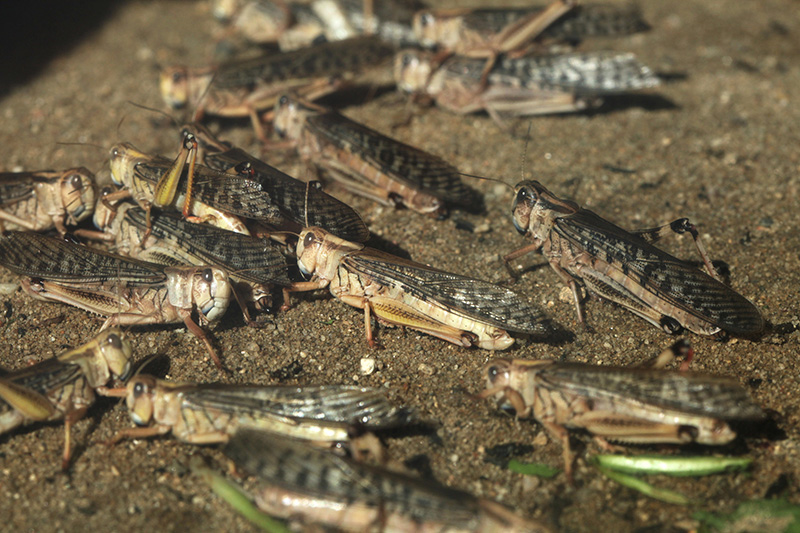
Locusts
© Vladimir Wrangel.
10:21–29. The ninth plague attacks the sun god, Amun-Re. It is a darkness “that can be felt” (10:21), possibly the sharav, a dry heat wave in which winds from the Arabian desert raise fine dust in the air, often obscuring the sun. Furthermore, in the ancient world, darkness was terrifying and dangerous, palpably “felt” in that sense. Amun was the god most closely linked with Pharaoh as a divine figure. In fear, Pharaoh orders Moses to leave with all the people and worship the Lord; he will not, however, allow them to take their livestock (10:24). Thus the impasse continues, with Pharaoh threatening death if Moses should appear before him again (10:25–29). [The Ten Plagues]
J. Warning of the tenth plague (11:1–10). Probably still in Pharaoh’s presence, Moses tersely announces the conditions, significantly ahead of the actual plague (11:4–8). At midnight as every firstborn died, the outcry of Egypt (11:6), parallel to Israel’s anguished cry, would have been horrifying. God would again distinguish between Israelites and Egyptians, and Pharaoh’s servants would beg the Israelites to leave (11:7–8). This chapter brings closure to the narrative of signs and wonders, promising that Pharaoh will drive the Israelites out and their Egyptian neighbors will send them away wealthy, notably because of Moses’s stature (11:1–3). This culminating plague also points ahead to the Passover.
The blood of the lamb marking the doorposts to protect the Israelites in Ex 12 compellingly foreshadows the protective blood of Christ, the Passover Lamb, who would bear the destructive wrath of God against sin (1 Co 5:7).
K. Instructions for Passover (12:1–28). While the Hebrew word translated “Passover” (pesah) appears frequently with reference to the sacrificial animal for the festival, the related verb (pasah) is not so common. In Is 31:5 (“by sparing it, he will deliver it”) it appears in poetic parallelism and clearly indicates protection. Thus, when the Lord sees the blood on the doorposts and lintel of a house, he will “pass over” (i.e., protect) the doorway (12:13; cf. 12:23, 27), not permitting the destroyer to enter and strike down the people.
This section includes instructions both for the Passover in Egypt (12:1–13) and for its commemoration on an annual basis (12:14–20). The liturgical component keeps alive for each successive generation the memory of God’s deliverance, particularly engaging the children. The Lord gives both sets of instructions to Moses (12:1), and Moses passes them along to the elders of Israel (12:21). Central to the Passover in Egypt is the lamb; in the celebration for generations to come, the emphasis switches to the unleavened bread.
The Israelites are instructed to take a one-year-old male lamb or kid without defect on the tenth day of the month and keep it until the fourteenth day (12:5–6). The four days of guarding the animal would ensure its unblemished state. One animal suffices for each extended household. The entire community will slaughter the animals at the same time. Hyssop, a plant with small leaves, bundled together, used for sprinkling the blood, has aromatic properties that counter the stench of blood (12:7, 22). The Israelites are to consume indoors the roasted sacrifice with bitter herbs and bread made without yeast (12:8, 15). They are not to break any bones of the sacrificial animal (12:46; cf. Jn 19:36). In the generations to come, those who eat leaven during the festival are to be cut off from Israel, the most severe of punishments (12:19).

Unleavened bread
In time the bitter herbs came to represent the bitterness of slavery, and unleavened bread, the purifying from the leaven of sin. Yeast affects the entire loaf of bread; so also the pollution of sin ranges much further than its original starting point. Fermentation also leads ultimately to decay and death, a compelling representation of the results of sin. Jesus identifies the “leaven of the Pharisees” as hypocrisy (Lk 12:1), and Paul uses the figure to address the need to deal in a radical way with sin in the Corinthian congregation (1 Co 5:6–8).
L. Tenth plague and departure of Israel (12:29–42). 12:29–32. The Lord passes through the land, striking down all the firstborn in Egypt, both human and animal (12:29). The firstborn of Pharaoh would have been considered divine; traditionally the god Amun visited the mother of the pharaoh-to-be. Utterly humiliated, Pharaoh summons Moses and Aaron in the night, orders them out, and seeks their blessing (12:30–32). Pharaoh first calls the people Israelites at this point (12:31), giving recognition to them as a national entity.
12:33–36. The Israelites ask for silver, gold, and clothing from Egyptians, and in doing so they receive token “payment” for the years of slave labor (12:35). That Israel goes out with provisions fits with the torah regulations that freed slaves be provisioned (Dt 15:13–15). Further, these materials constitute the voluntary offerings for the construction of the tabernacle (Ex 25:1–7; 35:4–29). In the OT pattern plunder is taken when Israelites are victorious, as they are here (12:36). The Lord gives Israel favor in the eyes of Egypt, suggesting that the Egyptians view this as “paying off” Yahweh in order to escape any further devastation.
12:37–42. The biblical text uniformly presents the number of the Israelites during the period of the exodus and wanderings as approximately six hundred “thousand” (Hb elep) fighting men (12:37; cf. Nm 1:46; 11:21; 26:51). With the addition of women and children, those who exited Egypt would have been in excess of two million persons. The entire population of Egypt was probably about five million in the fourteenth century BC. If the Israelites were so numerous it is not clear why they were so terrified by the Egyptian forces or the forthcoming battle with the nomadic Amalekites in 7:8–16. Further, Israel is described as having too few people to occupy the entire promised land right away (Ex 23:29–30; cf. Dt 7:7). The word elep, however, can also mean “troop,” “leader,” “group,” or “clan,” according to context. The average number of males per family was eight or nine, and likewise the number of men in a troop was nine or ten. Perhaps the total number of people leaving Egypt was approximately twenty thousand, still indicative of their multiplying (Ex 1:7) and an attestation to God’s clearly miraculous provision.
A mixed multitude joins the Israelites along with large numbers of flocks and herds (12:38). These may have been a conglomeration of fellow Semitic-speaking peoples in Egypt under bondage to Pharaoh.
M. Instructions for commemoration (12:43–13:16). 12:43–13:10. Israel is to observe the annual celebration, keeping vigil for generations to come because the Lord has kept watch that night. The reenactment of each aspect of the Passover will remind Israel of their previous distress, God’s mighty deliverance, and the terrible price of freedom.
Only members of the covenant people can participate in the Passover celebration (12:43). For males, this means circumcision (12:48). To ensure corporate memory and continuity of the tradition, the redemption of the firstborn and eating unleavened bread are designed to prompt children’s questions (13:8; cf. 13:14). The phrase “as a sign for you on your hand and as a reminder on your forehead” (13:9; cf. 13:16) is also part of the command to teach children the law (Dt 6:4–9) and is the basis for wearing phylacteries.
Eating unleavened bread for seven days (13:7) continues to identify and unite the community of Israel, even apart from the temple. The combined Festival of Passover and Unleavened Bread crosses the boundaries between home and family, where it began, and the corporate community at the central place of worship. Deuteronomy 16:2 indicates that God’s people are to sacrifice at the location he will choose as a dwelling for his name. When major reforms occur during the reigns of Hezekiah (2 Ch 30) and Josiah (2 Ch 35), central to each is the corporate celebration of Passover at the cleansed temple. God’s redemption means deliverance from sin, followed by transformed lives.
13:11–16. An additional element of the annual celebration is the consecration of firstborn males (cf. 13:1), a reminder that the firstborn is the Lord’s and that he required of the Egyptians their firstborn (13:15). In the case of livestock this means sacrifice. Firstborn sons are redeemed; a price is paid as a substitute.
N. Deliverance at the sea (13:17–14:31). 13:17–14:4. As the Israelites exit Egypt their path is not the well-fortified international trade and military route heading toward Philistine country, because they are not ready for major battle (13:17). In addition God’s design is to make them appear confused in the desert so that Pharaoh will pursue them, resulting in Egypt’s catastrophic defeat and final victory for the Lord (14:3).
The Philistines were among the sea peoples whose migration to the ancient Near East occurred during the early twelfth century BC, evidenced by reliefs from the reign of Rameses III. This was well after the exodus no matter which date is supposed for that event. Later editing of the text may have introduced this familiar designation of the coastal plain area, always controlled by more powerful, cosmopolitan political forces who were characteristically enemies of Israel. It is noteworthy that, when the Israelites battle Philistines centuries later, those Philistines allude to the memorable events in Egypt (1 Sm 4:8). It is also possible that while the major migration of the sea peoples occurred in the twelfth century, there had been smaller groups of them already resident in the land.
The Hebrew phrase yam sup, “Red Sea” (13:18), means “sea of reeds” and may refer to the lake region north of the Gulf of Suez (see the definition of “Red Sea”).
Moses takes the bones of Joseph (13:19) to fulfill the oath taken by the sons of Israel (Gn 50:25), drawing together the promises in Genesis with their fulfillment in Exodus. (See Heb 11:22.)
God’s presence in the pillar of cloud and fire guides Israel as they travel both day and night. This is an urgent journey (13:21).
14:5–14. Intending Israel’s annihilation, Pharaoh calls out all the chariots of Egypt along with his elite fighting corps (14:5–9). In fear the Israelites cry out to the Lord and reproach their visible leader, Moses (14:10–11). Five times in 14:12–13 they mention Egypt, a familiar and thus seemingly desirable place in these terrifying circumstances. Each step of the deliverance is accompanied by uncertainty, fear, and the resultant need to trust God.
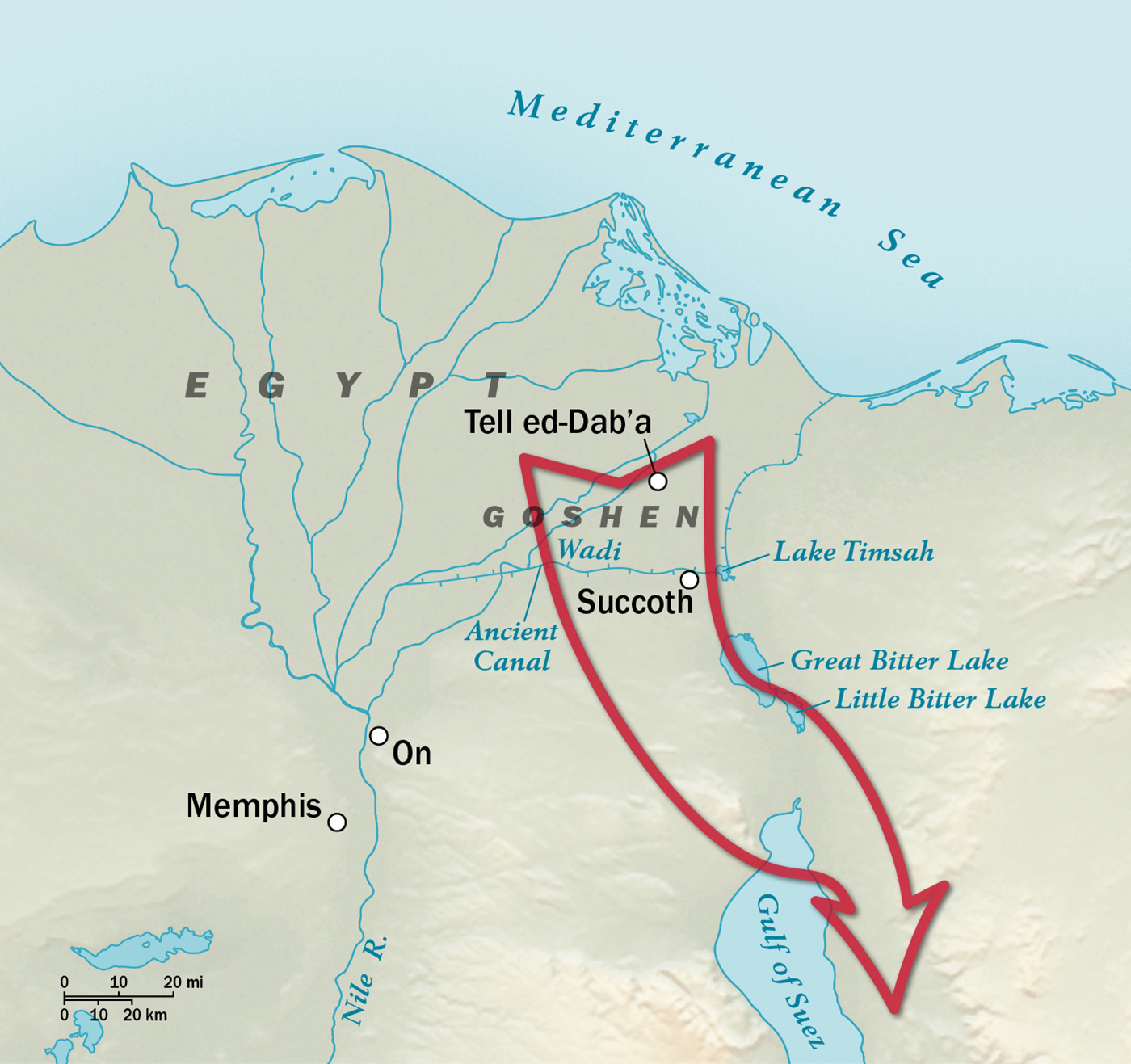
14:15–20. Moses encourages the Israelites with the promise of God’s deliverance, but he also appeals to the Lord, who instructs him to raise his staff in order to dry up the sea (14:16). Echoing the creation narrative, the dry ground emerges and the chaos of water is subdued. Because it takes all night for the waters to dry up, the angel of God and the pillar of cloud come between the army of Egypt and the Israelites (14:19).
14:21–31. The strong east wind (14:21) causes walls of water to pile up on both sides of its path as well as to the west. When Moses again stretches out his hand over the sea, it drowns the Egyptians who have turned around and are fleeing west (14:26–28).
As the Egyptians pursue the Israelites into the sea, they see God’s intervention and express their conviction that the Lord is fighting for Israel (14:23–25). In contrast it is not until the Israelites see Egyptians lying dead that they fear the Lord and put their trust in him and in Moses (14:30–31). The text does not mention that Pharaoh himself perishes, and there is no evidence of a change of pharaoh at the critical points in either the early- or late-date schemes.
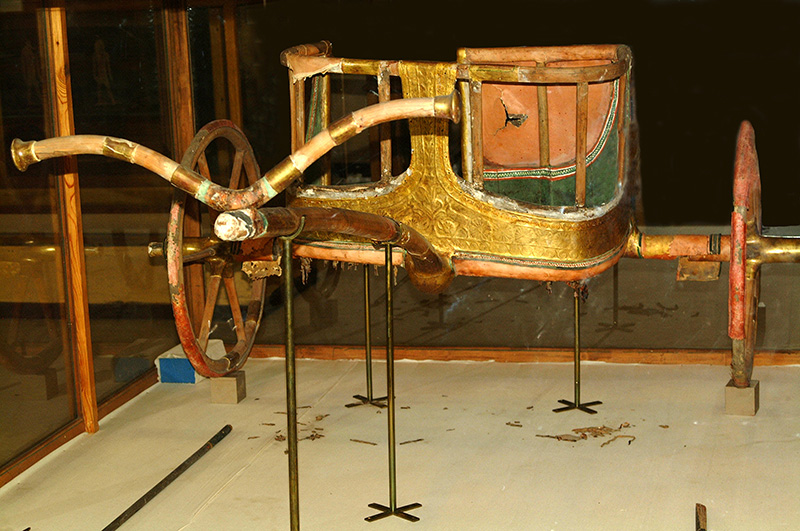
This wooden chariot was a gift from Pharaoh Amenhotep III.
© Baker Publishing Group and Dr. James C. Martin. Courtesy of the Egyptian Ministry of Antiquities and the Cairo Museum.
O. Song of victory (15:1–21). Poetry, a powerful vehicle for remembrance, was commonly used in Egyptian texts to emphasize a prose narrative. This is the first poetic rendition of God’s mighty deliverance, but the events are rehearsed again in Pss 78 and 106. Both Moses (15:1) and Miriam (15:20–21) teach the song to the Israelites. The first part (15:1–12) addresses the events that have already occurred, hailing God as the majestic warrior (15:3) whose mighty acts completely nullify the claims of Pharaoh to be divine. This song celebrates victory over a powerful and evil enemy in graphic images, often using anthropomorphic language. The right hand of the Lord has shattered the enemy (15:6); his burning anger consumes them as fire would chaff (15:7). The bombastic words of Pharaoh are followed by simply the breath of the Lord destroying them utterly (15:9–10).
Pharaoh drowns the Hebrew babies in Ex 1; God drowns the entire Egyptian army in Ex 14.
Exodus 15:13 transitions to promises for the future. The major enemies whom they will encounter, Philistines, Edom, Moab, and the Canaanites, will be terrified into silence and allow the people to pass by (15:14–16). Because the international coastal route traversed what would be later known as the plain of Philistia, these people are listed first, although recorded conflict with the Philistines would not occur until significantly later. The others appear in the order in which the Israelites encounter them. The poem ends not with victory in the land but with worship in God’s sanctuary, where he will rule as sovereign (15:17–18). This is a prophetic look forward from the perspective of Moses and Miriam; neither of them will set foot in the land.
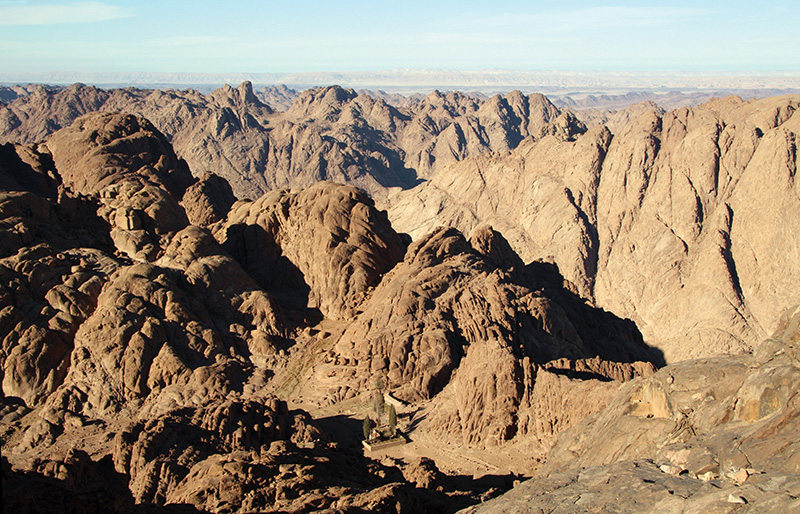
Jebel Musa, in the southern Sinai Peninsula, is a probable location of Mount Sinai.
2. TESTS IN THE WILDERNESS (15:22–18:27)
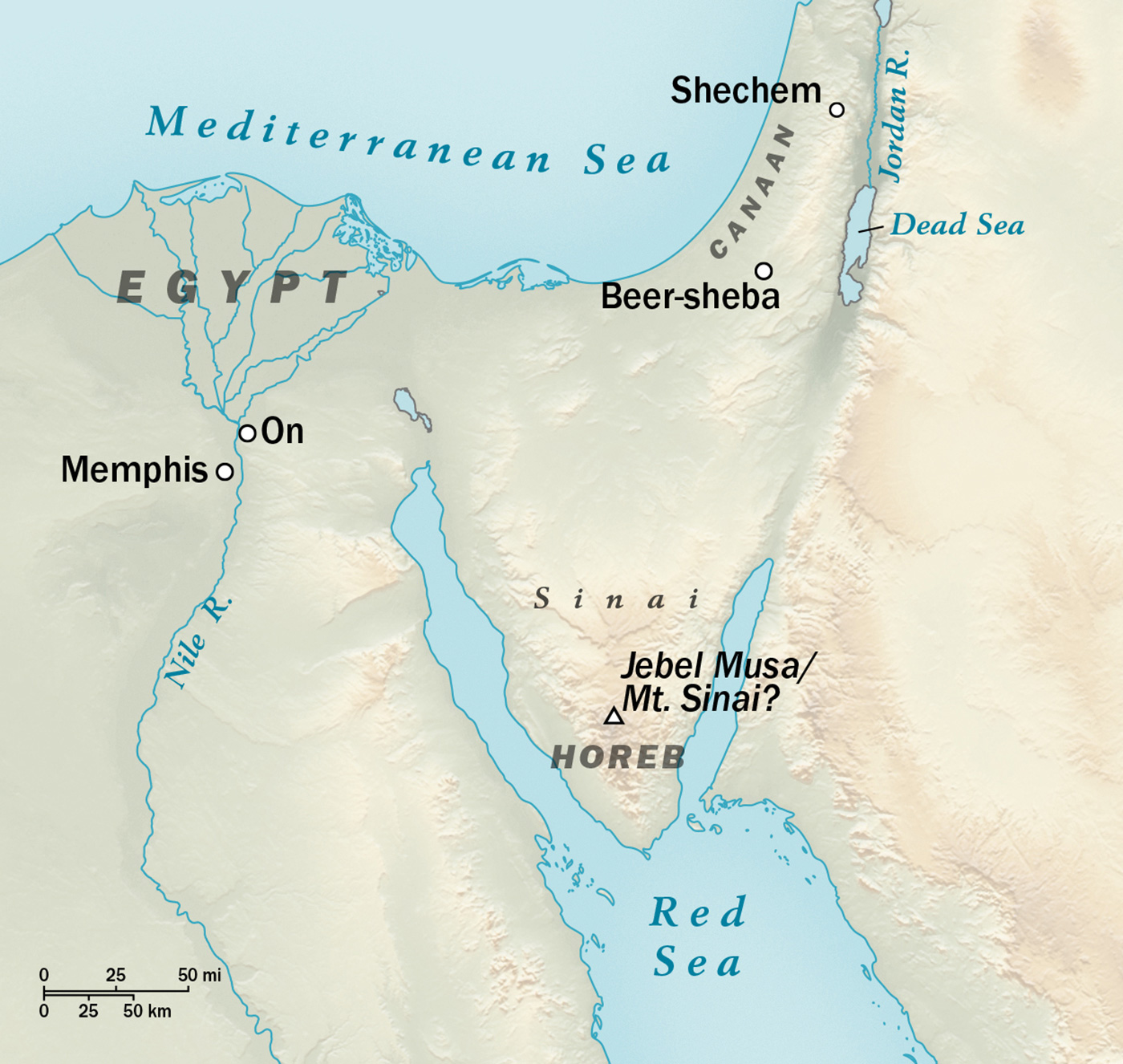
Neither the route of the Israelites to the mountain of God nor Mount Sinai itself can be identified with certainty, but the traditional location of the mountain in the southern part of the Sinai Peninsula is fitting. The region is rugged, far from the traveled northern routes across Sinai, and isolated from those routes by a barren and desolate wilderness. The Israelites’ journey is fraught with difficulties, and their faith is tested. Likewise they test God. The Israelites’ wilderness journey is mirrored in the lives of believers who have experienced profound joy in redemption only to be overwhelmed by the frustrations of life in a sinful world. The Israelites’ penchant for quickly forgetting God’s provision is a reminder that human nature has not changed. Each generation can see itself with chagrin in the increasingly strident and perpetually unhappy Israelites. The challenge is to be committed to obedience and trust that the Lord, fully in keeping with his character (Ex 3:14), will be faithful to provide what is necessary. Further, leaders of God’s people are inevitably the target of unjustified criticisms, obliged to sacrifice personal feelings for community well-being and “pray for those who mistreat you and persecute you” (Mt 5:44). Paul declares that these events occurred as examples so that God’s people through the centuries would learn not to set their hearts on evil things (1 Co 10:1–13).
A. Bitter waters (15:22–27). 15:22–25a. In the desert, three days without water is a crisis (15:22). The bitter water the Israelites find (15:23) fits well with the salinity of the swampy area north of the Gulf of Suez. God’s response is to show Moses a tree to cast into the waters in order to restore them (15:25a).
15:25b–27. At this point, God states his intention to test the Israelites (15:25b; cf. 16:4). Although the specific contents of the decree and the law are not articulated, the people are to obey God’s voice as they hear it and to heed the forthcoming commandments. The reward will be freedom from the diseases that God brought on the Egyptians (15:26). This may be a reference to far-reaching effects of the plagues, evidence of which they have seen. After the crisis, God brings them to a place with multiple springs (15:27). Twelve may symbolize the tribes, and seventy may represent the elders appointed later (Nm 11).
B. Threat of starvation (16:1–36). 16:1–12. A month later in the Wilderness of Sin the Israelites’ circumstances are so bleak that they voice their desire to return to Egypt, representing their previous estate in rosy colors complete with pots of meat and all the food they want (16:1–3). Their grumbling against Moses and Aaron prompts a response from the Lord; the Israelites will see manifested in the wilderness the glory and power of God in his benevolent provision (16:4–7). They will have meat in the evening and bread in the morning to meet their daily needs (16:8, 12). In this context, while both are promised, manna is the focus of the narrative. A year later (Nm 10:11), the quail are prominent. These are not disparate accounts of the same incident. Rather, the year at Mount Sinai, characterized by ongoing rebellion on the part of the people, makes them disdain the tedium of daily manna (Nm 11:6). While in this first instance God responds in mercy, their subsequent complaint results in severe judgment (Nm 11:31–34).
16:13–22. The quail are a natural seasonal event in Sinai, while the manna is a daily and miraculous provision. Even the name expresses the Israelites’ wonder at this substance: “They asked one another, ‘What is it [Hb man hu]?’ because they didn’t know what it was [mah-hu]” (16:15). The Hebrew name man (“what”) sticks. It appears as thin flakes like frost, is white like coriander seed, tastes like wafers made with honey, and looks like resin (16:31; cf. Nm 11:7–8). While it could be identified with a sticky, granular insect excretion of the Sinai Peninsula, the miraculous nature of God’s extensive, egalitarian, and continuous provision is evident.
16:23–30. Prior to giving the torah at Sinai, the Lord institutes the Sabbath observance in conjunction with providing manna. It is miraculously preserved from the sixth day through the seventh in contrast to its spoilage every other day, and the Israelites are not to collect it fresh on the seventh day (16:23–26). Although they are not to be greedy and hoard from one day to the next, the perversity of human nature is sadly evident in that, no matter what the people are commanded to do, some of them do not obey (16:27). The Sabbath is called a shabbaton shabbat-qodesh (“a day of complete rest, a holy Sabbath,” 16:23). Shabbat means a complete stop, bringing wholeness to the time preceding it. Shabbaton is superlative, indicating the greatest degree of rest. For this previously enslaved population, the Sabbath comes as a joyous gift. It is a time to leave the tedium and anxiety of work. It is also the culmination of the creation time cycle, and God sanctified it (Gn 2:2–3), a fact included in the Ten Commandments, as Israel is commanded to remember the Sabbath by sanctifying it just as the Creator did (Ex 20:8–11). When God’s people observe the Sabbath, they are re-presenting God’s acts of creating, completing, and resting. Further, the Sabbath will be the sign of the Sinai covenant, and desecrating the Sabbath is punishable by death (Ex 31:12–17). Because the Sabbath was and is an intrinsic part of nurturing the relationship between God and his people, its importance transcends the stipulations of the Sinai covenant.
16:31–36. Moses commands Aaron to place a jar containing an omer (“two quarts”) of manna before the Lord as a memorial of God’s faithful provision during the entire wilderness experience (16:33). It will be parallel to the Bread of the Presence instituted in the tabernacle structure. After celebrating the Passover in the land, the Israelites cease to receive manna (Jos 5:10–12).
C. Thirst in the desert (17:1–7). Traveling at the command of the Lord, the Israelites journey to Rephidim, find no water, and quarrel with Moses to the point where he fears for his life (17:1–4). God promises Moses, “I am going to stand there in front of you on the rock at Horeb; when you hit the rock, water will come out of it” (17:6). In Paul’s recital of the lessons to be learned from the wilderness events, he states that the people drank “from the spiritual rock that followed them, and that rock was Christ” (1 Co 10:4). Unpacking the symbolic connections, there is an intimation that God himself is struck.
Massah is related to the Hebrew verb nasah, meaning “to test,” and Meribah comes from rib, “to strive or quarrel” (17:7). A similar incident with the recurrence of the name Meribah occurs when the people arrive at Kadesh-barnea (Nm 20:1–13). Nevertheless God’s instructions to Moses at Kadesh-barnea are different. He is to speak to the rock instead of striking it, as in this instance. Because Moses there responds in anger, striking the rock twice and lashing out at the people, he is punished; God refuses to allow him to enter the land.
These incidents are paradigmatic for the psalmist (Ps 95:7–11) and for the author of Heb 3–4, both of whom are concerned about unbelief and hardness of heart in the face of God’s evident provision. The exhortation to enter the “Sabbath rest” (Heb 4:9–10) means leaving the life of disobedience and unbelief.
D. Attack from enemies (17:8–16). 17:8–13. The Israelites present a threat to the nomadic Amalekites’ water sources in the wilderness. Thus the Amalekites viciously attack weary Israel, cutting off stragglers, with no fear of the Lord (17:8; cf. Dt 25:17–18). The staff of God raised up by Moses is a visible symbol indicating that the battle is the Lord’s (17:11). When Moses tires and his hands sink, the Amalekites prevail until Aaron and Hur, representing the tribes of Levi and Judah, sustain him (17:12). This is the first mention of Joshua (17:9), whose name means “The Lord Saves.”
17:14–16. In the aftermath of the battle the Lord declares his perpetual enmity toward the Amalekites, who sporadically reappear on the stage of Israel’s history (17:16). In the first reference to writing in the Bible, Moses is commanded to record the sacred ban on Amalek on a scroll (17:14). Writing is presented here in conjunction with and as the basis for oral recitation; both are sources for the tradition.
E. Reuniting with family (18:1–12). At some point after the incident en route to Egypt from Midian (4:24–26), Moses sent Zipporah back to her father, possibly because the rigors of confronting Pharaoh would be overwhelming (18:2). She also would have been a foreigner in the Israelite context. Moses knows what it feels like to be an outsider, as the name of his first son, Gershom, testifies (18:3). Although it is not clear when his second son was born, the boy’s name, Eliezer, affirms that God is Moses’s helper (18:4), delivering him from death at the hand of Pharaoh. The children’s names symbolize the wilderness experiences for repeated generations of God’s people.
Horeb (Sinai) seems to have been on the edge of Midianite territory, and it was where God initially appeared to Moses (3:1). When Jethro hears all that the Lord has done for Israel, he testifies to the greatness of the Lord God above all other gods and brings sacrifices to express his allegiance (18:9–12a). The burnt offering atones for sin (Lv 1:4). In communion with Aaron (the priest of Israel) and the elders, this priest of Midian eats in the presence of God (18:12b).
F. Settling disputes (18:13–27). Jethro immediately contributes to the community’s well-being. Seeing the congestion created by large numbers of people coming to Moses with legal disputes, he advises Moses to delegate responsibility. As Moses represents the people before God and teaches them, qualified persons can serve under him, caring for set numbers of people (18:19–22). Those selected are to fear God, to be people of truth, and to hate dishonest gain (18:21). Jethro’s return home (18:27) is temporary, as he reappears to help Israel again after their Sinai sojourn (Nm 10:29–32).
Jebel Musa, in the southern Sinai Peninsula, is a probable location of Mount Sinai.
3. COVENANT AT SINAI (19:1–24:18)
God’s revelation comes to the people in the wilderness, characteristically a place for purification and for meeting God. The covenant encompasses the whole of Israel’s life. Their community comes into existence at the gracious will of God, and they are expected to exercise appropriate societal and individual responsibilities as his people. Even though there are affinities between the covenant and the Hittite treaty pattern, this relationship between God and the entire people is unique. Furthermore the setting in a narrative context is unique.
Exodus 20 begins the instructive words (torah, or law) of God for the recipients of the covenant. Torah reveals God’s holiness, indicating that there are specific standards of right and wrong; violations of those moral standards warrant punishment. Torah repeatedly calls the people of God to be holy as he is holy; it articulates purity and cleanliness standards for life lived in the presence of God. And torah reveals the depths of human sinfulness as those standards are repeatedly broken. Paul makes this point forcefully in Rm 3:9–20. No one is righteous, but through torah individuals become conscious of sin. Because torah demonstrates what sin is and how completely humans are captured by it, it serves to lead to Christ (Gl 3:24; see also Rm 7:7–13). Torah also sets the basic standards by which social structures function. Finally, Heb 10:1 suggests that the righteousness and goodness evident in torah are a shadow of the perfection and justice that will prevail when this world’s injustices have finally been overcome. This is a source of hope in a disheartening and fallen world.
These instructions address every aspect of life as a unified whole. One traditional categorization is moral-ethical, civil-social, and ritual-ceremonial torah. Although the instructions are interwoven in the text in a way that defies firm boundaries around each of the three categories, such a conceptual framework makes sense of the complex web of laws and underscores certain emphases as they appear. Moral-ethical torah affirms there are fundamental principles of right and wrong that transcend cultural and temporal boundaries. Civil-social torah addresses social structures and provides for proper administration of justice in a given cultural context. Specific formulations change, but the general principles remain the same because all social systems are composed of sinful humans. Ritual-ceremonial torah prepares the covenant community to approach God in worship and insists that all of life is conducted in the presence of God. While worship environments change, the fundamental need of sinful human beings to have a way into the presence of a holy God remains the same.
In the NT, Peter is drawing from Ex 19:6 when he states, “You are . . . a royal priesthood, a holy nation” (1 Pt 2:9), emphasizing Christians’ privileged status as God’s treasured possession. In the eschatological fulfillment of these covenant promises, those whom the Lamb has purchased with his blood are made to be a kingdom and priests to serve God (Rv 5:10).
A. Preparations to receive the covenant (19:1–25). 19:1–3. As covenant mediator, Moses goes up and down the mountain multiple times (19:3; cf. 19:7–9, 10, 14, 20–21, 24–25), communicating to Israel God’s promises and the procedures for purification, and communicating to God Israel’s expressed intention to be obedient. After Moses’s third trip up the mountain he objects to God’s repetition of the command to go down and warn the people (19:20–22), but in fact the people are still not fully prepared for God’s direct revelation and need additional warning. Even so, they are able to endure only the Ten Commandments; after that they request that Moses serve as mediator (20:19). Referring to the activities of Moses in this setting, Paul notes that “the law was put into effect through angels by means of a mediator” (Gl 3:19; see also Ac 7:53; on the angels’ role in the giving of the law, see Dt 33:2; Heb 2:2).
19:4–8. The promises of God follow his reiteration of his strong care for the people, since he has borne them on eagles’ wings to their present safe haven (19:4). The image of the eagle conveys both power and protection (Dt 28:49; 32:11). The promises set Israel apart from all nations but are conditional on their obedience. Israel will be God’s treasured possession, a kingdom of priests, and a holy nation (19:5–6). In these promises we see the Israelites’ transformation from slaves of Pharaoh to honored members of God’s kingdom. “Kingdom of priests” unites political and sacred vocations; they are to function among the nations as mediators of God’s blessings.
19:9–15. Meeting with God comes only after disciplined preparation. The people have to purify themselves, washing their clothes and setting boundaries around the mountain (19:10–12). The warning against mingling religious observance and sexual practice (19:15) is likely due to sacred prostitution characteristic of the surrounding nations. Whoever touches the mountain will be either shot with arrows or stoned, so that symbolically the people avoid direct contact with one guilty of presumptuous sin (19:13).
19:16–25. The descent of God on the third day is preceded by thunder, lightning, a thick cloud, and a loud trumpet blast (19:16). He arrives amid billowing smoke, raging fire, and violent trembling of the mountain (19:18). The event is beyond the capacity of any words to capture its essence, and the accompanying phenomena inspire the greatest dread and humility. God does indeed come down, an expression of his condescension, but the people are called to meet him in humble fear (19:20–22). These are important truths in light of contemporary trivializations of “mountaintop experiences” as places for self-indulgence. When God manifests himself, it is the prelude to his demand for transformed lives. Coming to grips with the terrible implications of his holiness is essential.
The author of Hebrews contrasts the terror inspired by this drama with the joy of approaching Mount Zion and the heavenly Jerusalem, the city of the living God, through Jesus, the mediator of the new covenant (Heb 12:18–24). Nevertheless that writer knows that the holy nature of God has not changed one iota, so the audience is urged to worship God with fear and awe because God is a consuming fire (Heb 12:28–29).
B. Ten Commandments and the people’s response (20:1–26). When Jesus is asked which commandment is the most important, he affirms two fundamental principles that characterize the Law and the Prophets: “Love the Lord your God with all your heart, with all your soul, with all your mind, and with all your strength,” and “Love your neighbor as yourself” (see Mk 12:28–34; Mt 22:34–40; Lk 10:25–27). The Decalogue (literally, the “Ten Words,” or the Ten Commandments) itself opens with “the LORD your God” (20:2) and closes with “your neighbor” (20:17). The first four of the Ten Commandments address the relationship of humans to God, affirming his unassailable right as Creator to the worship and undivided adoration of his people. The last six compactly articulate the absolute justice and goodness that must attend all human interactions. There are both positive and negative commandments, guarding against death and pointing the way to life. The commandments are designed to direct love to the proper object by ruling out those things that quench or distort love. All of the commandments are addressed to members of the community of Israel, with singular forms of the verbs. Each individual is to hear and obey, and the community is to be of one heart and mind. [The Ten Commandments]
The Ten Commandments appear twice in the OT, once in Ex 20:1–17 and again in Dt 5:6–21.
20:1–3. Because God identifies himself as the Israelites’ redeemer (20:2), the first commandment prohibits other gods; all of the people’s lives are to be shaped by singular loyalty to God. They have been living for centuries in Egypt, surrounded by elements of nature that are deified. They will be moving into Canaan, where the same practices are evident. Contemporary secular culture offers a plethora of choices (“other gods,” 20:3) where no allegiance is required, and in fact any wholehearted allegiance is viewed as suspect. God’s people are called to be radically bound by love for God.
20:4–6. The second commandment, against making images, bowing down to them, or serving them (20:4–5a), could refer both to images of Yahweh and to those of rival deities. Because the latter possibility was already addressed with the first commandment, this one primarily forbids any attempt to make a visible representation of God himself that would domesticate and trivialize his awesome majesty. Nevertheless the prohibition also applies to any of the elements of nature that so easily become objects of worship, especially those closely associated with the presence of God. The restriction is comprehensive, from the heavenly bodies to creatures in the sea. The people are easily tempted to attribute power to these various objects; an idol is the means of capturing that power and using it. It reduces God to something that could be managed for the self-satisfaction of the one who fashions the idol.
Idolatry was a sore temptation to which the Israelites succumbed throughout their history; their heinous idolatry repeatedly brought judgment on them, culminating in exile from the land. The stinging condemnation of idolatry as opposed to worship of God the Creator in Is 41–44 is echoed in Rm 1. Colossians 3:5 indicates that greed is idolatry.
God, who has bound his people to himself with covenant love, is jealous and will punish those who abuse his covenant love and refuse to be devoted exclusively to him (20:5b). The Hebrew adjective translated “jealous” is used only of God; it is the divine response to apostasy. Successive generations suffer the consequences of their forefathers’ choices to live in rebellion against God. Often children are the tragic victims of these choices. This warning is countered by the promise of unfailing covenant love (Hb hesed) to thousands (of generations) of those who love God and keep his commandments (20:6). Here both the justice and the mercy of God are evident.
20:7. According to the third commandment, uttering God’s name in the service of any objective outside God’s purposes is a serious affront to his glory and majesty. The ambiguity of the Hebrew expression for “misuse” allows a wide application, from swearing falsely in lawsuits to frivolous use of God’s mighty name, but may suggest taking an oath in a legal context. For Israelites, one who deliberately blasphemes the name of God with a curse is put to death (Lv 24:10–16). By the first century, Jews were careful to substitute other terms for God’s name so as to avoid breaking this commandment. Matthew usually uses the term “kingdom of heaven” rather than “kingdom of God.” In its wider application infractions of this commandment occur with sad frequency within the believing community, which too often lightly and frivolously jokes about God.
20:8–11. The Israelites were already taught the Sabbath procedures when they received the manna (Ex 16). In 20:8, the fourth commandment says to “remember” the Sabbath. The objective of setting the Sabbath apart is “to keep it holy.” Remembering establishes continuity with their past tradition; keeping implies protecting and guarding it for the future. God himself rested after creation (20:11), building into the very fabric of his created order the necessity of rest. As God set the day apart and blessed it, Israel is to remember and do the same. There is nothing in all the ancient Near East that corresponds to this gift from God to his people. The Sabbath is determined not by the movement of celestial bodies but by a simple seven-day cycle.
In Dt 5:15 keeping the Sabbath commemorates God’s rescue of Israel from Egypt. Because the exodus event foreshadows the redemption that Christians experience in the risen Christ, it is not surprising that Jesus infuses the Sabbath with even greater meaning when he says, “The Sabbath was made for man and not man for the Sabbath. So then, the Son of Man is Lord even of the Sabbath” (Mk 2:27–28). Jesus did not lessen the importance of the Sabbath but redirected the attention of the people to the necessary heart attitude of reverent worship of their Creator and Redeemer. The first-century Jewish legal experts systematized thirty-nine principal categories of forbidden work because the Sabbath was the sign of the Sinai covenant and infractions meant the death penalty. They were concerned to determine just what actions beyond those noted in Scripture (Ex 16:29; 34:21; 35:3; Nm 15:32–36; Neh 10:32; 13:15–18; Jr 17:21, 24, 27) were forbidden. Sabbath observance in its original intent, however, was viewed as a positive and restorative command, providing release from anxious toil and ambition.
20:12. The fifth commandment is in a pivotal position between the first group, which addresses humankind’s relationship with God, and the second, which attends to interactions on the human level. Parents bring new life into the world, and they are to be accorded corresponding honor. This is a comment on the value of life and the order established by God, whom parents represent to their children. While this is a call to children to esteem their parents, it is likewise a call to parents to be worthy of the honor. Observing that this is the first commandment with a promise, Paul indicates that it should be from parents that children learn how to love and serve God (Eph 6:2–4). Clearly, human parents often fail in this enterprise, some more drastically than others. Part of the honor accorded them is, in those cases, forgiveness and exerting every effort to live at peace (cf. Heb 12:14). Maligning parents who have been a severe detriment to one’s life only leads to bitterness. The punishment for cursing parents is death (Ex 21:17); rebellion and disobedience receive a like punishment (Dt 21:18–21). The Hebrew word translated “honor” literally means “to be heavy” or “to give weight to” and may be directed to those children who are already adults and responsible for providing for their parents. This aspect of the commandment seems to underlie Jesus’s rebuke of the Pharisees in Mk 7:9–13. Finally, the promise regarding the land may refer to the fact that poor family relationships will mean forfeiting the family property.
20:13. From this point the commandments are tersely articulated, allowing for considerable re-presentation in specific sociohistorical contexts. The sixth commandment prohibits murder and refers only to illegal killing. The Hebrew term for “murder” refers to intentional and deliberate taking of human life; most examples of where the term is used address improper homicide that clearly is damaging to the community. In Hebrew, two entirely different words are translated “to kill” and “to put to death.” The primary concerns here are not the death penalty or warfare. Murder is the most drastic antihuman action, violating the image of God. Satan was a murderer, knowing that introducing sin meant introducing death. Subsequent stipulations in the torah deal with such issues as manslaughter, going to war, and capital punishment. The punishment for murder is the death penalty (21:12).
20:14. With the seventh commandment, God forbids adultery. Violation of the marriage covenant leads only to disaster, graphically illustrated on the human level in Pr 5:1–23; 6:20–29; 7:1–27. The gift of sexuality is both rapturous and potentially destructive to individuals and whole communities, as it evokes desires that can overwhelm reason. Thus sexuality must be disciplined in a context of fidelity so that family stability and honor are maintained. Marriage symbolizes the intimate covenant love between God and his people; broken marriages represent the spiritual adultery of the people of Israel (Hs 1:1–2:23; Mal 2:13–16). All manner of unacceptable sexual practices are rampant in the land that the Israelites are going to possess, and God warns them soberly against these perversions, stating unequivocally that such perversions defile the land (Lv 18). As with all of the commandments up to this point, adultery is punishable by death (Lv 20:10). So also are other sexual aberrations (Lv 20:11–16). Jesus makes very strong comments about adultery and divorce, calling his audiences back to the principle of two becoming “one flesh” (Mk 10:2–12; Mt 19:3–12; cf. Gn 2:24).
20:15. The eighth commandment prohibits stealing. Underlying this commandment is the intrinsic value and freedom of persons and property. While God is the ultimate possessor of all creation, he has given stewardship and ownership of specific aspects of the creation to human beings, and that ownership is not to be violated. Subsequent chapters of Exodus address details regarding judicial procedures for the variety of possible infractions. The penalty for property theft is restitution (22:1–4), but if a person is stolen (kidnapped), the penalty is death (21:16).
20:16. The ninth commandment forbids false testimony and has specific application to witnesses in court. The penalty for false witnesses is severe (Dt 19:16–21). The rest of Scripture presents lying in general as a heinous offense. The book of Proverbs repeatedly warns of the damage that false speech does, declaring that a lying tongue and a false witness who pours out lies are detestable to the Lord (Pr 6:16–19). Jesus strikes at the root of the problem, calling the devil the father of lies and a murderer from the beginning (Jn 8:44). The end of liars, along with such offenders as murderers, the sexually immoral, and idolaters, will be the lake of fire (Rv 21:8). Distortions of the truth lead to ruined reputations, lack of trust, irreconcilable pain, and loss of life. Sadly, multiple biblical as well as contemporary illustrations demonstrate these consequences, both on the level of individuals and in terms of systemic and ideological shaping of truth.
20:17. Finally, the tenth commandment, against coveting, completes the circle created by this comprehensive statement of ethics. Coveting means an insatiable craving to serve oneself at any cost, a clear violation of the first two commandments. It is the heart attitude that surfaces in acts of murder, adultery, theft, and false witness. When Jesus challenges the self-righteous rich young ruler to give up all his possessions and follow Jesus, the ruler acknowledges that his heart is too attached to his wealth (Mt 19:16–22).
20:18–21. Having seen and heard the manifestation of God’s presence, the people are afraid and ask Moses to mediate (20:18–19). Moses attests to the protective value of fear, as it will keep them from sin (20:20). While the people remain at a distance, Moses approaches the thick darkness (20:21). Evidence of God’s overpoweringly dreadful presence and continuing mystery, the thick cloud shrouds his manifestation, so often portrayed as blazing fire. From this point forward, all of God’s revelation will be mediated through Moses, the continuing prophetic office, and finally the incarnate Word.
20:22–26. God’s initial words to Moses repeat the warning against idolatry (20:23) and give preliminary directives about constructing earthen and stone altars (20:24–25). This passage may affirm the use of sacrificial altars besides the central one at the tabernacle, and later the temple. That such did exist is clear both from the biblical text (1 Kg 18:30) and from archaeological finds, notably the horned altar at Beer-sheba. The warning against revealing nakedness in 20:26 may allude to the connection in the surrounding Canaanite culture between worship and sexuality.
C. Covenant stipulations (21:1–23:19). These specific stipulations interweave civil torah, social rules, moral injunctions, and prescriptions for worship, and none is privileged above the others. The initial civil-social instructions are presented as case law, specific for their ancient Near Eastern culture; about halfway through, the tone changes to imperatives addressing issues of justice, mercy, and proper worship. The bulk of the material establishes procedures to administer justice in this newly forming social entity and is designed for their life together in the land. In order to deal with some of the seemingly less-than-ideal stipulations included in the book of the covenant, some scholars have proposed applying trajectory theology. This interpretive model sees the laws articulated in the Sinai covenant as ethically more advanced than those in the surrounding cultures, but as only approximating the ideal to which they point.
Primary social issues addressed in 21:1–23:19 include the treatment of Hebrew slaves, personal injuries, theft and property damage, sexual abuses, and mistreatment of the disenfranchised. Such factors as intentionality, gender, and whether one is a slave or free affect how civil torah is implemented in that sociocultural setting. Israelites are not to pervert justice for ill motives, and balance in the administration of justice is essential.
21:1–6. The master-servant relationship was part of the widespread ancient socioeconomic structure, and the Israelites, emerging from their own harsh bondage, are to be particularly sensitive to mistreatment of slaves. The Hebrew word ebed means both “slave” and “servant.” Because there is provision for selling oneself into bondage in order to deal with unmanageable debt (22:3), hope for freedom is essential. A male servant does not have to buy his freedom but can leave at the end of six years if he chooses to do so (21:2). If, however, he loves his master, or his master has given to him a wife whom he loves, he can continue to serve his master (21:5). Because it was common practice in the ancient Near East for a master to “breed” slaves by giving the slave a wife, the slave might not have an emotional attachment to his wife and might leave by himself (21:4). Becoming a permanent slave was a major step, and thus an oath was taken in the presence of the judicial authorities, who represented God (21:6). If freedom means freedom in poverty, the slave may choose to remain secure in the master’s household.
21:7–11. Women were in a different position. In that social context it was not possible for a woman to live independently apart from the protection of father, husband, or master. When a father sold his daughter to be a servant in a stable household, that ensured her security and could involve marriage either to the new master or to his son. This explains why she is not allowed automatically to go free after six years (cf. Dt 15:12). The ambiguity of the passage is heightened by the provision for redeeming her if she is not pleasing (21:8) and even the possibility of her going free if her master does not provide her with the basics of food, clothing, and marital rights (21:10–11). This is a freedom for which she does not have to pay. However these particular factors fit together, she is not to be cast off, either by being sold to foreigners (21:8) or by becoming marginalized and abused in the extended family context (21:10).
21:12–17. In regard to personal injury and abuse (21:12–36) the matter of intentionality is prominent. If an individual dies as the result of a premeditated attack, the killer is to be put to death (21:12, 14). If, on the other hand, “God allowed it to happen” (21:13), then there is a system to protect the slayer from those who would take revenge. This is briefly mentioned in Exodus and developed significantly in conjunction with the cities of refuge (Nm 35:6–34; Dt 19:1–13). Dishonoring parents by physical or verbal abuse, a violation of the fifth commandment, is punishable by death (21:15, 17). So also with stealing persons, or kidnapping (21:16).
21:18–27. The same life value is put on women and men in the category of personal injury, but slaves are treated differently from nonslaves. Whereas injury to a free person means the assailant has to compensate for lost time (21:18–19), if a person injures his own slave, no punishment is required because the slave is his property (21:21). Injury to a free woman requires measure-for-measure punishment (21:22–25). In the case of a slave, compensation is effected by granting the slave freedom (21:26–27). If a bull gores a slave, compensation is made to the owner of the slave, but the punishment is not as rigorous (21:32). Masters can discipline slaves but not to the point of death (21:20). Otherwise the slave can be avenged. These instructions oscillate between humane justice and the concern for economics, as slaves represented a financial investment and were viewed as property. Even so, there are no other ancient Near Eastern legal codes that protect slaves from maltreatment by masters.
The case in 21:22–25 is complicated by the woman’s pregnancy. If, as a result of the blow, “her children” come out (21:22) but there is no serious injury, the punishment is a fine. Serious injury necessitates just retribution. While there is some potential ambiguity in the text, it seems likely that the injury addressed in this case is that which occurs to the woman (21:23). The fine applies to the prematurely born or miscarried children.
The measure-for-measure principle—“eye for eye, tooth for tooth, hand for hand” (21:23–25; see also Lv 24:17–22; Dt 19:16–21)—does not imply that literal hands and eyes are to be removed but indicates that the punishment must fit the crime; it is meant to curb the all-too-human tendency for revenge and to ensure equal treatment across sociological boundaries. The text affirms the possibility of compensatory payments in place of strict measure-for-measure action (21:26–27). These guidelines were established for court procedures. Jesus addresses the personal need to eschew any desire for retaliation by giving even more than is required (Mt 5:38–42).
21:28–36. The owner is responsible in the case of an ox that is known to be lethal (21:29–32). The animal is to be destroyed because of the sanctity of life. If the owner was aware that the animal was dangerous and did nothing to address the situation, he too is subject to stoning, although a ransom payment can be an alternative.
22:1–15. Because the society was agricultural, the cases regarding theft and property damage have primarily to do with animals and land produce. While theft in general means a twofold restitution, the relative value and necessity of certain animals means that the payback when they are stolen is significantly more: five head of cattle for an ox and four sheep for one sheep (22:1). Oxen were working animals, and their loss would have had significant productivity implications. Likewise, flocks were valuable for milk, fleece, flesh, and hides. There is even concern for justice for the housebreaking thief (22:2–4). If he is fatally struck at night the homeowner is not liable, but the latter is held responsible during a daytime theft if his defensive assault is lethal.
Cases of negligence and loss (22:5–15), where identifying the responsible party is difficult, are brought before God or the judges (Hebrew elohim can mean either; see the CSB footnotes for 22:8, 9). An oath taken before the Lord that the temporary keeper did not commit a crime in regard to the property is to be sufficient (22:11). The Hebrew verb shalem (“repay” or “make restitution”), which means to set right and restore well-being (shalom), recurs throughout the section, implying that making restitution means restoring the social fabric.
22:16–20. A man who seduces a virgin and sleeps with her is to take responsibility by paying the bridal price and marrying her. Even if her father refuses to allow her to marry, the seducer still has to pay the bridal price (22:16–17). The same stipulation is part of a much larger discussion of sexual improprieties in Dt 22:13–30. Likewise the brief mention of the death penalty for having sexual relations with an animal (22:19) is among numerous abuses detailed in Lv 18. The prohibitions in 22:18–20 address practices that are abominations. The serious nature of these infractions is evident in that the punishment involves the practice of herem, giving over to destruction those who have deliberately rejected the Lord (22:20).
22:21–27. Four groups are repeatedly the objects of God’s deep compassion—widows, orphans, aliens, and the poor (22:21–24). Just as God has heard the cry of the Israelites when they were in Egypt, so he promises to hear and respond with justice to the cry of disenfranchised persons. If Israelites treat widows or orphans unjustly, the number of widows and orphans in Israel will increase because God will kill the malefactors! Those who are financially disadvantaged are not to be abused, either in matters of justice or in financial dealings.
The need for a loan demonstrates devastating poverty; paying interest would relegate the person to perpetual economic distress (22:25). While there is evidence of loans with interest in the commercial and urban ancient Near East, the Israelites’ well-being depended on the land’s productivity, a more tenuous situation. Israelites could add interest to loans for foreigners because they were likely traveling with commercial and trade interests and, being more mobile, posed a greater financial risk. Both the individual and society were equally responsible to meet the needs of those who were in poverty; singular as well as plural verbs are woven into the commands.
22:28–31. The command not to blaspheme (22:28) may refer to God or to judges (Hb elohim; see the CSB footnote). Blasphemy trivializes authority, whether divine or human. The Israelites are also reminded to give to the Lord their firstborn and to demonstrate their separation by not eating improperly killed meat (22:29–31).
23:1–9. The principles that close the section on social and civil torah acknowledge the fundamental evil of lying, hatred, and greed and call for truthfulness as the basis of justice. No special consideration is to be given to social status, whether rich or poor (23:3, 6). The specific mandate to help the animal of one’s enemy would be a way of demonstrating evidence of forgiveness within the community (23:5).
23:10–13. The summary of Sabbath guidelines (23:10–12) highlights social and humanitarian concerns. The complex of seventh-year procedures, expanded in Dt 15, provides for the poor, as does the Jubilee (Lv 25). Even the command to observe one day in seven brings refreshment to the members of extended households that most need it: slaves, aliens, and working animals.
23:14–17. Each of the three major pilgrim festivals is described at greater length and with alternative names in parallel passages (Lv 23:1–44; Nm 28:16–29:40; Dt 16:1–17). Passover (not mentioned here) and the seven-day Festival of Unleavened Bread (23:15a) are combined, with greater emphasis being given to the latter. The Festival of Harvest (also called the Festival of Weeks or Pentecost; 23:16a; see the CSB footnote) celebrates the firstfruits of the crops and traditionally commemorates the gift of torah three months after leaving Egypt. The Festival of Ingathering, at the end of the year, is also called the Festival of Shelters (23:16b; see the CSB footnote). All are celebrations of God’s provision for Israel. In response, celebrants are to bring something back to God; they are not to appear before him empty-handed (23:15b). Once the temple is built, a male appearing before the Lord (23:17) means pilgrimage to Jerusalem.
23:18–19. Four ritual guidelines follow. They are not to offer sacrificial blood, the cleansing agent, with anything that contains yeast, because the latter symbolizes that which is evil (23:18a). The fat portion, always given over to the Lord (Lv 3:9–17), is not to be left until morning (23:18b). That would represent disdain for what belongs to the Lord. The best of the firstfruits belongs to God (23:19a). Finally, a young goat is not to be cooked in its mother’s milk (23:19b). Although this last prohibition appears three times in the Pentateuch (see also Ex 34:26; Dt 14:21), no reason is articulated. It may have been a Canaanite religious practice or a magical rite from which Israelites were to be separate.
D. Preparing the way to the land (23:20–33). 23:20–26. The accompanying angel, identified with the Lord himself, will bring the Israelites into the land inhabited by idolatrous people groups (23:20–23). The Israelites are to demolish all the idols and sacred stones lest they engage in practices that would threaten their fragile allegiance to the Lord God (23:24). The brief statement of blessings for covenant obedience (23:25–26) is a microcosm of those articulated in Lv 26:1–13 and Dt 28:1–14.
23:27–30. The Hebrew word tsirah (“hornet,” 23:28) is used only two other times, both in conjunction with the conquest (Dt 7:20; Jos 24:12). It could figuratively refer to the succession of pharaohs whose campaigns in Canaan devastated the economy and military fortifications. There is a phonetic similarity between mitsrayim (“Egypt”) and tsirah. That the people are not sufficiently numerous to move into the land all at once suggests that their numbers were not in the millions (23:30).
23:31–33. The borders indicated in 23:31 present a western “front” at the Mediterranean Sea and across Sinai to the southwest, and an eastern boundary out to the desert in the Transjordan and extending northeast to the Euphrates River. This interpretation is contingent on understanding the “Red Sea” as the same body of water that the Israelites crossed as they exited Egypt, which is not necessarily consistently the case in the biblical text. These boundaries are never realized, even under the united monarchy of David and Solomon.
E. Covenant ratification (24:1–18). 24:1–2. Only Moses is allowed to approach the Lord (24:2). Those invited to ascend the mountain are granted a vision of the God of Israel while the people worship at a distance. The representative leaders include Aaron, Nadab and Abihu, and the seventy elders (24:1). Nadab and Abihu are the eldest two sons of Aaron (Ex 6:23), who later bring unauthorized fire into the presence of the Lord and are consumed by fire (Lv 10:1–2). One of the possible explanations of that rash deed stems from this ceremony. Their privileged position here goes to their heads, and they presume to be able again to enter into the Lord’s presence when the tabernacle proceedings are inaugurated. The seventy elders are recognized leaders (cf. Nm 11:16).
24:3–8. Moses repeats to the people what the Lord has said, they promise to be obedient, and Moses writes down the contents of the covenant in preparation for the ratification ceremony (24:3). Moses also builds an altar and sets up the symbolic twelve stones, and young Israelite men sacrifice burnt offerings and fellowship offerings (24:4–5). While the purposes and procedures for these sacrifices are later detailed in Lv 1–4, the offerings are already known to the Israelites, as their idolatrous worship of the golden calf demonstrates (Ex 32:6). Possibly, as Moses wrote these accounts later, he described what happened in terms that were familiar to those who knew the sacrificial procedures. The Israelite young men, representative of the people, slaughter the animals, while Moses mediates by sprinkling the blood (24:6).
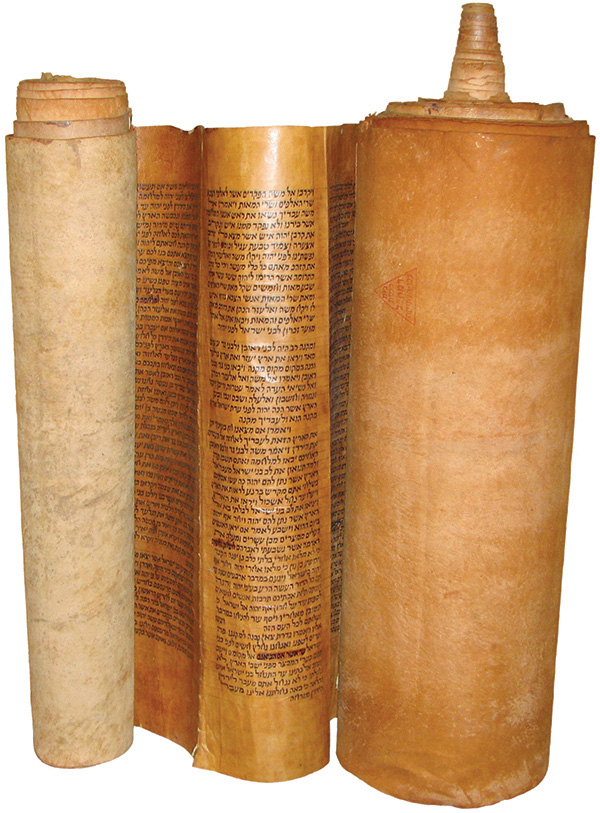
A handwritten scroll. Moses reads aloud to the people from the covenant scroll (Ex 24:7).
© Ijon / Wikimedia Commons, CC-by-sa-2.0.
The purpose of the whole burnt offering is to atone for sin in general (Lv 1:4), while the fellowship offering is an expression of gratitude and, by virtue of its name (an offering of “peace” or “wholeness,” related to Hebrew shalom), a symbol of restored relationship. The participants partake of the fellowship offering in God’s presence. The blood of these sacrifices represents life given to make atonement (cf. Lv 17:11), and half is put on the altar prior to reading the book of the covenant (24:7). When Moses sprinkles the other half on the people, he essentially ordains them as the “kingdom of priests” (24:8).
24:9–11. The Israelites’ vision of God corresponds in abbreviated fashion to significant aspects of Ezekiel’s vision into heaven. The clear pavement of lapis lazuli under God’s “feet” (24:10) sets apart the presence of God’s throne just as does the expanse gleaming “like awe-inspiring crystal” above the heads of the living creatures and below the throne (Ezk 1:22–26). Some of these same features reappear in the final throne vision of Rv 4. In every case the glory of God overwhelms its audience. Not only do these invited participants see God; they eat and drink in his presence, symbolizing the relationship established by this covenant (24:11).
24:12–18. Following the communal meal the Lord summons Moses to ascend the mountain and receive the tablets of stone on which the Lord has written the torah (24:12). Joshua, not part of the covenant ratification group, accompanies Moses. Aaron and Hur, of the tribes of Levi and Judah, are appointed as caretakers in their absence (24:13–14). Moses is called into the cloud, leaving the human sphere and venturing where no one has ever gone. The glory of God appears to the people as a fire that is consuming (24:15–17). It is no wonder they question if Moses will ever return. Moses remains on the mountain for forty days and nights to receive the instructions for the construction of the tabernacle and the preparation of the priesthood (24:18; cf. 25:40; 26:30; 27:8). When the glory of the Lord covers the mountain, it is a prelude to his presence manifested in the forthcoming tabernacle, God’s dwelling in the midst of his people. The tabernacle is only a copy and shadow of God’s heavenly dwelling (Heb 8:5; 9:24).
The words of Jesus at the Last Supper are an echo of Ex 24:8: “This is my blood of the covenant” (Mt 26:28). Hebrews 9:19–22 re-presents this ceremony, expanding the list of objects sprinkled with blood, and focusing on the blood as the means of cleansing and as necessary for forgiveness.
4. INSTRUCTIONS FOR SANCTUARY AND PRIESTHOOD (25:1–31:18)
The significance of the tabernacle and its ministers is evident in the amount and placement of text devoted to these topics. After the covenant is articulated and confirmed (Ex 20–24), God gives instructions about his sanctuary (Ex 25–31; 35–40) before he outlines the sacrificial procedures in Lv 1–10. The two distinct units on the sanctuary are separated by the devastating golden calf incident, in which Israel breaks the fundamental bond of the covenant. Yet, God determines to dwell in their presence; completion of the structure and ordination of the priests demonstrate God’s mercy.
The tabernacle is a powerful visual lesson about approaching the holy covenant God. It is exquisitely constructed, remarkably extravagant, and representative of the beauty and perfection of the Master of the universe as he comes to dwell in his people’s midst. The pathway is via blood sacrifice and subsequent symbolic cleansing. The very process of taking the life of the animal, the mess, the bloodshed, and the pain, are all grim reminders that sin is a horrifying and dreadful thing in the presence of God. None of this speaks of “coziness” with God.
A. Contributions (25:1–9). The precious materials for the tabernacle (25:2–7; cf. 35:20–29) are likely from the wealth that the Israelites took with them when they left Egypt. Out of grateful hearts, the people voluntarily give metals, fabric and yarns in colors of royalty, land and sea animal skins, wood, oil, spices, and precious stones. Moses is allowed to see the divine blueprint (25:9).
The tabernacle is called a “sanctuary,” a place set apart (25:8). The courtyard around the sanctuary defines that space. At the same time, the term for “tabernacle” means “dwelling place”—God has chosen to dwell in their midst. The tabernacle is also called the “tent of meeting” (e.g., Ex 27:21), indicative of God’s intention to meet his people wherever they are on their journey. The Sinai event is continued in the tabernacle, combining God’s presence and his mobility.
B. Ark of the covenant (25:10–22). The ark of the covenant, an acacia-wood box overlaid with gold (25:10–11), will be the sole object in the most holy place (26:33–34). It contains the tablets of the testimony from Mount Sinai, the permanent statement of the covenant relationship (25:16). The ark symbolizes the footstool of God’s throne (1 Ch 28:2), evoking the image of God as sovereign. At certain points in Israel’s history, this chest will also hold the pot of manna and Aaron’s staff (Ex 16:34; Nm 17:10; Heb 9:4; see 1 Kg 8:9; 2 Ch 5:10). The ark has a cover, above which extend the wings of two cherubim facing each other (25:17–22). The Hebrew verb meaning “to cover” is used primarily in conjunction with the atonement provided by the blood sacrifice. When Moses enters the tent of meeting he hears the voice of God speaking to him from between the two cherubim above the atonement cover (Ex 33:11; Nm 7:89). The cherubim figures represent celestial beings standing guard between the throne of God and the earthly spheres (Gn 3:24; Ezk 1:1–28; 10:1–22).
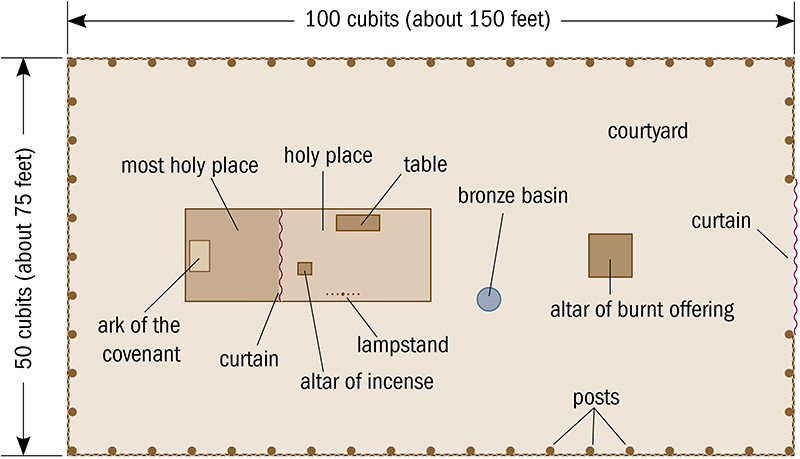
C. Table and lampstand (25:23–40). 25:23–30. The table for the Bread of the Presence is placed on the north side in the holy place of the tabernacle (26:35). Twelve loaves of bread are regularly set out before the Lord on behalf of the Israelites (Lv 24:5–9), a reminder of God’s faithful provision, most notably of manna in the wilderness. Accompanying the table are plates, ladles, pitchers, and bowls for pouring out offerings (25:29).
25:31–40. On the south side (26:35) is an elaborate lampstand with six branches extending out from a central shaft, three on each side (25:32). Altogether there are seven lamps on the stand (25:37; cf. 37:23). Each of the branches has multiple cups to hold oil for burning (25:33–34). The lamps inside the tabernacle are to be tended and kept burning continually (Ex 27:21; Lv 24:2–4), the pure radiant light of God’s presence constantly driving away the dark powers of evil. A symbolic connection between the lamps and the Spirit is suggested in Zch 4:1–14 and Rv 1.
D. Tabernacle (26:1–37). 26:1–30. The tabernacle is portable (cf. Nm 4:24–33) with upright frames and crossbars of manageable size and silver bases for the frames (26:15–26, 29). The use of acacia wood (26:15, 26; cf. 26:32) reflects the Sinai environment, as this tree grows most frequently in that relatively barren terrain. Four layers of curtains, likewise in segments for easy assembly and dismantling, cover the structure (26:1–14). The innermost layer is fine linen with figures of cherubim worked into the material (26:1). Longer curtains, protective coverings, are made of goat hair, ram skins, and the hides of animals whose habitat was apparently the Red Sea (26:7–14). The Hebrew word for these hides (“fine leather,” 26:14) is used almost exclusively in conjunction with the tabernacle, and it is not entirely clear just what type of creature the hides came from.
26:31–37. A separate and finely made linen curtain covers the entrance (26:36). It is protected from the outside elements by an extra length of the goat hair curtain. Inside the tabernacle another curtain, also adorned with cherubim, partitions off the most holy place, in which the ark is kept (26:31–35). Only the high priest entered the most holy place, and that occurred only on the Day of Atonement. At the moment Jesus dies this curtain is rent asunder from top to bottom (Mt 27:51). Hebrews 10:20 affirms that Jesus, in his role as our great High Priest, inaugurates for us a “new and living way through the curtain.”
E. Altar and courtyard (27:1–21). The altar for sacrifices is placed in the courtyard. The raised “horn” on each of the four corners (27:2) likely served the practical purpose of containing the burning wood and sacrifices heaped on the altar. The horns of the altar came to be identified as a place of refuge from someone seeking to take a person’s life (1 Kg 1:49–53; 2:28). The altar, of acacia wood with a bronze overlay, is hollow and thus transportable (27:1–2, 8). The curtained courtyard of the tabernacle delineates the sacred space. It is one hundred by fifty cubits (about 150 feet by 75 feet), with the entrance on the east side (27:9–13).
F. Priestly attire (28:1–43). 28:1–14. The mediating role of the high priest as he represents Israel before God is symbolized in the priestly attire (28:1–5). The ephod (28:6–14), a finely crafted garment of linen with strands of gold interwoven among blue, purple, and scarlet yarn, is worn over the priest’s robe. It has shoulder pieces on which are engraved the names of the children of Israel. Aaron bears these names before the Lord as a reminder (28:12).
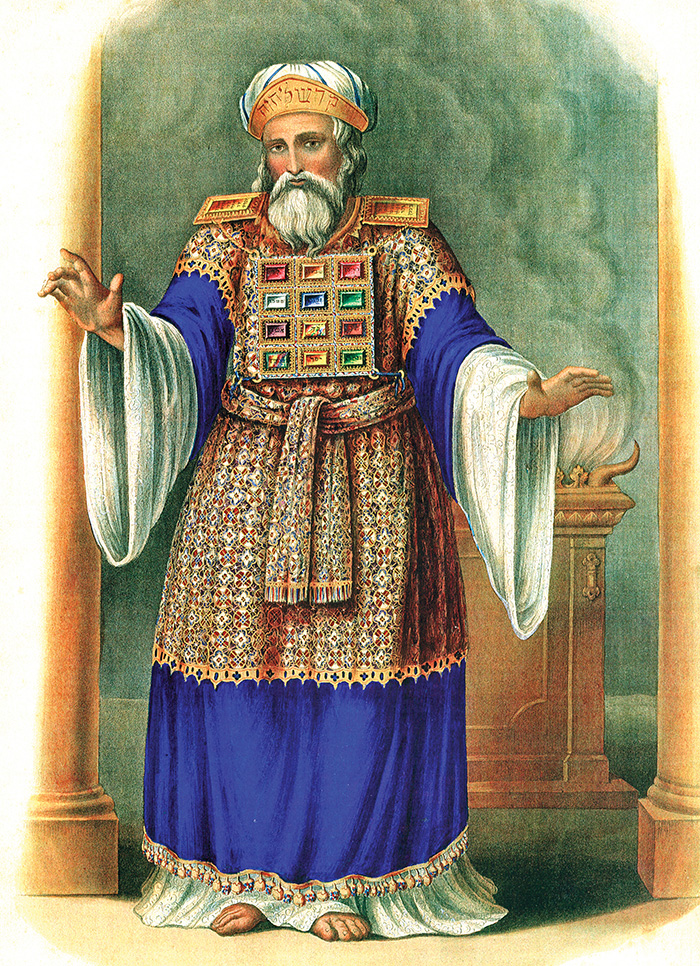
The high priest was the divinely appointed intermediary between the Lord and his people. His dress distinguished him from all others and was symbolic of his role (Ex 28).
© Ritmeyer Archaeological Design.
28:15–30. The breastpiece is a square piece of material attached to the ephod, folded double (28:15–16) and worn over the heart (28:29). It has twelve stones, one for each of the tribes (28:17–21). The Urim and the Thummim, for making decisions (cf. Nm 27:21), are put into the breastpiece (28:30). The command to take judicial issues to the priests, who will give decisions in the Lord’s presence, likely refers to their use of the Urim and Thummim (Dt 17:9–10). It is not clear how the Urim and Thummim functioned or even what the words mean. The traditional suggestion is that Urim means “lights” (from Hb or), and Thummim, “perfections” (from Hb tom); a confirming light would indicate a positive answer. Not every incident where they may have been used, however, so easily fits into the pattern of casting lots with simple positive or negative answers (cf. Jdg 1:2; 20:18; 2 Sm 5:22–25).
28:31–35. The high priest is to wear a blue robe with pomegranates and bells alternating around the hem (28:31–34). Pomegranates were among the seven fruits of the land (Dt 8:8), symbolic of God’s good blessings. Some suggest the bells were for the benefit of those outside, who would be concerned for the high priest’s safety in the presence of the Lord (28:35). If they could hear him, they would know he had not perished in God’s terrifying presence, a matter of particular concern after the incident with Nadab and Abihu (Lv 10). The text indicates that the bells have to do with God’s attention to the high priest in his representative dress. The entire worship ritual is a mutual communicative process that utilizes the full sensory experience. To speak of sounds and smells appealing to God is not primitive anthropomorphism (giving God human attributes) but recognizes something profoundly rich about the senses in the expressed relationship between the Creator and his worshiping creatures.
28:36–43. Aaron is also to wear a linen turban bearing a gold plate that says, “HOLY TO THE LORD” (28:36–38). In this way he will carry aspects of the guilt of Israel. All of the priests are to wear white linen underclothes and carefully constructed tunics, sashes, and headbands, symbolic of purity (28:39–43).
G. Consecration of priests (29:1–46). 29:1–14. Once dressed, the priests are consecrated for service (29:5–9), a process described in greater detail in Lv 8. Because the priest is the covenant mediator, the bull to cover his own sin is sacrificed first (29:10–14). While the blood of this animal is sprinkled before the curtain (Lv 4:6), placed on the altar of incense, and poured out at the base of the outside altar, its fat portions are burned on the sacrificial altar as an offering to the Lord, and its flesh and hide are to be burned outside the camp in a ceremonially clean place.
29:15–21. The first of two rams is a whole burnt offering (29:15–18), the blood of which is sprinkled on all sides of the altar. The blood of the second ram (29:19–21), the ordination offering, is sprinkled on all sides of the altar, and also put on the right ear lobes, thumbs, and big toes of Aaron and his sons. Traditionally this represents their need for care in how they listen, what they do, and how they conduct themselves. This procedure also applies to a person who has been cleansed from an infectious skin disease (Lv 14:28). These actions symbolize the comprehensive efficacy of the sacrificial blood to make the person presentable before God.
29:22–25. The fat of the offerings is always the Lord’s. The fat portions of the ordination offering, together with unleavened bread, a cake made with oil, and a wafer, are lifted up, symbolically being given to God, and then burned as “a pleasing aroma before the LORD” (29:25). This expression or some variation of it is used more than forty times in the OT, almost always in conjunction with God’s acceptance of both thanksgiving and propitiatory sacrifices. It is a profound acknowledgment of God’s participation in accepting offerings from his people. Idols are unable to smell (Ps 115:6); by way of contrast God can, and that is one way of articulating his pleasure, or displeasure. Amos 5:21 declares God’s rejection of sacrifices from an unacceptable people by saying, “I can’t stand the stench of your solemn assemblies.”
29:26–46. The parts of the ordination offering that are eaten (29:31–34) belong solely to the priests. Aaron and his sons are to lay their hands on its head (29:15), representing their identification with this living creature whose life will be a substitute for theirs. The consecration of the priests is an intricate, seven-day process and one that must be completed perfectly. Leviticus 8–9 indicates that Moses, Aaron, and the priests fulfill all the requirements; in response, the glory of the Lord appears to all the people, and fire consumes the Lord’s offerings on the altar.
The burnt offering of two lambs (29:38–41) is to be made twice daily, once in the morning and once at evening, affirming the continuing relationship between God and his people at that place where he has determined to dwell and where he will meet with them (29:42–46). The tabernacle is “set up in the first month of the second year, on the first day of the month” (40:17). Thus it is ready for the celebration of Passover.
H. Incense altar, half-shekel contribution, wash basin, oil, and incense (30:1–38). 30:1–10. The altar for incense (30:1–5) is to be positioned in front of the curtain separating the holy place from the most holy place (30:6), although there is some ambiguity regarding which side it was on. Possibly it was a second article in the most holy place (cf. Heb 9:3–4). When the incense was ignited, the cloud provided protective covering (Lv 16:13) as the high priest went into the most holy place once a year. In addition, incense is burned regularly every morning and evening (30:7–8). Neither profane incense nor any other substance is to be burned on the incense altar (30:9). This elucidates the horrifying narrative of Nadab and Abihu, who offer “unauthorized fire” before the Lord (Lv 10:1) and forfeit their lives as a result.
30:11–16. The half-shekel payment, collected in conjunction with the census, maintained the cultic system. It is called atonement money and serves as a reminder that the members of the community have been ransomed (30:12). While the original statement sounds like a one-time payment, it was collected at later points in history when the temple was being repaired (2 Kg 12:4; 2 Ch 24:9; 34:9) and seems to have been the precedent for an annual assessment (cf. Mt 18:24–27).
The cloud of incense from the incense altar will come to be symbolic of the prayers of the saints (Ps 141:2; Rv 5:8). The imagery and theology of Exodus infuse the book of Revelation, as it looks forward to perfect worship in the very presence of God.

Middle Eastern spices. Spices were used in the preparation of the holy anointing oil (Ex 30:23–25).
30:17–21. The basin and its stand are to be made of bronze (30:18), which comes from the mirrors of the women serving at the entrance to the tent of meeting (38:8). If Aaron and his sons do not wash their hands and feet in the basin before entering the tent, they will die (30:19–21). The altar is in front of the entrance to the tabernacle, and the basin is between the tent and the altar (40:6–7). Thus, there is a “path” into the presence of God. First, sacrificial blood is shed at the altar. Then, cleansing is necessary, and finally the cloud of incense precedes the priest into the presence of God and protects the priest.
30:22–38. All the cultic articles in the tent as well as the priests are to be consecrated with the fragrant anointing oil (30:22–33). A portion of the salted, pure, and sacred incense is to be placed in front of the testimony in the tabernacle (30:34–38). The pleasing aroma is a contrast to the stench of death. Used in conjunction with royalty and worship, spices were exceedingly precious in the ancient Near East. The Israelites may have acquired these materials from traders along their journey. Because salt both preserves and enhances flavor, it was an appropriate additive to incense and offerings that represented the relationship with the everlasting covenant God (cf. Lv 2:13).
I. Spirit-filled artisans (31:1–11). The Holy Spirit fills Bezalel, the artist who oversees the work, with practical wisdom (31:1–5). God also appoints his assistant, Oholiab, and gives them the ability to teach all the artisans (31:6; cf. 35:30–36:2). The artists are God’s agents, as they fashion all the furnishings according to the pattern Moses has seen on the mountain (31:7–11).
J. Sign of the covenant (31:12–18). The Lord’s Sabbath is the sign of this covenant (31:13). As the tabernacle is a reflection of God’s dwelling in heaven, the Sabbath sanctifies time, reflecting the fact that God himself was refreshed after his creative activity (31:17). God is holy; the people are holy because he makes them so, and they are to keep the Sabbath holy as a lasting covenant (31:18). Observing the Sabbath and embracing the holiness of God are of one piece. Thus, those who desecrate the Sabbath are to die, a twice-stated warning (31:14–15). While the activities that constitute “work” are not fully specified, 35:3 prohibits lighting a fire on the Sabbath.
5. APOSTASY AT SINAI (32:1–34:35)
Moses’s role as covenant mediator is particularly poignant in these chapters. Repeatedly he appeals to the Lord on behalf of the wayward people, seeking God’s forgiveness and promise of his continuing presence with them. Neither comes automatically, but Moses persists, even offering himself as a substitute. Finally, in asking to see God’s glory, Moses is given assurance of God’s forgiveness (34:6–7).
A. The golden calf (32:1–29). 32:1. While Moses is on the mountain receiving the instructions regarding the tabernacle and the special position and function of Aaron as the high priest, Aaron succumbs to the popular demand that he take over for Moses, who has been gone for a disturbingly long time.
32:2–6. The calf may represent Israel’s return to the gods of Egypt, flagrant idolatry. On the other hand, when Aaron fashions the calf, declares it is the god who has brought them out of Egypt, and proclaims the next day a festival to the Lord, he apparently does not view himself as engaged in wholesale apostasy (32:2–5). Ezekiel’s vision of cherubim involves calves’ feet and a face like an ox (Ezk 1:5–10). When the temple is constructed according to plans that the Spirit has given David (1 Ch 28:11–13), the great basin stands on twelve bulls (2 Ch 4:3–4). In Moses’s absence, perhaps the people choose to celebrate the Lord as a warrior, symbolically representing him as a strong bull, the pedestal on which Yahweh stands. If so, the Lord is not replaced by an idol but misrepresented, a far more insidious danger. Aaron has broken the second commandment, led the people astray with language that sounded orthodox, and allowed them to get wildly out of control (32:6). This incident is a sobering reminder that the very heart of religion can be fraught with danger. It is also a humbling reminder that leaders of God’s people need intercession and forgiveness.
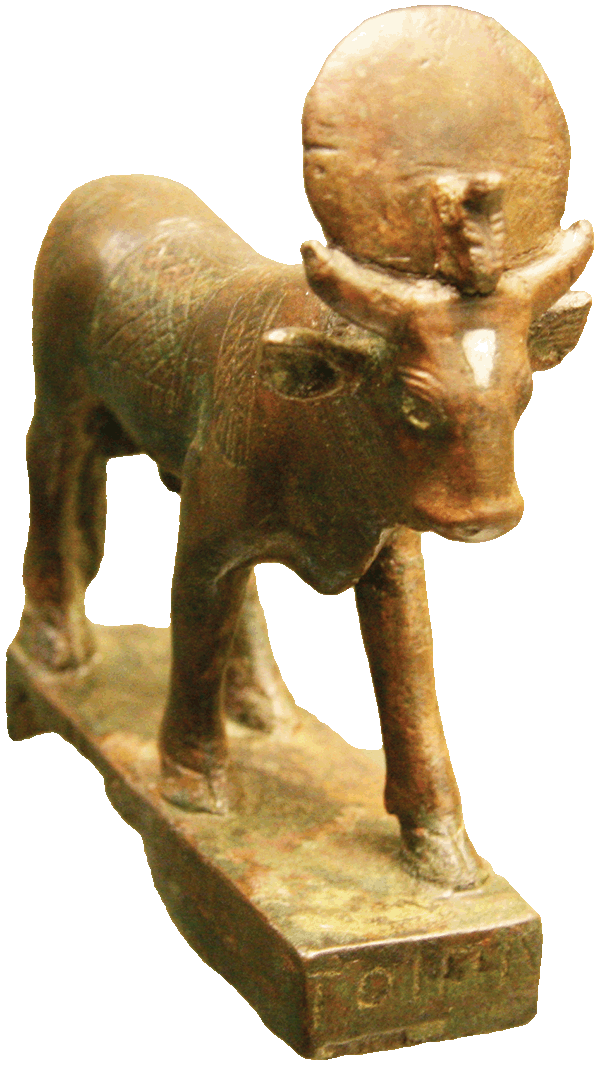
The gods of the ancient Near East were often portrayed as calves or bulls.
32:7–14. God’s words to Moses contain an ominous distancing. He calls the Israelites “your people you brought up from the land of Egypt” (32:7) and declares his intention to destroy them and make Moses into a great nation (32:10); this is a significant temptation to Moses, who has already endured immense distress on account of the people. Nevertheless, he intercedes for them even before descending from the mountain, asking God to turn from his anger and his destructive intentions and remember the covenant with Abraham, Isaac, and Israel (32:11–13). In response to Moses’s plea, God chooses not to bring disaster on the people (32:14). The Hebrew word for “relented” means to change one’s course of action. It can apply both to humans and to God. With regard to humans, the term is generally translated “repent.” When God “changes course,” it means that his intention, articulated at a given point in response to specific circumstances, has been altered to best address current developments (e.g., “regret” in Gn 6:6–7; 1 Sm 15:11; “relent” in Jnh 4:2). In ways that are beyond human comprehension, this is part of the complexity of God’s sovereignty.
32:15–20. When Moses descends the mountain, he carries two tablets, written both front and back (32:15). These are likely two complete copies of the covenant, one for God as suzerain and one for the vassal, Israel (see the article “Hittite Treaties and the Structure of Deuteronomy” in the introduction to Deuteronomy). Both copies would be put into the ark as a witness on behalf of the people. When Moses sees that the people have rebelled so blatantly against the covenant, in an action laden with symbolism he hurls and breaks the tablets (32:19). Then he burns the calf, grinds it, and makes the people drink the powder mixed with the water (32:20). There are possible parallels with the later legislation regarding the wife suspected of adultery (Nm 5:5–31). Curses are written on a scroll and washed off into water, and the woman must drink this bitter water. If she is guilty it will enter her and cause suffering. In this case, the idolatrous Israelites have committed spiritual adultery by breaking their marriage covenant with the Lord. Here, unlike Nm 5, the Israelites’ guilt is not in question.
Throughout the rest of the OT, God will frequently describe himself as the Lord who brought his people out of Egypt (e.g., Lv 19:36; Dt 6:12; cf. Jdg 6:8; 1 Kg 8:16; Jr 11:7).
32:21–29. Aaron does not manifest great strength of character. His response to Moses’s inquiry sets the responsibility almost entirely on the Israelites and their fundamentally evil nature (32:21–24). Worse yet, he reduces his active role in fashioning the calf to a passive one: “When I threw it into the fire, out came this calf!” (32:24). It seems that the destruction of the calf prompts a riot among the people, and the Lord calls on those who are faithful to him to kill the idolaters (32:25–29). The choice made by the tribe of Levi, Aaron’s own tribe, is not an easy one (32:26). Killing three thousand people who are continuing in flagrant disobedience is a horrifying task and a severe punishment for not standing up for righteousness in the first place. The weight of responsibility Aaron must have felt would undoubtedly have been crushing. Yet, in the sovereign workings of God, he will be the ideal human high priest, fully aware of his own weakness, knowing God’s mercy and forgiveness, and able to deal gently with those who stray (Heb 5:2).
B. Moses intercedes for the people (32:30–33:17). 32:30–33:6. Recognizing that the heinous sin still needs to be addressed, Moses continues his role as mediator, declaring his willingness to sacrifice himself (32:30–32). In response, God declares that the Israelites will go forward to the covenant land, but they have forfeited the fullness of God’s presence. Instead, God’s angel will accompany them (32:33–34; cf. 23:20–23). Paradoxically, God’s threat to withdraw his presence is for Israel’s protection. He knows their ongoing rebellion against him will bring just punishment of sin (33:1–6). The forgiving mercy of God is always balanced with his sovereign justice; neither can be minimized.
33:7–11. The placement of 33:7–11 is significant. The tent of meeting is set up “at a distance from the camp” (33:7), symbolic of God’s removal from their immediate presence. This tent existed prior to the construction of the “official” tabernacle, the one whose pattern was shown to Moses on the mountain, the one at which Aaron would officiate, and the one that would represent God’s dwelling with his people. Now they are at a critical juncture. Will God continue with his expressed intention to dwell in their midst, or will it be only Moses who will meet face to face with God (33:11)?
33:12–17. In a remarkable response to Moses’s persistence, God reverses his decision to remove his presence. Because Moses finds favor with God, the Lord declares that he will grant all of Moses’s requests for God’s presence, his favor, and rest (33:13–14). He promises again to go with them, thus restoring their distinct position from all the nations on the earth (33:16). The expression “know you by name” is used of no one else in the Bible, but it appears twice here (33:12, 17).
C. Revelation of God’s glory (33:18–34:9). 33:18. At this point, Moses, who already has entered into the cloud, requests to see the glory of God, the visible manifestation of the complete power, perfection, and radiance of God’s person. This manifest presence of God with his people has already been demonstrated in the wilderness, where the cloud was the vehicle for God’s glory. In 24:17, his presence appears as the brilliance of fire to all Israel. Subsequently, the glory of God will be manifested in the tabernacle, and later in the temple (Ex 40:34–35; Lv 9:23; 1 Kg 8:10–11).
33:19–23. Moses is allowed to experience what he is capable of seeing without being taken from this world by the overwhelming presence of God. Proclaiming his prerogative to exercise abundant mercy, God promises to hide Moses in the cleft of a rock and cover him “with [his] hand” while he causes his goodness to pass in front of Moses and proclaims his name in Moses’s presence (33:19–22). God’s “back” (33:23) suggests traces of the divine presence.
34:1–9. In a stunning display of grace, God descends in the cloud of glory, stands with Moses, and proclaims his covenant name, Yahweh, and his covenant character of compassion, mercy, patience, unfailing covenant love, forgiveness, and justice (34:5–7). Forgiveness has been the focus of Moses’s persistent entreaty; this declaration of God emboldens Moses to ask once more that Israel be forgiven and accepted as God’s inheritance (34:8–9). God’s justice means he will most certainly punish those who are guilty. Only there could rest the true goodness and integrity of his name and character. Repetition of “the LORD” (34:6) may echo the repetition in 3:14. These elements of the Lord’s name echo throughout the history of Israel as they persist in demonstrating their human failings and as God lavishes on them mercy and forgiveness.
The Lord’s description of himself in Ex 34:6–7, “a compassionate and gracious God, slow to anger and abounding in faithful love,” is echoed throughout the OT (e.g., Nm 14:18; Pss 86:15; 103:8; 145:8; Jr 32:18; Nah 1:3; Jl 2:13; Neh 9:17). Ironically, Jonah turns this into an accusation when he is angry with God for having compassion even on Israel’s repentant enemies (Jnh 4:1–2).
D. Restating the covenant (34:10–35). 34:10–16. The Lord restates his promise to work wonders for his covenant people as he drives out the inhabitants of the land (34:10–11). The warnings against becoming entangled in the Canaanites’ false worship are even more emphatic. To avoid the problem, the Israelites are not to intermarry or make treaties with any who live in the land (34:15–16). The latter warning is ignored in the case of the Gibeonite coalition that comes to Joshua and the Israelites requesting a treaty (Jos 9). The Israelites are to break down standing stones and Asherah poles, ridding themselves of any temptation to provoke God to jealousy (34:13–14). While the identity of Asherah within the ancient Near East pantheon is complex, she was related to fertility rituals and was the consort of one of the chief gods.
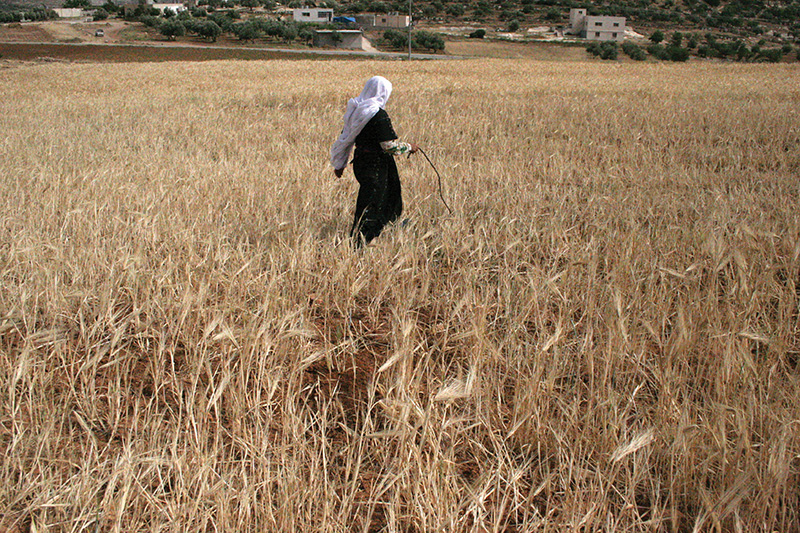
A field of wheat in Judea
34:17–28. In 34:17–26, the Lord restates significant elements of the torah, commencing with the warning against making idols and emphasizing the festivals that will take place in the context of the sanctuary, a reassurance that God’s presence will continue to be with them and a clear rejection of the false feast that Aaron has instituted. (On the restriction regarding cooking a kid in its mother’s milk in 34:26, see commentary on 23:10–19.) Then the Lord tells Moses to write the words of the covenant, the initial Ten Commandments, which has previously been shattered (34:27). It is clear that when Moses writes the words, it is as if God has written them (compare 34:1 with 34:28).
34:29–35. Moses’s intimate interactions with God result in his own visible transformation. His face is radiant with a brilliance so fearsome that he has to veil his face before the rest of the Israelites (34:33). The expression translated “face was radiant” (34:35) is not used this way elsewhere in the OT. It is related to the word for “horn” and prompted earlier translations and representations to depict Moses with horns. Doubtless, however, these were rays of light. The glory of the Lord thus moves from the mountain to Moses and finally to the tabernacle. This veil has both positive and negative implications for the people. On the one hand, that Moses’s face reflects the presence of God reassures them. On the other, it is only Moses who can mediate; the veil serves as a reminder of their apostasy.
Paul draws on this figure in 2 Co 3:7–18, declaring that the radiance faded away while the veil was over Moses’s face and contrasting that fading glory associated with Moses and the engraved tablets with the unfading glory of the ministry of the Spirit. Those who are in Christ reflect the Lord’s glory like Moses but do not need to wear the veil, as we are “transformed into the same image from glory to glory; this is from the Lord who is the Spirit” (2 Co 3:18).
Summary. The condition of this people who has fallen so far is no different from that experienced by believers, representatives of frail humanity, throughout the ages. Moses, as their leader and mediator, is painfully aware of the seriousness of their condition before the Lord. He persists in his expressed desire for assurance because he knows the reality of the wrath of the Lord against sin. He does not take lightly or easily God’s grace. He fasts again for forty days and forty nights (Dt 9:9, 18), recognizing his need to be prepared to be the covenant mediator who will declare the word of God. This fasting is a prototype of that of Jesus Christ, who in preparation for his role as the perfect mediator of the new covenant will fast in the Judean wilderness for forty days and nights. Just as the Ten Commandments are written again, graciously given to instruct and restore the Israelites to a right relationship with their covenant Lord, the Word incarnate came to instruct and fully restore fallen humankind.
6. ASSURANCE OF GOD’S PRESENCE (35:1–40:38)
A. Sabbath (35:1–3). While the Sabbath regulations closed the initial instructions regarding the tabernacle, they appear at the beginning of the description of its completion. The connection between sanctified place and time is an intimate one. This is more abbreviated but has the new prohibition regarding lighting a fire (35:3).
B. Establishing the tabernacle (35:4–40:38). 35:4–36:7. The voluntary donations are received in terms of both materials and skills (35:4–29). Not only does the Spirit fill Bezalel and Oholiab to produce the artistry demanded by this structure (35:30–35); all who are skilled come and contribute those skills (36:1–5). The expression “all who had willing hearts” (35:22) emphasizes that their offerings come from hearts aware of God’s great mercy and ready to obey the Lord. So overwhelming is the response that there is more than enough, indicative of their transformation from self-centered living to extravagant and lavish worship of God. Moses even has to order them to stop making and bringing gifts (36:6).
The tabernacle prefigures the incarnation of the Word of God, when “the Word became flesh and dwelt [literally, “tabernacled”] among us.” In this, “we observed his glory” (Jn 1:14), just as divine glory was manifest in conjunction with the tabernacle (Ex 25:8; 40:34–45).
36:8–37:29. The order in which the instructions are executed is somewhat different from the order in God’s description to Moses on the mountain. The tent itself is the first to be completed (36:8–38), followed by the most significant articles in the tabernacle: the ark of the covenant (37:1–9), table (37:10–16), lampstand (37:17–24), and the altar of incense along with the anointing oil and the sacred incense (37:25–29).
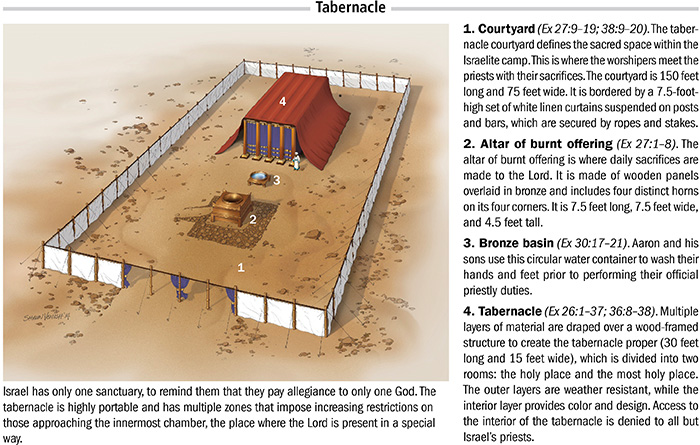
Israel has only one sanctuary, to remind them that they pay allegiance to only one God. The tabernacle is highly portable and has multiple zones that impose increasing restrictions on those approaching the innermost chamber, the place where the Lord is present in a special way.
1. Courtyard (Ex 27:9–19; 38:9–20). The tabernacle courtyard defines the sacred space within the Israelite camp. This is where the worshipers meet the priests with their sacrifices. The courtyard is 150 feet long and 75 feet wide. It is bordered by a 7.5-foothigh set of white linen curtains suspended on posts and bars, which are secured by ropes and stakes.
2. Altar of burnt offering (Ex 27:1–8). The altar of burnt offering is where daily sacrifices are made to the Lord. It is made of wooden panels overlaid in bronze and includes four distinct horns on its four corners. It is 7.5 feet long, 7.5 feet wide, and 4.5 feet tall.
3. Bronze basin (Ex 30:17–21). Aaron and his sons use this circular water container to wash their hands and feet prior to performing their official priestly duties.
4. Tabernacle (Ex 26:1–37; 36:8–38). Multiple layers of material are draped over a wood-framed structure to create the tabernacle proper (30 feet long and 15 feet wide), which is divided into two rooms: the holy place and the most holy place. The outer layers are weather resistant, while the interior layer provides color and design. Access to the interior of the tabernacle is denied to all but Israel’s priests.
38:1–8. Moving out to the courtyard, next are fashioned the altar for offerings (38:1–7) and the wash basin (38:8a). A new detail at this point is the mention of the bronze mirrors of the women who serve at the entrance to the tent of meeting (38:8b). There is some ambiguity regarding the function of these women. The verb “served” simply implies they are qualified to serve in the workforce, but a potentially ominous side of this activity is evident in 1 Sm 2:22, where Eli’s sons are sleeping with the women who serve at the entrance of the tabernacle.
38:9–31. After the actual construction of the tabernacle, Moses records the amounts of precious metals, the total of which is in the vicinity of six tons (38:21–28).
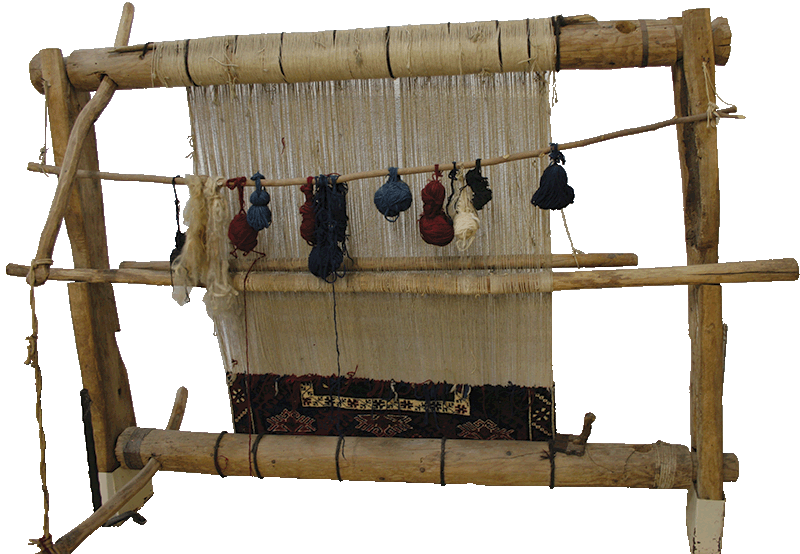
A weaving loom. The priests wore woven garments (Ex 39:1).
39:1–43. Once they finish the place, the priestly garments are prepared. Obedience is a constant drumbeat throughout this section (39:1–31). The people prepare everything “just as the LORD had commanded Moses” (39:32), and then the entire work is brought to Moses (39:33–41). He sees the evidence of their obedience and blesses them (39:42–43). [Breastpiece of the High Priest.]
40:1–33. The Lord gives Moses final instructions for placement and anointing of the furnishings and consecration of the priests (40:1–15). Moses does as the Lord commands and finishes the work (40:16–33).
40:34–38. Exodus closes on a note of joyous hope with the glory of the Lord present with his people (40:34–35) and guiding them on their journey (40:36–38). God’s people are assured of the reality of that presence in the ongoing wilderness experiences of despair and death. Even though that will be forthcoming, God’s presence never leaves them, even accompanying them into the exile in Babylon and bringing them back—a second exodus.
The presence of God, lost in the garden in Gn 3, is restored (to some extent) as God comes to dwell among his people in the tabernacle (Ex 25:8; 29:45–46; 40:34).