Title
As with the other three Gospels, the title is derived from the author’s name. According to tradition, Luke was a Gentile. The apostle Paul seems to confirm this, distinguishing Luke from those who were “of the circumcision” (Col. 4:11, 14). That would make Luke the only Gentile to pen any books of Scripture. He is responsible for a significant portion of the NT, having written both this Gospel and the Book of Acts (see Author and Date).
Very little is known about Luke. He almost never included personal details about himself, and nothing definite is known about his background or his conversion. Both Eusebius and Jerome identified him as a native of Antioch (which may explain why so much of the Book of Acts centers on Antioch—cf. Acts 11:19–27; 13:1–3; 14:26; 15:22, 23, 30–35; 18:22, 23). Luke was a frequent companion of the apostle Paul, at least from the time of Paul’s Macedonian vision (Acts 16:9, 10) right up to the time of Paul’s martyrdom (2 Tim. 4:11).
The apostle Paul referred to Luke as a physician (Col. 4:14). Luke’s interest in medical phenomena is evident in the high profile he gave to Jesus’ healing ministry (e.g., 4:38–40; 5:15–25; 6:17–19; 7:11–15; 8:43–47, 49–56; 9:2, 6, 11; 13:11–13; 14:2–4; 17:12–14; 22:50, 51). In Luke’s day, physicians did not have a unique vocabulary of technical terminology; so when Luke discusses healings and other medical issues, his language is not markedly different from that of the other Gospel writers.
Author and Date
The Gospel of Luke and the Book of Acts clearly were written by the same individual (cf. 1:1–4; Acts 1:1). Although he never identified himself by name, it is clear from his use of “we” in many sections of Acts that he was a close companion of the apostle Paul (Acts 16:10–17; 20:5–15; 21:1–18; 27:1–28:16). Luke is the only person, among the colleagues Paul mentions in his own epistles (Col. 4:14; 2 Tim. 4:11; Philem. 24), who fits the profile of the author of these books. That accords perfectly with the earliest tradition of the church that unanimously attributed this Gospel to Luke.
Luke and Acts appear to have been written at about the same time—Luke first, then Acts. Combined, they make a two-volume work addressed to “Theophilus” (1:3; Acts 1:1; see Background and Setting), giving a sweeping history of the founding of Christianity, from the birth of Christ to Paul’s imprisonment under house arrest in Rome (Acts 28:30, 31).
The Book of Acts ends with Paul still in Rome, which leads to the conclusion that Luke wrote these books from Rome during Paul’s imprisonment there (c. A.D. 60–62). Luke records Jesus’ prophecy of the destruction of Jerusalem in A.D. 70 (19:42–44; 21:20–24) but makes no mention of the fulfillment of that prophecy, either here or in Acts. Luke made it a point to record such prophetic fulfillments (cf. Acts 11:28); so, it is extremely unlikely he wrote these books after the Roman invasion of Jerusalem. Acts also includes no mention of the great persecution that began under Nero in A.D. 64. In addition, many scholars set the date of James’s martyrdom at A.D. 62, and if that was before Luke completed his history, he certainly would have mentioned it. So, the most likely date for this Gospel is A.D. 60 or 61.
Background and Setting
Luke dedicated his works to “most excellent Theophilus” (lit. “lover of God”—1:3; cf. Acts 1:1). This designation, which may be a nickname or a pseudonym, is accompanied by a formal address (“most excellent”)—possibly signifying that “Theophilus” was a well known Roman dignitary, perhaps one of those in “Caesar’s household” who had turned to Christ (Phil. 4:22).
It is almost certain, however, that Luke envisioned a much broader audience for his work than this one man. The dedications at the outset of Luke and Acts are like the formal dedication in a modern book. They are not like the address of an epistle.
Luke expressly stated that his knowledge of the events recorded in his Gospel came from the reports of those who were eyewitnesses (1:1, 2)—strongly implying that he himself was not an eyewitness. It is clear from his prologue that his aim was to give an ordered account of the events of Jesus’ life, but this does not mean he always followed a strict chronological order in all instances (e.g., see note on 3:20 ).
By acknowledging that he had compiled his account from various extant sources (see note on 1:1 ), Luke was not disclaiming divine inspiration for his work. The process of inspiration never bypasses or overrides the personalities, vocabularies, and styles of the human authors of Scripture. The unique traits of the human authors are always indelibly stamped on all the books of Scripture. Luke’s research is no exception to this rule. The research itself was orchestrated by divine providence. And in his writing, Luke was moved by the Spirit of God (2 Pet. 1:21). Therefore, his account is infallibly true (see note on 1:3 ).
Historical and Theological Themes
Luke’s style is that of a scholarly, well-read author (see note on 1:1–4 ). He wrote as a meticulous historian, often giving details that helped identify the historical context of the events he described (1:5; 2:1, 2; 3:1, 2; 13:1–4).
His account of the nativity is the fullest in all the Gospel records—and (like the rest of Luke’s work) more polished in its literary style. He included in the birth narrative a series of praise psalms (1:46–55; 1:68–79; 2:14; 2:29–32, 34, 35). He alone reported the unusual circumstances surrounding the birth of John the Baptist, the annunciation to Mary, the manger, the shepherds, Simeon, and Anna (2:25–38).
A running theme in Luke’s Gospel is Jesus’ compassion for Gentiles, Samaritans, women, children, tax collectors, sinners, and others often regarded as outcasts in Israel. Every time he mentions a tax collector (3:12; 5:27; 7:29; 15:1; 18:10–13; 19:2), it is in a positive sense. Yet, Luke did not ignore the salvation of those who were rich and respectable (e.g., 23:50–53). From the outset of Jesus’ public ministry (4:18) to the Lord’s final words on the Cross (23:40–43), Luke underscored this theme of Christ’s ministry to the pariahs of society. Again and again he showed how the Great Physician ministered to those most aware of their need (cf. 5:31, 32; 15:4–7, 31, 32; 19:10).
The high profile Luke accords to women is particularly significant. From the nativity account, where Mary, Elizabeth, and Anna are given prominence (chs. 1; 2), to the events of resurrection morning, where women again are major characters (24:1, 10), Luke emphasizes the central role of women in the life and ministry of our Lord (e.g., 7:12–15, 37–50; 8:2, 3, 43–48; 10:38–42; 13:11–13; 21:2–4; 23:27–29, 49, 55, 56).
Several other recurring themes form threads through Luke’s Gospel. Examples of these are human fear in the presence of God (see note on 1:12 ); forgiveness (3:3; 5:20–25; 6:37; 7:41–50; 11:4; 12:10; 17:3, 4; 23:34; 24:47); joy (see note on 1:14 ); wonder at the mysteries of divine truth (see note on 2:18 ); the role of the Holy Spirit (1:15, 35, 41, 67; 2:25–27; 3:16, 22; 4:1, 14, 18; 10:21; 11:13; 12:10, 12); the temple in Jerusalem (1:9–22; 2:27–38, 46–49; 4:9–13; 18:10–14; 19:45–48; 20:1–21:6; 21:37, 38; 24:53); and Jesus’ prayers (see note on 6:12 ).
Starting with 9:51, Luke devoted ten chapters of his narrative to a travelogue of Jesus’ final journey to Jerusalem. Much of the material in this section is unique to Luke. This is the heart of Luke’s Gospel, and it features a theme Luke emphasized throughout: Jesus’ relentless progression toward the Cross. This was the very purpose for which Christ had come to earth (cf. 9:22, 23; 17:25; 18:31–33; 24:25, 26, 46), and He would not be deterred. The saving of sinners was His whole mission (19:10).
Interpretive Challenges
Luke, like Mark, and in contrast to Matthew, appears to target a Gentile readership (for a discussion of the Synoptic Problem, see Introduction to Mark: Interpretive Challenges). He identified locations that would have been familiar to all Jews (e.g., 4:31; 23:51; 24:13), suggesting that his audience went beyond those who already had knowledge of Palestinian geography. He usually preferred Greek terminology over Hebraisms (e.g., “Calvary” instead of “Golgotha” in 23:33). The other Gospels all use occasional Semitic terms such as “Abba” (Mark 14:36), “rabbi” (Matt. 23:7, 8; John 1:38, 49), and “hosanna” (Matt. 21:9; Mark 11:9, 10; John 12:13)—but Luke either omitted them or used Greek equivalents.
Luke quoted the OT more sparingly than Matthew, and when citing OT passages, he nearly always employed the LXX, a Greek translation of the Hebrew Scriptures. Furthermore, most of Luke’s OT citations are allusions rather than direct quotations, and many of them appear in Jesus’ words rather than Luke’s narration (2:23, 24; 3:4–6; 4:4, 8, 10–12, 18, 19; 7:27; 10:27; 18:20; 19:46; 20:17, 18, 37, 42, 43; 22:37).
Luke, more than any of the other Gospel writers, highlighted the universal scope of the gospel invitation. He portrayed Jesus as the Son of Man, rejected by Israel, and then offered to the world. As noted above (see Historical and Theological Themes), Luke repeatedly related accounts of Gentiles, Samaritans, and other outcasts who found grace in Jesus’ eyes. This emphasis is precisely what we would expect from a close companion of the “apostle of the Gentiles” (Rom. 11:13).
Yet, some critics have claimed to see a wide gap between Luke’s theology and that of Paul. It is true that Luke’s Gospel is practically devoid of terminology that is uniquely Pauline. Luke wrote with his own style. Yet, the underlying theology is perfectly in harmony with that of the apostle’s. The centerpiece of Paul’s doctrine was justification by faith (see note on Rom. 3:24 ). Luke also highlighted and illustrated justification by faith in many of the incidents and parables he related, chiefly the account of the Pharisee and the publican (18:9–14); the familiar story of the prodigal son (15:11–32); the incident at Simon’s house (7:36–50); and the salvation of Zacchaeus (19:1–10).
I. THE PRELUDE TO CHRIST’S MINISTRY (1:1–4:13)
1:1–4 These four verses make a single sentence, written in the polished style of a Greek literary classic. It was common for Greek historical works to begin with such a prologue. After this formal prologue, however, Luke shifted into a simpler style of narrative, probably patterned after the familiar style of the LXX.
1:1 many. Although Luke wrote direct divine revelation inspired by the Holy Spirit, he acknowledged the works of others (see note on v. 2 ) who had set down in writing events from Christ’s life. All those sources have been long lost, except for the inspired Gospels. Since Matthew and Mark were most likely written before Luke, it has been suggested that either one or both of those may have been among Luke’s sources when he did his research. It is also known that he was personally acquainted with many firsthand witnesses to the events of Christ’s life. And it is possible that some of his sources were word-of-mouth reports. About sixty percent of the material in Mark is repeated in Luke, and Luke seems to follow Mark’s order of events closely (see Introduction to Mark: Interpretive Challenges, the Synoptic Problem). to set in order. Luke proposed to narrate the ministry of Christ in an authoritative, logical, and factual order (though not always strictly chronological—v. 3). those things which have been fulfilled. I.e., the OT messianic promises fulfilled in Christ. among us. I.e., in our generation. This phrase does not mean Luke was personally an eyewitness to the life of Christ (see note on v. 2 ).
1:2 eyewitnesses and ministers of the word. Luke’s primary sources were the apostles themselves, who delivered facts about Jesus’ life and teaching—both orally and by means of recorded memoirs in written documents made available to Luke. In any case, Luke made no pretense of being an eyewitness himself, but explained that these were facts supported by careful research (see note on v. 3 ).
1:3 having had perfect understanding. Lit. “having traced out carefully.” Luke’s Gospel was the result of painstaking investigation. Luke, more than anyone else in the early church, had the abilities and the opportunity to consult with eyewitnesses of Jesus’ ministry and consolidate their accounts. He spent more than two years during Paul’s imprisonment at Caesarea (Acts 24:26, 27), during which time he would have been able to meet and interview many of the apostles and other eyewitnesses of Jesus’ ministry. We know, for example, that he met Philip (Acts 21:8), who was undoubtedly one of Luke’s sources. In his travels, he may also have encountered the apostle John. Joanna, wife of Herod’s steward, is mentioned only in Luke’s Gospel (see note on 8:3; cf. 24:10), so she must have been a personal acquaintance of his. Luke also related details about Herod’s dealings with Christ not found in the other Gospels (13:31–33; 23:7–12). No doubt it was from Joanna (or someone in a similar position) that Luke learned those facts. However, his understanding was perfect because of the divine revelation he received from the Holy Spirit (2 Tim. 3:16, 17; 2 Pet. 1:19–21). from the very first. This could mean from the beginning of Christ’s earthly life. However, the word can mean “from above” (John 3:31; 19:11; James 3:15). “From the beginning” in verse 2 uses a different Greek word, arch?—so it is best to understand that Luke was saying he used earthly sources for his material, but was given heavenly guidance as he did his research and writing. It is clear that he regarded his account as authoritative (see note on v. 4 ). an orderly account. Luke’s account is predominantly ordered chronologically, but he does not follow such an arrangement slavishly. most excellent. This was a title used to address governors (Acts 23:26; 24:3; 26:25). This sort of language was reserved for the highest dignitaries, suggesting that “Theophilus” was such a person.
1:4 certainty. Note the implicit claim of authority. Though Luke drew from other sources (v. 3), he regarded the reliability and authority of his Gospel as superior to uninspired sources. instructed. Theophilus had been schooled in the apostolic tradition, possibly even by the apostle Paul himself. Yet, the written Scripture by means of this Gospel sealed the certainty of what he had heard.
B. The Birth of Jesus (1:5–2:38)
1. The annunciation to Zacharias (1:5–25)
1:5 Herod. Herod the Great. See note on Matthew 2:1. Zacharias. Lit. “Jehovah has remembered.” the division of Abijah. The temple priesthood was organized into twenty-four divisions, with each division serving twice a year for one week (1 Chr. 24:4–19); Abijah’s was the eighth division (1 Chr. 24:10). daughters of Aaron. I.e., both husband and wife were from the priestly tribe.
1:6 both righteous before God. I.e., they were believers, justified in God’s sight. There is a clear echo of Pauline theology in this expression. See Introduction: Interpretive Challenges.
1:7 barren . . . well advanced in years. This was seen by many as a sign of divine disfavor. See note on verse 25.
1:8 in the order of his division. I.e., his division was on duty for one of their two annual stints (see note on v. 5 ).
1:9 his lot fell to burn incense. A high honor (Ex. 30:7, 8; 2 Chr. 29:11). Because of the large number of priests, most would never be chosen for such a duty, and no one was permitted to serve in this capacity twice. Zacharias no doubt regarded this as the supreme moment in a lifetime of priestly service. The incense was kept burning perpetually, just in front of the veil that divided the holy place from the Most Holy Place. The lone priest would offer the incense every morning and every evening, while the rest of the priests and worshipers stood outside the holy place in prayer (v. 10).
1:12 fear. The normal response—and an appropriate one (12:5)—when someone is confronted by a divine visitation or a mighty work of God (Judg. 6:22; 13:22; Mark 16:5; see note on Rev. 1:17 ). Luke seems especially to take note of this; he often reports fear in the presence of God and His works (cf. vv. 30, 65; 2:9, 10; 5:10, 26; 7:16; 8:25, 37, 50; 9:34, 45; 23:40).
1:13 your prayer. Probably a prayer for children to be in his home (see note on v. 7; cf. v. 25). John. Lit. “Jehovah has shown grace.”
1:14 joy and gladness. The hallmarks of the messianic kingdom (Is. 25:9; Pss. 14:7; 48:11). The motif of joy runs through Luke’s Gospel (cf. vv. 44, 47, 58; 2:10; 6:23; 8:13; 10:17–21; 13:17; 15:5–10, 22–32; 19:6, 37; 24:52).
1:15 neither wine nor strong drink. This was a key element of the Nazirite vow (Num. 6:1–21) and would probably have been understood as such by Zacharias. Usually such a vow was temporary, but Samson (Judg. 16:17) and Samuel (1 Sam. 1:11) were subject to it from birth. The language here is reminiscent of the angel’s instructions to Samson’s parents (Judg. 13:4–7). However, no mention is made here of any restriction on the cutting of John’s hair. Luke may have simply omitted that detail to avoid weighing his Gentile audience down with the details of Jewish law. even from his mother’s womb. Reminiscent of Jeremiah (Jer. 1:5). This illustrates God’s sovereignty in salvation.
1:17 in the spirit and power of Elijah. Elijah, like John the Baptist, was known for his bold, uncompromising stand for the Word of God—even in the face of a ruthless monarch (cf. 1 Kin. 18:17–24; Mark 6:15). The final two verses of the OT (Mal. 4:5, 6) had promised the return of Elijah before the Day of the Lord. See notes on Matthew 3:4; 11:14; Mark 9:11, 12. to turn the hearts. Quoted from Malachi 4:6, showing that John the Baptist fulfilled that prophecy. make ready. Possibly an allusion to Is. 40:3–5 (see notes on 3:4; Matt. 3:3 ).
1:18 “How shall I know this?” Abraham also asked for a sign under similar circumstances (Gen. 15:8). The sign given Zacharias was also a mild rebuke for doubting (v. 20).
1:19 Gabriel. Lit. “strong man of God.” Gabriel also appears in Daniel 8:16; 9:21 (see note on Dan. 9:21 ). He is one of only two holy angels whose names are given in Scripture, the other being Michael (Dan. 10:13, 21; Jude 9; Rev. 12:7).
1:21 marveled that he lingered so long. Zacharias was only supposed to offer incense, then come out to pronounce the familiar blessing of Numbers 6:23–27 on the people who were waiting in the temple court. The conversation with the angel would have taken additional time.
1:23 the days of his service. A week. See note on verse 5. to his own house. In the hill country of Judea (v. 39).
1:24 hid herself. Probably an act of devotion out of deep gratitude to the Lord.
1:25 my reproach. Childlessness carried a reproach in a culture where blessings were tied to birthrights and family lines. Barrenness could occasionally be a sign of divine disfavor (Lev. 20:20, 21), but it was not always so (cf. Gen. 30:23; 1 Sam. 1:5–10). Still, it carried a social stigma that could be humiliating.
2. The annunciation to Mary (1:26–38)
1:26 in the sixth month. I.e., Elizabeth’s sixth month of pregnancy. Nazareth. See note on Matthew 2:23.
1:27 a virgin. The importance of the Virgin Birth cannot be overstated. A right view of the Incarnation hinges on the truth that Jesus was virgin-born. Both Luke and Matthew expressly state that Mary was a virgin when Jesus was conceived (see note on Matt. 1:23 ). The Holy Spirit wrought the conception through supernatural means (see notes on v. 35; Matt. 1:18 ). The nature of Christ’s conception testifies of both His deity and His sinlessness. betrothed. See notes on Matthew 1:18, 19.
1:28 highly favored. Lit. “full of grace”—a term used of all believers in Ephesians 1:6, where it is translated “accepted.” This portrays Mary as a recipient, not a dispenser, of divine grace.
1:30 Do not be afraid. The same thing Gabriel had said to Zacharias (v. 13). See note on verse 12.
1:31 JESUS. See notes on Matthew 1:1, 21.
1:32 He will be great. This same promise was made of John the Baptist. However, the subsequent title is what set Jesus apart. the Son of the Highest. Cf. verse 76, where John the Baptist is called “the prophet of the Highest.” The Greek term Luke uses for “Highest” is the one employed in the LXX to translate the Hebrew, “The Most High God.” Since a son bears his father’s qualities, calling a person someone else’s “son” was a way of signifying equality. Here the angel was telling Mary that her Son would be equal to the Most High God. His father David. See note on Matthew 9:27. Jesus was David’s physical descendant through Mary’s line. David’s “throne” was emblematic of the messianic kingdom (cf. 2 Sam. 7:13–16; Ps. 89:26–29).
| Name | Biblical Description | Reference |
| Anna | Recognized Jesus as the long-awaited Messiah | Luke 2:36–38 |
| Bernice | Sister of Agrippa before whom Paul made his defense | Acts 25:13 |
| Candace | A queen of Ethiopia | Acts 8:27 |
| Chloe | Woman who knew of divisions in the church at Corinth | 1 Cor. 1:11 |
| Claudia | Christian of Rome | 2 Tim. 4:21 |
| Damaris | Woman of Athens converted under Paul’s ministry | Acts 17:34 |
| Dorcas (Tabitha) | Christian in Joppa who was raised from the dead by Peter | Acts 9:36–41 |
| Drusilla | Wife of Felix, governor of Judea | Acts 24:24 |
| Elizabeth | Mother of John the Baptist | Luke 1:5, 13 |
| Eunice | Mother of Timothy | 2 Tim. 1:5 |
| Herodias | Queen who demanded the execution of John the Baptist | Matt. 14:3–10 |
| Joanna | Provided for the material needs of Jesus | Luke 8:3 |
| Lois | Grandmother of Timothy | 2 Tim. 1:5 |
| Lydia | Converted under Paul’s ministry in Philippi | Acts 16:14 |
| Martha and Mary | Sisters of Lazarus; friends of Jesus | Luke 10:38–42 |
| Mary Magdalene | Woman from whom Jesus cast out demons | Matt. 27:56–61; Mark 16:9 |
| Phoebe | A servant, perhaps a deaconess, in the church at Cenchrea | Rom. 16:1, 2 |
| Priscilla | Wife of Aquila; laborer with Paul at Corinth and Ephesus | Acts 18:2, 18, 19 |
| Salome | Mother of Jesus’ disciples James and John | Matt. 20:20–24 |
| Sapphira | Held back goods from the early Christian community | Acts 5:1 |
| Susanna | Provided for the material needs of Jesus | Luke 8:3 |
1:33 over the house of Jacob forever. This emphasizes both the Jewish character of the millennial kingdom and the eternal permanence of Christ’s rule over all. See notes on Isaiah 9:7; Daniel 2:44.
1:34 I do not know a man. I.e., conjugally. Mary understood that the angel was speaking of an immediate conception, and she and Joseph were still in the midst of the long betrothal, or engagement period (see note on Matt. 1:18 ), before the actual marriage and consummation. Her question was borne out of wonder, not doubt, nor disbelief, so the angel did not rebuke her as he had Zacharias (v. 20).
1:35 The Holy Spirit will come upon you. This was a creative act of the Holy Spirit, not the sort of divine-human cohabitation sometimes seen in pagan mythology.
1:36 Elizabeth your relative. It seems most reasonable to regard the genealogy of 3:23–38 as Mary’s (see note on 3:23 ). This would make her a direct descendant of David (see note on v. 32 ). Yet, Elizabeth was a descendant of Aaron (see note on v. 5 ). Therefore, Mary must have been related to Elizabeth through her mother, who would have been of Aaronic descent. Thus, Mary was a descendant of David through her father.
1:38 Let it be to me according to your word. Mary was in an extremely embarrassing and difficult position. Betrothed to Joseph, she faced the stigma of unwed motherhood. Joseph would obviously have known that the child was not his. She knew she would be accused of adultery—an offense punishable by stoning (Deut. 22:13–21; cf. John 8:3–5). Yet, she willingly and graciously submitted to the will of God.
1:41 filled with the Holy Spirit. I.e., controlled by the Holy Spirit, who undoubtedly guided Elizabeth’s remarkable expression of praise. See notes on verses 43, 44, 67.
1:43 the mother of my Lord. This expression is not in praise of Mary, but in praise of the child whom she bore. It was a profound expression of Elizabeth’s confidence that Mary’s child would be the long-hoped-for Messiah—the One whom even David called “Lord” (cf. 20:44). Elizabeth’s grasp of the situation was extraordinary, considering the aura of mystery that overshadowed all these events (cf. 2:19). She greeted Mary not with skepticism but with joy. She understood the response of the child in her own womb. And she seemed to comprehend the immense importance of the child whom Mary was carrying. All of this must be attributed to the illuminating work of the Spirit (v. 41).
1:44 the babe leaped in my womb for joy. The infant, like his mother, was Spirit-filled (cf. vv. 15, 41). His response, like that of Elizabeth, was supernaturally prompted by the Spirit of God (see note on v. 41 ).
1:46–55 Mary’s Magnificat (the first word in the Latin translation; see notes on vv. 68–79; 2:29–32 ) is filled with OT allusions and quotations. It reveals that Mary’s heart and mind were saturated with the Word of God. It contains repeated echoes of Hannah’s prayers, e.g., 1 Sam. 1:11; 2:1–10. These verses also contain numerous allusions to the law, the psalms, and the prophets. The entire passage is a point-by-point reciting of the covenant promises of God.
1:47 my Savior. Mary referred to God as “Savior,” indicating both that she recognized her own need of a Savior, and that she knew the true God as her Savior. Nothing here or anywhere else in Scripture indicates Mary thought of herself as “immaculate” (free from the taint of original sin). Quite the opposite is true; she employed language typical of someone whose only hope for salvation is divine grace. Nothing in this passage lends support to the notion that Mary herself ought to be an object of adoration.
1:48 lowly state. The quality of Mary that shines most clearly through this passage is a deep sense of humility. maidservant. I.e., a female slave.
5. The birth of the forerunner (1:56–80)
1:56 about three months. Mary arrived in the sixth month of Elizabeth’s pregnancy (v. 26), so she evidently stayed until John the Baptist was born. her house. At this point Mary was still betrothed to Joseph, not yet living in his house (cf. Matt. 1:24).
1:59 the eighth day. In accord with God’s commandment (Gen. 17:12; Lev. 12:1–3; cf. Phil. 3:5), it had become customary to name a child at circumcision. The ritual brought together family and friends, who in this case, pressured the parents to give the baby “the name of his father”—probably intending this as a gesture of respect to Zacharias.
1:60 No. Elizabeth had learned from Zacharias in writing (v. 63), everything Gabriel had said to him.
1:62 made signs to his father. The priests conducting the circumcision ceremony appear to have assumed that, since he could not speak, he was also deaf.
1:65 fear. See note on verse 12. all the hill country of Judea. I.e., Jerusalem and the surrounding area. John the Baptist’s reputation began to spread from the time of his birth (v. 66).
1:67 filled with the Holy Spirit. See note on verse 41. In every case where someone was Spirit-filled in Luke’s nativity account, the result was Spirit-directed worship. Cf. Ephesians 5:18–20.
1:68–79 This passage is known as the Benedictus (the first word of v. 68 in the Latin translation; see notes on vv. 46–55; 2:29–32 ). Like Mary’s Magnificat, it is liberally sprinkled with OT quotations and allusions. When Zacharias was struck mute in the temple (v. 20), he was supposed to deliver a benediction (see note on v. 21 ). So it is fitting that when his speech was restored, the first words out of his mouth were this inspired benediction.
1:69 horn of salvation. A common expression in the OT (2 Sam. 22:3; Ps. 18:2; cf. 1 Sam. 2:1). The horn is a symbol of strength (Deut. 33:17). These words were clearly not meant to exalt John the Baptist. Since both Zacharias and Elizabeth were Levites (see note on v. 5 ), the One raised up “in the house of . . . David” could not be John, but spoke of someone greater than he (John 1:26, 27). Verses 76–79 speak of John’s role.
1:72 His holy covenant. I.e., the Abrahamic covenant (v. 73), with its promise of salvation by grace. See note on Genesis 12:1–3.
1:76 the prophet of the Highest. See note on verse 32.
1:77 the remission of their sins. Forgiveness of sins is the heart of salvation. God saves sinners from separation from Him and from eternal hell only by atoning for and forgiving their sins. See notes on Romans 4:6–8; 2 Corinthians 5:19; Ephesians 1:7; Hebrews 9:22.
1:78 Dayspring. A messianic reference (cf. Is. 9:2; 60:1–3; Mal. 4:2; 2 Pet. 1:19; Rev. 22:16).
1:80 was in the deserts. Several groups of ascetics inhabited the wilderness regions east of Jerusalem. One was the famous Qumran community, source of the Dead Sea Scrolls. John’s parents, already old when he was born, might have given him over to the care of someone with ties to such a community. In a similar way, Hannah consecrated Samuel to the Lord by entrusting him to Eli (1 Sam. 1:22–28). However, there is nothing concrete in Scripture to suggest that John was part of any such group. On the contrary, he is painted as a solitary figure, in the spirit of Elijah. See note on verse 17.
Old Testament Covenants in Zacharias’ Prophecy
| 1. Davidic Covenant (2 Sam. 7:11b–16) | Luke 1:68–71 |
| 2. Abrahamic Covenant (Gen. 12:1–3; 15:18–21; 17:1–21; 26:2–5; 28:10–17) | Luke 1:72–75 |
| 3. New Covenant (Jer. 31:31–34) | Luke 1:76–79 |
2:1 Caesar Augustus. Caius Octavius, grand-nephew, adopted son, and primary heir to Julius Caesar. Before and after Julius’s death in 44 B.C., the Roman government was constantly torn by power struggles. Octavius ascended to undisputed supremacy in 31 B.C. by defeating his last remaining rival, Antony, in a military battle at Actium. In 29 B.C., the Roman senate declared Octavius Rome’s first emperor. Two years later they honored him with the title “Augustus” (“exalted one”—a term signifying religious veneration). Rome’s republican government was effectively abolished, and Augustus was given supreme military power. He reigned until his death at age seventy-six (A.D. 14). Under his rule, the Roman Empire dominated the Mediterranean region, ushering in a period of great prosperity and relative peace (the Pax Romana ). He ordered “all the world” (i.e., the world of the Roman Empire) to be “registered.” This was not merely a one-time census; the decree actually established a cycle of enrollments that were to occur every fourteen years. Palestine had previously been excluded from the Roman census, because Jews were exempt from serving in the Roman army, and the census was designed primarily to register young men for military service (as well as account for all Roman citizens). This new, universal census was ostensibly to number each nation by family and tribe (hence Joseph, a Judean, had to return to his ancestral home to register—see note on v. 3 ). Property and income values were not recorded in this registration. But soon the names and population statistics gathered in this census were used for the levying of poll taxes (see note on Matt.22:17 ), and the Jews came to regard the census itself as a distasteful symbol of Roman oppression. See note on verse 2.
2:2 Quirinius was governing Syria. Fixing a precise date for this census is problematic. Publius Sulpicius Quirinius is known to have governed Syria during A.D. 6–9. A well known census was taken in Palestine in A.D. 6. Josephus records that it sparked a violent Jewish revolt (mentioned by Luke, quoting Gamaliel, in Acts 5:37). Quirinius was responsible for administering that census, and he also played a major role in quelling the subsequent rebellion. However, that cannot be the census Luke has in mind here, because it occurred about a decade after the death of Herod (see note on Matt. 2:1 )—much too late to fit Luke’s chronology (cf. 1:5). In light of Luke’s meticulous care as a historian, it would be unreasonable to charge him with such an obvious anachronism. Indeed, archeology has vindicated Luke. A fragment of stone discovered at Tivoli (near Rome) in A.D. 1764 contains an inscription in honor of a Roman official who, it states, was twice governor of Syria and Phoenicia during the reign of Augustus. The name of the official is not on the fragment, but among his accomplishments are listed details that, as far as is known, can fit no one other than Quirinius. Thus, he must have served as governor in Syria twice. He was probably military governor at the same time that history records Varus was civil governor there. With regard to the dating of the census, some ancient records found in Egypt mention a worldwide census ordered in 8 B.C. That date is not without problems, either. It is generally thought by scholars that 6 B.C. is the earliest possible date for Christ’s birth. Evidently, the census was ordered by Caesar Augustus in 8 B.C. but was not actually carried out in Palestine until two to four years later, perhaps because of political difficulties between Rome and Herod. Therefore, the precise year of Christ’s birth cannot be known with certainty, but it was probably no earlier than 6 B.C. and certainly no later than 4 B.C. Luke’s readers, familiar with the political history of that era, would no doubt have been able to discern a very precise date from the information he gave.
2:3 own city. I.e., the place of tribal origin.
2:4 Nazareth . . . Bethlehem. Both Joseph and Mary were descendants of David and therefore went to their tribal home in Judea to be registered. This was a difficult trek of more than seventy miles through mountainous terrain—a particularly grueling journey for Mary, on the verge of delivery. Perhaps she and Joseph were conscious that a birth in Bethlehem would fulfill the prophecy in Micah 5:2.
2:5 betrothed. See note on Matthew 1:18. Matthew 1:24 indicates that when the angel told Joseph about Mary’s pregnancy, he “took to him his wife” (i.e., he took her into his home). But they did not consummate their marriage until after the birth of Jesus (Matt. 1:25). Therefore, technically, they were still betrothed.
2:7 firstborn. Mary had other children subsequent to this. See note on Matthew 12:46. swaddling cloths. Strips of cloth used to bind a baby tightly. It kept the baby from injuring sensitive facial skin and eyes with its own (often sharp) fingernails, and was believed to strengthen the limbs. This is still the custom in some Eastern cultures. The absence of swaddling cloths was a sign of poverty or lack of parental care (Ezek. 16:4). manger. A feeding trough for animals. This is the source of the notion that Christ was born in a stable, something nowhere stated in Scripture. Ancient tradition held that He was born in a cave (possibly one used as a shelter for animals). But no actual description of the location is given. no room for them in the inn. Possibly because many were returning to this ancient town to register in the census.
2:8 shepherds. Bethlehem was near Jerusalem, and many of the sheep used in the temple sacrifices came from there. The surrounding hills were prime grazing land, and shepherds worked in the area day and night, all year round. Therefore it is not possible to draw any conclusion about the time of year by the fact that shepherds were living out in the fields.
2:10 Do not be afraid. See note on 1:12; cf. 1:65.
2:11 city of David. I.e., Bethlehem, the town where David was born—not the City of David, which was on the southern slope of Mt. Zion (cf. 2 Sam. 5:7–9). a Savior. This is one of only two places in the Gospels where Christ is referred to as “Savior”—the other being John 4:42, where the men of Sychar confessed Him as “Savior of the world.” Christ. ”Christ” is the Greek equivalent of “Messiah” (see note on Matt. 1:1 ). Lord. The Greek word can mean “master”—but it is also the word used to translate the covenant name of God. Here (and in most of its NT occurrences), it is used in the latter sense, as a title of deity.
2:13 host. A term used to describe an army encampment. Christ also used military imagery to describe the angels in Matthew 26:53 (see note there ). Revelation 5:11 suggests that the number of the angelic host may be too large for the human mind to fathom. Note that here the heavenly army brought a message of peace and goodwill (v. 14).
2:14 the highest. I.e., heaven. peace. This is not to be taken as a universal declaration of peace toward all humanity. Rather, peace with God is a corollary of justification (see note on Rom. 5:1 ). goodwill toward men. The Greek word for “goodwill” is also used in 10:21. The verb form of the same word is used in 3:22; 12:32. In each case, it refers to God’s sovereign good pleasure. So a better rendering here might be “peace toward men on whom God’s sovereign pleasure rests.” God’s peace is not a reward for those who have good will, but a gracious gift to those who are the objects of His good will.
2:18 all those who heard it marveled. Wonderment at the mysteries of Christ’s words and works is one of the threads that run through Luke’s Gospel. Cf. verses 19, 33, 47, 48; 1:21, 63; 4:22, 36; 5:9; 8:25; 9:43–45; 11:14; 20:26; 24:12, 41. See note on verse 20.
2:20 praising God. Luke often reports this response. Cf. verse 28; 1:64; 5:25, 26; 7:16; 13:13; 17:15–18; 18:43; 19:37–40; 23:47; 24:52, 53.
2:21 eight days. See note on 1:59.
2:22 her purification. A woman who bore a son was ceremonially unclean for forty days (twice that if she bore a daughter—Lev. 12:2–5). After that she was to offer a yearling lamb and a dove or pigeon (Lev. 12:6). If poor, she could offer two doves or pigeons (Lev. 12:8). Mary’s offering indicates that she and Joseph were poor (v. 24). to Jerusalem. A journey of about six miles from Bethlehem. to present Him to the Lord. The dedication of the firstborn son was also required by Moses’ Law (v. 23, cf. Ex. 13:2, 12–15).
2:24 A pair of turtledoves. See note on verse 22. Quoted from Leviticus 12:8.
2:25 Simeon. He is mentioned nowhere else in Scripture. the Consolation of Israel. A messianic title, evidently derived from verses like Isaiah 25:9; 40:1, 2; 66:1–11.
2:26 it had been revealed to him. It is significant that with messianic expectation running so high (cf. 3:15), and with the many OT prophecies that spoke of His coming, still only a handful of people realized the significance of Christ’s birth. Most of them, including Simeon, received some angelic message or other special revelation to make the fulfillment of the OT prophecies clear.
2:29–32 Simeon’s psalm is known as the Nunc Dimittis, from the first two words of the Latin translation (see notes on 1:46–55; 1:68–79 ). It is the fourth of five psalms of praise Luke included in his birth narrative (see Introduction: Historical and Theological Themes). It is a touching expression of Simeon’s extraordinary faith.
2:30 Your salvation. I.e., the One who would redeem His people from their sins.
2:31 all peoples. I.e., all nations, tongues, and tribes (cf. Rev. 7:9)—both Israel and the Gentiles (v. 32).
2:34 fall and rising of many in Israel. To those who reject Him, He is a stone of stumbling (1 Pet. 2:8); those who receive Him are raised up (Eph. 2:6). Cf. Isaiah 8:14, 15; Hosea 14:9; 1 Corinthians 1:23, 24. spoken against. This was synecdoche. Simeon mentioned only the verbal insults hurled at Christ, but the expression actually embraced more than that—Israel’s rejection, hatred, and crucifixion of the Messiah. See note on verse 35.
2:35 a sword. This was undoubtedly a reference to the personal grief Mary would endure when she watched her own Son die in agony (John 19:25). that the thoughts of many hearts may be revealed. The rejection of the Messiah (see note on v. 34 ) would reveal the appalling truth about the apostate state of the Jews.
2:36 a prophetess. This refers to a woman who spoke God’s Word. She was a teacher of the OT, not a source of revelation. The OT mentions only three women who prophesied: Miriam (Ex. 15:20); Deborah (Judg. 4:4); and Huldah (2 Kin. 22:14; 2 Chr. 34:22). One other, the “prophetess” Noadiah, was evidently a false prophet, grouped by Nehemiah with his enemies. Isaiah 8:3 refers to the prophet’s wife as a “prophetess”—but there is no evidence that Isaiah’s wife prophesied. Perhaps she is so called because the child she bore was given a name that was prophetic (Is. 8:3, 4). This use of the title for Isaiah’s wife also shows that the title does not necessarily indicate an ongoing revelatory prophetic ministry. Rabbinical tradition also regarded Sarah, Hannah, Abigail, and Esther as prophetesses (apparently to make an even seven with Miriam, Deborah, and Huldah). In the NT, the daughters of Philip prophesied (see note on Acts 21:9 ).
2:37 a widow of about eighty-four years. This probably means she was an eighty-four-year old widow, not that she had been widowed that long, since if she had been widowed eighty-four years after a seven-year marriage (v. 35), she would have been at least 104 years old. not depart from the temple. She evidently had her living quarters on the temple grounds. There would have been several such dwelling places for priests in the outer court, and Anna must have been allowed to live there permanently because of her unusual status as a prophetess.
C. The Boyhood of Jesus (2:39–52)
2:39 they returned to Galilee. Luke omitted the visit of the Magi and the flight into Egypt (Matt. 2:1–18). The theme of early rejection, so prominent in Matthew (see Introduction to Matthew: Historical and Theological Themes), was not where Luke focused his attention.
2:41 Feast of the Passover. See note on Exodus 23:14–19. Passover was a one-day feast, followed immediately by the week-long Feast of Unleavened Bread (see note on Matt. 26:17 ).
2:43 Jesus lingered. In stark contrast to the apocryphal gospels’ spurious tales of youthful miracles and supernatural exploits, this lone biblical insight into the youth of Jesus portrays Him as a typical boy in a typical family. His lingering was neither mischievous nor disobedient; it was owing to a simple mistaken presumption on His parents’ part (v. 44) that He was left behind.
2:44 in the company. Obviously Joseph and Mary were traveling with a large caravan of friends and relatives from Nazareth. No doubt hundreds of people from their community went together to the feast. Men and women in such a group might have been separated by some distance, and it appears each parent thought He was with the other.
2:46 three days. This probably does not mean they searched Jerusalem for three days. They apparently realized He was missing at the end of a full day’s travel. That required another full day’s journey back to Jerusalem, and the better part of another day was spent seeking Him. listening to them and asking them questions. He was utterly respectful, taking the role of the student. But even at that young age, His questions showed a wisdom that put the teachers to shame.
2:48 why have You done this to us? Mary’s words convey a tone of exasperation and rebuke—normal for any mother under such circumstances, but misplaced in this case. He was not hiding from them or defying their authority. In fact, He had done precisely what any child should do under such circumstances (being left by His parents)—He went to a safe, public place, in the presence of trusted adults, where His parents could be expected to come looking for Him (v. 49). Your father. I.e., Joseph, who was legally His father.
2:49 My Father’s business. Contrasting with Mary’s “your father” in verse 48. His reply was in no sense insolent, but reveals a genuine amazement that they did not know where to look for Him. This also reveals that even at so young an age, He had a clear consciousness of His identity and mission.
2:51 was subject. His relationship with His heavenly Father did not override or nullify His duty to His earthly parents. His obedience to the fifth Commandment was an essential part of the perfect legal obedience He rendered on our behalf (Heb. 4:4; 5:8, 9). He had to fulfill all righteousness (see note on Matt.3:15 ).
2:52 And Jesus increased. Jesus did not cease being God or divest Himself of divine attributes in order to become man. Rather, He took on a human nature (an addition, not a subtraction), and submitted the use of His divine attributes to the will of the Father (John 5:19, 30; 8:28; Phil. 2:5–8). Therefore, there were times when His omniscience was on display (Matt. 9:4; John 2:24, 25; 4:17, 18; 11:11–14; 16:30) and other times when it was veiled by His humanity in accordance with the Father’s will (Mark 13:32). Christ was therefore subject to the normal process of human growth, intellectually, physically, spiritually, and socially. See note on Mark 13:32.
D. The Baptism of Jesus (3:1–4:13)
1. The preaching of John the Baptist (3:1–20)
3:1 fifteenth year of the reign of Tiberius. Because of the way Tiberius came to power, this date is hard to fix precisely. When the Roman Senate declared Augustus emperor (see note on 2:1 ), they did so on condition that his power would end with his death, rather than passing to his heirs. The idea was that the senate, rather than the emperor himself, was to choose the heir to the throne. However, Augustus circumvented that difficulty by appointing a co-regent, on whom he planned gradually to confer the imperial powers. When he outlived his first choice for successor, Augustus next selected his son-in-law, Tiberius, whom he adopted and made his heir in A.D. 4 (Augustus disliked Tiberius, but hoped to pass power to his grandsons through him). Tiberius was made co-regent in A.D. 11, then automatically became sole ruler at the death of Augustus on August 19, A.D. 14. If Luke’s chronology is dated from Tiberius’s appointment to the co-regency, the fifteenth year would be A.D. 25 or 26. If Luke was reckoning from the death of Augustus, this date would fall between August 19, A.D. 28 and August 18, A.D. 29. One other fact complicates the setting of a precise date: the Jews reckoned a ruler’s term from the Jewish New Year following accession, so if Luke was using the Jewish system, the actual dates could be slightly later. Pontius Pilate . . . Herod . . . Philip. See note on Matthew 2:22. Lysanias. Ruler of the area northwest of Damascus. History is virtually silent about him.
| 37–4 B.C. | Herod I (the Great) | King of Judea | Matt. 2:1–22; Luke 1:5 |
| 4 B.C.–A.D. 6 | Herod Archelaus | Ethnarch of Judea, Samaria, and Idumea | Matt. 2:22 |
| 4 B.C.–A.D. 34 | Herod Philip* | Tetrarch of Iturea and Trachonitis | Luke 3:1 |
| 4 B.C.–A.D. 39 | Herod Antipas | Tetrarch of Galilee and Perea | Matt. 14:1–11; Mark 6:14–29; Luke 3:1, 19; 13:31–33; 23:7–12 |
| A.D. 37–44 | Herod Agrippa | I King of Judea | Acts 12 |
| A.D. 44–100 | Herod Agrippa II (Became king in A.D. 48) | Tetrarch and king of Chalcis | Acts 25:13–26:32 |
3:2 Annas and Caiaphas were high priests. See note on Acts 4:6. According to Josephus, Annas served as high priest A.D. 6–15, when he was deposed by Roman officials. He nonetheless retained de facto power, as seen in the fact that his successors included five of his sons and Caiaphas, a sonin-law (see note on Matt. 26:3 ). Caiaphas was the actual high priest during the time Luke describes, but Annas still controlled the office. This is seen clearly in the fact that Christ was taken to Annas first after His arrest, then to Caiaphas (see note on Matt. 26:57 ). wilderness. See note on Matthew 3:1.
3:3 baptism of repentance. See note on Matthew 3:6. for the remission of sins. I.e., to symbolize and testify of the forgiveness already received upon repentance (see note on Acts 2:38 ).
3:4 Make His paths straight. Quoted from Isaiah 40:3–5 (see notes there ). A monarch traveling in wilderness regions would have a crew of workmen go ahead to make sure the road was clear of debris, obstructions, potholes, and other hazards that made the journey difficult. In a spiritual sense, John was calling the people of Israel to prepare their hearts for the coming of their Messiah.
3:6 all flesh. I.e., Gentiles as well as Jews (see note on 2:31 ). All four Gospels quote Isaiah 40:3 (Matt. 3:3; Mark 1:3; John 1:23). Only Luke adds verses 5, 6—thus using a familiar text from Isaiah to stress his theme of the universal scope of the gospel (see Introduction: Interpretive Challenges).
3:7 the wrath to come. Possibly a reference to the coming destruction of Jerusalem. But this certainly also looks beyond any earthly calamity to the eschatological outpouring of divine wrath in the Day of the Lord, and especially the final judgment, where divine wrath will be the just fruit of all the unrepentant (cf. Rom. 1:18; 1 Thess. 1:10; Heb. 10:27). See note on Matthew 3:7.
3:8 children to Abraham. Abraham’s true children are not merely physical descendants, but those who follow his faith, believing God’s Word the way he did (Rom. 4:11–16; 9:8; Gal. 3:7). To trust one’s physical ancestry is to shift the focus of faith away from God Himself—and that is spiritually fatal (cf. John 8:39–44). stones. Cf. 19:40. The imagery may echo OT passages such as Ezekiel 11:19; 36:26; God can sovereignly turn a heart of stone into a believing heart. He can raise up children to Abraham from inanimate objects if He chooses—or even from stony-hearted Gentiles (cf. Gal. 3:29).
3:9 ax . . . to the root. See note on Matthew 3:10.
3:11 two tunics. Shirt-like garments. Only one could be worn at a time. John was still emphasizing the imminence of the coming judgment. This was not a time to hoard one’s surplus goods.
3:12 tax collectors. See note on Matthew 5:46.
3:14 soldiers. These were most likely members of the forces of Herod Antipas stationed at Perea, perhaps along with Judean police. Do not intimidate anyone. Here and in verse 13, John demanded integrity and high character in the practical matters of everyday life, not a monastic lifestyle or a mystical asceticism. Cf. James 1:27.
3:16 baptize. See note on Matthew 3:11. sandal strap. Unfastening the sandal strap was the lowliest slave’s task, preliminary to washing the feet (see note on John 13:4, 5 ).
3:17 fan. See note on Matthew 3:12.
3:19 rebuked . . . concerning Herodias. See note on Matthew 14:3.
3:20 shut John up in prison. This event actually occurred much later during Jesus’ ministry (Matt. 14:1–12; John 3:22–24). But Luke organized his material on John the Baptist topically rather than chronologically (see Introduction: Background and Setting).
2. The testimony of heaven (3:21, 22)
3:21 baptized. See note on Matthew 3:15. while He prayed. Luke alone notes that Jesus was praying. Prayer is one of Luke’s themes (see Introduction: Historical and Theological Themes).
3:22 Holy Spirit. See note on Matthew 3:16, 17. All three persons of the Trinity are distinguishable; this verse provides a strong proof against the heresy of modalism, which suggests that God is one Person who manifests Himself in three distinct modes, one at a time. in bodily form. I.e., physical and visible to all (cf. Matt. 3:16; John 1:32). like a dove. A picture of gentleness (Matt. 10:16). My beloved Son. See note on Matthew 3:17.
3. The genealogy of the Son of Man (3:23–38)
3:23–38 Luke’s genealogy moves backward, from Jesus to Adam; Matthew’s moves forward, from Abraham to Joseph. Luke’s entire section from Joseph to David differs dramatically from that given by Matthew. The two genealogies are easily reconciled if Luke’s is seen as Mary’s genealogy and Matthew’s version represents Joseph’s. Thus, the royal line is passed through Jesus’ legal father, and His physical descent from David is established by Mary’s lineage. Luke, unlike Matthew (see note on Matt. 1:3 ), includes no women in his genealogy—even Mary herself. Joseph was “the son of Heli” by marriage (Heli having no sons of his own), and thus is named here in verse 23 as the representative of Mary’s generation. Moses himself established precedent for this sort of substitution in Numbers 27:1–11; 36:1–12. The men listed from Heli (v. 23) to Rhesa (v. 27) are found nowhere else in Scripture. Zerubbabel and Shealtiel (v. 27) are the only two names here that correspond to names in Matthew’s genealogy between David and Jesus. For an explanation see notes on Haggai 2:23; Matthew 1:12.
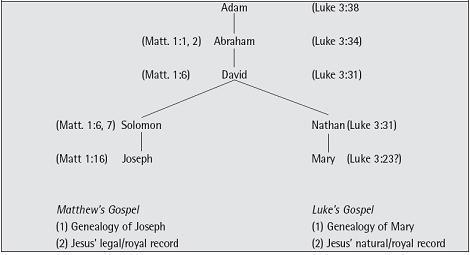
Nelson’s Complete Book of Bible Maps & Charts (Nashville: Thomas Nelson Publishers, 1996) 342. © 1993 by Thomas Nelson, Inc.
3:23 about thirty years of age. Luke was probably not fixing an exact age. Rather, this was an approximation, thirty being a customary age for entering into the office of prophet (Ezek. 1:1); priest (Num. 4:3, 35, 39, 43, 47), or king (Gen. 41:46; 2 Sam. 5:4). as was supposed. Luke had already established the fact of the Virgin Birth (1:34, 35); here, he made clear once again that Joseph was not Jesus’ true father.
4. The temptation of the Son of God (4:1–13)
4:1 led by the Spirit. See note on Matthew 4:1.
4:2 tempted for forty days. Evidently the temptation of Christ encompassed the full forty days of His fast (see note on Matt. 4:2 ). Both Matthew and Luke give a condensed recounting of only three specific temptations. Luke reverses the order of the last two temptations in Matthew’s account. Luke occasionally ordered material logically, rather than chronologically (see Introduction: Background and Setting; see note on 1:3 ). Luke may have had some purpose for doing so here—perhaps to end his account of Jesus’ temptation at the temple in Jerusalem (cf. v. 9), a very important location in Luke’s narrative (see Introduction: Historical and Theological Themes).
Temptation: The Two Adams Contrasted
| 1 John 2:16 | Genesis 3:6 First Adam | Luke 4:1–13 Second Adam-Christ |
| “the lust of the flesh” | “the tree was good for food” | “command this stone to become bread” |
| “the lust of the eyes” | “it was pleasant to the eyes” | “the devil . . . showed Him all the kingdoms” |
| “the pride of life” | “a tree desirable to make one wise” | “throw Yourself down from here” |
Nelson's Complete Book of Bible Maps & Charts (Nashville: Thomas Nelson Publishers, 1996) 336. © 1993 by Thomas Nelson, Inc.
4:3–13 See notes on Matthew 4:3–10.
4:4 Jesus quoted Deuteronomy 8:3.
4:8 Jesus quoted Deuteronomy 6:13.
4:10, 11 Satan quoted Psalm 91:11, 12.
4:12 Jesus quoted Deuteronomy 6:16.
4:13 until an opportune time. Satan’s temptations did not end here for Christ, but persisted throughout His ministry (cf. Heb. 4:15), and culminated in Gethsemane (22:39–46).
II. THE MINISTRY IN GALILEE (4:14–9:50)
A. The Commencement of His Ministry (4:14–44)
4:14 returned . . . to Galilee. The synoptic Gospels are largely silent about Jesus’ ministry between His baptism and His return to Galilee, but John recorded a fairly extensive ministry in Jerusalem and Judea (John 2:12–4:1). Because of this, news of Him quickly spread.
4:15 synagogues. See note on Mark 1:21.
4:16 He came to Nazareth. Luke acknowledged in verse 23 (see note there ) that Christ had already ministered in Capernaum. Yet, Luke purposely situated this episode at the beginning of his account of Christ’s public ministry. Here is an example of Luke’s ordering things logically rather than chronologically (see Introduction: Background and Setting; see note on 1:3). as His custom was. Nazareth was His hometown, so He would have been well known to all who regularly attended this synagogue.
4:18 He has anointed Me. I.e., the Spirit Himself was the anointing (vv. 1, 14).
4:19 the acceptable year of the LORD. Or, “the year of the Lord’s favor.” The passage Christ read was Isaiah 61:1, 2. He stopped in the middle of verse 2. The rest of the verse prophesies judgment in the day of God’s vengeance. Since that part of the verse pertains to the Second Advent, He did not read it.
4:20 sat down. It was customary for a teacher to stand respectfully during the reading of the Scriptures (v. 16), and sit humbly to teach. See note on Matthew 5:1.
4:21 this Scripture is fulfilled. This was an unambiguous claim that He was the Messiah who fulfilled the prophecy. They correctly understood His meaning but could not accept such lofty claims from One whom they knew so well as the carpenter’s son (v. 22; cf. Matt. 13:55).
4:23 Capernaum. Obviously Christ had already gained a reputation for His miraculous works in Capernaum. Scripture gives few details about that first year of public ministry. Most of what is known about those months is found in John’s Gospel, and it suggests Christ ministered mostly in Judea. However, John 2:12 mentions a brief visit to Capernaum, with no other details. John 4:46–54 describes that, while Christ was at Cana, He healed a nobleman’s son who lay sick in Capernaum. It is also known that Christ had already gathered some of His disciples, who were men from the north shore of the Sea of Galilee (John 1:35–42; see note on Matt. 4:18 ). He might have visited there more than once during that first year of ministry. In any case, He had been there long enough to do miracles, and His fame had spread throughout Galilee (cf. v. 14).
4:25–27 Both the widow of Zarephath (1 Kin. 17:8–24) and Naaman the Syrian (2 Kin. 5) were Gentiles. Both lived during times of widespread unbelief in Israel. Jesus’ point was that God bypassed all the widows and lepers in Israel, yet showed grace to two Gentiles. God’s concern for Gentiles and outcasts is one of the thematic threads that runs through Luke’s Gospel (see Introduction: Historical and Theological Themes).
4:28 filled with wrath. This is Luke’s first mention of hostile opposition to Christ’s ministry. What seems to have sparked the Nazarenes’ fury was Christ’s suggestion that divine grace might be withheld from them, yet extended to Gentiles.
4:30 passing through the midst of them. This implies a miraculous escape—the first of several similar incidents in which He escaped a premature death at the hands of a mob (cf. John 7:30; 8:59; 10:39).
4:32 authority. See note on Matthew 7:29.
4:33 demon. See note on Matthew 8:16.
4:34 Holy One of God. Demons always recognized Christ immediately (cf. v. 41; 8:28; Matt. 8:29; Mark 1:24; 3:11; 5:7)
4:38 Simon’s wife’s mother. Peter was married (cf. 1 Cor. 9:5), though no details about his wife are given anywhere in Scripture. a high fever. Matthew 8:14, 15 and Mark 1:30, 31 also report this miracle. But only Luke, the physician, remarks that the fever was “high,” and makes note of the means Jesus used to heal her (v. 39).
4:40 the sun was setting. This signified the end of the Sabbath. As soon as they were free to travel, the multitudes came.
4:41 “You are the Christ, the Son of God!” See note on verse 34.
3. Cities of Galilee (4:43, 44)
4:43 kingdom of God. This term, so prominent throughout the remainder of Luke’s Gospel, is introduced here for the first time. See note on Matthew 3:2.
B. The Calling of His Disciples (5:1–6:16)
5:1 Lake of Gennesaret. I.e., the Sea of Galilee, sometimes also called the Sea of Tiberius (John 6:1; 21:1). It is actually a large, freshwater lake, over 690 feet below sea level, and serves as the main source of water and commerce for the Galilee region.
5:2 washing their nets. Having fished all night with nothing to show for their labor (cf. v. 5), they were drying and mending their nets for another night’s work.
5:3 He sat. See notes on 4:20; Matthew 5:1.
5:4 let down your nets. Normally, the fish that were netted in shallow water at night would migrate during the daylight hours to waters too deep to reach easily with nets, which is why Peter fished at night. Peter, no doubt, thought Jesus’ directive made no sense, but he obeyed anyway, and was rewarded for his obedience. (v. 6).
5:8 Depart from me. The remarkable catch of fish was clearly a miracle, astonishing to all the fishermen in Capernaum (v. 9). Peter immediately realized he was in the presence of the Holy One exercising His divine power, and he was stricken with shame over his own sin. Cf. Exodus 20:19; 33:20; Judges13:22; Job 42:5, 6. See note on Isaiah 6:5.
5:11 forsook all and followed Him. See note on Matthew 4:18. Luke gave a more detailed account of the second call of these disciples.
5:12 full of leprosy. Luke’s emphasis suggests this was an extremely serious case of leprosy. See note on Mark 1:40.
5:13 Immediately. One of the characteristics of Jesus’ healings was immediate, total wholeness. Cf. 17:14; Matthew 8:13; Mark 5:29; John 5:9.
5:14 tell no one. See note on Matthew 8:4. show yourself to the priest. I.e., in accordance with the law governing leprosy (Lev. 13:1–46).
5:17 Pharisees. See note on Matthew 3:7. teachers of the law. I.e., scribes. See note on Matthew 2:4. These Jewish leaders came from as far away as Jerusalem. His reputation had spread, and already the scribes and Pharisees were watching Him critically.
5:19 through the tiling. This appears to have been a home with roof tiles which, when removed, gave access to lower the man between the roof beams. The extreme measures they took to lay this man before Jesus indicate that the crowds following Him were very large. With the press of people around Jesus, it would have been impossible for men carrying a paralytic to get close enough to Him, even if they waited until He left the house.
5:20 your sins are forgiven. Christ ignored the paralysis and addressed the man’s greater need first. See note on Matthew 9:2. In doing so, He asserted a prerogative that was God’s alone (v. 21; cf. 7:49). His subsequent healing of the man’s paralysis was proof that He had the authority to forgive sins as well.
5:21 blasphemies. Their assessment would have been correct if He were not God incarnate. See note on Matthew 9:3.
5:22 perceived. I.e., by means of His omniscience. Cf. Matthew 9:4; John 5:24, 25.
5:23 Which is easier. See note on Matthew 9:5.
5:24 that you may know. His ability to heal anyone and everyone at will—totally and immediately (v. 25)—was incontrovertible proof of His deity. As God, Jesus had all authority to forgive sins. This was a decisive moment and should have ended once and for all the Pharisees’ opposition. Instead, they began trying to discredit Him by charging Him with violating their Sabbath rules (see notes on 6:2–11 ).
5:26 strange things. The response is curiously non-committal—not void of wonder and amazement, but utterly void of true faith.
5:27 Levi. Matthew’s name prior to his conversion. See notes on Matthew 9:9, 11.
5:28 left all. Cf. verse 11; 9:59–62. This implies an irreversible action.
5:29 a great number of tax collectors. Levi’s immediate response was to introduce his former comrades to Christ.
5:30 eat and drink. Consorting with outcasts on any level—even merely speaking to them—was bad enough. Eating and drinking with them implied a level of friendship that was abhorrent to the Pharisees (cf. 7:34; 15:2; 19:7).
5:31 who are well. I.e., those who think they are whole don’t seek healing. See note on Matthew 9:12.
5:33 fast often. Jesus did fast on at least one occasion (Matt. 4:2)—but privately, in accordance with His own teaching (cf. Matt. 6:16–18). The law also prescribed a fast on the Day of Atonement (Lev. 16:29–31; 23:27)—but all other fasts were supposed to be voluntary, for specific reasons such as penitence and earnest prayer. The fact that these Pharisees raised this question shows that they thought of fasting as a public exercise to display one’s own spirituality. Yet, the OT also rebuked hypocritical fasting (Is. 58:3–6). See notes on Matthew 6:16, 17; 9:15.
5:36–38 See notes on Matthew 9:16, 17.
5:39 The old is better. Those who had acquired a taste for Old Covenant ceremonies and Pharisaic traditions were loath to give them up for the new wine of Jesus’ teaching. Luke alone adds this saying.
6:2 not lawful. See note on Matthew 12:2.
6:3 Have you not . . . read. A rebuke, suggesting that they were culpable for their ignorance of so basic a truth (cf. Matt. 12:5; 19:4; 21:16, 42; 22:31). what David did. See notes on 1 Samuel 21:1–6.
6:4 the showbread. See note on Matthew 12:4.
6:5 Lord of the Sabbath. See note on Matthew 12:8.
6:7 whether He would heal on the Sabbath. The scribes and Pharisees spotted the man with the withered hand (v. 6) and, with Christ present, they immediately knew that this would be an occasion for the man’s healing. In stark contrast to all other so-called healers, Christ was not selective. He healed all who came to Him (v. 19; cf. 4:40; Matt. 8:16).
6:8 knew their thoughts. Cf. 5:22. See note on Matthew 9:4. stand here. Jesus purposely did this miracle openly, before all, as if to demonstrate His contempt for the Pharisees’ man-made regulations.
6:9 to do good. The Sabbath laws forbade labor for profit, frivolous diversions, and things extraneous to worship. Activity per se was not unlawful. Good works were especially appropriate on the Sabbath—particularly deeds of charity, mercy, and worship. Works necessary for the preservation of life were also permitted. To corrupt the Sabbath to forbid such works was a perversion of God’s design. See notes on Matthew 12:2, 3. to do evil. Refusal to do good is tantamount to doing evil (James 4:17).
6:10 looked around at them. I.e., giving them a chance to respond to the question of verse 9. Evidently no one did.
6:11 filled with rage. A curious response in the face of so glorious a miracle. Such irrational hatred was their response to having been publicly humiliated—something they hated worse than anything (cf. Matt. 23:6, 7). They were unable to answer His reasoning (vv. 9, 10). And furthermore, by healing the man only with a command, He had performed no actual “work” with which they could charge Him. Desperately seeking a reason to accuse Him (v. 7), they could find none. They responded with blind fury.
6:12 continued all night in prayer. Luke frequently shows Jesus praying—particularly before major events in His ministry. Cf. 3:21; 5:16; 9:18, 28, 29; 11:1; 22:32, 40–46.
6:13 He called His disciples. See notes on Matthew 10:1–4. Christ had many disciples. At one point, He sent seventy out in pairs to proclaim the gospel (10:1). But on this occasion, He chose twelve and specifically commissioned them as apostles (i.e., “sent ones”) with a special authority to deliver His message on His behalf (cf. Acts 1:21, 22).
6:17–49 The Sermon on the Plateau. The similarity to the Sermon on the Mount (see notes on Matt. 5:1–7:29 ) is remarkable. It is possible, of course, that Jesus simply preached the same sermon on more than one occasion. (It is evident that He often used the same material more than once—e.g., 12:58, 59; cf. Matt. 5:25, 26.) It appears more likely, however, that these are variant accounts of the same event. Luke’s version is abbreviated somewhat, because he omitted sections from the sermon that are uniquely Jewish (particularly Christ’s exposition of the law). Aside from that, the two sermons follow exactly the same flow of thought, beginning with the Beatitudes and ending with the parable about building on the rock. Differences in wording between the two accounts are undoubtedly owing to the fact that the sermon was originally delivered in Aramaic. Luke and Matthew translate into Greek with slight variances. Of course, both translations are equally inspired and authoritative.
| 1. Jesus' first sermon in synagogue | Luke 4:17–27 |
| 2. Sermon on the plain | Luke 6:17–49 |
| 3. Sermon in parables | Luke 8:4–21 |
| 4. Sermon on the lost | Luke 15 |
| 5. Sermon on the kingdom of God | Luke 17:20–37 |
| 6. Sermon(s) on various themes | Luke 20:1–21:38 |
C. The Continuation of His Work (6:17–9:50)
1. Preaching on the plateau (6:17–49)
6:17 a level place. Elsewhere it says “on a mountain” (5:1). These harmonize easily if Luke is referring to either a plateau or a level place on the mountainside. Indeed, there is such a place at the site near Capernaum where tradition says this sermon was delivered. Tyre and Sidon. See notes on Matthew 11:21; Mark 3:8.
6:18 unclean spirits. Another name for demons, used ten times in the Gospels.
6:19 power went out from Him. Cf. 8:45, 46; see note on Mark 5:30.
6:20–25 Luke’s account of the Beatitudes is abbreviated (cf. Matt. 5:3–12). He lists only four, and balances them with four parallel woes.
6:20 you poor. Christ’s concern for the poor and outcasts is one of Luke’s favorite themes (see Introduction: Historical and Theological Themes). Luke used a personal pronoun (“you”) where Matthew 5:3 employed a definite article (“the”); Luke was underscoring the tender, personal sense of Christ’s words. A comparison of the two passages reveals that Christ was dealing with something more significant than mere material poverty and wealth, however. The poverty spoken of here refers primarily to a sense of one’s own spiritual impoverishment.
6:21 you who hunger. No mere craving for food, but a hunger and thirst for righteousness (see note on Matt. 5:6 ).
6:22 For the Son of Man’s sake. Persecution per se is not something to be sought. But when evil is spoken against a Christian falsely and for Christ’s sake (Matt. 5:11), such persecution carries with it the blessing of God.
6:29 offer the other also. See notes on Matthew 5:39.
6:31 See note on Matthew 7:12.
6:35 sons of the Most High. I.e., God’s children should bear the indelible stamp of His moral character. Since He is loving, gracious, and generous—even to those who are His enemies—we should be like Him. See note on Matthew 5:44, 45; cf. Ephesians 5:1, 2.
6:37 Judge not. This forbids hypocrisy and a condemning spirit rising from selfrighteousness. It does not condemn true discernment. See note on Matthew 7:1. you will be forgiven. See note on Matthew 6:15.
6:38 put into your bosom. I.e., poured into your lap. A long robe was used to carry the overflow of grain. Cf. Psalm 79:12; Isaiah 65:6; Jeremiah 32:18.
6:41 speck . . . plank. The humor of the imagery was no doubt intentional. Christ often employed hyperbole to paint comical images (cf. 18:25; Matt. 23:24).
6:46 you call Me ‘Lord, Lord.’ It is not sufficient to give lip service to Christ’s lordship. Genuine faith produces obedience. A tree is known by its fruits (v. 44). See notes on Matthew 7:21–23.
6:47–49 See note on Matthew 7:24–28.
2. Ministering in the cities (7:1–8:25)
a. healing a centurion’s servant (7:1–10)
7:2 centurion’s servant. See note on Matthew 8:5. The centurion’s tender concern for a lowly slave was contrary to the reputation Roman army officers had acquired in Israel. Yet, this is one of three centurions featured in the NT who gave evidence of genuine faith (see note on Matt. 8:5; cf. Acts 10).
7:3 elders of the Jews. Matthew 8:5–13 does not mention that the centurion appealed to Jesus through these intermediaries. It is a measure of the respect this man had in the community that Jewish elders would be willing to bring his cause to Jesus. He loved the Jewish nation and was somehow personally responsible for the building of the local synagogue (v. 5). He obviously was being drawn to Christ by God Himself (cf. John 6:44, 65). Like all men under conviction, he deeply sensed his own unworthiness (see note on 5:8 ), and that is why he used intermediaries rather than speaking to Jesus personally (vv. 6, 7).
7:6 not worthy. See note on Matthew 8:8.
b. raising a widow’s son (7:11–17)
7:11 Nain. A small town southeast of Nazareth.
7:12 only son. See note on 9:38.
7:14 touched the open coffin. This was a ceremonially defiling act, normally. Jesus graphically illustrated how impervious He was to such defilements. When He touched the coffin, its defilement did not taint Him; rather, His power immediately dispelled the presence of all death and defilement (see notes on v. 39; 8:44 ). This was the first of three times Jesus raised people from the dead (cf. 8:49–56; John 11:20–44). Verse 22 implies that Christ also raised others who are not specifically mentioned.
c. encouraging John the Baptist’s disciples (7:18–35)
7:18 the disciples of John. John the Baptist evidently kept apprised of Christ’s ministry—even after his imprisonment—through disciples who acted as messengers for him. Cf. Acts 19:1–7.
7:19 Are You the Coming One. John was not the sort of man who vacillated (v. 24). We are not to think that his faith was failing or that he had lost confidence in Christ. But with so many unexpected turns of events—John in prison, Christ encountering unbelief and hostility—John wanted reassurance from Christ Himself. That is precisely what Jesus gave him (vv. 22, 23). See notes on Matthew 11:3–11.
7:22 Go and tell John. Verses 22, 23 are quoted from Isaiah 35:5, 6; 61:1. These were messianic promises. (Is. 61:1 is from the same passage Jesus read in the Nazareth synagogue—see note on 4:19 ). John’s disciples were to report that Jesus was doing precisely what Scripture foretold of the Messiah (v. 21)—even though the scheme of prophetic fulfillment was not unfolding quite the way John the Baptist had envisioned it.
7:23 he who is not offended. This was not meant as a rebuke for John the Baptist, but as encouragement for him (cf. v. 28).
7:27 Quoted from Malachi 3:1.
7:28 See note on Matthew 11:11.
7:29 justified God. The common people and the outcast tax collectors who heard John the Baptist’s preaching acknowledged that what he required by way of repentance was from God and was righteous.
7:30 lawyers. See note on 10:25. rejected the will of God. John’s call to repentance was an expression of the will of God. By refusing repentance, they rejected not just John the Baptist, but also God Himself.
7:32 like children. Christ used strong derision to rebuke the Pharisees. He suggested they were behaving childishly, determined not to be pleased, whether invited to “dance” (a reference to Christ’s joyous style of ministry, “eating and drinking” with sinners—v. 34), or urged to “weep” (a reference to John the Baptist’s call to repentance and more austere manner of ministry—v. 33).
7:34 eating and drinking. I.e., living an ordinary life. This passage explains why John’s style of ministry differed so dramatically from Jesus’ approach, although their message was the same (see note on Matt.4:17 ). The different methods took away all the Pharisees’ excuses. The very thing they had professed to want to see in Jesus—rigid abstinence and a Spartan lifestyle—was what characterized the ministry of John the Baptist, yet they had already rejected him, too. The real problem lay in the corruption of their own hearts, but they would not acknowledge that. friend of . . . sinners. See notes on 5:30–33; 15:2.
7:35 wisdom is justified by all her children. I.e., true wisdom is vindicated by its consequences—what it produces. Cf. James 2:14–17.
d. forgiving a sinful woman (7:36–50)
7:36 one of the Pharisees. His name was Simon (v. 40). He does not appear to have been sympathetic to Jesus (cf. vv. 44–46). Undoubtedly, his motive was either to entrap Jesus or to find some reason to accuse Him (cf. 6:7).
7:37 an alabaster flask. See note on Matthew 26:7. This is similar in many ways to the events described in Matthew 26:6–13; Mark 14:3–9; John 12:2–8, but it is clearly a different incident. That occasion took place in Bethany, near Jerusalem, during the Passion Week. In the anointing at Bethany, it was Mary, sister of Martha and Lazarus, who anointed Jesus. This incident takes place in Galilee and involves “a woman . . . who was a sinner” (i.e., a prostitute). There is no reason to identify this woman with Mary Magdalene, as some have done (see note on 8:2 ).
7:38 stood at His feet behind Him. Jesus was reclining at a low table, as was the custom. It would have been shocking to all for a woman of such low reputation to come to a Pharisee’s house. Such dinners involving dignitaries were often open to spectators—but no one would have expected a prostitute to attend. Her coming took great courage and reveals the desperation with which she sought forgiveness. Her “weeping” was an expression of deep repentance.
7:39 what manner of woman. The Pharisees showed nothing but contempt for sinners. Simon was convinced that if Jesus knew her character, He would have sent her away, for her touching Him was presumed to convey ceremonial uncleanness. See notes on verse 14; 8:44.
7:40 Jesus answered. Jesus knew Simon’s thoughts (cf. 5:22; see note on Matt. 9:4 )—demonstrating to Simon that He was indeed a prophet.
7:41 denarii. Each denarius was worth a day’s labor (see note on Matt. 22:19 ), so this was a large sum—about two years’ full wages.
7:44 no water for My feet. A glaring oversight. Washing a guest’s feet was an essential formality (see note on John 13:4, 5 ). Not to offer a guest water for the washing of feet was tantamount to an insult—like it would be in modern Western culture if one did not offer to take a guest’s coat.
7:47 for she loved much. This is not to suggest that she was forgiven because she loved much. The parable (vv. 41–43) pictured a forgiveness that was unconditional, and love then was the result. Therefore, to make the woman’s love the reason for her forgiveness would be to distort the lesson Jesus is teaching here. “For” here has the sense of “wherefore.” And her faith (v. 50), not the act of anointing Jesus’ feet, was the instrument by which she laid hold of His forgiveness.
7:49 forgives sins. See notes on 5:20, 21; Matthew 9:1–3; Mark 2:7.
7:50 Your faith has saved you. Not all whom Jesus healed were saved, but those who exhibited true faith were (cf. 17:19; 18:42; Matt. 9:22; see note on Mark 5:34 ).
e. gathering loving disciples (8:1–3)
8:2 certain women. Rabbis normally did not have women as disciples. Mary called Magdalene. Her name probably derives from the Galilean town of Magdala. Some believe she is the woman described in 7:37–50, but it seems highly unlikely that Luke would introduce her here by name for the first time if she were the main figure in the account he just completed. Also, while it is clear that she had suffered at the hands of “demons,” there is no reason whatsoever to think that she had ever been a prostitute.
8:3 Joanna. This woman is also mentioned in 24:10, but nowhere else in Scripture. It is possible that she was a source for some of the details Luke recounts about Herod (cf. 23:8, 12). See note on 1:3. Susanna. Aside from this reference, she is nowhere mentioned in Scripture. She is probably someone Luke knew personally. from their substance. It was a Jewish custom for disciples to support rabbis in this way. Cf. 10:7; 1 Corinthians 9:4–11; Galatians 6:6; 1 Timothy 5:17, 18.
f. teaching the multitude with parables (8:4–21)
8:4 spoke by a parable. This marked a significant turning point in Jesus’ ministry. See notes on Matthew 13:3, 34.
8:5 to sow his seed. Seed was sown by hand over plowed soil. In throwing seed toward the edges of a field, the sower would naturally throw some that landed or was blown onto the hard beaten path on the edges of the field, where it could not penetrate the soil and grow (see notes on Matt. 13:4, 19 ). This could refer to the hard, obstinate Jewish leaders.
8:6 on rock. I.e., very shallow soil with a layer of rock lying just below the surface. See notes on Matthew 13:5, 20. This could refer to the fickle mob that followed Jesus only for His miracles.
8:7 thorns. See notes on Matthew 13:7, 22. This could refer to the materialists to whom earthly wealth was more important than spiritual riches.
8:8 a hundredfold. Luke simplified the parable. Matthew 13:8 and Mark 4:8 described three levels of fruitfulness. “Hundredfold” simply speaks of inconceivable abundance (cf. Gen. 26:12). He who has ears. All three of the synoptics include this admonition with the parable of the sower (cf. Matt. 13:9; Mark 4:9). Jesus often said this to emphasize particularly important statements cast in mysterious language (cf. 14:35; Matt. 11:15; 13:43; Mark 4:23).
8:10 mysteries. See notes on Matthew 13:11, 13. Seeing they may not see. This quotation from Isaish 6:9 describes God’s act of judicially blinding unbelievers.
8:13 who believe for a while. I.e., with a nominal, non-saving faith. See note on Matthew 13:20.
8:15 heard . . . keep . . . bear fruit. This constitutes evidence of true salvation. “Heard” is a reference to understanding and believing (John 8:31, 47). “Keep” refers to ongoing obedience (11:28; see note on John 14:21–24 ). “Fruit” is good works (Matt. 7:16–20; James 2:14–26).
8:16 under a bed. The fact that Christ taught mysteries in parables was not to suggest that His message was meant for elite disciples or that it should be kept secret. A lamp is not lit to be hidden, but must be put on a lampstand, where its light will reach furthest. Still, only those with eyes to see will see it.
8:17 nothing is secret that will not be revealed. All truth will be manifest in the judgment. Cf. 12:2, 3; 1 Corinthians 4:5; 1 Timothy 5:24, 25. God’s ultimate purpose is not to hide the truth, but to make it known.
8:18 take heed how you hear. One’s response to the light in this life is crucial, because at the throne of judgment there will be no opportunity to embrace truth that was formerly spurned (Rev. 20:11–15). Those who scorn the light of the gospel now will have all light removed from them in eternity. Cf. 19:26; Matthew 25:29.
8:19 brothers. See notes on Matthew 12:46–49.
8:20, 21 See notes on Mark 3:31, 35.
g. tilling the winds and waves (8:22–25)
8:22–25 See notes on Matthew 8:24–27.
3. Traveling in Galilee (8:26–9:50)
a. delivering a demoniac (8:26–39)
8:26–38 See notes on Matthew 8:28–34.
8:27 a certain man. Matthew reveals there were actually two men. Only one did the talking. See note on Matthew 8:28.
8:30 Legion. See notes on Matthew 8:30; Mark 5:9.
8:31 the abyss. See note on Matthew 8:31.
8:41 a ruler of the synagogue. See note on 13:14. Jesus had once cast a demon out of a man in Jairus’s synagogue (4:33–37).
8:42 only daughter. See note on 9:38. thronged. Lit. “choked” (i.e., they almost crushed Him).
8:43 a flow of blood. See note on Matthew 9:20.
8:44 came from behind and touched. Because of her affliction, she would normally render anyone she touched unclean. The effect here was precisely the opposite. See notes on 7:14, 39. border. See note on Matthew 9:20.
8:46 power going out from Me. See note on Mark 5:30.
The Healing Ministry of God Through Men
| Matthew | Mark | Luke | John | |
| 1. Disciples | 10:1–15 | 3:15; 6:7–13 | 9:1–6 | |
| 2. Unknown men | - | 9:38–40 | 9:49, 50 | - |
| 3. Seventy | - | - | 10:1–20 | - |
The Healing Ministry of God Through Jesus
| Matthew | Mark | Luke | John | |
| 1. Multitudes | 4:23, 24 | 1:39 | - | - |
| 2. Leper | 8:2, 3 | 1:40–42 | 5:12, 13 | - |
| 3. Slave | 8:5–13 | - | 7:2–10 | - |
| 4. Woman | 8:14, 15 | 1:30, 31 | 4:38, 39 | - |
| 5. Multitudes | 8:16, 17 | 1:32–34 | 4:40, 4 | - |
| 6. Demoniac | 8:28–34 | 5:1–20 | 8:26–39 | - |
| 7. Paralyzed man | 9:1–8 | 2:1–12 | 5:17–26 | - |
| 8. Little girl | 9:18, 19, 23–26 | 5:21–23, 35–43 | 8:40–42, 49–56 | - |
| 9. Woman | 9:20–22 | 5:24–34 | 8:43–48 | - |
| 10. Two Blind Men | 9:27–31 | - | - | - |
| 11. Demoniac | 9:32–34 | - | - | - |
| 12. Multitudes | 9:35 | - | - | - |
| 13. Multitudes | 11:2–5 | - | 7:18–22 | - |
| 14. Man | 12:9–14 | 3:1–6 | 6:6–11 | - |
| 15. Multitudes | 12:15–21 | 3:7–12 | - | - |
| 16. Demoniac | 12:22, 23 | - | - | - |
| 17. A few people | 13:54–58 | 6:1–6 | - | - |
| 18. Multitudes | 14:13, 14 | - | 9:10, 11 | 6:1–3 |
| 19. Multitudes | 14:34–36 | 6:53–56 | - | - |
| 20. Gentile girl | 15:21–28 | 7:24–30 | - | - |
| 21. Multitudes | 15:29–31 | - | - | - |
| 22. Demoniac boy | 17:14–21 | 9:14–29 | 9:37–43 | - |
| 23. Multitudes | 19:2 | - | - | - |
| 24. Blind men | 20:29–34 | 10:46–52 | 18:35–43 | - |
| 25. Blind/lame | 21:14 | - | - | - |
| 26. Demoniac | - | 1:21–28 | 4:31–37 | - |
| 27. Deaf man | - | 7:32–37 | - | - |
| 28. Blind man | - | 8:22–26 | - | - |
| 29. Multitudes | - | - | 5:15 | - |
| 30. Multitudes | - | - | 6:17–19 | - |
| 31. Widow’s son | - | - | 7:11–17 | - |
| 32. Women | - | - | 8:2 | - |
| 33. Demoniac | - | - | 11:14 | - |
| 34. Woman | - | - | 13:10–13 | - |
| 35. Man | - | - | 14:1–4 | - |
| 36. Ten lepers | - | - | 17:11–21 | - |
| 37. Man’s ear | - | - | 22:50, 51 | - |
| 38. Man’s son | - | - | - | 4:46–54 |
| 39. Lame man | - | - | - | 5:1–9 |
| 40. Blind man | - | - | - | 9:1–7 |
| 41. Lazarus | - | - | - | 11:1–45 |
| 42. Many more | - | - | - | 20:30, 31; 21:25 |
| 1. Elijah raised widow of Zarephath’s son. | 1 Kin. 17:22 |
| 2. Elisha raised Shunammite woman’s son. | 2 Kin. 4:34, 35 |
| 3. Man raised when he came into contact with Elisha’s bones. | 2 Kin. 13:20, 21 |
| 4. Jesus raised Jairus’ daughter. | Luke 8:52–56 |
| 5. Jesus raised widow of Nain’s son. | Luke 7:14, 15 |
| 6. Jesus raised Lazarus of Bethany. | John 11 |
| 7. Peter raised Dorcas. | Acts 9:40 |
| 8. Paul raised Eutychus. | Acts 20:9–12 |
8:50 only believe. Though not all Jesus’ healings required faith (cf. 22:51), at times He required it.
8:51 Peter, James, and John. See notes on 9:28; Matthew 10:2; 17:1.
8:52 she is not dead. See notes on Matthew 9:23, 24.
8:56 tell no one. See note on Matthew 8:4.
d. sending out the Twelve (9:1–6)
9:1–6 See notes on Matthew 10:1–42.
9:3 Take nothing. Slight differences between Matthew, Mark, and Luke have troubled some. Matthew 10:9, 10 and this text say the disciples were not to take staffs (see note there ); but Mark 6:8 prohibited everything “except a staff.” Mark 6:9 also instructed them to “wear sandals”; but in Matthew 10:10 sandals were included in the things they were not to carry. Actually, however, what Matthew 10:10 and this verse prohibited was the packing of extra staffs and sandals. The disciples were not to be carrying baggage for the journey, but merely to go with the clothes on their backs.
9:7 Herod the tetrarch. See note on Matthew 14:1. News of Christ reached to the highest levels of government. John had risen from the dead. Of course, this was not true, but Herod himself, nonetheless, seemed gripped by guilty fear (cf. Mark 6:16).
9:8 Elijah. See note on 1:17.
9:9 he sought to see Him. Only Luke gives this detail. See notes on 1:3; 8:3.
f. feeding the multitude (9:10–17)
9:10 into a deserted place. They were trying to get some rest and a break from the crowds. Cf. Mark 6:31, 32. Bethsaida. See note on Mark 8:22. Bethsaida Julias is on the north shore of Galilee, and to the east of where the Jordan River enters the lake.
9:12–17 Aside from the Resurrection, the feeding of the 5,000 is the only miracle of Jesus recorded in all four Gospels (cf. Matt. 14:15–21; Mark 6:35–44; John 6:4–13).
9:14 about five thousand men. Counting women and children, the actual size of the crowd may have been closer to 20,000.
9:17 baskets. See notes on Mark 6:43; 8:8.
g. predicting His crucifixion (9:18–26)
9:18–21 See notes on Matthew 16:13–20.
9:19 John the Baptist . . . Elijah . . . one of the old prophets. Cf. verses 7, 8. Such rumors were apparently quite common. See notes on 1:17; Matthew 11:14; Mark 9:13; Revelation 11:5, 6.
9:20 “The Christ of God.” I.e., the Messiah promised in the OT (Dan. 9:25, 26). See note on Matthew 16:16.
9:21 tell this to no one. See notes on Matthew 8:4; 12:16.
9:22 The Son of Man must suffer. This pronouncement was a great turning point in Jesus’ ministry. See note on Matthew 16:21.
9:23 cross. See note on Matthew 10:38. Self-denial was a common thread in Christ’s teaching to His disciples (cf. 14:26, 27; Matt. 10:38; 16:24; Mark 8:34; John 12:24–26). The kind of self-denial He sought was not a reclusive asceticism (see note on 7:34 ), but a willingness to obey His commandments, serve one another, and suffer—perhaps even die—for His sake.
9:24 whoever loses his life for My sake. Aside from the command “follow Me,” this saying is repeated more times in the Gospels than any other saying of Christ. Cf. 17:33; Matthew 10:39; 16:25; Mark 8:35; John 12:25. See note on 14:11.
9:26 whoever is ashamed of Me. I.e., unbelievers. Cf. Matthew 10:33; Romans 9:33; 10:11; 2 Timothy 2:12. See note on 12:9.
h. unveiling His glory (9:27–36)
9:27 see the kingdom. See note on Matthew 16:28.
9:28 about eight days. A common expression signifying about a week (cf. John 20:26). See note on Matthew 17:1. after these sayings. This expression ties the promise of seeing the kingdom (v. 27) to the events that follow (see note on Matt. 16:28 ). Peter, John, and James. These three alone were permitted to witness the raising of Jairus’s daughter (8:51), the Transfiguration (cf. Matt. 17:1), and Christ’s agony in the Garden (Mark 14:33). the mountain. The traditional site, Mount Tabor, is unlikely. Jesus and the disciples had been in “the region of Caesarea Philippi” (Matt. 16:13), and Tabor is nowhere near there. Besides, Tabor had evidently been the site of pagan worship (Hos. 5:1), and in Jesus’ day, an army garrison had their fortress at the top. The actual location of the Transfiguration is nowhere identified, but Mount Hermon (7,000 feet higher than Tabor, and closer to Caesarea Philippi) is believed by many to be the place.
9:29 As He prayed. See note on 3:21. As at Jesus’ baptism, while He was praying, the Father’s voice came from heaven (cf. Introduction: Historical and Theological Themes). glistening. Lit. “emitting light.” This word is used only here in the NT. It suggests a brilliant, flashing light, similar to lightning.
9:30 Moses and Elijah. See note on Matthew 17:3.
9:31 His decease. Peter uses the same term to speak of his own death (2 Pet. 1:15). Only Luke mentions the subject matter of their conversation and the fact that Peter, James, and John had fallen asleep (v. 32). Cf. 22:45.
9:32 saw His glory. Cf. Exodus 33:18–23.
9:33 three tabernacles. See note on Matthew 17:4.
9:34 the cloud. Matthew 17:5 says “a bright cloud,” i.e., enveloping the glory of God—similar to the pillar of cloud that led the Israelites in the OT (Ex. 14:19, 20). The brightness of this cloud and the sleepiness of the disciples (v. 32) suggest that this event may have occurred at night.
9:35 This is My beloved Son. See note on Matthew 3:17.
i. casting out an unclean spirit (9:37–42)
9:38 my only child. Cf. 7:12; 8:42. The son of the widow of Nain was her only child; and Jairus’s daughter was his only child. Luke alone mentions these details.
9:39 a spirit seizes him. This was no mere case of epilepsy; it was plainly demon possession. There’s no reason to think Luke, a physician, was merely accommodating the understanding of his readers. Besides, Jesus healed the boy by rebuking the demon (v. 42; cf. Mark 9:25).
9:40 they could not. See notes on Matthew 17:19–21.
9:41 faithless and perverse generation. See note on Matthew 17:17.
j. instructing His disciples (9:43–50)
9:44 about to be betrayed. See note on Matthew 17:22.
9:45 hidden from them. I.e., in accord with God’s sovereign design. Cf. 24:45.
9:46 be greatest. See note on Matthew 20:21.
9:48 Whoever receives this little child. See note on Matthew 18:5. he who is least . . . will be great. The way to preeminence in Christ’s kingdom is by sacrifice and self-denial. See note on verse 23.
9:49 because he does not follow with us. It is ironic that John, who came to be known as “the apostle of love,” would be the one to raise this objection (see note on v. 54 ). John came to see that only legitimate tests of another person’s ministry are the test of doctrine (1 John 4:1–3; 2 John 7–11) and the test of morals (1 John 2:4–6, 29; 3:4–12; 4:5, 20; cf. Matt. 7:16). This man would have passed both tests, but John was inclined to reject him because of his group affiliation. That is the error of sectarianism.
9:50 he who is not against us is on our side. Contrast this with 11:23. There is no middle ground and no neutrality. Here, Christ gave a test of outward conduct to use for measuring others. In 11:23, He gave a test of the inward life that is to be applied to oneself.
III. THE JOURNEY TO JERUSALEM (9:51–19:27)
1. A village turns Him away (9:51–56)
9:51 steadfastly set His face to go to Jerusalem. This begins a major section of Luke’s Gospel. From here to 19:27, Christ’s face was set toward Jerusalem (see note on v. 53 ), and Luke’s narrative is a travelogue of that long journey to the Cross. This was a dramatic turning point in Christ’s ministry. After this, Galilee was no longer His base of operation. Although 17:11–37 describes a return visit to Galilee, Luke included everything between this point and that short Galilean sojourn as part of the journey to Jerusalem. We know from a comparison of the Gospels that, during this period of Christ’s ministry, He made short visits to Jerusalem to celebrate feasts (see notes on 13:22; 17:11 ). Nonetheless, those brief visits were only interludes in this period of ministry that would culminate in a final journey to Jerusalem for the purpose of dying there. Thus, Luke underscored this turning point in Christ’s ministry more dramatically than any of the other Gospels, by showing Christ’s determination to complete His mission of going to the Cross. See note on 12:50.
9:52 Samaritans. These people were descendants of Jewish mixed marriages from the days of captivity. They were rivals of the Jewish nation and had devised their own worship, a hybrid of Judaism and paganism, with a temple of their own on Mt. Gerizim. They were considered unclean by the Jews and were so hated that most Jewish travelers from Galilee to Judah took the longer route east of the Jordan River to avoid traveling through Samaria. See note on John 4:4.
9:53 because His face was set for . . . Jerusalem. Traveling to Jerusalem for worship implied rejection of the temple on Mt. Gerizim and a contempt for Samaritan worship (see note on v. 52 ). This was a strong point of contention between Jews and Samaritans (cf. John 4:20–22).
9:54 James and John. Jesus nicknamed these brothers “Boanerges”—Sons of Thunder (Mark 3:17)—a fitting title, apparently. This was John’s second sin against charity in such a short time (see note on v. 49 ). It is interesting to note that several years later, the apostle John journeyed through Samaria once again with Peter, this time preaching the gospel in Samaritan villages (Acts 8:25).
Others and Demons in the Gospels
| Matthew | Mark | Luke | John | |
| 1. The Twelve | 10:1, 8 | 6:7, 13 | 9:1 | – |
| 2. The Twelve | – | 3:15 | – | – |
| 3. Unknown disciples | – | 9:38 | 9:49 | – |
| 4. The Twelve | – | 16:17 | – | – |
| 5. The Seventy | – | – | 10:17–20 | – |
9:55 rebuked them. Christ’s response to the Samaritans exemplifies the attitude the church ought to have with regard to all forms of religious persecution. The Samaritans’ worship was pagan at heart, plainly wrong (see note on John 4:22 ). Compounding that was their intolerance. Yet, the Lord would not retaliate with force against them. Nor did He even revile them verbally. He had come to save, not to destroy; and so His response was grace rather than destructive fury. Nonetheless, Christ’s words of disapproval here must not be taken as condemnation of Elijah’s actions in 1 Kings 18:38–40 or 2 Kings 1:10–12. Elijah was commissioned to a special ministry as prophet in a theocracy, and it was his God-ordained task to confront an evil monarch (Ahab) who was attempting to usurp God’s authority. Elijah was specifically authorized to measure out the reprisal of God’s wrath. Elijah acted with an authority comparable to that of modern civil authorities (cf. Rom. 13:4)—not in a capacity that parallels that of ministers of the gospel.
2. He turns away the half-hearted (9:57–62)
9:59, 60 See notes on Matthew 8:21, 22.
9:62 looking back. A plowman looking back cuts a crooked furrow.
3. He sends out the seventy (10:1–24)
10:1 seventy others. The commissioning of the seventy is recorded only in Luke. Moses also appointed seventy elders as his representatives (Num. 11:16, 24–26). The twelve disciples had been sent into Galilee (9:1–6); the seventy were sent into every city and place where He was about to go—i.e., into Judea, and possibly Perea (see note on Matthew 19:1 ). two by two. As the Twelve had been sent (Mark 6:7; cf. Eccl. 4:9, 11; Acts 13:2; 15:27, 39, 40; 19:22; Rev. 11:3).
10:3 lambs among wolves. I.e., they would face hostility (cf. Ezek. 2:3–6; John 15:20) and spiritual danger (cf. Matt. 7:15; John 10:12).
10:4 neither money bag, knapsack, nor sandals. I.e., travel without luggage. This does not mean they would be barefoot. See note on 9:3. greet no one. A greeting in that culture was an elaborate ceremony, involving many formalities, perhaps even a meal, and long delays (see note on 11:43 ). A person on an extremely urgent mission could be excused from such formalities without being thought rude. Everything in Jesus’ instructions speaks of the shortness of time and the great urgency of the task.
10:7 Do not go from house to house. I.e., for lodging (see note on Mark 6:10 ). They were to establish headquarters in a village and not waste time moving around or seeking more comfortable housing.
10:11, 12 See notes on Matthew 10:14, 15.
10:13–15 See notes on Matthew 11:21, 23.
10:16 These words elevate the office of a faithful minister of Christ, and magnify the guilt and the condemnation of those who reject the message.
10:17 returned with joy. How long the mission lasted is not recorded. It may have been several weeks. The seventy probably did not return all at once; but this dialogue appears to have occurred after they had all reassembled.
10:18 I saw Satan fall. In this context, it appears Jesus’ meaning was, “Don’t be so surprised that the demons are subject to you; I saw their commander cast out of heaven, so it is no wonder if his minions are cast out on earth. After all, I am the source of the authority that makes them subject to you” (v. 19). He may also have intended a subtle reminder and warning against pride—the reason for Satan’s fall (cf. 1 Tim. 3:6). For discussions of Satan’s fall, see notes on Isaiah 14:12–14; Ezekiel 28:12–15.
10:19 serpents and scorpions. Cf. Psalm 91:13; Ezekiel 2:6. These appear to be figurative terms for demonic powers (cf. Rom. 16:20).
10:20 do not rejoice in this. Rather than being so enthralled with extraordinary manifestations such as power over demons and the ability to work miracles, they should have realized that the greatest wonder of all is the reality of salvation—the whole point of the gospel message and the central issue to which all the miracles pointed. because your names are written in heaven. Cf. Philippians 4:3; Hebrews 12:23; Revelation 21:27. By contrast, unbelievers are “written in the earth” (Jer. 17:13).
10:21, 22 See notes on Matthew 11:25, 26.
4. He gives the parable of the good Samaritan (10:25–37)
10:25 lawyer. I.e., a scribe who was supposedly an expert in the Law of God. Aside from one usage of this word in Matthew 22:35 (see note there ), Luke is the only one of the Gospel writers who uses it (11:45, 46). what shall I do to inherit eternal life? The same question is raised by several inquirers (18:18–23; Matt. 19:16–22; John 3:1–15).
10:27 he answered. The lawyer summed up the requirements of the law (Lev. 19:18; Deut. 6:5) exactly as Christ did on another occasion (see notes on Matt. 22:37–40 ).
10:28 do this and you will live. Cf. Leviticus 18:5; Ezekiel 20:11. “Do and live” is the promise of the law. But since no sinner can obey perfectly, the impossible demands of the law are meant to drive us to seek divine mercy (Gal. 3:10–13, 22–25). This man should have responded with a confession of his own guilt, rather than self-justification (v. 29).
10:29 wanting to justify himself. This reveals the man’s self-righteous character. who is my neighbor? The prevailing opinion among scribes and Pharisees was that one’s neighbors were the righteous alone. According to them, the wicked—including rank sinners (such as tax collectors and prostitutes), Gentiles, and especially Samaritans—were to be hated because they were the enemies of God. They cited Psalm 139:21, 22 to justify their position. As that passage suggests, hatred of evil is the natural corollary of loving righteousness. But the truly righteous person’s “hatred” for sinners is not a malevolent enmity. It is a righteous abhorrence of all that is base and corrupt—not a spiteful, personal loathing of individuals. Godly hatred is marked by a broken-hearted grieving over the condition of the sinner. And as Jesus taught here and elsewhere (6:27–36; Matt. 5:44–48), it is also tempered by a genuine love. The Pharisees had elevated hostility toward the wicked to the status of a virtue, in effect nullifying the second Great Commandment. Jesus’ answer to this lawyer demolished the pharisaical excuse for hating one’s enemies.
10:30 down from Jerusalem to Jericho. A rocky, winding, treacherous descent of about 3,300 feet in 17 miles. That stretch of road was notorious for being beset with thieves and danger.
10:32 Levite. These were from the tribe of Levi, but not descendants of Aaron. They assisted the priests in the work of the temple.
10:33 Samaritan. For a Samaritan to travel this road was unusual. The Samaritan himself was risking not only the thieves, but also the hostility of other travelers.
10:34 oil and wine. Probably carried by most travelers in small amounts as a kind of first-aid kit. The wine was antiseptic; the oil soothing and healing.
10:35 two denarii. I.e., two days’ wages (see notes on Matt. 20:2; 22:19 ). Probably more than enough to permit the man to stay until he recovered.
10:36 neighbor to him. Jesus reversed the lawyer’s original question (v. 29). The lawyer assumed it was up to others to prove themselves neighbor to him (see note on v. 29 ). Jesus’ reply makes it clear that each has a responsibility to be a neighbor—especially to those who are in need.
B. Bethany and Judea (10:38–13:35)
10:38 a certain village. Bethany, two miles east of the temple in Jerusalem, on the east slope of the Mount of Olives. This was the home of Mary, Martha, and Lazarus (cf. John 11:1).
10:40 distracted. Lit. “dragging all around.” The expression implies that Martha was in a tumult. with much serving. Martha was evidently fussing about with details that were unnecessarily elaborate.
10:42 one thing . . . good part. Jesus was not speaking of the number of dishes to be served. The one thing necessary was exemplified by Mary (i.e, an attitude of worship and meditation), listening with an open mind and heart to Jesus’ words.
• Jesus’ prayer at baptism (3:21)
• Jesus prays in the desert (5:16)
• Jesus’ prayer before choosing apostles (6:12, 13)
• Blessing at feeding of 5,000 (9:16)
• Jesus’ prayer on Mount of Transfiguration (9:28, 29)
• Jesus’ thanksgiving to the Father (10:21)
• The Lord’s prayer (11:2–4)
• Blessing of Lord’s Supper (22:17–19)
• Jesus’ prayer for Peter’s faith (22:31, 32)
• Jesus’ prayer in Gethsemane (22:39–46)
• Prayer on the Cross (23:46)
• Blessing of food on Emmaus journey (24:30)
11:1 Lord, teach us to pray. Rabbis often composed prayers for their disciples to recite. Having seen Jesus pray many times, they knew of His love for prayer, and they knew prayer was not just the reciting of words (see note on Matt. 6:7 ).
11:2 Our Father in heaven. Virtually the same prayer was given as a model on two separate occasions by Christ, first in the Sermon on the Mount (see notes on Matt. 6:9–13 ), and then here, in response to a direct question. That accounts for minor variations between the two versions. Your name. God’s name represents all His character and attributes. Cf. Psalms 8:1, 9; 9:10; 22:22; 52:9; 115:1.
11:4 sins. See note on Matthew 6:12.
3. The importance of importunity (11:5–13)
11:7 my children are with me in bed. The one-room houses that were common in Israel had a common sleeping area shared by the whole family. If one person arose and lit a lamp to get bread, all would be awakened.
11:8 persistence. The word can even mean “impudence.” It conveys the ideas of urgency, audacity, earnestness, boldness, and relentlessness—like the persistent asking of a desperate beggar.
11:13 being evil. I.e., by nature. See note on Matthew 7:11.
4. The impossibility of neutrality (11:14–36)
11:14 it was mute. I.e., the demon. the mute spoke. I.e., the man.
11:15 Beelzebub. Originally this referred to Baal-Zebul (“Baal, the prince”), chief god of the Philistine city of Ekron; the Israelites disdainfully referred to him as Baal-Zebub (“Lord of Flies”). See note on 2 Kings 1:2.
11:16 a sign from heaven. I.e., a miraculous work of cosmological proportions, like the rearranging of the constellations, or something far greater than the casting out of a demon, which they had just witnessed. See note on Matthew 12:38.
11:17 knowing their thoughts. Jesus was God with full omniscience if He used it (see notes on 2:52; Mark 13:32; John 2:23–25 ). kingdom divided against itself. This may have been a subtle jab at the Jewish nation, a kingdom divided in the time of Jeroboam, and still marked by various kinds of bitter internal strife and factionalism, right up to the destruction of Jerusalem in A.D. 70.
11:19 by whom do your sons cast them out? There were Jewish exorcists who claimed power to cast out demons (Acts 19:13–15). Jesus’ point was that if such exorcisms could be done through satanic power, the pharisaical exorcists must be suspect as well. And in fact, the evidence in Acts 19 suggests that the sons of Sceva were charlatans who employed fraud and trickery to fabricate phony exorcisms. your judges. I.e., witnesses against you. This seems to suggest that the fraudulent exorcisms (which had their approval) stood as a testimony against the Pharisees themselves, who disapproved of Christ’s genuine exorcisms.
11:20 with the finger of God. In Exodus 8:19 the phony magicians of Egypt were forced to confess that Moses’ miracles were genuine works of God, not mere trickery such as they had performed. Here, Jesus made a similar comparison between His exorcisms and the work of the Jewish exorcists. the kingdom of God has come. See note on Matthew 12:28.
11:21 a strong man. I.e., Satan.
11:22 a stronger than he. I.e., Christ. divides his spoils. Probably a reference to Isaiah 53:12. When a demon is defeated by the power of Christ, the soul vacated by the power of darkness is taken over by Christ. Cf. verses 24–26.
11:23 He who is not with Me is against Me. See note on 9:50.
11:24 unclean spirit goes out. Christ was characterizing the work of the phony exorcists (see note on v. 19 ). What appears to be a true exorcism is merely a temporary respite, after which the demon returns with seven others (v. 26).
11:26 worse than the first. See note on Matthew 12:45.
11:28 More than that. This has the sense of, “Yes, but rather . . .” While not denying the blessedness of Mary, Christ did not countenance any tendency to elevate Mary as an object of veneration. Mary’s relationship to Him as His physical mother did not confer on her any greater honor than the blessedness of those who hear and obey the Word of God. See note on 1:47.
11:29 It seeks a sign. See note on verse 16. Jesus always declined to give signs on demand. Evidences were not the means by which He appealed to unbelievers. See note on 16:31.
11:30 Jonah became a sign. I.e., a sign of judgment to come. Jonah’s emergence from the fish’s belly pictured Christ’s Resurrection. Jesus clearly regarded Jonah’s account as historically accurate. See notes on Matthew 12:39, 40.
11:31, 32 See notes on Matthew 12:41, 42.
11:33 See note on 8:16.
11:34 The lamp of the body. This is a different metaphor from the one in verse 33. There the lamp speaks of the Word of God; here the eye is the “lamp” (i.e., the source of light) for the body. See note on Matthew 6:22, 23. when your eye is bad. The problem was their perception, not a lack of light. They did not need a sign; they needed hearts to believe the great display of divine power they had already seen.
5. Woes upon Pharisees and lawyers (11:37–54)
11:38 He had not first washed. The Pharisee was concerned with ceremony, not hygiene. The Greek word for “washed” refers to a ceremonial ablution. Nothing in the law commanded such washings, but the Pharisees practiced them, believing the ritual cleansed them of any accidental ceremonial defilement. See notes on Mark 7:2, 3.
11:39 full of greed and wickedness. I.e., they were preoccupied with external ceremonies but overlooked the more important issue of internal morality. See note on Matthew 23:25.
11:40 Foolish ones! I.e., persons who lack understanding. This was the truth and not the sort of coarse name-calling Christ forbade in Matthew 5:22.
11:41 alms of such things as you have. Lit. “Give that which is within as your alms.” This contrasts inner virtues with external ceremonies. Alms are to be given not for show, but as an expression of a faithful heart (cf. Matt. 6:1–4)—and the true almsgiving is not the external act, but one’s attitude before God.
11:42 tithe. See note on Matthew 23:23.
11:43 greetings. These were ostentatious ceremonies that were more or less elaborate, depending on the rank of the person being greeted.
11:44 graves which are not seen. Hidden sources of defilement. They had carefully concealed their own inward corruption, but it still was a source of defilement. See note on Matthew 23:27.
11:45 lawyers. I.e., scribes. See note on 10:25.
11:46 burdens. See note on Matthew 23:3.
11:47 you build the tombs of the prophets. They thought they were honoring those prophets, but in reality they had more in common with those who killed the prophets (v. 48). See note on Matthew 23:30.
11:49 the wisdom of God also said. There is no OT source for this quotation. Christ is prophetically announcing the coming judgment of God, not quoting a previously written source, but giving them a direct warning from God.
11:49–51 See notes on Matthew 23:34–36.
11:52 the key of knowledge. They had locked up the truth of the Scriptures and thrown away the key by imposing their faulty interpretations and human traditions on God’s Word. See note on Matthew 23:13.
11:54 to catch. The same word is used in Greek literature for the hunting of animals.
6. Lessons along the way (12:1–59)
a. against hypocrisy (12:1–12)
12:1 innumerable. The Greek word is the same from which we get the word “myriads.” leaven. See notes on Matthew 16:12; Mark 8:15.
12:2, 3 See notes on 8:17; Mark 4:22.
12:5 Fear Him. See note on Matthew 10:28.
12:6 two copper coins. Greek, assariov, a Roman coin equal to a sixteenth of a denarius. One assarius would be less than an hour’s wage. not one of them is forgotten before God. Divine providence governs even the most inconsequential details of God’s creation. He cares for all that He created, regardless of how insignificant. See note on Matthew 10:29.
12:8 before the angels of God. I. e., in the day of judgment. Cf. Matthew 25:31–34; Jude 24. See note on Matthew 10:32.
12:9 he who denies Me before men. This describes a soul-damning denial of Christ—not the sort of temporary wavering Peter was guilty of (22:56–62)—but the sin of those who through fear, shame, neglect, delay, or love of the world reject all evidence and revelation and decline to confess Christ as Savior and King, until it is too late.
12:10 blasphemes against the Holy Spirit. See notes on Matthew 12:31 32. This was not a sin of ignorance, but a deliberate, willful, settled hostility toward Christ—exemplified by the Pharisees in Matthew 12, who attributed to Satan the work of Christ (cf. 11:15).
12:11 do not worry. I.e., do not be anxious. This does not suggest that ministers and teachers should forego preparation in their normal spiritual duties. To cite this passage and others like it (21:12–15; Matt. 10:19) to justify the neglect of study and meditation is to twist the meaning of Scripture. This verse is meant as a comfort for those under life-threatening persecution, not an excuse for laziness in ministry. The exact same expression is used in verse 22, speaking of concern for one’s material necessities. In neither context was Jesus condemning legitimate toil and preparation. He was promising the Holy Spirit’s aid for times of persecution when there can be no preparation. See note on Mark 13:11.
b. against worldly materialism (12:13–21)
12:13 tell my brother to divide the inheritance. “The right of the firstborn” was a double portion of the inheritance (Deut. 21:17). Perhaps this man wanted an equal share. In any case, Jesus seemed unconcerned about the implied injustice, and refused the man’s request to arbitrate the family dispute.
12:14 who made Me a judge One of Christ’s roles is that of Judge of all the earth (John 5:22), but He did not come to be an arbiter of petty, earthly disputes. Settling an inheritance dispute was a matter for civil authorities.
12:22–31 See notes on Matthew 6:26–33.
12:22 do not worry. See note on verse 11.
12:32 good pleasure. See note on 2:14. Christ emphasized the Father’s tender care over His little flock as an antidote to anxiety (vv. 22–30).
12:33 Sell what you have and give alms. Those who amassed earthly possessions, falsely thinking their security lay in material resources (vv. 16–20), needed to lay up treasure in heaven instead. See note on Matthew 6:20. Believers in the early church did sell their goods to meet the basic needs of poorer brethren (Acts 2:44, 45; 4:32–37). But this commandment is not to be twisted into an absolute prohibition of all earthly possessions. In fact, Peter’s words to Ananias in Acts 5:4 make it clear that the selling of one’s possessions was optional. money bags which do not grow old. These purses that do not wear out (so as to lose the money) are defined as “treasure in the heavens that does not fail.” The surest place to put one’s money is in such a purse—in heaven, where it is safe from thieves and decay as well.
12:34 your heart will be also. Where one puts his money reveals the priorities of his heart. Cf. 16:1–13; Matthew 6:21.
d. against unfaithfulness (12:35–48)
12:35 girded. Speaks of preparedness. Long, flowing robes would be tucked into the belt to allow freedom to work. Cf. Exodus 12:11; 1 Peter 1:13.
12:36 when he will return. The servants were responsible to meet him with burning torches.
12:37 watching. The key here is readiness at all times for Christ’s return. See note on Matthew 25:1–13. gird himself. I.e., he will take the servant’s role and wait on them. This remarkable statement pictures Christ, at His return, ministering as a servant to believers.
12:38 second watch. 9:00 P.M. to midnight. third. Midnight to 3:00 A.M.
12:40 an hour you do not expect. Cf. 21:34; Matthew 24:36, 42–44; 1 Thessalonians 5:2–4; 2 Peter 3:10; Revelation 3:3; 16:15.
12:42 Christ did not directly answer Peter’s question (v. 41), but implied that these truths apply to unbelievers—most of all those to whom much has been committed (v. 48). steward. See note on 16:1.
12:43 Blessed is that servant. The faithful steward pictures the genuine believer, who manages well the spiritual riches God has put in his care for the benefit of others, and the careful management of the master’s estate. Faithful expression of the duty of such spiritual stewardship will result in honor and reward (v. 44).
12:45 to beat the . . . servants. This wicked steward’s unfaithfulness and cruel behavior illustrates the evil of an unbelieving heart.
12:46 cut him in two. I.e., utterly destroy him. This speaks of the severity of final judgment of unbelievers.
12:47, 48 The degree of punishment is commensurate with the extent to which the unfaithful behavior was willful. Note that ignorance is nonetheless no excuse (v. 48). That there will be varying degrees of punishment in hell is clearly taught in Matthew 10:15; 11:22, 24; Mark 6:11; Hebrews 10:29 (see notes there ).
e. against love of ease (12:49–53)
12:49 fire. I.e., judgment. See note on Matthew 3:11. For the connection between fire and judgment, see Isaiah 66:15; Joel 2:30; Amos 1:7, 10–14; 2:2, 5; Malachi 3:2, 5; 1 Corinthians 3:13; 2 Thessalonians 1:7, 8.
12:50 a baptism. A baptism of suffering. Christ was referring to His death. Christian baptism symbolizes identification with Him in death, burial, and resurrection. distressed. See note on Matthew 26:38. till it is accomplished. Though distressed about His coming passion, it was nonetheless the work He came to do, and He set His face steadfastly to accomplish it (see note on 9:51; cf. John 12:23–27).
12:51 not at all. See note on Matthew 10:34.
f. against unpreparedness (12:54–56)
12:54–56 See note on Matthew 16:2, 3.
g. against division (12:57–59)
12:58 make every effort along the way. See note on Matthew 5:25.
12:59 mite. See notes on 21:2; Mark 12:42.