Title
The title of the Fourth Gospel continues the pattern of the other Gospels, being identified originally as “According to John.” Like the others, “The Gospel” was added later.
Author and Date
Although the author’s name does not appear in the Gospel, early church tradition strongly and consistently identified him as the apostle John. The early church father Irenaeus (c. A.D. 130–200) was a disciple of Polycarp (c. A.D. 70–160), who was a disciple of the apostle John, and he testified on Polycarp’s authority that John wrote the Gospel during his residence at Ephesus in Asia Minor when he was advanced in age (Against Heresies 2.22.5; 3.1.1). Subsequent to Irenaeus, all the church fathers assumed John to be the Gospel’s author. Clement of Alexandria (c. A.D. 150–215) wrote that John, aware of the facts set forth in the other Gospels and being moved by the Holy Spirit, composed a “spiritual Gospel” (see Eusebius’s Ecclesiastical History 6.14.7).
Reinforcing early church tradition are significant internal characteristics of the Gospel. While the synoptic Gospels (Matthew, Mark, Luke) identify the apostle John by name approximately twenty times (including parallels), he is not directly mentioned by name in the Gospel of John. Instead, the author prefers to identify himself as the disciple “whom Jesus loved” (13:23; 19:26; 20:2; 21:7, 20). The absence of any mention of John’s name directly is remarkable when one considers the important part played by other named disciples in this Gospel. Yet, the recurring designation of himself as the disciple “whom Jesus loved,” a deliberate avoidance by John of his personal name, reflects his humility and celebrates his relation to his Lord Jesus. No mention of his name was necessary since his original readers clearly understood that he was the Gospel’s author.
Also, through a process of elimination based primarily on analyzing the material in chapters 20; 21, this disciple “whom Jesus loved” narrows down to the apostle John (e.g., 21:24; cf. 21:2). Since the Gospel’s author is exacting in mentioning the names of other characters in the book, if the author had been someone other than John the apostle, he would not have omitted John’s name.
The Gospel’s anonymity strongly reinforces the arguments favoring John’s authorship, for only someone of his well known and preeminent authority as an apostle would be able to write a Gospel that differed so markedly in form and substance from the other Gospels and have it receive unanimous acceptance in the early church. In contrast, apocryphal gospels produced from the midsecond century onward were falsely ascribed to apostles or other famous persons closely associated with Jesus, yet universally rejected by the church.
John and James, his older brother (Acts 12:2), were known as “the sons of Zebedee” (Matt. 10:2–4), and Jesus gave them the name “Sons of Thunder” (Mark 3:17). John was an apostle (Luke 6:12–16) and one of the three most intimate associates of Jesus (along with Peter and James—cf. Matt. 17:1; 26:37), being an eyewitness to and participant in Jesus’ earthly ministry (1 John 1:1–4). After Christ’s Ascension, John became a “pillar” in the Jerusalem church (Gal. 2:9). He ministered with Peter (Acts 3:1; 4:13; 8:14) until he went to Ephesus (tradition says before the destruction of Jerusalem), from where he wrote this Gospel and from where the Romans exiled him to Patmos (Rev. 1:9). Besides the Gospel that bears his name, John also authored 1, 2, and 3 John and the Book of Revelation (Rev. 1:1).
Because the writings of some church fathers indicate that John was actively writing in his old age and that he was already aware of the synoptic Gospels, many date the Gospel sometime after their composition, but prior to John’s writing of 1, 2, and 3 John or Revelation. John wrote his Gospel c. A.D. 80–90, about fifty years after he witnessed Jesus’ earthly ministry.
Background and Setting
Strategic to John’s background and setting is the fact that according to tradition John was aware of the synoptic Gospels. Apparently, he wrote his Gospel in order to make a unique contribution to the record of the Lord’s life (“a spiritual Gospel”) and, in part, to be supplementary as well as complementary to Matthew, Mark, and Luke.
The Gospel’s unique characteristics reinforce this purpose: First, John supplied a large amount of unique material not recorded in the other Gospels.
Second, he often supplied information that helps the understanding of the events in the synoptics. For example, while the synoptics begin with Jesus’ ministry in Galilee, they imply that Jesus had a ministry prior to that (e.g., Matt. 4:12; Mark 1:14). John supplies the answer with information on Jesus’ prior ministry in Judea (ch. 3) and Samaria (ch. 4). In Mark 6:45, after the feeding of the 5,000, Jesus compelled His disciples to cross the Sea of Galilee to Bethsaida. John recorded the reason. The people were about to make Jesus king because of His miraculous multiplying of food, and He was avoiding their ill-motivated efforts (6:26).
Third, John is the most theological of the Gospels, containing, for example, a heavily theological prologue (1:1–18), more didactic and discourse material in proportion to narrative (e.g., 3:13–17), and the largest amount of teaching on the Holy Spirit (e.g., 14:16, 17, 26; 16:7–14). Although John was aware of the Synoptics and fashioned his Gospel with them in mind, he did not depend upon them for information. Rather, under the inspiration of the Holy Spirit, he utilized his own memory as an eyewitness in composing the Gospel (1:14; 19:35; 21:24).
John’s Gospel is the second (cf. Luke 1:1–4) that contains a precise statement regarding the author’s purpose (20:30, 31). He declares, “these are written that you may believe that Jesus is the Christ, the Son of God, and that believing you may have life in His name” (20:31). The primary purposes, therefore, are twofold: evangelistic and apologetic. Reinforcing the evangelistic purpose is the fact that the word “believe” occurs approximately one hundred times in the Gospel (the synoptics use the term less than half as much). John composed his Gospel to provide reasons for saving faith in his readers and, as a result, to assure them that they would receive the divine gift of eternal life (1:12).
The apologetic purpose is closely related to the evangelistic purpose. John wrote to convince his readers of Jesus’ true identity as the incarnate God-Man whose divine and human natures were perfectly united into one person who was the prophesied Christ (“Messiah”) and Savior of the world (e.g., 1:41; 3:16; 4:25, 26; 8:58). He organized his whole Gospel around eight “signs” or proofs that reinforce Jesus’ true identity leading to faith. The first half of his work centers around seven miraculous signs selected to reveal Christ’s person and engender belief: (1) water made into wine (2:1–11); (2) the healing of the royal official’s son (4:46–54); (3) the healing of the lame man (5:1–18); (4) the feeding of a multitude (6:1–15); (5) walking on water (6:16–21); (6) healing of the blind man (9:1–41); and (7) the raising of Lazarus (11:1–57). The eighth sign is the miraculous catch of fish (21:6–11) after Jesus’ Resurrection.
Historical and Theological Themes
In accordance with John’s evangelistic and apologetic purposes, the overall message of the Gospel is found in 20:31: “Jesus is the Christ, the Son of God.” The book, therefore, centers on the person and work of Christ. Three predominant words (“signs,” “believe,” and “life”) in 20:30, 31 receive constant reemphasis throughout the Gospel to enforce the theme of salvation in Him, which is first set forth in the prologue (1:1–18; cf. 1 John 1:1–4) and expressed many times throughout the Gospel in varying ways (e.g., 6:35, 48; 8:12; 10:7, 9; 10:11–14; 11:25; 14:6; 17:3). In addition, John provides the record of how people responded to Jesus Christ and the salvation that He offered. Summing up, John’s Gospel focuses on: (1) Jesus as the Word, the Messiah, and Son of God; (2) who brings the gift of salvation to mankind; (3) who either accept or reject the offer.
John also presents certain contrastive sub-themes that reinforce his main theme. He uses dualism (life and death, light and darkness, love and hate, from above and from below) to convey vital information about the person and work of Christ and the need to believe in Him (e.g., 1:4, 5, 12, 13; 3:16–21; 12:44–46; 15:17–20).
There are also seven emphatic “I AM” statements that identify Jesus as God and Messiah (6:35; 8:12; 10:7, 9; 10:11, 14; 11:25; 14:6; 15:1, 5).
Interpretive Challenges
Because John composed his record in a clear and simple style, one might tend to underestimate the depth of this Gospel. Since John’s Gospel is a “spiritual” Gospel (see Authorship and Date), the truths he conveys are profound. The reader must prayerfully and meticulously explore the book, in order to discover the vast richness of the spiritual treasures that the apostle, under the guidance of the Holy Spirit (14:26; 16:13), has lovingly deposited in his Gospel.
The chronological reckoning between John’s Gospel and the Synoptics presents a challenge, especially in relation to the time of the Last Supper (13:2). While the Synoptics portray the disciples and the Lord at the Last Supper as eating the Passover meal on Thursday evening (Nisan 14) and Jesus being crucified on Friday, John’s Gospel states that the Jews did not enter into the Praetorium “lest they should be defiled, but that they might eat the Passover” (18:28). So the disciples had eaten the Passover on Thursday evening, but the Jews had not. In fact, John (19:14) states that Jesus’ trial and Crucifixion were on the day of preparation for the Passover and not after the eating of the Passover, so that with the trial and Crucifixion on Friday, Christ was actually sacrificed at the same time the Passover lambs were being slain (19:14). The question is, “Why did the disciples eat the Passover meal on Thursday?”
The answer lies in a difference among the Jews in the way they reckoned the beginning and ending of days. From Josephus, the Mishna, and other ancient Jewish sources we learn that the Jews in northern Palestine calculated days from sunrise to sunrise. That area included the region of Galilee, where Jesus and all the disciples, except Judas, had grown up. Apparently most, if not all, of the Pharisees used that system of reckoning. But Jews in the southern part, which centered in Jerusalem, calculated days from sunset to sunset. Because all the priests necessarily lived in or near Jerusalem, as did most of the Sadducees, those groups followed the southern scheme.
That variation doubtlessly caused confusion at times, but it also had some practical benefits. During Passover time, for instance, it allowed for the feast to be celebrated legitimately on two adjoining days, thereby permitting the temple sacrifices to be made over a total period of four hours rather than two. That separation of days may also have had the effect of reducing both regional and religious clashes between the two groups.
On that basis, the seeming contradictions in the Gospel accounts are easily explained. Being Galileans, Jesus and the disciples considered Passover day to have started at sunrise on Thursday and to end at sunrise on Friday. The Jewish leaders who arrested and tried Jesus, being mostly priests and Sadducees, considered Passover day to begin at sunset on Thursday and end at sunset on Friday. By that variation, predetermined by God’s sovereign provision, Jesus could thereby legitimately celebrate the last Passover meal with His disciples and yet still be sacrificed on Passover day.
One can see how God sovereignly and marvelously provides for the precise fulfillment of His redemptive plan. Jesus was anything but a victim of men’s wicked schemes, much less of blind circumstance. Every word He spoke and every action He took were divinely directed and secured. Even the words and actions by others against Him were divinely controlled. See, e.g., 11:49–52; 19:11.
Outline
I. THE INCARNATION OF THE SON OF GOD (1:1–18)
1:1–18 These verses constitute the prologue which introduces many of the major themes that John will treat, especially the main theme that “Jesus is the Christ, the Son of God” (vv. 12–14, 18; cf. 20:31). Several key words repeated throughout the Gospel (e.g., life, light, witness, glory) appear here. The remainder of the Gospel develops the theme of the prologue as to how the eternal “Word” of God, Jesus the Messiah and Son of God, became flesh and ministered among men so that all who believe in Him would be saved. Although John wrote the prologue with the simplest vocabulary in the NT, the truths that the prologue conveys are the most profound. Six basic truths about Christ as the Son of God are featured in the prologue: (1) the eternal Christ (vv. 1–3); (2) the incarnate Christ (vv. 4, 5); (3) the forerunner of Christ (vv. 6–8); (4) the unrecognized Christ (vv. 9–11); (5) the omnipotent Christ (vv. 12, 13); and (6) the glorious Christ (vv. 14–18).
1:1 In the beginning. In contrast to 1 John 1:1 where John used a similar phrase (“from the beginning”) to refer to the starting point of Jesus’ ministry and gospel preaching, this phrase parallels Genesis 1:1 where the same phrase is used in an absolute sense to refer to the beginning of the time-space-material universe. was. The verb highlights the eternal preexistence of the Word (i.e., Jesus Christ). Before the universe began, the second person of the Trinity always existed, i.e., He always was (cf. 8:58). This word is used in contrast with the verb “was made” (or “were made”) in verse 3 which indicates a beginning in time. Because of John’s theme that Jesus Christ is the eternal God, the second person of the Trinity, he did not include a genealogy as Matthew and Luke did. While in terms of Jesus’ humanity, He had a human genealogy; in terms of His deity, He has no genealogy. the Word. John borrowed the use of the term Word not only from the vocabulary of the OT but also from Greek philosophy, in which the term was essentially impersonal, signifying the rational principle of “divine reason,” “mind,” or even “wisdom.” John, however, imbued the term entirely with OT and Christian meaning (e.g., Gen. 1:3 where God’s Word brought the world into being; Pss. 33:6; 107:20; Prov. 8:27 where God’s Word is His powerful self-expression in creation, wisdom, revelation, and salvation) and made it refer to a person (i.e., Jesus Christ). Greek philosophical usage, therefore, is not the exclusive background of John’s thought. Strategically, the term “Word” serves as a bridge-word to reach not only Jews but also the unsaved Greeks. John chose this concept because both Jews and Greeks were familiar with it. the Word was with God. The Word, as the second person of the Trinity, was in intimate fellowship with God the Father throughout all eternity. Yet, although the Word enjoyed the splendors of heaven and eternity with the Father (Is. 6:1–13; cf. 12:41; 17:5), He willingly gave up His heavenly status, taking the form of a man, and became subject to the death of the Cross (see notes on Phil. 2:6–8 ). was God. The Greek construction emphasizes that the Word had all the essence or attributes of deity, i.e., Jesus the Messiah was fully God (cf. Col. 2:9). Even in His Incarnation when He emptied Himself, He did not cease to be God but took on a genuine human nature/body and voluntarily refrained from the independent exercise of the attributes of deity.
B. His Pre-incarnate Work (1:3–5)
1:3 All things were made through Him. Jesus Christ was God the Father’s agent involved in creating everything in the universe (Col. 1:16, 17; Heb. 1:2).
1:4, 5 life . . . light . . . darkness. John introduces the reader to contrastive themes that occur throughout the Gospel. “Life” and “light” are qualities of the Word that are shared not only among the Godhead (5:26) but also by those who respond to the gospel message regarding Jesus Christ (8:12; 9:5; 10:28; 11:25; 14:6). John uses the word life about thirty-six times in his Gospel, far more than any other NT book. It refers not only in a broad sense to physical and temporal life that the Son imparted to the created world through His involvement as the agent of creation (v. 3), but especially to spiritual and eternal life imparted as a gift through belief in Him (3:15; 17:3; Eph. 2:5). In Scripture, “light” and “darkness” are very familiar symbols. Intellectually, “light” refers to biblical truth while “darkness” refers to error or falsehood (cf. Ps. 119:105; Prov. 6:23). Morally, “light” refers to holiness or purity (1 John 1:5) while “darkness” refers to sin or wrongdoing (3:19; 12:35, 46; Rom. 13:11–14; 1 Thess. 5:4–7; 1 John 1:6; 2:8–11).“Darkness” has special significance in relationship to Satan (and his demonic cohorts) who rules the present spiritually dark world (1 John 5:19) as the “prince of the power of the air” promoting spiritual darkness and rebellion against God (Eph. 2:2). John uses the term darkness fourteen times (eight in the Gospel and six in 1 John) out of its seventeen occurrences in the NT, making it almost an exclusive Johannine word. In John, “light” and “life” have their special significance in relationship to the Lord Jesus Christ, the Word (v. 9; 9:5; 1 John 1:5–7; 5:12, 20).
1:5 comprehend. The better meaning of this term in context is “overcome.” Darkness is not able to overcome or conquer the light. Just as a single candle can overcome a room filled with darkness, so also the powers of darkness are overcome by the person and work of the Son through His death on the cross (cf. 19:11a).
1:6 sent from God. As forerunner to Jesus, John was to bear witness to Him as the Messiah and Son of God. With John’s ministry, the “400 silent years” between the end of the OT and the beginning of the NT period, during which God had given no revelation, ended. John. The name “John” always refers to John the Baptist in this Gospel, never to the apostle John. The writer of this Gospel calls him merely “John” without using the phrase “the Baptist,” unlike the other Gospels which use the additional description to identify him (Matt. 3:1; Mark 6:14; Luke 7:20). Moreover, John the apostle (or, son of Zebedee) never identified himself directly by name in the Gospel even though he was one of the three most intimate associates of Jesus (Matt. 17:1). Such silence argues strongly that John the apostle authored the Gospel and that his readers knew full well that he composed the Gospel that bears his name. For more on John the Baptist, cf. Matthew 3:1–6; Mark 1:2–6; Luke 1:5–25, 57–80.
1:7 witness . . . bear witness. The terms “witness” or “bear witness” receive special attention in this Gospel, reflecting the courtroom language of the OT where the truth of a matter was to be established on the basis of multiple witnesses (8:17, 18; cf. Deut. 17:6; 19:15). Not only did John the Baptist witness regarding Jesus as Messiah and Son of God (vv. 19–34; 3:27–30; 5:35), but there were other witnesses: (1) the Samaritan woman (4:29); (2) the works of Jesus (10:25); (3) the Father (5:32–37); (4) the OT (5:39, 40); (5) the crowd (12:17); and (6) the Holy Spirit (15:26, 27). that all through him might believe. The pronoun him refers not to Christ but to John as the agent who witnessed to Christ. The purpose of his testimony was to produce faith in Jesus Christ as the Savior of the world.
1:8 He was not that Light. While John the Baptist was the agent of belief, Jesus Christ is the object of belief. Although John’s person and ministry were vitally important (Matt. 11:11), he was merely the forerunner who announced the coming of the Messiah. Many years after John’s ministry and death, some still failed to understand John’s subordinate role to Jesus (Acts 19:1–3).
1:9 the true Light . . . coming into the world. The words “coming into the world” would be better grammatically if attached to “light” rather than “every man” and thus translated “the true Light coming into the world gives light to every man.” This highlights the Incarnation of Jesus Christ (v. 14; 3:16). which gives light to every man. Through God’s sovereign power, every person has enough light to be responsible. God has planted His knowledge in man through general revelation in creation and conscience. The result of general revelation, however, does not produce salvation but either leads to the complete light of Jesus Christ or produces condemnation in those who reject such “light” (see notes on Rom. 1:19, 20; 2:12–16 ). The coming of Jesus Christ was the fulfillment and embodiment of the light that God had placed inside the heart of man. the world. The basic sense of this Greek word meaning “an ornament” is illustrated by the word cosmetic (1 Pet. 3:3). While the NT uses it a total of 185 times, John had a particular fondness for this term, using it seventy-eight times in his Gospel, twenty-four times in 1, 2, and 3 John, and three times in Revelation. John gives it several shades of meaning: (1) the physical created universe (v. 9; cf. v. 3; 21:24, 25); (2) humanity in general (3:16; 6:33, 51; 12:19); and (3) the invisible spiritual system of evil dominated by Satan and all that it offers in opposition to God, His Word, and His people (3:19; 4:42; 7:7; 14:17, 22, 27, 30; 15:18, 19; 16:8, 20, 33; 17:6, 9, 14; cf. 1 Cor. 1:21; 2 Pet. 1:4; 1 John 5:19). The latter concept is the significant new use that the term acquires in the NT and that predominates in John. Thus, in the majority of times that John uses the word, it has decidedly negative overtones.
1:11 His own . . . His own. The first usage of “His own” most likely refers to the world of mankind in general, while the second refers to the Jewish nation. As Creator, the world belongs to the Word as His property, but the world did not even recognize Him due to spiritual blindness (cf. also v. 10). John used the second occurrence of “His own” in a narrower sense to refer to Jesus’ own physical lineage, the Jews. Although they possessed the Scriptures that testified of His person and coming, they still did not accept Him (Is. 65:2, 3; Jer. 7:25). This theme of Jewish rejection of their promised Messiah receives special attention in John’s Gospel (12:37–41).
1:12, 13 These verses stand in contrast to verses 10, 11. John softens the sweeping rejection of Messiah by stressing a believing remnant. This previews the book since the first twelve chapters stress the rejection of Christ, while chapters 13–21 focus on the believing remnant who received Him.
1:12 as many as received Him . . . to those who believe in His name. The second phrase describes the first. To receive Him who is the Word of God means to acknowledge His claims, place one’s faith in Him, and thereby yield allegiance to Him. gave. The term emphasizes the grace of God involved in the gift of salvation (cf. Eph. 2:8–10). the right. Those who receive Jesus, the Word, receive full authority to claim the exalted title of “God’s children.” His name. Denotes the character of the person himself. See note on 14:13, 14.
1:13 of God. The divine side of salvation. Ultimately, it is not a man’s will that produces salvation but God’s will (cf. 3:6–8; Titus 3:5; 1 John 2:29).
1:14 the Word became flesh. While Christ as God was uncreated and eternal (see notes on v. 1 ), the word became emphasizes Christ’s taking on humanity (cf. Heb. 1:1–3; 2:14–18). This reality is surely the most profound ever because it indicates that the Infinite became finite; the Eternal was conformed to time; the Invisible became visible; the supernatural One reduced Himself to the natural. In the Incarnation, however, the Word did not cease to be God but became God in human flesh, i.e., undiminished deity in human form as a man (1 Tim. 3:16). dwelt. Meaning “to pitch a tabernacle,” or “live in a tent,” the term recalls to mind the OT tabernacle where God met with Israel before the temple was constructed (Ex. 25:8). It was called the “tabernacle of meeting” (Ex. 33:7; “tabernacle of witness” LXX) where “the LORD spoke to Moses face to face, as a man speaks to his friend” (Ex. 33:11). In the NT, God chose to dwell among His people in a far more personal way through becoming a man. In the OT, when the tabernacle was completed, God’s Shekinah presence filled the entire structure (Ex. 40:34; cf. 1 Kin. 8:10). When the Word became flesh, the glorious presence of deity was embodied in Him (cf. Col. 2:9). we beheld His glory. Although His deity may have been veiled in human flesh, glimpses exist in the Gospels of His divine majesty. The disciples saw glimpses of His glory on the Mount of Transfiguration (Matt. 17:1–8). The reference to Christ’s glory, however, was not only visible but also spiritual. They saw Him display the attributes or characteristics of God (grace, goodness, mercy, wisdom, truth, etc.; cf. Ex. 33:18–23). the glory as of . . . Father. Jesus as God displayed the same essential glory as the Father. They are one in essential nature (cf. 5:17–30; 8:19; 10:30). only begotten. The term “only begotten” is a mistranslation of the Greek word. The word does not come from the term meaning “beget” but instead has the idea of “the only beloved one.” It, therefore, has the idea of singular uniqueness, of being beloved like no other. By this word, John emphasized the exclusive character of the relationship between the Father and the Son in the Godhead (cf. 3:16, 18; 1 John 4:9). It does not connote origin but rather unique prominence; e.g., it was used of Isaac (Heb. 11:17) who was Abraham’s second son (Ishmael being the first; cf. Gen. 16:15 with Gen. 21:2, 3). full of grace and truth. John probably had Exodus 33; 34 in mind. On that occasion, Moses requested that God display His glory to him. The Lord replied to Moses that He would make all His “goodness” pass before him, and then as He passed by, God declared “The LORD . . . merciful and gracious, longsuffering, and abounding in goodness and truth” (Ex. 33:18, 19; 34:5–7). These attributes of God’s glory emphasize the goodness of God’s character, especially in relationship to salvation. Jesus, as Yahweh of the OT (8:58; “I AM”), displayed the same divine attributes when He tabernacled among men in the NT era (Col. 2:9).
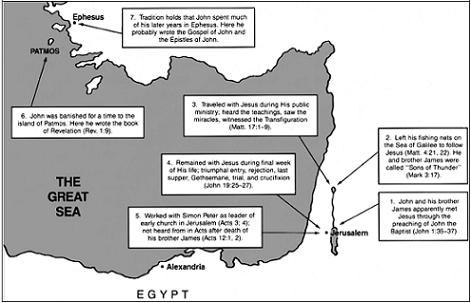
The MacArthur Bible Handbook, by John MacArthur (Nashville: Thomas Nelson Publishers, 2003) 496. © 2003 by Thomas Nelson, Inc.
1:15 John the Baptist’s testimony corroborates John the apostle’s statement regarding the eternality of the Incarnate Word (cf. v. 14).
1:16 grace for grace. This phrase emphasizes the superabundance of grace that has been displayed by God toward mankind, especially believers (Eph. 1:5–8; 2:7).
1:17, 18 Corroborating the truth of verse 14, these verses draw a closing contrast to the prologue. The Law, given by Moses, was not a display of God’s grace but God’s demand for holiness. God designed the Law as a means to demonstrate the unrighteousness of man in order to show the need for a Savior, Jesus Christ (Rom. 3:19, 20; Gal. 3:10–14, 21–26). Furthermore, the Law revealed only a part of truth and was preparatory in nature. The reality or full truth toward which the Law pointed came through the person of Jesus Christ.
1:18 who is in the bosom of the Father. This term denotes the mutual intimacy, love and knowledge existing in the Godhead (see 13:23; Luke 16:22, 23). declared. Theologians derived the term “exegesis” or “to interpret” from this word. John meant that all that Jesus is and does interprets and explains who God is and what He does (14:8–10).
II. THE PRESENTATION OF THE SON OF GOD (1:19–4:54)
A. Presentation by John the Baptist (1:19–34)
1. To the religious leaders (1:19–28)
1:19–37 In these verses, John presented the first of many witnesses to prove that Jesus is the Messiah and Son of God, thus reinforcing his main theme (20:30, 31). The testimony of John the Baptist was given on three different days to three different groups (cf. vv. 29, 35, 36). Each time, he spoke of Christ in a different way and emphasized distinct aspects regarding Him. The events in these verses took place in A.D. 26/27, just a few months after John’s baptism of Jesus (cf. Matt. 3:13–17; Luke 3:21, 22).
1:19 John. John, born into a priestly family, belonged to the tribe of Levi (Luke 1:5). He began his ministry in the Jordan Valley when he was approximately twenty-nine or thirty years old and boldly proclaimed the need for spiritual repentance and preparation for the coming of the Messiah. He was the cousin of Jesus Christ and served as His prophetic forerunner (Matt. 3:3; Luke 1:5–25, 36). the Jews . . . from Jerusalem. This may refer to the Sanhedrin, the main governing body of the Jewish nation. The Sanhedrin was controlled by the family of the high priest, and thus the envoys would naturally be priests and Levites who would be interested in John’s ministry, both his message and his baptism.
1:20 “I am not the Christ.” Some thought that John was the Messiah (Luke 3:15–17). Christ. The term “Christ” is the Greek equivalent of the Hebrew term for “Messiah.”
1:21 Are you Elijah? Malachi 4:5 (see note there ) promises that the prophet Elijah will return before Messiah establishes His earthly kingdom. “If John was the forerunner of Messiah, was he Elijah?” they asked. The angel announcing John’s birth said that John would go before Jesus “in the spirit and power of Elijah” (Luke 1:17), thus indicating that someone other than literal Elijah could fulfill the prophecy. God sent John who was like Elijah, i.e., one who had the same type of ministry, the same power and similar personality (2 Kin. 1:8; cf. Matt. 3:4). If they had received Jesus as Messiah, John would have fulfilled that prophecy (see notes on Matt. 11:14; Mark 9:13; Luke 1:17; Rev. 11:5, 6 ). Are you the Prophet? This is a reference to Deuteronomy 18:15–18 which predicted God would raise up a great prophet like Moses who would function as His voice. While some in John’s time interpreted this prophecy as referring to another forerunner of Messiah, the NT (Acts 3:22, 23; 7:37) applies the passage to Jesus.
1:23 John quoted and applied Isaiah 40:3 to himself (cf. Matt. 3:3; Mark 1:3; Luke 3:4). In the original context of Isaiah 40:3, the prophet heard a voice calling for the leveling of a path. This call was a prophetic picture that foreshadowed the final and greatest return of Israel to their God from spiritual darkness and alienation through the spiritual redemption accomplished by the Messiah (cf. Rom. 11:25–27). In humility, John compared himself to a voice rather than a person, thus focusing the attention exclusively upon Christ (cf. Luke 17:10).
1:25 baptize. Since John had identified himself as a mere voice (v. 23), the question arose as to his authority for baptizing. The OT associated the coming of Messiah with repentance and spiritual cleansing (Ezek. 36; 37; Zech. 13:1). John focused attention on his position as forerunner of Messiah, who used traditional proselyte baptism as a symbol of the need to recognize those Jews who were outside God’s saving covenant like Gentiles. They too needed spiritual cleansing and preparation (repentance; Matt. 3:11; Mark 1:4; Luke 3:7, 8) for Messiah’s advent. See notes on Matthew 3:6, 11, 16, 17 for an explanation of the significance of John’s baptism.
1:27 John the Baptist’s words here continue a theme of the preeminence of Messiah begun in the prologue (vv. 6–8, 15) and demonstrate extraordinary humility. Each time John had opportunity to focus on himself in these encounters, he instead shifted the focus onto Messiah. John went so far as to state that he, unlike a slave that was required to remove his master’s shoes, was not even worthy of performing this action in relationship to Messiah.
1:28 Bethabara. This word has been substituted for “Bethany” which is in the original text because some feel that John incorrectly identified Bethany as the place of these events. The better solution is that two Bethanys existed, i.e., one near Jerusalem where Mary, Martha, and Lazarus lived (11:1) and one “beyond the Jordan” near the region of Galilee. Since John took great pains to identify the other Bethany’s close proximity to Jerusalem, he most likely was referring here to that other town with the same name.
2. At Christ’s baptism (1:29–34)
1:29–34 This portion deals with John’s witness to a second group of Jews on the second day (see vv. 19–28 for the first group and day) regarding Jesus. This section forms something of a bridge. It continues the theme of John the Baptist’s witness but also introduces a lengthy list of titles applied to Jesus: Lamb of God (vv. 29, 36), Rabbi (vv. 38, 49), Messiah/Christ (v. 41), Son of God (vv. 34, 49), King of Israel (v. 49), Son of Man (v. 51), and “Him of whom Moses in the law, and also the prophets, wrote” (v. 45).
1:29 The next day. This phrase probably refers to the day after John’s response to the Jerusalem delegation. It also initiates a sequence of days (v. 43; 2:1) that culminated in the miracle at Cana (2:1–11). The Lamb of God. The use of a lamb for sacrifice was very familiar to Jews. A lamb was used as a sacrifice during Passover (Ex. 12:1–36); a lamb was led to the slaughter in the prophecies of Isaiah (Is. 53:7); a lamb was offered in the daily sacrifices of Israel (Ex. 29:38–42; Num. 28:1–8; cf. Heb. 10:5–7). John the Baptist used this expression as a reference to the ultimate sacrifice of Jesus on the Cross to atone for the sins of the world, a theme which John the apostle carries throughout his writings (19:36; cf. Rev. 5:1–6; 7:17; 17:14) and that appears in other NT writings (e.g., 1 Pet. 1:19). sin of the world. See note on verse 9; cf. 3:16; 6:33, 51. In this context “world” has the connotation of humanity in general, not specifically every person. The use of the singular “sin” in conjunction with “of the world” indicates that Jesus’ sacrifice for sin potentially reaches all human beings without distinction (cf. 1 John 2:2). John makes clear, however, that its efficacious effect is only for those who receive Christ (vv. 11, 12). For discussion of the relation of Christ’s death to the world, see note on 2 Corinthians 5:19.
1:31 I did not know Him. Although John was Jesus’ cousin, he did not know Jesus as the “Coming One” or “Messiah” (v. 30).
1:32 the Spirit descending. God had previously communicated to John that this sign was to indicate the promised Messiah (v. 33); so when John witnessed this act, he was able to identify the Messiah as Jesus (cf. Matt. 3:16; Mark 1:10; Luke 3:22).
1:34 the Son of God. Although, in a limited sense, believers can be called “sons of God” (e.g., v. 12; Matt. 5:9; Rom. 8:14), John uses this phrase with the full force as a title that points to the unique oneness and intimacy that Jesus sustains to the Father as “Son.” The term carries the idea of the deity of Jesus as Messiah (v. 49; 5:16–30; cf. 2 Sam. 7:14; Ps. 2:7; see notes on Heb. 1:1–9 ).
B. Presentation to John’s Disciples (1:35–51)
1:35–51 This portion deals with John’s witness to a third group (i.e., some of John’s disciples) on the third day (see vv. 19–28, 29–34 for the first and second groups), regarding Jesus. Consistent with John’s humility (v. 27), he focuses the attention of his own disciples onto Jesus (v. 37).
1:37 they followed Jesus. Although the verb “follow” usually means “to follow as a disciple” in the writing of the apostle (v. 43; 8:12; 12:26; 21:19, 20, 22), it may also have a neutral sense (11:31). The “following” here does not necessarily mean that they became permanent disciples at this time. The implication may be that they went after Jesus to examine Him more closely because of John’s testimony. This event constituted a preliminary exposure of John the Baptist’s disciples to Jesus (e.g., Andrew; 1:40). They eventually dedicated their lives to Him as true disciples and apostles when Jesus called them to permanent service after these events (Matt. 4:18–22; 9:9; Mark 1:16–20). At this point in the narrative, John the Baptist fades from the scene and the attention focuses upon the ministry of Christ.
1:39 the tenth hour. The Romans divided the 24 hour day into two periods of twelve hours each, starting at midnight. This would make the time about 10 a.m. John mentions the precise time, most likely, to emphasize that he was the other disciple of John the Baptist who was with Andrew (v. 40). As an eyewitness to these events occurring on three successive days, John’s first meeting with Jesus was so life-changing that he remembered the exact hour when he first met the Lord.
1:41 Messiah. The term Messiah is a transliteration of a Hebrew or Aramaic verbal adjective that means “Anointed One.” It comes from a verb that means “to anoint” someone as an action involved in consecrating that person to a particular office or function. While the term at first applied to the king of Israel (“the Lord’s anointed,” 1 Sam. 16:6), the high priest (“the anointed priest,” Lev. 4:3) and, in one passage, the patriarchs (“my anointed ones,” Ps. 105:15), the term eventually came to point, above all, to the prophesied “Coming One” or “Messiah” in His role as prophet, priest, and king. The term Christ, a Greek word (verbal adjective) that comes from a verb meaning “to anoint,” is used in translating the Hebrew term, so that the terms Messiah or Christ are titles and not personal names of Jesus.
1:42 when Jesus looked at him. Jesus knows hearts thoroughly (vv. 43–51) and not only sees into them (vv. 47, 48), but also transforms a person into what He wants him to become. You shall be called Cephas. Up to this time, Peter had been known as “Simon son of Jonah” (the name “Jonah” in Aramaic means “John”; cf. 21:15–17; Matt. 16:17). The term “Cephas” means “rock” in Aramaic which is translated “Peter” in Greek. Jesus’ assignment of the name “Cephas” or “Peter” to Simon occurred at the outset of his ministry (cf. Matt. 16:18; Mark 3:16). The statement not only is predictive of what Peter would be called but also declarative of how Jesus would transform his character and use him in relationship to the foundation of the church (cf. 21:18, 19; Matt. 16:16–18; Acts 2:14–4:32).
2. Philip and Nathaniel (1:43–51)
1:43–51 This section introduces the fourth day since the beginning of John the Baptist’s witness (cf. vv. 19, 29, 35).
1:44 Bethsaida, the city of Andrew and Peter. While Mark 1:21, 29 locates Peter’s house in Capernaum, John relates that he was from Bethsaida of Galilee (cf. 12:21; see note on Matt. 11:21 ). Resolution centers in the fact that Peter (and Andrew) most likely grew up in Bethsaida and later relocated to Capernaum in the same way that Jesus was consistently identified with His hometown of Nazareth, though He lived elsewhere later (Matt. 2:23; 4:13; Mark 1:9; Luke 1:26).
1:45 Him of whom Moses in the law, and also the prophets, wrote. This phrase encapsulates the stance of John’s whole Gospel: Jesus is the fulfillment of OT Scripture (cf. v. 21; 5:39; Deut. 18:15–19; Luke 24:44, 47; Acts 10:43; 18:28; 26:22, 23; Rom. 1:2; 1 Cor. 15:3; 1 Pet. 1:10, 11; Rev. 19:10).
1:46 Can anything good come out of Nazareth? Nathanael was from Cana (21:2), another town in Galilee. While Galileans were despised by Judeans, Galileans themselves despised people from Nazareth. In light of 7:52, Nathanael’s scorn may have centered in the fact that Nazareth was an insignificant village without seeming prophetic importance (cf., however, Matt. 2:23). Later, some would contemptuously refer to Christians as the “sect of the Nazarenes” (Acts 24:5).
1:47 no deceit. Jesus’ point was that Nathanael’s bluntness revealed that he was an Israelite without duplicitous motives who was willing to examine for himself the claims being made about Jesus. The term reveals an honest, seeking heart. The reference here may be an allusion to Genesis 27:35 where Jacob, in contrast to the sincere Nathanael, was known for his trickery. The meaning may be that the employment of trickery characterized not only Jacob but also his descendants. In Jesus’ mind, an honest and sincere Israelite had become an exception rather than the rule (cf. 2:23–25).
1:48 I saw you. This provides a brief glimpse of Jesus’ supernatural knowledge. Not only was Jesus’ brief summary of Nathanael accurate (v. 47), but He also revealed information that could only be known by Nathanael himself. Perhaps Nathanael had some significant or outstanding experience of communion with God at the location, and he was able to recognize Jesus’ allusion to it. At any rate, Jesus had knowledge of this event not available to men.
1:49 the Son of God! . . . the King of Israel! Jesus’ display of supernatural knowledge and Philip’s witness removed Nathanael’s doubts; so John added the witness of Nathanael to this section. The use of “the” with “Son of God” most likely indicates that the expression is to be understood as bearing its full significance (cf. v. 34; 11:27). For Nathanael, here was One who could not be described merely in human terms.
1:51 Most assuredly. Cf. 5:19, 24, 25. A phrase used frequently for emphasizing the importance and truth of the coming statement. heaven open, and the angels of God ascending and descending. In light of the context of verse 47, this verse most likely refers to Genesis 28:12 where Jacob dreamed about a ladder from heaven. Jesus’ point to Nathanael was that just like Jacob experienced supernatural or heaven-sent revelation, Nathanael and the other disciples would experience supernatural communication confirming who Jesus was. Moreover, the term “Son of Man” replaced the ladder in Jacob’s dream, signifying that Jesus was the means of access between God and man. Son of Man. See note on Matthew 8:20. This is Jesus’ favorite self-designation, for it was mostly spoken by Jesus who used it over eighty times. In the NT, it refers only to Jesus and appears mostly in the Gospels (cf. Acts 7:56). In the Fourth Gospel, the expression occurs thirteen times and is most commonly associated with the themes of crucifixion and suffering (3:14; 8:28) and revelation (6:27, 53), but also with eschatological authority (5:27). While the term at times may refer merely to a human being or as a substitute for “I” (6:27; cf. 6:20), it especially takes on an eschatological significance referring to Daniel 7:13, 14 where the “Son of Man” or Messiah comes in glory to receive the kingdom from the “Ancient of Days” (i.e., the Father).
C. Presentation in Galilee (2:1–12)
1. First sign: water to wine (2:1–10)
2:1–12 John relates the first great sign performed by Jesus to demonstrate His deity—the turning of water into wine. Only God can create from nothing. John identifies eight miracles in his Gospel that constitute “signs” or confirmation of who Jesus is. Each of the eight miracles were different; no two were alike (cf. v. 11).
2:1 On the third day. This phrase has reference to the last narrated event, i.e., the calling of Philip and Nathanael (1:43). wedding. Such a wedding celebration in Palestine could last for a week. Financial responsibility lay with the groom (vv. 9, 10). To run out of wine for the guests would have been an embarrassment to the groom and may have even opened him to a potential lawsuit from the relatives of the bride. Cana of Galilee. Cana was the home of Nathanael (21:2). Its exact location is unknown. A probable location is Khirbet Qana, a village now in ruins approximately nine miles north of Nazareth.
2:2 both Jesus and His disciples were invited. The fact that Jesus, His mother, and His disciples all attended the wedding suggests that the wedding may have been for a relative or close family friend. The disciples that accompanied Him are the five mentioned in chapter 1: Andrew, Simon Peter, Philip, Nathanael, and the unnamed disciple (1:35) who was surely John, who also witnessed this miracle.
2:3 wine. The wine served was subject to fermentation. In the ancient world, however, to quench thirst without inducing drunkenness, wine was diluted with water to between one-third and one-tenth of its strength. Due to the climate and circumstances, even “new wine” fermented quickly and had an inebriating effect, if not mixed (Acts 2:13). Because of a lack of water purification process, wine mixed with water was also safer to drink than water alone. While the Bible condemns drunkenness, it does not necessarily condemn the consumption of wine (Ps. 104:15; Prov. 20:1; see notes on Eph. 5:18 ).
2:4 Woman. The term is not necessarily impolite, but it does have the effect of distancing Jesus from His mother and her request. Perhaps it has the equivalent of “ma’am.” what does your concern have to do with Me? The expression, common in Semitic idiom (Judg. 11:12; 2 Sam. 16:10), always distances the two parties, the speaker’s tone conveying some degree of reproachapter Jesus’ tone was not rude, but abrupt. The phrase asks what is shared in common between the parties. The thrust of Jesus’ comment was that He had entered into the purpose for His mission on earth, so that He subordinated all activities to the fulfillment of that mission. Mary had to recognize Him not so much as a son that she raised, but as the promised Messiah and Son of God. Cf. Mark 3:31–35. My hour has not yet come. The phrase constantly refers to Jesus’ death and exaltation (7:30; 8:20; 12:23, 27; 13:1; 17:1). He was on a divine schedule decreed by God before the foundation of the world. Since the prophets characterized the messianic age as a time when wine would flow liberally (Jer. 31:12; Hos. 14:7; Amos 9:13, 14), Jesus was likely referring to the fact that the necessity of the Cross must come before the blessings of the millennial age.
2:6 purification of the Jews. The six water jars were made of stone because stone was more impervious than earthenware and did not contract uncleanness. Also, this made them more suitable to ceremonial washing (cf. Mark 7:3, 4).
2. Disciples believe (2:11, 12)
2:11 signs. John used the word sign here to refer to significant displays of power that pointed beyond themselves to the deeper divine realities that could be perceived by the eyes of faith. By this word, John emphasized that miracles were not merely displays of power, but had a significance beyond the mere acts themselves.
2:12 After this. The phrase “after this” (or similar wording such as “after these things”) is a frequent connective between narratives in this Gospel (e.g., 3:22; 5:1, 14; 6:1; 7:1; 11:7, 11; 19:28, 38). John placed this verse here as a transition to explain Jesus’ movement from Cana in Galilee to Capernaum and eventual arrival at Jerusalem for the Passover celebration. Capernaum was on the northwestern shore of Galilee about sixteen miles northeast of Cana.
D. Presentation in Judea (2:13–3:36)
1. Cleansing the temple (2:13–25)
2:13–25 John used this section where Jesus cleansed the temple in righteous indignation to reinforce his main theme that He was the promised Messiah and Son of God. In this section, he highlighted three attributes of Jesus that confirm His deity: (1) His passion for reverence (vv. 13–17); (2) His power of resurrection (vv. 18–22); and (3) His perception of reality (vv. 23–25).
2:13–17 The first way John demonstrated Christ’s deity in the narrative of the temple cleansing was to show His passion for reverence. God alone exercises the right to regulate His worship.
2:13 Passover of the Jews. This is the first of three Passovers which John mentions (v. 13; 6:4; 11:55). Jews selected the lamb on the tenth of the month, and celebrated Passover on the fourteenth day of the lunar month of Nisan (full moon at the end of March or beginning of April). They slaughtered the lamb between 3:00 and 6:00 P.M. on the night of the feast. Passover commemorates the deliverance of the Jews from slavery in Egypt when the angel of death “passed over” Jewish homes in Egypt whose “doorposts” were sprinkled with blood (Ex. 12:23–27). Jesus went up to Jerusalem. Jesus’ journeying to Jerusalem for the Passover was a standard, annual procedure for every devout Jewish male over twelve years old (Ex. 23:14–17). Jewish pilgrims crowded into Jerusalem for this greatest of Jewish feasts.
2:14 those who sold . . . the money changers. During the celebration of Passover, worshipers came from all over Israel and the Roman Empire to Jerusalem. Because many traveled large distances, it was inconvenient to bring their sacrificial animals with them. Opportunistic merchants, seeing a chance to provide a service and probably eyeing considerable profit during this time, set up areas in the outer courts of the temple in order for travelers to buy animals. The money changers were needed because the temple tax, paid annually by every conscientious Jewish male twenty years of age or older (Ex. 30:13, 14; Matt. 17:24–27), had to be in Jewish or Tyrian coinage (because of its high purity of silver). Those coming from foreign lands would need to exchange their money into the proper coinage for the tax. The money changers charged a high fee for the exchange. With such a large group of travelers and because of the seasonal nature of the celebration, both the animal dealers and money exchangers exploited the situation for monetary gain (“den of thieves”; Matt. 21:13). Religion had become crass and materialistic.
2:15 As John recorded this cleansing of the temple at the beginning of Jesus’ ministry, the synoptic Gospels record a temple cleansing at the end of Jesus’ ministry during the final Passover week before Jesus’ Crucifixion (Matt. 21:12–17; Mark 11:15–18; Luke 19:45, 46). The historical circumstances and literary contexts of the two temple cleansings differ so widely that attempts to equate the two are unsuccessful. Furthermore, that two cleansings occurred is entirely consistent with the overall context of Jesus’ ministry, for the Jewish nation as a whole never recognized Jesus’ authority as Messiah (Matt. 23:37–39). Instead, they rejected His message as well as His person, making such repeated cleansing of the temple highly probable (as well as necessary). drove them all out of the temple. When the holiness of God and His worship was at stake, Jesus took fast and furious action. The “all” indicates that He drove not only men out but also animals. Yet, although His physical action was forceful, it was not cruel. The moderation of His actions is seen in the fact that no riotous uproar occurred; otherwise the specially large contingent of Roman troops in Jerusalem at that time because of the Passover crowds, stationed in the Antonia Fortress overlooking the temple, would have reacted swiftly. Although the primary reference is to the actions of the Messiah in the millennial kingdom, Jesus’ actions in cleansing the temple were an initial fulfillment of Malachi 3:1–3 (and Zech. 14:20, 21) that speak of Messiah’s purifying the religious worship of His people.
2:16 Do not make. The force of the Greek imperative should better be translated “stop making,” indicating Jesus’ demand that they stop their current practice. God’s holiness demands holiness in worship. My Father’s. John gave a subtle hint of Jesus’ divine sonship as well as His messiahship with the recording of this phrase (see 5:17, 18). house a house of merchandise. Jesus may have intended a play on words. The word merchandise pictures a trading house filled with wares.
2:17 Quoted from Psalm 69:9 to indicate that Jesus would not tolerate irreverence toward God. When David wrote this psalm, he was being persecuted because of his zeal toward God’s house and his defense of God’s honor. The disciples were afraid that Jesus’ actions would precipitate the same type of persecution. Paul quotes the latter half of Psalm 69:9 (“The reproaches of those who reproached You fell on Me”) in Romans 15:3, clearly indicating the messianic nature that the psalm had for the early church.
2:18–22 The second way John demonstrated Christ’s deity in the account of the temple cleansing was to show His power over death through resurrection. Only God has this right.
2:18 the Jews. Most likely the temple authorities or representatives of the Sanhedrin (cf. 1:19). sign. The Jews demanded that Jesus show some type of miraculous sign that would indicate His authority for the actions that He had just taken in regulating the activities of the temple. Their demand for a sign reveals that they had not grasped the significance of Jesus’ rebuke that centered in their need for proper attitudes and holiness in worship. Such an action itself constituted a “sign” of Jesus’ person and authority. Moreover, they were requesting from Jesus a crass display of miracles on demand, further displaying their unbelief.
2:19 At his trial, the authorities charged Jesus (Mark 14:58; 15:29) with making a threatening statement against the temple, revealing that they did not understand Jesus’ response here. Once again, John’s Gospel supplements the other Gospels at this point by indicating that Jesus enigmatically referred to His Resurrection. As with His usage of parables, Jesus’ cryptic statement most likely was designed to reveal the truth to His disciples but conceal its meaning from unbelievers who questioned Him (Matt. 13:10, 11). Only after His Resurrection, however, did the disciples understand the real significance of this statement (v. 22; cf. Matt. 12:40). Importantly, through the death and resurrection of Christ, temple worship in Jerusalem was destroyed (cf. 4:21) and reinstituted in the hearts of those who were built into a spiritual temple called the church (Eph. 2:19–22).
2:20 forty-six years to build this temple. This was not a reference to the Solomonic temple, since it had been destroyed during the Babylonian conquest in 586 B.C. When the captives returned from Babylon, Zerubbabel and Joshua began rebuilding the temple (Ezra 1–4). Encouraged by the prophets Haggai and Zechariah (Ezra 5:1–6:18), the Jews completed the work in 516 B.C. In 20/19 B.C. Herod the Great began a reconstruction and expansion. Workers completed the main part of the project in ten years, but other parts were still being constructed even at the time Jesus cleansed the temple. Interestingly, the finishing touches on the whole enterprise were still being made at its destruction by the Romans, along with Jerusalem in A.D. 70. The famous “Wailing Wall” is built on part of the Herodian temple foundation.
2:23–25 The third way John demonstrated Christ’s deity in the account of the temple cleansing was to show His perception of reality. Only God truly knows the hearts of men.
2:23, 24 many believed in His name. . . . But Jesus did not commit Himself. John based both of these two phrases on the same Greek verb for “believe.” This verse subtly reveals the true nature of belief from a biblical standpoint. Because of what they knew of Jesus from His miraculous signs, many came to believe in Him. However, Jesus made it His habit not to wholeheartedly “entrust” or “commit” Himself to them because He knew their hearts. Verse 24 indicates that Jesus looked for genuine conversion rather than enthusiasm for the spectacular. The latter verse also leaves a subtle doubt as to the genuineness of the conversion of some (cf. 8:31, 32). This emphatic contrast between verses 23, 24 in terms of type of trust, therefore, reveals that literally “belief into His name” involved much more than intellectual assent. It called for whole-hearted commitment of one’s life as Jesus’ disciple (cf. Matt. 10:37; 16:24–26).
2. Teaching Nicodemus (3:1–21)
3:1–21 The story of Jesus and Nicodemus reinforces John’s themes that Jesus is the Messiah and Son of God (apologetic) and that He came to offer salvation to men (evangelistic). John 2:23, 24 actually serves as the introduction to Nicodemus’s story, since chapter 3 constitutes tangible evidence of Jesus’ ability to know men’s hearts and, thereby, also demonstrates Jesus’ deity. Jesus also presented God’s plan of salvation to Nicodemus, showing that He was God’s messenger, whose redemptive work brings about the promised salvation to His people (v. 14). The chapter may be divided into two sections: (1) Jesus’ dialogue with Nicodemus (vv. 1–10) and (2) Jesus’ discourse on God’s plan of salvation (vv. 11–21).
3:1–10 This section on Jesus’ dialogue with Nicodemus may be divided into three sections: (1) Nicodemus’ inquiry of Jesus (vv. 1–3); (2) Jesus’ insight into Nicodemus (vv. 4–8); and (3) Jesus’ indictment of Nicodemus (vv. 9, 10).
3:1 Pharisees. See note on Matthew 3:7. The word Pharisee most likely comes from a Hebrew word meaning “to separate” and, therefore, probably means “separated ones.” They were not separatists in the sense of isolationists, but in the puritanical sense, i.e., they were highly zealous for ritual and religious purity according to the Mosaic Law as well as their own traditions that they added to the OT legislation. Although their origin is unknown, they seem to have arisen as an offshoot from the “Hasidim” or “pious ones” during the Maccabean era. They were generally from the Jewish middle class and mostly consisted of laity (businessmen), rather than priests or Levites. They represented the orthodox core of Judaism and very strongly influenced the common people of Israel. According to Josephus, 6,000 Pharisees existed at the time of Herod the Great. Jesus condemned them for their hyperconcentration on externalizing religion (rules and regulations), rather than inward spiritual transformation (vv. 3, 7). Nicodemus. Although Nicodemus was a Pharisee, his name was Greek in origin and means “victor over the people.” He was a prominent Pharisee and member of the Sanhedrin (“a ruler of the Jews”). Nothing is known about his family background. He eventually came to believe in Jesus (7:50–52), risking his own life and reputation by helping to give Jesus’ body a decent burial (19:38–42). a ruler of the Jews. This is a reference to the Sanhedrin (see note on Matt. 26:59 ), the main ruling body of the Jews in Palestine. It was the Jewish “supreme court” or ruling council of the time and arose, most likely, during the Persian period. In NT times, the Sanhedrin was composed of the high priest (president), chief priests, elders (family heads), and scribes for a total of seventy-one people. The method of appointment was both hereditary and political. It executed both civil and criminal jurisdiction according to Jewish law. However, capital punishment cases required the sanction of the Roman procurator (18:30–32). After A.D. 70 and the destruction of Jerusalem, the Sanhedrin was abolished and replaced by the Beth Din (court of Judgment) composed of scribes whose decisions had only moral and religious authority.
3:2 came to Jesus by night. While some have thought that Nicodemus’ visit at night was somehow figurative of the spiritual darkness of his heart (cf. 1:5; 9:4; 11:10; 13:30) or that he decided to come at this time because he could take more time with Jesus and be unhurried in conversation, perhaps the most logical explanation lies in the fact that, as a ruler of the Jews, Nicodemus was afraid of the implications of associating openly in conversation with Jesus. He chose night in order to have a clandestine meeting with Jesus, rather than risk disfavor with his fellow Pharisees among whom Jesus was generally unpopular.
3:3 born again. The phrase literally means “born from above.” Jesus answered a question that Nicodemus did not even ask. He read Nicodemus’ heart and came to the very core of his problem, i.e., the need for spiritual transformation or regeneration produced by the Holy Spirit. New birth is an act of God whereby eternal life is imparted to the believer (2 Cor. 5:17; Titus 3:5; 1 Pet. 1:3; 1 John 2:29; 3:9; 4:7; 5:1, 4, 18). John 1:12, 13 indicates that “born again” also carries the idea “to become children of God” through trust in the name of the incarnate Word. cannot see the kingdom of God. In context, this is primarily a reference to participation in the millennial kingdom at the end of the age, fervently anticipated by the Pharisees and other Jews. Since the Pharisees were supernaturalists, they naturally and eagerly expected the coming of the prophesied resurrection of the saints and institution of the messianic kingdom (Is. 11:1–16; Dan. 12:2). Their problem was that they thought that mere physical lineage and keeping of religious externals qualified them for entrance into the kingdom, rather than the needed spiritual transformation which Jesus emphasized (cf. 8:33–39; Gal. 6:15). The coming of the kingdom at the end of the age can be described as the “regeneration” of the world (Matt. 19:28), but regeneration of the individual is required before the end of the world in order to enter the kingdom.
3:4 A teacher himself, Nicodemus understood the rabbinical method of using figurative language to teach spiritual truth. He was merely picking up Jesus’ symbolism.
3:5 born of water and the Spirit. Jesus referred not to literal water here, but to the need for “cleansing” (e.g., Ezek. 36:24–27). When water is used figuratively in the OT, it habitually refers to renewal or spiritual cleansing, especially when used in conjunction with “spirit” (Num. 19:17–19; Ps. 51:9, 10; Is. 32:15; 44:3–5; 55:1–3; Jer. 2:13; Joel 2:28, 29). Thus, Jesus made reference to the spiritual washing or purification of the soul, accomplished by the Holy Spirit through the Word of God at the moment of salvation (cf. Eph. 5:26; Titus 3:5), required for belonging to His kingdom.
3:8 The wind blows where it wishes. Jesus’ point was that just as the wind cannot be controlled or understood by human beings but its effects can be witnessed, so also it is with the Holy Spirit. He cannot be controlled or understood, but the proof of His work is apparent. Where the Spirit works, there is undeniable and unmistakable evidence.
3:10 the teacher. The use of the definite article “the” indicates that Nicodemus was a renowned master-teacher in the nation of Israel, an established religious authority par excellence. He enjoyed a high standing among the rabbis or teachers of his day. Jesus’ reply emphasized the spiritual bankruptcy of the nation at that time, since even one of the greatest of Jewish teachers did not recognize this teaching on spiritual cleansing and transformation based clearly in the OT (cf. v. 5). The net effect is to show that externals of religion may have a deadening effect on one’s spiritual perception.
3:11–21 The focus of these verses turns away from Nicodemus and centers on Jesus’ discourse regarding the true meaning of salvation. The key word in these verses is “believe,” used seven times. The new birth must be appropriated by an act of faith. While verses 1–10 center on the divine initiative in salvation, verses 11–21 emphasize the human reaction to the work of God in regeneration. In verses 11–21, the section may be divided into three parts: (1) the problem of unbelief (vv. 11, 12); (2) the answer to unbelief (vv. 13–17); and (3) the results of unbelief (vv. 18–21).
3:11, 12 Jesus focused on the idea that unbelief is the cause of ignorance. At heart, Nicodemus’s failure to understand Jesus’ words centered not so much in his intellect, but in his failure to believe Jesus’ witness.
3:11 you do not receive Our witness. The plural “you” here refers back to the “we” of verse 2, where Nicodemus was speaking as a representative of his nation Israel (“we know”). Jesus replied in verse 11 with “you,” indicating that Nicodemus’ unbelief was typical of the nation as a collective whole.
3:13 No one has ascended to heaven. This verse contradicts other religious systems’ claims to special revelation from God. Jesus insisted that no one has ascended to heaven in such a way as to return and talk about heavenly things (cf. 2 Cor. 12:1–4). Only He had His permanent abode in heaven prior to His Incarnation and, therefore, only He has the true knowledge regarding heavenly wisdom (cf. Prov. 30:4).
3:14 so must the Son of Man be lifted up. Cf. 8:28; 12:32, 34; 18:31, 32. This is a veiled prediction of Jesus’ death on the Cross. Jesus referred to the story of Numbers 21:5–9 where the Israelite people who looked at the serpent lifted up by Moses were healed. The point of this illustration or analogy is in the “lifted up.” Just as Moses lifted up the snake on the pole so that all who looked upon it might live physically, those who look to Christ, who was “lifted up” on the Cross, will live spiritually and eternally.
The Definitive Christological Passages
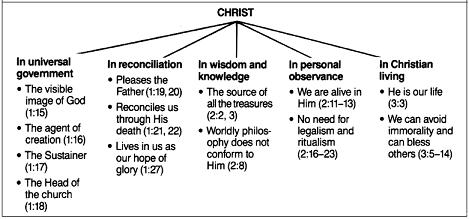
Nelson’s Complete Book of Bible Maps & Charts (Nashville: Thomas Nelson Publishers, 1996) 423. © 1993 by Thomas Nelson, Inc.
3:15 eternal life. This is the first of ten references to “eternal life” in John’s Gospel. The same Greek word is translated eight times as “everlasting life.” The two expressions appear in the NT nearly fifty times. Eternal life refers not only to eternal quantity, but divine quality of life. It means literally “life of the age to come” and refers, therefore, to resurrection and heavenly existence in perfect glory and holiness. This life for believers in the Lord Jesus is experienced before heaven is reached. This “eternal life” is in essence nothing less than participation in the eternal life of the Living Word, Jesus Christ. It is the life of God in every believer, yet not fully manifest until the resurrection (Rom. 8:19–23; Phil. 3:20, 21).
3:16 For God so loved the world. The Son’s mission is bound up in the supreme love of God for the evil, sinful “world” of humanity (cf. 6:32, 51; 12:47; see notes on 1:9; Matt. 5:44, 45 ) that is in rebellion against Him. The word so emphasizes the intensity or greatness of His love. The Father gave His unique and beloved Son to die on behalf of sinful men (see note on 2 Cor. 5:21 ). everlasting life. See note on verse 15; cf. 17:3; 1 John 5:20.
3:18 believed in the name. This phrase (lit. “to believe into the name”) means more than mere intellectual assent to the claims of the gospel. It includes trust and commitment to Christ as Lord and Savior which results in receiving a new nature (v. 7) which produces a change in heart and obedience to the Lord (see note on 2:23, 24 ).
3. Preaching by John the Baptist (3:22–36)
3:22–36 This section constitutes John the Baptist’s last testimony in this Gospel regarding Christ. As his ministry faded away, Jesus’ ministry moved to the forefront. In spite of the fact that John the Baptist received widespread fame in Israel and was generally accepted by the common people of the land as well as those who were social outcasts, his testimony regarding Jesus was rejected, especially by the leaders of Israel (cf. Matt. 3:5–10; Luke 7:29).
3:22 into the land of Judea. While the previous episode with Nicodemus took place in Jerusalem (2:23), which was part of Judea, the phrase here means that Jesus went out into the rural areas of that region. baptized. Jesus did not personally baptize, but His disciples carried on this work (cf. 4:2).
3:23 Aenon near Salim. The exact location of this reference is disputed. The phrase may refer to either Salim near Shechem or Salim that is six miles south of Beth Shean. Both are in the region of Samaria. Aenon is a transliterated Hebrew word meaning “springs,” and both of these possible sites have plenty of water (“much water there”).
3:24 John had not yet been thrown into prison. This provides another indication that John supplemented the synoptic gospels by providing additional information that helps further understanding of the movements of John the Baptist and Jesus (see Introduction: Background and Setting). In Matthew and Mark, Christ’s temptation is followed by John’s imprisonment. With this phrase, John the apostle fills in the gap between Jesus’ baptism and temptation and the Baptist’s imprisonment.
3:25 there arose a dispute. The dispute probably concerned the relation of the baptismal ministries of John and Jesus to the Jews’ purification practices alluded to in 2:6. The real underlying impetus, however, centered in the concern of John’s disciples that Jesus was in competition with him.
3:25–36 This section may be divided into three parts which highlight the significance of what was occurring in relationship to John’s and Jesus’ ministry: (1) John the Baptist constituted the end of the old age (vv. 25–29); (2) the transition to Jesus’ ministry (v. 30); and (3) Jesus’ ministry as constituting the beginning of the new age (vv. 31–36). Instead of jealousy, John exhibited humble faithfulness to the superiority of Jesus’ person and ministry.
3:26 all are coming to Him. The potential conflict between John and Jesus was heightened by the fact that both were engaged in ministry in close proximity to one another. Because baptism is mentioned in verse 22, Jesus may have been close to Jericho near the fords of the Jordan, while John was a short distance north baptizing at Aenon. John’s followers were especially disturbed by the fact that so many people were flocking to Jesus, whereas formerly they had come to John.
3:27 given to him from heaven. This verse emphasizes God’s sovereign authority in granting ministry opportunity (cf. 1 Cor. 4:7; 15:10).
3:29 bridegroom . . . friend of bridegroom. John conveyed his understanding of his own role through the use of a parable. The “friend of the bridegroom” was the ancient equivalent of the best man who organized the details and presided over the Judean wedding (Galilean weddings were somewhat different). This friend found his greatest joy in watching the ceremony proceed without problems. Most likely, John was also alluding to OT passages where faithful Israel is depicted as the bride of the Lord (Is. 62:4, 5; Jer. 2:2; Hos. 2:16–20).
3:31–36 In these verses, John the Baptist gave five reasons for Christ’s superiority to him: (1) Christ had a heavenly origin (v. 31); (2) Christ knew what was true by firsthand experience (v. 32); (3) Christ’s testimony always agreed with God (v. 33); (4) Christ experienced the Holy Spirit in an unlimited manner (v. 34); and (5) Christ was supreme because the Father sovereignly had granted that status to Him (v. 35).
3:31, 32 above all. These verses bring together several of the themes from the entire chapter. From the immediate context, John explained why Jesus the incarnate word must become greater, i.e., He alone is “from above” (heavenly origin) and therefore “above all.” The Greek term “above all” recalls verse 3 where the new birth “from above” can only be experienced by faith in the One who is “from above.” In contrast, all others are “of the earth” signifying finitude and limitation. In the immediate context, John the Baptist had to become less (v. 30) because he was “of the earth” and belonged to the earth. Although he called for repentance and baptism, John could not reveal heaven’s counsel like Jesus, the God-Man.
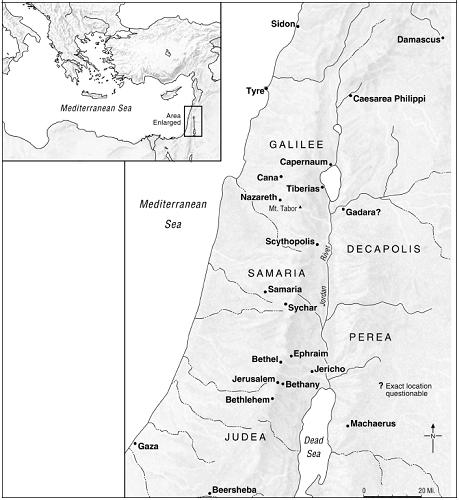
The MacArthur Bible Handbook, by John MacArthur (Nashville: Thomas Nelson Publishers, 2003) 340. © 2003 by Thomas Nelson, Inc.
3:34 the Spirit by measure. God gave the Spirit to the Son without limits (1:32, 33; Is. 11:2; 42:1; 61:1).
3:36 This constitutes a fitting climax to the chapter. John the Baptist laid out two alternatives, genuine faith and defiant disobedience, thereby bringing to the forefront the threat of looming judgment. As John faded from the forefront, he offered an invitation to faith in the Son and clearly expressed the ultimate consequence of failure to believe (i.e., “the wrath of God”).
E. Presentation in Samaria (4:1–42)
1. Witness to the Samaritan woman (4:1–26)
4:1–26 The story of the Samaritan woman reinforces John’s main theme that Jesus is the Messiah and Son of God. The thrust of these verses is not so much her conversion, but that Jesus is Messiah (v. 26). While her conversion is clearly implied, the apostle’s focus centers on Jesus’ declaration foretold in the Scriptures (v. 25). Important also is the fact that this chapter demonstrates Jesus’ love and understanding of people. His love for mankind involved no boundaries, for He lovingly and compassionately reached out to a woman who was a social outcast. In contrast to the limitations of human love, Christ exhibits the character of divine love that is indiscriminate and all-encompassing (3:16).
4:3 He left Judea. John the Baptist and Jesus had official scrutiny focused on them because of their distinctive message regarding repentance and the kingdom. Most likely, Jesus wanted to avoid any possible trouble with John’s disciples who were troubled with His growing popularity and, since the Pharisees were also focusing on His growing influence, Jesus decided to leave Judea and travel morth in order to avoid any conflict.
4:4 He needed to go through. Several roads led from Judea to Galilee: one near the seacoast; another through the region of Perea; and one through the heart of Samaria. Even with the strong antipathy between Jews and Samaritans, the Jewish historian Josephus relates that the custom of Judeans at the time of the great festivals was to travel through the country of the Samaritans because it was the shorter route. Although the verb “needed” may possibly refer to the fact that Jesus wanted to save time and needless steps, because of the Gospel’s emphasis on the Lord’s consciousness of fulfilling His Father’s plan (2:4; 7:30; 8:20; 12:23; 13:1; 14:31), the apostle may have been highlighting divine, spiritual necessity, i.e., Jesus had an appointment with divine destiny in meeting the Samaritan woman, to whom He would reveal His messiahship. Samaria. When the nation of Israel split politically after Solomon’s rule, King Omri named the capital of the northern kingdom of Israel “Samaria” (1 Kin. 16:24). The name eventually referred to the entire district and sometimes to the entire northern kingdom, which had been taken captive (capital, Samaria) by Assyria in 722 B.C. (2 Kin. 17:1–6). While Assyria led most of the populace of the ten northern tribes away (into the region which today is northern Iraq), it left a sizable population of Jews in the northern Samaritan region and transported many non-Jews into Samaria. These groups intermingled to form a mixed race through intermarriage. Eventually tension developed between the Jews who returned from captivity and the Samaritans. The Samaritans withdrew from the worship of Yahweh at Jerusalem and established their worship at Mount Gerizim in Samaria (vv. 20–22). Samaritans regarded only the Pentateuch as authoritative. As a result of this history, Jews repudiated Samaritans and considered them heretical. Intense ethnic and cultural tensions raged historically between the two groups so that both avoided contact as much as possible (v. 9; Ezra 4:1–24; Neh. 4:1–6; Luke 10:25–37). See note on 2 Kings 17:24.
4:5 Sychar. This town is probably identified with the modern village of Askar on the shoulder of Mount Ebal, opposite Mount Gerizim. A continuous line of tradition identifies Jacob’s well as lying about one-half mile south of Askar.
4:5, 6 These verses refer back to Genesis 48:22 where Jacob bequeathed a section of land to Joseph which he had purchased from the “children of Hamor” (cf. Gen. 33:19). When the Jews returned from Egypt, they buried Joseph’s bones in that land at Shechem. This area became the inheritance of Joseph’s descendants. The precise location of “Jacob’s well” has been set by a firm tradition among Jews, Samaritans, Muslims, and Christians and lies today in the shadow of the crypt of an unfinished Orthodox church. The term used here for “well” denotes a running spring, while in verses 11, 12 John used another term for “well” that means “cistern” or “dug-out-well” indicating that the well was both dug out and fed by an underground spring. This spring is still active today.
4:6 wearied from His journey. Since the Word became flesh (1:14), He also suffered from physical limitations in His humanity (Heb. 2:10–14). the sixth hour. If John used Roman time, which started reckoning from 12:00 P.M., the time would be about 6:00 P.M.
4:7 A woman of Samaria came to draw water. Women generally came in groups to collect water, either earlier or later in the day to avoid the sun’s heat. If the Samaritan woman alone came at 12:00 P.M. (see note on v. 6 ), this may indicate that her public shame (vv. 16–19) caused her to be isolated from other women. Give Me a drink. For a Jewish man to speak to a woman in public, let alone to ask from her, a Samaritan, a drink, was a definite breach of rigid social custom as well as a marked departure from the social animosity that existed between the two groups. Further, a “rabbi” and religious leader did not hold conversations with women of ill repute (v. 18).
4:8 to buy food. This verse indicates that since Jesus and His disciples were willing to purchase food from Samaritans, they did not follow some of the self-imposed regulations of stricter Jews, who would have been unwilling to eat food handled by outcast Samaritans.
4:10 living water. The OT is the background for this term, which has important metaphorical significance. In Jeremiah 2:13, Yahweh decries the disobedient Jews for rejecting Him, the “fountain of living waters.” The OT prophets looked forward to a time when “living waters shall flow from Jerusalem” (Ezek 47:9; Zech. 14:8). The OT metaphor spoke of the knowledge of God and His grace which provides cleansing, spiritual life, and the transforming power of the Holy Spirit (cf. Is. 1:16–18; 12:3; 44:3; Ezek. 36:25–27). John applies these themes to Jesus Christ as the living water which is symbolic of eternal life mediated by the Holy Spirit from Him (cf. v. 14; 6:35; 7:37–39). Jesus used the woman’s need for physical water to sustain life in this arid region in order to serve as an object lesson for her need for spiritual transformation.
4:15 The woman, like Nicodemus (3:4), did not realize that Jesus was talking about her spiritual needs. Instead, in her mind, she wanted such water in order to avoid her frequent trips to Jacob’s well.
4:16 call your husband. Since the woman failed to understand the nature of the living water He offered (v. 15), Jesus abruptly turned the dialogue to focus sharply on her real spiritual need for conversion and cleansing from sin. His intimate knowledge of her morally depraved life not only indicated His supernatural ability, but also focused on her spiritual condition.
4:18 not your husband. She was living conjugally with a man who Jesus said was not her husband. By such an explicit statement, our Lord rejected the notion that when two people live together it constitutes marriage. Biblically, marriage is always restricted to a public, formal, official, and recognized covenant.
4:19 You are a prophet. Jesus’ knowledge of her life indicated He had supernatural inspiration.
4:20 on this mountain. Both Jews and Samaritans recognized that God had commanded their forefathers to identify a special place for worshiping Him (Deut. 12:5). The Jews, recognizing the entire Hebrew canon, chose Jerusalem (2 Sam. 7:5–13; 2 Chr. 6:6). The Samaritans, recognizing only the Pentateuch, noted that the first place Abraham built an altar to God was at Shechem (Gen. 12:6, 7), which was overlooked by Mt. Gerizim, where the Israelites had shouted the blessings promised by God before they entered the Promised Land (Deut. 11:29, 30). As a result, they chose Mt. Gerizim for the place of their temple.
4:21 neither on this mountain, nor in Jerusalem. There was no reason to debate locations, since both places would be obsolete soon and neither would have any role to play in the lives of those who genuinely worship God. Jerusalem would even be destroyed, with its temple (A.D. 70).
4:22 you do not know. The Samaritans did not know God. They did not have the full revelation of Him, and thus could not worship in truth. The Jews did have the full revelation of God in the OT; thus, they knew the God they worshiped, because salvation’s truth came first to them (see note on Luke 19:9 ) and through them to the world (cf. Rom. 3:2; 9:4, 5).
4:23 hour. This refers to Jesus’ death, Resurrection, and Ascension to God, having completed redemption. true worshipers. Jesus’ point is that in light of His coming as Messiah and Savior, worshipers will be identified, not by a particular shrine or location, but by their worship of the Father through the Son. With Christ’s coming, previous distinctions between true and false worshipers based on locations disappeared. True worshipers are all those everywhere who worship God through the Son, from the heart (cf. Phil. 3:3).
4:24 God is Spirit. This verse represents the classical statement on the nature of God as Spirit. The phrase means that God is invisible (Col. 1:15; 1 Tim. 1:17; Heb. 11:27) as opposed to the physical or material nature of man (1:18; 3:6). The word order of this phrase puts an emphasis on “Spirit,” and the statement is essentially emphatic. Man could never comprehend the invisible God unless He revealed Himself, as He did in Scripture and the incarnation. must worship. Jesus is not speaking of a desirable element in worship but that which is absolutely necessary. in spirit and truth. The word spirit does not refer to the Holy Spirit, but to the human spirit. Jesus’ point here is that a person must worship not simply by external conformity to religious rituals and places (outwardly), but inwardly (“in spirit”) with the proper heart attitude. The reference to “truth” refers to worship of God consistent with the revealed Scripture and centered on the “Word made flesh” who ultimately revealed His Father (14:6).
4:25 Messiah. The Samaritans also anticipated Messiah’s coming.
4:26 I who speak to you am He. Jesus forthrightly declared Himself to be Messiah, though His habit was to avoid such declarations to His own Jewish people who had such crassly political and militaristic views regarding Messiah (cf. 10:24; Mark 9:41). The “He” in this translation is not in the original Greek for Jesus lit. said “I who speak to you am.” The usage of “I am” is reminiscent of 8:58 (see notes there ). This claim constitutes the main point of the story regarding the Samaritan woman.
4:27–42 These verses reinforce Jesus’ acknowledgment that He was Messiah by offering proof for His claim. John gave five genuine, but subtle, proofs that Jesus was truly Messiah and Son of God which reinforced his main theme of 20:31: (1) proof from His immediate control of everything (v. 27); (2) proof from His impact on the woman (vv. 28–30); (3) proof from His intimacy with the Father (vv. 31–34); (4) proof from His insight into men’s souls (vv. 35–38); and (5) proof from His impression on the Samaritans (vv. 39–42).
2. Witness to the disciples (4:27–38)
4:27 at this point. Had the disciples arrived earlier, they would have interrupted and destroyed the conversation; and if they had arrived any later, she would have gone and they would not have heard His declaration of messiahship. This feature subtly reveals Jesus’ divine control over the situation that was occurring.
4:28–31 to the men. Jesus had such an impact on the woman that she was eager to share the news among the townspeople whom she had previously avoided because of her reputation. Her witness and candor regarding her own life so impressed them that they came to see Jesus for themselves.
4:32, 33 I have food. Just like the Samaritan woman’s misunderstanding of Jesus words regarding literal water (v. 15), Jesus’ own disciples thought only of literal food. John commonly used such misunderstanding to advance the argument of his Gospel (e.g., 2:20; 3:3).
4:34 My food is to do the will of Him who sent Me. Most likely, Jesus echoed Deuteronomy 8:3 where Moses stated, “man shall not live by bread alone; but man lives by every word that proceeds from the mouth of the LORD” (cf. Matt. 4:4; Luke 4:4). When He talked with the Samaritan woman, Jesus was performing the will of the Father and thereby received greater sustenance and satisfaction than any mere physical food could offer Him (5:23, 24; 8:29; 17:4). Obedience to and dependence upon God’s will summed up Jesus’ whole life (Eph. 5:17). God’s will for Him to finish is explained in 6:38–40 (see note on 6:40).
4:35 four months and then comes the harvest. The event probably happened in December or January which was four months before the normal spring harvest (mid-April). Crops were planted in November, and by December or January the grain would be sprouting up in vibrant green color. Jesus used the fact that they were surrounded by crops growing in the field and waiting to be harvested as an object lesson to illustrate His urgency about reaching the lost which the “harvest” symbolized. Jesus points out the Samaritan woman and people of Sychar (“lift up your eyes”) who were at that moment coming upon the scene (v. 30) looking like a ripened “harvest” that urgently need to be “gathered” (i.e., evangelized). already white for harvest. Their white clothing seen above the growing grain may have looked like white heads on the stalks, an indication of readiness for harvest. Jesus knew the hearts of all (2:24), so He was able to state their readiness for salvation (cf. vv. 39–41).
4:36–38 The Lord’s call to His disciples to do the work of evangelism contains promises of reward (“wages”), fruit that brings eternal joy (v. 36), and the mutual partnership of shared privilege (vv. 37, 38).
3. Witness to the Samaritans (4:39–42)
4:42 Savior of the world. This phrase occurs also in 1 John 4:14. The verse constitutes the climax to the story of the woman of Samaria. The Samaritans themselves became another in a series of witnesses in John’s Gospel that demonstrated the identity of Jesus as the Messiah and Son of God. This episode represents the first instance of cross-cultural evangelism (Acts 1:8).
F. Presentation in Galilee (4:43–54)
1. Reception by the Galileans (4:43–45)
4:43–54 The episode of Jesus’ healing the official’s son constitutes the second major “sign” of eight which John used to reinforce Jesus’ true identity for producing belief in his readers (v. 54). In this episode, Jesus chided the official’s unbelief in needing a miraculous sign in order to trust in Christ (v. 48). While some believe that this story is the same as the healing of the centurion’s servant (Matt. 8:5–13; Luke 7:2–10), sufficient differences exist to demonstrate that it is different from the synoptic account; e.g., (1) no evidence exists that the official’s son was a Gentile; (2) the official’s son, not his servant, was healed; and (3) Jesus was far more negative regarding the official’s faith (v. 48) than the centurion’s (Matt. 8:10). One may divide this section into three parts: (1) Jesus contemplating unbelief (vv. 43–45); (2) Jesus confronting unbelief (vv. 46–49); and (3) Jesus conquering unbelief (vv. 50–54).
4:43 went to Galilee. After two days in Samaria, Jesus traveled to Galilee, resuming the trip that began in verse 3.
4:44 prophet has no honor in his own country. This proverb (also in Matt. 13:57; Mark 6:4) contrasts the believing response of the Samaritans (v. 39) with the characteristic unbelief of Jesus’ own people in Galilee (and Judea) whose reticent faith depended so much on Jesus’ performance of miracles (v. 48). While in Samaria, Jesus had enjoyed His first unqualified and unopposed success. His own people’s hearts were not open to Him, but exhibited reluctance and hardness.
4:45 the Galileans received Him. The apostle may have meant these words as irony especially in light of the surrounding context of verses 44, 48. The reception was likely that of curiosity seekers whose appetite centered more on seeing miracles than believing in Jesus as Messiah—as it had been at “the feast” (see notes on 2:23–25 ).
2. Second sign: healing the nobleman’s son (4:46–54)
4:46 Cana of Galilee. The deep irony of the statement in verse 45 increases with the fact that Jesus had only recently performed a miracle in Cana at the wedding. Instead of responding in belief, the people wanted more (see note on v. 48 ). The basis of their welcome was extremely crass. nobleman. The Greek term means “royal official” and most likely designated someone officially attached to the service of King Herod Antipas, Tetrarch of Galilee from 4 B.C. to A.D. 39. sick at Capernaum. Capernaum was approximately sixteen miles northeast of Cana.
4:47 implored Him. The language here indicates that he repeatedly begged Jesus to heal his son. His approach to Jesus was out of desperation, but he had little appreciation of who Jesus was. In light of verse 46, apparently the nobleman’s motivation centered in Jesus’ reputation as a miracle worker rather than as Messiah.
4:48 Unless you people see signs and wonders. The “you” is plural. Jesus addresses these words to the Galileans as a whole and not just to the nobleman (see notes on vv. 45, 46 ). The response of the Galileans was fundamentally flawed because it disregarded the person of Christ and centered in the need for a constant display of miraculous signs. Such an attitude represents the deepest state of unbelief.
4:50 your son lives. Jesus met the demands of Galilean unbelief by healing the official’s son, revealing not only His sympathy, but His marvelous graciousness in spite of such a faithless demand for miracles.
4:52 the seventh hour. About 7 P.M., reckoning from noon. See note on verse 6.
4:53 at the same hour. The time when the official’s son improved corresponded precisely with the time that he had spoken with Jesus. This served to strengthen the nobleman’s faith and, as a result, the “whole household” believed.
III. THE OPPOSITION TO THE SON OF GOD (5:1–12:50)
A. Opposition at the Feast in Jerusalem (5:1–47)
1. Third sign: healing the paralytic (5:1–9)
5:1–7:52 This section evidences the shift from reservation and hesitation about Jesus as Messiah (3:26; 4:1–3) to outright rejection (7:52). The opposition started with controversy regarding Jesus’ healing on the Sabbath (vv. 1–18), intensified in chapter 6 with many of His disciples abandoning Him (6:66), and finally hardened in chapter 7 into official opposition against Him with the religious authorities’ unsuccessful attempt to arrest Him (7:20–52). Accordingly, the theme of this section is the rejection of Jesus as Messiah.
5:1–18 Although opposition to Jesus smoldered beneath the surface (e.g., 2:13–20), the story of Jesus’ healing at the pool of Bethesda highlights the beginning of open hostility toward Him in Jerusalem in the southern parts of Palestine. The passage may be divided into three parts: (1) the miracle performed (vv. 1–9); (2) the Master persecuted (vv. 10–16a); and (3) the murder planned (vv. 16b–18).
5:1 feast of the Jews. John repeatedly tied his narrative to various Jewish feasts (2:13, Passover; 6:4, Passover; 7:2, Tabernacles; 10:22, Hanukkah or Feast of Dedication; and 11:55, Passover), but this reference is the only instance when he did not identify the particular feast occurring at the time.
| No. | Myth | See |
| 1 | Jesus Christ was only a great moral teacher. | Matt. 13:34-35 |
| 2 | There is no evidence that Jesus rose from the dead. | Matt. 28:1-10 |
| 3 | Science is in conflict with Christian faith. | John 4:48 |
| 4 | It doesn’t matter what you believe, all religions are basically the same. | Acts 4:12 |
| 5 | Christianity is just a crutch for the weak. | 1 Cor. 1:26 |
| 6 | People become Christians through social conditioning. | 1 Cor. 15:9-10 |
| 7 | Christianity stifles personal freedom. | Gal. 5:1-12 |
| 8 | Christianity is other-worldly and irrelevant to modern life. | Heb. 12:1-2 |
| 9 | The Bible is unreliable and not to be trusted. | 2 Pet. 1:16 |
| 10 | All the evil and suffering in the world proves there is no God. | Rev. 20:1-10 |
Nelson’s Complete Book of Bible Maps & Charts (Nashville: Thomas Nelson Publishers, 1996) 415. © 1993 by Thomas Nelson, Inc.
5:2 Sheep Gate. Most likely, this is a reference to the gate identified in Nehemiah 3:1, 32; 12:39. It was a small opening in the north wall of the city, just west of the northeast corner. there is . . . a pool. Some have suggested that John wrote his Gospel before the destruction of Jerusalem in A.D. 70, because his usage of “is” here implies that the pool still existed. However, John frequently used what is known as a “historical present” to refer to past events, so this argument carries no weight. For more on the date of writing, see Introduction: Author and Date. Bethesda. “Bethesda” is the Greek transliteration of a Hebrew (or Aramaic) name meaning “house of outpouring.”
5:3 lay. It was a custom at that time for people with infirmities to gather at this pool. Intermittent springs may have fed the pool and caused the disturbance of the water (v. 7). Some ancient witnesses indicate that the waters of the pool were red with minerals, and thus thought to have medicinal value.
5:3b, 4 The statement in the latter half of verse 3, “waiting for the moving of the water,” along with verse 4 are not original to the Gospel. The earliest and best Greek manuscripts, as well as the early versions, exclude the reading. The presence of words or expressions unfamiliar to John’s writings also militate against its inclusion.
5:5 thirty-eight years. John included this figure to emphasize the gravity of the debilitating disease that afflicted the individual. Since his sickness had been witnessed by many people for almost four decades, when Jesus cured him everyone knew the genuineness of the healing (cf. v. 9).
5:6 knew. The word implies supernatural knowledge of the man’s situation (1:47, 48; 4:17). Jesus picked the man out from among many sick people. The sovereign initiative was His, and no reason is given as to His choice.
5:8 Rise, take . . . walk. In the same way that He spoke the world into being at creation, (Gen. 1:3), Jesus’ spoken words had the power to cure (cf. 1:3; 8:58; Gen. 1:1; Col. 1:16; Heb. 1:2). bed. The “bed” or “mat” was normally made of straw and was light enough so that it could be carried on the shoulder of a well person who assisted the infirm (cf. Mark 2:3).
5:9 took up his bed, and walked. This phrase emphasizes the completeness of the cure (cf. v. 5).
2. Rejection by the Jews (5:10–47)
5:10, 11 The OT had forbidden work on the Sabbath but did not stipulate what “work” was specifically indicated (Ex. 20:8–11). The assumption in Scripture seems to be that “work” was one’s customary employment, but rabbinical opinion had developed oral tradition beyond the OT which stipulated thirty-nine activities forbidden (Mishnah Shabbath 7:2; 10:5), including carrying anything from one domain to another. Thus, the man had broken oral tradition, not OT law (see notes on v. 16 ).
5:10 it is not lawful. The phrase reveals that the Judaism during Jesus’ time had degenerated into pious hypocrisy. Such hypocrisy especially enraged the Lord Jesus (cf. Matt. 22, 23), who used this incident to set up a confrontation with Jewish hyper-legalism and identified the need for national repentance.
5:14 Sin no more, lest a worse thing come upon you. The basic thrust of Jesus’ comments here indicates that sin has its inevitable consequences (cf. Gal 6:7, 8). Although Scripture makes clear that not all disease is a consequence of sin (cf. 9:1–3; Luke 13:1–5), illness at times may be directly tied into one’s moral condition (cf. 1 Cor. 11:29, 30; James 5:15). Jesus may specifically have chosen this man in order to highlight this point.
5:16 persecuted. The verb tense means that the Jews repeatedly persecuted Jesus (i.e., continued hostile activity). This was not an isolated incident of their hatred toward Him because of His healings on the Sabbath (cf. Mark 3:1–6). on the Sabbath. Jesus did not break God’s law since, in it, there was no prohibition of doing good on that day (Mark 2:27). However, Jesus disregarded the oral law that the Jews had developed, i.e., “the traditions of men” (cf. also Matt. 15:1–9). Most likely, Jesus deliberately practiced such healing on the Sabbath to provoke a confrontation with their religious hypocrisy that blinded them to the true worship of God (see vv. 17–47 for the main reason for Jesus’ confrontation; see notes on vv. 10, 11 ).
5:17–47 These verses reveal the ultimate reason Jesus confronted the Jews’ religious hypocrisy, i.e., the opportunity to declare who He was. This section is Christ’s own personal statement of His deity. As such, it is one of the greatest Christological discourses in Scripture. Herein Jesus makes five claims to equality with God: (1) He is equal with God in His person (vv. 17, 18); (2) He is equal with God in His works (vv. 19, 20); (3) He is equal with God in His power and sovereignty (v. 21); (4) He is equal with God in His judgment (v. 22); and (5) He is equal with God in His honor (v. 23).
5:17 Jesus’ point is that whether He broke the Sabbath or not, God was working continuously and, since Jesus Himself worked continuously, He also must be God. Furthermore, God does not need a day of rest for He never wearies (Is. 40:28). For Jesus’ self-defense to be valid, the same factors that apply to God must also apply to Him. Jesus is Lord of the Sabbath (Matt. 12:8)! Interestingly, even the rabbis admitted that God’s work had not ceased after the Sabbath because He sustains the universe.
5:18 This verse confirms that the Jews instantly grasped the implications of His remarks that He was God (see note on v. 17 ).
5:19 Most assuredly. Cf. verses 24, 25; 1:51. This is an emphatic way of saying “I’m telling you the truth.” In response to Jewish hostility at the implications of His assertions of equality with God, Jesus became even more fearless, forceful, and emphatic. Jesus essentially tied His activities of healing on the Sabbath directly to the Father. The Son never took independent action that set Him against the Father because the Son only did those things that were coincident with and coextensive with all that the Father does. Jesus thus implied that the only One who could do what the Father does must be as great as the Father.
5:20 greater works. This refers to the powerful work of raising the dead. God has that power (cf. 1 Kin. 17:17–24; 2 Kin. 4:32–37; 5:7) and so does the Lord Jesus (vv. 21–29; 11:25–44; 14:19; 20:1–18).
5:23 honor the Son. This verse gives the reason that God entrusted all judgment to the Son (v. 22), i.e., so that all men should honor the Son just as they honor the Father. This verse goes far beyond making Jesus a mere ambassador who is acting in the name of a monarch, but gives Him full and complete equality with the Father (cf. Phil. 2:9–11). honor the Father. Jesus turned the tables on the Jewish accusation against Him of blasphemy. Instead, Jesus affirmed that the only way anyone can honor the Father is through receiving the Son. Therefore, the Jews were the ones who actually blasphemed the Father by rejection of His Son.
5:24 passed from death into life. This develops the truth of verse 21, that Jesus gives life to whomever He desires. The people who receive that life are here identified as those who hear the Word and believe in the Father and the Son. They are the people who have eternal life and never will be condemned (Rom. 8:1; Col. 1:13).
5:25–29 The theme of these verses is resurrection. Jesus related that all men, saved and unsaved, will be literally and physically resurrected from the dead. However, only the saved experience a spiritual (“born again”), as well as physical, resurrection unto eternal life. The unsaved will be resurrected unto judgment and eternal punishment through separation from God, i.e., the second death (cf. Rev. 20:6, 14; 21:8). These verses also constitute proof of the deity of Jesus Christ since the Son has resurrection power (vv. 25, 26), and the Father has granted Him the status of Judge of all mankind (v. 27). In the light of other Scripture, it is clear that Jesus speaks generally about resurrection, but not about one, general resurrection (see notes on Dan.12:2; 1 Cor. 15:23; 1 Thess. 4:16 ).
5:25 hour is coming, and now is. Cf. 4:23. This phrase reveals an already/not yet tension regarding the resurrection. Those who are born again are already “spiritually” resurrected (“now is”; Eph. 2:1; Col. 2:13); and yet a future physical resurrection still awaits them (“hour is coming”; 1 Cor. 15:35–54; Phil. 3:20, 21).
5:26 He has granted the Son. The Son from all eternity had the right to grant life (1:4). The distinction involves Jesus’ deity versus His Incarnation. In becoming a man, Jesus voluntarily set aside the independent exercise of His divine attributes and prerogatives (Phil. 2:6–11). Jesus here affirmed that even in His humanity, the Father granted Him “life-giving” power, i.e., the power of resurrection (see note on v. 20 ).
5:27 authority. Cf. 17:2; see note on Matthew 28:18.
5:29 those who have done good . . . evil. Jesus was not teaching justification by works (see 6:29). In the context, the “good” is believing on the Son so as to receive a new nature that produces good works (3:21; James 2:14–20), while the “evil” done is to reject the Son (the unsaved) and hate the light, which has the result of evil deeds (3:18, 19). In essence, works merely evidence one’s nature as saved or unsaved (see notes on Rom.2:5–10 ), but human works never determine one’s salvation.
5:30 the will of the Father. In summarizing all He has said from verse 19 on about His equality with God, Jesus claimed that the judgment He exercised was because everything He did was dependent upon the Father’s word and will (cf. vv. 19, 20).
5:32–47 The background of these verses is Deuteronomy17:6; 19:15 where witnesses were to establish the truthfulness of a matter (see note on 1:7 ). Jesus Himself emphasized the familiar theme of witnesses who testify to the identity of the Son: (1) John the Baptist (vv. 32–35); (2) Jesus’ works (vv. 35, 36); (3) the Father (vv. 37, 38); and (4) the OT Scriptures (vv. 39–47).
5:36 the very works that I do. Cf. 10:25. The miracles of Jesus were witness to His deity and messiahship. Such miracles are the major signs recorded by John in this Gospel, so as to fulfill His purpose in 20:30, 31 (see Introduction: Historical and Theological Themes).
5:37 Father . . . has testified. Cf. Matthew 3:17; Mark 1:11; Luke 3:22.
5:39 You search. Although the verb “search” could also be understood as a command (i.e., “Search the Scriptures!”), most prefer this translation as an indicative. The verb implies diligent scrutiny in investigating the Scriptures to find “eternal life.” However, Jesus points out that with all their fastidious effort, they miserably failed in their understanding of the true way to eternal life through the Son of God (see notes on Matt. 19:16–25; cf. 14:6; 2 Tim. 3:15). testify of Me. Cf. verse 45. Christ is the main theme of Scripture. See note on 1:45.
5:40 not willing. They searched for eternal life, but were not willing to trust its only source (cf. v. 24; 1:11; 3:19).
5:41 honor from men. If Jesus agreed to be the kind of Messiah the Jews wanted, providing miracles and food along with political and military power, He would receive honor from them. But He sought only to please God (vv. 19ff.).
5:43 him you will receive. The Jewish historian, Josephus, records that a string of messianic pretenders arose in the years before A.D. 70. This verse contrasts the Jewish rejection of their true Messiah because they did not love or know God (v. 42), with their willing acceptance of charlatans.
5:46 Moses . . . for he wrote about Me. Jesus does not mention any specific passage in the five books of Moses although there are many (e.g., Deut. 18:15; cf. 1:21; 4:19; 6:14; 7:40, 52).
B. Opposition During Passover (6:1–71)
1. Fourth sign: feeding the 5,000 (6:1–14)
6:1–14 The story of the feeding of the 5,000 is the fourth sign John employed to demonstrate that Jesus is the Messiah and Son of God. It is the only miracle recorded in all four Gospels (Matt. 14:13–23; Mark 6:30–46; Luke 9:10–17). Since John most likely wrote to supplement and provide additional information not recorded in the synoptics (see Introduction: Background and Setting), his recording of this miracle emphasized its strategic importance in two ways: (1) it demonstrated the creative power of Christ more clearly than any other miracle, and (2) it decisively supported John’s purposes of demonstrating the deity of Jesus Christ while also serving to set the stage for Jesus’ discourse on the “bread of life” (vv. 22–40). Interestingly, both creative miracles of Jesus, the water into wine (2:1–10) and the multiplying of bread (vv. 1–14), speak of the main elements in the Lord’s Supper or Communion (v. 53).
6:1 After these things. A large gap of time may exist between chapters 5 and 6. If the feast in 5:1 is Tabernacles, then at least six months passed (October to April). If the feast of 5:1 is Passover, then a year passed between these chapters. the Sea of Galilee. Chapter 6 is very close to the same structure as chapter 5 since both occur around a Jewish feast and both lead to a discourse of Jesus’ deity. While chapter 5 takes place in the south around Judea and Jerusalem, chapter 6 takes place in the north around Galilee. The result of both chapters is the same: Jesus is rejected not only in the southern but also in the northern regions. See note on 21:1.
6:2 they saw His signs. The crowds followed not out of belief, but out of curiosity concerning the miracles that He performed (v. 26). However, in spite of the crowd’s crass motivations, Jesus, having compassion on them, healed their sick and fed them (cf. Matt. 13:14; Mark 6:34).
| 1. John the Baptist | — | 1:6-8 |
| 2. Jesus’ works | — | 5:36 |
| 3. God the Father | — | 5:37 |
| 4. Scripture | — | 5:39 |
| 5. Jesus’ words | — | 8:18 |
| 6. God the Spirit | — | 15:26 |
| 7. Christ’s disciples | — | 15:27 |
6:7 Two hundred denarii. Since one denarius was a day’s pay for a common laborer, two hundred denarii would be approximately eight months’ wages. The crowd, however, was so large that such a significant amount was still inadequate to feed them.
6:10 five thousand. The number of men was 5,000, not including women and children, who probably brought the total up to 20,000.
6:14 the Prophet. The crowd referred to “the Prophet” of Deuteronomy 18:15. Sadly, these comments, coming right after Jesus healed and fed them, indicate that the people desired a Messiah who met their physical, rather than spiritual, needs. Apparently, no recognition existed for the need of spiritual repentance and preparation for the kingdom (Matt. 4:17). They wanted an earthly, political Messiah to meet all their needs and to deliver them from Roman oppression. Their reaction typifies many who want a “Christ” that makes no demands of them (cf. Matt. 10:34–39; 16:24–26), but of whom they can make their selfish personal requests.
2. Fifth sign: walking on water (6:15–21)
6:15 take Him by force to make Him king. John supplemented the information in Matthew and Mark by indicating that the reason Jesus dismissed the disciples and withdrew from the crowd into a mountain alone was because of His supernatural knowledge of their intention to make Him king in light of His healing and feeding of them. The crowd, incited by mob enthusiasm, was ready to proceed with crassly political intentions that would have jeopardized God’s will.
6:16–21 The story of Jesus’ walking on the water constituted the fifth sign in John’s Gospel designed to demonstrate the writer’s purpose that Jesus is the Messiah and Son of God (20:30, 31). The miracle demonstrates Jesus’ deity by His sovereignty over the laws of nature.
6:17 toward Capernaum. Matthew 14:22 and Mark 6:45 indicate that as soon as Jesus had fed the multitudes, He immediately dismissed His disciples to travel west toward Capernaum (vv. 16, 17).
6:18 a great wind was blowing. The Sea of Galilee is almost seven hundred feet below sea level. Cooler air from the northern mountains and southeastern tablelands rushes down into the lake and displaces the warm, moist air, causing violent churning of the water.
6:19, 20 Jesus walking on the sea. The synoptics reveal that in fear and the darkness, they thought He was a ghost (Matt. 14:26; Mark 6:49). The Son of God, who made the world, was in control of its forces and, in this case, He suspended the law of gravity. The act was not frivolous on Jesus’ part, for it constituted a dramatic object lesson to the disciples of Jesus’ true identity as the sovereign Lord of all creation (cf. 1:3).
6:21 immediately the boat was at the land. This wording indicates that another miracle occurred besides walking on the water, i.e., the boat miraculously and instantly arrived at its precise destination as soon as Jesus stepped into the boat.
3. Bread of Life episode (6:22–71)
6:22–58 Jesus’ famous discourse on the bread of life. The key theme is verse 35 (i.e., “I am the bread of life”) which is the first of seven emphatic “I AM” statements of Jesus in this Gospel (8:12; 10:7, 9; 10:11, 14; 11:25; 14:6; 15:1, 5). This analogy of Jesus as “the bread” of life reinforces John’s theme of Jesus as the Messiah and Son of God (20:30, 31). Although John records Jesus’ miracles to establish His deity, he moves quickly to Jesus’ discourse on the spiritual realities of His person in order to define correctly who Jesus Christ was, i.e., not merely a wonder-worker but the Son of God who came to save mankind from sin (3:16). This discourse took place in the synagogue at Capernaum (v. 59).
6:22, 23 These verses indicate that the crowds who witnessed Jesus’ healings and His feeding of the multitudes were still at the original site of these miracles (east of the lake) and, out of heightened curiosity, desired to find Jesus once again. Other boats loaded with people from Tiberias (on the northwestern shore of the lake) also heard of the miracles and sought Him out.
6:26 because you ate. This phrase emphasizes Jesus’ point that the crowds which followed Him were motivated by superficial desires of food rather than any understanding of the true spiritual significance of Jesus’ person and mission (8:14–21; Mark 6:52).
6:27 food which perishes. Jesus rebuked the crowd for purely materialistic notions of the messianic kingdom (cf. v. 26; 4:15). Although Messiah’s kingdom would be literal and physical some day, the people failed to see the overriding spiritual character and blessing of “everlasting life” given immediately to those who believe the witness of God to His Son. food which endures to everlasting life. The continuing discourse indicates that this was a reference to Jesus Himself (v. 35).
6:28 works of God. They thought Jesus was saying that God required them to do some works to earn everlasting life, which they thought they would be able to do.
6:29 the work of God, that you believe. The crowd misunderstood Jesus’ prohibition in verse 27 (“Do not labor”) which prompted Jesus to remind them that an exclusive focus on material blessings is wrong. The only work God desired was faith or trust in Jesus as Messiah and Son of God (cf. Mal. 3:1). The “work” that God requires is to believe in His Son (cf. 5:24).
6:30 What sign will You perform. The question demonstrated the obtuseness, the spiritual blindness of the crowd, and their shallow, selfish curiosity. The feeding of 20,000 (v. 10) was a sufficient enough sign to demonstrate Christ’s deity (cf. Luke 16:31).
6:31 Our fathers ate the manna. The crowd’s logic appeared to be that Jesus’ miraculous feeding was a small miracle compared to what Moses did. In order for them to believe in Him, they would need to see Him feed the nation of Israel on the same scale that God did when He sent manna and fed the entire nation of Israel during their wilderness wanderings for forty years (Ex. 16:11–36). They were demanding that Jesus outdo Moses, if they were to believe in Him. They quoted from Psalm 78:24.
6:32 true bread from heaven. The manna God gave was temporary and perished and was only a meager shadow of what God offered them in the true bread, Jesus Christ, who gives spiritual and eternal life to mankind (“world”).
6:33 bread of God. This phrase is synonymous with the phrase “bread of heaven” (v. 32).
6:34 Lord, give us this bread always. This statement once again demonstrated the blindness of the crowd, for they were thinking of some physical bread and failed to understand the spiritual implication that Jesus was that “bread” (cf. 4:15).
6:35 I am the bread of life. The obtuseness in verse 34 prompted Jesus to speak very plainly that He was referring to Himself.
6:37 All that the Father gives Me will come to Me. This verse emphasizes the sovereign will of God in the selection of those who come to Him for salvation (cf. vv. 44, 65; 17:6, 12, 24). The Father has predestined those who would be saved (see notes on Rom.8:29, 30; Eph. 1:3–6; 1 Pet. 1:2 ). The absolute sovereignty of God is the basis of Jesus’ confidence in the success of His mission (see note on v. 40; cf. Phil. 1:6). The security of salvation rests in the sovereignty of God, for God is the guarantee that “all” He has chosen will come to Him for salvation. The idea of “gives Me” is that every person chosen by God and drawn by God (v. 44) must be seen as a gift of the Father’s love to the Son. The Son receives each “love gift” (v. 37), holds on to each (v. 39), and will raise each to eternal glory (vv. 39, 40). No one chosen will be lost (see notes on Rom. 8:31–39 ). This saving purpose is the Father’s will that the Son will not fail to do perfectly (v. 38; cf. 4:34; 10:28, 29; 17:6, 12, 24).
6:40 everyone who sees the Son and believes in Him. This verse emphasizes human responsibility in salvation. Although God is sovereign, He works through faith, so that a man must believe in Jesus as the Messiah and Son of God who alone offers the only way of salvation (cf. 14:6). However, even faith is a gift of God (Rom. 12:3; Eph. 2:8, 9). Intellectually harmonizing the sovereignty of God and the responsibility of man is impossible humanly speaking, but perfectly resolved in the infinite mind of God.
6:41–50 This section constitutes the beginning of the crowd’s reaction to Jesus’ discourse on the bread of life and may be divided into three sections: (1) the murmuring reaction of the crowd (vv. 41, 42); (2) Jesus’ rebuke of the crowd for their reaction (vv. 43–46); and (3) Jesus’ reiteration of His message to the crowd (vv. 47–51).
6:41 The Jews. In this Gospel, the term Jews is often associated with hostility toward Christ. It is used ironically to indicate the incongruity of their rising hostility toward their Messiah. Since they hardened their hearts, God judicially hardened their hearts also (cf. 12:37–40; Is. 6:10; 53:1; Matt. 13:10–15). In the Tribulation, Israel will turn to Jesus as their true Messiah and be saved (Rom. 11:25–27; Rev. 1:7; 7:1–8; cf. Zech. 12:10–14). complained. The reaction of the synagogue crowds to Jesus’ statements was the same as the Jews in the wilderness who murmured against God both before and after the manna was given to them (Ex. 16:2, 8, 9; Num. 11:4–6). because He said, “I am the bread . . . from heaven.” The Jews’ anger centered in two things: (1) that Jesus said He was the bread and (2) that He came down from heaven. Both the Jews in Jerusalem (5:18) and the Galileans reacted negatively when Jesus placed Himself equal with God.
6:42 whose father and mother we know. On the human level, they knew Jesus as a fellow Galilean. These words are reminiscent of Jesus’ words in 4:44, “a prophet has no honor in his own country.” Their hostility sprang from the root of unbelief. Jesus’ death was impending because hostility had resulted everywhere He went.
6:44 draws him. Cf. verse 65. The combination of verse 37a and verse 44 indicate that the divine drawing activity which Jesus referred to cannot be reduced to what theologians call “prevenient grace,” i.e., that somehow the power to come to Christ is allegedly dispensed to all of mankind, thus enabling everyone to accept or reject the gospel according to their own will alone. Scripture indicates that no “free will” exists in man’s nature, for man is enslaved to sin (total depravity) and unable to believe apart from God’s empowerment (Rom. 3:1–19; Eph. 2:1–3; 2 Cor. 4:4; 2 Tim. 1:9). While “whosoever will” may come to the Father, only those whom the Father gives the ability to will toward Him will actually come to Him. The drawing here is selective and efficacious (producing the desired effect) upon those whom God has sovereignly chosen for salvation, i.e., those whom God has chosen will believe because God has sovereignly determined that result from eternity past (Eph. 1:9–11).
6:45 Jesus paraphrased Isaiah 54:13 to support the point that if someone comes to faith and repentance to God, it is because they have been “taught,” and hence drawn, by God. The “drawing” and “learning” are just different aspects of God’s sovereign direction in the person’s life. Those taught by God to grasp the truth are also drawn by God the Father to embrace the Son.
6:49, 50 Jesus contrasted the earthly and heavenly bread. The manna that was given in the wilderness, although sent from heaven to help sustain the Israelites for their physical needs, could not impart eternal life nor meet their spiritual needs as could the “bread of life” (v. 48) that came down from heaven in the person of Jesus the Messiah. The proof of this contrast centers in the irrefutable fact that all the fathers died who ate the wilderness manna.
6:51–59 This section may be divided into three divisions: (1) Jesus’ pronouncement (v. 51); (2) the crowd’s perplexity (v. 52); and (3) Jesus’ promises (vv. 53–59).
6:51 This pronouncement exactly reiterates verses 33, 35, 47, 48. My flesh, which I shall give for the life of the world. Jesus refers here prophetically to His impending sacrifice upon the cross (cf. 2 Cor. 5:21; 1 Pet. 2:24). Jesus voluntarily laid down His life for evil, sinful mankind (10:18; 1 John 2:2).
6:52 quarreled. Once again the perplexity of the Jews indicates that they failed to understand the spiritual truth behind Jesus’ illustration. Every time Jesus had given them a veiled saying or physical illustration, the Jews failed to see its spiritual significance (e.g., 3:4; 4:15). The Mosaic Law prohibited the drinking of blood or the eating of meat with blood still in it (Lev. 17:10–14; Deut. 12:16; Acts 15:29). The Jews, unable to go beyond the mere physical perspective, were perplexed and angered.
6:53–58 eat . . . drink. Jesus’ point was an analogy that has spiritual, rather than literal, significance: just as eating and drinking are necessary for physical life, so also is belief in His sacrificial death on the Cross necessary for eternal life. The eating of His flesh and drinking of His blood metaphorically symbolize the need for accepting Jesus’ work on the Cross. For the Jews, however, a crucified Messiah was unthinkable (cf. Acts 17:1–3). Once again, the Jews, in their willful and judicial blindness, could not see the real spiritual significance and truth behind Jesus’ statements. Moreover, Jesus’ reference here to eating and drinking was not referring to the ordinance of Communion for two significant reasons: (1) Communion had not been instituted yet, and (2) if Jesus was referring to Communion, then the passage would teach that anyone partaking of Communion would receive eternal life.
6:60–71 These verses constitute the reaction of Jesus’ disciples to His sermon on the “bread of life.” As with the crowds’ response in Jerusalem (ch. 5) and in Galilee (ch. 6), the response of many of His disciples was unbelief and rejection of Him. John lists two groups and their reactions: (1) the false disciples’ reaction of unbelief (vv. 60–66), and (2) the true disciples’ reaction of belief (vv. 67–71). After this sermon, only a small nucleus of disciples remained (v. 67).
6:61 His disciples complained. Many of Jesus’ disciples had the same reaction as the Jews in verse 41 and of the first generation of Israelites to manna, i.e., they murmured (Ex. 16:2).
6:64 Jesus knew. Reminiscent of Jesus’ words in 2:23–25, Jesus knew the hearts of men, including those disciples who followed Him. He supernaturally knew that many did not believe in Him as Messiah and Son of God, so He did not entrust Himself to them. These false disciples were simply attracted to the physical phenomena (e.g., miracles and food), and failed to understand the true significance of Jesus’ teaching (v. 61).
6:65 I have said. See notes on verses 37, 44. Although men and women are commanded to believe and will be held accountable for unbelief, genuine faith is never exclusively a matter of human decision. Once again, in the face of unbelief, Jesus reiterated God’s sovereignty involved in selection for salvation.
6:66 disciples . . . walked with Him no more. The language indicates that the abandonment was decisive and final (cf. 1 Pet. 2:6–8; 1 John 2:19).
6:69 we have come to believe. Peter’s words were somewhat pretentious in that he implied that the true disciples somehow had superior insight and, as a result, came to belief through that insight.
6:70 Did I not choose you, the twelve. In response to Peter’s words that the disciples had come to believe in Jesus, He reminds them that He sovereignly chose them (vv. 37, 44, 65). Jesus would not allow even a whisper of human pretension in God’s sovereign selection. a devil. The word devil means “slanderer” or “false accuser.” The idea perhaps is better rendered “one of you is the devil.” This meaning is clear from 13:2, 27; Mark 8:33; Luke 22:3. The supreme Adversary of God so operates behind failing human beings that his malice becomes theirs (cf. Matt. 16:23). Jesus supernaturally knew the source and identified it precisely. This clearly fixes the character of Judas, not as a well-intentioned but misguided man trying to force Jesus to exert His power and set up His kingdom (as some suggest), but as a tool of Satan doing unmitigated wickedness (see notes on 13:21–30 ).
6:71 Iscariot. The word most likely is from a Hebrew word meaning “man of Kerioth,” the name of a village in Judah. As with the other three Gospels, as soon as he was named, he became identified as the betrayer.
C. Opposition at the Feast of Tabernacles (7:1–10:21)
7:1–8:59 The main thrust of this section can be summarized as “high-intensity hatred,” since the smoldering dislike of Jesus in chapters 5; 6 erupted into a blazing inferno. The culmination of this hatred occurs in 11:45–57 where the Jewish authorities plot to kill the Son of God, culminating ultimately in His Crucifixion. Both chapters deal with Jesus at the Feast of Tabernacles in Jerusalem. Especially noteworthy is the fact that two major themes associated with Tabernacles (i.e., water and light) come to prominence in these two chapters (vv. 37–39; 8:12). At the next Passover following this celebration of Tabernacles, Jesus was crucified. The central truth that dominates this whole passage is that Jesus was on a divine timetable. His life was not random, but operated according to God’s sovereign and perfect timing and direction.
7:1–13 This section has two parts: (1) Jesus’ avoidance of the wrong time in God’s sovereign plan (vv. 1–9) and (2) Jesus’ perfect obedience to the right time in God’s sovereign plan (vv. 10–13).
7:1 After these things. A seven-month gap most likely took place between chapters 6 and 7. While chapter 6 occurred around Passover (6:4, April), chapter 7 occurs at the Feast of Tabernacles (October). John wrote nothing about those months since his purpose was not to present an exhaustive chronology of Christ’s life, but to portray Him as the Messiah and Son of God and show how men reacted to Him. walked in Galilee. Chapter 6 indicates Jesus spent two days with the multitude of 20,000 people (6:22), but He spent seven months teaching His twelve disciples who believed in Him. This phrase subtly highlights the great importance of discipleship, for Jesus concentrated great lengths of time upon training His future spiritual leaders.
7:2 Feast of Tabernacles. See note on 5:1. The Feast of Tabernacles was associated in the OT with the ingathering of the harvest of grapes and olives (Ex. 23:16; Lev. 23:33–36, 39–43; Deut. 16:13–15), while grain was reaped between April and June. The feast occurred for seven days from the 15th to the 21st of Tishri (September–October). According to Josephus, this feast was the most popular of the three principal Jewish feasts (Passover, Pentecost, and Tabernacles). People living in rural areas built makeshift structures of light branches and leaves to live in for the week (hence, “booths” or “tabernacles”; cf. Lev. 23:42), while town dwellers put up similar structures on their flat roofs or in their courtyards. The feast was known for water-drawing and lamp-lighting rites to which Jesus makes reference (“If anyone thirsts, let him come to Me and drink,” vv. 37, 38 and “I am the light of the world,” 8:12).
7:3 His brothers. Matthew 13:55 lists Jesus’ brothers as “James, Joses, Simon, and Judas.” James authored the NT epistle that bears his name and became the leader of the Jerusalem church and Judas (or Jude) wrote the epistle that also bears his name. Because of Jesus’ Virgin Birth, they were only the half-brothers of Jesus since Mary, not Joseph, was Jesus’ only human parent (cf. Matt. 1:16, 18, 23; Luke 1:35).
7:4 to be known openly . . . . show Yourself to the world. Jesus’ brothers wanted Him to put on a display of His miracles. Although the text does not clearly state their motivation, perhaps they made the request for two reasons: (1) they wanted to see the miracles for themselves to determine their genuineness and (2) they may have had similar crass political motives as did the people, namely that He would become their social and political Messiah. Jerusalem’s acceptance of Him was to be the acid test for them as to whether His own family would believe in Him as Messiah.
7:5 As with the crowds in Jerusalem and Galilee, even His own brothers did not believe in Him at first. They did not become His followers until after the Resurrection (Acts 1:14; 1 Cor. 15:7).
7:6 My time has not yet come. This recalls the response to Jesus’ mother at the wedding in Cana (see 2:4). It also reveals the first reason why Jesus would not go to the feast: it was not in God’s perfect timing. The sentence reveals Jesus’ complete dependence on and commitment to the Father’s sovereign timetable for His life (cf. 8:20; Acts 1:7; 17:26). Furthermore, Jesus never committed Himself to being motivated by unbelief, even that of His own half-brothers. your time is always ready. Because Jesus’ brothers did not believe in Him, they were of the world and, therefore, knew nothing of God or His purposes. Because of unbelief, they did not listen to His word, did not recognize God’s schedule, and could not perceive the incarnate Word before them. As a result, any time would do for them, preferably that moment.
7:7 The world cannot hate you. The world cannot hate Jesus’ brothers because they belonged to the world and the world loves its own (cf. 15:18, 19). The evil world system and all who reject the Word and Son of God lie in the control of the Evil One himself (1 John 5:19). I testify of it that its works are evil. A true born-again believer who is living a life for God’s glory should experience the hatred and antagonism of the world (cf. 15:18–25; 16:1–3; 2 Tim. 3:12).
7:8 My time has not yet fully come. This reveals the second reason why Jesus would not go to the feast in Jerusalem. The Jews could not kill Him before God’s perfect timing and plan was ready (cf. Gal. 4:4). Jesus’ commitment to God’s timetable would not permit any deviance from what God had decreed.
7:10 in secret. The assumption is that the Father had directed Jesus to permit Him to go to Jerusalem. Jesus left Galilee for the last time before the Cross. The secrecy of His journey indicates His maximum discretion which was the complete opposite of what His brothers had demanded of Him (cf. v. 4).
7:11 the Jews sought Him. The contrast between the phrase “the Jews” in this verse and “the people” in verse 12 indicates that the term “Jews” designates the hostile Jewish authorities in Judea who were headquartered in Jerusalem. The search for Jesus was certainly hostile in intent.
7:12, 13 complaining among the people. The crowds, made up of Judeans, Galileans, and Diaspora (scattered) Jews, expressed various opinions regarding Christ. The spectrum ranged from superficial acceptance (“He is good”) to cynical rejection (“He deceives the people”). The Jewish Talmud reveals that the latter view of deception became the predominant opinion of many Jews (Babylonian Talmud, Sanhedrin 43a).
7:14–24 The increasing hostility to Jesus did not prevent His teaching ministry. Instead, Jesus relentlessly set forth His claims regarding His identity and mission. In the midst of the Feast of Tabernacles, when Jews from all over Israel had migrated into Jerusalem, Jesus once again began to teach. In this section, Jesus set forth the justification of His ministry and taught with authority as God’s Son. In this passage, five reasons are set forth as to why Jesus’ claims regarding Himself are true: (1) His supernatural knowledge originated from the Father Himself (vv. 15, 16); (2) His teaching and knowledge could be confirmed by testing (v. 17); (3) His actions demonstrated His selflessness (v. 18); (4) His impact on the world was startling (vv. 19, 20); and (5) His deeds demonstrated His identity as the Son of God (vv. 21–24).
7:14 middle of the feast. Jesus may have waited until the middle of the feast in order to prevent a premature “triumphal entry” that some may have forced upon Him for political motivations. into the temple and taught. Jesus taught according to the custom of the teachers or rabbis of His day. Prominent rabbis would enter the temple environs and expound on the OT to crowds who sat around them.
7:15 marveled. Jesus’ knowledge of Scripture was supernatural. The people were amazed that someone who had never studied at any great rabbinical centers or under any great rabbis could display such profound mastery of Scripture. Both the content and manner of Jesus’ teachings were qualitatively different than any other teacher.
7:16 His who sent Me. The qualitative difference of Jesus’ teaching was found in its source, i.e., the Father gave it to Him (8:26, 40, 46, 47; 12:49, 50). It originated from God the Father Himself, in contrast to rabbis who received it from man (Gal. 1:12). While rabbis merely relied on the authority of others (a long chain of human tradition), Jesus’ authority centered in Himself (cf. Matt. 7:28, 29; Acts 4:13).
7:17 If anyone wills to do His will, he shall know. Those who are fundamentally committed to doing God’s will will be guided by Him in the affirmation of His truth. God’s truth is self-authenticating through the teaching ministry of the Holy Spirit (cf. 16:13; 1 John 2:20, 27).
7:18 He who seeks the glory of the One who sent Him. While other saviors and messiahs acted for their own selfish interests, thereby revealing their falseness, Jesus Christ as God’s Son came solely to glorify the Father and accomplish the Father’s will (2 Cor. 2:17; Phil. 2:5–11; Heb. 10:7).
7:19, 20 kill Me. If Jesus were another religious fake, the world never would have reacted with such hatred. Since the evil world system loves its own, its hatred toward Him demonstrates that He came from God (15:18, 19).
7:21 one work. The context makes clear (vv. 22, 23) that Jesus had reference to the healing of the paralytic that evoked the beginning of persecution against Him by the Jewish authorities because it took place on the Sabbath (see 5:1–16).
7:22 but from the fathers. The patriarchal period during the time of Abraham when God instituted the sign of circumcision (Gen. 17:10–12), which was later included as part of the Mosaic covenant at Sinai (Ex. 4:26; 12:44, 45). This observation not only depreciated the Jewish esteem for Moses, but even more importantly showed that this rite was antecedent to the Mosaic Law and took precedence over it (Gal. 3:17). Furthermore, circumcision antedates the Sabbath law also.
7:23 on the Sabbath. The law required that circumcision occur on the eighth day (Lev. 12:1–3). If a child was born on the Sabbath, then the eighth day would fall again on the subsequent Sabbath, when the Jews would circumcise the child. Jesus’ point was that the Jews broke their own Sabbath law with the circumcision of the child. Their hypocrisy is evident. I made a man completely well. Jesus used an argument of the lesser to the greater. If ceremonial cleansing of one part of the body is permitted on the Sabbath through the act of circumcision (the lesser), how much more so should the actual healing of the entire body be permitted on the Sabbath (the greater).
7:24 with righteous judgment. While Jesus forbade harsh, censorious judgment that self-righteous legalism promotes (Matt. 7:1), He demanded the exercise of moral and theological discernment.
7:25–36 In this section, John once again reiterated the claims of Jesus to His identity as the Messiah and Son of God. He focused on His divine origin and citizenship. While some believed in Him at this time (v. 31), the religious leaders became even more angry at Him and nefariously planned to seize Him (v. 32). Jesus confronted the people with three dilemmas recorded in these verses: (1) the problem of dense confusion (vv. 25–29); (2) the problem of divided conviction (vv. 30–32); and (3) the problem of delayed conversion (vv. 33–36). These three problems left Jerusalem in a state of utter despair.
7:26 He speaks boldly. What surprised the masses was that in spite of the ominous threat from the religious authorities (vv. 20, 32), Jesus boldly proclaimed His identity. Do the rulers know. The question indicates the crowds and the rulers were in great confusion and uncertainty as to who Jesus was and what to do about Him. They did not really have any firm convictions regarding Jesus’ identity, for their question reveals their doubt and unbelief. They were also perplexed at the religious leaders’ failure to arrest and silence Him if He really was a fraud. Such dense confusion caused the crowd to wonder if the religious authorities in private concluded that He was indeed the Christ. Mass confusion among all groups reigned regarding Jesus. Christ. See notes on 1:20, 41.
7:27 no one knows where He is from. Only information regarding Messiah’s birthplace was revealed in Scripture (Mic. 5:2; Matt. 2:5, 6). Beyond that, a tradition had developed in Jewish circles that Messiah would appear suddenly to the people, based on a misinterpretation of Isaiah 53:8 and Malachi 3:1. In light of this, the meaning of this phrase most likely is that the identity of the Messiah would be wholly unknown until He suddenly appeared in Israel and accomplished Israel’s redemption. In contrast, Jesus had lived His life in Nazareth and was known (at least superficially) to the people (v. 28).
7:28 cried out. Jesus gave the greatest publicity to this important teaching by voicing it loudly (cf. v. 37; 1:15; 12:44). You both know Me, and you know where I am from. These words stand in antithesis with 8:19 where Jesus told His enemies that they neither knew Him nor the Father, thus indicating a deep irony and sarcasm on Jesus’ part here. Jesus’ point is that contrary to what they thought, they really had no true understanding of who He was. They knew Him in the earthly sense, but not in the spiritual sense, because they didn’t know God either. whom you do not know. Although they thought that they were acutely perceptive and spiritually oriented, their rejection of Jesus revealed their spiritual bankruptcy (Rom. 2:17–19).
7:30 His hour had not yet come. This reveals the reason why they could not seize Him (i.e., God’s sovereign timetable and plan for Jesus would not allow it).
7:31 many . . . believed. Divided conviction existed among the people regarding Jesus. While some wanted to seize Him, a small remnant of genuine believers existed among the crowds. The question here anticipates a negative answer, i.e., the Messiah could do no greater kinds of miracles than those Jesus had done.
7:32 Pharisees and the chief priests. See note on 3:1. The Pharisees and chief priests historically did not have harmonious relationships with each other. Most of the chief priests were Sadducees, who were political and religious opponents of the Pharisees. John repeatedly links these two groups in his Gospel (see also v. 45; 11:47, 57; 18:3) in order to emphasize that their cooperation stemmed from their mutual hatred of Jesus. Both were alarmed at the faith of those indicated in verse 31 and, in order to avoid any veneration of Jesus as Messiah, attempted unsuccessfully to arrest Him (v. 30). officers. Temple guards who functioned as a kind of police force composed of Levites who were in charge of maintaining order in the temple environs. They could also be used by the Sanhedrin in areas outside the temple environs in religious disputes that did not affect Roman policy.
7:34 where I am you cannot come. Jesus referred here to His return to His heavenly origin with His Father after His Crucifixion and Resurrection (see 17:15).
7:35, 36 John again highlights the ignorance of the Jews regarding Jesus’ words. The words were spoken to mock Jesus.
7:35 teach the Greeks. The phrase “teach the Greeks” probably had reference to Jewish proselytes (i.e., Gentiles). John may have been citing this phrase with ironic force since the gospel eventually went to the Gentiles because of Jewish blindness and rejection of their Messiah. See notes on Romans 11:7–11.
7:37–52 This section catalogues the different reactions of people to Jesus’ claims. These reactions have become universal patterns for reactions to Him through the ages. This section may be divided into (1) the claim of Christ (vv. 37–39) and (2) the reactions to Christ (vv. 40–52). The reactions may be subdivided into five sections: (1) the reaction of the convinced (vv. 40–41a); (2) the reaction of the contrary (vv. 41b–42); (3) the reaction of the hostile (vv. 43, 44); (4) the reaction of the confused (vv. 45, 46); and (5) the reaction of the religious authorities (vv. 47–52).
7:37 On the last day. This suggests that this occasion occurred on a different day than the controversy in verses 11–36. If anyone thirsts. A tradition grew up in the few centuries before Jesus that on the seven days of the Feast of Tabernacles, a golden container filled with water from the pool of Siloam was carried in procession by the high priest back to the temple. As the procession came to the Water Gate on the south side of the inner temple court, three trumpet blasts were made to mark the joy of the occasion and the people recited Isaiah 12:3, “With joy you will draw water from the wells of salvation.” At the temple, while onlookers watched, the priests would march around the altar with the water container while the temple choir sang the Hallel (Pss. 113–118). The water was offered in sacrifice to God at the time of the morning sacrifice. The use of the water symbolized the blessing of adequate rainfall for crops. Jesus used this event as an object lesson and opportunity to make a very public invitation on the last day of the feast for His people to accept Him as the living water. His words recall Isaiah 55:1. thirsts . . . come . . . drink. These three words summarize the gospel invitation. A recognition of need leads to an approach to the source of provision, followed by receiving what is needed. The thirsty, needy soul feels the craving to come to the Savior and drink, i.e., receive the salvation that He offers.
7:38 living water. The water-pouring rite was also associated within Jewish tradition as a foreshadowing of the eschatological rivers of living water foreseen in Ezekiel 47:1–9 and Zechariah 13:1. The significance of Jesus’ invitation centers in the fact that He was the fulfillment of all the Feast of Tabernacles anticipated, i.e., He was the One who provided the living water that gives eternal life to man (cf. 4:10, 11).
7:39 He spoke concerning the Spirit. The impartation of the Holy Spirit is the source of spiritual and eternal life. See note on 16:7.
7:41 out of Galilee? This betrays the people’s great ignorance, because Jesus was born in Bethlehem of Judea, not Galilee (Mic. 5:2 cf. Matt. 2:6; Luke 2:4). They did not even bother to investigate His true birthplace, showing their lack of interest in messianic credentials.
7:43 division. See Matt. 10:34–36; Luke 12:51–53.
7:44 See notes on verses 8, 30.
7:45 the officers. The officers failed in their attempt to arrest Jesus when they were confronted with His person and powerful teaching. Since they were religiously trained, Jesus’ words struck at their very heart. For their identity, see notes on verse 32.
7:47, 48 The Pharisees mocked the officers, not on professional (as police officers), but religious grounds (as Levites). In essence, they accused them of being seduced by a deceiver (i.e., Jesus) in contrast to the Pharisees themselves who arrogantly and self-righteously felt that in their wisdom and knowledge no one could ever deceive them.
7:49 crowd. The Pharisees condescendingly labeled the people as a “crowd.” The rabbis viewed the common people (or, people of the land) as ignorant and impious in contrast to themselves. This ignorance was not only because of their ignorance of Scripture, but especially the common people’s failure to follow the Pharisees’ oral traditions. accursed. The people were considered damned because they did not belong to the elite group or follow their beliefs regarding the law.
7:50–52 Nicodemus’ (see 3:10) mind had not closed regarding Christ’s claims, so that while not defending Jesus directly, he did raise a procedural point in Jesus’ favor.
7:51 Does our law judge. No explicit OT text can be cited that makes Nicodemus’ point. Most likely, he referred to rabbinical traditions contained in their oral law.
7:52 no prophet has arisen out of Galilee. The real ignorance lay with the arrogant Pharisees who did not carefully search out the facts as to where Jesus was actually born. While they accused the crowds of ignorance, they too were really as ignorant (v. 42). Furthermore, the prophet Jonah did come from Galilee.
7:53–8:11 This section dealing with the adulteress most likely was not a part of the original contents of John. It has been incorporated into various manuscripts at different places in the Gospel (e.g., after vv. 36, 44, 52, or 21:25), while one manuscript places it after Luke 21:38. External manuscript evidence representing a great variety of textual traditions is decidedly against its inclusion, for the earliest and best manuscripts exclude it. Many manuscripts mark the passage to indicate doubt as to its inclusion. Significant early versions exclude it. No Greek church father comments on the passage until the twelfth century. The vocabulary and style of the section also are different from the rest of the Gospel, and the section interrupts the sequence of verse 52 with 8:12ff. Many, however, do think that it has all the earmarks of historical veracity, perhaps being a piece of oral tradition that circulated in parts of the Western church, so that a few comments are in order. In spite of all these considerations of the likely unreliability of this section, it is possible to be wrong on the issue; and, thus, it is good to consider the meaning of this passage and leave it in the text, just as with Mark 16:9–20.
8:6 testing Him . . . to accuse Him. If Jesus rejected the Law of Moses (Lev. 20:10; Deut. 22:22), His credibility would be gone. If He held to Mosaic law, His reputation for compassion and forgiveness would have been questioned.
8:7 He who is without sin. This directly refers to Deuteronomy13:9; 17:7, where the witnesses of a crime are to start the execution. Only those who were not guilty of the same sin could participate.
8:8 Cf. verse 6. This seems to have been a delaying device, giving them time to think.
8:11 sin no more. Actually, “Leave your life of sin” (cf. 3:17; 12:47; Matt. 9:1–8; Mark 2:13–17).
8:12–21 Excluding the story of the adulterous woman in 7:53–8:11, this verse attaches itself well to 7:52. The word again indicates that Jesus spoke once more to the people at this same Feast of Tabernacles (see 7:2, 10). While Jesus first used the water-drawing rite (7:37–39) as a metaphor to portray the ultimate spiritual truth of Himself as Messiah who fulfills all that the feast anticipated, He then turned to another rite that traditionally occurred at the feast: the lighting ceremony. During Tabernacles, four large lamps in the temple’s court of women were lit and an exuberant nightly celebration took place under their light with people dancing through the night and holding burning torches in their hands while singing songs and praises. The levitical orchestras also played. Jesus took this opportunity of the lighting celebration to portray another spiritual analogy for the people: “I am the light of the world.”
8:12 I am the light of the world. This is the second “I AM” statement (see 6:35). John has already used the “light” metaphor for Jesus (1:4). Jesus’ metaphor here is steeped in OT allusions (Ex. 13:21, 22; 14:19–25; Pss. 27:1; 119:105; Prov. 6:23; Ezek. 1:4, 13, 26–28; Hab. 3:3, 4). The phrase highlights Jesus’ role as Messiah and Son of God (Ps. 27:1; Mal. 4:2). The OT indicates that the coming age of Messiah would be a time when the Lord would be a light for His people (Is. 60:19–22; cf. Rev. 21:23, 24) as well as for the whole earth (Is. 42:6; 49:6). Zechariah 14:5b–8 has an emphasis on God as the light of the world who gives living waters to His people. This latter passage probably formed the liturgical readings for the Feast of Tabernacles. For further significance of Jesus as the “light,” see notes on 1:4, 5; 1 John 1:5. He who follows Me. The word “follows” conveys the idea of someone who gives himself completely to the person followed. No halfhearted followers exist in Jesus’ mind (cf. Matt. 8:18–22;10:38, 39). A veiled reference exists here to the Jews, following the pillar of cloud and fire that led them during the Exodus (Ex. 13:21).
8:13 You bear witness of Yourself. The Jews mockingly brought up Jesus’ own words from 5:31. However, Jesus’ words there and here are reconciled by the fact that OT law required not one but multiple witnesses to establish the truth of a matter (Deut. 17:6). Jesus was not alone in His witness that pointed to Him as Messiah, for many had already testified concerning this truth (see note on 1:7 ).
8:14–18 These verses give three reasons why Jesus’ witness was true: (1) Jesus knew His origin and destiny while the Jews were ignorant even of basic spiritual truths, making their judgment limited and superficial (vv. 14, 15); (2) the intimate union of the Son with the Father guaranteed the truth of the Son’s witness (v. 16); and (3) the Father and Son witnessed harmoniously together regarding the identity of the Son (vv. 17, 18).
8:17 written in your law. Cf. Deuteronomy 17:6; 19:15; see notes on 1:7.
8:19 Where is your Father? The Jews, as was their habit (e.g., 3:4; 4:11; 6:52), once again thought merely on human terms in asking about Jesus’ paternity.
8:21–30 Jesus revealed the consequence of the rejection of Him as Messiah and Son of God, i.e., spiritual death (v. 24; cf. Heb. 10:26–31). These verses reveal four ways that ensure someone will die in their sins and, as a result, experience spiritual death: (1) being self-righteous (vv. 20–22); (2) being earthbound (vv. 23, 24); (3) being unbelieving (v. 24); and (4) being willfully ignorant (vv. 25–29). The Jews who rejected Jesus displayed all four of these characteristics.
8:21 Jesus repeated His message of 7:33, 34 but with more ominous overtones regarding the consequences of rejecting Him. I am going away. By means of His impending death, Resurrection, and Ascension to the Father.
8:22 Will He kill Himself. The Jews spoke either in confusion (see notes on 7:34, 35 ) or, perhaps more likely, in mockery of Christ. Jewish tradition condemned suicide as a particularly heinous sin that resulted in permanent banishment to the worst part of Hades (Josephus, Jewish Wars, iii.viii.5 [iii.375]). God did deliver Him to be killed (Acts 2:23); thus, as God, He gave up His own life (10:18).
8:23 You are from beneath. The contrast here is between the realm of God and that of the fallen, sinful world (i.e., “from beneath”). The world in this context is the invisible spiritual system of evil dominated by Satan and all that it offers in opposition to God, His Word, and His people (see notes on 1:9; 1 John 5:19 ). Jesus declared that His opponents’ true kinship was with Satan and his realm. By this domination, they were spiritually blinded (see 2 Cor. 4:4; Eph. 2:1–3).
8:24 if you do not believe. Jesus emphasized that the fatal, unforgivable, and eternal sin is failure to believe in Him as Messiah and Son of God. In truth, all other sins can be forgiven if this one is repented of. See notes on 16:8, 9. I am He. “He” is not part of the original statement. Jesus’ words were not constructed normally but were influenced by OT Hebrew usage. It is an absolute usage meaning “I AM” which has immense theological significance. The reference may be to both Exodus 3:14 where the Lord declared His name as “I AM” and to Isaiah 40–55 where the phrase “I am” occurs repeatedly (especially 43:10, 13, 25; 46:4; 48:12). In this, Jesus referred to Himself as the God (Yahweh—the LORD) of the OT, and directly claimed full deity for Himself, prompting the Jews’ question of verse 25. See note on verse 58.