THE EPISTLE OF PAUL TO THE
GALATIANS
Title
Galatians derives its title from the region in Asia Minor (modern Turkey) where the churches addressed were located. It is the only one of Paul’s epistles specifically addressed to churches in more than one city (1:2; cf. 3:1; 1 Cor. 16:1).
Author and Date
There is no reason to question the internal claims that the apostle Paul wrote Galatians (1:1; 5:2). Paul was born in Tarsus, a city in the province of Cilicia, not far from Galatia. Under the famous rabbi, Gamaliel, Paul received a thorough training in the OT Scriptures and in the rabbinic traditions at Jerusalem (Acts 22:3). A member of the ultraorthodox sect of the Pharisees (Acts 23:6), he was one of first-century Judaism’s rising stars (1:14; cf. Phil. 3:5, 6).
The course of Paul’s life took a sudden and startling turn when, on his way to Damascus from Jerusalem to persecute Christians, he was confronted by the risen, glorified Christ (see notes on Acts 9 ). That dramatic encounter turned Paul from Christianity’s chief persecutor to its greatest missionary. His three missionary journeys and trip to Rome turned Christianity from a faith that included only a small group of Palestinian Jewish believers into an empire-wide phenomenon. Galatians is one of thirteen inspired letters he addressed to Gentile congregations or his fellow workers. For further biographical information on Paul, see Introduction to Romans: Author and Date.
In chapter 2, Paul described his visit to the Jerusalem Council of Acts 15 (see note on 2:1 ), so he must have written Galatians after that event. Since most scholars date the Jerusalem Council about A.D. 49, the most likely date for Galatians is shortly thereafter.
Background and Setting
In Paul’s day, the word Galatia had two distinct meanings. In a strict ethnic sense, Galatia was the region of central Asia Minor inhabited by the Galatians. They were a Celtic people who had migrated to that region from Gaul (modern France) in the third century B.C. The Romans conquered the Galatians in 189 B.C. but allowed them to have some measure of independence until 25 B.C. when Galatia became a Roman province, incorporating some regions not inhabited by ethnic Galatians (e.g., parts of Lycaonia, Phrygia, and Pisidia). In a political sense, Galatia came to describe the entire Roman province, not merely the region inhabited by the ethnic Galatians.
Paul founded churches in the southern Galatian cities of Antioch, Iconium, Lystra, and Derbe (Acts 13:14–14:23). These cities, although within the Roman province of Galatia, were not in the ethnic Galatian region. There is no record of Paul’s founding churches in that northern, less-populated region.
Those two uses of the word Galatia make it more difficult to determine who the original recipients of the epistle were. Some interpret Galatia in its strict racial sense and argue that Paul addressed this epistle to churches in the northern Galatian region, inhabited by the ethnic descendants of the Gauls. Although the apostle apparently crossed the border into the fringes of ethnic Galatia on at least two occasions (Acts 16:6; 18:23), Acts does not record that he founded any churches or engaged in any evangelistic ministry there.
Because neither Acts nor Galatians mentions any cities or people from northern (ethnic) Galatia, it is reasonable to believe that Paul addressed this epistle to churches located in the southern part of the Roman province, but outside of the ethnic Galatian region. Acts records the apostle’s founding of such churches at Pisidian Antioch (13:14–50), Iconium (13:51–14:7; cf. 16:2), Lystra (14:8–19; cf. 16:2), and Derbe (14:20, 21; cf. 16:1). In addition, the churches Paul addressed had apparently been established before the Jerusalem Council (2:5), and the churches of southern Galatia fit that criterion, having been founded during Paul’s first missionary journey before the council met. Paul did not visit northern (ethnic) Galatia until after the Jerusalem Council (Acts 16:6).
Paul wrote Galatians to counter judaizing false teachers who were undermining the central NT doctrine of justification by faith (see note on Rom. 3:31 ). Ignoring the express decree of the Jerusalem Council (Acts 15:23–29), they spread their dangerous teaching that Gentiles must first become Jewish proselytes and submit to all the Mosaic Law before they could become Christians (see 1:7; 4:17, 21; 5:2–12; 6:12, 13). Shocked by the Galatians’ openness to that damning heresy (cf. 1:6), Paul wrote this letter to defend justification by faith, and to warn these churches of the dire consequences of abandoning that essential doctrine. Galatians is the only epistle Paul wrote that does not contain a commendation for its readers. This omission reflects how urgently he felt about confronting the defection and defending the essential doctrine of justification.
Historical and Theological Themes
Galatians provides valuable historical information about Paul’s background (chs. 1; 2), including his three-year stay in Nabatean Arabia (1:17, 18), which Acts does not mention; his fifteen-day visit with Peter after his stay in Arabia (1:18, 19); his trip to the Jerusalem Council (2:1–10); and his confrontation of Peter (2:11–21).
As already noted, the central theme of Galatians (like that of Romans) is justification by faith. Paul defends that doctrine (which is the heart of the gospel) both in its theological (chs. 3; 4) and practical (chs. 5; 6) ramifications. He also defends his position as an apostle (chs. 1; 2) since, as in Corinth, false teachers had attempted to gain a hearing for their heretical teaching by undermining Paul’s credibility.
The main theological themes of Galatians are strikingly similar to those of Romans, e.g., the inability of the law to justify (2:16; cf. Rom. 3:20); the believer’s deadness to the law (2:19; cf. Rom. 7:4); the believer’s crucifixion with Christ (2:20; cf. Rom. 6:6); Abraham’s justification by faith (3:6; cf. Rom. 4:3); that believers are Abraham’s spiritual children (3:7; cf. Rom. 4:10, 11) and therefore blessed (3:9; cf. Rom. 4:23, 24); that the law brings not salvation but God’s wrath (3:10; cf. Rom. 4:15); that the just shall live by faith (3:11; cf. Rom. 1:17); the universality of sin (3:22; cf. Rom. 11:32); that believers are spiritually baptized into Christ (3:27; cf. Rom. 6:3); believers’ adoption as God’s spiritual children (4:5–7; cf. Rom. 8:14–17); that love fulfills the law (5:14; cf. Rom. 13:8–10); the importance of walking in the Spirit (5:16; cf. Rom. 8:4); the warfare of the flesh against the Spirit (5:17; cf. Rom. 7:23, 25); and the importance of believers bearing one another’s burdens (6:2; cf. Rom. 15:1).
Interpretive Challenges
First, Paul described a visit to Jerusalem and a subsequent meeting with Peter, James, and John (2:1–10). There is a question to be resolved in that text, as to whether that was his visit to the Jerusalem Council (Acts 15), or his earlier visit bringing famine relief to the Jerusalem church (Acts 11:27–30).
Second, those who teach baptismal regeneration (the false doctrine that baptism is necessary for salvation) support their view from 3:27.
Third, others have used this epistle to support their attacks on the biblical roles of men and women, claiming that the spiritual equality taught in 3:28 is incompatible with the traditional concept of authority and submission.
Fourth, those who reject the doctrine of eternal security argue that the phrase “you have fallen from grace” (5:4) describes believers who lost their salvation.
Fifth, there is disagreement whether Paul’s statement, “See with what large letters I have written to you with my own hand!” (6:11), refers to the entire letter, or merely the concluding verses.
Finally, many claim that Paul erased the line between Israel and the church when he identified the church as the “Israel of God” (6:16). Those challenges will be addressed in the notes to the appropriate passages.
I. PERSONAL: THE PREACHER OF JUSTIFICATION
(1:1–2:21)
A. Apostolic Chastening (1:1–9)
1:1 Paul. See Introduction to Romans: Author and Date; see note on Acts 9:1. apostle. In general terms, it means “one who is sent with a commission.” The apostles of Jesus Christ—the Twelve and Paul—were special ambassadors or messengers chosen and trained by Christ to lay the foundation of the early church and to be the channels of God’s completed revelation (see note on Rom. 1:1; cf. Acts 1:2; 2:42; Eph. 2:20). not from men . . . but through Jesus Christ. To defend his apostleship against the false teachers’ attack, Paul emphasized that Christ Himself appointed him as an apostle before he met the other apostles (cf. vv. 17, 18; Acts 9:3–9). raised Him from the dead. See notes on Romans 1:4. Paul included this important fact to show that the risen and ascended Christ Himself appointed him (see notes on Acts 9:1–3, 15 ), thus Paul was a qualified witness of His resurrection (cf. Acts 1:22).
1:2 churches of Galatia. The churches Paul founded at Antioch of Pisidia, Iconium, Lystra, and Derbe during his first missionary journey (Acts 13:14–14:23; see Introduction: Background and Setting).
1:3–5 Paul’s deep concern over the churches’ defection from the gospel is evident from his greeting, which lacks his customary commendations and courtesies, and is instead brief and impersonal.
1:3 Grace to you and peace. See note on Romans 1:1. Even Paul’s typical greeting attacked the Judaizers’ legalistic system. If salvation is by works as they claimed, it is not of “grace” and cannot result in “peace,” since no one can be sure he has enough good works to be eternally secure.
1:4 for our sins. No one can avoid sin by human effort or law-keeping (Rom. 3:20); therefore it must be forgiven, which Christ accomplished through His atoning death on the cross (3:13; see notes on 2 Cor. 5:19–21; 1 Pet. 2:24 ). present evil age. The Greek word for “age” does not refer to a period of time but an order or system, and in particular to the current world system ruled by Satan (see notes on Rom. 12:2; 1 John 2:15, 16; 5:19 ). the will of our God. The sacrifice of Christ for salvation was the will of God designed and fulfilled for His glory. Cf. Matthew 26:42; John 6:38–40; Acts 2:22, 23; Romans 8:3, 31, 32; Ephesians 1:7, 11; Hebrews 10:4–10.
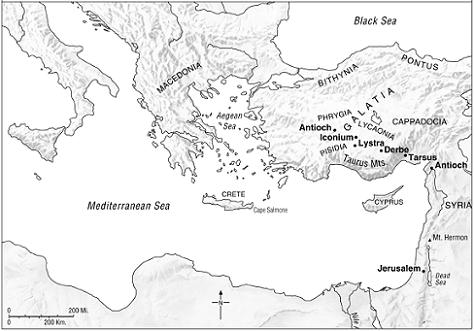
The MacArthur Bible Handbook, by John MacArthur (Nashville: Thomas Nelson Publishers, 2003) 392. © 2003 by Thomas Nelson, Inc.
1:6 turning away. This is better translated “deserting.” The Greek word was used of military desertion, which was punishable by death. The form of this Greek verb indicates that the Galatian believers were voluntarily deserting grace to pursue the legalism taught by the false teachers (see notes on 5:4 ). so soon. This Greek word can mean either “easily” or “quickly” and sometimes both. No doubt both senses characterized the Galatians’ response to the false teachers’ heretical doctrines. called you. This could be translated, “who called you once and for all” (cf. 2 Thess. 2:13, 14; 2 Tim. 1:8, 9; 1 Pet. 1:15), and refers to God’s effectual call to salvation (see note on Rom. 1:7 ). grace of Christ. God’s free and sovereign act of mercy in granting salvation through the death and resurrection of Christ, totally apart from any human work or merit (see note on Rom. 3:24 ). different gospel. Cf. 2 Corinthians 11:4. The Judaizers’ perversion of the true gospel. They added the requirements, ceremonies, and standards of the Old Covenant as necessary prerequisites to salvation. See notes on 3:3; 4:9; 5:7; Philippians 3:2.
1:7 trouble. The Greek word could be translated “disturb” and means “to shake back and forth,” such as to agitate or stir up. Here, it refers to the deep emotional disturbance the Galatian believers experienced. pervert. To turn something into its opposite. By adding law to the gospel of Christ, the false teachers were effectively destroying grace, turning the message of God’s undeserved favor toward sinners into a message of earned and merited favor. the gospel of Christ. The good news of salvation by grace alone through faith alone in Christ alone (see notes on Rom. 1:1; 1 Cor. 15:1–4 ).
1:8, 9 Throughout history God has devoted certain objects, individuals, and groups of people to destruction (Josh. 6:17, 18; 7:1, 25, 26). The NT offers many examples of one such group: false teachers (Matt. 24:24; John 8:44; 1 Tim. 1:20; Titus 1:16). Here the Judaizers are identified as members of this infamous company.
1:8 we, or an angel from heaven. Paul’s point is hypothetical, calling on the most unlikely examples for false teaching—himself and holy angels. The Galatians should receive no messenger, regardless of how impeccable his credentials, if his doctrine of salvation differs in the slightest degree from God’s truth revealed through Christ and the apostles. accursed. The translation of the familiar Greek word anathema, which refers to devoting someone to destruction in eternal hell (cf. Rom. 9:3; 1 Cor. 12:3; 16:22).
1:9 As we have said before. This refers to what Paul taught during an earlier visit to these churches, not to a previous comment in this epistle. anyone. Paul turns from the hypothetical case of verse 8 (the apostle or heavenly angels preaching a false gospel) to the real situation faced by the Galatians. The Judaizers were doing just that, and were to be devoted to destruction because of their damning heresy.
B. Apostolic Credentials (1:10–2:10)
1:10–12 Because the false teachers sought to undermine Paul’s spiritual credentials, he set out to defend his apostleship, explaining once again (cf. v. 1) that he was appointed by God and not by men.
1:10 still pleased men. Paul’s previous motivation when he used to persecute Christians on behalf of his fellow Jews. a bondservant of Christ. See note on Romans 1:1. Paul had become a willing slave of Christ, which cost him a great deal of suffering from others (6:17). Such personal sacrifice is exactly opposite the goal of pleasing men (6:12).
1:11 make known to you. The strong Greek verb Paul used here often introduced an important and emphatic statement (1 Cor. 12:3; 2 Cor. 8:1). the gospel . . . not according to man. The gospel Paul preached was not human in origin or it would have been like all other human religion, permeated with works righteousness born of man’s pride and Satan’s deception (Rom. 1:16).
1:12 neither received it from man, nor was I taught it. This was in contrast to the Judaizers, who received their religious instruction from rabbinic tradition. Most Jews did not study the actual Scriptures; instead, they used human interpretations of Scripture as their religious authority and guide. Many of their traditions not only were not taught in Scripture but also contradicted it (Mark 7:13). through the revelation. This refers to the unveiling of something previously kept secret—in this case, Jesus Christ. While he knew about Christ, Paul subsequently met Him personally on the road to Damascus and received the truth of the gospel from Him (Acts 9:1–16).
1:13–2:21 Paul offers a brief biographical sketch of important events in his life to further defend his apostleship and prove the authenticity of the gospel of grace he proclaimed.
1:13 Judaism. The Jewish religious system of works righteousness, based not primarily on the OT text, but on rabbinic interpretations and traditions. In fact, Paul will argue that a proper understanding of the OT can lead only to Christ and His gospel of grace through faith (3:6–29). persecuted. The tense of this Greek verb emphasizes Paul’s persistent and continual effort to hurt and ultimately exterminate Christians. See notes on Acts 8:1–3; 9:1; 1 Timothy 1:12–14.
1:14 advanced . . . beyond. The Greek word for advanced means “to chop ahead,” much like one would blaze a trail through a forest. Paul blazed his path in Judaism (cf. Phil. 3:5, 6), and because he saw Jewish Christians as obstacles to its advancement, he worked to cut them down. exceedingly zealous. Paul demonstrated this by the extent to which he pursued and persecuted Christians (cf. Acts 8:1–3; 26:11). traditions of my fathers. The oral teachings about OT law commonly known as the Halakah. This collection of interpretations of the law eventually carried the same authority as, or even greater than, the law (Torah) itself. Its regulations were so hopelessly complex and burdensome that even the most astute rabbinical scholars could not master it by either interpretation or conduct.
1:15 separated me from my mother’s womb. Paul is not talking about being born, separated physically from his mother, but being separated or set apart to God for service from the time of his birth. The phrase refers to God’s election of Paul without regard for his personal merit or effort (cf. Is. 49:1; Jer. 1:5; Luke 1:13–17; Rom. 9:10–23). called me through His grace. This refers to God’s effectual call (see notes on Rom. 1:7 ). On the Damascus road, God actually brought Saul, whom He had already chosen, to salvation.
1:16 reveal His Son in me. Not only was Christ revealed to Paul on the Damascus Road, but in him as God gave him the life, light, and faith to believe in Him. preach Him among the Gentiles. Paul’s specific call to proclaim the gospel to non-Jews (see notes on Acts 9:15; 26:12–18; cf. Rom. 1:13–16; 11:13; 15:18). confer with flesh and blood. Paul did not look to Ananias or other Christians at Damascus for clarification of or addition to the revelation he received from Christ (Acts 9:19, 20).
1:17 Jerusalem . . . Arabia . . . Damascus. Rather than immediately travel to Jerusalem to be instructed by the apostles, Paul instead went to Nabatean Arabia, a wilderness desert that stretched east of Damascus down to the Sinai peninsula. After being prepared for ministry by the Lord, he returned to minister in nearby Damascus.
1:18 three years. The approximate time from Paul’s conversion to his first journey to Jerusalem. During those years he made a visit to Damascus and resided in Arabia, under the instruction of the Lord. This visit is discussed in Acts 9:26–30 (see note on Acts 9:23 ). up to Jerusalem. Travelers in Israel always speak of going “up” to Jerusalem because of its higher elevation (see note on Acts 18:22 ). see. Better translated, “to become acquainted with.” Peter. See notes on Matthew 10:2; see Introduction to 1 Peter: Author and Date. The apostle who was the personal companion of the Lord and the most powerful spokesman in the early years of the Jerusalem church (Acts 1–12).
1:19 James, the Lord’s brother. Cf. 2:9, 12; see note on Acts 15:13; see Introduction to James: Author and Date.
1:20 The directness of this statement indicates that Paul had been accused by the Jewish legalists of being a liar, who was shameless or deluded.
1:21 Syria and Cilicia. See note on Acts 15:23 ; cf. Acts 9:30. This area included Paul’s hometown of Tarsus. He was preaching in that region for several years. When word of revival in that area reached Jerusalem, they sent Barnabas (see Acts 11:20–26). Paul stayed on in that region as a pastor in the church at Antioch. With Barnabas, they went from there on the first missionary journey (Acts 13:1–3), and afterward returned to Antioch (Acts 14:26) from where they were sent to the Jerusalem Council (Acts 14:26–15:4).
1:22 Judea. See note on Acts 1:8.
1:23 Over the fourteen years before the Jerusalem Council (see note on 2:1 ), Paul had come only twice to Jerusalem (Acts 9:26–30; 11:30) so the Christians there only knew him by reputation.
1:24 they glorified God in me. Proof that the gospel Paul preached was the same one the other apostles had taught the Judean believers.
2:1–10 By recounting the details of his most significant trip to Jerusalem after his conversion, Paul offered convincing proof that the message he proclaimed was identical to that of the other twelve apostles.
2:1 fourteen years . . . again to Jerusalem. This was the period from the time of his first visit to Jerusalem (1:18) to the one Paul refers to here, which probably was for the Jerusalem Council (Acts 15:1–22) called to resolve the issue of Gentile salvation. Linguistically, the word again need not refer to the next visit; it can just as easily mean “once again” without respect to how many visits took place in between. And in fact, Paul did visit Jerusalem during that fourteen-year period to deliver famine relief to the church there (Acts 11:27–30; 12:24, 25), but he does not refer to that visit here since it had no bearing on his apostolic authority. Barnabas. See note on Acts 4:36. Paul’s first ally who vouched for him before the apostles at Jerusalem (Acts 9:27), and became his traveling companion on his first missionary journey (Acts 13:2, 3). Titus. A spiritual child of Paul and a coworker (Titus 1:4, 5). As an uncircumcised Gentile, Titus was fitting proof of the effectiveness of Paul’s ministry. See Introduction to Titus: Author and Date.
2:2 by revelation. This revelation from God was the voice of the Holy Spirit (see notes on Acts 13:2–4 ). He refers to the divine commissioning of his visit in order to refute any suggestion by the Judaizers that they had sent Paul to Jerusalem to have the apostles correct his doctrine. gospel. See note on 1:7. those who were of reputation. The three main leaders of the Jerusalem church: Peter, James (the Lord’s brother, 1:19), and John (cf. v. 9). This phrase was typically used of authorities and implied a position of honor. Paul refers to them in a similar way two other times (vv. 6, 9), suggesting a hint of sarcasm directed toward the Judaizers, who claimed they had apostolic approval for their doctrine and Paul did not. They had likely made a habit of exalting these three leaders at the expense of Paul. might run . . . in vain. Paul hoped the Jerusalem leaders would support his ministry to the Gentiles and not soften their opposition to legalism. He did not want to see his ministry efforts wasted because of conflict with the other apostles.
2:3 Greek. See note on Romans 1:14. compelled to be circumcised. At the core of the Judaizers’ works system was the Mosaic prescription of circumcision (see notes on Gen. 17:9–14; Rom. 4:9–12 ). They were teaching that there could be no salvation without circumcision (Acts 15:1, 5, 24). Paul and the apostles denied that, and the issue was settled at the Jerusalem Council (Acts 15:1–22). See notes on 5:2–12; 6:15; Romans 4:10–12; cf. 1 Corinthians 7:19. As a true believer, Titus was living proof that circumcision and the Mosaic regulations were not prerequisites or necessary components of salvation. The apostles’ refusal to require Titus’ circumcision verified the church’s rejection of the Judaizers’ doctrine (cf. Timothy, Acts 16:1–3).
2:4 false brethren. The Judaizers, who pretended to be true Christians. Yet, their doctrine, because it claimed allegiance to Christ, was opposed to traditional Judaism, and because it demanded circumcision and obedience to the Mosaic Law as prerequisites for salvation, was opposed to Christianity. to spy out. This Greek word pictures spies or traitors entering by stealth into an enemy’s camp. The Judaizers were Satan’s undercover agents sent into the midst of the church to sabotage the true gospel. liberty. Christians are free from the law as a means of salvation, from its external ceremonial regulations as a way of living, and from its curse for disobedience to the law—a curse that Christ bore for all believers (3:13). This freedom is not, however, a license to sin (5:13; Rom. 6:18; 1 Pet. 2:16). bondage. Conveys the idea of absolute slavery to an impossible system of works righteousness.
2:5 we did not yield. Paul and Titus (v. 3) never budged from their position of salvation by grace alone through faith alone. truth of the gospel. The true gospel as opposed to the different (1:6–8) and false one propagated by the Judaizers (see note on Rom. 1:1 ).
2:6 those who seemed to be something. Another reference to Peter, James, and John (see note on v. 2 ). personal favoritism. The unique privileges of the Twelve did not make their apostleship more legitimate or authoritative than Paul’s; Christ commissioned them all (cf. Rom. 2:11). Paul never saw himself as apostolically inferior (see 2 Cor. 12:11, 12).
2:7 The Judaizers claimed Paul was preaching a deviant gospel, but the apostles confirmed that he proclaimed the true gospel. It was the same gospel Peter proclaimed, but to a different audience. for the uncircumcised. Better translated “to the uncircumcised.” Paul preached the gospel primarily to the Gentiles (also to Jews in Gentile lands, as his pattern was to go to the synagogue first; cf. Acts 13:5). circumcised . . . Peter. Peter’s ministry was primarily to the Jews.
2:8 He who worked effectively in Peter . . . in me. The Holy Spirit, who has but one gospel, empowered both Peter and Paul in their ministries.
2:9 James, Cephas, and John. This James was Jesus’ half-brother (1:19), who had risen to a prominent role in the Jerusalem church (see Introduction to James). Cephas (Peter) and John (the brother of James the apostle, martyred in Acts 12:2), were two of Christ’s closest companions and became the main apostles in the Jerusalem church (see Acts 2–12). pillars. Emphasizing the role of James, Peter, and John in establishing and supporting the church. grace . . . given to me. The only conclusion these leaders could make was that God’s grace was responsible for the powerful preaching of the gospel and the building of the church through Paul’s efforts. Barnabas. See notes on verse 1; Acts 4:36. the right hand of fellowship. In the Near East, this represented a solemn vow of friendship and a mark of partnership. This act signified the apostles’ recognition of Paul as a teacher of the true gospel and a partner in ministry. we should go to the Gentiles. Further confirmation of Paul’s divine call to ministry and a blow to the Judaizers, since the apostles directed him to continue in his already flourishing ministry to the Gentiles. circumcised. See note on verse 7.
2:10 remember the poor. A practical reminder for Paul and the growing ranks of Gentile Christians. The number of Christians in Jerusalem grew rapidly at first (cf. Acts 2:41–45; 6:1), and many who were visiting the city for the feast of Pentecost (Acts 2:1, 5) remained and never returned to their homes. While the believers initially shared their resources (Acts 2:45; 4:32–37), many had little money. For years the Jerusalem church was economically pressed. See note on Acts 11:28.
C. Apostolic Confidence (2:11–21)
2:11–13 A brief account of the darkest of days in the history of the gospel. By withdrawing from the Gentile believers to fellowship with the Judaizers who held a position he knew was wrong, Peter had in appearance supported their doctrine and nullified Paul’s divine teaching, especially the doctrine of salvation by grace alone through faith alone. See notes on 2 Corinthians 6:14–18; 2 John 10, 11.
2:11 Antioch. See note on Acts 11:19. The location of the first Gentile church. to be blamed. Better translated, “stood condemned.” Peter was guilty of sin by aligning himself with men he knew to be in error and because of the harm and confusion he caused his Gentile brethren.
2:12 certain men . . . from James. Peter, knowing the decision the Jerusalem Council had made (Acts 15:7–29), had been in Antioch for some time, eating with Gentiles. When Judaizers came, pretending to be sent by James, they lied, giving false claims of support from the apostles. Peter had already given up all Mosaic ceremony (Acts 10:9–22) and James had at times held only to some of it (Acts 21:18–26). withdrew. The Greek term refers to strategic military withdrawal. The verb’s form may imply that Peter’s withdrawal was gradual and deceptive. To eat with the Judaizers and decline invitations to eat with the Gentiles, which he had previously done, meant that Peter was affirming the very dietary restrictions he knew God had abolished (Acts 10:15) and thus striking a blow at the gospel of grace. fearing those . . . of the circumcision. This was the true motivation behind Peter’s defection. He was afraid of losing popularity with the legalistic, Judaizing segment of people in the church, even though they were self-righteous hypocrites promoting a heretical doctrine.
2:13 the rest of the Jews. The Jewish believers in Antioch. hypocrite. This Greek word refers to an actor who wore a mask to depict a mood or certain character. In the spiritual sense, it refers to someone who masks his true character by pretending to be something he is not (cf. Matt. 6:1–6). They were committed to the gospel of grace, but pretended to accept Jewish legalism.
2:14 straightforward. Lit. to walk “straight” or “uprightly.” By withdrawing from the Gentile Christians, Peter and the other Jewish believers were not walking in line with God’s Word. truth of the gospel. See note on verse 5. live in the manner of Gentiles. Before his gradual withdrawal, Peter regularly had fellowship and ate with the Gentiles, thus modeling the ideal of Christian love and liberty between Jew and Gentile. compel Gentiles to live as Jews. By his Judaizing mandate, he was declaring theirs was the right way.
2:15, 16 Paul’s rebuke of Peter serves as one of the most dynamic statements in the NT on the absolute and unwavering necessity of the doctrine of justification by grace through faith (see note on Rom. 3:24 ). Peter’s apparent repentance acknowledged Paul’s apostolic authority and his own submission to the truth (cf. 2 Pet. 3:15, 16).
2:15 sinners of the Gentiles. This is used in the legal sense since Gentiles were sinners by nature and they had no revealed divine written law to guide them toward salvation or living righteously.
2:16 works . . . faith. Three times in this verse Paul declares that salvation is only through faith in Christ and not by law. The first is general, “a man is not justified”; the second is personal, “we might be justified”; and the third is universal, “no flesh shall be justified.” justified. This basic Greek word forensically describes a judge declaring an accused person not guilty and therefore innocent before the law. Throughout Scripture, it refers to God’s declaring a sinner not guilty and fully righteous before Him by imputing to him the divine righteousness of Christ and imputing the person’s sin to his sinless Savior for punishment, (see notes on Rom. 3:24; Phil. 3:8 9 ). works of the law. Keeping the law is a totally unacceptable means of salvation because the root of sinfulness is in the fallenness of man’s heart, not his actions. The law served as a mirror to reveal sin, not a cure for it (see notes on 3:22–24; Rom. 7:7–13; 1 Tim. 1:8–11 ).
2:17 we . . . are found sinners. If the Judaizers’ doctrine was correct, then Paul, Peter, Barnabas, and the other Jewish believers fell back into the category of sinners because they had been eating and fellowshiping with Gentiles, who according to the Judaizers were unclean. minister of sin. If the Judaizers were right, then Christ was wrong and had been teaching people to sin because He taught that food could not contaminate a person (Mark 7:19; cf. Acts 10:13–15). He also declared that all who belong to Him are one with Him and therefore with one another (John 17:21–23). Paul’s airtight logic condemned Peter, because by his actions he had in effect made it appear as if Christ was lying. This thought is utterly objectionable and caused Paul to use the strongest Greek negative (“certainly not”; cf. 3:21; Rom. 6:1, 2; 7:13).
2:18 things which I destroyed. The false system of salvation through legalism (see note on 1:13 ), done away with by the preaching of salvation by grace alone through faith alone.
2:19 died to the law. When a person is convicted of a capital crime and executed, the law has no further claim on him. So it is with the Christian who has died in Christ (who paid the penalty for his sins in full) and rises to new life in Him. Justice has been satisfied, and he is forever free from any further penalty. See notes on Romans 7:1–6.
2:20 I have been crucified with Christ. See notes on Romans 6:2–6. When a person trusts in Christ for salvation, he participates spiritually with the Lord in His Crucifixion and His victory over sin and death. no longer I who live, but Christ lives in me. The believer’s old self is dead (see note on Eph. 4:22 ), having been crucified with Christ (Rom. 6:3, 5). The believer’s new man has the privilege of the indwelling Christ empowering him and living through him (see notes on Rom. 8:9, 10 ). gave Himself for me. The manifestation of Christ’s love for the believer through His sacrificial death on the Cross (John 10:17, 18; Rom. 5:6–8; Eph. 5:25–30).
2:21 Paul concluded that Peter, by taking his stand with the Judaizers and thus against Christ, was in effect denying the need for God’s grace and thereby nullifying the benefit of Christ’s death. righteousness. See note on Romans 1:17. Christ died in vain. This can be better translated, “Christ died needlessly.” Those who insist they can earn salvation by their own efforts undermine the foundation of Christianity and render unnecessary the death of Christ.
II. DOCTRINAL: THE PRINCIPLES OF
JUSTIFICATION (3:1–4:31)
A. The Experience of the Galatians (3:1–5)
3:1 foolish. This refers not to lack of intelligence, but to lack of obedience (cf. Luke 24:25; 1 Tim. 6:9; Titus 3:3). Paul expressed his shock, surprise, and outrage at the Galatians’ defection. Who . . . ? The Judaizers, the Jewish false teachers, were plaguing the Galatian churches (see Introduction: Background and Setting). bewitched. Charmed or misled by flattery and false promises. The term suggests an appeal to the emotions by the Judaizers. clearly portrayed. The Greek word describes the posting of official notices in public places. Paul’s preaching had publicly displayed the true gospel of Jesus Christ before the Galatians. crucified. The Crucifixion of Christ was a one-time historical fact with continuing results into eternity. Christ’s sacrificial death provides eternal payment for believers’ sins (cf. Heb. 7:25), and does not need to be supplemented by any human works.
3:2 Did you receive the Spirit …? The answer to Paul’s rhetorical question is obvious. The Galatians had received the Spirit when they were saved (Rom. 8:9; 1 Cor. 12:13; 1 John 3:24; 4:13), not through keeping the law, but through saving faith granted when hearing the gospel (cf. Rom. 10:17). The hearing of faith is actually hearing with faith. Paul appealed to the Galatians’ own salvation to refute the Judaizers’ false teaching that keeping the law is necessary for salvation.
3:3 Are you so foolish? Incredulous at how easily the Galatians had been duped, Paul asked a second rhetorical question, again rebuking them for their foolishness. begun in the Spirit . . . by the flesh. The notion that sinful, weak (Matt. 26:41; Rom. 6:19), fallen human nature could improve on the saving work of the Holy Spirit was ludicrous to Paul.
3:4 suffered. The Greek word has the basic meaning of “experienced,” and does not necessarily imply pain or hardship. Paul used it to describe the Galatians’ personal experience of salvation in Jesus Christ. many things. This refers to all the blessings of salvation from God, Christ, and the Holy Spirit (cf. Eph. 1:3). if indeed it was in vain. See Luke 8:13; Acts 8:13, 21; 1 Corinthians 15:2; 2 Corinthians 6:1; 13:5, 6.
3:5 hearing of faith. See note on verse 2
B. The Blessing of Abraham (3:6–9)
3:6 As he does in Romans (see note on Rom. 4:3 ), Paul quoting Genesis 15:6 uses Abraham as proof that there has never been any other way of salvation than by grace through faith. Even the OT teaches justification by faith.
3:7 sons of Abraham. Believing Jews and Gentiles are the true spiritual children of Abraham because they follow his example of faith (cf. v. 29; Rom. 4:11, 16).
3:8 Scripture, foreseeing. Personifying the Scriptures was a common Jewish figure of speech (cf. 4:30; John 7:38, 42; 19:37; Rom. 9:17; 10:11; 11:2; 1 Tim. 5:18). Because Scripture is God’s Word, when it speaks, God speaks. preached the gospel to Abraham. The “Good News” to Abraham was the news of salvation for all the nations (quoted from Gen. 12:3; 18:18). See Genesis 22:18; John 8:56; Acts 26:22, 23. Salvation has always, in every age, been by faith.
3:9 those who are of faith . . . Abraham. Whether Jew or Gentile. The OT predicted that Gentiles would receive the blessings of justification by faith, as did Abraham. Those blessings are poured out on all believers because of Christ (cf. John 1:16; Rom. 8:32; Eph. 1:3; 2:6, 7; Col. 2:10; 1 Pet. 3:9; 2 Pet. 1:3, 4).
C. The Curse of the Law (3:10–14)
3:10 as many as are of the works of the law. Those attempting to earn salvation by keeping the law. under the curse. Quoted from Deuteronomy 27:26 to show that failure to keep the law perfectly brings divine judgment and condemnation. One violation of the law deserves the curse of God. Cf. Deuteronomy 27, 28. all things. See James 2:10. No one can keep all the commands of the law—not even strict Pharisees like Saul of Tarsus (Rom. 7:7–12).
3:11 no one is justified by the law. Cf. Romans 3:20. justified. Made righteous before God. See note on Romans 3:24. the just shall live by faith. See note on Romans 1:17. Paul’s earlier OT quote (v. 10; cf. Deut. 27:26) showed that justification does not come from keeping the law; this quote from Habakkuk 2:4 shows that justification is by faith alone (cf. Heb. 10:38).
3:12 the law is not of faith. Justification by faith and justification by keeping the law are mutually exclusive, as Paul’s OT quote from Leviticus 18:5 proves.
3:13 Christ has redeemed us from the curse of the law. The Greek word translated “redeemed” was often used to speak of buying a slave’s or debtor’s freedom. Christ’s death, because it was a death of substitution for sin, satisfied God’s justice and exhausted His wrath toward His elect, so that Christ actually purchased believers from slavery to sin and from the sentence of eternal death (4:5; Titus 2:14; 1 Pet. 1:18; cf. Rom. 3:24; 1 Cor. 1:30; Eph. 1:7; Col. 1:14; Heb. 9:12). having become a curse for us. By bearing God’s wrath for believers’ sins on the cross (see note on 2 Cor. 5:21; cf. Heb. 9:28; 1 Pet. 2:24; 3:18), Christ took upon Himself the curse pronounced on those who violated the law (see note on v. 10 ). it is written. The common NT way (sixty-one times) of introducing OT quotes (see note on Rom. 3:10 ). Deuteronomy 21:23 is quoted.
3:14 the blessing of Abraham. Faith in God’s promise of salvation. See note on verse 9. promise of the Spirit. From God the Father. Cf. Isaiah 32:15; 44:3; 59:19–21; Ezekiel 36:26, 27; 37:14; 39:29; Joel 2:28, 29; Luke 11:13; 24:49; John 7:37–39; 14:16, 26.
D. The Promise of the Covenant (3:15–18)
3:15–22 Paul anticipated and refuted a possible objection to his use of Abraham to prove the doctrine of justification by faith that the giving of the law at Sinai after Abraham brought about a change and a better method of salvation. The apostle dismissed that argument by showing the superiority of the Abrahamic covenant (vv. 15–18), and the inferiority of the law (vv. 19–22).
3:15 Brethren. This term of endearment reveals Paul’s compassionate love for the Galatians—which they may have begun to question in light of his stern rebuke (vv. 1, 3). manner of men . . . man’s covenant. Even human covenants, once confirmed, are considered irrevocable and unchangeable; how much more a covenant made by the unchanging God (Mal. 3:6; James 1:17).
3:16 Seed. Cf. verse 19. The quote is from Genesis 12:7. The singular form of the Hebrews word, like its English and Greek counterparts, can be used in a collective sense. Paul’s point is that in some OT passages (e.g., Gen. 3:15; 22:18), seed refers to the greatest of Abraham’s descendants, Jesus Christ. promises. Those associated with the Abrahamic covenant (Gen. 12:3, 7; 13:15, 16; 15:5, 18; 17:8; 22:16–18; 26:3, 4; 28:13, 14). Because they were made both to Abraham and his descendants, they did not become void when Abraham died, or when the law came.
3:17 four hundred and thirty years. From Israel’s sojourn in Egypt (cf. Ex. 12:40) to the giving of the law at Sinai (c. 1445 B.C.). The law actually came 645 years after the initial promise to Abraham (c. 2090 B.C.; cf. Gen. 12:4; 21:5; 25:26; 47:9), but the promise was repeated to Isaac (Gen. 26:24) and later to Jacob (c. 1928 B.C.; Gen. 28:15). The last known reaffirmation of the Abrahamic covenant to Jacob occurred in Genesis 46:2–4 (c. 1875 B.C.) just before he went to Egypt—430 years before the Mosaic Law was given. the covenant. The Abrahamic covenant (see note on v. 16 ). For a discussion of the biblical covenants, see notes on Genesis 9:16; 12:1–3; Romans 9:4. confirmed before by God. See note on verse 15. The term means “ratified.” Once God ratified the covenant officially (see notes on Gen. 15:9–21 ), it had lasting authority so that nothing and no one could annul it. The Abrahamic covenant was unilateral (God made the promise to Himself), eternal (it provided for everlasting blessing), irrevocable (it will never cease), unconditional (in that it depended on God, not man), but its complete fulfillment awaits the salvation of Israel and the millennial kingdom of Jesus Christ.
3:18 Paul again emphasized that there is no middle ground between law (works) and promise (grace); the two principles are mutually exclusive ways of salvation (cf. Rom 4:14). An “inheritance” by definition is something granted, not worked for, as proven in the case of Abraham.
E. The Purpose of the Law (3:19–29)
3:19–22 Having shown the superiority of the promise to Abraham (vv. 15–18), Paul described the inferiority of the law, and its purpose.
3:19 was added because of transgressions. Paul’s persuasive argument that the promise is superior to the law raises an obvious question: What was the purpose of the law? Paul’s answer is that the law reveals man’s utter sinfulness, inability to save himself, and desperate need of a Savior. It was never intended to be the way of salvation (cf. Rom. 7:1–13). Seed. See note on verse 16. through angels. The Bible teaches that angels were involved in the giving of the law (cf. Acts 7:53; Heb. 2:2), but does not explain the precise role they played.
3:20 mediator. Paul’s point is apparently that a mediator is required when more than one party is involved, but God alone ratified the covenant with Abraham (see notes on Gen. 15:7–21 ).
3:21 Paul uses the strongest Greek negative (see note on 2:17 ) to disdain the idea that the law and the promise are at opposite purposes. Since God gave them both and does not work against Himself, law and promise work in harmony; the law reveals man’s sinfulness and need for the salvation freely offered in the promise. If the law could have provided righteousness and eternal life, there would be no gracious promise.
3:22 confined all under sin. The Greek verb translated “confined” means “to enclose on all sides.” Paul portrays all mankind as hopelessly trapped in sin, like a school of fish caught in a net. That all people are sinners is the express teaching of Scripture (see note on Rom. 3:19; cf. 1 Kin. 8:46; Ps. 143:2; Prov. 20:9; Eccl. 7:20; Is. 53:6; Rom. 3:9–19, 23; 11:32).
3:23 before faith came. From the viewpoints of both the history of redemption and through all times in the area of individual salvation (cf. vv. 19, 24, 25; 4:1–4), only saving faith unlocks the door of the prison where the law keeps people bound. kept under guard by the law. Paul personifies the law as a jailer of guilty, condemned sinners, on death row awaiting God’s judgment (Rom. 6:23). the faith which would afterward be revealed. Again, Paul was looking at the coming of Christ, historically and at each believer’s salvation, individually. Faith in Christ alone releases people from bondage to law, whether the Mosaic Law, or the law written on the hearts of Gentiles (Rom. 2:14–16).
3:24 tutor. The Greek word denotes a slave whose duty it was to take care of a child until adulthood. The tutor escorted the children to and from school and watched over their behavior at home. Tutors were often strict disciplinarians, causing those under their care to yearn for the day when they would be free from their tutor’s custody. The law was our tutor which, by showing us our sins, was escorting us to Christ.
3:25, 26 Believers, through faith in Jesus Christ, have come of age as God’s children. Thus, they are not under the tutelage of the law (Rom. 6:14), although they are still obligated to obey God’s holy and unchanging righteous standards which are now given authority in the new covenant (6:2; Rom. 8:4; 1 Cor. 9:21).
3:26 sons of God. While God is the Father of all people in a general sense because He created them (Acts 17:24–28), only those who have put their faith in Jesus Christ are God’s true spiritual children. Unbelievers are the children of Satan (Matt. 13:38; John 8:38, 41, 44; Acts 13:10; 1 John 3:10; cf. Eph. 2:3; 1 John 5:19).
3:27 baptized into Christ. This is not water baptism, which cannot save (see notes on Acts 2:38; 22:16 ). Paul used the word baptized in a metaphorical manner to speak of being “immersed,” or “placed into” Christ (cf. 2:20) by the spiritual miracle of union with Him in His death and Resurrection. See notes on Romans 6:3, 4; cf. 1 Corinthians 6:17. put on Christ. The result of the believer’s spiritual union with Christ. Paul was emphasizing the fact that we have been united with Christ through salvation. Positionally before God, we have put on Christ, His death, Resurrection, and righteousness (see notes on Phil. 3:8–10 ). Practically, we need to “put on Christ” before others, in our conduct (Rom. 13:14).
3:28 you are all one in Christ Jesus. All those who are one with Jesus Christ are one with one another. This verse does not deny that God has designed racial, social, and sexual distinctions among Christians, but it affirms that those do not imply spiritual inequality before God. Nor is this spiritual equality incompatible with the God-ordained roles of headship and submission in the church, society, and at home. Jesus Christ, though fully equal with the Father, assumed a submissive role during His Incarnation (Phil. 2:5–8).
3:29 Abraham’s seed. See note on verse 7. Not all physical children of Abraham are the “Israel of God” (cf. 6:16), that is, true spiritual children of Abraham (Rom. 9:6–8). Gentile believers who are not physical children of Abraham are, however, his spiritual children in the sense that they followed the pattern of his faith (see note on Rom. 4:11, 12 ). heirs according to the promise. All believers are heirs of the spiritual blessing that accompanied the Abrahamic covenant—justification by faith (Gen. 15:6; cf. Rom. 4:3–11).
F. The Sonship of Believers (4:1–7)
4:1–7 Paul expands on the analogy of a child’s coming of age (3:24–26), contrasting believers’ lives before salvation (as children and servants), with their lives after salvation (as adults and sons). Both Paul’s Jewish and Gentile readers readily understood this imagery, since the Jews, Greeks, and Romans all had a ceremony to mark a child’s coming of age.
4:1 child. The Greek word refers to a child too young to talk, a minor, spiritually and intellectually immature and not ready for the privileges and responsibilities of adulthood.
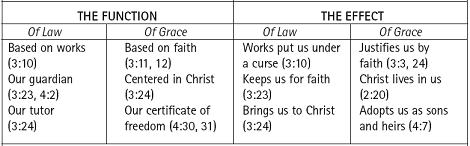
The law functions to (1) declare our guilt, (2) drive us to Christ, and (3) direct us in a life of obedience. However, the law is powerless to save.
Nelson’s Complete Book of Bible Maps & Charts (Nashville: Thomas Nelson Publishers, 1996) 403. © 1993 by Thomas Nelson, Inc.
4:2 guardians and stewards. Guardians were slaves entrusted with the care of underage boys, while stewards managed their property for them until they came of age. Along with the tutor (3:24), they had almost complete charge of the child—so that, for all practical purposes, a child under their care did not differ from a slave.
4:3 when we were children . . . in bondage. Before our “coming of age” when we came to saving faith in Jesus Christ. the elements of the world. Elements is from a Greek word meaning “row,” or “rank,” and was used to speak of basic, foundational things like the letters of the alphabet. In light of its use in verse 9, it is best to see it here as a reference to the basic elements and rituals of human religion (see note on Col. 2:8 ). Paul describes both Jewish and Gentile religions as elemental because they are merely human, never rising to the level of the divine. Both Jewish religion and Gentile religion centered on man-made systems of works. They were filled with laws and ceremonies to be performed in order to achieve divine acceptance. All such rudimentary elements are immature, like behaviors of children under bondage to a guardian.
4:4 the fullness of the time. In God’s timetable, when the exact religious, cultural, and political conditions demanded by His perfect plan were in place, Jesus came into the world. God sent forth His Son. As a father set the time for the ceremony of his son becoming of age and being released from the guardians, stewards, and tutors, so God sent His Son at the precise moment to bring all who believe out from under bondage to the law—a truth Jesus repeatedly affirmed (John 5:30, 36, 37; 6:39, 44, 57; 8:16, 18, 42; 12:49; 17:21, 25; 20:21). That the Father sent Jesus into the world teaches His pre-existence as the eternal second member of the Trinity. See notes on Philippians 2:6, 7; Hebrews 1:3–5; cf. Romans 8:3, 4. born of a woman. This emphasizes Jesus’ full humanity, not merely His Virgin Birth (Is. 7:14; Matt. 1:20–25). Jesus had to be fully God for His sacrifice to be of the infinite worth needed to atone for sin. But He also had to be fully man so He could take upon Himself the penalty of sin as our substitute. See Luke 1:32, 35; John 1:1, 14, 18. under the law. Like all men, Jesus was obligated to obey God’s Law. Unlike anyone else, however, He perfectly obeyed that law (John 8:46; 2 Cor. 5:21; Heb. 4:15; 7:26; 1 Pet. 2:22; 1 John 3:5). His sinlessness made Him the unblemished sacrifice for sins, who “fulfilled all righteousness,” i.e., perfectly obeyed God in everything. That perfect righteousness is what is imputed to those who believe in Him.
4:5 to redeem. See note on 3:13. those . . . under the law. Guilty sinners who are under the law’s demands and its curses (see notes on 3:10, 13 ) and in need of a Savior (see note on 3:23 ). the adoption as sons. Adoption is the act of bringing someone who is the offspring of another into one’s own family. Since unregenerate people are by nature children of the devil (see note on 3:26 ), the only way they can become God’s children is by spiritual adoption (Rom. 8:15, 23; Eph. 1:5).
4:6 Spirit of His Son. It is the Holy Spirit’s work to confirm to believers their adoption as God’s children (see note on Rom. 8:15 ). Assurance of salvation is a gracious work of the Holy Spirit and does not come from any human source. Abba. An Aramaic term of endearment, used by young children to speak to their fathers; the equivalent of the word Daddy (see note on Rom. 8:15 ).
G. The Futility of Ritualism (4:8–20)
4:8–11 While salvation is the free gift of God (Rom. 5:15, 16, 18; 6:23; Eph. 2:8), it brings with it serious responsibility (cf. Luke 12:48). God requires believers to live holy lives because they are children of a holy God and desire to love and worship Him (Matt. 5:48; 1 Pet. 1:15–18). That obligation was to the unchanging moral and spiritual principles that forever reflect the nature of God; however, it did not include the rituals and ceremonies unique to Israel under the Mosaic Law as the Judaizers falsely claimed.
4:8 when you did not know God. Before coming to saving faith in Christ, no unsaved person knows God. See notes on Ephesians 4:17–19; 2 Corinthians 4:3–6. by nature are not gods. The Greco-Roman pantheon of non-existent deities the Galatians had imagined they worshiped before their conversion (cf. Rom. 1:23; 1 Cor. 8:4; 10:19, 20; 12:2; 1 Thess. 1:9).
4:9 known by God. We can know God only because He first knew us, just as we choose Him only because He first chose us (John 6:44; 15:16), and we love Him only because He first loved us (1 John 4:19). turn again. See notes on 3:1–3. weak . . . elements . . . again. . . bondage. See note on verse 3.
4:10 days . . . years. The rituals, ceremonies, and festivals of the Jewish religious calendar which God had given, but were never required for the church. Paul warns the Galatians, as he did the Colossians (see notes on Rom. 14:1–6; Col. 2:16, 17 ), against legalistically observing them as if they were required by God or could earn favor with Him.
4:11 labored . . . in vain. Paul feared that his effort in establishing and building the Galatian churches might prove to be futile if they fell back into legalism (cf. 3:4; 1 Thess. 3:5).
4:12–20 Having sternly rebuked the Galatians, Paul changes his approach and makes an appeal based on his strong affection for them.
4:12 become like me, for I became like you. Paul had been a proud, self-righteous Pharisee, trusting in his own righteousness to save him (cf. Phil. 3:4–6). But when he came to Christ, he abandoned all efforts to save himself, trusting wholly in God’s grace (Phil. 3:7–9). He urged the Galatians to follow his example and avoid the legalism of the Judaizers. You have not injured me. Though the Jews persecuted him when he first went to Galatia, the Galatian believers had not harmed Paul, but had enthusiastically received him when he preached the gospel to them (cf. Acts 13:42–50; 14:19). How, he asked, could they reject him now?
4:13 physical infirmity. Some think the illness Paul refers to was malaria, possibly contracted in the coastal lowlands of Pamphylia. That could explain why Paul and Barnabas apparently did not preach at Perga, a city in Pamphylia (cf. Acts 13:13, 14). The cooler and healthier weather in Galatia and especially at Pisidian Antioch (3, 600 ft. above sea level), where Paul went when he left Perga, would have brought some relief to the fever caused by malaria. Although malaria is a serious, debilitating disease, its attacks are not continuous; Paul could have ministered between bouts with fever.
4:14 you received me. The Galatians welcomed Paul in spite of his illness, which was not a barrier to his credibility or acceptance. as Christ Jesus. See notes on Matthew 18:5–10.
4:15 blessing you enjoyed. Blessing can also be translated “happiness,” or “satisfaction.” Paul points out that the Galatians had been happy and content with his gospel preaching (cf. Acts 13:48) and wonders why they had turned against him. plucked out your own eyes. This may be a figure of speech (cf. Matt. 5:29; 18:9), or an indication that Paul’s bodily illness (see note on v. 13 ) had somehow affected his eyes (cf. 6:11). In either case, it reflects the great love the Galatians had initially expressed for the apostle.
4:16 your enemy. The Galatians had become so confused that, in spite of their previous affection for Paul, some had come to regard him as their enemy. The apostle reminds them that he had not harmed them, but merely told them the truth—a truth that had once brought them great joy (see note on v. 15 ).
4:17 They. The Judaizers (see Introduction: Background and Setting). zealously. With a serious concern, or warm interest (the same word is used in 1:14 to describe Paul’s former zeal for Judaism). The Judaizers appeared to have a genuine interest in the Galatians, but their true motive was to exclude the Galatians from God’s gracious salvation and win recognition for themselves.
4:18 not only when I am present. Paul encouraged the Galatians to have the same zeal for the true gospel of grace that they had shown when he was with them.
4:19 My little children. Paul’s only use of this affectionate phrase, which John uses frequently (1 John 2:1, 18, 28; 3:7, 18; 4:4; 5:21). until Christ is formed in you. In contrast to the evil motives of the Judaizers (see note on 3:1 ), Paul sought to bring the Galatians to Christlikeness. This is the goal of salvation (see notes on Rom. 8:29 ).
4:20 doubts. The verb means “to be at wit’s end.” Cf. verse 6.
H. The Illustration from Scripture
(4:21–31)
4:21–31 Paul, continuing to contrast grace and law, faith and works, employs an OT story as an analogy or illustration of what he has been teaching.
4:21 under the law. See note on 3:10.
4:22 two sons. Ishmael, son of Sarah’s Egyptian maid Hagar (Gen. 16:1–16), and Isaac, Sarah’s son (Gen 21:1–7).
4:23 according to the flesh. Ishmael’s birth was motivated by Abraham and Sarah’s lack of faith in God’s promise and fulfilled by sinful human means. through promise. God miraculously enabled Abraham and Sarah to have Isaac when Sarah was well past childbearing age and had been barren her entire life.
4:24 symbolic. The Greek word was used of a story that conveyed a meaning beyond the literal sense of the words. In this passage, Paul uses historical people and places from the OT to illustrate spiritual truth. This is not an allegory, nor are there any allegories in Scripture. An allegory is a fictional story where real truth is the secret, mysterious, hidden meaning. The story of Abraham, Sarah, Hagar, Ishmael, and Isaac is actual history and has no secret or hidden meaning. Paul uses it only as an illustration to support his contrast between law and grace. two covenants. Paul uses the two mothers, their two sons, and two locations as a further illustration of two covenants. Hagar, Ishmael, and Mt. Sinai (earthly Jerusalem) represent the covenant of law; Sarah, Isaac and the heavenly Jerusalem the covenant of promise. However, Paul cannot be contrasting these two covenants as different ways of salvation, one way for OT saints, another for NT saints—a premise he has already denied (2:16; 3:10–14, 21, 22). The purpose of the Mosaic covenant was only to show all who were under its demands and condemnation their desperate need for salvation by grace alone (3:24). It was never intended to portray the way of salvation. Paul’s point is that those, like the Judaizers, who attempt to earn righteousness by keeping the law receive only bondage and condemnation (3:10, 23). Those who partake of salvation by grace—the only way of salvation since Adam’s sin—are freed from the law’s bondage and condemnation. Mount Sinai. An appropriate symbol for the Old Covenant, since it was at Mount Sinai that Moses received the law (Ex. 19). Hagar. Since she was Sarah’s slave (Gen. 16:1), Hagar is a fitting illustration of those under bondage to the law (cf. vv. 5, 21; 3:23). She was actually associated with Mount Sinai through her son Ishmael, whose descendants settled in that region.
4:25 corresponds to Jerusalem. The law was given at Sinai and received its highest expression in the temple worship at Jerusalem. The Jewish people were still in bondage to the law.
4:26 Jerusalem above is free. Heaven (Heb. 12:18, 22). Those who are citizens of heaven (Phil. 3:20) are free from the Mosaic Law, works, bondage, and trying endlessly and futilely to please God by the flesh. the mother. Believers are children of the heavenly Jerusalem, the “mother-city” of heaven. In contrast to the slavery of Hagar’s children, believers in Christ are free (5:1; Is. 61:1; Luke 4:18; John 8:36; Rom. 6:18, 22; 8:2; 2 Cor. 3:17).
4:27 Paul applies the passage from Isaiah 54:1 to the Jerusalem above.
4:28 children of promise. Just as Isaac inherited the promises made to Abraham (Gen. 26:1–3), so also are believers the recipients of God’s redemptive promises (1 Cor. 3:21–23; Eph. 1:3), because they are spiritual heirs of Abraham (see note on 3:29 ).
4:29 he who was born according to the flesh. Ishmael. See note on verse 23. persecuted him who was born according to the Spirit. Isaac, whom Ishmael mocked at the feast celebrating Isaac’s weaning (see Gen. 21:8, 9). even so it is now. Ishmael’s descendants (Arabs) have always persecuted Isaac’s (Jews). So unbelievers have always persecuted believers (cf. Matt. 5:11; 10:22–25; Mark 10:30; John 15:19, 20; 16:2, 33; 17:14; Acts 14:22; 2 Tim. 3:12; Heb. 11:32–37; 1 Pet. 2:20, 21; 3:14; 4:12–14).
The Old Testament in Galatians
| 1. 3:6 | Gen. 15:6 |
| 2. 3:8 | Gen. 12:3; 18:18 |
| 3. 3:10 | Deut. 27:26 |
| 4. 3:11 | Hab. 2:4 |
| 5. 3:12 | Lev. 18:5 |
| 6. 3:13 | Deut. 21:23 |
| 7. 3:16 | Gen. 12:7 |
| 8. 4:27 | Is. 54:1 |
| 9. 4:30 | Gen. 21:10 |
| 10. 5:14 | Lev. 19:18 |
4:30 Cast out the bondwoman. Quoted from Genesis 21:10 to illustrate that those who are attempting to be justified on the basis of keeping the law will be cast out of God’s presence forever (Matt. 8:12; 22:12, 13; 25:30; Luke 13:28; 2 Thess. 1:9).
4:31 we are not children of the bondwoman. See notes on 4:24, 26.
III. PRACTICAL: THE PRIVILEGES OF
JUSTIFICATION (5:1–6:18)
A. Freedom from Ritual (5:1–6)
5:1 Stand fast. Stay where you are, Paul asserts, because of the benefit of being free from law and the flesh as a way of salvation and the fullness of blessing by grace. free. Deliverance from the curse that the law pronounces on the sinner who has been striving unsuccessfully to achieve his own righteousness (3:13, 22–26; 4:1–7), but who has now embraced Christ and the salvation granted to him by grace (see notes on 2:4; 4:26 ; cf. Rom. 7:3; 8:2). entangled again. Better translated “to be burdened by,” “to be oppressed by,” or “to be subject to,” because of its connection with a yoke. yoke of bondage. Yoke refers to the apparatus used to control a domesticated animal. The Jews referred to the “yoke of the law” as a good thing, the essence of true religion. Paul argued that for those who pursued it as a way of salvation, the law was a yoke of slavery. See note on Matthew 11:28–30.
5:2 circumcised. See notes on 2:3. Paul had no objection to circumcision itself (cf. Acts 16:1–3; Phil. 3:5). But he objected to the notion that it had some spiritual benefit or merit with God and was a prerequisite or necessary component of salvation. Circumcision had meaning in Israel when it was a physical symbol of a cleansed heart (cf. Deut. 30:6; Jer. 4:4; 9:24–26) and served as a reminder of God’s covenant of salvation promise (Gen. 17:9, 10). Christ . . . profit you nothing. The atoning sacrifice of Christ cannot benefit anyone who trusts in law and ceremony for salvation.
5:3 a debtor to keep the whole law. God’s standard is perfect righteousness; thus a failure to keep only one part of the law falls short of the standard (see note on 3:10 ).
5:4 justified. See notes on 2:16; Romans 3:24. estranged from Christ . . . fallen from grace. The Greek word for estranged means “to be separated” or “to be severed.” The word for fallen means “to lose one’s grasp on something.” Paul’s clear meaning is that any attempt to be justified by the law is to reject salvation by grace alone through faith alone. Those once exposed to the gracious truth of the gospel, who then turn their backs on Christ (Heb. 6:4–6) and seek to be justified by the law are separated from Christ and lose all prospects of God’s gracious salvation. Their desertion of Christ and the gospel only proves that their faith was never genuine (cf. Luke 8:13, 14; 1 John 2:19).
5:5 the hope of righteousness by faith. Christians already possess the imputed righteousness of Christ, but they still await the completed and perfected righteousness that is yet to come at glorification (Rom. 8:18, 21).
5:6 neither circumcision nor uncircumcision avails anything. Cf. 6:15. Nothing done or not done in the flesh, even religious ceremony, makes any difference in one’s relationship to God. What is external is immaterial and worthless, unless it reflects genuine internal righteousness (cf. Rom. 2:25–29). faith working through love. Saving faith proves its genuine character by works of love. The person who lives by faith is internally motivated by love for God and Christ (cf. Matt. 22:37–40), which supernaturally issues forth in reverent worship, genuine obedience, and self-sacrificing love for others.
B. Freedom from Legalists (5:7–12)
5:7 You ran well. Cf. 3:3. Paul compares the Galatians’ life of faith with a race, a figure he used frequently (2:2; Rom. 9:16; 1 Cor. 9:24). They had a good beginning—they had received the gospel message by faith and had begun to live their Christian lives by faith as well. obeying the truth. See note on 1 Peter 1:22. A reference to believers’ true way of living, including both their response to the true gospel in salvation (cf. Acts 6:7; Rom. 2:8; 6:17; 2 Thess. 1:8), and their consequent response to obey the Word of God in sanctification. Paul wrote more about salvation and sanctification being a matter of obedience in Romans 1:5; 6:16, 17; 16:26. The legalistic influence of the Judaizers prevented the unsaved from responding in faith to the gospel of grace and true believers from living by faith.
5:8 This persuasion. Salvation by works. God does not promote legalism. Any doctrine that claims His gracious work is insufficient to save is false (see notes on 1:6, 7 ).
5:9 leaven. A common axiomatic saying (cf. 1 Cor. 5:6) regarding the influence of yeast in dough. Leaven is often used in Scripture to denote sin (Matt. 16:6, 12) because of its permeating power. See notes on Matthew 13:33; Mark 8:15.
5:10 confidence in you. Paul expresses encouraging assurance that the Lord will be faithful to keep His own from falling into this gross heresy. See John 6:39, 40; 10:28, 29; Romans 8:31–39; Philippians 1:6, 7. They will persevere and be preserved (Jude 24). judgment. All false teachers will incur strict and devastating eternal condemnation. See notes on 2 Peter 2:2, 3, 9.
5:11 still preach circumcision. Apparently, the Judaizers had falsely claimed that Paul agreed with their teaching. But he makes the point that if he was preaching circumcision as necessary for salvation, why were the Judaizers persecuting him instead of supporting him? offense of the cross. The Greek word for offense can mean “trap,” “snare,” or “stumbling block.” Any offer of salvation that strips man of the opportunity to earn it by his own merit breeds opposition (cf. Rom. 9:33).
5:12 cut themselves off. This is better translated “mutilate themselves.” The Greek word was often used of castration, such as in the cult of Cybele, whose priests were self-made eunuchs. Paul’s ironic point is that, since the Judaizers were so insistent on circumcision as a means of pleasing God, they should go to the extreme of religious devotion and mutilate themselves.
C. Freedom in the Spirit (5:13–26)
5:13 liberty. See note on 2:4. opportunity for the flesh. The Greek word for “opportunity” was often used to refer to a central base of military operations (cf. Rom. 7:8). In this context, flesh refers to the sinful inclinations of fallen man (see note on Rom. 7:5 ). The freedom Christians have is not a base from which they can sin freely and without consequence. serve one another. Christian freedom is not for selfish fulfillment, but for serving others. Cf. Romans 14:1–15.
5:14 all the law. The ethics of the OT law are the same as those of the NT gospel as indicated in the quote from Leviticus 19:18 (see notes on Rom. 7:12; 8:4 ; cf. James 2:8–10). When a Christian genuinely loves others, he fulfills all the moral requirements of the Mosaic Law concerning them (Matt. 22:36–40; cf. Deut. 6:5; Rom. 13:8–10). This is the ruling principle of Christian freedom (vv. 6, 13).
5:15 bite and devour one another. The imagery is of wild animals savagely attacking and killing each other—a graphic picture of what happens in the spiritual realm when believers do not love and serve one another.
5:16 Walk in the Spirit. All believers have the presence of the indwelling Holy Spirit (cf. Rom. 8:9; 1 Cor. 6:19, 20) as the personal power for living to please God. The form of the Greek verb translated “walk” indicates continuous action, or a habitual lifestyle. Walking also implies progress; as a believer submits to the Spirit’s control—that is, responds in obedience to the simple commands of Scripture—he grows in his spiritual life (see notes on Rom. 8:13; Eph. 5:18; Col. 3:16 ). the flesh. This is not simply the physical body, but includes the mind, will, and emotions which are all subject to sin. It refers in general to our unredeemed humanness. See notes on Romans 7:5; 8:23 ; cf. verse 13.
5:17 contrary to one another. The flesh opposes the work of the Spirit and leads the believer toward sinful behavior he would not otherwise be compelled to do (see notes on Rom. 7:14–25 ).
5:18 led by the Spirit . . . not under the law. These are mutually exclusive. Either you live by the power of the Holy Spirit which results in righteous behavior and spiritual attitudes (vv. 22–29) or by the law which can only produce unrighteous behavior and attitudes (vv. 19–21). Cf. 1 Corinthians 15:56.
5:19–21 These sins characterize all unredeemed mankind living under the impotent commands of the law which produces only iniquity, though not every person manifests all these sins or exhibits them to the same degree. Paul’s list, which is not exhaustive, encompasses three areas of human life: sex, religion, and human relationships. For other such lists, see Romans 1:24–32; 1 Corinthians 6:9, 10.
5:19 evident. The flesh manifests itself in obvious and certain ways. fornication. The Greek word is porneia, from which the English word pornography comes. It refers to all illicit sexual activity, including (but not limited to) adultery, premarital sex, homosexuality, bestiality, incest, and prostitution. lewdness. The word originally referred to any excessive behavior or lack of restraint, but eventually became associated with sexual excess and indulgence.
5:20 sorcery. The Greek word pharmakeia, from which the English word pharmacy comes, originally referred to medicines in general, but eventually only to mood-altering and mind-altering drugs, as well as the occult, witchcraft, and magic. Many pagan religious practices required the use of these drugs to aid in communication with deities. contentions . . . heresies. Many of these sins manifested in the area of human relationships have to do with some form of anger. Hatred results in “contentions” (strife). Jealousies (hateful resentment) result in “outbursts of wrath” (sudden, unrestrained expressions of hostility). The next four represent animosity between individuals and groups.
5:21 drunkenness, revelries. Probably a specific reference to the orgies that characterized pagan, idolatrous worship. Generally, it refers to all rowdy, boisterous, and crude behavior. practice. Here is the key word in Paul’s warning. The sense of this Greek verb describes continual, habitual action. Although believers undoubtedly can commit these sins, those people whose basic character is summed up in the uninterrupted and unrepentant practice of them cannot belong to God (see notes on 1 Cor. 6:11; 1 John 3:4–10 ). will not inherit the kingdom of God. See note on Matthew 5:3. The unregenerate are barred from entering the spiritual kingdom of redeemed people over whom Christ now rules, and they will be excluded from His millennial kingdom and the eternal state of blessing that follows it. See note on Ephesians 5:5.
5:22 fruit of the Spirit. Godly attitudes that characterize the lives of only those who belong to God by faith in Christ and possess the Spirit of God. The Spirit produces fruit which consists of nine characteristics or attitudes that are inextricably linked with each other and are commanded of believers throughout the NT. love. One of several Greek words for love, agape, is the love of choice, referring not to an emotional affection, physical attraction, or a familial bond, but to respect, devotion, and affection that leads to willing, self-sacrificial service (John 15:13; Rom. 5:8; 1 John 3:16, 17). joy. A happiness based on unchanging divine promises and eternal spiritual realities. It is the sense of well-being experienced by one who knows all is well between himself and the Lord (1 Pet. 1:8). Joy is not the result of favorable circumstances, and even occurs when those circumstances are the most painful and severe (John 16:20–22). Joy is a gift from God, and as such, believers are not to manufacture it but to delight in the blessing they already possess (Rom. 14:17; Phil. 4:4). peace. The inner calm that results from confidence in one’s saving relationship with Christ. The verb form denotes binding together and is reflected in the expression “having it all together.” Like joy, peace is not related to one’s circumstances (John 14:27; Rom. 8:28; Phil. 4:6, 7, 9). longsuffering. Patience which refers to the ability to endure injuries inflicted by others and the willingness to accept irritating or painful situations (Eph. 4:2; Col. 3:12; 1 Tim. 1:15, 16). kindness. Tender concern for others, reflected in a desire to treat others gently, just as the Lord treats all believers (Matt. 11:28, 29; 19:13, 14; 2 Tim. 2:24). goodness. Moral and spiritual excellence manifested in active kindness (Rom. 5:7). Believers are commanded to exemplify goodness (6:10; 2 Thess. 1:11). faithfulness. Loyalty and trustworthiness (Lam. 3:22; Phil. 2:7–9; 1 Thess. 5:24; Rev. 2:10).
5:23 gentleness. Better translated “meekness.” It is a humble and gentle attitude that is patiently submissive in every offense, while having no desire for revenge or retribution. In the NT, it is used to describe three attitudes: submission to the will of God (Col. 3:12), teachability (James 1:21), and consideration of others (Eph. 4:2). self-control. This refers to restraining passions and appetites (1 Cor. 9:25; 2 Pet. 1:5, 6). no law. When a Christian walks by the Spirit and manifests His fruit, he needs no external law to produce the attitudes and behavior that please God (cf. Rom. 8:4), nor does any law prohibit these distinctly Christian qualities.
5:24 have crucified the flesh. One of four uses of “crucified” that does not refer to Christ’s Crucifixion (cf. 2:20; 6:14; Rom. 6:6). Here Paul states that the flesh has been executed, yet the spiritual battle still rages in the believer (see notes on Rom. 7:14–25 ). Paul’s use looks back to the Cross of Christ, where the death of the flesh and its power to reign over believers was actually accomplished (Rom. 6:1–11). Christians must wait until their glorification before they are finally rid of their unredeemed humanness (Rom. 8:23), yet by walking in the Spirit they can please God in this world.
5:25 walk in the Spirit. See note on verse 16.
D. Freedom from Spiritual Bondage
(6:1–10)
6:1 overtaken. Lit. “caught,” which may imply the person was actually seen committing the sin or that he was caught or snared by the sin itself. you . . . spiritual. Those believers who are walking in the Spirit (see note on 5:16 ), filled with the Spirit (see notes on Eph. 5:18–20; Col. 3:16 ), and evidencing the fruit of the Spirit (see notes on 5:22, 23 ). restore. Sometimes used metaphorically of settling disputes or arguments, it literally means “to mend” or “repair,” and was used of setting a broken bone or repairing a dislocated limb (Heb. 12:12, 13; see notes on Rom. 15:1; 1 Thess. 5:14, 15 ). The basic process of restoration is outlined in Matthew 18:15–20 (see notes there ). spirit of gentleness. See note on 5:23 (cf. 2 Cor. 2:7; 2 Thess. 3:15). considering. Also “looking to, observing.” The Greek form strongly emphasizes a continual, diligent attentiveness.
6:2 Bear one another’s burdens. Burdens are extra heavy loads, which here represent difficulties or problems people have trouble dealing with. Bear connotes carrying something with endurance. the law of Christ. The law of love which fulfills the entire law (see notes on 5:14; John 13:34; Rom. 13:8, 10 ).
6:4 examine. Lit. “to approve something after testing it.” Believers first must be sure their lives are right with God before giving spiritual help to others (cf. Matt. 7:3–5). have rejoicing in himself. If a believer rejoices or boasts, it should be only boasting in the Lord for what God has done in him (cf. 2 Cor. 10:12–18), not for what he supposedly has accomplished compared to other believers (see note on 1 Cor. 1:30, 31 ).
6:5 bear his own load. This is not a contradiction to verse 2. Load has no connotation of difficulty; it refers to life’s routine obligations and each believer’s ministry calling (cf. Matt. 11:30; 1 Cor. 3:12–15; 2 Cor. 5:10). God requires faithfulness in meeting those responsibilities.
6:6 all good things. Although this expression could refer to material compensation, the context suggests that Paul is referring to the spiritually and morally excellent things learned from the Word, in which they fellowship together. Paul uses this same term to describe the gospel (Rom. 10:15; cf. Heb. 9:11).
6:7 whatever a man sows . . . reap. This agricultural principle, applied metaphorically to the moral and spiritual realm, is universally true (cf. Job 4:8; Prov. 1:31–33; Hos. 8:7; 10:12). This law is a form of God’s wrath. See note on Romans 1:18.
6:8 sows to his flesh. See notes on 5:16–19; Romans 7:18; 8:23. Here it means pandering to the flesh’s evil desires. corruption. From the Greek word for degeneration, as in decaying food. Sin always corrupts and, when left unchecked, always makes a person progressively worse in character (cf. Rom. 6:23). sows to the Spirit. To walk by the Holy Spirit (see notes on 5:16–18; Eph. 5:18 ; cf. John 8:31; 15:7; Rom. 12:1, 2; Col. 2:6; 3:2). everlasting life. This expression describes not only a life that endures forever but, primarily, the highest quality of living that a person can experience (cf. Ps. 51:12; John 10:10; Eph. 1:3, 18).
6:10 opportunity. This Greek word refers to a distinct, fixed time period, rather than occasional moments. Paul’s point is that the believer’s entire life provides the unique privilege by which he can serve others in Christ’s name. especially . . . the household of faith. Our love for fellow Christians is the primary test of our love for God (see notes on John 13:34, 35; Rom. 12:10–13; 1 John 4:21 ).
6:11–17 This closing section of the letter is Paul’s final rhetorical attack against the Judaizers’ doctrine (see notes on 1:7–9 ) and motives. It is also a positive statement of his own godly motives in preaching the true gospel.
6:11 with what large letters. This can be interpreted in two ways: (1) Paul’s poor eyesight forced him to use large letters (cf. 4:13, 15); or (2) instead of the normal cursive style of writing used by professional scribes, he used the large, block letters (frequently employed in public notices) to emphasize the letter’s content rather than its form. It was a visible picture that contrasted his concern with the content of the gospel for the Judaizers’ only concern: appearances. The expression served as a transition to his concluding remarks. I have written . . . my own hand. As a good translation of the Greek verb, this indicates that Paul wrote the entire letter by his own hand, not merely penning a brief statement at the end of dictation to a secretary as he did other times (cf. 1 Cor. 16:21; Col. 4:18; 2 Thess. 3:17). Paul wrote this letter himself to make sure the Galatians knew he—not some forger—was writing it, and to personalize the document, given the importance and severity of its contents.
6:12 good showing. The Judaizers were motivated by religious pride and wanted to impress others with their external piety (cf. Matt. 6:1–7). compel you to be circumcised. See notes on 2:3; 5:2–6. may not suffer persecution. The Judaizers were more concerned about their personal safety than correct doctrine. By adhering more to the Mosaic Law than to the gospel of Jesus, they hoped to avoid social and financial ostracism from other Jews and maintain their protected status as Jews within the Roman Empire.
6:13 circumcised. Specifically, in this case, the Judaizers (see notes on 2:7, 8; cf. Acts 10:45; 11:2). boast in your flesh. They zealously worked to win Gentile converts to the law so they could brag about their effective proselytizing (cf. Matt. 23:15).
6:14 boast except in the cross. The Greek word for boast is a basic expression of praise, unlike the English word, which necessarily includes the aspect of pride. Paul glories and rejoices in the sacrifice of Jesus Christ (cf. Rom. 8:1–3; 1 Cor. 2:2; 1 Pet. 2:24). the world. The evil, satanic system (see notes on 1 John 2:15, 16; 5:19 ). crucified to me, and I to the world. The world is spiritually dead to believers, and they are dead to the world (see notes on 2:20; Rom. 6:2–10; 1 John 5:4, 5 ; cf. Phil. 3:20, 21).
6:15 circumcision nor uncircumcision. See notes on 5:6. a new creation. The new birth (see notes on John 3:3; 2 Cor. 5:17 ).
6:16 peace and mercy. The results of salvation: Peace is the believer’s new relationship to God (Rom. 5:1; 8:6; Col. 3:15), and mercy is the forgiveness of all his sins and the setting aside of God’s judgment (Ps. 25:6; Dan. 9:18; Matt. 5:7; Luke 1:50; Rom. 12:1; Eph. 2:4; Titus 3:5). Israel of God. All Jewish believers in Christ, i.e., those who are both physical and spiritual descendants of Abraham (see notes on 3:7, 18; Rom. 2:28, 29; 9:6, 7 ).
6:17 marks. The physical results of persecution (scars, wounds, etc.) that identified Paul as one who had suffered for the Lord (cf. Acts 14:19; 16:22; 2 Cor. 11:25; see notes on 2 Cor. 1:5; 4:10; Col. 1:24 ).
6:18 Even Paul’s final benediction implicitly extols the superiority of the gospel of grace over any man-made system of works righteousness.
Further Study
Bruce, F. F. The Epistle to the Galatians. Grand Rapids: Eerdmans, 1983.
Kent, Homer A., Jr. The Freedom of God’s Son. Grand Rapids: Baker, 1976.
Luther, Martin. Commentary on Galatians. Grand Rapids: Kregel, reprint 1979.
MacArthur, John. Galatians. Chicago: Moody, 1987.