Title
The clear claim to authorship in 1:1 by the apostle Peter gives the epistle its title. To distinguish it from Peter’s first epistle, it was given the Greek title Petrou B, or 2 Peter.
Author and Date
The author of 2 Peter is the apostle Peter (see Introduction to 1 Peter). In 1:1, he makes that claim; in 3:1, he refers to his first letter; in 1:14, he refers to the Lord’s prediction of his death (John 21:18, 19); and in 1:16–18, he claims to have been at the Transfiguration of Jesus (Matt. 17:1–4). However, critics have generated more controversy over 2 Peter’s authorship and rightful place in the canon of Scripture than over any other NT book. The church fathers were slow in giving it their acceptance. No church father refers to 2 Peter by name until Origen near the beginning of the third century. The ancient church historian, Eusebius, only included 2 Peter in his list of disputed books, along with James, Jude, 2 John, and 3 John. Even the leading Reformers only hesitatingly accepted it.
The question about differences in Greek style between the two letters has been satisfactorily answered. Peter wrote that he used an amanuensis, Silvanus, in 1 Peter (cf. 1 Pet. 5:12). In 2 Peter, he either used a different amanuensis or wrote the letter by himself. The differences in vocabulary between the two letters can be explained by the differences in themes. First Peter was written to help suffering Christians. Second Peter was written to expose false teachers. On the other hand, there are remarkable similarities in the vocabulary of the two books. The salutation, “grace to you and peace be multiplied,” is essentially the same in each book. The author uses such words as “precious,” “virtue,” “putting off,” and “eyewitness,” to name just a few examples, in both letters.
Certain rather unusual words found in 2 Peter are also found in Peter’s speeches in the Book of Acts. These include “obtained” (1:2; Acts 1:17); “godliness” (1:3, 6, 7; 3:11; Acts 3:12); and “wages of iniquity” (2:13, 15; Acts 1:18). Both letters also refer to the same OT event (2:5; 1 Pet. 3:18–20). Some scholars have pointed out that there are as many similarities in vocabulary between 1 and 2 Peter as there are between 1 Timothy and Titus, two letters almost universally believed to have been written by Paul.
The differences in themes also explain certain emphases, such as why one letter teaches that the Second Coming is near, and one deals with its delay. First Peter, ministering especially to suffering Christians, focuses on the imminency of Christ as a means of encouraging the Christians. Second Peter, dealing with scoffers, emphasizes the reasons why that imminent return of Christ has not yet occurred. Other proposed differences invented by the critics, such as the contradiction between including the Resurrection of Christ in one letter and the Transfiguration of Christ in the other, seem to be contrived.
Moreover, it is seemingly irrational that a false teacher would spuriously write a letter against false teachers. No unusual, new, or false doctrines appear in 2 Peter. So if 2 Peter were a forgery, it would be a forgery written by a fool for no reason at all. This is too much to believe. The conclusion to the question of authorship is that, when the writer introduced the letter and referred to himself as Peter, he was writing the truth.
Nero died in A.D. 68, and tradition says that Peter died in Nero’s persecution. The epistle may have been written just before his death (1:14; c. A.D. 67–68).
Background and Setting
Since the time of the writing and sending of his first letter, Peter had become increasingly concerned about false teachers who were infiltrating the churches in Asia Minor. Though these false teachers had already caused trouble, Peter expected that their heretical doctrines and immoral lifestyles would result in more damage in the future. Thus, Peter, in an almost last will and testament (1:13–15), wrote to warn the beloved believers in Christ about the doctrinal dangers they were facing.
Peter does not explicitly say where he was when he wrote this letter, as he does in 1 Peter (1 Pet. 5:13). But the consensus seems to be that Peter wrote this letter from prison in Rome, where he was facing imminent death. Shortly after this letter was written, Peter was martyred, according to reliable tradition, by being crucified upside down (see note on John 21:18, 19 ).
Peter says nothing in the salutation about the recipients of this letter. But according to 3:1, Peter was writing another epistle to the same people to whom he wrote 1 Peter. In his first letter, he spelled out that he was writing “To the pilgrims of the Dispersion in Pontus, Galatia, Cappadocia, Asia, and Bithynia” (1 Pet. 1:1). These provinces were located in an area of Asia Minor, which is modern Turkey. The Christians to whom Peter wrote were mostly Gentiles (see note on 1:1 ).
Historical and Theological Themes
Second Peter was written for the purpose of exposing, thwarting, and defeating the invasion of false teachers into the church. Peter intended to instruct Christians in how to defend themselves against these false teachers and their deceptive lies. This book is the most graphic and penetrating exposé of false teachers in Scripture, comparable only to Jude.
The description of the false teachers is somewhat generic. Peter does not identify some specific false religion, cult, or system of teaching. In a general characterization of false teachers, he informs his readers that they teach destructive heresies. They deny Christ and twist the Scriptures. They bring true faith into disrepute. And they mock the Second Coming of Christ. But Peter was just as concerned to show the immoral character of these teachers as he was to expose their teaching. Thus, he describes them in more detail than he describes their doctrines. Wickedness is not the product of sound doctrine, but of “destructive heresies” (2:1).
Other themes for this letter can be discerned in the midst of Peter’s polemic against the false teachers. He wanted to motivate his readers to continue to develop their Christian character (1:5–11). In so doing, he explains wonderfully how a believer can have assurance of his salvation. Peter also wanted to persuade his readers of the divine character of the apostolic writings (1:12–21). Near the end of the letter, he presents reasons for the delay in Christ’s Second Coming (3:1–13).
Another recurring theme is the importance of knowledge. The word knowledge appears in some form sixteen times in these three short chapters. It is not too much to say that Peter’s primary solution to false teaching is knowledge of true doctrine. Other distinctive features of 2 Peter include a precise statement on the divine origin of Scripture (1:20, 21); the future destruction of the world by fire (3:8–13); and the recognition of Paul’s letters as inspired Scripture (3:15, 16).
Interpretive Challenges
Perhaps the most important challenge in the epistle is to rightly interpret 1:19–21, because of its far-reaching implications with regard to the nature and authenticity of Scripture. That passage, along with 2 Timothy 3:15–17, is vital to a sound view of the Bible’s inspiration. Peter’s remark that the Lord “bought” false teachers (2:1) poses a challenge interpretively and theologically with regard to the nature of the Atonement. The identity of the angels who sinned (2:4) also challenges the interpreter. Many who believe that the saved can be lost again use 2:18–22 for their argument. That passage, directed at false teachers, must be clarified so as not to contradict a similar statement to believers in 1:4. Further, whom does God not want to perish (3:9)? All of these matters will be treated in the notes.
1:1 Simon Peter. See Introduction. a bondservant and apostle. Peter identifies himself with a balance of humility and dignity. As a servant, he was on an equal basis with other Christians—an obedient slave of Christ. As an apostle, he was unique, divinely called, and commissioned as an eyewitness to the Resurrection of Christ (see notes on Rom. 1:1 ). To those. The recipients of this letter are the same as those who received Peter’s first letter (cf. 3:1; 1 Pet. 1:1; see Introductions to 1, 2 Peter). obtained. An uncommon word often referring to obtaining something by lot (cf. Acts 1:17). It is often translated “received,” and can mean “attaining by divine will.” Here, Peter was emphasizing that salvation was not attained by personal effort, skill, or worthiness, but came purely from God’s grace. like precious. Generally the Greek word which is translated “like precious” was used to designate equal in rank, position, honor, standing, price, or value. It was used in the ancient world with strangers and foreigners who were given equal citizenship in a city. Here, Peter was emphasizing that Christians have all received the same precious, priceless saving faith. There are no first- and second-class Christians in spiritual, racial, or gender distinctions (cf. Gal. 3:28). Since Peter was writing to mostly Gentiles, he may have been emphasizing that they have received the same faith as the Jews (cf. Acts 10:44–48; 11:17, 18). faith. Peter is speaking of a subjective faith, i.e., the Christian’s power to believe for his salvation. Faith is the capacity to believe (Eph. 2:8, 9). Even though faith and belief express the human side of salvation, God still must grant that faith. God initiates faith when the Holy Spirit awakens the dead soul in response to hearing the Word of God (cf. Acts 11:21; Eph. 2:8; Phil. 1:2). by the righteousness. Peter’s point is that believers share the equal gift of salvation because God’s righteousness is imputed to them. That righteousness recognizes no distinction between people, except that the sins of some are more heinous than others. So not only do they have faith because God gives it to them; they are saved only because God imputes righteousness to them (see notes on Rom. 3:26; 4:5; 2 Cor. 5:21; Phil. 3:8, 9 ). our God and Savior Jesus Christ. The Greek construction has only one article before this phrase, making the entire phrase refer to the same person. Thus, Peter is identifying Jesus Christ as both Savior and God (cf. Is. 43:3, 11; 45:15, 21; 60:16; Rom. 9:5; Col. 2:9; Titus 2:13; Heb. 1:8).
1:2 knowledge. This is a strengthened form of “knowledge” implying a larger, more thorough, and intimate knowledge. The Christian’s precious faith is built on knowing the truth about God (cf. v. 3). Christianity is not a mystical religion, but is based on objective, historical, revealed, rational truth from God and intended to be understood and believed. The deeper and wider that knowledge of the Lord, the more “grace and peace” are multiplied.
I. KNOW YOUR SALVATION (1:3–11)
A. Sustained by God’s Power (1:3, 4)
1:3 His divine power. His refers to Jesus Christ. Christ’s power is the source of the believer’s sufficiency and perseverance (cf. Matt. 24:30; Mark 5:30; Luke 4:14; 5:17; Rom. 1:4; 2 Cor. 12:9). all things that pertain to life. The genuine Christian is eternally secure in his salvation and will persevere and grow because he has received everything necessary to sustain eternal life through Christ’s power. godliness. To be godly is to live reverently, loyally, and obediently toward God. Peter means that the genuine believer ought not to ask God for something more (as if something necessary to sustain his growth, strength, and perseverance was missing) to become godly, because he already has every spiritual resource to manifest, sustain, and perfect godly living. knowledge of Him. Knowledge is a key word in 2 Peter (vv. 2, 5, 6, 8; 2:20; 3:18). Throughout Scripture, it implies an intimate knowledge (Amos 3:2), and is even used for sexual intercourse (Gen. 4:1) The knowledge of Christ emphasized here is not a superficial knowledge, or a mere surface awareness of the facts about Christ, but a genuine, personal sharing of life with Christ, based on repentance from sin and personal faith in Him (cf. Matt. 7:21). called us by glory and virtue. This call, as always when mentioned in the NT epistles, is the effectual call to salvation (cf. 1 Pet. 1:15; 2:21; 5:10; see note on Rom. 8:30 ). This saving call is based on the sinner’s understanding of Christ’s revealed majesty and moral excellence evidencing that He is Lord and Savior. This implies that there must be a clear presentation of Christ’s person and work as the God-Man in evangelism, which attracts people to salvation (cf. 1 Cor. 2:1, 2). The Cross and Resurrection most clearly reveal His glory and virtue.
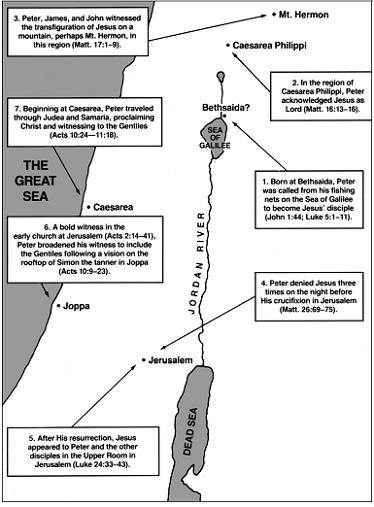
The MacArthur Bible Handbook, by John MacArthur (Nashville: Thomas Nelson Publishers, 2003) 488. © 2003 by Thomas Nelson, Inc.
1:4 exceedingly great and precious promises. That is, the promises of abundant and eternal life. partakers of the divine nature. This expression is not different from the concepts of being born again, born from above (cf. John 3:3; James 1:18; 1 Pet. 1:23), being in Christ (cf. Rom. 8:1), or being the human home of the Trinity (John 14:17–23). The precious promises of salvation result in becoming God’s children in the present age (John 1:12; Rom. 8:9; Gal. 2:20; Col. 1:27), and thereby sharing in God’s nature by the possession of His eternal life. Christians do not become little gods, but they are “new creations” (2 Cor. 5:17) and have the Holy Spirit living in them (1 Cor. 6:19, 20). Moreover, believers will partake of the divine nature in a greater way when they bear a glorified body like Jesus Christ (Phil. 3:20, 21; 1 John 3:1–3). escaped the corruption. The word corruption has the idea of something decomposing or decaying. Escaped depicts a successful flight from danger. At the time of salvation, the believer escapes from the power which the rottenness in the world has over him through his fallen, sinful nature.
B. Confirmed by Christian Graces (1:5–7)
1:5 for this very reason. Because of all the God-given blessings in verses 3 and 4, the believer cannot be indifferent or self-satisfied. Such an abundance of divine grace calls for total dedication. giving all diligence. That is, making maximum effort. The Christian life is not lived to the honor of God without effort. Even though God has poured His divine power into the believer, the Christian himself is required to make every disciplined effort alongside of what God has done (cf. Phil. 2:12, 13; Col. 1:28, 29). add to your faith. Add is to give lavishly and generously. In Greek culture, the word was used for a choirmaster who was responsible for supplying everything that was needed for his choir. The word never meant to equip sparingly, but to supply lavishly for a noble performance. God has given us faith and all the graces necessary for godliness (vv. 3, 4). We add to those by our diligent devotion to personal righteousness. virtue. First in Peter’s list of moral excellencies is a word that, in classical Greek, meant the God-given ability to perform heroic deeds. It also came to mean that quality of life which made someone stand out as excellent. It never meant cloistered virtue, or virtue of attitude, but virtue which is demonstrated in life. Peter is here writing of moral energy, i.e., the power that performs deeds of excellence. knowledge. This means understanding, correct insight, and truth properly comprehended and applied. This virtue involves a diligent study and pursuit of truth in the Word of God.
1:6 self-control. Lit. “holding oneself in.” In Peter’s day, self-control was used of athletes who were to be self-restrained and self-disciplined. Thus, a Christian is to control the flesh, the passions, and the bodily desires, rather than allowing himself to be controlled by them (cf. 1 Cor. 9:27; Gal. 5:23). Virtue, guided by knowledge, disciplines desire and makes it the servant, not the master, of one’s life. perseverance. That is patience or endurance in doing what is right, never giving in to temptation or trial. Perseverance is spiritual staying power that will die before it gives in. It is the virtue which can endure, not simply with resignation, but with a vibrant hope. godliness. See note on verse 3.
1:7 brotherly kindness. I.e., brotherly affection, mutual sacrifice for one another (cf. 1 John 4:20). love. See 1 Corinthians 13; 1 Peter 4:8.
C. Honored by Abundant Reward (1:8–11)
1:8 neither barren. To be barren is to be inactive, indolent, and useless (cf. Titus 1:12; James 2:20–22). With these virtues increasing in one’s life (vv. 5–7), a Christian will not be useless or ineffective. nor unfruitful. I.e., unproductive (cf. Matt. 13:22; Eph. 5:11; 2 Thess. 3:14; Jude 12). When these Christian qualities are not present in a believer’s life (vv. 5–7), he will be indistinguishable from an evildoer or a superficial believer. But when these qualities are increasing in a Christian’s life, there is the manifestation of “the divine nature” within the believer (see note on v. 4 ).
1:9 these things. The qualities mentioned in verses 5–7 (see v. 10). shortsighted, even to blindness. A professing Christian who is missing the virtues mentioned above is, therefore, unable to discern his true spiritual condition, and thus can have no assurance of his salvation. forgotten. The failure to diligently pursue spiritual virtues produces spiritual amnesia. Such a person, unable to discern his spiritual condition, will have no confidence about his profession of faith. He may be saved and possess all the blessings of verses 3 and 4, but without the excellencies of verses 5–7, he will live in doubt and fear.
1:10 make your call and election sure. This expresses the bull’s-eye Peter has been shooting at in verses 5–9. Though God is “sure” who His elect are and has given them an eternally secure salvation (see notes on 1 Pet. 1:1–5; cf. Rom. 8:31–39), the Christian might not always have assurance of his salvation. Security is the Holy Spirit-revealed fact that salvation is forever. Assurance is one’s confidence that he possesses that eternal salvation. In other words, the believer who pursues the spiritual qualities mentioned above guarantees to himself, by spiritual fruit, that he was called (cf. v. 3; Rom. 8:30; 1 Pet. 2:21) and chosen (cf. 1 Pet. 1:2) by God to salvation. never stumble. As the Christian pursues the qualities enumerated by Peter (vv. 5–7) and sees that his life is useful and fruitful (v. 8), he will not stumble into doubt, despair, fear, or questioning, but enjoy assurance that he is saved.
1:11 abundantly into the everlasting kingdom. Peter piles up the words to bring joy to the weary Christian’s heart. An abundant entrance into eternal heaven is the hope and reality for a Christian who lives a faithful, fruitful life here on earth. Peter’s point is that a Christian who pursues the listed virtues (vv. 5–7) will not only enjoy assurance in the present, but a full, rich reward in the future life (cf. 1 Cor. 4:5; Rev. 22:12).
II. KNOW YOUR SCRIPTURES (1:12–21)
A. Certified by Apostolic Witness (1:12–18)
1:12, 13 this reason. Truth always needs repetition because believers forget so easily. Cf. 2 Thessalonians 2:5; Jude 5.
1:13, 14 tent. Death is described aptly as laying aside one’s tent (cf. 2 Cor. 5:1). Peter was likely in his seventies as he wrote this letter (likely from a Roman prison) and anticipated dying soon. Nero’s persecution had begun and he was martyred in it soon after writing this epistle. Tradition says he was crucified upside down, refusing to be crucified like his Lord.
1:14 Christ showed me. Christ had prophesied the death Peter would die almost forty years earlier (see note on John 21:18, 19 ).
1:15 after my decease. Peter wanted to make certain that after he died, God’s people would have a permanent reminder of the truth; thus he penned this inspired letter.
1:16 cunningly devised fables. The word for fables was used to refer to mythical stories about gods and miracles (cf. 1 Tim. 1:4; 4:7; 2 Tim. 4:4; Titus 1:14). Realizing that false leaders and their followers would try to discredit this letter, and that he was probably already being accused of concocting fables and myths in order to get people to follow him so he could amass wealth, power, and prestige as false teachers were motivated to do, Peter gave evidences in the following verses to prove that he wrote the truth of God as a genuinely inspired writer. made known. This word is a somewhat technical term for imparting a new revelation—something previously hidden, but now revealed. the power and coming of our Lord Jesus Christ. Since there is only one definite article with this phrase, the meaning is, “the powerful coming,” or “the coming in power.” The false teachers who were opposing Peter had tried to debunk the doctrine of the Second Coming of Christ (see 3:3, 4), about which Peter had spoken and written (1 Pet. 1:3–7, 13; 4:13). eyewitnesses of His majesty. The “we” that begins this verse refers to the apostles. In one sense, all of the apostles had been eyewitnesses to Christ’s majesty, especially His miracles, resurrection body, and Ascension into heaven. Peter, however, is referring to a more specific event which he will describe in the next verse. The kingdom splendor of Christ revealed at this event was intended as a preview of His majesty to be ultimately manifested at His Second Coming (cf. Matt. 16:28; see notes on Matt. 17:1–6 ). The Transfiguration of Jesus was a glimpse of the glory to be unveiled at the final revelation, the Apocalypse of Christ (Rev. 1:1). It must be noted that Jesus’ earthly ministry of healing, teaching, and gathering souls into His kingdom was a preview of the character of the earthly kingdom He will establish at His return.
1:17 Excellent Glory. A reference to the glory cloud on the Mount of Transfiguration from which God spoke to the disciples (Matt. 17:5). This is My beloved Son. This means, “This One is in essence with Me.” The Father is thus affirming the deity of Christ (cf. Matt. 17:5; Luke 9:27–36).
1:18 when we were with Him. Peter implied that there was no reason to believe the false teachers who denied the majesty and Second Coming of Christ, since they were not on the Mount of Transfiguration to see the preview of the kingdom and glory of Christ, as were he, James, and John.
B. Inspired by the Holy Spirit (1:19–21)
1:19 the prophetic word. The prophetic word refers not just to the OT major and minor prophets, but to the entire OT. Of course, all of the OT was written by “prophets” in the truest sense, since they spoke and wrote God’s Word, which was the task of a prophet; and they looked forward, in some sense, to the coming Messiah (cf. Luke 24:27). confirmed. This translation could indicate that the eyewitness account of Christ’s majesty at the Transfiguration confirmed the Scriptures. However, the Greek word order is crucial in that it does not say that. It says, “And we have more sure the prophetic word.” That original arrangement of the sentence supports the interpretation that Peter is ranking Scripture over experience. The prophetic word (Scripture) is more complete, more permanent, and more authoritative than the experience of anyone. More specifically, the Word of God is a more reliable verification of the teachings about the person, atonement, and Second Coming of Christ than even the genuine firsthand experiences of the apostles themselves. you do well to heed. Peter was warning believers that since they would be exposed to false teachers, they must pay careful attention to Scripture. a light that shines in a dark place. The murky darkness of this fallen world keeps people from seeing the truth until the light shines. The light is the lamp of revelation, the Word of God (cf. Ps. 119:105; John 17:17). the day dawns and the morning star rises. These simultaneous images mark the parousia, i.e., the appearing of Jesus Christ (cf. Luke 1:78; Rev. 2:28; 22:16). the morning star rises in your hearts. The Second Coming will have not only an externally transforming impact on the universe (3:7–13), but also an internally transforming impact on those believers who are alive when Jesus returns, forever removing any of their remaining doubts. The perfect, but limited, revelation of the Scriptures will be replaced with the perfect and complete revelation of Jesus Christ at the Second Coming (cf. John 14:7–11; 21:25). Then, the Scriptures will have been fulfilled; and believers, made like Christ (1 John 3:1, 2), will have perfect knowledge and all prophecy will be abolished (see note on 1 Cor. 13:8–10 ).
1:20 knowing this first. A call to recognize God’s truth as priority, namely that Scripture is not of human origin. prophecy of Scripture. I.e., all of Scripture. This refers primarily to all of the OT, and then by implication to all of the NT (see notes on 3:15, 16 ). private interpretation. The Greek word for interpretation has the idea of a “loosing,” as if to say no Scripture is the result of any human privately, “untying” and “loosing” the truth. Peter’s point is not so much about how to interpret Scripture, but rather how Scripture originated, and what its source was. The false prophets untied and loosed their own ideas. But no part of God’s revelation was unveiled or revealed from a human source or out of the prophet’s unaided understanding (see v. 21).
1:21 by the will of man. As Scripture is not of human origin, neither is it the result of human will. The emphasis in the phrase is that no part of Scripture was ever at any time produced because people wanted it so. The Bible is not the product of human effort. The prophets, in fact, sometimes wrote what they could not fully understand (1 Pet. 1:10, 11), but were nonetheless faithful to write what God revealed to them. moved by the Holy Spirit. Grammatically, this means that they were continually carried or borne along by the Spirit of God (cf. Luke 1:70; Acts 27:15, 17), who is the divine author and originator, the producer of the Scriptures. In the OT alone, the human writers refer to their writings as the words of God over 3,800 times (e.g., Jer. 1:4; cf. 3:2; Rom. 3:2; 1 Cor. 2:10). Though the human writers of Scripture were active rather than passive in the process of writing Scripture, God the Holy Spirit superintended them so that, using their own individual personalities, thought processes, and vocabulary, they composed and recorded without error the exact words God wanted written. The original copies of Scripture are therefore inspired, i.e., God-breathed (cf. 2 Tim. 3:16) and inerrant, i.e., without error (John 10:34, 35; 17:17; Titus 1:2). Peter defined the process of inspiration which created an inerrant, original text (cf. Prov. 30:5; 1 Cor. 14:36; 1 Thess. 2:13).
III. KNOW YOUR ADVERSARIES (2:1–22)
A. Deceptive in Their Infiltration (2:1–3)
2:1 false prophets. Peter described false teachers in detail in this chapter so that Christians would always recognize their characteristics and methods. The greatest sin of Christ-rejecters and the most damning work of Satan is misrepresentation of the truth and its consequent deception. Nothing is more wicked than for someone to claim to speak for God to the salvation of souls when, in reality, he speaks for Satan to the damnation of souls (cf. Deut. 13:1–18; 18:20; Jer. 23; Ezek. 13; Matt. 7:15; 23:1–36; 24:4, 5; Rom. 16:17; 2 Cor. 11:13, 14; Gal. 3:1, 2; 2 Tim. 4:3, 4). among the people. The people is used in the NT of Israel (cf. Acts 26:17, 23). Peter’s point, though, is that Satan has always endeavored to infiltrate groups of believers with the deceptions of false teachers (cf. John 8:44). Since Eve, he has been in the deception business (see notes on 2 Cor. 11:3, 4 ). secretly bring in destructive heresies. The false teachers parade themselves as Christian pastors, teachers, and evangelists (cf. Jude 4). Heresies means self-designed religious lies which lead to division and faction (cf. 1 Cor. 11:19; Gal. 5:20). The Greek word for destructive basically means damnation. This word is used six times in this letter and always speaks of final damnation (vv. 1–3; 3:7, 16). This is why it is so tragic when a church makes a virtue out of the toleration of unscriptural teachings and ideas in the name of love and unity (see 2 Thess. 3:14; 1 Tim. 4:1–5; Titus 3:9–11). denying the Lord. This phrase exposes the depth of the crime and guilt of the false teachers. This unusual Greek word for Lord appears ten times in the NT and means one who has supreme authority, whether human authority or divine authority. Peter, here, warns that false prophets deny the sovereign lordship of Jesus Christ. Though their heresies may include the denial of the Virgin Birth, deity, bodily resurrection, and Second Coming of Christ, the false teachers’ basic error is that they will not submit their lives to the rule of Christ. All false religions have an erroneous Christology. who bought them. The terms which Peter used here are more analogical than theological, speaking of a human master over a household. The master bought slaves, and the slaves owed the master allegiance as their sovereign. (For an OT parallel, see Deuteronomy 32:5, 6, where God is said to have bought Israel, though they rejected Him.). Doctrinally, this analogy can be viewed as responsibility for submission to God which the false teachers had refused. Beyond this, they are probably claiming that they were Christians, so that the Lord had bought them actually and personally. With some sarcasm, Peter mocks such a claim by writing of their coming damnation. Thus, the passage is describing the sinister character of the false teachers who claim Christ, but deny His lordship over their lives. swift destruction. This refers to either physical death or judgment at the return of Christ (Prov. 29:1; 2 Thess. 1:7–10).
2:2 many will follow their destructive ways. Many people will profess to be Christians but deny Christ’s lordship over their lives, refusing to live as obedient servants to Christ and His Word, following instead the lusts of the flesh, the world, and the devil. Such nominal Christians will be included in the Lord’s condemnation of hypocrites at the judgment (Matt. 7:21–23; cf. Jude 4, 7). Denying the lordship of Christ while claiming to be a believer destructively infects other people and discredits the gospel. the way of truth will be blasphemed. The world mocks and scoffs at the gospel of Jesus Christ because of nominal Christians who do not follow the Lord they claim; as such, they have been unmasked as hypocritical people.
2:3 By covetousness. That is, uncontrolled greed. Peter observed that the underlying motive of the false teachers was not love of the truth, but love of money (see v. 14). They exploited people through their lies. their judgment has not been idle. The principle that God will damn false teachers was set in place in eternity past, repeated throughout the OT, and “has not been idle” in the sense that it has not worn out or become ineffective. It is still potent and will come to pass (see Jude 4). their destruction does not slumber. Peter is personifying destruction as if destruction were an executioner who is fully awake and alert, ready to act. Because God is by nature a God of truth, He will judge all liars and deceivers (cf. Prov. 6:19; 19:5, 9; Is. 9:15; 28:15, 22; Jer. 9:3, 5; 14:14; 23:25, 26; Rev. 21:8, 27).
B. Doomed by Their Iniquity (2:4–10)
2:4 if. This is better translated “since” because there is no doubt about the history of judgment which Peter is about to recount. Verses 4–10 are one long sentence, with the conclusion to the “since” clause beginning in verse 9. Lest anyone think that God is too loving and merciful to judge the wicked false teachers and their deceived people, Peter gives three powerful illustrations of past divine judgment on the wicked. These illustrations set the precedents for the future and final judgment on liars and deceivers. Though God has no pleasure in the death of the wicked (Ezek. 33:11), He must judge wickedness because His holiness requires it (2 Thess. 1:7–9). the angels who sinned. These angels, according to Jude 6, “did not keep their proper domain,” i.e., they entered men who promiscuously cohabited with women. Apparently, this is a reference to the fallen angels of Genesis 6 (sons of God): (1) before the Flood (v. 5; Gen. 6:1–3) who left their normal state and lusted after women, and (2) before the destruction of Sodom and Gomorrah (v. 6; Gen. 19). See notes on Genesis 6:1, 2; Jude 6. cast them down to hell. Peter borrows a word from Greek mythology for hell, tartarus. The Greeks taught that tartarus was a place lower than Hades reserved for the most wicked of human beings, gods, and demons. The Jews eventually came to use this term to describe the place where fallen angels were sent. It defined for them the lowest hell, the deepest pit, and the most terrible place of torture and eternal suffering. Jesus, in spirit, entered that place when His body was in the grave, and proclaimed triumph over the demons during the time between His death and resurrection (see notes on Col. 2:14; 1 Pet. 3:18, 19 ). chains of darkness. The demons feared going there and begged Jesus during His life on earth not to send them there (cf. Matt. 8:29; Luke 8:31). Not all demons are bound. Many roam the heavens and earth (cf. Rev. 12:7–9). Some are temporarily bound (see notes on Rev. 9:1–12 ). These were, because of their sin in Genesis 6, permanently bound in darkness. reserved for judgment. These permanently bound demons are like prisoners who are incarcerated awaiting final sentencing. Tartarus is only temporary in the sense that, in the Day of Judgment, the wicked angels confined there will be ultimately cast into the lake of fire (Rev. 20:10).
2:5 did not spare the ancient world. The second illustration serving as precedent for God’s future judgment on false teachers is the judgment on the ancient world through the worldwide Flood (cf. Gen. 6–8). The human race was reduced to eight people by that judgment (cf. 1 Pet. 3:20). a preacher of righteousness. See Genesis 6:9; 7:1. His life spoke of righteousness as he called people to repent and avoid the flood judgment.
2:6 Sodom and Gomorrah. The third precedent for a future divine judgment on the wicked is the total destruction of Sodom and Gomorrah and the surrounding cities (cf. Gen. 13; 18:16–33; 19:1–38; Deut. 29:23). This judgment destroyed every person in the area by incineration. See notes on Jude 7. making them an example. That is, a model or a pattern. God sent an unmistakable message to all future generations that wickedness results in judgment.
2:7, 8 delivered righteous Lot. He was righteous, as all the saved are, by faith in the true God. Righteousness was imputed to him by grace through faith, as it was to Abraham (Gen. 15:6; Rom. 4:3, 11, 22, 23). There was spiritual weakness in Lot (Gen. 19:6), e.g., immorality (Gen. 19:8) and drunkenness (Gen. 19:33–35). His heart was in Sodom (Gen. 19:16), yet he did hate the sins of his culture and sought ways to protect God’s angels from harm. He obeyed the Lord in not looking back at Sodom (Gen. 19). In both of the illustrations where God rendered a wholesale judgment on all living people (once on the whole earth, and once in the whole region of the plain south of the Dead Sea), Peter pointed out that God’s people were rescued (v. 5; cf. v. 9). The Greek word for “oppressed” implies that Lot was troubled deeply and tortured (the meaning of “tormented”) with the immoral, outrageous behavior of the people living in and around Sodom and Gomorrah. Tragically, it is ordinary for believers to be no longer shocked by the rampant sin in today’s society.
2:9 to deliver the godly out of temptations. The Greek word for temptations can mean “an attack with intent to destroy” (cf. Mark 8:11; Luke 4:12; 22:28; Acts 20:29; Rev. 3:10) and refers to severe divine judgment. The pattern of the plan of God is to rescue the godly before His judgment falls on the wicked. to reserve the unjust. The wicked are kept like prisoners awaiting the sentencing that will send them to their eternal prison (cf. v. 4). The final judgment on the wicked is called the Great White Throne judgment (Rev. 20:11–15) where all the ungodly of all the ages will be raised, judged finally, and cast into the lake of fire.
2:10 walk according to the flesh. Cf. Jude 6. Like the wicked of Noah’s and Lot’s time, the false teachers of Peter’s era were slaves to the corrupt desires of the flesh. despise authority. Authority comes from the same Greek word as lord (1:2). The false teachers identified with Christ outwardly, but they would not live under His lordship. The two major characteristics of false teachers are emphasized in this verse: (1) lust and (2) arrogance. presumptuous, self-willed. Presumptuous is to be brazen, audacious, and defiant. Self-willed is to be obstinate and determined in one’s own way. speak evil of dignitaries. Cf. Jude 8. To speak evil is to ridicule and blaspheme. Dignitaries refers to angels, probably wicked angels. Wicked angels have a level of existence in the supernatural world that has a dignity and a transcendent quality about it that is beyond humanity (Eph. 6:12). A certain honor belongs to those who transcend time. Consequently, there must be no flippancy regarding Satan and his angels. It may even be that these teachers tried to excuse their wicked lusts by pointing to the angels in Genesis 6 “who did not keep their proper domain” (Jude 6). The blasphemy of even bad angels by the false teachers demonstrated their arrogance and antipathy toward any authority, be it good or bad.
C. Disdainful in Their Impurity (2:11–17)
2:11 angels, who are greater in power. A reference to the holy angels, who are greater in power than human beings. do not bring a reviling accusation. Unlike false teachers who are defiant toward higher powers, the holy angels so revere their Lord that they will not speak insults against any authority. Even the archangel, Michael, recognizing the great presence and power of Satan, refused to speak evil of him (see notes on Jude 8, 9 ), but called on the Lord to do so (see note on Zech.3:2 ). No believer should be so boldly foolish as to mock or command the power of supernatural demons, especially Satan.
2:12 like natural brute beasts. Cf. Jude 10. The false teachers have no sensitivity to the power and presence of demons or holy angels, but like wild animals, insubordinate, insolent, and arrogant, they charge into the supernatural realm, cursing away at persons and matters they don’t understand. utterly perish. Since they live like beasts who are “made to be caught and destroyed,” the false teachers will be killed like beasts. False teachers cannot get beyond their own instincts and, thus, will be destroyed by the folly of those passions.
2:13 the wages of unrighteousness. Immorality and arrogant boldness will not pay. It will rob and destroy. carouse in the daytime. Sinning during the day, without the cover of darkness, was a sign of low-level wickedness in Roman society (cf. 1 Thess. 5:7). But these false teachers are so consumed with lust and rebellion that they are pleased not to wait for the night. Their unbridled passions consume them. spots and blemishes. Cf. Jude 10. That is, dirt spots and scabs. They are opposite to the character of Christ (1 Pet. 1:19). The church should be like her Lord (Eph. 5:27). carousing . . . while they feast with you. The false teachers, feigning to be teachers of truth while sitting with Christians at church love feasts, were behaving arrogantly and immorally, even on such occasions intended for Christian fellowship. Though attempting to cover their corruption with religious talk, they were filthy defects on these church gatherings (cf. 2 John 9–11; Jude 12).
2:14 eyes full of adultery. The false teachers had so totally lost moral control that they could not look at any woman without seeing her as a potential adulteress (cf. Matt. 5:28). They were uncontrollably driven by lust, never resting from their sins. enticing unstable souls. The metaphor is from fishing and appears also in verse 18. To beguile is to catch with bait. False teachers do not capture those strong in the Word, but prey on the weak, the unstable, and the young in the faith (see 3:16; cf. Eph. 4:14; 1 John 2:13). heart trained in covetous practices. The word trained was often used for training in athletics. The false teachers have trained, prepared, and equipped their minds to concentrate on nothing but the forbidden things for which their passions lusted. They were well schooled in the craft of self-fulfillment. accursed children. This is a Hebraism for the curse of sin being the dominant thing in their lives, thus saying that they are damned to hell for their blatant wickedness. Cf. Galatians 3:10, 13; Ephesians 2:1–3; 1 Peter 1:14.
2:15 forsaken the right way. The right way is an OT metaphor for obedience to God (cf. Acts 13:10). Balaam. Cf. Jude 11. Balaam served as an illustration and example of such false prophets. He was an OT compromising prophet for sale to whomever paid him. He preferred wealth and popularity over faithfulness and obedience to God (Num. 22–24). Through a talking donkey, God kept him from cursing Israel (v. 16; cf. Num 22:21–35).
2:17 wells without water. In this verse, Peter uses two poetic figures (“wells” and “clouds”) which represent a precious commodity in the Middle East. A well without water would be a major disappointment in a hot and dry land. Likewise, false teachers have a pretense of spiritual water to quench the thirsty soul, but they actually have nothing to give. clouds carried by a tempest. The coming of clouds would seem to promise rain, but sometimes the storm would blow the clouds by, leaving the land dry and hot. The false teachers might seem to promise spiritual refreshment, but were all show with no substance (cf. Jude 12). the blackness of darkness. That is, hell (cf. Matt. 8:12; Jude 13.)
D. Devastating in Their Impact (2:18–22)
2:18 great swelling words of emptiness. Cf. Jude 16. That is, ostentatious verbosity. The false teachers deceive the weak with high-sounding words that masquerade as scholarship or profound spiritual insight, and even as direct revelation from God. They may contradict the plain historic teachings of Scripture which, in some cases, they are not able to explain properly because of their lack of adequate training and divine wisdom (cf. 1 Cor. 2:14). In reality, they say nothing genuinely scholarly, spiritual, or divine. allure through . . . lewdness. Nevertheless, in spite of all the empty talk, false teachers entice others to their philosophies by appealing to people on the baser level. Seduction, rather than the winsomeness of truth, is their ploy. They offer people a kind of religion that they can embrace and still hold on to their fleshly desires and sensuality. Peter may also be implying that false teachers particularly aim to seduce women through sensual methods. actually escaped . . . error. The preferred translation is “barely escaping” or “trying to escape.” This is a description not of saved people, but of people who are vulnerable because they have high levels of guilt and anxieties—people with broken marriages, people who are lonely and tired of the consequences of sin and are looking for a new start, even for religion or help from God. The false teachers exploit these kinds of people.
2:19 promise them liberty. False teachers promise those “trying to escape” the struggles of life, the very freedom they seek. slaves of corruption. The false teachers can’t deliver the freedom they promise because they themselves are enslaved to the very corruption which people are trying to escape. overcome . . . bondage. Whoever puts himself, in the name of freedom, into the hands of a false teacher, who is a prisoner himself, also becomes a prisoner. Bondage to corruption awaits all followers of false teachers.
2:20 escaped the pollutions of the world. Pollutions has the idea of putrid or poisonous vapors. Morally, the world gives off a deadly influence. Peter notes that at some point in time, these false teachers and their followers wanted to escape the moral contamination of the world system and sought religion, even Jesus Christ (on their terms, not His; see notes on v. 1 ). But these false teachers had never genuinely been converted to Christ. They heard the true gospel and moved toward it, but then rejected the Christ of that gospel. That is apostasy, like the people of Hebrews 10:26, 27. Their last end is far worse than the first (for examples of apostasy, see Luke 11:24–26; 12:47, 48; 1 Cor. 10:1–12; Heb. 3:12–18; 6:6; 10:26, 38ff.; 1 John 2:19; Jude 4–6).
2:21 to turn from the holy commandment. Lit. “to turn back.” This verse describes the perversion and defection of the false teachers. They professed the Christian experience (the way of righteousness; cf. Matt. 21:32), and even had access to the true teachings of Scripture. But by their lives, they demonstrated that they ultimately had chosen to reject Christ (cf. Heb. 10:26–31). Such false teachers, as Peter was describing, were not made outside Christianity. They are always bred in the church, half in and half out; but eventually, they reject the truth and try to seduce others in their attempt to fulfill their self-gratification.
2:22 dog . . . sow. Two graphic analogies of an apostate. The first from Proverbs 26:11; the second is Peter’s own.
IV. KNOW YOUR PROPHECY (3:1–18)
A. The Certainty of the Day of the Lord (3:1–10)
3:1 Beloved. This attitude toward the readers of his letter reflects Peter’s pastoral concern (cf. 1 Pet. 5:1–4). this second epistle. That is, second to 1 Peter (see Introduction). your pure minds. A good commendation which demonstrates that Peter believed that his readers were genuine Christians. Pure means uncontaminated, unmixed with the seductive influences of the world, the flesh, and the devil. How different the true believers were from the corrupt, apostate false teachers (2:10–22). Peter sought to impress on his readers the truth they already knew, so that their sanctified reason and spiritual discernment would be able to detect and refute the purveyors of false doctrine.
3:2 holy prophets. The OT prophets are in view. They were holy in contrast to the unholy false teachers. God’s Word was written by those prophets in the Scriptures (see notes on 1:19–21 ). In particular, those prophets warned about coming judgment (e.g., Ps. 50:1–4; Is. 13:10–13; 24:19–23; Mic. 1:4; Mal. 4:1, 2), and even about the coming of the Lord (Zech. 14:1–9). the commandment of us. Peter is referring to the warnings which he and the other apostles had written regarding judgment (Jude 17). apostles of the Lord. The apostles (see notes on Rom. 1:1; Eph. 4:11 ) of Christ filled the 260 chapters of the NT with about 300 references to the Second Coming. NT revelation concerning (1) Christ coming to gather His own, (2) warnings about eschatological judgments, (3) information about the establishment of His kingdom, and (4) teaching about God’s bringing in eternal righteousness, comprise the irrefutable proof for the Second Coming of Christ and the judgment of the wicked.
3:3 knowing this first. First here means the preeminent matter, not the first in a list. Peter’s priority in this section of his letter is to warn Christians about how the false teachers would try to deny this judgment and steal the hope of believers. scoffers will come. False teachers argue against the Second Coming of Christ or any teaching of Scripture through ridicule (cf. Is. 5:19; Jude 18). in the last days. This phrase refers to that entire period of time from the arrival of the Messiah to His return (cf. Acts 2:17; Gal. 4:4; 2 Tim. 3:1; Heb. 1:2; James 5:3; 1 Pet. 1:20; 1 John 2:18, 19; Jude 18). The entire age will be marked by saboteurs of the Christian truth and, especially, the hope of Christ’s return. walking according to their own lusts. Walking speaks of the way of conduct, the course of lifestyle. Peter, again, speaks of the lifestyle of the false teachers, which was characterized by sexual lusts (cf. 2:2, 10, 13, 14, 18), driving home his warning. False teachers who do not know the truth and do not know God have nothing to restrain their lusts. They particularly mock the Second Coming of Jesus Christ, because they want to pursue impure sexual pleasure without consequence or without having to face divine retribution. They want an eschatology that fits their conduct (cf. 1 John 2:28, 29; 3:2, 3).
3:4 Where is the promise of His coming? The early church believed that Jesus was coming back imminently (cf. 1 Cor. 15:51; 1 Thess. 1:10; 2:19; 4:15–18; 5:1, 2). These scoffers employed an emotional argument against imminency, rather than a biblical argument. Their argument played on ridicule and disappointment. the fathers. The OT patriarchs, Abraham, Isaac, and Jacob (cf. Rom. 9:5; Heb. 1:1). all things continue as they were. This argument against the Second Coming of Christ is based on the theory of uniformitarianism, which says that all natural phenomena have operated uniformly since the beginning of the earth. The false teachers were also implying that God is absent from earth affairs. In effect, they were teaching that “there will not be a great cataclysmic, judgmental event at the end of history, because that is not how the universe works. There never has been such a judgment, so why should we expect one in the future? Instead, everything in the universe is stable, closed, fixed, and governed by never-varying patterns and principles of evolution. Nothing catastrophic has ever happened in the past, so nothing catastrophic ever will happen in the future. There will be no divine invasion, no supernatural judgment on mankind.”
3:5 they willfully forget. The false teachers, in their quest to avoid the doctrine of judgment, deliberately ignore the previous two major divine cataclysmic events—creation and the Flood. by the word of God the heavens were of old. Creation was God’s stepping into the emptiness and bringing the universe into existence, not by uniformitarianism, but by an instantaneous, explosive six-day creation. Everything has not continued along in some consistent, unvarying evolutionary process. In six days of twenty-four hours, the whole universe was created mature and complete (see notes on Gen. 1; 2 ). earth standing out of water and in the water. The earth was formed between two realms of watery mass. During the early part of the creation week, God collected the upper waters into a canopy around the whole earth, and the lower waters into underground reservoirs, rivers, lakes, and seas. See notes on Genesis 1:2–10.
3:6 by which. That is, by water. God, by creating water above and below, built into His creation the tool of its destruction. the world that then existed. A reference to the pre-flood world order. This world included the physical arrangement with the canopy above, the waters in the underground reservoirs, rivers, lakes, and seas below, and the heavens in the middle. The pre-Flood world, sheltered from the sun’s destructive ultraviolet rays, and with a gentle climate without rain, storms, and winds, was characterized by long life of humans (Gen. 5) and the ability of the earth (like a green house) to produce extensively. perished, being flooded with water. The second great divine cataclysm that refutes the idea of uniformitarianism was the universal Flood which drowned the whole earth and altered the world order. According to Genesis 7:11ff., the Flood occurred from two directions: first, the bursting open of the sources of water below as the earth cracked open and gas, dust, water, and air burst up; then, came the breakup of the overhead canopy when hit by all that upward flow, which sent the water from above crashing down on the earth. The deluge was so cataclysmic that the inhabitants of the earth were all destroyed, except eight people and a representation of every kind of animal (see notes on Gen. 7:11–24 ). Clearly, by those two great events, it is certain that the world is not in a uniformitarian process.
The Promise of Christ’s Second
| OT | NT |
| 1. Ezek. 21:27 | 1. Matt. 24:27, 30 |
| 2. Dan. 7:13, 14 | 2. Luke 17:30 |
| 3. Zech. 2:10 | 3. John 14:3 |
| 4. Zech. 14:5 | 4. Acts 1:11 |
| 5. Mal. 3:1 | 5. 1 Thess. 4:16 |
3:7 which are now. Humanity, since the Flood, lives in the second world order. One of the obvious differences between the two world orders is that people live about 70 years in the present world, not 900 years, which was a common age of pre-Flood human beings. And Peter was making the point that there is a third form of the heavens and earth yet to come following another cataclysm. are now preserved by the same word. The present world system is reserved for future judgment, which will come by the Word of God just as creation and the Flood came. God will speak it into existence as well, after the present order is again destroyed. reserved for fire. God put the rainbow in the sky to signify that He would never destroy the world again by water (Gen. 9:13). In the future, God will destroy the heavens and the earth by fire (cf. Is. 66:15; Dan. 7:9, 10; Mic. 1:4; Mal. 4:1; Matt. 3:11, 12; 2 Thess. 1:7, 8). In the present universe, the heavens are full of stars, comets, and asteroids. The core of the earth is also filled with a flaming, boiling, liquid lake of fire, the temperature of which is some 12,400 degrees Fahrenheit. The human race is separated from the fiery core of the earth by only a thin 10-mile crust. Far more than that, the whole of creation is a potential fire bomb due to its atomic structure. As man from atoms creates destructive bombs that burn a path of death, so God can disintegrate the whole universe in an explosion of atomic energy (see notes on vv.10–12 ). until the day of judgment . . . of ungodly men. The earth waits for the day of judgment and destruction of ungodly people. The godly will not be present on earth when God speaks into existence the judgment by fire (cf. 1 Thess. 1:10; 5:9).
3:8 one day is as a thousand years. God understands time much differently than man. From man’s viewpoint, Christ’s coming seems like a long time away (cf. Ps. 90:4). From God’s viewpoint, it will not be long. Beyond that general reference, this may be a specific indication of the fact that there are actually 1,000 years between the first phase of the Day of the Lord at the end of the Tribulation (Rev. 6:17), and the last phase 1,000 years later at the end of the millennial kingdom when the Lord creates the new heavens and new earth (see notes on vv. 10, 13; Rev. 20:1–21:1 ).
3:9 not slack. That is, not loitering or late (cf. Gal. 4:4; Titus 2:13; Heb. 6:18; 10:23, 37; Rev. 19:11). longsuffering toward us. Us is the saved, the people of God. He waits for them to be saved. God has an immense capacity for patience before He breaks forth in judgment (cf. v. 15; Joel 2:13; Luke 15:20; Rom. 9:22; 1 Pet. 3:15). God endures endless blasphemies against His name, along with rebellion, murders, and the ongoing breaking of His law, waiting patiently while He is calling and redeeming His own. It is not impotence or slackness that delays final judgment; it is patience. not willing that any should perish. The any must refer to those whom the Lord has chosen and will call to complete the redeemed, i.e., the us. Since the whole passage is about God’s destroying the wicked, His patience is not so He can save all of them, but so He can receive all His own. He can’t be waiting for everyone to be saved, since the emphasis is that He will destroy the world and the ungodly. Those who do perish and go to hell, go because they are depraved and worthy only of hell and have rejected the only remedy, Jesus Christ, not because they were created for hell and predetermined to go there. The path to damnation is the path of a non-repentant heart; it is the path of one who rejects the person and provision of Jesus Christ and holds on to sin (cf. Is. 55:1; Jer. 13:17; Ezek. 18:32; Matt. 11:28; 23:37; Luke 13:3; John 3:16; 8:21, 24; 1 Tim. 2:3, 4; Rev. 22:17). all should come to repentance. All (cf. us, any ) must refer to all who are God’s people who will come to Christ to make up the full number of the people of God. The reason for the delay in Christ’s coming and the attendant judgments is not because He is slow to keep His promise, or because He wants to judge more of the wicked, or because He is impotent in the face of wickedness. He delays His coming because He is patient and desires the time for His people to repent.
3:10 The day of the Lord. See Introduction to Joel: Historical and Theological Themes; see note on 1 Thessalonians 5:2. “Day of the Lord” is a technical term pointing to the special interventions of God in human history for judgment. It ultimately refers to the future time of judgment whereby God judges the wicked on earth and ends this world system in its present form. The OT prophets saw the final Day of the Lord as unequaled darkness and damnation, a day when the Lord would act in a climactic way to vindicate His name, destroy His enemies, reveal His glory, establish His kingdom, and destroy the world (cf. Is. 2:10–21; 13:6–22; Joel 1, 2; Amos 5; Obad. 15; Zech. 14; Mal. 4; 2 Thess. 1:7; 2:2). It occurs at the time of the tribulation on earth (Rev. 6:17), and again 1,000 years later at the end of the millennial kingdom before the creation of the new heavens and new earth (v. 13; Rev. 20:1–21:1). as a thief in the night. The Day of the Lord will have a surprise arrival, sudden, unexpected, and disastrous to the unprepared (see notes on 1 Thess. 5:2 ). the heavens will pass away with a great noise. The heavens refer to the physical universe. The great noise connotes a whistling or a crackling sound as of objects being consumed by flames. God will incinerate the universe, probably in an atomic reaction that disintegrates all matter as we know it (vv. 7, 11, 12, 13). the elements will melt with fervent heat. The elements are the atomic components into which matter is ultimately divisible, which make up the composition of all the created matter. Peter means that the atoms, neutrons, protons, and electrons are all going to disintegrate (v. 11). the earth and the works. The whole of the physical, natural earth in its present form, with its entire universe will be consumed. Cf. Isaiah 24:19, 20; 34:4.
B. The Sanctification of God’s People (3:11–18)
3:11 what manner of persons ought you to be. This is an exclamation rather than a question. It means, “How astoundingly excellent you ought to be!” This is a straightforward challenge for Christians to conform their lives to God’s standards in light of the reality of coming judgment and eternity (cf. 1 Cor. 4:15; 2 Cor. 5:9). holy conduct and godliness. Holy conduct refers to the way a Christian should live life—separate from sin. Godliness refers to the spirit of reverence which should permeate a Christian’s attitude—that which rules the heart.
3:12 looking for and hastening. One of the motives for holy conduct and godliness is expectation. Hastening means “eagerly desiring” that something will happen. Christians are not to fear the future day of God, but eagerly hope for it (cf. 1 Cor. 1:7; 16:22; 1 John 2:28; 3:3). the day of God. The “day of God” is not the same as the “Day of the Lord.” The “day of God” refers to the eternal state, in preparation for which the heavens and the earth are burned up and the new creation is made. It is likely so named because of what Paul had in mind in 1 Corinthians 15:28, the eternal glory of the new creation, with God being all in all. When the day of God comes, man’s “day” will be over. The corrupting of the universe by man and Satan will have been terminated and judged, finally and forever. the heavens will be dissolved. See notes on verses 7, 10, 11. The new world in which righteousness dwells (v. 13), requires the Lord to first destroy the old, sin-cursed universe (cf. Rom. 8:19–22).
3:13 new heavens and a new earth. The promise of a new universe is rooted in the OT (e.g., Ps. 102:25; Is. 65:17; 66:22). The word new means new in quality, i.e., different from before, not just new in chronology. righteousness dwells. The universe is new in quality because righteousness has settled in and taken up permanent and exclusive residence (cf. Is. 60:19–22; Rev. 21:1–7).
3:14 in peace. When Christ returns, each Christian should be found enjoying the peace of Christ which knows no worry or fear about the Day of the Lord or the judgment of Christ (cf. Phil. 4:6, 7). To have this peace means that the Christian has a strong sense of assurance of his salvation and a life of obedience to Christ (cf. 1 John 4:17). without spot and blameless. Christians should have a spotless character and a blameless reputation. These characteristics are in graphic contrast to the false teachers (cf. 2:13), but like Christ (1 Pet. 1:18).
3:15 the longsuffering of our Lord is salvation. In addition to what he has already explained in verse 9 about the Lord’s patience being the reason He delays judgment, here Peter adds that during the time of God’s patience, Christians should engage in seeking the salvation of souls.
3:15b, 16 hard to understand. Since Paul had (by the time Peter wrote) written all his letters and died, the readers of 2 Peter would have already received letters about future events from Paul. Some of Paul’s explanations were difficult (not impossible) to interpret. Nevertheless, Peter uses Paul as a support for his teaching.
3:16 untaught and unstable . . . twist. In Peter’s day (as today), there was a proliferation of foolish and hurtful perverting of apostolic teaching about the future (cf. vv. 3, 4; 2 Thess. 2:1–5; 3:6–12). to their own destruction. The fact that distorting Paul’s writings leads to eternal damnation proves that Paul’s writings were inspired of God. the rest of the Scriptures. This is one of the most clear-cut statements in the Bible to affirm that the writings of Paul are Scripture. Peter’s testimony is that Paul wrote Scripture, but the false teachers distorted it. The NT apostles were aware that they spoke and wrote the Word of God (1 Thess. 2:13) as surely as did the OT prophets. Peter realized that the NT writers brought the divine truth that completed the Bible (1 Pet. 1:10–12).
3:17 know this beforehand. Since Christians now know that there will be false teachers who will appear, twisting and distorting the Scriptures, they should be all the more on their guard. beware lest you also fall. Any time a believer seriously listens to a false teacher, he runs the risk of being led astray (cf. 2 Tim. 2:14–18; Titus 1:10–16).
3:18 grow in the grace and knowledge. Peter ends this letter with a summary statement of the same instruction with which he began it (1:2–11). Pursuing Christian maturity and a deepening knowledge of the Lord Jesus Christ will lead to doctrinal stability and prevent a Christian from being led astray. To Him be the glory. Such a call for glory to Christ demonstrates again that Peter considered Jesus Christ to be deity, equal in honor with God the Father (cf. 1:1; John 5:23).
Further Study
Hiebert, D. Edmond. Second Peter and Jude. Greenville, S.C.: Unusual, 1989.
MacArthur, John. Second Peter and Jude. Chicago: Moody, forthcoming.