THE REVELATION OF
JESUS CHRIST
Title
Unlike most books of the Bible, Revelation contains its own title: “The Revelation of Jesus Christ” (1:1). Revelation (Greek apokalupsis ) means “an uncovering,” “an unveiling,” or “a disclosure.” In the NT, this word describes the unveiling of spiritual truth (Rom. 16:25; Gal. 1:12; Eph. 1:17; 3:3), the revealing of the sons of God (Rom. 8:19), Christ’s Incarnation (Luke 2:32), and His glorious appearing at His Second Coming (2 Thess. 1:7; 1 Pet. 1:7). In all its uses, revelation refers to something or someone, once hidden, becoming visible. What this book reveals or unveils is Jesus Christ in glory. Truths about Him and His final victory, that the rest of Scripture merely allude to, become clearly visible through revelation about Jesus Christ (see Historical and Theological Themes). This revelation was given to Him by God the Father, and it was communicated to the apostle John by an angel (1:1).
Author and Date
Four times the author identifies himself as John (1:1, 4, 9; 22:8). Early tradition unanimously identified him as John the apostle, author of the Fourth Gospel and three epistles. Important second-century witnesses to the apostle John’s authorship include Justin Martyr, Irenaeus, Clement of Alexandria, and Tertullian. Many of the book’s original readers were still alive during the lifetimes of Justin Martyr and Irenaeus—both of whom held to apostolic authorship.
There are differences in style between Revelation and John’s other writings, but they are insignificant and do not preclude one man from writing both. In fact, there are some striking parallels between Revelation and John’s other works. Only John’s Gospel and Revelation refer to Jesus Christ as the Word (19:13; John 1:1). Revelation (1:7) and John’s Gospel (19:37) translate Zechariah 12:10 differently from the Septuagint, but in agreement with each other. Only Revelation and the Gospel of John describe Jesus as the Lamb (5:6, 8; John 1:29); both describe Jesus as a witness (cf. 1:5; John 5:31, 32).
Revelation was written in the last decade of the first century (C. A.D. 94–96), near the end of Emperor Domitian’s reign (A.D. 81–96). Although some date it during Nero’s reign (A.D. 54–68), their arguments are unconvincing and conflict with the view of the early church. Writing in the second century, Irenaeus declared that Revelation had been written toward the end of Domitian’s reign. Later writers, such as Clement of Alexandria, Origen, Victorinus (who wrote one of the earliest commentaries on Revelation), Eusebius, and Jerome affirm the Domitian date.
The spiritual decline of the seven churches (chs. 2, 3) also argues for the later date. Those churches were strong and spiritually healthy in the mid-60s, when Paul last ministered in Asia Minor. The brief time between Paul’s ministry there and the end of Nero’s reign was too short for such a dramatic decline to have occurred. The longer time gap also explains the rise of the heretical sect known as the Nicolaitans (2:6, 15), who are not mentioned in Paul’s letters, not even to one or more of these same churches (Ephesians). Finally, dating Revelation during Nero’s reign does not allow time for John’s ministry in Asia Minor to reach the point at which the authorities would have felt the need to exile him.
Background and Setting
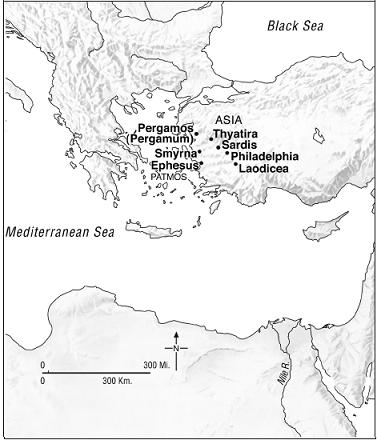
Revelation begins with John, the last surviving apostle and an old man, in exile on the small, barren island of Patmos, located in the Aegean Sea southwest of Ephesus. The Roman authorities had banished him there because of his faithful preaching of the gospel (1:9). While on Patmos, John received a series of visions that laid out the future history of the world.
When he was arrested, John was in Ephesus, ministering to the church there and in the surrounding cities. Seeking to strengthen those congregations, he could no longer minister to them in person and, following the divine command (1:11), John addressed Revelation to them (1:4). The churches had begun to feel the effects of persecution; at least one man—probably a pastor—had already been martyred (2:13), and John himself had been exiled. Now, the storm of persecution was about to break in full fury upon the seven churches so dear to the apostle’s heart (2:10). To those churches, Revelation provided a message of hope: God is in sovereign control of all the events of human history, and though evil often seems pervasive and wicked men seem all-powerful, their ultimate doom is certain. Christ will come in glory to judge and rule.
Historical and Theological Themes
Since it is primarily prophetic, Revelation contains little historical material, other than that in chapters 1–3. The seven churches to whom the letters were addressed were existing churches in Asia Minor (modern Turkey). Apparently, they were singled out because John had ministered in them.
Revelation is first and foremost a revelation about Jesus Christ (1:1). The book depicts Him as the risen, glorified Son of God ministering among the churches (1:10ff.), as “the faithful witness, the firstborn from the dead, and the ruler over the kings of the earth” (1:5), as “the Alpha and the Omega, the Beginning and the End” (1:8), as the One “who is and who was and who is to come, the Almighty” (1:8), as “the First and the Last” (1:11), as “the Son of Man” (1:13), as the One who was dead, but now is alive forevermore (1:18), as “the Son of God” (2:18), as the One who is holy and true (3:7), as “the Amen, the Faithful and True Witness, the Beginning of the creation of God” (3:14), as “the Lion of the tribe of Judah” (5:5), as the Lamb in heaven, with authority to open the title deed to the earth (6:1ff.), as the Lamb on the throne (7:17), as the Messiah who will reign forever (11:15), as the majestic King of kings and Lord of lords, returning in glorious splendor to conquer His foes (19:11ff.), as “The Word of God” (19:13), and as “the Root and the Offspring of David, the Bright and Morning Star” (22:16).
Many other rich theological themes find expression in Revelation. The church is warned about sin and exhorted to holiness. John’s vivid pictures of worship in heaven both instruct and exhort believers. In few other books of the Bible is the ministry of angels so prominent. Revelation’s primary theological contribution is to eschatology, i.e., the doctrine of last things. One learns about: the final political setup of the world; the last battle of human history; the career and ultimate defeat of Antichrist; Christ’s 1,000-year earthly kingdom; the glories of heaven and the eternal state; and the final state of the wicked and the righteous.
Finally, only Daniel rivals this book in declaring that God providentially rules over the kingdoms of men and will accomplish His sovereign purposes regardless of human or demonic opposition.
Interpretive Challenges
No other NT book poses more serious and difficult interpretive challenges than Revelation. The book’s vivid imagery and striking symbolism have produced four main interpretive approaches:
The preterist approach interprets Revelation as a description of first-century events in the Roman Empire (see Author and Date). This view conflicts with the book’s own often-repeated claim to be prophecy (1:3; 22:7, 10, 18, 19). It is impossible to see all the events in Revelation as already fulfilled. The Second Coming of Christ, for example, obviously did not take place in the first century.
The historicist approach views Revelation as a panoramic view of church history from apostolic times to the present—seeing in the symbolism such events as the barbarian invasions of Rome, the rise of the Roman Catholic Church (as well as various individual popes), the emergence of Islam, and the French Revolution. This interpretive method robs Revelation of any meaning for those to whom it was written. It also ignores the time limitations the book itself places on the unfolding events (cf. 11:2; 12:6, 14; 13:5). Historicism has produced many different—and often conflicting—interpretations of the actual historical events contained in Revelation.
The idealist approach interprets Revelation as a timeless depiction of the cosmic struggle between the forces of good and evil. In this view, the book contains neither historical allusions nor predictive prophecy. This view also ignores Revelation’s prophetic character and, if carried to its logical conclusion, severs the book from any connection with actual historical events. Revelation then becomes merely a collection of stories designed to teach spiritual truth.
The futurist approach insists that the events of chapters 6–22 are yet future, and that those chapters literally and symbolically depict actual people and events yet to appear on the world scene. It describes the events surrounding the Second Coming of Jesus Christ (chs. 6–19), the Millennium and final judgment (ch. 20), and the eternal state (chs. 21, 22). Only this view does justice to Revelation’s claim to be prophecy and interprets the book by the same grammatical-historical method as chapters 1–3 and the rest of Scripture.
I. THE THINGS WHICH YOU HAVE SEEN (1:1–20)
1:1 The Revelation. The Greek word from which the English word apocalypse comes literally means “to uncover, or to reveal.” When it refers to a person, it means that person becomes clearly visible (see Introduction: Title; cf. Luke 2:30–32; Rom. 8:19; 1 Cor. 1:7; 1 Pet. 1:7). Jesus Christ. The Gospels unveil Christ at His First Coming in humiliation; Revelation reveals Him in His exaltation: (1) in blazing glory (vv. 7–20); (2) over His church, as its Lord (chs. 2, 3); (3) in His Second Coming, as He takes back the earth from the usurper, Satan, and establishes His kingdom (chs. 4–20); and (4) as He lights up the eternal state (chs. 21, 22). The NT writers eagerly anticipate this unveiling (1 Cor. 1:7; 2 Thess. 1:7; 1 Pet. 1:7). God gave Him. As a reward for Christ’s perfect submission and Atonement, the Father now presented to Him the great record of His future glory (cf. Phil. 2:5–11). Readers eavesdrop on the gift of this book, from the Father to His Son. shortly. The primary meaning of this word (lit. “soon”; cf. 2:5, 16; 3:11; 11:14; 22:12; 2 Tim. 4:9) underscores the imminence of Christ’s return.
1:3 Blessed. This is the only biblical book that comes with a blessing for the person who listens to it being read and explained and, then, responds in obedience. This is the first of seven Beatitudes in the book (v. 3; 14:13; 16:15; 19:9; 20:6; 22:7, 14). time is near. Time refers to epochs, eras, or seasons. The next great epoch of God’s redemptive history is imminent. But although Christ’s Coming is the next event, it may be delayed so long that people begin to question whether He will ever come (cf. Matt. 24:36–39; 2 Pet. 3:3, 4).
1:4 seven churches which are in Asia. Asia Minor, equivalent to modern Turkey, was composed of seven postal districts. At the center of those districts were seven key cities which served as central points for the dissemination of information. It is to the churches in those cities that John writes. who is and who was and who is to come. God’s eternal presence is not limited by time. He has always been present and will come in the future. the seven Spirits. There are two possible meanings: (1) a reference to Isaiah’s prophecy concerning the sevenfold ministry of the Holy Spirit (Is. 11:2); or (2) more likely, it is a reference to the lampstand with seven lamps (a menorah) in Zechariah—also a description of the Holy Spirit (see notes on 4:5; 5:6; Zech. 4:1–10 ). In either case, seven is the number of completeness, so John is identifying the fullness of the Holy Spirit.
1:5 firstborn. Of all who have been or will be raised from the dead, Jesus is the preeminent One, the only One who is the rightful heir (cf. 3:14; Ps. 89:27; Col. 1:15).
1:6 kings and priests. More accurately, “a kingdom and priests.” All who believe live in the sphere of God’s rule, a kingdom entered by faith in Jesus Christ. And as priests, believers have the right to enter God’s presence.
1:7 coming with clouds. This echoes the promise of Daniel: The Son of Man will come with the clouds of heaven (Dan. 7:13)—not ordinary clouds but clouds of glory. In the OT, God often manifested Himself in an energized, blazing light, called the Shekinah or glory cloud. No one could see it fully and live (Ex. 33:20), so it had to be veiled. But when Christ returns, the glory will be completely visible. Cf. Matthew 24:29, 30; 25:31; see notes on 6:12–17. they who pierced. Not a reference to the four Roman soldiers usually involved in crucifixion, but to the Jews who were actually responsible for Christ’s death (Acts 2:22, 23; 3:14, 15). Zechariah identified the ones who pierced Him as “the house of David” and “the inhabitants of Jerusalem” and prophesied that they will weep tears of genuine repentance because of what they did to their Messiah (Zech. 12:10). all the tribes . . . will mourn. The mourning of the rest of the earth’s inhabitants is not that which accompanies genuine repentance (cf. 9:21). It is the result of guilt for sin and fear of punishment (6:16; cf. Gen. 3:8–10).
1:8 Alpha and the Omega. These are the first and last letters of the Greek alphabet. An alphabet is an ingenious way to store and communicate knowledge. The twenty-six letters in the English alphabet, arranged in almost endless combinations, can hold and convey all knowledge. Christ is the supreme, sovereign alphabet; there is nothing outside His knowledge, so there will be no unknown factors that can sabotage His Second Coming. (cf. Col. 2:3). the Almighty. “Almighty God” occurs eight times in Revelation, underscoring that God’s power is supreme over all the cataclysmic events it records (see also 4:8; 11:17; 15:3; 16:7, 14; 19:15; 21:22). He exercises sovereign control over every person, object, and event; and not one molecule in the universe is outside that dominion.
B. The Vision of the Glorified Christ (1:9–18)
1:9–18 This vision of Christ is equaled in grandeur only by the vision of His final return as King of kings and Lord of lords (19:11–16).
1:9 tribulation and kingdom and patience. There are four characteristics that John and his believing readers share: (1) persecution for their faith; (2) membership in the redeemed community over which Christ serves as Lord and King; (3) eager anticipation of the glory of His coming millennial reign on earth; and (4) endurance and perseverance in spite of difficult times. island . . . called Patmos. Located in the Aegean Sea off the coast of Asia Minor (modern Turkey) and part of a group of about fifty islands, Patmos was a barren, rocky, crescent-shaped island in John’s day that is about ten miles long and less than six miles wide at its widest point. It served as a Roman penal colony. According to early Christian historian, Eusebius, the emperor Nerva (A.D. 96–98) released John from Patmos.
1:10 in the Spirit. This was not a dream. John was supernaturally transported out of the material world awake—not sleeping—to an experience beyond the normal senses. The Holy Spirit empowered his senses to perceive revelation from God (cf. Acts 10:11). Lord’s Day. This phrase appears in many early Christian writings and refers to Sunday, the day of the Lord’s Resurrection. Some have suggested this phrase refers to the Day of the Lord (see note on 1 Thess. 5:2 ), but the context doesn’t support that interpretation, and the grammatical form of the word Lord is adjectival, thus “the Lord’s day.” loud voice. Throughout Revelation, a loud sound or voice indicates the solemnity of what God is about to reveal.
1:11 book. The Greek word refers to a scroll made of parchment formed from papyrus, a reed that grows plentifully along the Nile River in Egypt.
1:12 lampstands. These were portable gold lampstands that held small oil lamps. Each lampstand represented a church (v. 20), from which the light of life was to have shone. Throughout Scripture, seven is the number of completeness, so these seven lampstands are representative of all the churches.
1:13 Son of Man. According to the Gospels, this is the title Christ used most often for Himself during His earthly ministry (eighty-one times in the Gospels). Taken from the heavenly vision in Daniel 7:13, it is an implied claim to deity. garment. Most occurrences of this word in the Septuagint, the Greek OT, refer to the garment of the high priest. The golden sash across His chest completes the picture of Christ serving in His priestly role (cf. Lev. 16:1–4; Heb. 2:17).
1:14 white like wool. White does not refer to a flat white color, but a blazing, glowing, white light (cf. Dan. 7:9). Like the glory cloud (or Shekinah), it is a picture of His holiness. eyes . . . flame of fire. Like two lasers, the eyes of the exalted Lord look with a penetrating gaze into the depths of His church (2:18; 19:12; Heb. 4:13).
1:15 feet . . . fine brass. The altar of burnt offering was covered with brass and its utensils were made of the same material (cf. Ex. 38:1–7). Glowing hot, brass feet are a clear reference to divine judgment. Jesus Christ, with feet of judgment, is moving through His church to exercise His chastening authority upon sin. voice . . . sound of many waters. No longer was His voice like the crystal clear note of a trumpet (v. 10), but John likened it to the crashing of the surf against the rocks of the island (cf. Ezek. 43:2). It was the voice of authority.
1:16 seven stars. These are the messengers who represent the seven churches (see note on v. 20 ). Christ holds them in His hand, which means that He controls the church and its leaders. a sharp two-edged sword. A large, two-edged, broad sword. It signifies judgment (cf. 2:16; 19:15) on those who attack Christ’s people and destroy His church.
1:17 fell at His feet. A common response to seeing the awesome glory of the Lord (Gen. 17:3; Num. 16:22; Is. 6:1–8; Ezek. 1:28; Acts 9:4). the First and the Last. Jesus Christ applies this OT name for Yahweh (22:13; Is. 41:4; 44:6; 48:12) to Himself, clearly claiming to be God. Idols will come and go. He was before them, and He will remain after them.
A Picture of Christ (Rev. 1:14–16)
| Symbol | Reality |
| 1. Head and hair like wool and white as snow (v. 14) | Christ’s holiness |
| 2. Eyes like a flame of fire (v. 14) | Christ’s all-knowingness |
| 3. Feet like fine brass, refined in a furnace (v. 15) | Christ chastises sin in the church |
| 4. Voice as the sound of many waters (v. 15) | Christ’s authority |
| 5. Right hand holding seven stars (v. 16) | Christ’s control of church leaders |
| 6. Out of His mouth, a sharp two-edged sword (v. 16) | Christ’s judgment on the church’s enemies |
| 7. Countenance like the shining sun (v. 16) | Christ’s glory |
1:18 keys of Hades and of Death. See note on Luke 16:23. Death and Hades are essentially synonyms, but death is the condition and Hades, equivalent to the OT Sheol, the place of the dead (see note on 20:13 ). Christ decides who lives, who dies, and when.
C. The Apostle’s Commission to Write (1:19, 20)
1:19 This verse provides a simple outline for the entire book: “the things which you have seen” refers to the vision John has just seen (ch. 1); “the things which are” denotes the letters to the churches (chs. 2, 3); and “the things which will take place after this” refers to the revelation of future history (chs. 4–22).
1:20 the angels. The word literally means “messenger.” Although it can mean angel—and does throughout the book—it cannot refer to angels here because angels are never leaders in the church. Most likely, these messengers are the seven key elders representing each of those churches (see note on v. 16 ).
II. THE THINGS WHICH ARE (2:1–3:22)
A. The Letter to the Church at Ephesus (2:1–7)
2:1–3:22 Although these seven churches were actual, historical churches in Asia Minor, they represent the types of churches that perennially exist throughout the church age. What Christ says to these churches is relevant in all times.
2:1 angel. The elder or pastor from the church (see note on 1:20 ). Ephesus. It was an inland city three miles from the sea, but the broad mouth of the Cayster River allowed access and provided the greatest harbor in Asia Minor. Four great trade roads went through Ephesus; therefore, it became known as the gateway to Asia. It was the center of the worship of Artemis (Greek), or Diana (Roman), whose temple was one of the seven Wonders of the Ancient World. Paul ministered there for three years (Acts 20:31), and later met with the Ephesian elders on his way to Jerusalem (Acts 20). Timothy, Tychicus, and the apostle John all served this church. John was in Ephesus when he was arrested by Domitian and exiled fifty miles southwest to Patmos. seven stars. See note on 1:16. seven golden lampstands. See note on 1:12.
2:2 who say they are apostles. The Ephesian church exercised spiritual discernment. It knew how to evaluate those who claimed spiritual leadership by their doctrine and behavior (cf. 1 Thess. 5:20, 21).
2:3 not become weary. For over forty years, since its founding, this church had remained faithful to the Word and the Lord. Through difficulty and persecution, the members had endured, always driven by the right motive, i.e., for Christ’s name and reputation.
2:4 left your first love. To be a Christian is to love the Lord Jesus Christ (John 14:21, 23; 1 Cor. 16:22). But the Ephesians’ passion and fervor for Christ had become cold, mechanical orthodoxy. Their doctrinal and moral purity, their undiminished zeal for the truth, and their disciplined service were no substitute for the love for Christ they had forsaken.
2:5 remove your lampstand. God’s judgment would bring an end to the Ephesian church. Cf. 3:3.
2:6 the deeds of the Nicolaitans. A problem in Pergamos also (vv. 12–15), this heresy was similar to the teaching of Balaam (vv. 14, 15). Nicolas means “one who conquers the people.” Irenaeus writes that Nicolas, who was made a deacon in Acts 6, was a false believer who later became apostate; but because of his credentials, he was able to lead the church astray. And, like Balaam, he led the people into immorality and wickedness. The Nicolaitans, followers of Nicolas, were involved in immorality and assaulted the church with sensual temptations. Clement of Alexander wrote, “They abandoned themselves to pleasure like goats, leading a life of self-indulgence.” Their teaching perverted grace and replaced liberty with license.
2:7 him who overcomes. According to John’s own definition, to be an overcomer is to be a Christian (see note on 1 John 5:4; cf. vv. 11, 17, 26; 3:5, 12, 21). tree of life. True believers enjoy the promise of heaven (see notes on 22:2; Gen. 2:9 ).
B. The Letter to the Church at Smyrna (2:8–11)
2:8 angel. See note on verse 1. Smyrna. Smyrna means “myrrh,” the substance used for perfume and often for anointing a dead body for aromatic purposes. Called the crown of Asia, this ancient city (modern Izmir, Turkey) was the most beautiful in Asia Minor and a center of science and medicine. Always on the winner’s side in the Roman wars, Smyrna’s intense loyalty to Rome resulted in a strong emperor-worship cult. Fifty years after John’s death, Polycarp, the pastor of the church in Smyrna, was burned alive at the age of eighty-six for refusing to worship Caesar. A large Jewish community in the city also proved hostile to the early church. the First and the Last. See note on 1:17.
2:9 who say they are Jews. Although they were Jews physically, they were not true Jews but spiritual pagans (cf. Rom. 2:28), who allied with other pagans in putting Christians to death as they attempted to stamp out the Christian faith. synagogue of Satan. With the rejection of its Messiah, Judaism became as much a tool of Satan as emperor worship.
The MacArthur Study Bible, by John MacArthur (Nashville: Word Publishing, 1997) 1994. © 1993 by Thomas Nelson, Inc.
2:10 devil. The Greek name for God’s archenemy means “accuser.” For a discussion of Satan, see notes on Ephesians 6:10–17. tribulation ten days. Their imprisonment will be brief. crown of life. It is the crown which is life or the reward which is life, not an actual crown to adorn the head. Crown here does not refer to the kind royalty wear, but to the wreath awarded winning athletes. See notes on 1 Thessalonians 2:19; 2 Timothy 4:8.
2:11 who overcomes. This identifies every Christian (see note on v. 7 ). the second death. The first death is only physical; the second is spiritual and eternal (cf. 20:14).
C. The Letter to the Church at Pergamos (2:12–17)
2:12 angel. See note on 1:20. Pergamos. Pergamos literally means “citadel” and is the word from which we get parchment—a writing material developed from animal skin, which apparently was first developed in that area. Pergamos (modern Bergama) was built on a 1,000-foot hill in a broad, fertile plain about twenty miles inland from the Aegean Sea. It had served as the capital of the Roman province of Asia Minor for over 250 years. It was an important religious center for the pagan cults of Athena, Asklepios, Dionysius (or Bacchus, the god of drunkenness), and Zeus. It was the first city in Asia to build a temple to Caesar (29 B.C.) and became the capital of the cult of Caesar worship. twoedged sword. See note on 1:16.
2:13 where Satan’s throne is. The headquarters of satanic opposition and a Gentile base for false religions. On the acropolis in Pergamos was a huge, throne-shaped altar to Zeus. In addition, Asklepios, the god of healing, was the god most associated with Pergamos. His snake-like form is still the medical symbol today. The famous medical school connected to his temple mingled medicine with superstition. One prescription called for the worshiper to sleep on the temple floor, allowing snakes to crawl over his body and infuse him with their healing power. Antipas. Probably the pastor of the church. faithful martyr. Tradition says Antipas was burned to death inside a brass bull. Martyr, a transliteration of the Greek word, means “witness.” Because so many of the witnesses faithful to Christ were put to death, the word martyr developed its current definition.
2:14 doctrine of Balaam. Balaam tried unsuccessfully to prostitute his prophetic gift and cursed Israel for money offered him by Balak, king of Moab. So he devised a plot to have Moabite women seduce Israelite men into intermarriage. The result was the blasphemous union of Israel with fornication and idolatrous feasts (for the story of Balaam, see Num. 22–25). things sacrificed to idols. See Acts 15:19–29.
2:15 Thus you also. The teaching of the Nicolaitans led to the same behavior as Balaam’s schemes. doctrine of the Nicolaitans. See note on verse 6.
2:16 sword of My mouth. See note on 1:16.
2:17 overcomes. See note on verse 7. hidden manna. Just as Israel received manna (Ex. 16), God promises to give the true believer the spiritual bread the unbelieving world cannot see: Jesus Christ (cf. John 6:51). white stone. When an athlete won in the games, he was often given, as part of his prize, a white stone which was an admission pass to the winners’ celebration afterwards. This may picture the moment when the overcomer will receive his ticket to the eternal victory celebration in heaven. new name. A personal message from Christ to the ones He loves, which serves as their admission pass into eternal glory. It is so personal that only the person who receives it will know what it is.
D. The Letter to the Church at Thyatira (2:18–29)
2:18 angel. See note on 1:20. Thyatira. Located halfway between Pergamos and Sardis, this city had been under Roman rule for nearly three centuries (c.190 B.C.). Since the city was situated in a long valley that swept forty miles to Pergamos, it had no natural defenses and had a long history of being destroyed and rebuilt. Originally populated by soldiers of Alexander the Great, it was little more than a military outpost to guard Pergamos. Lydia came from this city on business and was converted under Paul’s ministry (Acts 16:14, 15). eyes like a flame of fire. See note on 1:14. feet like fine brass. Cf. 19:15; see note on 1:15.
2:20 Jezebel. Probably a pseudonym for a woman who influenced the church in the way Jezebel influenced the OT Jews into idolatry and immorality (cf. 1 Kin. 21:25, 26). sexual immorality and eat things sacrificed to idols. Cf. Acts 15:19–29; see note on verse 14.
2:22 sickbed. Lit. “bed.” Having given this woman time to repent, God was to judge her upon a bed. Since she used a luxurious bed to commit her immorality, and the reclining couch at the idol feast to eat things offered to false gods, He was to give her a bed in hell where she would lie forever.
2:23 her children. The church was about forty years old as John wrote, and her teaching had produced a second generation, advocating the same debauchery. who searches the minds and hearts. God has perfect, intimate knowledge of every human heart; no evil can be hidden from Him (Ps. 7:9; Prov. 24:12; Jer. 11:20; 17:10; 20:12). according to your works. Human works are always the basis for future judgment (20:12, 13; Matt. 16:27; Rom. 2:6). Works do not save (Eph. 2:8, 9), but they do evidence salvation (James 2:14–26).
2:24 the depths of Satan. This unbelievable libertinism and license was the fruit of pregnostic teaching that one was free to engage and explore the sphere of Satan and participate in evil with the body without harming the spirit (see Introduction to 1 John: Background and Setting).
2:26 overcomes. See note on verse 7.
2:27 rule them with a rod of iron. Lit. “shepherd them with an iron rod.” During the millennial kingdom, Christ will enforce His will and protect His sheep with His iron scepter from any who would seek to harm them (cf. Ps. 2:9).
2:28 the morning star. John later reveals Christ to be “the Bright and Morning Star” (22:16). Although the morning star has already dawned in our hearts (2 Pet. 1:19), someday we will have Him in His fullness.
E. The Letter to the Church at Sardis (3:1–6)
3:1 angel. Messenger or pastor (see note on 1:20 ). Sardis. Situated on a natural acropolis rising 1,500 feet above the valley floor, the city (modern Sart) was nearly impregnable. Around 1200 B.C. it gained prominence as the capital of the Lydian kingdom. Its primary industry was harvesting wool, dying it, and making garments from it. The famous author, Aesop, came from Sardis, and tradition says that Melito, a member of the church in Sardis, wrote the first-ever commentary on certain passages in the Book of Revelation. The church in Sardis was dead, that is, basically populated by unredeemed, unregenerate people. seven Spirits. See note on 1:4. seven stars. The pastors of these seven churches (see notes on 1:16, 20 ).
3:3 come upon you as a thief. Here the reference is not to Christ’s Second Coming (cf. 16:15; 1 Thess. 5:2; 2 Pet. 3:10), but to His sudden and unexpected coming to His unrepentant, dead church to inflict harm and destruction. Cf. 2:5.
3:4 who have not defiled their garments. Defiled means “to smear, to pollute,” or “to stain,” and garments refers to character. There were a few whose character was still godly (cf. Jude 23). in white. The white garments of all the redeemed (cf. 6:11; 7:9, 13;19:8, 14), speak of holiness and purity. Such white robes are reserved for Christ (Matt. 17:2; Mark 9:3), holy angels (Matt. 28:3; Mark 16:5), and the glorified church (19:8, 14). In the ancient world, white robes were commonly worn at festivals and celebrations.
3:5 overcomes. All true Christians (see note on 2:7 ). Book of Life. A divine journal records the names of all those whom God has chosen to save and who, therefore, are to possess eternal life (13:8; 17:8; 20:12, 15; 21:27; 22:19; cf. Dan. 12:1; Luke 10:20). Under no circumstances will He erase those names (see note on Phil 4:3 ), as city officials often did of undesirable people on their rolls.
F. The Letter to the Church at Philadelphia (3:7–13)
3:7 angel. See note on 1:20. Philadelphia. Located on a hillside about thirty miles southeast of Sardis, the city (modern Alashehir) was founded around 190 B.C. by Attalus II, king of Pergamos. His unusual devotion to his brother earned the city its name, “brotherly love.” The city was an important commercial stop on a major trade route called the Imperial Post Road, a first-century mail route. Although Scripture does not mention this church elsewhere, it was probably the fruit of Paul’s extended ministry in Ephesus (cf. Acts 19:10). holy . . . true. A common description in this book (4:8; 6:10; 15:3; 16:7; 19:2, 11). Christ shares the holy, sinless, pure nature of His Father (Ps. 16:10; Is. 6:3; 40:25; 43:15; Hab. 3:3; Mark 1:11, 24; John 6:69; Acts 3:14); that is, He is absolutely pure and separate from sin. True can refer both to one who speaks truth, and who is genuine or authentic as opposed to fake. the key of David. Christ has the sovereign authority to control entrance into the kingdom (Is. 22:22; cf. Matt. 16:19; John 14:6). In 1:18, He is pictured holding the keys to death and hell—here, the keys to salvation and blessing.
3:8 open door. This is either admission into the kingdom (see v. 7), or an opportunity for service (cf. 1 Cor. 16:9; 2 Cor. 2:12; Col. 4:3).
3:9 synagogue of Satan. See note on 2:9. who say they are Jews. See note on 2:9.
3:10 keep you from the hour of trial. Christ’s description—an event still future that for a short time severely tests the whole world—must refer to the time of tribulation, the seven-year period before Christ’s earthly kingdom is consummated, featuring the unleashing of divine wrath in judgments expressed as seals, trumpets, and bowls. This period is described in detail throughout chapters. 6–19. The latter half is called “the Great Tribulation” (7:14; Matt. 24:21) and is identified as to time in 11:2, 3; 12:6, 14; 13:5. The verb “to keep” is followed by a preposition whose normal meaning is “from” or “out of”—this phrase, “keep . . . from” supports the pretribulational Rapture of the church (see notes on John 14:1–3; 1 Cor. 15:51, 52 1 Thess. 4:13–17 ). This period is the same as Daniel’s seventieth week (see notes on Dan. 9:24–27 ) and “the time of Jacob’s trouble” (see notes on Jer. 30:7 ).
3:11 I am coming quickly! This isn’t the threatening temporal judgment described in verse 3; 2:5, 16, or the final judgment of chapter 19; it is a hopeful event because Christ will return to take His church out of the hour of trial (see note on 2 Thess. 2:1 ).
3:12 He who overcomes. All Christians (see note on 2:7 ). a pillar. Believers will enjoy an unshakable, eternal, secure place in the presence of God. temple. See note on 7:15. write . . . name of My God. In biblical times, one’s name spoke of his character. Christ’s writing His name on us speaks of imprinting His character on us and identifying us as belonging to Him. New Jerusalem. The capital city of heaven (see notes on 21:1–27 ). The overcomer will enjoy eternal citizenship. My new name. At the moment we see Christ, whatever we may have called Him and understood by that name will pale in the reality of what we see. And He will give us a new, eternal name by which we will know Him.
G. The Letter to the Church at Laodicea (3:14–22)
3:14 angel. The pastor-messenger designated to deliver this letter (see note on 1:20 ). Laodiceans. Located in the Lycus River Valley, the southwest area of Phrygia, Laodicea became the wealthiest, most important commercial center in the region. It was primarily known for three industries: banking, wool, and medicine (notably eye salve). An inadequate local water supply forced the city to build an underground aqueduct. All three industries, as well as the inadequate water supply, played a major part in this letter. The church began through the ministry of Epaphras, while Paul was ministering in Ephesus (cf. Col. 1:7; Paul never personally visited Laodicea). the Amen. A common biblical expression signifying certainty and veracity (cf. Is. 65:16, “the God of truth”). According to 2 Corinthians 1:20, all the promises of God are fulfilled in Christ; that is, all God’s promises and unconditional covenants are guaranteed and affirmed by the person and work of Jesus Christ. Faithful and True Witness. He is a completely trustworthy and perfectly accurate witness to the truth of God (John 14:6). Beginning of the creation. This corrects a heresy, apparently present in Laodicea as in Colosse, that Christ was a created being (cf. Col. 1:15–20). Instead, He is the “Beginning” (lit. “beginner, originator, initiator”) of creation (cf. John 1:3; 3:14) and the “firstborn of creation”; that is, the most preeminent, supreme person ever born (Col. 1:15). As a man, He had a beginning, but as God, He was the beginning. Sadly, this heresy concerning the person of Christ had produced an unregenerate church in Laodicea.
3:16 lukewarm. I.e., tepid. Nearby Hierapolis was famous for its hot springs, and Colosse for its cold, refreshing mountain stream. But Laodicea had dirty, tepid water that flowed for miles through an underground aqueduct. Visitors, unaccustomed to it, immediately spat it out. The church at Laodicea was neither cold, openly rejecting Christ, nor hot, filled with spiritual zeal. Instead, its members were lukewarm, hypocrites professing to know Christ, but not truly belonging to Him (cf. Matt. 7:21ff.). I will vomit you out of My mouth. Just like the dirty, tepid water of Laodicea, these self-deceived hypocrites sickened Christ.
3:18 gold . . . white garments . . . eye salve. See note on verse 14. Christ was offering them the spiritual counterparts to their three major industries. Each item was a way to refer to genuine salvation.
3:19 As many as I love . . . chasten. Verses 18 and 20 indicate that Christ was speaking here to unbelievers. God certainly loves the unconverted (cf. John 3:16). And chasten (lit. “reprove”) often refers to God’s convicting and punishing the unregenerate (Matt. 18:17; 1 Cor. 14:24; 2 Tim. 2:25).
The Seven Churches of Revelation
| COMMENDATION | CRITICISM | INSTRUCTION | PROMISE | |
| Ephesus (2:1-7) | ||||
| Rejects evil, perseveres, has patience | Love for Christ no longer fervent | Do the works you did at first | The tree of life | |
| Smyrna (2:8-11) | ||||
| Gracefully bears suffering | None | Be faithful until death | The crown of life | |
| Pergamos (2:12-17) | ||||
| Keeps the faith of Christ | Tolerated immorality, idolatry, and heresies | Repent | Hidden manna and a stone with a new name | |
| Thyatira (2:18-29) | ||||
| Love, service, faith, patience is greater than at first | Tolerates cult of idolatry and immorality | Judgment coming; keep the faith | Rule over nations and receive morning star | |
| Sardis (3:1-6) | ||||
| Some have kept the faith | A dead church | Repent; strengthen what remains | Faithful honored and clothed in white | |
| Philadelphia (3:7-13) | ||||
| Perseveres in the faith | None | Keep the faith | A place in God’s presence, a new name, and the New Jerusalem | |
| Laodicea (3:14-22) | ||||
| None | Indifferent | Be zealous and repent | Share Christ’s throne |
The MacArthur Bible Handbook, by John MacArthur (Nashville: Thomas Nelson Publishers, 2003) 519. © 2003 by Thomas Nelson, Inc.
3:20 I stand at the door and knock. Rather than allowing for the common interpretation of Christ’s knocking on a person’s heart, the context demands that Christ was seeking to enter this church that bore His name, but lacked a single true believer. This poignant letter was His knocking. If one member would recognize his spiritual bankruptcy and respond in saving faith, He would enter the church.
3:21 overcomes. All true Christians (see note on 2:7 ). sit with Me on My throne. A figurative expression meaning that believers will share the privilege and authority that Christ enjoys as they reign with Him (1:6; Matt. 19:28; Luke 22:29, 30).
III. THE THINGS WHICH WILL TAKE PLACE AFTER THIS (4:1–22:21)
A. Worship in Heaven (4:1–5:14)
4:1 Come up here. This is not a veiled reference to the Rapture of the church, but a command for John to be temporarily transported to heaven “in the Spirit” (see note on 1:10 ) to receive revelation about future events. things which must take place after this. According to the outline given in 1:19, this begins the third and final section of the book, describing the events that will follow the church age.
4:2 I was in the Spirit. See note on 1:10. throne. Not so much a piece of furniture, but a symbol of sovereign rule and authority (7:15; 11:19; 16:17, 18; cf. Is. 6:1). It is the focus of chapter 4, occurring thirteen times, eleven times referring to God’s throne.
4:3 jasper. John later describes this stone as “crystal clear” (21:11), probably referring to a diamond, which refracts all the colors of the spectrum in wondrous brilliance. sardius. A fiery, bright ruby stone named for the city near which it was found. emerald. A cool, emerald-green hue dominates the multicolored rainbow surrounding God’s throne (cf. Ezek. 1:28). From the time of Noah, the rainbow became a sign of God’s faithfulness to His Word, His promises, and His Noahic covenant (Gen. 9:12–17).
4:4 twenty-four elders. Their joint rule with Christ, their white garments (19:7, 8), and their golden crowns (2:10) all seem to indicate that these twenty-four represent the redeemed (vv. 9–11; 5:5–14; 7:11–17; 11:16–18; 14:3; 19:4). The question is which redeemed? Not Israel, since the nation is not yet saved, glorified, and coronated. That is still to come at this point in the events of the end. Their resurrection and glory will come at the end of the seven-year Tribulation time (cf. Dan. 12:1–3). Tribulation saints aren’t yet saved (7:9, 10). Only one group will be complete and glorified at this point—the church. Here, elders represent the church, which sings the song of redemption (5:8–10). They are the overcomers who have their crowns and live in the place prepared for them, where they have gone with Jesus (cf. John 14:1–4).
4:5 lightnings, thunderings. Not the fury of nature, but the firestorm of righteous fury about to come from an awesome, powerful God upon a sinful world (8:5; 11:19; 16:18). seven Spirits of God. The Holy Spirit (see note on 1:4 ).
| Interpretive Approach | Basic Thesis | |
| Preterist | All the events of Revelation were fulfilled during the period of the Roman Empire. | |
| Historical | Revelation is a panorama of church history from the apostolic era until the consummation. | |
| Idealist | Revelation is not a representation of actual events, but is rather a symbolic depiction of the spiritual warfare between good and evil. | |
| Futurist | Beginning with ch. 4, Revelation describes future events accompanying the end of the age. |
Nelson’s Complete Book of Bible Maps & Charts (Nashville: Thomas Nelson Publishers, 1996) 488. © 1993 by Thomas Nelson, Inc.
4:6 sea of glass. There is no sea in heaven (21:1), but the crystal pavement that serves as the floor of God’s throne stretches out like a great, glistening sea (cf. Ex. 24:10; Ezek. 1:22). four living creatures. Lit. “four living ones or beings.” These are the cherubim (singular, cherub), those angels frequently referred to in the OT in connection with God’s presence, power, and holiness. Although John’s description is not identical to Ezekiel’s, they are obviously both referring to the same supernatural and seemingly indescribable beings (Pss. 80:1; 99:1; see notes on Ezek. 1:4–25; 10:15 ). full of eyes. Although not omniscient—an attribute reserved for God alone—these angels have a comprehensive knowledge and perception. Nothing escapes their scrutiny (cf. v. 8).
4:7 first . . . like a lion. In what is obviously intended as symbolic language, John compares these four beings with four of God’s earthly creations. Ezekiel indicates that every cherub has these four attributes. The likeness to a lion symbolizes strength and power. second . . . like a calf. The image of a calf demonstrates that these beings render humble service to God. third . . . face like a man. Their likeness to man shows they are rational beings. fourth . . . like a flying eagle. The cherubim fulfill their service to God with the swiftness of eagles’ wings.
4:8 full of eyes. See note on verse 6. Holy, holy, holy. Often, God is extolled for His holiness in this threefold form, because it is the summation of all that He is—His most salient attribute (see note on Is. 6:3 ). Who was and is and is to come! See note on 1:4.
4:10 cast their crowns. Aware that God alone is responsible for the rewards they have received, they divest themselves of all honor and cast it at the feet of their King (see note on 2:10 ).
4:11 You created all things. It is the Creator God who set out to redeem His creation.
5:1 a scroll. See note on 1:11. written inside and on the back. This is typical of various kinds of contracts in the ancient world, including deeds, marriage contracts, rental and lease agreements, and wills. The inside of the scroll contained all the details of the contract, and the outside—or back—contained a summary of the document. In this case, it almost certainly is a deed—the title deed to the earth (cf. Jer. 32:7ff.) sealed with seven seals. Romans sealed their wills seven times—on the edge at each roll—to prevent unauthorized entry. Hebrew title deeds required a minimum of three witnesses and three separate seals, with more important transactions requiring more witnesses and seals.
5:2 strong angel. The identity of this angel is uncertain, but it may refer to the angel Gabriel, whose name means “strength of God” (Dan. 8:16).
5:3 heaven or on the earth or under the earth. A common biblical expression denoting the entire universe, but not intended to teach three precise divisions.
5:5 the Lion of the tribe of Judah. One of the earliest titles for the Messiah (see notes on Gen. 49:8–12 ), it speaks of His fierceness and strength, which although glimpsed in His First Coming, do not appear in their fullness until the moment anticipated here. the Root of David. Another clearly messianic title (see notes on Is. 11:1–10 ), it anticipates His being a descendant of David, who with devastating force will compel the wicked of the earth to succumb to His authority.
5:6 Lamb. Hearing of a lion, John turns to see a lamb (lit. “a little, pet lamb”). God required the Jews to bring the Passover lamb into their houses four days, essentially making it a pet, before it was to be violently slain (Ex. 12:3, 6). This is the true Passover Lamb, God’s Son (cf. Is. 53:7; Jer. 11:19; John 1:29). as though it had been slain. The scars from its slaughter are still clearly visible, but it is standing—it is alive. seven horns. In Scripture, horns always symbolize power, because in the animal kingdom they are used to exert power and inflict wounds in combat. Seven horns signify complete or perfect power. Unlike other defenseless lambs, this One has complete, sovereign power. seven eyes . . . seven Spirits. Cf. 4:5; see note on 1:4.
5:8 harp. These ancient stringed instruments not only accompanied the songs of God’s people (1 Chr. 25:6; Ps. 33:2), but also accompanied prophecy (cf. 1 Sam. 10:5). The twenty-four elders, representative of the redeemed church, played their harps in praise and in a symbolic indication that all the prophets had said was about to be fulfilled. bowls full of incense. These golden, wide-mouth saucers were common in the tabernacle and temple. Incense was a normal part of the OT ritual. Priests stood twice daily before the inner veil of the temple and burned incense so the smoke would carry into the Holy of Holies and be swept into the nostrils of God. That symbolized the people’s prayers rising to Him. prayers of the saints. Specifically, these prayers represent all that the redeemed have ever prayed concerning ultimate and final redemption.
5:9 new song. Cf. 15:3. The OT is filled with references to a new song that flows from a heart that has experienced God’s redemption or deliverance (cf. 14:3; Pss. 33:3; 96:1; 144:9). This new song anticipates the final, glorious redemption that God is about to begin. redeemed us to God by Your blood. The sacrificial death of Christ on behalf of sinners made Him worthy to take the scroll (cf. 1 Cor. 6:20; 7:23; 2 Cor. 5:21; Gal. 3:3; 1 Pet. 1:18, 19; 2 Pet. 2:1).
5:10 kings and priests. See note on 1:6. reign on the earth. See note on 20:2.
5:11 ten thousand times ten thousand. Lit. “myriads of myriads.” The number is to express an amount beyond calculation. The Greek expression can also be translated “innumerable” (Luke 12:1; Heb. 12:22).
5:12 power . . . and blessing. This doxology records seven qualities intrinsic to God and to the Lamb that demand our praise.
5:13 heaven and on the earth and under the earth. See note on verse 3.
5:14 four living creatures. See note on 4:6. twenty-four elders. See note on 4:4.
B. The Great Tribulation (6:1–18:24)
6:1–18:24 This lengthy section details the judgments and events of the time of Tribulation (see note on 3:10 ) from its beginning with the opening of the first seal (vv. 1, 2) through the seven seal, trumpet, and bowl judgments.
6:1 the seals. In chapter 5, Christ was the only one found worthy to open the little scroll—the title deed to the universe. As He breaks the seven seals that secure the scroll, each seal unleashes a new demonstration of God’s judgment on the earth in the future Tribulation period (see notes on 5:1; Matt. 24:3–9 ). These seal judgments include all the judgments to the end. The seventh seal contains the seven trumpets; the seventh trumpet contains the seven bowls.
6:2 white horse. The animal represents an unparalleled time of world peace—a false peace that is to be short-lived (see note on v. 4 ). This peace will be ushered in by a series of false messiahs, culminating with the Antichrist (Matt. 24:3–5). He who sat on it. The four horses and their riders do not represent specific individuals, but forces. Some, however, identify this rider with Antichrist. Although he will be the leading figure, John’s point is that the entire world will follow him, being obsessed with pursuing this false peace. bow. The bow is a symbol of war, but the absence of arrows implies that this victory is a bloodless one—a peace won by covenant and agreement, not by war (cf. Dan. 9:24–27). crown. This word refers to the kind of laurel wreath awarded winning athletes. It “was given to him.” Antichrist becomes king, elected by the world’s inhabitants regardless of the cost, and will conquer the entire earth in a bloodless coup.
6:4 Another horse, fiery red. Its blood-red appearance speaks of the holocaust of war (cf. Matt. 24:7). God will grant this horse and its rider the power to create worldwide war. But as horrible as this judgment is, it will be only the “birth pangs,” the beginning pains of God’s wrath (Matt. 24:8; Mark 13:7, 8; Luke 21:9). people should kill one another. Violent slaughter will become commonplace. sword. Not the long, broad sword, but the shorter, more easily maneuvered one that assassins often used and that soldiers carried into battle. It depicts assassination, revolt, massacre, and wholesale slaughter (cf. Dan. 8:24).
6:5 black horse. Black signifies famine (cf. Lam. 5:8–10). Worldwide war will destroy the food supply which spawns global hunger. pair of scales. The common measuring device—two small trays hung from each end of a balance beam—indicates that the scarcity of food will lead to rationing and food lines.
6:6 quart of wheat. The approximate amount necessary to sustain one person for one day. denarius. One day’s normal wage. One day’s work will provide enough food for only one person. three quarts of barley. Usually fed to animals, this grain was low in nutrients and cheaper than wheat. A day’s wage provides enough for only a small family’s daily supply. oil and the wine. Although the point could be that these foods will not be affected by the famine, a more straightforward meaning is that bare staples—oil was used in the preparation of bread, and wine was considered necessary for cooking and purifying water—suddenly will become luxuries that have to be carefully protected.
6:8 pale horse. The Greek word from which the English word chlorophyll comes describes the pale, ashen-green, pallor characteristic of the decomposition of a corpse. God grants this horseman the authority to bring death to twenty-five percent of the world’s population. Hades. See note on Luke 16:23. The place of the dead, which is identified as a common and fitting partner for death (20:13; see note on 1:18 ).
6:9 fifth seal. This seal describes the force of the saints’ prayers for God’s vengeance. Its events will begin in the first half and mark the mid-point and events following, in the seven-year period, which is called the Great Tribulation (2:22; 7:14; see notes on Dan. 9:27; Matt. 24:15; 2 Thess. 2:3, 4 ). The second three-and-one-half-year period (11:2; 12:6; 13:5) features the Day of the Lord, in which God unleashes His judgment and wrath on the earth in intensifying waves (see note on 1 Thess. 5:2 ). under the altar. Probably a reference to the altar of incense, which pictured the saints’ prayers ascending to God (5:8; cf. Ex. 40:5). the souls of those who had been slain. Christians martyred for their faith (cf. 7:9, 13–15; 17:6; Matt. 24:9–14; see also Mark 13:9–13; Luke 21:12–19).
6:11 white robe. See note on 3:4. rest a little while longer. God will answer their prayer for vengeance, but in His time. until both the number . . . was completed. God has predetermined the number of the righteous whose death He will allow before moving to destroy the rebels.
6:12 sixth seal. The force described in this seal is overpowering fear (cf. Luke 21:26). While the first five seals will result from human activity God used to accomplish His purposes, at this point He begins direct intervention (cf. Matt. 24:29; Luke 21:25). The previous five seals will be precursors to the full fury of the Day of the Lord which will begin with the sixth seal (v. 17). The events described in this seal unleash the seventh, which contains the trumpet judgments (chs. 8, 9; 11:15ff.) and the bowl judgments (ch. 16). great earthquake. There have been many earthquakes prior to this (Matt. 24:7), but this will be more than an earthquake. All the earth’s faults will begin to fracture simultaneously, resulting in a cataclysmic, global earthquake. moon became like blood. Accompanying the earthquake will be numerous volcanic eruptions; and large amounts of ash and debris will be blown into the earth’s atmosphere, blackening the sun and giving the moon a blood-red hue (cf. Zech. 14:6, 7).
6:13 stars of heaven fell. The word stars can refer to any celestial body, large or small, and is not limited to normal English usage. The best explanation is a massive asteroid or meteor shower. late figs. Winter figs that grow without the protection of leaves and are easily blown from the tree.
6:14 sky receded as a scroll. The earth’s atmosphere will be somehow dramatically affected and the sky, as we know it, will disappear (cf. Is. 34:4). every mountain and island was moved. Under the stress created by the global earthquake, great segments of the earth’s plates will begin to slip and shift, realigning whole continents.
6:16 wrath of the Lamb. Earth’s inhabitants will recognize for the first time the source of all their trouble (see note on 5:6 ). Incredibly, prior to this they will be living life as usual (Matt. 24:37–39).
6:17 great day. The sixth seal will begin what the prophets call the “Day of the Lord.” See Introduction to Joel: Historical and Theological Themes; see note on 1 Thessalonians 5:2.
7:1–17 Chapter 7 forms a parenthesis between the sixth seal (6:12–17) and the seventh seal (8:1) and answers the question posed at the end of chapter 6. Two distinct groups will survive the divine fury: (1) 144,000 Jewish evangelists on earth (vv. 1–8) and (2) their converts in heaven (vv. 9–17).
7:1 four corners. The four quadrants of the compass; that is, the angels will take up key positions on earth. four winds. A figurative expression, indicating all the earth’s winds—those from south, east, north, and west. The four angels will turn off, for a brief interlude, the essential engine of our earth’s atmosphere.
| 1. Seal One (Rev. 6:1, 2) | Antichrist’s reign |
| 2. Seal Two (Rev. 6:3, 4) | Human conflict on earth |
| 3. Seal Three (Rev. 6:5, 6) | Famine on earth |
| 4. Seal Four (Rev. 6:7, 8) | Death on earth |
| 5. Seal Five (Rev. 6:9–11) | Persecution on earth |
| 6. Seal Six (Rev. 6:12–17) | Mega-natural disasters |
| 7. Seal Seven (Rev. 8:1–5) | The seven trumpets and seven bowls (see note on 6:1) |
7:2 seal of the living God. Seal often refers to a signet ring used to press its image into wax melted on a document. The resulting imprint implied authenticity and ownership and protected the contents (cf. 9:4; Ezek. 9:3, 4). In this case, the mark is the name of God (14:1).
7:4 One hundred and forty-four thousand. A missionary corps of redeemed Jews who are instrumental in the salvation of many Jews and Gentiles during the Tribulation (vv. 9–17). They will be the firstfruits of a new redeemed Israel (v. 4; Zech. 12:10). Finally, Israel will be the witness nation she refused to be in the OT (see notes on Rom. 11:25–27 ). all the tribes of the children of Israel. By sovereign election, God will seal 12,000 from each of the Twelve Tribes, promising His protection while they accomplish their mission.
7:9 a great multitude. While the Tribulation period will be a time of judgment, it will also be a time of unprecedented redemption (cf. v. 14; 6:9–11; 20:4; Is. 11:10; Matt. 24:14). all nations, tribes, peoples, and tongues. All the earth’s people groups. white robes. See note on 3:4. palm branches. In ancient times, they were associated with celebrations, including the Feast of Tabernacles (Lev. 23:40; Neh. 8:17; John 12:13).
7:10 Salvation belongs to our God. Salvation is the theme of their worship, and they recognize that it comes solely from Him.
7:11 elders. See note on 4:4. See note on 4:6.
7:12 Blessing . . . and might. See note on 5:12.
7:13 white robes. See note on 3:4.
7:14 the great tribulation. See notes on 3:10; 6:1, 9, 12. These people didn’t go with the raptured church, since they were not yet saved. During the seven-year period they will be saved, martyred, and enter heaven. Though it is a time of unparalleled judgment, it is also a time of unparalleled grace in salvation (cf. Matt. 24:12–14). washed their robes. Cf. 19:8. Salvation’s cleansing is in view (see Titus 2:11–14). blood of the Lamb. This refers to the atoning sacrifice of Christ (cf. 1:5; 5:9; Rom. 3:24, 25; 5:9).
7:15 His temple. This refers to the heavenly throne of God (see note on 11:19 ). During the Millennium, there will also be a temple on earth—a special holy place where God dwells in a partially restored but still fallen universe (see Ezek. 40–48). In the final, eternal state with its new heavens and earth, there is no temple; God Himself, who will fill all, will be its temple (21:22). dwell among them. The preferred reading is that He “will spread His tent over them.” God’s presence will become their canopy of shelter to protect them from all the terrors of a fallen world and the indescribable horrors they have experienced on the earth during the time of Tribulation.
7:17 shepherd. In a beautiful mix of images, the Lamb has always been the Shepherd (Ps. 23; John 10:14ff.; Heb. 13:20).
8:1 the seventh seal. This seal includes not only an earthquake, but the seven trumpet judgments (8:1–9:21; 11:15ff.) and the seven bowl judgments (16:1–21), with the bowl judgments flowing out of the seventh trumpet and coming in rapid succession just before Christ’s return (see note on 6:1 ). silence in heaven. The silence of awe and anticipation at the grim reality of the judgments God is about to unleash.
8:2 seven trumpets. In Revelation, trumpets primarily announce impending judgment. The trumpets are of greater intensity than the seals, but not as destructive as the final bowl judgments will be (cf. 16:1–21). They occur during the final three and one-half years, but the time of each is indefinite, except the effects of the fifth trumpet judgment, which will last five months (9:10). The first four announce the divine destruction of earth’s ecology (vv. 6–12), while the final three involve demonic devastation of earth’s inhabitants (9:1–21; 11:15ff.).
8:3 censer. A golden pan, suspended on a rope or chain, that was used to transport fiery coals from the brazen altar to the altar of incense, in order to ignite the incense, symbolizing the prayers of the people (5:8; Ex. 27:3; cf. Luke 1:8, 9). This occurred twice daily at the time of the morning and evening sacrifices.
8:5 thunderings, lightnings. See note on 4:5. an earthquake. Surely of equal or greater intensity than the one described in the sixth seal (see note on 6:12 ).
8:7 hail and fire followed, mingled with blood. This may describe volcanic eruptions that could certainly result from the earthquake in verse 5. The steam and water thrown into the sky by such eruptions could easily condense into hail and fall to earth along with the fiery lava (cf. Ex. 9:13–25). Dust and gases may so contaminate falling liquid water that it appears blood red. a third of the trees were burned up. The lava storm will create a blazing fire that devastates one-third of the earth’s forests.
8:8 like a great mountain. Probably a huge meteor or asteroid surrounded by gases that will ignite as it enters earth’s atmosphere. Its impact will create a tidal wave, destroying one-third of the world’s ships. sea became blood. This may refer to an event known as red tides, caused by billions of dead microorganisms poisoning the water—in this case the result of the meteor’s collision. Or it may be actual blood, a clear act of eschatological judgment.
8:10 great star fell. Another celestial body, perhaps a comet in this case since it leaves a fiery trail (see notes on v. 8; 6:13 ). It will disintegrate as it nears the earth, scattering over the globe.
8:11 Wormwood. A bitter, poisonous substance, derived from a root, that causes drunkenness and eventually death (Deut. 29:18; Prov. 5:4; Jer. 9:15; Lam. 3:15).
| 1. Trumpet One (Rev. 8:7) | Ravaging fires |
| 2. Trumpet Two (Rev. 8:8, 9) | Seas polluted |
| 3. Trumpet Three (Rev. 8:10, 11) | Fresh water contaminated |
| 4. Trumpet Four (Rev. 8:12, 13) | Celestial disruption |
| 5. Trumpet Five (Rev. 9:1–12) | Demon invasion |
| 6. Trumpet Six (Rev. 9:13–21) | Demons wage war |
| 7. Trumpet Seven (Rev. 11:15–19) | The seven bowls (see note on 6:1) |
8:12 a third of the sun was struck. God will supernaturally reduce the intensity of the celestial bodies by one-third. The loss of solar heat will cause a radical drop in temperature, producing severe changes in meteorological, botanical, and biological cycles (Luke 21:25; cf. Ex. 10:21–23). But this is temporary (cf. 16:8, 9).
8:13 Woe, woe, woe. One for each remaining trumpet blast. Although the first four trumpets are unimaginable, they will be nothing like the three to come (9:1–21; 11:15ff.).
9:1 a star fallen from heaven. Unlike the other stars that will have fallen (6:13; 8:8), this one will be an angelic being (cf. v. 2)—probably Satan himself (v. 4; 12:7; see notes on Is. 14:12–14; Ezek. 28:12–15; Luke 10:18 ). bottomless pit. Lit. “pit of the abyss.” Mentioned seven times in Revelation, it always refers to the prison where some of the demonic hordes are incarcerated, the place of severest torment and isolation (vv. 1, 2, 11; 11:7; 17:8; 20:1, 3; see notes on 2 Pet. 2:4; Jude 6, 7 ).
9:3 locusts. Grasshopper-like insects that descend in swarms so thick they can obscure the sun and strip bare all vegetation. In the 1950s, a locust swarm devoured every growing thing for several hundred thousand square miles in the Middle East. These are not normal locusts, however, but specially prepared ones that are merely the outward form of demons, who, like locusts, will bring swarming desolation (see notes on Joel 2:2, 4 ). Like appears nine times in John’s description; he finds it difficult to describe what he sees in a way the reader can understand. scorpions. An arachnid that inhabits warm, dry regions and has an erect tail tipped with a venomous stinger. A scorpion’s victim often rolls on the ground in agony, foams at the mouth, and grinds his teeth in pain. The demons, in locust form, are able to inflict the physical—and perhaps, spiritual—pain like the scorpion (v. 5).
9:4 men who do not have the seal of God. Everyone on earth, except the two groups mentioned in chapter 7—the 144,000 Jewish evangelists and their converts (see note on 7:4 ).
9:5 five months. The normal life cycle of locusts is five months, usually from May to September.
9:6 seek death and will not find it. The tormented will find no relief. Even their unimaginable attempts to end their misery in suicide will be unsuccessful.
9:7 faces of men. Probably a reference to these demonic creatures as rational, intelligent beings.
9:8 women’s hair. Jeremiah 51:27 refers to locusts having bristles like hair. lions’ teeth. They are fierce, powerful, and deadly (cf. Jer. 51:27).
9:9 breastplates of iron. Breastplates were designed to protect the vital organs and sustain the life of the warrior. These creatures are invulnerable.
9:10 five months. See note on verse 5.
9:11 Abaddon . . . Apollyon. Although locusts normally have no king (Prov. 30:27), these demonic creatures do. His name in both Hebrew and Greek means “destroyer.” There is a hierarchy of power among the demons, just as among the holy angels. Apparently, “the angel of the bottomless pit” is one of Satan’s most trusted leaders or, possibly, Satan himself.
9:12 One woe. The first of the final three trumpets (see note on 8:13 ).
9:13 horns of the golden altar. God’s design for the golden altar of incense included small protrusions (horns) on each corner (Ex. 30:2; see note on 6:9 ). Normally a place of mercy; as God responds to His people’s prayers, the altar will resound with a cry for vengeance.
9:14 four angels. Scripture never refers to holy angels as being bound. These are fallen angels—another segment of Satan’s force whom God had bound, but will free to accomplish His judgment through their horsemen (vv. 15–19). God’s control extends even to the demonic forces; they are bound or freed at His command. Euphrates. One of the four rivers that flowed through the Garden of Eden (see note on 16:12; cf. Gen. 2:14). Starting with Babel, this region has spawned many of the world’s pagan religions.
9:15 the hour and day and month and year. God works according to His predetermined plan (cf. Matt. 24:36; Acts 1:7).
9:16 the army. Some see this as a reference to forces accompanying the kings of the east (16:12) and identify them with a human army coming from Asia. But that event occurs in connection with the seventh trumpet, not the sixth. The language is better understood as referring to a demon force that makes war with the earth’s inhabitants and kills one-third of humanity (v. 15).
9:17 breastplates. See note on verse 9. brimstone. Brimstone is a yellowish, sulfuric rock that often attends fire and smoke in Revelation (14:10; 19:20; 20:10). Common in the Dead Sea region, when ignited such deposits melt and produce burning streams and suffocating gas.
9:19 tails are like serpents, having heads. John’s language represents the demons’ ability to vent their destructive power in both directions.
9:20, 21 God lists five sins that are representative of their defiance.
9:20 demons. Reminiscent of Paul’s comments about idolatry (see note on 1 Cor. 10:19, 20 ); demons impersonate the stone and wood idols men make.
9:21 they did not repent. Cf. 16:9, 11, 21. sorceries. This Greek word is the root of the English word pharmacy. Drugs in the ancient world were used to dull the senses and induce a state suitable for religious experiences such as seances, witchcraft, incantations, and cavorting with mediums (21:8; 22:15). See note on Ephesians 5:18.
10:1–11:14 These verses serve as an interlude between the sixth trumpet and the seventh trumpet (11:15). The seals and the bowls also have a brief interlude between their sixth and seventh judgments (7:1–17; 16:15). God’s intention is to encourage and comfort His people in the midst of the fury and to remind them that He is still sovereign, that He remembers His people, and that they will ultimately be victorious.
10:1 another mighty angel. Many commentators understand this to be Jesus Christ. But the Greek word translated “another” means one of the same kind, that is, a created being. This is not one of the seven angels responsible for sounding the trumpets (8:2), but one of the highest ranking in heaven, filled with splendor, greatness, and strength (cf. 5:2; 8:3; 18:1). rainbow. See note on 4:3. Perhaps God included this to remind John that even in judgment, He will always remember His Noahic covenant and protect His own. feet like pillars of fire. This angel’s feet and legs indicate the firm resolve with which he will execute the Day of the Lord.
10:2 little book. The seven-sealed scroll that is the title deed to the earth (see note on 5:1 ) will be fully opened and all the final judgments made visible. right foot on the sea and his left foot on the land. Although Satan has temporarily usurped the sea and the earth, this symbolic act demonstrates that all creation belongs to the Lord and He rules it with sovereign authority.
10:3 seven thunders. See note on 4:5; cf. 6:1; 8:5.
10:4 seven sourcerers. John was told he must conceal the message of the seven thunders until God’s time (cf. 22:10; Dan. 8:26, 27; 12:9).
10:5 raised up his hand. This Greek verb appears often in the technical sense of raising the hand to take an oath or a solemn vow (cf. Dan. 12:7; see notes on Matt. 5:33, 34 ). The hand is raised toward heaven because that is where God dwells. The angel is taking an oath.
10:6 there should be delay no longer. This initiates the last plagues of the Day of the Lord (11:15), indicating that the time the disciples anticipated has come (Matt. 24:3; Acts 1:6). The prayers of the saints will be answered (6:9–11; Matt. 6:10).
10:7 the mystery. A Greek term meaning “to shut” or “to close.” In the NT, a “mystery” is a truth that God concealed, but has revealed through Christ and His apostles (see notes on Eph. 3:4, 5; cf. Rom. 16:25). Here the mystery is the final consummation of all things as God destroys sinners and establishes His righteous kingdom on earth. as He declared. This mystery, though not fully revealed, was declared to God’s prophets (cf. Amos 3:7).
10:9 Take and eat it. This act graphically illustrates taking in God’s Word. John’s physical reactions demonstrate what every believer’s proper response to God’s judgment should be (cf. Ezek. 3:1)—sweet anticipation of God’s glory and the Christians’ victory, and at the same time, the bitterness of seeing God’s wrath poured out on those who reject His Son. your stomach bitter. As he truly digests what the seal, trumpet, and bowl judgments hold in store for the sinner, John becomes nauseated. sweet as honey in your mouth. But still, God’s final victory and vindication are sweet realities to the believer.
10:11 prophesy again. A call for John to warn people about the bitter judgment in the seventh trumpet and the seven bowls. peoples, nations, tongues, and kings. See note on 7:9.
11:1 a reed. A hollow, bamboo-like cane plant that grew in the Jordan Valley. Because of its light weight and rigidity, it was commonly used as a measuring rod (cf. Ezek. 40:3, 5). Measuring the temple signified God’s ownership of it (cf. 21:15; Zech. 2:1–5). the temple of God. This refers to the Holy of Holies and the Holy Place, not the entire temple complex (cf. v. 2). A rebuilt temple will exist during the time of the Tribulation (Dan. 9:27; 12:11; Matt. 24:15; 2 Thess. 2:4). altar. The reference to worshipers suggests this is the bronze altar in the courtyard, not the incense altar in the Holy Place, since only the priests were permitted inside the Holy Place (cf. Luke 1:8–10).
11:2 court which is outside. The court of the Gentiles, separated from the inner court in the Herodian temple by a low wall. Gentiles were forbidden to enter the inner court on penalty of death. That John is instructed not to measure the outer court symbolizes God’s rejection of the unbelieving Gentiles who have oppressed His covenant people. tread the holy city underfoot. Assyria, Babylon, Medo-Persia, Greece, and Rome all oppressed Jerusalem in ancient times (cf. 2 Kin. 25:8–10; Ps. 79:1; Is. 63:18; Lam. 1:10). This verse refers to the future devastating destruction and oppression of Jerusalem by the forces of the Antichrist. forty-two months. This three-and-one-half-year period covers the second half of the Tribulation and coincides with the visibly evil career of the Antichrist (v. 3; 12:6; 13:5). During this same time, the Jews will be sheltered by God in the wilderness (12:6, 14).
11:3 two witnesses. Individuals granted special power and authority by God to preach a message of judgment and salvation during the second half of the Tribulation. The OT required two or more witnesses to confirm testimony (cf. Deut. 17:6; 19:15; Matt. 18:16; John 8:17; Heb. 10:28), and these two prophets will be the culmination of God’s testimony to Israel: a message of judgment from God and of His gracious offer of the gospel to all who will repent and believe. one thousand two hundred and sixty days. Forty-two months or three and one-half years (cf. 12:6; 13:5; see note on v. 2 ). sackcloth. Coarse, rough cloth made from goat or camel hair. Wearing garments made from it expressed penitence, humility, and mourning (cf. Gen. 37:34; 2 Sam. 3:31; 2 Kin. 6:30; 19:1; Esth. 4:1; Is. 22:12; Jer. 6:26; Matt. 11:21). The witnesses are mourning because of the wretched wickedness of the world, God’s judgment on it, and the desecration of the temple and the holy city by the Antichrist.
11:4 This imagery is drawn from Zechariah 3 and 4 (see notes there ). Zechariah’s vision had both a near fulfillment (the rebuilding of the temple by Joshua and Zerubbabel) and a far future fulfillment (the two witnesses, whose ministry points toward Israel’s final restoration in the millennium). two olive trees and the two lampstands. Olive oil was commonly used in lamps; together, the olive trees and lampstands symbolize the light of spiritual revival. The two witnesses’ preaching will spark a revival, just as Joshua’s and Zerubbabel’s did in Israel after the Babylonian captivity.
11:5, 6 While it is impossible to be dogmatic about the identity of these two witnesses, several observations suggest they might be Moses and Elijah: (1) like Moses, they strike the earth with plagues, and like Elijah, they have the power to keep it from raining; (2) Jewish tradition expected both Moses (cf. Deut. 18:15–18) and Elijah (cf. Mal. 4:5, 6) to return in the future (cf. John 1:21); (3) both Moses and Elijah were present at the Transfiguration of Jesus, the preview of Christ’s Second Coming; (4) both Moses and Elijah used supernatural means to provoke repentance; (5) Elijah was taken up alive into heaven, and God buried Moses’ body where it would never be found; and (6) the length of the drought the two witnesses bring (three and one-half years; cf. v. 3) is the same as that brought by Elijah (James 5:17).
11:5 fire proceeds . . . and devours. This probably refers to literal fire. These two will be invincible during their ministry, protected by supernatural power. The false prophet will counterfeit this sign (13:3).
11:6 power to shut heaven. Miracles have often authenticated God’s messengers. Here, bringing a three-and-one-half-year drought (as did Elijah before them) will add immeasurable torment to those experiencing the worldwide disasters of the Tribulation—and exacerbate their hatred of the two witnesses. waters to turn them to blood. The earth’s water, already devastated by the effects of the second and third trumpets, will become undrinkable, adding immensely to the suffering caused by the drought.
11:7 the beast. The first of thirty-six references to this person in Revelation, who is none other than the Antichrist (see ch. 13). That he will ascend out of the bottomless pit indicates that his power is satanic. kill them. Their ministry completed, God will withdraw the two witnesses’ supernatural protection. The beast will then be able to accomplish what many had died trying to do.
11:8 bodies will lie in the street. Refusing to bury one’s enemies was a way to dishonor and show contempt for them (cf. Acts 14:19). The OT expressly forbids this practice (Deut. 21:22, 23). the great city. Identifying Jerusalem as a city like Sodom and Egypt emphasizes the city’s wickedness. Its Jewish population will apparently be the focus of the witnesses’ ministry, leading to the conversions of verse 13.
11:9 three-and-a-half days. The entire world will watch (undoubtedly on the latest form of visual media) and glorify the Antichrist as the bodies of the dead prophets who have been killed begin to decay.
11:10 rejoice . . . make merry . . . send gifts. Wild with joy over the death of their tormentors, those who dwell on the earth (a phrase used eleven times in Revelation to speak of unbelievers) will celebrate the two witnesses’ deaths as a holiday.
11:11 breath of life from God entered them. The festivities, however, are short-lived as God vindicates His faithful witnesses by resurrecting them.
11:12 ascended to heaven in a cloud. Some may wonder why God will not allow them to preach, assuming their message would have more force following their resurrection. But that ignores Christ’s clear statement to the contrary (Luke 16:31). enemies saw them. Those who hated and dishonored the two witnesses will watch their vindication.
11:13 earthquake. God punctuates the ascension of His prophets with a shattering earthquake. The destruction and loss of life may be primarily among the leaders of the Antichrist’s forces. the rest. This refers to the Jews still living, who will not yet have come to faith in Christ. gave glory to the God of heaven. A genuine experience of the salvation of Jews (cf. Luke 17:18, 19), in contrast to those who blaspheme and refuse to glorify God (16:9). This makes a key fulfillment of Zechariah’s prophecy (12:10; 13:1) and Paul’s (Rom. 11:25–27).
11:14 second woe. The sixth trumpet (see note on 9:12 ). The interlude between the sixth and seventh trumpets ends (see note on 10:1 ). Israel’s repentance will shortly usher in the millennial kingdom (Acts 3:19–21; Rom. 11:25, 26). But first will come the final, climactic judgments.
11:15 seventh angel sounded. The seventh trumpet includes the seven bowl, final judgments depicted in chapter 16 and all the events leading up to the establishing of the millennial kingdom (ch. 20) and the coronation of Jesus as King (ch. 19). kingdoms of our Lord and of His Christ. The singular (kingdom) is the preferred reading. Despite its many political and cultural divisions, the Bible views the world spiritually as one kingdom, with one ruler—Satan (John 12:31; 14:30; 16:11; 2 Cor. 4:4). Following Satan’s lead, the human rulers of this world are generally hostile to Christ (Ps. 2:2; Acts 4:26). The long rebellion of the world kingdom will end with the victorious return of the Lord Jesus Christ to defeat His enemies and establish His messianic kingdom (Is. 2:2, 3; Dan. 2:44; 7:13, 14, 18, 22, 27; Luke 1:31–33). This kingdom also belongs to God the Father (see notes on 1 Cor. 15:24 ).
11:16 twenty-four elders. See note on 4:4.
11:17 One who is and who was. The final phrase, “who is to come” (used in 1:4, 8; 4:8), is omitted in the most reliable Greek manuscripts. The coming of the kingdom is no longer future, it will be immediate.
11:18 nations were angry. No longer terrified (cf. 6:15–17), they will be filled with defiant rage. Their hostility will shortly manifest itself in a foolish attempt to fight against Christ—a doomed, futile effort that is the apex of human rebellion against God (16:14; 19:17–21). Your wrath. Almighty God answers the feeble, impotent fury of the nations (cf. Ps. 2:1–9). The twenty-four elders speak of God’s future wrath (20:11–15) as if it were already present, signifying its certainty. That God will one day pour out His wrath on rebellious people is a major theme in Scripture (cf. Is. 24:17–23; 26:20, 21; 30:27–33; Ezek. 38:16ff.; 2 Thess. 1:5–10). dead . . . judged. The final outpouring of God’s wrath includes judging the dead (cf. Matt. 25:31–46; John 5:25–29). The judgment has two parts: (1) God rewards OT saints (Dan. 12:1–3; cf. 22:12; 1 Cor. 3:8; 4:5), the raptured church (1 Cor. 15:51, 52; 1 Thess. 4:13–18), and Tribulation saints (20:4); and (2) God condemns unbelievers to the lake of fire forever (20:15).
11:19 temple of God . . . heaven. See 3:12; 7:15; 14:15, 17; 15:5–8; 16:1, 17. The heavenly Holy of Holies (see notes on Ex. 26:31–36 ) where God dwells in transcendent glory, already is identified as His throne (chs. 4, 5). Cf. Heb 9:24. John had seen the throne (4:5), the altar (6:9; 8:3–5), and, here, the Holy of Holies. ark of His covenant. This piece of furniture in the OT tabernacle and temple (see notes on Ex. 25:11–18 ) symbolized God’s presence, atonement, and covenant with His people. That earthly ark was only a picture of this heavenly one (see Heb. 9:23; 10:20). It was there God provided mercy and atonement for sin. As the earthly Holy of Holies was open when the price of sin was paid (Matt. 27:51; Heb. 10:19, 20), so the Holy of Holies in heaven is opened to speak of God’s saving New Covenant and redeeming purpose in the midst of judgment. lightnings, noises, thunderings, an earthquake, and great hail. What was anticipated in 4:5 and 8:5 will become a terrifying reality. These events occur as part of the seventh bowl (16:17–21) and are the climax of the seventh trumpet. Since heaven is the source of vengeance, judgment also comes out of God’s Holy of Holies (14:15, 17; 15:5–8; 16:1, 7, 17). See note on 6:1.
12:1 sign. A symbol pointing to something else. This is the first of seven signs in the last half of Revelation. Cf. verse 3; 13:13, 14; 15:1; 16:14; 19:20. a woman. Not an actual woman, but a symbolic representation of Israel, pictured in the OT as the wife of God (Is. 54:5, 6; Jer. 3:6–8; 31:32; Ezek. 16:32; Hos. 2:16). Three other symbolic women appear in Revelation: (1) Jezebel, who represents paganism (2:20); (2) the scarlet woman (17:3–6), symbolizing the apostate church; and (3) the wife of the Lamb (19:7), symbolizing the true church. That this woman does not represent the church is clear from the context. clothed with the sun . . . moon under her feet . . . twelve stars. Cf. Genesis 37:9–11. Being clothed with the sun speaks of the glory, dignity, and exalted status of Israel, the people of promise who will be saved and given a kingdom. The picture of the moon under her feet possibly describes God’s covenant relationship with Israel, since new moons were associated with worship (1 Chr. 23:31; 2 Chr. 2:4; 8:13; Ezra 3:5; Ps. 81:3). The twelve stars represent the Twelve Tribes of Israel.
12:2 cried out . . . in pain. Israel, often pictured as a mother giving birth (cf. Is. 26:17, 18; 54:1; 66:7–12; Hos. 13:13; Mic. 4:10; 5:2, 3; Matt. 24:8), had agonized and suffered for centuries, longing for the Messiah to come and destroy Satan, sin, and death, and usher in the kingdom.
12:3 great, fiery red dragon. The woman’s mortal enemy is Satan, who appears as a dragon thirteen times in this book (cf. v. 9; 20:2). Red speaks of bloodshed (cf. John 8:44). seven heads . . . ten horns . . . seven diadems. Figurative language depicting Satan’s domination of seven past worldly kingdoms and ten future kingdoms (cf. Dan. 7:7, 20, 24). See notes on 13:1; 17:9, 10. Satan has and will rule the world until the seventh trumpet blows (11:15). He has inflicted relentless pain on Israel (Dan. 8:24), desiring to kill the woman before she could bring forth the child who would destroy him (see notes on Esth. 3:6–15 ).
12:4 a third of the stars of heaven. Satan’s original rebellion (cf. Is. 14:12ff.; Ezek. 28:11ff.) resulted in one-third of the angelic host joining his insurrection and becoming demons. to devour her Child. Unable to prevent the Virgin Birth of Christ, Satan tried to kill the child in a general massacre of male children commanded by Herod (Matt. 2:13–18; cf. Luke 4:28, 29).
12:5 a male Child. Jesus Christ in His Incarnation was of Jewish descent (Matt. 1:1; 2 Tim. 2:8). Despite Satan’s efforts to destroy Israel and the messianic line, Jesus’ birth took place as predicted by the prophets (cf. Is. 7:14; 9:6; Mic. 5:2). rod of iron. This describes Jesus’ coronation as King over the nations of the world (cf. 11:15; 19:15; Ps. 2:6–9). her Child was caught up to God. Christ’s Ascension is in view (Acts 1:9; 2:33; Heb. 1:1–3; 12:2).
12:6 wilderness. God will protect Israel from Satan by hiding her in the wilderness, perhaps in the regions of Moab, Ammon, and Edom, east of Palestine. Interestingly, those countries will be specifically spared from the Antichrist’s attack against the Holy Land (cf. Dan. 11:41). one thousand two hundred and sixty days. At the mid-point of the Tribulation, the Antichrist breaks his covenant with Israel, puts a stop to temple worship, sets up the abomination of desolation (Dan. 9:27; Matt. 24:15), and devastates Jerusalem (11:2). At that time, many Jews flee for their lives (Matt. 24:16ff.). God will preserve them during the last 1,260 days (forty-two months; three and one-half years) constituting the Great Tribulation. See notes on 3:10; 6:1, 9.
12:7 war broke out in heaven. The tumultuous events on earth during the Tribulation find their counterpart in heaven. A state of war has existed since the fall of Satan (cf. v. 4; cf. Dan. 10:13; Jude 9). Something will intensify that warfare—possibly the raptured saints passing through the realm of the prince of the power of the air (cf. Eph. 2:2).
12:9 dragon was cast . . . to the earth. Satan and his demons were cast out of heaven at the time of their original rebellion, but still have access to it (cf. Job 1:6; 2:1). That access will then be denied, and they will be forever barred from heaven. Devil and Satan. Cf. 20:2. Devil comes from a Greek verb meaning “to slander” or “to falsely accuse.” He is a malignant liar (John 8:44; 1 John 3:8). His accusations against believers (v. 10) are unsuccessful because of Christ our Advocate (1 John 2:1). Satan, meaning “adversary,” or “enemy,” appears especially in Job and the Gospels. deceives the whole world. As he has throughout human history, Satan will deceive people during the Tribulation (cf. 13:14; 20:3; John 8:44). After his temporary release from the bottomless pit at the end of the Millennium, he will briefly resume his deceitful ways (20:8, 10).
12:10 accuser. See note on verse 9. Satan will no longer accuse believers before the throne of God because he will no longer have access to heaven.
12:11 blood of the Lamb. No accusation can stand against those whose sins have been forgiven because of Christ’s sacrificial death (see Rom. 8:33–39).
12:12 he has a short time. Knowing that his time is limited, Satan will intensify his efforts against God and mankind, and specifically target Israel (v. 13, 17).
12:14 wings of a great eagle. Not actual birds’ wings, but a graphic depiction of God’s providential protection of Israel (cf. Ex. 19:4). Wings often speak of protection (cf. Deut. 32:9–12; Ps. 91:4; Is. 40:31). Eagles—probably vulture-like griffins—were the largest birds known in Palestine. a time and times and half a time. Three and one-half years; the second half of the Tribulation (cf. v. 6; 11:2, 3; 13:5).
12:16 earth opened its mouth. A great army will come against Israel like a flood (v. 15; cf. Jer. 46:8; 47:2), only to be swallowed up, perhaps in conjunction with one of the numerous earthquakes that occur during that period (6:12; 8:5; 11:13, 19; 16:18; Matt. 24:7).
12:17 rest of her offspring. Satan will turn his frustrated rage against every follower of the Lamb he can find—Jew or Gentile. commandments of God . . . testimony of Jesus. The revealed truth from God and Christ contained in Scripture. Obedience to God’s Word always marks a genuine believer. Cf. John 8:32.
13:1 Then I stood. Most manuscripts read “he stood,” referring again to the dragon, or Satan (cf. 12:9, 17). He takes a position in the midst of the nations of his world, represented by the sand of the sea. a beast. Lit. “a monster” (cf. 11:7), which describes a vicious, killing animal. In this context, the term represents both a person (Antichrist) and his system (the world). The final satanic world empire will be inseparable from the demon-possessed man who leads it. For a discussion of Antichrist, see notes on 2 Thessalonians 2:3–11. He is also described in Daniel 7:8, 21–26; 8:23–25; 9:24–27; 11:36–45. rising up out of the sea. The sea represents the abyss or pit, the haunt of demons (cf. 11:7; 17:8; 20:1; Luke 8:31). The picture is of Satan summoning a powerful demon from the abyss, who then activates and controls the beast (Antichrist) and his empire. seven heads and ten horns. This description is like that of Satan in 12:3. The heads may represent successive world empires—Egypt, Assyria, Babylon, Medo-Persia, Greece, Rome, and the final kingdom of Antichrist (see notes on 17:9, 10 ). The final one is made up of all the kingdoms represented by the horns (see notes for 17:12 ). Ten is a number that symbolizes the totality of human military and political power assisting the beast (Antichrist) as he controls the world. Horns always represent power, as in the animal kingdom—both offensive power (attack) and defensive power (protection). Daniel shows that the human Antichrist will rise up from these ten kings (Dan. 7:16–24). John picks up the numerical imagery of Daniel 2:41, 42, which refers to the ten toes on the statue’s clay and iron feet. The apostle sees the beast as the final world government—the anti-Christ, anti-God coalition—headed by a revived Roman Empire, having the strengths of various world powers, yet mixed with weakness and ultimately crushed (cf. Dan. 2:32–45; 7:7, 8, 19–25; see note on 12:3 ). The crowns show the regal dominion of this confederate kingdom. blasphemous name. Throughout history, every time a monarch has identified himself as a god, he has blasphemed the true God. Each ruler who contributes to the beast’s final coalition has an identity, wears a crown, exerts dominion and power, and, therefore, blasphemes God.
13:2 leopard. A metaphor for ancient Greece, alluding to the Greeks’ swiftness and agility as their military moved forward in conquest, particularly under Alexander the Great (cf. Dan. 7:6). The leopard and subsequent animal symbols were all native wildlife in Palestine, familiar to John’s readers. bear. A metaphor for the ancient Medo-Persian Empire, depicting that kingdom’s ferocious strength, combined with its great stability (cf. Dan. 7:5). lion. A metaphor for the ancient Babylonian Empire, referring to the Babylonians’ fierce, all-consuming power as they extended their domain (cf. Dan. 7:4). The dragon gave him his power. See notes on verse 1; 12:9.
13:3 his deadly wound was healed. This statement could refer to one of the kingdoms that was destroyed and revived (i.e., the Roman Empire). But more likely, it refers to a fake death and resurrection enacted by the Antichrist, as part of his lying deception. Cf. verses 12, 14; 17:8, 11; 2 Thessalonians 2:9. world marveled. People in the world will be astounded and fascinated when Anti-christ appears to rise from the dead. His charisma, brilliance, and attractive but deluding powers will cause the world to follow him unquestioningly (v. 14; 2 Thess. 2:8–12).
13:5 was given. The sovereign God will establish the limits within which Antichrist will be allowed to speak and operate. God will allow him to utter his blasphemies, to bring the rage of Satan to its culmination on earth for three and one-half years (v. 5; 11:2, 3; 12:6, 13, 14). forty-two months. The final three and one-half years—1,260 days—of the “time of Jacob’s trouble” (Jer. 30:7) and Daniel’s seventieth week (Dan. 9:24–27), known as the Great Tribulation (see notes on 11:2; 12:6; cf. Dan. 7:25). This last half is launched by the abomination of desolations (see note on Matt. 24:15 ).
13:6 His name. This identifies God and summarizes all His attributes (cf. Ex. 3:13, 14). His tabernacle. This is symbolic of heaven (cf. Heb. 9:23, 24). those who dwell in heaven. The angels and glorified saints who are before the throne of God and serve Him day and night.
13:7 make war with the saints. The Antichrist will be allowed to massacre those who are God’s children (cf. 6:9–11; 11:7; 12:17; 17:6; Dan. 7:23–25; 8:25; 9:27; 11:38; 12:10; Matt. 24:16–22). See note on 17:6.
13:8 Book of Life. See note on 3:5. Lamb slain. The Lord Jesus who died to purchase the salvation of those whom God had chosen was fulfilling an eternal plan. from the foundation of the world. According to God’s eternal, electing purpose before creation, the death of Christ seals the redemption of the elect forever (cf. Acts 2:23; 4:27, 28). Antichrist can never take away the salvation of the elect. The eternal registry of the elect will never be altered, nor will the saved in the Antichrist’s day worship him.
13:9 Cf. 2:7, 11 17, 29; 3:6, 13, 22. This phrase omits “what the Spirit says to the churches” as in the seven letters to the churches, perhaps because they have been raptured.
13:10 A call for believers to accept persecution from Antichrist with perseverance and endurance. God has chosen some believers to be imprisoned and executed which they must not resist (cf. Matt. 26:51–54; 2 Cor. 10:4), but accept with patience such suffering as God ordains for them (cf. 1 Pet. 2:19–24).
13:11 another beast. This is the final false prophet (called such in 16:13; 19:20; 20:10) who promotes Antichrist’s power and convinces the world to worship him as God. This companion beast will be the chief, most persuasive proponent of satanic religion (cf. 16:13; 19:20; 20:10). Antichrist will be primarily a political and military leader, but the false prophet will be a religious leader. Politics and religion will unite in a worldwide religion of worshiping the Antichrist (see 17:1–9, 15–17). out of the earth. Likely another reference to the abyss that lies below the earth. The false prophet will be sent forth and controlled by a powerful demon from below. The earth imagery, in contrast to that of the foreboding, mysterious sea in verse 1, may imply that the false prophet is subtler and more winsome than Antichrist. two horns like a lamb. This describes the relative weakness of the false prophet compared to Antichrist, who has ten horns. A lamb has only two small bumps on its head, very inferior to the ten-horned beast. like a lamb. The lamb imagery may also imply that the false prophet will be also a false Christ masquerading as the true Lamb. Unlike Antichrist, the false prophet will come not as a killing, destroying animal, but as one who appears gentle and deceptively attractive. spoke like a dragon. The false prophet will be Satan’s mouthpiece and, thus, his message will be like the dragon, Satan—the source of all false religion (cf. 2 Cor. 11:14).
13:12 exercises all the authority of the first beast. The false prophet exercises the same kind of satanic power as Antichrist because he is empowered by the same source. He, too, will have worldwide influence and reputation as a miracle worker and speaker. causes . . . to worship. “He causes” is used eight times of him. He wields influence to establish a false world religion headed by Antichrist and to entice people to accept that system. whose deadly wound was healed. See notes on verse 3; 17:8. This likely refers to the carefully crafted deception of a false resurrection, a false murder to inspire allegiance for the world.
13:13 great signs. The same phrase is used of Jesus’ miracles (John 2:11, 23; 6:2), which indicates the false prophet performs signs that counterfeit Christ’s. Satan, who has done supernatural works in the past (e.g., Ex. 7:11; 2 Tim. 3:8), must use his strategy of false miracles to convince the world that Antichrist is more powerful than God’s true witnesses (ch. 11), including Jesus Christ. fire come down from heaven. The context indicates that the false prophet does counterfeit pyrotechnic signs continually to convince people of his power, and also in imitation of the two witnesses (11:5).
13:14 make an image. This refers to a replication of Antichrist that is related to the throne he will erect during the abomination of desolation, halfway into the Tribulation period. This will happen in the Jerusalem temple when Antichrist abolishes the former false world religion and seeks to have people worship him alone as God (cf. Dan. 9:27; 11:31; 12:11; Matt. 24:15; 2 Thess. 2:4). The false prophet and Antichrist again will deceive the world with a clever imitation of Christ, who will later return and reign from the true throne in Jerusalem.
13:15 speak. The false prophet will give the image of Antichrist the appearance of life, and the image will seem to utter words—contrary to what is normally true of idols (cf. Ps. 135:15, 16; Hab. 2:19). cause . . . to be killed. His gentleness is a lie, since he is a killer (7:9–17). Some Gentiles will be spared to populate the kingdom (Matt. 25:31–40), and Jews will be protected (12:17).
13:16 a mark. In the Roman Empire, this was a normal identifying symbol, or brand, that slaves and soldiers bore on their bodies. Some of the ancient mystical cults delighted in such tattoos, which identified members with a form of worship. Antichrist will have a similar requirement, one that will need to be visible on the hand or forehead.
13:17 buy or sell. Antichrist’s mark will allow people to engage in daily commerce, including the purchase of food and other necessities. Without the identifying mark, individuals will be cut off from the necessities of life. number of his name. The beast (Antichrist) will have a name inherent in a numbering system. It is not clear from the text exactly what this name and number system will be or what its significance will be.
13:18 His number is 666. This is the essential number of a man. The number six falls one short of God’s perfect number, seven, and thus represents human imperfection. Antichrist, the most powerful human the world will ever know, will still be a man, i.e., a six. The ultimate in human and demonic power is a six, not perfect, as God is. The threefold repetition of the number is intended to reiterate and underscore man’s identity. When Antichrist is finally revealed, there will be some way to identify him with this basic number of a man, or his name may have the numerical equivalent of 666. (In many languages, including Hebrew, Greek, and Latin, letters have numerical equivalents.) Because this text reveals very little about the meaning of 666, it is unwise to speculate beyond what is said.
14:1 a Lamb. See note on 5:6. Mount Zion. The city of Jerusalem, where Messiah will return and plant His feet (cf. Pss. 2; 48:1, 2; Is. 24:23). one hundred and forty-four thousand. See note on 7:4. name. The counterpart to the mark of the beast. It is the stamp that will identify the 144,000 as belonging to God (see note on 13:6 ).
14:2 harps. See note on 5:8.
14:3 new song. The song of redemption, being sung by all the redeemed saints in one gigantic choir. They are rejoicing over the accomplishment of God’s entire redemptive work before Christ’s return (cf. Pss. 33:1–3; 40:3; 96:1; 144:9, 10; 149; Luke 15:10; see note on 5:9 ). the four living creatures, and the elders. See notes on 4:4, 6.
14:4 not defiled with women. An illustration of God’s ability to keep believers remarkably pure in the midst of great difficulty. This phrase indicates that the 144,000 Jewish evangelists will have not only resisted the perverse system of Antichrist, but they will have also resisted all temptations to illicit sex. Cf. 2 Corinthians 11:2. follow the Lamb. This indicates partisanship for Jesus Christ. The victorious 144,000 are unwaveringly loyal to Him, whatever the cost (cf. Matt. 16:24; Mark 10:21; Luke 9:23; John 10:27; 12:26; 14:15). firstfruits. Like the OT firstfruits offerings, these men will be set apart for special service to God (cf. Deut. 26:1–11). Some see firstfruits as the first large group of redeemed Israel (see note on 11:13 ), saved much earlier, and representative of more converts to follow (cf. Rom. 16:5; 1 Cor. 16:15), the first fruits of a redeemed Israel (Rom. 11:1–5, 11–15, 25–27).
14:5 no deceit. The 144,000 speak God’s truth accurately and precisely, with no exaggeration or understatement (cf. Zeph. 3:13). without fault. Not sinless, but sanctified (see Eph. 1:4; 5:27; Col. 1:22).
14:6 midst of heaven. From a Greek term (“mid-heaven”) denoting the point in the noonday sky where the sun reaches its zenith. This is the highest and brightest point, where all can see and hear. the everlasting gospel. The angel is preaching the good news concerning everlasting life and entrance into the kingdom of God (cf. Matt. 24:14; 1 Cor. 15:1–10). He is urging the people of the world to change their allegiance from the beast to the Lamb. It is also called, in the NT, the gospel of God, the gospel of grace, the gospel of Christ, the gospel of peace, the glorious gospel, and the gospel of the kingdom. It is good news that God saves by the forgiveness of sin and opens His kingdom to all who will repent and believe. The whole world will hear this preaching by the angel as God graciously calls all to salvation.
14:7 Fear God. Not Satan, or Antichrist. This is the theme of Scripture, calling people to give honor, glory, worship, and reverence to God (cf. Prov. 23:17; 1 Pet. 2:17). See notes on Rom. 1:18–21. hour of His judgment has come. The last moment arrives to repent and believe before God’s wrath is poured out. This is the book’s first use of the word judgment, a term that has the same meaning as wrath (see 6:17; 12:12). Him who made heaven and earth. Creation is the great proof of God, which preachers will appeal to as the ground for all people to believe in Him and worship Him (cf. 4:11; 10:6; John 1:9; Acts 14:15–17; 17:23–28).
14:8 Babylon is fallen. Lack of response to the first angel’s message causes a second angel to pronounce this judgment. Babylon refers to the entire worldwide political, economic, and religious kingdom of Antichrist (cf. 16:17–19 for details of this fall). The original city of Babylon was the birthplace of idolatry where the residents built the Tower of Babel, a monument to rebelliousness and false religion. Such idolatry was subsequently spread when God confounded man’s language and scattered them around the world (cf. Gen. 11:1–9). wine of the wrath of her fornication. This pictures Babylon causing the world to become intoxicated with her pleasures and enter an orgy of rebellion, hatred, and idolatry toward God. Fornication is spiritual prostitution to Antichrist’s false system, which will fall for such iniquity.
14:9 worships the beast. See notes on 13:14, 15; cf. 13:8.
14:10 cup of His indignation. Anyone loyal to the Antichrist and his kingdom will suffer the outpouring of God’s collected wrath, done with the full force of His divine anger and unmitigated vengeance (cf. Ps. 75:8; Is. 51:17; Jer. 25:15, 16). Divine wrath is not an impulsive outburst of anger aimed capriciously at people God does not like. It is the settled, steady, merciless, graceless, and compassionless response of a righteous God against sin. fire and brimstone. These two elements are often associated in Scripture with the torment of divine punishment (Gen. 19:24, 25; Is. 34:8–10). Here, the reference is to hell, the lake of fire (cf. 19:20; 20:10; 21:8). Brimstone is a fiery sulfur (see note on 9:17 ).
14:11 torment ascends forever and ever. A reference to the eternality of hell (cf. Matt. 3:12; 13:41, 42; 25:41; Mark 9:48). Torment is the ceaseless infliction of unbearable pain (cf. Luke 16:23, 24), here prescribed for all who are loyal to Satan’s leader.
14:12 This is excellent scriptural support for the doctrine of perseverance, which assures all true believers in Christ that they will never lose their faith. The regenerate will continually endure, right to the end, in obedience to the truth, no matter what may come against them (see notes on Rom. 8:31–39; Phil. 1:6; cf. Jer. 32:40; Matt. 24:13; John 6:35–40; 10:27–30; 1 John 5:4, 11–13, 20).
14:13 Blessed. See note on 1:3.
14:14 Son of Man. See note on 1:13. The imagery of the Lord on a cloud is from Daniel 7:13, 14 and emphasizes magnificent majesty (cf. 1:7; Matt. 24:30; 26:64; Acts 1:9–11). golden crown. The victor’s crown, a laurel wreath, worn by those who celebrated victory in war or athletic competition. Christ now wears this particular crown, in this case made of gold, as a triumphant conqueror coming out of heaven to prevail over His enemies. sickle. A harvesting tool with a razor-sharp, curved steel or iron blade and a wooden handle, commonly used by ancient farmers to cut grain. It represents swift and devastating judgment.
14:15 harvest of the earth. The grain—in this case the ungodly people of the world—is ready to be gathered up and judged.
14:17 temple. See note on 11:19. This refers to the heavenly dwelling place of God, not the Tribulation temple in Jerusalem (cf. 11:1).
14:18 another angel . . . who had power over fire. This angel is associated with fire on the altar, which represents the prayers of the saints (6:9–11; 8:3–5). Fire refers to the constantly burning fire on the brass altar of Jerusalem’s temple. Twice daily the priest would burn incense with that fire and offer the burning incense in the Holy Place as a symbol of the people’s prayers (see notes on 5:8; 6:9; 8:3 ). This angel is coming from the heavenly altar to ensure that all the prayers of all the saints for judgment and the coming of the kingdom are answered. He calls for judgment to start. sickle. See note on verse 14.
14:19 winepress. This vivid imagery signifies a horrendous slaughter or bloodbath (cf. Is. 63:2, 3; Lam. 1:15; Joel 3:13). Here, it refers to the slaughter of all the enemies of God who are still alive, facing the destruction at Armageddon, the final battle against God’s enemies, staged on the plain of Esdraelon. The bloody imagery comes from the fresh juice of stomped grapes splattering and running down a trough from the upper vat to the lower vat of a stone winepress.
14:20 outside the city. God will determine that this bloodbath will occur outside Jerusalem, as if God wants to protect the city from the carnage all around. Zechariah 14:1–5 makes clear that Jerusalem will be attacked, but will not be destroyed in the end; the city will be spared for the glory of the kingdom, and the believing remnant will be saved as the Lord defends them and the city against the nations. They will escape through a newly created valley as the Lord finishes judgment and sets up His kingdom. up to the horses’ bridles. The severity of the slaughter is indicated in the imagery of the blood of those killed in the battle of Armageddon splattering as high (about four feet) as the bridles of the horses involved. Equally likely, if the battle occurs near the central valley of Israel, the tremendous volume and flow of blood could easily form troughs four feet deep in some places. This event clearly is described in 19:11–21. Ezekiel 39:8–16 may be describing the clean up. one thousand six hundred furlongs. Approximately 184 miles The approximate distance from Armageddon in the north of Palestine to Edom in the south. The great battle will rage across that entire area and even slightly beyond.
15:1–8 Chapter 15 introduces the seven bowls of wrath, God’s final judgments at the end of the seven-year Tribulation period. The bowl judgments come in a rapid-fire, staccato fashion, each one stronger in fury and intensity. The bowls are the last plagues that issue from the blast of the seventh trumpet, and will conclude the seventh seal (see note on 6:1 ).
15:1 wrath of God. See notes on 11:18; 14:10; 16:19; 19:15; cf. Romans 1:18–21.
15:2 sea of glass. God’s heavenly throne sits on a transparent crystal platform or pavement (see note on 4:6 ). victory over the beast. All the saints from every nation, including Israel, ultimately triumph over Satan’s Antichrist and his system because of their faith in Jesus Christ. number of his name. See note on 13:17. harps. See note on 5:8.
15:3 song of Moses. Sung by the people of Israel immediately after their passage through the Red Sea and their deliverance from the Egyptian armies (Ex. 15:1–21; cf. Deut. 32:1–43), this was a song of victory and deliverance that the redeemed who overcome Antichrist and his system will readily identify with. song of the Lamb. See 5:8–14. These two songs celebrate two great redemptive events: (1) deliverance of Israel by God from Egypt through Moses; and (2) deliverance of sinners by God from sin through Christ. Great and marvelous are Your works. This statement from the song of the Lamb extols God’s powerful works in creation as He providentially upholds the universe (cf. Ps. 139:14). Almighty. God is omnipotent (cf. Amos 4:13). King of the saints. God is sovereign over the redeemed of every nation (cf. Jer. 10:7).
15:4 God’s holy and perfect character inevitably demands that He judge (cf. Ps. 19:9; Nah. 1:3, 6). After God’s righteous judgment is complete, He will set up Christ’s millennial kingdom on earth, and the elect from every nation will come and worship Him (cf. Ps. 66:4; Is. 66:23; Phil. 2:9–11).
15:5 the temple of the tabernacle of the testimony. This refers to the location of the ark of the covenant in the Holy of Holies where God dwells (see note on 11:19; cf. Num. 10:11).
15:6 seven plagues. The final, most severe judgments from God, described in chapter 16 (see note on v. 1 ). linen . . . golden bands. The fabric represents holiness and purity (19:14). These are belts or girdles, running from the shoulder to the waist, that each of the seven angels wear over his garments. The bands demonstrate riches, royalty, and untarnished glory.
15:7 four living creatures. See notes on 4:6–8. seven golden bowls. These are shallow saucers, familiar items often associated with various functions of the temple worship (1 Kin. 7:50; 2 Kin. 12:13; 25:15), such as wine (Amos 6:6) and blood sacrifice (Ex. 27:3). Their flat shallowness pictures how the divine judgments will be emptied instantly, rather than slowly poured, drowning those who refused to drink the cup of salvation. wrath of God. See notes on 11:18; 14:10.
15:8 filled with smoke. Cf. Exodus 19:16–18; 40:34–35; 1 Kings 8:10, 11; Isaiah 6:4.
16:2 first . . . bowl . . . a foul and loathsome sore. The Septuagint (LXX) uses the same Greek word to describe the boils that plagued the Egyptians (Ex. 9:9–11) and afflicted Job (Job 2:7). In the NT, it describes the open sores that covered the beggar Lazarus (Luke 16:21). All over the world, people will be afflicted with incurable, open, oozing sores. mark of the beast. Only the worshipers of Antichrist will be afflicted (see note on 13:16; cf. 14:9–11).
16:3 second . . . bowl . . . every living creature in the sea died. This is reminiscent of the second trumpet (8:8, 9), and of the first plague against Egypt (Ex. 7:20–25). This plague, however, will be far more widespread. The water in the world’s oceans will become thick, dark, and coagulated, like the blood of a corpse. The death and decay of billions of sea creatures will add to the misery of this judgment.
16:4 third . . . bowl . . . rivers and springs of water. Fresh water, already in short supply because of the prolonged drought (11:6), will now suffer the fate of the oceans (cf. Ex. 7:19ff.). In addition to suffering from thirst, the worshipers of Antichrist will have no clean water with which to wash their sores.
16:5 who is and who was and who is to be. This phrase expresses God’s eternality (cf. 1:4, 8; 4:8; 11:17). Verse 6 says that the eternal God will judge justly because they have killed the believers and preachers of the gospel (6:9–11; 7:9–17; 11:18; 17:6; 18:20). This slaughter will have no parallel in history (Matt. 24:21) and neither will the vengeance of God (cf. Rom. 12:19–21).
16:6 given them blood to drink. The thick, blood-like substance which the fresh waters have become is all that is available to drink (cf. v. 4). For it is their just due. The angel exonerates God from any charge that His judgments are too harsh. The unspeakably wicked generation then alive will shed more blood than any before it, including that of saints (6:9; 17:6) and prophets (11:7–10). God’s judgment is fair and proper (cf. Ex. 21:25–27; Lev. 24:19, 20; Heb. 10:26–31).
16:7 altar. The personified altar echoes the words of the angel, reinforcing the truth that God is just in all judgment (19:1, 2; cf. Gen. 18:25; Ps. 51:4; Rom. 3:4).
16:8 fourth . . . bowl . . . scorch . . . with fire. The sun that normally provides light, warmth, and energy will become a deadly killer. With no fresh water to drink, earth’s inhabitants will face extreme heat. The scorching heat will melt the polar ice caps, which some estimate would raise the level of the world’s oceans by two hundred feet, inundating many of the world’s major cities and producing further catastrophic loss of life (cf. Amos 9:5, 6). The resulting disruption of ocean transportation will make it difficult to distribute the dwindling resources of food and water.
| 1. Bowl One (Rev. 16:2) | Incurable skin sores |
| 2. Bowl Two (Rev. 16:3) | Death of all sea creatures |
| 3. Bowl Three (Rev. 16:4–7) | Fresh water turns to blood |
| 4. Bowl Four (Rev. 16:8, 9) | Humans scorched with great heat |
| 5. Bowl Five (Rev. 16:10, 11) | Worldwide darkness |
| 6. Bowl Six (Rev. 16:12–16) | Armageddon anticipated |
| 7. Bowl Seven (Rev. 16:17–21) | The Day of the Lord |
16:9 they did not repent. Incredibly, sinners will still refuse to repent (cf. vv. 11, 21), and, instead, blaspheme God—the One they know has caused their afflictions.
16:10 throne of the beast. This refers to either Antichrist’s actual throne, or his capital city, but extends to all his dominion. Regardless of where the darkness begins, it eventually covers Antichrist’s entire kingdom. full of darkness. Worldwide darkness is elsewhere associated with the judgment of God (cf. Is. 60:2; Joel 2:2; Mark 13:24, 25). gnawed their tongues. A futile attempt to alleviate the pain from their sores, the drought, and the fierce heat.
16:11 blasphemed the God of heaven. A sign of their continued loyalty to Antichrist and their anger at God for the cumulative miseries brought about by the first five bowls. “God of heaven,” a frequent OT title for God, appears in the NT only here and in 11:13. their sores. The lingering effects of the first bowl are the chief cause of their blasphemy.
16:12 Euphrates. Called “the great river” five times in Scripture (cf. 9:14; Gen. 15:18; Deut. 1:7; Josh. 1:4), it flows some 1,800 miles from its source on the slopes of Mt. Ararat to the Persian Gulf (see note on 9:14 ). It forms the eastern boundary of the land God promised to Israel (Gen. 15:18; Deut. 1:7; 11:24; Josh. 1:4). With its flow already reduced by the prolonged drought and intensified heat, God supernaturally will dry it up to make way for the eastern confederacy to reach Israel (Is. 11:15). the kings from the east. God providentially draws these kings and their armies in order to destroy them in the battle of Armageddon (v. 14). Their reason for coming may be to rebel against Antichrist, whose failure to alleviate the world’s suffering will no doubt erode his popularity. Or, this may be a final act of rabid anti-Semitism intent on destroying Israel, perhaps in retaliation for the plagues sent by her God. Since the sun may have melted the ice caps on Mt. Ararat, flooding the valley of the Euphrates as the river overflows its banks and bridges, the land will be swamped. God will have to dry it up miraculously for the eastern army to get to Armageddon.
16:13 three unclean spirits. A common NT designation for demons (cf. Matt. 12:43; Mark 1:23; Luke 8:29). These are especially vile, powerful, and deceitful (v. 14). like frogs. This figure further emphasizes their vileness (cf. Lev. 10:11, 41). Frogs were unclean animals according to OT dietary laws (Lev. 11:10, 11, 41). Persian mythology views them as plague-inducing creatures. The demons are thus described as slimy, coldblooded, loathsome beings. the dragon . . . the beast . . . the false prophet. The “unholy trinity,” composed of Satan (the dragon; see note on 12:3 ), the Antichrist (the beast; see note on 11:7 ), and Antichrist’s associate (the false prophet; see note on 13:11 ), spew out this plague.
16:14 signs. These are supernatural wonders (cf. 13:12–15) designed to deceive (cf. 19:20; 1 Kin. 22:20–23; Mark 13:22) the kings into invading Israel. Their impact will be so great that the unclean spirits are able to induce the kings to make the journey in spite of their sores, the intense heat, drought, and darkness. kings of the earth. No longer just the eastern confederacy, but now all the world begins to gather in Israel for the final, climactic battle (Ps. 2:2, 3; Joel 3:2–4; Zech. 14:1–3). the battle of that great day of God Almighty. The battle of Armageddon (v. 16). It is the great war with God and Christ (see notes on 2 Thess. 1:7–10; cf. Joel 2:11; 3:2, 4). The war will end when Christ arrives (19:17–20).
16:15 Blessed. See note on 1:3. watches, and keeps his garments. Our Lord emphasizes the need for constant readiness for His return (cf. 1 John 2:28). The imagery pictures a soldier ready for battle, or a homeowner watchful for the arrival of a thief (see also 3:3; 1 Thess. 5:2, 4; 2 Pet. 3:10).
16:16 Armageddon. The Hebrew name for Mt. Megiddo, sixty miles north of Jerusalem. The battle will rage on the nearby plains, site of Barak’s victory over the Canaanites (Judg. 4), and Gideon’s victory over the Midianites (Judg. 7). Napoleon called this valley the greatest battlefield he had ever seen. But the battle of Armageddon will not be limited to the Megiddo plains; it will encompass the length of Israel (see note on 14:20 ).
16:17 seventh . . . bowl . . . It is done! This bowl will complete God’s wrath (except for final judgment on the rebellion at the end of the Millennium; 20:7–10) and immediately precedes the Second Coming of Christ. It will usher in the worst calamity in the history of the world. The voice from the temple in heaven is undoubtedly that of God Himself. “It is done!” is best translated, “It has been and will remain done” (cf. John 19:30). God will punctuate the completion of His wrath with a devastating earthquake—the most powerful in earth’s history (cf. vv. 19–21).
16:19 the great city. Cf. 11:13; 21:10; see notes on Zechariah 14:1–8. Jerusalem will be split into three parts (Zech. 14:4), not as a judgment (cf. 11:13), but as an improvement. The additional water supply (Zech. 14:8) and topographical changes (Zech. 14:4, 5) will prepare the city for its central place in the millennial kingdom. Jerusalem is the only city to be spared the judgment (cf. 1 Chr. 23:25; Ps. 125:1, 2; Mic. 4:7) and will be made more beautiful (Ps. 48:2), because of her repentance (see 11:13). cities of the nations. God’s purpose is very different for the rest of the world’s cities—they are to be destroyed. Babylon. The capital of the Antichrist’s empire will receive a special outpouring of God’s wrath as prophesied in Isaiah 13:6–13. Chapters 17 and 18 give details of its destruction.
16:20 every island fled . . . mountains . . . not found. This powerful earthquake will radically alter all the earth’s topography, preparing it for the coming millennial kingdom. Cf. 6:12–14; Isaiah 40:4, 5; Jeremiah 4:23–27.
16:21 a talent. The heaviest weight a normal man could carry (about 75 lbs.). The huge size of the hailstones indicates unparalleled atmospheric convulsions. Such massive chunks of ice will cause unimaginable devastation and death.
17:1 seven angels. The reference to these angels links chapters 17 and 18 with the bowl judgments (ch. 16), which extend to the Second Coming of Christ (see note on 16:17 ). Chapters 17 and 18 focus on one aspect of those bowl judgments, the judgment of Babylon. The judgments already described are identified as targeting the final world system. great harlot. See note on 14:8. Prostitution frequently symbolizes idolatry or religious apostasy (cf. Jer. 3:6–9; Ezek. 16:30ff.; 20:30; Hos. 4:15; 5:3; 6:10; 9:1). Nineveh (Nah. 3:1, 4), Tyre (Is. 23:17), and even Jerusalem (Is. 1:21) are also depicted as harlot cities. sits on many waters. This picture emphasizes the sovereign power of the harlot. The picture is of a ruler seated on a throne, ruling the waters, which symbolize the nations of the world (see v. 15).
17:2 kings . . . committed fornication. The harlot will ally herself with the world’s political leaders. Fornication here does not refer to sexual sin, but to idolatry (see note on 14:8 ). All the world rulers will be absorbed into the empire of Satan’s false christ. wine of her fornication. The harlot’s influence will extend beyond the world’s rulers to the rest of mankind (cf. v. 15; 13:8, 14). The imagery does not describe actual wine and sexual sin, but pictures the world’s people being swept up into the intoxication and sin of a false system of religion.
17:3 in the Spirit. Cf. 1:10; 4:2; 21:10. The Holy Spirit transports John into the wilderness (a deserted, lonely, desolate wasteland), perhaps to give him a better understanding of the vision. a woman. The harlot of verse 1, Babylon. scarlet beast. The Antichrist (cf. 13:1, 4; 14:9; 16:10), who for a time will support and use the false religious system to effect world unity. Then he will assume political control (cf. v. 16). Scarlet is the color of luxury, splendor, and royalty. full of names of blasphemy. Because of his self-deification (cf. 13:1; Dan. 7:25; 11:36; 2 Thess. 2:4). having seven heads and ten horns. This pictures the extent of Antichrist’s political alliances (see notes on vv. 9–12; 13:1 ).
17:4 purple and scarlet. The colors of royalty, nobility, and wealth. The woman is portrayed as a prostitute who has plied her trade successfully and become extremely wealthy. adorned. Prostitutes often dress in fine clothes and precious jewels to allure their victims (cf. Prov. 7:10). The religious harlot Babylon is no different, adorning herself to lure the nations into her grasp. a golden cup. Still another evidence of the harlot’s great wealth (cf. Jer. 51:7); but the pure gold is defiled by the filthiness of her immorality. Just as a prostitute might first get her victim drunk, so the harlot system deceives the nations into committing spiritual fornication with her.
17:5 forehead. It was customary for Roman prostitutes to wear a headband with their name on it (cf. Jer. 3:3), parading their wretchedness for all to see. The harlot’s forehead is emblazoned with a threefold title descriptive of the world’s final false religious system. Mystery. A NT mystery is truth once hidden, but in the NT revealed. See notes on Matthew 13:11; Ephesians 3:4, 5. Spiritual Babylon’s true identity is yet to be revealed. Thus, the precise details of how it will be manifested in the world are not yet known. Babylon the Great. This Babylon is distinct from the historical, geographical city of Babylon (which still existed in John’s day). The details of John’s vision cannot be applied to any historical city (see note on 14:8 ). Mother of Harlots. All false religion stems ultimately from Babel, or Babylon (cf. Gen. 11; see note on 14:8 ).
17:6 the blood of the saints . . . martyrs of Jesus. Some see the first group as OT saints, and the second as NT saints—an unimportant distinction since this pictures the martyrs of the Tribulation. John’s point is that the harlot is a murderer. False religion has killed millions of believers over the centuries, and the final false system will be far more deadly than any that preceded it.
17:7 mystery. Not that Babylon is a false system of religion, because that is already known, but that the beast will fully support the harlot and together exert vast influence over the whole earth.
17:8 The beast. Both a king and kingdom are referred to by this term. was, and is not, and will ascend. A reference to the Antichrist’s false resurrection (13:3, 4, 12–14; see note on 13:3 ). out of the bottomless pit. After his “resurrection,” the Antichrist will become possessed by a great demon from the abyss (see notes on 13:1, 3 ). perdition. Eternal destruction (cf. v. 11; Matt. 7:13; John 17:12; Phil. 1:28; 3:19; 2 Thess. 2:3; Heb. 10:39; 2 Pet. 2:3; 3:7, 16). This is the lake of fire, the place of Antichrist’s destruction (19:20). Book of Life. The roll of the elect, written in eternity past by God (see note on 3:5 ). Only the elect will escape the Antichrist’s deception (Matt. 24:24). from the foundation of the world. See note on 13:8; cf. 2 Timothy 1:9; Titus 1:2 (“before time began”). A frequent phrase (Matt. 13:35; 25:34; Luke 11:50; John 17:24; Eph. 1:4; Heb. 4:3; 9:26; 1 Pet. 1:20) referring to God’s precreation plan.
17:9 seven mountains. The Greek word is often used of hills (Matt. 5:1; 15:29; John 6:15; 8:1). Many commentators interpret this expression to mean Rome, which sits on seven hills. It is true that the final worldwide system of false religion includes, but is not necessarily limited to, Rome; but specifically, the seven mountains in context likely symbolize the seven kingdoms and their kings of verse 10.
17:10 seven kings. Representatives of the seven great world empires (Egypt, Assyria, Babylon, Medo-Persia, Greece, Rome, and that of the Antichrist). Cf. Daniel’s image in Daniel 2:37–45. Five have fallen, one is, and the other. When John wrote, the Egyptian, Assyrian, Babylonian, Medo-Persian, and Greek empires had gone out of existence; Rome still existed; and the Antichrist’s empire had not yet come. When it does, it will be brief (12:12; 13:5) and he will end in perdition (v. 11; see note on v. 8).
17:11 and is not . . . the eighth. The Antichrist’s kingdom is said to be both the seventh and eighth kingdoms because of his supposed demise and resurrection. He is the seventh king before and the eighth king after his “resurrection” when he destroys the harlot’s religious empire and demands exclusive worship of himself (v. 16).
17:12 ten kings. See notes on 12:3; 13:1 (cf. Dan. 2:41, 42). These kings are sub-rulers under the Antichrist, whose empire will apparently be divided into ten administrative districts. no kingdom as yet. Thus, the kings cannot be identified with any historical figures. one hour. Symbolic of the brief three and one-half year period of time (cf. 11:2, 3; 12:6, 12, 14; 13:5; 18:10, 17, 19).
17:14 make war. A reference to the battle of Armageddon (16:14–16), where the Lamb will utterly destroy the kings (19:17–21). Lord of lords and King of kings. A title for God (19:16; 1 Tim. 6:15; cf. Deut. 10:17; Ps. 136:3) that emphasizes His sovereignty over all other rulers to whom He has delegated authority.
17:15 See note on verse 1.
17:16 these will hate the harlot. After using the false religious system to unify the world kingdoms and gain control of all, the Antichrist—with the help of his ten subrulers—will turn against the system, plunder and destroy it, and seize all power and worship for himself. They will be carrying out God’s will (v. 17). Cf. Genesis 50:20.
17:18 great city. Here is another identification of the capital city of Babylon, centerpiece of Antichrist’s empire. Cf. 18:10, 18, 21.
18:1 earth was illuminated with his glory. The fifth bowl (16:10) will have plunged the world into darkness. Against that backdrop, the sudden, blazing appearance of another angel (not the same as in 17:1, 7, 15) will certainly rivet the world’s attention on him and his message of judgment on Babylon (cf. 14:8).
18:2 Babylon the great is fallen. Cf. 14:8; see note on Isaiah 21:9, the verse from which these words come. The Greek text views the results of this as if it had already taken place (see note on 14:8 ). But the seventh bowl is being referred to here, and it is yet to come at this point (16:17–21). When it comes, devastation and annihilation will take place, leaving the place to demons.
18:3 wine . . . of her fornication. Religious Babylon (ch. 17) lures the nations into spiritual drunkenness and fornication with false gods (17:2, 4); commercial Babylon (ch. 18) seduces the unbelieving world into a materialistic stupor, so that the people of the world will become drunk with passion because of their relationship with Babylon. kings . . . merchants. Political rulers and corporate leaders alike are swept up in this worldwide system of commerce (14:8; 17:2).
18:4 Come out of her, my people. God will call His own to disentangle themselves from this evil system. This may also be God’s calling the elect to abandon the world system and come to faith in the Savior. In either case, the message is to abandon the system before it is destroyed (cf. 2 Cor. 6:17; 1 John 2:15). The judgment of God on that society living in sinful, arrogant self-indulgence can be avoided. Cf. Isaiah’s and Jeremiah’s message to their people to leave Babylon (Is. 48:20; Jer. 50:8; 51:6–9, 45).
18:5 remembered. See 16:19. God does not remember the iniquities of His people (Jer. 31:34), but does remember to protect them (Mal. 3:16–4:2). For unrepentant Baby- lon, there will be no such forgiveness, only judgment.
18:6, 7 repay. The angel calls for God to recompense wrath to Babylon in her own cup to repay her according to her deeds (see note on 17:4 ). This is an echo of the OT law of retaliation (Ex. 21:24) which will be implemented by God (Rom. 12:17–21).
18:6 double. Has the sense of “full,” or “overflowing.” The punishment will fit the crime (cf. Jer. 16:18). cup. The cup of wickedness from which so many people have drunk (14:8; 17:2, 4, 6) will call for the cup of wrath (14:10; 16:19).
18:7 am no widow. A proud, but empty, boast of self-sufficiency, also made by historical Babylon (Is. 47:8). Cf. 1 Corinthians 10:12.
18:8 her plagues. These could include those of 16:1ff., but must be the special destruction of the city as well, described as “death and mourning and famine.” in one day. See verses 10, 17, 19. The special judgments on Babylon take place in a brief period of time. Daniel 5:30 records that Babylon of old fell in one day.
18:9–20 This section records the lament over Babylon’s destruction, not her sin, by those who were part of her system.
18:9 kings. The political leaders of the world will weep because the loss of his capital city will signal the doom of Antichrist’s empire, and with it, the source of their power. Cf. verse 3; 17:2. weep and lament for her. Weep means “to sob openly.” Lament translates the same Greek word used to express the despair of the unbelieving world at the return of Christ (1:7).
18:10 one hour. Cf. verses 8, 17, 19.
18:12, 13 Over half of their commodities appear in the list of Ezekiel 27:12–22.
18:12 purple. This refers to garments laboriously dyed with purple dye extracted from shellfish. Lydia (Acts 16:14) was a seller of such expensive garments. A distinctive mark of the Caesars was their purple robes. citron wood. Wood from North African citrus trees, highly valued because of its color, which was used to make extremely expensive pieces of furniture. marble. Marble, imported from Africa, Egypt, and Greece, was widely used in Roman buildings.
18:13 fragrant oil. A very costly perfume (cf. Matt. 26:7, 12; John 12:3). frankincense. A fragrant gum or resin imported from Arabia and used in incense and perfume (Song 3:6; Matt. 2:11). bodies and souls of men. The slave trade, long banned by the civilized nations of the world, will reappear in Antichrist’s debauched commercial system.
18:17 shipmaster. Ship captains will mourn the loss of Babylon and the lucrative transport business that went with it.
18:19 threw dust on their heads. An ancient expression of grief (cf. Josh. 7:6; 1 Sam. 4:12; 2 Sam. 1:2; 15:32; Job 2:12; Lam. 2:10; Ezek. 27:30). in one hour. Not just sixty minutes, but one brief period of swift judgment (see note on v. 8 ).
18:20 God has avenged you on her. The angel will exhort the tribulation martyrs (6:9–11) to rejoice, not over the deaths of those doomed to eternal hell, but because God’s righteousness and justice will have prevailed.
18:21 great millstone. Millstones were large, heavy stones used to grind grain. This metaphor portrays the violence of Babylon’s overthrow. Cf. Jeremiah 51:61–64; see note on Matthew 18:6.
18:22, 23 The fall of Babylon ends whatever semblance of normalcy will still exist in the world after all the seals, trumpets, and bowls. Life will be totally disrupted and the end near. No more music, no industry, no preparing of food (“millstone”), no more power for light, and no more weddings because God will destroy the deceivers and deceived.
18:24 blood of prophets and saints. The religious and commercial/political systems embodied in Babylon will commit unspeakable atrocities against God’s people (cf. 6:10; 11:7; 13:7, 15; 17:6; 19:2). God will avenge that slaughter of His people (19:2).
C. The Return of the King (19:1–21)
19:1–6 Alleluia! The transliteration of this Hebrew word appears four times in the NT, all in this chapter (vv. 1, 3, 4, 6). This exclamation, meaning “Praise the Lord,” occurs frequently in the OT (cf. Pss. 104:35; 105:45; 106:1; 111:1; 112:1; 113:1; 117:1; 135:1; 146:1). Five reasons for their praise emerge: (1) God’s deliverance of His people from their enemies (v. 1); (2) God’s meting out of justice (v. 2); (3) God’s permanent crushing of man’s rebellion (v. 3); (4) God’s sovereignty (v. 6); and (5) God’s communion with His people (v. 7).
19:1 After these things. This is a time key. After the destruction of Babylon at the end of the Great Tribulation, just before the kingdom is established (ch. 20). This section bridges the Tribulation and the millennial kingdom. great multitude. Probably angels, since the saints join in later (vv. 5ff.; cf. 5:11, 12; 7:11, 12). The imminent return of the Lord Jesus Christ prompts this outburst of praise.
19:2 judgments. Saints long for the day of judgment (cf. 6:10; 16:7; Is. 9:7; Jer. 23:5). Godly people love righteousness and hate sin, because righteousness honors God and sin mocks Him. Believers long for a world of justice, and it will come (v. 15; 2:27; 12:5).
19:3 smoke rises. This is because of the fire (cf. 17:16, 18; 18:8, 9, 18; 14:8–11).
19:4 twenty-four elders. Best understood as representatives of the church (see note on 4:4 ). four living creatures. A special order of angelic beings (see note on 4:6 ). These compose the same group as in 7:11 and are associated with worship frequently (4:8, 11; 5:9–12, 14; 11:16–18).
19:5 small and great. All distinctions and ranks are to be transcended.
19:6 Omnipotent. Or “Almighty.” Used nine times in Revelation as a title for God (cf. v. 15; 1:8; 4:8; 11:17; 15:3; 16:7, 14; 21:22). The great praise of the multitude sounds like a massive crashing of waves.
19:7 marriage of the Lamb. Hebrew weddings consisted of three phases: (1) betrothal (often when the couple were children); (2) presentation (the festivities, often lasting several days, that preceded the ceremony); and (3) the ceremony (the exchanging of vows). The church was betrothed to Christ by His sovereign choice in eternity past (Eph. 1:4; Heb. 13:20) and will be presented to Him at the rapture (John 14:1–3; 1 Thess. 4:13–18). The final supper will signify the end of the ceremony. This symbolic meal will take place at the establishment of the millennial kingdom and last throughout that 1,000-year period (cf. 21:2). While the term bride often refers to the church, and does so here (2 Cor. 11:2; Eph. 5:22–24), it ultimately expands to include all the redeemed of all ages, which becomes clear in the remainder of Revelation.
19:8 righteous acts of the saints. Not Christ’s imputed righteousness granted to believers at salvation, but the practical results of that righteousness in believers’ lives, i.e., the outward manifestation of inward virtue.
19:9 Blessed. See note on 1:3. those who are called. This is not the bride (the church) but the guests. The bride doesn’t get invited; she invites. These are those saved before Pentecost, all the faithful believers saved by grace through faith up to the birth of the church (Acts 2:1ff.). Though they are not the bride, they still are glorified and reign with Christ in the millennial kingdom. It is really differing imagery rather than differing reality. The guests also will include tribulation saints and believers alive in earthly bodies in the kingdom. The church is the bride, pure and faithful—never a harlot, like Israel was (see Hos. 2). So the church is the bride during the presentation feast in heaven, then comes to earth for the celebration of the final meal (the Millennium). After that event, the new order comes and the marriage is consummated (see notes on 21:1, 2 ). true sayings of God. This refers to everything since 17:1. It is all true—the marriage will take place after judgment.
19:10 fell at his feet. Overwhelmed by the grandeur of the vision, John collapsed in worship before the angel (cf. 1:17; 22:8). do not do that. Cf. 22:8, 9. The Bible forbids the worship of angels (Col. 2:18, 19). the testimony of Jesus is the spirit of prophecy. The central theme of both OT prophecy and NT preaching is the gospel of the Lord Jesus Christ.
19:11 heaven opened. The One who ascended to heaven (Acts 1:9–11) and had been seated at the Father’s right hand (Heb. 8:1; 10:12; 1 Pet. 3:22) will return to take back the earth from the usurper and establish His kingdom (5:1–10). The nature of this event shows how it differs from the Rapture. At the Rapture, Christ meets His own in the air—in this event He comes with them to earth. At the Rapture, there is no judgment; in this event, it is all judgment. This event is preceded by blackness—the darkened sun, moon gone out, stars fallen, smoke—then lightning and blinding glory as Jesus comes. Such details are not included in rapture passages (John 14:1–3; 1 Thess. 4:13–18). white horse. In the Roman triumphal processions, the victorious general rode his white war horse up the Via Sacra to the temple of Jupiter on the Capitoline Hill. Jesus’ First Coming was in humiliation on a colt (Zech. 9:9). John’s vision portrays Him as the conqueror on His war horse, coming to destroy the wicked, to overthrow the Antichrist, to defeat Satan, and to take control of the earth (cf. 2 Cor. 2:14). Faithful and True. True to His word, Jesus will return to earth (Matt. 24:27–31; see note on 3:14 ). in righteousness He judges. See 20:11–15; cf. Matthew 25:31ff.; John 5:25–30; Acts 17:31. makes war. This startling statement, appearing only here and 2:16, vividly portrays the holy wrath of God against sinners (cf. Ps. 7:11). God’s patience will be exhausted with sinful, rebellious mankind.
19:12 His eyes were like a flame of fire. Nothing escapes His penetrating vision, so His judgments are always just and accurate (see note on 1:14 ). a name . . . no one knew. John could see the name, but was unable to comprehend it (cf. 2 Cor. 12:4). There are unfathomable mysteries in the Godhead that even glorified saints will be unable to grasp.
19:13 a robe dipped in blood. This is not from the battle of Armageddon, which will not have begun until verse 15. Christ’s blood-spattered garments symbolize the great battles He has already fought against sin, Satan, and death and been stained with the blood of His enemies. The Word. Only John uses this title for the Lord (see Introduction: Author and Date). As the Word of God, Jesus is the image of the invisible God (Col. 1:15); the express image of His person (Heb. 1:3); and the final, full revelation from God (Heb. 1:1, 2).
19:14 armies in heaven. Composed of the church (v. 8), tribulation saints (7:13), OT believers (Jude 14; cf. Dan. 12:1, 2), and even angels (Matt. 25:31). They return not to help Jesus in the battle (they are unarmed), but to reign with Him after He defeats His enemies (20:4; 1 Cor. 6:2; 2 Tim. 2:12). Cf. Psalm 149:5–9.
19:15 sharp sword. This symbolizes Christ’s power to kill His enemies (1:16; cf. Is. 11:4; Heb. 4:12, 13). That the sword comes out of His mouth indicates that He wins the battle with the power of His Word. Though the saints return with Christ to reign and rule, they are not the executioners. That is His task, and that of His angels (Matt. 13:37–50). rod of iron. Swift, righteous judgment will mark Christ’s rule in the kingdom. Believers will share His authority (2:26; 1 Cor. 6:2; see notes on 2:27; 12:5; Ps. 2:9 ). winepress. A vivid symbol of judgment (see note on 14:19 ). Cf. Isaiah 63:3; Joel 3:13.
19:16 on His thigh. Jesus will wear a banner across His robe and down His thigh with a title emblazoned on it that emphasizes His absolute sovereignty over all human rulers (see note on 17:14 ).
19:17–21 These verses depict the frightening holocaust unparalleled in human history—the battle of Armageddon, the pinnacle of the Day of the Lord (see note on 1 Thess. 5:2 ). It is not so much a battle as an execution, as the remaining rebels are killed by the Lord Jesus (v. 21; see notes on 14:19, 20; cf. Ps. 2:1–9; Is. 66:15, 16; Ezek. 39:1ff.; Joel 3:12ff.; Matt. 24, 25; 2 Thess. 1:7–9). This Day of the Lord was seen by Isaiah (66:15, 16), Joel (3:12–21), Ezekiel (39:1–4, 17–20), Paul (2 Thess. 1:6ff.; 2:8) and our Lord (Matt. 25:31–46).
19:17, 18 supper of the great God. Cf. Ezekiel 39:17. Also called “the battle of that great day of God Almighty” (16:14), it will begin with an angel summoning birds to feed on the corpses of those who will be killed (cf. Matt. 24:27, 28). God will declare His victory before the battle even begins. The OT frequently pictures the indignity of carrion birds feasting on human dead (Deut. 28:26; Ps. 79:2; Is. 18:6; Jer. 7:33; 16:4; 19:7; 34:20; Ezek. 29:5).
19:19 kings of the earth. See 17:12–17. their armies. See 16:13, 14. His army. Zechariah describes this army of the Lord as “all the saints” (14:5).
19:20 beast was captured, and . . . the false prophet. In an instant, the world’s armies are without their leaders. The beast is Antichrist (see notes on 13:1–8 ); the false prophet is his religious cohort (see notes on 13:11–17 ). cast alive. The bodies of the beast and the false prophet will be transformed, and they will be banished directly to the lake of fire (Dan. 7:11)—the first of countless millions of unregenerate people (20:15) and fallen angels (cf. Matt. 25:41) to arrive in that dreadful place. That these two still appear there 1,000 years later (20:10) refutes the false doctrine of annihilationism (cf. 14:11; Is. 66:24; Matt. 25:41; Mark 9:48; Luke 3:17; 2 Thess. 1:9). lake of fire. The final hell, the place of eternal punishment for all unrepentant rebels, angelic or human (cf. 20:10, 15). The NT says much of eternal punishment (cf. 14:10, 11; Matt. 13:40–42; 25:41; Mark 9:43–48; Luke 3:17; 12:47, 48). fire . . . brimstone. See note on 9:17. These two are frequently associated with divine judgment (14:10; 20:10; 21:8; Gen. 19:24; Ps. 11:6; Is. 30:33; Ezek. 38:22; Luke 17:29).
“Not that we are sufficient of ourselves to think of anything as being from ourselves, but our sufficiency is from God. . . .” (2 Cor. 3:5)
One of the great tenets of Scripture is the claim that Jesus Christ is completely sufficient for all matters of life and godliness (2 Pet. 1:3, 4)! He is sufficient for creation (Col. 1:16, 17), salvation (Heb. 10:10–12), sanctification (Eph. 5:26, 27), and glorification (Rom. 8:30). So pure is He that there is no blemish, stain, spot of sin, defilement, lying, deception, corruption, error, or imperfection (1 Pet. 1:18–20).
So complete is He that there is no other God besides Him (Is. 45:5); He is the only begotten Son (John 1:14, 18); all the treasures of wisdom and knowledge are in Him (Col. 2:3); the fullness of the Godhead dwells bodily in Him (Col. 2:9); He is heir of all things (Heb. 1:2); He created all things and all things were made by Him, through Him, and for Him (Col. 1:16); He upholds all things by the word of His power (Col. 1:17; Heb. 1:3); He is the firstborn of all creation (Col. 1:15); He is the exact representation of God (Heb. 1:3).
He is the only Mediator between God and man; He is the Sun that enlightens; the Physician that heals; the Wall of Fire that defends; the Friend that comforts; the Pearl that enriches; the Ark that supports; and the Rock to sustain under the heaviest of pressures; He is seated at the right hand of the throne of the Majesty on high (Heb. 1:3; 8:1); He is better than the angels (Heb. 1:4–14); better than Moses; better than Aaron; better than Joshua; better than Melchizedek; better than all the prophets; greater than Satan (Luke 4:1–12); and stronger than death (1 Cor. 15:55).
He has no beginning and no end (Rev. 1:17, 18); He is the spotless Lamb of God; He is our Peace (Eph. 2:14); He is our Hope (1 Tim. 1:1); He is our Life (Col. 3:4); He is the living and true Way (John 14:6); He is the Strength of Israel (1 Sam. 15:29); He is the Root and Offspring of David, the Bright and Morning Star (Rev. 22:16); He is Faithful and True (Rev. 19:11); He is the Author and Finisher of our faith (Heb. 12:1, 2); He is the Captain of our Salvation (Heb. 2:10); He is the Champion; He is the Elect One (Is. 42:1); He is the Apostle and High Priest of our confession (Heb. 3:1); He is the Righteous Servant (Is. 53:11).
He is the Lord of Hosts, the Redeemer—the Holy One of Israel, the God of the whole earth (Is. 54:5); He is the Man of Sorrows (Is. 53:3); He is the Light; He is the Son of Man (Matt. 20:28); He is the Vine; He is the Bread of Life; He is the Door; He is Lord (Phil. 2:10–13); He is Prophet, Priest and King (Heb. 1:1–3); He is our Sabbath rest (Heb. 4:9); He is our Righteousness (Jer. 23:6); He is the Wonderful Counselor, the Mighty God, the Everlasting Father, the Prince of Peace (Is. 9:6); He is the Chief Shepherd (1 Pet. 5:4); He is Lord God of hosts; He is Lord of the nations; He is the Lion of Judah; the Living Word; the Rock of Salvation; the Eternal Spirit; He is the Ancient of Days; Creator and Comforter; Messiah; and He is the great I AM (John 8:58)!
The MacArthur Study Bible, by John MacArthur (Nashville: Word Publishing, 1997) 1831. © 1993 by Thomas Nelson, Inc.
19:21 sword. See verse 15; cf. Zechariah 14:1–13. birds were filled with their flesh. All remaining sinners in the world will have been executed, and the birds will gorge themselves on their corpses.
20:1–22:21 Chapter 19 ends with the battle of Armageddon and Christ’s Second Coming—events that mark the close of the Tribulation. The events of chapter 20—the binding of Satan, Christ’s 1,000-year earthly kingdom, Satan’s final rebellion, and the Great White Throne judgment—fit chronologically between the close of the Tribulation and the creation of the new heaven and the new earth described in chapters 21 and 22.
20:1 bottomless pit. The place where demons are incarcerated pending their final sentencing to the lake of fire (see notes on 9:1; 2 Pet. 2:4 ).
20:2 laid hold. This includes not only Satan, but the demons as well. Their imprisonment will dramatically alter the world during the kingdom, since their destructive influence in all areas of human thought and life will be removed. dragon. Likening Satan to a dragon emphasizes his ferocity and cruelty (see note on 12:3 ). serpent of old. A reference to Satan’s first appearance in the Garden of Eden (Gen. 3:1ff.), where he deceived Eve (cf. 2 Cor. 11:3; 1 Tim. 2:14). Devil . . . Satan. See note on 12:9. a thousand years. This is the first of six references to the length of the millennial kingdom (cf. vv. 3, 4, 5, 6, 7). There are three main views of the duration and nature of this period: (1) Premillennialism sees this as a literal 1,000-year period during which Jesus Christ, in fulfillment of numerous OT prophecies (e.g., 2 Sam. 7:12–16; Ps. 2; Is. 11:6–12; 24:23; Hos. 3:4, 5; Joel 3:9–21; Amos 9:8–15; Mic. 4:1–8; Zeph. 3:14–20; Zech. 14:1–11; Matt. 24:29–31, 36–44), reigns on the earth. Using the same general principles of interpretation for both prophetic and nonprophetic passages leads most naturally to premillennialism. Another strong argument supporting this view is that so many biblical prophecies have already been literally fulfilled, suggesting that future prophecies will likewise be fulfilled lit. (2) Postmillennialism understands the reference to a 1,000-year period as only symbolic of a golden age of righteousness and spiritual prosperity. It will be ushered in by the spread of the gospel during the present church age and brought to completion when Christ returns. According to this view, references to Christ’s reign on earth primarily describe His spiritual reign in the hearts of believers in the church. (3) Amillennialism understands the 1,000 years to be merely symbolic of a long period of time. This view interprets OT prophecies of a Millennium as being fulfilled spiritually now in the church (either on earth or in heaven) or as references to the eternal state. Using the same literal, historical, grammatical principles of interpretation so as to determine the normal sense of language, one is left with the inescapable conclusion that Christ will return and reign in a real kingdom on earth for 1,000 years. There is nothing in the text to render the conclusion that “a thousand years” is symbolic. Never in Scripture when “year” is used with a number is its meaning not literal (see note on 2 Pet. 3:8 ).
20:3 bottomless pit. All seven times that this appears in Revelation, it refers to the place where fallen angels and evil spirits are kept captive, waiting to be sent to the lake of fire—the final hell prepared for them (Matt. 25:41). released for a little while. Satan will be released so God can make a permanent end of sin before establishing the new heaven and earth. All who survive the Tribulation and enter the kingdom will be believers. However, despite that and the personal presence and rule of the Lord Jesus Christ, many of their descendants will refuse to believe in Him. Satan will then gather those unbelievers for one final, futile rebellion against God. It will be quickly and decisively crushed, followed by the Great White Throne judgment and the establishment of the eternal state.
20:4 the souls of those who had been beheaded. These are tribulation martyrs (cf 6:9; 18:24; 19:2). The Greek word translated “beheaded” became a general term for execution, not necessarily a particular method. his mark. See note on 13:16. Tribulation martyrs will be executed for refusing the mark of the beast. reigned. Tribulation believers, along with the redeemed from both the OT and NT eras, will reign with Christ (1 Cor. 6:2; 2 Tim. 2:12) during the 1,000-year kingdom.
20:5 the rest of the dead. The bodies of unbelievers of all ages will not be resurrected until the Great White Throne judgment (vv. 12, 13). first resurrection. Scripture teaches two kinds of resurrections: the “resurrection of life” and “the resurrection of condemnation” (John 5:29; cf. Dan. 12:2; Acts 24:15). The first kind of resurrection is described as “the resurrection of the just” (Luke 14:14), the resurrection of “those who are Christ’s at His coming” (1 Cor. 15:23), and the “better resurrection” (Heb. 11:35). It includes only the redeemed of the church age (1 Thess. 4:13–18), the OT (Dan. 12:2), and the Tribulation (v. 4). They will enter the kingdom in resurrection bodies, along with believers who survived the Tribulation. The second kind of resurrection, then, will be the resurrection of the unconverted who will receive their final bodies suited for torment in hell.
20:6 Blessed. Those who die in the Lord (14:13) are blessed with the privilege of entering His kingdom (see note on 1:3 ). second death. The first death is only physical; the second is spiritual and eternal in the lake of fire, the final, eternal hell (v. 14). It could exist outside the created universe as we know it, outside of space and time, and be presently unoccupied (see note on 19:20 ). thousand years. See note on verse 2.
20:7 Satan . . . released. He is loosed to bring cohesive leadership to the world of rebels born to the believers who entered the kingdom at the beginning. He is loosed to reveal the character of Christ-rejecting sinners who are brought into judgment for the last time ever.
20:8 Gog and Magog. The name given to the army of rebels and its leader at the end of the Millennium. They were names of ancient enemies of the Lord. Magog was the grandson of Noah (Gen. 10:2) and founder of a kingdom located north of the Black Sea and the Caspian Sea. Gog is apparently the leader of a rebel army known collectively as Magog. The battle depicted in verses 8 and 9 is like the one in Ezekiel 38 and 39; it is best to see this one as taking place at the end of the Millennium. For the difference, see notes on Ezekiel 38, 39.
20:9 beloved city. Jerusalem (cf. Pss. 78:68; 87:2), the capital city during Christ’s millennial reign (Jer. 3:17). The saints will be living around the city where Christ reigns (cf. Is. 24:23; Jer. 3:17; Zech. 14:9–11). fire. Frequently associated in Scripture with divine judgment of wicked men (Gen. 19:24; 2 Kin. 1:10, 12, 14; Luke 9:54; 17:29).
20:10 deceived. Just as his demons will entice the world’s armies into the battle of Armageddon, Satan will draw them into a suicidal assault against Christ and His people (16:13, 14). lake of fire and brimstone. See note on 19:20. tormented day and night. See note on 14:11. Continuous, unrelieved torment will be the final state of Satan, fallen angels, and unredeemed men.
E. The Great White Throne Judgment (20:11–15)
20:11–15 These verses describe the final judgment of all the unbelievers of all ages (Matt. 10:15; 11:22, 24; 12:36, 41, 42; Luke 10:14; John 12:48; Acts 17:31; 24:25; Rom. 2:5, 16; Heb. 9:27; 2 Pet. 2:9; 3:7; Jude 6). Our Lord referred to this event as the “resurrection of condemnation” (John 5:29). This judgment takes place in the indescribable void between the end of the present universe (v. 11) and the creation of the new heaven and earth (21:1).
20:11 great white throne. Nearly fifty times in Revelation there is the mention of a throne. This is a judgment throne, elevated, pure, and holy. God sits on it as judge (cf. 4:2, 3, 9; 5:1, 7, 13; 6:16; 7:10, 15) in the person of the Lord Jesus Christ. See 21:5, 6; John 5:22–29; Acts 17:31. earth and the heaven fled away. John saw the contaminated universe go out of existence. Peter described this moment in 2 Peter 3:10–13 (see notes there ). The universe is “uncreated,” going into nonexistence (cf. Matt. 24:35).
20:12 standing before God. In a judicial sense, as guilty, condemned prisoners before the bar of divine justice. There are no living sinners left in the destroyed universe since all sinners were killed and all believers glorified. books. These books record every thought, word, and deed of sinful men—all recorded by divine omniscience (see note on Dan. 7:9, 10, the verse that is the source of this text). They will provide the evidence for eternal condemnation. Cf. 18:6, 7. Book of Life. It contains the names of all the redeemed (Dan. 12:1; see notes on 3:5 ). judged according to their works. Their thoughts (Luke 8:17; Rom. 2:16), words (Matt. 12:37), and actions (Matt. 16:27) will be compared to God’s perfect, holy standard (Matt. 5:48; 1 Pet. 1:15, 16) and will be found wanting (Rom. 3:23). This also implies that there are degrees of punishment in hell (cf. Matt. 10:14, 15; 11:22; Mark 12:38–40; Luke 12:47, 48; Heb. 10:29).
20:13 Death and Hades. See note on 1:18. Both terms describe the state of death. All unrighteous dead will appear at the Great White Throne judgment; none will escape. All the places that have held the bodies of the unrighteous dead will yield up new bodies suited for hell.
20:14 second death. See note on verse 6.
20:15 lake of fire. See note on 19:20.
F. The Eternal State (21:1–22:21)
21:1 As the chapter opens, all the sinners of all the ages, both demons and men, including Satan, the beast, and false prophet, are in the lake of fire forever. The whole universe has been destroyed, and God creates a new universe to be the eternal dwelling place of the redeemed. a new heaven and a new earth. The entire universe, as we now know it, will be destroyed (2 Pet. 3:10–13) and be replaced by a new creation that will last forever. This fulfills an OT prophecy (Ps. 102:25, 26; Is. 65:17; 66:22), as well as a NT one (Luke 21:33; Heb. 1:10–12). See note on 20:11–15. no more sea. Currently, three fourths of the earth’s surface is water; but the new environment will no longer be water-based and will have completely different climatic conditions. See notes on 22:1, 2.
21:2–22:5 By this point in the chronology of Revelation, OT saints, tribulation saints, and all those converted during the millennial kingdom will be incorporated into the ultimate redeemed bride and will dwell in the New Jerusalem. John described the consummation of all things in Christ and the New Jerusalem descending into the eternal state (cf. 19:7; 20:6; 1 Cor. 15:28; Heb. 12:22–24).
21:2 New Jerusalem. Cf. 3:12; Hebrews 11:10; 12:22–24; 13:14. This is the capital city of heaven, a place of perfect holiness. It is seen “coming down out of heaven” indicating it already existed; but it descends into the new heavens and new earth from its place on high. This is the city where the saints will live (cf. John 14:1–3). bride. An important NT metaphor for the church (cf. Matt. 25:1–13; Eph. 5:25–27). John’s imagery here extends from the third part of the Jewish wedding, the ceremony. Believers (the bride) in the New Jerusalem come to meet Christ (the Bridegroom) in the final ceremony of redemptive history (see note on 19:7 ). The whole city, occupied by all the saints, is called the bride, so that all saints must be finally included in the bride imagery and bridal blessing. God has brought home a bride for His beloved Son. All the saints live with Christ in the Father’s house (a promise made before the church began; John 14:2).
21:3 the tabernacle of God. The word translated tabernacle means “place of abode.” This is God’s house, the place where He lives (cf. Lev. 26:11, 12; Deut. 12:5).
21:4 wipe away every tear. Since there will never be a tear in heaven, nothing will be sad, disappointing, deficient, or wrong (cf. Is. 53:4, 5; 1 Cor. 15:54–57).
21:5 true and faithful. Cf. 3:14; 19:11. God always speaks truth (John 17:17).
21:6 the Alpha and the Omega. See note on 1:8. water of life. Cf. 7:17; 22:1, 17. The lasting spiritual water of which Jesus spoke (John 4:13, 14; 7:37, 38; cf. Is. 55:1, 2). him who thirsts. Heaven belongs to those who, knowing their souls are parched by sin, have earnestly sought the satisfaction of salvation and eternal life (cf. Ps. 42:1, 2; Is. 55:1, 2; John 7:37, 38).
21:7 He who overcomes. Cf. 1 John 5:4, 5. Anyone who exercises saving faith in Jesus Christ (see note on 2:7 ). inherit. The spiritual inheritance all believers will receive (1 Pet. 1:4; cf. Matt. 25:23) is the fullness of the new creation. Cf. Romans 8:16, 17.
21:8 A solemn, serious warning about the kinds of people who will be outcasts from the new heaven and the new earth in the lake of fire. The NT often goes beyond just citing unbelief in listing character and lifestyle traits of the outcast, so that believers can identify such people (1 Cor. 6:9, 10; Gal. 5:19; cf. John 8:31). sorcerers. See note on 9:21. lake which burns with fire. See note on 19:20. brimstone. See note on 9:17. second death. See note on 20:6.
21:9 seven bowls. See note on 15:7. seven last plagues. See note on 15:1–8.
21:9, 10 the Lamb’s wife. The New Jerusalem takes on the character of its inhabitants, the redeemed (see notes on v. 2; 19:7–9 ).
21:10 in the Spirit. See note on 1:10.
21:11 jasper. A transliteration, not a translation, of the Greek word. Rather than the modern opaque jasper, the term actually refers to a completely clear diamond, a perfect gem with the brilliant light of God’s glory shining out of it and streaming over the new heaven and the new earth (cf. 4:3).
21:12–14 wall. See verse 16 for the dimensions of the city and, thus, the length of the wall.
21:15 gold reed. See note on Ezekiel 40:3. The reed was about ten feet long, which was a standard for measure. measure the city. This action indicates that the capital of heaven belongs to God and He is measuring what is His (cf. 11:1; Ezek. 40:3).
21:16 twelve thousand furlongs. This would be nearly 1,400 miles cubed or about two million square miles, offering plenty of room for all the glorified saints to live. length, breadth, and height. The city has the symmetrical dimensions of a perfect cube, which parallels its closest earthly counterpart, the inner sanctuary in the tabernacle and temple (cf. 1 Kin. 6:20).
21:17 one hundred and forty-four cubits. This is 72 yards or 216 feet. This is likely the width of the wall.
21:18 jasper. See note on verse 11. This is the material of the thick wall—diamond! pure gold, like clear glass. Unlike earth’s gold, this gold will be transparent so the overpowering radiance of God’s glory can refract and glisten through the entire city.
21:19, 20 Because some of the names of these gems have changed through the centuries, it is difficult to identify each one with certainty. Eight of the twelve stones are found in the breastplate of the high priest (Ex. 28, 39), and the other four may also be related to the breastplate. The gems picture a brilliant, indescribable panoply of beautiful colors that send forth the light of God’s glory. The following are possible identifications for these gems.
21:19 chalcedony. This name derives from Chalcedon, an ancient name for a city in modern Turkey. The gem is a sky-blue agate stone with translucent, colored stripes.
21:20 sardonyx. A variety of chalcedony with parallel layers of red and white (see note on v. 19 ). sardius. A common stone from the quartz family, which ranged in color from orange-red to brownish-red to blood-red (4:3). chrysolite. A gem with a transparent gold or yellowish tone. beryl. A mineral with several varieties of gems, ranging from the green emerald to the golden yellow beryl to the light blue aquamarine. topaz. Ancient topaz was a softer stone with a yellow or yellow-green color. chrysoprase. The modern form of this jewel is an apple-green variety of quartz. The Greek name suggests a goldtinted, green gemstone. jacinth. Today, this stone is a transparent zircon, usually red or reddish-brown. The one John saw was blue or shining violet in color. amethyst. A clear quartz crystal that ranges in color from a faint purple tint to an intense purple.
21:21 one pearl. Each of the gates of the city is a single, almost 1,400-mile-high pearl. Even as earthly pearls are formed in response to the wounding of oyster flesh, so these gigantic, supernatural pearls will remind saints throughout eternity of the magnitude of Christ’s suffering and its eternal benefit.
21:22 no temple. Several passages affirm that there is a temple in heaven (3:12; 7:15; 11:19; 15:5). Here, it is clear there is none in eternity. How can this be? The temple is not a building; it is the Lord God Himself. Revelation 7:15 implies this when it says, “He who sits on the throne will dwell among them.” Verse 23 continues the thought of no temple, except God and the Lamb. The glory of God which illuminates all heaven defines it as His temple. There is no need for a temple in the eternal state since God Himself will be the temple in which everything exists. The presence of God literally fills the entire new heaven and new earth (cf. v. 3). Going to heaven will be entering the limitless presence of the Lord (cf. John 14:3; 1 Thess. 4:17).
21:24 the nations. Lit. “the peoples.” Redeemed people from every nation and ethnic group will dwell in heaven’s light. In the eternal city, there will be no more divisions, barriers, or exclusions because of race or politics. All kinds of peoples in eternity dissolve into the one people of God, and they will move freely in and about the city.
21:27 Lamb’s Book of Life. See note on 3:5.
22:1 river . . . of life. This river is unlike any on earth because no hydrological cycle exists. Water of life symbolizes the continual flow of eternal life from God’s throne to heaven’s inhabitants (see note on 21:6 ).
22:2 tree of life. A symbol of both eternal life and continual blessing (see note on Gen. 2:9 ). The tree bears twelve fruits, one for each month, and is symbolic of the abundant variety in heaven. The English word therapeutic comes from the Greek word translated “healing.” The leaves somehow enrich heavenly life, making it full and satisfying.
22:3 no more curse. The curse on humanity and the earth, as a result of Adam’s and Eve’s disobedience (Gen. 3:16–19), will be totally finished. God will never have to judge sin again, since it will never exist in the new heaven and new earth. His servants shall serve Him. See note on 7:15.
22:4 see His face. No unglorified human could see God’s face and live (Ex. 33:20–23). But the residents of heaven can look on God’s face without harm because they are now holy (cf. John 1:18; 1 Tim. 6:16; 1 John 3:20). His name. They are God’s personal possession (see note on 3:12 ).
22:5 they shall reign. Heaven’s citizens are more than servants (see note on 3:21 ).
22:6 His servants. The members of the seven churches of Asia Minor who received this letter (1:11), and then all believers who have read, or will read it since. things which must shortly take place. This involves the entire revelation which John has just related (see note on 1:1 ).
22:7 I am coming quickly! Jesus’ return is imminent (see note on 3:11 ). Blessed. See note on 1:3.
22:8 heard and saw. John resumes speaking for the first time since chapter 1 and confirms the veracity of the revelation with his own eyewitness testimony—the basis of any reliable witness. fell down to worship. See note on 19:10.
22:10 Do not seal the words. Cf. 10:11. Previous prophecies were sealed up (Dan. 8:26; 12:4–10). These prophecies are to be proclaimed so they can produce obedience and worship. the time is at hand. This refers to imminency, which means that the end is next.
22:11 Those who reject God’s warnings will fix their eternal destiny in hell, where they will retain their evil and filthy natures for all eternity. Those who respond to the warnings will fix their eternal destiny in glory and realize perfect righteousness and holiness in heaven.
22:12 I am coming quickly. See note on 3:11. Again, imminence is the issue (cf. Mark 13:33–37). according to his work. Only those works which survive God’s testing fire have eternal value and are worthy of reward (1 Cor. 3:10–15; 4:1–5; 2 Cor. 5:10).
22:13 the Alpha and the Omega. See note on 1:8.
22:14 Blessed are those who do His commandments. See note on 1:3. The preferred reading is “Blessed are those who wash their robes,” symbolizing those who have been forgiven of their sins—who have been cleansed by the blood of the Lamb of God (Heb. 9:14; 1 Pet. 1:18, 19; see note on 7:14 ). tree of life. See notes on verse 2; Genesis 2:9.
22:15 dogs. Considered despicable creatures in NT times, the term when applied to people referred to anyone of low moral character. Unfaithful leaders (Is. 56:10) and homosexual prostitutes (Deut. 23:18) are among those who received such a designation. sorcerers. See note on 9:21.
22:16 My angel. See 1:1. the churches. The seven churches of Asia Minor who were the book’s original recipients (1:11). the Root and the Offspring of David. Christ is the source (root) of David’s life and line of descendants, which establishes His deity. He is also a descendant of David (offspring), which establishes His humanity. This phrase gives powerful testimony to Christ as the God-Man (cf. 2 Tim. 2:8). Bright and Morning Star. This is the brightest star announcing the arrival of the day. When Jesus comes, He will be the brightest star who will shatter the darkness of man’s night and herald the dawn of God’s glorious day (see note on 2:28 ).
22:17 “Come!” This is the Spirit’s and church’s answer to the promise of His coming. let him. This is an unlimited offer of grace and salvation to all who desire to have their thirsty souls quenched. Cf. Isaiah 55:1, 2. water of life. See note on verse 1.
22:18, 19 Jesus offers extended testimony on the authority and finality of the prophecy. He commissioned John to write it, but He was its author. These are not the first such warnings (cf. Deut. 4:2; 12:32; Prov. 30:6; Jer. 26:2). These warnings against altering the biblical text represent the close of the NT canon. Anyone who tampers with the truth by attempting to falsify, mitigate, alter, or misinterpret it will incur the judgments described in these verses.
22:20 Surely I am coming quickly. See note on 3:11. In light of this future expectation, what is now required of believers is outlined by Peter (see 2 Pet. 3:11–18).
Further Study
MacArthur, John. Revelation 1–11. Chicago: Moody, 1999.
MacArthur, John. Revelation 12–22. Chicago: Moody, 2000.
Thomas, Robert L. Revelation 1–7. Chicago: Moody, 1992.
Thomas, Robert L. Revelation 8–22. Chicago: Moody, 1995.