Introduction
See 1 Kings for the introductory discussion and outline.
1:1 Moab rebelled. See note on Genesis 19:37, 38; Introduction to Ruth: Background and Setting; cf. 3:4–27.
1:2 Ahaziah. This king of the northern kingdom of Israel is not to be confused with Ahaziah of Judah (8:25–9:29). lattice of his upper room. Ahaziah’s rooftop room was enclosed with crossbars of interwoven reed or wood strips, which shut out direct sunlight while letting in cool breezes. It was not sturdy enough to keep Ahaziah from falling to the ground below (for unexplained reasons). This took place c. 852 B.C. Baal-Zebub. This was a local expression of the Baal cult at Ekron (see note on 1 Kin. 16:31, 32 ). Baal-Zebub meant “lord of the flies,” suggesting that he was the storm god who controlled diseases brought by flies. On the other hand, the name may have been the sarcastic Israelite parody of Baal-Zebul, meaning “prince Baal” or “exalted lord,” a common title for Baal in extrabiblical Canaanite texts. The NT preserved the name in the form Beelzebul, a name for Satan, the prince of the demons (Matt. 10:25; 12:24; Mark 3:22; Luke 11:15). Ekron. The northernmost of the major Philistine cities, located about twenty-two miles west of Jerusalem (see note on 1 Sam. 5:10 ).
1:3 the angel of the LORD. Although some interpret this as a reference to the preincarnate Christ (e.g., Gen. 16:7–14; Judg. 2:1–4; see note on Ex. 3:2 ), probably this reference is to an angelic messenger, like the one sent earlier by the Lord to Elijah (cf. 19:35; 1 Kin. 19:7). The Lord’s messenger was in contrast to the messengers of the wicked king (vv. 2, 3, 5). Elijah. The record of this unusual prophet to Israel begins in 1 Kings 17:1 and extends to 2 Kings 2:11 (see note on 1 Kin. 17:1 ).
1:4 you shall surely die. The Lord’s punishment on Ahaziah for consulting a false god instead of the true God was that he would fail to recover from his injuries. This was a merciful application of the Mosaic Law (cf. Ex. 22:20), which demanded death. Cf. verses 16, 17.
1:8 A hairy man. Lit. “possessor of hair.” This has been interpreted in two ways: (1) Elijah was physically hairy or (2) Elijah wore a garment made of hair. The language supports the second viewpoint that Elijah wore a coarse wool garment girded at the waist with a leather belt. Zechariah 13:4 describes such a garment as belonging to prophets (cf. Matt. 7:15). Further, the NT describes John the Baptist, who came in the spirit and likeness of Elijah, as clothed in camel’s hair (Matt. 3:4).
1:9 Man of God. A technical title for a man who spoke for God. See notes on Deuteronomy 33:1; 1 Kings 12:22; 1 Timothy 6:11.
1:10–12 fire came down from heaven. This was the proof that Elijah was a prophet of the Lord and entitled to respect. Additionally, it was an indication that Elijah was like Moses, who also was validated as the Lord’s prophet by fire from heaven (Num. 16:35).
1:15 angel of the LORD. See note on 1:3.
1:16 Baal-Zebub. See note on 1:2.
1:17 Jehoram . . . Jehoram. The first Jehoram mentioned here was, like Ahaziah (1 Kin. 22:51), a son of Ahab (3:1), who ruled over the northern kingdom of Israel for twelve years, c. 852–841 B.C. (see note on 3:1 ). The second Jehoram mentioned was the son and successor to Jehoshaphat, who ruled in the southern kingdom of Judah, c. 853–841 B.C. (cf. 8:16–24). second year. C. 852 B.C. This was the second year of Jehoram of Judah’s co-regency with Jehoshaphat his father (see notes on 3:1; 8:17; 2 Chr. 21:4–20 ).
3. The influence of Elisha concerning the true God (2:1–9:13)
2:1 by a whirlwind. Lit. “in the whirlwind.” This was a reference to the specific storm with lightning and thunder in which Elijah was taken to heaven (v. 11). The Lord’s presence was connected with a whirlwind in Job 38:1; 40:6; Jeremiah 23:19; 25:32; 30:23; Zechariah 9:14. Elisha. The record of this prophet, who was the successor to Elijah, begins in 1 Kings 19:16 and extends to his death in 2 Kings 13:20 (see note on 1 Kin. 19:16 ). Gilgal. Although some take this to be the Gilgal located west of the Jordan River near Jericho (cf. Josh. 4:19; 5:9), the close affinity to Bethel (v. 2) and its distance from Jericho (v. 4) seem to indicate that the Gilgal mentioned here was located in the hill country of Ephraim about seven miles north of Bethel.
2:2 Bethel. A town in Benjamin about eight miles north of Jerusalem, where one of Israel’s false worship centers was located (see note on 1 Kin. 12:29 ).
2:3 the sons of the prophets. See note on 1 Kings 20:35. take away. The same term was used of Enoch’s translation to heaven in Genesis 5:24. The question from the sons of the prophets implied that the Lord had revealed Elijah’s imminent departure to them. Elisha’s response that he didn’t need to hear about it (“keep silent”) explicitly stated that Elijah’s departure had been revealed by the Lord to him also (cf. v. 5). from over you. I.e., from supervising you, an allusion to the habit of students sitting beneath the feet of their master, elevated on a platform. Elisha would soon change from being Elijah’s assistant to serving as the leader among the prophets.
Succession of Four World Empires
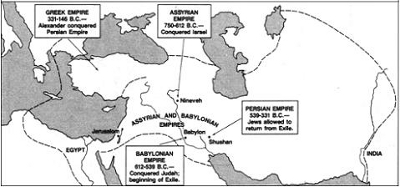
Nelson’s Complete Book of Bible Maps & Charts (Nashville: Thomas Nelson Publishers, 1996) 287. © 1993 by Thomas Nelson, Inc.
2:4 Jericho. A city about fourteen miles southeast of Bethel in the Jordan River Valley (cf. Josh. 2:1; 6:1), to which Elisha accompanied Elijah (cf. v. 6).
2:8 water . . . was divided. Elijah rolled up his cloak into a kind of rod and struck the water of the Jordan River. Immediately, the water parted, leaving a dry path through the river bed for the two prophets to cross. Elijah’s act recalled Moses’ parting of the Red Sea with his rod (Ex. 14:21, 22) and the parting of the Jordan River when Israel crossed over into the land (Josh. 3:14–17). The crossing put Elijah on the Jordan’s east bank, the area where Moses’ life came to an end (Deut. 34:1–6).
2:9 a double portion. In Israel, the firstborn son inherited a double share of his father’s possessions and with it the right of succession (Deut. 21:17). “A double portion of your spirit” was not merely Elisha’s request to succeed Elijah in his prophetic ministry, since the Lord had already revealed this succession in 1 Kings 19:16–21. Nor was it Elisha’s desire for ministry superior to Elijah’s, though Elisha did, in fact, do twice as many recorded miracles as Elijah. Apparently, Elisha was asking to succeed Elijah in the prophetic office, as God had promised, with spiritual power beyond his own capabilities to meet the responsibilities of his position as Elijah’s successor. He desired that Elijah’s mighty power might continue to live through him.
2:10 a hard thing. Since only God can give spiritual power, Elijah did not have the ability to grant Elisha’s request. Elijah told Elisha that if Elisha saw his departure, it would be the sign that God Himself would grant Elisha’s request.
2:11 chariot of fire . . . with horses of fire. The horse-drawn chariot was the fastest means of transport and the mightiest means of warfare in that day. Thus, the chariot and horses symbolized God’s powerful protection, which was the true safety of Israel (v. 12). As earthly kingdoms are dependent for their defense on such military force as represented by horses and chariots, one single prophet had done more by God’s power to preserve his nation than all their military preparations.
2:12 My father. The sons of the prophet recognized the leader of their company as their spiritual father. This title of respect for a person of authority (Gen. 45:8; Judg. 17:10) was later used for Elisha (6:21; 13:14).
2:13 the mantle of Elijah. Elijah’s cloak (see note on 1:8 ), picked up by Elisha, authenticated him as Elijah’s legitimate spiritual successor.
2:14 water . . . was divided. Elisha repeated the action of Elijah (v. 8) in using the cloak to part the waters of the Jordan River, allowing Elisha to recross on dry land. This confirmed that Elisha had received from God the same great power as his master, Elijah.
2:15 bowed to the ground. This action symbolized the submission of the prophets to the preeminence of Elisha as the major prophet in Israel.
2:16 They knew that when souls went into God’s presence at death, bodies remained on earth. Out of sensitivity to the body of Elijah, they wanted to retrieve it for appropriate care. Elisha knew Elijah’s body would not be left behind, because he had seen his bodily ascension (v. 11) while the others had not, so he said, “No.”
2:17 ashamed. In 8:11 and Judges 3:25, this term was used for the feeling of embarrassment under the unrelenting pressure of their request. But with shame for his own failure to believe what he had seen, Elisha was also embarrassed for the prophets, knowing the futile outcome of their search (v. 18). Cf. 1 Kings 18:12.
2:20, 21 bowl . . . salt. Salt purifies water, but the small amount used there could not clean the whole water supply. Rather, the use of salt from a new bowl symbolized the cleansing of the waters that God would miraculously perform. The healing of Jericho’s water, through Elisha, freed the city from Joshua’s curse, making it habitable for humans once again (cf. Josh. 6:26; 1 Kin. 16:34).
2:23 youths. These were not children, but infidels and idolatrous young men in their late teens or twenties (cf. Gen. 22:12; 37:2; 1 Kin. 20:14, 15). baldhead. Baldness was regarded as a disgrace (cf. Is. 3:17, 24). The baldness of Elisha referred to here may be: (1) natural loss of hair; (2) a shaved head denoting his separation to the prophetic office; or more likely, (3) an epithet of scorn and contempt, Elisha not being literally bald. These youths were sarcastically taunting and insulting the Lord’s prophet by telling him to repeat Elijah’s translation (“go up”).
2:24 pronounced a curse. Because these young people of about twenty years of age or older (the same term is used of Solomon in 1 Kin. 3:7) so despised the prophet of the Lord, Elisha called upon the Lord to deal with the rebels as He saw fit. The Lord’s punishment was the mauling of forty-two youths by two female bears. The penalty was clearly justified, for to ridicule Elisha was to ridicule the Lord Himself. The gravity of the penalty mirrored the gravity of the crime. The appalling judgment was God’s warning to any who attempted to interfere with the prophet’s ministry.
2:25 Mount Carmel. For the location, see note on 1 Kings 18:19. Elisha associated his prophetic ministry with Elijah’s stand against Baalism. Samaria. The capital city of the northern kingdom, located in central Palestine (cf. 1 Kin. 16:24).
3:1 Jehoram. See note on 1:17. He was Ahaziah’s brother (1 Kin. 22:51). eighteenth year. C. 852 B.C. This was Jehoshaphat of Judah’s eighteenth year of rule after the death of his father Asa in 870 B.C. Jehoshaphat was co-regent with Asa from 873–870 B.C. Jehoshaphat’s son Jehoram was co-regent with his father from 853–848 B.C. (see notes on 1:17; 8:17 ). twelve years. 852–841 B.C.
3:2 pillar of Baal. This was probably an image of the god Baal that King Ahab had made and placed in the temple he built to Baal (1 Kin. 16:32, 33). This image was only put in storage, not permanently destroyed, because it reappeared at the end of Jehoram’s reign (10:26, 27).
3:3 Jeroboam. C. 931–910 B.C. See notes on 1 Kings 11:26–14:20; 2 Chronicles 9:29–13:20.
3:4 Mesha king of Moab. According to the Moabite Stone (discovered at Dihon, Moab, in A.D. 1868 and dated to c. 840–820 B.C.), Moab, which is located east of the Dead Sea between the Arnon River and the Brook Zered, had been Israel’s vassal since Omri (c. 880 B.C.). Moab’s king, Mesha, was a sheep breeder (cf. Amos 1:1) who supplied the king of Israel with lambs and wool. This was Moab’s annual tribute to the Israelite king.
3:5 Moab rebelled. Mesha used Ahab’s death as an opportunity to cast off the political domination of Israel with its heavy economic burden. Moab’s rebellion took place in 853 B.C. during the reign of Ahaziah (1:1). Jehoram determined to put down Moab’s rebellion upon his accession to Israel’s throne in 852 B.C. He mobilized Israel for war (v. 6) and asked Jehoshaphat of Judah to join him in the battle (v. 7).
3:8 the Wilderness of Edom. This was the long and circuitous route by the lower bend of the Dead Sea, the arid land in the great depression south of the sea known as the Arabah, or an area of marshes on Edom’s western side. According to the Moabite Stone (see note on 3:4 ), Mesha’s army controlled the northern approach into Moab. Therefore, an attack from the south had a much better chance of success. It was the most defenseless position, and Mesha could not enlist help from the forces of Edom (v. 9).
3:11 poured water on the hands. Probably derived from the custom of washing hands before and after meals. The idiom meant that Elisha had personally served Elijah. Jehoshaphat recognized that Elisha was a true prophet of the Lord (v. 12).
3:13 What have I to do with you? A Hebrew idiom that expressed the completely different perspective of two individuals (cf. 2 Sam. 16:10). Elisha sarcastically ordered Jehoram to consult the prophets of his father Ahab, prophets of the northern kingdom’s deviant religion (1 Kin. 22:6, 10–12), and the prophets of his mother Jezebel, the prophets of Baal and Asherah (1 Kin. 18:19).
3:14 regard the presence. Elisha agreed to seek word from the Lord because of his great respect for Jehoshaphat, the king of Judah, who did what was right in the eyes of the Lord (1 Kin. 22:43).
3:15 a musician. The music was used to accompany praise and prayer, which calmed the mind of the prophet that he might clearly hear the word of the Lord. Music often accompanied prophecies in the OT (cf. 1 Chr. 25:1).
3:16 this valley. Probably the northeast area of the Arabah, west of the highlands of Moab and southeast of the Dead Sea (see v. 8).
3:20 the grain offering. This was offered daily (see Ex. 29:38–41). water came by way of Edom. Divinely created flash floods from the mountains of Edom caused water to flow in the direction of the Dead Sea. This water was caught in the canals that had been built in the valley (v. 16).
3:22 water . . . red as blood. As the Moabites looked down at the unfamiliar water in the ditches dug in the valley below them, the combination of the sun’s rays and the red sandstone terrain gave the water a reddish color, like pools of blood. Unaccustomed to water being in those places and having heard no storm (see v. 17), the Moabites thought that the coalition of kings had slaughtered each other (v. 23) and so went after the spoils. The coalition army led by Israel defeated the Moabites, who had been delivered into their hands by the Lord (see vv. 18, 24).
3:25 Kir Haraseth. The coalition army invaded Moab and besieged its capital city, Kir Haraseth, located about eleven miles east of the Dead Sea and about twenty miles northeast of the Arabah.
3:27 his eldest son . . . offered him. In desperation, hoping for intervention by his idol god, Mesha sacrificed his oldest son to the Moabite god Chemosh. This was done in plain view of everyone inside and outside the city in an attempt to induce Chemosh to deliver the Moabites from disastrous defeat. great indignation against Israel. It seems best to understand that the king’s sacrifice inspired the Moabites to hate Israel more and fight more intensely. This fierceness perhaps led Israel to believe that Chemosh was fighting for the Moabites. Thus, the indignation or fury came from the Moabites.
4:1 the sons of the prophets. See note on 1 Kings 20:35. my two sons to be his slaves. According to the Mosaic Law, creditors could enslave debtors and their children to work off a debt when they could not pay (Ex. 21:2–4; Deut. 15:12–18). The period of servitude could last until the next year of Jubilee (Lev. 25:39, 40). Rich people and creditors, however, were not to take advantage of the destitute (see Deut. 15:1–18).
4:2 jar of oil. A flask of oil used to anoint the body.
4:4 shut the door behind you. Since the widow’s need was private, the provision was to be private also. Further, the absence of Elisha demonstrated that the miracle happened only by God’s power. God’s power multiplied little into much, filling all the vessels to meet the widow’s need (cf. 1 Kin. 17:7–16).
4:8 Shunem. A town in the territory of Issachar near Jezreel (Josh. 19:18), on the slopes of Mount Moreh, overlooking the eastern end of the Jezreel Valley (see note on 1 Kin. 1:3 ). a notable woman. The woman was great in wealth and in social prominence.
4:9 man of God. See note on 1:9. The woman recognized Elisha as a prophet uniquely separated to God. Elisha’s holiness prompted the woman to ask her husband that a separate, small, walled upper room be provided for the prophet (v. 10). The woman must have feared the “holy” Elisha coming into contact with their “profane” room (cf. Lev. 10:10).
4:12 Gehazi. Elisha’s personal servant who was prominent here and in 5:20–27. Gehazi probably is the unnamed servant in verse 43; the term servant used there was used in 1 Kings 19:21 of Elisha’s relationship to Elijah. Throughout this narrative, Elisha contacted the Shunammite woman through Gehazi (vv. 11–13, 15, 25, 29). Gehazi was involved in this ministry so that he might have opportunity to mature in his service to the Lord.
4:13 I dwell among my own people. This reply expressed her contentment, since she wanted nothing.
4:14 no son, and her husband is old. This remark implied two things: (1) she suffered the shame of being a barren woman (cf. Gen. 16:1; 18:10–15; 25:21; 30:1, 2; 1 Sam. 1:6); and (2) her husband might die without an heir to carry on his name (Deut. 25:5–10).
4:16 No, my lord. In response to Elisha’s announcement that she would have a son, the woman asked Elisha not to build up her hopes if she would be disappointed later. Her reply indicated that she felt having a son was impossible. Man of God. See note on 1:9.
4:17 conceived . . . bore. This was like Abraham and Sarah (Gen. 21:1, 2).
4:19 My head, my head! The child probably suffered sunstroke. The cries of the boy, the part affected, and the season of the year (“reapers”) lead to that conclusion. Sunstroke could be fatal, as in this case (v. 20).
4:23 neither the New Moon nor the Sabbath. The first day of the month and the seventh day of the week were both marked with special religious observances and rest from work (cf. Num. 28:9–15). The husband implied that only on such dates would a person visit a prophet. She apparently concealed the death of the child from him (“It is well”) to spare him unnecessary grief, in light of the power of the man of God whom she believed might perform a miracle for the boy.
4:25 Mount Carmel. See note on 1 Kings 18:19. The distance from Shunem was about fifteen to twenty-five miles
4:26 “It is well.” She withheld the real sorrow of her son’s death, waiting to tell the prophet Elisha directly.
4:27 by the feet. The grasping of the feet was a sign of humiliation and veneration.
4:28 See verse 16.
4:29 lay my staff on the face of the child. Elisha sent Gehazi ahead because he was younger and, therefore, faster. He may have expected the Lord to restore the child’s life when his staff was placed on him, viewing that staff as representative of his own presence and a symbol of divine power (cf. 2:8).
4:34 stretched himself out on the child. Like Elijah (see 1 Kin. 17:17–24), Elisha demonstrated the Lord’s power over death by raising their son from the dead. Also, like Elijah, part of the restoration process involved lying on top of the boy’s body.
4:38 Gilgal. See note on 2:1. This was about forty miles south of Shunem. sons of the prophets. See note on 1 Kings 20:35.
4:39 wild gourds. Probably a kind of wild cucumber that can be fatally poisonous if eaten in large quantities.
4:41 flour. The flour itself did not make the noxious stew edible, but a miraculous cure was accomplished through the flour. Like Elijah (cf. 1 Kin. 17:14–16), Elisha used flour to demonstrate the concern of God for man.
4:42 Baal Shalisha. The exact location is uncertain. bread of the firstfruits. Normally, the firstfruits were reserved for God (Lev. 23:20) and the Levitical priests (Num. 18:13; Deut. 18:4, 5). Though the religion in the northern kingdom was apostate, the man who brought the loaves to Elisha was a representative of godly religion in Israel.
4:43, 44 The multiplication of the loaves in accordance with the word of the Lord through His prophet anticipated the messianic ministry of Jesus Himself (cf. Matt. 14:16–20; 15:36, 37; John 6:11–13).
5:1 Naaman. A common name in ancient Syria, meaning “gracious, fair.” Four phrases describe the importance of Naaman: (1) he was the supreme commander of the army of Syria as indicated by the term commander used of an army’s highest ranking officer (Gen. 21:22; 1 Sam. 12:9; 1 Chr. 27:34); (2) he was “a great man,” a man of high social standing and prominence; (3) he was “an honorable man in the eyes of his master,” a man highly regarded by the king of Syria because of the military victories he had won; and (4) he was “a mighty man of valor,” a term used in the OT for both a man of great wealth (Ruth 2:1) and a courageous warrior (Judg. 6:12; 11:1). Severely mitigating against all of this was the fact that he suffered from leprosy, a serious skin disease (cf. v. 27; see notes on Lev. 13; 14 ). king of Syria. Either Ben-Hadad I or, more likely, Ben-Hadad II. See note on 1 Kings 15:18. by him the LORD had given victory to Syria. Naaman’s military success was attributable to the God of Israel, who is sovereign over all the nations (cf. Is. 10:13; Amos 9:7).
5:2 raids. Naaman led the Syrian army in quick penetrations across Israel’s border (cf. 1 Sam. 30:8, 15). On one of his raids, he captured a young Israelite girl used as a servant, who ultimately told him of Elisha.
5:3 the prophet . . . in Samaria! Elisha maintained a residence in the city of Samaria (6:32).
5:5 king of Israel. Jehoram. See note on 1:17. ten talents of silver, six thousand shekels of gold. About 750 pounds of silver and 150 pounds of gold.
5:7 tore his clothes. This action was a sign of distress and grief (cf. 1 Kin. 21:27). Jehoram thought that Ben-Hadad expected him to cure Naaman’s leprosy. Since Jehoram knew that this was impossible, he thought he was doomed to have a major battle with the Syrians. When Elisha heard of Jehoram’s distress, he told the king to send Naaman to him for healing (v. 8).
5:11 surely come out to me. Because of his personal greatness (v. 1), his huge gift (v. 5), and diplomatic letter (v. 6), Naaman expected personal attention to his need. However, Elisha did not even go out to meet him. Instead, he sent his instructions for healing through a messenger (v. 10). Naaman was angry because he anticipated a personal, cleansing ceremony from the prophet himself.
5:12 Abanah . . . Pharpar. The Abanah River (modern Barada) began in the Lebanon mountains and flowed to Damascus, producing orchards and gardens with its clear water. The Pharpar River flowed east from Mount Hermon to the south of Damascus. If Naaman needed to wash in a river, those two rivers were superior to the muddy Jordan. However, it was obedience to God’s Word that was the issue, not the quality of the water.
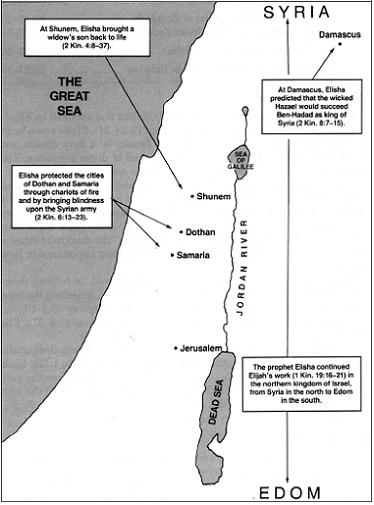
Nelson’s Complete Book of Bible Maps & Charts (Nashville: Thomas Nelson Publishers, 1996) 130. © 1993 by Thomas Nelson, Inc.
5:13 My father. The title father was not usually used by servants of their masters. The use of the term here may indicate something of the warmness that the servants felt for Naaman (cf. 2:12). His servants pointed out to Naaman that he had been willing to do anything, no matter how hard, to be cured. He should be even more willing, therefore, to do something as easy as washing in a muddy river.
5:14 flesh of a little child. This description indicates that ancient leprosy was a disease of the skin, distinct from modern leprosy, a disease primarily of the nerves.
5:15 there is no God . . . except in Israel. Upon his healing, Naaman returned from the Jordan River to Elisha’s house in Samaria (about twenty-five miles) to give confession of his new belief. Naaman confessed that there was only one God, Israel’s God, the Lord. In saying this, Naaman put to shame the Israelites who continued to blasphemously believe that both the Lord and Baal were gods (cf. 1 Kin. 18:21).
5:16 he refused. To show that he was not driven by the mercenary motives of pagan priests and prophets, Elisha, though accepting gifts on other occasions (cf. 4:42), declined them so the Syrians would see the honor of God only.
5:17 two mule-loads of earth. In the ancient Near East, it was thought that a god could be worshiped only on the soil of the nation to which he was bound. Therefore, Naaman wanted a load of Israelite soil on which to make burnt offerings and sacrifices to the Lord when he returned to Damascus. This request confirmed how Naaman had changed—whereas he had previously disparaged Israel’s river, now he wanted to take a pile of Israel’s soil to Damascus.
5:18 Rimmon. The Hebrew term Rimmon (lit. “pomegranate”) is a parody of the Syrian deity, Hadad, whom the Assyrians named Rananu (lit. “the thunderer”). Hadad was the storm god, usually identified with the Canaanite god, Baal. As an aide to Syria’s king, Naaman’s duty demanded that he accompany the king to religious services at the temple of Rimmon in Damascus. Naaman requested that the Lord forgive this outward compromise of his true faith in and commitment to the Lord.
5:22 My master has sent me. A lie for selfish gain revealed the sad state of Gehazi’s character. Another lie followed to cover up (v. 25).
5:23 two talents of silver. About 150 pounds of silver.
5:26 Did not my heart go with you. Elisha knew Gehazi lied. Though his body did not move, Elisha’s mind had seen all that had transpired between Gehazi and Naaman.
5:27 leprosy . . . shall cling to you. Gehazi’s greed had cast a shadow over the integrity of Elisha’s prophetic office. This made him no better in the people’s thinking than Israel’s false prophets, who prophesied for material gain, the very thing he wanted to avoid (vv. 15, 16). Gehazi’s act betrayed a lack of faith in the Lord’s ability to provide. As a result, Elisha condemned Gehazi and his descendants to suffer Naaman’s skin disease forever. The punishment was a twist for Gehazi, who had gone to “take something” from Naaman (v. 20), but what he received was Naaman’s disease.
6:1 place where we dwell. Some have understood the term dwell in the sense of live. This leads to the conclusion that the sons of the prophets, those specially instructed by Elisha, lived together in a communal setting. However, the term dwell can also be understood as “sit before.” The term is used this way of David sitting before the Lord in worship (2 Sam. 7:18) and the elders sitting before Ezekiel to hear his advice (Ezek. 8:1; 14:1). Thus, the “place” here refers to a dormitory where Elisha also instructed the sons of the prophets. The growing number of men who wished to be taught led to the need for a larger building.
6:4 Jordan . . . trees. The Jordan Valley had mostly smaller kinds of trees, e.g., willow, tamarisk, and acacia that did not give heavy lumber. The resulting structure would be a humble, simple building.
6:5 iron . . . borrowed. Iron was expensive and relatively rare in Israel at that time and the student-prophet was very poor. The ax head was loaned to the prophet since he could not have afforded it on his own, and would have had no means to reimburse the owner for it.
6:6 made the iron float. Elisha threw a stick in the river at the exact spot where the ax head entered, and the stick caused the heavy iron object to float to the surface. Through this miracle, the Lord again provided for a person who was faithful to Him.
6:8 king of Syria. Either Ben-Hadad I or, more likely, Ben-Hadad II (v. 24). See note on 1 Kings 15:18. making war. The Syrian king was probably sending raiding parties (v. 23) to pillage and plunder Israelite towns.
6:9 the man of God. I.e., Elisha (v. 12). See note on Deuteronomy 33:1. king of Israel. I.e., Jehoram. See note on 1:17.
6:9, 10 do not pass this place. Elisha, receiving supernatural revelation, continually identified to Jehoram the Israelite towns which the king of Syria planned to attack. Jehoram then took the proper precautions and appropriately fortified those towns in order to frustrate the Syrian plan.
6:11 which of us. The Syrian king was sure someone in his household was revealing his plans to Israel.
6:13 Dothan. A town in the hill country of Manasseh located about ten miles north of Samaria and twelve miles south of Jezreel. Dothan commanded a key mountain pass along a main road that connected Damascus and Egypt (cf. Gen. 37:17). get him. The king of Syria’s plan was to capture Elisha, who knew all his secrets (v. 12), so that no matter how great Elisha’s knowledge might be, he would not be free to inform Israel’s king.
| 1. The Jordan River divided | 2 Kings 2:13, 14 |
| 2. Jericho’s spring water purified | 2 Kings 2:19–22 |
| 3. The widow’s oil multiplied | 2 Kings 4:1–7 |
| 4. The widow’s son resuscitated | 2 Kings 4:8–37 |
| 5. Poisonous stew purified | 2 Kings 4:38–41 |
| 6. The prophets’ food multiplied | 2 Kings 4:42–44 |
| 7. Naaman healed of leprosy | 2 Kings 5:1–19 |
| 8. Gehazi’s leprosy | 2 Kings 5:20–27 |
| 9. The floating axhead | 2 Kings 6:1–7 |
| 10. Horses and chariots surrounded the city of Dothan | 2 Kings 6:8–17 |
| 11. Syrian soldiers blinded | 2 Kings 6:18 |
6:14 a great army. In contrast to the smaller raiding parties (vv. 8, 23), the king of Syria sent a sizable force, including horses and chariots, to take Elisha prisoner. Arriving at Dothan, the army encircled the town.
6:16 those who are with us. Elisha was referring to God’s heavenly army or “host” (cf. Josh. 5:13–15; 2 Chr. 32:7, 8; Dan 10:20; 12:1).
6:17 open his eyes. Elisha asked the Lord to enable his servant to see this heavenly host. The Lord gave his servant the ability to see the normally unseen world of God’s heavenly armies, here waiting to do battle with the Syrians (cf. Gen. 32:1, 2).
6:18 blindness. This word occurs only here and in Genesis 19:11. The term is related to light and seems to mean “a dazzling from bright light” (note the “chariots of fire” in v. 17). Both biblical uses of the term involve a miraculous act with angelic presence and both are used in the context of deliverance from danger.
6:19 Follow me . . . to the man whom you seek. By going to Samaria himself, Elisha did not lie, but did lead the Syrian army to where he ultimately would be found.
6:20 inside Samaria! God delivered a sizable portion of the Syrian army into the hands of the king of Israel without bloodshed. The Syrians discovered they were surrounded and captives of Israel.
6:21 My father. See note on 5:13. By using this expression, which conveyed the respect a child had for his father, King Jehoram of Israel acknowledged the authority of Elisha.
6:22 You shall not kill them. Elisha, bearing divinely delegated authority, prohibited the execution of the captives. It was uncommon and unusually cruel to put war captives to death in cold blood, even when taken by the point of a sword, but especially by the miraculous power of God. Kindness would testify to the goodness of God and likely stall future opposition from the Syrian raiders. These kind deeds gained a moral conquest (v. 23).
6:23 a great feast. In the ancient Near East, a common meal could signify the making of a covenant between two parties (cf. Lev. 7:15–18).
6:24 Ben-Hadad. See note on 1 Kings 15:18. This same Ben-Hadad had laid siege to Samaria earlier (1 Kin. 20:1), which was the result of Ahab’s foolish and misplaced kindness (1 Kin. 20:42). all his army. In contrast to the smaller raiding parties (vv. 8, 23) and the larger force seeking Elisha’s capture (v. 14), Ben-Hadad gathered his entire army, marched to Samaria, and besieged the capital.
6:25 a donkey’s head . . . eighty shekels of silver. The siege resulted in a terrible famine gripping the city of Samaria. This ignominious body part of an unclean animal (Lev. 11:2–7; Deut. 14:4–8) sold at an overvalued price of about two pounds of silver. dove droppings . . . five shekels of silver. Dove droppings was either a nickname for some small pea or root, or literal dung to be used as fuel or food in the desperate situation. Approximately one pint cost about two ounces of silver.
6:26 Help, my lord, O king! The woman asked King Jehoram to render a legal decision in her dispute with another woman (see note on 1 Kin. 3:16–27 ).
6:28, 29 Give your son, that we may eat him. The curses of the Mosaic covenant, especially for the sin of apostasy, predicted this sort of pagan cannibalism (Lev. 26:29; Deut. 28:52–57). The way in which the woman presented her case without feeling added to the horror of it.
6:30 tore his clothes. A sign of distress and grief (see note on 1 Kin. 21:27 ). sackcloth on his body. A coarse cloth, made from goat’s hair, worn as a sign of mourning (cf. Gen. 37:34). He was not truly humbled for his sins and the nation’s or he would not have called for vengeance on Elisha.
6:31 the head of Elisha. Jehoram swore an oath to have Elisha killed. The reason Jehoram desired the death of Elisha could have been: (1) the king viewed the siege as the work of the Lord (v. 33), so he assumed that the Lord’s representative, the prophet with whom the kings of Israel were in conflict, was involved as well; (2) the king remembered when Elijah had ended a famine (1 Kin. 18:41–46); (3) Jehoram thought that Elisha’s clemency to the Syrian army (v. 22) had somehow led to and added intensity to the present siege; or (4) because Elisha had miracle power, he should have ended the famine. But most likely, the reason he wanted Elisha dead was because he expected that his mourning, perhaps counseled by the prophet as an act of true repentance (which it was not; see note on v. 30 ), would result in the end of the siege. When it did not, he sought the prophet’s head.
6:32 the elders were sitting with him. The elders were the leading citizens of Samaria, whose gathering indicated the high regard in which Elisha was held by the prominent people of Samarian society. son of a murderer. This phrase can mean both that: (1) Jehoram was the son of Ahab, who was guilty of murder (1 Kin. 21:1–16); and (2) he had the character of a murderer.
6:33 why should I wait for the LORD any longer? Jehoram rightly viewed the Lord as the instigator of the siege and famine in Samaria and declared that he saw no hope that the Lord would reverse this situation.
7:1 a seah . . . for a shekel. About seven quarts of flour would sell for about two-fifths of an ounce of silver. two seahs . . . for a shekel. About thirteen or fourteen quarts of barley would also sell for about two-fifths of an ounce of silver. These prices, when compared to those in 6:25, indicated that the next day the famine in Samaria would end. at the gate. In ancient Israel, the city gate was the marketplace where business was transacted (cf. Ruth 4:1; 2 Sam. 15:1–5). Normal trade at the city gate of Samaria implied that the siege would be lifted.
7:2 an officer on whose hand the king leaned. See note on 9:25. The king depended on this officer as his chief adviser. you shall see . . . but . . . not eat. The royal official questioned the Lord’s ability to provide food within the day. For that offense against God, Elisha predicted that the officer would witness the promised miracle, but he would not eat any of it. How this prophecy was fulfilled is described in verses 16 and 17.
7:3 leprous men. The account of these lepers is used to tell of the siege’s end and the provisions for Samaria (vv. 3–11). at the entrance of the gate. In the area immediately outside the city gate, four lepers lived, shut out of Samaria because of their disease (Lev. 13:46; Num. 5:3). The lepers knew that living in Samaria, whether just outside or inside the gate, offered them nothing but death.
7:5 the outskirts of the Syrian camp. Lit. “the edge of the camp.” The normal meaning of this phrase would refer to the back edge of the army camp, the farthest point from the wall of Samaria.
7:6 the Hittites and . . . Egyptians. Sometime before the arrival of the lepers, the Lord had made the Syrians hear the terrifying sound of a huge army approaching. They thought the Israelite king had hired two massive foreign armies to attack them. The Hittites were descendants of the once-great Hittite empire who lived in small groups across northern Syria (see note on 1 Kin. 10:29 ). Egypt was in decline at this time, but its army would still have represented a great danger to the Syrians.
7:9 punishment. The lepers did not fear that the Syrians would return, but that the Lord would punish them for their sin of not telling the Israelite king of their discovery.
7:12 what the Syrians have done to us. Jehoram greeted the report from the lepers with great suspicion. He thought the Syrians were feigning the pull-back to appear defeated, in order to lure the Israelites out of Samaria for a surprise attack to gain entrance into the city. However, verses 13–15 describe how the leper’s report was confirmed.
7:16–20 By repeating words from verses 1 and 2 and by explicit statements (“according to the word of the LORD,” v. 16; “just as the man of God had said/spoken,” vv. 17, 18), the text emphasizes that Elisha’s prophecy in 7:2 literally came to pass.
8:1–6 The chronological question of when the events recounted in these verses took place in Elisha’s ministry has been much debated. Interpreters hold to one of three positions: (1) The encounter between the Shunammite woman, the king of Israel, and Gehazi took place toward the end of the reign of Jehoram in Israel. However, this would mean Gehazi was in the presence of the king (vv. 4, 5), although afflicted with leprosy (5:27), and King Jehoram was asking what great things Elisha had done after personally witnessing the events recorded in 6:8–7:19. (2) Because the king of Israel did not know Elisha’s exploits, some interpreters place the final encounter during the early reign of Jehu. However, there are still the issues of Gehazi’s leprosy and Jehu’s being well acquainted with the prophecy of Elijah (9:36, 37; 10:17) that predicted Elisha’s ministry (1 Kin. 19:15–18). (3) The best explanation is that the record is out of chron ological sequence, being thematically tied to the subject of famine in 6:24–7:20, but having occurred earlier in the reign of King Jehoram of Israel, before the events recorded in 5:1–7:20.
8:1 a famine . . . for seven years. Seven-year famines were known in the ancient Near East (cf. Gen. 41:29–32). Since the Shunammite woman would have been only a resident alien in a foreign land, her return within seven years may have aided her legal claim to her property (cf. Ex. 21:2; 23:10, 11; Lev. 25:1–7; Deut. 15:1–6).
8:2 land of the Philistines. The area located southwest of Israel along the Mediterranean Sea coastal plain between the Jarkon River in the north and the Besor Brook in the south. The fact that the famine was localized in Israel demonstrated that this was a curse, a punishment for apostasy (cf. Deut. 28:38–40), because of Israel’s disobedience of the Mosaic covenant.
8:3 an appeal to the king. The Shunammite woman made a legal appeal to the king to support her ownership claim. In Israel, the king was the final arbiter of such disputes (see note on 1 Kin. 3:16–27 ). Providentially, the widow arrived just as Gehazi was describing how Elisha had raised her son from the dead (v. 5).
8:6 Restore all . . . and all the proceeds. The king’s judgment was to return to the woman everything she owned, including the land’s earnings during her absence.
8:7 Elisha went to Damascus. It was unusual for a prophet to visit foreign capitals, but not unknown (cf. Jon. 3:3). Elisha went to Damascus, the capital of Syria, to carry out one of the three commands God had given to Elijah at Horeb (1 Kin. 19:15, 16). Ben-Hadad. See note on 1 Kings 15:18. Ben-Hadad died c. 841 B.C., the same year as Jehoram of Israel (3:1), Jehoram of Judah (8:17), and Ahaziah of Judah (8:25, 26). man of God. See note on Deuteronomy 33:1.
8:8 Hazael. His name means “God sees” or “whom God beholds.” Hazael was a servant of Ben-Hadad and not a member of the royal family. Assyrian records called Hazael the “son of a nobody,” and his lineage was not recorded because he was a commoner.
8:9 every good thing of Damascus. The city of Damascus was a trade center between Egypt, Asia Minor, and Mesopotamia. It had within it the finest merchandise of the ancient Near East. Ben-Hadad evidently thought an impressive gift would influence Elisha’s prediction. Your son. Ben-Hadad approached Elisha with the humble respect of a son for his father (cf. 5:13; 6:21).
8:10 recover . . . die. Ben-Hadad wanted to know whether or not he would recover from his present illness. In response, Elisha affirmed two interrelated things: (1) Ben-Hadad would be restored to health; his present sickness would not be the means of his death and (2) Ben-Hadad would surely die by some other means.
8:11 he was ashamed. With a fixed gaze, Elisha stared at Hazael because it had been revealed to him what Hazael would do, including the murder of Ben-Hadad (v. 15). Hazael was embarrassed, knowing that Elisha knew of his plan to assassinate the Syrian king.
8:12 the evil. Elisha mourned, knowing the atrocities that Hazael would bring on Israel. The harsh actions mentioned here were common in ancient wars (Ps. 137:9; Is. 13:16; Hos. 10:14; 13:16; Amos 1:13; Nah. 3:10). Hazael did prove to be a constant foe of Israel (9:14–16; 10:32; 12:17, 18; 13:3, 22).
8:13 your servant—a dog. To call oneself a dog was an expression of humility (see note on 2 Sam. 9:8 ). Hazael sought to deny that he would ever have the power to commit such atrocities. He was trying to convince Elisha that he had no plan to take over the kingship of Syria. you will become king over Syria. In response to Hazael’s feigned self-deprecation, Elisha affirmed that the Lord willed that Hazael be king over Syria (cf. 1 Kin. 19:15).
8:15 he died. Hazael took a bed furnishing, soaked it, and killed Ben-Hadad by suffocation. Hazael reigned. Upon Ben-Hadad’s death, Hazael took the kingship of Syria and ruled c. 841–801 B.C., during the reigns of Jehoram, Jehu, and Jehoahaz in Israel and Ahaziah, Athaliah, and Joash in Judah.
8:16 fifth year. C. 848 B.C., the year Jehoshaphat of Judah died. Joram. An alternate name for the king referred to as Jehoram previously (1:17; 3:1, 6). See notes on 2 Chronicles 21:4–20.
8:17 eight years. 848–841 B.C. See notes on 2 Chronicles 21:4–20. Jehoram of Judah served as co-regent with his father Jehoshaphat for the final four years of his reign, 853–848 B.C. Joram (Jehoram) became king of Israel during the second year of this co-regency, 852 B.C. (see notes on 1:17; 3:1 ). Jehoram of Judah ruled alone for eight years after his father’s death, until 841 B.C. (cf. 2 Chr. 21:15). Most likely, Obadiah prophesied during his reign.
8:18 as the house of Ahab. Jehoram officially sanctioned Baal worship in Judah as Ahab had in Israel (1 Kin. 16:31–33). the daughter of Ahab. Jehoram was married to Athaliah, the daughter of Ahab and Jezebel (v. 26). Just as Jezebel incited Ahab to do evil in the sight of the Lord (1 Kin. 21:25), so Athaliah influenced Jehoram. Athaliah’s wicked actions are recorded in 11:1–16; 2 Chronicles 22:10–23:15.
8:19 a lamp . . . forever. See note on 1 Kings 11:36.
8:20 Edom revolted. Edom had been a vassal of the united kingdom, and of the southern kingdom of Judah since David’s reign (2 Sam. 8:13, 14).
8:21 Zair. The exact location is unknown.
8:22 Edom has been in revolt . . . to this day. During the reign of Jehoram, Edom defeated the Judean army, took some border lands, and became independent of Judah’s rule. The continuing sovereignty of Edom proved that none of the future kings of Judah recorded in 2 Kings was the anticipated Messiah because He would possess Edom (cf. Num. 24:18). Libnah. A town located in the Shephelah on the border with Philistia, about twenty miles southwest of Jerusalem (Josh. 15:42; 21:13). The revolt of Libnah was probably connected with that of the Philistines and Arabians recounted in 2 Chronicles 21:16, 17.
8:25–29 The reign of Ahaziah (c. 841 B.C.) is not to be confused with that of Israel’s King Ahaziah (1 Kin. 22:51–2 Kin. 1:8). See notes on 2 Kings 9:27; 2 Chronicles 22:1–9.
8:26 twenty-two. This reading is preferred over the forty-two of 2 Chronicles 22:2 (see note there ). Athaliah. See note on verse 18.
8:27 like the house of Ahab. Like his father, Jehoram, Ahaziah continued the official sanctioning of Baal worship in Judah (see note on v. 18 ).
8:28 Ramoth Gilead. See note on 1 Kings 22:3.
8:29 went down to see Joram. Ahaziah’s travel to visit the recuperating Joram (also called Jehoram) king of Israel placed him in Jezreel (west of the Jordan River, southwest of the Sea of Galilee) during Jehu’s purge of the house of Omri (see 9:21–29).
9:2 Jehu. The Lord had previously told Elijah that Jehu would become king over Israel and kill those involved in the worship of Baal (cf. 1 Kin. 19:17). The fulfillment of the prophecy is recorded from 9:1–10:31. inner room. A private room that could be closed off to the public. Elisha commissioned one of the younger prophets to anoint Jehu alone behind closed doors. The rite was to be a secret affair without Elisha present so Jehoram would not suspect that a coup was coming.
9:3 anointed you king over Israel. The anointing with olive olier chosen that person to be king (cf. 1 Sam. 10:1; 16:13). This action of anointing by a commissioned prophet indicated divine investiture with God’s sovereign power to Jehu. flee, and do not delay. The need for haste by the young prophet underscored the danger of the assignment. A prophet in the midst of Israel’s army camp would alert the pro-Jehoram elements to the possibility of the coup.il by a prophet of the Lord confirmed that God Himself had ear
9:7 avenge the blood. Jehu was to be the Lord’s avenger (cf. Num. 35:12) for the murders of the Lord’s prophets (1 Kin. 18:4) and of people like Naboth who served the Lord (1 Kin. 21:1–16).
9:9 like the house of Jeroboam . . . Baasha. God would thoroughly annihilate Ahab’s line in the same way as Jeroboam’s dynasty and Baasha’s dynasty had previously ended violently (1 Kin. 15:27–30; 16:8–13).
9:10 dogs shall eat. Dogs were considered scavengers in the ancient Near East and they would devour the corpse of Jezebel. Jezreel. Formerly the area of Naboth’s vineyard (1 Kin. 21:1–16). none to bury her. In Israel, the failure to be buried indicated disgrace (see note on 1 Kin. 13:22 ).
9:11 this madman. The soldier demonstrated his disdain for Elisha’s servant (vv. 1, 4) by referring to him as crazy or demented. In Jeremiah 29:26 and Hosea 9:7 this same term was used as a derogatory term for prophets whose messages were considered crazy. Jehu’s response referred to the prophet’s “babble,” not his behavior.
9:12 Thus and thus. This refers to the repeating of the prophecy in verses 4–10.
9:13 they blew trumpets. Having laid their cloaks under Jehu’s feet with the steps of the house serving as a makeshift throne, the officers blew trumpets acclaiming Jehu as king. A trumpet often heralded such a public proclamation and assembly, including the appointment of a king (cf. 11:14; 2 Sam. 15:10; 1 Kin. 1:34).
| Kings | Dates | Scripture References |
| Hezion (Rezon) | c. 990-930 B.C. | 1 Kings 11:23, 25; 15:18 |
| Tabrimmon | c. 930-885 B.C. | 1 Kings 15:18 |
| Ben-Hadad I | c. 885-860 B.C. | 1 Kings 15:18, 20 |
| Ben-Hadad II | c. 860-841 B.C. | 1 Kings 20; 2 Kings 6:24; 8:7, 9, 14 |
| Hazael | c. 841-801 B.C. | 1 Kings 19:15, 17 |
| 2 Kings 8; 9:14, 15; 10:32 12:17, 18; 13:3, 22, 24, 25 | ||
| Ben-Hadad III | c. 807-780? B.C. | 2 Kings 13:3, 24, 25 |
| Rezin | c. 780?-732 B.C. | 2 Kings 15:37; 16:5, 6, 9 (cf. Is. 7:1, 4, 8; 8:6; 9:11) |
4. The overthrow of Baal worship in Israel (9:14–10:36)
9:15 let no one . . . go and tell it in Jezreel. For Jehu to succeed in his revolt and to avoid a civil conflict, it was important to take Joram totally by surprise. Therefore, Jehu ordered the city of Ramoth Gilead, where he had been anointed (vv. 2, 3), to be sealed lest someone loyal to Joram escape and notify the king.
9:16 to Jezreel. From Ramoth Gilead, Jezreel was straight west across the Jordan River, north of Mount Gilboa.
9:21 Naboth the Jezreelite. Providentially, the kings of Israel and Judah met Jehu at the very place where Ahab and Jezebel had Naboth killed (1 Kin. 21:1–16). The alarmed king, aware by then of impending disaster, summoned his forces and, accompanied by Ahaziah, met Jehu as Jehu’s men ascended the slope up to the city from the northern side.
9:22 What peace. Joram wished to know if Jehu’s coming meant peace, apparently unsure of Jehu’s rebellious plans. Jehu replied that there could be no true peace in Israel because of Jezebel’s influence. Harlotries, a common biblical metaphor for idolatry, and witchcraft, i.e., seeking information from demonic forces, described the nature of Jezebel’s influence. Idolatry had lured Israel into demonic practices.
9:25 Bidkar his captain. Captain originally referred to the third man in a chariot, besides the driver and a warrior; it was his task to hold the shield and arms of the warrior. The term was eventually applied to a high-ranking official (cf. 7:2). Jehu and Bidkar either rode together in one chariot as part of the chariot team or were in different chariots behind Ahab when Elijah gave his prediction to Ahab recorded in 1 Kings 21:17–24. the LORD laid this burden upon him. The term burden referred to a prophetic oracle, the prophetic utterance of Elijah recorded in 1 Kings 21:19, 20–24. Jehu viewed himself as God’s avenging agent fulfilling Elijah’s prediction.
9:26 Naboth . . . sons. Although their deaths are not expressly mentioned in the record concerning Naboth, they are plainly implied in the confiscation of his property (see 1 Kin. 21:16).
9:27 Ahaziah king of Judah . . . died. Ahaziah fled by way of the road to Beth Haggan, a town seven miles southwest of Jezreel. Jehu and his men pursued Ahaziah and wounded him at the ascent of Gur by Ibleam which was just south of Beth Haggan. According to 2 Chronicles 22:9, Ahaziah reached Samaria, about eight miles south of Beth Haggan, where he hid for a while. Ahaziah then fled north to Megiddo, about twelve miles north of Samaria, where he died.
9:29 eleventh year. C. 841 B.C. Cf. 8:25, twelfth year. In 8:25, the non-accession-year system of dating was used, so that Joram’s accession year was counted as the first year of his reign (see note on 12:6 ). Here, the accession-year dating system was used, where Joram’s accension year and his second year were counted as the first year of his reign.
9:30 paint on her eyes. Eyelids were painted with a black powder mixed with oil and applied with a brush. This darkened them to give an enlarged effect. Jezebel’s appearance at the window gave the air of a royal audience to awe Jehu.
9:31 Zimri. In referring to Jehu by that name, Jezebel sarcastically alluded to the previous purge of Zimri (1 Kin. 16:9–15). Since Zimri died seven days after beginning to reign, Jezebel was implying that the same fate awaited Jehu.
9:32 eunuchs. Some of Jezebel’s own officials threw her out of a second-story window, after which Jehu drove his horses and chariots over her body.
9:34 a king’s daughter. Jehu recognized Jezebel’s royalty, while denying that she deserved to be the queen of Israel.
9:36 This is the word of the LORD. Where and how Jezebel died fulfilled Elijah’s prophetic oracle (1 Kin. 21:23).
10:1 seventy sons. These were the male descendants of Ahab, both sons and grandsons. Ahab had a number of wives (1 Kin. 20:5) and, therefore, many descendants. Since these living relatives could avenge a dead kinsman by killing the person responsible for his death (cf. Num. 35:12), Jehu’s life was in jeopardy while Ahab’s male descendants survived. Samaria. Ahab’s surviving family members were living in the capital city of the northern kingdom, located about twenty-five miles south of Jezreel. rulers . . . elders . . . those who reared. Jehu sent the same message (vv. 2, 3) in a number of letters to: (1) the royal officials, who had probably fled from Jezreel to Samaria; (2) the leaders of the tribes of Israel; and (3) those appointed as the custodians and educators of the royal children.
10:3 fight for your master’s house. Realizing potential conflict existed between himself and Ahab’s family, Jehu was demanding that Ahab’s appointed officials either fight to continue the royal line of Ahab or select a new king from Ahab’s descendants who would fight Jehu in battle to decide which family would rule Israel (cf. 1 Sam. 17:8, 9; 2 Sam. 2:9).
10:5 he who was in charge of the house . . . city. These two officials were the palace administrator and the city governor, probably the commander of the city’s fighting force. We are your servants. These officials and leaders transferred their allegiance from the house of Omri to Jehu.
10:6 the heads of the men. As a tangible sign of their surrender, Jehu required the officials to decapitate all of Ahab’s male descendants and bring their heads to Jehu at Jezreel by the next day.
10:7 heads in baskets. Out of fear, the officials obeyed Jehu by decapitating Ahab’s male descendants. However, they did not personally go to Jehu in Jezreel, probably fearing that a similar fate would await them.
10:8 two heaps. The practice of piling the heads of conquered subjects at the city gate was common in the ancient Near East, especially by the Assyrians. The practice was designed to dissuade rebellion.
10:9 I conspired . . . killed. Jehu is referring to his murder of Joram (9:14–24).
10:10 word of the LORD. God had prophesied through Elijah the destruction of Ahab’s house (1 Kin. 21:17–24).
10:11 Jehu killed all. Jehu went beyond God’s mandate and executed all of Ahab’s officials, a deed for which God later judged Jehu’s house (cf. Hos. 1:4).
10:13 brothers of Ahaziah. Since the brothers of Ahaziah, the slain king of Judah (9:27–29), had been previously killed by the Philistines (2 Chr. 21:17), these must have been relatives of Ahaziah in a broader sense, like nephews and cousins.
10:14 This slaughter by Jehu was because these people might have stimulated and strengthened those who were still loyal to the family of Ahab.
10:15 Jehonadab the son of Rechab. This man was a faithful follower of the Lord and a strict observer of the Mosaic law, leading a life of austerity and abstinence. According to Jeremiah 35:1–16, the Rechabites did not plant fields or drink wine. They shook hands, indicating a pledge of support for Jehu from this influential man.
10:18, 19 Ahab served Baal a little, Jehu will serve him much. Though it was in fact a ruse (v. 19), Jehu promised to outdo Ahab’s devotion to Baal. The people of Samaria might have thought that Jehu was seeking a military, not a religious, reformation. If so, Jehu was seeking Baal’s blessing on his reign as king (v. 20).
10:21 temple of Baal. The idolatrous worship center that Ahab had built in Samaria (1 Kin. 16:32). All the worshipers could fit into that one edifice because the number of Baal devotees had been reduced by the influence of Elijah and Elisha and by the neglect and discontinuance of Baal worship under Joram.
10:26 sacred pillars. These were wooden idols distinct from the main image pillar of Baal (v. 27).
10:27 a refuse dump. Lit. “place of dung.” This desecration of the site discouraged any rebuilding of the temple of Baal.
10:28 destroyed Baal from Israel. Jehu rid the northern kingdom of royally sanctioned Baal worship. It was done, however, not from spiritual and godly motives, but because Jehu believed that Baalism was inextricably bound to the dynasty and influence of Ahab. By its extermination, he thought he would kill all the last vestiges of Ahab loyalists and incur the support of those in the land who worshiped the true God. Jonadab didn’t know of that motive, so he concurred with what Jehu did.
10:29 the sins of Jeroboam. However, Jehu did continue to officially sanction other idolatry introduced into the northern kingdom by Jeroboam I (cf. 1 Kin. 12:28–33).
10:33 from the Jordan eastward. Because Jehu failed to keep the Lord’s law wholeheartedly (v. 31), the Lord punished him by giving Israel’s land east of the Jordan River to Syria. This lost region was the homeland of the tribes of Gad, Reuben, and half of Manasseh (Num. 32:1–42).
10:36 twenty-eight years. 841–814 B.C.
5. The overthrow of Baal worship in Judah (11:1–12:21)
11:1 Athaliah. A granddaughter of Omri (8:26) and daughter of Ahab and Jezebel. She was zealous to rule after the death of her son, Ahaziah (9:27) and was dedicated to seeing the worship of Baal officially sanctioned in Judah (see note on 8:18 ). She reigned for six years (v. 3) c. 841–835 B.C. See note on 2 Chronicles 22:10–23:21. destroyed all the royal heirs. The previous deaths of Jehoram’s brothers (2 Chr. 21:4) and Ahaziah’s brothers and relatives (10:12–14; 2 Chr. 21:17) left only her grandchildren for Athaliah to put to death to destroy the Davidic line. Though the Lord had promised that the house of David would rule over Israel and Judah forever (2 Sam. 7:16), Athaliah’s purge brought the house of David to the brink of extinction.
11:2 Jehosheba. She was probably the daughter of Jehoram by a wife other than Athaliah, and so a half-sister of Ahaziah, who was married to the high priest, Jehoida (2 Chr. 22:11). Joash. The grandson of Athaliah who escaped her purge. bedroom. Lit. “the room of the beds.” It was either the palace storeroom where servants kept the bedding or a room in the living quarters of the temple priests.
11:3 in the house of the LORD. The temple in Jerusalem. six years. 841–835 B.C.
11:4 seventh year. The beginning of Athaliah’s seventh year of reign, 835 B.C. Jehoiada. The high priest during Athaliah’s reign (see note on 2 Chr. 24:15, 16 ). He was the husband of Jehosheba (v. 2; 2 Chr. 22:11). captains of hundreds. These were the commanders of each 100-soldier unit; 2 Chronicles 23:1, 2 names five of these commanders. The bodyguards were “Carites” associated with the Pelethites (2 Sam. 20:23), who were mercenary soldiers serving as royal bodyguards. The escorts, lit. “runners,” were probably another unit of royal bodyguards who provided palace security (see 1 Kin. 14:27). Jehoiada received an agreement of support from the royal guards, sealed with an oath of allegiance, and then presented Joash to them. The military leaders supported the plan to dispose of Athaliah and make Joash king.
11:5–8 Jehoiada outlined his plan to crown Joash as the king. On a selected Sabbath, the royal guards coming on duty, including priests and Levites (2 Chr. 23:4), would guard the palace as usual. They would especially make sure that no word concerning the coup in the temple courtyard reached Athaliah and those loyal to her. The companies going off duty would not return to their quarters as usual, but would instead report to the temple to form a tight security ring around the young potential king. The successful accomplishment of Jehoiada’s plan is recorded in verses 9–12.
11:6 gate of Sur. The exact location of this gate is unknown. Verse 19 implies that this gate connected the temple with the palace.
11:10 spears and shields. These were probably part of the plunder David captured from King Hadadezer of Zobah (2 Sam. 8:3–12). Dedicated to the Lord by David (2 Sam. 8:7, 11), these articles were stored in the temple. Since the soldiers were already armed, these additional ancient weapons symbolically reassured the soldiers that the temple authorities approved of their actions.
11:12 the Testimony. This was a copy of the whole law (Ps. 119:88). According to Deuteronomy 17:18–20, a copy of the law was to be kept with the king always so that it became his guide for life. anointed. A priest or prophet customarily anointed kings, as here (9:6; 1 Sam. 10:1; 16:13; 1 Kin. 1:39).
11:14 pillar. Either one of the two pillars, Jachin or Boaz, on the temple’s front porch (1 Kin. 7:21), or a raised platform in the court of the temple (cf. 2 Chr. 6:13). people of the land. Probably Jehoiada chose to stage his coup on the Sabbath during one of the major religious festivals, when those from Judah who were loyal to the Lord would be in Jerusalem.
11:16 king’s house . . . she was killed. Execution was not appropriate in the temple area since it was a place of worship (cf. 2 Chr. 24:20–22). Thus, the soldiers seized Athaliah and put her to death at one of the entrances to the palace grounds.
11:17 a covenant. The renewal of the agreement between the people and the Lord and between the house of David and the people was appropriate because of the disruption under Athaliah. A similar ceremony was held later, during the reign of Josiah (23:1–3). See notes on Exodus 24:4–8.
11:18 the temple of Baal. A temple in Jerusalem used by Athaliah to promote the worship of Baal in Judah. As Jezebel had promoted Baalism in Israel, her daughter Athaliah had sought its sanction in Judah. During Athaliah’s reign as queen, Baalism gained its strongest foothold in Judah. This purge of Baalism in Judah paralleled the earlier purge of Baalism led by Jehu in the northern kingdom (10:18–29).
11:21 Jehoash. Jehoash and Joash are variants of the same name, meaning “The LORD gave.” See notes on 2 Chronicles 24:1–27.
12:1 seventh year. 835 B.C. Jehu of Israel began his reign in 841 B.C. (see notes on 9:29; 10:36 ). forty years. 835–796 B.C.
12:2 all the days . . . Jehoiada . . . instructed him. Joash did what pleased the Lord while Jehoida served as his parental guardian and tutor. After Jehoida died, Joash turned away from the Lord (see note on 2 Chr. 24:17, 18a ).
12:3 the high places. See note on 1 Kings 3:2. As with most kings of Judah, Joash failed to remove these places of worship where, contrary to the Mosaic Law, the people sacrificed and burned incense to the Lord (cf. Deut. 12:2–7, 13, 14).
12:4–16 See 2 Chronicles 24:5–14.
12:4 the dedicated gifts. Lit. “holy gifts.” These offerings were given to the priests and used to support the temple. These three main offerings were the half-shekel assessed from every male twenty years old and above whenever a census was taken (Ex. 30:11–16), the payments of personal vows (Lev. 27:1–8), and voluntary offerings (Lev. 22:18–23; Deut. 16:10).
12:5 his constituency. This person would be a friend of the priest who either gave offerings or collected the offerings for the priest. Such friends of the priest would make up his “constituency.” However, some interpret the Hebrew term to mean “treasurer.” This understanding views the individual as a member of the temple personnel who assisted the priests with the valuation of sacrifices and offerings brought to the temple. repair the damages of the temple. During the reign of Athaliah, the temple had suffered major damages, and temple articles had been taken for use in the temple of Baal (2 Chr. 24:7). Joash ordered the priests to channel the temple offerings to fund the needed repairs. This was to be in addition to the normal temple expenses.
12:6 twenty-third year. C. 813 B.C. Judah seems to have used the non-accession-year system during the reigns of Athaliah and Joash (see note on 13:1 ), which did not count the first year of the reign but began with the second. Joash was twenty-nine years of age.
12:7, 8 The plan of Joash did not work. Either the revenue from these sources was inadequate to support the priests and Levites and also to pay for the temple repairs, or the priests, for some unknown reason, would not fund the temple repairs. Therefore, the priests no longer received the offerings from the people, nor did they fund the temple repairs from the income they had already received.
12:9–16 Joash instituted a new plan. First, a single collection box was to receive all incoming offerings. When the chest was full, only the royal secretary and high priest would be authorized to empty it. Second, from the funds thus generated, men were hired to supervise and pay the carpenters, builders, masons, and stonecutters who worked on the temple repairs. The men involved were so trustworthy that no accounting was taken of them (v. 15).
12:9 priests who kept the door. These were priests who normally screened the people to keep unclean worshipers from entering the temple (25:18; Jer. 52:24). These priests took the offerings from the worshipers, who then personally watched the priests drop them into the chest.
12:16 money from the trespass offerings and . . . sin offerings. The income from these offerings was distinct from the income mentioned in verse 4 and so was not used in the repair of the temple, but remained the property of the priests (see Lev. 4:1–6:7). The temple repairs did not deprive the priests of their income (Lev. 7:7).
12:17 Hazael. See notes on 8:8–15. Gath. One of the five major Philistine cities (1 Sam. 5:8), located about twenty-five miles southwest of Jerusalem. Gath had previously belonged to Judah (2 Chr. 11:8).
12:18 all the sacred things. When Joash’s army was defeated by Hazael and his leading men killed (2 Chr. 24:23, 24), he averted further attacks against Jerusalem by sending tribute to the king of Syria. This tribute included gifts donated to the temple in Jerusalem by kings of Judah (cf. 1 Kin. 15:15, 18).
12:19 acts of Joash. A more complete account of the reign of Joash is found in 2 Chronicles 22:10–24:27.
12:20 a conspiracy. Some of the officials of Joash conspired against him because he had killed the high priest, Zechariah, the son of the priest, Jehoiada (2 Chr. 24:20–22). house of the Millo. Probably a house built on a landfill north of David’s city of Jerusalem and south of the temple mount. Cf. 2 Chronicles 24:25. Silla. Possibly a ramp that descended from the landfill to the Kidron Valley.
12:21 Amaziah. See 14:1–22 for the reign of Amaziah.
6. The death of Elisha (13:1–25)
13:1 twenty-third year. 814 B.C. Joash of Judah began his reign in 835 B.C. (see note on 12:1 ) and Jehu of Israel died in 814 B.C. (see note on 10:36 ). Thus the twenty-third year of Joash of Judah was calculated according to the non-accession-year system (see notes on 12:6; 13:10 ). seventeen years. 814–798 B.C., i.e., part of seventeen calendar years, with the actual reign counted as sixteen years.
13:2 Jeroboam. For his sins, see notes on 1 Kings 12:25–32. This description of Jeroboam as one who “made Israel sin” occurs in verses 6, 11; 3:3; 10:29, 31; 14:24; 15:9, 18, 24, 28; 17:21, 22; 1 Kings 14:16; 15:30; 16:31.
13:2–7 The record of the reign of Jehoahaz, the king of Israel, has literary and verbal similarities to the Book of Judges: (1) Jehoahaz did evil in the sight of the Lord (v. 2; cf. Judg. 2:11–13; 3:7); (2) the anger of the Lord was aroused against Israel and He delivered them over to their enemies (v. 3; cf. Judg. 2:14, 15; 3:8); (3) Jehoahaz cried out to the Lord who saw their oppression (v. 4; cf. Judg. 2:18; 3:9); (4) the Lord raised up a deliverer for Israel who rescued them out of the hand of their enemies (v. 5; cf. Judg. 2:16, 18; 3:9); and (5) Israel continued in her evil ways with the result of further oppression (vv. 6, 7; cf. Judg. 2:19; 3:12–14).
13:3 Hazael. See notes on 8:8–15. Ben-Hadad. Either Ben-Hadad II or, more likely, III (see note on 1 Kin. 15:18 ). His reign as king of Syria began c. 801 B.C. The length of his rule is unknown.
13:5 a deliverer. The deliverer was not specifically named. This deliverer was: (1) the Assyrian king Adad-Nirari III (c. 810–783 B.C.), whose attack on the Syrians enabled the Israelites to break Syria’s control over Israelite territory (see v. 25; 14:25); or (2) Elisha who, as the leader of Israel’s military successes (see v. 14; cf. 6:13, 16–23), commissioned Joash to defeat the Syrians (vv. 15–19); or (3) Jeroboam II (c. 793–753 B.C.), who was able to extend Israel’s boundaries back into Syrian territory (14:25–27).
13:6 sins . . . of Jeroboam. See note on verse 2. wooden image. This idol representing Asherah, a Canaanite goddess and a consort of Baal, had been set up by Ahab (1 Kin. 16:33) and had escaped destruction by Jehu when he purged Baal worship from Samaria (10:27, 28). Along with the other idolatrous religion of Jeroboam II, there were still remnants of Baal worship in the northern kingdom.
13:7 the army. Syria was able to dominate Israel militarily because the Lord had left Jehoahaz only a small army with very few chariots. dust at threshing. The army of Israel was so inconsequential, particularly when compared to the armies of Syria and Assyria, that it was likened to the dust left over after grain had been winnowed at a threshing floor.
13:10 thirty-seventh year. C. 798 B.C. Joash of Judah began his reign in 835 B.C. (see note on 12:1 ). There is a change here to the accession-year system of dating for the reign of Joash of Judah (see note on 13:1 ). This explains how Jehoahaz of Israel could reign sixteen years with only a fifteen-year advance on Joash of Judah’s regnal years (cf. v. 1). Jehoash. This king of Israel had the same name as his contemporary, the king of Judah (see note on 11:21 ). sixteen years. 798–782 B.C.
13:12 fought against Amaziah. See notes on 14:8–14.
13:14 Elisha. The last previous reference to Elisha the prophet was in 9:1 when Jehu was anointed king of Israel. Since Jehu and Jehoahaz reigned from 841–798 B.C. (see notes on 10:36; 13:1 ), nothing was recorded for over forty years of Elisha’s life. Elisha began ministering with Elijah during the kingship of Ahab c. 874–853 B.C. (1 Kin. 19:19–21) and so must have been over seventy years of age when these final events of his life took place. my father. Jehoash humbly voiced his great respect for Elisha and his dependence on his counsel (see note on 2:12 ). the chariots of Israel and their horsemen! Jehoash acknowledged by this metaphor that the Lord, through Elisha, was the real strength and power of Israel against all her adversaries (see note on 2:11 ).
13:16 Elisha put his hands on the king’s hands. This symbolic act indicated that Jehoash would exert power against the Syrians that came from the Lord through His prophet.
13:17 east window. This window opened toward the east to the Transjordan region controlled by Syria (10:32, 33). The arrow of the LORD’s deliverance. When Jehoash obeyed Elisha by shooting an arrow out the window, the prophet interpreted the meaning of the action. The shot symbolized the Lord’s deliverance for Israel through the defeat of the Syrian army by Jehoash (cf. v. 5). Aphek. See note on 1 Kings 20:26.
13:19 three times. Further, Elisha commanded Jehoash to shoot the remaining arrows into the ground (v. 18). Jehoash shot only three arrows into the ground instead of emptying the entire quiver. Because of his lack of faith, Jehoash would win only three victories over the Syrians instead of completely destroying them. The account of these victories is given in verse 25.
13:20 spring. The prophet, who was Israel’s defense (v. 14), was dead and it was the season for war campaigns to begin after the rains of winter.
13:21 he revived. A dead man returned to life after touching Elisha’s bones. This miracle was a sign that God’s power continued to work in relationship to Elisha even after his death. What God had promised to Jehoash through Elisha when he was alive would surely come to pass after the prophet’s death (cf. vv. 19, 25) in the defeat of the enemy, the recovery of the cities that had been taken, and their restoration to the kingdom of Israel (vv. 22–25).
13:22 See note on 8:12.
13:23 His covenant with Abraham, Isaac, and Jacob. During the wicked reign of Jehoahaz (vv. 2–7), the Lord was very patient and did not bring the ultimate military defeat that would lead to exile for Israel. This was because of His agreement with the patriarchs to give their descendants the land (Gen. 15:18–21; 26:2–5; 28:13–15). It was God’s promise, not the Israelites’ goodness, that motivated God to be merciful and compassionate toward Israel.
D. Kings of Judah/Israel (14:1–15:38)
14:1–15:38 This section quickly surveys the kings and selected events of the northern and southern kingdoms from 796 to 735 B.C. In contrast to the previous nineteen chapters (1 Kin. 17:1–2 Kin. 13:25), which narrated ninety years of history (885–796 B.C.) with a concentration on the ministries of Elijah and Elisha during the final sixty-five years of that period (860–796 B.C.), sixty-two years are covered in these two chapters. The previous section concluded with a shadow of hope: officially sanctioned Baal worship had been eradicated in both Israel (10:18–28) and Judah (11:17, 18); the temple of the Lord in Jerusalem had been repaired (12:9–15); and the Syrian threat to Israel had been overcome (13:25). However, this section emphasizes that the fundamental problems still remained: the false religion established by Jeroboam I continued in Israel even with the change of royal families (14:24–15:9, 18, 24, 28), and the high places were not removed in Judah, even though there were only good kings there during those years (v. 4; 15:4, 35).
14:1 second year. 796 B.C. Amaziah. See notes on 2 Chronicles 25:1–28.
14:2 twenty-nine years. 796–767 B.C.
14:3 not like . . . David. David set a high standard of unswerving devotion to the Lord for the kings of Judah who were his descendants to follow (cf. 1 Kin. 11:4, 6; 15:3). Amaziah did not follow the Lord completely, as David had, because he, like his father Joash, did not remove the high places (v. 4) where, in disregard for Mosaic Law, the people worshiped the Lord (Deut. 12:2–7, 13, 14). Further, according to 2 Chronicles 25:14–16, Amaziah embraced the false gods of the Edomites.
| 1. Widow of Zarephath’s son, raised by Elijah | 1 Kin. 17:22 |
| 2. Shunammite woman’s son, raised by Elisha | 2 Kin. 4:34, 35 |
| 3. Man raised when he came into contact with the bones of Elisha | 2 Kin. 13:20, 21 |
| 4. Widow of Nain’s son, raised by Jesus | Luke 7:14, 15 |
| 5. Jairus’ daughter, raised by Jesus | Luke 8:52-56 |
| 6. Lazarus of Bethany, brother of Mary and Martha, raised by Jesus | John 11 |
| 7. Dorcas, raised by Peter | Acts 9:40 |
| 8. Eutychus, raised by Paul | Acts 20:9-12 |
14:5, 6 When firmly in control of the kingdom, Amaziah took revenge on Jozachar and Jehozabad, the officials who assassinated his father Joash (12:20, 21). However, he spared the lives of their sons, in obedience to the Mosaic Law that children were not to die for their fathers’ sins (Deut. 24:16; cf. Ezek. 18:1–20).
14:7 For an elaboration of Amaziah’s war with Edom, see the notes on 2 Chronicles 25:5–16. Edom had revolted in Joram’s reign (see 8:20), so the king wanted them subjugated again. the Valley of Salt. Probably a marshy plain at the south end of the Dead Sea (see note on 2 Sam. 8:13 ). Sela . . . Joktheel. Sela (meaning “rock” in Hebrew) is best identified as Petra (meaning “rock” in Greek), a city carved out of sheer mountain walls located about fifty miles south of the Dead Sea, though some prefer to place it in northern Edom near Bozra on the King’s Highway (Judg. 1:36). Renaming a captured city, as Amaziah did with the name Joktheel, implied his control over it.
14:8 Jehoash . . . of Israel. See notes on 13:10–23. face one another. Amaziah’s challenge to Jehoash constituted a declaration of war. Amaziah, emboldened by his victory over Edom (v. 10), thought he could defeat the stronger army of Israel (cf. 13:25). He was probably also upset by the refusal of Jehoash to establish a marriage alliance with him (v. 9).
14:9 thistle . . . cedar. In this parable (cf. Judg. 9:8–15), the thistle (Amaziah), an irritating and worthless plant, sought to become the equal of the majestic cedar (Jehoash), but a wild animal crushed the thistle. Jehoash counseled Amaziah that he was overestimating his power and prominence and should not go to war with Israel lest he be crushed (v. 10).
14:11 Beth Shemesh. A town about fifteen miles west of Jerusalem, where the armies of Israel and Judah faced each other in battle.
14:13 Jehoash . . . captured Amaziah. Winning the battle, Jehoash also captured Amaziah. Jehoash probably took Amaziah back to Samaria as a hostage (v. 14). The king of Judah was forced to stay in Samaria until the death of Jehoash in 782 B.C. (v. 17). Gate of Ephraim . . . Corner Gate. The Corner Gate (cf. Jer. 31:38; Zech. 14:10) was at the northwest corner of the wall around Jerusalem. The Ephraim Gate was in Jerusalem’s northern wall facing Ephraim, 600 feet east of the Corner Gate. This northwestern section of the wall of Jerusalem, torn down by Jehoash, was the point where Jerusalem was most vulnerable.
14:14 he took. Jehoash plundered both the temple at Jerusalem and the palace of Amaziah. The value of the plundered articles was probably not great, because Jehoash of Judah had previously sent the temple and palace treasures to pay tribute to Hazael of Damascus (12:17, 18). Jehoash probably took hostages from Jerusalem to Samaria to secure additional payments of tribute in view of the small war booty.
14:17 fifteen years. 782–767 B.C.
14:18 the acts of Amaziah. His apostasy (2 Chr. 25:27), his disastrous war with Israel, the ruinous condition of Jerusalem, the plunder of the temple, and the loss of hostages lost him the respect of his people, who rebelled and killed him.
14:19 Lachish. A town about twenty-five miles southwest of Jerusalem to which Amaziah fled seeking to escape death.
14:21 sixteen years old. Azariah (Uzziah) (see note on 15:1 ) had actually begun to reign at the age of sixteen in 790 B.C. when his father Amaziah was taken prisoner to Samaria (v. 13). When Amaziah returned to Judah, Azariah ruled with him as co-regent from 782–767 B.C. (v. 17). In 767 B.C. when Amaziah was killed (v. 19), Azariah began his sole rule (15:1). See notes on 2 Chronicles 26:1–23.
14:22 Elath. Elath was located on the northern coast of the Gulf of Aqabah and was closely associated with Ezion Geber, a seaport of Solomon (1 Kin. 9:26). Azariah’s restoration of Elath to Judah marked the first significant act of his sole rule; his further successes are summarized in 2 Chronicles 26:6–15.
14:23 fifteenth year. C. 782 B.C. This marked the beginning of the sole reign of Jeroboam II. Since his son Zechariah succeeded him in 753 B.C. (see 15:8), Jeroboam II must have had a co-regency with his father Jehoash for eleven years, making a total reign of forty-one years (793–753 B.C.), longer than any other king in the northern kingdom. Jeroboam. This was Jeroboam II who, like the other kings of Israel, followed the false religion of Jeroboam I. During the reign of Jeroboam II, the prophets Hosea (Hos. 1:1) and Amos (Amos 1:1) ministered to the northern kingdom. These prophets showed that Jeroboam II’s reign was a time of great prosperity and greater spiritual apostasy in Israel.
14:25 restored the territory of Israel. Jeroboam II’s greatest accomplishment was the restoration of Israel’s boundaries to approximately their extent in Solomon’s time, excluding the territory belonging to Judah. The northern boundary was the entrance of Hamath, the same as Solomon’s (cf. 1 Kin. 8:65) and the southern boundary was the Sea of the Arabah, the Dead Sea (Josh. 3:16; 12:3). Jeroboam II took Hamath, a major city located on the Orontes River, about 160 miles north of the Sea of Galilee. He also controlled Damascus, indicating that the Transjordan territory south to Moab was also under his authority. These victories of Jeroboam II were accomplished because the Syrians had been weakened by attacks from the Assyrians, while Assyria herself was weak at this time, suffering from threats on her northern border, internal dissension, and a series of weak kings. Jonah. The territorial extension of Jeroboam II was in accordance with the will of the Lord as revealed through the prophet Jonah. This was the same Jonah who traveled to Nineveh with God’s message of repentance for the Assyrians (see Introduction to Jonah). Gath Hepher. A town located in the tribal area of Zebulun, about fourteen miles west of the Sea of Galilee (Josh. 19:13).
14:25, 26 The explanation for Jonah’s prophecy is given here. The Lord had personally witnessed the heavy, bitter affliction borne by everyone in Israel with no human help available (v. 26). Further, the Lord had not decreed Israel’s final doom (v. 27). To “blot out the name of Israel from under heaven” meant to annihilate Israel totally, leaving no trace or memory of her (Deut. 9:14; 29:20). Thus, moved with compassion, the Lord used Jeroboam II’s reign to rescue His suffering people. However, as the books of Hosea and Amos show, Israel did not respond to God’s grace with repentance.
14:28 Without devotion to the Lord, Jeroboam, by might and clever leadership, brought Israel more prosperity than the country had known since Solomon. The people rested in their prosperity rather than God’s power. Material blessing was no sign of God’s blessing, since they had no commitment to Him.
15:1 twenty-seventh year. 767 B.C. This included the eleven years of Jeroboam II’s co-regency with Jehoash (see note on 14:23 ). Azariah. The name means “The LORD has helped” (14:21; 15:6, 7, 8, 17, 23, 27; 1 Chr. 3:12). He was also called Uzziah, meaning “The LORD is my strength” (15:13, 30, 32, 34; 2 Chr. 26:1–23; Is. 1:1; 6:1; Hos. 1:1; Amos 1:1; Zech. 14:5). Isaiah the prophet began his public ministry during Azariah’s reign (Is. 1:1).
15:2 fifty-two years. 790–739 B.C. Azariah was sixteen when he began his co-regency with his father Amaziah. Azariah’s sole rule began in 767 B.C. (see note on v. 8 ).
15:4 Cf. 12:3; 14:4.
15:5 leper. Azariah suffered from leprosy as punishment for usurping the priestly function of burning incense on the altar in the temple (see notes on 2 Chr. 26:16–18, 19, 20 ). The disease eventually killed him (see note on Is. 6:1 ). isolated house. Lit. “in a house of freedom.” Azariah was relieved of all royal responsibilities. His son Jotham served as co-regent until Azariah’s death (750–739 B.C.; see notes on vv. 2, 32 ). As co-regent, Jotham specifically supervised the palace and governed the nation.
15:8 thirty-eighth year. 753 B.C., making Azariah’s co-reign with his father Amaziah (see notes on v. 2; 14:21 ) begin in 792–791 B.C. (accession year) or 790 B.C. (non-accession year). Zechariah. Zechariah was the fourth and final generation of the dynasty of Jehu (c. 753/752 B.C.). His death fulfilled the prophecy given by the Lord (cf. 15:12; 10:30).
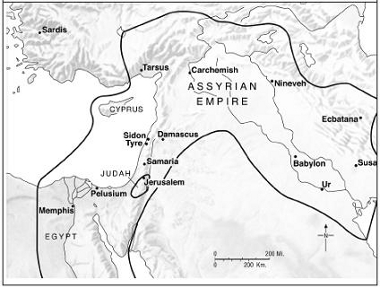
The MacArthur Study Bible, by John MacArthur (Nashville: Word Publishing, 1997) 542. © 1993 by Thomas Nelson, Inc.
15:10 Shallum. Shallum killed Zechariah and replaced him as king of Israel. Assyrian records call Shallum “the son of nobody,” indicating that he was not from the royal family.
15:13 thirty-ninth year. 752 B.C. Zechariah’s reign spanned the last months of Azariah’s thirty-eighth year (v. 8) and the first months of the following year.
15:14 Menahem. Menahem had probably been a military commander under Zechariah. Tirzah. The former capital of the northern kingdom (1 Kin. 14:17; 15:21, 33), located about nine miles east of Samaria. Menahem was probably stationed with his troops at Tirzah.
15:16 Tiphsah. Since Tiphsah was located on the Euphrates River about 325 miles north of Samaria (1 Kin. 4:24), a majority of interpreters translate this term “Tappuah,” a town fourteen miles southwest of Tirzah (Josh. 17:8). ripped open. The ripping open of pregnant women was a barbarous practice and elsewhere associated only with foreign armies (8:12; Hos. 13:16; Amos 1:13). Menahem probably did this as a visible reminder of the city’s failure to “open up” to his demands.
15:17 thirty-ninth year. 752 B.C. ten years. 752–742 B.C. With Menahem, the northern kingdom changed from the non-accession to the accession-year system of computing reigns.
15:19 Pul. Assyrian kings frequently had two names, a throne name for Assyria and another for Babylon. Pul was the Babylonian throne name of the Assyrian king Tiglath-Pileser III (cf. 1 Chr. 5:26) who reigned c. 745–727 B.C.
15:19, 20 Tiglath-Pileser III invaded Israel in 743 B.C. Menahem paid tribute of 1,000 talents of silver (c. 37 tons) raised from the wealthy men of Israel. Each of 60,000 men paid 20 ounces of silver to raise the required 37 tons of silver. For his tribute, Tiglath-Pileser III supported Menahem’s claim to the throne of Israel and withdrew his army. By this action, Menahem became a vassal of the Assyrian king.
15:23 fiftieth year. 742 B.C. two years. 742–740 B.C.
15:24 sins of Jeroboam. See notes on 13:2; 1 Kings 12:25–32.
15:25 Pekah. See note on verse 27. Pekah was one of Pekahiah’s military officers, probably commanding Gilead, since fifty Gileadites accompanied him when he assassinated Pekahiah. Argob and Arieh were either Pekahiah’s sons or loyal military officers. Pekah probably represented the anti-Assyrian faction in Israel (cf. 16:5).
15:27 fifty-second year. 740 B.C. twenty years. On the basis of Assyrian records, it can be determined that Tiglath-Pileser III deposed Pekah as king of Israel in 732 B.C., evidently using Hoshea as his instrument. Therefore, Pekah reigned c. 752–732 B.C., using the accession-year system of dating (that is, counting the first year as one). For an explanation of this dating system see 1 Kings Introduction: Interpretive Challenges. This included the years 752–740 B.C., when Pekah ruled in Gilead while Menahem (vv. 17–22) and Pekahiah (vv. 23–26) reigned in Samaria (the Jordan River being the boundary of the split kingdom). Verse 25 seems to indicate that Pekah had an alliance with Menahem and Pekahiah, ruling Gilead for them.
15:29 Ijon . . . Naphtali. The areas of Galilee and Gilead are described here. When Pekah and Rezin, the king of Syria, sought to have Judah join their anti-Assyrian alliance, another invasion by Assyria was provoked (cf. 16:5–9) in 733/732 B.C. Tiglath-Pileser III took Galilee and Gilead and converted them into three Assyrian provinces governed by royal appointees. He also was involved in replacing Pekah with Hoshea as king over the remaining area of Israel (see note on v. 27 ).
15:30 twentieth year. Jotham of Judah began his reign in 750 B.C. (see note on v. 32 ). His twentieth year was 732 B.C., according to the non-accession-year system. Assyrian records confirm that Hoshea began to rule Israel in 732 B.C. (see notes on v. 27; 2 Chr. 27:1–9 ).
15:32 second year. 750 B.C., the year of Pekah’s second year of rule in Gilead, according to the accession-year system (see note on v. 27 ).
15:33 sixteen years. 750–735 B.C. According to verse 30, Jotham reigned until 731 B.C. Jotham was probably replaced as a functioning king of Judah by a pro-Assyrian faction who established Ahaz as ruler (see notes on vv. 1, 2 ) while leaving Jotham as a powerless co-regent. the prophets Isaiah (Is. 1:1) and Micah (Mic. 1:1) ministered to Judah during Jotham’s reign.
| Ruler | Dates of Rule | Scripture Reference |
| Tiglath-Pileser III or Tiglath-Pilneser, or Pul(u) | c. 745-727 B.C. | 2 Kings 15:19, 29; 16:7-10 |
| Shalmaneser V | c. 727-722 B.C. | 2 Kings 17:1-6 |
| Sargon II | c. 722-705 B.C. | Isaiah 20 |
| Sennacherib | c. 705-681 B.C. | 2 Kings 18; 19; Isaiah 36; 37 |
| Esarhaddon | c. 681-669 B.C. | Ezra 4:2 |
| Osnapper (a.k.a. Ashurbanipal) | c. 668-627 B.C. | Ezra 4:10 |
15:35 the Upper Gate. Probably the Upper Benjamin Gate, which stood along the north side of the temple complex facing the territory of Benjamin (cf. Jer. 20:2; Ezek. 9:2; Zech. 14:10). Other accomplishments of Jotham are noted in 2 Chronicles 27:3–6.
15:37 Rezin . . . Pekah. See notes on 16:5–9.
E. The Defeat and Exile of Israel by Assyria (16:1–17:41)
16:1–17:41 At this point, the narrative turns to the defeat and exile of Israel by Assyria. In 17:7–23, the prophetic writer states the reasons why Israel was punished by the Lord. A major reason was the sinful religion established by Jeroboam I (17:21–23), which was followed by every king in Israel. Ominously, the section begins with the narrative concerning Ahaz of Judah who “walked in the way of the kings of Israel” (16:3). The kind of punishment that came upon Israel would come later upon Judah for the same reason (17:19, 20).
16:1 seventeenth year. 735 B.C., since Pekah’s reign began in 752 B.C. (see note on 15:27 ). Although Jotham, the father of Ahaz, was still alive (see note on 15:30 ), Ahaz exercised the sovereign authority in Judah from 735 B.C. to Jotham’s death in c. 731 B.C. The prophets Isaiah (Is. 1:1–7:1) and Micah (Mic. 1:1) continued to minister to Judah during the reign of Ahaz. See notes on 2 Chronicles 28:1–27.
16:2 sixteen years. 731–715 B.C. The principle of “dual dating” was followed here. See 1 Kings Introduction: Interpretive Challenges for an explanation of this principle. In 16:1 and 17:1, Ahaz was recognized as king in the year he came to the throne as a co-regent, but the year of his official accession was determined as the year when he began to reign alone. Ahaz shared royal power with Azariah (to 739 B.C.) and Jotham from 744 to 735 B.C. (see note on 17:1 ); he exercised total authority as co-regent with Jotham from 735–731 B.C. (see note on v. 1 ); he was sole king from 731 to 729 B.C. and was co-regent with his son Hezekiah from 729 to 715 B.C. (see note on 18:1 ).
16:3 walked in the way of the kings of Israel. This does not necessarily mean that Ahaz participated in the calf worship introduced by Jeroboam I at Bethel and Dan, but that he increasingly brought pagan, idolatrous practices into the worship of the Lord in Jerusalem. These are specified in verses 10–16 and parallel those of Jeroboam I in the northern kingdom. This included idols to Baal (2 Chr. 28:2). made his son pass through the fire. As a part of the ritual worship of Molech, the god of the Moabites, children were sacrificed by fire (cf. 3:27). This horrific practice was continually condemned in the OT (Lev. 18:21; 20:2–5; Deut. 18:10; Jer. 7:31; 19:5; 32:35). the abominations of the nations. Cf. 21:2. See note on Deuteronomy 18:9–12.
16:4 the high places. Ahaz was the first king in the line of David since Solomon who was said to have personally worshiped at the high places. While all the other kings of Judah had tolerated the high places, Ahaz actively participated in the immoral Canaanite practices that were performed at the high places on hilltops under large trees (cf. Hos. 4:13).
16:5 Rezin . . . Pekah. The kings of Syria and Israel wanted to overthrow Ahaz in order to force Judah into their anti-Assyrian coalition. The two kings with their armies besieged Jerusalem, seeking to replace Ahaz with their own king (cf. Is. 7:1–6). The Lord delivered Judah and Ahaz from this threat because of His promise to David (cf. Is. 7:7–16).
16:6 Elath. The Syrians did displace Judah from Elath (see note on 14:22 ). Later this important port town on the Gulf of Aqabah was captured by the Edomites.
16:7 Tiglath-Pileser. See notes on 15:19, 29. your servant and your son. Ahaz willingly became a vassal of the Assyrian king in exchange for his military intervention. This was a pledge that Judah would serve Assyria from this point on. In support of his pledge, Ahaz sent Tiglath-Pileser III silver and gold from the temple and from the palace treasuries (v. 8). Evidently, the prosperous reigns of Azariah and Jotham had replenished the treasures plundered by Jehoash of Israel fifty years earlier during Amaziah’s reign (14:14).
Tiglath-Pileser’s Assyrian Campaigns Against Israel and Judah (734–732 B.C.)
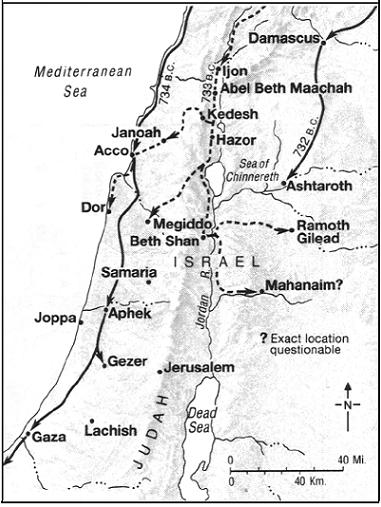
From 734 B.C. to 732 B.C. Tiglath-Pileser III mounted one invasion against Judah and two against Israel.
Nelson’s Complete Book of Bible Maps & Charts (Nashville: Thomas Nelson Publishers, 1996) 133. © 1993 by Thomas Nelson, Inc.
16:9 the king of Assyria heeded him. According to Assyrian records, in 733 B.C. Tiglath-Pileser III’s army marched against Damascus, the Syrian capital, laid siege for two years, and captured it. The victorious Assyrian king executed Rezin and deported his subjects to Kir, whose location is unknown.
16:10 the altar. When Ahaz traveled to Damascus to meet Tiglath-Pileser III, he saw a large altar (v. 15) which was most likely Assyrian. Ahaz sent a sketch of this altar to Urijah the high priest in Jerusalem and Urijah built an altar just like it. The serious iniquity in this was meddling with and changing, according to personal taste, the furnishings of the temple, the design for which had been given by God (Ex. 25:40; 26:30; 27:1–8; 1 Chr. 28:19). This was like building an idol in the temple, done to please the pagan Assyrian king, whom Ahaz served instead of God.
16:12, 13 offerings. As did Solomon and Jeroboam before him (1 Kin. 8:63; 12:32), Ahaz dedicated the new altar by offering sacrifices.
16:14–16 bronze altar. Feeling confident about his alterations in the temple, Ahaz moved the old bronze altar dedicated by Solomon (1 Kin. 8:22, 54, 64), which stood in front of the temple between the new altar and the temple itself (v. 14). Ahaz had the bronze altar moved to a spot north of the new altar, thereby relegating it to a place of secondary importance. All offerings from then on were to be given on the altar dedicated by Ahaz, while Ahaz reserved the bronze altar for his personal use in seeking guidance (v. 15). The term inquire probably referred here to pagan divination through religious rituals. Deuteronomy 18:9–14 expressly forbade such divination in Israel.
16:17, 18 Ahaz made further changes in the temple at Jerusalem. First, he removed the side panels and basins from the portable stands (cf. 1 Kin. 7:27–29, 38, 39). Second, he removed the large ornate reservoir called “the Sea” from atop the twelve bronze bulls to a new stone base (cf. 1 Kin. 7:23–26). Third, he removed the “Sabbath pavilion,” probably some sort of canopy used by the king on the Sabbath. Fourth, he removed “the king’s outer entrance,” probably a special entrance to the temple used by the king on Sabbaths and feast days (cf. 1 Kin. 10:5).
16:18 on account of the king of Assyria. Both items mentioned here were moved into the temple in the hope that if the king of Assyria laid siege to Jerusalem, Ahaz could secure the entrance of the temple from him.
16:20 Hezekiah. For his reign, see 18:1–20:21.
17:1 twelfth year. 732 B.C. This date for the accession of Hoshea as king of Israel is well established according to biblical and extra-biblical data (see note on 15:27 ). Therefore, Ahaz of Judah must have become co-regent with his father Jotham, who was himself co-regent with his father, Azariah, at that time (see notes on 15:30, 33 ), in 744 B.C. (see note on 16:2 ). nine years. 732–722 B.C. according to the accession-year system. Hoshea was imprisoned (v. 4) during the siege of Samaria by Assyria in 724–722 B.C. (v. 5).
17:2 he did evil. Though Hoshea was characterized as a wicked king, it is not stated that he promoted the religious practices of Jeroboam I. In this way, he was some improvement over the kings of Israel who had gone before him. However, this did not offset the centuries of sin by Israel’s kings or divert her inevitable doom.
17:3 Shalmaneser. Shalmaneser V succeeded his father Tiglath-Pileser III as king of Assyria and reigned from 727–722 B.C. During the siege of Samaria, when the Assyrians began the destruction and captivity of the northern kingdom, Shalmaneser V died and was succeeded by Sargon II (see Is. 20:1), who completed the siege, captured the city, destroyed the nation of Israel, and exiled the inhabitants (v. 6). Sargon II reigned as king from 722–705 B.C. See note on Hosea 10:14.
17:4 So, king of Egypt. Instead of paying his yearly tribute owed as a vassal of Assyria, Hoshea tried to make a treaty with Osorkon IV (c. 727–716 B.C.), king of Egypt. This was foolish because Assyria was powerful. It was also against God’s will, which forbade such alliances with pagan rulers (cf. Deut. 7:2). This rebellion led to Israel’s destruction (vv. 5, 6).
17:5 Samaria . . . besieged. In 724 B.C., Shalmaneser V invaded Israel and quickly conquered the land and captured Hoshea. However, the capital city of Samaria resisted the Assyrian invaders until 722 B.C. Like all major cities, Samaria had an internal water supply and plenty of stored food that allowed her to endure the siege for three years.
17:6 king of Assyria. Sargon II (see note on 17:3 ). carried Israel away. The capture of Samaria marked the end of the northern kingdom. According to Assyrian records, the Assyrians deported 27,290 inhabitants of Israel to distant locations. The relocation of populations was characteristic of Assyrian policy during that era. The Israelites were resettled in the upper Tigris-Euphrates Valley and never returned to the Promised Land. Halah was a city northeast of Nineveh. The Habor River was a northern tributary of the Euphrates. The “cities of the Medes” were northeast of Nineveh. Samaria was resettled with foreigners (v. 24). God did what He said He would do in Deuteronomy 28. The Jews were carried as far east as Susa, where the Book of Esther later took place.
17:7–23 In these verses, the writer departs from quoting his written sources and gives his own explanation for the captivity of Israel. Judah is included, though her captivity did not occur until 605/604–586 B.C. at the hands of the Babylonians. Her sins were the same. Here is a very full and impressive vindication of God’s action in punishing His privileged but rebellious and apostate people. In verse 7, he begins by stating that the Israelites had sinned against the Lord who had redeemed them from Egypt. Gross perversion of the worship of God and national propensity to idolatry finally exhausted divine patience. The idolatry of Israel is described in verses 7–12. In response to Israel’s actions, the Lord sent His prophets to Israel and Judah with a message of repentance (v. 13). However, the people failed to respond to the prophets’ messages because, like their fathers, they did not have faith in the Lord (v. 14). Their lack of faith resulted in disobedience to the Lord’s commands and the further pursuit of idolatry (vv. 15–17). The idolatry of Israel (and Judah) brought forth the anger of the Lord, which resulted in exile (v. 18). The great sin of both Israel and Judah was their continual following of the wicked pattern of Jeroboam I, departing from the Lord and practicing idolatry, thus bringing down the judgment of captivity predicted by the pro-phets (vv. 19–23).
Shalmaneser’s/Sargon’s Assyrian Campaigns Against Israel (725/722 B.C.)
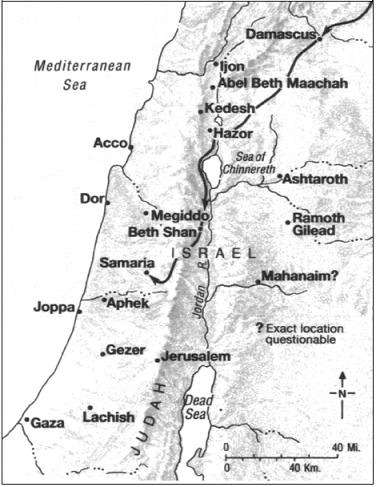
In 725 B.C. Shalmaneser V invaded Israel and marched on Samaria. Sargon II took Samaria in 722 B.C.
Nelson’s Complete Book of Bible Maps & Charts (Nashville: Thomas Nelson Publishers, 1996) 134. © 1993 by Thomas Nelson, Inc.
17:7 feared other gods. The primary cause of Israel’s exile was the worship of other gods. The fear of the Lord led to listening to His Word and obeying His ordinances and statutes (Deut. 4:10; 5:29; 6:24), but the fear of the gods of Canaan led Israel to obey the laws of the Canaanite gods (v. 8). The result of this obedience to false gods is recorded in verses 9–12, 16, 17.
17:8 walked in the statutes of the nations. This was expressly forbidden in Leviticus 18:3; 20:23.
17:9 built . . . high places. In addition to their private sins (“secret”), judgment came for public wickedness and idolatry. These were not the high places utilized by Israel for worshiping God before the building of the temple (see note on 1 Kin. 3:2 ). In direct disobedience to Deuteronomy 12:1–4, the Israelites built new, raised altars in the Canaanite pattern after the temple was constructed. These high places were in all the habitations of Israel, from small fortified structures to large garrison cities, i.e., from the smallest to largest towns. The “high place” altars were on wooded hills with images representing the false gods (v. 10; cf. Deut. 16:21, 22).
17:13 Turn from your evil ways. The prophets continually called the people to repentance (cf. Jer. 7:3, 5; 18:11; Ezek. 33:11).
17:14 stiffened their necks. A stubborn refusal to respond (see note on Deut. 9:6; cf. Ex. 32:9; 33:3, 5; 34:9; Acts 7:51).
17:16 a molded image and two calves. The text should be translated “molded images, even two calves.” Worship of them was instituted by Jeroboam (see 1 Kin. 12:25–33). wooden image. This was built by Rehoboam (see 1 Kin. 14:15, 23). the host of heaven. In the ancient Near East, the sun, moon, and stars were deified and worshiped. This astral worship entered Israel and Judah (21:5; 23:4, 5; Ezek. 8:15, 16; Amos 5:26). The worship of the heavenly bodies was prohibited by the Mosaic Law (Deut. 4:19; 17:3).
17:17 pass through the fire. See notes on 3:27; 16:3. witchcraft and soothsaying. See note on Deuteronomy 18:9–12. Isaiah prophesied of the devastation these practices would produce (8:19–22).
17:19 Judah followed Israel into sin and judgment.
17:21 He tore Israel. See notes on 1 Kings 11:11–13, 29–39.
17:22 the sins of Jeroboam. See notes on 1 Kings 12:25–32. The sins of that king put in motion an unbroken pattern of idolatrous iniquity. See note on 13:2.
17:23 as it is to this day. The exiles of Israel never returned en masse as did Judah (see note on 1 Chr. 9:1 ).
17:24 Samaria. After its conquest by the Assyrians, the central hill and coastal plain region of the former northern kingdom of Israel became an Assyrian province, all of which was called “Samaria” after the ancient capital city (cf. vv. 28, 29). The Assyrian king, Sargon II, settled alien people, who came from widely scattered areas also conquered by Assyria, in the abandoned Israelite towns. Babylon and Cuthah were located in southern Mesopotamia. Hamath was a town on the Orontes River in Syria. The exact location of Ava and Sepharvaim are unknown. These people, who intermarried with the Jews who escaped exile, became the Samaritans—a mixed Jew and Gentile people, later hated by NT Jews (cf. Matt. 10:5; John 4:9; see notes on Luke 10:29–36 ).
17:25 lions among them. Lions were employed occasionally by God as instruments of punishment (cf. 1 Kin. 13:24; 20:36).
17:26 the rituals of . . . God. The newcomers interpreted the lions as a punishment from the God of Israel, whom they viewed as a deity who needed to be placated. Since they did not know how to appease Him, they appealed to Sargon II for help.
17:27, 28 one of the priests. In response, the Assyrian king ordered an Israelite priest back to Samaria from exile to teach the people what the God of the land required in worship.
17:29–32 Though they had been taught the proper way to worship God, these people all placed God alongside their other gods in an eclectic kind of worship that was blasphemy to the one true and living God.
17:30 Succoth Benoth. Lit. “tents of the daughters,” probably indicating some deity worshiped by sexual orgies. Nergal. Perhaps the Assyrian god of war. Ashima. An idol in the form of a bald male goat.
17:31 Nibhaz. A dog-like idol. Tartak. Either a donkey or a celestial body, Saturn. Adrammelech. Perhaps the same as Molech, worshiped in the form of the sun, a mule, or a peacock. Anammelech. A rabbit or a goat idol.
17:33 served their own gods. The religion of the Samaritans was syncretistic; it combined elements of the worship of the Lord with the worship practices of the gods which the Assyrian settlers had brought with them (see note on v. 24 ).
17:34–41 Having shown how the Samaritan people and their religion came into being (vv. 24–33), the writer of Kings shows how the syncretistic worship of the Samaritans continued for generations, even to his own day (cf. v. 41; during the Babylonian exile). The religion of the Samaritans was, at its foundation, no different from Jeroboam I’s deviant religion.
III. THE SURVIVING KINGDOM: THE KINGS OF JUDAH (18:1–25:21)
A. Hezekiah’s Righteous Reign (18:1–20:21)
18:1–25:21 With the fall of Samaria, the northern kingdom of Israel came to an end (17:5, 6; 18:9–12). This last major division of the Books of Kings narrates the events in the surviving southern kingdom of Judah from 722 B.C. to its captivity and destruction in 586 B.C. These chapters are dominated by the accounts of two good kings, Hezekiah (18:1–20:21) and Josiah (22:1–23:30). However, the reforms of these two godly kings did not reverse the effects of the two worst kings of Judah, Ahaz (16:1–20) and Manasseh (21:1–18). The result of Judah’s apostasy was exile, just like it was for Israel (23:31–25:21). The Books of Kings begin with the building of the temple (1 Kin. 5:1–6:38) and end with its destruction (25:8, 9, 13–17), chronicling the sad journey from the establishment of true worship to the destruction of apostasy.
18:1 third year. Ca. 729 B.C. Hoshea began to reign in 732 B.C. (see notes on 15:27; 17:1 ). Hezekiah was co-regent with Ahaz to 715 B.C. (see note on 16:2 ). See notes on 2 Chronicles 29:1–32:32. With this verse, the writer returned from his digression summarizing the causes of captivity to the historical record of the kings of the southern kingdom, Judah.
18:2 twenty-nine years. 715–686 B.C. He reigned by himself for twenty years (715–695 B.C.), and with his son, Manasseh, for nine years (695–686 B.C.). The twenty-nine years given here indicate only those years after his co-regency with Ahaz was over, when he was the actual sovereign. During Hezekiah’s reign, the prophets Isaiah (19:2; Is. 1:1; 37:21) and Micah (Mic. 1:1) continued to minister in Judah.
18:4 removed the high places. Hezekiah was the first king of Judah to eradicate the high places, i.e., the worship centers built contrary to the Mosaic Law (cf. Deut. 12:2–7, 13, 14). sacred pillars . . . wooden image. Hezekiah destroyed the idols used in the worship of Baal and Asherah. the bronze serpent. Hezekiah broke the Nehushtan into pieces. This was the bronze snake made by Moses in the wilderness (see notes on Num. 21:4–9 ). Judah had come to worship it as an idol, perhaps influenced by Canaanite religion, which regarded snakes as fertility symbols.
18:5 He trusted in the LORD God of Israel. The most noble quality of Hezekiah (in dramatic contrast to his father, Ahaz) was that he relied on the Lord as his exclusive hope in every situation. What distinguished him from all other kings of Judah (after the division of the kingdom) was his firm trust in the Lord during a severe national crisis (18:17–19:34). Despite troublesome events, Hezekiah clung tightly to the Lord, faithfully following Him and obeying His commands (v. 6). As a result, the Lord was with him and gave him success (v. 7).
18:7 He rebelled against . . . Assyria. Before he became king, his father had submitted to Assyria. Courageously, Hezekiah broke that control by Assyria and asserted independence (cf. Deut. 7:2).
18:8 Gaza. The southernmost city of the Philistines, located about fifty-five miles southwest of Jerusalem. Since Assyria had controlled Philistia, Hezekiah’s invasion defied Assyrian rule and brought the threat of retaliation.
18:9–12 These verses flash back to the time just before Israel’s destruction and captivity to give a summary of the fall of Samaria (more fully narrated in 17:5–23) as a graphic reminder of the Assyrian power and the threat this nation still was to Judah. This review sets the scene for the siege of Jerusalem with its reminder of Israel’s apostasy against which Hezekiah’s faith in the Lord was a bright contrast.
18:13–20:19 This narrative, with a few omissions and additions, is found in Isaiah 36:1–39:8. See Isaiah notes for amplification.
18:13 fourteenth year. 701 B.C. Hezekiah began his sole rule in 715 B.C. (see notes on vv. 1, 2 ). This date for the siege of Jerusalem is confirmed in Assyrian sources. Sennacherib. He succeeded Sargon II as king of Assyria in 705 B.C. and ruled until 681 B.C. Hezekiah had rebelled against him (v. 7), probably by withholding tribute when he invaded Philistia. fortified cities. See note on Isaiah 36:1.
18:14–16 Hezekiah sought to rectify the situation with Sennacherib by admitting his error in rebelling and paying the tribute the Assyrian king demanded. Sennacherib asked for about eleven tons of silver and one ton of gold. To pay, Hezekiah emptied the temple and palace treasuries and stripped the layers of gold off the doors and doorposts of the temple.
18:17–24 The tribute did not satisfy Sennacherib, who sent messengers to demand Hezekiah’s surrender.
18:17 Tartan. General of the Assyrian army (cf. Is. 20:1). Rabsaris. A high official in the palace. Rabshakeh. The word is not a proper noun, but means “commander.” He was the spokesman for Sennacherib, who represented the king against Jerusalem on this occasion. Lachish. See note on 14:19. Sennacherib’s conquest of this city was in its closing phase when he sent the messengers. great army. This was a token force of the main army (19:35) with which Sennacherib hoped to bluff Judah into submitting. aqueduct from the upper pool. Isaiah had met Ahaz at the same spot to try, unsuccessfully, to dissuade him from trusting in foreign powers (Is 7:3). It was probably located on the higher ground northwest of Jerusalem on the main north-south highway between Judah and Samaria. Fuller’s. The word means “launderer” and indicates the field where such activity was done, being near the water supply.
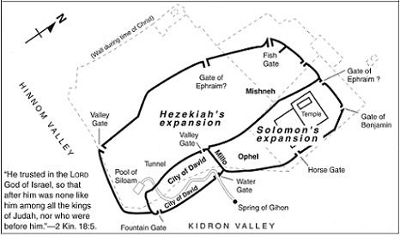
The MacArthur Study Bible, by John MacArthur (Nashville: Word Publishing, 1997) 549. © 1993 by Thomas Nelson, Inc.
18:18 Eliakim . . . Shebna. Eliakim was the palace administrator and Shebna, the secretary. See notes on Isaiah 22:19–22. Joah . . . the recorder. The position was that of an intermediary between the king and the people (cf. 2 Sam. 8:16).
18:19–25 The Rabshakeh’s logic was twofold: (1) Egypt would be unable to deliver Jerusalem (vv. 20, 21, 23, 24); and (2) the Lord had called on the Assyrians to destroy Judah (vv. 22, 25).
18:19 great king. Cf. verse 28. The self-appropriated title of Assyrian kings. In contrast, Rabshakeh omitted any title for Hezekiah (vv. 19, 22, 29, 30, 31, 32).
18:20 mere words. See note on Isaiah 36:5. whom do you trust? The implication was that Assyria was so strong, there was none stronger.
18:21 broken reed, Egypt. The Assyrian’s advice strongly resembled that of Isaiah (Is. 19:14–16; 30:7; 31:3). Egypt was not strong and could not be counted on for help.
18:22 He whose high places and whose altars. The Rabshakeh mistakenly thought Hezekiah’s reforms in removing idols from all over the land and reestablishing central worship in Jerusalem (v. 4; 2 Chr. 31:1) had removed opportunities to worship the Lord, and thus cut back on honoring Judah’s God, thereby displeasing Him and forfeiting His help in war. this altar. That all worship should center in Solomon’s temple was utterly foreign to the polytheistic Assyrians.
18:23, 24 See note on Isaiah 36:8, 9.
18:25 The LORD said. See note on Isaiah 36:10.
18:26 Aramaic . . . Hebrew. See note on Isaiah 36:11.
18:27 men . . . on the wall. See note on Isaiah 36:12.
18:28–32 The Rabshakeh spoke longer and louder in Hebrew, suggesting (1) that Hezekiah could not save the city, but (2) the great king of Assyria would fill the people with abundance if they would promise to surrender to his sovereign control, give tribute to him, and be willing to go into a rich and beneficial exile (vv. 31, 32).
18:32 take you away. See note on Isaiah 36:17.
18:32–35 See note on Isaiah 36:18–20.
18:36 held their peace. See note on Isaiah 36:21.
18:37 clothes torn. See note on Isaiah 36:22.
19:1 tore . . . sackcloth. See note on 6:30. A reaction that symbolized Hezekiah’s grief, repentance, and contrition. The nation had to repent and the king had to lead the way. house of the LORD. See note on Isaiah 37:1.
19:2 elders of the priests. See note on Isaiah 37:2. Isaiah the prophet. The first reference in 1 and 2 Kings to one of the Lord’s greatest prophets (cf. Is. 1: 1). He had already been ministering for forty years since the days of Uzziah (Is. 6:1), also called Azariah (14:21).
19:3 come to birth . . . no strength. See note on Isaiah 37:3.
19:4 reproach the living God. See note on Isaiah 37:4. remnant that is left. See note on Isaiah 37:4.
19:6 Do not be afraid. Sennacherib had blasphemed the Lord by equating Him with other gods. The Lord would personally demonstrate to the Assyrian king His superiority over all other so-called deities.
19:7 spirit. The Lord promised to incline Sennacherib’s attitude in such a way that he would leave Jerusalem unharmed and return home. How the Lord did that is recorded in verses 35–37.
19:8 Libnah. See note on Isaiah 37:8.
19:9 Tirhakah king of Ethiopia. See note on Isaiah 37:9.
19:9–13 The king of Assyria sent messengers to summarize the arguments given in the Rabshakeh’s ultimatum of 18:19–25.
19:10 deceive. The accusation of deception was first against Hezekiah (18:29), then against the Lord.
19:11–13 The threat repeated the thrust of 18:33–35.
19:12, 13 The conquered cities mentioned here lay between the Tigris and Euphrates rivers in Mesopotamia, and were cities of Syria that had recently fallen to Sennacherib and the Assyrians.
19:14 house of the LORD. Godly Hezekiah returned to the house of the Lord (cf. v. 1) as he should have, in contrast to Ahaz, who in a similar crisis refused even to ask a sign from the Lord (Is. 7:11, 12).
19:15 the One who dwells . . . heaven and earth. See note on Isaiah 37:16.
19:16 hear . . . see . . . hear. See note on Isaiah 37:17.
19:17, 18 See note on Isaiah 37:18, 19.
19:19 You alone. See note on Isaiah 37:20.
19:20 Isaiah the son of Amoz. See note on Isaiah 37:21.
19:21 laughed you to scorn. See note on Isaiah 37:22.
19:22 you reproached and blasphemed? The Lord had heard Sennacherib’s reproach against Him (v. 16).
19:23, 24 See note on Isaiah 37:24, 25.
19:25–28 I have brought it to pass. See notes on Isaiah 37:26–29.
19:29 sign. The two years in which they were sustained by the growth of the crops were the two in which Sennacherib ravaged them. He left immediately after the deliverance (v. 36), so in the third year the people remaining could plant again.
19:30, 31 remnant . . . remnant. From the remnant of survivors in Jerusalem came descendants who covered the land once again (cf. Is. 1:9, 27; 3:10; 4:3; 6:13; 8:16, 17; 10:20, 22; 11:12, 16; 26:1–4, 8; 27:12; 28:5; 37:4).
Sennacherib’s Assyrian Campaign Against Judah (701 B.C.)
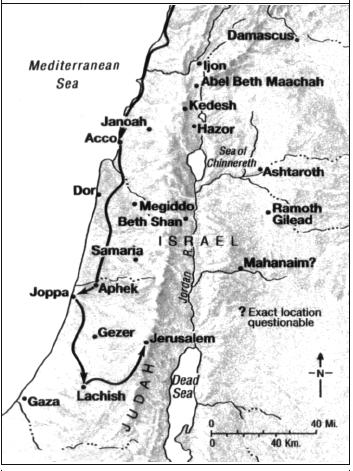
Sennacherib moved southward along the coastal plains to Lachish and camped against Jerusalem in 701 B.C.
Nelson’s Complete Book of Bible Maps & Charts (Nashville: Thomas Nelson Publishers, 1996) 134. © 1993 by Thomas Nelson, Inc.
19:31 zeal of the LORD of hosts. The same confirmation of God’s promise in 19:7 assured the future establishment of the messianic kingdom. Deliverance from Sennacherib in Hezekiah’s day was a down payment on the literal, final restoration of Israel at Christ’s Second Coming.
19:32 shall not come . . . build a siege mound. See note on Isaiah 37:33.
19:33 shall he return. See note on Isaiah 37:34.
19:34 For My own sake. Since Sennacherib had directly challenged the Lord’s faithfulness to His Word (v. 10), the faithfulness of God was at stake in this contest with the Assyrians (cf. Ezek. 36:22, 23). for My servant David’s sake. God pledged to perpetuate David’s line on his throne (2 Sam. 7:16; cf. Is. 9:6, 7; 11:1; 55:3).
19:35 the angel of the LORD. For identification, see note on Exodus 3:2. For the angel as an agent of destruction, see Genesis 19:15; 2 Samuel 24:16.
19:35–37 killed. See notes on Isaiah 37:36–38.
20:1 In those days . . . sick. The date of Hezekiah’s sickness poses three reasonable possibilities: (1) since Hezekiah would be given fifteen years of life and delivered from the Assyrians (v. 6), the sickness occurred c. 701 B.C.; (2) since Berodach-Baladan (v. 12) died in 703 B.C., the sickness occurred shortly before and was followed by the embassy from Babylon that saw the temple treasures (vv. 12–19); or (3) since Berodach-Baladan’s greatest power was c. 721–710 B.C., Hezekiah’s sickness occurred during those years. The first or second possibility is most likely. Set your house in order. An instruction telling Hezekiah to make his final will known to his family (cf. 2 Sam. 17:23). you shall die, and not live. The prediction sounded final, but Hezekiah knew God was willing to hear his appeal (cf. Ex. 32:7–14).
20:2, 3 prayed . . . wept bitterly. Hezekiah reminded the Lord in prayer of his piety and devotion to God. He did not specifically ask to be healed. Based on the interpretation of the date from verse 1, Hezekiah wept because: (1) he thought his death would give Sennacherib cause for boasting; or (2) his son Manasseh was too young to become king.
20:3 loyal heart. See note on Isaiah 38:3.
20:6 fifteen years. The Lord’s immediate (v. 4) response granted the king’s request. Having to reverse a prophecy so quickly did not alarm Isaiah as it did Jonah later on (Jon. 4:2, 3). Isaiah resembled Nathan in this respect (2 Sam. 7:3–6). I will deliver . . . this city. See note on Isaiah 38:6.
20:8–11 sign . . . ten degrees backward. Here is the first biblical mention of any means of marking time. Hezekiah requested this sign to confirm the Lord’s promise of healing.
20:12 At that time. Just after Hezekiah’s sickness and recovery. Berodach-Baladan. Berodach-Baladan, ruler of the city of Babylon, defied Assyria repeatedly between 721 and 710 B.C. He apparently approached Hezekiah (c. 703 B.C.) for help against Sargon, king of Assyria, though interest in the reversal of the sundial (2 Chr. 32:31) and Hezekiah’s recovery may have been part of his motivation.
20:13 Hezekiah was attentive. The text does not say whether it was because of flattery or out of a desire for help against the Assyrian threat. Cf. pleased in Isaiah 39:2.
20:13, 14 treasures . . . treasures. See notes on Isaiah 39:2, 3.
20:16, 17 word of the LORD . . . carried to Babylon. Isaiah predicted the Babylonian captivity that would come over a century later (586 B.C.), another prophecy historically fulfilled in all of its expected detail.
20:17 nothing shall be left. Hezekiah’s sin of parading his wealth before the visitors backfired, though this sin was only symptomatic of the ultimate reason for the captivity. The major cause was the corrupt leadership of Manasseh, Hezekiah’s son (21:11–15).
20:18 sons who will descend from you. Hezekiah’s sons had to go into captivity. See 24:12–16; 2 Chronicles 33:11; Daniel 1:3, 4, 6 for the prophecy’s fulfillment.
20:19 word of the LORD . . . good! A surprising response to the negative prophecy of verses 16–18. It acknowledged Isaiah as God’s faithful messenger, and God’s goodness in not destroying Jerusalem during Hezekiah’s lifetime. peace and truth . . . in my days? Hezekiah might have reacted selfishly, or perhaps he looked for a bright spot to lighten the gloomy fate of his descendants.
20:20 tunnel. See note on 2 Chronicles 32:30.
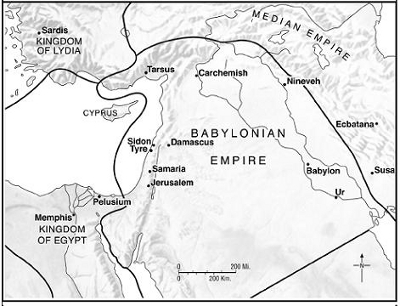
The MacArthur Study Bible, by John MacArthur (Nashville: Word Publishing, 1997) 553. © 1993 by Thomas Nelson, Inc.
B. Manasseh’s and Amon’s Wicked Reigns (21:1–26)
21:1 twelve years old. Manasseh began to reign as co-regent alongside his father, Hezekiah, in 695 B.C. Since the years of the subsequent royal reigns in Judah total ten years longer than the actual historical period and the dates of the later kings synchronize well with history, it is best to assume a ten year co-regency in Manasseh’s long reign. Hezekiah groomed his son as a youth to succeed him as king; however, Manasseh turned out to be the worst king in Judah’s history. fifty-five years. 695–642 B.C. See notes on 2 Chronicles 33:1–20.
21:2 the abominations of the nations. Cf. 16:3. The detestable practices of the Canaanites were enumerated in Deuteronomy 18:9–12. Israel’s reproduction of these abominable practices of the nations that preceded her in the land was forbidden in Deuteronomy 12:29–31. The idolatry of Manasseh is detailed in verses 3–9 (cf. 17:7–12, 15–17).
21:3 high places . . . altars . . . wooden image. Manasseh reversed the reforms of Hezekiah (cf. 18:4), reestablishing the worship of Baal as an official state-sanctioned religion in Judah, just as Ahab had done in Israel (cf. 1 Kin. 16:30–33). host of heaven. See note on 17:16. The worship of the sun, moon, and stars was prohibited in Deuteronomy 4:19; 17:2–5.
21:4 altars in the house of the LORD. These altars were dedicated to “the host of heaven” (v. 5).
21:6 made his son pass through the fire. See note on 16:3. soothsaying . . . witchcraft . . . piritists and mediums. The king was engaged in every form of occultism, including black magic, fortune-telling, demon contacts, and wizards. All this was in direct violation of God’s law (Lev. 19:31; Deut. 18:9–12).
21:7 set . . . put. Manasseh provoked the Lord by “setting” an idol of a Canaanite goddess in the temple where the Lord had “set” His name (see 1 Kin. 8:29; 9:3; 2 Chr. 7:12, 16). Asherah (cf. 23:4; 2 Chr. 15:16) was believed to be the mother of seventy deities, including Baal.
21:8, 9 This alludes to the promise of 2 Samuel 7:10. From the very start of their time in Canaan, the people were called to this obedience, but because the people of Judah did not carefully follow the stipulations of the Mosaic Law, they were again led into idolatry by Manasseh. Their idolatry even exceeded the idolatry of the Canaanites from whom they took the land.
21:10 the prophets. Through his spokesman, the Lord announced Judah’s judgment. In verses 11–15, the prophetic message to Judah is summarized.
21:11 Amorites. A general designation of the original inhabitants of Canaan (cf. Gen. 15:16; Josh. 24:8).
21:13 the plummet. These were weighted lines dropped from walls to see whether they were structurally straight (cf. Is. 28:17; Amos 7:7, 8). Walls out of line were torn down. The Lord had measured Jerusalem by the standard of His Word and had determined that the fate of Samaria (Israel) was also to befall Jerusalem. wipe Jerusalem. As one would wipe food off a dish, the Lord would wipe Jerusalem clean off the earth, i.e., obliterate her and leave her turned upside down, empty and useless.
21:14 forsake. The Lord was going to abandon His people into the hands of enemies who would plunder them (cf. Jer. 12:7). remnant. Judah, the only remaining group of the chosen people.
21:15 provoked Me to anger. The history of God’s people, Israel, was a history of disobedience toward the Lord. With the reign of Manasseh, the sin of God’s people climaxed, God’s patience was withdrawn, and the judgment of exile became inevitable (cf. 24:1–4).
21:16 very much innocent blood. The reference here is ambiguous and several interpretations have been offered: (1) child sacrifice (cf. v. 6); (2) oppression and persecution of the weak (Jer. 7:6; 22:3, 17; Ezek. 22:6–31); or (3) the martyrdom of God’s prophets (cf. v. 10). A combination of all three is most likely. Jewish and Christian tradition alike report that Manasseh had Isaiah sawn in two inside a hollow log (cf. Heb. 11:37).
21:19 two years. 642–640 B.C. Amon continued the idolatrous practices of his father, abandoning the Lord completely (vv. 20–22). See note on 2 Chronicles 33:21–25.
21:24 the people of the land. Probably a group of Judah’s national leaders who killed the assassins of Amon and installed his son Josiah on the throne. Apparently, they desired to maintain the Davidic dynasty (cf. 2 Kin. 11:14–18).
C. Josiah’s Righteous Reign (22:1–23:30)
22:1 thirty-one years. 640–609 B.C. During Josiah’s reign, power in the ancient Near East passed from Assyria to Babylon. Nineveh, the capital of Assyria, was destroyed by the Babylonians in 612 B.C., and the Assyrian Empire fell in 609 B.C. Josiah was the last good king of the Davidic line prior to the Babylonian exile. Jeremiah (Jer. 1:2), possibly Habakkuk, and Zephaniah (Zeph. 1:1) were prophets to Judah during the reign of Josiah. See notes on 2 Chronicles 34:1–35:27.
22:2 did not turn aside. Josiah had complete devotion to God’s approved course of conduct for his life (cf. 23:25). He obeyed the Mosaic stipulations as he came to know them, following the example of David, who set the pattern for the rulers of God’s people (Deut. 17:11, 20; Josh. 1:7).
22:3 eighteenth year. 622 B.C., when Josiah was twenty-six years of age.
22:4 Hilkiah. The high priest was the father of Azariah and the grandfather of Seraiah, the high priest who would be executed at the time of the exile by the Babylonians (cf. 25:8–20).
22:4–7 the doorkeepers. See note on 12:9. Josiah used the same procedure as King Joash for collecting funds to repair the temple after its abuse in the days of Manasseh and Amon.
22:8 the Book of the Law. A scroll containing the Torah (the Pentateuch), the revelation of God through Moses to Israel (see notes on 23:2; Deut. 28:61 ). Manasseh may have destroyed all the copies of God’s law that were not hidden. This could have been the official copy laid beside the ark of the covenant in the Most Holy Place (Deut. 31:25, 26). It may have been removed from its place under Ahaz, Manasseh, or Amon (cf. 2 Chr. 35:3), but was found during repair work.
22:9, 10 Some believe that Shaphan must have read Deuteronomy 28–30, in which are recorded a renewal of the national covenant and a listing of the terrible threats and curses against all who violate the law of God.
22:11 tore his clothes. Josiah’s reaction at the reading of the law was one of immediate contrition, expressed by the common sign of lamentation and grief (see 18:37; 19:1). Josiah’s grief sprang from Judah’s guilt and God’s punishment (v. 13).
22:14 Huldah. This prophetess is otherwise unknown in the OT. She was held in some regard for her prophetic gift, though why she was consulted and not another prophet like Jeremiah or Zephaniah (see note on 22:1 ) is unexplained. Rarely did God speak to the nation through a woman (cf. Miriam, Ex. 15; Deborah, Judg. 5) and never did a woman have an ongoing prophetic ministry identified in Scripture. No woman was inspired to author any of Scripture’s sixty-six books. the wardrobe. Likely, these were the royal garments or those used by the priests. the Second Quarter. This district of Jerusalem was called second because it comprised the city’s first major expansion. It was probably located on the western hill of Jerusalem, an area enclosed by the city wall and built during the reign of Hezekiah. The expansion of the city during Hezekiah’s reign was perhaps to accommodate Jewish refugees who had escaped from the Assyrian invasion of Israel.
22:15–20 Huldah gave God’s message to Josiah through his messengers. First, the Lord confirmed to Josiah that He was surely going to bring His judgment upon Jerusalem because of her idolatry (vv. 15–17). Second, the Lord’s personal word to Josiah was that he would die “in peace” (v. 20), meaning that he would escape the horrors in store for Jerusalem. This promise was based on Josiah’s response of tenderness and humility before the Lord when he heard the scroll de-(vv. 18, 19).
22:20 in peace. His heart was at peace with God and he never lived to see Jerusalem destroyed, but he did die in battle (2 Chr. 35:23).
23:2 Book of the Covenant. Although this designation was used in Exodus 24:7 with ref erence to the contents of Exodus 20:22–23:33, it seems here to refer to a larger writing. Since the larger part of the Pentateuch focused on the Mosaic covenant, these five books came to be called thusly. Since all the men of Judah and all the inhabitants of Jerusalem were assembled together by Josiah, it seems best to view this as the reading of the whole written law found in Genesis 1 through Deuteronomy 34 (see notes on Deut. 31:9, 11 ).
23:3 pillar. See note on 11:14. a covenant . . . this covenant. Josiah made a public, binding agreement to completely obey the Lord by doing all that was commanded in the Book of the Covenant that the people had just heard read to them. Following Josiah’s example, all the people promised to keep the stipulations of the Mosaic covenant. See notes on 11:17; Exodus 24:4–8.
23:4 Asherah. See note on 21:7. the fields of Kidron. Josiah burned everything in the temple that was devoted to idolatry. This was done in the lower portion of the Kidron Valley, east of the city of Jerusalem (cf. v. 6). ashes to Bethel. Located about ten miles north of Jerusalem, Bethel was one of the two original places where Jeroboam I established an apostate worship center (1 Kin. 12:28–33). Bethel was located just north of the border of Judah in the former northern kingdom, which was then the Assyrian province of Samaria. With a decline in Assyrian power, Josiah was able to exert his religious influence in the north. He used the ashes of the burned articles of idolatry to desecrate Jeroboam’s religious center (cf. vv. 15–20).
23:5 constellations. Cf. 21:3. The astrologers were also removed. See Isaiah 47:13.
23:6 wooden image. The idol of Asherah (see note on 21:7 ). graves of the common people. The Kidron Valley contained a burial ground for the common people (cf. Jer. 26:23). Scattering ashes from the object of idolatry is said in 2 Chronicles 34:4 to have been on the graves of those who sacrificed to that idol. The common people had followed their leaders to apostasy, defilement, and damnation—all symbolized by the act of scattering the ashes.
23:7 booths. Tents (called “Succoth Benoth” in 17:30) used by women who were devoted to Asherah, in which they made hangings and committed sexual sins.
23:8 Geba to Beersheba. Geba was located about seven miles northeast of Jerusalem at the far north of Judah, and Beersheba was located c. forty-five miles south of Jerusalem at the southern end of Judah. Thus, this phrase was an idiomatic way of saying “throughout all of Judah.”
23:10 Topheth. Meaning “a drum,” it identified the area in the Valley of Hinnom where child sacrifice occurred (cf. Is. 30:33; Jer. 7:31, 32; 19:5, 6). It, perhaps, was called “drum” because drums were beaten to drown out the cries of the children being sacrificed.
23:11 horses . . . dedicated to the sun. The horses and the chariots of the sun were probably thought to symbolize the sun blazing a trail across the sky and were a part of worshiping the sun. Recently, a religious shrine with horse figurines has been found in Jerusalem (cf. Ezek. 8:16).
23:12 on the roof. Altars were erected on the flat roofs of houses so people could worship the “host of heaven” by burning incense (Jer. 19:13; Zeph. 1:5).
23:13 Solomon . . . had built. Solomon had built high places east of Jerusalem on the Mt. of Olives, renamed after the desecration, to be used in worship of foreign gods, e.g., the fertility goddess Ashtoreth from Sidon, the Moabite god Chemosh, and the Ammonite god Molech (1 Kin. 11:7). These altars existed for over 300 years before Josiah finally destroyed them. The placing of human bones defiled them and, thus, rendered these sites unclean and unsuitable as places of worship.
23:15 the altar . . . at Bethel. Josiah reduced the altar that Jeroboam I had built at Bethel to dust and ashes (see 1 Kin. 12:28–33).
23:16 tombs. Seeing tombs nearby, perhaps where idolatrous priests were buried, Josiah had their bones removed and burned on the altar at Bethel to defile it. This action fulfilled a prophecy given about the altar approximately 300 years before (1 Kin. 13:2).
23:17, 18 See 1 Kings 13:1–32, especially verses 31, 32.
23:18 Samaria. The former northern kingdom of Israel had become known as Samaria, so named as an Assyrian province (see note on 17:24 ).
23:19 cities of Samaria. The desecration of the high place at Bethel was only the beginning of Josiah’s desecration of all the high places in the Assyrian province of Samaria.
23:20 executed all the priests. These non-Levitical priests, who led apostate worship in the former northern kingdom, were idolaters who seduced God’s people into idolatry. They were put to death in accordance with the statutes of Deuteronomy 13:6–18; 17:2–7, and their graves were doubly defiled with burned bones.
23:21, 22 Such a Passover. Judah’s celebration of this Passover (see Deut. 16:2–8) more closely conformed to the instructions given in the Mosaic Law than any in the previous 400 years of Israel’s history. Though the Passover was observed by Hezekiah (2 Chr. 30), no observance had been in exact conformity to God’s law since the judges. Further details of this Passover observance are found in 2 Chronicles 35:1–19.
23:23 eighteenth year. C. 622 B.C. All the reforms of Josiah described took place in the same year (cf. 22:3).
23:24 the book . . . found. See 22:8.
23:25 no king like him. Of all the kings in David’s line, including David himself, no king more closely approximated the royal ideal of Deuteronomy 17:14–20 than Josiah (cf. Matt. 22:37). Yet, even Josiah fell short of complete obedience because he had multiple wives (cf. vv. 31, 36; see note on Gen. 2:24 ). However, even this righteous king could not turn away the Lord’s wrath because of Manasseh’s sin (vv. 26, 27). See chapters 17; 18.
23:29 Necho. Pharaoh Necho II (609–594 B.C.) was an ally of Assyria against the growing power of Babylon. For some unstated reason, Josiah was determined to stop Necho and his army from joining the Assyrian army at the Euphrates River to fight Babylon. Megiddo. The well-fortified stronghold overlooking the Jezreel Valley about sixty-five miles north of Jerusalem. Megiddo guarded a strategic pass on the route between Egypt and Mesopotamia. Josiah’s death is explained with more detail in 2 Chronicles 35:20–27.
D. The Defeat and Exile of Judah by Babylon (23:31–25:21)
23:31 three months. Jehoahaz reigned during 609 B.C., became a prisoner of Pharaoh Necho II, and ultimately died in Egypt. See note on 2 Chronicles 36:1–4.
23:33 Riblah in the land of Hamath. Jehoahaz was in prison at Pharaoh Necho II’s military headquarters located on the Orontes River in the north Lebanon Valley (see note on 25:6 ). silver . . . gold. The tax imposed on Judah, whose king was imprisoned, was 750 pounds of silver and 7.5 pounds of gold.
23:34 Eliakim . . . Jehoiakim. In 609 B.C., Pharaoh Necho II placed Jehoahaz’s older brother on the throne of Judah. Necho changed his name from Eliakim, meaning “God has established,” to Jehoiakim, “the Lord has established.” The naming of a person was regarded in the ancient Near East as sign of authority; so by naming Jehoiakim, Necho demonstrated that he was the lord who controlled Judah. As a vassal of Egypt, Judah risked attack by Egypt’s enemy Babylon. See note on 2 Chronicles 36:5–8.
23:35 Jehoiakim taxed his people severely to pay tribute to Egypt, though he still had enough to build a magnificent palace for himself (see Jer. 22:13, 14).
23:36 eleven years. 609–597 B.C.
24:1 Nebuchadnezzar. Nebuchadnezzar II was the son of Nabopolassar, king of Babylon from 626–605 B.C. As crown prince, Nebuchadnezzar had led his father’s army against Pharaoh Necho and the Egyptians at Carchemish on the Euphrates River in northern Syria (605 B.C.). By defeating the Egyptians, Babylon was established as the strongest nation in the ancient Near East. Egypt and its vassals, including Judah, became vassals of Babylon with this victory. Nebuchadnezzar followed up his victory at Carchemish by invading the land of Judah. Later, in 605 B.C., Nebuchadnezzar took some captives to Babylon, including Daniel and his friends (cf. Dan. 1:1–3). Toward the end of 605 B.C., Nabopolassar died and Nebuchadnezzar succeeded him as king of Babylon, three years after Jehoiakim had taken the throne in Judah (Jer. 25:1). Nebuchadnezzar reigned from 605–562 B.C. three years. Nebuchadnezzar returned to the west in 604 B.C. and took tribute from all of the kings of the west, including Jehoiakim of Judah. Jehoiakim submitted to Babylon-ian rule from 604–602 B.C. In 602 B.C., Jehoiakim rebelled against Babylon, disregarding the advice of the prophet Jeremiah (Jer. 27:9–11).
| Nationality | Name | Scripture |
| Amalekite | Agag | 1 Sam. 15:8–33 |
| Ammonite | Ammon, King of (unnamed) | Judg. 11:12–28 |
| Ammonite | Baalis | Jer. 40:14 |
| Ammonite | Hanun | 2 Sam. 10:1–4 |
| Ammonite | Nahash | 1 Sam. 11:12 |
| Canaanite | Adoni-Zedek | Josh. 10:1–27 |
| Canaanite | Bera | Gen. 14:2–24 |
| Canaanite | Jabin | (1) Josh. 11:1–11 |
| Canaanite | (2) Judg. 4:2 | |
| Canaanite | Jericho, King of (unnamed) | Josh. 2:2 |
| Edomite | Edom, King of (unnamed) | Num. 20:14–21 |
| Egyptian | Egypt, Pharaoh of (unnamed) | (1) Gen. 12:18–20 |
| Egyptian | (2) Gen. 41:38–55 | |
| Egyptian | (3) Ex. 1:8 | |
| Egyptian | (4) Ex. 2:15 | |
| Egyptian | (5) Ex. 3:10; 5:1 | |
| Egyptian | (6) 1 Kin. 3:1 | |
| Egyptian | Hophra | Jer. 44:30 |
| Egyptian | Neco | 2 Kin. 23:29, 30 |
| Egyptian | Shishak | 1 Kin. 14:25, 26; 2 Chr. 12:2–9 |
| Moabite | Balak | Num. 22–24 |
| Moabite | Eglon | Judg. 3:12–30 |
| Moabite | Mesha | 2 Kin. 3:4–27 |
| Philistine | Abimelech | (1) Gen. 20 |
| Philistine | Abimelech | (2) Gen. 26 |
| Philistine | Achish | 1 Sam. 21:10–14; 27–29 |
| Tyrian | Hiram | 1 Kin. 5:1–18 |
| Tyrian | Tyre, Prince of (unnamed) | Ezek. 28:1–10 |
24:2 the LORD sent . . . raiding bands. As punishment for Jehoiakim’s disobedience of the Lord’s Word through His prophet Jeremiah, the Lord sent Babylonian troops, along with the troops of other loyal nations, to inflict military defeats on Judah.
24:4 innocent blood. See note on 21:16.
24:7 king of Egypt. In 601 B.C., Nebuchadnezzar again marched west against Egypt and was turned back by strong Egyptian resistance. However, though able to defend its own land, Egypt was not able to be aggressive and recover its conquered lands or provide any help for its allies, including Judah.
24:8 eighteen. This reading is preferred over the “eight” of 2 Chronicles 36:9 (see note ). three months. Having regrouped, Nebuchadnezzar invaded Judah for a second time in the spring of 597 B.C. Before he could enter Jerusalem, Jehoiakim died and was succeeded as king of Judah by his son, Jehoiachin. Jehoiachin ruled for a short time in 597 B.C. See note on 2 Chronicles 36:9, 10.
Nebuchadnezzar’s Campaigns Against Judah (605–586 B.C.)
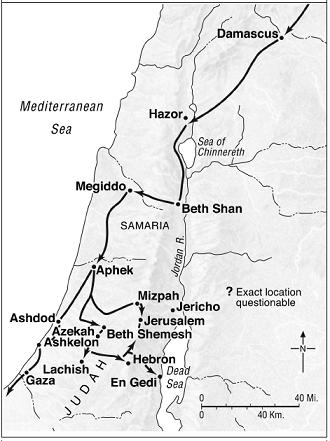
The MacArthur Study Bible, by John MacArthur (Nashville: Word Publishing, 1997) 560. © 1993 by Thomas Nelson, Inc.
24:10–12 The Babylonian siege of Jerusalem was begun by the troops of Nebuchadnezzar. Later, Nebuchadnezzar himself went to Jerusalem, and it was to the king himself that Jehoiachin surrendered (v. 12).
24:12 eighth year. 597 B.C. For the first time, the Books of Kings dated an event in Israelite history by a non-Israelite king. This indicated that Judah’s exile was imminent and the land would be in the hands of Gentiles.
24:13 Nebuchadnezzar plundered the treasures of the temple and king’s palace, just as the Lord had said he would (cf. 20:16–18).
24:14–16 In 597 B.C., Nebuchadnezzar took an additional 10,000 Judeans as captives to Babylon, in particular the leaders of the nation. This included the leaders of the military and those whose skills would support the military. Included in this deportation was the prophet Ezekiel (see notes on Ezek. 1:1–3 ). Only the lower" classes remained behind in Jerusalem. The Babylonian policy of captivity was different from that of the Assyrians, who took most of the people into exile and resettled the land of Israel with foreigners (17:24). The Babylonians took only the leaders and the strong, while leaving the weak and poor, elevating those left to leadership and, thereby, earning their loyalty. Those taken to Babylon were allowed to work and live in the mainstream of society. This kept the captive Jews together, so it would be possible for them to return, as recorded in Ezra.
24:17 Mattaniah . . . Zedekiah. Mattaniah was a son of Josiah and an uncle of Jehoiachin (cf. 1 Chr. 3:15; Jer. 1:3). Mattaniah’s name, meaning “gift of the LORD,” was changed to Zedekiah, “righteousness of the LORD.” Nebuchadnezzar’s changing of Zedekiah’s name demonstrated his authority as lord over him (see note on 23:34 ). See notes on 2 Chronicles 36:11–21.
24:18 eleven years. Zedekiah ruled in Jerusalem, under Babylonian sovereignty, from 597–586 B.C.
24:20 Zedekiah rebelled. In 588 B.C., Apries (also called Hophra), the grandson of Necho, became the pharaoh over Egypt. He appears to have influenced Zedekiah to revolt against Babylon (cf. Ezek. 17:15–18).
25:1 ninth year. Responding to Zedekiah’s rebellion (24:20), Nebuchadnezzar sent his whole army to lay siege against the city of Jerusalem. The siege began in the ninth year of Zedekiah’s reign, Jan., 588 B.C. The siege wall was comprised of either wood towers higher than the walls of the city or a dirt rampart encircling the city.
| Name | Scripture | Identification |
| Michal | 1 Sam. 18:20–28; 26:44 | Daughter of Saul and first wife of David |
| Michal | 2 Sam. 3:13–16; 6:20–23 | Daughter of Saul and first wife of David |
| Bathsheba | 2 Sam. 11; 12 | Wife of Uriah, then wife of David and mother of Solomon |
| Bathsheba | 1 Kin. 1; 2 | Wife of Uriah, then wife of David and mother of Solomon |
| Queen of Sheba | 1 Kin. 10:1–13 | Foreign queen who visited Solomon |
| Naamah | 1 Kin. 14:21, 3 | Mother of King Rehoboam of Judah |
| Maacah | 1 Kin. 15:10 | Mother of King Abijah and grandmother of King Asa of Judah |
| Jezebel | 1 Kin. 16:31; 18:13, 19; 19:1, 2; 21:1–25 | Evil wife of King Ahab of Israel (who promoted Baal worship, persecuted God’s prophets, and planned Naboth’s murder) |
| Azubah | 1 Kin. 22:42 | Mother of King Jehoshaphat of Judah |
| Jezebel | 2 Kin. 9:30–37 | Evil wife of King Ahab of Israel (who promoted Baal worship, persecuted God’s prophets, and planned Naboth’s murder) |
| Athaliah | 2 Kin. 11 | Evil daughter of Ahab and Jezebel; mother of King Ahaziah of Judah (only woman to rule Judah in her own right) |
| Jehoaddin | 2 Kin. 14:2 | Mother of King Amaziah of Judah |
| Jecoliah | 2 Kin. 15:2 | Mother of King Azariah of Judah |
| Abijah | 2 Kin. 18:2 | Mother of King Hezekiah of Judah |
| Hephzibah | 2 Kin. 21:1 | Mother of King Manasseh of Judah |
| Meshullemeth | 2 Kin. 21:19 | Mother of King Amon of Judah |
| Jedidah | 2 Kin. 22:1 | Mother of King Josiah of Judah |
| Hamutal | 2 Kin. 23:31; 24:18 | Mother of King Jehoahaz and King Zedekiah of Judah |
| Zebidah | 2 Kin. 23:36 | Mother of King Jehoiakim of Judah |
| Nehushta | 2 Kin. 24:8 | Mother of King Jehoiachin of Judah |
| Maacah | 2 Chr. 15:16 | Mother of King Abijah and grandmother of King Asa of Judah |
| Esther | Esth. 2–9 | Jewish wife of King Ahasuerus of Persia |
25:2 eleventh year. Jerusalem withstood the siege until the eleventh year of Zedekiah, July of 586 B.C. Hezekiah’s tunnel guaranteed the city an uninterrupted supply of fresh water (20:20), and an Egyptian foray into Judah gave the city a temporary reprieve from the siege (Jer. 37:5).
25:3 famine. After a siege of over two years, the food supply in Jerusalem ran out (Jer. 38:2, 3).
25:4 the city wall was broken. The two walls near the king’s garden were probably located at the extreme southeast corner of the city, giving direct access to the Kidron Valley. This gave Zedekiah and his soldiers an opportunity to flee for their lives to the east.
25:5 plains of Jericho. Zedekiah fled toward the Jordan rift valley. Babylonian pursuers caught him in the Jordan Valley south of Jericho, about twenty miles east of Jerusalem.
25:6 Riblah. Located on the Orontes River about 180 miles north of Jerusalem, Riblah was Nebuchadnezzar’s military headquarters for his invasion of Judah. This location was ideally situated as a field headquarters for military forces because ample provisions could be found nearby (cf. 23:33). The captured traitor Zedekiah was brought to Nebuchadnezzar at Riblah, where he was blinded after witnessing the death of his sons. The execution of the royal heirs ensured the impossibility of a future claim to the throne or rebellion from his descendants. The blinding made his own future rebellion or retaliation impossible. Jeremiah had warned Zedekiah that he would see Nebuchadnezzar (see notes on Jer. 32:2–5; 34:3 ), while Ezekiel had said he would not see Babylon (see note on Ezek. 12:10–13 ). Both prophecies were accurately fulfilled.
25:8 seventh day. See note on Jeremiah 52:12. This was August of 586 B.C., one month after the Babylonian breakthrough of Jerusalem’s walls (vv. 2–4). Nebuzaradan. He was the commander of Nebuchadnezzar’s own imperial guard, sent by the king to oversee the destruction of Jerusalem. The dismantling and destruction of Jerusalem was accomplished by the Babylonians in an orderly progression.
25:9 First, Jerusalem’s most important buildings were burned.
25:10 Second, the Babylonian army tore down Jerusalem’s outer walls, the city’s main defense.
25:11, 12 Third, Nebuzaradan organized and led a forced march of remaining Judeans into exile in Babylon. The exiles included survivors from Jerusalem and those who had surrendered to the Babylonians before the capture of the city. Only poor, unskilled laborers were left behind to tend the vineyards and farm the fields.
25:13–17 Fourth, the items made with precious metals in the temple were carried away to Babylon. See notes on 1 Kings 7:15–49 for a description of these temple items.
25:17 three cubits. See note on Jeremiah 52:22.
25:18–21 Fifth, Nebuzaradan took Jerusalem’s remaining leaders to Riblah, where Nebuchadnezzar had them executed. This insured that they would never lead another rebellion against Babylon.
25:18 Seraiah. Seraiah was the grandson of Hilkiah (22:4, 8; 1 Chr. 6:13, 14) and an ancestor of Ezra (Ezra 7:1). Even though Seraiah was executed, his sons were deported (1 Chr. 6:15).
Babylonian Rulers in Scripture
| Ruler | Dates of Rule | Scripture Reference |
| Merodach-Baladan II | 721–689 B.C. | 2 Kin. 20:12; Is. 39:1 |
| Nebuchadnezzar II | 605–562 B.C. | 2 Kin. 24; 25; Dan. 1–4 |
| Evil-Merodach | 562–560 B.C. | 2 Kin. 25:27–30; Jer. 52:31–34 |
| Nergal-Sharezer | 560–556 B.C. | Jer. 39:3, 13 |
| Belshazzar | Co-regent with Nabonidus 556–539 B.C. | Dan. 5; 7:1 |
25:21 Judah . . . carried away captive. Exile was the ultimate curse brought upon Judah because of her disobedience to the Mosaic covenant (cf. Lev. 26:33; Deut. 28:36, 64). The Book of Lamentations records the sorrow of Jeremiah over this destruction of Jerusalem.
IV. EPILOGUE: THE PEOPLE’S CONTINUED REBELLION AND THE LORD’S CONTINUED MERCY (25:22–30)
25:22–30 The Books of Kings conclude with this brief epilogue. Despite the punishment of the Lord experienced by Israel and Judah, the people were still rebellious (vv. 22–26). However, due to the Lord’s mercy, the house of David endured (vv. 27–30). The books of Kings end with a note of hope.
25:22 Gedaliah. In an attempt to maintain political stability, Nebuchadnezzar appointed a governor from an important Judean family. A more detailed account of Gedaliah’s activities is found in Jeremiah 40:7–41:18. Gedaliah’s grandfather, Shaphan, was Josiah’s secretary, who had implemented that king’s reforms (22:3). His father, Ahikam, was part of Josiah’s delegation sent to Huldah (22:14) and a supporter of the prophet Jeremiah (Jer. 26:24).
25:23 Mizpah. Located about eight miles north of Jerusalem, Mizpah became the new center of Judah. Mizpah might have been one of the few towns left standing after the Babylonian invasion.
25:24 oath. As governor, Gedaliah pledged to the remaining people that loyalty to the Babylonians would ensure their safety.
25:25 seventh month. October of 586 B.C., two months after the destruction of Jerusalem (cf. v. 8). Ishmael. Elishama, Ishmael’s grandfather, was a secretary under Jehoiakim (Jer. 36:12; 41:1). Ishmael probably assassinated Gedaliah because he wished to reestablish the kingship in Judah with himself as king, since he was of royal blood (cf. Jer. 41:1).
25:26 went to Egypt. Fearing reprisals from the Babylonians, the people fled to Egypt.
25:27 thirty-seventh year. March of 561 B.C. Jehoiachin was about fifty-five years old (cf. 24:8). Evil-Merodach. The son and successor of Nebuchadnezzar, he ruled as king of Babylon from 562–560 B.C. To gain favor with the Jews, the king released Jehoiachin from his imprisonment and gave him special privileges.
25:28–30 spoke kindly to him. This good word from the king of Babylon to the surviving representative of the house of David served as a concluding reminder of God’s good word to David. Through the curse of exile, the dynasty of David had survived. There was still hope that God’s good word to David about the seed who would build God’s temple and establish God’s eternal kingdom would be fulfilled (cf. 2 Sam. 7:12–16). The Book of 2 Kings opened with Elijah being carried away to heaven, the destination of all those faithful to God. The book ends with Israel, and then Judah, being carried away to pagan lands as a result of failing to be faithful to God.
Further Study
Davis, John J. and John C. Whitcomb. A History of Israel from Conquest to Exile. Grand Rapids: Baker, 1980.
Patterson, R. D. and Hermann J. Austel. 1, 2 Kings, in Expositor’s Bible Commentary. Grand Rapids: Zondervan, 1988.