Title
Esther serves as the title of this book without variation through the ages. This book and the Book of Ruth are the only OT books named after women. Like the Song of Solomon, Obadiah, and Nahum, the NT does not quote or allude to Esther.
Hadassah (2:7), meaning “myrtle,” was the Hebrew name of Esther, which came either from the Persian word star or possibly from the name of the Babylonian love goddess, Ishtar. As the orphaned daughter of her father Abihail, Esther grew up in Persia with her older cousin, Mordecai, who raised her as if she were his own daughter (2:7, 15).
Author and Date
The author remains unknown, although Mordecai, Ezra, and Nehemiah have been suggested. Whoever penned Esther possessed a detailed knowledge of Persian customs, etiquette, and history, plus particular familiarity with the palace at Shushan (1:5–7). He also exhibited intimate knowledge of the Hebrew calendar and customs, while additionally showing a strong sense of Jewish nationalism. Possibly a Persian Jew, who later moved back to Israel, wrote Esther.
Esther appears as the seventeenth book in the literary chronology of the OT and closes the OT historical section. Only Ezra 7–10, Nehemiah, and Malachi report later OT history than Esther. The Esther account ends in 473 B.C. before Ahasuerus died by assassination (c. 465 B.C.). Esther 10:2 speaks as though Ahasuerus’s reign has been completed, so the earliest possible writing date would be after his reign around the mid-fifth century B.C. The latest reasonable date would be prior to 331 B.C. when Greece conquered Persia.
Background and Setting
Esther occurred during the Persian period of world history, c. 539 B.C. (Dan. 5:30, 31) to c. 331 B.C. (Dan. 8:1–27). Ahasuerus ruled from c. 486 to 465 B.C.; Esther covers the 483–473 B.C. portion of his reign. The name Ahasuerus represents the Hebrew transliteration of the Persian name Khshayarsha, while Xerxes represents his Greek name.
The events of Esther occurred during the wider time span between the first return of the Jews after the seventy-year captivity in Babylon (Dan. 9:1–19) under Zerubbabel c. 538 B.C. (Ezra 1–6) and the second return led by Ezra c. 458 B.C. (Ezra 7–10). Nehemiah’s journey (the third return) from Susa to Jerusalem (Neh. 1; 2) occurred later (c. 445 B.C.).
Esther and Exodus both chronicle how vigorously foreign powers tried to eliminate the Jewish race and how God sovereignly preserved His people in accordance with His covenant promise to Abraham c. 2100–2075 B.C. (Gen. 12:1–3; 17:1–8). As a result of God’s prevailing, chapters 9 and 10 record the beginning of Purim—a new annual festival in the twelfth month (February/March) to celebrate the nation’s survival. Purim became one of two festivals given outside of the Mosaic legislation still to be celebrated in Israel (Hanukkah, or the Festival of Lights, is the other, cf. John 10:22).
Historical and Theological Themes
All 167 verses of Esther have ultimately been accepted as canonical, although the absence of God’s name anywhere has caused some to unnecessarily doubt its authenticity. The Greek Septuagint (LXX) added an extra 107 apocryphal verses which supposedly compensated for this lack. Along with the Song of Solomon, Ruth, Ecclesiastes, and Lamentations, Esther stands with the OT books of the Megilloth, or “five scrolls.” Rabbis read these books in the synagogue on five special occasions during the year—Esther being read at Purim (cf. 9:20–32).
The historical genesis for the drama played out between Mordecai (a Benjamite descendant of Saul—2:5) and Haman (an Agagite—3:1, 10; 8:3, 5; 9:24) goes back almost 1,000 years when the Jews exited from Egypt (c. 1445 B.C.) and were attacked by the Amalekites (Ex. 17:8–16), whose lineage began with Amalek, grandson of Esau (Gen. 36:12). God pronounced His curse on the Amalekites, which resulted in their total elimination as a people (Ex. 17:14; Deut. 25:17–19). Although Saul (c. 1030 B.C.) received orders to kill all the Amalekites, including their king Agag (1 Sam. 15:2, 3), he disobeyed (1 Sam. 15:7–9) and incurred God’s displeasure (1 Sam. 15:11, 26; 28:18). Samuel finally hacked Agag into pieces (1 Sam. 15:32, 33). Because of his lineage from Agag, Haman carried deep hostility toward the Jews.
The time of Esther arrived 550 years after the death of Agag, but in spite of such a lengthy passage of time, neither Haman the Agagite nor Mordecai the Benjamite had forgotten the tribal feud that still smoldered in their souls. This explains why Mordecai refused to bow down to Haman (3:2, 3) and why Haman so viciously attempted to exterminate the Jewish race (3:5, 6, 13). As expected, God’s prophecy to extinguish the Amalekites (Ex. 17:14; Deut. 25:17–19) and God’s promise to preserve the Jews (Gen. 17:1–8) prevailed.
Because of God’s faithfulness to save His people, the festival of Purim (named after the Akkadian word for lot—3:7; 9:26), an annual, two-day holiday of feasting, rejoicing, sending food to one another, and giving gifts to the poor (9:21, 22), was decreed to be celebrated in every generation, by every family, in every province and city (9:27, 28). Esther later added a new feature of fasting with lamentation (9:31). Purim is not biblically mentioned again, although it has been celebrated throughout the centuries in Israel.
Esther could be compared to a chess game. God and Satan (as invisible players) moved real kings, queens, and nobles. When Satan put Haman into place, it was as if he announced “Check.” God then positioned Esther and Mordecai in order to put Satan into “Checkmate!” Ever since the Fall of man (Gen. 3:1–19), Satan has attempted to sever God’s relationship with His human creation and disrupt God’s covenant promises with Israel.
For example, Christ’s line through the tribe of Judah had been murderously reduced to Joash alone, who was rescued and preserved (2 Chr. 22:10–12). Later, Herod slaughtered the infants of Bethlehem, thinking Christ was among them (Matt. 2:16). Satan tempted Christ to denounce God and worship him (Matt. 4:9). Peter, at Satan’s insistence, tried to block Christ’s journey to Calvary (Matt. 16:22). Finally, Satan entered into Judas, who then betrayed Christ to the Jews and Romans (Luke 22:3–6). While God was not mentioned in Esther, He was everywhere apparent as the One who opposed and foiled Satan’s diabolical schemes by providential intervention.
In Esther, all of God’s unconditional covenant promises to Abraham (Gen. 17:1–8) and to David (2 Sam. 7:8–16) were jeopardized. However, God’s love for Israel is nowhere more apparent than in this dramatic rescue of His people from pending elimination. “Behold, He who keeps Israel shall neither slumber nor sleep” (Ps. 121:4).
Interpretive Challenges
The most obvious question raised by Esther comes from the fact that God is nowhere mentioned, as in the Song of Solomon. Nor does the writer or any participant refer to the Law of God, the Levitical sacrifices, worship, or prayer. The skeptic might ask, “Why would God never be mentioned when the Persian king receives over 175 references? Since God’s sovereignty prevailed to save the Jews, why does He then not receive appropriate recognition?”
It seems satisfying to respond that if God desired to be mentioned, He could just as sovereignly have moved the author to write of Him as He acted to save Israel. This situation seems to be more of a problem at the human level than the divine, because Esther is the classic illustration of God’s providence as He, the unseen power, controls everything for His purpose. There are no miracles in Esther, but the preservation of Israel through providential control of every event and person reveals the omniscience and omnipotence of Jehovah. Whether He is named is not the issue. He is clearly the main character in the drama.
Second, “Why were Mordecai and Esther so secular in their lifestyles?” Esther (2:6–20) does not seem to have the zeal for holiness like Daniel (Dan. 1:8–20). Mordecai kept his and Esther’s Jewish heritage secret, unlike Daniel (Dan. 6:5). The Law of God was seemingly absent in contrast to Ezra (Ezra 7:10). Nehemiah had a heart for Jerusalem that apparently eluded the affections of Esther and Mordecai (Neh. 1:1–2:5).
The following observations help to shed some light on these issues.
First, this short book does not record everything. Perhaps Mordecai and Esther actually possessed a deeper faith than becomes apparent here (cf. 4:16). Second, even godly Nehemiah did not mention his God when talking to King Artaxerxes (Neh. 2:1–8). Third, the Jewish festivals which provided structure for worship had been lost long before Esther, e.g., Passover (2 Kin. 23:22) and Tabernacles (Neh. 8:17).
Fourth, possibly the anti-Jewish letter written by the Samaritans to Ahasuerus several years earlier had frightened them (c. 486 B.C.; Ezra 4:6). Fifth, the evil intentions of Haman did not just first surface when Mordecai refused to bow down (3:1, 2). Most likely they were long before shared by others which would have intimidated the Jewish population. Sixth, Esther did identify with her Jewish heritage at a most appropriate time (7:3, 4). And yet, the nagging question of why Esther and Mordecai did not seem to have the same kind of open devotion to God as did Daniel remains. Further, Nehemiah’s prayer (Neh. 1:5–11, esp. v. 7) seems to indicate a spiritual lethargy among the Jewish exiles in Susa. So this issue must ultimately be resolved by God, since He alone knows human hearts.
I. ESTHER REPLACES VASHTI (1:1–2:18)
A. Vashti’s Insubordination (1:1–22)
1:1 Ahasuerus. See Introduction: Background and Setting. one hundred and twenty-seven provinces. The kingdom comprised twenty regions (3:12; 8:9; 9:3) which were further divided into provinces ruled over by governors (3:12). India to Ethiopia. Ethiopia, not Asia Minor, is mentioned as representing the western edge of the kingdom to avoid any remembrance of the king’s previous defeat by the Greeks c. 481–479 B.C. (cf. 8:9). This description also avoided any confusion with the Ahasuerus of Daniel 9:1.
1:2 Shushan the citadel. Shushan (the Hebrew rendering of the Greek Susa ), the winter residence, was one of four capital cities of the Persians; the other three included Babylon, Ecbatana (Ezra 6:2), and Persepolis. The citadel refers to the fortified palace complex built above the city for protection.
1:3 the third year. C. 483 B.C. This probably included the planning phase for Ahasuerus’s later campaign against Greece in which the king suffered a humiliating defeat (c. 481–479 B.C.). Persia and Media. Cyrus the Persian inherited Media and, thus, the name Media became just as prominent as Persia (c. 550 B.C.).
1:9 Queen Vashti. Greek literature records her name as Amestris. She gave birth (c. 483 B.C.) to Ahasuerus’s third son, Artaxerxes, who later succeeded his father Ahasuerus on the throne (Ezra 7:1).
1:12 Vashti refused. Her reason is not recorded, although suggestions have included that (1) her appearance would have involved lewd behavior before drunken men, or (2) that she was still pregnant with Artaxerxes.
1:14 the seven princes. These highest ranking officials (cf. Ezra 7:14) were perhaps equivalent to the magi of Daniel 1:20.
1:19 will not be altered. The irrevocable nature of Persian law (cf. Dan. 6:8, 12, 15) played an important role in how the rest of Esther concluded (cf. 8:8).
1:22 letters. The efficient Persian communication network (a rapid relay by horses) played an important role in speedily publishing kingdom edicts (cf. 3:12–14; 8:9, 10, 14; 9:20, 30).
B. Esther’s Coronation (2:1–18)
2:1 After these things. Most likely during the latter portion of the king’s ill-fated war with Greece (c. 481–479 B.C.). he remembered Vashti. The king was legally unable to restore Vashti (cf. 1:19–22), so the counselors proposed a new plan with promise.
2:5 Mordecai. See Introduction: Historical and Theological Themes. He was among the fourth generation of deported Jews. Kish. Mordecai’s great grandfather who actually experienced the Babylonian deportation. After Babylon fell to Medo-Persia (c. 539 B.C.), Jews were moved to other parts of the new kingdom. Kish represents a Benjamite family name that could be traced back (c. 1100 B.C.) to Saul’s father (1 Sam. 9:1).
2:6 Jeconiah. Former king of Judah (also known as Jehoiachin and Coniah) who was deported c. 597 B.C. (cf. 2 Kin. 24:14, 15; 2 Chr. 36:9, 10). Due to his disobedience, the Lord removed his descendants from the line of David to Christ (Jer. 22:24–30). The family of Mordecai and Esther were part of the good figs in Jeremiah 24:1–7.
2:7 Esther. See Introduction: Title.
2:8 Esther also was taken. It is impossible to tell if Esther went voluntarily or against her will.
2:9 pleased him. That she pleased Hegai points to God’s providential control.
2:10 not to reveal it. Possibly because of the hostile letter mentioned in Ezra 4:6 or the anti-Semitic sentiments of Haman and other like-minded people.
2:14 the second house. The place of concubines.
2:15 obtained favor. This was according to the Lord’s providential plan.
2:16 Tebeth. The tenth month corresponding to December/January the seventh year. C. 479–478 B.C. Four years had elapsed since Vashti’s fall from favor.
2:18 a holiday. This probably refers to a remission of taxes and/or release from military service.
II. MORDECAI OVERCOMES HAMAN (2:19–7:10)
A. Mordecai’s Loyalty (2:19–23)
2:19 a second time. Perhaps the king intended to add the second best to his concubine collection.
2:21 the king’s gate. This indicates the strong possibility that Mordecai held a position of prominence (cf. 3:2; Dan. 2:49). became furious. Perhaps in revenge over the loss of Vashti.
2:23 hanged on a gallows. The Persian execution consisted of being impaled (cf. Ezra 6:11). It is likely that they were the originators of crucifixion. book of the chronicles. The king would five years later (Ahasuerus’s twelfth year) read these Persian records as the turning point in Esther (6:1, 2).
B. Haman’s Promotion and Decree (3:1–15)
3:1 After these things. Sometime between the seventh (2:16) and twelfth year (3:7) of the king’s reign. Haman . . . the Agagite. See Introduction: Historical and Theological Themes.
3:2 would not bow. There is a question as to whether Esther and Mordecai were inclined to obey the Mosaic Law. This refusal may be more likely grounded in the family feud between the Benjamites and the Agagites (see Introduction: Historical and Theological Themes), than Mordecai’s allegiance to the second Commandment (Ex. 20:4–6).
3:4 he was a Jew. It seems evident, from Haman’s fury and attempted genocide, that there were strong anti-Semitic attitudes in Shushan, which seems to explain Mordecai’s reluctance to reveal his true ethnic background.
3:6 the people of Mordecai. Haman was being satanically used to target the entire Jewish race in an unsuccessful attempt to change the course of redemptive history and God’s plans for Israel.
3:7 Nisan. The time period March/April. Ironically, the Jews should have been celebrating the Passover to remind them of a former deliverance. twelfth year. C. 474 B.C. they cast. Haman’s court of advisers made decisions superstitiously based on astrology and casting of lots. Pur . . . lot. A lot would be like modern dice which were cast to determine future decisions (cf. the Hebrew lot, 1 Chr. 26:14; Neh. 10:34; Jon. 1:7). Proverbs 16:33 states that God providentially controlled the outcome of the lot. Adar. February/ March. There would have been an eleven-month interval between Haman’s decree and its expected fulfillment.
3:8 a certain people. Haman never divulged their identity.
3:9 ten thousand talents. The exact dollar amount is uncertain, but reportedly it would have weighed 375 tons and equaled almost 70 percent of the king’s annual revenue. Since this sum would have been derived from the plunder of the Jews, it indicates that they had grown prosperous.
3:10, 11 The king would have easily been eager to eliminate any rebellion against his authority (cf. 3:8), although he did not seem to be interested in the money.
3:10 the enemy of the Jews. Cf. 7:6; 8:1; 9:10, 24.
3:12 sealed . . . king’s signet ring. This would be equivalent to the king’s signature. The date has been calculated by historians to be April 7, 474 B.C.
3:13 to destroy. An ambitious plot to annihilate the Jews in just one day. Historians have calculated the date to be March 7, 473 B.C. The king had unwittingly approved this provision which would kill his own queen.
3:14 as law. It would be irrevocable (cf. 1:19; 8:5–8).
3:15 perplexed. No specific reason is stated. Most likely, even this pagan population was puzzled at the extreme and deadly racism of the king and Haman.
C. Esther’s Intervention (4:1–5:14)
4:1 sackcloth and ashes. An outward sign of inward distress and humiliation (cf. Jer. 6:26; Dan. 9:3; Matt. 11:21). Mordecai realized that he had prompted this genocidal retaliation by Haman.
4:4 she sent garments. Mordecai could then enter the king’s gate (cf. 4:2) and talk with Esther directly (cf. Neh. 2:2).
4:5 Hathach. A trusted eunuch who knew of Esther’s Jewish background.
4:7, 8 That Mordecai possessed this specific knowledge and a copy of the edict further shows his prominent position in Persia.
4:11 golden scepter. In order to protect the king’s life from would-be assassins, this practice prevailed. Seemingly, the king would extend the scepter (a sign of kingly authority) only to those whom he knew and from whom he welcomed a visit (cf. 5:2; 8:4). these thirty days. Perhaps Esther feared she had lost favor with the king since he had not summoned her recently.
4:14 relief and deliverance. Mordecai exhibited a healthy faith in God’s sovereign power to preserve His people. He may have remembered the Lord’s promise to Abraham (cf. Gen. 12:3; 17:1–8). you . . . will perish. Mordecai indicated that Esther would not escape the sentence or be overlooked because of her prominence (cf. 4:13). such a time as this. Mordecai indirectly appealed to God’s providential timing.
4:16 fast. The text does not mention prayer being included such as was Daniel’s practice (Dan. 9:3), though it surely was. perish. Esther’s heroic willingness to die for the sake of her fellow Jews is commendable.
5:2 she found favor. This actually means that Esther first found favor with the God of Israel (cf. Prov. 21:1).
5:3 What is your request? Esther deferred her real wish until 7:2, 3.
5:3, 6 up to half the kingdom. Royal hyperbole that was not intended to be taken at face value (cf. Mark 6:22, 23).
5:4 the banquet. The first of two (cf. 5:4–8; 6:14–7:1) that Esther prepared. God would providentially intervene between the two (6:1, 2).
5:11 the multitude of his children. At least ten sons were fathered by Haman (cf. 9:13), who personified sinful pride (cf. Prov. 16:18; 1 Cor. 10:12; Gal. 6:3).
5:13 avails me nothing. Haman expressed raging fixation on killing Mordecai.
5:14 gallows. A stake on which a human would be impaled to death and/or displayed after death (cf. 2:23). fifty cubits. Approximately seventy-five feet or almost eight stories high. Perhaps the gallows involved displaying a shorter stake atop a building or wall to attain this height.
D. Mordecai’s Recognition (6:1–13)
6:1 the book. Five years (cf. 2:16 with 3:7) had intervened since Mordecai’s loyal but unrewarded act (cf. 2:23). At exactly the proper moment, God providentially intervened so the king suffered insomnia, called for the book of records, read of Mordecai’s unrewarded deeds five years past, and then desired to reward him (cf. Dan. 6:18).
6:4 Who is in the court? The drama intensified as Haman arrived at just the wrong time and for just the wrong reason.
6:6, 7 Haman ironically defined the honor to be given to Mordecai at Haman’s expense. To his potential wealth from the Jewish plunder, he thought public acclaim would be added.
6:8 royal robe . . . royal crest. An honor which involved being treated as though the recipient were the king himself (cf. 8:15). This is reminiscent of Joseph in Egypt (Gen. 41:39–45). History affirms that horses were adorned with the royal crown.
6:9 the city square. Whereas Mordecai had been there the day before in sackcloth and ashes (4:1), he now would arrive with royal honor.
6:10 Mordecai the Jew. Cf. 8:7; 9:29, 31; 10:3. Why the king did not remember Haman’s edict against the Jews remains unknown.
6:12 mourning. Deservedly, Haman has inherited Mordecai’s distress (cf. 4:1, 2). What a difference a day makes! His imagined honors had quickly turned to unimaginable humiliation. his head covered. This is an extreme sign of shame (cf. 2 Sam. 15:30; Jer. 14:3, 4).
6:13 you have begun to fall. Neither divine prophecy (Ex. 17:14) nor biblical history (1 Sam. 15:8, 9) stood in Haman’s favor. Haman’s entourage seemed to have some knowledge of this biblical history.
The Historical Chronology of Esther
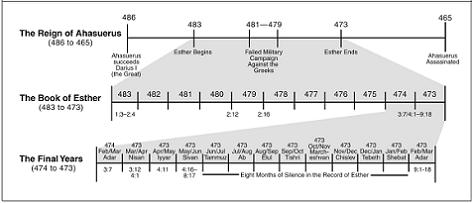
The MacArthur Bible Handbook, by John MacArthur (Nashville: Thomas Nelson Publishers, 2003) 138. © 2003 by Thomas Nelson, Inc.
6:14 Haman to the banquet. Like a lamb led to slaughter, Haman was escorted off to his just due.
7:2 second day. The first day reference point included the first banquet. This refers to the second banquet on the second day (cf. 5:8). what is your request? This was the third time that the king had inquired (cf. 5:3, 6).
7:3 my people. This plea paralleled God’s message through Moses to Pharaoh, “Let my people go,” almost 1,000 years earlier (Ex. 7:16).
7:4 sold. This refers back to Haman’s bribe (cf. 3:9; 4:7). destroyed . . . killed . . . annihilated. Esther recounted the exact language of Haman’s decree (cf. 3:13).
7:6 this wicked Haman. Similar to Nathan’s famous accusation against King David, “You are the man” (2 Sam. 12:7). Haman’s honor had quickly turned to humiliation, and then to horror.
7:8 assault the queen. Blinded by anger, Ahasuerus interpreted Haman’s plea to be an act of violence against Esther, rather than a plea for mercy.
7:9 Harbonah. Cf. 1:10. Look! Because the place prepared by Haman for Mordecai’s execution towered above the city, it became the obvious spot for Haman’s death. Mordecai, who spoke good. Haman heard the third capital offense charged against him. One, he manipulated the king in planning to kill the queen’s people. Two, he was perceived to accost the queen. Three, he planned to execute a man whom the king had just honored for loyalty to the kingdom.
7:10 they hanged Haman. This was the ultimate expression of justice (cf. Ps. 9:15, 16).
III. ISRAEL SURVIVES HAMAN’S GENOCIDE ATTEMPT (8:1–10:3)
A. Esther’s and Mordecai’s Advocacy (8:1–17)
8:1 the house of Haman. The property of a traitor, by Persian custom, was returned to the king. In this case, he gave it to his queen, Esther, who put Mordecai over it (8:2). The outcome for Haman’s wife Zeresh and his wise men is unknown (5:14; 6:12, 13). Haman’s ten sons later died (9:7–10).
8:5 to revoke. This proved to be impossible in light of the inflexible nature of the king’s edicts (1:19). However, a counterdecree was possible (cf. 8:8, 11, 12).
8:9 Sivan. This refers to the period May/June. It had been two months and ten days since Haman’s decree (cf. 3:12); eight months and twenty days remained until both decrees became simultaneously effective (cf. 3:13).
8:11 the king permitted. Just as the king had permitted Haman, so he permitted the Jews to defend themselves and to plunder their spoil (cf. vv. 10, 15, 16).
8:15 Mordecai went out. This second reward exceeded the first (cf. 6:6–9). Blue and white were the royal colors of the Persian Empire.
8:17 many . . . people . . . Jews. The population realized that the God of the Jews exceeded anything that the pantheon of Persian deities could offer (cf. Ex. 15:14–16; Ps. 105:38; Acts 5:11), especially in contrast to their recent defeat by the Greeks.
9:1 twelfth month. During the period February-March. Here is a powerful statement with regard to God’s providential preservation of the Jewish race in harmony with God’s unconditional promise to Abraham (Gen. 17:1–8). This providential deliverance stands in contrast to God’s miraculous deliverance of the Jews from Egypt; yet, in both cases, the same end had been accomplished by the supernatural power of God.
9:3 the fear of Mordecai. Pragmatically, the nation had a change of heart toward the Jews, knowing that the king, the queen, and Mordecai were the ranking royal officials of the land. To be pro-Jewish would put one in favor with the king and his court and put one on the side of God, the ultimate King (cf. Rev. 19:16).
9:6, 7 Five hundred men died in Shushan.
9:10 did not lay a hand. Unlike Saul, who did take the plunder (cf. 1 Sam. 15:3 with 15:9), the Jews focused only on the mission at hand, i.e., to preserve the Jewish race (cf. vv. 15, 16), even though the king’s edict permitted this (8:11).
9:12 further request? Even this pagan king served the cause of utterly blotting out the Amalekites in accord with God’s original decree (Ex. 17:14) by allowing for a second day of killing in Shushan to eliminate all Jewish enemies.
9:13 be hanged. I.e., be publicly displayed.
9:15, 16 Over 1,500 years earlier God had promised to curse those who curse Abraham’s descendants (Gen. 12:3).
9:15 fourteenth day. Another 300 men died the second day of killing in Shushan, bringing the total dead in Shushan to 810.
9:16 killed. Outside of Shushan, only one day of killing occurred in which 75,000 enemies died.
9:18, 19 This section recounted why Purim would be celebrated for two days rather than one.
C. Purim’s Beginning (9:20–32)
9:20–25 A brief summary of God’s providential intervention on behalf of the Jews.
9:26 Purim. The first and last biblically revealed, non-Mosaic festival with perpetual significance.
9:29 second letter. An additional letter (cf. v. 20 for the first letter), which added “fasting and lamenting” to the prescribed activity of Purim.
9:32 written in the book. This could be the chronicle referred to in 10:3, or another archival-type document. It certainly does not hint that Esther wrote this canonical book.
10:1–3 This was apparently a postscript.
10:3 Mordecai . . . was second. Mordecai joined the top echelon of Jewish international statesmen like Joseph, who ranked second in the Egyptian dynasty (Gen. 41:37–45), and Daniel, who succeeded in both the Babylonian (Dan. 2:46–49; 5:29) and Medo-Persian Empires (Dan. 6:28). speaking peace. Less than ten years later (c. 465 B.C.), Ahasuerus was assassinated. There are no further details about Esther and Mordecai. What Mordecai did for less than a decade on behalf of Israel, Jesus Christ will do for all eternity as the Prince of Peace (Is. 9:6, 7; Zech. 9:9, 10).
Further Study
Huey, F. B., Jr. Esther, in Expositor’s Bible Commentary. Grand Rapids: Zondervan, 1988.
Martin, John. Esther, in The Bible Knowledge Commentary—OT. Wheaton, Ill.: Victor, 1985.
Whitcomb, John C. Esther: Triumph of God’s Sovereignty. Chicago: Moody, 1979.