Title
The Greek Septuagint (LXX) and Latin Vulgate versions follow the Hebrew (Masoretic Text—MT) with literal translations of the first two words in 1:1—“Song of Songs.” Several English versions read “The Song of Solomon,” thus giving the fuller sense of 1:1. The superlative, “Song of Songs” (cf. “Holy of Holies” in Exodus 26:33, 34 and “King of Kings” in Rev. 19:16), indicates that this song is the best among Solomon’s 1,005 musical works (1 Kin. 4:32). The word translated “song” frequently refers to music that honors the Lord (cf. 1 Chr. 6:31, 32; Pss. 33:3; 40:3; 144:9).
Author and Date
Solomon, who reigned over the united kingdom forty years (971–931 B.C.), appears seven times by name in this book (1:1, 5; 3:7, 9, 11; 8:11, 12). In view of his writing skills, musical giftedness (1 Kin. 4:32), and the authorial (not dedicatory) sense of 1:1, this piece of Scripture could have been penned at any time during Solomon’s reign. Since cities to the north and to the south are spoken of in Solomon’s descriptions and travels, both the period depicted and the time of actual writing point to the united kingdom before it divided after Solomon’s reign ended. Knowing that this portion of Scripture comprises one song by one author, it is best taken as a unified piece of poetic, wisdom literature rather than a series of love poems without a common theme or author.
Background and Setting
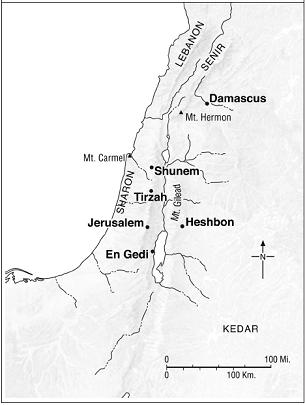
Two people dominate this true-life, dramatic, love song. Solomon, whose kingship is mentioned five times (1:4, 12; 3:9, 11; 7:5), appears as “the beloved.” The Shulamite maiden (6:13) remains obscure; most likely, she was a resident of Shunem, three miles north of Jezreel in lower Galilee. Some suggest she is Pharaoh’s daughter (1 Kin. 3:1), although the Song provides no evidence for this conclusion. Others favor Abishag, the Shunammite who cared for King David (1 Kin. 1:1–4, 15). An unknown maiden from Shunem, whose family had possibly been employed by Solomon (8:11), seems most reasonable. She would have been Solomon’s first wife (Eccl. 9:9), before he sinned by adding 699 other wives and 300 concubines (1 Kin. 11:3).
Minor roles feature several different groups in this book. First, note the not-infrequent commentary by “the daughters of Jerusalem” (1:4b, 8, 11; 3:6–11; 5:9; 6:1, 10, 13a; 7:1–5; 8:5a), who might be part of Solomon’s household staff (cf. 3:10). Second, the affirmation of 5:1b would most likely be God’s blessing on the couple’s union. Third, the Shulamite’s brothers speak (8:8, 9).
The setting combines both rural and urban scenes. Portions take place in the hill country north of Jerusalem, where the Shulamite lived (6:13) and where Solomon enjoyed prominence as a vinegrower and shepherd (Eccl. 2:4–7). The city section includes the wedding and time afterward at Solomon’s home in Jerusalem (3:6–7:13).
The first spring appears in 2:11–13 and the second in 7:12. Assuming a chronology without gaps, the Song of Solomon took place over a period at least one year in length, but probably no longer than two years.
Historical and Theological Themes
All 117 verses in Solomon’s Song have been recognized by the Jews as a part of their sacred writings. Along with Ruth, Esther, Ecclesiastes, and Lamentations, it is included among the OT books of the Megilloth, or “five scrolls.” The Jews read this song at Passover, calling it “the Holy of Holies.” Surprisingly, God is not mentioned explicitly, except possibly in 8:6. No formal theological themes emerge. The NT never quotes Solomon’s Song directly.
In contrast to the two distorted extremes of ascetic abstinence and lustful perversion outside of marriage, Solomon’s ancient love song exalts the purity of marital affection and romance. It parallels and enhances other portions of Scripture which portray God’s plan for marriage, including the beauty and sanctity of sexual intimacy between husband and wife. The Song rightfully stands alongside other classic Scripture passages which expand on this theme, e.g., Genesis 2:24; Psalm 45; Proverbs 5:15–23; 1 Corinthians 7:1–5; 13:1–8; Ephesians 5:18–33; Colossians 3:18, 19; and 1 Peter 3:1–7. Hebrews 13:4 captures the heart of this song, “Marriage is honorable among all, and the bed undefiled; but fornicators and adulterers God will judge.”
Interpretive Challenges
The Song has suffered strained interpretations over the centuries by those who use the allegorical method of interpretation, claiming that this song has no actual historical basis, but rather that it depicts God’s love for Israel and/or Christ’s love for the church. The misleading idea from hymnology that Christ is the rose of Sharon and the lily of the valleys results from this method (2:1). The typological variation admits the historical reality, but concludes that it ultimately pictures Christ’s love as the bridegroom for His bride the church.
A more satisfying way to approach Solomon’s Song is to take it at face value and interpret it in the normal historical sense, understanding the frequent use of poetic imagery to depict reality. To do so understands that Solomon recounts (1) his own days of courtship, (2) the early days of his first marriage, followed by (3) the maturing of this royal couple through the good and bad days of life. The Song of Solomon expands on the ancient marriage instructions of Genesis 2:24, thus providing spiritual music for a lifetime of marital harmony. It is given by God to demonstrate His intention for the romance and loveliness of marriage, the most precious of human relations and “the grace of life” (1 Pet. 3:7).
1:1 See Introduction: Title; Author and Date.
II. THE COURTSHIP: “LEAVING” (1:2–3:5)
1:2–3:5 In this first of three major sections to the Song, thirty-two out of thirty-nine verses are spoken by the Shulamite, with brief interludes by her beloved and the daughters of Jerusalem. This portion most likely represents her remembrances of past events combined with the desires of her heart to marry the king, as she anticipates his arrival to take her to Jerusalem for the wedding in 3:6ff.
A. The Lovers’ Remembrances (1:2–2:7)
1:2, 3 Four features of Solomon attracted the beloved: (1) his lips, (2) his love, (3) his lotion, and (4) his pure lifestyle. Later, Solomon noticed these same features in her (4:9–11).
1:3 the virgins. The daughters of Jerusalem (v. 5).
1:4 We will run. This is better understood as spoken by the Shulamite, rather than the daughters of Jerusalem, in the sense of “let us hurry/run.” The king has brought me. This is better understood as the desire of her heart—“Let the king bring me into his chambers”—rather than a statement of fact. We will remember your love. The daughters of Jerusalem affirmed the Shulamite’s praise in v. 2.
1:5, 6 I am dark. The Shulamite was concerned that the sun (from working outdoors) had marred her complexion (cf. vineyard, 7:12; 8:11).
1:6 my own vineyard. She speaks of herself (cf. 8:12).
| I. LEAVE (Gen. 2:24a) | |
| 1:1 | Introduction |
| 1:2–4a | Bride |
| 1:4b | Friends |
| 1:5–7 | Bride |
| 1:8 | Friends |
| 1:9, 10 | Bridegroom |
| 1:11 | Friends |
| 1:12–14 | Bride |
| 1:15 | Bridegroom |
| 1:16–2:1 | Bride |
| 2:2 | Bridegroom |
| 2:3–3:5 | Bride |
| II. CLEAVE (Gen. 2:24b) | |
| 3:6–11 | Friends |
| 4:1–15 | Bridegroom |
| 4:16 | Bride |
| 5:1a | Bridegroom |
| 5:1b | God |
| III. WEAVE (Gen. 2:24c) | |
| 5:2–8 | Bride |
| 5:9 | Friends |
| 5:10–16 | Bride |
| 6:1 | Friends |
| 6:2, 3 | Bride |
| 6:4–9 | Bridegroom |
| 6:10 | Friends |
| 6:11, 12 | Bridegroom |
| 6:13a | Friends |
| 6:13b | Bridegroom |
| 7:1–5 | Friends |
| 7:6–9a | Bridegroom |
| 7:9b–8:4 | Bride |
| 8:5a | Friends |
| 8:5b | Bridegroom |
| 8:6, 7 | Bride |
| 8:8, 9 | Brothers of the bride |
| 8:10–12 | Bride |
| 8:13 | Bridegroom |
| 8:14 | Bride |
| 1:5 | “tents of Kedar” | nomadic tribal tents made of dark goat hair |
| 1:5 | “curtains of Solomon” | most likely the beautiful curtains of Solomon’s palace |
| 1:9 | “My filly” | a young, female horse |
| 1:12; 4:13,14 | “spikenard” | an aromatic oil taken from an Indian herb |
| 1:13; 3:6; 4:6,14 | “myrrh” | an aromatic gum from the bark of a balsam tree made into perfume in either liquid or solid form |
| 1:14; 4:13 | “henna blooms” | a common shrub whose white, spring blossoms give off a fragrant scent |
| 1:14 | “En Gedi” | a lush oasis just west of the Dead Sea |
| 1:15; 4:1; 5:12 | “dove’s eyes” | beautiful, deep, smoke gray eyes of the dove |
1:7 veils herself. Valuing purity, she disclaimed the veil of the prostitute, unlike Tamar (Gen. 38:14–16). Rather, she would go as a shepherdess to a shepherd.
1:8 This could have been spoken by the daughters of Jerusalem. O fairest among women. The Shulamite received accolades as the best (cf. 5:9; 6:1). This is reminiscent of the Proverbs 31 woman (v. 29).
1:9 my love. The first of nine uses (1:15; 2:2, 10, 13; 4:1, 7; 5:2; 6:4) my filly. Coming from an accomplished horseman (1 Kin. 10:26–29), this figure of speech makes perfect sense as a striking compliment of her dazzling beauty.
1:11 This could have been spoken by the daughters of Jerusalem.
1:13 my beloved. The first of twenty-four appearances.
1:15 you are fair. Verbal affirmation fueled this romance. He used fair at least ten times (1:15; 2:10, 13; 4:1, 7; 6:4, 10; 7:6). dove’s eyes. She returned the compliment in 5:12, which is best understood as beautiful eyes representing a lovely personality.
1:16, 17 Actually, an outdoor setting in the forest.
2:3–6 This scene pictures the loving desire of the Shulamite rather than her actual experience.
2:4 banqueting house. The scene continues in the outdoors. This “house of wine” symbolizes the vineyard, just as the beams and rafters of 1:17 refer to the forest. his banner. As a military flag indicates location or possession, so Solomon’s love flew over his beloved one (cf. Num. 1:52; Ps. 20:5).
2:7 I charge you. This refrain, which is repeated before the wedding (3:5) and also afterward (8:4), explicitly expresses her commitment to a chaste life before and during marriage. She invites accountability to the daughters of Jerusalem.
B. The Lovers’ Expression of Reciprocal Love (2:8–3:5)
2:11–13 Winter past, rains over, flowers appearing, and vines blooming use springtime as a picture of their robust, growing love for each other.
2:14 This is best taken as a continuation of what Solomon said as quoted by the Shulamite (vv. 10–15).
2:15 Catch us the foxes. Perhaps, as she literally did in the vineyards, Solomon wanted her to do by analogy in their relationship, i.e., to remove those things in their relationship that would spoil their blossoming love. It could also be thought of as “Let us . . .”
Local Color in the Song of Solomon
| 2:1 | “rose of Sharon” | probably a bulb flower like crocus, narcissus, iris or daffodil growing in the low country (plain of Sharon), south of Mt. Carmel |
| 2:1, 16 | “lily of the valleys” | possibly a six petaled flower that grew in the fertile, watered areas |
| 2:3, 5; 7:8; 8:5 | “apple” | an aromatic, sweet fruit–possibly an apricot |
| 2:5 | “cakes of raisins” | a food associated with religious festivals, having possible erotic significance (cf. 2 Sam. 6:19; Hos. 3:1) |
| 2:7, 9, 14; 3:5; 8:14 | “gazelles” | a graceful member of the antelope family |
| 2:7; 3:5 | “does” | a female deer |
| 2:9, 17; 8:14 | “stag” | a male deer |
| 2:14; 5:2; 6:9 | “dove” | a common symbol of love |
| 2:17 | “mountains of Bether” | a ravine or rugged hills in an unidentifiable location in Israel |
2:16 My beloved is mine, and I am his. This clearly expresses the sanctity of a monogamous relationship that is built on mutual love (cf. 6:3; 7:10).
3:1–4 As the wedding time approaches, the Shulamite’s expectations grew more intense. It is best to understand this as her dream, rather than a historical remembrance.
3:1 the one I love. She repeated this phrase once in each of the initial four verses, expressing her exclusive love for Solomon.
3:3 watchmen. This imagined encounter resembles a real experience later (cf. 5:6–8).
3:4 The Shulamite finds Solomon in her dreams and brings him to where she actually resides—her mother’s house.
3:5 As in 2:7, the beloved knows that the intensity of her love for Solomon cannot yet be experienced until the wedding, so she invites the daughters of Jerusalem to keep her accountable regarding sexual purity. Up to this point, the escalating desire of the Shulamite for Solomon has been expressed in veiled and delicate ways as compared to the explicit and open expressions which follow, as would be totally appropriate for a married couple (cf. 4:1 ff.).
III. THE WEDDING: “CLEAVING” (3:6–5:1)
3:6–5:1 This second major section portrays the king actually coming for his bride and their return to Jerusalem (3:6–11), the wedding (4:1–7), and the couple’s consummation of their union (4:8–5:1). Unlike the previous section, Solomon does most of the speaking (fifteen of twenty-three verses).
A. The Kingly Bridegroom (3:6–11)
3:6–11 This narrative would be better understood as spoken by the daughters of Jerusalem who are also called “the daughters of Zion” (v. 11).
3:6 Cf. 8:5.
Local Color in the Song of Solomon
| 3:6; 4:6, 14 | “frankincense” | amber resin extracted from trees and used for incense/spices |
| 3:6 | “fragrant powders” | various spices |
| 3:7, 9 | “couch, palanquin” | a sedan chair that transported the king and his bride |
| 3:9; 4:8, 11, 15; 5:15 | “Lebanon” | a beautiful country, north of Israel on the coast, with rich natural resources |
B. The Wedding and First Night Together (4:1–5:1a)
4:1–5:1 Until 3:11, there has been no hint of a wedding or marriage; thus, the scenario of events support the idea that 1:2–3:5 refers to premarital days, while 4:1ff. rehearses the wedding and their love-life that followed. Several reasons support this explanation: (1) “wedding” is not mentioned before 3:11; (2) “bride” does not appear until 4:8, and then it is mentioned six times from 4:8 to 5:1; and (3) prior to 4:1, the beloved has a holy preoccupation with sexual restraint (cf. 2:7; 3:5), but not afterwards in the holy bonds of matrimony.
4:1–15 Possibly Solomon speaks verses 1–7 in public and the far more intimate words of verses 8–15 in private as they prepare to consummate their marriage in verse 16 and 5:1.
4:1–7 For other specific descriptions of the Shulamite’s beauty, see 6:4–9 and 7:1–7. He begins verse 1 and closes verse 7 with the same refrain, “you are fair, my love.”
4:1, 3 veil. This is not the veil of a prostitute (1:7), but the bride.
4:8 from Lebanon. This figuratively describes the distance that the couple had kept sexually, which is further described in verse 12 as an enclosed garden, a shut-up spring, and a sealed fountain.
4:9 My sister. A common ancient Near Eastern term of endearment by a husband for his wife, which expresses closeness and permanence of relationship (cf. 4:10, 12; 5:1, 2).
4:15 a well of living waters. Solomon testified that, whereas she was closed to his physical love before marriage (vv. 8, 12), now she is appropriately open to it (cf. Prov. 5:15–20).
4:16 The Shulamite then portrays herself as an open garden, whereas before she was closed (4:12). She describes herself as “his garden,” signifying voluntary sexual surrender (cf. 1 Cor. 7:3–5) as would be appropriate for a wife to her husband.
5:1a I have. While the guests feasted, the couple consummated their marriage (cf. Gen. 29:23; Deut. 22:13–21), and Solomon announced the blessing (cf. Gen. 2:25).
5:1b Eat, O friends! Given the intimate and private nature of sexual union, it seems difficult to understand anyone but God speaking these words (cf. Prov. 5:21). This is the divine affirmation of sexual love between husband and wife as holy and beautiful.
Local Color in the Song of Solomon
| 4:1; 6:5 | “Mount Gilead” | the high plateau east of Galilee and Samaria |
| 4:4 | “tower of David” | probably the armory tower of Nehemia 3:19,25 |
| 4:8 | “top of Amana” | the hill in which the Amana River has its source in Syria |
| 4:8 | “top of Senir and Herman” | the Amorite and Hebrew names for the tallest summit in northern Israel (over 9,200 ft., cf. Deut. 3:9) |
| 4:10, 14, 16; 5:2, 24;6:3; 8:14 | “spices” | the sweet smelling oill from the balsam |
| 4:14 | “saffron” | the dried, powdered pistils and stamens of a small crocus |
| 4:14 | “calamus” | the wild grass with a gingery scent |
| 4:14 | “cinnamon” | a spice taken from the bark of a tree |
| 4:14 | “aloes” | a spicy drug with a strong scent |
IV. THE MARRIAGE: “WEAVING” (5:2–8:14)
5:2–8:14 This third major section features the couple’s first argument (5:2–6:3) and their reconciliation (6:4–8:14).
A. The First Major Disagreement (5:2–6:3)
5:2–6:3 Inevitable discord comes to even the most idyllic marriage. The “little foxes” of 2:15 have visited the home in this segment.
5:2 I sleep, but my heart is awake. Some have suggested the beloved dreams here, as in 3:1–4. However, she acknowledges “my heart is awake,” indicating that she was not sound asleep. To make this a dream would make the rest of the book a dream, which is highly unlikely. Open for me. It appears that Solomon returned home earlier than expected and wanted to give his bride a romantic surprise.
5:3 How can I? Her groggy response to Solomon.
5:4–6 By the time she awakens fully and opens the door, Solomon has departed.
5:7 Unlike what happened in her dream (3:3), the watchmen treat her badly. Between the darkness and the unfamiliar features of the new bride, this could easily have happened.
5:9 The wise daughters of Jerusalem twice ask a question that prompts this bride to recall the superlative features of her new husband in verses 10–16.
5:10–16 She responds that he is chief among ten thousand which is another way to say, “He is the best of the best.”
6:1 Having established why they should look (5:9), the daughters ask a second question of “where to look?”
6:2, 3 She believed Solomon had gone back to the garden and reaffirmed her exclusive love (cf. 2:16; 7:10).
6:4–8:4 The couple works through their difficulties and rekindles their love.
6:4–9 Apparently, a reunion has occurred, prompting Solomon once again to assure her of his love.
6:4 lovely as Jerusalem. The nation’s capital city was known as “the perfection of beauty, the joy of the whole earth” (cf. Ps. 48:1, 2; Lam. 2:15).
6:8, 9 Solomon reaches new heights in telling his bride she remains the best of the best (cf. 2:2; 4:7; 5:2).
Local Color in the Song of Solomon
| 5:14 | “beryl” | possibly a yellowish or greenish stone such as topaz |
| 5:14 | “sapphires” | the azure-blue lapis lazuli which was abundant inthe East |
| 6:4 | “Tirzah” | a site known for its natural beauty and gardens located seven miles northeast of Shechem in Samaria |
| 6:13 | “the dance of the double camp” | literally “the dance of the two companies” which is possibly a dance of unknown origin associated with the place of Mahanaim (cf. Gen. 32:2) |
6:8 queens . . . concubines . . . virgins. Are these Solomon’s other women? Actually, there is no language of ownership or relationship. Also, the numerical progression from sixty to eighty to “without number” points to the use of various categories for literary effect only. Solomon tells his beloved that she stands above all women.
The MacArthur Study Bible, by John MacArthur (Nashville: Word Publishing, 1997) 945. © 1993 by Thomas Nelson, Inc.
6:10 This is better understood as being said by the daughters of Jerusalem as the third question in a series of three (cf. 5:9; 6:1). This time, they exalt the Shulamite as one who ranks with the great beauties of God’s creation.
6:11–13 This represents the most difficult portion to interpret in the entire song.
6:11, 12 This is best understood as being spoken by the beloved. Solomon acknowledges that when he left home hastily (cf. 5:2–6), he returned to agricultural (v. 11) and military (v. 12) matters.
6:13 Return, return. This is best understood as being spoken by the daughters of Jerusalem. In effect, they beckon the bride back to the royal palace. Shulamite. A variant spelling of Shunammite, i.e., a resident of Shunem, a part of the high priest allotted to Issachar (cf. Josh. 19:18). What would you see. This is best understood as being spoken by the beloved. This probably refers to some form of marital dance associated with the city of Mahanaim which would be inappropriate for anyone other than Solomon to witness.
7:1–5 It is better to understand this as the friends answering Solomon. Verses 1 and 5 are more understandable this way.
7:1 O prince’s daughter! She appeared by beauty and dress to be of royal lineage, although she really came from a humble background.
Local Color in the Song of Solomon
| 7:4 | “the pools in Heshbon” | water reservoirs in the Moabite city of Heshbon near Amman |
| 7:4 | “the gate of Bath Rabbim” | possibly a gate name in Heshbon |
| 7:4 | “the tower of Lebanon” | most likely refers to the white color of the mountain rather than its elevation of 10,000 feet |
| 7:4 | “Damascus” | the capital city of Syria to the east of the Lebanon mountains |
| 7:5 | “Mount Carmel” | a prominent wooded mountain in northern Israel |
| 7:13 | “mandrakes” | a pungently frangrant herb considered to be an aphrodisiac (cf. Gen. 30:14) |
| 8:11 | “Baal Hamon” | an unknown location in the hill country north of Jerusalem |
7:6–9a Solomon and his bride start all over again. He picked up where he left off at 5:2.
7:9b–8:4 Unlike her response in 5:3, this time Solomon’s beloved one responds with reciprocal love.
7:10 I am my beloved’s. She expressed her loyal love for the third time (cf. 2:16; 6:3).
8:1 like my brother. This way she could have publicly bestowed her affection without embarrassment.
8:3, 4 It will be just like it was when they courted (cf. 2:6, 7). This time, the restraint involves waiting for lovemaking until they are in private circumstances, rather than in public.
8:5–14 This final scene portrays the original “marriage encounter” where they reaffirm their love for each other.
8:5a This is spoken by the daughters of Jerusalem (cf. 3:6).
8:5b I awakened you. This is better understood as being spoken by Solomon. The Shulamite’s dream of 3:4 has actually been realized now in their marriage. mother. This is the sixth reference to the Shulamite’s mother (cf. 1:6; 3:4; 6:9; 8:1; 8:2). In contrast, Solomon’s mother Bathsheba is mentioned only once (cf. 3:11).
8:6 seal. The Shulamite is the seal, and Solomon would do the sealing. This represents their publicly declared mutual love for each other.
8:6, 7 For love. This represents the 1 Corinthians 13:1–8 of the OT. Four qualities of love appear: (1) love is unyielding in marriage, as death is to life; (2) love is intense like the brightest flame, perhaps as bright as the glory of the Lord; (3) love is invincible or unquenchable, even when flooded by difficulty; and (4) love is so priceless that it cannot be bought, only given away.
8:8, 9 The bride’s brothers reminded everyone that they did their brotherly duty of keeping their sister pure before marriage (cf. the brothers of Rebekah in Gen. 24:50–60; Dinah in Gen. 34:13–27; and Tamar in 2 Sam. 13:1–22). The same standard of purity is taught in the NT (cf. 1 Thess. 4:1–8).
8:9 wall . . . door. Wall represents sexual purity; door portrays an openness to immorality.
8:10 wall. She reaffirmed that she lived a premarital life of a wall, successfully rebuffing all attempts on her honor. Thus, her husband took great delight and contentment in her moral purity.
8:11, 12 While Solomon might have leased out his real vineyard for profit, she gave selflessly the vineyard of her love to Solomon.
8:13 The companions. These could be (1) Solomon’s shepherd companions (cf. 1:7), (2) the daughters of Jerusalem (cf. 6:13), or (3) those who escorted the bride to Jerusalem (cf. 3:7).
8:14 gazelle . . . stag. Cf. the same imagery in 2:9, 17. mountains of spices. The actual mountains are not identified; however, it seems most likely that she is inviting her beloved to come for a time of appropriate love (cf. “spice,” 5:1).
Further Study
Carr, G. Lloyd. The Song of Solomon, in Tyndale Old Testament Commentaries. Downers Grove, Ill.: IVP, 1984.
Glickman, S. Craig. A Song of Lovers. Downers Grove, Ill.: IVP, 1976.