Title
Following the lead of the Hebrew Masoretic text, the title of the book is derived from the principal character, Jonah (meaning “dove”), the son of Amittai (1:1). Both the Septuagint and the Latin Vulgate ascribe the same name.
Author and Date
The book makes no direct claim regarding authorship. Throughout the book, Jonah is repeatedly referred to in the third person, causing some to search for another author. It was not an uncommon OT practice, however, to write in the third person (e.g., Ex. 11:3; 1 Sam. 12:11). Furthermore, the autobiographical information revealed within its pages clearly points to Jonah as the author. The firsthand accounts of such unusual events and experiences would be best recounted from the hand of Jonah himself. Nor should the introductory verse suggest otherwise, since other prophets such as Hosea, Joel, Micah, Zephaniah, Haggai, and Zechariah have similar openings.
According to 2 Kings 14:25, Jonah came from Gath-hepher near Nazareth. The context places him during the long and prosperous reign of Jeroboam II (c. 793–753 B.C.), making him a prophet to the northern tribes just prior to Amos during the first half of the eighth century B.C., c. 760 B.C. The Pharisees were wrong when they said, “No prophet has arisen out of Galilee” (John 7:52), because Jonah was a Galilean. An unverifiable Jewish tradition says Jonah was the son of the widow of Zarephath whom Elijah raised from the dead (1 Kin. 17:8–24).
Background and Setting
As a prophet to the ten northern tribes of Israel, Jonah shares a background and setting with Amos. The nation enjoyed a time of relative peace and prosperity. Both Syria and Assyria were weak, allowing Jeroboam II to enlarge the northern borders of Israel to where they had been in the days of David and Solomon (2 Kin. 14:23–27). Spiritually, however, it was a time of poverty; religion was ritualistic and increasingly idolatrous, and justice had become perverted. Peacetime and wealth had made her bankrupt spiritually, morally, and ethically (cf. 2 Kin. 14:24; Amos 4:1ff.; 5:10–13).
As a result, God was to punish her by bringing destruction and captivity from the Assyrians in 722 B.C. Nineveh’s repentance may have been aided by the first of two plagues (765 and 759 B.C.) and a solar eclipse (763 B.C.), preparing them for Jonah’s message of judgment.
Historical and Theological Themes
Jonah, though a prophet of Israel, is not remembered for his ministry in Israel which could explain why the Pharisees erringly claimed in Jesus’ day that no prophet had come from Galilee (cf. John 7:52). Rather, the book relates the account of his call to preach repentance to Nineveh and his refusal to go. Nineveh, the capital of Assyria and infamous for its cruelty, was a historical nemesis of Israel and Judah.
The focus of this book is on that Gentile city, which was founded by Nimrod, great-grandson of Noah (Gen. 10:6–12). Perhaps the largest city in the ancient world (1:2; 3:2, 3; 4:11), it was nevertheless destroyed about 150 years after the repentance of the generation in the time of Jonah’s visit (612 B.C.), as Nahum prophesied (Nah. 1:1ff.). Israel’s political distaste for Assyria, coupled with a sense of spiritual superiority as the recipient of God’s covenant blessing, produced a recalcitrant attitude in Jonah toward God’s request for missionary service.
Jonah was sent to Nineveh, in part, to shame Israel by the fact that a pagan city repented at the preaching of a stranger, whereas Israel would not repent though preached to by many prophets. He was soon to learn that God’s love and mercy extends to all of His creatures (4:2, 10, 11), not just His covenant people (cf. Gen. 9:27; 12:3; Lev. 19:33, 34; 1 Sam. 2:10; Is. 2:2; Joel 2:28–32).
The Book of Jonah reveals God’s sovereign rule over mankind and all creation. Creation came into being through Him (1:9) and responds to His every command (1:4, 17; 2:10; 4:6, 7; cf. Mark 4:41). Jesus used the repentance of the Ninevites to rebuke the Pharisees, thereby illustrating the hardness of the Pharisees’ hearts and their unwillingness to repent (Matt. 12:38–41; Luke 11:29–32). The heathen city of Nineveh repented at the preaching of a reluctant prophet, but the Pharisees would not repent at the preaching of the greatest of all prophets, in spite of overwhelming evidence that He was actually their Lord and Messiah.
Jonah is a picture of Israel, who was chosen and commissioned by God to be His witness (Is. 43:10–12; 44:8), who rebelled against His will (Ex. 32:1–4; Judg. 2:11–19; Ezek. 6:1–5; Mark 7:6–9), but who has been miraculously preserved by God through centuries of exile and dispersion to finally preach His truth (Jer. 30:11; 31:35–37; Hos. 3:3–5; Rev. 7:1–8; 14:1–3).
Interpretive Challenges
The primary challenge is whether the book is to be interpreted as historical narrative or as allegory/parable. The grand scale of the miracles, such as being kept alive three days and nights in a big fish, has led some skeptics and critics to deny their historical validity and substitute spiritual lessons, either to the constituent parts (allegory) or to the book as a whole (parable). But however grandiose and miraculous the events may have been, the narrative must be viewed as historical. Centered on a historically identifiable OT prophet who lived in the eighth century B.C., the account has been recorded in narrative form; there is no alternative but to understand Jonah as historical. Furthermore, Jesus did not teach the story of Jonah as a parable, but as an actual account firmly rooted in history (Matt. 12:38–41; 16:4; Luke 11:29–32).
I. RUNNING FROM GOD’S WILL (1:1–17)
A. The Commission of Jonah (1:1, 2)
1:1 Jonah the son of Amittai. Jonah’s name is Hebrew for “dove,” while that of his father means “truthful” or “loyal.”
1:2 Arise, go to Nineveh. While other prophets prophesied against Gentile nations (see Isaiah: God’s Judgment on the Nations; Nahum: God’s Judgment Against Assyria/ Nineveh), this is the only case of a prophet actually being sent to a foreign nation to deliver God’s message against them. Jonah’s ministry was for the salvation of that city, for the shame and jealousy of Israel, as well as a rebuke to the reluctance of the Jews to bring Gentiles to the true God. Nineveh, which dates back to Nimrod (Gen. 10:11), was located on the banks of the Tigris River about five hundred miles northeast of Israel. It was always one of Assyria’s royal cities and for many years served as the capital.
The name Nineveh is thought to derive from “ninus,” i.e., Nimrod, and means the residence of Nimrod or “nunu” (Akkadian for “fish”). The people worshiped the fish goddess Nanshe (the daughter of Ea, the goddess of fresh water) and Dagon the fish god who was represented as half man and half fish. that great city. Nineveh was great, both in size (3:3) and in power, exerting significant influence over the Middle East until her destruction by Nebuchadnezzar in 612 B.C. It was possibly the largest city in the world at this time. According to historians, magnificent walls almost eight miles long enveloped the inner city, with the rest of the city/district occupying an area with a circumference of some sixty miles. Its population could have approached 600,000 (cf. 4:11). their wickedness has come up before Me. Nineveh was the center of idolatrous worship of Assur and Ishtar. A century later, Nahum pronounced doom upon Assyria for her evil ways and cruelty (Nah. 3), which was carried out by Nebuchadnezzar in 612 B.C.
1:3 But Jonah arose to flee to Tarshish. This is the only recorded instance of a prophet refusing God’s commission (cf. Jer. 20:7–9). The location of Tarshish, famous for its wealth (Ps. 72:10; Jer. 10:9; Ezek. 27:12, 25), is not known for certain. The Greek historian Herodotus identified it with Tartessus, a merchant city in southern Spain, about 2,500 miles west of Joppa. The prophet went as far west in the opposite direction as possible, showing his reluctance to bring salvation blessing to Gentiles. from the presence of the LORD. While no one can escape from the Lord’s omnipresence (Ps. 139:7–12; Amos 9:2–4), it is thought that the prophet was attempting to flee His manifest presence in the temple at Jerusalem (cf. Gen. 4:16; Jon. 2:4). Joppa. Joppa (today Jaffa), located on the Mediterranean coast near the border of Judah and Samaria, was also the location of Peter’s vision in preparation for his visit to Cornelius, a Gentile (Acts 10).
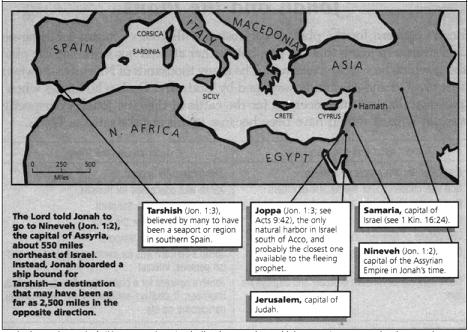
Nelson’s Complete Book of Bible Maps & Charts (Nashville: Thomas Nelson Publishers, 1996) 259. © 1993 by Thomas Nelson, Inc.
C. The Pursuit of Jonah (1:4–16)
1:4 a great wind. This is not an ordinary storm (see note on Acts 27:14 ), but an extreme one sent (lit. “hurled”) from God. Sailors, accustomed to storms, were afraid of this one (v. 5), a fear which served God’s purpose (cf. Ps. 104:4). This is not unlike the apostle Paul’s experience enroute to Rome (Acts 27:1–44).
1:5, 6 his god . . . your God. These sailors were hopelessly committed to a polytheistic belief system (in contrast to Jonah’s monotheism), not unlike the Athenians in Paul’s day (see note on Acts 17:23, 24 ).
1:7 cast lots. The last resort is to ascertain whose guilt has caused such divine anger. God could reveal His will by controlling the lots, which He did. This method of discernment by casting lots, the exact procedure of which is not known, was not forbidden in Israel (cf. Prov. 16:33; Josh. 7:14ff.; 15:1; 1 Sam. 14:36–45; Acts 1:26).
1:8 Please tell us! What Jonah did not tell them was that he might have already known that Assyria would one day be victorious over Israel. Undoubtedly, Jonah’s fierce natural pride clouded his prophet’s commitment to God’s divine appointment to evangelize Nineveh.
1:9 I am a Hebrew. Jonah identified himself by the name that Israelites used among Gentiles (cf. 1 Sam. 4:6, 9; 14:11). the God of heaven. This title, in use from earliest times (Gen. 24:3, 7), may have been specifically chosen by Jonah to express the sovereignty of the Lord in contrast to Baal, who was a sky god (cf. 1 Kin. 18:24). Spoken to sailors who were most likely from Phoenicia, the center of Baal worship, the title bears significant weight, especially when coupled with the phrase “who made the sea and the dry land.” This was the appropriate identification when introducing the true and living God to pagans who didn’t have Scripture, but whose reason led them to recognize the fact that there had to be a Creator (cf. Rom 1:18–23). To begin with creation, as in Acts 14:14–17 and 17:23b–29, was the proper starting point. To evangelize Jews, one can begin with the OT Scripture.
1:10 exceedingly afraid. See note on 1:16.
1:11, 12 Unwilling to go to Nineveh and feeling guilty, Jonah was willing to sacrifice himself in an effort to save the lives of others. Apparently, he would rather have died than go to Nineveh.
1:13, 14 Heathen sailors had more concern for one man than Jonah had for tens of thousands in Nineveh. The storm, Jonah’s words, and the lots all indicated to the sailors that the Lord was involved; thus, they offered sacrifices to Him and made vows, indicating Jonah had told them more about God than is recorded here.
1:15 the sea ceased. The effect was similar to Christ’s quieting the storm on the Sea of Galilee (cf. Matt. 8:23–27).
1:16 feared . . . exceedingly. See note on Mark 4:41.
D. The Preservation of Jonah (1:17)
1:17 a great fish. The species of fish is uncertain; the Hebrew word for whale is not here employed. God sovereignly prepared (lit. “appointed”) a great fish to rescue Jonah. Apparently Jonah sank into the depth of the sea before the fish swallowed him (cf. 2:3, 5, 6). three days and three nights. Cf. Matthew 16:4. See note on Matthew 12:40.
| Jonah | The Mariners |
| He was a Hebrew with a rich history of YAHWEH God’s faithfulness | They were Gentiles with no history of YAHWEH God. |
| He was monotheistic, believing in the one true God (v. 9). | They were polytheistic, worshiping many false gods. |
| He was rightly related to the true God. | They had no relationship with the true God. |
| He was spiritually insensitive, going in the wrong direction from God (v. 5). | They were spiritually sensitive, moving in the right direction toward God. They prayed (v. 5). |
| He was indifferent toward God’s will in spite of knowing Him. | They were concerned before God in spite of little or no knowledge of Him. |
| He was uncompassionate toward Ninevah (v. 3). | They were compassionate toward Jonah (vv. 11-14). |
| Jonah was rebellious and therefore discipled, but not destroyed (v. 7). | They were brought to worship and commitment (v. 16). |
Nelson’s Complete Book of Bible Maps & Charts (Nashville: Thomas Nelson Publishers, 1996) 260. © 1993 by Thomas Nelson, Inc.
II. SUBMITTING TO GOD’S WILL (2:1–10)
2:1–9 Jonah’s prayer acknowledged God’s sovereignty (vv. 1–3) and submitted to it (vv. 4–9). Jonah’s prayer under duress stands in contrast to the prayers of obedient men, like Daniel (9:3–20) and Nehemiah (1:5–11).
A. The Helplessness of Jonah (2:1–3)
2:2 Out of the belly of Sheol. The phrase does not necessarily indicate that Jonah actually died. Sheol frequently has a hyperbolic meaning in contexts where it denotes a catastrophic condition near death (Ps. 30:3). Later, Jonah expressed praise for his deliverance “from the pit,” speaking of his escape from otherwise certain death. See note on 1:17.
2:3 In describing his watery experience, Jonah acknowledged that his circumstances were a judgment from the Lord.
B. The Prayer of Jonah (2:4–7)
2:4 I have been cast out of Your sight. In 1:3, Jonah ran from the Lord’s presence; here, he realizes that the Lord has temporarily expelled him. Your holy temple. Jonah expressed confidence that he would one day see and be in the sight of God, possibly in Jerusalem but more likely in heaven (cf. v. 7).
2:5 my soul. This describes Jonah’s total person—both physically and spiritually (cf. v. 7).
C. The Repentance of Jonah (2:8, 9)
2:9 I have vowed. Jonah found himself in the same position as the mariners: offering sacrifices and making vows (cf. 1:16). In light of 3:1–4, Jonah’s vow could well have been to carry out God’s ministry will for him by preaching in Nineveh (Pss. 50:14; 66:13, 14). Salvation . . . Lord. Cf. Psalm 3:8; Isaiah 45:17. The God of Israel is the only Savior (Is. 43:11; Hos. 13:4; Jude 25).
D. The Deliverance of Jonah (2:10)
2:10 the LORD spoke. Just as God spoke the world into existence (Gen. 1:3, 6, 9, 11, 14, 20, 24) and calls the stars by name (Is. 40:26; cf. Ps. 147:4), so He speaks to His creation in the animal world (cf. Num. 22:28–30). Most likely, Jonah was vomited upon the shore of Palestine, possibly near Joppa.
III. FULFILLING GOD’S WILL (3:1–10)
A. The Commission Renewed (3:1, 2)
3:1, 2 Gracious in giving Jonah a second chance, God again commissioned him to go to Nineveh. Jonah is the only prophet actually sent by God to preach repentance in a foreign land. The prophet was to travel over five hundred miles from Joppa to Nineveh.
3:3 an exceedingly great city, a three-day journey. Lit. “a great city to God,” the text emphasizes not only its size (cf. 1:2), but its importance (cf. 4:11). A metropolitan city the size of Nineveh, with a circumference of about sixty miles, would require three days just to get around it. These dimensions are confirmed by historians. Stopping to preach would only add to the time requirement.
3:4 Yet forty days. The time frame may harken back to Moses’ supplication for forty days and nights at Sinai (Deut. 9:18, 25). Jonah’s message, while short, accomplishes God’s intended purpose.
3:5 the people . . . believed God. Jonah’s experience with the fish (2:1–10), in light of the Ninevites’ pagan beliefs (see note on 1:2 ), certainly gained him an instant hearing. From the divine side, this wholesale repentance was a miraculous work of God. Jesus used the Ninevites’ repentance at the lesser prophet Jonah to condemn the Pharisees’ rejection of Jesus, a greater one than Jonah (Matt. 12:41; Luke 11:32). Pagan sailors and a pagan city responded to the reluctant prophet, showing the power of God in spite of His servant’s weakness.
3:6 The king of Nineveh, thought by some to be Adadnirari III (c. 810–783), but much more likely Assurdan III (c. 772–755), exchanged his royal robes for sackcloth and ashes (cf. Job 42:6; Is. 58:5). Reports of Jonah’s miraculous fish experience may have preceded him to Nineveh, accounting for the swift and widespread receptivity of his message (cf. 1:2). It is generally believed that acid from the fish’s stomach would have bleached Jonah’s face, thus validating the experience.
3:7–9 man nor beast. It was a Persian custom to use animals in mourning ceremonies.
3:10 God saw . . . God relented. See notes on 2 Samuel 24:16; Psalm 106:45; Jeremiah 18:8–10; 42:10. The Ninevites truly repented, which is what Jonah did not really want to happen (cf. 4:2). Thus, the Assyrian nation could be used one generation later as the rod of God’s anger (Is. 10:5) as foretold by Isaiah, Hosea, and Amos.
| 1. | 1:4 | "the LORD sent out a great wind on the sea" |
| 2. | 1:7 | "the lot fell on Jonah" |
| 3. | 1:15 | "the sea creased from its raging" |
| 4. | 1:17 | "the LORD had prepared a great fish" |
| 5. | 1:17 | "to swallow Jonah (alive)" |
| 6. | 2:10 | "the LORD spoke to the fish... it vomited Jonah onto dry land" |
| 7. | 3:10 | "God saw their works...they turned from their evil way" |
| 8. | 4:6 | "the LORD God prepared a plant" |
| 9. | 4:7 | "God prepared worm" |
| 10. | 4:8 | "God prepared a vehement east wind" |
The MacArthur Study Bible, by John MacArthur (Nashville: Word Publishing, 1997) 1294. © 1993 by Thomas Nelson, Inc.
IV. QUESTIONING GOD’S WILL (4:1–11)
A. The Prophet Displeased (4:1–5)
4:1, 2 Jonah, because of his rejection of Gentiles and distaste for their participation in salvation, was displeased at God’s demonstration of mercy toward the Ninevites, thereby displaying the actual reason for his original flight to Tarshish. From the very beginning, Jonah had clearly understood the gracious character of God (cf. 1 Tim. 2:4; 2 Pet. 3:9). He had received pardon, but didn’t want Nineveh to know God’s mercy (cf. a similar attitude in Luke 15:25ff.). Jonah was much like the Pharisees of Jesus’ day (Matt. 12:41; Luke 11:34).
4:2 gracious . . . lovingkindness. These are well-documented attributes of God (Ex. 34:6; Num. 14:18; Pss. 86:15; 103:8; 145:8, 9). Cf. Joel 2:13.
4:3 better . . . to die than to live! Perhaps Jonah was expressing the reality of breaking his vow (2:9) to God a second time (cf. Num. 30:2; Eccl. 5:1–6). Jonah joined the ranks of Job (6:8, 9), Moses (Num. 11:10–15), and Elijah (1 Kin. 19:4) in wanting to die. Cf. 4:8.
4:4 right . . . angry? Cf. verse 1. Jonah’s anger was kindled because his will did not prevail; rather, God’s will did (Matt. 26:39, 42). Jonah apparently gave no answer. Cf. 4:9.
B. The Prophet Rebuked (4:6–11)
4:6 a plant. The identity is uncertain, but it possibly could be the fast-growing castor oil plant, which in hot climates grows rapidly to give shade with its large leaves.
4:8 vehement east wind. A hot, scorching wind, normally called “sirocco,” blowing off the Arabian desert. The shelter Jonah made for himself (v. 5) would not exclude this “agent” of God’s sovereignty.
| God and Nineveh | Jonah and the Plant |
|---|---|
| God cared for the people of Nineveh | Jonah cared for a plant. |
| God was concerned for the welfare of others. | Jonah was concerned for himself. |
| God created all that was in Nineveh. | Jonah did not create the plant. |
| God tended Nineveh. | Jonah did nothing for the plant. |
| The people of Nineveh are of eternal significance. | The plant was most temporal. |
| God’s concern was and is for human life. | Jonah’s concern was for personal comfort and selfish personal interest. |
| God’s concern for Nineveh is proper and displays His love. | Jonah’s concern for a plant rather than for people is improper; it displays selfishness and an improper perspective on life. |
4:9 Jonah’s anger had reached the point of being irrational, as God describes in verse 10. James 1:19, 20 expresses the antidote for Jonah’s emotional poison.
4:10, 11 God’s love for the people of Nineveh, whom He had created, is far different from Jonah’s indifference to their damnation and greater than Jonah’s warped concern for a wild plant’s shade for which he had done nothing worthy to deserve it. God was ready to spare Sodom for ten righteous people; how much more a city which includes 120,000 small children, identified as those who cannot discern the right hand from the left (cf. Gen. 18:22, 23). With that many three- or four-year old children, it is reasonable to expect a total population in excess of 600,000. Jonah’s preaching certainly equaled, if not eclipsed, Peter’s ministry at Pentecost (cf. Acts 2:14–39).
Further Study
Feinberg, Charles L. The Minor Prophets. Chicago: Moody, 1980.
Hannah, John D. Jonah, in The Bible Knowledge Commentary—OT. Wheaton, Ill.: Victor, 1985.