The English word gospel derives from the Anglo-Saxon word godspell, which can mean either “a story about God,” or “a good story.” The latter meaning is in harmony with the Greek word translated “gospel,” euangellion, which means “good news.” In secular Greek, euangellion referred to a good report about an important event. The four Gospels are the good news about the most significant events in all of history—the life, sacrificial death, and resurrection of Jesus of Nazareth.
The Gospels are not biographies in the modern sense of the word, since they do not intend to present a complete life of Jesus (cf. John 20:30; 21:25). Apart from the birth narratives, they give little information about the first thirty years of Jesus’ life. While Jesus’ public ministry lasted over three years, the Gospels focus much of their attention on the last week of His life (cf. John 12–20). Though they are completely accurate historically, and present important biographical details of Jesus’ life, the primary purposes of the Gospels are theological and apologetic (John 20:31). They provide authoritative answers to questions about Jesus’ life and ministry, and they strengthen believers’ assurance regarding the reality of their faith (Luke 1:4).
Although many spurious Gospels were written, the church from earliest times has accepted only Matthew, Mark, Luke, and John as inspired Scripture. While each Gospel has its unique perspective (see the discussion of the “Synoptic Problem” in the Introduction to Mark: Interpretive Challenges), Matthew, Mark, and Luke, when compared to John, share a common point of view. Because of that, they are known as the synoptic (from a Greek word meaning “to see together,” or “to share a common point of view”) Gospels. Matthew, Mark, and Luke, for example, focus on Christ’s Galilean ministry, while John focuses on His ministry in Judea. The synoptic Gospels contain numerous parables, while John records none. John and the synoptic Gospels record only two common events (Jesus’ walking on the water, and the feeding of the 5,000) prior to Passion Week. These differences between John and the synoptic Gospels, however, are not contradictory, but complementary.
As already noted, each Gospel writer wrote from a unique perspective, for a different audience. As a result, each Gospel contains distinctive elements. Taken together, the four Gospels form a complete testimony about Jesus Christ.
Matthew wrote primarily to a Jewish audience, presenting Jesus of Nazareth as Israel’s long-awaited Messiah and rightful King. His genealogy, unlike Luke’s, focuses on Jesus’ royal descent from Israel’s greatest king, David. Interspersed throughout Matthew are OT quotes presenting various aspects of Jesus’ life and ministry as the fulfillment of OT messianic prophecy. Matthew alone uses the phrase “kingdom of heaven,” avoiding the parallel phrase “kingdom of God” because of the unbiblical connotations it had in first-century Jewish thought. Matthew wrote his Gospel, then, to strengthen the faith of Jewish Christians; thus, it provides a useful apologetic tool for Jewish evangelism.
Mark targeted a Gentile audience, especially a Roman one (see Introduction to Mark: Background and Setting). Mark is the Gospel of action; the frequent use of “immediately” and “then” keeps his narrative moving rapidly along. Jesus appears in Mark as the Servant (cf. Mark 10:45) who came to suffer for the sins of many. Mark’s fast-paced approach would especially appeal to the practical, action-oriented Romans.
Luke addressed a broader Gentile audience. As an educated Greek (see Introduction to Luke: Author and Date), Luke wrote using the most sophisticated literary Greek of any NT writer. He was a careful researcher (Luke 1:1–4) and an accurate historian. Luke portrays Jesus as the Son of Man (a title appearing twenty-six times), the answer to the needs and hopes of the human race, who came to seek and save lost sinners (Luke 9:56; 19:10).
John, the last Gospel written, emphasizes the deity of Jesus Christ (e.g., 5:18; 8:58; 10:30–33; 14:9). John wrote to strengthen the faith of believers and to appeal to unbelievers to come to faith in Christ. The apostle clearly stated his purpose for writing in 20:31: “These are written that you may believe that Jesus is the Christ, the Son of God, and that believing you may have life in His name.”
Taken together, the four Gospels weave a complete portrait of the God-Man, Jesus of Nazareth. In Him were blended perfect humanity and deity, making Him the only sacrifice for the sins of the world, and the worthy Lord of those who believe.
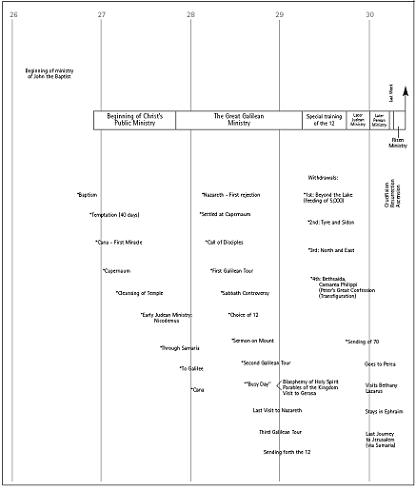
| Matt. | Mark | Luke | John | ||
| Introductions to Jesus Christ | |||||
| (1) Luke’s Introduction | 1:1–4 | ||||
| (2) Pre-fleshly state of Christ | 1:1–18 | ||||
| (3) Genealogy of Jesus Christ | 1:1–17 | 3:23–38 | |||
| Birth, Infancy, and Adolescence of Jesus and John the Baptist | |||||
| (1) Announcement of Birth of John | 1:5–25 | ||||
| (2) Announcement of Birth of Jesus to the Virgin | 1:26–38 | ||||
| (3) Song of Elizabeth to Mary | 1:39–45 | ||||
| (4) Mary’s Song of Praise | 1:46–56 | ||||
| (5) Birth, Infancy, and Purpose for Future of John the Baptist | 1:57–80 | ||||
| (6) Announcement of Jesus’ Birth to Joseph | 1:18–23 | ||||
| (7) Birth of Jesus Christ | 1:24, 25 | 2:1–7 | |||
| (8) Proclamation by the Angels | 2:8–14 | ||||
| (9) The Visit of Homage by Shepherds | 2:15–20 | ||||
| (10) Jesus’ Circumcision | 2:21 | ||||
| (11) First Temple Visit with Acknowledgments by Simeon and Anna | 2:22–38 | ||||
| (12) Visit of the Wise Men | 2:1–12 | ||||
| (13) Flight into Egypt and Massacre of Innocents | 2:13–18 | ||||
| (14) From Egypt to Nazareth with Jesus | 2:19–23 | 2:39 | |||
| (15) Childhood of Jesus | 2:40 | ||||
| (16) Jesus, 12 Years Old, Visits the Temple | 2:41–50 | ||||
| (17) 18-Year Account of Jesus’ Adolescence and Adulthood | 2:51, 52 | ||||
| Truths About John the Baptist | |||||
| (1) John’s Ministry Begins | 3:1 | 1:1–4 | 3:1, 2 | ||
| (2) Man and Message | 3:2–12 | 1:2–8 | 3:3–14 | ||
| (3) His Picture of Jesus | 3:11, 12 | 1:7, 8 | 3:15–18 | ||
| (4) His Courage | 14:4–12 | 3:19, 20 | |||
| Beginning of Jesus’ Ministry | |||||
| (1) Jesus Baptized | 3:13–17 | 1:9–11 | 3:21–22 | ||
| (2) Jesus Tempted | 4:1–11 | 1:12, 13 | 4:1–13 | ||
| (3) John’s Testimony | 1:19–34 | ||||
| (4) Calls First Disciples | 1:35–51 | ||||
| (5) The First Miracle | 2:1–11 | ||||
| (6) First Stay in Capernaum | 2:12 | ||||
| (7) First Cleansing of the Temple | 2:13–22 | ||||
| (8) Received at Jerusalem | 2:23–25 | ||||
| (9) Teaches Nicodemus about Second Birth | 3:1–21 | ||||
| (10) Co-Ministry with John | 3:22–36 | ||||
| (11) Leaves for Galilee | 4:12 | 1:14 | 4:14 | 4:1–4 | |
| (12) Samaritan Woman at Jacob’s Well | 4:5–42 | ||||
| (13) Returns to Galilee | 1:15 | 4:15 | 4:43–45 | ||
| The Galilean Ministry of Jesus | |||||
| (1) Healing of the Nobleman’s Son | 4:46–54 | ||||
| (2) Rejected at Nazareth | 4:16–30 | ||||
| (3) Moved to Capernaum | 4:13–17 | ||||
| (4) Four Become Fishers of Men | 4:18–22 | 1:16–20 | 5:1–11 | ||
| (5) Demoniac Healed on the Sabbath Day | 1:21–28 | 4:31–37 | |||
| (6) Peter’s Mother-in-Law Cured, Plus Others | 8:14–17 | 1:29–34 | 4:38–41 | ||
| (7) First Preaching Tour of Galilee | 4:23–25 | 1:35–39 | 4:42–44 | ||
| (8) Leper Healed and Response Recorded | 8:1–4 | 1:40–45 | 5:12–16 | ||
| (9) Paralytic Healed | 9:1–8 | 2:1–12 | 5:17–26 | ||
| (10) Matthew’s Call and Reception Held | 9:9–13 | 2:13–17 | 5:27–32 | ||
| (11) Disciples Defended via a Parable | 9:14–17 | 2:18–22 | 5:33–39 | ||
| (12) Goes to Jerusalem for Second Passover; Heals Lame Man | 5:1–47 | ||||
| (13) Plucked Grain Precipitates Sabbath Controversy | 12:1–8 | 2:23–28 | 6:1–5 | ||
| (14) Withered Hand Healed Causes Another Sabbath Controversy | 12:9–14 | 3:1–6 | 6:6–11 | ||
| (15) Multitudes Healed | 12:15–21 | 3:7–12 | 6:17–19 | ||
| (16) Twelve Apostles Selected After a Night of Prayer | 3:13–19 | 6:12–16 | |||
| (17) Sermon on the Mount | 5:1–7:29 | 6:20–49 | |||
| (18) Centurion’s Servant Healed | 8:5–13 | 7:1–10 | |||
| (19) Raises Widow’s Son from Dead | 7:11–17 | ||||
| (20) Jesus Allays John’s Doubts | 11:2–19 | 7:18–35 | |||
| (21) Woes Upon the Privileged | 11:20–30 | ||||
| (22) A Sinful Woman Anoints Jesus | 7:36–50 | ||||
| (23) Another Tour of Galilee | 8:1–3 | ||||
| (24) Jesus Accused of Blasphemy | 12:22–37 | 3:20–30 | |||
| (25) Jesus’ Answer to a Demand for a Sign | 12:38–45 | ||||
| (26) Mother, Brothers Seek Audience | 12:46–50 | 3:31–35 | 8:19–21 | ||
| (27) Famous Parables of Sower, Seed, Tares, Mustard Seed, Leaven, Treasure, Pearl, Dragnet, Lamp Told | 13:1–52 | 4:1–34 | 8:4–18 | ||
| (28) Sea Made Serene | 8:23–27 | 4:35–41 | 8:22–25 | ||
| (29) Gadarene Demoniac Healed | 8:28–34 | 5:1–20 | 8:26–39 | ||
| (30) Jairus’s Daughter Raised and Woman with Hemorrhage Healed | 9:18–26 | 5:21–43 | 8:40–56 | ||
| (31) Two Blind Men’s Sight Restored | 9:27–31 | ||||
| (32) Mute Demoniac Healed | 9:32–34 | ||||
| (33) Nazareth’s Second Rejection of Christ | 13:53–58 | 6:1–6 | |||
| (34) Twelve Sent Out | 9:35—11:1 | 6:7–13 | 9:1–6 | ||
| (35) Fearful Herod Beheads John | 14:1–12 | 6:14–29 | 9:7–9 | ||
| (36) Return of Twelve, Jesus Withdraws, Five Thousand Fed | 14:13–21 | 6:30–44 | 9:10–17 | 6:1–14 | |
| (37) Walks on the Water | 14:22–33 | 6:45–52 | 6:15–21 | ||
| (38) Sick of Gennesaret Healed | 14:34–36 | 6:53–56 | |||
| (39) Peak of Popularity Passes in Galilee | {6:22–71; 7:1 | ||||
| (40) Traditions Attacked | 15:1–20 | 7:1–23 | |||
| (41) Aborted Retirement in Phoenicia: SyroPhoenician Healed | 15:21–28 | 7:24–30 | |||
| (42) Afflicted Healed | 15:29–31 | 7:31–37 | |||
| (43) Four Thousand Fed | 15:32–39 | 8:1–9 | |||
| (44) Pharisees Increase Attack | 16:1–4 | 8:10–13 | |||
| (45) Disciples’ Carelessness Condemned; Blind Man Healed | 16:5–12 | 8:14–26 | |||
| (46) Peter Confesses Jesus Is the Christ | 16:13–20 | 8:27–30 | 9:18–21 | ||
| (47) Jesus Foretells His Death | 16:21–26 | 8:31–38 | 9:22–25 | ||
| (48) Kingdom Promised | 16:27, 28 | 9:1 | 9:26, 27 | ||
| (49) The Transfiguration | 17:1–13 | 9:2–13 | 9:28–36 | ||
| (50) Epileptic Healed | 17:14–21 | 9:14–29 | 9:37–42 | ||
| (51) Again Tells of Death, Resurrection | 17:22, 23 | 9:30–32 | 9:43–45 | ||
| (52) Taxes Paid | 17:24–27 | ||||
| (53) Disciples Contend About Greatness; Jesus Defines; also Patience, Loyalty, Forgiveness | 18:1–35 | 9:33–50 | 9:46–50 | ||
| (54) Jesus Rejects Brothers’ Advice | 7:2–9 | ||||
| (55) Galilee Departure and Samaritan Rejection | 19:1 | 9:51–56 | 7:10 | ||
| (56) Cost of Discipleship | 8:18–22 | 9:57–62 | |||
| Last Judean and Perean Ministry of Jesus | |||||
| (1) Feast of Tabernacles | 7:11–52 | ||||
| (2) Forgiveness of Adulteress | {7:53— 8:11 | ||||
| (3) Christ—the Light of the World | 8:12–20 | ||||
| (4) Pharisees Can’t Meet the Prophecy Thus Try to Destroy the Prophet | 8:12–59 | ||||
| (5) The Service of the Seventy | 10:1–24 | ||||
| (6) Lawyer Hears the Story of the Good Samaritan | 10:25–37 | ||||
| (7) The Hospitality of Martha and Mary | 10:38–42 | ||||
| (8) Another Lesson on Prayer | 11:1–13 | ||||
| (9) Accused of Connection with Beelzebub | 11:14–36 | ||||
| (10) Judgment Against Lawyers and Pharisees | 11:37–54 | ||||
| (11) Jesus Deals with Hypocrisy, Covetousness, Worry, and Alertness | 12:1–59 | ||||
| (12) Repent or Perish | 13:1–5 | ||||
| (13) Barren Fig Tree | 13:6–9 | ||||
| (14) Crippled Woman Healed on Sabbath | 13:10–17 | ||||
| (15) Parables of Mustard Seed and Leaven | 13:18–21 | ||||
| (16) Man Born Blind Healed; Following Consequences | 9:1–41 | ||||
| (17) Parable of the Good Shepherd | 10:1–21 | ||||
| (18) Feast of Dedication | 10:22–39 | ||||
| (19) Withdrawal Beyond Jordan | 10:40–42 | ||||
| (20) Begins Teaching Return to Jerusalem with Special Words About Herod | 13:22–35 | ||||
| (21) Meal with a Pharisee Ruler Occasions Healing Man with Dropsy; Parables of Ox, Best Places, and Great Supper | 14:1–24 | ||||
| (22) Demands of Discipleship | 14:25–35 | ||||
| (23) Parables of Lost Sheep, Coin, Son | 15:1–32 | ||||
| (24) Parables of Unjust Steward, Rich Man and Lazarus | 16:1–31 | ||||
| (25) Lessons on Service, Faith, Influence | 17:1–10 | ||||
| (26) Resurrection of Lazarus | 11:1–44 | ||||
| (27) Reaction to It: Withdrawal of Jesus | 11:45–54 | ||||
| (28) Begins Last Journey to Jerusalem via Samaria & Galilee | 17:11 | ||||
| (29) Heals Ten Lepers | 17:12–19 | ||||
| (30) Lessons on the Coming Kingdom | 17:20–37 | ||||
| (31) Parables: Persistent Widow, Pharisee and Tax Collector | 18:1–14 | ||||
| (32) Doctrine on Divorce | 19:1–12 | 10:1–12 | |||
| (33) Jesus Blesses Children: Objections | 19:13–15 | 10:13–16 | 18:15–17 | ||
| (34) Rich Young Ruler | 19:16–30 | 10:17–31 | 18:18–30 | ||
| (35) Laborers of the 11th Hour | 20:1–16 | ||||
| (36) Foretells Death and Resurrection | 20:17–19 | 10:32–34 | 18:31–34 | ||
| (37) Ambition of James and John | 20:20–28 | 10:35–45 | |||
| (38) Blind Bartimaeus Healed | 20:29–34 | 10:46–52 | 18:35–43 | ||
| (39) Interview with Zacchaeus | 19:1–10 | ||||
| (40) Parable: the Minas | 19:11–27 | ||||
| (41) Returns to Home of Mary and Martha | {11:55— 12:1 | ||||
| (42) Plot to Kill Lazarus | 12:9–11 | ||||
| Jesus’ Final Week of Work at Jerusalem | |||||
| (1) Triumphal Entry | 21:1–9 | 11:1–11 | 19:28–44 | 12:12–19 | |
| (2) Fig Tree Cursed and Temple Cleansed | 21:10–19 | 11:12–18 | 19:45–48 | ||
| (3) The Attraction of Sacrifice | 12:20–50 | ||||
| (4) Withered Fig Tree Testifies | 21:20–22 | 11:19–26 | |||
| (5) Sanhedrin Challenges Jesus. Answered by Parables: Two Sons, Wicked Vinedressers, and Marriage Feast | {21:23— 22:14 | {11:27— 12:12 | 20:1–19 | ||
| (6) Tribute to Caesar | 22:15–22 | 12:13–17 | 20:20–26 | ||
| (7) Sadducees Question the Resurrection | 22:23–33 | 12:18–27 | 20:27–40 | ||
| (8) Pharisees Question Commandments | 22:34–40 | 12:28–34 | |||
| (9) Jesus and David | 22:41–46 | 12:35–37 | 20:41–44 | ||
| (10) Jesus’ Last Sermon | 23:1–39 | 12:38–40 | 20:45–47 | ||
| (11) Widow’s Mite | 12:41–44 | 21:1–4 | |||
| (12) Jesus Tells of the Future | 24:1–51 | 13:1–37 | 21:5–36 | ||
| (13) Parables: Ten Virgins, Talents, The Day of Judg ment | 25:1–46 | ||||
| (14) Jesus Tells Date of Crucifixion | 26:1–5 | 14:1, 2 | {21:37, 38; 22:1, 2 | ||
| (15) Anointing by Mary at Simon’s Feast | 26:6–13 | 14:3–9 | 12:2–8 | ||
| (16) Judas Contracts the Betrayal | 26:14–16 | 14:10, 11 | 22:3–6 | ||
| (17) Preparation for the Passover | 26:17–19 | 14:12–16 | 22:7–13 | ||
| (18) Passover Eaten, Jealousy Rebuked | 26:20 | 14:17 | {22:14–16, 24–30 | ||
| (19) Feet Washed | 13:1–20 | ||||
| (20) Judas Revealed, Defects | 26:21–25 | 14:18–21 | 22:21–23 | 13:21–30 | |
| (21) Jesus Warns About Further Desertion; Cries of Loyalty | 26:31–35 | 14:27–31 | 22:31–38 | 13:31–38 | |
| (22) Institution of the Lord’s Supper | 26:26–29 | 14:22–25 | 22:17–20 | ||
| (23) Last Speech to the Apostles and Intercessory Prayer | {14:1— 17:26 | ||||
| (24) The Grief of Gethsemane | {26:30, 36–46 | {14:26, 32–42 | 22:39–46 | 18:1 | |
| (25) Betrayal, Arrest, Desertion | 26:47–56 | 14:43–52 | 22:47–53 | 18:2–12 | |
| (26) First Examined by Annas | {18:13–14, 19–23 | ||||
| (27) Trial by Caiaphas and Council; Following Indignities | {26:57, 59–68 | {14:53, 55–65 | {22:54a, 63–65 | 18:24 | |
| (28) Peter’s Triple Denial | {26:58, 69–75 | {14:54, 66–72 | {22:54b– 62 | {18:15–18, 25–27 | |
| (29) Condemnation by the Council | 27:1 | 15:1a | 22:66–71 | ||
| (30) Suicide of Judas | 27:3–10 | ||||
| (31) First Appearance Before Pilate | 27:2, 11–14 | 15:1b–5 | 23:1–7 | 18:28–38 | |
| (32) Jesus Before Herod | 23:6–12 | ||||
| (33) Second Appearance Before Pilate | 27:15–26 | 15:6–15 | 23:13–25 | {18:39— 19:16a | |
| (34) Mockery by Roman Soldiers | 27:27–30 | 15:16–19 | |||
| (35) Led to Golgotha | 27:31–34 | 15:20–23 | 23:26–33a | 19:16b, 17 | |
| (36) Six Events of First Three Hours on Cross | 27:35–44 | 15:24–32 | 23:33b–43 | 19:18–27 | |
| (37) Last Three Hours on Cross | 27:45–50 | 15:33–37 | 23:44–46 | 19:28–30 | |
| (38) Events Attending Jesus’ Death | 27:51–56 | 15:38–41 | {23:45, 47–49 | ||
| (39) Burial of Jesus | 27:57–60 | 15:42–46 | 23:50–54 | 19:31–42 | |
| (40) Tomb Sealed and Women Watch | 27:61–66 | 15:47 | 23:55, 56 | ||
| The Resurrection Through the Ascension | |||||
| (1) Women Visit the Tomb | 28:1–8 | 16:1–8 | 24:1–11 | ||
| (2) Peter and John See the Empty Tomb | 24:12 | 20:1–10 | |||
| (3) Jesus’ Appearance to Mary Magdalene | 16:9–11 | 20:11–18 | |||
| (4) Jesus’ Appearance to the Other Women | 28:9, 10 | ||||
| (5) Guards’ Report of the Resurrection | 28:11–15 | ||||
| (6) Jesus’ Appearance to Two Disciples on Way to Emmaus | 16:12, 13 | 24:13–35 | |||
| (7) Jesus’ Appearance to Ten Disciples Without Thomas | 24:36–43 | 20:19–25 | |||
| (8) Appearance to Disciples with Thomas | 20:26–31 | ||||
| (9) Jesus’ Appearance to Seven Disciples by Sea of Galilee | 21:1–25 | ||||
| (10) Great Commission | 28:16–20 | 16:14–18 | 24:44–49 | ||
| (11) The Ascension | 16:19, 20 | 24:50–53 |