THE GOSPEL ACCORDING TO
MATTHEW
Title
Matthew, meaning “gift of the Lord,” was the other name of Levi (9:9), the tax collector who left everything to follow Christ (Luke 5:27, 28). Matthew was one of the twelve apostles (10:3; Mark 3:18; Luke 6:15; Acts 1:13). In his own list of the Twelve, he explicitly calls himself a “tax collector” (10:3). Nowhere else in Scripture is the name Matthew associated with “tax collector”; the other evangelists always use his former name, Levi, when speaking of his sinful past. Identifying himself in this way is evidence of humility on Matthew’s part. As with the other three Gospels, this work is known by the name of its author.
Author and Date
The canonicity and Matthean authorship of this Gospel were unchallenged in the early church. Eusebius (c. A.D. 265–339) quotes Origen (c. A.D. 185–254): “Among the four Gospels, which are the only indisputable ones in the Church of God under heaven, I have learned by tradition that the first was written by Matthew, who was once a publican, but afterwards an apostle of Jesus Christ, and it was prepared for the converts from Judaism” (Ecclesiastical History, 6:25).
It is clear that this Gospel was written at a relatively early date—prior to the destruction of the temple in A.D. 70. Some scholars have proposed a date as early as A.D. 50. For a further discussion of some of the issues related to the authorship and dating of this Gospel, especially “The Synoptic Problem,” see Introduction to Mark: Interpretive Challenges.
Background and Setting
The Jewish flavor of Matthew’s Gospel is remarkable. It is evident even in the opening genealogy, which Matthew traces back only as far as Abraham. In contrast, Luke’s genealogy, aiming to show Christ as the redeemer of humanity, goes all the way back to Adam (Luke 3:23–38). Matthew’s purpose is somewhat narrower: to demonstrate that Christ is the King and Messiah of Israel. This Gospel quotes more than sixty times from OT prophetic passages, emphasizing how Christ fulfills all those promises.
The probability that Matthew’s audience was predominantly Jewish is further evident from several facts: Matthew usually cites Jewish custom without explaining it, in contrast to the other Gospels (cf. Mark 7:3; John 19:40). He constantly refers to Christ as “the Son of David” (1:1; 9:27; 12:23; 15:22; 20:30; 21:9, 15; 22:42, 45). Matthew even guards Jewish sensibilities regarding the name of God, referring to “the kingdom of heaven,” where the other evangelists speak of “the kingdom of God.” All the book’s major themes are rooted in the OT and set in light of Israel’s messianic expectations.
Matthew’s use of Greek may suggest that he was writing as a Palestinian Jew to Hellenistic Jews elsewhere. He wrote as an eyewitness of many of the events he described, giving firsthand testimony about the words and works of Jesus of Nazareth.
His purpose is clear: to demonstrate that Jesus is the Jewish nation’s long-awaited Messiah. His voluminous quoting of the OT is specifically designed to show the tie between the Messiah of promise and the Christ of history. This purpose is never out of focus for Matthew, and he even adduces many incidental details from the OT prophecies as proofs of Jesus’ messianic claims (e.g., 2:17, 18; 4:13–15; 13:35; 21:4, 5; 27:9, 10).
Historical and Theological Themes
Since Matthew is concerned with setting forth Jesus as Messiah, the King of the Jews, an interest in the OT kingdom promises runs throughout this Gospel. Matthew’s signature phrase “the kingdom of heaven” occurs thirty-two times in this book (and nowhere else in all of Scripture).
The opening genealogy is designed to document Christ’s credentials as Israel’s king, and the rest of the book completes this theme. Matthew shows that Christ is the heir of the kingly line. He demonstrates that Jesus is the fulfillment of dozens of OT prophecies regarding the king who would come. He offers evidence after evidence to establish Christ’s kingly prerogative. All other historical and theological themes in the book revolve around this one.
| Gospel | Matthew | Mark | Luke | John |
|---|---|---|---|---|
| Audience | Jews | Romans | Hellenists | Greek World |
| Portrait of Jesus | Jesus is the Messiah/King who fulfills Old Testament prophecy and expectations | Jesus is the authoritative Son of God | Jesus is the perfect Son of Man who came to save and minister to all people through the power of the Holy Spirit and prayer | Jesus is the fully divine Son of God in whom we should believe to receive eternal life (the “I AM” of God) |
| Key Verses | Matthew 1:1; 16:16; 20:28 | Mark 1:1; 8:27; 10:45; 15:34 | Luke 19:10 | John 20:31 |
| Key Words | Fulfilled | Immediately | Son of Man | Believe; Eternal Life |
Nelson’s Complete Book of Bible Maps & Charts (Nashville: Thomas Nelson Publishers, 1996) 296. © 1993 by Thomas Nelson, Inc.
Matthew records five major discourses: (1) the Sermon on the Mount (chs. 5–7); (2) the commissioning of the apostles (ch. 10); (3) the parables about the kingdom (ch. 13); (4) a discourse about the childlikeness of the believer (ch. 18); and (5) the discourse on His Second Coming (chs. 24, 25). Each discourse ends with a variation of this phrase: “when Jesus had ended these sayings” (7:28; 11:1; 13:53; 19:1; 26:1). That becomes a motif signaling a new narrative portion. A long opening section (chs. 1–4) and a short conclusion (28:16–20) bracket the rest of the Gospel, which naturally divides into five sections, each with a discourse and a narrative section. Some have seen a parallel between these five sections and the five books of Moses in the OT.
The conflict between Christ and Pharisaism is another common theme in Matthew’s Gospel. But Matthew is keen to show the error of the Pharisees for the benefit of his Jewish audience—not for personal or self-aggrandizing reasons. Matthew omits, for example, the parable of the Pharisee and the tax collector (Luke 18:9–14), even though that parable would have put him in a favorable light.
Matthew also mentions the Sadducees more than any of the other Gospels. It regularly portrays both Pharisees and Sadducees negatively and holds them up as warning beacons. Their doctrine is a leaven that must be avoided (16:11, 12). Although these groups were doctrinally at odds with each other, they were united in their hatred of Christ. To Matthew, they epitomized all in Israel who rejected Christ as King.
The rejection of Israel’s Messiah is another constant theme in this Gospel. In no other Gospel are the attacks against Jesus portrayed as strongly as here. From the flight into Egypt to the scene at the cross, Matthew portrays Christ’s rejection more vividly than any of the other evangelists. In Matthew’s account of the Crucifixion, for example, no thief repents, and no friends or loved ones are seen at the foot of the cross. In His death, He is forsaken even by God (27:46). The shadow of rejection is never lifted from the story.
Yet Matthew also portrays Jesus as a victorious King who will one day return “on the clouds of heaven with power and great glory” (24:30).
Interpretive Challenges
As noted above, Matthew groups his narrative material around five great discourses. He makes no attempt to follow a strict chronology, and a comparison of the Gospels reveals that Matthew freely places things out of order. He is dealing with themes and broad concepts, not laying out a time line.
The prophetic passages present a particular interpretive challenge. Jesus’ Olivet Discourse, for example, contains some details that evoke images of the violent destruction of Jerusalem in A.D. 70. Jesus’ words in 24:34 have led some interpreters to conclude that all these things were fulfilled—albeit not literally—in the Roman conquest of that era. This view is known as “preterism.” But this interpretation blunders seriously by forcing the interpreter to read into these passages spiritualized, allegorical meanings unwarranted by normal exegetical methods. The grammatical-historical hermeneutical approach to these passages is the approach to follow, and it yields a consistently futuristic interpretation of crucial prophecies.
For a discussion of the synoptic problem, see “Similarities in the Gospels” above and Introduction to Mark: Interpretive Challenges.
I. PROLOGUE: THE KING’S ADVENT (1:1–4:25)
1:1 book of the genealogy of Jesus Christ. This phrase is viewed by some as Matthew’s title for the entire Gospel. The Greek phrase translated “book of the genealogy” is exactly the same phrase used in Genesis 5:1 in the Septuagint. Jesus Christ. The Hebrew Jeshua means “the Lord is Salvation.” Christos (Gr.) means “anointed one” and is the exact equivalent of the Hebrew word for “Messiah” (Dan. 9:25). Son of David. A title used for Messiah in only the synoptic Gospels (see notes on 22:42, 45 ). Son of Abraham. This title takes Jesus’ royal lineage all the way back to the nation’s inception in the Abrahamic covenant (Gen. 12:1–3).
1:2 For a comparison of this genealogy and the one given by Luke, see note on Luke 3:23–38.
1:3 Tamar. It is unusual for women to be named in genealogies. Matthew names five: Tamar was a Canaanite woman who posed as a prostitute to seduce Judah (Gen. 38:13–30). Rahab (v. 5) was a Gentile and a prostitute (Josh. 2:1). Ruth (v. 5) was a Moabite woman (Ruth 1:3) and a worshipper of idols. Bathsheba (“Uriah’s wife,” v. 6) committed adultery with David (2 Sam. 11). And Mary (v. 16) bore the perceived stigma of pregnancy outside of wedlock. Each of these women is an object lesson about the workings of divine grace.
1:5, 6 Salmon begot Boaz by Rahab . . . and Jesse begot David the king. This genealogy is not exhaustive. Several additional generations must have elapsed between Rahab (in Joshua’s time) and David (v. 6)—nearly four centuries later. Matthew’s genealogy (like most of the biblical ones) sometimes skips over several generations between well-known characters in order to abbreviate the listing. See notes on Ruth 4:18–22; 4:21.
1:8 Joram begot Uzziah. See 1 Chronicles 3:10–12. Matthew skips over Ahaziah, Joash, and Amaziah, going directly from Joram to Uzziah (Azariah)—using a kind of genealogical shorthand. He seems to shorten the genealogy intentionally in order to divide it symmetrically into three divisions in verse 17.
1:11 Josiah begot Jeconiah. Again, Matthew skips a generation between Josiah and Jeconiah (1 Chr. 3:14–16). Jeconiah is also called Jehoiachin (2 Kin. 24:6; 2 Chr. 36:8) and sometimes Coniah (Jer. 22:24). Jeconiah’s presence in this genealogy presents an interesting problem. A curse on him denied any of his descendants the throne of David forever (Jer. 22:30). Jesus was heir through Joseph to the royal line of descent, but since he was not an actual son of Joseph and thus not a physical descendant through this line, the curse bypassed him.
1:12 Shealtiel begot Zerubbabel. See 1 Chronicles 3:17–19, where Zerubbabel is said to be the offspring of Pedaiah, Shealtiel’s brother. Elsewhere in the OT, Zerubbabel is always called the son of Shealtiel (e.g., Hag. 1:1; Ezra 3:2; Neh. 12:1). Possibly Shealtiel adopted his nephew (see note on Hag. 2:23 ). Zerubbabel is the last character in Matthew’s list who appears in any of the OT genealogies.
1:16 Joseph the husband of Mary, of whom was born Jesus. This is the only entry in the entire genealogy where the word begot is not used—including those where whole generations were skipped. The pronoun whom is singular, referring to Mary alone. The unusual way in which this final entry is phrased underscores the fact that Jesus was not Joseph’s literal offspring. The genealogy, nonetheless, establishes His claim to the throne of David as Joseph’s legal heir.
| Joseph | Four separate dreams: | |
| • assured of Mary’s purity | Matt. 1:20 | |
| • warned to flee to Egypt | Matt. 2:13 | |
| • told to return to Israel | Matt. 2:19, 20 | |
| • warned by God to return to Nazareth | Matt. 2:22 | |
| Wise men | Warned of Herod’s plot against the baby Jesus | Matt. 2:12 |
1:17 fourteen generations. The significance of the number fourteen is not clear, but Matthew’s attention to numbers—a distinctly Hebrew characteristic—is evident throughout the Gospel. The systematic ordering may aid memorization. Note that Matthew counts Jeconiah in both the third and fourth groups, representing both the last generation before the Babylonian captivity and the first generation after.
1:18 betrothed. Jewish betrothal was as binding as modern marriage. A divorce was necessary to terminate the betrothal (v. 19), and betrothed couples were regarded legally as husband and wife (v. 19)—even before their physical union. See note on Luke 2:5. with child of the Holy Spirit. See verses 20, 23; Luke 1:26–35.
1:19 Joseph . . . being a just man . . . was minded to put her away secretly. Stoning was the legal prescription for this sort of adultery (Deut. 22:23, 24). Joseph’s righteousness meant he was also merciful; thus, he did not intend to make Mary “a public example.” The phrase “a just man” is a Hebraism suggesting that he was a true believer in God who had thereby been declared righteous and who carefully obeyed the law (see Gen. 6:9). To “put her away” would be to obtain a legal divorce (19:8, 9; Deut. 24:1), which according to the Jewish custom was necessary in order to dissolve a betrothal (see note on v. 18 ).
1:20 an angel of the Lord. This is one of only a few such angelic visitations in the NT, most of which are associated with Christ’s birth. For others, see 28:2; Acts 5:19; 8:26; 10:3; 12:7–10; 27:23; Revelation 1:1. in a dream. As if to underscore the supernatural character of Christ’s advent, Matthew’s narrative of the event describes five such revelatory dreams: verse 20; 2:12, 13, 19, 22. Here, the angel tells Joseph he is to take Mary into his own home.
1:21 Jesus. See verse 25; Luke 1:31. The name actually means “Savior” (see note on v. 1 ).
1:22 that it might be fulfilled. Matthew points out fulfillments of OT prophecies no fewer than a dozen times (2:15, 17, 23; 4:14; 8:17; 12:17; 13:14, 35; 21:4; 26:54–56; 27:9, 35). He quotes from the OT more than sixty times, more frequently than any other NT writer, except Paul in Romans.
1:23 virgin. Scholars sometimes dispute whether the Hebrew term in Isaiah 7:14 means “virgin” or “maiden.” Matthew quotes here from the LXX, which uses the unambiguous Greek term for “virgin” (see note on Is. 7:14 ). Thus Matthew, writing under the Spirit’s inspiration, ends all doubt about the meaning of the word in Isaiah 7:14. Immanuel. Cf. Isaiah 8:8, 10.
1:24 took to him his wife. See note on Luke 2:5.
1:25 know her. A euphemism for sexual intercourse. See Genesis 4:1, 17, 25; 38:26; Judges 11:39.
2:1 Bethlehem. A small village on the southern outskirts of Jerusalem. Hebrew scholars in Jesus’ day clearly expected Bethlehem to be the birthplace of the Messiah (Mic. 5:2; John 7:42). in the days of Herod the king. This king is Herod the Great, the first of several important rulers from the Herodian dynasty who are named in Scripture. This Herod, founder of the famous line, ruled from 37–4 B.C. He is thought to have been Idumean, a descendant of the Edomites, offspring of Esau. Herod was ruthless and cunning. He loved opulence and grand building projects, and many of the most magnificent ruins that one can see in modern Israel date back to the days of Herod the Great. His most famous project was the rebuilding of the temple at Jerusalem (see note on 24:1 ). That project alone took several decades and was not completed until long after Herod’s death (John 2:20). See note on verse 22. wise men from the East. The number of wise men is not given. The traditional notion that there were three stems from the number of gifts they brought. These were not kings, but Magi, magicians or astrologers—possibly Zoroastrian wise men from Persia whose knowledge of the Hebrew Scriptures could be traced back to the time of Daniel (Dan. 5:11).
2:2 saying. This present participle conveys the idea of continuous action. It suggests they went around the city questioning everyone they met. star. This could not have been a supernova or a conjunction of planets, as some modern theories suggest, because of the way the star moved and settled over one place (v. 9). It is more likely a supernatural reality similar to the Shekinah that guided the Israelites in the days of Moses (Ex. 13:21).
2:4 chief priests. These were the temple hierarchy. They were mostly Sadducees (see note on 3:7 ). scribes. Primarily Pharisees (i.e., authorities on the Jewish law). Sometimes they are referred to as “lawyers” (see note on Luke 10:25 ). They were professional scholars whose specialty was explaining the application of the law. They knew exactly where the Messiah was to be born (v. 5), but lacked the faith to accompany the Magi to the place where He was.
2:6 This ancient prophecy from Micah 5:2 was written in the eighth century B.C. The original prophecy, not quoted in full by Matthew, declared the deity of Israel’s Messiah: “Yet out of you shall come forth to Me the One to be Ruler in Israel, whose goings forth are from of old, from everlasting.” a Ruler who will shepherd My people Israel. This portion of Matthew’s quote actually seems to be a reference to God’s words to David when Israel’s kingdom was originally established (2 Sam. 5:2; 1 Chr. 11:2). The Greek word for “ruler” evokes the image of strong, even stern, leadership. “Shepherd” emphasizes tender care. Christ’s rule involves both (Rev. 12:5).
New Testament Political Rulers
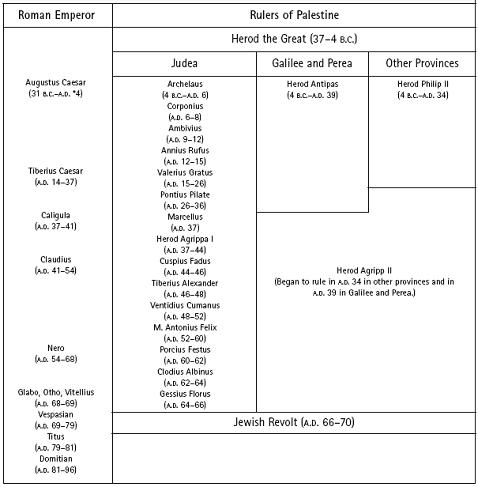
Nelson’s Complete Book of Bible Maps & Charts (Nashville: Thomas Nelson Publishers, 1996) 310. © 1993 by Thomas Nelson, Inc.
2:8 that I may come and worship Him. Herod actually wanted to kill the child (vv. 13–18), whom he saw as a potential threat to his throne.
2:11 into the house. By the time the wise men arrived, Mary and Joseph were situated in a house, not a stable (Luke 2:7). the young Child with Mary His mother. Whenever Matthew mentions Mary in connection with her child, Christ is always given first place (vv. 13, 14, 20, 21). gold, frankincense, and myrrh. Gifts suitable for a king (Is. 60:6). The fact that Gentiles would offer such worship had prophetic significance as well (Ps. 72:10).
2:12, 13 in a dream. See note on 1:20.
2:15 the death of Herod. Recent scholarship sets this date at 4 B.C. It is probable that the stay in Egypt was very brief—perhaps no more than a few weeks. Out of Egypt. This quotation is from Hosea 11:1 (see note there ), which speaks of God’s leading Israel out of Egypt in the Exodus. Matthew suggests that Israel’s sojourn in Egypt was a pictorial prophecy, rather than a specific verbal one such as verse 6; cf. 1:23. These pictorial prophecies are called “types,” and all are always fulfilled in Christ and identified clearly by the NT writers. Another example of a type is found in John 3:14. See note on verse 17.
2:16 put to death all the male children. Herod’s act is all the more heinous in light of his full knowledge that the Lord’s Anointed One was the target of his murderous plot.
2:17 fulfilled. See note on verse 15. Again, this prophecy is in the form of a type. Verse 18 quotes Jeremiah 31:15 (see note there ), which speaks of all Israel’s mourning at the time of the Babylonian captivity (c. 586 B.C.). That wailing prefigured the wailing over Herod’s massacre.
2:19 in a dream. See note on 1:20.
2:22 Archelaus. Herod’s kingdom was divided three ways and given to his sons: Archelaus ruled Judea, Samaria, and Idumea; Herod Philip II ruled the regions north of Galilee (Luke 3:1); and Herod Antipas ruled Galilee and Perea (Luke 3:1). History records that Archelaus was so brutal and ineffective that he was deposed by Rome after a short reign and replaced with a governor appointed by Rome. Pontius Pilate was the fifth governor of Judea. Herod Antipas is the main Herod in the Gospel accounts. He was the one who had John the Baptist put to death (14:1–12) and examined Christ on the eve of the Crucifixion (Luke 23:7–12).
2:23 He shall be called a Nazarene. Nazareth, an obscure town seventy miles north of Jerusalem, was a place of lowly reputation and nowhere mentioned in the OT. Some have suggested that “Nazarene” is a reference to the Hebrew word for “branch” in Isaiah 11:1. Others point out that Matthew’s statement that “prophets” had made this prediction may refer to verbal prophecies nowhere recorded in the OT. A still more likely explanation is that Matthew is using “Nazarene” as a synonym for someone who is despised or detestable—for that was how people from the region were often characterized (John 1:46). If that is the case, the prophecies Matthew had in mind would include Psalm 22:6–8; Isaiah 49:7; 53:3.
Mary, Joseph, and Jesus Flee to Egypt
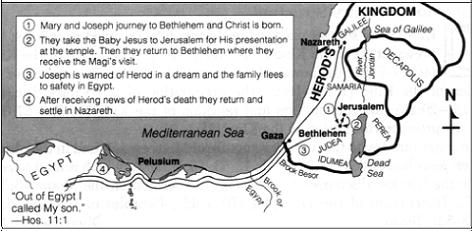
Nelson’s Complete Book of Bible Maps & Charts (Nashville: Thomas Nelson Publishers, 1996) 314. © 1993 by Thomas Nelson, Inc.
B. His Entry into Public Ministry (3:1–4:25)
3:1 John the Baptist. Cf. Mark 1:2–14; Luke 1:5–25, 57–80; 3:3–20; John 1:6–8, 19–39. the wilderness of Judea. The region to the immediate west of the Dead Sea—an utterly barren desert. The Jewish sect of the Essenes had significant communities in this region. But there is no biblical evidence to suggest that John was in any way connected with that sect. John seems to have preached near the northern end of this region, close by where the Jordan River flows into the Dead Sea (v. 6). This was a full day’s journey from Jerusalem and seems an odd location to announce the arrival of a king. But it is perfectly in keeping with God’s ways (1 Cor. 1:26–29).
3:2 Repent. This is no mere academic change of mind, nor simply regret or remorse. John the Baptist speaks of repentance as a radical turning from sin that inevitably became manifest in the fruit of righteousness (v. 8). Jesus’ first sermon begins with the same imperative (4:17). For a discussion of the nature of repentance, see notes on 2 Corinthians 7:8–11. the kingdom of heaven. Only Matthew’s Gospel uses this expression. It uses “heaven” as a euphemism for God’s name—to accommodate his Jewish readers’ sensitivities (cf. 23:22). The rest of Scripture refers to “the kingdom of God.” Both expressions refer to the sphere of God’s dominion over those who belong to Him. The kingdom is now manifest in heaven’s spiritual rule over the hearts of believers (Luke 17:21) and, one day, will be established in a literal earthly kingdom (Rev. 20:4–6). is at hand. In one sense, the kingdom is present but, in its fullest sense, is yet to be fulfilled.
3:3 spoken of by the prophet Isaiah. John’s mission had long ago been described in Isaiah 40:3–5 (see notes there ). All four of the Gospels cite this passage as a prophecy pointing to John the Baptist (see note on Luke 3:6 ).
3:4 clothed in camel’s hair, with a leather belt. These represent practical and long-wearing clothes, but far from comfortable or fashionable. John evokes the image of Elijah (2 Kin. 1:8), whom the Israelites were expecting before the Day of the Lord (Mal. 4:5). locusts. Moses’ Law allowed these as food (Lev. 11:22).
3:6 baptized. The symbolism of John’s baptism likely has its roots in OT purification rituals (Lev. 15:13). Baptism had also long been administered to Gentile proselytes coming into Judaism. The baptism of John thus powerfully and dramatically symbolizes repentance. Jews accepting John’s baptism were admitting they had been as Gentiles and needed to become the people of God genuinely, inwardly (an amazing admission, given their hatred of Gentiles). The people were repenting in anticipation of the Messiah’s arrival. The meaning of John’s baptism differs somewhat from Christian baptism (Acts 18:25). Actually, Christian baptism altered the significance of the ritual, symbolizing the believer’s identification with Christ in His death, burial, and resurrection (Rom. 6:3–5; Col. 2:12).
3:7 Pharisees and Sadducees. See note on John 3:1. The Pharisees were a small (about 6,000), legalistic sect of the Jews who were known for their rigid adherence to the ceremonial fine points of the law. Their name means “separated ones.” Jesus usually conflicted with the Pharisees. He rebuked them for using human tradition to nullify Scripture (15:3–9) and especially for rank hypocrisy (15:7, 8; 22:18; 23:13, 23, 25, 29; Luke 12:1). The Sadducees were known for denying the supernatural, including the resurrection of the dead (22:23) and the existence of angels (Acts 23:8). Unlike the Pharisees, they rejected human tradition, accepted only the Pentateuch (Genesis through Deuteronomy) as authoritative, and scorned legalism. They tended to be wealthy, aristocratic members of the priestly tribe and, in the days of Herod, controlled the temple (see note on 2:4 ), though they numbered fewer than the Pharisees. Pharisees and Sadducees had little in common. Pharisees were ritualists; Sadducees were rationalists. Pharisees were legalists; Sadducees were liberals. Pharisees were separatists; Sadducees were compromisers and political opportunists. Yet they united in opposing Christ (22:15, 16, 23, 34, 35). John publicly addresses them as deadly snakes. the wrath to come. See note on Luke 3:7. John’s preaching echoes the familiar OT theme of promised wrath in the Day of the Lord (e.g., Ezek. 7:19; Zeph. 1:18; see Introduction to Joel: Historical and Theological Themes). This rebuke must have stung the Jewish leaders, who imagined that divine wrath was reserved only for non-Jews.
3:8 fruits worthy of repentance. See note on verse 2. Repentance itself is not a work, but works are its inevitable fruit. Repentance and faith are inextricably linked in Scripture. Repentance means turning from one’s sin, and faith is turning to God (1 Thess. 1:9). They are like opposite sides of the same coin. That is why both are linked to conversion (Mark 1:15; Acts 3:19; 20:21). Note that the works John demands to see are “fruits” of repentance. But repentance itself is no more a “work” than faith is (see note on 2 Tim. 2:25 ).
3:9 Abraham as our father. See John 8:39–44. John’s listeners may have believed that merely being descendants of Abraham, members of God’s chosen race, made them spiritually secure. But Abraham’s real descendants are those who share his faith (Rom. 4:16); and “only those who are of faith are sons of Abraham” (Gal. 3:7, 29). See note on Luke 3:8.
3:10 the ax is laid to the root. Irreversible judgment is imminent.
3:11 Three types of baptism are referred to here: (1) with water unto repentance. John’s baptism symbolized cleansing (see note on v. 6 ); (2) with the Holy Spirit. All believers in Christ are Spirit-baptized (1 Cor. 12:13); and (3) with . . . fire. Because fire is used throughout this context as a means of judgment (vv. 10, 12), here it refers to a baptism of judgment upon the unrepentant.
3:12 winnowing fan. A tool for tossing grain into the wind so that the chaff blows away.
3:14 John tried to prevent Him. John’s baptism symbolizes repentance, so John sees no need for the spotless Lamb of God (John 1:29) to be baptized.
3:15 it is fitting for us to fulfill all righteousness. Through His baptism, Christ identifies with sinners. He will ultimately bear their sins; His perfect righteousness will be imputed to them (2 Cor. 5:21). This act of baptism is a necessary part of the righteousness He secured for sinners. This first public event of His ministry is also rich in meaning: (1) it pictures His death and resurrection (Luke 12:50); (2) it, therefore, prefigures the significance of Christian baptism (see note on v. 6 ); (3) it marks His first public identification with those whose sins He would bear (Is. 53:11; 1 Pet. 3:18); and (4) it affirms His messiahship publicly by testimony directly from heaven (see note on v. 17 ).
3:16, 17 Jesus . . . the Spirit of God . . . a voice came from heaven. Here all three persons of the Trinity are clearly expressed. See note on Luke 3:22. The Father’s command to hear His Son and the Spirit’s vindication and empowerment (see note on 12:31 ) officially inaugurate Christ’s ministry.
3:17 My beloved Son, in whom I am well pleased. This heavenly pronouncement combines language from Psalm 2:7 and Isaiah 42:1, prophecies that those expecting a coming Messiah would have known well. (Cf. 17:5; Mark 1:11; 9:7; Luke 3:22; 9:35.)
4:1 led up by the Spirit . . . to be tempted by the devil. God Himself is never the agent of temptation (James 1:13), but here—as in the Book of Job—God uses even satanic tempting to serve His sovereign purposes. Christ was tempted in all points (Heb. 4:15; 1 John 2:16); Satan tempted Him with “the lust of the flesh” (vv. 2, 3); “the lust of the eyes” (vv. 8, 9); and “the pride of life” (vv. 5, 6).
4:2 forty days and forty nights. Similarly, Moses was without food or drink on Mt. Sinai for “forty days and forty nights” (Deut. 9:9), and Elijah also fasted that long (1 Kin. 19:8). See note on 12:40.
4:3 If You are the Son of God. The conditional if here carries the meaning of “since.” Satan did not doubt who Jesus was; but Satan wanted to get Him to violate the plan of God and to use wrongfully the divine power He had set aside in His humiliation (Phil. 2:7).
4:4 It is written. All three of Jesus’ replies to the devil are taken from Deuteronomy. This one, from Deuteronomy 8:3, states that God allowed Israel to hunger so that He might feed them with manna and teach them to trust Him to provide for them. So the verse is directly applicable to Jesus’ circumstances and a fitting reply to Satan’s temptation. every word that proceeds from the mouth of God. A more important source of sustenance than food, Scripture nurtures our spiritual needs in a way that benefits us eternally, rather than merely providing temporal relief from physical hunger.
4:5 pinnacle of the temple. This was probably a roof with a portico at the southeast corner of the temple complex, where a massive retaining wall descended from a level well above the temple mount, deep into the Kidron Valley. According to the Jewish historian Josephus, this was a drop of nearly 450 feet.
| Temptation | Genesis 3 | Matthew 4 | 1 John 2 |
| Physical appetite | You may eat of any tree (implied, 3:1). | You may eat by changing stones to bread (4:3). | Lust of eyes (2:16) |
| Personal gain | You will not die (3:4). | You will not hurt Your foot (4:6). | Lust of flesh (2:16) |
| Power | You will be like God (3:5). | You will have all the world’s kingdoms (4:8, 9). | Pride of life (2:16) |
4:6 For it is written . . . Lest you dash your foot against a stone. Note that Satan also quotes Scripture (Ps. 91:11, 12) but utterly twists its meaning, using a passage about trusting God in a flawed attempt to justify testing Him.
4:7 It is written again. Christ replies with another verse from Israel’s wilderness experience (Deut. 6:16), recalling the experience at Massah, where the grumbling Israelites put the Lord to the test, angrily demanding that Moses produce water where there was none (Ex. 17:2–7).
4:9 I will give You. Satan is the “ruler of this world” (John 12:31; 14:30; 16:11) and the “god of this age” (2 Cor. 4:4). The whole world lies in his power (1 John 5:19). This is illustrated in Daniel 10:13 (see note there ), which indicates that demonic power controlled the kingdom of Persia, so much so that a demon is called the Prince of Persia.
4:10 For it is written. Here Christ is citing and paraphrasing Deuteronomy 6:13, 14. Again, these relate to the Israelites’ wilderness experiences. Christ is led, as they were, into the wilderness to be tested (Deut. 8:2). But unlike them, He withstands every aspect of the test.
4:11 angels came and ministered to Him. Psalm 91:11, 12—the verse Satan tried to twist—is thus fulfilled in God’s way and in God’s perfect timing.
4. His earliest ministry (4:12–25)
4:12 John had been put in prison. John was imprisoned for his bold rebuke of Herod Antipas. See 14:3, 4.
4:13 leaving Nazareth. Some time elapsed between verses 12 and 13. Jesus’ stay in Nazareth ended abruptly when He was violently rejected by the people of Nazareth who tried to murder Him (see Luke 4:16–30). Capernaum. He settled in this important town on the trade route at the north end of the Sea of Galilee. Capernaum was the home of Peter and Andrew (v. 18), James and John (v. 21), and Matthew (9:9). A comparison of the Gospels reveals that Christ had already ministered extensively in Capernaum (see note on Luke 4:23 ).
4:15 Galilee of the Gentiles. This name was used even in Isaiah’s time because Galilee lay on the route through which all Gentiles passed in and out of Israel. In Jesus’ time, the region of Galilee had become an important center of Roman occupation. The prophecy Matthew cites is from Isaiah 9:1, 2. See Isaiah 42:6, 7.
4:17 From that time Jesus began to preach. This verse marks the beginning of His public ministry. Note that His message echoes John the Baptist’s preaching exactly. Repent, for the kingdom of heaven is at hand. See note on 3:2. The opening word of this first sermon sets the tone for Jesus’ entire earthly ministry (cf. Luke 5:32). Repentance is a constant motif in all His public preaching. And in His closing charge to the apostles, He commands them to preach repentance as well (Luke 24:47).
4:18 two brothers. Jesus had encountered Peter and Andrew before, near Bethabara, in the Jordan region, where Andrew (and perhaps Peter as well) had become a disciple of John the Baptist (John 1:35–42). They left John to follow Jesus for a time before returning to fishing in Capernaum. Perhaps they had returned to Capernaum during Jesus’ earlier ministry here (see note on Luke 4:23 ). Here He calls them to follow Him in long-term discipleship.
4:21 James the son of Zebedee. This James is easy to distinguish from the other men named James in the NT, because he is never mentioned in Scripture apart from his brother John. His martyrdom by Herod Agrippa I marked the beginning of a time of severe persecution in the early church (Acts 12:2). For information on other people named James, see note on 10:2; Introduction to James: Author and Date.
4:23 teaching . . . preaching . . . healing. The three main activities in Christ’s public ministry.
4:24 Syria. The area immediately northeast of Galilee.
4:25 Decapolis. A confederation of ten Hellenized cities south of Galilee and mostly east of the Jordan River. The league of cities formed shortly after Pompey’s invasion of Palestine (c. 64 B.C.) to preserve Greek culture in the Semitic region. These cities were naturally Gentile strongholds.
II. THE KING’S AUTHORITY (5:1–9:38)
A. Discourse 1: The Sermon on the Mount (5:1–7:29)
The Sermon on the Mount introduces a series of five important discourses recorded in Matthew (see Introduction: Historical and Theological Themes). This sermon exposits the law masterfully and assaults Pharisaic legalism potently, closing with a call to true faith and salvation (7:13–29). In it Christ expounds the full meaning of the law, showing that its demands are humanly impossible (5:48). This proper use of the law with respect to salvation closes off every possible avenue of human merit and leaves sinners dependent on nothing but divine grace for salvation (cf. Rom. 3:19, 20; Gal. 3:23, 24). Christ plumbs the depth of the law, showing that its true demands go far beyond the surface meaning of the words (5:28, 39, 44) and set a standard that is higher than that the most diligent students of the law have realized (5:20). See note on Luke 6:17–49.
1. Righteousness and happiness (5:1–12)
5:1 was seated. Rabbis normally sat while teaching (cf. 13:1, 2; 26:55; Mark 4:1; 9:35; Luke 5:3; John 6:3; 8:2). See note on Luke 4:20.
5:3 Blessed. Blessing literally means “happy, fortunate, blissful.” Here it speaks of more than a surface emotion. Jesus describes the divinely-bestowed well-being that belongs only to the faithful. The Beatitudes demonstrate that the way to heavenly blessedness is opposite the worldly path people normally follow to find happiness. The worldly idea is that happiness is found in riches, merriment, abundance, leisure, and such things. The real truth is the very opposite. In the Beatitudes, Jesus describes the character of true faith. poor in spirit. The opposite of self-sufficiency, spiritual poverty includes the deep humility of recognizing one’s utter spiritual bankruptcy apart from God. It describes those who are acutely conscious that they are lost and hopeless apart from divine grace (cf. 9:12; Luke 18:13). See note on 19:17. theirs is the kingdom of heaven. See note on 3:2. This opening verse of the sermon clearly presupposes the truth of salvation by grace. Jesus teaches that the kingdom is a gracious gift to those who sense their own poverty of spirit.
5:4 those who mourn. Mourning over sin means having the godly sorrow that produces repentance leading to salvation without regret (2 Cor. 7:10). The “comfort” is the comfort of forgiveness and salvation (cf. Is. 40:1, 2).
5:5 the meek. Meekness is the opposite of being out of control. It is not weakness, but rather supreme self-control empowered by the Spirit (Gal. 5:23). For they shall inherit the earth quotes Psalm 37:11.
5:6 hunger and thirst for righteousness speaks of those who seek God’s righteousness rather than attempt to establish a righteousness of their own (Rom. 10:3; Phil. 3:9), as the self-righteous Pharisees do. God’s righteousness will fill those who seek it; i.e., it will satisfy their hunger and thirst for a right relationship with God.
5:7 they shall obtain mercy. The converse—the unmerciful obtaining judgment—is also true (James 2:13).
5:8 see God. Not only with the perception of faith, but also in the glory of heaven. Cf. Hebrews 12:14; Revelation 22:3, 4.
5:9 peacemakers. See verses 44, 45 for more on this quality.
5:10 persecuted. Cf. James 5:10, 11; 1 Peter 4:12–14. See note on Luke 6:22.
2. Righteousness and discipleship (5:13–16)
5:13 if the salt loses its flavor, how shall it be seasoned? Salt both preserves food and enhances its flavor. Pure salt cannot lose effectiveness, but the salt that is common in the Dead Sea area is contaminated with gypsum and other minerals and may have a flat taste or be ineffective as a preservative. Such mineral salts were useful for little more than keeping footpaths free of vegetation.
5:16 light so shine. A godly life testifies convincingly to the saving power of God, and it glorifies Him. Cf. 1 Peter 2:12.
3. Righteousness and the Scriptures (5:17–20)
5:17 Do not think that I came to destroy the Law or the Prophets. We are not to think that Jesus’ teaching in the verses that follow intends to alter, abrogate, or replace the moral content of the OT law. He neither gives a new law nor modifies the old but rather explains the true significance of the moral content of Moses’ Law and the rest of the OT. The phrase “the Law and the Prophets” speaks of the entirety of the OT Scriptures, not the rabbinical interpretations of them. fulfill. This speaks of fulfillment in the same sense that prophecy is fulfilled. Christ indicates that He fulfills the law in all its aspects. He fulfills the moral law by keeping it perfectly. He fulfills the ceremonial law by being the embodiment of everything to which the law’s types and symbols pointed. And He fulfills the judicial law by personifying God’s perfect justice (cf. 12:18, 20).
5:18 till heaven and earth pass away . . . till all is fulfilled. Here Christ emphasizes both the inspiration and the enduring authority of all Scripture. He specifically affirms the utter inerrancy and absolute authority of the OT as the Word of God—down to the least jot and tittle. Again (see note on v. 17 ), we should not think that the NT supplants or completely abrogates the OT but instead fulfills and explicates it. For example, all the ceremonial requirements of the Mosaic Law are fulfilled in Christ and are no longer to be observed by Christians (Col. 2:16, 17). Yet not one jot or tittle is thereby erased; the underlying truths of those Scriptures remain—and, in fact, the mysteries behind them are now revealed in the brighter light of the gospel. These—from the smallest letter to the deepest mystery—have not passed from the law, Jesus teaches. one jot or one tittle. A “jot” refers to the smallest Hebrew letter, the yohd, which is a meager stroke of the pen, like an accent mark or an apostrophe. The “tittle” is a tiny extension on a Hebrew letter, like the serif in modern typefaces.
5:19 shall be called least . . . shall be called great. The consequence of practicing or teaching disobedience to any of God’s Word is to be called least in the kingdom of heaven (see note on James 2:10 ). Determining rank in the kingdom of heaven is entirely God’s prerogative (Matt. 20:23); Jesus declares that He will hold in lowest esteem those who hold His Word in lowest esteem. There is no impunity for believers who disobey, discredit, or belittle God’s law (see note on 2 Cor. 5:10 ). That Jesus does not refer to loss of salvation is clear from the fact that, though offenders will be called “least,” they will still be in the kingdom of heaven. The positive result is that whoever keeps and teaches God’s Word shall be called great in the kingdom of heaven. Here Jesus mentions the two aspects of doing and teaching. Kingdom citizens are to uphold every part of God’s law, both in their living and in their teaching.
5:20 unless your righteousness exceeds the righteousness of the scribes and Pharisees. On the one hand, Jesus was calling His disciples to a deeper, more radical holiness than that of the Pharisees. Pharisaism tended to soften the law’s demands by focusing only on external obedience. In the verses that follow, Jesus explains the full moral significance of the law, and shows that the righteousness which the law calls for actually involves an internal conformity to the spirit of the law, rather than mere external compliance to the letter. will by no means enter the kingdom of heaven. On the other hand, this call sets up an impossible barrier to works-salvation. Scripture teaches repeatedly that sinners are capable of nothing but a flawed and imperfect righteousness (e.g., Is. 64:6). Therefore, the only righteousness by which sinners may be justified is the perfect righteousness of God that He imputes to those who believe (Gen. 15:6; Rom. 4:5).
4. Righteousness and morality (5:21–48)
5:21, 22 You have heard . . . But I say to you. See verses. 27, 31, 33, 38, 43. The quotes are from Exodus 20:13; Deuteronomy 5:17. Jesus is not altering the terms of the law in any of these passages. Rather, He is correcting what they had “heard”—the rabbinical understanding of the law (see note on v. 38 ).
5:22 Raca! Lit. “Empty-headed!” Jesus suggests that verbal abuse stems from the same sinful motives (anger and hatred) that ultimately lead to murder. The internal attitude is what the law actually prohibits and, therefore, an abusive insult carries the same kind of moral guilt as an act of murder. hell. A reference to the Hinnom Valley, southwest of Jerusalem. Ahaz and Manasseh permitted human sacrifices there during their reigns (2 Chr. 28:3; 33:6) and, therefore, it was called “The Valley of Slaughter” (Jer. 19:6). In Jesus’ day, it was a garbage dump where fires burned continually, aptly symbolizing eternal fire.
5:25 Agree . . . quickly. Jesus calls for reconciliation to be sought eagerly, aggressively, and quickly—even if it involves self-sacrifice. It is better to be wronged than to allow a dispute between brethren to dishonor Christ (1 Cor. 6:7). adversary refers to one’s opponent in a law case. prison refers to debtor’s prison, where the person could work to earn back what he had defrauded.
5:27 Quoted from Exodus 20:14; Deuteronomy 5:18.
5:29 pluck it out and cast it from you. Jesus is not advocating self-mutilation (because this would not cure lust, which is actually a problem of the heart). He uses this graphic hyperbole to demonstrate the seriousness of sins of lust and evil desire. The point is that it would be “more profitable” (v. 30) to lose a member of one’s own body than to bear the eternal consequences of the guilt from such a sin. Sin must be dealt with drastically because of its deadly effects.
5:31 it has been said. See note on Deuteronomy 24:1–4. The rabbis had taken liberty with what Scripture actually said. They referred to Deuteronomy 24:1–4 as if it were given merely to regulate the paperwork when one sought divorce (see note on 19:7 ). Thus they had wrongly concluded that men could divorce their wives for anything that displeased them, as long as they gave “a certificate of divorce.” But Moses provided this process as a concession to protect the woman who was divorced (see notes on 19:7–9 ), not to justify or legalize divorce under all circumstances.
5:32 except sexual immorality. See note on 19:9. Divorce was allowed in cases of adultery. Luke 16:18 must be understood in the light of this verse. causes her to commit adultery. This verse assumes that divorced people will remarry. If the divorce is not for sexual immorality, then any remarriage is adultery because God does not acknowledge the divorce. For more on divorce, see note on 1 Corinthians 7:15.
5:33 You shall not swear falsely. This verse expresses teaching from Leviticus 19:12; Numbers 30:2; Deuteronomy 23:21, 23.
5:34 do not swear at all. Cf. James 5:12. This prohibition does not condemn oaths in all circumstances. God Himself confirmed a promise with an oath (Heb. 6:13–18; cf. Acts 2:30). Christ Himself spoke under oath (26:63, 64). And the law prescribed oaths in certain circumstances (e.g., Num. 5:19, 21; 30:2, 3). What Christ here forbids is the flippant, profane, or careless use of oaths in everyday speech. In that culture, such oaths were often used to deceive. Some Jews would deceive their victims by swearing by “heaven,” “earth,” “Jerusalem,” or their own “heads” (vv. 34–36), not by God, hoping to avoid divine judgment for their lie. But since God had created all these, oaths by them still drew God in and produced guilt before Him, exactly as if the oath were made in His name. Jesus suggests that all our speech should be as if we were under an oath to tell the truth (v. 37).
5:38 An eye for an eye. The law did establish this standard as a principle for limiting retribution to that which was just (Ex. 21:24; Lev. 24:20; Deut. 19:21). It aimed to insure that the punishment fit the crime. It never sanctioned personal retaliation. So again (see notes on vv. 17, 18 ), Jesus does not alter the true meaning of the law. He merely explains and affirms the law’s true meaning.
5:39 not to resist an evil person. Like verse 38, this deals only with matters of personal retaliation, not criminal offenses or acts of military aggression. Jesus applies this principle of non-retaliation to affronts against one’s dignity (v. 39), lawsuits to gain one’s personal assets (v. 40), infringements on one’s liberty (v. 41), and violations of property rights (v. 42). He is calling for a full surrender of all personal rights.
5:41 compels speaks of coercion or force. The NT pictures this when Roman soldiers “compelled” Simon the Cyrene to carry Jesus’ cross (27:32).
5:43 love your neighbor and hate your enemy. The first half of this is found in Moses’ Law (Lev. 19:18). The second part is found in how the scribes and Pharisees explained and applied that OT command. Jesus’ application is exactly the opposite, resulting in a much higher standard: Love for one’s neighbors should extend even to those neighbors who are enemies (v. 44). Again, this was no innovation, since even the OT taught that God’s people should do good to their enemies (Prov. 25:21).
5:44, 45 love your enemies . . . that you may be sons of your Father. These verses plainly teach that God’s love extends even to His enemies. This universal love of God is manifest in blessings which God bestows on all people indiscriminately. Theologians refer to this as common grace. It must be distinguished from the everlasting love God has for the elect (Jer. 31:3), but it is a sincere goodwill nonetheless (Ps. 145:9).
5:46 tax collectors were disloyal Israelites hired by the Romans to tax other Jews for personal profit. They became symbols for the worst kind of people (9:10, 11; 11:19; 18:17; 21:31; Mark 2:14–16; Luke 5:30; 7:25, 29, 34; 18:11–13). Matthew had been one of them (see notes on 9:9; Mark 2:15 ).
5:48 you shall be perfect. Christ sets an unattainable standard, which sums up what the law itself demands (James 2:10). Though this standard is impossible to meet, God could not lower it without compromising His own perfection. He who is perfect could not set an imperfect standard of righteousness. The marvelous truth of the gospel is that Christ has met this standard on our behalf (see note on 2 Cor. 5:21 ).
5. Righteousness and practical religion (6:1–18)
Here Christ expands the thought of 5:20, showing how the Pharisees’ righteousness was deficient, by exposing their hypocrisy in the matters of “charitable deeds” (vv. 1–4); “prayer” (vv. 5–15); and “fasting” (vv. 16–18). All of these acts are supposed to be worship rendered to God, never displays of self-righteousness to gain the admiration of others.
6:2 hypocrites. This word had its origins in Greek theater, describing a character who wore a mask. The term, as used in the NT, normally describes an unregenerate person who is self-deceived. they have their reward. Cf. verses 5, 16. Their reward is that they were seen by men, nothing more. God does not reward hypocrisy, but He does punish it (cf. 23:13–23).
6:4 sees in secret. Cf. verses 6, 18; Jeremiah 17:10; Hebrews 4:13. God knows all.
6:7 vain repetitions. Prayers are not to be merely recited, nor are our words to be repeated thoughtlessly, or as if they were automatic formulas. But this teaching does not prohibit stubborn persistence (see notes on Luke 11:8; 18:1–8 ).
6:9 In this manner. Cf. Luke 11:2–4. The prayer is a model, not merely a liturgy. It is notable for its brevity, simplicity, and comprehensiveness. Of the six petitions, three are directed to God (vv. 9, 10) and three toward human needs (vv. 11–13).
6:10 Your will be done. All prayer, first of all, submits willingly to God’s purposes, plans, and glory. See note on 26:39.
6:12 forgive us our debts. The parallel passage (Luke 11:4) uses a word that means “sins,” so that in context, spiritual debts are intended. Sinners are debtors to God for their violations of His laws (see notes on 18:23–27 ). This request is the heart of the prayer; it is what Jesus emphasizes in the words that immediately follow the prayer (vv. 14, 15; cf. Mark 11:25).
6:13 do not lead us into temptation. Cf. Luke 22:40. God does not tempt us (James 1:13), but He will subject us to trials that may expose us to Satan’s assaults, as in the case of Job and Peter (Luke 22:31, 32). This petition expresses the believer’s desire to avoid the dangers of sin altogether. God knows what a person’s need is before he asks (v. 8), and He promises that no one will be subjected to testing beyond what can be endured. He also promises a way of escape—often through endurance (1 Cor. 10:13). But still, the proper attitude for the believer is the one expressed in this petition.
6:15 neither will your Father forgive your trespasses. This conditional statement does not mean that God will withdraw justification from those who have already received the free pardon He extends to all believers. Forgiveness in that sense—a permanent and complete acquittal from the guilt and ultimate penalty of sin—belongs to all who are in Christ (cf. John 5:24; Rom. 8:1; Eph. 1:7). Yet Scripture also teaches that God chastens His children who disobey (Heb. 12:5–7). Believers are to confess their sins in order to obtain a day-to-day cleansing (1 John 1:9). This sort of forgiveness simply washes a person from the worldly defilements of sin but does not repeat the wholesale cleansing from sin’s corruption that comes with justification. It is like a washing of the feet rather than a bath (cf. John 13:10). God threatens to withhold forgiveness as a day-to-day cleansing from Christians who refuse to forgive others (cf. 18:23–35).
6:16, 17 when you fast. This direction assumes that fasting is a normal part of one’s spiritual life (cf. 1 Cor. 7:5). Fasting is associated with sadness (9:14, 15), prayer (17:21), charity (Is. 58:3–6), and seeking the Lord’s will (Acts 13:2, 3; 14:23).
6. Righteousness and mundane things (6:19–34)
6:20 treasures. Don’t amass earthly wealth. Jesus commends the use of financial assets for heavenly and eternal purposes. See notes on Luke 16:1–9.
6:22, 23 These verses argue from the lesser to the greater. The analogy is simple: If your eye is bad, no light can come in, and you are left with darkness because of that malady. How much worse when the problem is not merely impaired physical vision, but corruption of one’s spiritual nature, so that the darkness actually emanates from within and affects one’s whole being. Jesus indicts superficial earthly religion that leaves one’s heart dark. See note on Luke 11:34.
6:24 mammon. Earthly, material treasures, especially money. See note on Luke 16:13.
6:26 your heavenly Father feeds them. Obviously, this in no way advocates a sinful kind of idleness (Prov. 19:15). Birds are not idle either, but God provides them with food to eat.
6:27 add one cubit to his stature. The Greek phrase may also refer to adding time to one’s lifespan.
6:29 Solomon in all his glory. The glory and pageantry of Solomon’s kingdom was famous worldwide (2 Chr. 9).
6:30 you of little faith. The Lord often rebuked weak disciples’ lack of faith: 8:26; 14:31; 16:8; 17:20.
6:32 Gentiles refers to those outside the Jewish people of promise and outside the blessing of God. Cf. Ephesians 4:17–19.
6:33 kingdom of God. This phrase means the same as “the kingdom of heaven.” See note on 3:2. It refers to the sphere of salvation. Jesus urges listeners to seek salvation—and with it would come the full care and provision of God. Cf. Romans 8:32; Philippians 4:19; 1 Peter 5:7.
7. Righteousness and human relations (7:1–12)
7:1 Judge not. As the context reveals, this direction does not prohibit all types of judging (v. 16). We are supposed to exercise a righteous kind of judgment with careful discernment (John 7:24). Censorious, hypocritical, self-righteous, or other kinds of unfair judgments are forbidden; but in order to fulfill the commandments that follow, it is necessary to discern dogs and swine (v. 6) from one’s own brethren (vv. 3–5).
7:6 Do not give what is holy to the dogs. Because of this principle Jesus Himself did not do miracles for unbelievers (13:58). Respect for what is holy, not merely contempt for the dogs and swine, motivates the principle. Nothing here contradicts the principle of loving enemies (5:44). That verse governs personal dealings with one’s enemies (see note there ), while this principle governs how one handles the gospel in the face of those who hate the truth.
7:11 you . . . being evil. Jesus presupposes the doctrine of human depravity (see note on Romans 1:18–3:20 ). how much more. If earthly fathers give what their sons need (vv. 9, 10), will not God give to His sons what they ask (vv. 7, 8)? See note on James 1:17.
7:12 do also to them. Versions of the Golden Rule existed before Christ, in the rabbinic writings and even in Hinduism and Buddhism. All of them cast the rule as a negative command, such as Rabbi Hillel’s version, “What is hateful to yourself do not to someone else.” Jesus made it a positive command, enriching its meaning and underscoring that this one imperative aptly summarizes the whole gist of the ethical principles contained in the Law and the Prophets.
8. Righteousness and salvation (7:13–29)
7:13–29 This closing section of the Sermon on the Mount is a gospel application. Here are two gates, two ways, two destinations, and two groups of people (vv. 13, 14); two kinds of trees and two kinds of fruit (vv. 17–20); two groups at the judgment (vv. 21–23); and two kinds of builders, building on two kinds of foundations (vv. 24–28). Christ draws the line as clearly as possible between the way that leads to destruction and the way that leads to life.
7:13, 14 Many people think that both the narrow gate and the wide gate provide the entrance to God’s kingdom. These do represent two ways that people live. But only the narrow gate—constricted and precise, salvation by faith through Christ alone—is God’s way that leads to life eternal. The wide gate includes all religions of works and self-righteousness, with no single way (cf. Acts 4:12); but it leads to hell, not heaven.
7:14 difficult is the way. Christ continually emphasized the difficulty of following Him (10:38; 16:24, 25; John 15:18, 19; 16:1–3; cf. Acts 14:22). Salvation is by grace alone, but it is not easy. It calls for knowledge of the truth, repentance, submission to Christ as Lord, and a willingness to obey His will and Word. See notes on 19:16–28.
7:15 false prophets. These deceive not by disguising themselves as sheep, but by impersonating true shepherds. They promote the wide gate and the wide way. sheep’s clothing may refer to the woolen attire that was the characteristic garb of a shepherd.
7:16 You will know them by their fruits. See note on 3:8. False doctrine cannot restrain the flesh, so false prophets manifest wickedness. Cf. 2 Peter 2:12–22.
7:21 Not everyone who says . . . but he who does. The faith that says but does not do is really barren unbelief (cf. v. 20). Jesus is not suggesting that works merit salvation but that true faith will not fail to produce the fruit of good works. This point is also precisely the point of James 1:22–25; 2:26.
7:22 have we not prophesied . . . cast out demons . . . and done many wonders. Note that far from being totally devoid of works of any kind, these people were claiming to have done some remarkable signs and wonders. In fact, their whole confidence was in these works—further proof that these works, spectacular as they might have appeared, could not have been authentic. No one so bereft of genuine faith could possibly produce true good works. A bad tree cannot bear good fruit (v. 18).
7:23 lawlessness. All sin is lawlessness (1 John 3:4), i.e., rebellion against the law of God (cf. 13:41).
7:24–27 The house represents a religious life; the rain represents divine judgment. Only the one built on the foundation of obedience to God’s Word stands. This obedience calls for repentance, rejection of salvation by works, and trust in God’s grace to save through His merciful provision. See notes on James 1:22–25.
7:29 not as the scribes. The scribes quoted other people to establish the authority of their teachings; Jesus was His own authority (28:18). This matter of authority was a major issue between Jesus and the Jews, who felt their authority being challenged. See note on 21:23. Cf. Mark 1:22; 11:28–33; Luke 4:32; 20:2–8; John 12:49, 50; 14:10.
B. Narrative 1: The Authenticating Miracles (8:1–9:38)
8:1 down from the mountain. Cf. 5:1.
8:2 if You are willing. This man had no doubt about Christ’s power, only His will (cf. Mark 1:40–45).
8:4 tell no one. Publicity over such miracles might hinder Christ’s mission and divert public attention from His message. Mark records that this is precisely what happened. In this man’s exuberance over the miracle, he disobeyed; as a result, Christ had to move His ministry away from the city and into the desert regions (Mark 1:45). the gift that Moses commanded. A sacrifice of two birds, one of which was killed and the other set free (Lev. 14:4–7). as a testimony to them. I.e., to the priests.
2. The centurion’s servant healed (8:5–13)
8:5 Capernaum. See note on 4:13. centurion. A Roman military officer who commanded (v. 9) one hundred men. Luke indicates that the centurion appealed to Jesus through intermediaries (Luke 7:3–6) because of his own sense of unworthiness (v. 8; cf. Luke 7:7). Matthew does not mention the intermediaries.
8:8 I am not worthy that You should come under my roof. Jewish tradition held that a person who entered a Gentile’s house was ceremonially defiled (cf. John 18:28). The centurion, undoubtedly familiar with this law, felt unworthy of having Jesus suffer such an inconvenience for his sake. He also had faith enough to know that Christ could heal by merely speaking a word (see note on v. 10 ).
8:10 I have not found such great faith, not even in Israel! This centurion understood Jesus’ absolute authority (vv. 8, 9). Even some of Jesus’ own disciples did not see things so clearly (v. 26).
8:11 many . . . from east and west. Gentiles, in the kingdom with Abraham, will enjoy salvation and the blessing of God (Is. 49:8–12; 59:19; Mal. 1:11; Luke 13:28, 29).
8:12 sons of the kingdom refers to the Hebrew nation, physical heirs of Abraham. will be cast out. This thought directly opposed the rabbinical expectation that the kingdom would feature a great feast in the company of Abraham and the Messiah—open to Jews only. weeping and gnashing. See note on 22:13. Cf. 24:51; 25:30; Luke 13:28. This expression describes the eternal agonies of those in hell.
8:13 as you have believed. Sometimes faith was involved in the Lord’s healings (but in this case not by the person being healed, as also with healings in 9:2 and 15:28); other times it was not a factor (vv. 14–16; Luke 22:51).
3. Peter’s mother-in-law healed (8:14, 15)
4. Multitudes healed (8:16–22)
8:16 demon-possessed. This means “demonized,” or under the internal control of a demon. All of the cases of demonization dealt with by Christ involved the actual indwelling of demons who utterly controlled the bodies of their victims, even to the point of speaking through them (Mark 5:5–9), causing derangement (John 10:20) or violence (Luke 8:29), or rendering them mute (Mark 9:17–22).
8:17 spoken by Isaiah the prophet. See note on healing and the atonement at Isaiah 53:4, 5. Matthew cites that passage here. Christ bore both the guilt and the curse of sin (Gal. 3:13). Both physical healing and ultimate victory over death are guaranteed by Christ’s atoning work, but these will not be fully realized until the very end (1 Cor. 15:26).
8:18 the other side. The eastern shore of the lake.
8:19 a certain scribe. As a scribe, this man was breaking with his fellow scribes by publicly declaring his willingness to follow Jesus. Nonetheless, Jesus evidently knew that he had not counted the cost in terms of suffering and inconvenience.
8:20 Son of Man. See notes on Mark 2:10; John 1:51. Jesus used this name for Himself more than any other, eighty-three times in the Gospels. It is a messianic title (Dan. 7:13, 14) that refers clearly to the humanity and the humility of Christ. Yet it also speaks of His everlasting glory, as Daniel 7:13, 14 shows (cf. 24:27; Acts 7:56).
8:21 let me first go and bury my father. This does not mean that the man’s father was already dead. The phrase, “I must bury my father” was a common figure of speech meaning, “Let me wait until I receive my inheritance.”
8:22 let the dead bury their own dead. Let the world (the spiritually dead) take care of mundane things.
5. The winds and sea rebuked (8:23–27)
8:24 suddenly a great tempest arose. The Sea of Galilee is more than 690 feet below sea level. To the north, Mt. Hermon rises 9,200 feet, and from May to October strong winds often sweep through the narrow surrounding gorges into this valley, causing extremely sudden and violent storms. He was asleep. Just before the disciples saw one of the most awesome displays of Jesus’ deity, they were given a touching picture of His humanity. He was so weary that not even the violent tossing of the boat awakened Him—even though the disciples feared they would drown (v. 25).
8:26 you of little faith. See note on 6:30. calm. Cf. Psalms 65:7; 89:9.
8:27 the winds and the sea obey Him. This was convincing proof of Christ’s deity (cf. Pss. 29:3, 4; 89:9; 93:4; 107:25–29).
6. Two demoniacs delivered (8:28–34)
8:28 country of the Gergesenes. Some texts say “Gadarenes” (Mark 5:1; Luke 8:26). This phrase refers to a small town on the lake opposite Tiberius, perhaps where the modern village of Khersa (Kursi) is located. Some ancient tombs are there, and the shoreline descends steeply into the water, exactly matching the description of the terrain in this account. two demon-possessed men. Mark 5:2 and Luke 8:27 mention only one of the men. Evidently one impressed eyewitnesses more than the other.
8:29 to torment us before the time. The demons not only recognize the deity of Jesus but also know that He will judge them at a divinely-appointed time. Their eschatology is factually correct, but they do not live by it (cf. James 2:19).
8:30 herd of many swine. Mark 5:13 adds that there were two thousand in this herd. Such a large herd of unclean animals suggests that Gentiles dominated the region. It also suggests that the number of demons was large (cf. Mark 5:9).
8:31 the demons begged Him. Luke 8:31 relates that they pleaded not to be sent into the abyss, meaning the pit, the underworld, the prison of bound demons who disobeyed (see notes on 2 Pet. 2:4; Jude 6 ). They know that Jesus had the power and authority to send them there if He desired.
8:34 begged Him to depart. Perhaps they were concerned with the financial impact from the loss of the pigs. More likely, they were all ungodly people frightened to be in the presence of such spiritual power (cf. Mark 5:14, 15).
7. A paralytic pardoned and healed (9:1–8)
9:1 His own city. Capernaum (see note on 4:13 ): Jesus had left there to get away from the crowds for a time (8:18).
9:2 your sins are forgiven. Brought to Jesus on a bed, the man’s paralysis was severe. Jesus’ words of forgiveness may indicate that the paralysis was a direct consequence of the man’s own sin. Cf. John 9:1–3; see notes on Luke 5:20–26.
9:3 This Man blasphemes! This judgment would be true about anyone but God incarnate, for only the One who has been sinned against has the prerogative to forgive. Jesus’ words to the man, therefore, claimed divine authority unequivocally.
9:4 knowing their thoughts. Cf. 12:25; John 2:24. Though the Lord Jesus humbled Himself (Phil. 2:4–8) and set aside the independent use of His divine prerogatives while on earth (John 5:30), He was still fully God and, therefore, omniscient. See Mark 13:32; Luke 2:52.
9:5 which is easier. It is certainly easier to claim the power to pronounce absolution from sin than to demonstrate the power to heal. Christ actually proved His power to forgive by instantly healing the man of his paralysis. If He could actually do the apparently harder, He could also do what seemed easier. The authentic forgiving of sins was in reality the more difficult task, however, because it ultimately required Him to sacrifice His life.
8. A tax collector called (9:9–13)
9:9 sitting at the tax office. Matthew’s own humility is seen here. He did not disguise his past or make any excuse for it. Whereas Mark 2:14 and Luke 5:27 use his former name, Levi, Matthew himself used the name by which he was known after becoming a disciple (cf. Mark 3:18; Luke 6:15). Tax collectors were among the most despised persons in this society. The money they collected was often partly a tax for Rome but also partly what they could extort for personal gain (cf. Luke 19:8). Both collecting taxes for Rome and more for themselves made them not only thieves, but also traitors to the Jewish nation (see notes on 5:46; Mark 2:15 ).
9:11 tax collectors. See note on 5:46.
9:12 well . . . sick. The Pharisees thought they were well—religiously pure and whole. The outcasts knew they were not. Salvation can’t come to the self-righteous.
9:13 go and learn what this means. This phrase was commonly used as a rebuke for those who did not know something they should have known. The verse Jesus cites is Hosea 6:6 (cf. 1 Sam. 15:22; Mic. 6:6–8), which emphasizes the absolute priority of the law’s moral standards over its ceremonial requirements. The Pharisees tended to focus on the outward, ritual, and ceremonial aspects of God’s Law, to the neglect of its inward, eternal, and moral precepts. In doing so, they became harsh, judgmental, and self-righteously scornful of others. Jesus repeats this same criticism in 12:7.
9. A question answered (9:14–17)
9:14 disciples of John. Luke implies that the Pharisees asked this question (see note on Luke 5:33; cf. Mark 2:18–20). Evidently, some Pharisees were still present when John’s disciples came. Both groups together may have asked this question. the Pharisees fast often. Cf. Luke 18:12.
9:15 then they will fast. See note on 6:16, 17. Using the analogy of a wedding party, Jesus answers that as long as He is present with them there is too much joy for fasting, which was connected to seasons of sorrow and intense prayer.
9:16 unshrunk cloth on an old garment. That new cloth does not work on old material is analogous to trying to patch New Covenant truth onto old Mosaic ceremonial forms.
9:17 new wine into old wineskins. Animal skins were used for fermentation of wine because of their elasticity. As the wine fermented, pressure built up, stretching the wineskin. A previously stretched skin lacked elasticity and would rupture, ruining both wine and wineskin. Jesus uses this as an illustration to teach that the forms of old rituals, such as the ceremonial fastings practiced by the Pharisees and John’s disciples, are not fit for the new wine of the New Covenant era (cf. Col. 2:17). In both analogies (vv. 16, 17), the Lord is saying that what the Pharisees did in fasting or any other ritual had no part with the gospel.
10. A girl raised from the dead (9:18–26)
9:18 ruler. Jairus (Mark 5:22; Luke 8:41) was a ruler of the synagogue.
9:20 a flow of blood for twelve years. This woman’s affliction not only was serious physically but also left her permanently unclean for ceremonial reasons (cf. Lev. 15:25–27). This meant she would have been shunned by everyone, including her own family, and excluded from both synagogue and temple. the hem of His garment (also 14:36) refers probably to one of the tassels sewn to the corners of a garment in order to remind the wearer to obey God’s commandments (Num. 15:38–40; Deut. 22:12).
9:22 made you well. Lit. “saved you.”
9:23 flute players and the noisy crowd. These were typical fixtures at a time of mourning in that culture (cf. 2 Chr. 35:25). The crowd at a funeral usually included professional mourners, women whose task it was to wail plaintively, while reciting the name of the departed one, as well as any other loved ones who had died recently. The result was a noisy, chaotic din.
9:24 sleeping. Jesus is not saying that her death was a misdiagnosis; He is prophesying that she will live again. He made a similar comment about Lazarus’ death (John 11:11) and then had to explain to the disciples that he was speaking metaphorically (John 11:14). Sleep is a euphemism for death in the NT (1 Cor. 11:30; 15:51; 1 Thess. 5:10). they ridiculed Him. How quickly their paid act of mourning turned to derision!
11. Two blind men given sight (9:27–31)
9:27 Son of David. Cf. 1:1; 12:23; 21:9, 15. A messianic title (see note on 1:1 ). See 20:29–34 for a remarkably similar, but separate, account.
9:29 According to your faith. See note on 8:13.
9:30 See that no one knows. See note on 8:4.
9:34 the ruler of the demons. The Pharisees had seen enough of Jesus’ power to know it was God’s power. But in their willful unbelief, they said His was the power of Satan. See note on 12:24; cf. 25:41; Mark 3:22; Luke 11:15.
13. Multitudes viewed with compassion (9:35–38)
9:35 every sickness and every disease. Jesus banishes illness in an unprecedented healing display, giving impressive evidence of His deity and making the Jews’ rejection all the more heinous. See note on 12:15.
9:36 He was moved with compassion. Here the humanity of Christ allows expression of His attitude toward sinners in human terms: He is “moved” with compassion. Whereas God, who is immutable, is not subject to the rise and fall and change of emotions (Num. 23:19), Christ, who was fully human with all the faculties of humanity, was on occasion moved to literal tears over the plight of sinners (Luke 19:41; see note on Luke 13:34 ). God Himself expressed similar compassion through the prophets (Ex. 33:19; Ps. 86:15; Jer. 9:1; 13:17; 14:17). they were weary and scattered. The people’s spiritual needs were even more desperate than the need for physical healing. Meeting that need would require more laborers (v. 37).
9:37 harvest. Cf. Luke 10:1, 2. The Lord speaks of the spiritual harvest of souls for salvation.
9:38 Therefore pray. Jesus affirms the fact that believers’ prayers participate in the fulfillment of God’s plans.
III. THE KING’S AGENDA (10:1–12:50)
A. Discourse 2: The Commissioning of the Twelve (10:1–11:1)
10:1, 2 disciples . . . apostles. Disciple means “student,” one who is being taught by another. Apostles refers to qualified representatives who are sent on a mission. The two terms emphasize different aspects of the calling of the Twelve.
10:1 He gave them power. See note on 2 Corinthians 12:12. Jesus delegates His power to the apostles to show clearly that He and His kingdom were sovereign over the physical and spiritual realms, the effects of sin, and the efforts of Satan. This display of power was unheard of, never before seen in all redemptive history. Its purpose was to announce Messiah’s arrival and authenticate Him plus His apostles who preached His gospel. This power previews the power Christ will exhibit in His earthly kingdom, when Satan will be bound (Rev. 20) and the curse on physical life curtailed (Is. 65:20–25).
10:2 the names of the twelve apostles. The Twelve are always listed in a similar order (cf. Mark 3:16–19; Luke 6:13–16; Acts 1:13). Peter is always named first. The list contains three groups of four. The three subgroups are always listed in the same order, and the first name in each subgroup is always the same, though there is some variation in the order within the subgroups, but Judas Iscariot is always named last. Peter . . . Andrew . . . James and John. The first subgroup of four is the most familiar to us. These two sets of brothers, all fishermen, represent an inner circle of disciples often seen closest to Jesus (see note on 17:1 ).
10:3 James the son of Alphaeus. Four men in the NT are named James: (1) the apostle James, brother of John (see note on 4:21 ); (2) the disciple mentioned here, also called “James the Less” (Mark 15:40); (3) James, father of Judas (not Iscariot, Luke 6:16); and (4) James, the Lord’s half-brother (Gal. 1:19; Mark 6:3), who wrote the epistle that bears the name and who also played a leading role in the early Jerusalem church (Acts 12:17; 15:13; Gal. 1:19). Lebbaeus, whose surname was Thaddaeus. Elsewhere he is called Judas, son of James (Luke 6:16; Acts 1:13).
10:4 Simon the Cananite. The better manuscripts read “Cananaean,” a term for the party of the Zealots, a group determined to overthrow Roman domination in Palestine. Acts 1:13 refers to him as “Simon the Zealot.” Simon was probably a member of the Zealot party before coming to Christ. See note on Mark 3:18.
10:5–11:1 This major discourse is the second of five recorded in Matthew (see Introduction: Historical and Theological Themes).
2. The sending of the disciples (10:5–23)
10:5 Do not go into the way of the Gentiles. Christ does not forbid the disciples to preach to Gentiles or Samaritans if they encounter them on the way, but they are to take the message first to the covenant people, in the regions nearby (cf. Rom. 1:16).
10:6 lost sheep of the house of Israel. Cf. 15:24; Jeremiah 50:6. Jesus narrows this priority even more when He says that the gospel is only for those who know they are spiritually sick (9:13) and need a physician (Luke 5:31, 32).
10:7 at hand. See note on 3:2.
10:8 Freely you have received, freely give. Jesus gives them great power to heal the sick and raise the dead. If they sold these gifts for money, they could have made quite a fortune. But that would have obscured the message of grace which Christ sent them to preach. So He forbids them to charge money for their ministry, yet He permits them to accept support to meet their basic needs, since a workman is worthy of such support (v. 10).
10:9, 10 See note on Luke 9:3. The restrictions on what they are to carry are unique for this mission. See Luke 22:36 where, on a later mission, Christ gives completely different instructions. The point here is to teach them to trust the Lord to supply their needs through the generosity of the people to whom they minister and to teach those who receive the blessing of their ministry to support the servants of Christ. Cf. 1 Timothy 5:18.
10:13 peace is equivalent to the Hebrew shalom and refers to prosperity, well-being, or blessing.
10:14 hear your words. The priority is to preach that the King had come and His kingdom is near. The message was the main thing; the signs and wonders are to authenticate it. shake off the dust from your feet. Jews did this commonly as an expression of disdain when they returned from Gentile regions. Paul and Barnabas also did this when expelled from Antioch (Acts 13:51). This visible protest signifies that they regarded the place as no better than a pagan land.
10:15 Sodom and Gomorrah. Those cities and the entire surrounding region were judged without warning, and with the utmost severity. See notes on Genesis 19:1–29.
10:16 wolves is used to describe false prophets who persecute the true ones and seek to destroy the church (cf. 7:15; Luke 10:3; Acts 20:29). See note on Luke 10:3.
10:17 deliver you up translates a technical word, in this context, used for handing over a prisoner for punishment. Persecution of believers has often been the official policy of governments. Such persecutions give opportunity for testifying to the truth of the gospel. Cf. John 16:1–4; 2 Timothy 4:16.
10:19 do not worry. See note on Luke 12:11.
10:21–23 These verses clearly have an eschatological significance that goes beyond the disciples’ immediate mission. The persecutions He describes seem to belong to the tribulation period that precedes Christ’s Second Coming, alluded to in verse 23.
10:22 he who endures . . . end. See note on 24:13.
3. Hallmarks of discipleship (10:24–11:1)
10:24 not above. If the Teacher (Christ) suffers, so will His pupils. If they attack the Master (Christ) with blasphemies, so will they curse the servants. Such is the promise of persecution. Cf. John 15:20.
10:25 Beelzebub is the Philistine deity associated with satanic idolatry. The name came to be used for Satan, the prince of demons (see notes on 2 Kin. 1:2; Luke 11:15 ).
10:28 fear Him. God is the one who destroys in hell (Luke 12:5). Persecutors can harm only the body.
10:29 apart from your Father’s will. Not merely “without His knowledge”; Jesus is teaching that God providentially controls the timing and circumstances of such insignificant events as the death of a sparrow. Even the number of hairs on our heads is controlled by His sovereign will (v. 30). In other words, divine providence governs even the smallest details and even the most mundane matters. These affirmations of the sovereignty of God are very powerful.
10:32 confesses Me. The person who acknowledges Christ as Lord in life or in death (if necessary) is the one whom the Lord will acknowledge before God as His own. See notes on 13:20; 2 Timothy 2:10–13.
10:33 See note on Luke 12:9.
10:34 not . . . peace but a sword. Though the ultimate end of the gospel is peace with God (John 14:27; Rom. 8:6), its immediate result is frequently conflict. Conversion to Christ can result in strained family relationships (vv. 35, 36), persecution, and even martyrdom. Following Christ presupposes a willingness to endure such hardships (vv. 32, 33, 37–39). Though He is called “Prince of Peace” (Is. 9:6), Christ will have no one deluded into thinking that He calls believers to a life free from conflict.
10:35, 36 Quoted from Micah 7:6.
10:38 take his cross. Here Jesus first mentions the word cross to His disciples (see note on 16:21 ). To them it would have evoked a picture of a violent, degrading death (see note on 27:31 ). He is demanding total commitment from them—even unto physical death—and making this call to full surrender a part of the message they are to proclaim to others. Christ repeats this same call to life-or-death devotion in 16:24; Mark 8:34; Luke 9:23; 14:27. Those who come to Christ with self-renouncing faith receive true and eternal life (v. 39).
10:40 He who receives you receives Me. Christ lives in His people. They also come in His name as His ambassadors (2 Cor. 5:20). Therefore, however others treat His people is how they treat Him (cf. 18:5; 25:45; Luke 9:48).
10:41 in the name of a prophet . . . in the name of a righteous man expands on the principle of verse 40. To welcome Christ’s emissaries is to welcome Him (cf. 25:40).
10:42 little ones refers to believers. See notes on 18:3–10; 25:40.
11:1 in their cities, i.e., in Galilee. Meanwhile, the disciples are also ministering in the Jewish towns in and around Galilee (10:5, 6).
B. Narrative 2: The Mission of the King (11:2–12:50)
1. Jesus’ identity affirmed for John’s disciples (11:2–19)
11:3 Are You the Coming One, or do we look for another? John the Baptist had introduced Christ as One who would “burn up the chaff with unquenchable fire” (3:12) in fierce judgment. John is understandably confused by the turn of events: he is imprisoned while Christ carries on a ministry of healing, not judgment, in Galilee, far from Jerusalem, the city of the King—and not finding a completely warm reception there (cf. 8:34). John wonders if he has misunderstood Jesus’ agenda. It would be wrong to interpret this as a wavering of his faith (v. 7).
11:4 tell John. Jesus sends John’s disciples back as eyewitnesses of many miracles. Evidently, He performed these miracles in their presence just so they could report back to John that they had personally seen proof that He was indeed the Messiah (cf. Is. 29:18, 19; 35:5–10). Note, however, that he offers no further explanation to John, knowing exactly how strong John’s faith is (cf. 1 Cor. 10:13).
11:10 Quoted from Malachi 3:1.
11:11 least . . . is greater than he. John was greater than the OT prophets because he actually saw with his eyes and personally participated in the fulfillment of what they only prophesied (vv. 10, 13; cf. 1 Pet. 1:10, 11). But all believers after the cross are greater still, because they participate in the full understanding and experience of something John merely foresaw in shadowy form—the actual atoning work of Christ.
11:12 the kingdom of heaven suffers violence. From the time he begins his preaching ministry, John the Baptist evokes a strong reaction. Having been imprisoned already, John ultimately falls victim to Herod’s savagery. But the kingdom can never be subdued or opposed by human violence. Notice that where Matthew says, “the violent take it by force,” Luke has, “everyone is pressing into it” (Luke 16:16). So the sense of this verse may be rendered this way: “The kingdom presses ahead relentlessly, and only the relentless press their way into it.” Thus again Christ is magnifying the difficulty of entering the kingdom (see notes on 7:13, 14 ).
11:14 he is Elijah. I.e., he fulfills Malachi 4:5, 6 (see 17:12, 13). The Jews were aware that Elijah had not died (cf. 2 Kin. 2:11). This expression does not suggest that John was Elijah returned. In fact, John himself denies that he is Elijah (John 1:21); yet he came in the spirit and power of Elijah (Luke 1:17). If they had believed, John would have been the fulfillment of the Elijah prophecies. See notes on Mark 9:13; Revelation 11:5, 6.
11:16 like children. See note on Luke 7:32.
11:19 eating and drinking. See note on Luke 7:34.
2. Woes pronounced on the impenitent (11:20–24)
11:21 Woe to you, Chorazin! . . . Bethsaida! Both were cities very close to Capernaum, near the northern shore of the Sea of Galilee. Tyre . . . Sidon. Phoenician cities on the shore of the Mediterranean Sea. The prophecy about the destruction of Tyre and Sidon in Ezekiel 26–28 was fulfilled in precise detail.
11:22, 24 more tolerable indicates that there will be degrees of punishment in hell for the ungodly (see notes on 10:15; Mark 6:11; Luke 12:47, 48; Heb. 10:29 ).
11:23 Capernaum . . . exalted . . . brought down. Capernaum, chosen by Jesus to be His headquarters, faces an even greater condemnation. Curiously, there is no record that the people of that city ever mocked or ridiculed Jesus, ran Him out of town, or threatened His life. Yet the sin of that city—indifference to Christ—is worse than Sodom’s gross wickedness (cf. 10:15).
3. Rest offered to the weary (11:25–30)
11:25 wise and prudent . . . babes. These words identify the Jewish leaders sarcastically as wise and prudent and the followers of Christ as infants (cf. 18:3–10)—yet God has revealed to these followers the truth of the Messiah and His gospel. Cf. 13:10–17.
11:26 it seemed good in Your sight. Cf. Luke 10:21, 22. This verse affirms the sovereignty of God over all the affairs of men; and in the verse that follows, Christ claims that the task of executing the divine will has been committed to Him—a claim that would be utterly blasphemous if Jesus were anything less than sovereign God Himself.
11:28–30 Come to Me, all you who labor and are heavy laden. This passage echoes the first beatitude (5:3). Note that it openly invites all who hear, but it is phrased such that the only ones who will respond are those burdened by their own spiritual bankruptcy and the weight of trying to save themselves by keeping the law. Sinful, rebellious humanity are so stubborn that without a sovereignly-bestowed spiritual awakening, none will acknowledge the depth of their spiritual poverty. That is why, as Jesus says in verse 27, salvation is the sovereign work of God. This truth of divine election in verse 27 coheres with the free offer to all in verses 28–30.
11:29 you will find rest, i.e., from the endless, fruitless effort to save oneself by the works of the law (cf. Heb. 4:1–3, 6, 9–11). Rest speaks of a permanent respite in the grace of God completely apart from works (v. 30).
4. Lordship asserted over the Sabbath (12:1–13)
12:2 not lawful to do on the Sabbath. Actually, no law prohibited the plucking of grain in order to eat on the Sabbath. The law permitted a person to glean handfuls of grain from a neighbor’s field to satisfy his immediate hunger (Deut. 23:25). It prohibited only labor for the sake of profit. Thus a farmer could not harvest for profit on the Sabbath, but an individual could glean enough grain to eat.
12:3 He said. Jesus’ answer in verses 3–8 points out that the Sabbath laws do not restrict deeds of necessity (vv. 3, 4); service to God (vv. 5, 6); or acts of mercy (vv. 7, 8). He reaffirms that God made the Sabbath for man’s benefit and His glory. God never intended it to be a yoke of bondage to the people of God (Mark 2:27). See note on Luke 6:9.
12:4 the showbread. The consecrated bread of the Presence consisted of twelve loaves baked fresh each Sabbath, which was usually eaten only by the priests (Lev. 24:5–9). God was not offended by David’s act, done to satisfy a legitimate need when his men were weak with hunger (1 Sam. 21:4–6). See notes on Mark 2:26; Luke 6:3.
12:5 profane the Sabbath, and are blameless. Because the priests have to do their work on the Sabbath, some aspects of the Sabbath restrictions are clearly not inviolable moral absolutes but rather precepts pertaining to the ceremonial features of the law.
12:6 greater than the temple. Jesus here straightforwardly claims deity. The Lord Jesus is God incarnate—God dwelling in human flesh—far superior to a building that God merely visited.
12:7 mercy and not sacrifice. Quoted from Hosea 6:6. See note on 9:13.
12:8 the Son of Man is Lord even of the Sabbath. Christ has the prerogative to rule over not only their man-made sabbatarian rules but also over the Sabbath itself, which was designed for worshiping God. Jesus again claims deity, and His claim prompts the Pharisees’ violent outrage (v. 14).
12:10 Is it lawful to heal on the Sabbath? Jewish tradition prohibited the practice of medicine on the Sabbath, except in life-threatening situations. But no actual OT law forbade the giving of medicine, healing, or any other acts of mercy on the Sabbath. It is always lawful to do good.
5. Opposition fomented by the Jewish leaders (12:14–45)
12:15 healed them all. See note on 9:35. In all of OT history, there was never a time or a person who exhibited such extensive healing power. Physical healings were very rare in the OT. Christ displays His deity by healing, raising the dead, and liberating people from demons. Such acts not only show the Messiah’s power over the physical and spiritual realms but also demonstrate the compassion of God toward those people affected by sin. See note on John 11:35.
12:16 warned them not to make Him known. See note on 8:4. Here Christ avoids being pressed into the mold of Messiah as conquering hero, which rabbinical experts had drawn from messianic prophecy (see note on v. 18 ).
12:18 Behold! My Servant. Verses 18–21 are quoted from Isaiah 42:1–4 to demon-strate that (contrary to the typical first-century rabbinical expectations) the Messiah would not arrive with political agendas, military campaigns, and great fanfare, but with gentleness and meekness—declaring righteousness even “to the Gentiles.”
12:19 not quarrel nor cry out. The Messiah would not try to stir up a revolution or force His way into power.
12:20 bruised reed . . . smoking flax. Shepherds used the reed to fashion a small musical instrument. Once cracked or worn, it was useless. A smoldering wick was also useless for giving light. These represent people deemed useless by the world. But Christ restores and rekindles such people, not “break” or “quench” them. This verse speaks of His tender compassion toward the lowliest of the lost. He came not to gather the strong for a revolution, but to show mercy to the weak. Cf. 1 Corinthians 1:26–29.
12:23 Son of David. See note on 1:1.
12:24 Beelzebub. See note on 10:25. After all the displays of Jesus’ deity, the Pharisees declare that He is from Satan—exactly opposite the truth, and they know it (see note on v. 31; cf. 9:34; Mark 3:22; Luke 11:15).
12:28 kingdom of God has come. The King is in their midst, displaying His sovereign power. He shows it by demonstrating His ability to bind Satan and his demons (v. 29).
12:31 the blasphemy against the Spirit. Jesus confronts the Pharisees’ deliberate rejection of deeds that they know to be of God (cf. John 11:48; Acts 4:16). Since they cannot deny the reality of what the Holy Spirit has done through Him, they attribute it to Satan (v. 24; Mark 3:22).
12:32 it will be forgiven him. Someone never exposed to Christ’s divine power and presence might reject Him in ignorance and be forgiven, if the unbelief gives way to genuine repentance. Even a Pharisee such as Saul of Tarsus could be forgiven for speaking “against the Son of Man” or persecuting His followers, because his unbelief stemmed from ignorance (1 Tim. 1:13). But those who know His claims are true and reject Him anyway sin “against the Holy Spirit,” because it is the Holy Spirit who testifies of Christ and makes His truth known to us (John 15:26; 16:14, 15). No forgiveness is possible for these Pharisees who witness His miracles firsthand, know the truth of His claims, and still blaspheme the Holy Spirit, because they have already rejected the fullest possible revelation. See notes on Hebrews 6:4–6; 10:29.
12:36 every idle word. The most seemingly insignificant sin—even a slip of the tongue—carries the full potential of all hell’s evil (cf. James 3:6). No infraction against God’s holiness is a trifling thing, and each person will ultimately give account of such indiscretion. Nothing indicates a bad tree more truly than the bad fruit of speech (vv. 33, 35). The poisonous snakes were known by their poisonous mouths revealing evil hearts (v. 34; cf. Luke 6:45). God judges a person by his words, because they reveal the state of his heart.
12:38 we want to see a sign from You. They are hoping for a sign of astronomical proportions (Luke 11:16). Instead, Jesus gives them a “sign” from Scripture. See notes on 16:1; 21:21.
12:39 An evil and adulterous generation speaks of spiritual adultery, unfaithfulness to God (cf. Jer. 5:7, 8).
12:40 three days and three nights is quoted from Jonah 1:17. It was a common way of underscoring the prophetic significance of a period of time. An expression like “forty days and forty nights” (see note on 4:2 ) may, in some cases, refer simply to a period of time longer than a month. “Three days and three nights” meant “three days” emphatically, and by Jewish reckoning would express aptly a period of time that included three days—in whole or part. Thus if Christ was crucified on a Friday and if His resurrection occurred on the first day of the week (Sunday), by Hebrew reckoning this period corresponds to “three days and three nights.”
All sorts of elaborate schemes have been devised to suggest that Christ might have died on a Wednesday or Thursday, just to accommodate a modern, extremely literal understanding of these words. But the original meaning does not require this wooden interpretation. See note on Luke 13:32.
12:41 men of Nineveh . . . repented. See Jonah 3:5–10. The spiritual revival in Nineveh under Jonah’s preaching was one of the most extraordinary the world has ever seen. Some interpreters have suggested that the repentance of the Ninevites stopped short of saving faith, because the city reverted within one generation to its old pagan ways (cf. Nah. 3:7, 8). From Jesus’ words here, however, it is clear that the revival under Jonah represented authentic saving conversions. Only eternity will reveal how many souls from that one generation were swept into the kingdom as a result of the revival.
12:42 queen of the South. See 1 Kings 10:1–13. The queen of Sheba came to see Solomon’s glory (see note on 6:29 ) and in the process encountered the glory of Solomon’s God (1 Kin. 10:9).
12:45 the last state of that man is worse than the first. The problem is that the evil spirit found the house “empty” (v. 44). This verse describes someone who attempts moral reform without being indwelt by the Holy Spirit. Reform apart from regeneration is never effective and eventually reverts to pre-reform behavior.
6. Eternal relationships defined by spiritual ancestry (12:46–50)
12:46 brothers are actual siblings (half-brothers) of Jesus. Matthew explicitly connects them with Mary, indicating that they were not cousins or Joseph’s sons from a previous marriage, as some of the church fathers imagined. They are mentioned in all the Gospels (Mark 3:31; Luke 8:19–21; John 7:3–5). Matthew and Mark give the names of four of Jesus’ brothers and mention that He had sisters as well (13:55; Mark 6:3).
12:48, 49 Jesus is not repudiating His earthly family (cf. John 19:26, 27). Rather, He emphasizes the supremacy and eternality of spiritual relationships (cf. 10:37). After all, even His own family needed Him as Savior (cf. John 7:5).
12:50 does the will of My Father. Doing the will of God is the evidence of salvation by grace, not salvation by works. See notes on 7:21–27.
IV. THE KING’S ADVERSARIES (13:1–17:27)
A. Discourse 3: The Kingdom Parables (13:1–52)
This discourse is the third of five featured in Matthew (see Introduction: Historical and Theological Themes).
13:3 parables. Parables were a common form of teaching in Judaism. The Greek term for “parable” appears forty-five times in the LXX. A parable is a long analogy, often cast in the form of a story. Before this point in His ministry, Jesus had used many graphic analogies (cf. 5:13–16), but their meaning was fairly clear in the context of His teaching. Parables require more explanation (cf. v. 36), and Jesus uses them to obscure the truth from unbelievers while making it clearer to His disciples (vv. 11, 12). For the remainder of His Galilean ministry, He does not speak to the multitudes except in parables (v. 34). Jesus’ veiling the truth from unbelievers this way was both an act of judgment and an act of mercy: judgment because it kept them in the darkness that they loved (cf. John 3:19); but mercy because they had already rejected the light, so any exposure to more truth would only increase their condemnation. See note on verse 13.