23:14-19. The law at this point included a brief summary of the laws regarding the three feasts set aside for national worship. This is the first of five “Festival Calendars” in the writings of Moses (cf. Ex 34:18-26; Lv 23; Nm 28–29; Dt 16:1-17). The text at this point is only a brief notice; the parallel texts give the detailed instructions and explanations of these festivals. The Feast of Unleavened Bread was a memorial of the exodus; The Feast of the Harvest (or of First Fruits, 34:22 [of Weeks]) was a celebration of the Lord’s provision of grain; The Feast of Ingathering (or of Tabernacles/Booths, Lv 23:33-36) was a celebration of the Lord’s bounty of the rest of the agricultural produce. Although the Feast of Trumpets and the Day of Atonement are not mentioned, they likely were included as part of the fall festivals. When Israelites would appear before the Lord for Booths, they would likely come earlier and participate in these others. It was specified that on the three feasts no one was to attend empty-handed (23:15c).
If the point of these festivals was to celebrate what the Lord had provided, it would be a contradiction to appear with nothing (cf. 23:19a). Requiring all males (and presumably their wives and families with them; cf. Dt 31:10-12; 1Sm 1:3-5; Neh 8:13ff.) to attend the feasts three times a year (23:17) would foster unity and devotion in the nation grounded in their mutual faith in the Lord, national and theological unity.
Finally, the care one must take for proper worship is noted: there was to be no idolatry (23:13) but there were to be appropriate sacrifices (23:18-19a). Some have thought that the prohibition against boiling a young goat in the milk of its mother (23:19b) referred to some pagan ritual or practice (cf. Davis, Moses and the Gods, 246). Neither pagan-like incantations (23:13) nor pagan-inspired practices (such as the use of the “blood” and the “fat”; 23:18) were to be a part of the true worship of God. It is more likely that “boiling a kid in its mother’s milk” meant not that milk and meat cannot be eaten together, the common Jewish understanding, but that a young animal was not to be taken away from its mother and cooked (boiled) while still suckling (in the milk of its mother). Doing so would cause considerable trauma to the mother.
The enduring principles found in these verses teach the overarching precept, “He is the Lord of your property and your time” (Hamilton, Exodus, 426). So devotion to the Lord must be a concern daily, weekly, annually, and continually. Keeping the feasts was meant not only to unite the nation in a common worship but further to remind them annually of the blessings of the covenant-keeping Lord. The devotion owed to Him was to be woven into the calendar, the ebb and flow, of life. The worship of God must be according to His ways and not a mixture of societal ways and forms of worship, that is, ways and forms familiar to and with associations meaningful to pagans. The Lord cares about such matters, even the apparently mundane aspects of life (respecting it, preserving it) and property (oxen); and He cares about fairness, justice, and common concern for others.
E. Plans for the Conquest of the Land (23:20-33)
This section of Ex 23 is often considered the epilogue to the book of the Covenant; but in some respects this final portion is distinct from the rest of the book of the Covenant. As one commentator notes, “A natural question that might arise from this material is ‘What is it doing here?’ After all, this [23:20-33] is a passage of promise and warning, so how does it fit with this legal material?” (Stuart, Exodus, 541). Three reasons may be suggested: one, this reiterated to the nation that the land promise had not been forgotten (cf. Gn 12:1; 15:18-21). Second, in some cases it is obvious that the land was important to the fulfillment and application of some parts of the book of the Covenant just revealed. That is, several stipulations assume possession of the land (e.g., the Sabbath rest for the land, 23:10ff.) because it was in their own land that they were to live out these laws and to celebrate these feasts (23:14-19). Third, mostly the “land” was meant to be somewhere “separate” from the rest of the “world.” The law separated the Jewish people from the “world.” The land also was to be a place “separate” from the world. The nation was to have its own place to live as the people of God, a place where the people could worship and serve the Lord separated, and more precisely, distinct from the world around them. If they were going to be the nation and people He was calling them to be, if they were to really keep the covenant, they needed their own land, a place that itself looked and was different and distinct! If they were to be different and distinct in the way they lived, they needed to be different and distinct in where they lived.
23:20-26. In this section God revealed four promises to facilitate the conquest. First there was the promise of the warrior angel. Some suggest this is a “special-agent angel” charged with a unique, one-time mission, i.e., pre-conquest terror delivered to the inhabitants of the land. Others are confident that this is The Angel of the Lord, a theophany of the pre-incarnate Christ (cf. Davis, Moses and the Gods, 247). The key to the identity of this angel is the phrase since My name is in him (23:21c). This could simply mean “He carries My authority” (and it surely does mean at least that); or it could mean “My character and nature is His character and nature” (since in the OT one’s “name” was that which reflected one’s character and nature). So to say this angel comes in the name of the Lord is to say he comes with the Lord’s authority, with His power, and with His promise.
This brief section has a longer parallel in Dt 7; there it is clear that it is the Lord Himself who “brings [them] into the land” (Dt 7:1) and who defeats the enemy nations (7:2). In short, this angel is the Lord (cf. Gn 18:2, 16-17; 19:1) appearing as a theophany.
What will this angel do? First, the angel will be sent to guard them along the way (23:20a) and to guide (bring) the nation into the land, the place which I have prepared (23:20b, 23a). This nation was not to rely on itself to find its own way nor to “look for its own place.” This nation was to look to the angel! God was protecting and guiding this nation and by His angel, He would ultimately lead it to the place chosen and “prepared” by Him. Second: the angel will “take on” the enemies and adversaries of the nation and destroy them (23:22b, 23b). This, of course, did not mean they did not have to fight at all, but that the victories would ultimately be not because of them but because God’s power and promise.
Then there was the promise of provision and good health (23:24-26), prefaced with a twofold admonition. On the one hand, there was a prohibition against syncretistic devotion (23:24a) and an injunction for the utter destruction of pagan worship (23:24b). Nothing short of complete separation from and destruction of pagan and Canaanite religion would be acceptable. There was to be absolutely no allowance for pagan religion and absolutely no opportunity given for the vile Canaanite religions to mix with or influence the worship and life of the nation.
On the other hand, they were to show absolute devotion to the Lord (23:25a). The simple phrase serve the LORD has the idea not only of serving in worship (in the sense of observing the feasts, 23:14-19), but (in the context of the “book of the Covenant”) they were to “serve the Lord” by living this way, by observing the law just revealed to them. For heeding this admonition and living out this devotion, God promised the people a fourfold blessing: basic provisions, (bread and … water, 23:25b), general good health, no sickness (23:25c), healthy pregnancies, no miscarrying or barrenness (23:26a), and longevity (23:26b). These particular blessings were important blessings for a growing, thriving nation. (See Dt 7:12ff.)
23:27-30. Next came the promise of successful conquest (23:27-30). The Lord told the nation that the conquest would be accomplished by a series of probably supernatural but severe events (23:27-28). The terror and even the hornets (cf. Dt 7:20) are probably to be understood in a figurative or metaphorical way; that is, in some fashion the Lord sent “fear and panic” ahead of the nation to cause confusion and create dismay and despondency to undercut morale among the occupants of the land, thus facilitating the actual conquest. Whatever this was, it worked as Rahab told the spies “the terror of you [Israel] has fallen on us,” such that “all the inhabitants of the land have melted away before you” (Jos 2:9). Furthermore, God informed them that the conquest would be accomplished in a controlled manner (23:29-30; cf. Dt 7:22ff.). This was a “practical” point. Without people in the land, the land would become overgrown and need to be re-cleared for agriculture, and the wild animals would take over, posing a danger to human life. God’s program was to remove the Canaanites gradually so as to make Israel’s occupation easier.
23:31-33. Finally came the promise of secure borders. The final promise reiterated the dimensions of the land (23:31a; to the west, the sea of the Philistines refers to the Mediterranean [so called because of their domination of that coastline, cf. Ex 13:17]; to the south, the wilderness is the desert areas south and east of the Dead Sea; and to the north, the River is the Euphrates in Babylon or modern Iraq). The description here is of the “western border and the eastern border.” However, secure borders (to keep enemies out) would mean little if there remained “enemies within.” Thus the Lord commanded that the Canaanites be defeated and driven out. There was to be no treaty with them (cf. Dt 7:2) and none were to be allowed to live in your land (23:31b-33a). The reason for this apparently severe requirement was clear: unless they were eliminated they would be a snare, a temptation to make you sin (23:33b). For a discussion of the morality of God’s requirement, see the “Excursus: Canaanite Genocide—Killing the Seemingly Innocent” at Jos 6:21.
F. The Ratification of the Covenant (24:1-18)
1. The Approach to the Lord (24:1-11)
24:1-2. The actual ratification of the covenant took place in three steps: First the principals approached the Lord. While Aaron and his sons Nadab and Abihu with the seventy elders were invited with Moses to Come up to the LORD (v. 1a) only Moses was invited to come near to the LORD, and the others were to worship at a distance; the people were to stay even further back. Utter reverence is due the Lord, so approach to Him is limited and access denied except to the few. This is in contrast to what believers enjoy today (cf. Heb 2:17-18; 4:16). Texts like this should make believers in Jesus Christ more appreciative of the warm invitation they have to come freely with their worship and to have their needs met by their merciful Father (Heb 2:17-18; 4:16).
24:3-8. Second, the people gave their approval. Their consent took place in two phases: One, Moses spoke (recounted) to the people all the words of the LORD, and they responded in affirmation (24:3). Then (two) Moses wrote down all those words of the LORD (24:4a). This was the “book of the Covenant” (24:7) provided in the previous section (chaps. 20–23). An altar was built with a symbolic design: the twelve pillars represented the twelve tribes (24:4). The sacrifices presented also were symbolic: the young men were probably representative of the “firstborn,” as were the young bulls. The sacrifices, the manipulation of blood were the common elements in “covenant making” (cf. the comments on Gn 15). These were peace offerings (24:5; cf. Lv 3:1ff.), that is, offerings that celebrated, as opposed to establishing, the peace and fellowship the nation and worshiper enjoyed with God. The blood was sanctifying, cleansing, and consecrating and so it was sprinkled on the altar to purify and sanctify it (24:6) and it was sprinkled … on the people who had affirmed their commitment to this covenant (24:8) to sanctify and set them apart. It was a solemn service to remind them of their solemn oath.
24:9-11. Third, the Lord appeared. After this solemn service came one of the most mysterious events in the OT. In some fashion not altogether clear, the leaders then acted on the earlier invitation (24:1-2) and they went up the mountain part way (but still “at a distance,” 24:1b), and there they saw the God of Israel (24:10a). In this context there are two different terms translated “saw”; ra’a, “see” (24:10a), has the idea more of a glance, and haza, “behold” (24:11b), has the idea more of a sustained gaze. In some fashion (again, not altogether clear) the men both “saw” and “beheld” Him in a time of fellowship. Perhaps this was like the experience of Abraham (Gn 18) or Manoah (Jdg 13).
Adding to the wonder is the description of what was under His feet … a pavement of sapphire (24:10b), no doubt giving the setting an “other worldly” sense. The note that He did not stretch out His hand against them (24:11a) is made in light of Ex 33:20, which says “no man can see God and live” apparently unless God permits it. Moreover, it is likely that they saw only God’s glory or a vision of God, and not God Himself. Finally, the whole scene ends with the note that they ate and drank (v. 11c). Eating and drinking is a common element within worship. For example, Abraham worshiped with Melchizedek (Gn 14:18); believers today worship with food and drink when celebrating the Lord’s table (1Co 11:23-26); in the future, there will be a great celebration of worship with food and drink at the marriage supper of the Lamb (Rv 19:7-10); in the messianic kingdom, the nations will gather for the great messianic banquet (Is 25:6). Clearly, this scene in Exodus was meant to show that the covenant commitment of the people was accepted by the Lord, for here was a “covenant ratification meal,” and now there was genuine fellowship with God and the nation, indicated by His personal fellowship with these leaders.
2. Moses on the Mountain (24:12-18)
24:12.The final part of this section records that Moses was called up to receive the tablets (24:12). This is the first mention of the stone tablets. No doubt the choice of stone had to do with durability and permanency, representing those qualities of the law itself. These stone tablets would also have been impressive and weighty, again indicating, metaphorically, that those same qualities were inherent in the law. The imagery is clear: the law and commandments were to have the same qualities as the “stone” they were written on.
24:13-18. Moses was called up alone. Even with the good men around him, Moses was a leader and he would be the mediator of the law (cf. Jn 1:17). Once on the mountain Moses was surrounded by glory (24:15-18). This manifested the presence of the Lord, a bright, brilliant, fiery cloud. See the intentional and typological parallels with Mt 17:1-8 and the transfiguration, which was meant to confirm who Jesus Christ was—the One who has the glory of the Lord. Not only did Moses receive the stone tablets, but during his forty days and forty nights (24:18) on the mountain he no doubt received the details about the tabernacle. It was an awesome display during a glorious revelation about an awe-inspiring structure.
G. The Tabernacle (25:1–27:21; 30:1-21; 35:1–38:31)
Excursus: Introduction to the Tabernacle
Focal Point for the Nation
The tabernacle was to be the focal point for the nation, both in a physical/literal sense and in a figurative/spiritual sense. The directives for the tabernacle came from the Lord Himself (25:1; 30:11, 22, 34; 31:1, 12). This was meant to drive home the significance of this structure for (1) the relationship between the nation and the Lord, (2) the proper and acceptable worship of the Lord, and (3) the nation’s overall devotion to the Lord. “Exodus devotes approximately two chapters to narrating the [actual] exodus from Egypt, [only] two-thirds of one chapter to the Decalogue, but thirteen [chapters] to the tabernacle … That is about one-third of the entire book” (Hamilton, Exodus, 449). This indicates that God desired the nation’s priorities to center on worship and devotion to Him. Starting with 25:1 (through 30:10), this section records the longest sustained speech of the Lord in Exodus (Hamilton, Exodus, 455).
Theories of Origin
Several theories have been proposed for the origin of the tabernacle. Some view the tabernacle as (1) an idealized (and anachronistic) reimaging of the temple projected back onto a fictional narrative of the nation’s early history, “a projection backward of the temple into Israel’s nomadic past” (e.g., this was the critical view of the Wellhausen school of thought). Thus, the “weight of modern [critical] scholarship is opposed to the historicity of the Tabernacle” (see the key points and counter points in Charles L. Feinberg, “Tabernacle,” vol. 5, Zondervan Pictorial Encyclopedia of the Bible [Grand Rapids, MI: Zondervan, 1976], 578–81; Kaiser, “Exodus,” 451). “However, contrary to the claims of the hypothetical source theory, the text presents Exodus 25, 40 as being historical” (Kitchen, Reliability of the OT, 275ff., 495).
Some suggest the tabernacle was (2) a reproduction or version of other portable shrines found in the surrounding ANE cultures. That there were such portable shrines is not in question, but the tabernacle has several distinctive features that distinguish it from the examples suggested by the critics (which will be identified in the commentary).
Of course, some see the tabernacle as (3) a unique structure whose plan and purpose was revealed by God. “The only really adequate explanation for the magnificent tabernacle structure is that it originated not in the fertile mind of Moses but as a revelation from God” (Davis, Moses and the Gods, 253; see 251–53). Repeatedly the text notes that The LORD spoke to Moses … According to all that I am going to show you … after the pattern which was shown you on the mountain (25:1, 9, 40; also 26:30; 27:8b; cf. Ac 7:44; cf. Heb 8:5; 9:23-24). “Scripture makes it perfectly clear that the origin of the tabernacle was found in God and given to Moses by special revelation” (Davis, Moses and the Gods, 253).
Terms to Designate the Tabernacle
At least five different terms were used to designate the tabernacle (see Davis, Moses and the Gods, 254; cf. Feinberg, “Tabernacle,” 572–73). (1) In 25:8 the term is “sanctuary” (miqdash). This indicated that this place was a holy (qadahs; qodesh) place, set apart and holy to the Lord. This marked the tabernacle out as a place apart so that it was distinct. It was sacred, and so the profane and unclean were to be kept out. Everything about it and in it was devoted to the worship of the Lord, and it was to be used for nothing else. (See Richard E. Averbeck, “Sanctuary,” miqdas, vol. 2, New International Dictionary of Old Testament Theology and Exegesis [Grand Rapids, MI: Zondervan, 1997], 1078–87). (2) In 25:9 the term is “tabernacle” (miskan), which comes from the term sakan “to dwell” or “to abide”; this was a place for God to dwell among His people. (3) In 26:36 the term is “tent” (’ohel), and which simply means it was a temporary and portable structure. (4) In 29:42 the term is “tent of meeting” (’ohel mo‘ed) and comes from the term for “meeting” and carries the idea of a solemn meeting at an appointed place. This meeting was actually for worship. (5) In 38:21 the term or phrase is “tabernacle of the testimony” (miskan ha‘edut) (cf. Nm 17:7 and 23). The name “tent of testimony” indicates that this place was to serve as a “testimony” to the Lord’s power, promise, and provision for relationship; it was meant to foster the nation’s faith and commitment. The tablets of the Ten Words were themselves called the “testimony” (40:20, 21); hence this was the place that housed those tablets.
Purposes of the Tabernacle
The tabernacle served the nation of Israel in several ways. “The wilderness tabernacle brought three dynamics to the worshiping community”; it was established to give “order to the worship of God.” Further, it provided a “tangible sense of God’s presence.” And it provided “a point of stability” and a “location” for the nation; even in the wilderness there was “the place to be” (see Hamilton, Exodus, 449). Also, it would foster national unity (which is often accomplished through shared symbols such as a flag or national monuments). It would provide a sense of social cohesion (the activities of the community literally revolved around this structure). And the tabernacle would offer a focal point for/of civic pride, since they all contributed to its construction, they “brought it to fruition,” together they worked on it and watched it being built.
But mostly the tabernacle acted as a symbol of “the basic concept … that underlay the theocracy itself: the Lord dwelling in visible glory in His sanctuary among His people…. God dwelling with man is the dominant theme of the symphony of the tabernacle” (Feinberg, “Tabernacle,” 583).
The basic theological purposes of the tabernacle may be summed up under three headings: Relationship/Worship/Typology (see Davis, Moses and the Gods, 255–56). The nation was to have fellowship with the Lord (in a restricted but real sense) and each other through the services of the tabernacle. Besides the sacrifices for atonement, other offerings, grain offerings (cf. Lv 2:1-16) and peace offerings (cf. Lv 3:1-7) provided people a means to express devotion, for the sake of “fellowship.”
Of course, the nation was to worship at the tabernacle. Thus “the sanctuary provided a visible center for the worship of the one true God and thus provided a bulwark against the worship of the many gods of the heathen. This [tabernacle], like the law [itself] was a protection against idolatry (Ex 29:43, 45; Nm 35:34)” (Davis, Moses and the Gods, 255).
Finally, the tabernacle served the purpose of typology (illustration) of the atoning work of Jesus Christ on the cross. “The tabernacle also provided a prophetic pre-figurement of the redemptive program of God as focused in Jesus Christ. It is clear from the book of Hebrews that the earthly tabernacle was only a pattern of the heavenly, but was designed to point to the ministry and the deity of our Lord Jesus Christ” (Davis, Moses and the Gods, 255). Davis notes the word “dwelt” in Jn 1:14 is literally “to tabernacle”; Jesus was indeed “God with us!” And He was the atoning sacrifice for sin. And immediately after His death “the veil of the temple was torn in two from top to bottom” (Mt 27:51) symbolizing that now believers can “draw near with confidence to the throne of grace” (Heb 4:16; 10:19). Furthermore, knowing that He, Jesus Christ, is in the “heavenly sanctuary” where “He always lives to make intercession” for them (Heb 7:25).
“The tabernacle of Moses’ day was a remarkable picture of both the high priestly work of Christ here on earth and His eternal work in the heavens” (cf. Heb 7:26-27) (Davis, Moses and the Gods, 255–56). However, attempts to find typological significance in every element of the tabernacle (the number and materials, the length of the poles, the size of the sockets, the length of the curtains, etc.) are unwarranted and diminish the significance of the tabernacle in its original setting.
A few scholars have suggested that there are “a number of parallels between the Garden of Eden account in Genesis 2–3 and the tabernacle” (Richard E. Averbeck, “Tabernacle,” Dictionary of the Old Testament Pentateuch [Downers Grove, IL; InterVarsity, 2003], 817; Gordon J. Wenham, “Sanctuary Symbolism in the Garden of Eden Story,” in“I Studied Inscriptions From Before the Flood”: Ancient Near Eastern Literary Approaches to Genesis 1–11, ed. Richard S. Hess and David Toshio Tsumura [Winona Lake, IN: Eisenbrauns, 1994]). If such parallels are granted, then it seems the tabernacle could be viewed as copy in miniature of the heavenly throne room and the place where human beings may have fellowship with God. See the chart “The Creation and the Tabernacle.”
1. The Initial Instructions (25:1-9)
a. The Contributions (25:1-8; 30:11-16; 35:4-9; 38:21–39:1)
25:1-7; cf. 35:20-29. God had blessed the nation “exceedingly abundantly” (cf. Eph 3:20-21) with the plunder from Egypt (cf. Ex 12:35-36) so when the sons of Israel were called upon to supply the materials to furnish the tabernacle they responded with generous contributions of precious metals, gold, silver and bronze, as well as other rare materials and money. Critical scholars have questioned the accounting of the precious metals used in the tabernacle. However, the precise numbers recorded would indicate that a careful accounting was taken and dutifully recorded (cf. 38:21-31). Stuart notes that “various equivalencies” between modern weights and measures have been proposed but “we cannot know for sure what exact weights and measures were employed at any given ancient time and place” (Stuart, Exodus, 772 n. 300). Many assume that one talent is about seventy-five pounds and one shekel is between two-fifths and one-half an ounce. Roughly speaking, then, the total amount of gold used was between 2,000 and 2,200 pounds; the silver would amount to about 7,500 pounds and the bronze about 5,300 pounds. The silver alone, according to 38:26, worked out to half a shekel’s worth for each of the 605,550 men who were at least twenty years old.
25:3-7. Fourteen component materials are mentioned, but it is not necessary to think this list is exhaustive. Minor components may have been too common to mention.
A rather obvious question is: “Where did all this come from?” And the equally obvious answer is: “mostly from Egypt.” This was the plunder from the Egyptians (cf. Ex 12:35-36). Also, they would have had some plunder from the defeat of the Amalekites (cf. 17:8-16). Furthermore, they may have had opportunities for trade with the Midianites and caravans that passed through the region.
The basic materials were both organic and non-organic. The former included animal skins that were readily available (goats were obviously plentiful, as were rams). The reference to porpoise (25:5; 26:14) translates a term that is obscure but probably refers to some type of a marine animal. Textiles were mostly linen (common in Egypt) made from flax or animal hair (woven or spun) fabrics; the dyes used to decorate and color these items may have been homemade (from shellfish, plants, minerals) or acquired by trade (from the Phoenicians, who traded all across the Mediterranean basin). Acacia wood came from a kind of “thorn tree” or bush. It was plentiful in that region, and could grow up to twenty-five feet high. The wood was orange-colored, hard, durable, and highly insect resistant. The trunks and the branches made excellent “poles.” “Consumable” materials would have to be replenished: oil for lighting the lamps (25:6) and oil (mixed with aromatic spices; cf. Kaiser, “Exodus,” 453) for anointing, as well as incense (25:6; see 30:22-38).
The Creation and the Tabernacle
The nonorganic materials required various levels of refinement. Semiprecious stones would be cut or shaped to be used as decoration sewn in or on in some fashion; metals like gold, silver, and bronze would have to be refined and worked; the technology, though rudimentary, was fairly common. The tabernacle itself contained a symbolic gradation of the metals, from the least precious, bronze, mostly used in the court (the altar and laver), to the silver and gold in the building itself, to the most extensive use of gold in the holy of holies on the ark and mercy seat.
25:8; cf. 35:4-9. God instructed Moses to ask for the contributions before He gave them the plans, and with only one motivation, that I may dwell among them (25:8). The Lord made it clear to Moses that He desired only those gifts that were given willingly, whoever is of a willing heart (35:4-9), and not merely out of grudging obligation (cf. 2Co 8:4-5; 9:7). Those who gave did so because their hearts were “stirred” and “moved” (35:21, 22, 29). It is evident from 35:21-29 and 36:3-7 that the people did respond, out of joyful hearts, so much so that they had to be “restrained from bringing” any more (36:3-7). “A similar spirit was witnessed in David’s time when preparations for construction of the Temple were undertaken (cf. 1Ch 29:1-9)” (Davis, Moses and the Gods, 261).
30:11-16. In addition to these voluntary offerings for the construction of the tabernacle, the Lord instituted a tax for the upkeep and continuing operations of the tabernacle. This was called atonement money and was to be used for the service of the tent of meeting (30:16). This tax was calculated by a census of the sons of Israel (30:11), and it was determined that the tax should be one-half shekel for everyone who is numbered, from twenty years old and over (30:14). The tax was spread evenly over the population, and there was no distinction between rich and poor. All paid the same (30:15). As the atonement money (30:16), the tax was to make atonement (30:15, 16) and called a ransom (30:12). This tax was to be taken seriously; failure to pay it put them in danger of judgment, a plague (30:12). Apparently, the point is that this money was necessary for the ongoing work of the tabernacle, which was necessary for the accomplishment of atonement. Any failure to pay the tax was tantamount to failure to regard seriously the need for atonement.
b. The Lord’s Pattern (25:9)
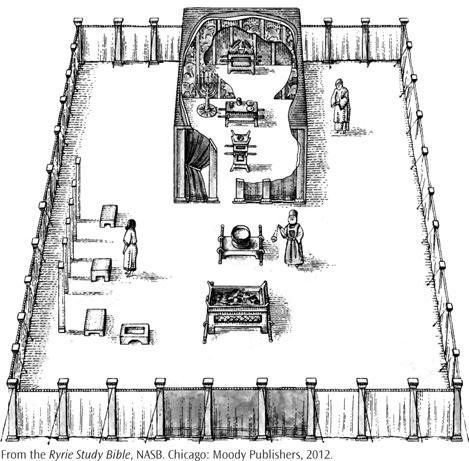
25:9. The pattern of the tabernacle (25:9b) as given by the Lord Himself to Moses was to be followed carefully, just so you shall construct it (25:9c). The tabernacle was both a court (a self-contained compound) and a building (the tabernacle proper) within the court and compound. The tabernacle was apparently a rectangle, placed inside an oblong compound (of two perfect squares; 27:9-12, 18). There was only one opening on the east end. The structure was always set up with the entrance on the east and the holy of holies in the western end of the compound, probably so the ark was at the center of the western half (square) and the bronze altar at the center of the eastern half (square). From the entrance one would see the bronze altar; the laver was next (and may have been placed to one side); next came the tabernacle proper, with its two chambers: the holy place and the holy of holies (cf. 26:33).
2. The Ark of the Covenant: Symbol of the Lord’s Holy Presence (25:10-16; 26:34; 37:1-5)
25:10-16; 26:34; 37:1-5. The center (both in a literal and figurative/spiritual sense) of the tabernacle was the ark of the covenant, “clearly the most sacred of all the pieces of furniture in the tabernacle” (Hamilton, Exodus, 459). Kaiser notes the ark “is mentioned 180 times, thereby stressing its importance” (“Exodus,” 454). Actually, this was merely an oblong wooden box, (’aron, “chest”), albeit overlaid in gold, but it had “transcendent significance!” With the lid, the mercy seat, it was the only object in the holy of holies. It was two and a half cubits (about 3 feet 9 inches) long, one and a half cubits (about 2 feet 3 inches) wide, and one and a half cubits (about 2 feet 3 inches) high. It had four feet or posts, one on each corner, and rings on each of the feet, through which poles, also of acacia wood overlaid with gold, were installed to carry the object; in the case of the ark (unlike other furniture with rings and poles) these poles were never to be removed (25:15).
Tabernacle
The ark was to serve as the depository of the two stone tablets (25:16, 21; 40:20) referred to as the testimony (cf. Dt 10:1-5, “tablets,” “Ten Commandments”). Later the ark contained the manna and Aaron’s rod (cf. Heb 9:4-5). Numbers 4:5-6 reveals that the ark was to be covered when being transported; no doubt this was for protection from the elements but also to prevent it from being seen.
3. The Mercy Seat: Symbol of Propitiation (25:17-22; 37:6-9)
25:17-22; 37:6-9. Kaiser notes that “[William] Tyndale was the first to render this word [the term kapporet (‘atonement cover’)] as ‘mercy seat’ followed in 1534 by Luther’s translation” (Kaiser, “Exodus,” 454). Indeed, “atonement cover” is an appropriate title for this object since “atonement” is a central rationale for the entire tabernacle and sacrificial system, and this object is a focal point of the tabernacle. This lid of the ark was solid gold; the description pure gold (here and in reference to other items, e.g., the lampstand) should probably be understood as “solid gold” since the technology of the day was unable to make “pure gold” as this is understood today.
The mercy seat featured two cherubim, one at each end, facing each other, wings extended and touching. The cherubim were a class of angels and were associated with the transcendent, glorious presence of God (Ezk 10:1-22). Images of these creatures were also woven into the decorations of the curtains in the holy place (cf. 26:1, 31). The term “mercy seat” comes from a Hebrew term “to cover,” and conveys the idea of “atonement”; it is the focal point of the Day of Atonement ceremony (cf. Lv 16), on the only day of the year when the high priest was allowed to enter the holy of holies. On that day the blood of a sacrifice was sprinkled on the mercy seat and accomplished the “covering of sin” for the nation for one year. The symbolism was clear: above was the Shekinah glory of God (cf. 40:34ff.), in the ark was the law (the “testimony”) and between on the mercy seat, was the atoning blood.
“The ark of the covenant with the mercy seat was quite clearly the most important object in the tabernacle proper” (Davis, Moses and the Gods, 264) No one saw it, but they knew it was there and that this was where He was: There I will meet with you; and from above the mercy seat, (cf. 1Sm 4:4) from between the two cherubim (25:22). The central meaning of human existence on planet earth was to have a relationship with God that brings Him glory; this tabernacle was a symbol of how that relationship might be made viable. It brought God near: it provided for propitiation (the Gk. word often translated “propitiation” in Rm 3:25 refers to Jesus as the “mercy-seat”; see the comments there), it offered atonement for the sinner and it made the nation’s worship acceptable.
4. The Table of Showbread: Symbol of Physical Provision (25:23-30; 26:25; 37:10-15)
25:23-30; 26:25; 37:10-15. The table was also made of acacia wood and overlaid with gold and decorated with gold. It was a rather narrow table, as tall as the ark but shorter and not as wide (i.e., two cubits long, one cubit wide and one and a half cubits high). This table was to be placed on the north side of the holy place inside the tabernacle. The details concerning the border and the relatively wide rim (a handbreadth 25:25) indicate this was to be not only a beautiful work of the craftsman’s art but a functional table. The rim, obviously, was meant to keep things from falling off easily. The table was supplied with rings and poles (similar to the ark) to facilitate transporting it and the appropriate “tableware” (pans, jars, bowls) to be used for the various offerings presented there.
The main use of the table was as a display for the bread of the Presence (25:30). This bread, which was to be placed on the table each week on the Sabbath (a new batch of twelve loaves each week; see Lv 24:5-8), was not a “meal for God” (as such offerings were often meant in pagan shrines). It was not to be eaten by anyone other than the priests (who were permitted to use it for their own food, Lv 24:9). The twelve loaves were symbolic of the participation of the twelve tribes in the table fellowship with the Lord; this tabernacle made this “fellowship” possible, the bread was in His Presence and the tribes were there by proxy in the persons of the priests. The bread was no doubt symbolic as well of the physical provision the Lord gave to the nation; “The bread itself perhaps represents the Lord’s provision of the basic necessities of life for His people (see Mt 6:11; Lk 11:3)” (Youngblood, Exodus, 120). Davis notes, “The loaves furthermore point toward Jesus Christ who was the bread of life (John 6:32, 35). As the bread of the table supplied the priests, so Jesus Christ meets the needs of His” own (Davis, Moses and the Gods, 265).
5. The Golden Lampstand: Symbol of Spiritual Provision (25:31-40; 26:35; 37:17-24)
25:31-40; 26:35; 37:17-24. The solid gold lampstand (menorah) stood on the south side of the holy place opposite the table of showbread. This lampstand was not built to burn candles (because candles were not invented until Roman times) but oil. It weighed one talent (about seventy-five pounds; 25:39), crafted from one piece of gold (29:36). Its base supported a shaft (25:31) that held six branches, three on each side (25:32-33), with one lamp atop each branch and one atop the shaft, for a total of seven lamps. Made themselves of gold, the lamps were shaped into cups, bulbs (technically a “calyx”, the cup-like structure of petals forming a small flower), and flowers designed to resemble the flowers of an almond tree. Although the exact appearance of the lampstand is unclear, the purpose and basic design is plain. In some fashion oil was poured into a reservoir on each branch and in turn each reservoir fed another cup that held the burning oil. The oil used was to be clear oil of beaten (crushed) olives (27:20).
Each morning and evening someone serviced the lamps (30:7-8; Lv 24:3-4); “trimming” is not the right word for this service since these were not candles. The term trims (30:8) means “to cause to ascend,” indicating that perhaps the oil reservoir was below the cup and oil was somehow fed up to it. These lamps were to be kept burning continually (27:21).
The lampstand had a practical purpose, providing light in the windowless and shrouded inner tabernacle. It also had a symbolic purpose, signifying the “illumination” the Lord gave by His presence, since His presence was “revelatory.” Also, the lampstand had typical significance pointing to “Jesus Christ who is the True Light (John 1:6-9; 8:12)” (Davis, Moses and the Gods, 267).
6. The Tabernacle Itself: Symbol of God’s Personal Presence (26:1-30)
26:1-30. The overall construction of the area comprising the holy place and the holy of holies (26:33) formed a trellis-like structure with a framework covered with several layers of curtains. The first layers consisted of linen curtains dyed blue and purple and scarlet (26:1) and cut to precise lengths. These curtains were decorated with cherubim (26:1), and suspended in a series of loops (26:4-5), probably alternating the colors, with golden clasps (26:6). Over these layers were laid eleven layers of goats’ hair curtains (26:7; no doubt shutting out all outside light) and then layers of rams and porpoise skins (26:14; perhaps for soundproofing and no doubt for waterproofing).
Underneath all of these layers was that trellis-like structure itself made of acacia wood boards (26:15ff.; more than likely these were not “planks” but “frames,” “ladder like” objects) that acted as the “uprights” of the trellis. “There were forty-eight frames in all, twenty each for the north and south sides, six for the west side, and two at the rear corners, most likely for added support ([26:]18, 20, 22, 23)” (Hamilton, Exodus, 471–72). It could be that the description they shall be double beneath … complete to its top (26:24) means these frames were wide at the bottom and tied together at the top forming an A-frame, another reason to have two on each corner. The bars (26:26ff.) were the “cross-ties” and there were fifteen of them, five to each side (26:26-27). Finally there was one central cross bar (26:28). These boards (or frames) and bars were to be assembled with a “tenons and sockets” system that made the structure sturdy when erected but easy to disassemble and reassemble. Like the court, the tabernacle itself opened to the east.
7. The Veil and Screen: Symbol of God’s “Hiddenness” (26:31-37)
26:31-37. Two curtains featured prominently in the holy place. One curtain or screen (26:36) covered the opening on the east (court side); this was made of linen and dyed in the same colors as the linen layers that were over the tabernacle itself, blue and purple and scarlet (26:36; cf. 26:1). It was suspended on five pillars of acacia and held on by golden hooks (26:37). Another curtain (a veil, 26:1) hung between the holy place (which held the altar of incense, the table of showbread and the lampstand) and the holy of holies (which contained the ark and mercy seat). Only the high priest could open this second curtain (Lv 16:11-12), and only once each year (Lv 16:2, 34) during the Day of Atonement ceremony (Lv 16:29-30).
These items “hide” God even though He is “near.” Although He was “with them,” He was still the “transcendent God.” In the temple of Herod’s day this inner curtain was no mere linen veil (see Alfred Edersheim, The Life and Times of Jesus the Messiah, vol. II, [London: Longmans, Green and Co., 1900], 609), yet Mt 27:51 records that upon Jesus’ death “the veil of the temple was torn from top to bottom”; see the comments there. This was meant to convey two truths: the death of Christ opened the way into the presence of the Holy God as no other sacrifice could (cf. Heb 4:16; 10:19) and also that it was God alone, “top to bottom”, who made this access into “the throne of grace” possible.)
8. The Bronze Altar: Symbol of the Need for a Sacrifice for Sin (27:1-8; 38:1-7)
27:1-8; 38:1-7. This altar was a large box; at five cubits by five cubits by three cubits high (or approximately seven and a half feet by seven and a half feet by four and a half feet) it was the largest piece of furniture in the tabernacle. Made of acacia wood and overlaid with bronze (27:1), its center was hollow except for a grating (27:4); there the coals would be placed to burn the sacrifices. (It was called “the altar of burnt offering” in Lv 4:7, 10, 18.) The inside of the box probably was lined with earth when the fire was burning (to keep the box itself from igniting); workers could remove the earth for easy transport when necessary. Craftsmen created bronze implements for removing the ashes of a sacrifice (shovels, basins, forks, firepans, 27:3).
Four horns adorned the altar, one on each corner; these were essentially vertical corner extensions probably stylized to resemble the horns of an animal. The horns were used to tie up and suspend the sacrifice over the fire (27:2; cf. Ps 118:27). The horns themselves would be smeared with the blood of the sacrifice (Ex 29:12; Lv 8:15; 9:9; 16:18) to sanctify it to receive the sacrifice. The altar was fitted with rings through which poles, also of wood covered with bronze, could be installed to facilitate carrying the altar.
As noted, the altar was the first object a worshiper would see on entering the court; it was a powerful reminder that sin separates one from God and that sin means death. It spoke of the absolute necessity for atonement if one were to approach the Lord. “The slaughter of animals on this altar was a very vivid reminder to Israel that sin indeed requires a high price. It was not a pleasant thing to see an innocent animal slaughtered and burned, but then sin is an ugly thing and the sacrifice here, as well as at Calvary, should be a vivid reminder to everyone of the hideousness of sin and its price” (Davis, Moses and the Gods, 272).
9. The Court: Symbol of Separation (27:9-20; 38:9-20)
27:9-20; 38:9-20. A series of bronze pillars marked off the court/courtyard/compound. Between the pillars curtains were suspended, attached with silver hooks (27:10). Made of fine twisted linen (27:9) five cubits high (27:18) or approximately seven and a half feet high, the curtains kept “casual eyes” from observing what was happening in the tabernacle area; activities inside the courtyard were solemn and serious and were not to be viewed nonchalantly. The curtains of the entrance were unlike the rest of the curtains that made up the court (27:16), identifying the only way in to the court and tabernacle.
10. The Priests of the Tabernacle (27:21–29:46)
a. Priestly Functions (27:21–28:1)
27:21–28:1. The priests oversaw the ongoing operation of the tabernacle, and the whole nation needed to recognize the priests’ position (authority and duties). The priests were consecrated for their duties, which needed to be clearly articulated or else this effort to build the tabernacle would be in vain. How unlike the times before Moses: “In pre-Mosaic times the office of priest was occupied by the father of a family (cf. Jb 1:5) or the head of a tribe …, for example Abraham, Isaac, and Jacob built altars and offered sacrifices (Gn 12:7; 13:18; 26:25; 33:20; 35:1, 2). Other pre-Mosaic priests included Melchizedek, Genesis 14 and Jethro, Ex 2:16; 3:1)” (cf. Davis, Moses and the Gods, 278). However, the role of the priest in service to the tabernacle was unique.
The most detailed set of instructions concerning the priests is given in Leviticus chaps. 1–8. (See commentary on Lv 1–8). The priest’s primary role was as a mediator between God and man (standing before God on behalf of others), and his basic functions were sacrifice and intercession (prayer). The priest’s duties took place in the tabernacle (27:21a; in the tent of meeting) and before the LORD (27:21b). Davis notes, “The idea of a priesthood naturally implies a consciousness of sin and the need for mediatorial representation” (Davis, Moses and the Gods, 278).
The priest’s work alternated between the maintenance work in and on the tabernacle (cf. 30:7-8) and the spiritual work of a mediator (cf. 29:38-44; Lv 9:22; Nm 6:23-27).
“The priests were not self-appointed mystics or cultists that rose [to prominence and position] by their own power in Israel. They were selected by God and had to be descendants of Aaron” (Davis, Moses and the Gods, 278). Exodus 27:21 simply identifies Aaron and his sons as the authorized persons to perform functions in the tabernacle (this is the first verse in the OT to explicitly tie Aaron and his sons to the priestly service), and 28:1 identifies Aaron and his sons, Aaron, Nadab, Abihu, Eleazar, and Ithamar, as priests. The Lord said explicitly that these men are called to minister as priest to Me; that phrase is repeated twice more (28:3, 4), making it emphatic. This office was not one a man could aspire to or assume on his own authority; it was not an office intended to elevate the man but to meditate between God and Israel. Everything about the priests, their clothes, their duties, their role, was designed to focus on the office and the function of the man. The quality and character of the man under the clothes counted, but only so far as the man’s character did not defile the clothes or demean the office. In his person he did not contribute to the value and vitality of the position, He could detract from it but it was all about the office and it was all about the mediatorial function.
b. Priestly Garments (28:2-43; 39:1-31)
28:2-5; 39:1. God describes the garments of the priests as holy garments … for glory and for beauty (28:2). They were designed to impress. (This was much like a case in which “the clothes made the man.”) They were unique, unlike the daily wear of the common person. This was for an obvious reason: The priests performed unique duties so unlike those of the common person. In addition their clothes, sometimes referred to as vestments (clothing that indicates an office or position of authority) reflected the dignity and magnificence of the tabernacle itself. And in some instances these garments were to be functional in the sense that in some cases the very elements of the garments themselves were to be used by the priest to perform his functions and accomplish his duties.
“The priestly office was intentionally elevated in the eyes of the people. The apparel would serve to distinguish the priests as a class by themselves and in a certain sense above the rest of the nation. The distinctiveness of their garments would be a constant reminder to the priests themselves of their holy station and its demand for consecrated living” (Davis, Moses and the Gods, 283). For these reasons the work on these garments demanded especially skillful persons (28:3; cf. 28:8, 15).
The complete list and general description of the garments is given first (28:4-5; cf. 39:1) and then the descriptive details are furnished. The garments listed are the breastpiece, ephod, robe, tunic, turban and sash. The descriptive details do not follow the order of that list (although there does not seem to be any particular reason for the difference).
28:6-14; 39:2-7. The ephod was similar to an apron or coverall, yet made of made of the same beautiful materials and in the same colors as the curtains in the tabernacle itself (cf. 26:1). As the primary symbol of the priestly office (cf. 1Sm 2:18; 28; 14:3; 22:18), the ephod had a front and a back, made of linen, probably sleeveless, with (real) gold threads woven into the fabric (39:3-3). The two parts joined at each shoulder by a clasp or strap of gold (28:13-14); a band (28:8) secured the waist. The most striking features of the ephod were the two onyx stones atop each shoulder in a setting on the clasp or strap. Each of these stones bore the engraved names of six of the twelve tribes of Israel (28:9-12). The significance was clear: the priest was representing the whole nation every time he put the ephod on. These stones were memorial stones for the sons of Israel (39:7).
28:15-30; 39:8-21. The instructions concerning breastpiece exceeded those for any other item, thereby highlighting its importance. Made of the same material as the ephod and attached with gold cords and rings (28:24-28; 39:15-21) to the front of the ephod, the breastpiece was folded double to be made in a square (28:16) of about nine inches (a span). In all likelihood this was a pouch of some sort and it was worn over the high priest’s heart (28:29). Mounted on this were four rows of precious stones (28:17-20; 39:13), three in each row, that again, represented the twelve tribes since the names of the tribes were to be engraved on the these stones (28:21; 39:14). Thus every time the high priest entered the holy place he carried the nation with him (28:29).
Among the more notable (and mysterious) parts of the breastpiece were the Urim and Thummim (v. 30); the terms mean respectively “lights” and “perfection.” They apparently helped the high priest to determine the will of God (cf. Nm 27:21) in a manner not clearly understood today. Some have suggested that they were used as sacred lots (something like modern dice) to gain yes and no answers to specific questions. However, it might be that these objects were only symbolic of the high priest’s special authority as the Lord’s spokesman; in other words, when the priest was wearing these stones he was speaking for God (cf. Davis, Moses and the Gods, 286; Kaiser, “Exodus,” 467).
28:31-35; 39:22-26. The robe of the high priest was worn under the ephod. The blue robe was slightly longer than the ephod, reaching to the knees. This seamless, one-piece covering “had slits for the arms and a hole for the head to pass through” (Kaiser, “Exodus,” 467). Blue, purple and scarlet bits that looked like pomegranates adorned the hem,. These “pomegranates” alternated with a row of golden bells all around on the hem of the robe (28:34). The bright colors and pomegranates would have made the high priest stand out, and the golden bells would have made him sound off. The sound of the tinkling bells as the high priest moved within told those outside the holy place that the unseen priest remained alive in his godly duties, obeying and pleasing God.
28:36-38; 39:30-31. The turban or miter was the headdress of the high priest and was both literally and figuratively the crowning feature of the high priest’s regalia. This turban probably consisted of folded fabric around the head, the sort of thing made familiar in pictures of men from the Middle East and Islamic countries today. On its front hung a plate of pure gold attached with a blue cord (28:37). The plate had a most significant engraving: Holy to the LORD (28:36). (It should be noted that the description of this item started with this plate.) This plate was more than likely the first item people would have looked at when seeing the high priest, and they would have noticed it repeatedly when the high priest was in view, appropriately dominating the whole outfit. And it should have, because it “indicated the very essence of Israel’s worship” (Davis, Moses and the Gods, 287). The high priest had to be Holy to the LORD (28:38) because the entire venue was a testimony to the “Holiness of the LORD,” and the whole process was to make the worshiper “holy to the Lord.”
Wearing this turban and this plate with this inscription qualified the high priest (as one who bore the sanctifying presence of the Lord into the holy place) to take away (lit., “bear”) the iniquity of the holy things, that is, to sanctify fully all the holy gifts that made up this tabernacle and made them accepted before the LORD (28:38).
28:39-43; 39:27-29. The rest of the items of clothing mentioned were to be worn by all the priests. The tunic (28:39) was a long white linen garment worn over the underwear, the linen breeches (28:42), but under the blue ephod; modesty was the point of this item (28:43). The tunics, caps, and sashes of the ordinary priests (28:40-43; 39:27-29) were simple yet intended to display the same glory and beauty (28:40) as the rest of the features in the tabernacle.
Summary. The details with which the garments of the priests are described and the care that was taken to make them just as the LORD had commanded Moses (39:1, 5, 7, 21, 26, 29, 31) reinforces once again the major lesson from these chapters: the Lord cared about how He was to be worshiped. All of this was designed to make the people aware of what was going on and to think carefully about what was happening. “Conscious faith is central to religious ritual…. In other words, a person’s belief about what he or she is doing in a religious act is essential to the validity of that act” (Stuart, Exodus, 615). All of this was to make individual worshipers realize: “I am worshiping a holy God here” and to reorient their minds and hearts toward God.
c. The Consecration of the Priests (29:1-46)
29:1-46. Once the garments of the priests were ready, the appropriate individuals and Moses clothed themselves in order to consecrate them[selves] that they may serve the Lord as priests (28:41). Consecrating the priests simply meant setting them apart to minister as priests to the Lord (29:1a).
The service for consecrating the priests (29:2-9; cf. Lv 8) began with sacrifices (29:1b) and offerings (29:2-3). The animals were to be without blemish (29:1). This would have indicated to the worshiper that the sacrifice had to be pure and acceptable to God. Also, there was cleansing with water (29:4), again highlighting the need for purity and sanctification of the priests to make the sacrifices and offerings acceptable. The service then continued with a solemn ceremony of investiture, that is, actually providing the high priest with the regalia and the garments appropriate to his office (29:5-6). Then the priest would be anointed with oil (29:7) and finally, all the priests were provided with tunics, sashes, and caps appropriate to their calling (29:8-9).
After giving the summary of the service, Ex 29 describes the sacrifices in greater detail. Davis summarizes, “The sacrifices consisted of one young bullock for a sin offering, one ram for a burnt offering and the ram of consecration” (Davis, Moses and the Gods, 289). Three times the priests were to lay hands on the sacrificial animals (29:10, 15, 19). The priest laying hands on the animal symbolized the transfer of guilt (imputation) from the guilty to the innocent. This was a key feature of the entire sacrificial system (cf. Lv 16:21-22; cf. 1Pt 2:24; Is 53). The concepts of transfer and imputation point to a system and theology of substitution. Combined with the act of slaying the animal, the entire scene pictured penal substitution.
In the consecration ceremony, the priests killed the animals and applied the blood: with the bull’s blood the altar was cleansed (29:11-14); with the ram’s blood propitiation (appeasing God’s wrath) was accomplished (29:16-18); with blood from the other ram the priests were cleansed and consecrated (29:20-21). The entrails and the bread and cakes were used for wave or heave offerings (29:24, 28). These offerings were obviously so named for the action of the priest waving and holding up the sacrifice symbolically before the Lord (“See this!” See Lv 7:30-32). The significance of such offerings is indicted by the terms peace offering (29:28). A peace offering (cf. Lv 7) was in a sense celebratory, a joyful act symbolizing the peace now enjoyed (after the sin and guilt offerings had been made and accepted by the Lord) between the worshiper and God. (For a much fuller treatment of all this, see commentary on Lv 1–8.)
The final paragraphs of this chapter (Ex 29) provided further regulations for the priests and their duties. The high priest’s garments were to be passed down to succeeding generations. They were to be reused, not remade (29:29-30); this allowed continuity across generations. The offerings became food for the priests, but laymen were expressly forbidden to consume the flesh of a sacrifice or eat the bread that had been a part of the offerings (29:31-34); this prevented the sacrifices from becoming a mere commodity. The ordination ceremony was to last for seven days (29:35-37); this made it a memorable event. Some details were given concerning the daily sacrifices and how they were to distinguish between morning and evening sacrifices (29:38-41; cf. Nm 28:3-8); this would give order and symmetry to the daily activity of the priests.
Finally, the continual burnt offering (29:42) was to be a reminder and promise of the Lord’s intention to meet with the nation in this tent of meeting (29:42-44) and to do so through the mediatorial work of the priests (29:44). This tabernacle was the culmination of what had been God’s intention through and since the actual exodus itself—it was that I might dwell among them, because I am the LORD their God (29:45).
11. The Altar of Incense: Symbol of Prayer and Intercession (30:1-10; 37:25-29)
30:1-10; 37:25-29. In addition to the golden lampstand and table of showbread, the third piece of furniture in the holy place was the altar of incense. Like the other pieces, the altar was made of acacia wood and overlaid with gold (30:1, 3). It was one cubit in length and width and two cubits tall (30:2). Apparently, this was a smaller version, in gold, of the bronze altar in the court, complete with the horns on each corner. Like the other items, it was fitted with rings and supplied with poles to be inserted through the rings when the item was being transported. The altar of incense stood on the west side of the holy place just in front of the veil and so, in effect, just in front of the mercy seat (30:6).
As with the lamps so with the incense, the priest was to service the altar every day (30:7) and this practice was to be perpetual (30:8). No other incense (strange incense; see 30:34-38 and the discussion below on the sacred incense) and no other offering was to be placed on this altar except the atonement blood on the Day of Atonement (30:9, 10). The solemn pronouncement It is most holy to the LORD (30:10) was meant to reiterate the care and reverence the nation was to maintain in worship and devotion to God. This altar was symbolic of the nation’s prayers and praise; like this pleasing incense, the prayers of the people were to ascend continually to a glorious and gracious Lord God (cf. Ps 141:2; Rv 5:8; 8:3-4).
12. The Census (30:11-16)
See comments on 25:1-9.
13. The Bronze Laver: Symbol of Cleansing (30:17-21; 38:8; 40:30-32)
30:17-21; 38:8; 40:30-32. The bronze laver was essentially a washbasin made of bronze mirrors donated by the women who were serving the worshipers at the entrance (38:8). The laver may have been made in two parts, the main reservoir and under it another basin to be used for the actual washing; thus the priest would draw some water from the main bowl and pour it into the base of bronze, for washing (30:18). Significantly the laver was to be used by the priests not after the sacrifices were made but before they were made (30:20). It was another vivid reminder that God expected “clean hands and a pure heart” (Ps 24:3-4) from those who served and worshiped Him. The priest needed to be cleansed from the “defilement of the world” before he could serve the Lord (cf. Eph 5:25-26).
14. The Anointing Oil and Incense: Symbol of Consecration (30:22-38)
30:22-38. Moses was given special instructions (note the insertion of the phrase the LORD spoke to Moses; 30:22, 34) about the anointing oil (30:22-33) and the sacred incense (30:34-38). The holy anointing oil (30:25) was to be made from a precise recipe using the finest of spices (30:23), the most expensive ingredients. Myrrh is mentioned frequently in the Bible; perhaps the best known instance being as one of the gifts of the magi to the infant Jesus (Mt 2:11). Made from the gum or resin from the tree of the same name, myrrh had many uses. A second spice, cinnamon, can come from both the oil of the crushed nut produced by the blossom of the tree by the same name and the shavings of the bark from that tree. Cassia is the oil of the blossom of the cinnamon tree. Cane was probably the pith from the root a reed plant. Olive oil made up the base of the mixture.
This special oil was used extensively to anoint the structure of the tabernacle, the furniture, the furnishings, and the utensils (30:26-28). The purpose was to mark and distinguish these items so that that they would be considered most holy (30:29), separated for sacred use. In addition, this oil was to be used to anoint the priests to consecrate them (30:30). This oil, in this formula, was to be reserved for this use and not reproduced for any other or common use, for to do so would undermine its value for identifying that which is to be considered “sacred” and “consecrated.” Anyone caught violating this restriction would be cut off from his people (30:33). Hamilton notes, “‘Cutting off’ a person is a metaphor borrowed from the felling of trees” (cf. Jr 11:19) (Hamilton, Exodus, 516). It was a euphemism for execution.
Likewise the sacred incense was to be made from a precise formula of expensive spices (30:34), processed with great care (30:35), and used in the tabernacle and nowhere else. It too was to be considered most holy to you (30:36, 37). Again, the Lord expressed the singular significance He attached to even this minor aspect of the tabernacle system and His worship by decreeing the death penalty for any who would violate this injunction and use this perfume for a common purpose.
15. The Builders of the Tabernacle (31:1-11; 35:30-35; 36:1-2)
31:1-11; 35:30-35; 36:1-2. Several texts indicate the vital importance of the skilled craftsmen. The Lord’s insistence for skill and skillful workers (31:6) and skill to perform every work (35:35) necessary for the tabernacle is woven throughout Moses’ instructions (cf. 26:1, 31; 28:3, 6, 8, 15, 27; 29:5). Of the many skilled craftsmen who worked on the tabernacle, the passage names only two: Bezalel (whose name means “in the shadow of God,” indicating “protection”; note 31:2; 35:30; 36:1-2) and Oholiab (whose name means “the father [God] is my tent”; see 31:6; 35:34; 36:1-2). These two men probably served like foremen, leaders in some capacity over the other skilled men (and women; cf. 35:25-26).
While all the craftsmen were filled with skill (the Hb. word is lit., “wisdom”) (31:6; 36:1), only Bezalel was said to be “filled with the Spirit of God” (31:3; 35:31, in wisdom, in understanding and in all knowledge and in all … craftsmanship). This likely means he was provided with a spiritual giftedness that enabled him to use his “technical skills” (either natural or acquired) in exactly the way the Lord wanted them used and this project required them to be used. (“In fact, ‘being filled with the Spirit’ is a biblical idiom for ‘having from God the ability to do and say exactly what God wants done or said’”; Stuart, Exodus, 650–52.) Thus, it would seem that the “skillful” were already capable craftsmen who were given increased facility in their area of expertise in order to work on the tabernacle. Not only did they execute the necessary works of skilled craftsmanship but they taught others how to perform the work as well (35:34). Hamilton notes, “It is of some interest that the first ‘Spirit-filled’ individual in the Bible” is not a patriarch or prophet or priest but “a construction foreman, Bezalel. The Bible sanctifies the work and craftsmanship of the laborer as much as it does of the work of the patriarch or prophet or priest. What one does with one’s hands [can be] as sacred as what one does with one’s mind” (Hamilton, Exodus, 483).
The work of building the tabernacle required a wide variety of technical skills—metallurgy, carpentry, molding, wood-carving, metal engraving, sewing, embroidering, weaving, perfumery and overall design and more (cf. 35:10-19). The work occupied every skillful man (35:10). It would have been a singular privilege to work on the tabernacle, but it was a privilege enjoyed by many; and it was a merit-based privilege—any who had the skill were employed; anyone could work on the tabernacle without regard to his or her social position. In the Lord’s work all who were willing and able were welcomed.
16. Sabbath Reminder (31:12-17; 35:1-3)
31:12-18; 35:1-3. Inserted into His directives concerning the tabernacle, the Lord gave Moses a reminder about the Sabbath (31:12-17) and Moses later repeated that reminder (35:1-3). These reminders probably were given to reiterate the priorities of the Lord even in the context and process of tabernacle construction. The craftsmen were to understand that the Sabbath requirement still pertained even as they worked on the tabernacle. As Youngblood suggests, “The Sabbath passages in Ex 31 and 35 are obviously meant to warn Israel not to work on the construction of the tabernacle or its furnishings on the Sabbath day” (Youngblood, Exodus, 113).
The Lord made three points regarding this Sabbath observance. First, the purpose of Sabbath observance was to impress upon the nation that God is the One who sanctifies you (31:13); this was to be a day when one’s life was to be centered on the Lord. They were to “do” no work but they were to celebrate [lit., that term means simply “do”] the sabbath (31:16). Second, the penalty for violating the Sabbath was death (31:14, 15; 35:2). While this might seem to be a harsh penalty by modern standards, it impressed upon the nation the importance of that day and its purposes (rest, cf. 31:15, 17; 35:2, and devotion). Third, this Sabbath observance was meant to give the nation a transgenerational sense of national identity centered on the covenantal relationship that the Lord Himself had accomplished for them (v. 16). It was a perpetual covenant and the regular (perpetual) observance of the Sabbath was meant to be a reminder of that fact; it was a sign between Me and the sons of Israel forever (31:16-17). Just as the Noahic covenant had an outward sign (the rainbow, Gn 9:12-17) as did the Abrahamic covenant (circumcision, Gn 17:9-22), so the sign of the Sinai covenant was the Sabbath.
H. Apostasy and Aftermath (32:1–34:35)
These three chapters come between God’s instructions for the tabernacle (25:1–31:18) and the record of the actual construction of the tabernacle (35:1–39:31). They record a devastating act of apostasy on the part of the nation and an amazing act of grace on the part of the Lord. They are placed here to emphasize the need for the tabernacle, which at that point was still under construction. Without the constant lessons provided by the tabernacle itself and the service of the tabernacle, the people would follow the patterns of worship from the world in which they lived. If they did not have a divinely, graciously provided pattern for fellowship with God, they would invent one of their own making. But the Lord accepts only the way to God and true worship that He has shown and graciously provided.
1. The Golden Calf (32:1-29)
a. The Folly of Aaron and the People (32:1-6)
32:1-6. The account of idol worship begins after Moses had been delayed; this caused the people to fear that he was lost (32:1a). The people were foolishly impatient and fickle. Rather than allow Moses the time to receive the law from the Lord, they wanted events to happen in a time of their own choosing. This led to a god of their own making. Kaiser notes, “Without proper visible leadership, people fail” (Kaiser, “Exodus,” 478). This is true but in reality it was not Moses’ leadership that the people were missing. That they viewed Moses as the man who brought us up from the land of Egypt indicates that the people did not understand that the Lord Himself was their true “leader.” When Moses was around they had a leader, they concluded; but when he was absent they assumed they had no “leader.” Although the people could not see Moses while he was on the mountain, the people had never “seen” the Lord either, the One who really brought them up from the land of Egypt. Especially here, at the foot of Sinai, they should have “walked by faith and not by sight.” But without Moses in view, they wavered in their faith.
Furthermore, they had seen the manifestations of God’s power and majesty (cf. 19:18; so much for those who think seeing miracles are the key to engendering faith), and they knew that the Lord had called Moses up (cf. 19:21; 24:1). They knew their representatives had seen God (including seventy elders; cf. 24:9-11), and they had committed themselves to the Lord, to be obedient (24:3, 7). Their eyes should have been on, and their trust should have been in the Lord.
Their impatience and fear led to a foolish request (32:1b), Come, make us a god. The people were religious, they were spiritual, and they wanted to worship, but they had an inadequate theology.
The term god (’elohim) is plural, and this has generated several views. Some have suggested this was indicative that the people held to a form of polytheism. Others have proposed that this is simply a “plural of majesty.” Still others have offered that this is simply a grammatical necessity since the verb will go in the phrase who will go before us is plural; however, Davis notes, “Normally when ’elohim is used of the true God a singular verb is employed” (Davis, Moses and the Gods, 293). In other words, the use of ’elohim does not by itself indicate that the people had reverted to polytheism.
As the scene develops, it seems that the issue here is simple idolatry—they were not attempting to add another god to a pantheon, but they were attempting to worship the God who had delivered them from bondage (32:4) in this idolatrous form. In short it was not a matter of the people wanting more or newer gods but a case of trying to worship the true God by means of a “graven image.” Thus the golden calf was not merely a false god. Rather (as v. 4 seems to suggest) it was an attempt to depict the true God in a false way.
Acceding to the demands of the people, Aaron encouraged them to make a foolish contribution (32:2-3). They gave up their gold rings. This was a bad transaction. The people had contributed generously to the construction of the tabernacle (cf. 25:2-7; 35:21-24) but now they took their most precious personal possessions to be used to make a golden idol.
Aaron’s actions are described deliberately: He took, he fashioned, he made (32:4a). This emphasizes that while the decision to make this idol was rash, the action was deliberate. This took time, time that should have given Aaron pause to think about his actions. “Sometimes even the holiest of men, as Aaron, can be persuaded to do things contrary to their testimony” (Kaiser, “Exodus,” 478). This “thing” was probably not “solid gold” but a “cheap wooden knock-off” of some Egyptian god covered with the gold from the rings of the people. A molten calf meant it was made of “molten (melted and recast) metal,” here gold. The calf was probably chosen because it was common object of worship in Egypt and elsewhere; it was a symbol of virility and power. This was a blatant example of religious syncretism, taking parts of the (pagan) culture and trying to make them fit with what the Lord had revealed. This sort of idol was familiar to them and so it seemed right—it was what they were used to seeing in Egypt. Therefore, they thought they could use it to worship the Lord. That is how syncretism works.
Aaron’s declaration betrayed a foolish theology. This is your god, O Israel (32:4b). Again, this was not an attempt to change their faith because Aaron went on to say this was the one who brought you up from the land of Egypt. In other words, Aaron did not think of this as a change of gods but an improvement of the worship of the true God. (See 1Kg 12:28, where Jeroboam made the same claim when he set up the idolatrous shrines in Israel. Jeroboam’s motive seems to have been political as well. He wanted to keep his people from going to Jerusalem because it might tend to prompt them to honor the king of Judah, undermining his claim to the regency in Israel.) This is nothing short of blasphemy.
Aaron then made a foolish proclamation and promoted an idolatrous worship (vv. 5-6). In effect Aaron attempted to introduce a new holy-day and provided the people with an altar and offerings and a new way to celebrate it. This act was not merely foolish—it was degrading. The last line in v. 6, and rose up to play, implies some rather unsavory connotations; this was carnal, fleshly, sensual, and immoral play, “drunken orgies and sexual play” (Kaiser, “Exodus,” 478). This sort of behavior was fairly typical in conjunction with idolatry; cf. Gl 5:19-21; 1Pt 4:3.
Here was worship designed to meet the personal wishes of the worshipers. It was selfish (man-centered, it was something they liked), it was syncretistic (it took parts of the culture, the surrounding cultures’ religious practices, and tried to make them fit them with the worship of the Lord; it was something the world would have understood) and it was sensual (it had “sex appeal”). But it was blasphemous toward God and corrupting for the people.
b. Anger and Intercession (32:7-14)
32:7-10. Before Moses even knew what had happened in the camp below him, he faced the anger of the Lord up on the mountain. The Lord’s words must have been something of a shock to Moses, Go down at once. In contrast to the inviting and personal words He had previously spoken (cf. 24:1, 12), here the Lord’s words were “abrupt and detached” (Kaiser, “Exodus,” 478). Speaking to Moses, instead of “My people” (cf. 3:7), He called them your people. Instead of affirming that it had been His purpose to bring the people “out from under the bondage of the Egyptians” (cf. 6:6ff.), God identified the people as those whom you (emphasis added) brought up from the land of Egypt (32:7a). The Lord had verbally disowned them. Even before the sad events were explained to Moses, God’s indictment was pronounced: they have corrupted themselves (32:7b). This “renders the same verb found in Genesis 6:12 for the apostasy and corruption in Noah’s day. It means ‘to go to ruin or destruction’ (cf. Dt 9:6; 10:16; Ps 75:5; Jr 17:23; Ac 7:51)” (Kaiser, “Exodus,” 478). They had not just erred, this was not merely a “mistake in judgment” but they had quickly turned aside, they had rapidly and rashly fallen into iniquity and transgression. They had failed to walk in the way which I commanded them; they had missed the mark and fallen short (32:8a). Taking the definition of “sin” as “any want of conformity unto, or transgression of, the law of God” (Westminster Shorter Catechism, Question 38), the people had failed on both counts.
In His explanation to Moses (32:8b) the Lord related the information that was just recorded in the previous verses (32:1-6). As Moses was hearing it from the mouth of the Lord, it made for chilling and stunning news. The Lord related the actions of the people in something like verbal thrusts: they have made … they have worshiped … they have sacrificed (32:8). These thrusts culminated in a testimonial that must have been especially troubling to the Lord. The people were assured, This is your god, O Israel, who brought you up from the land of Egypt (32:8c). To hear His people profess devotion to a stupid, impotent idol and then give to that grotesque monstrosity the praise due to the one true God must have been particularly distressing and provoking to Him. Thus God’s anger began to rise. I have seen these people (32:9a) is a summary statement to indicate “I have watched them, I have answered their fears, I have supplied their needs, I have blessed them, I have preserved them and now I have seen them do this! All I have done for them and this is the thanks I get?!”
His indictment is, They are an obstinate (32:9b; lit., “stiff-necked”) people. The expression “stiff-necked” was used to describe the people with distressing frequency in succeeding narratives of the nation (cf. 33:3, 5; 34:5; Dt 9:6; 10:16; 2Ch 30:8; 36:13; Ps 75:5; Jr 17:23; Ac 7:51). The picture is that of a horse that refused to turn its head when the reins were pulled one direction or another by a rider; the nation often refused to heed the Lord’s direction. Ironically, they willingly bowed before an inert, stupid, lifeless idol but they stubbornly refused to bend before the living, sovereign Lord.
The Lord’s impatient response, let Me alone (32:10a), was meant to express to Moses the depth of God’s disappointment. To convey the depth of His sentiment, He spoke of His anger and even suggested that He may destroy them and start over with Moses alone (32:10b). This is an instance of anthropopathism, expressions describing a truth about the Lord using human (anthropos, Gk. for “man”) terms to describe God’s emotions. The emotions and feelings of the Lord are higher and holier than those of fallen human beings, but they are no less real and genuine. In this case the anthropopathic description reveals the pain or distress of God when His own people sin egregiously to their own destruction.
These words amounted to something of a test for Moses (e.g., Kaiser, “Exodus,” 479; Davis, Moses and the Gods, 296). Would Moses selfishly accept the offer to make of him a great nation, in effect a new Abraham (cf. Gn 12:2), or would he keep his faith in God’s promises? Would Moses trust the Lord, prove to be a faithful mediator, and intercede for the people? Moses “chooses the role of intercessor over that of patriarch” (Hamilton, Exodus, 538).
32:11-14. Moses recognized the seriousness of the situation and lost no time in beseeching and imploring (he entreated) the Lord (32:11a). Moses offered four reasons for the Lord to relent, to turn from, to not do what He said He would do … what He “felt like doing.” First, he recalled how God Himself had delivered these people from bondage in Egypt. In effect Moses was saying, “Remember Lord, these people, who have just aroused Your anger were the same ones who had aroused Your compassion when they were in bondage” (32:11b; cf. Ex 2:23-25; 3:7, 9). God had just (speaking to Moses) called the people “your people” but Moses returns to the covenantal language the Lord had previously used and referred to them as “Your people.” Moses was appealing to the Lord’s previous expressions of love and concern for the people.
Second, he reminded the Lord of the great power He had displayed and the demonstration of His mighty hand in delivering them (32:11c). That work would prove to be futile if the Lord gave up on them now. In effect, “You provided an astonishing deliverance for them; it would be a shame for all that to be for naught.” Third, Moses pointed out that the Egyptians would be watching; if the Lord destroyed this nation it would give the Egyptians an opportunity to gloat over God (32:12a). The Egyptians might conclude that He was foolish to deliver such a people from bondage. Or worse, perhaps they might think that He was really an evil deity and that the deliverance was a nasty trick to get them to a place where He could destroy them. The great testimony to God’s justice and compassion in delivering His people from bondage would be lost. Fourth, Moses recalled the covenant promises to the fathers, Abraham, Isaac, and Jacob (32:13a). These men are identified as Your servants and the promises of many descendants and all this land are recalled (32:13). These promises were sovereignly decreed (You swore … I will … I will) and intended to be everlasting (forever) (32:13b). Moses directly pleads with God: Turn from Your burning anger and change Your mind (32:12b). In a way, he was asking God to “keep His word,” to “hold on to His original intention” to bless this nation as He had promised and abandon any thought of terminating them.
In response to Moses’ intercession, God changed His mind (32:14) away from the threatened destruction and back to His first plan, namely the fulfillment of His covenant promises. In effect, this “repentance” was not really a change of mind. It was an expression of His intention to remain who He is, constant and faithful. The term “repent” (KJV) is “a translation of the Hebrew word naham meaning ‘to be sorry, move to pity, have compassion.’ This word is used thirty times in reference to God and in each case He changes His mind or intention in accord with His righteous purposes and takes action commensurate with that purpose” (Davis, Moses and the Gods, 297).
This repentance does not mean that God has literally “changed His mind” about what He intended to do. Rather, “when God is said to repent, it indicates 1) his awareness that the human situation has altered and 2) his desire to act in a way fitting to this changed situation.” (Bruce A. Ware, God’s Lesser Glory: The Diminished God of Open Theism [Wheaton, IL: Crossway Books, 2000], 90) Thus the “change of mind” is not the Lord’s but the people’s, and in the light of that He returns to, or rather remains committed to His original purpose—namely to bless this people. “The grounds for the Lord’s repenting are three: (1) intercession (cf. Am 7:1-6); (2) repentance of the people (Jer 18:3-11; Jonah 3:9-10); and (3) compassion (Dt 32:36; Jdg 2:18; 2 Sam 24:16)” (Kaiser, “Exodus,” 479).
c. Confrontation: Moses Against Aaron and the People (32:15-29)
Having averted the disaster of God’s anger, Moses now returned to the people to deal with this calamity. From his heartfelt intercession before the Lord he turned to heated confrontation with the people and Aaron.
(1) A “Heavy” Descent (32:15-18)
32:15-18. Moses not only had to carry the two stone tablets of the testimony but he also, no doubt, had to carry a heavy heart as he considered the words of the Lord and what he had to face after he descended the mountain and returned to the people. “This is the only passage that informs us that the ‘two tablets of the Testimony’ were inscribed ‘on both sides’ (32:15)” (Kaiser, “Exodus,” 479). The text here says that the tablets were God’s work and the writing was God’s writing (32:16) and yet 34:28 says that Moses “wrote on the tablets.” This is not a contradiction but an affirmation of “verbal plenary inspiration” (meaning that the inspiration of Scripture extends to the individual words and included all of Scripture, cf. Charles C. Ryrie, Basic Theology [Chicago: Moody, 1999], 76–82). When Joshua heard the noise from below the mountain he presumed that it must have been caused by a battle of some sort in the camp. Joshua’s reaction to the tumult showed he had a good heart. His first thought was the people were being attacked and he apparently did not suspect that the people were capable of such sinful behavior and gross idolatry. Moses poetically corrected him (32:18 is in poetic verse) and he sang a short song about the singing below. It was not, as Joshua assumed, a war cry but singing, and it was not a joyful noise unto the Lord but the cacophony of pagan-like worship.
(2) A “Hot” Confrontation (32:19-20)
32:19-20. As Moses approached the camp and saw the calf and the dancing, his reaction was swift and violent. The expression Moses’ anger burned does not sufficiently express the depth of his fury. The popular expressions “he exploded” or “he was infuriated” are accurate renderings of the level of his ire. He smashed the tablets, shattered them at the base of the mountain (32:19). This may have been a hasty act but it was also symbolic one: the people had shattered the law by this idolatry and debauched worship, so Moses shattered the tablets! Moses then reduced the idol to ashes and cast the ashes on the water and made the people drink the water. This would not be difficult to do since (as noted above) this was probably a mostly wooden idol overlaid with gold so it would have burned easily. The strange and dramatic act of making them “drink the ashes” was a way to humiliate them (cf. Is 44:20, where the idolater is said to “feed on ashes”). It was a shameful punishment for a shameful act of infidelity to the Lord (cf. 2Ki 23:15).
(3) A “Heated” Conversation, Moses vs. Aaron (32:21-24)
32:21-24. Moses then turned to Aaron. The conversation was in many ways predictable. First Moses accused Aaron of bringing a great sin upon the nation (32:21b). There is a subtle indication that Moses considered Aaron’s actions even more egregious than that of the people: What did this people do to you that you have done this to them? (32:21a; in effect, Moses said, “Aaron, you could not have done more harm to the people if you meant to do it!”). Aaron’s response was threefold (and again predictable). To start with he blamed the people (32:22-23a), claiming that they were the ones who demanded a god be made. In fact, the specific charges Aaron made about the people, that they were prone to evil (32:22c) and that they were making unrighteous demands (32:23a), should have been the exact reasons for Aaron not to give them what they were asking for. Second, Aaron suggested that the cause of the people’s angst was Moses’ delay (32:23b), thereby subtly suggesting that in a sense it was Moses’ fault. Finally, he offered the preposterous suggestion that the idol was self-generated and therefore, miraculous—the spontaneous result from tossing the gold he had collected into the fire (I threw it into the fire and out came this calf, 32:24). So he was saying in effect, “I didn’t make it! It made itself!” (One wonders if such reasoning by a youthful Aaron had worked with his mother Jochebed?)
These rationalizations are so transparently bad and implausible that Moses did not even bother to refute them. Aaron stood condemned by his own foolish excuses. He is a profile in failed leadership, for a leader fails when he blames others and suggests events are just out of his control.
(4) A Harsh Division (32:25-29)
32:25-29. Moses then acted to separate the true infidels from those who had merely been “led astray.” At this point the situation was completely chaotic (32:25); the people had cast off all restraint and they were out of control (32:25; the term [pr‘] is used twice). This term has the idea of “loosening” or “uncovering.” This chaos would have been a cause for ridicule had the enemies of Israel witnessed it (32:25c). Moses called out from the gate of the camp, a place where he could make himself heard and seen: Whoever is for the LORD, come to me (32:26a; lit., simply “to me!”). This would have stunned the whole camp and brought the celebration to a halt. This would then have given a chance to those who were mere bystanders to the debauchery an opportunity to separate themselves from it. Given the chance to make a “clean break” from the folly, idolatry, and immorality, the sons of Levi gathered together (32:26b). Moses’ instructions (32:27) to the Levites might seem to some to be rather harsh, even extreme: Every man of you put his sword upon his thigh … and kill every man his brother, and every man his friend, and every man his neighbor. However, it would seem (considering the actual number struck down was about three thousand, 32:28b) that only those who persisted in the idolatry and debauchery were executed. The punishment was severe indeed, but not overly harsh given the crime and the real danger it posed to the fledgling nation. This blatant instance of unfaithfulness and idolatry required swift and definite punishment for the sake of the nation’s purity before the Lord and its future devotion to the Lord. And yet, even though it was just and necessary, it would have been difficult for the Levites to carry out, for these were fellow Israelites, not enemies. They were brothers and friends (32:27b).
Nevertheless, they knew it had to be done. In this work, in this clash between truth and error, there was no neutrality; there could be no halfway covenant. Idolatry, especially of such a brazen nature, simply could not be tolerated. Idolaters had to be cut off (cf. Ex 22:20; Dt 7) to preserve the nation as the people of God, separate and distinct. The action was no doubt bloody and heartbreaking; it took “dedicated men” (32:29a) and yet it yielded a blessing for those men who undertook it (32:29b).
Summary. There is no doubt that the incident of the golden calf drove a wedge between the nation and the Lord. Such unfaithfulness is bound to have a lasting impact; the loss of trust, the pain of a broken promise, the sense of emotional distance that inevitably comes with infidelity and unfaithfulness was now a part of God’s relationship with these people. How could the Lord keep to His intention to dwell with such people? He could not be close to them when they were so prone to be fickle toward Him (cf. 33:5). As He had done before (e.g., Enoch, Noah, Abraham) and would do again (e.g., Samuel, David, Solomon, Hezekiah, Josiah), God narrowed His focus to one man. His purpose to dwell with them that they may dwell with Him must be accomplished without violation to His righteous holiness and without the need for harsh measures whenever they prove unfaithful by dwelling in intimate communion with one man, Moses.
In the next section of the exodus experience, we can see Moses taking on two roles. He became the intercessor for Israel, and at the same time the intimate companion of the Lord.
2. Five Scenes of Intercession and Intimacy, Moses and the Lord (32:30–33:23)
a. Scene One: A Selfless Offer (32:30-35)
32:30-35. In this scene Moses offered himself for the sins of the people; but the Lord informed him that people must suffer for their own sins. This is one of the most selfless prayers ever uttered (cf. Rm 9:1-3). “So moved was Moses in his appeal to God that he did not complete the conditional sentence recorded in v. 32” (Davis, Moses and the Gods, 301). In effect he prayed, “If You will forgive their sin, then … I would be content. But if You do not then ….”. Moses’ distress is so great he asks God to blot me out from Your book which You have written (v. 32b). This book referred to here may be the same as that referred to in Ps 69:28, the “book of life.” It apparently refers to a book or record in heaven (“a celestial book,” Hamilton, Exodus, 555) that identifies those who are recipients of the Lord’s favor (cf. Is 34:16; Dn 12:1; Mal 3:16; cf. Php 4:3; Rv 3:5; 20:12, 15; 21:27). In a display of utter selflessness and self-sacrifice Moses offered to give up his place in this book, including the promise of blessing, in exchange for God’s favor for the people (cf. Rm 9:3). But the Lord refused and reaffirmed the principle, “the person who sins is accountable for his own sin (Deut 24:16; Ezek 18:4, 13, 17)” (Kaiser, “Exodus,” 481).
b. Scene Two: A Hopeful and Sorrowful Word (33:1-6)
33:1-6. This scene depicts a classic good news/bad news revelation from the Lord. In the good news God reaffirmed His intention to keep His promise to the patriarchs. The land would be theirs (33:1-3a). However, the bad news was He would not be with them on this journey in the way they had envisioned (33:3b, 5a). The reason given was that if He were present with them and they lapsed once again He would be forced to destroy them (33:5a). This bad news was indeed depressing (33:4a). They were instructed to remove (put off) their ornaments (33:5b-6). Perhaps after they had stripped off their gold rings for the folly of the golden calf they had made other ornaments to hide that they had given up their precious personal possessions. Now they would become bare-fingered and vacant-eared (no finger rings, no earrings). The absence of these items would be a sad reminder of what they had lost, not merely physically but more importantly, spiritually—of their relative lack of the presence of God.
c. Scene Three: A Separate Arrangement (33:7-11)
33:7-11. This scene describes how Moses and the Lord conducted their intimate conversations, no doubt before the arrangement before the tabernacle was complete. The tent of meeting in these verses should be distinguished from the tabernacle itself. While the phrase tent of meeting is used later for the tabernacle, this tent of meeting was a temporary tent outside the camp (33:7) used only by Moses (whereas the tabernacle was to be used by Aaron and the Aaronic priests ). The cloud of God’s presence came to and departed from this tent depending on Moses’ presence in the tent (whereas the presence of God in the tabernacle, once established, was constant). It seems this was a provisional and temporary tent of meeting set up to assure the necessary communication between the Lord and the nation until the tabernacle was completed.
This arrangement made it possible for the Lord to be present enough to continue to guide the nation while He was not in their midst (cf. 33:3). A dramatic sign made it evident when the Lord was talking to Moses: when Moses went to the tent the pillar of cloud would descend and stand at the entrance of the tent (33:9); this meant that God and Moses were speaking with one another. At such times the people would stand at attention, each at their own individual tents, and worship (33:8 and 10). The statement the LORD used to speak to Moses face to face (33:11) should not be taken literally since the Lord God is a spirit (cf. Jn 4:24) and has no body, much less a face (see 33:20 below). This is anthropomorphic language, language that communicates some truth about God in His relation to His creatures using human terms. “The fact that the Lord spoke to Moses ‘face to face, as a man speaketh to a friend’ (33:11a) indicated the warm communication that Moses had with his God. The expression denotes familiar conversation” (Davis, Moses and the Gods, 303). This likely refers to direct revelation as opposed to dreams and visions (cf. Nm 12:6-8). Significantly, at the close of the Pentateuch, it states that there had not yet been a prophet like Moses with whom the Lord spoke face to face indicating that Israel was to keep looking for such a prophet (see Dt 34:10-12 and comments there). After these sessions Joshua … would not depart from the tent (33:11b). This may mean that Joshua would attend to Moses in Moses’ tent and not leave while Moses needed him.
d. Scene Four: An Intimate Conversation (33:12-17)
33:12-17. This scene features one of the conversations (perhaps representative of many) between Moses and God. “The words of Moses do not reflect arrogant boldness or lack of godly reverence. On the contrary, they represent a confidence in prayer which is only achieved when one is earnestly searching the heart of God” (Davis, Moses and the Gods, 304). As Moses considered the task of leading the people he had some concerns to lay before God (33:12a). Moses needed the Lord to reassure him that he, Moses, was truly the man chosen to lead the people. At first Moses appeared to ask the Lord for a helper, whom You will send with me (33:12b). God’s answer to this was simply My presence shall go with you (33:15a). Moses then needed to be reassured that he had the Lord’s favor (grace). The phrase “found favor in Your sight” (and equivalents) is repeated several times in this exchange (33:12b; 13 [2 times]; 16; 17) and is clearly Moses’ main concern. Moses knew that this favor (grace) was necessary to know God’s name (33:12b), to know God’s ways (33:13a), and to be reassured of God’s unique relationship with His people (33:16b). Moses asked that this favor be assured to him by a pledge from the Lord that He would grant His presence in the impending journey (33:14-15). This the Lord graciously promised to Moses (33:17).
e. Scene Five: A Glorious Encounter (33:18-23)
33:18-23. Moses made the boldest request in all of his intimate conversations with God in this final scene: I pray You, show me Your glory! (33:18). God’s response showed His willingness to grant Moses’ desire, although He tempered it by acknowledging the reality of the distance, metaphysically and morally, between them.
The Lord began by explaining what would happen. Moses would be allowed to see His goodness, he would hear a proclamation of the name of the LORD, and he would have a demonstration of the Lord’s graciousness and compassion (33:19). Also, Moses was informed about what could not happen: You cannot see My face … and live (33:20). Finally, the Lord explained how Moses would receive this revelation: first Moses was to be given a place of protection in the cleft of the rock and covered by the Lord, My hand (33:22). Again, this is an example of anthropomorphic language. Precisely what mechanism the Lord used to accomplish this act is not specified. Then the Lord promised that He would pass by with/in His glory: while My glory is passing by (33:22). Thus Moses was to be allowed to see the Lord “from behind” (My back), but would not be allowed to view Him from the front (My face shall not be seen, 33:23). The clear statement of 33:20, no man can see Me and live (cf. Jn 1:18; 6:46; 1Tm 1:16-17), seems to be in conflict with other OT instances where individuals are said to have seen God’s face or at least seen God (e.g., Hagar, Gn 16:13; Jacob, Gn 32:30; Manoah, Jdg 13; Isaiah, Is 6:1ff.; etc). In many of those instances the appearance is likely a theophany or visible manifestation of God in a form or manner perceptible by human senses. In other instances the expression is meant to convey not physical sight per se but a genuine encounter or relationship with God.
It seems that Moses’ encounter transcended those other types of seeing or meeting the Lord, but precisely how is not indicated. Although it might be that Moses saw only the Shekinah glory of God and not the Lord Himself, any speculation as to what really happened is just that, speculation. “What really occurred on Mount Sinai between Moses and God on this occasion will never be fully known. Undoubtedly Moses saw things which the human tongue would be incapable of uttering” (Davis, Moses and the Gods, 305; cf. 2Co 12:4).
3. Restoration and Renewal (34:1-35)
Exodus 34 is a bittersweet chapter of restoration and covenant renewal. It is bitter-sweet because it was sin in the life of the nation that required this act of restoration and made this ceremony covenant renewal necessary. But it is bitter-sweet because the grace of God, His longsuffering, His unwavering commitment to His promises, and His perfections (esp. 34:6-7) are so marvelously evident in these events.
a. Restoration of the Two Tablets (34:1-9)
34:1-9. The restoration process began when the Lord gave His instructions to Moses (34:1-3). Moses had shattered the original two tablets upon his return to the camp when he saw the golden calf (34:1; cf. 32:19). If the relationship between the Lord and His people was to be restored these tablets had to be restored. There is much grace behind the simple words Now the LORD said to Moses (34:1a). That the Lord was willing to begin again with these people was itself an act of incalculable grace and mercy. He Himself offered to write on the tablets the words that were on the former tablets (34:1b). Significantly, God did not add words or jettison words from the original tablets; the law did not need to be edited in the light of Israel’s failure. Rather they needed to be reiterated, to be heard and this time heeded. Once again, Moses was to come up the mountain alone. However, unlike the first time (24:1-18), there is no mention of Aaron, his sons, or the other elders. Once again, reflecting the changed relationship with the people (cf. 33:3-5), God was no longer dealing with the nation through their several representatives but through His one representative—He is dealing with Moses alone.
Dutifully Moses complied and the solemn descent (cf. 32:15-16) was reversed; Moses ascended the mountain once more (34:4; cf. 24:12-15). While that first ascent had been full of joyful anticipation, this ascent must have been full of sad contrition. And yet the word from the Lord was rich with mercy and grace. The record of the Lord giving His revelation to Moses is one of the most amazing paragraphs in Exodus (34:5-7), and several points are noteworthy.
First, the condescension (in the best sense of that term) of the Lord is seen, literally and figuratively, when He comes to stand with Moses as he called upon the name of the LORD (34:5c). The Lord had said “Let Me alone” (cf. 32:10), but now He has called Moses to come up to Him (v. 2) and now He actually stood there with him (34:5), because Moses had called upon Him. Then the Lord passed by in front of him (34:6a) to indicate that He was prepared to give Moses a revelation. That revelation consisted of His Name and His attributes: the Name, The LORD, the LORD God was meant to remind Moses and the nation of His “memorial” and covenant name (cf. 3:14, 15). This was the Lord—the God who makes promises and keeps them.
The attributes and perfections—being benevolent, compassionate and gracious, slow to anger and abounding in lovingkindness [chesed, “permanent, covenantal love”] and truth (34:6b)—all were attributes vital to the blessing and preservation of this nation. “Everything the Lord says autobiographically is something God is or does for the benefit of others, especially His chosen people” (Hamilton, Exodus, 576). The attributes of His justice and righteousness, lovingkindness, forgiveness, and judgment (34:7) are meant to reassure and warn the people. He shows His lovingkindness to thousands, but He will by no means leave the guilty unpunished (34:7b). This refers to His distributive justice, that is, His dispensing of both rewards and punishments (cf. Is 3:10; Rm 2:6; 1Pt 1:17; cf. Paul Enns, Moody Handbook of Theology, rev. ed. [Chicago: Moody] 200) as well as His retributive justice, that is, the “expression of Divine wrath in which God punishes the wicked” (Enns, Handbook of Theology, 200; cf. Gn 2:17; Dt 27:26; Gl 3:10; Rm 6:23). These attributes reflect the balance of justice and benevolence; He is a God of justice but He is also very much a God of compassion. Going forward God’s people were not to presume on the latter by being reminded of the former. They should not think lightly of His wrath but they should not expect anything less than lovingkindness (cf. 20:5, 6). For Paul’s use of this episode, see the comments on Rm 9:14-16.
The only appropriate response to this revelation is worship; Moses worshiped (34:8) and interceded (34:9). Again, it is Moses who is the single representative of the people; as such his request is personal: If now I have found favor in Your sight (v. 9a). The people are not deserving, but for the sake of God’s servant, Moses asks for three blessings. He asks for the Lord’s presence in our midst, for pardon for their iniquity and sin, and that He might again take the people for His own possession (34:9b).
b. Renewal of the Covenant (34:10-26)
34:10-26. The Lord now spoke directly to the people and in such a way to show that He answered Moses’ prayer. He began by revealing His intention to make or renew the covenant (34:10a).
Two concerns relative to the conquest of the land were noted. First, the Lord promised to perform miracles designed to amaze the inhabitants of the land; these miracles would be unusual (which have not been produced in all the earth), they would be widely visible (all the people … will see), and they would produce dread (it is a fearful thing) (34:10). Second, the Lord promised to drive out the nations that inhabit the land (34:11). He admonished and warned the people concerning several matters: they were to make no covenant (treaty) with the inhabitants of the land. Rather, they were to tear down their altars and smash their sacred pillars (34:11-13). No compromise with the inhabitants was to be considered or allowed. And moreover they were not to worship any other god (34:11-14a). The reason for this last admonition is given: the Lord’s name is Jealous (34:14b). This was an unusual self-designation by the Lord. Of course, no negative connotations of “overly possessive selfishness” are to be attached to this. To say He is a jealous God means He is “justly protective of both His own honor and the proper and fitting devotion of His people.” Total separation from the inhabitants is commanded to prevent assimilation to their pagan ways of behavior and thinking. A covenant with the inhabitants would lead to participation in their worship (play the harlot … sacrifice to their gods) which in turn would lead to intermarriage (34:15-16). The syncretism that led to the golden calf must be avoided totally (34:17).
The Lord’s covenant stipulations (34:18-26) are somewhat repetitive and are intended to be a summary of the previous stipulations in the book of the Covenant (cf. chaps. 21 through 23). However, this “shorter list” is not meant to indicate that a “reduced” version of the stipulations has replaced the book of the Covenant; it was a summary way of saying that all of those stipulations are still in force. It may be significant that there is no mention of the people making a profession of obedience (cf. 24:3, 7); this time the covenant is all of the Lord.
c. Summary and Transition (34:27-28)
34:27-28. Once again, (cf. 24:4) Moses was commanded to record the words of the covenant (34:27); these words were not to be forgotten or ignored but lived. Verse 28 is a transitional verse noting the time, conditions, and purpose of Moses’ sojourn on the mountain.
d. Epilogue: Moses’ Face Shines (34:29-35)
34:29-35. After Moses had spent another forty-day and forty-night sojourn on the mountain re-receiving the tablets and the stipulations of the covenant, he returned to the sons of Israel. Apparently, Moses was unaware that his face was shining because he had been in the glorious presence of the Lord speaking with Him (v. 29). “The radiance of Moses’ face was a reflection of divine glory (2Co 3:7)” (Davis, Moses and the Gods, 308). This otherworldly manifestation frightened Aaron and all the sons of Israel and they were afraid to approach him (34:30). After he called to them (and no doubt reassured them that all was well with him), he commanded them to do everything the LORD had spoken to him on Mount Sinai (vv. 31-32). This manifestation could have been distracting to some people and disconcerting to others. Some may have found it intimidating; others may have found it perplexing that the glory faded after some time. Thus Moses chose to wear a veil that he would don on all occasions except “when he was alone with God either in the temporary tent of meeting or in the tabernacle” or “when he had a message for the people from God” (Davis, Moses and the Gods, 308). See the application of this manifestation by the apostle Paul in 2Co 3:13.
I. The Instructions for the Tabernacle Are Repeated (35:1–39:43)
These five chapters repeat the Lord’s instructions to Moses. Here Moses told the congregation to perform the work just as God had commanded: These are the things the LORD has commanded you to do (35:1). Several reasons or purposes may be suggested for this repetition. For one thing, the repetition is not exact. In chaps. 25–31 the text emphasizes the word of the Lord. He is personally giving the instructions and the emphasis is on the planning. However, in chaps. 35–40 the text emphasizes the accomplishment of the people and workers. And the record of the actual construction (36:8; 39:31) placed the emphasis on not just what was to be done but that it was indeed done—complete and finished—and on the ones (artisans and builders) who did it. In these verses the words he made (and similar terms) are repeated over and over in order to make the point that the items did not just “appear out of thin air”; they were made by skilled dedicated workers.
Also, the repetition “draws attention to the faithfulness of Moses in transmitting accurately the message God gave him to deliver to his people” (Hamilton, Exodus, 611). The action is put into the past tense. The work that had been envisioned by the Lord and revealed to Moses was being done, and was actually completed. Beginning in 39:1 the point was driven home that the construction was completed and the structure erected just as the LORD had commanded Moses (39:1, 5, 7, 21, 26, 29, 31, 32, 42, 43; 40:19, 21, 23, 25, 27, 29, 32).
Of course, another major point to be made by the repetition is that the debacle of the golden calf (chaps. 32–34) did not ultimately put an end to the grand project of the tabernacle.
1. The Sabbath Reminder (35:1-3)
See comments on 31:12-17.
2. The Contributions (35:4-9)
See comments on 25:1ff.
3. The Workmen and Their Work (35:10-19)
See comments on 26:1-30 and 31:1-11.
4. The Workmen and the Contributions (35:20–36:7)
Once again the emphasis is on the willingness of the people to give and labor for the work, everyone whose heart stirred and everyone whose spirit moved him (35:21; cf. 35:22, 29). See comments on 25:1-9.
5. The Construction Continued (36:8–37:29)
See comments on 26:1-30, 31-37.
a. The Curtains, the Boards, the Veil and Screen (36:8-38)
See comments on 26:1-37.
b. The Ark, the Mercy Seat, the Table, the Lampstand, the Altar of Incense (37:1-29)
See comments on 25:10-40; 30:1-10.
6. The Bronze Altar, the Laver, the Courtyard (38:1-20)
See comments on 27:1-20; 30:1-17.
7. The Inventory (38:21–39:1)
See comments on 25:1ff.
8. The Priestly Garments: Ephod, Breastpiece, Robe, Tunics, Turban (39:2-31)
See comments on 28:2-43.
9. Summary: Tabernacle Completed (39:32-43)
39:32-43. Kaiser suggests that this final statement, all the work of the tabernacle of the tent of meeting was completed (39:32), “is reminiscent of Genesis 2:1-2, the concluding words of the creation account” (Kaiser, “Exodus,” 495). This again emphasizes that the tabernacle was a “finished project.” Furthermore, the summary list of the parts was intended to emphasize that it was indeed complete. No parts were missing. And again, it is emphasized that the work was done just as the Lord had commanded Moses (39:32, 42, 43).
J. The Construction and Erection of the Tabernacle (40:1-33)
40:1-33. The tabernacle was completed and erected in the first month of the second year, on the first day of the month (40:17). This was about one year from the time the nation had arrived at Sinai. All that time they had devoted themselves to this project. The tent was set up (40:18-19); the ark was brought in, the mercy seat was installed (40:20-21); the furniture was put in place (40:22-30). All the now familiar items are mentioned here, as a summary, as a final checklist. Quite literally everything was falling into place; then Moses and Aaron and the priests washed (40:31-32), and they looked around and it was all there and it was finished (40:33). Moses had finished the tabernacle, a vehicle to show the value of having “atonement.” By contrast, Jesus actually provided atonement (Jn 19:30).
K. The Occupation of the Tabernacle (40:34-38)
40:34-38. The grand culmination of the work is reached when the cloud of the glory of the Lord covered then settled on the tent and finally filled the tabernacle. This would have been a thrilling climax and a deeply satisfying moment for the leaders, the skilled workers, and all the people who had made contributions. The work was not only complete but by this manifestation it was clear that God was pleased with the final product. Hamilton observes that in a way the tabernacle “relocates the Mount of Sinai experience. The God whose presence has shrouded the top of Mount Sinai, far away from the Israelites at the base, will now dwell in the midst of His people, at the center of their encampment. The transcendent One becomes the incarnate One [and yet] He remains, to use something of an oxymoron, an out-of-sight Immanuel” (Hamilton, Exodus, 451).
The intensity of the phenomenon is evident in that even Moses was not able to enter the tent of meeting (40:35).
This phenomenon became the means to let the people know it was time to move, whenever the cloud was taken up (40:36; cf. Nm 10:11) and conversely was the sign that He desired the people to remain where they were. This phenomenon followed the pattern of the previous manifestation of the divine presence and protection, the pillar of cloud and fire (13:21). It was not literal fire that the people saw inside the tabernacle (40:38) but the brilliance of the glory of the Lord.
The book ends looking forward. The tabernacle is finished but it was designed to move and this nation needed to be on its way to the land of promise.
BIBLIOGRAPHY
Cole, R. Alan. Exodus. Tyndale Old Testament Commentaries. Downers Grove, IL: InterVarsity, 1973.
Davis, John J. Moses and the Gods of Egypt: Studies In Exodus. Winona Lake, IN: BMH Books, 1986.
Hamilton, Victor P. Exodus: An Exegetical Commentary. Grand Rapids, MI: Baker, 2011.
Kaiser, Jr., Walter C. Exodus. Vol. 2 of The Expositors Bible Commentary, ed. by Frank E. Gaebelein, 287–497. Grand Rapids, MI: Zondervan, 1990.
Motyer, Alec. The Message of Exodus. The Bible Speaks Today. Downers Grove, IL: InterVarsity, 2005.
Sailhamer, John H. The Pentateuch as Narrative. Grand Rapids, MI: Zondervan, 1992.
Stuart, Douglas K. Exodus. The New American Commentary. Nashville: Broadman & Holman, 2006.
Youngblood, Ronald F. Exodus. Everyman Bible Commentary. Chicago: Moody, 1983.
