The title of Exodus in Hebrew (w’elleh semot) is taken from the first few words of 1:1, “Now these are the names.” This phrase, which also appears in Gn 46:8, introduces the list of the persons who “came to Egypt with Jacob.” Since the book begins with an adverb of time, “Now,” as well as this unmistakable connection with Genesis, it is evident that Exodus was meant to be a continuation of the narrative of Genesis. Furthermore, the subject matter of the tabernacle (the last major portion of Exodus) and the subject of the functions of the Levitical priests who served in the tabernacle (the first chapters of Leviticus) tie the second and third books of the Torah (Law) or Pentateuch (five books) together. Plainly the Torah was intended to be read as one book with five volumes, not five separate books.
The title of the book in the English Bible is derived from the Septuagint (the ancient Gk. version of the OT) through the Latin (exodus is the Lat. of the Gk. exodos which means “going out”). This title is, of course based on the major theme of the first part of the book, the “exodus,” the departure of the nation of Israel from bondage in Egypt. This departure was the first vital step on a journey to the land of promise (cf. 3:8, 17; 13:5; 32:13; 33:1; 34:11-12). That journey, which began with the exodus, is taken up again in the book of Numbers (cf. Nm 15:2) only to be delayed by fear and unbelief (see commentary on Nm 13, 14). When the story of that journey is taken up once more in Deuteronomy (cf. Dt 1:6-8), it ties together the narrative of the nation’s promise from the Lord (Gn 12–50), deliverance by the Lord (Exodus), provision, preservation, and protection from the Lord (Exodus–Numbers), and preparation (for entering the land, Deuteronomy). Viewed in this way “Exodus forms the heart of the Torah” (Walter C. Kaiser Jr., “Exodus,” in vol. 2 Expositor’s Bible Commentary, ed. Frank E. Gaebelein [Grand Rapids, MI: Zondervan, 1990], 287).
Author. The liberal and critical view that the Pentateuch is a late (c. 550 BC) compilation of earlier materials from a variety of somewhat incommensurate sources (i.e., the JEDP theory; see Bill T. Arnold, “Pentateuchal Criticism, History of,” in Dictionary of the Old Testament Pentateuch, ed. T. Desmond Alexander and David W. Baker [Downers Grove, IL: InterVarsity, 2003], 622–31; see also Kaiser, “Exodus,” 288, and John J. Davis, Moses and the Gods of Egypt [Winona Lake, IN: BMH Books, 1986], 45) stands in stark contrast to the view indicated in the text itself that Moses himself was the author of the Pentateuch. Kitchen simply states, “The basic fact is that there is no objective, independent evidence for any of these four compositions (or any variant of them) anywhere outside the pages of our existing Hebrew Bible” (Kenneth A. Kitchen, On the Reliability of the Old Testament [Grand Rapids, MI: Eerdmans, 2003], 492).
Several lines of evidence support Mosaic authorship of Exodus. First, internal evidence can be found in Exodus in passages where Moses is instructed to write things down (17:14; 34:4, 27-29) and where the text records that “Moses wrote down all the words of the LORD” (24:4; cf. Nm 33:1-2; Dt 31:9). Second, “the great abundance of details reflecting an eyewitness account would seem to support” Mosaic authorship (Davis, Moses and the Gods, 46; note especially the account of Moses’ call [chaps. 3 and 4] when only he and the Lord were present; no one but Moses could know the details of this conversation). Third, other OT books indicate Mosaic authorship of Exodus and the Pentateuch (cf. Jos 1:7; 8:31-32; 1Ki 2:3; 2Ki 14:6; Ezr 6:18; Neh 13:1; Dn 9:1-13; Mal 4:4). Fourth, the NT also clearly affirms Mosaic authorship. “Mark 12:26 locates Exodus 3:6 in ‘the Book of Moses,’ [cf. Mk 7:10] while Luke 2:22-23 assigns Exodus 13:2 to both ‘the Law of Moses’ and ‘the Law of the Lord’” (Kaiser, “Exodus,” 288). John likewise confirms Moses’ authorship of the Law (Jn 7:19; cf. 5:46-47; Ac 3:22; Rm 10:5).
Finally, it is eminently plausible that Moses wrote the books attributed to him, for he “was educated in all the learning of the Egyptians and he was a man of power in words and deeds” (Ac 7:22).
Date. The contemporary debate on the date of the exodus itself is a question mainly reserved “for those who take the biblical record seriously” (John H. Walton, “Exodus, Date of,” Dictionary of the Old Testament Pentateuch, ed. T. Desmond Alexander and David W. Baker [Downers Grove, IL: InterVarsity, 2003], 258–72). Broadly speaking, the issue has come down to two possible dates: an early date at the time of the later pharaohs of the 18th Dynasty (c. 1580–1321 BC) or a late date at the time of the 19th Dynasty (c. 1321–1205 BC) (cf. Kaiser, “Exodus,” 289).
Advocates of the late date point to the identity of the storage cities identified in 1:11 as Pithom and Raamses and identify the latter with Raamses II of the Nineteenth Dynasty. Late date advocates also point to certain strands of archaeological data to bolster their view (cf. Walton, “Exodus, Date of,” 263; Kaiser, “Exodus,” 289).
On the other hand, the early date is supported by two texts of Scripture. One is found in Jdg 11:26, which indicates that three hundred years had passed between entrance of the nation into the land (the conquest of the land) and Jephthah’s rule as judge. The second text is 1Ki 6:1; this verse states clearly that the exodus happened 480 years before the fourth year of Solomon. If the latter is dated as 966/5 BC (cf. Davis, Moses and the Gods, 34; see commentary on 1Ki 6:1) then the exodus itself took place 1446/5 BC, a date much in line with the time indicated in Jdg 11:26 (when one adds the years between the exodus itself and the start of the conquest; cf. Nm 14:34). As for the city being named after Raamses II, the city could have been built earlier by Israelite slaves and renamed after Raamses II came to power. Then later copyists may have updated the names (even as they did with Laish, substituting Dan, Gn 14:14; see “The Presence of Anachronisms” in the section on the Documentary Hypothesis in the introduction to Genesis).
The matter of the date of the exodus is related to the question of the identity of the different kings and pharaohs in the narrative of Exodus. Since the entire time of bondage was over four hundred years (cf. Gn 15:13; Ex 12:40; Ac 7:6), it is obvious that the king who began the oppression is not the one who was alive at the time of the exodus itself. The “new king” (1:8) was probably one of the Hyksos (c. 1730–1570 BC), a Semitic people who conquered Egypt briefly in the era before the 18th Dynasty (cf. Davis, Moses and the Gods, 40, 53; Ronald F. Youngblood, Exodus: Everyman’s Bible Commentary [Chicago: Moody, 1983], 23; cf. Kaiser, “Exodus,” 305n8). The early date of the exodus places that event late in the 18th Dynasty (which ran from c. 1580–1321 BC), thus the “Egyptians” mentioned in 1:13 were those (probably pharaohs Kamose and Ahmose I, first rulers of the 18th Dynasty) who expelled the Hyksos, but persisted in the oppression of the Hebrews. The king who “spoke to the Hebrew midwives” (1:15) was most likely Thutmose I, during whose reign Moses was born (1525 BC). After Thutmose died his son Thutmose II ruled only briefly and was followed by Queen Hatshepsut. Her stepson was Thutmose III and he was the pharaoh from whom Moses fled (forty years before the exodus; 2:15) and the one whose death was noted in 4:19. His son Amenhotep II was the pharaoh at the time of the exodus itself (cf. Davis, Moses and the Gods, 42–43; Youngblood, Exodus, 24–25).
Purpose. Obviously the book of Exodus supplies a crucial link in the historical narrative of the nation. Even as the Lord made an unconditional promise to Abram and his descendants (see Gn 15), He informed Abraham that his descendants would be “strangers in a land that is not theirs” and that they would be “enslaved and oppressed” but ultimately they would “return here”—to the land of promise (see Gn 15:13-16). Exodus provided the details of the nation’s bondage and deliverance to impress upon the generation that experienced the exodus (and subsequent generations) that the enslavement and the great deliverance they had experienced was in accord with the sovereign and gracious plan and purposes of God.
Furthermore, the book was meant to impress upon the nation the privilege and importance of the presence of God among them. The tabernacle (along with the instructions for the priests in Leviticus) was a tangible reminder of the importance of careful, serious, and solemn worship; one could hardly be flippant about approaching God in a venue like the tabernacle. And of course Exodus contains the first writing of the Decalogue—the Ten Commandments—which was the gracious gift from the Lord to encourage the people to live in such a way that they might enjoy the blessings of His sovereign plan for them and His awesome presence with them.
In the light of the failure of that exodus generation to enter the land of promise, the second generation, that of the conquest (see Joshua), would have read this part of the Pentateuch (Exodus) as both encouragement (the Lord keeps His promises, specifically to live in the land of promise) and warning (the Lord is to be trusted and obeyed for any generation to know and enjoy His promises) (see Dt 28).
Themes. No incident in the history of the nation is referred to more frequently by the rest of the OT than is the exodus. The theme of deliverance from bondage—redemption—is central to the theology and history of the OT, and this theme is at the heart of the first part of the book of Exodus. The second major theme in Exodus is worship. This theme is highlighted by instructions about and construction of the tabernacle. The details of the construction and furnishings of the tabernacle testify to the central role worship was to play in the life of God’s people.
Overall, the major theme of the book of Exodus is theology proper, the study of God. Few other books can rival the breadth of theology, teaching about God, revealed in this book, including the revelation of the person, attributes, and perfections of God. The theology of Exodus is foundational for understanding the person and program of the Lord God in the remainder of the OT and indeed the whole Bible. In Exodus the Lord is shown to be the God who keeps His covenant promise to the nation. He is the God who calls, empowers, and employs unlikely but submissive servants; He is I AM (cf. 3:14). He is revealed as the One who demonstrates His sovereign power and authority (while idols and false gods are proven impotent). He is the holy God who desires His people to live before Him in holiness (and to that end He gave them the Ten Commandments). His very character is revealed in the law; “the law is something of a transcript of the nature of God” (Millard J. Erickson, Christian Theology [Grand Rapids, MI: Baker, 1998], 820). He is displayed as the longsuffering and faithful God who cares for, provides for, and protects His people. He is revealed as the awesome and holy God who nevertheless desires to dwell in the presence of His people (in the tabernacle); He is the worthy God who demands true worship.
COMMENTARY ON EXODUS
I. Redemption: The Lord Delivered the People of Israel from Bondage in Egypt (1:1–18:27)
The narrative begins with the account of how God provided Israel with deliverance/liberation from bondage in Egypt, preservation/protection in the exodus from Egypt, and guidance/provision on the journey to Sinai.
A. How the Bondage Began (1:1-22)
The explanation of how the children of Israel came to be in bondage in Egypt is brief and to the point. This section reveals how the nation came to need deliverance.
1. Opening Genealogy (1:1-7)
1:1-7. In the brief opening paragraph of Exodus the author has tied the narrative of Genesis to the narrative of Exodus with a genealogy of the sons of Jacob (cf. Gn 46:8-27), highlighting the special status of Joseph. He is mentioned last in the list and his death is singled out. The Lord’s providence was evident in His preservation of Joseph personally and was the means of the preservation of the family of Jacob and thus of the nation of Israel (see Gn 37; 39–47; 50:20). That family that came to Egypt amounted to just over seventy persons (cf. Gn 46:27; Dt 10:22; Ac 7:14; seventy came to Egypt with Jacob, and Joseph’s family was already there). That family had, in fulfillment of the promises of the Lord to Abraham (Gn 15:5, 13; 17:6) and Jacob (35:11-12) become a nation. They had increased greatly, and multiplied in number (1:7; see Nm 1:46) and potentially in power. These few verses summarize a period of over four hundred years.
2. The Oppression Begins (1:8-14)
1:8-14. After so many years the memory of, and gratitude for, the ministry of Joseph and his service to Egypt was lost. A new king (probably a ruler in the Hyksos period; see Introduction: Date) arose over Egypt (1:8). The expression arose over may be meant to convey something more like “arose against,” thus indicating that this was not the normal succession but a takeover by a hostile power (cf. Davis, Moses and the Gods, 53). This king recognized that the remarkable growth and prosperity of the children of Israel (no longer a mere family but now a nation) was an internal threat to his administration of Egypt and/or a potential ally of any invading army. His response, to diminish the threat, was to initiate a program of oppression and affliction by enslaving the children of Israel. Perhaps he intended to deplete the population of Israel or simply meant to keep their growth in check while keeping them as subjects and slaves. The policy failed, however, because the more they were afflicted, the faster the population of Israel increased and the further they spread out. Still, the pharaoh pursued his shortsighted and oppressive policy with increased vigor.
Since the bondage lasted over four hundred years (12:40; cf. Gn 15:13; Ac 7:6) it is obvious that there was a gap of time between the initial bondage of the new king and the continued systematic oppression indicated in 1:13. Here it is the Egyptians (see Introduction: Date) who devised the manner of oppression by means of brickmaking and labors in the field (1:14).
3. The Oppression Continues (1:15-22)
1:15-22. When the policy of oppression failed to reduce the numbers of the sons of Israel or to diminish the perceived threat against them, the Egyptians initiated a policy of genocide (and not for the last time would the descendants of Israel face such a horror). Essentially the king of Egypt (probably Thutmose I, see Introduction: Date) instructed the Hebrew midwives Shiphrah and Puah to murder all the male children born to the Hebrew women. These two women were probably the acknowledged, if unofficial, authorities over the vocation of midwifery, and all the Hebrew midwives were to carry out the king’s orders. These brave and faithful women are said to have feared God, and no doubt they believed that children were the gift of God (Ps 127:3) and the killing of such was simply murder. They knew the principle that when the laws of man are in conflict with the commandments and will of God the faithful must obey God rather than men (Ac 5:29). And so these godly women defied the king’s orders, and the children of Israel continued to thrive and multiply.
When asked for an explanation for the ongoing male births, the midwives told the king that the Hebrew women were vigorous and gave birth without their intervention, which may have been the case but highly unlikely. It is possible that the midwives were blessed, not for their less-than-forthright answer to the king’s inquiry but because they feared God. Another possibility is that they chose the greater good (life-saving over truth-telling), and were thus exempt from the requirement of telling the truth. This would be similar to a surgeon performing life-saving surgery being exempt from laws forbidding cutting someone with a sharp instrument, or the exemption for traffic laws that an ambulance driver receives when rushing a coronary victim through a red light in order to get him to the hospital. In this case, the midwives were blessed for their lifesaving and their less-than-forthright answer.
In frustration the king simply ordered all his people (1:22) to take an active role to ensure the death of the newborn male children of the Hebrews.
B. Moses: Early Life and Calling (2:1-22)
The narrative proceeds to tell how Moses came to be God’s instrument to deliver the children of Israel from bondage in Egypt: this section chronicles the life of the instrument of Israel’s deliverance.
1. Moses’ Mother Endeavors to Save Her Son (2:1-4)
2:1-4. The narrative quickly moves from the menace of Pharaoh’s command to the nation as a whole to the peril it posed for one Levite couple (Amram and Jochebed, cf. Ex 6:20) and their newborn son. The description that the child was beautiful indicates that even in infancy this child was recognized as exceptional (cf. Ac 7:20; Heb 11:23). The tenderness of a mother’s love led to desperate measures to preserve Moses’ life. In terms reminiscent of the ark of Noah (which preserved life), Moses was placed in a papyrus basket covered with tar and pitch (cf. Gn 6:14) and set afloat on the Nile (in literal, if not intentional, obedience to Pharaoh’s command; cf. 1:22). This ark was placed out of the current of the river (among the reeds) and watched over by his sister (Miriam, cf. Ex 15:20; Nm 26:59).
2. Moses’ Life Is Preserved by Pharaoh’s Daughter (2:5-10)
2:5-10. Either by the design of Moses’ mother or simply God’s providence, the ark was placed near the spot where a royal princess came down to bathe at the Nile (2:5). In short order, the ark and child were discovered and the crying infant elicited the princess’ pity, even though she recognized that this baby was one of the Hebrews’ children. Sensing the princess’ intention to preserve this child, Moses’ sister stepped forward with a bold proposal to find a wet-nurse to care for the infant, a proposal that was quickly accepted. By this unlikely means Moses’ life was spared and he was reunited with his birth mother (who was paid for the privilege to nurse him).
As the son of the Egyptian princess, he received a royal upbringing (and likely a high level Egyptian education, Ac 7:22) but being cared for by his birth-mother, he would also have understood his heritage as a Hebrew. His name, Moses, perhaps related to contemporary Egyptian names (Ahmose, Thutmose), was a pun drawn from his being “drawn out” (the meaning of a Hb. verb mashah) of the water. It is unlikely that an Egyptian princess would have made a pun using a Hebrew verb; the name was likely given or suggested by Moses’ birth mother. God’s providential care was clearly evident. Just as God was faithful in protecting Moses, this episode would encourage the Israelite readers of Moses’ book that He would be faithful to them as they would fight to enter and subdue the promised land in the years to come.
3. Moses’ Failure (2:11-15a)
2:11-15a. Moses’ first attempt to deliver and preserve his brethren was inept and an utter failure. Many years (about forty, Ac 7:23) passed and the narrative moves to Moses the man. Apparently, while still living in the privileged position as the son of an Egyptian princess, he was nevertheless aware of his Hebrew lineage and knew them as his brethren (2:11; noted twice in the text). No doubt their hard labors, in contrast to his life of relative privilege, aroused an acute sense for injustice in Moses (cf. Heb 11:25). On one occasion, Moses saw an Egyptian abusing a Hebrew and his sense of injustice was provoked. This incited a misguided and rash act—Moses killed the Egyptian. That he had looked around to assure himself that he would not be seen and that he hid the body in the sand (2:12) shows that Moses himself knew this act was wrong. If Moses expected that his brethren would applaud his act and protect his identity he was mistaken. On the next day Moses witnessed two Hebrews fighting and sought to intervene, only to be rebuffed and threatened with exposure. The offenders’ comment (as you killed the Egyptian, 2:14) was a not-so-subtle threat letting Moses know the matter has become known; and indeed when Pharaoh heard of the offense he tried to kill Moses (2:15).
4. Moses’ Sojourn in Midian (2:15b-22)
2:15b-22. Once again the narrative moves quickly through the story of Moses’ sojourn and subsequent marriage. God’s providential plan for preparing Moses to guide the people of Israel led to an extended sojourn (of about forty years, cf. Ac 7:29-30) in the desert region of Midian. There, his sense for injustice once again led him to intervene in a dispute between the daughters of the priest of Midian (Reuel, Jethro, Ex 3:1) and some shepherds at the well for watering livestock (2:17). This act of chivalry led to his marriage (to Zipporah), a family (son, Gershom), and a life as a shepherd. “The long years in the desert were not wasted but times of further maturity and reflection in the things of God (cf. Ac 7:29ff.)” (Davis, Moses and the Gods, 57).
C. The Call of Moses: Reluctance and Compulsion (2:23–4:26)
1. The Nation’s Bondage Recalled (2:23-25)
2:23-25. While the sons of Israel continued to suffer in bondage, Moses was being prepared; even with a change of regime in Egypt, the need for his service grew even more acute. The bondage of the nation was severe; but God heard Israel’s cries and He remembered His covenant (2:24) with the patriarchs. When He took notice of them (2:25), He would soon send them a man to liberate and lead them. The point of this brief note in 2:23-25 is to place Israel’s need to be freed from bondage in the context of Moses’ call. While the nation suffered the Lord was preparing for their deliverance. They were completely unaware that, in an unknown place in an unimaginable way, the Lord was calling an unexpected man to be their deliverer. God’s providence in the preparation of Moses may have served as an encouragement for Moses’ readers. During the oppression in Egypt, the Jewish people could not have anticipated how God would work to prepare a leader for them, but He was working. In the same way, He would undertake for them in equally surprising ways to conquer the land when they would enter it.
2. Moses Called to the Burning Bush (3:1-9)
3:1-6. God called Moses while Moses was engaged in the mundane business of tending his father-in-law’s flock, probably in a location he had been to many times before during these forty years away from Egypt (see Ac 7:23 and Ex 7:7). It was at Horeb (3:1; another name for Sinai; cf. Ex 19:11), the mountain of God, that the Lord called Moses, and it was a calling as unexpected to Moses as it was inescapable in God’s eternal purposes. Here a brilliant manifestation of God appeared (cf. Gn 15:17; Ex 13:21; 40:34; 1Ki 8:11), the burning bush, to signify that the Lord (here in the form of the angel of the LORD) was present (3:2). The expression angel of the LORD may also be translated “messenger of the Lord” leading some to conclude that this is a supernatural being (“a special divine messenger from the court of heaven … representing the Lord” [Youngblood, Exodus, 32]) but not the Lord Himself. Others argue, however, that the entity here “is unlikely to be a supernatural being distinct from God” (Victor P. Hamilton, Exodus: An Exegetical Commentary [Grand Rapids, MI: Baker, 2011], 46). The “angel/messenger” of the Lord appears in a number of biblical narratives (cf. Gn 16:7, 9, 11; 22:11, 15; 31:11; 48:16; Jdg 6:11; 13:13, 15, 16), and a number of “these references speak of angel/God/Lord as if interchangeable and undistinguishable, reinforcing the idea that the Lord himself is the angel and the angel is the Lord himself” (Hamilton, Exodus, 46). Some have gone further and suggested that the “angel of the Lord” is a pre-incarnate manifestation of Jesus Christ. Since “no man has seen God at any time” and since Jesus Christ is the Revealer of the Father (cf. Jn 1:18; 12:45; 14:9), they argue, the theophanies (visible manifestations of God) in the OT are actually manifestations of the pre-incarnate Christ. (See comments on Gn 32:24-25).
The angel established the solemnity and sacredness of the setting and of the moment by a solemn address, Moses, Moses, and a stern command to remove his sandals (being filthy) because the place was made holy by the presence of the Lord (3:5). The Lord’s self-identification as the God of the patriarchs signified that Moses’ calling was to be in service to the Lord’s promise (cf. Gn 12:1-3; 15:13-16). What began as mere curiosity (3:3) was turned to reverential fear (3:6b) by the awesome encounter with God.
3:7-9. Immediately the Lord turned Moses’ attention to the affliction of My people who are in Egypt (3:7). God informed Moses that He was well aware of their misery (cf. 2:24-25), their cry caused by their sufferings. Moreover, He was about to fulfill His promise to Abraham and bring them up from Egypt to the land of promise, the land of blessing, flowing with milk and honey (3:8). The land was clearly demarcated in the promise He had made to Abraham in Gn 15. A comparison of the list of Canaanite names here with those in Gn 15:19-21 demonstrates the continuity of this narrative with that of Genesis and the abiding validity of the promise God made to Abraham.
Here in Exodus as there in Genesis the intent of the list of these names is to specify the actual geography—the land, the “dirt”—where the promise to Abraham was to be fulfilled. Since both Abraham and Moses would have been thinking of an actual physical land as God reiterated His promise, it is obvious that nothing less than the actual physical land could be or will be the fulfillment of this promise. It should also be noted that the list in both contexts ends with the Jebusites (cf. 3:17; 13:5; 23:23), the Canaanite tribe that David later displaced in order to establish his capital at Jerusalem (cf. 2Sm 5:6ff.). The defeat of the Jebusites and the establishment of Jerusalem as the nation’s (everlasting) capital is foreshadowed in this seemingly pedantic list of Canaanite names. By reiterating this list to Moses—first given to Abraham and looking forward to David—the Lord tied together several stages of the history of His promise-people.
Lastly, the oppression of the nation by the Egyptians was noted again, not simply to say the Lord was aware but to indicate that it was about to come to an end.
3. Moses Commissioned by “I AM WHO I AM” (3:10–4:17)
In the light of the cry of Israel and the intense oppression by the Egyptians, Moses was told that he was chosen to be the human instrument to accomplish God’s deliverance of the nation (My people). Immediately Moses objected to this call and in the course of this encounter he offered several more objections. The Lord answered each objection consecutively, until Moses reluctantly and humbly accepted the task to which God was calling him.
a. Moses’ First Objection (3:10-12)
3:10-12. In this first objection Moses feigns personal insignificance and inadequacy; he displayed a false humility (3:11). God’s answer essentially accepted his argument, Moses was, in and of himself, insignificant and inadequate; but with the Lord’s presence—I will be with you—His power, and His purpose, Moses could not fail. Moses would be sufficient and adequate for the call with a sufficiency and adequacy supplied by God Himself. Only by obeying the call and seeing the sign of an accomplished work, when a redeemed nation will be gathered for worship on this very mountain (3:12) could Moses accomplish the monumental task the Lord set before him. God unfolded to Moses what would come about, and the role Moses would play in it. Since these events did transpire as God predicted, the original audience, Israelites who were about to enter the land, would do battle to take the land. They would be encouraged that God not only knew what would happen, but promised that they would succeed, just as He did for Moses.
b. Moses’ Second Objection (3:13-17)
3:13-17. This objection is rather odd: the Lord had identified Himself to Moses as the God of the patriarchs (cf. 3:6), the fathers. Here Moses seems to be suggesting that if he returned and told the sons of Israel that this God had authorized him they would ask for His name. Moses was implying that if he could not supply them with a name this would somehow undermine his authority with them. In the majestic and awesome response, God gave one of the most important expressions of His self-revelation recorded in Scripture. He identified Himself as I AM WHO I AM and informed Moses that he should simply say to the people I AM has sent me to you (3:14).
The name I AM is a literal translation of first person singular of the Hebrew verb ‘ehyeh (“I am”); the third person singular of this verb is transliterated yehweh (“he is”). This latter term is taken as the name of God (“Yahweh”) and is rendered in most English translations as “LORD”; the combination of these four letters (in Hb. YHWH) is called the “tetragrammaton” (the four letter name of God). This name is dense with implications about the nature and being of God—He is self-existent, affirming that God is uncaused and depends on no other source for His existence—and rich with theological meaning—as the memorial-name this name becomes the name identifying God as the deity who makes covenant promises and keeps them to all generations (3:15). But the immediate significance for Moses and the nation was readily apparent. This name declared that the God who IS (exists), the God who IS God (the living God, the real God), the God upon whose existence all that exists depends (cf. Jn 1:1-2; Col 1:17) is none other than the God who spoke to and made promises to the patriarchs (3:15).
In short, His name and His association with the patriarchs would mean to the nation that their God was the only God, the true God (cf. Is 44:6-8), and He had the power and authority as God and the interest and commitment to them as the God of the fathers (the patriarchs, Abraham, “Isaac,” and Jacob) to bring about their deliverance from bondage. God’s explanation to Moses reiterated that His concern for them was not merely because of their sufferings but that He intended to fulfill His promise concerning the land, a promise that may have provided considerable encouragement for the people as they were preparing to enter the land. In terms reminiscent of the covenant promise to Abram in Gn 15, the Lord specified the location (based on the tribal identities of the Canaanite tribes) and fruitfulness of the land (3:17) to which He would deliver the nation.
c. A Preview of Coming Events (3:18-22)
3:18-22. God took this moment to provide Moses with a brief overview of the events of the exodus that were soon to unfold. He assured Moses that while the elders of Israel would pay heed to Moses’ words, the king of Egypt would not (3:19). Even a modest request for the opportunity to worship and sacrifice to the Lord, the God of the Hebrews, would be rejected. Thus, only by force, under compulsion and by the miracle power of My hand, My miracles (the coming plagues), will the king of Egypt let them go. And in the process the people will not go empty-handed from Egypt but the Egyptians themselves will provide every household (every woman) with wealth and provisions (perhaps like a bride) to have them leave after the devastation of the plagues; thus they would plunder the Egyptians (3:22). Abraham’s sojourn in Egypt foreshadowed the events described here (see comments at Gn 12:10-20). This overview was given to encourage Moses, and later the nation, that the Lord’s plan will unfold exactly as He had foretold. As they saw His previous promises fulfilled as He said, they could trust Him to fulfill His promises to enable them to conquer the land.
d. Three Signs and a Spokesman for Moses (4:1-17)
4:1-9. Moses was still not ready to commit himself to God’s calling. His third objection was that he lacked the credentials necessary to authenticate that the Lord had indeed appeared to him (4:1). To overcome this objection, Moses was given three signs (cf. Dt 13:1-3). First, his own shepherd’s staff would be enabled to become a serpent and then a staff again (4:2-5). That this was not a mere illusion of a snake but a real snake is proven by the note that when Moses first performed this sign even he fled from it (4:3). Also, Moses picked the serpent up by the tail (4:4; the usual manner is to pick up dangerous snakes is by the neck to avoid the fangs) to demonstrate total mastery over the creature. The symbolism here is fairly clear. The serpent had been an instrument of Satan (cf. Gn 3:1, 14), hence an emblem of evil and was used often in Egyptian iconography and religion. Moses’ mastery over the serpent indicated the Lord’s mastery over Satan and the gods of Egypt. This point will be made even more clearly in the coming judgments on the Egyptians; cf. chaps. 7–12.
For the second sign, Moses’ hand could be turned leprous and then restored (4:6-7). Kaiser notes that “leprosy,” or Hansen’s disease, was known in antiquity. But leprosy in the Bible apparently covered cases of psoriasis, vitiligo, ringworm and other skin ailments (Kaiser, “Exodus,” 326). For the purposes of the sign the disease had to be advanced and then instantly cured. Living in the dry and insect-infested environment they did, the Egyptians were constantly afflicted with skin ailments and they were scrupulous about skin hygiene. This sign would have at first horrified them and then intrigued them. This kind of power spoke directly to the existential realities of their daily lives.
In the third sign Moses was to take water from the Nile which when poured out on dry ground was turned to blood (4:8-9). This sign proved the power of the Lord over one of the most sacred elements of Egyptian religion and obviously had the potential to affect the most vital aspect of Egyptian daily life, water from the Nile River.
The overall point of these particular signs was obviously the supernatural power they demonstrated. These wonders were beyond the power of a mere man and verified that the message Moses spoke was, like these wonders, from the Lord (cf. 1Ki 17:24). Beyond that they demonstrated the power of God over elements that the Egyptians held sacred and over things they considered were under the authority of their gods. And just as God would overcome Moses’ reluctance to confront the Egyptians with His promises and power, so also the narrative might encourage any of the Jewish people who were reluctant in the face of the daunting prospects of subduing the promised land.
4:10-17. Even after these amazing signs are given to him, Moses had two more objections. In the fourth of his objections he protested that he had never been eloquent and that he was slow of speech and slow of tongue (4:10). God responded that since He made man’s mouth and gave men the abilities of their senses (4:11) He could overcome any deficiencies in His chosen messenger. In a final objection Moses bluntly asked God to send someone else (4:13). With His patience at an end, the anger of the LORD burned (4:14a). However, He was still gracious to His chosen servant, and the Lord answered the fourth objection by giving Moses a spokesman, Aaron, his brother, to speak for him (4:15-16). In His providence Aaron was already on his way to meet Moses (4:14c). Thus, Moses was to take his hand, his staff, the signs, and himself and “Go!”
4. Transitions (4:18-26)
4:18-23. Between Moses’ call and his first confrontation with Pharaoh a series of transitional events occurred. Moses needed to transition from his temporal obligations and prepare for the climatic confrontation with Pharaoh. Moses had not been simply sitting around waiting for the Lord’s call. He had an active home life and obligations that needed to be addressed before he was ready to devote himself to God’s calling. First, in an act of deference and respect, Moses took leave of his father-in-law, Jethro (v. 18). The Lord then reassured him that those who sought his life were now dead. Then he packed up his family, his wife and his sons (Gershom, cf. 2:22; Eliezer, cf. 18:5), on a donkey (indicating that he was traveling light), took the symbol of his calling, the staff of God in his hand (for reassurance), and left for Egypt. Once again the Lord warned Moses that he should be prepared to use all the signs given to him but that Pharaoh would be obstinate (on the meaning of harden his heart, see 7:3) and refuse to comply with the demand to let the people go. Here the Lord called Israel His firstborn son (4:22), an indication of priority and preferred status. Because Pharaoh had afflicted the Lord’s firstborn he would suffer the death of his firstborn, foreshadowing the last plague on Egypt.
4:24-26. Then a curious event took place that involved Moses’ son. The man of God cannot be less than dutiful and thorough in his obedience to the Lord in all things and apparently, Moses had failed to circumcise one of his sons. For this, the Lord disciplined him, and sought to put him (Moses) to death (4:24). The death threat was probably some life-threatening illness but the exact nature is not clear. It seems that Zipporah then took it upon herself to perform the rite, even though she found the act repulsive, likely because of her non-Israelite origins. She flung the baby’s foreskin at Moses’ feet (possibly a euphemism for genitals but not necessarily) and called him a bridegroom of blood. In saying this, Zipporah is declaring that Moses is now her bridegroom for a second time. Umberto Cassuto explains that she was saying, “I have delivered you from death, and your return to life makes you my bridegroom a second time, this time my blood bridegroom, a bridegroom acquired through blood” (Umberto Cassuto, A Commentary on the Book of Exodus, 3rd ed. [Jerusalem: Magnes Press, 1967], 60).
The significance of this passage is twofold. First, it demonstrated that if Moses was to be the spokesman for the covenant-keeping God of Abraham, he needed to keep the provisions of the covenant (Gn 17:9-22). Second, it foreshadowed the requirement that those participating in the Passover were required to be circumcised (Ex 12:43-48). It may have been at this time that Moses’ family returned to Midian (see comment on 18:2).
D. The Return of Moses: Failure and (Re-)Confirmation (4:27-7:7)
While the reunion of Moses and Aaron brought them joy, and their initial report brought the nation joy, the first encounter with Pharaoh brought the nation increased hardship and affliction. Already the Lord would have to reassure a discouraged and distracted leader.
1. Reunion of Moses and Aaron and Reception by the Nation (4:27-31)
4:27-31. Aaron had been sent by the Lord to meet Moses (cf. 4:14), and the two brothers were reunited at the mountain of God (4:27). After relating to Aaron all that God had told him, Moses proceeded with Aaron to Egypt and assembled all the elders and sons of Israel and showed them the signs and informed them of God’s intention to free them from their affliction. They believed and worshiped (4:31).
2. Rejection by Pharaoh (5:1-23)
5:1-23. The hardhearted resistance of Pharaoh soon dissipated the initial joy of the people over the news of God’s intention to free the nation from bondage. Moses’ initial request to Pharaoh was instantly and harshly rebuffed. When Pharaoh said, I do not know the LORD (5:2), he probably did not mean he had no knowledge of Israel’s God but that their God was not one he acknowledged, worshiped, or served. Moses and Aaron made a milder request and asked to be released merely for a respite to worship. Perhaps Moses and Aaron were testing Pharaoh or attempting to gauge how far he would be willing to negotiate. Perhaps they intended to “work up” from this mild request to the bolder demand to let the people go. They argued that they made this plea in fear of divine judgment, otherwise He will fall upon us (5:3).
This was an odd argument because the Lord had said nothing like this in any of His previous instructions to Moses. In any case, Pharaoh rebuffed even this milder request. The exchange here seems to indicate that Moses and Aaron were negotiating with Pharaoh rather than forthrightly speaking exactly what God had commanded them (cf. 7:2). Nor did Moses perform the sign that had been given to him as the Lord had directed him (cf. 4:21; 7:10).
Pharaoh then accused Moses of catering to the laziness of the people (5:4; cf. 5:8, 17), and he even increased the intensity of their labors and the severity of their treatment by the taskmasters (5:6-9). Straw served as a binding and strengthening agent for the clay used to make the bricks, and was apparently provided for them. But at this point the responsibility for gathering the straw was forced upon them. Yet the quota of bricks was to remain the same as before. In order to fulfill this demand the people were forced to spend more time and effort gathering stubble for straw, that is, the remnants of the stalks left in the fields after the harvest. To compel compliance for this increased labor, even the foremen of the sons of Israel (5:15a) (probably Israelite man who served as “lead men” or level of foremen under the taskmasters and foremen of the Egyptians) were beaten (5:14). Perhaps thinking that the taskmasters were exceeding their authority and that they were being unreasonable, the Israelite foremen appealed to Pharaoh, Why do you deal this way with your servants? (5:15b). Pharaoh’s response was an even more direct accusation that they were lazy and a reiteration of the directive that they were to produce their quota of bricks (5:17-18) while also gathering straw. This left the foreman despondent and upon meeting Moses and Aaron they accused them of bringing this trouble upon them; you have made us odious (“you have made us stink”) and you have put a sword into their hand (“you have made it even easier for them to destroy us”) (5:20-21).
Moses himself succumbed to this despondency and complained, Oh Lord, why? (Why this? Why me?) (5:22). Evidently, Moses had forgotten the Lord had told him to expect this reaction from Pharaoh (cf. 4:21).
3. A Patient Reminder of the Lord’s Promises (6:1-8)
6:1-8. For Moses and the people, Pharaoh’s rejection of Moses’ request was a disheartening setback. The people’s quick reversal of attitude, from the joy of Moses’ revelation of God’s intent to deliver them (cf. 4:31) to the dejection of the foremen, led to a despondent Moses. So God once again patiently reassured him. In a passage of rich theological importance, He reminded Moses I am the LORD (6:2, 6), the God who makes promises and keeps them (cf. 3:14-15). He reminded Moses that this deliverance was something He would do (I will; 6:1, 6 [3x], 7 [2x], 8 [2x]). He reminded Moses of the covenant promise made to the patriarchs (6:4, 5, 8). He reminded Moses of His compassion and concern over their burdens and bondage (6:7, 9). When the Lord said that the patriarchs knew Him as God Almighty but that by the name LORD He had not made [Himself] known to them (6:3), He could not have meant that they had never heard or learned of that name, for they surely had (cf. Gn 4:26; 9:26; 12:8; 22:14; 24:12).
The idea here is the patriarchs knew of the God who made the promise (of a great nation) but this generation, Moses’ generation and the generation that conducted the conquest, would know Him as the God who keeps the promise (of making them a great nation and leading them out of bondage, cf. Gn 15:13-14). The patriarchs knew Him as a promise-making God. Moses’s people will know Him as a promise-keeping God and they will say He is: the LORD your God, who brought [us] out of bondage (6:7). And this God would fulfill the promise by giving this people the land of promise (6:4 [2x]; 8).
4. Reassurance and Preparation (6:9–7:7)
6:9–7:7. Such was the disappointment over the initial failure to move Pharaoh to release the nation that the people were not reassured even by what the Lord had told Moses (6:9), and Moses again expressed his lack of confidence in his speaking ability (6:12b, 30). Two arguments are given for reassurance that Moses was indeed the man for the job: first, a selective genealogy is given that records Moses’ and Aaron’s hereditary and familial background. “The Hebrew method of identification was to give a genealogy” (Alan R. Cole, Exodus, TOTC [Downers Grove, IL: InterVarsity, 1973], 93). As the ones who are called by God to confront Pharaoh with the demand for release of the nation, Moses and Aaron had to be legitimate spokesmen for the nation—and for that they had to be part of the nation—as this genealogy attests. The charge to Moses and Aaron (6:13, and 6:28-29) brackets the genealogy.
Second, God simply and firmly reminded Moses and Aaron of three facts. First, they have been called by God for this task and all they were required to do was speak all that I command you (7:2). Second, the resistance of Pharaoh was not only to be expected but was in fact a part of the plan. And third, the aim of all this was to demonstrate that I am the LORD (6:29; 7:5). The use of weak (and aged, 7:7) instruments (i.e., Moses and Aaron) and the resistance of the most powerful monarch on earth at the time would make it clear to all that the deliverance to come would be accomplished not by Moses’ persuasive ability or by the nation’s own might or as the result of the weakness of the king but by the compassion and awesome power of God in fulfillment of His promises. So it would be when the weak instrument consisting of the wilderness generation would face its opponents when entering the land.
The matter of the hardening of Pharaoh’s heart (7:3) is a question that has been debated at length (see the commentary on Rm 9:17-18), and often comes down to a debate over the sovereignty of God and the question of human free will. It should be noted that the author of Exodus makes no attempt to reconcile the issue. It is true that God hardened Pharaoh’s heart (4:21; 7:3; 9:12; 10:1, 20, 27; 11:10; 14:4, 8, 17) and it is true that Pharaoh hardened his own heart (7:13, 14, 22; 8:15, 19, 32; 9:7, 34, 35; 13:15). Some have tried to resolve the issue by suggesting that Pharaoh is responsible for hardening his own heart, and God simply determined what He (fore-)knew Pharaoh would do of his own free will. But this will not do since it is clear from 4:21 and here in 7:3 that the hardening was initially and principally the Lord’s doing for His purposes.
This is a classic case of compatibilism, which simply means that the determined plan, purpose, or action of God is compatible with the free act of an agent (in this case Pharaoh). The Lord had determined that Pharaoh’s heart would be hardened—God is sovereign—but Pharaoh, in the act of hardening his own heart, was still free because he was not forced to do something he did not want to do, something that was contrary to his will. As John Feinberg explains, “an action is free even if causally determined so long as the causes are nonconstraining” (John Feinberg, “God Ordains All Things,” in Predestination and Free Will: Four Views of Divine Sovereignty and Human Freedom, ed. David Basinger and Randall Basinger [Downers Grove, IL: InterVarsity, 1986], 24). That is, even though God determined (sovereignly made it happen in such a way that it might legitimately be said that He caused it to happen) that Pharaoh would exhibit a hardened heart, since there were no constraining causes (that is, Pharaoh was not forced to act against what he wanted to do anyway) he was free and thus he is responsible for his own hard heart. Pharaoh freely chose to do exactly what God determined he would do.
The immediate point to be made here in this context is that the Lord Himself makes it clear He is the one behind the hardening and this was for the purpose of manifesting His power, My signs and My wonders in the land of Egypt (7:3b).
E. The Judgment of the Plagues (7:8–10:29)
The narrative proceeds to relate how the children of Israel were finally freed from bondage in Egypt. This section and the next describe the process of Israel’s deliverance by means of the ten judgments. A series of miracles, the “signs and wonders” of which the Lord spoke (7:3), take place. These miracles authorize the Lord’s spokesmen, demonstrate the Lord’s power, humble the Egyptians and Pharaoh, and are directly aimed at the false deities of the pagan Egyptian religion to discredit them, and to unmask them for the false gods they are.
1. Initial Confrontation (7:8-13)
7:8-13. Once again the Lord directed His servants to confront Pharaoh. Here the sign of the rod that became a serpent (cf. 4:2-5), which had been used to authorize Moses and Aaron to the nation (4:30), was employed again in response to Pharaoh’s request to work a miracle (lit., “to show a wonder”). In contrast to the first encounter with Pharaoh (cf. 5:1-3), Moses and Aaron did just as the LORD commanded (cf. 7:6, 10), and Aaron threw down his staff and it became a serpent. Pharaoh attempted to deflect this display of divine authority and power when he called on his wise men, sorcerers, and magicians (officials and practitioners of Egyptian religion; cf. 2Ti 3:8) to employ their secret arts (that is, occultic and demonically empowered practices; cf. Rv 16:14) to mimic the sign either by sleight of hand, by illusion such as the physical manipulation of an actual snake, or by an actual supernatural event empowered by Satan and demons (cf. 2Co 11:13-14; 1Ti 4:1). However, the superior power of the Lord was quickly revealed when Aaron’s staff/serpent swallowed up the staffs/serpents of the Egyptian sorcerers.
In spite of the obviously superior power of the Lord and the preeminence of His servants, Pharaoh’s heart was adamant and he remained implacable. Apparently, Moses and Aaron were not discouraged and despondent at this apparent failure as they had been after the first encounter; perhaps this is because this time they remembered that this had happened just as the LORD had said it would (7:13).
2. The Nine Judgments or Plagues (7:14–10:29)
7:14–10:29. The next encounter with Pharaoh set up the dramatic series of events often referred to as the “ten plagues.” A few preliminary points are in order before giving a summary view of the overall flow of these events. First, it seems best to consider the first nine judgments as a unit unto themselves and the final judgment—the death of the firstborn—as the single culminating event, with the Passover, that precipitates the exodus proper. As will be noted, there is a pattern to the first nine events that is not seen in the last event; and the presentation of the last event is much more detailed, indicating that it is distinct from the first nine. Second, the typical designation for these events is “plagues”; but the English term “plague” (as something pertaining to communicable diseases or epidemics) does not fit in that sense with all of these events. The term “judgments” is more descriptive of all of the events and it conveys the divine intent behind them as well. Third, when considering these judgments, especially the first nine, many commentators have attempted to explain them as instances of natural occurrences with perhaps divinely guided timing (cf. 8:23), divinely directed locating (9:4, 6, 26), and in divinely produced proportions. However, it seems best in the light of the timing (viz. Moses’ pronouncements), extent (some were limited to the Egyptians; cf. 8:22; 9:4, 6, 26; 11:7) and evident intent (as attacks on the Egyptian pantheon; see comments below) to take them as genuine miracles (cf. 7:3), manifestations of supernatural divine power that only the Lord God could have accomplished.
This leads to the observation that, fourth, there is an unmistakable theological intent in these events that should not be missed but often is by those who focus more on naturalistic explanations rather than seeing the very point they were originally meant to make: the Lord is the only true God (cf. 40:17). This leads to two final observations: fifth, there was a gradual intensification about these judgments from serious inconvenience to life-threatening disaster; and sixth, though not explicitly indicated, it is clear these judgments were attacks on key features of Egyptian religion and in effect are contests with Egyptian deities (cf. Nm 33:4), designed to prove their impotence and unreality (see the notes under the fourth point below). These tests also are intended to show Pharaoh and his people that the God of the Hebrews, the Lord YHWH, is God.
It is clear that there is a general pattern to these events: First, there was God’s instruction to Moses and Aaron (Then the LORD said to Moses and Aaron: 7:14; 8:1, 16, 20; 9:1, 8, 13; 10:1, 21). Here, at last, Moses and Aaron learned to say and do exactly what God had told them to say and do and thus, in spite of Pharaoh’s recalcitrance, they remained bold, resolute, and determined throughout the unfolding process of these judgments.
Second, in several instances, God, through Moses, made a demand, Let My people go (7:16; 8:1, 20; 9:1, 13; 10:3). This demand is missing in the third, sixth, and ninth events.
Third, in several instances God through Moses gave a warning (7:17-18; 8:2-4, 21; 9:2-3, 14-16; 10:4). Again this warning was missing in the third, sixth, and ninth events. That the demands and warnings were sometimes given indicates that, on the one hand, the Lord was gracious to make His will clear; He wanted Pharaoh to know that His people must be released from bondage and there would be consequences if Pharaoh refused. He did not simply send the judgments and leave Pharaoh wondering why these calamities were happening. In one instance, the Lord even made it clear that the disaster could be avoided if the Egyptians would only seek shelter (cf. 9:18-21). But, on the other hand, in those instances when there was no prior demand and no warning before the judgment fell, the Lord was warning Pharaoh not to be presumptuous. God’s gracious warning was not to be treated lightly or interpreted as a lack of divine resolve. From this it is clear that people should never be presumptuous and expect God will give them time to prepare for the calamity of His judgment (cf. Lk 12:20).
Fourth, often the judgment would be at the expense of a revered god of the Egyptians. Prior to one looming judgment, God described the event: water was to be turned to blood (7:17-18). This was an attack on the god of the Nile, perhaps the river itself, which was considered a deity, or against Hapi, the god of the Nile, or Khnum, god of water and life. The attack could have been to humble Osiris, for whom, in one myth, the Nile was his bloodstream. In 8:3-4 frogs were to invade the land. This was an attack on the god or goddess Heket—or Heqt, wife of Khnum, who was usually represented as a frog. This goddess was in charge of childbirth. In 8:16b gnats (the term is unclear, perhaps “mosquitos”) were to cover man, beast, and the land. This was an attack on Geb, god of the land, the dirt itself. In 8:21 flies (lit., “swarms”; the LXX has kynomuia, a type of blood-sucking “dog-fly”) were to swarm over the land. This was in effect an attack on all the gods of the land.
In 9:3 the judgment fell upon the livestock; these would die across the land. This was an attack on Apis, a male god of fertility, often represented as a bull, or Hathor, a goddess of the sky who was symbolized in the form of a cow. In 9:9 boils were to break out on man and beast. This was an attack on Qadshu, goddess of sex, indicating the boils were likely sores on the genitals. The irony here is that ash, or soot from a kiln (9:8), was often used by the Egyptians to make soap to keep one clean from such infections, but now would cause them under God’s providence.
Likewise the judgments by hail, locusts, and darkness all were attacks on Egyptian gods. In 9:18-19 fiery hail was to fall on the land. This was an attack on Seth, god of wind and storms. In 10:4-6 locusts were to descend on the land. This was an attack on Serapis, the god of protection of the land; or Isis, the goddess of life associated with flax and making clothes; or Min, a god of fertility and vegetation, who was supposed to be a protector of crops. When darkness overtook the land (10:21-23), several major deities associated with the sun were humbled: Re, Ra, and Amon-Re, and also Aten, Atum, and Horus. These attacks on the Egyptian pantheon would be much more obvious and pointed for the Egyptians living at the time. In effect these were attacks on their entire worldview. Everything that helped them to make sense of the world would crumble around them.
Fifth, a gesture of judgment was performed: for the first (7:20), second (8:6), third (8:17), seventh (9:22), eighth (10:13), and ninth (10:22) judgments this gesture was either Aaron or Moses raising the staff, or both hands, one holding the staff, or just raising one hand. This would not only lend a solemnity to the event but it would make clear that these judgments did not just happen. They descended at the bidding of the spokesmen of the Lord.
Sixth, a description of the event often revealed its impact. The description variously concerned (1) the extent of the judgment (e.g., all the water … was turned to blood, 7:20; through all the land, 7:21; frogs will be everywhere into your bedroom and on your bed … into your kneading bowls, 8:3; all the dust of the earth became gnats through all the land of Egypt, 8:17; insects in all the land of Egypt, 8:24; all the livestock of Egypt died, 9:6; sores on man and beast through all the land of Egypt, 9:9; the hail struck … all the land of Egypt, 9:25; the locusts came up over all the land of Egypt, 10:14; thick darkness in all the land of Egypt, 10:22), (2) the timing of the judgment (e.g., for seven days, 7:25; tomorrow, 8:10; tomorrow this sign will occur, 8:23; a definite time, 9:5; about this time tomorrow, 9:18; for three days, 10:22); and/or (3) the effect of the judgment (e.g., so that the Egyptians could not drink water from the Nile, 7:21; the land was laid waste because of the swarms of insects, 8:24; all the livestock of Egypt died, 9:6; the hail struck every plant of the field and shattered every tree … Now the flax and the barley were ruined, 9:25, 31; the locusts ate every plant of the land and all the fruit of the trees … Thus nothing green was left, 10:15; a darkness that could be felt so they did not see one another, nor did anyone rise from his place for three days, 10:21, 22) In some instances the description noted the protection granted by the Lord to the Hebrews: the flies did not invade Goshen where My people lived, 8:22-23; the cattle of Israel did not die of the pestilence 9:4, 6, 7; in the land of Goshen, where the sons of Israel were, there was no hail, 9:26; but all the sons of Israel had light in their dwellings, 10:23. Those exemptions would have been disconcerting and galling to the proud Egyptians.
Seventh, there was the reaction of the Egyptians to the judgment, beginning with the reaction of Pharaoh. At first Pharaoh was indifferent (with no concern, 7:23), but as the judgments continued to fall and became increasingly severe he was forced to call and re-call Moses and Aaron (e.g., 8:8, 25; 9:27; 10:8, 16, 24) to seek a mitigation of the suffering. Second, there was the reaction of the Egyptian magicians. They were able to reproduce the wonders at first (7:22; 8:7), but then became unable to do so (8:18-19, even confessing that the judgments were the finger of God, 8:19), and finally becoming victims of the judgments themselves (specifically the boils, 9:11). Third, there was the reaction of the servants (likely a reference to the general population); after eight judgments they call upon Pharaoh to comply with Moses’ demands and Let the men go (10:7).
Eighth, as noted, Pharaoh was forced to call Moses and Aaron, and in several instances the king seemed ready to concede. There were instances of Pharaoh (1) asking for Moses’ and Aaron’s intercession (e.g., Entreat the LORD, 8:8; Make supplication for me, 8:28; 9:28; 10:17) and (2) beginning negotiation (e.g. 8:25ff.; 10:8ff.; 10:24ff.). In each of these it is clear the Pharaoh was not bargaining in good faith and even apparent instances of (3) repentance (e.g., 9:27; 10:16). Instead Pharaoh’s repentance was disingenuous at best.
Ninth, there were instances of Moses and Aaron interceding for Pharaoh and Egypt, followed by a mitigation of the judgment granted by the Lord (e.g., 8:12, 30; 9:33; 10:18). This demonstrated the patience and longsuffering of God, and that note should always be added to any discussion of the hardening of Pharaoh’s heart. While it is obvious the Lord is in control and He is inexorably moving Pharaoh to resist and oppose the His demand (see the themes below), it is also true the Lord graciously gives opportunity for, and in a genuine sense desires, true repentance (cf. Ezk 33:11; Mt 23:37).
Tenth, the pattern concludes in each case with the note concerning the reneging of Pharaoh, going back on his promise to let the people go, and the hardening of his heart (7:22; 8:15, 19, 32; 9:7, 12, 34-35; 10:20, 27).
Several themes run through the narrative of the first nine judgments. There is the theme of God’s watch-care over His own. As noted, in several of these judgments the Lord made it clear that He would protect His people from the judgments inflicted on Egypt (cf. 8:22-23a; 9:26; 10:23b). Of course, the best protection would come when the people were taken out of Egypt altogether (similar to what will happen to the Church when it is raptured and escapes the wrath of God during the great tribulation; cf. the comments on 1Th 4:13, 5:11 and Rv 3:10).
A second theme is resistance to the will of the Lord is futile. Pharaoh is made to confront the fundamental reality that the Lord’s will is irresistible. A sub-theme here is that partial repentance and temporary or insincere sorrow for one’s sins against the Lord are unavailing. Only sincere submission is acceptable. Only utter humility before God is appropriate (cf. 10:3).
And that leads to a third, but actually the primary, theme of this narrative, and it is summed up in the majestic declaration: By this you shall know that I am the LORD (7:17a). These events prove that God is sovereign; He is utterly unique (there is no one like the LORD our God, 8:10; there is no one like Me in all the earth, 9:14b); He is active in His creation (I am in the midst of the land, 8:22b); He desires the worship of His people (that they may serve Me, 7:16; 8:1, 20; 9:1, 13; 10:3); He demands the compliance and obedience of all creatures (e.g., every command made to Pharaoh in the narrative).
In the heart of the narrative are two important and revealing passages relating the very words of the Lord to Moses and Aaron. In the first passage in 9:14-16, in words directed to Pharaoh, the Lord explained why He was going about this piecemeal process of delivering the nation from bondage. It was so that you may know that there is no one like Me in all the earth (9:14). Again, this is a direct attack on the paganism and false religion practiced by Pharaoh and the Egyptians. All their gods are impotent and false but these judgments prove that He, the LORD, the God of the Hebrews (9:13) is the only true God. Furthermore, the Lord explained, in effect (9:15) He could have wiped Pharaoh out (cut off from the earth) instantly but He says, I have allowed you to remain (9:16a), it is by divine permission, and grace, and patience, in order [note the divine purpose clause] to show My power and in order to proclaim My Name through all the earth (9:16b; cf. also the comments on Rm 9:17-18). This magnificent purpose is still being fulfilled as the people of God read this account and over thirty-five-hundred years after these events, are still proclaiming to the world His power and His name on account of this amazing demonstration of His grace and power.
In a second key passage, 10:1-2, the Lord revealed specifically that this series of events was to be told to the succeeding generations of the nation so that they would know that I am the LORD (10:2c). Whereas the word to Pharaoh was meant to reveal a God sovereign over all the earth, this word to the nation was meant to reveal that this Lord was God to them in a special sense; He was acting and had acted in their behalf. That word would be especially significant to the next generation reading the account as they stood on the cusp of protracted warfare in order to subdue and conquer the land God promised to them. In effect, while they had not been there in Egypt as the Lord performed these judgments, these judgments were just as much existentially “for them” and for their encouragement as they had been for the people who experienced them firsthand.
The whole of the narrative arrives at a denouement in 10:28-29. Pharaoh speaks better than he knows when in his frustration and humiliation he orders Moses, Get away from me! Beware, do not see my face again. In other words, “This is the last time we will meet.” Moses acknowledges that he has spoken truly, but obviously not in the way he, Pharaoh, meant it. While it was Pharaoh who made the “death threat,” it is Moses who will survive the final confrontation to come.
F. Free at Last (11:1–15:21)
The narrative carefully describes how it was that the children of Israel left Egypt and survived Pharaoh’s last attack: this section narrates Israel’s deliverance accomplished and Israel’s preservation from a pursuing enemy. Moses may have intended this section to encourage the people of Israel as they were getting ready to enter the land to possess it, a process that would require the displacement of a number of tribes who were living there. God would deliver Israel from her enemies during the conquest and preserve them from those who would pursue her to destroy her.
1. The Last Judgment or Plague (11:1-10)
11:1-8. The nature of last plague, the death of the firstborn, was revealed to Moses in simple but compelling terms. God probably revealed to Moses the information given in 11:1-3 during the three days of darkness, and Moses probably delivered it to Pharaoh at the same time as that in 10:29, immediately after Pharaoh’s death threat. God informed Moses that the protracted rounds of judgments were about to end. Moreover, not only would Pharaoh “let the people go” he would, in fact, drive you out (11:1). Furthermore, the Lord told Moses to instruct the people to ask for articles of silver and gold from the Egyptians. The nation could expect the Egyptian people to be generous to the Hebrews, for He would give the people favor in the sight of the Egyptians and Moses himself would be greatly esteemed in the land of Egypt. This was not only a remarkable reversal of fortunes, it also had a practical purpose—the nation would need that wealth to facilitate their journey and provide the wealth for the construction of the tabernacle (cf. 25:2-7; 35:20-29; 38:21-31). Also (11:3) this description of Moses as greatly esteemed by both Egyptians and the people of Israel would clarify why the Egyptians were willing to give up their wealth and to let the people of Israel go.
Moses delivered to Pharaoh a most chilling, and righteously indignant (11:8c), description of the coming judgment. In the dead of night (about midnight) death would visit the land of Egypt in an unprecedented way—all the firstborn in the land of Egypt shall die. The firstborn in a family was an especially significant position in Egypt as well as Israel, and in many other ancient patriarchal societies. The firstborn in any family was the main heir of the family fortune and the symbol of the ongoing social position of the family; much was invested in his well-being. The firstborn of the king or pharaoh was to inherit the throne, and with him rested, literally and symbolically, the fortunes and future of the dynasty and the nation. The death of the firstborn was a religious, social, and dynastic as well as personal/familial cataclysm. The extent of the catastrophe reached from Pharaoh’s throne to the most humble dwelling of slaves and even to the stables and barnyards of that nation. Literally every home, every house, every barn would know a death in Egypt that night (cf. 12:30b), and the devastation would produce a great cry (11:6), a singular national lamentation, of extraordinary and unequaled proportions. In one night it would have incapacitated this nation for a generation or more.
To make the injury even more poignant for the Egyptians, the sons of Israel would be spared even the insult of a barking dog, that is, no one would utter a word of protest against the nation. This was to show that God makes a distinction between His own and those who oppose Him. Pharaoh is even told that this catastrophe would cause his people to come to Moses, not to him, and demand that Moses Go out, you and all the people who follow you.
11:9-10. The summary verses (11:9-10) are intended to recall the entire previous narrative and add justification for the drastic calamity of the final judgment. The wonders that should have produced humility, repentance, and submission to the word of the Lord yielded a hard heart and culminated in a final, terrible retribution.
2. Deliverance from Death and Preservation by Passover (12:1-30)
a. The Preparation of the People for the Passover (12:1-13)
12:1-10. Preparation for the Passover consisted of several sets of instructions about pertinent topics. These instructions were probably also given during the days of darkness and were for all the congregation (‘eda) of Israel (12:3), and for the whole assembly (12:6). This is the first use of the term ‘eda—a term that appears over one-hundred times in the Exodus–Joshua narrative. It has the basic meaning of “community” or “congregation.” Up to now the people have been identified as “Hebrews” or “sons of Israel,” but from now on they are constituents of a unique assembly; they will be exclusively bound together by this Passover experience into the ‘eda. Furthermore, “whenever the text explicitly states that Moses addresses ‘the entire congregation of Israel,’ one can be sure that what will follow will be of extreme importance” (see Ex 35:1; Nm 1:2, 8; 26:2) (Hamilton, Exodus, 180). The Lord began with instructions regarding a new calendar (12:1-2). To emphasize the significance of the event at hand, the exodus itself, the Lord instructed Moses to reorient the Hebrew calendar so that the month of the exodus (this month), the month of Abib (cf. Ex 13:4; 23:15; 34:18; Dt 16:1; March/April), was the first month of the religious year. After the Babylonian captivity there was another re-orientation of the religious calendar; Abib was changed to Nisan (cf. Neh 2;1; Est 3:7) so, in effect, by the time of Christ, there were two calendars, one religious, one civil (secular) and the first month of the one was in the seventh month of the other.
This was followed by instructions dealing with the timing for Passover. A lamb (or kid goat) was to be selected on the tenth of Abib (12:3a) and kept (that is, observed and examined for suitability, as well as separated from the rest of the flock) until the fourteenth (12:6a); on that night at twilight (12:6b lit., “between the two evenings”; cf. Dt 16:6 “at sunset”) it was to be slain (cf. Hamilton, Exodus, 180).
The instructions about the lamb itself were specific: the lamb was to be of sufficient size for a household (12:3b); if one’s household was too small, he was to share that of a neighbor (12:4a); the lamb was to be an unblemished male a year old (12:5a); if a suitable lamb was not found, a kid goat with the same qualities could be used (12:5b). Then there were specific instructions about the eating of the Passover: the animal was to be killed, and roasted, not boiled (cf. Dt 16:7, “cooked”) or raw (12: 9a); “The command not to eat the meat raw was significant because many of the surrounding pagan peoples often ate raw flesh at their sacrificial meals” (Davis, Moses and the Gods, 148). The animal was to be prepared whole, its head and its legs (12:9b; and its legs were not to be broken, cf. 12:46); it was to be fully consumed that night (12:10a) and leftovers were to be burned up, nothing was to be left behind (12:10b).
In addition the lamb was to be eaten along with unleavened bread and bitter herbs (12:8b; cf. Nm 9:11). The bitter herbs (“such as endive, chicory and other plants with a bitter taste [which were] native to Egypt” [Youngblood, Exodus, 60]) were to remind the nation of the bitterness of their bondage (cf. Ex 1:14). The unleavened bread was bread made without yeast and in such haste that the bread had no time to rise. The exact etymology of matzot is uncertain: it may have the idea of “squeezed, or pressed (flat) bread” or it may be related to terms in cognate Semitic languages that indicate common types of bread (cf. Kaiser, “Exodus,” 375). Also the participants were to eat this meal fully clothed, as if ready to depart in haste (12:11a). Following this were instructions about manipulating the blood of the Passover: the blood of this Passover lamb was to be handled in a most unusual fashion: it was to be applied to the two doorposts and on the lintel of any home where this meal was being eaten in the prescribed manner (12:7; on the significance of this see comments on 12:21-22 below).
12:11-13. Then came the summary explanation (12:11-13) of the purpose of the death in the Passover and the manipulation of the blood. Emphatically this was called the LORD’s Passover (12:11b). He was the One who conceived of this Passover; in effect He provided for it, and He was the One who actually “passed over” upon seeing this blood. All of this presumed that He had the right to judge: I will execute judgments, I am the LORD (12:12). And yet it proved that He was a gracious God: when I see the blood I will pass over you (12:13b). The Lord also made it clear that the judgment of the tenth plague would be against all the gods of Egypt (12:12). Those gods would once and for all be proven (as they had already been proven) to be impotent and empty. Yet, while sin brought judgment, there was grace, a provision—salvation was made possible by the shedding of blood. “Salvation always comes through judgment. Everyone who gets saved is saved through judgment” (cf. James M. Hamilton Jr., God’s Glory of Salvation Through Judgment [Wheaton, IL: Crossway, 2010], 57, 58). The nation of Israel was saved, delivered through and from judgment (on Egypt) by the death and shedding of the blood of the lamb. “Redemption, including the forgiveness of sin, takes place only when the blood of an innocent offering is shed (Heb. 9:22); 1 John 1:7). The ‘Passover lamb’ (12:21) typifies [pointed to and illustrates the cross work of] Jesus as ‘the lamb of God’” (Youngblood, Exodus, 60).
The apostle John applied this aspect of the Passover to Jesus Christ and the salvation He accomplished when he declared of Jesus of Nazareth “Behold the Lamb of God who takes away the sin of the world” (Jn 1:29; see the comments there). And the apostle Paul also tied the Passover ceremony to the sacrificial work of Jesus Christ when he affirmed “Christ our Passover also has been sacrificed” (1Co 5:7; see the comments there). As the nation was saved from the judgment (on Egypt), so believers in Jesus Christ are saved through and from judgment by the death/blood of The Lamb.
b. The Instructions for the Feast of Unleavened Bread (12:14-20)
12:14-20. This meal was clearly and definitely connected to the Passover (cf. Ex 23:15; Lv 23:5-8; Dt 16:1-8), so the Passover and the Feast of Unleavened Bread were “for all practical purposes combined as one feast; see Mark 14:1, 12” (Youngblood, Exodus, 61). First the nature of the Feast was noted: it was to be a memorial, a celebration (12:14) and a permanent ordinance (12:17). These notes made the point that this whole experience (the entire Egyptian bondage and the trauma of the last plague) had been a hard lesson for all involved and it was to be remembered so (1) the lesson would not have to be repeated and so (2) subsequent generations would know that they had much to be thankful for from the Lord. “Passover would forever commemorate their deliverance from Egypt and Unleavened Bread would remind them of the hardships of their hurried flight” (Youngblood, Exodus, 61).
The feast was to last seven days (12:15, 18, 19), and so it would have brought all mundane activity to a halt. The dedication to the Lord was to be conscientious and conspicuous. It required concerted thought and planning—it would have interrupted their daily routine to plan, to prepare, to think about their actions and the reasons for performing them.
Next the instructions for the preparations for the feast were given. They began with the removal of all leaven (v. 15). In passages such as Lv 2:11 and 1Co 5:7-8 leaven is understood as “a symbol of corruption” (Davis, Moses and the Gods, 150), but it does not always signify this (see the comments on Mt 13:33). So “the whole household needed to be pure and clean of heart; therefore all yeast was to be removed from the entire house (12:19)” (Kaiser, “Exodus,” 374). The physical and actual removal of leaven from the house was to indicate a spiritual and inward removal of impurity from their hearts.
Then there were instructions about the assemblies (12:16a); these were to occur at the beginning and at the end of the seven days of celebration. Both of these assemblies were called holy (12:16a) indicating they were to be celebrations separated and dedicated to the things of the Lord. In other words, this entire celebration was meant to help subsequent generations focus their minds and hearts in order to recall the work of God on behalf of the nation at this first Passover in fulfillment of His promises.
The Lord also revealed several stipulations for celebrating the feast: no work was to be done (12:16b), this was to be a time devoted to the Lord; and whoever eats what is unleavened … shall be cut off (12:15, 19), that is, removed from the blessing and protection of the community. These stipulations were meant to protect the purpose and value of the celebration. If someone disregarded the feast in these ways it diminished its significance for the entire community. The sanction in v. 19 applied to an alien or a native of the land, which indicates that “Gentiles may be celebrants along with Israel even as was contemplated in the Abrahamic covenant of Genesis 12:3” (Kaiser, “Exodus,” 374).
The significance of this feast was twofold: the nation was to remember that the Lord had delivered the people from Egypt in haste (12:17b): for on this very day I brought your hosts out of the land of Egypt. But they were also to know that He had delivered them to be a separate people. The purging of leaven from their houses was meant to reinforce both of those themes. The nature of leavening involves infiltration (of the yeast fungus) and the pervasiveness and the spread of the yeast. It also speaks to an influence or a permeating effect of something. It is that feature of leaven to which later biblical passages refer (e.g., the spread of the kingdom in Mt 13:33; Lk 13:20-21; the spreading influence of the teaching of the Pharisees in Mt 16:6; Mk 8:15; Lk 12:21; the old leaven of malice and wickedness in 1Co 5:6-8; cf. Gl 5:9). So here it would seem that the point of purging leaven for the seven day feast was conscientiously to keep out the unspiritual influences of the life, worldview, and values of the culture (here of the Egyptians) around them. They were to purge the worldliness that seeks to infiltrate and influence their thinking away from living for and devotion to the Lord.
c. The Passover Executed (12:21-22, 28)
12:21-22, 28. In simple but moving terms these verses record that just as the LORD had commanded Moses and Aaron, so they did (12:28). The lintel is the beam across the top of a doorway and the doorposts are the two sides framing the doorway (12:22). It was assumed (and this was typical) that there was only one way in or out of the dwelling. Hyssop (12:21) is a plant from the mint family that is itself rather pungent and fragrant and has “masses of tiny white flowers” and a surface of hairy filaments “good for dipping and sprinkling” (cf. Davis, Moses and the Gods, 151; cf. Lv 14:49-52; Nm 19:18-19). Sprinkling sacrificial blood with hyssop was an act of consecration and cleansing (cf. Lv 16:14-15). Actually, any sprinkling blood usually implied atonement, specifically substitutionary atonement. Placing the blood on the doorposts and lintel was not an act of superstition but indicated that the occupants had faith that the atonement had been made that now provided for their protection. “The act of slaying the lamb and sprinkling the blood on the door, which represented the entry and protection of the house, had great significance. It immediately pointed out the great price of redemption [death, shedding of blood, sacrifice, payment, ransom] and symbolically it pointed to the death of Jesus Christ (cf. 1 Pet 1:2; Rom 5:8-9; Heb 9:13-14; 13:12)” (Davis, Moses and the Gods, 147). What that lamb was for them, Jesus Christ is for believers today. See commentary on Jn 1:19; 1Co 5:7.
d. The Promise of the Passover and the Promise to the Nation (12:23-27)
12:23. The immediate promise of protection from the destroyer (12:23) was linked to the promise of the land (12:25). The destroyer “was not a demonic power that rivaled God but probably an angel of the Lord who expedited his will” (Kaiser, “Exodus,” 376). It may even be that this was the Angel of the Lord (cf. 1Sm 24:16; Is 37:36), that is, a theophany, an appearance in angelic form of God Himself. Whether by His direct or mediated (cf. Ps 78:49) action this was the Lord’s doing, the LORD will pass through to smite (cf. Heb 11:28), yet He would pass over the door that had the blood on the lintel and doorposts.
12:24-27. The focus shifts seamlessly from the promise to those who experienced the actual Passover to the generations to come (12:24) and specifically to those who will enter the land (12:25). They too were to observe this feast; this ordinance was to be observed perpetually (forever) and it was the responsibility of parents to involve and instruct their children (12:24, 26) in its significance. Specifically they were to perform this ceremony in the land, when you enter the land (12:25). As the children of Israel read this immediately prior to entering the land to subdue it, they would be reminded of God’s power exhibited so dramatically at the exodus and would take heart at the prospect of the daunting task awaiting them in the conquest. The exodus, though indeed grand and glorious, was not an end in itself but the means to an end. These people were meant for the land, they were redeemed from bondage in Egypt to receive what He has promised (v. 25).
This was a key component in the covenant promises made to Abraham (cf. Gn 15:13-16; 17:7, 8). Sadly, the nation was wildly inconsistent in observing this feast until after the Babylonian exile. It is recorded as being observed only three times between entering the promised land and the Babylonian captivity: by Solomon (2Ch 8:13), by Hezekiah (2Ch 30), and by Josiah (2Ch 35). Perhaps it was observed at other times, but these later texts do indicate that the practice had been neglected and was being revived.
e. The Last Judgment Executed: The Death of the Firstborn (12:29-30)
12:29-30. Just as He had said it would happen, the LORD struck all the firstborn in the land of Egypt (12:29) and there was a great cry in Egypt. Not a single home was exempt: there was no home where there was not someone dead (12:30). Of course, the point here is that every Egyptian home knew a death that night, but it was also true in a more absolute sense every home knew a death! It was either the death of the firstborn or the death of the Passover lamb. The only thing that averted the judgment of God was a bloody, substitutionary sacrifice.
3. The Exodus Itself (12:31-39)
a. Pharaoh Relented in Sorrow (12:31-32)
12:31-32. The event of the actual exodus came in dramatic fashion. After the death of the firstborn of Egypt and pointedly after the death of the firstborn of Pharaoh (cf. 12:29), Pharaoh relented. Without waiting until daybreak (at night), he summoned Moses and Aaron. His words Rise up, get out (12:31) were still defiant but were unequivocal. Previously he had offered (disingenuously) to allow them some limited freedom to worship (see 8:25; 10:8, 24), but here his concession was absolute.
Not only did they have permission to go; they were ordered to go (just as God had predicted to Moses, cf. 11:1). “No qualifications, no concessions were part of his response; in fact, the departure was to take place on Moses’ terms (12:32)” (Davis, Moses and the Gods, 153). Even when he said bless me also (12:32c) it was insincere; “Pharaoh desires a blessing, but repenting for his disgraceful, arrogant behavior never crosses his mind” (Hamilton, Exodus, 193).
b. The Nation Departed in Haste (12:33-39)
12:33-39. The sons of Israel left Egypt in such haste that the bread had no time to rise (before it was leavened) and their utensils were hastily bound up in sacks of clothing (12:34). The Egyptians were anxious to see them gone (12:33), so anxious apparently that they did not balk at giving the Israelites many gifts as a means to hasten their departure (the Jewish people would not have to be as painstaking in gathering supplies for their journey if the Egyptians just gave them many things; 12:36). Apparently (and this was foretold as caused by the Lord’s favor, cf. 11:2-3), all they had to do was ask. The Egyptian motives here were probably not good will or guilt. Perhaps this reflected a desire to win favor with the Hebrews’ God, a desire to be rid of the Jewish people because of the grief brought upon Egypt because of them (see 12:33), or it may be that the Egyptians simply had no use for the silver and gold trinkets, idols, precious objects of devotion for their now defeated and discredited gods. In any case, it was the Lord who moved the Egyptians to this show of generosity, for the LORD had given the people favor in the eyes of the Egyptians (12:36); and this was in fulfillment of the promise to Abraham (cf. Gn 15:14).
The nation moved out quickly, moving from Rameses to Succoth; while the precise locations are uncertain it is likely that this was a move away from the place where the Egyptians had subjugated them (cf. Ex 1:11) to a border town “in the eastern delta of the Nile, south and a bit east of Raamses. About a day’s journey [sic]” (Hamilton, Exodus, 193). The word Succoth (v. 37) is the Hebrew term sukkot which means “booth,” and may indicate that Succoth was nothing much more than a caravan stop, a place of mere booths.
The note that there were six hundred thousand men on foot would mean that the entire population ranged from two to two-and-a-half million persons. While a number of scholars have denied the accuracy of this number and have declared it to be impossible, others have offered several arguments for its viability (see Davis, Moses and the Gods, 154–56; Hamilton, Exodus, 194; Kaiser, “Exodus,” 379). For instance, the number 600,000 “reappears consistently in the biblical record: Ex 38:26; Num 1:46; 2:32 (603,550); 11:21 (600,000)” (Hamilton, Exodus, 194) and this argues against scribal error or misunderstanding of the Hebrew numbering system. Also, the reference to a more specific number as in Nm 2:32 (cf. above) mitigates against a non-literal interpretation or a misreading in the texts that use the round number of six hundred thousand. And it may be noted that the number had to be large enough for Pharaoh to say “the people of the sons of Israel are more and mightier than we” (cf. 1:9); a contingent of 600 families (as some critics take the number) would hardly elicit such apprehension.
In many instances the attempt to reduce the number to something “more reasonable” has been dictated by nothing more than what seems reasonable to the critical scholar despite the clear testimony of the text. However, such a hermeneutic is much too subjective and has led to serious misreading (and outright denials) of the biblical/historical accounts. Given the time (four-hundred-plus years) of the sojourn in Egypt it is not unreasonable to suppose that the nation had grown to over two-and-a-half million persons and given the second generation was numbered at 601,730 families (Nm 26:51), it seems most reasonable to accept the accuracy of the number given here.
Along with the people of Israel was a mixed multitude (‘ereb rab). This was probably a collection of other enslaved peoples as well as Egyptians who “were impressed by the power of the God of the Hebrews” (Davis, Moses and the Gods, 156). Some may have been genuine converts to the faith of Israel but many were not and later they were the source of problems for Moses and the nation (cf. Nm 11:4).
4. Summary: The Years of Bondage (12:40-41)
12:40-41. The number of the years of the sojourn in Egypt was noted as four hundred and thirty (12:41). Some have suggested a contradiction between this and the number given in Gn 15:13 in the promise and prophecy to Abram, where an even four hundred years is mentioned. Most likely the time noted in Gn 15:13 is a round-number approximation (Abram hardly needed a more precise number for the point being made there), and this (Ex 12:41) is the historically accurate number (which might be expected here in the summary accounting at the end of the actual time of Egyptian bondage).
5. Instructions Regarding the Foreigner and Sojourner and the Passover (12:42-51)
12:42-51. These instructions deal with a circumstance that might have been anticipated given the contest between the true Lord God and the false gods of Egypt, namely what should happen with any non-Israelite who is either attached to an Israelite household or who wished to sojourn with them (i.e., an Egyptian who wanted to escape the devastation and participate in the Passover and go with the nation of Israel). These instructions stipulated that such persons needed to be circumcised and be made like a native of the land (12:48). While the whole Passover ceremony indicated that the deliverance, the protection, and the salvation are only for those who have come under the blood of the Passover lamb, it also affirmed that any who will come and believe, and submit, and obey will be welcomed and they too would be saved. This was true not only for the generation that participated in the exodus, but for the generation that read Exodus, that would conquer the holy land and subsequently live in it.
6. The Consecration of the Firstborn (13:1-16)
13:1-16. These instructions were given to the nation (for this and future generations) so that the nation would remember the event of the exodus and the Passover (13:3b-4). God spoke to Moses, and Moses instructed the people (13:3) to remember. Moses probably gave these instructions at the same time he gave the instructions about the Passover (chap. 12). This memorial was to take place once the nation was in the land (13:5), again making the point that the exodus was a means to an end—that the nation might possess the land of promise (cf. 3:8, 17; Gn 15:13-21). The memorial was to take place at the appointed time, this day in the month of Abib (13:4) and at its appointed time every year (13:10). It was to be a family memorial (13:8, 14).
Further, Moses explained how they would remember. There were to be three means (essentially three mnemonic devices) given for this remembering: First, they were to dedicate (sanctify to Me, v. 2; devote to the LORD, 13:12) the firstborn. This could be accomplished by either sacrifice or the firstborn could be given over to the service of the Lord as appropriate (13:13). Obviously, this was meant to recall the last judgment on Egypt (death of the firstborn) and thus the preservation of the firstborn by the God (via the Passover lamb). Also, it was meant to be a way to show that every son and daughter (indeed, every person), every life (every animal)—they all really belonged to the Lord. The priority of the firstborn was an indication of the priority of devotion to the Lord (see Davis, Moses and the Gods, 161).
Second, there were more instructions about the unleavened bread (13:3, 6-7) and once again this was to remind them of the dedication that was to guide their lives and they were to demonstrate to others. The idea behind the metaphor of the leaven is that of pervasive influence. As the leaven pervades and affects the whole loaf, so the leaven of ungodly influences must be eliminated if the people were to be wholly dedicated to the Lord.
Third, the remembering was to be facilitated by the wearing of a sign on the hand and a reminder on the forehead (lit., “between your eyes”). Some take this as a figurative wearing (see Pr 3:3; 6:21) but the Jewish people took this literally and introduced the use of phylacteries (the term means something like “frontlet bands,” in effect forehead bands; indeed, that seems to be what 13:16 is indicating). These were small leather boxes with bits of Scripture on parchments that were held on heads and arms by leather bands to remind them of these events and their significance, parallel to the current idea of “tying a string around one’s finger” in order to remember to do something important.
Finally, Moses noted what they were to remember, for with a powerful hand the LORD brought you/us out of Egypt (13:9, 16). In a sense this deliverance was not just for the generation that experienced it but it was for every Israelite of every generation of the nation afterward. In a way their very existence as a nation and people was made possible by this great deliverance.
7. Deliverance through the Sea (13:17–14:31)
This dramatic section describes three phases of this deliverance.
a. Phase One: The Lord Led the People (13:17-22)
13:17-20. The narrative explains that the Lord did not lead the people by the way of … the Philistines, that is, along the coastal road (this northeast route would have been apparently the most direct) because the Philistines (or pre-Philistine “sea-peoples”) were there and it would have required an intense and prolonged military campaign (13:17). They marched along in martial array (13:18b). This probably simply means with weapons and perhaps in a military-like formation (cf. Jos 1:14; 4:12; Jdg 7:11; cf. Davis, Moses and the Gods, 164). But in spite of appearances they were not ready to engage in a military conflict. It was not that they lacked the weapons. Rather, they did not have the heart. That is, they lacked the settled convictions and unwavering confidence in the Lord required to do battle. Before they took on the conquest, this people needed to see what the Lord was about to do and they needed the commitment and cohesiveness that only the law could give them. At that point in their history, they were still only a loose band of former slaves. They needed to be a nation before they could engage in the serious battles to come.
So the Lord led them around by the way of the wilderness to the Red Sea (13:18a) and He took them to Succoth and camped in Etham on the edge of the wilderness (13:20). The precise location of these places is unknown (Kaiser lists several suggestions but concludes “Everyone is guessing!”; cf. Kaiser, “Exodus,” 385; see Kitchen, Reliability of the OT, 256–60), but the general sense is that the route was south-southeast and mostly into the desert regions on the eastern border of Egypt.
It is clear the author of this record knew where these places were and by recording them in such detail he gave a testimony to the historicity of the record (cf. Davis, Moses and the Gods, 168). The Red Sea (yam-suph) could be rendered “Reed Sea,” designating a papyrus marsh. Kitchen notes that in “extended usage” the term is even “applied to the Gulf of Suez and the Gulf of Aqaba” which may render yam suph less a specific location and merely a reference the general area “from north to south” which featured “a series of stretches of often salty water” that ended at the Gulf of Suez (cf. Kitchen, Reliability of the OT, 262–63).
Four Possible Routes of The Exodus from Egypt
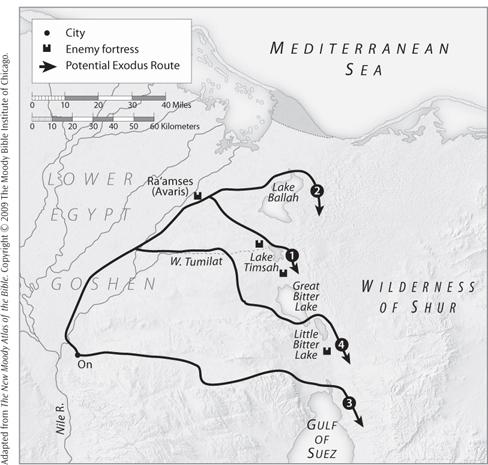
As to the exact location of the crossing, Davis notes four views: One view places the crossing near “Lake Timsah or the southern extension of the present Lake Menzaleh” (Davis, Moses and the Gods, 176; this view is based on references to these bodies in Egypt writings as yam suph). However, as noted, yam suph was used for several marshy waterways. Another view puts the crossing through the northeastern areas of the Nile delta but these would have been the forbidden way of the land of the … Philistines (13:17) and was actually in the wrong direction from Marah, a known location where the Israelites went (see 15:22, 23). A third view suggests the crossing was much farther south, at the northern end of the Gulf of Suez. But this crossing would not place them in the Wilderness of Shur (which was on the northwest section of the Sinai Peninsula, where the Israelites clearly went; see 15:22) when they reached the other side. A fourth view is that the crossing took place in the so-called Bitter Lakes region, a location that could appropriately be called a yam suph since it was a marshy area and which was located directly across from the Wilderness of Shur. A crossing at this location would have put them easily within three days’ journey of Marah (15:22-23).
Of course, critical scholars hold a fifth view: the event never happened, and it should be read as a mythological story of divine deliverance. However, the overall sense of the text and the precision of names and locales argue that the author wanted his reader to know that this was historical narrative. And as Oswalt argues, if these events are not historical and did not happen as the author has recorded them, “we are hard-pressed to explain why Israel chose to create this unique historical fiction to tell its story” (John N. Oswalt, The Bible Among the Myths [Grand Rapids, MI: Zondervan, 2009], 150).
In sum, while the precise locations are debated, Yam Suph could well be referring to a portion of the Red Sea; at least “nothing prevents our linking Yam Suph with the Red Sea” (Kaiser, “Exodus,” 384); hence either the first or third views seem the most viable.
The comment about the bones of Joseph (13:19) recalls Joseph’s request (cf. Gn 50:24-25), a testimony to Joseph’s faith in God’s promise. Joseph knew that even in death God would give the nation that land! The reading of this episode by the Israelites as they prepared to take the land would have been a model for them of the kind of faith they should have in the Lord—the kind of faith exemplified by Joseph long before. He had great confidence in what God would do in the future. They needed their own confidence bolstered as well.
13:21-22. In this journey the Lord led the people with a unique manifestation, a pillar of cloud by day … and a pillar of fire by night (13:21-22). For the hundreds of thousands following Moses in the wilderness, this would have been impressive, encouraging, and very practical. Later it became clear this was a manifestation of God (cf. 14:19; 23:20-23; such brilliant manifestations are typical for depicting the presence of God (e.g., the Shekinah glory). The sight would remind the people that God was always present with them. It would have been inspiring to them and an assurance that He was providing for their security and guidance. Perhaps this was why no one questioned the unexpected direction of their exodus from Egypt.
b. Phase Two: Pharaoh Chased the People (14:1-12)
14:1-4. In brief compass the Lord laid out the whole series of events about to unfold (14:1-4); … you shall camp … Pharaoh will say … I will harden … he will chase … I will be honored … Egyptians will know. Once again the precise locations of Pi-hahiroth and Migdol (lit., “tower”) are unknown, but the inference of this being between Migdol and the sea (14:2) is reasonable. This camp would leave them with no escape since they were pinned against the sea, and from a logistical point of view it was not a defensible place. To Pharaoh it appeared that their wanderings had been aimless and had left them trapped, shut them in (14:3). But while the people might have appeared to be trapped, the Lord was setting the stage to ensnare Pharaoh. The hard-hearted (see commentary on 7:3) and arrogant king would pursue the people only to be destroyed by the Lord. Thus God would be honored through Pharaoh (14:4a), for after his defeat all would know that I am the LORD (14:4b; see also the comments on Rm 9:17-18, 23).
14:5-9. At some point after the shock of the last judgment had worn off, Pharaoh and his servants (virtually the whole population of Egypt) had a change of heart (14:5). They expressed regret at allowing their slaves to escape and made plans to chase them down with chariots (15:5b-6, 9). The number of chariots employed by Pharaoh—six hundred select chariots, and all the other chariots of Egypt with officers over all of them—was an indication of his intention to have a complete victory. The chariots were the seemingly invincible weapon of ancient times and were the symbol of Egyptian might and power. They are highlighted here in order to set up the contrast between God’s power and Pharaoh’s. In short order this massive mighty military force was to be wiped out by the Lord’s forces, their resources consisting, ironically, of nothing but the simple elements of wind and water.
14:10-12. At first the sons of Israel “were going out boldly” (lit., “with a high hand” 14:8), triumphantly and confidently. But as Pharaoh drew near they became very frightened and they cried out to the LORD (14:10). This reaction might be understandable, but what they said next betrayed their immaturity and lack of faith. With “bitter sarcasm and irony” (Davis, Moses and the Gods, 169) they lamented, Were there no graves in Egypt? Which was to say, “If you meant to kill us, it would have been easier to do that in Egypt because there certainly were plenty of graves there!” In other words, they were assuming they were about to die in the wilderness and they even wished themselves back in bondage to Pharaoh as a condition preferable to being slaughtered by Pharaoh in the wilderness (14:11-12). Apparently, the terror of the moment had caused them to forget the great manifestations of the power of God they had so recently witnessed, and they lost heart. They were estimating the outcome of events based on their external circumstances (which were admittedly bad from a human perspective) and their own resources (which were certainly weak).
c. Phase Three: The Lord Preserved the People (14:13-31)
14:13-15. Moses’ response showed that at least he had been changed, not by the events but by his knowledge of the Lord. He did not rehearse all the events, judgments, and demonstrations of power they have recently experienced. He simply commanded the people, Do not fear (14:13a). They were not told to get ready to fight but to stand by (lit., “take your stand”) and see (14:13b). And they were to stop talking (14:14b). This was perhaps in part to stifle the panic their talking had fueled. It may be recalled that the last time the people became discouraged (cf. 5:20-21) Moses followed them into despondency (cf. 5:22-23). But this time he took his eyes off Pharaoh and recalled the words of the Lord. Moses told the people, the LORD will fight for you (14:14) and that they would see His salvation and that they would not see any more Egyptians after that day (14:13c). This did not mean they were to remain inactive. They needed to go forward (14:15b) but that the battle was the Lord’s.
14:16-20. These dramatic events, briefly expressed in the text, would have taken some time to unfold. First, Moses was commanded to do something seemingly incongruous and unexpected. He was to raise his staff over the sea and divide it (14:16a) thus providing a completely unexpected way of escape for the people through the midst of the sea on dry land (14:16b). Again, the Lord reiterated His plan and purpose for the Egyptians (14:17-18; cf. 3:4). In the meantime the angel of God, in the form of the pillar of cloud (i.e., smoke and fire, cf. 13:21-22) performed a rear guard action to keep the Egyptians back so that the people would have sufficient time to make their escape through the sea (14:19-20).
14:21-29. And then, in dramatic action, Moses stretched out his hand … and the LORD swept (lit., “caused to go”) the sea back by a strong east wind and the sea turned to dry land and the waters were like a wall (14:21-22, 29; cf. Ps 78:13). The entire event itself is best understood as a supernatural occurrence, not, as skeptics often argue, a sudden drainage of a lake, not a natural wind, not a frozen or congealed surface of the waters (cf. Davis, Moses and the Gods, 171–75).
When the Egyptians attempted a pursuit (14:23) the God sent confusion (v. 24; the time was the morning watch, the last night watch just before sunrise) to the Egyptian army such that their best and most powerful weapons, their chariots, were rendered utterly ineffective (14:25a). At that point the Egyptians become discouraged and they acknowledged the LORD is fighting for them (14:25). Although they intended to retreat, it was too late and the process that made Israel’s deliverance possible was reversed. At daybreak Moses raised his staff to return the waters to their basin (14:27a) and the Egyptian army was utterly destroyed (14:27b-28). If, as many critical scholars argue, the Israelites escaped through knee-deep water without any real miracle, then it was miraculous that the Egyptian soldiers drowned in such shallows.
14:30-31. The summary verses (14:30-31) are in sharp contrast to the fear and complaints that the people had expressed just before the great event unfolded. The emphasis in these verses is on Israel. Whereas they came to this place as “a people” delivered from bondage, now they stood as a cohesive nation observing an utterly defeated enemy. They no longer had to fear Pharaoh, but the people rightly feared the LORD, and they believed in the LORD (14:31).
8. Praise for Deliverance and Preservation: The Song of Moses (15:1-21)
15:1-21. Inserted into the narrative of Exodus, the so-called “Song of Moses” is a psalm of praise to commemorate and celebrate the great event of the deliverance of the nation through the sea. It is a poetic retelling of the historical account related in the previous chapter, and it was probably composed much later in Moses’ lifetime and placed here in a late edition of the book (likely by Moses himself). The references to Edom and Moab in v. 15 indicate this, for those nations did not enter the story or experience of the nation until much later (cf. Nm 20:14ff.; 22:1; 26:3). Davis notes that this song “sets the spiritual and theological standard for all subsequent praise” (Davis, Moses and the Gods, 183).
This psalm contains four major themes: (1) praise to the Lord for His victory over the Egyptians, 15:1-3, 6-8, 11-13, 21; (2) joy over the defeat of the Egyptians by the Lord, 15:4-5, 9-10; (3) warning to the nations, 15:14-16a, b; and (4) expectation of the fulfillment of the Lord’s promise to the nation, 15:16c, d-17. The psalm speaks of the enemies of the Lord and the attributes of the Lord. Each of these four themes would be relevant for the readers of Exodus as they prepared to enter the land and fight to possess it.
The contents of the song describes the Lord’s enemies, attributes, and deliverance. First the song speaks about the enemies of the Lord. They actually were powerful (15:4) because they had chariots and officers. But in their presumption (15:9a) they were sure they would prevail. Instead the Egyptian soldiers were (and all such enemies will be) utterly defeated (15:5b, 10b). They sank like a stone and were destroyed (15:9b). As a result, God’s enemies should fear (15:14-16a, b) and yet they do not fear and this will result in their own eventual destruction.
Second, the song speaks of God’s attributes. He is “transcendent.” The rhetorical question Who is like You among the gods, O LORD? (15:11a) leads to the obvious answer, “No one is like Him!” He is holy (15:11b). Indeed He is majestic in holiness. He is all powerful, including over enemies, over elements, over circumstances, and with that power He fights for His people (15:3, 6, 8a; 15:10a, 12).
He is a “relational” God (15:2) and the psalmist can say with confidence, The LORD is my strength and song, And He has become my salvation; This is my God, and I will praise Him; My father’s God, and I will extol Him. The first person singular pronoun here should be understood as applying to or speaking for the nation as a whole. And yet this is something each individual could say, for God is personally active in the lives of His own (15:13). He is a promise-keeping God (15:17), He is Lord, and He will reign forever and ever (v. 18; see Ps 10:16; 29:10; 146:10; Rv 11:15). The final, ultimate victory is yet to come in the last days!
Finally, the song speaks of the Lord’s deliverance of Israel. A summary description of the exodus (in effect the third retelling; 15:19) follows. There is a description of celebration featuring Miriam the prophetess (15:20-21; cf. Nm 12:2). Miriam was the first woman ever given this title in the Bible (cf. Deborah, Jdg 4:4; Huldah, 2Ki 22:14; Anna, Lk 2:36; Philip’s daughters, Ac 21:9). Contrary to the culture of that day, women in Israel were accorded high privileges and duties and given great honor for their devotion and service to the Lord.
Together with the song of Moses this scene depicts “the affairs of a community” in which “both men and women take essential parts. When the community joins together for the common songs and celebration there is a strong senses of solidarity. In the leadership of these two [Moses and Miriam] … mutual complementarity functions as a key model for the unity and efficiency of the entire community” (Hamilton, Exodus, 235). It is remarkable to note that she had to be near ninety years old and yet she was dancing and playing timbrels (probably small finger cymbals).
G. The Journey from the Sea to Sinai, Part One (15:22–17:7)
The journey from the sea to the Sinai centers on the grumbling of the people and the provision of God: The people grumbled about water (15:22-27). They grumbled about food (16:1-12). Then they grumbled about water again (17:1-7).
15:22-27. They first grumbled just three days after the passage through the sea (15:22), and those grumblings were about water, a serious problem for a large number of people living in the desert. They did find water at Marah (Hb. “bitter”) but it was undrinkable (15:23), probably because of high mineral content or simply uncleanness. In answer to Moses’ prayer (15:25a) God provided a special tree to make the water drinkable. No known tree has the quality to turn impure water pure or to filter out the mineral content. This is to be seen for what it appears to be—a miracle of the Lord’s provision.
When the people set out into the wilderness the issue of provisions, especially the need for water, should not have been unexpected by the nation. It certainly was not something unforeseen by the Lord. He intended to make it an object lesson and a test for the people, and there He tested them (15:25c). The word for “test” here has the idea of “to prove the worth” of something, “to verify the quality” of something. The Lord was not trying to cause them to fail Rather, as an exercise in training and testing, the need for provisions gave the people an opportunity to verify their faith. In effect, this was to remind them that, after delivering them from the plagues and dividing the sea, God would be the One to provide for their everyday needs (something for which at the commencement of the conquest, Moses’ readers would need reassurance as well). And yet He wanted to provide those daily needs in such a way that they would be reminded to give earnest heed to the voice of the LORD your God, and do what is right in His sight (15:26a). The unusual manner of God’s provisions was intended to remind the people of their usual obligation to keep all His statutes (15:26b). Soon after this they came to a place (Elim, present day Wadi Garandel, an oasis some 60 miles southeast of Suez) where the water was abundant (15:27).
16:1-12. The next incident of grumbling happened less than a month after the passage through the sea, (16:1) and this time the issue was food (16:3). Again, God explained to Moses that this was a test, that I may test them (16:4). The daily provision of manna was meant, as with the water, to remind them that He, the Lord, the same Lord who brought them out of the land of Egypt (16:6), was the One doing the providing (cf. 16:7, you will see and 16:12, you shall know that I am the LORD your God). At the same time the Lord sent meat (lit., “flesh”) (16:12-13) in the form of quails (16:13; cf. Ps 78:27, where it says He “rained meat” upon them). This was not the only food they had. In 12:32, 38 (cf. 17:3) it was noted that they took their flocks and herds, so they would have had plenty of food; but of course if they ate all their livestock they would have had nothing with which to re-stock the promised land once they had settled there.
This food came each day—a regular provision by unusual means to remind them to do what is right (cf. 15:26), to walk in My instruction (16:4). These provisions were gracious but they were also a “test” (15:25; 16:4) for the people. Each day as they gathered these food supplies they would either gratefully and humbly acknowledge the Lord’s provision as such or thoughtlessly and selfishly consume them. If one daily acknowledged the Lord’s provision it should naturally lead that one to acknowledge and submit to the Lord’s commandments and statutes. However, if one was unmindful of the source of these provisions one would likely be unmindful of the Lord’s command to walk in My instruction. In spite of the continued grumblings of the people (16:2, 7) the Lord was gracious and provided for the needs of His people.
16:13-36. In the middle of these grumbling accounts is an extended section about the manna. Regardless of many attempts, all naturalistic explanations of the manna fail. The quantity and qualities of the substance described here are nothing like the lichen (fungus-like organisms) that grow on rocks and trees, or like the bark, twigs, leaves, or sap of any known flora (e.g., tamarisk bushes) of the region. “The very fact that so much space is devoted to [explaining] this phenomenon referred to so many times in the Old Testament is an indication of its supernatural quality” (Davis, Moses and the Gods, 192). “Manna must be regarded as a peculiar substance, miraculously created for a special purpose” (Kaiser, “Exodus,” 403).
Several features regarding this manna are noteworthy. First, Moses recorded the discovery and provided a description of manna (16:13-15, 31). The manna appeared with the early-morning dew and it was there after the dew dried. It was a fine flake-like thing … it was like coriander seed, white, and its taste was like wafers with honey. In short it had a familiar taste but was not exactly like anything they were used to eating. Appropriately they asked, What is it? In Hebrew this question is man hu, forming a wordplay with man (the Hb. word transliterated into Eng. as manna). The Greek OT [LXX] has ti esti touto or “what is this?” So the actual name of this substance is literally “What is it?” Both their question and the lack of an answer indicates that this was not a natural food.
Next Moses described the process for gathering the manna (16:16-21). Again, the supernatural nature of the substance was made even clearer when they gathered it. Everyone was to pick up an omer (about two quarts; cf. 16:36) per person. But no matter how much they gathered, everyone had just enough—not too much, not too little. Furthermore, no one could gather enough in one day to last two days because it would spoil overnight. Everyone had to gather it day-by-day. Of course, some of them tried to gather extra anyway but they found out that that was not wise because it bred worms and became foul (16:20). The note that Moses was angry with them (16:20b) reflects the frustration he felt in dealing with a people who refused to follow even such simple instructions. This suggests that God intended to teach Israel daily reliance upon Him—just as Jesus taught His followers to pray, “Give us this day our daily bread” (Mt 6:11).
There were also special instructions pertaining to the Sabbath and the manna (16:22-30). On the sixth day they were to gather twice the usual amount so that it would not be necessary to gather it on the Sabbath (16:22a, 25-26). Moses informed the leaders (16:22b-23a) that everything for the Sabbath was to be prepared on the sixth day (16:23). Unlike the extra manna gathered on other days, the manna collected on the sixth day was perfectly fine on the seventh, the Sabbath (16:24). Once again some tried to go out on the Sabbath and gather some manna but they were disappointed to find it was not there (16:27). This time it was the Lord who expressed frustration when the people failed to follow instructions, and He reiterated the importance and privilege of the Sabbath (16:28-30).
The final verses of this excursus (16:32-36) record the memorial of the manna. This paragraph demonstrates that Moses completed writing the Pentateuch just prior to the conquest since it mentions the forty years of wanderings (16:35). A portion of this manna was preserved to remind the nation of the provision of the Lord. Later it was placed in the ark, before the Testimony (16:34). This was to remind succeeding generations that manna was not just a provision of food for those who ate it. Without manna, the exodus generation would not have survived. Had that generation not survived the later generations who only saw the manna would not have existed either. They were to realize that “What is it?” had made the lives of succeeding generations possible as well—the manna was the means the Lord chose to preserve the people so that He could fulfill His promises to them, not only to meet their needs.
17:1-7. The third instance of grumbling was once again over water. Here the situation was a bit different, for it seems now the people were testing the Lord (see 17:2c, 7, because they tested the LORD). Here the idea is a test in the sense of a challenge. They were challenging God to provide, and they were challenging the leadership of Moses to the point that he was actually afraid for his life (17:4). While the Lord did provide, and He did vindicate Moses’ leadership, the sorry event was memorialized in two names imposed on this the location, Massah and Meribah (lit., “testing” and “quarreling”), to remind the people that their behavior was inappropriate and proved that they had a long way to go before they passed His test. It may be noted that here Moses was instructed to strike the rock (17:6) in contrast to Nm 20:8 (see commentary on that text).
H. The Journey from the Sea to Sinai, Part Two (17:8–18:27)
1. War with Amalek (17:8-16)
17:8-16. Exactly who the Amalekites were (apart from the fact that they were descendants of Esau; cf. Gn 36:12) and why they opposed the nation of Israel at this point is not clear. They would appear several more times in Israel’s history (cf. Dt 25:17-18; Nm 14:43-45; 1Sm 15:2-9; 30:1-20.) This is the first mention of Joshua, the man who becomes the nation’s general (17:9) and Moses’ personal aide (cf. Ex 24:13; 32:17; 33:11; Jos 1:1). It should be noticed that Moses gave him orders (17:9) and Joshua did as Moses told him (17:10), an example of obedience that stands in contrast to the people as a whole. This battle is most remarkable because the ebb and flow of the battle seemed to be more dependent on Moses, who was literally above it all, than it was with the men who were actually engaged in the fighting. Of course, the act of Moses holding up his hands (17:11) was not merely encouraging to the combatants nor was it simply a matter of Moses’ personal intercession. This action symbolized that the success of the army was dependent on the constancy of the Lord, for after the victory the memorial altar was called The LORD [not “Moses’ Arms”] is My Banner (17:15 YHWH–Nissi; meaning “the standard,” “the flag,” or “the emblem”). The Lord was the source of courage and strength, and hence the Author of this victory.
2. Reunion with and Advice from Jethro (18:1-27)
18:1-12. This chapter begins with a reunion with Moses’ wife and sons. The names of Moses’ sons reflect Moses’ spiritual experiences, “Gershom means ‘banishment’ and Eliezer literally means ‘my God is help’” (Davis, Moses and the Gods, 197). This is followed by a reunion of Moses with his father-in-law (18:5-12). Moses clearly held Jethro in high esteem and probably regarded him as a priest (perhaps like Melchizedek in Gn 14; or Job) of the true God. Apparently, Moses’ story served to confirm Jethro’s faith (18:11).
18:13-23. As he observed Moses’ routine, Jethro saw a problem. Moses was trying to serve as the main priest (intercessor) and magistrate (judge) for the whole nation. The people went to Moses with spiritual matters (to inquire of God, 18:15) and for mundane matters (to settle a dispute, v. 16). This was far too demanding on Moses and the people (v. 18a). Jethro’s rebuke was blunt: you cannot do it alone (18:18b), but he did offer a solution (18:19-23). He first advised Moses to be the people’s representative before God (18:19a). This would mean intercession for them before God (18:19b) and instruction about God to them (18:20). Then Moses was to select … able men, men with some serious qualifications for service (18:21), and he was to subdivide the workload of judging among these men (18:22-23). Thus if there were major issues or disputes, Moses could handle them, but all minor matters these men and the parties involved could work out for themselves under the direction of these men (18:22). Not only did this advice provide Moses with some excellent management principles, but as the spiritual leader, Moses was freed up for spiritual service (cf. Ac 6).
18:24-27. Moses fully accepted the advice of Jethro: Moses listened to his father-in-law and did all he said. Apparently the program instituted by Moses worked well and Jethro departed into his own land (v. 27b).
II. The Law and the Tabernacle (19:1–40:38)
The children of Israel, having been delivered from bondage, were given the Sinai covenant, which was to be a blessing to them in three areas: life in a relationship with God, life in kinship with the people of God, life centered on true worship of God.
A. Preparation of the People to Receive the Law (19:1-25)
1. The People Accept and Commit to the Covenant (19:1-8)
19:1-2. The arrival at Sinai is recorded in simple terms without fanfare. It had taken three months for the nation to go from Egypt to Sinai (19:1). By comparing 19:1 and Nm 10:11 it seems the nation began an eleven-month stay at Sinai. “Everything that happens in Exodus 19:1-40:38 + Leviticus 1:1-27:34 + Numbers 1:1-10:10 transpires while God’s people are resting at this holy site” (Hamilton, Exodus, 291). This “was for Moses a return to familiar surroundings”; he had returned to a location that was “majestic and inspiring” (Davis, Moses and the Gods, 202, 203). The term wilderness is repeated to emphasize that the great event of the giving of the law happened in the wilderness, a place where there were no distractions, no other associations, and nothing of the world. There was really nothing here but the Lord Himself. All other associations were set aside so that the people could focus on the covenant, the relationship about to be established. This is “one of the high points in Hebrew history” (Davis, Moses and the Gods, 202).
19:3-8. These verses reveal the covenant itself and reflect the provisions of a standard ANE suzerain treaty (that is a treaty between an underling and an overlord; see J. W. Marshall, “Decalogue,” in Dictionary of the Old Testament Pentateuch, ed. T. Desmond Alexander and David W. Baker [Downers Grove, IL: InterVarsity: 2003], 173ff.). There was a standard pattern or formula to such treaties: preamble (“Hear ye, hear ye”; 19:3); history of relations between the vassals and their master (“This is how we have arrived at this stage in our relationship”; 19:4); stipulations (“This is what you [underling] will do”; 19:5a); promises/blessings (“This is what I [overlord] will give you”; 19:5b-6a); formal presentation (19:6b-7); and formal acceptance (19:8). A covenant such as this was meant to elevate and formalize an already extant relationship (see Hamilton, Exodus, 301). Here the relationship with the nation was based on the Lord’s promises to the patriarchs (cf. 6:8; 13:5) and on His sovereign and gracious deliverance of them from bondage: bore you on eagles’ wings and brought you to Myself (19:4).
The stipulations obey My voice and keep My covenant (19:5) were thus not the means to earn the promises (as noted above, those promises had been given to the patriarchs Abraham [Gn 12:1-3; chaps. 15, 17], Isaac [Gn 26:24], and Jacob [Gn 28:13-15; 35:11-12), but the way to live so as to enjoy the promises. The idea is “If you obey and keep the commandments you will prove to be My own possession …” (19:5). They already were His people (see Hamilton, Exodus, 301). God gave Israel the law to ensure that Israel would be able to fulfill the Abrahamic covenant by avoiding sin and therefore, the consequences of experiencing the temporal discipline of God.
If God disciplined them, the nation would be driven from the land (Dt 28:64-65) and they would not be able to experience His glory and blessings. A further result would be that the Abrahamic covenant could not be fulfilled in its entirety. Eventually, of course, Moses anticipated Israel’s inability to keep the law (Dt 31:29) and predicted that God would make the fulfillment of the promises possible for Israel through receiving the circumcised hearts of the new covenant (Dt 30:6). Thus, God gave these laws to Israel because only by living as He commanded and according to His standards by His own nature could they expect to enjoy His blessings. “In essence, the Sinaiatic covenant spells out the type of nation that Yahweh intends Israel to be …. Israel, the patriarch’s promised descendants, could enjoy the divine-human relationship anticipated in Genesis 17:7-8 only by maintaining the ethical distinctiveness enshrined in God’s instructions to Abraham (‘Walk before Me and be blameless,’ Gen 17:1)” (P. R. Williamson, “Covenant,” in Dictionary of the Old Testament: Pentateuch [Downers Grove, IL: IVP Academic, 2002], 150).
The blessings were summarized in three “titles”: they would prove to be My own possession (“unique treasure,” a “chosen and special status”; Dt 7:6; 14:2; 26:18; Ps 135:4; Mal 3:17), they would be a kingdom of priests, and they would be a holy nation (19:5-6; cf. 1Pt 2:9). These titles indicate that as a new nation (in the truest sense “under God”) they had a unique relationship with the Lord, they had a unique responsibility to the rest of humanity, and they had a unique standing in the world of nations—a new name and privilege, a new responsibility, and a new character. These titles speak of the nation’s royal (kingly), priestly, and prophetic standing before God and before the world, among all the peoples, for all the earth is Mine (19:5). This has been called the “Great Commission” of the OT (cf. Youngblood, Exodus, 90).
In sum, to enjoy their promise-based relationship with God they had to accept it. Then they had to commit to it; that is, they had to commit to live by the stipulations and live up to the blessings. The people were enthusiastic at this point, answering, All that the LORD has spoken we will do! (19:8). Sadly this commendable sentiment was not always matched with consistent action.
2. The People Demonstrate Consecration (19:9-25)
a. The Place of the Lord (19:9)
19:9. God informed Moses that He would speak to the people from a thick cloud (19:9). This manifestation was meant to convey two truths: He was immanent (near them) and yet He was transcendent (above and beyond them). These two truths had to be acknowledged and kept in theological and existential balance. Too much immanence and He would be too familiar and the people might be flippant about this relationship. But then too much transcendence and He might seem too distant and even unknowable. As noted later, the tabernacle was designed to keep these two qualities in balance. He was near—He was to dwell with them –but He was hidden, covered by the walls and veils to be approached only by sacrifice. He was in the thick cloud but He could be heard, so that the people may hear when I speak.
b. The Place of the People (19:10-15)
19:10-15. The Lord told Moses that he must first consecrate them (19:10a). The basic idea of this consecration is that they be set apart, purified, and cleansed in preparation to meet the Lord. The procedures for this consecration and cleansing followed several steps: first, they were to have their garments washed (19:10b, 14); this was an obvious symbol of cleansing. Second, they were to dedicate three days for preparation (19:11, cf. 19:15a). This in effect took putting aside all the regular activities of daily life and apparently the people were to use that time to prepare for the presence and words of the Lord (19:11b). Third, they were to observe the boundaries of the mountain since it was “holy” (19:12a; cf. 3:5, this is “holy ground”). These boundaries were to be taken seriously since to violate them would mean death (19:12b). A person who violated the boundaries was to be considered so unclean he was not to be touched even in his execution. He was to be killed by stoning or shot through (apparently with arrows) (19:13). Fourth they were to wait for the proper sound, a blast through a ram’s horn, before they could begin to approach the mountain (19:13c). In the Hebrew, it states that at the blast of the ram’s horn, they shall come up … the mountain. So after keeping away from the mountain for three days, on the third day, the entire nation was to ascend the mountain. And fifth they were to abstain from sexual relations (19:15b; see Lv 15:16).
These external preparations (of the body, the wearing clean clothes, standing at a respectful distance) were to demonstrate the inward preparations of heart and mind. All of this was meant to make them consider carefully, worshipfully, the One they were about to meet.
c. The Place of the Priests (19:22)
19:22. In addition there were special instructions for the priests at this meeting. The priests were to consecrate themselves (19:22). These were not yet the official priests (the Levitical priesthood had not yet been established; cf. Nm 3:45) but were most likely the family heads, or perhaps the firstborn who had been dedicated to the Lord (cf. 13:2). This was another layer of protection against mindlessness and against any casual flippancy in their approach to the Lord.
d. The Appearance of the Lord (19:16-20)
19:16-20. The Lord’s appearance was accompanied by dramatic and amazing manifestations: thunder, lightning, a thick cloud, a very loud trumpet sound (19:16), smoke, fire, quaking, and the trumpet sound growing louder and louder (19:18-19). Naturalistic explanations of these manifestations are inadequate and unnecessary. This was no volcano nor was it a mere thunderstorm. It was a decidedly supernatural and awe-inspiring display meant to convey the awesome presence of the Lord, and it was appropriately “frightening and fascinating” (Hamilton, Exodus, 307; even for Moses, cf. Heb 12:21). It was meant “to impress upon the people the majestic power of this sovereign God” so that the commitment they had made (19:8) would not “be taken lightly” (Davis, Moses and the Gods, 206). “A deep moral impression was made on the people, for they were in the presence of the glorious majesty of the Holy God who was about to reveal his person and character in his law” (Kaiser, “Exodus,” 418).
It seemingly terrified them to such an extent, that the people refused to ascend the mountain (19:17) as they had been commanded (cf. comments at 19:13). Therefore, instead of God giving His covenant to the entire nation, He gave it to their mediator, Moses. As a result, the nation would not be a nation of priests (cf. 19:5), but a nation with priests (mediators) (John H. Sailhamer, The Pentateuch as Narrative [Grand Rapids, MI: Zondervan, 1992], 53–57).
e. The Warning of the Lord (19:21, 23-25)
19:21, 23-25. The instructions about boundaries given in preparation are likely not repeated here. Rather, only after refusing to come up the mountain (cf. 19:13, 17; 20:18-21), God now gave them a powerful warning that they were no longer to attempt to come to the top of the mountain. This was the consequence of becoming a nation with priests. Therefore, God commanded that they do not break through … to gaze (19:21) or to come up to the LORD (19:24). They needed to keep their place if they wanted to keep their lives. To clarify that God’s expectation of the people had changed, the Lord gave this new command (19:24). Therefore, Moses went down … and told them (19:25). This once again indicated that the God with whom they had to do was not One to take lightly or approach flippantly. To enjoy this relationship with God required that they know, respect, and observe His place and their place.
B. Presentation of the Decalogue to the People (20:1-17)
1. Preamble (20:1-2)
20:1-2. The opening words of the Decalogue proclaim three great theological truths: The Lord is the God who speaks (in words), He is self-revealing, the God who relates: I am the LORD your God (emphasis added). The Lord is the God who acts, He is the God who redeems, who brought you out. “The lawgiver places His law in the environment of grace, for it was His gracious act of redemption and deliverance from Egypt that revealed His name Yahweh” (LORD). Many scholars have noted the parallel between this “historical prologue” and “the great suzerain-vassal treaties of the ancient Near East” (Kaiser, “Exodus,” 422). The Lord probably revealed the law to Moses in this form so that Moses and the people would be familiar with its structure and have some understanding of how they related to it.
There were two tablets of the law: tablet one contained commandments one through four and these set down the obligation of men and women to God as creatures to honor their Creator; tablet two set down the obligations of men and women toward one another in their various relationships, family, and society.
2. The First Tablet Commanded the People to Honor the Lord (20:3-11)
a. No Other Gods (20:3)
20:3. The Lord is God, the only God (20:3)! The expression before Me probably has the sense of “in addition to Me.” One was not allowed to worship the one true God as if He were a part of a pantheon of gods. This expression is not suggesting that there actually are other gods. It prohibits the honoring of any other entity, real or imaginary, as God. Nothing else, no other gods (money [cf. Mt 6:24], pleasure, power, fame, even one’s self) can have the priority in one’s thoughts, words, or deeds. God’s people and indeed all living creatures, owe ultimate allegiance to Him and Him alone.
b. No Idols (20:4-6)
20:4-6. Idolatry is unacceptable because any attempt to depict or represent God (especially for the ostensible purpose of worship) not only falls short of the truth about God but inevitably distorts the worshipers’ understanding of God. “God is Spirit” (Jn 4:24). Thus any physical representation will misrepresent Him and lead to false notions about Him. All idols are thus false gods, and even an idol meant to depict or represent the true God by some carving, statue, or any other physical representation is deforming of the truth about God. The prohibition extends to any likeness of creatures heavenly, earthly, or of the sea (water under the earth). The three tiers of existence—heaven (that is the atmospheric heaven, not the “spiritual” place), earth, and water—were the mythological locations of those Egyptian gods that had been defeated in the plagues (see Rm 1:22-25). Two reasons were given to reinforce this prohibition. First God revealed that He is a jealous God, that is, He has a consuming love for His people and thus He will brook no rebellion from them. The consequences of His chastisement will extend for three or four generations. This is not to mean that God brings generational curses for sin or even that the Lord judges the children for the parents’ sins (Dt 24:16; Ezk 18:20). Rather, it means that the consequences of sin and rebellion (idolatry) and the judgment that befalls such will extend to several generations. One of the consequences of such rebellion is that the children frequently follow in the parents’ ways and become rebels and practice idolatry themselves, thus extending the judgment.
Second, the Lord revealed that He is a loving God, that is, His blessings for obedience will extend for many generations to those who love Me and keep My commandments. Clearly, the imbalance of the consequence for obedience, blessings for thousands, as opposed to consequences for rebellion to three or four generations, shows that the Lord is not a vengeful God but He practices lovingkindness, being merciful and gracious. He loves His people and desires their best, and He is their best.
c. No Swearing (20:7)
20:7. In Scripture the name of a person was not merely a label but was shorthand for the total character of the person, “a revelation of his true nature.” Thus, “the name of God is the revelation of the nature of God” (G. F. Hawthorne, “Name,” vol. 3, International Standard Bible Encyclopedia [Grand Rapids, MI: Eerdmans, 1986], 481–82). God’s name is to be respected because He, His person, is to be respected. Thus to use the Lord’s name in a flippant or disrespectful manner, in vain (lit., “to no purpose”), whether in an informal oath (i.e., cursing) or in a formal oath (i.e., swearing an oath before God in a court of law but without any serious thought about God), was forbidden. This does not rule out legitimate oaths but the idea is this: when one utters the name of the Lord one should do so with reverence, respect, and the conscious acknowledgment that He is the true Lord God. The mindless invoking of the name of the Lord is not merely disrespectful but an implicit denial and trivializing of His majestic personhood and ultimate governance of all life.
d. Sabbath Observance (20:8-11)
20:8-11. The Sabbath was to be observed as an acknowledgment that the Lord deserved complete loyalty, including not only singular and absolute devotion and worship but also the entirety of His people’s individual lives. This is indicated by the Lord’s demand on time. The basic thrust of the fourth Commandment is that Israel was to devote one day in seven to the Lord as a token of a lifetime devoted to Him. The basic idea of the term Sabbath means “rest” (cf. Kaiser, “Exodus,” 423). The pattern of six days of work and one of rest was meant for all mankind (cf. Gn 2:1-3; Mk 2:27; cf. Dt 5:13-15) and the Sabbath also had special significance for the nation of slaves, who could seldom rest, delivered from bondage in Egypt (cf. Dt 5:15). “Israel observed the Sabbath to remember God’s work of Creation and the Exodus” (Kaiser, “Exodus,” 424). Davis observes, “The Sabbath became a foundation for all the festival times and observances of the Israelites since they culminated in a Sabbath rest” (Davis, Moses and the Gods, 214). The command concerning the Sabbath (as such) is not repeated in the NT, and while there are applicable principles (one day in seven for rest and worship), the command was given in a unique sense to the nation of Israel as a sign between the Lord and the sons of Israel (cf. Ex 31:13-17) and thus it is not applicable to the Church in the same way as it was to Israel (cf. Col 2:16-17). (See Thomas R. Schreiner, 40 Questions About Christians and Biblical Law [Grand Rapids, MI: Kregel Academic, 2010], 209ff.).
4. The Second Tablet Commanded the People to Honor Others (20:12-17)
a. Honor Parents (20:12)
20:12. “To honor” means “to prize highly” (cf. Pr 4:8), “to care for” (cf. Ps 9:15), “to show respect for” (cf. Lv 19:3) (cf. Youngblood, Exodus, 98). Since all authority belongs to the Lord and since He instituted the family and established all human authority structures into human social relationships, all such authority structures are to be respected. Rebellion and insubordination to parents, governments (cf. Rm 13), teachers, and others, ultimately is rebellion and insubordination to God. The commandment is not just applicable to minor children but teaches that adult children are to have respect and to care for their aged parents. “The fifth commandment provides the key to real social stability” (Davis, Moses and the Gods, 216). The promise attached to this commandment had primary applicability to the nation of Israel living in the land, but the principle “a stable family-life leads to a stable-society” allows for a broader application (cf. Eph 6:1-3).
b. Do Not Murder (20:13)
20:13. If any of the seven terms for killing in the OT prohibits premeditated and intentional killing, it is the term murder (cf. Kaiser, “Exodus,” 424–5). All life belongs to the Lord, since He is the Creator of life, especially human life. Murder is not only an attack on another human being but since every person is made in the image of God (cf. Gn 1:26-27; 9:6) it is an attack on God. All life is therefore sacred; that is, it is set apart to and belongs to the Lord and should be devoted to Him. Thus it is His and His alone to give or to take. This commandment prohibits murder and all taking of innocent life as well as taking of one’s own life but does not prohibit one from self-defense, national-defense or capital punishment. Indeed, the OT itself recognizes there are times when killing in self-defense is not culpable (Ex 22:2; cf. Est 9:1-5), when war is necessary (Ex 17:9), and capital punishment is the appropriate punishment (Gn 9:6).
c. Do Not Commit Adultery (20:14)
20:14. God created marriage and the family and it must be honored for His sake. This commandment says in effect that any form of sexual expression (by either man or woman) outside of the bonds of marriage is a perversion (in both the most basic and the fullest sense of that term) and is prohibited (cf. Mt 5:27-28; cf. Lv 20:10).
d. Do Not Steal (20:15)
20:15. The “right of private property is an important principle for the stability of any society” (Davis, Moses and the Gods, 218). This commandment forbids the taking of any goods or valuables of another without due compensation and any form of dishonest profit or gain at the expense of another.
e. Do Not Lie (20:16)
20:16. The Lord is a God of truth, He loves truth (because He loves Himself) and He “hates every false way” (cf. Ps 119:104, 128). Lying is a denial that truth is always right. It is a denial of God’s character and of His attributes. Without truth-telling the whole social structure will fail. This command prohibits blatant lies, any conscious deceptions, and unsubstantiated assertions (i.e., gossip and rumor).
f. Do Not Covet (20:17)
20:17. “This commandment is a staunch prohibition against all lustful desire” (Davis, Moses and the Gods, 220). A person cannot be said to live by these words if he or she keeps them only in an external way. These commandments must be kept in one’s heart as well as in one’s actions. Jesus taught this when He taught that hate was in effect murder, and lust was in effect adultery (see the comments on Mt 5:21-30). The corruption of sin is in the heart before it is in the actions. “Covetousness has a psychologically degrading effect upon an individual” (Davis, Moses and the Gods, 220). It takes away contentment (cf. Php 4:11-12; 1Tm 6:6-8) and rivets one’s attention on acquiring earthly and temporal toys rather than the heavenly and eternal treasures (cf. Mt 6:20, 33).
C. The People Respond with Devotion, Fear, and Worship (20:18-26)
20:18-21. This narrative retells the story of Ex 19:13-16 and actually took place before Moses descended the mountain and gave the Ten Commandments. The previous narrative (19:13-16) told the story of the people’s fear of God and failure to ascend the mountain from a divine perspective. Here (20:18-21) it recounts the story from the people’s perspective (Sailhamer, The Pentateuch as Narrative, 56). In this telling, Moses sought to encourage the people to not be afraid (20:20a). He explained: for God has come … in order that the fear of Him may remain with you, so that you may not sin (20:20b). The point was, “Do not be so fearful that you run from Him or fail to come up the mountain, but in your fear you must stand and listen and obey” (20:20b). Nevertheless, the people refused to ascend the mountain and afterwards, were prohibited from doing so (cf. 19:24). As a result, God gave Moses, Israel’s mediator, even more laws for them to obey, a section of the law known as the “Covenant Code” (20:22–31:18).
20:22-26. The people responded to the Ten Commandments with worship. Keeping in mind the stipulations just revealed, namely, they were to embrace no other gods and no idols (20:22-23), the people were instructed to make an altar (20:24) for sacrifice. Even though the sons of Israel had plenty of gold and silver (see 12:35-36), the Lord instructed them that He wanted only an earthen altar (20:24) or one made of natural (uncut, un-worked) stones (20:25). It seems these instructions were intended to distance Israelite worship from that of the pagans around them. Apparently somehow the use of tools would profane it (20:25), but why that would be the case is not clearly indicated; perhaps this was meant to restrict any image or representation from being chiseled into the stone. In any case great care was to be taken to avoid any form of idolatry as well as to distance the acts of worship on this altar from those of the pagans (20:26). The altar was to be erected to the Lord in every place where I cause my name to be remembered (20:24c) and not to the “local deities” the nation would encounter. The altar of the tabernacle would have, when completed, obviated the need for these altars.
D. Application of the Law: Living the Life of Faithfulness (21:1–23:19)
After the “Ten Words” and the instructions for proper worship, Moses received instructions from the Lord, ordinances which you are to set before them (21:1) that amounted to principles for living faithfully in the community of God’s people. These laws were of both the casuistic form (i.e., case-law, recognized by the common “If … then” structure, providing examples or cases as guides for community living and resolving disputes) and the apodictic form (i.e., commands and precepts laid down, the “do’s and don’ts”). There are basically two purposes for such laws: one, to promote faithfulness in living in the community and two, for fostering faithfulness in devotion to the Lord. This section, encompassing chaps. 21 through 23, is called the “book of the Covenant” (see 24:7).
Some have suggested that the “law codes” of the OT “borrowed” from other ANE law codes (e.g., Sumerian codes, Urnammu and Lipit-Ishtar; Babylonian codes, Hammurabi and Eshnunna, Hittite law codes) (See Davis, Moses and the Gods, 223–26; Hamilton, Exodus, 359). However, it is more likely that the similarities are the result of simply living in similar socioeconomic conditions and cultures (which would generate the same sorts of issues and problems, e.g., unruly animals). On the other hand, the differences are striking and basic (e.g., the way slaves were to be treated, the care and concern for “the widow, the orphan, the poor, the defenseless” [Youngblood, Exodus, 102]). The Lord gave the “book of the Covenant” to Moses but in none of these other ANE law codes does a deity speak. There are parts of this “book of the Covenant” that only fit in the story and narrative of Promise, Exodus, Conquest, Kingdom that is recorded in the OT (see Hamilton, Exodus, 360).
1. Laws Pertaining to Slavery (21:1-11)
Slavery was a fact of life (as it has been for more cultures and societies in history than not). In that culture generally and in Israelite culture specifically it was not the same institution as the forced servitude and racially demarcated bondage familiar to many today. Nevertheless, the Hebrew word ‘ebed meant more than mere “servant.” In that society when people fell into bad economic circumstances they might adopt “indentured servitude,” becoming the slave of another in exchange for the basic necessities of life. Since elimination of the institution was not feasible, its regulation was necessary. One might become a slave for a variety of reasons: a captive of war (cf. Nm 31:26; Dt 20:10ff.); a foreigner acquired by purchase (Lv 22:11; 25:44-45); a child sold by parents in hard times (Neh 5:5; cf. possibly Am 2:6; 8:6); at times, even someone selling himself (Lv 25:39). This would be a form of “indentured servitude.” The slave in view here was most likely a “debt-slave,” a person who had to become a slave because they had “fallen on hard times,” or they were required to serve a term of slavery as restitution for a crime (22:3c; cf. Hamilton, Exodus, 373, 395).
a. Male Slaves (21:1-6)
21:1-6. The law set down several stipulations regarding males slaves. The first demand limited the length of servitude to six years (21:2) This was a unique feature of the institution of slavery in Israelite society. The second stipulation dealt with the complication of marital status. While the man had a right to keep his wife (21:3), the master had the right to keep his slave(s) (21:4). Exactly how this would have been worked out is not fully explained, allowing for the latitude necessary for particular cases to be worked out equitably. The key point was that there had to be a balance between the personal rights of the slave and the economic and property rights of the owner. The third condition dealt with the case of a slave who wished to remain with his master (21:5-6). That such cases were frequent enough to require this formal recognition would seem to indicate that the institution in view was not the harsh bondage normally associated with pre-Civil War American slavery; it was “slavery,” but it was often a congenial arrangement. In order to formalize this relationship there had to be a public “testimony” and “permanent sign” that is for the life of the individual so marked (see the HCSB “for life.”) There is a question here about the “witnesses” (21:6). The term is ha’elohim and could be “God” [NASB] or “the judges” [KJV]. Since this was to be a formal and solemn and public ceremony it seems best to take the term as referring to the human judges as “witnesses before God.”
b. Regarding Female Slaves (21:7-11)
21:7-11. The law also set down several regulations regarding female slaves. The parallel text in Dt 15:17b seems to suggest that there could be female slaves who fall into the arrangement indicated in vv. 2-6, that is, those laws might pertain to female as well as male slaves. However, the arrangement in view here appears to be somewhat different. The first stipulation dealt with an arrangement wherein apparently a father does not himself enter into “debt-slavery” but puts his daughter up (presumably in payment of his debt) instead. This arrangement was not so easily dissolved (21:7) since (it may be supposed) this was matrimonial in nature. However, the second regulation indicated the steps to be taken if the arrangement failed, and so different scenarios are described. If she had been designated for the master he could not resell her but she could be redeemed by her family (21:8a). Emphatically the law stated she could not be sold to a foreigner or non-Israelite (21:8b). If she had been designated for a son she was to be treated as a daughter with full familial rights (21:9), and she retained her status even if other wives were brought into the family (21:10). Finally, if her rights and status were not maintained she was free to leave this family, without payment, and more than likely she would return to her own family. At that point she would then be free to be attached or designated to another (21:11).
The point of these laws was to ensure that the rights of the individual were respected, but at the same time taking the rights of the master into account. Perpetual slavery was unacceptable (21:2). Even a female servant had rights, a remarkable point of law in that culture. If she had been purchased for marriage or concubinage she could not simply be thrown out (21:7) and within the family she had rights, even rights to her own personal possessions (21:10).
All of this shows that God cares about individual rights and personal dignity. In any economy there may be (will be) “haves and have nots” but the individual’s personal dignity and rights, under God, before others, must be respected. In short, people are to be treated as people, not things, objects, or possessions.
2. Laws Pertaining to Personal Injury (21:12-36)
In a series of “case laws” the pattern of a protasis (“What if there is … ?” clause) is followed by an apodosis (“Then,” or “In that case …”) to stipulate laws that provide for equity and justice in the life of the community. First is a series of cases where someone inflicts an injury on another (more or less) directly (21:12-27).
21:12, 14. What if there was a blow—one man struck another with malice aforethought (premeditation), and death followed (21:12a, 14a)? In that case there must be a payment in kind, namely a death (21:12b, 14b). The Bible is not unclear or equivocal about clear cases of “murder” or “homicide.” Life, especially human life (cf. Gn 9:6), belongs to God. Any such murder is a usurping of His prerogative and is actually and ultimately an attack upon Him. It is also an attack on the whole society (of humanity). And it is an attack on the deceased’s family. It usurps a personal right (the person’s very life), a divine right (the devotion and service to God that life should have been allowed to perform), a social right (the contribution that life could/should have made for the whole society), and a family right (the provisions/roles that life were to have fulfilled for the well-being and prosperity and happiness of his/her family). Murder undermines more of what holds a culture and a society together than any other single crime. It violates both tablets of the law at once by usurping God’s role in life and death and in harming one’s neighbor. If life itself is not respected and protected there can be no secure social structure. No sanctuary is to be given for such a murderer (21:14).
21:13. What if there was a blow where one man struck another in an act of “un-premeditated” manner or in a spontaneous act of vengeance and there was a death? In such a case the perpetrator had the option to flee to refuge (later revealed as the six cities of refuge; cf. Nm 35:6-24; Dt 19:1-13). In such a case it was presumed that God had allowed it. Providence was seen as a mitigating circumstance.
21:15, 17. What if there was a blow to, or even a curse directed at, a parent? Once again the penalty was death. The son or daughter who strikes may carry out an actual physical attack or a metaphorical assault (such as a son who undermines his father’s authority; e.g., Absalom). The one who curses may engage in a verbal attack or, more likely, a “sin of omission” (e.g., a man does not take care of his aged and dependent parents; cf. Hamilton, Exodus, 378–79). This might seem severe to modern ears but again, the message was that such an act was tantamount to undermining the authority of the Lord and the basic societal institution of the family. Those values had to be taken seriously.
21:16. What if there was a kidnapping? Once again the penalty was death (cf. Dt 24:7). The motive for such an act in those days was probably not to gain a ransom but to enslave, resulting in a deprivation of personal rights for the person and his/her family.
It may be noted that four times the text has said the perpetrator shall surely be put to death (vv. 12, 15-17), but it does not say who is to perform the execution or how. That seems to make this law more of a moral standard than a civil prescription. Hamilton points out that the expression shall surely be put to death is mot yumat and may be translated either “must be put to death” or “may be put to death.” (“The Hebrew imperfect does not distinguish between ‘must’ and ‘may’” [Hamilton, Exodus, 378].) Furthermore, there is a curious lack of interest in how or who should do the executing, which leads Hamilton to suggest that “the main intent of these capital offenses is less legal than moral,” and so “death injunctions or death threats alert to the gravity of transgression” but may not prescribe the legal necessity of actual execution in every case. In other words, perhaps these sins are worthy of death in God’s eyes but that is a moral judgment more than a specific legal command to carry out such executions (cf. Hamilton, Exodus, 378). Therefore, the law in these cases may not actually have been as harsh, or strictly applied, as it first appears.
21:18-19. What if there was a blow that resulted in a serious injury but not in death? Then the perpetrator was required to pay all the expenses of the injured until he was completely healed. If he died, of course, then the stipulations of 21:12 would be in effect. The point here is obvious; God’s people are required to take personal responsibility for their actions. The injured person should, in the end, after his recovery, be in a position as if nothing happened; all the “loss” should be incurred by the perpetrator. The detail that the blow was delivered with a stone or fist would indicate that it happened in the context of an all-out brawl or a spontaneous act in a fit of anger.
21:20-21, 26-27. What if the blow was to a slave? Here several scenarios are envisioned. If the slave died then the perpetrator would be punished (21:20; lit., “suffer vengeance,” which could be death for the perpetrator since even slave life is still human life). If the slave survived, for even a day or two, there would be no punishment. Perhaps the situation in view here is that of a particularly difficult slave who has required multiple and increasingly harsh beatings. Here the law is attempting to balance the need of the master for respect and service while protecting the slave from overly harsh, even fatal, treatment. In a case where the slave loses an eye or tooth from the discipline, the result was freedom for the slave (21:26-27). In short, the master had rights as the slave owner but at a basic level the slave had personal rights that superseded those of the master.
21:22-25. What if the blow was to a pregnant woman? Again, different scenarios are envisioned. First if there was no injury (presumably to the woman herself) but the wife gives birth prematurely, a fine would be levied. The woman’s husband would demand [a certain] amount but the judges [would] decide to preserve true equity. However, if there was an injury to the woman herself then there had to be “equivalent punishment,” a “retaliatory injury” to the perpetrator (21:23-25).
Some Bible versions incorrectly translate 21:22 “that she has a miscarriage.” Consequently, some have contended that, since only a fine is levied and not capital punishment, a pre-born child has less value than other humans, thereby legitimizing abortion. The Hebrew literally reads “that her children come out,” indicating a premature birth. Moreover, the assault in this circumstance does not cause further injury. The word for injury means “serious or fatal injury” The Mekhilta (an ancient rabbinic commentary on Exodus) understood it to mean “death” (Mekhilta Mishpatim N’zik. S. 8). Therefore, this is describing an assault on a woman that causes a premature birth but there is no fatality, either to the woman or her children. Thus, this verse does not indicate that the life of the fetus is in any way less than fully human; any suggestion to that effect is quite beyond the intent or implication of this text.
The well-known stipulation of eye for eye, tooth for tooth, etc., is called “The Law of Retaliation”—Lex Talionis (cf. Mt 5:38-41). This principle has been ridiculed as barbaric and mocked as unworkable and “lacking social sophistication” (cf. Davis, Moses and the Gods, 236). And yet it simply means “the punishment must fit the crime.” It was never meant to be taken in as literal a manner as some seem to think but was to be applied “in principle.” In fact, it was far from barbaric but actually limited vengeance. For example, if someone lost an eye in a mishap, they could not insist on killing someone in response. “The goal of talion laws was a simple one: to see that full justice was done” (Douglas K. Stuart, Exodus, NAC [Nashville, TN: Broadman & Holman, 2006], 492-94).
21:28-32. Next the law set forth some cases where the injury was inflicted more or less inadvertently either by an animal or through personal carelessness. In the case where one’s ox gored a person (21:28-32) various dispositions are envisioned. If this was a one-time goring that resulted in a human death the animal was to be killed and disposed of but the owner was not liable (21:28). If the animal was known to be aggressive (with other animals presumably) and the owner should have known, and that animal kills someone, the owner was liable, even to the death penalty (21:29). However he was given the option to pay a redemption price instead (21:30), and that may be whatever the aggrieved family decided, except for slaves and that price was set at thirty shekels (21:32).
21:33-36. The next law considered the case of one who owned an open pit. Open pits were common mostly as cisterns for water reclamation. The owner of such a pit was to take care to cover it to prevent animals (and humans) from becoming stuck (and usually drowned) (21:33). If an owner was negligent and an animal died, the pit owner in effect “just bought himself a dead ox” and had to make restitution to the animal’s owner (21:34). In the case where one’s ox gored another animal (21:35-36) two scenarios were envisioned. A first time goring that resulted in one dead animal left the live one to be sold and the price divided and the dead animal is divided (21:35) between the respective owners. Where an animal was known to be a repeat offender (in the habit of goring) and was allowed to “gore again” the owners were to trade animals, the dead one for live one (21:36).
The enduring principles of these laws reveal that God is the author of life, all life is His, and He cares about all life; that people are more important than animals; and that God’s people are to “Take [personal] responsibility for what is yours” (Hamilton, Exodus, 393).
3. Laws Pertaining to Personal Property (22:1-15)
22:1-15. In that culture owning livestock meant more than just having personal property. It was both an indication of social standing and at the same time provided for basic necessities of daily life. If a man stole another man’s livestock he was not taking a mere status symbol but likely another’s means of livelihood. In such cases when he was caught he was required to make restitution (22:1).
In cases of theft involving breaking and entering, several scenarios are envisioned. If a thief was killed in the course of his attempt, no guilt would be attributed to the homeowner (22:2). If the thief survived the attempt (or was caught), he was required to make restitution (22:3-4). However, the restitution was not merely a matter of returning the stolen items but a penalty was exacted as well.
In cases of carelessness with one’s own or another’s property, several scenarios are envisioned. If an owner allowed his livestock to over graze his own ground and then let his livestock graze in another’s field, he was required to make restitution (22:5). If one was careless with fire and it caused damages, the fire-starter was required make restitution (22:6). If someone acted as trustee for another’s goods and the goods were stolen or mishandled, he was required make restitution (22:7-13). However, if the thief was caught he was required to make restitution (22:7, 12). If someone borrowed another’s property he was considered to be responsible for it (22:14), unless it was a case of hiring the original owner along with the item in question (22:15).
The operative word in each of these scenarios is “restitution”; the perpetrator was to “make it good,” “pay it back,” “just compensation,” and “restore the item or make the equivalent in payment.” “Restitution is at the heart of every penalty for theft. Even forgiveness does not cancel the need for making amends” (Hamilton, Exodus, 395). The Lord intended that His people have and own “personal property” and that an individual’s personal property had to be respected by others.
4. Laws Pertaining to Personal Integrity (22:16–23:9)
22:16-17. To provide for a functioning society the law addressed matters of personal behavior. A seducer of a virgin was required to pay the dowry price of the woman he seduced regardless of whether he married the girl or not. This of course was not meant to make allowances for such behavior but to provide for a just outcome when such inappropriate behavior occurred. To be clear, this text is not addressing rape, but a seduction of an unmarried woman leading to her consent to sexual relations. The result of this unholy relationship would be that she would be unable to marry someone else. Therefore, this law was designed to protect the woman afterwards. The seducer could not discard her but needed to make provision for her as a wife.
22:18-20. The practices of sorcery (22:18), bestiality (22:19), and idolatry (22:20) were punishable by death. Besides being morally offensive (contrary to the nature of God) in their own right, such practices were destructive to the social structure of the community. All of these practices were typical of the pagan and cultic behaviors of the surrounding culture and as such were avoided by God’s people.
22:21-24. The exploitation of aliens (strangers), widows, or orphans was prohibited. To do so would arouse the Lord’s anger and bring severe punishment (22:23-24). The note of the Lord’s personal concern in this matter stands in stark contrast to most of the other ANE law codes where this matter was not even addressed. The alien (stranger) and the foreigner in most ANE societies had no rights and were often oppressed and enslaved. They were among the most vulnerable in that society, as were orphans and widows who were vulnerable in obvious ways. Among the Lord’s people the oppressed, the unnoticed and uncared-for, and the defenseless had to be protected.
22:25-27. Several laws pertaining to the use of money were established: usury was prohibited (22:25) and the demand for unjust collateral is prohibited (22:26-27). The poor were another “abused and vulnerable” class. They were easily exploited and used. This is not calling for “no interest loans” for everybody but for fairness and deference when the loan is made to the poor.
22:28-30. Several laws that spoke to the need for singular devotion to God were established. One was not to curse God (22:28) but rather honor God with the firstborn (22:29-30; cf. 13:2, 12). This was another reminder of where their “first devotion” in life belonged. Another was not to eat the flesh of animals discovered already dead, that is, carrion (22:31). This may seem an odd law in this context, but it was meant to remind the people of the need for purity.
23:1-9. Several laws were given that seemed to reiterate some of the laws previously established. Lying (a false report) was prohibited (23:1). So also was participating in a false testimony (join your hand) (23:1). One was not to join in a mob-like action (23:2) for this often leads to more injustices. Nor is one to be partial to the poor in a legal or criminal matter simply because he is poor; the principle of “fairness” was to be upheld above all (23:3). One was enjoined to care for the property of others (23:4-5); the principle of the right and value of personal property was just as much a concern as the need to care for the vulnerable and needy. Justice (as in a court of law) was to be maintained—no false witness was to be given, no bribe was to be taken, no oppression (advantage taken) of strangers (23:6-9) was permitted.
Some of these laws appear to be fairly obvious as to their intent and purpose. They teach that there must be equity and evenhandedness in social relationships. Furthermore they teach that these behaviors are simply incompatible with the mind, heart, and will of God. These actions, such as immorality, impurity, injustice, inconsideration of others, and lies, are simply contrary to His nature. Devotion to God will mean living and serving and worship in ways quite distinct from the surrounding culture. The Lord is a God of truth and justice and His people must be the people of truth and justice.
5. Laws Pertaining to Worship (23:10-19)
23:10-13. A series of laws were given that pertained to the nation’s worship and life before the Lord. The law of Sabbath rest for the land (23:10-11) stipulated that there should be six years of sowing and reaping and then one year for the land to lie fallow. This requirement for a sabbatical “seventh year seems to have been unique with Israel” (Davis, Moses and the Gods, 244). In part this was a provision for the poor, so that the needy of your people may eat; presumably they could harvest the residual crop that grows up on fallow ground. This was also for the beast of the field, presumably to give wild animals some suitable habitation. The nation failed notoriously to observe the land sabbatical and was in part the reason for the seventy-year captivity (cf. 2Ch 36:17-21). “All Sabbaths were reminders of the sovereignty of God in His exercise of power in creative acts. The Sabbath year was a reminder that the land belonged to God and man merely possessed it in trust under God (Lv 25:23)” (Davis, Moses and the Gods, 244). In addition there was to be a Sabbath rest for the domestic animals and the domestic servants (23:12). Thus there were times for work and times for rest; there was to be rest personally, for animals, and for slaves.