For Introduction, see the Introduction to 1 and 2 Chronicles, pp. 553–556. Because 1 and 2 Chronicles were originally one book, the outline and commentary in this chapter of 2 Chronicles represent a continuation of the outline and commentary in 1 Chronicles. Therefore, the outline that follows begins with Roman numeral III and picks up with a portion of 1 Chronicles 29.
III. History of Solomon (1Ch 29:22b-25; 2Ch 1:1–9:31)
The books of 1 and 2 Chronicles were originally one work (see Introduction to 1 Chronicles), and 2 Chronicles picks up immediately where 1 Chronicles concluded. The last few chapters of 1 Chronicles centered on David’s preparations for building the temple. The first chapters of 2 Chronicles deal with Solomon’s work to finish the preparations, to actually build the temple, and to dedicate it. In a way “the reigns of the two kings are really a single unit” (Selman, 2 Chronicles, 285). In the Chronicler’s narrative, both David and Solomon are focused on building the temple, and this singular focus is the outworking of and response to the Davidic covenant (1Ch 17; 2Sm 7; Ps 89).
The Lord’s promise to build a house (dynasty) for David foresaw that Solomon would build “a house to the name of the LORD” (see 1Ch 22:6-16; 28:6-7). By devoting themselves to the building of the temple, David in preparation and Solomon in construction, both kings affirmed their confidence and faith in the promise of God (the Davidic covenant) to build a house (dynasty) for David. For the Chronicler, the postexilic second temple had virtually the same significance—that if the new temple were to be raised up (after the exile) in the same place that David’s/Solomon’s temple was built, it would also affirm that the Lord had not forgotten His unconditional and everlasting promise to build a house for David. It would further assure that the Chronicler’s generation would again enjoy the promise and the presence of the Lord.
David’s house was not limited to the kings who followed Solomon, but would culminate in One who would “be a Son” to the Lord and occupy David’s throne “forever.” That One of course is Jesus Christ. In a way, the concern for the temple, as the concrete and visible embodiment of the Davidic covenant, both in the days of David and Solomon and in the days of the Chronicler, was the evidence of faith in the messianic aspect of the Davidic promise. In short, the temple was the focus of David and Solomon, and the Chronicler highlighted that focus in his history, because they had faith in all of God’s promises. They were looking forward to the ultimate fulfillment of those promises by the Greater Son of David.
In the history of the kings after Solomon, the Chronicler differentiated the “good kings” by their concern for the temple and the purity of its services and the “bad kings” by their lack of concern for the temple and the introduction of false, idolatrous worship there. Here again, the kings’ focus on the temple was the tangible expression of trust in the Lord and the promises of God.
With that focus in view, as with the life and kingship of David, the Chronicler did not include in his narrative several events from the reign of Solomon. In particular, he passed over the succession struggles (1Kg 1 and 2) and simplified the accounts about Solomon’s power, wealth, and wisdom (compare 1Kg 3:16-28; 4:1-34 to 2Ch 1:14-17). He also left out the later accounts of Solomon’s building of his own palace (1Kg 7:1-12) and the narrative about Solomon’s many wives and how they led him away from complete devotion to the Lord (1Kg 11:1-40). As far as the Chronicler was concerned, “Whatever his weaknesses, Solomon had true greatness, and that greatness was seen in his devotion to the worship of God at the temple” (Sailhamer, First and Second Chronicles, 69). For the postexilic community, “it was Solomon’s temple that captured their greatest concern” (Payne, “2 Chronicles,” 443).
Of the nine chapters in 2 Chronicles that concern Solomon, only three (chaps. 1, 8, and 9) deal directly with him and his reign while the other six deal with his preparations for the temple (chap. 2), the building and furnishing of the temple (chaps. 3 and 4), and the dedication of the temple (chaps. 5, 6, and 7).
A. Solomon Made King (1Ch 29:22b-25)
1Ch 29:22b-25. The note that this was the second time Solomon had been made king was most likely meant to indicate that this was a public ceremony that took place after the private ceremony (cf. 1Kg 1:35-39). As with the accession of David (cf. 1Ch 11:1-3) the emphasis here is on the unity of all Israel (vv. 23, 25). Here too all the officials and the mighty men (v. 24; cf. 1Ch 11:1-3, 10) were solidly behind Solomon. This unity was the result of the Lord’s gift to Solomon of honor and royal majesty (v. 25) in the sight of all Israel. The loss of David was mitigated by the Lord’s continued involvement with and approval of Solomon and His faithfulness to His promise.
B. Solomon Consolidated His Regnancy (2Ch 1:1-17)
1. Solomon Secured His Kingdom; the Lord Was with Him (1:1)
1:1. The theme of the Lord’s continued endorsement and approval of Solomon opens the narrative in 2 Chronicles. The notes that the LORD his God was with him and exalted him greatly (2Ch 1:1) are not pious fillers intended to give a sanctimonious patina to the realpolitik behind Solomon’s accession to the throne of David. This was in reality the key to Solomon’s success—his regency achieved security and stability because the Lord was with him.
2. Solomon Addressed All Israel (1:2-6)
1:2-3. The Chronicler’s account of Solomon, centering on the temple, began with Solomon assembling all Israel in the form of the nation’s officials (v. 2) at the tabernacle in Gibeon (v. 3; for the names of, and terms used to identify, the tent of meeting see commentary on Ex 25:1-5). This showed Solomon’s sensitivity and care as he proceeded to move the locus of the nation’s worship to Jerusalem. David had attempted to move the ark without such care, and the result was the tragic death of Uzzah (2Sm 6:1-11; 1Ch 13:5-14). Solomon will proceed with all due diligence.
1:4-6. The main point of the account is to show that Solomon sought the Lord. Even with all the indications of the approval and blessing of the Lord, Solomon was rightly careful to exhibit humility and deference to the institutions that have served the nation up to this point (v. 3). This was indicated by his care to seek out the bronze altar made by Bezalel, the Spirit-enabled artisan (Ex 31:1-11; 38:1-2), and to offer sacrifices upon it (2Ch 1:5-6). Those kings who did not seek the Lord and who ignored the divinely ordained institutions (temple, priesthood) found their reigns troubled and their legacies shamed. The Chronicler was concerned to teach his generation that God’s blessings depended on respecting the ancient divine institutions. By coming to Gibeon to sacrifice and pray, “Solomon shows himself to be suitably qualified to build a temple which will be a ‘temple for sacrifices’ (2 Ch. 7:12; cf. 2:6) and a ‘house of prayer’ (Is. 56:7; cf. 2 Ch. 6:40; 7:14, etc.)” (Selman, 2 Chronicles, 289).
3. Solomon Asked for Wisdom (1:7-13)
1:7. In one of the most famous conversations in Scripture, Solomon’s careful and humble seeking was rewarded by an appearance and offer from God. In a dream (1Kg 3:5) God took the initiative and made an incredible offer, yet it was an offer that tested Solomon’s heart: Ask what I shall give you (2Ch 1:7).
1:8-9. Solomon’s reply began with the recognition that God had already been faithful to His promises: First, the Lord had shown great lovingkindness (1:8; chesed, a word that emphasizes God’s characteristic of “loyal love” to those with whom He is in a covenant relationship [Dt 7:9, 12]). Moreover, God’s “loyal love” is frequently linked with His forgiveness and mercy (Ex 34:6-7; Ps 103:4) to David. Second, He had kept His promise to Solomon and made him king (2Ch 1:8b-9a). Not only had the Lord been faithful to the Davidic covenant promises, Solomon acknowledged that He also had been faithful to the Abrahamic covenant promises as well in that He had been made … king over a people as numerous as the dust of the earth (v. 9b; cf. Gn 13:16; 28:14; cf. Nm 23:10). The reminder that God had fulfilled His promises, that He had been faithful to His ancient covenants, would have been a tremendous encouragement to the Chronicler’s generation (and should be an encouragement to God’s people in any dispensation).
1:10. Solomon’s request for wisdom and knowledge (v. 10) was a humble acknowledgment of what David had affirmed about his youth and inexperience (1Ch 22:5; 29:1). “Wisdom and understanding” often appear in combination (cf. Pr 2:2; 3:13, 19; 4:5). The Hebrew notion of “wisdom” (hokmah) is something like “skill,” even artistic ability (cf. Ex 31:1-3). The notion of “knowledge” is often simply “common, or practical sense” (derived from “obvious and observable facts”) applied in a particular situation or occupation (e.g., the craftsmen who worked on the tabernacle, Ex 12:1-3; 35:1). Here Solomon was asking for “skill” and “practical competence” for leadership. He wanted to identify with the people—that I may go out and come in before this people (v. 10) that he might effectively rule this great people. Sailhamer suggests that the Chronicler and the author of the parallel passage in 1Kg 3:6-9 both had in view “the requirement of the king in Deuteronomy 17:18-20. The king was to know the law (Torah) of God and was to learn the fear of God and observe the will of God expressed in the law (Torah)” (Sailhamer, First and Second Chronicles, 70).
1:11-13. God responded to this humble and appropriate request by listing all the things for which Solomon could have asked, had he been selfishly motivated—riches, wealth, honor, revenge on enemies, long life (v. 11). The Lord was pleased with Solomon’s request for wisdom and knowledge (noted twice by the Lord). Therefore, He not only granted the request, He went beyond it to grant Solomon the riches and wealth that he had not requested. The Chronicler was not teaching the reader that the way to riches and wealth is to ask surreptitiously for more noble things like wisdom and spiritual understanding, hoping God will grant the lesser blessings as well. Rather, the point of these added blessings was to show that the Lord was pleased by Solomon’s request for wisdom and understanding, because this indicated that Solomon’s overarching desire was to be a good king. Solomon sought to honor God first and all the other things were added to him by God’s goodness and grace (cf. Mt 6:33). Based upon the motive behind Solomon’s request, God expected that the riches and wealth would not be selfishly used and abused but would also contribute to Solomon being a good king.
4. Solomon’s Wealth (1:14-17)
1:14-17. Solomon’s wealth was noted, and this demonstrated the fulfillment of God’s answer to his request and gave tangible evidence that Solomon was “exalted greatly” (cf. 1Ch 29:25; 2Ch 1:1). The mention of chariots and horsemen (v. 14) is made without comment or explanation even though Dt 17:16 prohibited the kings of Israel from multiplying horses. The point of the prohibition was to keep the king from relying on his temporal power (cf. Zch 4:6). Apparently, at the outset of his regency Solomon was not relying on his chariots and horses, as they were more of a commodity to be bought and sold. He imported horses from Egypt and Kue (a region in Turkey) and exported them to the Hittites and the Arameans (v. 17).
C. Solomon’s Preparations for the Temple (2:1-18)
David had made extensive preparations to build the temple (cf. 1Ch 22:1-5), centering on the enlistment of foreign leaders and workers (cf. 1Ch 22:2). The point is that Solomon had the good will and strong international relations that allowed him to concentrate on the temple as well as access to the skilled labor and engineering expertise necessary to accomplish the task. For the Chronicler the issue of maintaining good relations with other peoples and nations would be timely. The lesson was, to accomplish the Lord’s work, “If possible, so far as it depends on you, be at peace with all men” (Rm 12:18).
1. Attention Turned to the Temple (2:1)
2:1. In the Chronicler’s view the most important feature of Solomon’s reign was his temple-building program, and he turned to that quickly in 2:1. He reiterated that the temple was to be a house for the name of the LORD (v. 1; cf. 1Ch 22:6, 19). A person’s name stood for the whole person. The temple would be a place to “call on the name of the Lord” (cf. 1Kg 8:29; cf. Dt 12:11). Solomon’s palace received a brief mention (cf. 1Kg 7), but the focus of the Chronicler remained on the temple.
2. The Workers (2:2, 17-18)
2:2, 17-18. The Chronicler noted the skilled foreign workers David had gathered (cf. 1Ch 22:2). Solomon also enlisted the aliens who were in the land of Israel (2Ch 2:17) for the unskilled labor necessary to do such work as carry loads and quarry stones (vv. 2, 18; this information began and ended the chapter). Such a massive undertaking as the temple would require large numbers of such workers, who were probably conscripted.
3. Solomon Communicated with Huram King of Tyre (2:3-16)
The inclusion of the correspondence between Solomon and Huram is an example of the care with which the Chronicler consulted and employed his sources.
2:3-10. Solomon’s main “supplier” for the temple was Huram King of Tyre (called “Hiram” in the parallel account in 1Kg 5). Tyre was a major port city on the Mediterranean coast of Lebanon, about 20 miles south of Sidon and 23 miles north of Acre. It was an important mercantile location receiving and sending goods from all over the western Mediterranean basin as well as exporting the goods—mainly lumber and cedars—of Lebanon. Huram was Phoenician—a people mostly noted for their maritime prowess—and he had built his kingdom by trade mainly on the sea. Solomon’s written communication with Huram was predicated on the friendship David established (2Ch 2:3). Solomon invoked previous treaty arrangements to encourage Huram to accede to the requests he was about to make. This letter was intended to accomplish three main goals: first, it was a request for materials, specifically timber (vv. 8-9), along with a negotiated price (v. 10; the cedars of Lebanon were world famous for their size and quality). Second, it was a request for skilled workers to work along with the skilled men … in Judah and Jerusalem (v. 7). Third, it was preeminently an apologetic, a theological justification for building the temple (vv. 4-6). The temple, again identified as a house for the name of the LORD (v. 4), was to be a place of worship, atonement and celebration of the appointed feasts of the LORD our God (v. 4). Accordingly, in the light of these exalted purposes and owing to the superlative greatness of our God than all the gods, this house will be great (v. 5). Here, however, Solomon introduced a note he sounded again at the completion of the construction of the temple: as great as this temple will be, it will not be big enough to contain Him, indeed, the heavens and the highest heavens cannot contain Him (v. 6). This was not merely an affirmation of the immensity of God, or of His omnipresence. Solomon’s focus was on the transcendence of God—the quality of God that puts Him beyond physical or temporal limitations, that puts Him beyond human comprehension. In effect, Solomon testified to Huram that the Lord was (and is) the only sovereign God.
2:11-12. Huram’s reply to Solomon was more detailed in 2Ch 2 than the parallel in 1Kg 5:7-9. In this letter Huram responded to each point in Solomon’s letter: first, he acknowledged in a blessing that the LORD, the God of Israel is the creator of heaven and earth (2Ch 2:12) and that it was this same LORD who loves His people and made Solomon king (v. 11). This need not be taken to indicate that Huram was a believer. Often the professions of truth about God from the mouths of unbelievers are recorded (2Ch 36:23; Ezr 1:2; 5:11-12; 6:10; Jr 10:11-12; Acts 4:24; 14:15; 17:24-26) to emphasize to the discerning believer that God has not left Himself without a witness to the whole world (cf. Rm 1:20).
2:13-16. Huram diplomatically praised Solomon (v. 13) and proceeded to answer his requests. The man to be sent by Huram was Huram-abi, a man especially qualified to assist in building the temple. He was not only uniquely skilled but he also was partly of Israelite ancestry. According to 1Kg 7:14, his mother was “from the tribe of Naphtali,” whereas here in 2Ch 2:14a she was identified as a Danite woman. She was probably from the tribe of Naphtali by descent and from the area where the tribe of Dan settled (cf. Jdg 18). Finally, Huram promised delivery of the timbers (2Ch 2:16) upon receipt of the payment for them (v. 15). The mention of the port of Joppa (v. 16) indicated that this rather unpromising seaport had been sufficiently upgraded by Solomon to handle such large shipments.
D. Solomon Built and Furnished the Temple (3:1–4:22)
1. The Temple Plan (3:1-17)
Given the Chronicler’s emphasis on the temple and the record of the many preparations for construction, it is “a little surprising” that the Chronicler’s “account of the temple’s construction is actually briefer than in Kings. Seventy-seven verses in 1Kg 6–7 (omitting the account of the royal palace, 7:1-12) have been condensed into 40 verses in 2Ch 3:1–5:1” (Selman, 2 Chronicles, 303). By devoting more of his narrative to the dedication of the temple (see chaps. 5–7) than to its construction, the Chronicler indicated that its purpose was more important than its impressive size or spectacular furnishings. This would have been an encouragement to the generation of the Chronicler in their evaluation of the second temple (see Ezr 3:8-13; 6:16), a less impressive structure in appearance than Solomon’s.
3:1. The note that Solomon began to build the temple (3:1) is climactic. The planning and preparation were over—the construction had begun. The Chronicler located the site of the temple with three increasingly specific designations—Jerusalem … Mount Moriah … threshing floor of Ornan (3:1). This served to remind the reader of the historically climactic events (cf. 1Ch 11:4-9; Gn 22:2—the sacrifice of Isaac; 1Ch 21:18) that took place at this specific spot and of God’s providential choice of this location. This was a place of substitutionary sacrifice (cf. Gn 22:13-14; 1 Ch 21:26, 28) and where God had revealed Himself to two special servants who had received covenant promises from Him—Abraham and David. The construction began in 966 BC (Payne, “2 Chronicles,” 450).
3:2-9. The project began on the second day in the second month (that is, sometime in the spring [April/May]; cf. 1Kg 6:1, 37) of the fourth year of Solomon’s reign (2Ch 3:2). It was completed “in the eleventh year … the eighth month” (1Kg 6:38; cf. 2Ch 5:3; that is, sometime in the fall [Oct/Nov]). Thus the temple took seven and a half years to finish. (For exact dates see Thiele, The Mysterious Numbers of the Hebrew Kings, 51–52.) The account of the temple in 2Ch 3 is not a “blueprint” so much as a guided tour of the building. Beginning with the foundations (v. 3), the Chronicler recorded the description and dimensions of the building entrance, the porch (v. 4), the main room (vv. 5-7) corresponding to the holy place of the tabernacle, and the room of the holy of holies (vv. 8-9). The amount of gold used in this part of the temple is estimated at 23 tons (cf. Payne, “2 Chronicles,” 451). The location of Parvaim (v. 6) is uncertain. (This is the only reference to this geographical location in the Bible, and the term is not used in any other known literature, except for commentaries on this passage.) The “cubit” (’ammah) was by no means a standard length. It was generally the distance from a man’s elbow to the fingertips (cf. Dt 3:11). There were Egyptian cubits, Babylonian cubits, and something called “Royal” cubit (Ezk 40:5)—these varied from about 17.5 or 17.6 inches to 20.6 or more inches. One talent was about 75 pounds, and one shekel was between two-fifths and one-half an ounce.
3:10-17. The Chronicler noted three unique features of the temple. First there were the two sculptured cherubim inside the holy of holies that covered the ark of the covenant, essentially filling the space above the ark (vv. 10-13; see comments on 1 Ch 28:18). Cherubim were angel-like creatures whose presence symbolized the nearness of the transcendent. The second feature noted was the multicolored veil that separated the holy of holies from the holy place (cf. Ex 26:31-35). It was a reminder of the awesome presence of God, and its placement was a constant reminder that while God was indeed with them (see notes on 2 Ch 6:11-14) yet none could approach Him without atonement. While the high priest entered the holy of holies every year on the Day of Atonement (see the commentary on Lv 16), only the sacrificial, substitutionary death of Christ would make a final way “through the veil” (cf. Heb 10:20).
The third unique feature of the temple, the two pillars (2Ch 3:15), were apparently highly ornamented, free standing (non-supporting), cast bronze pillars at the entrance of the temple. The note that they were 35 cubits high is certainly wrong and probably a result of a copyist’s error (see 1Kg 7:15, specifying their height as 12 cubits). (This admission should not weaken the readers’ confidence in the Bible’s inerrancy since the claim of inerrancy is made only for the original writings, not for the many copies and manuscripts; cf. Paul D. Feinberg, “Bible, Inerrancy and Infallibility of,” in Evangelical Dictionary of the Bible, ed. Walter A. Elwell [Grand Rapids, MI: Baker, 1984, 2001], 156-59.) The purpose was mainly to impress worshipers with the grandeur of the edifice. The significance of the names—the one on the right Jachin (he establishes) and the one on the left Boaz (in strength) (2Ch 3:17) is debated but may have to do with Hebrew terms of praise, and taken together they form a sentence: “He (God) establishes in strength.”
The view that “Israel’s small temple was to be understood to be a microcosm of the entire heaven and earth” (G. K Beale, The Erosion of Inerrancy in Evangelicalism [Wheaton, IL: Crossway, 2008], 164; cf. Beale, The Temple and the Church’s Mission [Downers Grove, IL: InterVarsity, 2004] and John H. Walton, The Lost World of Genesis One [Downers Grove, IL: InterVarsity, 2009]) is based on certain premises about the nature and interpretation of the biblical text, especially Gn 1. Since the temple, and tabernacle before it, were intended to be suitable structures for the “cosmic presence” of the Lord, it may very well be that certain elements and aspects of those structures reflected the grand structure of the cosmos itself. However, this need not be taken to mean that the text of Gn 1 cannot be understood in a literal way (see commentary on Gn 1) or that this exhausts the tangible and practical use, the meaning and significance of the temple (and tabernacle) by the nation of Israel (historically)—or that there are no typico-prophetic elements of these structures (pointing to the substitutionary atonement of Jesus Christ on the cross) or that there will not be a literal rebuilding of the temple in the future (see Ezk 40–48).
2. The Furnishings (4:1-22)
4:1-22. The description of the temple furnishings was intended to indicate that Solomon was meticulous in following the plan for the temple delivered to him by David (see 1Ch 28:11-19). The pattern or floor plan of the temple followed that of the tabernacle, indicating the continuity of the ancient institutions with the new temple. The bronze altar (2Ch 4:1) of course, meant that approach to the Lord required atonement, as the cast metal sea (v. 2), a larger version of the laver (cf. Ex 30:17-21), indicated the need for cleansing. This feature of the temple will, in the millennial temple, be replaced with flowing waters (Ezk 47:1-12). The ten basins (2Ch 4:6) were not found in the tabernacle. The ten golden lampstands (v. 7) took the place of the single lampstand, and the ten tables (v. 8) for the showbread (bread of the Presence, v. 19) took the place of the single table of the tabernacle. These features were meant to indicate the larger size of the temple to accommodate the larger nation of Solomon’s day. The lamps and the bread were symbols of the presence of God. The courts are mentioned (v. 9) as the place where the priests served, and the implements and utensils listed in vv. 11-22a were their tools. Bronze objects are listed in vv. 11-18, and golden objects are listed in vv. 19-22a. The priests’ function was mainly intercessory by means of sacrifice and prayer. The sacred space and the preciousness of their tools indicated the supreme importance of their service for the nation. The golden doors of the temple completed the picture of a magnificent structure that was meant to focus the worshiper on the greatness and holiness of the Lord.
E. Dedication of the Temple (5:1–7:22)
5:1a. The dedication of the temple held much more interest for the Chronicler than did the details of construction. Therefore, he devoted three chapters to this most noteworthy event. The temple was begun in 966 BC and was completed in 959 BC, taking over seven years to complete (see 1Kg 6:1, 38). All of that was condensed to one verse—Thus all the work that Solomon performed for the house of the LORD was finished (2Ch 5:1a). By contrast the Chronicler devoted three chapters to the days (see 2Ch 7:8-9) of dedication. The actual celebration was delayed several months until “the feast that is in the seventh month” (5:3, September/ October 959 BC) so that the dedication might correspond to the Feast of Trumpets, the Day of Atonement (although Chronicles makes no mention of this), and the Feast of Booths (see Payne, “2 Chronicles,” 4:459).
1. The Ark and the Glory of God (5:1b-14)
The final act of furnishing the temple was also the first act of dedication of the temple. The theme that ties these verses together is “the presence of the Lord.” Both the ark and the glory indicate the presence of the Lord in the house that was built for the name of the Lord.
Solomon’s Temple
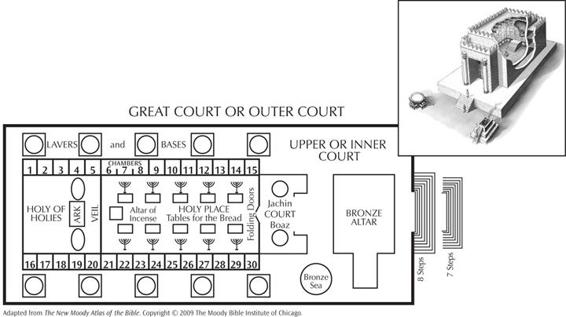
a. The Ark Comes to the Temple (5:1b-10)
5:1b. Solomon’s first act of dedication of the temple was to bring the things that David his father had dedicated and the ark of the covenant to the temple.
5:2-3, 6. With the note that Solomon assembled the leaders of the nation to Jerusalem (v. 2a), the Chronicler focused on the theme of unity once again. This assembly effectively brought all the men of Israel (v. 3) together around the symbol of national pride and accord. In the rest of the narrative in Chronicles this type of national assembly was meant to indicate a time of revival of faith and fidelity to the Lord (cf. 2Ch 20:5-19; 30:13-27; 34:29-33). The many sacrifices offered by the king and all the congregation of Israel (v. 6) also served to bring a sense of unity to the entire proceeding.
5:4-5. The two accounts of David’s attempt to move the ark (one ending in tragedy, 1Ch 13:1-14; and one ending in success, 1Ch 15:1-28) as well as the instructions in the law for transporting the ark (cf. Nm 4:15) are the historical and prescriptive backgrounds for the account recorded here. Solemn respect mixed with nearly breathless anticipation can be sensed in the description of the account of the transportation of the ark to the temple. That the priests involved were specially selected (not using the usual process) and consecrated for this task (see 5:11b) indicates the care taken in moving the ark.
Apparently the priests and Levites went to the tent where David had placed the ark (cf. 1Ch 16:1) and the tent of meeting (2Ch 5:5a; cf. 1:3) in Gibeon and brought all the holy utensils (v. 5b) to the temple, effectively uniting the ancient tabernacle with the new temple. It was important that the Chronicler demonstrate to his generation that the ancient institutions were not lost but preserved, and could be revived, in the rebuilt temple of their day.
5:7-10. The Chronicler related the placement of the ark with great precision, conveying the care that had been taken in the actual event. Four aspects of the ark are noted: its location, the inner sanctuary … the holy of holies (v. 7); its surroundings, the cherubim (vv. 7b-8; cf. 1Ch 28:18; 2Ch 3:10-13); its means of transport, the poles (5:9); and its contents, the two tablets which Moses put there (5:10). Payne notes, “the golden pot of manna (Ex 16:32-34) and Aaron’s rod that budded (Nm 17:10-11; Heb 9:4) must have been lost” at some time over the years (Payne, “2 Chronicles,” 460).
b. The Glory of God Comes to the Temple (5:11-14)
5:11-14. The Lord’s presence symbolized by the ark now received an even more dramatic confirmation. As the priests (the ones specially selected and consecrated) who had transported the ark were exiting the holy place, as the singers were singing, the musicians playing—as the celebration was reaching a crescendo—then the house, the house of the LORD, was filled with a cloud (v. 13d), the Shekinah (divine presence). The dramatic event brought the ministry of the priests to a standstill for the glory of the LORD filled the house of God (v. 14). This was an unmistakable sign—as the Lord had come into the tabernacle in Moses’ day (cf. Ex 40:34-38), so He had now graced Solomon’s temple with His awesome presence. This “cloud” was a vivid and inimitable manifestation of God’s presence (cf. Ex 13:31-32; Mt 17:5; Ac 1:9). Here it served as confirmation of the Lord’s acceptance of and pleasure in this temple. (He will provide the same confirmation for the millennial temple according to Ezk 43:1-5.)
The praise of the priests—His lovingkindness (chesed) is everlasting (v. 13b)—recalls God’s covenant loyalty (chesed, cf. 1:7-13 and comments there) to Solomon (see 1Ch 17:13) and so gives the credit for this completed temple to Him.
2. Solomon’s Dedicatory Speech (6:1-11)
In recording the speech and prayer of Solomon, the Chronicler seemed particularly interested in relating to the reader the posture and orientation of the king and the assembly. His dedicatory verse (6:1-2) was apparently addressed toward the temple. His blessing and speech were delivered facing the standing assembly (6:3). For his prayer he began standing “before the altar” (v. 12) on a specially constructed bronze platform (v. 13; a detail not included in 1Kg 8:22-23) and then knelt and “spread out his hands” (vv. 12, 13c). These details were meant to convey the depth of dignity and solemnity of this moment. The presence of God was awe-inspiring, and the form of worship was vital to communicating the assembly’s feelings of admiration, reverence, and respect. Solomon (and the Chronicler) knew that “posture in worship” could contribute to (or detract from) the depth, weight, and authenticity of worship.
a. Dedicatory Verse (6:1-2)
6:1-2. This “dedicatory verse” was uttered in response to the dramatic and climactic event of the glory of God filling the temple in the form of a cloud (cf. 5:13d). The image of a thick cloud (6:1) as the indication of God’s presence is probably drawn from Moses’ experience on Mount Sinai (Ex 20:21; cf. 2Sm 22:7-8; Ps 97:2). Now that the Lord, in the manifestation of this cloud, had come to the lofty house (2Ch 6:2a) Solomon had built, He demonstrated His approval of it and His intention to make it a place for His dwelling forever (v. 2).
b. Dedicatory Address (6:3-11)
6:3-4a. Solomon maintained the solemnity of the service by blessing the assembly and blessing the LORD, the God of Israel (v. 4). These blessings were not “pious words” but deeply felt petitions for joy and happiness (a beatitude) for the assembly and honor and thanksgiving toward the Lord.
6:4b-6. This address began with a series of remembrances of the Lord’s promises and fulfillments. He spoke to David (v. 4b; cf. 1Ch 17:3-14), and He fulfilled it with His hands (2Ch 6:4c; that is, directly and literally). He spoke to Abraham and Moses (cf. Gn 15:13-14; Ex 3:7-10), and He fulfilled it when He brought His people from the land of Egypt (2Ch 6:5a). Again, He spoke to David and chose Jerusalem (vv. 5b-6a; cf. 1Ch 11:4ff.; 17:5; cf. 2Ch 12:13; Zch 1:17; 8:3), and he chose David (2Ch6:6b; 1Ch 28:4; cf. 1 Ch 17:23, 27; cf. 1Sm 16:1-13). This list would have encouraged Solomon’s audience and the Chronicler’s readers to remember that the Lord’s promises are certain (cf. Ps 105:1-8; Rm 11:29).
6:7-11. Solomon moved to the specific promise God made regarding the construction of the temple and its subsequent fulfillment. David had desired to build a house for the name of the LORD, and while this was commendable it was denied to him (vv. 7-9; cf. 1Ch 28:2-3). Rather, the honor for this task was granted to David’s son (2Ch 6:9). This too the LORD has fulfilled (v. 10). Four aspects of Solomon’s experience were specifically mentioned: first, he had risen in the place of my father David; second, he sat on the throne of Israel; third, he had built the house for the name of the LORD; and fourth, he had successfully set the ark of the covenant in the proper place. Each of these was the fulfillment of His Word which He spoke (v. 10). Besides the themes of promise and fulfillment, two other themes are touched upon: first, the Lord accomplished the fulfillment actively—by His “mouth” and His “hands” (6:4; cf. 6:15b) by His word which He spoke (v. 10). Second, those whom He uses to accomplish His work must be ready to serve in whatever manner He chooses—David not to build but to prepare—Solomon to build and to do all according to His Word. While Solomon considered himself to be the fulfillment of the promises regarding David’s ultimate son (v. 10, I have risen in the place of my father David and sit on the throne of Israel … and have built the house), the Chronicler’s readers would know from Israel’s history that Solomon’s failures disqualified him from being the Son of David, the Messiah (cf. 1Kg 11:1-13; see the comments on Mt 1:1).
3. Solomon’s Dedicatory Prayer (6:12-42)
6:12-13. Solomon’s prayer of dedication is one of the great prayers of the Bible. As noted, the solemnity and dignity of the moment were conveyed through Solomon’s posture and attitude in prayer—he knelt on his knees (v. 13) indicating his humility before God and his reverence for God. The prayer itself is a model of praise and petition.
a. Prayer of Acknowledgment (6:14-15, 18)
6:14-15, 18. Solomon praised the LORD, the God of Israel (v. 14a) by acknowledging His transcendent uniqueness—there is no god like You in heaven or on earth (v. 14a)—His immensity—Behold, heaven and the highest heaven cannot contain You (v. 18), His covenant keeping “loyal love” (“lovingkindness,” chesed, see comments on 1:7-13), and again, His promise fulfilled to David.
b. Prayer of Petition (6:16-17, 19-21)
6:16-17. Solomon made three petitions: first, he appealed to the Lord to keep … that which You have promised (v. 16), to let Your word be confirmed which You have spoken (v. 17). These were not expressions of doubt about whether the Lord would keep His Word. Solomon knew that God works through the prayers of His people to accomplish what He has decreed. Solomon was praying for God’s promise to be kept, even as he prayed with God’s promise as his assurance. He was in effect expressing his confidence in that promise.
6:19-21. Second, Solomon prayed for the Lord to have regard (v. 19a) to this prayer, to listen to the cry, to the prayer, to the supplications (vv. 19b, 21), to keep an open eye (v. 20a; cf. 6:40), to hear when prayers are made toward this house (i.e. the place of God’s presence; v. 20). Again, these do not indicate that the Lord needed to be cajoled or prodded into hearing the prayers of His people. The key appears in the final expression in v. 21—hear and forgive. Solomon knew that he and the nation had access to God in prayer solely on the basis of God’s grace. These are all pleas for God to be gracious—pleas from a sinner asking God to be forgiving and open to hearing the prayers of the penitent. Indeed, the prayers are made toward this house, this place of atonement for sin. They are the pleas of the unworthy to a gracious God to be forgiving in the light of the atonement to be accomplished in this temple. The theological idea behind these pleas is that the presence of the Lord in the temple was not merely “ceremonial” but that He would be taking an active role in the life of the nation and the experiences of the individual members of the community.
c. Prayer Regarding Various Situations (6:22-39)
Solomon next listed various circumstances for these pleas for a gracious hearing from God that might apply most. Selman notes, “Each paragraph follows the same pattern: (1) a situation of need, usually involving sin; (2) temple-based prayer and confession; (3) request for God to hear; (4) restoration and forgiveness” (Selman, 2 Chronicles, 328).
6:22-39. Times when the Lord’s active presence should be invoked include: (1) in the circumstance of those who take oaths, that the Lord may punish the wicked who break the oath and justify the righteous who keep the oath (vv. 22-23); (2) in the event of defeat by an enemy of the nation, that upon confession of the underlying sin He restore the nation to the land of promise (vv. 24-25); (3) in the event of drought (like a defeat it was a sign of God’s chastisement for the nation’s sin), that upon confession He forgive the sin and teach them the good way and send rain on Your land (vv. 26-27); (4) in the events of famine … pestilence … sickness when individuals or the nation—any man or by all Your people Israel—make supplication and pray, that He render to each according to all his ways and according to the sincerity of his heart (vv. 28-31); (5) in the case of foreigners, that when such a one who recognizes the truth of who the Lord is and His power, that He hear and answer them, so that all the peoples of the earth may know Your name, and fear You and thereby testify that the temple is indeed the house that is called by Your name (v. 33); (6) in the case of a war of conquest, whatever way You shall send them, that upon their prayers they be given success (vv. 34-35); (7) in the event of captivity, something only possible because of their sin, that when they take thought of the land, upon their repentance and confession, their return to You with all their heart and with all their soul, and their prayer toward their land and the city of the Lord’s promise and choosing, He hear, and forgive, and restore them (vv. 36-39).
d. Final Appeal (6:40-42)
6:40-42. Solomon’s confidence that the Lord would be attentive to this and all such prayers was predicated on the Lord’s presence in this place—the temple. He concluded his prayer with a call for the Lord to take up Your resting place, and one final plea that He not turn away (vv. 41, 42).
4. Fire and the Glory of the Lord (7:1-3)
7:1-3. The Lord dramatically answered Solomon’s prayer by sending down fire … from heaven to consume the burnt offering and the sacrifices and once again the glory of the LORD filled the house (v. 1). This was an unmistakable confirmation that the Lord had accepted the temple as His house and that He would deal with His people according to the ways Solomon had just petitioned Him. The reaction of the priests and people was fear—they bowed down in worship and praise (v. 3).
5. Sacrifices and Festival (7:4-11)
7:4-11. The assembly continued with sacrifices (vv. 4-5), music (v. 6), more offerings (v. 7), and celebration of the Feast of Booths (vv. 8-9). “Solomon had delayed the temple’s dedication for a number of months (cf. 5:3) so that this might be celebrated along with the feast of Booths, when at the latter season all Israel would be coming in pilgrimage to Jerusalem (Ex 23:16-17” (Payne, “1 Chronicles,” 464). Then Solomon dismissed the people rejoicing and happy (v. 10). The key to this rejoicing and celebration was the understanding of the people that the temple and all the blessings they were enjoying were grounded in the truth that His lovingkindness (“loyal love,” chesed, see definition 1:7-13) is everlasting (7:3c, 6b). That is, they recognized with Solomon that as a people they deserved nothing, but that based on His covenant promises He would never forsake them. This was a message that the generation of the Chronicler (and all generations of God’s people) needed to hear. The Lord will keep His promises. Of course, another note has been sounded in this paean of praise, namely, that the enjoyment of these blessings, for an individual or the nation, depends on obedience (cf. 6:16)—this point was soon to be driven home to Solomon.
6. Post-Dedication Appearance of the Lord to Solomon (7:12-22)
This nighttime appearance of the Lord to Solomon (v. 12) is the second recorded in 2 Chronicles (cf. 2Ch 1:7ff.) and was the occasion of another significant word from the Lord to Solomon in particular and to the Davidic dynasty in general. When the pertinent texts are considered (see 1Kg 6:38–7:1; 9:10), the note that the Lord spoke to Solomon after the completion of both the temple and the palace (2Ch 7:11-12) indicates that this appearance was some 13 years after the dedication ceremonies just recorded. It must have seemed more appropriate to the Chronicler that this divine confirmation be noted at the moment of the temple’s dedication.
a. The Lord Confirms His Choice of the Temple (7:12, 16)
7:12, 16. The Lord made it clear that this appearance was in answer to Solomon’s prayer of dedication—I have heard your prayer. He acknowledged that the temple was to be the place of mediation—of sacrifice and prayer. The nation could count on His promise—based on His choice of the temple—to hear their prayers because this was the place where His name, His eyes, and His heart (that is, His conscientious attention and affection) would be manifested perpetually (7:16b).
b. The Lord Extended His Promise to Include Restoration (7:13-15)
7:13-15. This awesome promise placed a compelling responsibility on the nation. The Lord anticipated a time of trial, one that would have been real to any nation in that time and place—a period of drought, pestilence, and famine (7:13). There is no indication that this eventuality was necessarily the result of sin—it might have been so, or it may simply have been an experience under God’s providential direction. In any case, the promise meant that the nation had recourse to alleviate such disasters. In what is perhaps the best-known verse in all of Chronicles, the Lord outlined the proper attitudes and actions to regain and enjoy the blessing of the Lord. Although the promise was specifically directed to My people, the principles are applicable to all who call upon the name of the Lord (cf. Jl 2:32; Zph 3:9; Ac 2:21; Rm 10:13; 1Co 1:2) (cf. Selman, 2 Chronicles, 338).
The four actions listed in 2Ch 7:14 were not intended to be understood as “steps in a process” but as contemporaneous “facets of an active attitude given tangible expression.” These acts would be illustrated by several of the exemplary Davidic kings in the narrative to follow in 2 Chronicles, giving proof to the truth of this promise. A repentant people are, first, to humble themselves, that is they must refuse the stubbornness and pride so ever-present in the nation’s history. Second, they are to pray and afford themselves of the great privilege represented by the temple itself. Third, they are to seek My face, again one of the key themes of the Chronicler—seeking God’s face means the people are to reject self-seeking and self-reliance. Fourth, they are to turn from their wicked ways—this is repentance. These acts indicate that the Lord expects nothing less than a deeply felt rejection of self-reliance, self-trust, self-seeking, and a conscientious dependence upon Him, an active submission to Him, and a determined and active alteration of lives to be lived for Him.
The Lord’s promise in response to this “active attitude” was threefold: first, He again promised to hear from heaven—an overwhelming reality if understood; to forgive their sin—the necessary step to restoration of the relationship with Him and the enjoyment of His covenant blessings; and third, to heal their land. This last element not only recalled the tangible aspect of the Abrahamic promise—the land—but also would have been especially encouraging to the Chronicler’s generation as they were struggling in that very land—one badly in need of restoration. These promises were addressed to His covenant people Israel and reflect the Deuteronomic blessings and cursings promised in the law (cf. Dt 27, 28) and are therefore not appropriately enjoined for believers who do not live in a theocratic nation. Certainly God would long for the people of the United States (or any other country) to humble themselves and pray, and turn in faith to Jesus the Messiah. Although God would certainly forgive the sins of those people who turned to Him, there is no promise here that God would restore their respective nations or heal their lands.
c. The Lord Reiterated His Promise to the House of David (7:17-18)
7:17. The Lord next addressed Solomon personally, but in effect He was addressing the rest of David’s dynasty. That is, while the Lord was speaking to Solomon, these words were equally relevant and urgent for each of the Davidic kings who would follow. While the promise to David was inviolable (v. 18b; cf. 1Ch 17), the enjoyment of it, in any individual king’s reign, was contingent upon that king’s obedience. The obedience expected was described in three terms: the king was to walk, to do, and to keep (2Ch 7:17). First, the obedience the Lord required was characterized as “walking”—behaving, serving, reigning—as your father David walked (v. 17a). David was the paradigm of covenant faithfulness. He was not perfect, but he was “a man after [God’s] own heart” (cf. 1Sm 13:14; Ac 13:22). Second, the king was to do according to all that I have commanded you. The king was actually to serve as “vice-regent” under the sovereign Lord, the True King. Third, the king was responsible to keep My statutes and My ordinances. He was to obey the law as a guide to the will of God. “Keeping the law” did not mean keeping it as a legalistic code but rather adhering to it as the means for the Lord to bless the king and the nation (cf. Ps 1:1-3; 119:1-8). The exhortation here is remarkably similar to the description of Abraham in Gn 26:5: “Abraham obeyed Me and kept My charge, My commandments, My statutes and My laws.” Surprisingly, Abraham is described this way even though the law was not given until hundreds of years later. Yet Abraham can be described in this way because he “believed in the LORD,” and it was “reckoned … as righteousness” (Gn 15:6). The only reasonable explanation of Abraham is that because he lived a life of faith, he was able to carry out the law, even before it was given. Hence the message of the Pentateuch was to encourage faith leading to faithful obedience. Here Solomon is enjoined to obey as an expression of his faith.
7:18. The promise You shall not lack a man to be ruler in Israel (v. 18b) was (obviously) not a promise that there would always be a king over Israel. Indeed, the Chronicler was well aware that the nation had had no king since the captivity began (and still had no king in his day). The promise, however, was an expression of his messianic hope. While the covenant promises may not be enjoyed by a disobedient king, and the nation may fail to enjoy the blessings of having a descendant of David on the throne at any particular point in history, yet the Chronicler is sure this promise will find ultimate fulfillment in the Greater Son of David (cf. 1Ch 17:13-14), the Messiah who would come “to be ruler in Israel” (cf. Mc 5:2).
d. The Lord Warned of Exile for “Forsaking” His Law (7:19-22)
7:19-22. The Lord concluded the word to Solomon with a warning clearly articulating the themes “seeking the Lord” on the one hand and “forsaking the Lord” on the other hand (see Introduction: Purpose and Themes in 1 Chronicles). The history of the divided monarchy, beginning with the apostasy of Jeroboam I (cf. 1Kg 12:25-33) and running until the reign of Zedekiah (2Kg 24:17ff.) was checkered with disobedience to the law and the practice of idolatry. The warnings of exile and international ridicule were not potentialities to the Chronicler’s generation—they were the tragic history the nation had actually suffered and from which they had returned relatively recently. The Chronicler’s purpose “was not to rub salt in old wounds, [sic] rather his purpose was to show how to avoid the consequences of disobedience” and that when such consequences do fall, to show that “the proper recourse of the people is repentance” (Sailhamer, First and Second Chronicles, 78).
F. Solomon’s Reign (8:1–9:31)
After 20 years on the throne (8:1), mostly consumed with building the temple and his own palace, Solomon was ready to enjoy the fruits of his labor. Being the king, however, meant that challenges and duties never stopped. The Chronicler concluded the narrative of Solomon by highlighting his activities in securing the kingdom and administering it in wisdom. His wealth and power are also noted.
1. Solomon Secured His Kingdom (8:1-18)
a. Solomon’s Building Projects (8:1-11)
8:1-6. The Chronicler recorded the other, outlying building projects of Solomon, highlighting the cities he built for defense, fortified cities (v. 5), for storage—probably indicating places to secure his wealth (vv. 4, 6), and for bivouacking his chariots and horsemen (v. 6). The geographical notices indicate that Solomon extended his kingdom and secured it from attack.
8:7-10. The building of the cities indicates that Solomon secured his kingdom from external threats, and the note here about his labor forces indicates he secured his kingdom internally as well. All foreigners were conscripted as forced laborers (v. 8b; cf. 1Ch 22:2). This need not be understood in a way that envisions harsh conditions and severe taskmasters. It does indicate that Solomon kept close tabs on these people and did not allow them to advance to higher-level positions of authority. Those positions were reserved for the sons of Israel (2Ch 8:9). The purpose appears to be that only those who could be expected to have primary loyalty to the nation and the king would be in positions of responsibility and power.
8:11. Solomon also built a separate house for his Egyptian bride. The explanation seems to indicate that Solomon recognized the inappropriateness of having a foreign (possibly pagan) wife living in proximity to the holy places he had so recently consecrated for the ark. (On the matter of OT men having multiple wives see comments on 1Ch 14:3-7 and Gn 29, 30).
b. Solomon’s Temple Ceremonies and Personnel (8:12-15)
8:12-15. The note here regarding the ceremonies and personnel of the temple must be understood in context as another feature of securing the kingdom. While the external and geopolitical steps taken for security were practical and important, the real security of the nation’s people lay in their devotion to and trust in the Lord. These were given tangible expression in the sincere and faithful worship services in the temple. When all was done according to the daily rule (v. 13), and according to the ordinance of … David (v. 14a), and the priests served according to the daily rule (v. 14b), and when they did not depart from the commandment of the king (v. 15), the nation was assured of the Lord’s continuing presence in the temple.
Solomon’s Domestic Administration
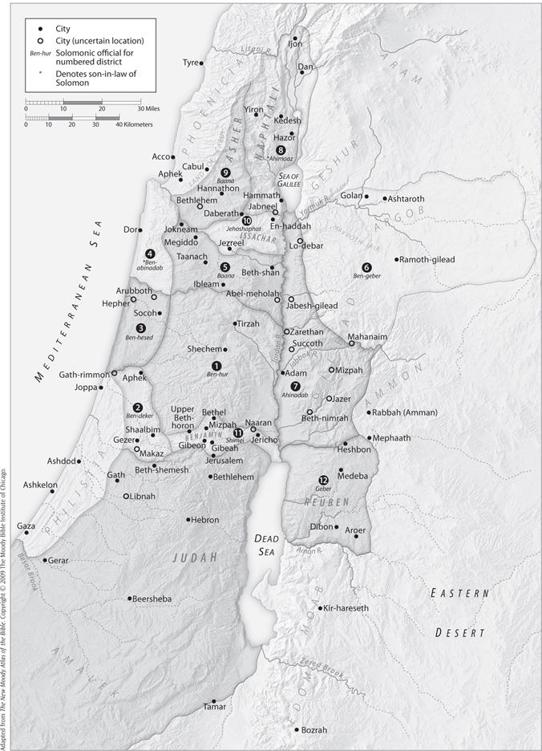
c. Summary Statement Regarding the Temple (8:16)
8:16. This final statement of the completion of the temple is not redundant. The Chronicler was driving home the point that Solomon’s dedication to building the temple underlay the prosperity and security the king and the nation now enjoyed.
d. His Seaports and Trading (8:17-18; 9:10-11, 21)
8:17-18; 9:10-11, 21. The final note regarding Solomon’s efforts to secure the nation concerns his establishment of seaports Ezion-geber and Eloth (modern Eilat) in the south, on the Gulf of Aqaba. These ports gave access to Ophir from which Solomon imported large amounts of gold and other riches (cf. 9:10-11). Since the Israelites were not seafaring people, Solomon employed the servants of Huram (King of Tyre) for this maritime enterprise. The location of Ophir and the mythical “King Solomon’s mines” is unknown. Since the account of the seaports is linked to the visit of the Queen of Sheba it is probable that Ophir was located in or near Sheba—an empire that stretched from southern Arabia across the Red Sea to eastern Ethiopia (see Payne, “2 Chronicles,” 4:470).
Another trade route was initiated to Tarshish (9:21a; cf. 2Ch 20:36). This was also manned by the servants of Huram and was also highly lucrative (9:21b).
2. Solomon Administered Kingdom in Wisdom, Amassed Great Wealth (9:1-28)
The narrative in this chapter demonstrated that the promise the Lord made to Solomon at the first night visit (1Ch 1:8-13) was completely fulfilled. The Lord promised Solomon wisdom and wealth—and Solomon indeed displayed unusual wisdom and amassed incredible wealth.
a. Solomon’s Wisdom and Queen of Sheba (9:1-9, 12)
As Solomon’s kingdom grew more secure and powerful it attracted the attention of other empires in the region. One such was the empire of Sheba. This empire of southern Arabia was built on intercontinental trade mainly between Africa and the Middle East (Asia). The attention devoted to the visit of the Queen of Sheba indicates the spread of Solomon’s power and influence.
9:1-4, 9. Having heard of the fame of Solomon, the queen came to see for herself if the accounts of wisdom and wealth were true. In keeping with the social customs of visitors bearing gifts for their hosts, the queen brought a large amount of gold and precious stones (v. 1b). The queen’s “gift, also recorded in 1 Kings 10:10” (one hundred and twenty talents of gold, 2Ch 9:9) “amounted to over four and a half tons of gold” (Payne, “2 Chronicles,” 470).
The object of her visit was to test Solomon with difficult questions (v. 1a). This was not an attempt to “trip him up” but rather to discover for herself the depth of his wisdom and understanding. Solomon did not disappoint. He answered all her questions and gave her complete explanations (v. 2). This is more than a matter of historical interest to the Chronicler. Not only was this a specific instance of the fulfillment of the Lord’s promise to Solomon (cf. 1:11-12) but also it is “reminiscent of the kind of messianic hope characteristic of the chronicler’s day (Haggai 2:7)” (Sailhamer, First and Second Chronicles, 79). Indeed, the expectation of the Gentile nations coming to the Davidic King for instruction and enlightenment into the ways of the Lord was a significant feature of Jewish messianic expectation (see Is 60:3-6). The wisdom and splendor of Solomon left the queen breathless (2Ch 9:4c).
9:5-8, 12. The queen’s personal visit proved to be a surprise to her, and she confessed that the half of the greatness of Solomon’s wisdom was not told to her—his wisdom surpassed her expectations (v. 6). As earlier with Huram (cf. 2:11-12), the Chronicler recorded the remarkable theological insight of a non-Israelite—the Lord is the One responsible for this wisdom and splendor. Indeed, in this Davidic King and in this pagan queen there is the foreshadowing and portent of the promise that many nations will come to Jerusalem and “to the house of the God of Jacob” to receive “the word of the Lord” (Is 2:2-3).
The note in 9:12 indicates that in both physical and spiritual realms the queen returned home with more than what she had brought to the king.
b. Solomon’s Wealth and Power (9:13-20, 22-28)
9:13-28. The record of the incredible wealth of Solomon was yet another indication of the fulfillment of the Lord’s promise (1:11-13). The details of the golden shields (9:13-16), the throne of ivory and gold (vv. 17-19), and the golden drinking vessels (v. 20) gave evidence that Solomon was greater than all the kings of the earth in riches and wisdom (v. 22). Indicative of the same point, the Chronicler recorded that other kings followed after the example of the Queen of Sheba and came to witness Solomon’s wisdom and bring him tribute (vv. 23-24, 28). Solomon’s military might and the extent of his hegemony were also noted (vv. 25-26). The Chronicler recorded all of this as a message of hope for his generation. What God has done for Solomon in fulfillment of the Davidic promise, He will do fully, finally, and forever for the greater Son of David, the Messiah. While Solomon’s power and authority reached the zenith in the extent of the kingdom in the OT (v. 26) his kingdom did not extend as far as the land promise to Abraham had indicated (here in 9:26—border of Egypt; cf. Gn 15:18-21—“river of Egypt”). Later prophets reiterated the promise (e.g. Am 9:11-15; Is 57:13; 61:7, indicating that they did not view the promise as fulfilled or abrogated), and the promise was ultimately meant to be “everlasting”—forever (Gn 12:1, 7; 13:15; 15:18; Is 60:21).
3. Summary and Death of Solomon (9:29-31)
9:29-31. The most striking aspect of this concluding formula is that it appears without the record of Solomon’s failures toward the end of his reign (see 1Kg 11:1-43). Nothing is mentioned of his apostasy or that “the LORD was angry with Solomon because his heart was turned away from the LORD” (1Kg 11:9). As in the Chronicler’s narrative of David, these more negative accounts in the narrative of Solomon were not included, though not in an attempt to deny them or rewrite history. Indeed, the Chronicler assumes the reader is aware of these parts of Solomon’s story. His purpose, however, was to encourage his generation, and those negative details simply did not contribute to that end. For the Chronicler, the point of the narrative was not Solomon’s success or failure but the Lord’s promise and fulfillment of it. “Solomon was ‘primarily exemplary.’ Solomon was an example of the promised descendant of David, who in the chronicler’s day had not yet come” (Sailhamer, First and Second Chronicles, 82). Nevertheless, Solomon’s story did indicate that the Lord’s promise would be fulfilled: the Greater Son of David would come, with wisdom and splendor even greater than Solomon’s.
IV. The Kings of David’s Line (10:1–36:23)
The fourth major division of the Chronicler’s work essentially deals with the kings of the Davidic dynasty from the death of Solomon to the captivity. The focus is on the kingdom of Judah, and the references to the kings and kingdom of the northern tribes (Israel) are limited to those times when there was significant intercourse between the kingdoms. The Chronicler “was seeking not a comprehensive understanding of the past but a theological perspective on the present and the future” (Sailhamer, First and Second Chronicles, 83). The Chronicler was much less reticent in this section to recount the foibles and sins of the Davidic kings (when compared to his version of the lives of David and Solomon). However, while he did recount some serious problems with several of the kings in the Davidic line, he also presented a perspective that highlighted the benefits of “seeking the Lord” and presented that as a possibility even in the face of great failure (as in the case of Manasseh). While it was true that the Lord would chastise the king who failed to “seek the Lord,” nevertheless the Lord responded favorably to sincere repentance and faith.
A. Rehoboam (10:1–12:16)
The reign of Rehoboam was set down by the Chronicler in three parts, each corresponding to the three chapters of 2Ch 10, 11, and 12. The first of these, delineated in 2Ch 10, corresponds closely to the parallel in 1Kg 12. This once again indicates that the Chronicler was not attempting to rewrite history—his retelling was meant to highlight certain aspects of the story to create an overall theological sense of the narrative. Much of the material in 2Ch 11 and 12 is unique to the Chronicler.
The division of the kingdom was a major event in the nation’s history and an explanation was needed, especially in the light of the Davidic promise (1Ch 17). In Kings, it is clear that Solomon (cf. 1Kg 11:26-39, the account of the word of the Lord to Jeroboam through Ahijah the prophet), Rehoboam, and Jeroboam were each, in different ways, responsible for the division of the kingdom. However, the Chronicler highlighted one note from Kings to make it emphatically clear that the Lord predicted this division (2Ch 10:15; cf. 1Kg 12:15), so it “was a turn of events from God.” As the Lord transferred kingship from Saul to David (cf. 1Ch 10:14), so He was also in control of even this unhappy phase of the nation’s history. Thus, the Chronicler has indicated that the Lord is in charge of the great “turning points” in the nation’s history.
1. The Kingdom Divided (10:1-19)
a. Rehoboam Met with All Israel; Coronation Delayed (10:1-5)
10:1-3. Rehoboam traveled to Shechem to meet with all Israel and be recognized as king. Since the tribal divisions that would result in two kingdoms were already in place, the meeting’s location at Shechem was significant. Shechem was about 30 miles north of Jerusalem in the territory of Ephraim and was already recognized as an important political center for the northern tribes. After the split, it became the first capital of the northern kingdom (cf. 1Kg 12:25).
It seemed that Rehoboam expected this coronation to proceed as his grandfather’s had (cf. 1 Ch 11:1) since all Israel was in attendance. However, Jeroboam, who had been exiled to Egypt by Solomon (cf. 1Kg 11:26-40), had been recalled and had been appointed spokesman for the people. The atmosphere of this scene as recounted by the Chronicler was serious but not necessarily tense.
10:4-5. The statement Your father made our yoke hard and the reference to hard service (v. 4a) was a serious charge—essentially charging Solomon with “pharaoh-like” treatment (cf. the similar wording in Ex 6:6-7) of his countrymen in violation of the commandment directed at kings (Dt 17:20). However, the charge was immediately softened by a pledge that should this burden be lightened the people would be willing to serve the new king (2Ch 10:4b). Rehoboam acted prudently by delaying the response for time to consider the demand. At this point, humanly speaking, the division of the kingdom was not inevitable. The Chronicler may have been telling his readers that such disasters are avoidable and divisions are best healed while the breach is small.
b. Rehoboam Met with His Advisors (10:6-11)
If Rehoboam had been thinking of a previous assembly of “all Israel” (cf. 1Ch 1) he might have recognized the need to pray for wisdom as his father had done. The absence of prayer at this critical juncture in the nation’s history and in Rehoboam’s reign was glaring. Instead he met with his human advisors, and even then heeded the wrong ones.
10:6-7. The elders who advised Rehoboam were the men who had served his father (v. 6). Their advice was to do as the people had requested. “The parallel passage in 1Kg 12:7 quotes even stronger advice by the elders to the king: not simply that he ‘be kind’ and ‘favorable’ to the people, but that he ‘be a servant’ and ‘serve’ them” (Payne, “2 Chronicles,” 4:474). What the people could endure for the great tasks of building the temple and palace could not be sustained indefinitely. Sacrifice for a grand project was one thing—constant subjugation for the king’s personal aggrandizement was quite another.
10:8-11. The two times the text mentions that Rehoboam forsook the counsel of the elders (10:8a, 13) brackets the account and served to highlight his failure to “seek the Lord.” He turned instead to the young men who grew up with him. Their self-serving loyalty was to him alone (served him) (v. 8b) and not the whole nation. Rehoboam’s repetition of the people’s charge (v. 9b) while leaving out the part about their promise to serve, distorted the issue and made the unreasonable advice of the young men seem more fitting. A challenge was met with a threat—always a bad policy! The bellicose advice of the young men, seen from the historical perspective after the division of the kingdom, was both immature and shortsighted.
c. Rehoboam Met with Jeroboam and All the People (10:12-15)
10:12-15. The parties reconvened and Rehoboam answered them harshly (v. 13). The repetition in these verses gave the sense that the scene had turned tense and adversarial. The Chronicler summarized with the words, So the king did not listen to the people (v. 15a). Rehoboam had clearly underestimated the seriousness of the challenge and overestimated his ability to carry out the threatened oppression. However, the Chronicler was quick to make clear that this turn of events (v. 15b) was of the Lord. “The reader is reminded that even a disastrous situation such as the division of the kingdom and the loss of the ten tribes of Israel was not without its place in God’s plan” (Sailhamer, First and Second Chronicles, 84).
d. Kingdom Divided (10:16-19)
10:16-19. The reaction to Rehoboam’s truculent and deprecating response was swift and unambiguous. The poetic question, what portion do we have in David? likely became a popular refrain among the people. The division between the house of David and all Israel reflects a rare time in Chronicles when the unity of the nation was shattered.
Rehoboam attempted to make good on his threat, but his man, Hadoram (“Adoram” in 1Kg 12:18) was stoned to death for his efforts. Rehoboam was forced to flee for safety to Jerusalem where he reigned over the cities of Judah (2Ch 10:17). The note about Israel being in rebellion to this day (10:19) most likely recounts the words of the Chronicler’s source (cf. 1Kg 12:19). The Chronicler omitted the narrative of the coronation of Jeroboam (cf. 1Kg 12:20). From this point forward, he generally ignored the history of the northern kingdom (since his focus was on the Davidic dynasty), including the kings or events of the northern kingdom only when they related to the narrative of the Davidic kings of Judah. (The whole history of the rebellion, disobedience, and judgment of the northern kingdom did not serve the more optimistic view of the Chronicler. He was not interested in rehashing who was chastised, but he wanted his generation to “keep looking at the promise” and the Greater Son of David who would bring about the blessing on the nation.)
2. The Reign of Rehoboam (11:1-23)
At this point the Chronicler’s account of Rehoboam’s reign diverged considerably from that of Kings. The account in Chronicles is longer, with material not found in Kings. Furthermore, while the overall evaluation of Rehoboam is the same in both accounts (cf. 2Ch 12:14 and 1Kg 14:22) there is more place given to Rehoboam’s albeit temporary repentance (2Ch 12:6) and to examples from Rehoboam’s reign that indicate the Davidic promise endured despite the king’s evil. Regardless of his folly and loss of the northern tribes, Rehoboam consolidated his kingdom (11:5ff.) just as David and Solomon had done. Furthermore, he gathered the priests and Levites (11:13) from all Israel and demonstrated a “Davidic” interest in the place of true worship—Jerusalem (cf. 11:16). Once again, the Chronicler was not attempting to rewrite history (he expects the reader to be familiar with the story as told in Kings), but he offered a perspective on Rehoboam that highlighted the Lord’s faithfulness to His Davidic covenant promises.
a. Rehoboam Prevented from Attacking Israel (11:1-4)
11:1-3. Upon his return to Jerusalem, Rehoboam’s initial response to the rebellion and to the outrage of the murder of his envoy was to assemble a force from Judah and Benjamin to fight against Israel. His objective was to restore (“to win back”) the unity of the nation under himself (v. 1). The mention of Judah and Benjamin shows that it was these two tribes that made up the southern kingdom of Judah (cf. v. 3). Rehoboam had not yet learned from his folly and intended to force the northern tribes to submit.
The Lord put a swift halt to such intentions through Shemaiah the man of God, a prophet who ministered throughout the reign of Rehoboam and later wrote a noncanonical book about him (v. 2; cf. 12:5-7, 15). The message was addressed to the king and to all Israel in Judah and Benjamin (v. 3). The words all Israel (in contrast to “all the house of” in 1Kg 12:23) are significant. The Chronicler subtly shifts his use of this designation from its general application to the whole of the unified nation (2Ch 11:16) to those who are loyal to the Davidic dynasty and especially those who are devoted to the temple in Jerusalem. In other words, “all Israel” in a general sense means “all those who are descendants of the patriarchs,” but a more “theologically centered” sense refers to those who “set their hearts on seeking the LORD God of Israel” (11:16) and proved their loyalty by going to Jerusalem to worship at the temple. The lesson for the Chronicler’s generation was that those who returned from captivity, whose hope was in the Davidic promise, and whose worship centered on the temple, could legitimately be called “all Israel.” (In 12:1 the shift is complete; there the terms are used to designate Judah alone.)
11:4. Shemaiah related the words of the LORD to Rehoboam and all Israel that it was not the Lord’s will for them to go against their relatives (“brothers”) (v. 4). The Lord’s commands were sharp and clear: You shall not go up or fight … return every man to his house (v. 4a). His explanation was arresting: for this thing is from Me (v. 4b). This simple statement belies the complexity involved in the Lord’s purposes for the division of the nation. The author of Kings made it clear that one reason for this division was chastisement for Solomon’s apostasy (cf. 1Kg 11:29-33). Here, the Chronicler was indicating that the division was caused by the obstinacy and hubris of Rehoboam. But there is a subtler point: the division made a clear distinction between those “who set their hearts on seeking the LORD” (2Ch 11:16) and those who had forsaken the Lord. The positive effect of the division was the preservation of Judah from the apostasy of the northern tribes (cf. 11:14-15). Payne summarizes, “The overriding divine purpose was to separate the godly in Judah from the apostate in Israel (11:6-22) and to concentrate in the south those who remained faithful out of the northern tribes: ‘thus they strengthened the kingdom of Judah’ (v. 17)” (Payne, “2 Chronicles,” 4:474).
The final word in this brief section recounted not an act of resignation by the king and the people but an act of obedience and submission: So they listened to the words of the LORD (v. 4c).
b. Rehoboam Secured His Kingdom (11:5-13)
11:5-13. Rehoboam’s works of city building (11:5-10) and fortifying the nation (vv. 11-12) recall those of Solomon (cf. 8:2-6), and the underlying point is the same: the nation’s security was a priority because only with security can the purpose of worship and service to the Lord proceed unhindered. Once the security of the nation was established then matters of true worship could be addressed (cf. 11:13, 16).
c. Jeroboam’s Apostasy Led to Judah’s Strength (11:14-17)
11:14-17. The Chronicler noted the apostasy of Jeroboam (v. 15), but his account highlights a providentially positive effect: since Jeroboam’s idolatrous changes (cf. 1Kg 12:25-33) excluded the Levites, they were forced south to the Jerusalem temple, the center of true worship. This strengthened the kingdom of Judah (v. 17a) and helped Rehoboam. Sadly this effect lasted only three years (v. 17c), “an ominous reminder that Rehoboam was not to be the promised messianic Son of David” (Sailhamer, First and Second Chronicles, 85).
d. Rehoboam’s Family (11:18-23)
11:18-23. The paragraph detailing Rehoboam’s family was included not only to establish the line of succession through Abijah (a choice that did not follow the normal rules of succession). It also recorded how Solomon’s disobedient (cf. Dt 17:19) and fatal error of multiplying wives, who turned the heart of the king from the fear of the Lord, was repeated by his son. Even though the Chronicler dutifully recorded that it happened, it is not to be inferred that it was acceptable to the Lord that Rehoboam married a half-sister.
Rehoboam’s Fortified Cities
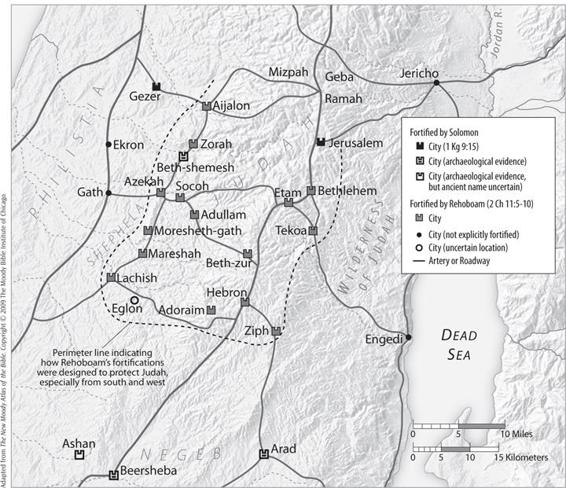
3. Invasion of Shishak (12:1-12)
In some ways this chapter is the starting point for the rest of Chronicles (see Payne, “2 Chronicles,” 4:477ff.). In this chapter the Chronicler regarded Rehoboam not so much as Solomon’s successor but as the first in the line of historical kings of Judah that terminated with the captivity. This is not so much the (theocratic) Davidic line but the semi-cyclical (historical) line of Judah that toggled between “bad” and “good” rulers until the captivity by Nebuchadnezzar. Although the Davidic promise was carried by this historical line, these kings were at best mere representatives of the ideal, and actually often served as negative contrasts of the promised Greater Son of David, the Messiah.
a. Invasion by Egypt (12:1-4)
12:1-4. The opening statement of this chapter (v. 1) was to be recalled in a haunting echo in many of the accounts that followed: a king, blessed by the Lord with security and strength, failed to honor God and found the nation’s security and strength weakened. The Chronicler specified that Rehoboam forsook the law (v. 1) and was unfaithful to the LORD (v. 2a) with the result that Shishak king of Egypt (v. 2b) invaded Judah. “To be unfaithful … to God is one of Chronicles’ key terms…. It involves denying God the worship due Him” (Selman, 2 Chronicles, 373). As a result, cites of Judah were taken and Jerusalem was itself threatened (11:4) to the extent that the leaders were gathered there (cf. 12:5). Egyptian records confirm the historicity and many of the details of this invasion (see Leo Depuydt, “Egypt, Egyptians,” in Dictionary of the Old Testament, Historical Books, ed. Bill T. Arnold and H.G.M. Williamson [Downers Grove, IL and Leicester, England: InterVarsity], 243).
b. Cause of Invasion Explained (12:5)
12:5. What the Chronicler had already told his readers, Shemaiah revealed to Rehoboam and the princes, repeating the charge of forsaking the Lord (v. 5c; cf. v. 1) and underscoring the seriousness of this offense—it was the direct opposite of “seeking the Lord” (cf. 1Ch 28:9; 2Ch 15:2).
c. Repentance and Humility Avert Total Disaster (12:6-12)
12:6-12. The Chronicler added more material to his own account of Rehoboam than is found in 1Kg 14:25-28, and in doing so has offered a nuance to his story—there was repentance and humility on the part of the king and the princes (2Ch 12:6). This lesson is one the Chronicler’s generation needed to hear. While “forsaking the Lord” brought chastisement, it was the loving purpose of a gracious God to bring about repentance through the “pain” and then, on the basis of the repentance and humility, to mitigate the penalty. Chastisement and even loss as the consequence of “forsaking the Lord” does not mean an end to His grace or His promises. While there was a heavy price to pay in treasure and gold (v. 9), nevertheless, because the king humbled himself, the anger of the LORD was averted and the destruction was minimized (v. 12). Indeed, even though the golden shields were lost, there were bronze shields to replace them, and in spite of the loss conditions were good in Judah (v. 12). The Chronicler’s generation needed to know that the humbling experience of the captivity had not demonstrated the Lord’s abandonment of His people. They had even less than the “bronze shields” but they had the hope that conditions could be good in Judah again.
4. Summary of Rehoboam’s Reign (12:13-16)
12:13-16. The concluding formula recorded in these verses was generally repeated for each of the Judaic kings to follow. The details—length of life and reign, summary of accomplishments, matters of succession—were more than a mere record of statistics and data. They were a brief overview of the life and story of the king designed to set up the moral evaluation. In Rehoboam’s case it was not good—he did evil. But it was not so much an active evil (as will be true of some kings of Judah and of Rehoboam’s rival Jeroboam) as it was a failure to do good—he did not set his heart to seek the LORD (v. 14). Although he reigned in Jerusalem, the city which the LORD had chosen … to put His name there (v. 13b), he had not been wholehearted toward the Lord. The Chronicler may have noted that his mother was Naamah the Ammonitess to imply that his failure to be true to the Lord came from the non-Israelite influence of his mother. Then again, the detail of adding the mothers’ names for several of these kings (cf. 13:2; 25:1; 27:1; 29:1) may simply be a means of precise identification for those who knew the family relationships. The Chronicler’s generation once again lived in that city, and this example would be a solemn encouragement to avoid Rehoboam’s fate by avoiding his failure.
The note concerning his sources (v. 15) would have increased the Chronicler’s credibility and the power of his narrative.
B. Abijah (13:1–14:1)
1. Introductory Formula for Abijah (13:1-2a)
13:1-2a. Abijah was called “a great sinner” by the author of Kings (1Kg 15:3), but in accord with the general tenor of his work the Chronicler chose to highlight the positive in Abijah’s brief reign—three years (2Ch 13:2a) from 913 to 911 BC. The name of his mother was Micaiah (Maacah, 1Kg 15:2) “and Uriel may be the son of Absalom (‘Abishalom’, 1Kg 15:2) making Micaiah/Maacah the granddaughter, though certainty is impossible” (Selman, 2 Chronicles, 379). The Chronicler’s account is longer than that of Kings, drawn from a source other than Kings, namely, “the treatise of the prophet Iddo” (2Ch 13:22b), and taken up mostly with the war between Abijah and Jeroboam (v. 2b). The account is less about Abijah himself than it is about the principle that humility and trust in God will bring victory and blessing since it is the LORD God of Israel (13:5) who brings victory. Because Abijah’s reign was mostly concerned with rivalry and war with the northern kingdom, the Chronicler dated Abijah by the reign of his rival Jeroboam (v. 1). While this cross-dating of kings is a fairly constant feature in Kings, “It occurs only here in the books of Chronicles” (Sailhamer, First and Second Chronicles, 86).
2. Abijah’s War with Israel (13:2b-19)
a. Nations at War (13:2b-3)
13:2b-3. The Chronicler simply and directly noted that there was war between the rival nations, indicating that Abijah and the southern kingdom were outnumbered by Jeroboam and the northern kingdom, two to one. Nevertheless, it was Abijah who began the battle (v. 3a).
b. Abijah’s Speech to Israel (13:4-12)
The record of Abijah’s speech is a typical literary device for the Chronicler. In fact, in narrative literature of the Bible, insight is regularly given through a speech by a primary character in the story.
(1) First Charge against Israel: Rebellion to Davidic Dynasty (13:4-7)
13:4-7. The exact occasion and location (Mount Zemaraim, v. 4a; cf. Jos 18:22) are uncertain, but apparently, while the two armies were lined up for battle, Abijah addressed his rival and all Israel (v. 4b). He delineated the charges against Israel and justification of this battle.
The first charge against Israel was her rebellion against the Lord’s chosen Davidic dynasty. Abijah reminded the rebellious nation that the LORD … gave the rule over Israel forever to David (v. 5a). The reference to the covenant of salt (v. 5b) is probably to be understood as “a metaphor for permanence based on Nm 18:19” (cf. Lv 2:13) (Selman, 2 Chronicles, 380). The primary use of salt in the ancient world was as a preservative—hence a covenant of salt would “last.” Abijah scolded the northern kingdom for following Jeroboam, a traitor surrounded by worthless men and scoundrels, instead of siding with the legitimate heir of Solomon (vv. 6-7a). Abijah’s characterization of his father Rehoboam was clearly biased but not inaccurate.
(2) Second Charge against Israel: Apostasy from True Worship (13:8-9)
13:8-9. The rebellion of the northern kingdom was not merely a political one but theological, thereby making it apostasy—a more serious matter for the Chronicler. It was not David’s, nor Solomon’s, nor Rehoboam’s kingdom against which they have rebelled but the kingdom of the LORD through the sons of David (v. 8a). Their apostasy was expressed in the golden calves set up by Jeroboam. That these gods were made for them (v. 8b) made their naked idolatry more appalling. Additionally, the northern kingdom had employed illegitimate, self-proclaimed pagan priests (v. 9c; cf. 11:14-15), while the true priests of the LORD, the sons of Aaron and the Levites (13:9a; cf. 11:16-17) had been driven out of the northern territories. The idolatrous worship Jeroboam instituted was no better than the pagan idolatry of the peoples of other lands (13:9b). It was this defense of the Davidic dynasty and of the true worship of the temple that raised Abijah’s reputation in the eyes of the Chronicler. It was of vital importance for the Chronicler and his generation to maintain the uniqueness of temple worship against the idolatry that had sent the nation into captivity and the paganism that continued to surround them. If they were to be blessed with success and security, they needed to be as bold as Abijah was in their regard for true worship.
(3) Justification of Southern Kingdom: Not Forsaking the Lord, True Worship Upheld (13:10-11)
13:10-11. Abijah mentioned a key theme of the Chronicler: we have not forsaken Him (v. 10). “This is extremely serious, for God would forsake those who forsook Him (1 Ch 28:9; 2 Ch 15:2; 24:20; cf. 2 Ch 12:1, 5)” (Selman, 2 Chronicles, 381). Abijah could say the LORD is our God (13:10a) because he could point to the ongoing and faithful worship of the temple, just as that worship had been prescribed (vv. 10c-11).
(4) Appeal to Northern Kingdom: God Is with Us—Do Not Fight against Him (13:12)
13:12. In the same manner, Abijah could predict that the northern kingdom would not prevail (you will not succeed) because of their rebellion and apostasy. Those who worship and serve the Lord sincerely and in truth may expect His help. Those who forsake Him can expect to suffer loss. Not only the remainder of this account but the long history after the fall of the northern kingdom would drive home the truth of that assertion to the Chronicler’s generation. Furthermore, it was a message to the opponents who may have been seeking to thwart the work of the Chronicler’s generation in their efforts to rebuild Jerusalem and the temple.
c. The Battle Joined (13:13-19)
13:13-14. Even as Abijah was appealing to his wayward brethren, Jeroboam was busy flanking Judah’s forces in preparation for a sneak attack behind them, so that Judah was surrounded. The Chronicler recorded that without a note of panic they cried to the LORD, and the priests blew the trumpets (v. 14). The presence of the priests in the line of battle indicated that Judah’s trust was not in military might but instead well placed in the Lord.
13:15-17. Again, the events moved swiftly, but the men of Judah did not panic in this dire circumstance but rather raised a war cry (v. 15a; noted twice)—a confident and defiant gesture. Although the precise military details of the battle were not recorded, the underlying source of the victory was God Himself. Although no supernatural means is indicated, it was God who routed Jeroboam and all Israel before Abijah and Judah (v. 15b) and it was God who gave them into their hand (v. 16). At the end of the battle the forces of the northern kingdom were reduced to inferior numbers compared to Judah’s.
13:18-19. The summary of Abijah’s victory gave the Chronicler another chance to drive home the main point of this narrative: Abijah and Judah were victorious because they trusted in the LORD, the God of their fathers (v. 18). Israel had been subdued (lit., “humbled”) and Abijah had captured her cities, most notably Bethel (v. 19, one of the places of the golden calves; cf. 1Kg 12:28-33) because the false gods could not defend themselves against the true God.
3. Concluding Formula for Abijah (13:20–14:1)
13:20. The summary of Jeroboam’s loss and death was simply noted. The only detail was the LORD struck him (v. 20). Once again, the Chronicler provided his readers with a warning to those contemplating apostasy and an encouragement to not forsake the Lord.
13:21–14:1. The Chronicler noted Abijah’s strength to explain why the northern kingdom did not counterattack and to preview the peace that prevailed in his son Asa’s day (cf. 14:1b). It was the Lord who gave him prosperity and security (cf. 1Ch 26:5; 2 Ch 11:18-21).
C. Asa (14:2–16:14)
As with Abijah, the Chronicler gave more attention to Asa than did the author of Kings (compare 2 Chronicles’ three chapters to 1Kg 15:9-24). Asa’s example is a mixed one, however, and his reign exemplified both major themes of the Chronicler: at the outset of his reign Asa is one who is found “seeking the Lord” (e.g., 2Ch 14:2-3), but at the end of his reign he is one “forsaking the Lord” (16:7-10).
1. The Lord Gives Godly King Asa Great Victory (14:2-15)
a. King Asa Did Right before the Lord (14:2)
14:2.The Chronicler wasted no time in offering a hopeful beginning, by stating that Asa did good and right in the sight of the LORD his God (v. 2). This was a reminder that such beginnings must be followed by unflagging obedience.
b. Asa Instituted Religious Reforms (14:3-5)
14:3-5. Asa began his reign by a series of reforms designed to cleanse the nation from idolatry and to foster true worship. The centerpiece of his reforms (vv. 3-5, and literally at the center of these verses) was fostering the “seeking of the Lord.” There was an encouragement to obedience to the law (v. 4) that was bracketed by the order to remove idolatrous forms of worship (see vv. 3 and 5). For the Chronicler, obedience to the law was anything but mere “legalism.” “Since obedience is equated with seeking God, the law is viewed as a means of maintaining fellowship with God (cf. 6:16; 12:1, 5)” (Selman, 2 Chronicles, 388).
c. Asa Instituted Nationwide Security Program (14:6-8)
14:6-8. Asa’s security program involved fortifications and a well-equipped standing army. However, his true security was based much more on the LORD who had given him rest (v. 6, cf. v. 7). The king wisely enlisted the people in his program and reiterated to them that the security they sought would come because they had sought the LORD their God (v. 7). The brief note that this needed to be done while the land was still theirs (v. 7b) would have pricked the ears of the Chronicler’s first readers—a reminder of how the land had been lost and how it might be kept in the their own day.
d. Asa’s War with Zerah the Ethiopian (14:9-15)
The preparations for security were soon tested by a threat from an unlikely source. The identity of Zerah is unknown outside of Chronicles. Most likely, this was a proxy war fought in behalf of the Egyptians who had ongoing conflicts with Judah and the other nations to its northeast.
14:9-10. The intimidating numbers of the enemy did not prevent Asa and Judah from proceeding out to the battlefield to face them. The battle plan, however, included a serious and determined effort at “seeking the Lord” before engaging the enemy. Mareshah was about 25 miles southwest of Jerusalem.
14:11. Asa’s prayer began with acknowledgment of the singular power and strength of the Lord, thereby acknowledging his need and dependence on that power and strength. He expressed his and the nation’s trust in the Lord, basing his petition not on anything in himself, nor in the nation, but only because the Lord had identified Himself with this nation. It was for the sake of God’s name and because the Lord was their God that He should go before them in this battle. In effect, the enemy had not come against the king or nation so much as against the Lord. Therefore, Asa prayed let not man prevail against You (v. 11d).
14:12-15. The Chronicler left the reader with no uncertainty that the prayer was answered, and that the victory was itself achieved by the Lord: So the LORD routed the Ethiopians (v. 12a). The description of the extent of the victory and the plunder the nation carried away was an example of the Lord doing “exceedingly, abundantly above all” that the king had asked or expected.
2. Asa’s Response to Azariah’s Prophecy (15:1-19)
After the great victory the Lord sent His prophet Azariah to solidify the commitment and faithfulness of Asa and the nation. The description of Azariah’s prophetic word and the covenant ceremony that followed are unique to the Chronicler’s account.
a. Prophet Brings the Lord’s Word to King and Nation (15:1-7)
15:1-2a. Azariah, who appears only here in Scripture, was empowered for his task by the Spirit of God (15:1a). This was a standard way to indicate the divine credentials of the man speaking for God. It recalled the way the Lord intervened in the days of the judges and kings—by Spirit-empowered leaders such as Othniel (Jdg 3:10) and Samson (Jdg 14:6) and Saul (1Sm 10:10; cf. 16:14).
15:2b. Seeking the Lord and not forsaking Him was a major theme of the Chronicler and the Asa narrative. As such this was the central verse in the whole of Asa’s story (see Introduction: Purpose and Themes in 1 Chronicles).
15:3-6. Azariah recalled first the “bad old days” when the nation was without the direction and protection of the true God in the form of His priests mediating His law (v. 3). The description of the time indicated by Azariah seems best to fit the time of the Judges when the cycle of disobedience, distress, crying out to the Lord, and His deliverance was repeated several times over. This was a time of repeated disturbances (v. 5) and every kind of distress (v. 6).
15:7. Asa was admonished to avoid such a sorry cycle of “revival and relapse,” and the phrase be strong and do not lose courage clearly recalled the words of the Lord to a leader who conquered and achieved victory, namely, Joshua (cf. Jos 1:6; cf. 1Ch 22:13b).
b. Asa’s Response to God’s Word: Reformation, Revival (15:8-19)
15:8-19. Asa took courage (v. 8a), and his response to the words of Azariah was immediate and dynamic. He embarked on an ambitious series of reforms that culminated in a gathering of the faithful, a rededication, and a covenant of commitment.
Asa removed idols (v. 8), restored altars (v. 9), and reinstituted sacrifices (vv. 10-11). He then strengthened the relationship with those who had defected from the northern kingdom of Israel (v. 9). He removed his own mother from power because she had encouraged idolatry (v. 16), and he added to the wealth and prestige of the temple (v. 18). But central to his reforms was the covenant he established between the Lord and all Judah (v. 9a) and all those from the northern kingdom who saw that the LORD his God was with him (v. 9b). This covenant of commitment to seek the LORD God of their fathers with all their heart and soul was the high point of Asa’s reign. The Chronicler saw this as the reason Asa enjoyed many years of peace and success.
This then was the Chronicler’s message to his own generation (and all subsequent generations)—security (cf. vv. 15c, 19) comes by committing oneself to the Lord with a whole heart and seeking Him earnestly (v. 15). Only by such sincere movements of heart, mind and soul can one expect that He will let them find Him (v. 15b). It goes without saying the Lord will be faithful to His promises—but the enjoyment of those promises by any generation requires the same level of sincerity and commitment exhibited by Asa and the nation at this point in the nation’s history.
3. Asa Sought Security in Treaty with Enemy (16:1-14)
While the effects of Asa’s revival lasted for many years (cf. 15:19–16:1) they did not last indefinitely, even for Asa himself. “Asa’s last five years … completely reversed the pattern of the rest of his life” (Selman, 2 Chronicles, 396).
a. Asa Made a Temporal Alliance (16:1-6)
16:1. The actions of Baasha, the king of Israel, in securing a border town of Ramah hardly seemed to offer much of a threat to Asa’s or Judah’s security. No doubt it was a provocative action, but it was designed to keep his own people from further defections to Judah more than to pose a threat to Judah.
16:2-3. In addition to the foible of depleting his and the nation’s wealth, Asa’s treaty with Ben-hadad displayed a lack of trust in the Lord and provoked a needless war for Israel.
16:4. It would appear that the idea to attack Israel came not from Ben-hadad but from Asa (16:4, Ben-hadad listened to King Asa). If so, it was ironic that having won a proxy war with Egypt (through Zerah), Asa himself initiated a proxy war with Israel (through Ben-hadad). The rather underhanded aspect of provoking this war was only the subtext for the main issue, however—namely, Asa was putting his security in alliances rather than in the Lord.
16:5-6. The final note regarding the battle again paints Asa in a poor light. He was opportunistic and disingenuous. He now threatened Israel more than he was endangered by Israel. All of Asa’s actions at this point were based on “temporal calculations” with no evidence of seeking the Lord.
b. Hanani the Seer (Prophet) Rebuked Asa (16:7-9)
16:7-9. Hanani went to Asa and spoke directly: these actions were nothing less than a lack of faith in the Lord and a violation of Asa’s previous covenant commitment to seek the Lord. Apparently the Lord had intended Judah to defeat Ben-hadad (Aram) (v. 7), but that was no longer possible since they were now in effect allies (and the threat from the Arameans would remain for subsequent kings, cf. 2Ch 18; 22:5). Asa’s previous reliance on the Lord and victory over the Ethiopians and the Lubim (Lybians; 12:3; Nah 3:9) was held up by Hanani as the example of what Asa ought to have done in this case (2Ch 16:8). Hanani’s description of the Lord’s care over His own was not only memorably descriptive, it is also one of universal application: it shows a God who is intensely interested (the eyes of the LORD move to and fro, v. 9a) and deeply involved (that He may strongly support, v. 9b) in the lives of His people. The words you have acted foolishly (v. 9c) were a stinging rebuke to Asa, and would have made an unforgettable impression on the Chronicler’s readers.
c. Asa’s Reaction Inappropriate (16:10)
16:10. Where repentance to God’s rebuke was in order Asa chose to retaliate against God’s messenger. He had Hanani imprisoned and he oppressed the people, perhaps because they opposed this injustice toward the Lord’s prophet.
d. Asa’s Punishment (16:12)
16:12. The sad result of Asa’s disobedience was a debilitating disease in his feet. Even with this, he failed to seek the Lord, relying rather on the physicians than seeking the Great Physician. This is not to suggest that seeking medical assistance was wrong in and of itself, but Asa was trusting only in the doctors, thus indicating his heart was no longer seeking the Lord. “Asa began his reign standing firmly in his trust in God. He ended his reign with diseased feet. Certainly part of the chronicler’s intention in including this account of Asa’s diseased feet was the picture it calls to mind of Asa’s inability to stand firm” (Sailhamer, First and Second Chronicles, 91).
e. Concluding Formula for Asa (16:11, 13-14)
16:11, 13-14. Even though Asa’s reign ended poorly he was honored in his death for the many years of his generally peaceful and prosperous reign. The notes concerning the funeral preparations indicate the nation’s esteem for him despite his spiritual failures. “Asa, however, was still the most godly monarch to arise in Judah, from the division of Solomon’s kingdom up to this point” (Payne, “2 Chronicles,” 4:485). Unfortunately, this was not to be the last instance of a king who began well but ended poorly.
D. Jehoshaphat (17:1–20:37)
The reign of Jehoshaphat, whose name means “the Lord will judge,” covers the next four chapters of 2 Chronicles. Unlike the record in Kings, where his story is ancillary to that of Ahab (of the northern kingdom of Israel), here in Chronicles Jehoshaphat takes center stage, being generally depicted as a good king. However, as with other generally godly kings, the Chronicler is forthright about his shortcomings and failures. He was a man of prayer (20:5ff.) who sought God (19:5b) and he “did not seek the Baals” (17:3b), but his unwise alliances with Ahab and Ahaziah brought serious rebukes from the Lord (cf. 19:1-2; 20:35-37). In several respects, the experiences and lessons (successes and failures) of his father Asa were repeated in the reign of Jehoshaphat.
1. Jehoshaphat Established His Kingdom (17:1-6)
a. He Secured the Nation (17:1-2)
17:1-2. When Jehoshaphat began his reign the tensions with the northern kingdom that had been evident during his father’s reign were still present. He made his position over Israel firm by fortifying the border cities that his father Asa had conquered. This was not necessarily a provocative act and did not signal an aggressive stance toward the northern kingdom.
b. He Devoted Himself to God (17:3-6)
17:3-6. Jehoshaphat began his reign by demonstrating his devotion to God. He followed the example of David’s earlier days (v. 3b; this seems an admission that David’s later days were less than exemplary; cf. 2Sm 11 and 12). Jehoshaphat did not seek the Baals (2Ch 17:3b), that is, he did not lapse into idolatry, as did so many of his fellow kings. He sought the God of his father (v. 4a)—once again, a main theme of the Chronicler. He obeyed the commandments of the Lord. He did not act as Israel did (v. 4b)—that is, he did not follow the idolatry of Jeroboam I. He took great pride in the ways of the LORD (v. 6a), that is, he openly and sincerely served the Lord and sought to obey Him. Finally, he removed the high places and the Asherim (Canaanite female fertility goddesses, v. 6b), that is, he continued and expanded the reforms begun under his father Asa (cf. 15:16-17) by demolishing the places of pagan worship in Judah. Clearly, the Chronicler intended his readers to see in Jehoshaphat a list of acts of devotion that exemplify the best of the Davidic line.
For all this the LORD was with Jehoshaphat (17:3a), and the LORD established the kingdom in his control (v. 5a). This blessing was made tangible in that the nation brought tribute to Jehoshaphat (v. 5b)—not only honor but also great riches.
2. Jehoshaphat Administered His Kingdom (17:7-19)
Before beginning the actual narrative of Jehoshaphat’s reign, the Chronicler noted his wise administration of the nation in two strategic areas.
a. Jehoshaphat’s “Spiritual” Administration (17:7-9)
17:7-8. The placement of this note concerning the “spiritual” administration of Jehoshaphat before the note concerning the “military” administration of Jehoshaphat’s kingdom indicates both the Chronicler’s and Jehoshaphat’s priorities. “Jehoshaphat was concerned that his kingdom be properly instructed in the law of God” (Sailhamer, First and Second Chronicles, 92). He understood that while military might had its place, there was no substitute for obedience to the Lord if the nation was to enjoy security and prosperity. With that mission in mind, he appointed his officials, Levites, and priests to teach in the cities of Judah (v. 7), a team consisting of five government officials, nine Levites and two priests (v. 8; the names were common, and precise identification with other persons with the same names is not possible).
17:9. This mission was intended to serve the people who could not make regular visits to the temple but still needed instruction in the Word of God. What they taught was the book of the law of the LORD (v. 9a)—not their own ideas or man’s wisdom; where they taught was in all the cities of Judah (v. 9b)—that is, no community was excluded; and who they taught were the people (v. 9c)—indicating that even the common people were expected to know, understand, and obey the law. This formula would have greatly encouraged the leaders in the Chronicler’s generation as they too were seeking stability and prosperity for those who had returned to the land—the way to true security is knowledge of and trust in the Word of God.
b. Jehoshaphat’s “Temporal” (“Military”) Administration (17:10-19)
17:10-19. Jehoshaphat also continued to secure the nation militarily. Because he prospered under the Lord’s establishment of his kingdom (cf. v. 5a) the dread of the LORD (v. 10a) was upon the surrounding nations. Jehoshaphat’s godly leadership prospered Judah, and the nations brought him tribute in an effort to forestall military conflict (v. 10b). The Philistines on the west brought the monetary wealth from their sea trading (v. 11a) and the Arabians on the east brought the wealth of livestock they had gained through the caravan trade on the eastern side of the Jordan River (v. 11b). This wealth served to make Jehoshaphat even stronger, and with it he built fortresses and store cities (v. 12) and a formidable, well-equipped army (vv. 13-19). The detailed notes of military strength anticipated the military conflicts to come in Jehoshaphat’s reign.
3. Jehoshaphat’s Disastrous Alliance with Ahab (18:1–19:3)
“The account of the alliance of Jehoshaphat and Ahab [18:1-34] is almost verbatim from 1 Kings 22:1-53 and is centered more on Ahab than on Jehoshaphat” (Sailhamer, First and Second Chronicles, 93).
a. Alliance by Marriage (18:1)
18:1. Jehoshaphat began his disastrous alliance with Ahab of the northern kingdom of Israel with the marriage of his son Jehoram to Ahab’s daughter Athaliah (cf. 21:6; 2Kg 8:18). Such alliances were typical of the era, and Jehoshaphat may not have intended for this alliance to do more than secure peace between the two nations. However, the union was to be the source of a series of calamities for Jehoshaphat, his kingdom, and his family. It is a practical lesson on the reason a believer should “not be bound together with unbelievers” (2Co 6:14).
b. Alliance for War (18:2-27)
The remainder of the chapter concerns the ongoing war between the northern kingdom and the Arameans (Syria). This time the conflict concerned the disputed territory of Ramoth-gilead. This city, about 50 miles northeast of Jerusalem, was a significant city on the eastern side of the Jordan. It was on an important trade route and seems to have been a recurring source of tension between the two kingdoms.
18:2-3. The scene appeared at first to be no more than a “state visit” by one king to another (v. 2a). However, Ahab had ulterior motives. In the conversation and the ensuing conflict Jehoshaphat seemed somewhat naïve. After some “wining and dining” (v. 2b) Ahab induced (persuaded) Jehoshaphat to accompany him on an expedition to retake Ramoth-gilead. Impulsively, Jehoshaphat committed himself and his entire nation (v. 3b).
18:4-5. Even though to this point Jehoshaphat had acted naïvely and impulsively, he had enough spiritual sense to ask for some input from those who could give the kings some divine guidance before they embarked upon this military excursion (v. 4). Ahab may have expected such a request, for he produced no fewer than four hundred prophets who unanimously encouraged the kings to go into battle (v. 5).