Author. Some have suggested that the book of Isaiah is the product of multiple authors working independently. They have posited two or three “Isaiahs” normally identified as first, second (or “deutero”), and third (or “trito”) Isaiah, whose works were ultimately united into the book as it is now. Generally, first Isaiah corresponds to chaps. 1–39, a section thought to have an Assyrian background. Second Isaiah comprises chaps. 40–55, which are assumed to have a Babylonian background. Third Isaiah is identified as chaps. 56–66, considered to be a postexilic section. The division of Isaiah into three separate parts is based on notoriously difficult to demonstrate stylistic criteria as well as a presumption that predictive prophecy is not possible (John N. Oswalt, The Book of Isaiah, Chapters 1–39 [Grand Rapids, MI: Eerdmans, 1987], 23–29).
Though the prophecies recorded in the book of Isaiah originated with the prophet himself, the author of the book of Isaiah is more difficult to identify. Early interpreters often identified Isaiah himself as the author of the book. Josephus, an early Jewish historian, suggests, “Now as to this prophet [Isaiah], he was by the confession of all, a divine and wonderful man in speaking truth; and out of the assurance that he had never written what was false, he wrote down all his prophecies, and left them behind him in books” (Josephus, Antiquities X, ii). While it is possible that Isaiah recorded his own visions and recorded them in this book, it is also possible that an editor compiled Isaiah’s visions into a single work.
In either case, the prophecies of Isaiah would have been transmitted in oral or written form from the preexilic period regardless of when the book was finally compiled. One support for the unity of the book is that every extant version of the book of Isaiah, including the scroll dating to the first century BC found among the Dead Sea Scrolls at Qumran, presents all 66 chapters of Isaiah as a unified whole. That the prophecies originated prior to the exile preserves the predictive nature of Isaiah’s oracles and underlines their divine source. Despite those hypotheses positing multiple Isaiahs, the traditional view maintains that the book of Isaiah, whether written by the prophet himself or by an editor who compiled his prophecies, forms an organic whole which stands as a witness to God’s exhaustive knowledge and faithfulness.
There are several reasons for maintaining the traditional view of Isaiah’s authorship. First, those suggesting chaps. 40–55 have a Babylonian background fail to recognize that oracles against Babylon also occur in chaps. 1–39 (cf. 21:1-10). In fact, the word “Babylon” occurs more frequently in chaps. 1–39 than in 40–55, with nine occurrences in the former and only four in the latter (cf. 13:1, 19; 14:4, 22; 21:9; 39:1, 3, 6-7; 43:14; 47:1; 48:14, 20). The use of “Babylon” in chaps. 1–39 and 40–55 suggests that the identification of 40–55 as Babylonian based on the appearance of this term is wrongheaded.
Second, the recurrence of the name “the Holy One of Israel” throughout the book of Isaiah supports the unity of the book. This title for the God of Israel is only used six times outside of the book of Isaiah (cf. 2Kg 19:22; Pss 71:22; 78:41; 89:19; Jr 50:29; 51:5). But Isaiah utilizes the term 25 times. The phrase is used in chaps. 1–39 (1:4; 5:19), 40–55 (41:14, 16, 20), and 56–66 (60:9, 14). The frequency with which the book of Isaiah uses the term suggests that the holiness of God is central to Isaiah’s theology. The title is in accordance with Isaiah’s call in which the God who is “Holy, Holy, Holy” (6:3) purifies Isaiah’s lips before sending him out as His prophet.
Third, as mentioned above, the Isaiah scroll found at Qumran preserved the book as a unified whole. Fourth, the NT attributes both sections of the book to Isaiah. Note the NT passages and the corresponding portion of Isaiah to which they refer in the chart “Quotation of Isaiah.”
Quotation of Isaiah
New Testament Reference | Isaiah Passage Quoted |
Matthew 13:14-15 | Isaiah 6:9-10 |
John 12:37-38 | Isaiah 53:1 |
John 12:39-40 | Isaiah 6:10 |
Date. Isaiah’s ministry began around 740 BC and ended after the death of Hezekiah around 680 BC. The book was likely written shortly afterward, in the early to middle seventh century. There is no record of Isaiah having a public ministry during the reign of Manasseh, who ascended to the throne of Judah in 697 BC. Various strands of Jewish tradition suggest that Isaiah was killed by King Manasseh. Though the accounts vary in certain details, there are common elements. According to tradition, Manasseh discovered Isaiah hidden in a cedar tree and cut the tree and Isaiah in half, likely referenced in Heb 11:37 (for the accounts of Isaiah’s death see Yebamoth 49b, Sanhedrin X, and the Targum of Isaiah).
If the traditions are correct, Isaiah would have died between 687 and 642 BC. As noted above, the book of Isaiah was likely compiled sometime after the death of Hezekiah in 686 BC, likely in the early to middle seventh century. This dating assumes that the audience of the book was not the same as the audience to whom the prophet Isaiah originally delivered his message. Instead, the message of the prophet was preserved and passed on as a continual reminder, exhortation, and witness to future generations.
Recipients. The book of Isaiah is different from the personal ministry of Isaiah. The book was written for the faithful remnant of Israel in order to engender comfort, hope, and faith in them by reminding them that the Holy One of Israel would judge sin and ultimately comfort and restore Israel according to His promise.
Theme and Purpose. The book of Isaiah covers a great deal of ground in its 66 chapters. Theological themes, including messianic expectation and trusting in God, are discussed and developed throughout this book. While it is difficult to identify a single, unifying theme in the book, it seems appropriate to recognize Isaiah’s depiction of God as “the Holy One of Israel” and faithful deliverer of His people as a common element uniting the book. The God of Isaiah is the holy God who faithfully restores His people and fulfills His promises. This understanding of God underlines the book’s desire to remind the people of God that living in the presence of a holy, faithful God empowers them to live obedient, joyful, peace-filled lives. It inspires them not to accept that which appears to be prudent, rational, or expedient, but to think with a theological rationale that calls them to trust in God to intervene, to protect, and to rule.
The enduring message of Isaiah is that God’s people would continue to live in the knowledge that He is the holy God who delivers those faithful to Him. This message is interwoven in the various discussions about the remnant, the coming Messiah, and the eventual restoration of all creation. Recognizing that God is the holy God who delivers those faithful to Him empowers believers of all generations to live lives of obedience and love regardless of the circumstances in which they find themselves. It continues to remind the faithful to trust in God and to follow Him even when it appears to be irrational, inconvenient, or dangerous.
Structure. In addition to those proposals associated with the historical-critical division discussed above, several proposals for the book of Isaiah’s structure have been suggested, based on more thematic analyses. Dorsey, for instance, identifies a chiastic structure, in which themes from one section of the book are mirrored by the same themes in another section. (See chart in David A. Dorsey, The Literary Structure of the Old Testament: A Commentary on Genesis–Malachi [Grand Rapids, MI: Baker, 1999], 234.)
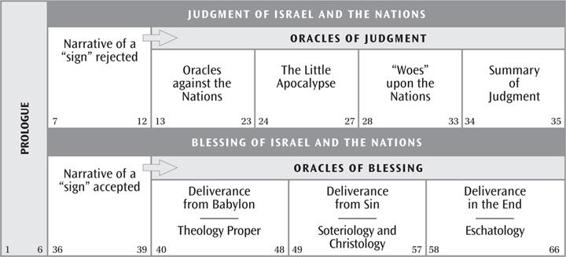
Another approach to structure sees the book opening with a prologue (chaps. 1–6) followed by two main sections, the first emphasizing the judgment of Israel and the nations (chaps. 7–35) and the second emphasizing the blessing of Israel and the nations (chaps. 36–66). Both of the main sections contain a narrative about a Davidic king, who is facing a military threat and then receives an offer of a sign from God. In the first narrative (chaps. 7–12), the king rejects the sign, so what follows are oracles emphasizing judgment (chaps. 13–35). In the second narrative (chaps. 36–39), the king believes the sign and what follows are narratives emphasizing blessing (chaps. 40–66). See the chart “Structure of Isaiah.”
Structure of Isaiah
Genre. The book of Isaiah is comprised of several different literary forms. These include the prophetic oracle (chaps. 13–23), autobiographical narrative (chap. 6) and biographical narratives (chaps. 37–39), and visions (chap. 6), as well as various other forms such as prayers and doxologies. Isaiah’s oracles generally include either words of judgment or comfort spoken to Israel, Judah, or other groups of people or individuals within Israel and Judah. Phrases such as “thus says the LORD” or “The word of the LORD came to Isaiah” are characteristic introductions to prophetic oracles. Isaiah’s oracles also contain predictive prophecy.
Visions are less common within the prophetic literature and often overlap with the autobiographical form. Isaiah’s vision in chap. 6 is a good example of the merging of vision and autobiography. Isaiah’s call to prophetic ministry was relayed to his audience through the narrative description of his vision of Israel’s holy God on His heavenly throne.
Biographical and autobiographical narratives within Isaiah point to the importance of Isaiah’s activities and interactions throughout his prophetic ministry. As noted above, Isaiah’s call was narrated in an autobiographical style. This narrative authorized Isaiah’s prophetic ministry, but it also provides a vivid, compelling picture of God and highlights the significance of Isaiah interaction with the Lord at the beginning of his ministry. The autobiographical and biographical narratives provide a context for the surrounding oracles, offering a framework in which the prophetic pronouncements may be understood.
Background. Isaiah 1:1 places the beginning of Isaiah’s ministry during the reigns of Uzziah and Jotham around 750 BC. Uzziah’s military campaigns against the Philistines and building projects in Jerusalem (cf. 2Ch 26:6-15) established Judah as an economic and military power. He fortified Jerusalem through the construction of towers “at the Corner Gate and at the Valley Gate and at the corner buttress” (2Ch 26:9). Uzziah also trained and equipped an army of more than 300,000 soldiers to solidify Judah’s position as having influence in ancient Near Eastern politics.
Uzziah’s success in the early part of his reign may be attributed to his willingness to do “right in the sight of the LORD” (2Ch 26:4). Uzziah’s early faithfulness was paired with turmoil in Assyria, a growing power within the ancient Near East. Internal struggles and famines kept the Assyrians from expanding their territory and encroaching on Judah (A. Kuhrt, The Ancient Near East: c. 3000–300 BC, II [New York: Routledge, 1995], 490–93). With the Lord’s blessing and the absence of competing national entities, Uzziah was able to overcome the Philistines, Meunites, and Ammonites (cf. 2Ch 26:6-8). Despite the Lord’s blessing, Uzziah became prideful, overstepped his bounds, and burned incense at the temple. As a result God struck him with leprosy and he was prohibited from entering the temple for the rest of his reign. After Uzziah contracted leprosy, Jotham, Uzziah’s son, reigned as king over Judah. Jotham “did right in the sight of the LORD” (2Ch 27:2). Though Jotham’s reign was marked by economic and political success, he was not able to institute widespread spiritual reform in Judah, leaving the southern kingdom prosperous financially but spiritually fragile.
Ahaz became king after the death of Jotham (c. 735 BC). Ahaz did not follow the example of Jotham his father. Instead, “He walked in the ways of the kings of Israel; he also made molten images for the Baals. Moreover, he burned incense in the Valley of Ben-hinnom and burned his sons in fire, according to the abominations of the nations whom the LORD had driven out before the sons of Israel. He sacrificed and burned incense on the high places, on the hills and under every green tree” (2Ch 28:2-4). Ahaz’s disregard for the Lord did not go unpunished. His reign was characterized by pressure and political scheming as he attempted (and failed!) to maintain the security and independence of Judah.
While Ahaz mistakenly cast his lot with the Baals (false gods of Canaan) and the other enemies of the Lord, the Assyrians were beginning to grow in power under the leadership of Tiglath-pileser III, who reigned in Assyria from 745–727 BC. Under his guidance, Assyria acquired several vassal states from which Assyria received tribute. King Rezin of Damascus and King Pekah of Israel formed an alliance against Assyria in an attempt to resist Assyrian conquest. After Ahaz refused to join the alliance of Rezin and Pekah, the two kings set out to dethrone Ahaz in order to place a king on the throne of Judah who would join with them against Assyria. The campaign against Ahaz was devastating to Judah (cf. 2Ch 28:6-8). The attacks of Rezin and Pekah combined with Edomite invasions eventually prompted Ahaz to enlist the help of Tiglath-pileser III and the Assyrians to defeat Rezin and Pekah. But while Ahaz was no longer in danger from Syria and Israel, Tiglath-pileser III turned Judah into an Assyrian vassal state (cf. 2Kg 16:7-18).
Judah continued its downward spiral under the leadership of Ahaz, who continually refused to depend upon the Lord. Instead, he sacrificed to the gods of Damascus, defiled and closed the temple of the Lord, and promoted idolatry in Jerusalem and Judah (cf. 2Kg 16:10-20; 2Ch 28:1-4). Ahaz died in 715 BC, leaving his kingdom to his son Hezekiah.
The continual growth and influence of the Assyrian empire cast its shadow over Hezekiah’s reign. Although Assyria did not directly affect Judah until 701 BC when King Sennacherib (704–681) confronted the alliance between Egypt, Philistia, and Judah (cf. 2Kg 18:7), Assyrian activity under Sargon II (721–705 BC) produced turmoil in the region and created uncertainty in Judah. Judah’s leaders watched as the Assyrians conquered other states. One example was Azuri, king of Ashdod, who attempted to break away from Assyria. Thinking that Egypt would protect him from Assyrian retaliation, Azuri refused to pay tribute to the Assyrians. Unfortunately for Azuri, Egypt did not come to his aid and Assyria conquered Ashdod around 711 BC. Isaiah’s three years of nakedness (20:2-3) were prompted by Sargon II’s invasion of Ashdod, and served as a sign to Hezekiah that he should not put his faith in the Egyptians. Hezekiah listened to Isaiah and did not depend on Egypt, which was eventually defeated by Assyria.
Second Kings 18:7-8 record the anti-Assyrian acts of Hezekiah. He refused to pay tribute to Sargon II and took control of a portion of Assyria’s territory in Philistia. Hezekiah’s actions were not addressed until the reign of Sennacherib, which began in 705 BC following the death of Sargon II. Sennacherib’s campaigns in Philistia put pressure on Hezekiah, who eventually paid tribute to Assyria (cf. 2Kg 18:14-16). Having received this payment, Sennacherib turned his attention to Egypt. The payment provided only temporary relief and Sennacherib ultimately returned to Judah. He sacked Lachish and Libnah (about 25 and 20 miles southwest of Jerusalem, respectively; cf. 2Kg 19:8; 37:8) and laid siege to Jerusalem. Hezekiah’s attempts to fortify Jerusalem against Sennacherib were successful, and he maintained control of Jerusalem until 686 BC (cf. 2Ch 22:8-11; 32:3-5, 30; 37:36-38).
In addition to his decision to trust God against Assyria, Hezekiah succeeded in instituting several spiritual reforms (cf. 2Ch 29:3-11, 15-36; 30:1-11, 18-21; 31:1; 32:6-8, 20-21; 2Kg 18:4). Despite these reforms, other books of Scripture record Hezekiah’s missteps (cf. 2Kg 18:14-16; 20:12-18; 2Ch 32:25-26). Though Isaiah applauded Hezekiah for choosing to trust God to defeat the Assyrians, he painted a less-than-positive picture of the spiritual state of Judah and its leaders. Judah’s actions would bring judgment on Jerusalem (cf. Is 29:1-4), yet Jerusalem was not blameless. Jerusalem also needed to turn back to God in obedience and trust in the Lord to defeat the Assyrians (cf. 30:31-33; 31:8-9).
Isaiah confronted a nation whose identity as God’s chosen people had become confused. The erosion of Judah’s faith in the face of heavy political pressures provided the impetus for Isaiah’s prophecies. As Judah’s leaders struggled to imagine a world in which political alliances were not necessary, Isaiah called them to recognize a theological reality. That reality was rooted in the sovereignty of God and His desire to glorify His name through Israel.
Contribution to the Bible. Isaiah is the most cited prophetic book in both the NT and in rabbinic literature. The book of Isaiah’s impact on the theology of the OT and NT is difficult to overstate. Often referred to as the “fifth gospel,” Isaiah’s messianic prophecies, as well as the book’s development of remnant theology, anticipate the coming of Messiah and the restoration of Israel.
COMMENTARY ON ISAIAH
I. Prologue: The Indictment of Israel and Call of Isaiah (1:1–6:13)
The first six chapters of the book of Isaiah function as a prologue to the entire book, introducing the relationship between God and Judah. Its main emphasis is an indictment of Judah for sin. God offered a message of impending doom and future hope for Israel by describing the nation’s identity in the present and the future. Their ignorance of God and His desires would result in disaster, but that disaster was not complete. God would sustain a remnant and restore Israel, but only through judgment and discipline. As a culmination of the indictment, the story of the call of Isaiah was recounted. Having indicted Judah, demonstrating a need for a prophet, God called Isaiah to bring His message to His wayward people.
A. Israel’s Rebellion and the Hope for Restoration (1:1-31)
1:1. The superscription introduces the book of Isaiah as the vision given to the prophet Isaiah concerning Judah and Jerusalem. This verse locates the vision within the reigns of Uzziah, Jotham, Ahaz, and Hezekiah, kings of Judah, thereby offering a life setting for Isaiah’s visions. Isaiah’s relatively easy access to the kings of Judah has prompted some commentators to speculate that Isaiah was of royal lineage. More significantly, the visionary quality of the message sets it apart from other critiques of Israel’s situation and from the visions of false prophets.
1:2-9. Isaiah began delivering his message in v. 2 when he called the heavens and the earth as witnesses to God’s indictment. The language is similar to that found in the announcement of a formal “legal case” (cf. Dt 30:19; 31:28; 32:1; Ps 50:4). Isaiah described the charges that God was bringing against the people and called into question the wisdom of continuing to suffer when repentance would bring relief.
God’s first charge was that the Israelites were rebellious. The comparison of Israel to the ox and the donkey (v. 3) highlighted the nation’s ignorance of God’s ways and their refusal to adhere to them. The refusal to turn back to God results in suffering described as a beating (stricken, v. 5). The prophet questioned where the next blow would land since Judah was covered with wounds and bruises from head to toe (v. 6). The land of Judah was destroyed and was being overthrown by strangers (v. 7). Judah has become like an abandoned hut in a harvested field (v. 8). These images spoke to the relationship between God and Israel, yet the suffering of Israel was not without a glimmer of hope. Despite their rebellion, God would not make them like Sodom and Gomorrah (v. 9). He would not destroy them completely, but would leave a remnant to rebuild the nation.
1:10-20. In v. 10, the rulers of Sodom and the people of Gomorrah were called to hear (Hb. shama) just as previously the heavens and the earth were called to “listen” (Hb. shama, 1:2). The identification of Israel with Sodom and Gomorrah in v. 10 was designed to underline the depravity of Judah’s people and leadership. The characterization of Israel as a prototypical pagan and wicked city was followed by God’s rejection of Judah’s empty worship (vv. 11-14), resulting in God’s temporary abandonment of Judah (v. 15). The hands of Judah, covered in the blood of unwanted sacrifices and oppressed peoples, caused God to turn away and to ignore their prayers. God would not grant the requests of those who engaged in hollow worship and harsh oppression.
Verse 16 shifts from a demonstration of the people’s iniquity to a call for them to wash themselves clean of sin and turn back to God. Repentance involved turning from sin to the practice of justice and righteousness, particularly in relation to the oppressed, the orphan, and the widow, who were the weakest members of that society (v. 17). God’s people did not need to seek to gain advantage through subjugation. God would remove the crimson stain of sin and provide all they needed and more if they would trust and obey Him (vv. 18-19). They would eat the best of the land if they turned and obeyed (v. 19). But if they did not repent, they would be devoured by the sword (v. 20).
1:21-31. Having described the alternatives associated with obedience and rebellion in vv. 19-20, the focus shifted to the unfortunate state of Jerusalem. Verses 21-23 present a stark contrast between the Jerusalem of the past and the Jerusalem of the present. God lamented the fall of the once faithful city into unfaithful practices. While harlotry or prostitution is often used to refer to idolatry in the OT (cf. Jr 2:20; 3:1; Ezk 6:9; 16:15-16; Hs 4:12; Nah 3:4), in this case it was linked to the oppressive, immoral social practices bring carried out in Jerusalem. The deprivation of Jerusalem’s leadership was highlighted by their willingness to trade justice for bribery and to ignore the cause of the widow and orphan. Such practices were unimaginative and reflected a lack of trust in God that was characteristic of many of those to whom Isaiah prophesied. The drive for more power, more security, and more wealth in the present limited the leaders’ ability to envision a future in which all the people would experience God’s blessing.
The depraved activities of Judah’s leaders caused God to come against them to re-establish order within Jerusalem and to reassert His rightful claim as ruler in Jerusalem. The Lord GOD of Hosts, The Mighty One of Israel (v. 24), would fight against those who oppressed the vulnerable within society. He would console himself (v. 24) by coming against His enemies within Jerusalem. Once order was restored, God would smelt away Jerusalem’s impurity (v. 25) and transform the city of harlotry into the city of righteousness (v. 26). The wicked leaders of the city would be replaced by leaders whose trust in God would be reflected in their honest dealings and wise counsel. The presumption is that this transformation of Jerusalem would take place at the return from captivity. However, even a cursory examination of the postexilic prophets demonstrates that the people of Jerusalem continued to struggle with righteous living (cf. Hg 1:1-11; 2:10-14; Zch 1:4-5; 7:4-14; Mal 1:6-14; 2:1-9; 2:10-17). Therefore, it is more likely that the promise to make Jerusalem a city of righteousness will be fulfilled in the distant future, in the messianic kingdom.
In Is 1:27, the prophet reveals that in this distant future, justice and righteousness will redeem Zion and those within her who repent. Zion, a poetic term for Jerusalem and the surrounding region, denotes “the chosenness, hope, and beauty which belong to those who are in God,” will be freed by the just and righteous actions of God (Oswalt, The Book of Isaiah, Chapters 1–39, 109). As God judges fairly and restores order to Zion, those who seek their own selfish agendas will be crushed (v. 28), and those who commit to God’s way will live in peace and prosperity. When God brings judgment, those who rebelled against Him will be ashamed or disappointed by the oaks which [they] have desired and the gardens which [they] have chosen (v. 29).
These oaks and gardens are likely associated with the worship of foreign gods. The Septuagint (LXX), an ancient Greek translation of the OT, translates “idols” rather than oaks, suggesting that the translators understood this reference to be aimed at the worship of false gods. The shame and disappointment the people will feel is related to the inability of their gods to sustain them through the onslaught of the true God. The gods on whom they depended to sustain their way of life will fail them. This embarrassment is underlined by the comparison of v. 30 in which the fragility of the oak and garden are used to describe the people who wither under the judgment of God. The vitality of living plants is replaced by dry, dead tinder that will burn easily and will not be put out (v. 31).
B. Israel’s Present Judgment and Coming Glory (2:1–4:6)
The message in these chapters exhibits a chiastic structure, a literary device used to relate multiple clauses, in which the establishment of the kingdom in 2:1-4 and 4:2-6 surround the condemnation of the proud in 2:6-22 and 3:1–4:1. Note the chart of the chiasm taken from Gary V. Smith (Isaiah 1–39, NAC [Nashville: Broadman & Holman, 2007], 122).
Chiastic Structure 2:1–4:6
2:1-5 God’s kingdom will be established
2:6-22 Condemnation of pride
‘3:1–4:1 Condemnation of pride
‘4:2-6 God’s kingdom will be established
The chiastic structure underscores the inevitability of God’s kingdom. Regardless of the supposed strength and glory of humanity, God’s kingdom will come. Attempts to gain wisdom and security through human alliance (2:6), to amass wealth (2:7), and to create gods that will not oppose their efforts (2:8) only result in humiliation as God comes to establish His majesty. The day of the Lord will bring low the esteem of man and exalt God’s majesty.
2:1-5. Verse 1 is not described as a “vision,” but as a word (“message”) depicting the glorious eschatological future for Israel and Jerusalem. The prophet announced what he had seen concerning Jerusalem and Judah. The picture of Israel in chap. 2 inspires hope that God will bring about His promised blessing by making the temple mount, or the mountain of the house of the LORD (v. 2, cf. v. 3), the highest of the mountains. The height of the mountain was a significant factor because of the ancient Near Eastern perspective suggesting that the peaks of the mountains were associated with the presence of the gods. Mountains, in particular the temple mount, were viewed as the junction between heaven and earth. That the mountain of the house of the Lord will be higher than any other mountain speaks to its prominence and, in this context, the glory of the temple and the truthfulness of the worship that occurs there.
As the law is proclaimed from Zion (v. 3), the mountain of the Lord, the nations will call one another to worship at the temple so that they may learn God’s ways and live obediently (v. 3). Although God’s law is eternal, it has various expressions. This likely does not indicate that the law of Moses will be reinstated in the messianic kingdom. More likely, the word law should be translated “instruction” (HCSB) and refer to the laws God establishes for the future eschatological kingdom. The nations will finally recognize God as the true God who will judge the world with righteousness and bring peace to the nations, signified by turning their implements of war into agricultural tools. While the first four verses of the chapter present the glorious future of Zion without reference to the sin and rebellion of Israel, v. 5 appears to be a call for the house of Jacob to return to Zion. The depiction of the nations streaming to Zion in vv. 2-4 is utilized to motivate Judah to walk obediently in the light of the LORD (v. 5).
2:6-11. This section, through v. 22, begins the first condemnation of pride, to be followed by a second one (3:1–4:1), as part of the chiastic structure (see above). Some commentators suggest that the depiction of the nations in vv. 2-4 is designed to make the Jewish people jealous so that they will return to follow God (Oswalt, The Book of Isaiah, Chapters 1–39, 118). It seems more likely, however, to function as a critique of Judah, given the contrast between the foreign practices associated with Judah in 2:6-9. The phrase beginning with for (v. 6) provides the reason that Judah must turn and walk in the light of the Lord. God has abandoned them temporarily and Judah needs to repent in order to be restored.
The NASB translates v. 9 so the common man has been humbled and the man of importance has been abased, but do not forgive them. Although the italicized words have been supplied in the translation for clarity, this translation may actually be misleading. The grammar of v. 9 suggests that it is continuing the description of the action in vv. 6-8. If this is the case, the emphasis would be on the activities of those who worship idols. They bow down and are humbled before their idols. In the final phrase of v. 9, the prophet exhorts God not to “lift them up” (Hb.). The NASB correctly translates this phrase with its intended meaning of forgive, imploring God not to forgive idolaters.
Verse 9 offers a play on words, as do vv. 11 and 17, utilizing the same Hebrew terms for humbled and abased as v. 9. In these latter verses the terms are used with reference to pride, suggesting that God will humble those whose arrogance has produced rebellion. In v. 9, it seems that these terms foreshadow those in vv. 11 and 17, perhaps suggesting that the sort of humility that humanity currently exhibits before idols is a false humility that will be corrected in the coming day of the Lord.
Verse 11 also marks the first instance of the phrase in that day, one of the most frequently used phrases in the book of Isaiah. It appears 45 times throughout the book and generally refers to the events associated with a coming day of reckoning. The worship of and dependence on the Lord (cf. 2:11; 10:20; 12:1, 4; 17:7; 19:18-19, 21, 23-24; 25:9; 26:1; 27:13), the removal of idols, the loss of wealth and security and the destruction of cities (cf. 2:20; 3:18; 17:9; 19:16; 20:6; 22:25; 31:7), the arrival of enemies (cf. 7:18, 20, 23; 17:4), the deliverance of God’s people (cf. 10:27; 11:11), and the establishment of Israel’s leadership (cf. 4:2; 11:10; 22:20) all will occur in that day.
This day is a day of punishment and victory in which God will overcome His enemies (cf. 2:11, 17; 24:21; 27:1, 12). It will be a time of difficulty that gives way to justice, prosperity, and wholeness (cf. 28:5-6; 29:18; 30:23). Isaiah also uses similar phraseology, for example, referring to a day or the day (cf. 2:12; 14:3; 30:8), the day of punishment (cf. 10:3), the day of the Lord (cf. 13:6, 9), the day of His burning anger (cf. 13:13), and the day of a great slaughter (cf. 30:25). Each appears to be pointing to the same time frame as that denoted by the phrase “in that day.” Isaiah 22:5 also refers to a day of tumult, trampling, terror, a day of battering down walls, and of crying out to the mountains.
The “day of the LORD” is frequently a reference to God’s eschatological judgment of the earth, when the nations will be judged and Israel fully restored (cf. Is 13:6-16, 9; 34:8; Jl 1:15; 2:1,11; 3:14; Am 5:18, 20; Ob 15; Zph 1:7, 14; Zch 14:1; Mal 4:1-6; 1Th 5:2; 2Th 2:2; 2Pt 3:10). However, it can also refer to God’s temporal judgments (cf. Lm 2:21-22), even as Judah and Israel had experienced God’s temporal judgment when punished for their sins (cf. Ezk 7:1-14).
2:12-22. There will be a day of reckoning to humble the proud (v. 12). Isaiah went on to associate the proud with prominent symbols of power and security, including the well-known cedars of Lebanon and oaks of Bashan (v. 13), lofty mountains and high hills (v. 14), fortified wall[s] and tower[s] (v. 15), and impressive ships (v. 16). These associations underline the misplaced security of the proud. If the majesty and implied permanence of the trees, mountains, walls, and ships will fall to the power of the Lord, human power cannot hope to stand. In the end, only God will be lifted up (2:17).
In addition, the idols that the people serve will finally be found worthless in the coming day of the Lord (v. 18). The people will abandon them and hide from the judgment of the Lord (v. 19). Their human sources of security will fade and their trust in human potential will be revealed as misplaced. The rhetorical question in v. 22 underscores the futility of elevating human prowess. There should be no particular esteem given to the capacity of humankind whose power is ultimately fleeting. The day of the Lord as described here is not addressing temporal judgment but rather, the eschatological day of the Lord. This is evident from its universal scope (note the uses of “and” in vv. 13-16), the absolute end to all idolatry (vv. 20-21), and the ultimate exaltation of the Lord over all (vv. 11, 17).
3:1-7. A second section (3:1–4:1) condemning pride begins here. This is part of the chiastic structure discussed above. Verse 1 offers support for God’s claim that humanity’s power is fleeting and conditioned upon His provision, and provides God’s response to human exaltation and pride. God will strip away everything upon which Jerusalem and Judah depend. Food, water, prophets, and leaders will all be taken from Judah (vv. 2-3). The country will fall into disarray under the leadership of inexperienced lads, capricious children, and women (vv. 4, 12) as an indication of God’s judgment against them. The prosperity of Judah will be diminished to the point that a man with a coat will be made leader of the people (v. 6). God will remove everything that inspires the pride of Judah and replace it with desperation, uninspired leadership, and poverty.
3:8-15. The people’s widespread rebellion and arrogance against God will bring divine judgment (v. 9), but just as the wicked will eat the fruit of their actions, so will the righteous … eat the fruit of their actions (vv. 10-11). Though the nation will experience judgment, it will go well for the righteous. As Judah’s rulers oppress and lead astray, the Lord will come to convict His people and to punish those who have sought security through oppression and theft (vv. 14-15).
3:16-23. This section announces God’s judgment of the women of Jerusalem. The extravagance and haughty attitude of the women are the focus of the condemnation and would result in the reversal of their fortunes. God would bring shame upon them and, as Childs notes, “the horrors of war—rape, disease, and famine—will replace the luxurious life of opulence and self indulgence” (Brevard S. Childs, Isaiah: A Commentary [Louisville: Westminster John Knox, 2001], 34). The reference to the women’s hair in v. 17 reflects ancient Near Eastern practices in relation to the treatment of prisoners. Shaving off a woman’s hair, or portions of it, was considered an act of public humiliation. Verses 18-23 continue the theme of humiliation as the woman’s decadent trinkets are removed from them.
3:24–4:1. After describing the garments worn by the daughters of Zion, these verses portray Zion as women who will lose their men and be deserted (vv. 25-26). The shortage of men would result in desperation on behalf of Zion’s women. Attempting to escape the shame and insecurity of being without a husband, the women of Jerusalem would suspend normal social convention in order to find a husband (4:1). Left in a socially compromising position, these women were seeking a mate even if they had to pay their own way. Husbands were to provide their wives with food and clothing. These women are pictured as offering to provide for themselves, suggesting that their desire for a husband had less to do with economic concerns and more to do with a desire to legitimize their position in society through marriage.
The irony of the section should not be overlooked. The beautiful, well-adorned women described in previous verses would no longer be alluring and self-sufficient. Their physical appearance would no longer be enough to sustain them. Instead, they must resort to paying their own way to find companionship and social standing. These decadent women who once had every luxury must now share one man. This section paints a vivid picture of the end awaiting those who rely on their own wealth rather than on the Holy One of Israel.
4:2-6. As part of the previously mentioned chiastic structure of this section, this paragraph again speaks of the messianic kingdom (as did 2:1-5). Despite the degradation of Israel, God will not abandon the nation. The phrase in that day links 4:2-6 to the previous portions of Isaiah’s prophecies in which Isaiah described the coming day (cf. 2:2; 11-12, 17; 3:7, 18; 4:1). Here, however, the day is characterized by restoration rather than discipline. Though the Branch of the LORD is often used as a reference to Messiah (cf. Jr 23:5; 33:15; Zch 3:8; 6:12), several modern commentators suggest that the reference in 4:2 is a more general reference to the land’s vegetation because of the parallel phrase the fruit of the earth.
There are three possible interpretations for these phrases. (1) They may be entirely literal, and both phrases would refer to the glorious gardens Israel will have in the future. In light of the other prophets using the word Branch as a messianic title, and the seeming incongruent nature of depicting the glorious future of Israel with mere agriculture, this seems unlikely. (2) Both phrases may be figurative and depict the future Messiah. But this is problematic in that the Messiah is nowhere else called the fruit of the earth. (3) They may be partially figurative and partially literal, with the first phrase about the Branch referring to the Messiah and the second about the fruit of the earth referring to agriculture in the messianic kingdom. Some argue that this is inconsistent, but it is not unusual for the prophets to depict the coming of the future Messiah with agricultural blessings (cf. Is 30:20-23). Therefore, this seems to be the most likely option. Nevertheless, whether or not the Messiah is in mind, the passage highlights the coming glorification and abundance given to the remnant of Israel by God (4:3). The remnant of Israel will experience a reversal of fortune as God’s punishment turns to blessing. Through judgment, God will wash away the disgraceful filth and bloodshed that previously stained Zion, the city of Jerusalem. He will then bring protection to Zion through the provision of cloud and flaming fire (v. 5) as He had done previously in the wilderness (cf. Nm 9:15-23).
C. Israel’s Judgment and Exile (5:1-30)
5:1-7. While God will restore Israel, specifically the faithful remnant, the time of their restoration is still future. Chapter 5 highlights the condition of Israel at the time of Isaiah’s prophecy. These verses use an extended metaphor or parable to underscore the strained relationship between Israel and God, with Israel depicted as a vineyard and God as the vinedresser. God had cared for His vineyard and provided it with everything necessary to prosper (vv. 2, 4), but the vineyard did not produce good grapes (v. 4). Because the vineyard had not produced, all the provisions would be taken from it (v. 5). The vinedresser would lay it waste so that it no longer had the opportunity to bring forth produce (v. 6). Verse 7 offers a summary interpretation of the metaphor in which the house of Israel and the men of Judah are identified as the vineyard and the vines. The fruit they were to produce, justice and righteousness, never sprouted. Instead of this good fruit, Israel produced bloodshed and a cry of distress.
5:8-23. The parable of vv. 1-7 is followed by a series of six woes against the people of Judah, specifically those who greedily accumulated wealth and power (vv. 8-17) and those who mocked God and recognized evil as good (vv. 18-30). A similar parable of a vineyard is found in 27:2-6 and is also followed by six woes, but these are on the leaders of Judah (chaps. 28–33). The other distinction is that the first parable describes the judgment of the vineyard and the second depicts its preservation.
The word woe is more of a lament than a judgment—it could be paraphrased “How sad for you.” The Lord lamented for six specific sins in Judah. The first sin was greed (vv. 8-10). Amassing houses and land would become vanity when the Lord came to destroy many houses and leave great and fine houses empty. The Lord also lamented their second sin: debauchery (vv. 11-17). The people of Judah’s love of beer (the meaning of strong drink in the NASB; distilled liquor had not yet been developed) and wine and banquets (vv. 11-12) caused a lack of regard for God. This would be the downfall of the people as their fundamental misunderstanding of the world’s order and of God’s role as Sovereign within that order would be their undoing (vv. 12-13). Their security in earthly power and wealth was a false security that would eventually result in the humbling of humankind (vv. 14-15). Humanity would be humbled, but God would be exalted in justice and righteousness (v. 16). The return of the sheep and the lambs is a bold image in which the meekest of animals would overtake the stronghold of the rich and powerful. The land that was overtaken by the powerful would be given back to the weak.
Verses 18-19 continues the lament of those who stood against God by identifying their third sin, blasphemy. In contrast to the previous sins, the following sins were less related to greed and more to the perversion of reality. The people blasphemed because they were tied to their sin, dragging it with cords of falsehood. The cords, along with the ropes mentioned in the next line, describe the inextricable attachment the people had to their sins (v. 18). In light of their sin, they challenged God to come quickly and to show His plan. Their blasphemy was that they sinned boldly and then challenged God to do something about it. The people’s arrogance in their own ability and their lack of respect for God’s power led them to disregard the supposed plans of God. Such disdain would be their undoing.
Judah’s fourth sin was perversion, in that they called evil good, and good evil (v. 20). The people’s inverted value system caused them to reject God’s standards of righteousness. With a fifth woe, God lamented their sin of arrogance (v. 21), being wise in their own eyes. Their sixth sin was corruption (vv. 22-23). They were heroes in drinking wine but failures at justice, taking bribes and invalidating justice for the ones who are in the right.
5:24-30. As a result of Judah’s sins, God promised to judge those who were incapable of viewing the world in proper order. The reference to the rejection of God’s law in v. 24 suggests more than simple disobedience to God’s commands. It was a rejection of God’s wisdom, of His way of ordering the nation of Israel. Obeying the law is an act of trust in the Lord. The woes came upon those who refused God’s view of the world (v. 20), who saw themselves and their own capacities as a source of wisdom (v. 21), who excelled at excess (v. 22), and who corrupted justice for money (v. 23). God would punish Israel for their rejection of His law (v. 25). His instrument of punishment would be the nations that would come swiftly and powerfully with no yielding (vv. 26-30).
D. Isaiah’s Call to Prophesy (6:1-13)
The prologue of the book culminates in Isaiah’s call to ministry. Some have understood this account chronologically, assuming that Isaiah was called to ministry after his initial messages in chaps. 1–5. This is unlikely. Rather, after giving the particulars of God’s indictment of Judah, Isaiah included this statement of the prophet’s call. It was because of Israel’s sin that the Lord was sending His prophet to His people.
6:1-7. The account of Isaiah’s call refers to Uzziah’s death, providing a marker for dating the call of Isaiah at approximately 740 BC. Isaiah saw God in a vision, seated on His high throne with seraphim standing above Him. The seraphim have often been identified as a category of angelic beings along with the cherubim. Despite this identification, the term “seraphim” is a transliteration of a Hebrew word and not a translation. While it is certainly possible to identify the seraphim as angelic beings, it may also be translated as “burning ones” or, as is the case in other biblical passages, used to refer to poisonous (fiery) snakes (cf. Nm 21:6; Dt 8:15; Is 14:29; 30:6). Isaiah 14:29 and 30:6 describe the snakes as flying, which may lend weight to the identification of the seraphs mentioned in 6:2 as serpentine in appearance. However, to depict these angelic beings as flying serpents with feet, wings, and a face is unlikely. The association of the word “seraph” with the word “fiery” would make the translation “burning ones” more likely. The text provides specific descriptions of the seraphim and their activities. They had six wings, with two covering their faces and two covering their feet. Even the fiery seraphim cannot be fully exposed in the presence of the God who is Holy, Holy, Holy.
The threefold repetition of Holy (“that which is utterly separated from all evil and possessing moral perfection”) in v. 3 is not a reference to God’s Trinitarian nature, but a device meant to underscore the degree of God’s holiness. A similar device is used in Ezk 21:27 (“A ruin, a ruin, a ruin I will make it”, meaning a complete and total ruin). The essence of this proclamation is that God is completely and totally holy, in every way distinct and wholly apart from all that He rules. The threefold repetition in combination with the description of God on His throne highlights the separation of God from His creation, yet the whole earth is full of His glory (v. 3).
It is the Lord’s drastic separation from sinful humanity that prompted Isaiah’s reaction before Him. Gazing upon the holiness of God, Isaiah became aware of his own uncleanness (v. 5). He quickly identified his lips as unclean. This reference might be associated with his coming call to prophesy, but his reference to the unclean lips of the people suggests otherwise. It is more likely that Isaiah was referring to the praise of the seraphim, or burning ones. Isaiah was unable to worship, as were the people of Israel, because of their unclean lips. In response to his pronouncement, a burning one flew to Isaiah to touch his mouth with a burning coal. The coal purified Isaiah and made him fit to worship and to serve (v. 7). Of course, the law prescribed a sacrifice for atonement (cf. Lv 17:11). This, however, is a vision and not literal; therefore the burning coal depicted God’s removal of sin.
6:8-13. God’s mobilization of the nations described in 5:26-30 was not His final act against the people of Israel. Having cleansed Isaiah and accepted him as His messenger (vv. 7-8), God gave him a message. The content of the message has troubled commentators because of its apparent command to offer a message that would harden the hearts of the people to whom it was given. Even ancient translations and commentaries change the text of chap. 6, suggesting discomfort with the text. For instance, the Dead Sea Scrolls change the command in v. 9 so that Isaiah is called to assist the people to understand.
The Septuagint, the ancient Greek translation of the OT, changes the imperatives or commands in v. 9 into descriptive, future verbs translating, “you will hear but you will not understand; you will see, but you will not perceive.” In each case, the change away from the Hebrew text reflects an attempt to make v. 9 more palatable by shifting the blame of Israel’s sin from God and Isaiah to Israel itself. While it is possible that the message should be read as ironic, the overall context, particularly that of chap. 5, suggests the inevitability of God’s coming judgment on His people. The proclamation of Isaiah would only serve to harden the people’s hearts further, and the evidence of the text, as presented above, indicates that God governed this process.
In v. 11, Isaiah asked how long the message would harden the people of Israel. Though some have suggested that the question is more objection than inquiry, it seems best to understand the question as part inquiry and part lament (Ivan Engnell, The Call of Isaiah: An Exegetical and Comparative Study [Uppsala, Sweden: A.B. Lundequistska Bokhandeln, 1949], 69). God’s response revealed that the people’s hardening would continue through the destruction of cities, the desolation of the land, and the deportation of the people. Near the end of the book, the prophet once again asked God to explain His decision to harden Israel (65:17). Here God reminded Isaiah that despite these punishments, there would remain a tenth of the population in the land (v. 13). After a second desolation, only a stump would remain, the holy seed, or remnant, of Israel. This group is crucial to understanding the audience of Isaiah. In every generation, God retained a faithful remnant of Israel (10:21; 65:8-10; cf. 1Kg 19:18; Rm 11:1-6). This faithful remnant was proof that God would be loyal to His promises to Israel.
II. The Judgment of Israel and the Nations (7:1–35:10)
The prologue (chaps. 1–6) was designed to demonstrate the specific sins of Judah (chaps. 1–5) and the Lord’s call of the prophet Isaiah (chap. 6) to bring the nation to account. That being completed, what follows is the body of the book. The two main sections of Isaiah begin with narratives containing similar content. In each one, a king from Judah is facing a military threat and Isaiah brings them each a sign of hope. The primary difference between these two narratives is that in the first (chaps. 7–12), wicked King Ahaz rejects the Lord’s sign, while in the second (chaps. 36–39), good King Hezekiah trusts the Lord’s sign. Both narratives are followed by sections of oracles; after the rejected sign the oracles emphasize judgment (chaps. 13–35), whereas after the accepted sign, they emphasize blessing (chaps. 40–66).
A. A Narrative of a Sign Rejected: Ahaz Chooses to Trust the Nations (7:1–12:6)
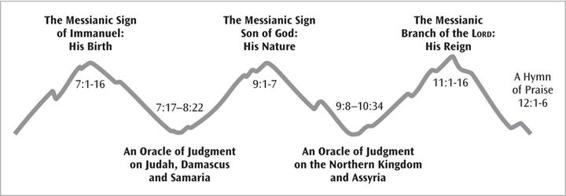
The first main section of the book (chaps. 7–35) begins with a narrative about a sign rejected (chaps. 7–12) and is followed by a series of oracles emphasizing judgment (chaps. 13–35). In chaps. 7–12, there is a cycle of messianic blessing followed by oracles of judgments, moving repeatedly from mountain peaks to valleys (see accompanying chart, “Messianic Blessings and Judgments Chapters 7–12”).
1. The Messianic Sign of Immanuel: His Birth (7:1-16)
This chapter contains one of the most controversial messianic predictions in the Hebrew Bible. Interpreters differ over a number of issues, such as the meaning of the Hebrew word ‘almah (translated “virgin” [v. 14] in the NASB), the way Isaiah’s sign (v. 14) relates to the context, how the original audience would have understood Isaiah’s words, and Matthew’s intention in citing this passage as a prediction of the virgin birth of Jesus (cf. Mt 1:18-25).
As a result of these disputed meanings, there are three primary interpretations of this passage, and even among these three, expositors have their own distinct perspectives. The first approach, held by many traditional Christian interpreters, sees the prophecy as a direct prediction of the virgin birth. Although there are a variety of ways that these interpreters come to this conclusion, they all agree that the word ‘almah means “virgin” and refers to the virgin mother of the Messiah. A second view, frequently held by traditional Jewish scholars and biblical critics, sees the passage as purely historical. In this view, a young woman in the eighth century BC would give birth to a child in a completely natural way. A third explanation of the passage, held by many other Christian interpreters, understands the passage as having dual or multiple fulfillments. These interpreters understand the passage to refer to the natural birth of a child in the eighth century BC. Nevertheless, they contend that this does not exhaust its meaning. Rather, by double fulfillment, typology, and progressive fulfillment, the prophecy also refers to the virgin birth. This commentary will argue for the traditional interpretation, that the passage contains a direct prediction of the virgin birth of the Messiah.
7:1-9. After Isaiah’s call, the first narrative of the book depicts his prophetic ministry. Moreover, Ahaz’s refusal to heed the sign given by Isaiah appears as an outworking of the ministry to which Isaiah has been called. Ahaz was hardened and would not receive the prophet’s message. As predicted (6:9-10), he listened, but did not understand; he looked, but did not perceive. His denial of the sign served as an example of those who cannot see past their current circumstances to imagine the reality that God would bring about if humankind would only trust Him.
Messianic Blessings and Judgments Chapters 7–12
The situation in which Ahaz found himself was not trivial. His refusal to form an alliance with Syria, the northern kingdom of Israel, and Egypt caused King Rezin of Syria and King Pekah of Israel to march against Judah (v. 1). Their goal was to dethrone Ahaz in order to set another king on the throne, the son of Tabeel, who would be more sympathetic to their cause (v. 6). Ahaz was faced with a difficult situation in which his throne and his kingdom were in jeopardy. Judah could not stand before the combined forces of Syria and Israel. Ahaz’s fear was well described—the house of David is pictured as trembling like the trees of the forest shake with the wind (v. 2), since replacing Ahaz would also entail the murder of the entire house of David. Michael Rydelnik explains:
This threat provides a significant detail in understanding the passage. While some have contended that there would be no reason to foretell the coming of the Messiah, the danger to the house of David explains the messianic concerns of the passage. It was the Davidic Covenant (2 Sam 7:12-16; 1 Chron 17:11-14) that led to the expectation of a future Messiah who would be a descendant of David. Therefore, if Ahaz and the entire royal house were to be destroyed, it would bring an end to the Messianic hope. A long-term prophecy of the birth of Messiah would assure the Davidic house and the readers of the scroll of Isaiah that the Messianic hope was indeed secure (Michael Rydelnik, “An Example from the Prophets: Interpreting Isaiah 7:14 as Messianic Prophecy”, In The Messianic Hope: Is the Hebrew Bible Realy Messianic? [Nashville: Broadman & Holman, 2010], 148).
While Ahaz formulated a plan to survive the impending threat of Rezin and Pekah, God sends Isaiah to present a divine possibility to Ahaz. God commanded Isaiah to take his son Shear-jashub with him to meet Ahaz at the end of the upper pool’s aqueduct (v. 3). Introducing Shear-jashub was no trivial detail—he would play a significant role in the prediction later in the passage. The aqueduct was outside the city, but it was a strategic point from a military perspective as it was Jerusalem’s water source. Military strategies in the ancient Near East often entailed sieges in which an attacking army trapped their opponents inside a walled city (Israel Eph’al, The City Besieged: Siege and Its Manifestations in the Ancient Near East [Leiden: Brill, 2009], 35–113). Those inside the city could hold off an attack if they were adequately stocked with food and water.
While it is not stated in the text, the implication is that Ahaz was actively planning to resist Rezin and Pekah by preparing for a siege. When Isaiah arrived with Shear-Jashub, which means “a remnant will return,” he told Ahaz not to worry about Rezin and Pekah. These two kings are described as two stubs of smoldering firebrands, suggesting that they were about to die out (v. 4). While his enemies plotted against Ahaz and sought to take over his kingdom, God proclaimed another plan (vv. 5-9). The disjunction between the two plans is important. Ahaz was presented with two potential outcomes. The first involved defeat at the hands of Rezin and Pekah, who would dethrone him, take over Judah, and ally Judah and Israel with Egypt against Assyria. The second involved trusting God, who would protect Ahaz and Judah from Rezin and Pekah so that their threat would not stand nor … come to pass (v. 7).
While Judah’s enemies appeared to be powerful, God declared that in 65 years, Ephraim (the independent northern kingdom of Israel) would be shattered, so that it was no longer a people (v. 8). This prediction came to fruition in three phases. (1) Tiglath-pileser, the king of Assyria, sent many captives from Israel to Assyria when he conquered Israel in 732 BC (cf. 2Kg 15:29). (2) Assyria destroyed the kingdom of Israel in 721 BC, sending a large portion of the population to Assyria and replacing them in Israel with other peoples (cf. 2Kg 17:24). (3) The fulfillment was completed when Ashurbanipal made the final population transfers between Israel and Assyria (cf. Ezr 4:2, 10). Thus, in exactly 65 years, the kingdom of Israel was shattered, so that it [was] no longer a people (v. 8).
The power of Rezin and Pekah, those stubs of smoldering firebrands (v. 4), was to be fleeting. If Ahaz would only trust in the Lord, his kingdom would stand (v. 9).
7:10-15. Ahaz was given the opportunity to confirm God’s words by asking for a divine sign, or proof that what the Lord had declared would actually come about. But Ahaz refused to ask for a sign, with false spirituality (v. 12). The use of the word test suggests some connection with Dt 6:16, although the latter text refers to the testing at Massah when the Israelites complained against the Lord. They were challenging the Lord’s claims concerning His ability to care for them in the wilderness.
In contrast, Ahaz was given the opportunity to ask for a sign, with no restrictions. Ahaz could ask for anything—a sign as deep as Sheol or high as heaven (v. 11). Although the word sign in Hebrew can refer either to a miraculous or a natural sign, this offer indicates that it was to be viewed as a miraculous sign. Ahaz was not constrained from asking for a sign because of a limited amount of options, but by his lack of faith. By refusing, Ahaz revealed that he was not interested in entertaining the possibility that God could protect him from Rezin and Pekah. It represented his implicit choice to deny the Lord.
Ahaz’s rejection of Isaiah’s offer caused Isaiah to address the house of David. This is evident not just by the use of the vocative Listen now, O house of David (v. 13), but also in the use of the second person plural pronoun you, evident in Hebrew but not in English since English does not have a distinct word for the second person singular and plural pronouns (“you” serves as both). The rhetorical questions in v. 13 highlight the ironic result of Ahaz’s refusal to ask for a sign. While he did not want to test God, the king exhausted God’s patience by not asking for a sign. What appeared to be a pious decision was revealed as false piety.
Since Ahaz refused to ask for a sign, now the entire house of David, under a threat of destruction because of Ahaz’s lack of faith, would receive a sign: a virgin will be with child and bear a son, and she will call His name Immanuel (v. 14). This was the first of two signs. The first sign was addressed to the entire house of David and gave a long-term prophecy of the coming Messiah (vv. 13-15) to reassure them of God’s preservation of the nation. The second sign was a short-term prophecy addressed to Ahaz about the immediate situation he was facing.
The term sign occurs elsewhere in Isaiah with reference to various objects, people, or non-miraculous events that are identified as having particular significance (8:18; 19:20; 20:3; 37:30; 55:13; 66:19). While non-miraculous events can be used as signs, Isaiah also used the word sign to refer to miraculous events. For example, later in the book Hezekiah would be given a sign that his life would be extended, namely, that the shadow on the stairway would retreat ten steps, clearly a miraculous event (38:7-8, 22). Hence, the way to determine if the word refers to a miracle is by the context. Since Isaiah had previously offered a sign as deep as Sheol or high as heaven (v. 11), it appears that this sign now would also be miraculous.
The Lord called special attention to the ensuing sign with the word behold (v. 14). When used in similar constructions in the Hebrew Bible (cf. Gn 16:11; 17:19; Jdg 13:5-7), this word serves to bring attention to a birth of special importance. The sign the Lord promised the house of David was that “the” virgin would conceive. The use of the definitive article (frequently untranslated in modern English versions) with the word ‘almah indicates that the Lord had a particular woman in mind. She was not some nameless woman in the court of Ahaz, but one whom the prophet specifically saw.
Controversy has long surrounded the translation of ‘almah. Does it mean “young woman” or “virgin?” Etymologically, ‘almah is derived from a word which means “to be sexually strong, sexually mature, sexually ripe or ready,” emphasizing the age of the woman (pubescent) rather than indicating whether she was sexually active. However, the best way to determine the meaning of ‘almah is by examining its usage throughout the Hebrew Bible. If there were but one place in Scripture where ‘almah were to refer to a non-virgin (that is, as some maintain, “a young woman of marriageable age who is engaging in intercourse and on the verge of conception”), then it would dismiss the translation of the word as “virgin.” However, in every usage, the word is used either of a virgin (a woman who has not had sexual relations) or in a sense that is indeterminate, meaning it does not address the sexual experience of the young woman (cf. Gn 24:43; Ex 2:8; 1Ch 15:20; Pss 46:1; 68:25; Pr 30:19; Sg 1:3; 6:8).
The passages that speak to the sexuality of the ‘almah always indicate that she was not sexually active. For example, in Gn 24, Rebekah is called an ‘almah (v. 43) and a betulah (general word for virgin, v. 16). In Ex 2:8, Miriam, Moses’ sister, is described as an ‘almah, and she is young and plainly a virgin. In Sg 6:8, the king’s harem is described as having sixty queens and eighty concubines, and maidens [alamot, plural of ‘almah] without number. The queens were those married to the king, the concubines those with whom he has had sexual relations, and the alamot were virgins who would either become concubines or queens. In Pr 30:19, the word ‘almah is used to describe the pure, romantic attraction between a maiden and a young man. Since the following verse (v. 20) contrasts that attraction with an immoral woman, it would be unlikely that the attraction in 30:19 was anything other than wholesome, and the word ‘almah would refer to a virgin.
Beyond usage in the Hebrew Bible, in the intertestamental period the Septuagint (second-century BC Greek translation of the Hebrew Bible) translated ‘almah as parthenos in Mt 1:23, an undisputed Greek word for virgin. (See the extended word study in Rydelnik’s The Messianic Hope, 151-55; see also the comments on Mt 1:22-23.) Based on the use of ‘almah in the Hebrew Bible, the meaning of the word is precise and specific, referring to a maiden who has just arrived at puberty but has not been sexually active. She is a virtuous maiden in the truest and purest sense.
The virgin of Is 7:14 would be with child. However, the Hebrew is even more emphatic, using the feminine singular adjective harah (“pregnant”). This should more accurately be translated “the virgin is pregnant” or “the pregnant virgin.” Were it not for the context calling for a miraculous sign, such a translation would seem impossible. However, the prophet, by a vision, saw a specific pregnant virgin before him who would be the sign of hope for the house of David. Indeed, this would meet the miraculous requirement of being deep as Sheol or high as heaven (v. 11).
The virgin mother would recognize the special nature of the child and call His name Immanuel, meaning “God is with us” (cf. Mt 1:22). The message to Judah was that God would be with them in a special way through this child. Since the next great vision of the future Davidic king describes Him as “Mighty God” (9:6), Immanuel should also be read as a divine title.
By describing the virgin-born Davidic Messiah as eating curds and honey as He matured (v. 15), the oracle gives a clue to the situation into which He would be born. Later in the chapter it speaks of the coming Assyrian oppression when Assyria would shave the land (v. 20). At that time, fields would not be cultivated and instead would become pastures for oxen and sheep (vv. 23-25). The effect of this would be an overabundance of dairy (indicated by the word “curds”) because of the pasturing of livestock, and an excess of honey because bees would be able to pollinate the wild flowers. Therefore, because of the abundance of the milk produced … everyone that is left within the land will eat curds and honey (v. 22). So in this passage, curds and honey do not represent the food of royalty, but rather the food of oppression. The point then of v. 15 describing the future virgin-born Davidic king eating curds and honey is not to emphasize His royalty, but to accentuate that he would be born during a time of political and economic oppression.
Thus, Matthew’s quotation of Is 7:14 (cf. Mt 1:23) in his narrative of the virgin birth was derived from a careful reading of Isaiah. He recognized that the prediction given to the house of David had found its fulfillment in the virgin birth of Jesus of Nazareth. Immanuel had come just as prophesied eight centuries earlier. God was with Israel.
7:16. What follows is the second of the two signs in this passage, this one focused on the short-term crisis facing Judah. Verse 16 should not to be understood as a direct continuation of the prophecy in 7:13-15, but rather as a contrast. The opening word for can have an adversative nuance in Hebrew, showing an obvious distinction between the child described in vv. 13-15 and the one described in v. 16. The NIV and NLT (first edition) are two recent English versions that have caught this, beginning 7:16 with the words “But before” reflecting the contrast. There is a different child in view in v. 16.
So who is the child in 7:16? In light of Isaiah being directed to bring his own son to the confrontation with the king at the conduit of the upper pool (cf. v. 3), it makes most sense to identify the lad as Shear-jashub. Otherwise, there would be no purpose for God directing Isaiah to bring his boy. Thus, having promised the virgin birth of the Messiah (vv. 13-15), the prophet next pointed to the small boy that he had brought along and said, [But] before the boy [this lad, using the article with a demonstrative force] will know enough to refuse evil and choose good, the land whose two kings you dread will be forsaken. In this way, Shear-jashub functioned as a sign to King Ahaz about matters in his own day.
This prediction was directed to King Ahaz. This is evident in the Hebrew text, but not necessarily in the English translations. In v. 16, the prophet returned to using the second person singular pronoun (the land whose two kings you [sg] dread). In vv. 10-11 Isaiah used the singular to address King Ahaz. Then, when addressing the House of David with the prophecy of Messiah, he shifted to the plural. But in v. 16, he used the singular pronoun once again, addressing Ahaz and giving him a near prophecy: before Shear-jashub would be able to discern good from evil, the northern confederacy attacking Judah would fail. Within two years, Tiglath-pileser defeated both Israel and Syria, just as the prophet had predicted.
This short-term prophecy had a distinct purpose for the reader. Just as God faithfully fulfilled the prediction of Shear-jashub, so He could be trusted to fulfill the prediction about Immanuel. He recorded these so the prophet’s readership could have confidence in the distant prediction by observing the fulfillment of the near one.
2. An Oracle of Judgment on Judah, Damascus, and Samaria (7:17–8:22)
What follows is an oracle of judgment on all three nations involved in this regional dispute. Nevertheless, the judgment focuses primarily on God’s people, Judah.
7:17-25. Though the destruction of Rezin and Pekah was good news for Judah, Isaiah’s message indicated that Judah was not left unscathed. Verse 17 offers an ominous prediction concerning Judah’s future and the coming terror accompanying the king of Assyria. Verses 18-19 describes Judah’s future metaphorically as a destination for the flies of Egypt and the bees of Assyria. The swarms of flies and bees would overtake the land (7:19). The imagery then shifts to that of a razor in v. 20. Since shaving off portions of hair was used to humiliate offenders or enemies (cf. 2Sm 10:4), the reference in this context likely denoted Judah’s coming disgrace.
Judah would be left with little when the Lord came (v. 21). They would survive on the milk of a young cow and two goats. The recurrence of curds and honey in v. 22 reinforces the understanding of vv. 13-15 offered previously. The coming judgment would not lead to annihilation, but to oppression. Israel would be crippled as the land refused to bring forth produce (v. 23). The land would become wild and the farmland trampled by cattle and sheep.
8:1-4. Given the prophecy of the child in chap. 7, it is often suggested that the child of chap. 8 is one of the boys predicted in chap. 7. However, there are some potentially critical differences between the descriptions of the children in chaps. 7–8. First, the names Immanuel or Shear-jashub never appear in chap. 8. Instead, the child here is to be named Maher-shalal-hash-baz, or swift is the booty, speedy is the prey (v. 1; cf. v. 3). Second, it is clear that the prophetess, unidentified in the context, was not the ‘almah from chap. 7, since she had already given birth to Shear-jashub and so was not a virgin. Third, both Immanuel (7:14-15) and Shear-jashub were described as refusing evil and choosing good, but the child in chap. 8 would witness the destruction of Syria before he knows how to cry out ‘My father’ or ‘My mother’ (v. 4). Finally, the discipline of Judah in chap. 7 was that the Lord would bring on Judah the king of Assyria (v. 4).
But the judgment in chap. 8 would be that the wealth of Damascus and the spoil of Samaria will be carried away (v. 4). Clearly, these are distinct prophecies and different children. This prophecy entailed writing on a large tablet the words swift is the booty, speedy is the prey (v. 1) before witnesses to confirm the truth of the prophecy (v. 2). Not only were these words the name of the child that Isaiah’s wife would bear (Maher-shalal-hash-baz), but they would also be the words that soldiers would cry as they defeated Aram and Israel.
The significance of Maher-shalal-hash-baz was as a sign of the impending defeat of the alliance of Aram and Israel against Judah. These two nations would be defeated by Assyria before the child was old enough to have full speech. The prophecy was fulfilled less than two years later, when Assyria plundered both Damascus and Samaria in 732 BC.
8:5-10. God addressed Isaiah with another message in v. 5. It was addressed to the nation of Judah, which, under the leadership of Ahaz, had rejected God’s protection and continued to fear Rezin and Pekah. This rejection would cause Judah to be overcome by the strong and abundant waters of the Euphrates, the king of Assyria (v. 7). The water imagery in v. 7 is juxtaposed to that in v. 6. The gently flowing waters of Shiloah had been rejected, so the Lord would give them the floodwaters of the Euphrates. If Judah would not trust in God’s protection, He would demonstrate his power through Assyria. The appearance of the name Immanuel in v. 8 denotes that God would have His people in the land, which actually belonged to the messianic King promised in 7:13-15. Immanuel also reminded the nation that although judgment was coming, God would not forget His covenant or break faith with His people. He would still be with them.
Israel’s enemies would not go unchecked. The cry to Immanuel in v. 8 turned the prophet’s attention toward God’s faithfulness to Israel and His ultimate plans for Zion. The nations may plan to come against God’s people. They may be allowed to wage war against Israel, but they would not do so without suffering the retribution of the Lord who is with Israel. God’s presence is denoted by an echo of Immanuel. God’s faithfulness and continued presence with Israel will ultimately bring redemption to Israel, For God is with us (v. 10).
8:11-18. The next paragraph reveals God’s encouragement to Isaiah to remain separate from the rest of Judah. He must not fear what the people fear, or get caught up in conspiracy theories. Instead, the Lord exhorted Isaiah to fear Him and to regard Him as holy. Isaiah must remember God as Isaiah saw Him in his initial vision, sitting on His great throne among the seraphim praising Him with the refrain of “Holy, Holy, Holy” (6:3) ringing out. By fearing God and regarding Him as holy, Isaiah recognized God as his sanctuary (v. 14). The term translated sanctuary is used 75 times in the OT, including three other uses in the book of Isaiah (cf. 16:12; 60:13; 63:18). It generally denotes the place of God’s dwelling, with connotations of strength and refuge (cf. Ps 27:5; Ezk 11:16). Isaiah’s experience of God as sanctuary is contrasted to the way those who do not fear God experience Him. For them, He will be a stone over which Judah and Israel will stumble (v. 15). For those who fear Him, God will be a refuge, but for those who refuse to trust Him, God will be their undoing.
In v. 16 God commanded Isaiah, Bind up the testimony, seal the law (or “instruction”), meaning “to care for the prophetic messages” that God had given him. Preserving these prophecies provided a way to authenticate the divine proclamation against the people of Israel and Judah. Some suggest that vv. 16-18 narrate a break in Isaiah’s ministry in which he no longer prophesied publicly for a few years (George Buchanan Gray, A Critical and Exegetical Commentary on the Book of Isaiah 1–27 [Edinburgh, Scotland: T&T Clark, 2001]). Though such an understanding is possible, particularly given the reference to Isaiah’s patience in v. 17, it may be best to understand Isaiah’s patience in relation to the people’s hardening against his message (cf. 6:9-10). The people’s rejection of Isaiah’s message required him to persevere and to wait for God’s action while ensuring that he and his followers maintained their faith in the Lord.
8:19-22. It is difficult to determine whether it is Isaiah or the Lord who is speaking in this section. If it is the Lord speaking, this section resumes the discourse begun in vv. 12-15 in which the prophet and his followers were exhorted to fear the Lord and revere Him as holy. Given that Isaiah is speaking to his followers in vv. 16-18, it seems best to read vv. 19-22 as a continuation of Isaiah’s encouragement to his followers.
Though the people sought mediums and underworld spirits to determine the future (v. 19), true knowledge and security concerning the future could only come from the Lord. Seeking the dead to determine the fate of the living was far inferior to the law and to the testimony (v. 20). Whether seeking refuge from human powers, or seeking guidance and insight concerning one’s fate, God has provided the answers in His Word to humankind. Without His law and testimony there is no knowledge, no insight, and no dawn. Instead, those who do not speak according to the Word of God will find no answers and no comfort (v. 21). Ultimately, their dire situation will lead them to curse their God and their king. Having put their trust in something other than God, they will find no solace in the world, no mechanism through which the distress and darkness, the gloom of anguish may be lifted, and no hope for anything but continued suffering (v. 22).
3. The Messianic Son of God: His Nature (9:1-7)
After the prediction of Messiah’s birth (7:1-16) and the judgment of Judah and the surrounding nations (7:17–8:22), the prophet next returned to the promise of the messianic King.
9:1-5. Though those who refuse to live in accordance with the Word of the Lord will live in continual distress (8:22), those who were once distressed will experience comfort (v. 1). The tribes of Zebulun and Naphtali refer to the northern region of Galilee in which invading nations would have first come against Israel. These territories were seized by Tiglath-pileser in his campaign against Israel in 733 BC (cf. 2Kg 15:29). Zebulun and Naphtali may be roughly equated to the way of the sea, on the other side of the Jordan, and Galilee of the Gentiles (Yohanan Aharoni, Land of the Bible: A Historical Geography [Philadelphia: Westminster, 1967], 374). The humbled lands will be glorified and their fortunes will be reversed.
Verse 2 utilizes the images of light and darkness common in Isaiah. In several instances light and darkness are used in association with judgment and deliverance or justice. Isaiah 45:7 places light and darkness in parallel with prosperity and disaster. The association of light and salvation is also available in several other passages (cf. 5:20; 13:10-11; 49:6; 51:4; 58:8). Verse 2 makes a similar association between light and darkness. Those walking in darkness, or judgment, will see a great light, or deliverance. The reference to the nation’s growth and increased joy in v. 3 further suggests the connection between darkness and judgment and light and salvation. The joy of the people is compared to that experienced at the time of a great harvest, or when soldiers bring back plunder from war. God’s victory over Midian served as a paradigmatic instance of God’s deliverance in the past. He will crush the oppressive yoke of Israel’s new enemy just as he defeated Midian (v. 4; cf. Jdg 7:19-25 and the comments on it). The blood-covered clothes will be burned in an act of dedication to God (v. 5).
9:6-7. The joys described in vv. 1-5 are grounded in the birth of a child within the Davidic line. The child’s birth will bring deliverance, and the titles bestowed upon him are impressive. The first given is that of Wonderful Counselor. The word Wonderful (extraordinary to the point of being miraculous) is not meant in the colloquial usage of contemporary society. Rather it refers to the supernatural work of God. A good example is its usage in Jdg 13:15-21, wherein the angel of the Lord does a “wonderful” thing (v. 18) and ascends to heaven in the flame of Manoah’s sacrifice (v. 20).
The title of Counselor does not carry the same sense as the modern English word, which is often associated with a therapist or social worker. Instead, the word means “one who advises, who serves as a consultant to help and lead others.” The title here must be construed as denoting this child’s capacity to guide the people of the nation, particularly with reference to military endeavors. Though the child’s guidance of the nation would not be limited to warfare, it does suggest that his skill in making decisions for the nation exhibits a divine or miraculous character that would not be possible through simply human devices (Smith, Isaiah 1–39, 240). The word “wonderful” stands in epexegetical construct to “counselor,” and could be translated “a wonder of a counselor” or “a wonder-counselor.”
The second title, Mighty God, is repeated in Is 10:21 and applied to God Himself. Although the Hebrew word for Mighty can refer to a valiant warrior, this close usage to 10:21 seems to indicate a reference to deity. The word means “valiant military hero” or “champion.” Similar phrases are also used in Dt 10:17 and Jr 32:18 with reference to God. Oswalt notes, “This king will have God’s true might about him,” being so powerful so as to be able to absorb all evil and defeat it (Oswalt, The Book of Isaiah, Chapters 1–39, 247).
The child is also called Eternal Father. Filial relationships, such as father and son, were emphasized in the ancient Near East. The king was generally the son in such relationships and the deity the father (John H. Walton, et al., IVP Bible Background Commentary: Old Testament [Downers Grove, IL: InterVarsity, 2000], 518). Kings, however, also claimed to be the “father” of those they ruled (Oswalt, Isaiah 1–39, 247). The notion of a human king as father of his people is not foreign to the OT. Note, for instance, 1Sm 24:12 in which David calls Saul his father. But this one is not merely the royal father of His people. The adjective Eternal speaks to the idea of one who is forever or eternal. He is the “Father of eternity,” indicating that He is the author or creator of time. The child born here is not to be confused with the Father in the triune Godhead. Rather, the Son of God is the creator of time, the author of eternity.
The final title given to the child is Prince of Peace. This child will have a reign characterized by peace. There will be no more war under this king. Instead, the child will usher in an era of rest from conflict that is noted in 2Sm 7:10-11.
Some have suggested that these titles are merely a theophoric name, a name that embeds God’s name in a human name. Hence, “Isaiah” (“The Lord saves”) is theophoric, but does not indicate that Isaiah is deity. If this is so here, then the child is not necessarily deity, but rather a royal human figure with a long name, similar to Maher-shalal-hash-baz (“Swift is the booty, fast is the prey,” Is 8:1), containing names of deity. They translate this as “A wonderful counselor is the Mighty God, the eternal Father is the Prince of Peace.”
This explanation is unlikely for three reasons. (1) The name in 8:3 is dependent on 8:1 and is not parallel syntactically to 9:6. All the words in 9:6 are substantives that do not have subjects and predicates. (2) Titles such as this one frequently reflect the nature of the person (cf. 2Sm 12:24-25; Is 1:26; Hs 1:10). (3) Frequently, the verb “call” with a name indicates the nature of the one named, either by a play on words (cf. Gn 5:29) or direct meaning (cf. Is 1:26). Hence, this usage in v. 6 indicates that the names are related to the nature of the child born. Robert Reymond is correct in stating that there is no reason, “except dogmatic prejudice,” to prohibit the conclusion that Isaiah meant nothing other than unabridged deity here (Robert L. Reymond, Jesus, Divine Messiah: The OT Witness [Fearn, Ross-shire, Scotland: Christian Focus Publications. 1990], 51).
The child will fulfill the promise of the Davidic covenant (cf. 2Sm 7:12-16), and establish the messianic kingdom through justice and righteousness. This kingdom will not be the outworking of a king with human wisdom and power. The child will rule with the wisdom, power, and peace of God. The final statement in v. 7 notes that the Lord will accomplish all that has been described. Isaiah again underscores that trust in the Lord is the key to receiving the promised blessing.
4. An Oracle of Judgment on Samaria and Assyria (9:8–10:34)
Isaiah continues the cycle of hope followed by judgment. Having promised the birth of the messianic King (7:1-16), foretold judgment on Judah and the surrounding nations (7:17–8:22), and predicted the nature of the future messianic King (9:1-7), he now returned to an oracle of judgment. The two nations facing judgment are Samaria (9:8–10:4) and Assyria (10:5-34).
a. The Judgment of Samaria (9:8–10:4)
This section promises judgment on the northern kingdom of Israel for four specific sins. Each of the four sections ends with the refrain, “In spite of all this, His anger does not turn away and His hand is still stretched out” (9:12, 17, 21; 10:4).
9:8-12. The first sin to be judged is human pride and self-sufficiency. Having described the coming glory of the child’s kingdom, Isaiah turned to those whose pride and sin would not stand beneath God’s regime. Jacob, otherwise known as Israel, received a message from God that condemned those whose arrogance and pride refused to allow them to admit defeat, even when God’s judgment had taken away their prosperity (vv. 8-9). They looked at the devastation of God’s judgment, yet they continued in their self-sufficiency.
The plans of the arrogant, however, would be met with opposition. God would stand against Israel and bring foreign enemies against the nation (v. 11). The Arameans and the Philistines would turn and devour Israel (v. 12). Despite this punishment, the Lord’s anger would not be assuaged and would continue to burn against His people (v. 12).
9:13-17. The second sin to be judged was misleading leadership. Even after they experienced the consequences of not trusting the Lord, the people refused to return to the Lord (v. 13). The leaders of the nation, the elders and the prophets, would all be eliminated for leading the nation astray (v. 14). Because the people followed leaders who led them away from the Lord, the Lord would not spare them either. Even the groups on whom the Lord normally has compassion, such as orphans and widows, would not be spared (v. 17).
9:18-21. The northern kingdom of Israel would be judged for a third sin: social anarchy. The severity and completeness of this punishment did not calm God’s anger and the situation in Israel continued to worsen as God destroyed the nation (vv. 18-21). The nation was divided, with each person taking advantage of the other (v. 20). The nation was so divided that the only area of unity was in their opposition to Judah (v. 21).
10:1-4. The fourth sin to be judged was unjust oppression. Although many in Israel had accumulated wealth and power, they had done so through unjust practices and oppression of the weak. Therefore, their position and wealth would not help them in the day of judgment. They would ultimately be enslaved among the captives or slaughtered among the slain (v. 4), underscoring the uselessness of their ill-gotten gains. This, as with Isaiah’s other prophecies, highlighted the value of trusting in the Lord rather than trusting in one’s own wealth and power. Efforts to gain human advantage through injustice will be shown futile in order to display the sovereign power of God and His capacity to bless and punish.
b. The Judgment of Assyria (10:5-34)
God would not only judge His own people but, as predicted in what follows, He would bring devastation upon Assyria, His instrument of judgment upon Israel.
10:5-12. While God’s anger against His people would be made manifest through Assyria, that nation would be punished for its role in the devastation of God’s people (v. 5). God’s use of Assyria was for a specific purpose. He called them to punish those among His people who had angered Him. Assyria, however, took advantage of God’s authorization to implement a larger plan of destruction (v. 7). But God will not allow Assyria to implement its own agenda without retribution. Though the Assyrians had powerful commanders (v. 8) and a track record of victory over the idols of other nations (v. 9), the Assyrian assumption that the defeat of Jerusalem and Samaria constituted a defeat of the God of Jerusalem and Samaria reflected their ignorance of their true task. They were not empowered by their own inherent strength or by their national gods, but by the Lord. He would not allow their arrogance to continue, but would punish them for not recognizing and following Him (v. 12).
10:13-19. The punishment of Assyria’s pride may be compared to the pride of God’s people. Assyria claimed to defeat the nations by their own power and wisdom (v. 13). But the celebration of Assyrian power was misguided, because it is God who orchestrates the activities of the nations. The rhetorical questions of v. 15 express this well. Is the axe to boast itself over the one who chops with it? Is the saw to exalt itself over the one who wields it? Of course not—they are only tools. Assyria’s boasting would result in humiliation as the Lord debilitated the nation’s mighty warriors with a wasting disease (v. 16). The light of Israel, the Lord who guides Israel, would become a fire to burn Assyria in judgment. God is his [collective Israel’s] Holy One, who will be a flame burning Assyria as thorns and … briars (vv. 17-19). God’s control over the Assyrians provided an odd sense of comfort as the fate of Israel was not based on the mercy of Assyria, but upon the steadfast faithfulness of God. God would punish, but not annihilate, His people. His desire was to discipline, not destroy.
10:20-27. This sense of comfort was confirmed in the following paragraph. A remnant of Judah would be preserved through the Assyrian strike, and they would no longer depend upon their oppressors, but upon the Lord (v. 20). Those who remain would no longer look to foreign political powers, or, by extension, any power aside from the Lord. The remnant would not make the fundamental mistake made by Israel and its leaders of trusting human power rather than God. Despite this glimmer of hope, the consequences of Israel’s sin were regrettably evident. The once numerous nation with a population as numerous as the sand by the sea would be reduced to a vestige of Israelites who had been allowed to survive the Lord’s destruction, overflowing with righteousness (vv. 22-23).
Verses 24-27 offer words of encouragement to Israel. Though the Assyrians were coming to destroy, God reminded His people that He wielded Assyria and that there was no need to fear them. Israel’s fate did not rest upon the mercy of Assyria, but upon the mercy of the Lord. God was in complete control of Assyria and would deliver Israel as He had in the past (vv. 25-26). The final phrase in v. 27, the yoke will be broken because of fatness, is difficult to interpret though it appears to be related to the coming blessing of the Lord. Assyrian oppression would end as the Lord blessed His people and made it impossible for Assyria’s yoke to remain upon Israel.
10:28-34. This last paragraph describes the path that the invading army would take as it moved toward Judah and Jerusalem. The northernmost cities were mentioned first as the army moved south. As the invaders reached Zion, the Lord intervened. His actions were described using the imagery of a forest being cut down. The reference to Lebanon recalled the coveted cedars that grew in Lebanon, which were prized for their size and quality (Walton, et al., IVP Bible Background Commentary, 36).
5. The Messianic Branch of the Lord: His Reign (11:1-16)
The prophet continues the cycle of messianic hope—followed by judgment—followed by messianic hope. This chapter returns to the theme of messianic hope found in chaps. 7 and 9.
11:1-5. The passage begins with a description of a shoot that will spring from the stem of Jesse. This description stands in contrast to the imagery of a mighty forest that would be cut off in 10:33-34. The cedars of Lebanon, which elicit images of strength, size, and power, have been destroyed, so that the seemingly fragile bud sprouting from the root of Jesse may rule. Likely it describes the King as coming from Jesse rather than David to emphasize His humble ancestry. This new ruler will be empowered by the Spirit of the LORD (v. 2). The presence of the Lord’s Spirit denotes the human ruler’s access to supernatural resources that will give Him a more-than-human capacity to rule. It also legitimizes His rule as divinely ordained.
The Spirit of the Lord is characterized by three sets of paired attributes: (1) wisdom and understanding, (2) counsel and strength, and (3) knowledge and the fear of the LORD (v. 2). The first pairing (wisdom and understanding) speaks to the Spirit’s empowering of the King to make godly decisions as the ruler of Israel. The second pairing (counsel and strength) is likely related to the capacity given to the King to devise and implement plans for the nation. Counsel here brings to mind Is 9:6 in which the title “Wonderful Counselor” was also applied to the coming King (see the comments there). The final pairing of knowledge and the fear of the LORD suggests an intimate relationship of loyalty to God that is rooted in reverence for the Lord. That the King’s delight will be in the fear of the Lord highlights the intensity of the King’s loyalty to and dependence on God (v. 3). The King’s judgments are not driven by appearance or rumor, but by a deep commitment to God’s righteousness. In relying upon God, the King will look beyond appearances to see the heart of the matter. The King will not favor the rich and the powerful in His judgments, but will offer right judgments regardless of station. The poor and the weak will receive justice (v. 4).
The phrase fear of the LORD and those similar to it are used often in Scripture (cf. 2Ch 19:9; Pss 19:10; 34:12; 111:10; Pr 1:7, 29; 2:5; 8:13; 9:10; 10:27; 14:26-27; 15:16, 33; 16:6; 19:23; 22:4; 23:17), though more rarely in Isaiah (vv. 2-3). While the use of fear could suggest the sort of terror elicited when one is faced with sudden death or loss of some kind, in Scripture this fear denotes a healthy, overwhelming reverence for God. It is an orientation toward God that overshadows any desire for earthly position or possession. As Sheriffs notes, “‘The fear of the Lord is hatred of evil’, and the evil concerned is not demonic or cosmic, but the down-to-earth evil of human ‘pride,’ ‘arrogance’ and ‘perverted speech.’ It is in this sense of moral choice that ‘the fear of the Lord is a fountain of life, so that one may avoid the snares of death’” (Deryck Sheriffs, The Friendship of the Lord [Eugene, OR: Wipf and Stock, 2004], 163).
11:6-10. The descriptions of the kingdom found in vv. 6-9 paint an idyllic picture of the King’s reign. These descriptions speak to the uniqueness of this King’s reign and the restorative regime that He will bring with him. The King’s capacity to bring forth peace moves beyond the kings of the past. Isaiah is not simply looking forward to the installation of the next Davidic monarch, but to the installation of the Davidic monarch, the supreme Son of David, who will live in full obedience to God and rule with God’s wisdom, strength, and justice (v. 5). Not only will the root of Jesse bring the peace and harmony described in 10:6-9, but His reign will also initiate God’s gathering of the remnant from the four corners of the earth (v. 11). This new King’s wise rule will attract even the nations and serve as a banner around which the nations will rally to hear His counsel (v. 10).
11:11-16. Under this King’s rule, the divided kingdoms (Israel in the north; Judah in the south) will set aside past animosity and unify to defeat their common enemies (vv. 13-14). The previously mentioned peace will come through the unification of Israel and Judah and the removal of all wickedness from the land (cf. v. 4). The conquest of Philistia, Edom, Moab, and the Ammonites refers to the accomplishment of security in the nation of Israel. The nations mentioned lie on the east, west, and south of Israel. Their continued presence would represent a remaining threat to the nation. The defeat of these nations secures peace under the hand of a single sovereign.
Verses 15-16 portray the acts of God that will make the return of the remnant possible. Nothing will stand in the way of God’s people and their return. God will create a highway that will lead his people out of Assyria, just as there was for Israel in the day that they came up out of the land of Egypt (v. 16). Chapter 11 offers a powerful picture of Israel’s future that is ultimately rooted in God’s acts on behalf of the nation in the past. The reference to the exodus from Egypt, one of the most foundational events in the history of Israel, anchors the predicted events in Israel’s past experience of God. The identity of the nation will be preserved not because Israel is a powerful nation, but because Israel’s God desires it to be so. His acts on behalf of Israel will come to fruition. This prophecy, the future that it reveals, and the past in which it is rooted, solidifies Israel’s identity and offers assurance of the nation’s continued existence and prosperity as God’s covenant people.
6. A Hymn of Praise (12:1-6)
At the end of this cyclical section, the prophet concludes with a hymn of praise. This paragraph functions as a fitting conclusion or epilogue to the section frequently called “The Book of Immanuel.” Having cycled back and forth between God’s gracious promise of Messiah and His just judgment of Israel and the nations, the author concludes with an exultant song of thanksgiving to God.
12:1-2. This passage represents a song of victory celebrating the Lord’s defeat of Israel’s enemies and His deliverance of Israel. The song begins with an acknowledgement of God’s anger, which has turned away resulting in comfort and salvation (v. 1). It continues with the affirmation that the people’s salvation is found only in God. Verse 2 does not point to the activities of God that have led to salvation, but to God Himself as salvation (Smith, Isaiah 1–39, 282). As such, the people will no longer look to more powerful nations, political alliances, or their own wealth and strength for salvation, but to God alone. The people will finally trust and fear the Lord, acknowledging Him as the source of all refuge and strength (v. 2).
12:3-6. The revelation that God is salvation prompts the call to proclaim the Lord’s prowess throughout the nations. Having seen God move powerfully to restore the remnant and to establish a king and kingdom of wisdom, justice, and peace, Israel finally recognizes God as the only one on whom Israel needs to depend. Nations like Assyria are tools of God that cannot offer any true deliverance. Instead, Israel must learn to trust in the Lord despite the appearance of the economic and political landscape.
B. The Oracles of Judgment (13:1–35:10)
The first main section of Isaiah (chaps. 7–35) is about the judgment of the nations. This is developed with a narrative (chaps. 7–12) in which King Ahaz rejected God’s offer of a sign. Although the Lord gave the sign as well as other signs, the outcome of faithless Ahaz’s decision was a series of oracles that emphasize God’s judgment of the nations (chaps. 13–35).
1. The Oracles against the Nations (13:1–23:18)
The first part of the judgment section of Isaiah emphasizes God’s oracles against all of the nations surrounding and including Judah. However, the judgment focuses on Babylon more than the other nations mentioned (there are 55 verses dealing with the judgment of Babylon, but not more than 38 for any other nation). Though other views are possible, it appears that Is 13:1–23:18 forms a unit devoted to prophecies against specific nations.
J. A. Motyer’s observations concerning this section are helpful in that they offer a sense of cohesion to the oracles against the nations (J. A. Motyer, The Prophecy of Isaiah [Downers Grove, IL,: InterVarsity, 1993], 131–32). He suggests that the oracles be organized into two groups of five oracles each, with each group beginning with an oracle against Babylon. The chart below depicts Motyer’s organization of the ten oracles.
While many of these oracles prophesy against nations other than Israel, their record here suggests that the condemnation of the nations and their practices contain a message for Israel. Given that Israel’s leadership exhibited a tendency to cast their lot with the nations, it may be that these oracles were designed to remind Israel’s leaders that partnering with foreign powers was futile. The oracles would also have encouraged the remnant, those within Israel who trusted the Lord. No nation, regardless of its perceived power, will stand before God.
a. The Oracle against Babylon (13:1–14:27)
13:1-10. First and foremost among these nations was Babylon. This is the first of two oracles against Babylon (it ends in 14:27; the second appears in 21:1-10). Babylon’s prominence in this section is probably tied to the nation’s prominence on the geopolitical stage after the domination of the Neo-Assyrian empire in 627 BC when Nebuchadnezzar rose to power in the newly established Neo-Babylonian empire (Walton, et al., IVP Bible Background Commentary, 601). Babylon also gained significance in Isaiah through Hezekiah’s interactions with Babylon in 39:1-8.
After the introduction to the oracle in 13:1, it shifts between the voice of God (13:2-3, 11-18) and the voice of the prophet (13:4-10, 19-22). God recounted the call of His consecrated ones and mighty warriors to stand against Babylon (vv. 2-3). The prophet then proclaimed the coming of the Lord’s massive army which would destroy Babylon (vv. 4-5). There would be no mistake that the destruction was divine in its origins as it would bring the sort of terror, fury, and natural disruption that only the judgment of God could bring (vv. 6-10).
Motyer’s Organization of the Oracles in Isaiah 13:1–23:18