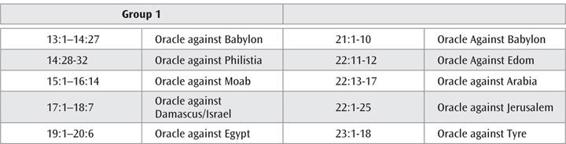
13:11-18. God’s speech in this section highlights His intention to punish the people of the world for their evil and display Himself as the sole Ruler of the earth. The tyrants and the proud who have rebelled against God will be humbled. Pride is again pictured as the object of the Lord’s wrath. The vanity of human pride will be revealed as God shakes the very foundations upon which human dynasties have been built. God will make people scarce (v. 12). He will shake the heavens and the earth (v. 13). Those who try to escape will be caught and killed (vv. 14-15). Horrendous acts will be performed against women and children (v. 16). God appointed the Medes as His attackers. Their lack of concern for silver and gold neutralized the rich and eliminated any attempts at bribery. The Medes’ desire for blood pushed out all pity and compassion, so that even children were not spared (vv. 17-18).
13:19-22. The third-person reference to God in v. 19 (God overthrew) suggests that the prophet was once again speaking about God, rather than God speaking about Himself. Babylon is described as the beauty of kingdoms (v. 19), the glory of the Babylonians’ pride, but its fate would be the same as that of Sodom and Gomorrah. It would be made desolate so that not even nomads and shepherds would use the location. Only wild animals would live in Babylon after God was done with it. This sort of description was typical of the manner in which demolished cities were described in the ancient Near East (Seth Erlandsson, The Burden of Babylon: A Study of Isaiah 13:2–14:23 [Lund: CWK, 1954], 118). The once proud city would soon be disgraced (v. 22) as the Medes under the leadership of Cyrus overcame Babylon in 538 BC. This invasion, however, was relatively peaceful and did not produce the sort of destruction described in chap. 13. Babylon was destroyed by Sennacherib during an earlier Assyrian invasion and was rebuilt under Esarhaddon between 681 and 669 BC. The city’s ultimate eschatological destruction is also mentioned in Rv 18.
So when did or will this destruction of Babylon take place? For several reasons, it seems best to view Isaiah’s depiction of Babylon’s destruction as eschatological. First, Babylon’s defeat will be in “the day of the LORD” (vv. 6, 9), which is generally an eschatological expression. Moreover, the signs in the heavens (v. 10) and the whole earth (vv. 9, 11) align with the eschatological signs of the end of days. Second, Babylon’s fall will be violent destruction (vv. 15-18), but as noted above, no historical defeat of Babylon matches that description. It is likely to happen at the end of days. Third, Babylon’s defeat will coincide with Israel’s end-time restoration (14:1-2), an event related to the end of days.
The difficulty with understanding Babylon’s defeat as eschatological is the reference to the Medes participating in its destruction (v. 17). This would automatically lead to the conclusion that Babylon’s fall, described here, took place at the hands of Cyrus the Great and his Medo-Persian kingdom in 539 BC. However, in light of the evidence pointing to an eschatological defeat in this passage and the rest of the Bible (see the comments on Jr 50–51 and Rv 17–18), it is preferable to view the mention of the Medes as a reference to one of the nations at the end that will come against Babylon.
14:1-4. The oracle against Babylon continues with a statement of God’s loyalty to Israel and the reconstitution of the nations (vv. 1-21). When God brings eschatological relief to Israel, they will look upon those who once oppressed them, particularly Babylon, and mock them (vv. 1-4). The rest of the passage is dedicated to recounting Israel’s taunting. The taunt reinforces several of the prominent themes that have been previously introduced in Isaiah’s prophecy. The arrogance of Babylon is epitomized in its leader’s attempts to elevate himself to the level of the Most High (v. 14). Despite its lofty aspirations, the nation does not achieve the heavens, but is brought down to Sheol.
14:5-23. This passage uses language reflecting ancient Near Eastern cosmic geography. Sheol, which is mentioned several times throughout the passage (vv. 9, 11, 15), was the place lying beneath the earth where those under divine judgment would spend eternity (Philip S. Johnson, Shades of Sheol: Death and Afterlife in the Old Testament [Downers Grove, IL: InterVarsity, 2002], 83.). While the Babylonian leaders wished to ascend to the heights of the gods (vv. 13-14), they would descend into Sheol (i.e., the grave; see the comments on Ps 49:15 for a discussion of the word sheol). They would be humbled and people would be amazed that these men were ever capable of mastering the earth (vv. 15-17). This drastic reversal of fortune in death and defeat highlights the degree of pride and arrogance exhibited by Babylon. Unlike other kings, the leader of Babylon would not rest in his own tomb (vv. 18-20), his offspring would be executed cutting off the king’s lineage (vv. 21-22), and all memory of Babylon would be erased (v. 22).
Some have understood the words of 14:12-15 as an address to Satan, describing his fall. The support for this is found in Dn 10, where demons and angels are associated with nations, influencing the affairs of humanity. Hence, as the power behind Babylon, Satan’s fall is described as desiring to make himself like the Most High (v. 14). The difficulty with this interpretation, and what makes it unlikely, is that there is no change of address syntactically—it all appears to be addressed to the king of Babylon.
14:24-27. Although seemingly a separate oracle against Assyria, this is not so because the word “oracle” is not here as it is in the other oracles to the nations. This is likely because Assyria is linked to Babylon, with Babylon being the successor empire to Assyria. The Lord’s judgment of Assyria is certain (just as I have planned so it will stand, v. 24). Although Babylon’s defeat of Assyria certainly judged that nation, this is more eschatological in nature. It will take place in Israel, in My land … on My mountains (v. 25) when the Lord gathers the nations there to execute eschatological judgment (cf. Ezk 39:4; Zch 14:2). This is part of God’s plan for the whole earth (v. 26). In the end, the Lord’s plans will come to fruition. No power may stand against God and no nation can frustrate His plans (v. 27).
b. The Oracle against Philistia (14:28-32)
14:28. The oracle about the Philistines was given for Judah’s benefit. The time marker in v. 28 marks the shift from the oracle against Babylon to that against Philistia. Israel had a long history with the Philistines. Uzziah had brought Philistia under Judean control during the first part of the eighth century BC (cf. 2Ch 26:6). During the reign of Ahaz, the Philistines gained their independence (cf. 2Ch 28:18). While Philistia was one of Israel’s opponents during the reign of Ahaz, it was also plagued by the Assyrians.
14:29-32. Philistia was not to celebrate because the rod that struck you is broken (v. 29). This is not a reference to Ahaz, but to Uzziah. However, with the death of Ahaz, the house of David was further weakened as was Judah, and the Philistines had hope of greater conquest. However, a viper (a metaphor for a deadly foe) and a flying serpent (indicating a deadly and speedy conquering nation) would strike Philistia, referring to Assyria (v. 29). In but a few short years after this oracle (711 BC) the Assyrian king Sargon II conquered Philistia and made it an Assyrian province. Judah’s response to this news would be that the LORD has founded Zion (v. 32). Assyria would not be able to conquer Jerusalem (cf. chaps. 36–37) and the Babylonians would not conquer Judah until many years afterwards (586 BC).
c. The Oracle against Moab (15:1–16:14)
15:1-9. Moab, like Philistia, was no stranger to Assyrian domination. Moab was noted in the prophecies of other Israelite prophets (cf. Jr 48; Am 2:1-5). Several of the cities noted in vv. 1-4 were in northern Moab including Kir, Nebo, Medeba, Heshbon, and Elealeh (vv. 1-4). The southern cities of Dibon (v. 2) and Jahaz (v. 4) were distant participants in the destruction occurring in Moab. The people of Dibon performed the classic activities associated with morning: lamenting at the high places and the removal of the hair on one’s head and face (v. 2) (Walton, et al., IVP Bible Background Commentary, 605). The distance between the northern and southern cities served to highlight the extent of the devastation and anguish felt in the northern cities (v. 4).
In vv. 5-9 the people of Moab are pictured as fleeing from the coming destruction. They ran away with whatever they could carry in search of a place where they could find safety. The reason for their flight is given in v. 6. The waters of Nimrim likely refer to an oasis of sorts north of Zoar southeast of the Dead Sea. The location was known for its abundant resources (David Noel Freedman, et al., Eerdman’s Dictionary of the Bible [Grand Rapids, MI: Eerdmans, 2000], 965). The announcement in 15:6 that the waters of Nimrim have dried up offers a powerful image of destruction. The drying up of Nimrim prompted the people’s departure with their wealth over the brook of Arabim (v. 7), which should likely be identified as the Wadi el-Hesa between Moab and Edom at the southern border of Moab (Walter A. Elwell and Philip W. Comfort, Tyndale Bible Dictionary [Carol Stream, IL: Tyndale, 2008], 1302). The entire country would be engulfed with the cries of the people from Eglaim and Beer-elim in the north to Wadi el-Hesa in the south. Those fleeing the north would find no refuge in the south. As the refugees flee southward to escape the invaders from the north, they would feel as if a lion was pursuing them (v. 9).
16:1-5. The oracle against Moab continues with a call to send a tribute to Jerusalem (v. 1). Moab now sought Judah’s protection from their enemies. The Moabites compared themselves to birds without nests who were trying to find a new home. The once proud Moabites had been reduced to begging Judah for support and protection (v. 3), so Moab pled for a decision from Zion. This request speaks to the theological perspective presented in this oracle. As Young notes, “If there is to be deliverance Moab must be covered with Zion’s shadow. Indeed, all who will find deliverance must be covered with Zion’s shadow” (Edward J. Young, The Book of Isaiah [3 Volumes]. [Grand Rapids, MI: Eerdmans, 1965–1972], 463). If the Moabites were allowed to take shelter in Judah, they could escape the coming destruction as they waited for the establishment of that Davidic King, the Messiah, whose reign will usher in an age of justice (v. 5, cf. 11:1-16).
16:6-12. Next, the sin of pride once again becomes the focus of Isaiah’s prophecy. The Moabites were a proud people. Their excess and abundance were a source of boasting, which would be proven empty (v. 6). Moabite pride and the devastation of their land came together to produce the lamentation of the nation (vv. 7-8). The destruction was so great that even the prophet had sympathy for Moab (vv. 10-11). Not only had the Moabites lost the security that came from abundance and excess, but they had also lost the security, however false, that was once drawn from their gods. Their pleading and praying would be forever ineffective (v. 12).
The oracle against Moab reflects again the futility of trusting and reveling in human accomplishments. The pride of Moab, embodied and emboldened by their lavish lifestyle, their vineyards, and their gods, did not save them from the coming destruction. The attempt to befriend Judah and the condemnation of Moab’s pride stand in juxtaposition. The oracle calls those who read it to join themselves to Zion and the Lord who reigns there rather than trusting in human accomplishments.
16:13-14. This previous message is underscored by the Lord’s pronouncement of Moab’s demise. The glory of Moab would disappear and the nation’s population would be devastated. This short-term prophecy was fulfilled as predicted. Within three years, Sennacherib destroyed Moab (701 BC). This example of short-term fulfillment was offered to give greater confidence with regard to the fulfillment of the previous long-term prophecies.
d. The Oracle against Syria and Ephraim (17:1-11)
17:1-11. The oracle against Damascus included judgment against Ephraim, the northern kingdom, Israel (v. 3). This is likely because of the alliance between Syria and Israel (cf. 7:1). This oracle differs from the ones previously delivered against Babylon and Moab in that it does not refer to the pride of the nation (aside from the reference to the glory of Jacob; v. 4). Instead, the nation’s trust in the Lord rather than idols appears to be at issue (vv. 7-8). The altars and Asherah poles of the Israelites had produced a situation in which God had been forgotten. Asherah poles were pagan fertility symbols that were used in idolatrous worship. The production and prosperity of Israel would come to nothing because they had ignored God (vv. 10-11). Therefore, God ordained discipline for Israel, to motivate them to look to the Holy One of Israel (v. 7). Under God’s hand, Tiglath-pileser III was swift in responding to Ahaz’s gift. He conquered Damascus, killed King Rezin, and made the city a ruin (cf. 2Kg 16:7-9). Even so, Isaiah’s repetition of the phrase in that day (vv. 4, 7, 9, 11) seems to point to an “end of days” fulfillment of this prophecy. In that case, Tiglath-pileser III’s conquest would be a mere foreshadowing of a far more serious conquest at the end of days.
e. The Oracle against Cush (17:12–18:7)
17:12-14. While it is possible to view vv. 12-14 as the conclusion of the oracle begun in v. 1, the similarity in imagery and perspective between 17:12-14 and 18:1-7 make it reasonable to view these verses as a single unit. There is also a noticeable shift between 17:1-11 and 17:12-14. Whereas vv. 1-11 concern the sins of Damascus and Ephraim, which are primarily concerned with idolatry and the abandonment of God, vv. 12-14 focus on the raging nations and their inevitable failure. There is also a repetition of the term Alas in both 17:12 and 18:1, linking these sections together (the word is literally “woe” as in the NIV, an expression of lament that could be paraphrased “how sad for you”). These factors suggest that 17:12-14 be viewed as presenting an oracle distinct from 17:1-11 and joined to 18:1-7.
The apparent power of the nations is introduced in v. 12. Their roaring and raging are powerful, but they are no match for the Lord (v. 13). The juxtaposition of imagery in v. 13 contrasts the perceived roar of the nations that will crash down like powerful waves with the harmless chaff on the hills or tumbleweed that is driven along by the wind. Rather than dominating, the nations find themselves dominated by the Lord’s “sudden terror” (17:14, NIV). Such is the fate of the enemies of the Lord and His people (v. 14).
18:1. This verse identifies the oracle as directed against Cush, modern Sudan and Ethiopia. The phrase whirring wings has been variously interpreted. The most likely understanding seems to be that offered by the Septuagint and the Targumim (Aramaic paraphrases of the OT by ancient rabbis) which interpret the phrase in relation to boats. Such an understanding plays on the prominence of insects in the land of Cush and on the reference to boats in v. 2. The imagery of whirring wings, then, suggests that the speedy “ships of the Ethiopians whiz up and down the rivers like winged insects” (Oswalt, The Book of Isaiah, Chapters 1–39, 359).
18:2-7. While it has been suggested that Cush is the one that sent envoys to Judah, it seems best to see an unknown group sending messengers to Cush in order to request their aid against other enemies. Perhaps this is a reference to Damascus and Ephraim and their alliance with Egypt, though the lack of a specific referent makes this identification difficult to confirm. In any case, the description of the nation and its people (v. 2), in combination with the command to Go, seems to picture Cush as a likely savior whose strength would provide safety. Such a description is only perceived since the woe saying of 18:1 is against Cush. Verse 3 critiques the unnecessary preparations for war. If the Lord were preparing an army, it would not be a secret. The whole world would see His banner and hear His trumpet. The verse appears to be a condemnation of the human efforts to prepare for battle rather than wait on the Lord.
Instead of making furious preparations for war, the Lord waits in silence until the time of pruning before the harvest (vv. 4-5). He will cut off portions of the vine and leave them for the birds and other wild animals to eat. The growth of God’s enemies will only result in pruning. In the end, God will have His tribute as the nations, including the mighty Cush, will come to Zion. It seems that this is addressing Cush as experiencing eschatological judgment with the rest of the nations of the world (vv. 1-6). Nevertheless, a remnant of Cush will believe in the God of Israel and worship at Mount Zion in the millennial kingdom (v. 7).
f. The Oracle against Egypt (19:1–20:6)
The oracle against Egypt has two main sections. The first contains a long-term prophecy of events that will occur at the end of days (19:1-25) and the second has a near-term prophecy of events in eighth century BC (20:1-6). In the first section, there is a prediction of eschatological judgment (19:1-15) followed by eschatological blessing (vv. 16-25).
19:1-10. The events predicted in this chapter refer to the end of days. This is likely because the judgments described have yet to occur, such as the drying of the Nile River (vv. 5-8). Also, the future blessing described, when Egypt will come to know the God of Israel, has never happened. Further, the repetition of the eschatological phrase, in that day (vv. 16, 18, 21, 23-24) indicates that the oracle points to both judgment and blessing at the end of days. At the end of days, Egypt will also become subject to the Lord’s actions. The weakness and worthlessness of their idols will be revealed and the whole nation will be in turmoil, with neighbor turning against neighbor (vv. 1-3). Despite their attempts to find answers by consulting their idols … mediums and spiritists (v. 3), Egypt is still at the mercy of the Lord (v. 4). Although some have identified the king of Assyria as the cruel master and mighty king who will oppress Egypt (v. 4), the eschatological nature of the chapter seems to point instead to the future world ruler called the little horn in Daniel (see the comments on Dn 7:8, 11-12, 19-27; 11:36-39). The Nile River is the primary resource on which Egypt depends, but at the end it will no longer be available to sustain the nation and its people (vv. 5-10).
19:11-15. The foolishness of Egypt’s leaders is displayed in their inability to rightly direct the nation (vv. 11-13). Their inability to lead is ultimately attributed to the action of the Lord, who has mixed within her a spirit of distortion (v. 14). Egypt will appear as a drunk who staggers in his vomit (v. 14). This picture offers a vivid depiction of Egypt’s confused, pitiable, and helpless state (v. 15).
19:16-22. The phrase in that day (v. 16), as well as the introduction of Judah (v. 17), marks a shift in the message to Egypt from end of days judgment to end of days blessing. The comparison between Egypt and women reflects the general understanding of women’s social status in the ancient Near East. Women were not generally involved in military endeavors. The Egyptians have become delicate. They no longer have the illusion that they are capable of protecting themselves. Instead, they tremble as they watch the Lord come against them (v. 16). Judah will become the instrument of God’s terror not just for Egypt, but also for everyone to whom [Judah] is mentioned (v. 17). This reversal of fortune in which the previous world powers tremble before the small, insignificant nation of Judah is achieved through the revelation of the Lord God of Israel.
The trembling of the Egyptians in that day will give way to a newly found allegiance to the Lord. Five cities in the land of Egypt will be speaking the language of Canaan and swearing allegiance to the LORD of hosts (v. 18). The reference to the five cities has been a source of confusion as the number of cities is relatively small in comparison to the number of cities actually in Egypt. The relative number of cities, however, may be of less significance. Note, for instance, the use of the number “five” in Lv 26:8: “Five of you will chase a hundred, and a hundred of you will chase ten thousand, and your enemies will fall before you by the sword.” The use of five and one hundred to chase one hundred and ten thousand, respectively, suggests that though the number is small, the Lord will bring victory. Oswalt suggests that the number is meant to highlight the “radical nature of the turn” from idols to the Lord (Oswalt, Isaiah 1–39, 377). The adoption of Hebrew, the language of Canaan, does not indicate that Egyptians will stop speaking their own language, but that the Egyptians’ turn to the Lord will cause them to worship in Israel and learn that language.
Of additional significance in this instance is the phrase City of Destruction or “city of the sun” in v. 18. The Hebrew phrase more traditionally translated as “city of destruction” is difficult to understand given the repentant response of the five cities with which it is included. Other ancient sources, including Isaiah scrolls found among the Dead Sea Scrolls, certain medieval Hebrew manuscripts, Aramaic translations (Targumim), Latin translations (Vulgate), and certain Greek translations of the text, suggest that the phrase be translated as “City of the Sun.” If this latter translation is accepted, the reference would likely be to the city of Heliopolis. Heliopolis was the center for the Egyptian priesthood when Onias’s temple was built in the nearby city of Leontopolis in the second century BC. Because the words “sun” and “destruction” look similar in Hebrew, it may be that there is a play on words here suggesting that the City of the Sun is, in fact, also the City of Destruction and refers to the destruction of Egypt’s idols.
An altar to the Lord and a sacred pillar will replace the Egyptian cultic structures in the middle and border of Egypt. Because it is often assumed that the OT requires a central location for worship, this prediction may seem strange. However, the OT appears to make concession for worship at sites apart from the central sanctuary even when the central sanctuary was functioning. Vogt notes, “[T]the validity of a place of worship is determined not by the inherent sanctity of a place … but by the endorsement of the site by Yahweh…. ‘The place’ had to be one that Yahweh chose” (Peter T. Vogt, Deuteronomic Theology and the Significance of Torah [Winona Lake, IN: Eisenbrauns, 2006], 177). Once the altar and sacred pillar are established, they will serve as a sign and a witness to the LORD of hosts in the land of Egypt (v. 20). The altar and pillar could be construed as a sign for God or as a sign to the people. In either case, God will become Egypt’s protector and Egypt will acknowledge God and His sovereignty in worship (v. 21).
19:23-25. The next section describes the millennial peace between Assyria, Egypt, and Israel. When the Messiah Jesus returns and establishes His earthly kingdom, these three nations will be united in worship of the Lord. The turning of Egypt and Assyria to the Lord represents another affirmation of God’s coming triumph. Israel need not fear these other national powers. Instead, Israel must wait for the nations to recognize God’s authority. They must focus on remaining faithful to God rather than making political alliances. God will bring unprecedented peace through the unification of the nations in worship of Him.
20:1-6. The prophet shifts from the idyllic picture of peace amongst the nations at the end of days to one of soon-coming judgment against Egypt. Isaiah went about naked and barefoot for three years as a symbol of the devastation of Egypt when Assyria would come against her. Likely the word naked only refers to the prophet going without an outer garment and not without any clothing whatsoever. This judgment fell in 711 BC when Egypt handed over the king of Ashdod, who had been granted asylum in Egypt, to the Assyrians. The message is that those who trust in Egypt trust in a nation that has already fallen. Again, the emphasis is placed on turning back to the Lord.
g. The Oracle against Babylon (21:1-10)
21:1. This oracle speaks against the nation of Babylon, or the wilderness of the sea. Why Babylon is referred to as such is difficult to ascertain. Ancient translations vary, with the Dead Sea Scrolls reading “words of the sea.” The replacement of wilderness with “words” is based on the similarity of the two words in Hebrew, with only one letter differentiating the two. The Aramaic Targum expands the phrase to read “armies that come from the desert like water from the sea.” Other more modern commentators have suggested that the reference is related to southern Mesopotamia’s identification as “the Sealand” with wilderness having a predictive function and referring to Babylon’s inability to help other nations (Oswalt, Isaiah 1–39, 340).
21:2-10. Isaiah identified the vision he had received as harsh (v. 2). Babylon would be defeated by the treacherous one and the destroyer. While the enemy is not specifically identified, the word “treacherous” is used of Assyria in Is 33:1. Isaiah’s reaction to the vision reflected his dismay over the coming destruction of Babylon. Smith suggests that the prophet was frustrated because “the defeat of Babylon meant that Judah would probably have to face Assyria by itself, with little hope to defend itself against Assyria” (Smith, Isaiah 1–39, 372). Such an interpretation seems to stand in tension with the message of God’s sovereignty that the rest of Isaiah provides.
It is, however, difficult to understand why this message of judgment had such an impact on Isaiah. Perhaps it is best to understand the description of the prophet’s attitude in juxtaposition to the relatively carefree attitude of Babylon (v. 5). The Babylonians appeared to be too busy feasting and drinking to prepare for war. Isaiah called for guards to be posted to watch for the coming onslaught, only to report the complete destruction of Babylon along with the nation’s idols. Babylon and its idols were not invincible. Judah could not rely on Babylonian power, but must rely on God.
Identifying the time when Babylon would fall is more challenging. Some have taken it to refer to the fall of Babylon to the Assyrians in 689 BC (because of Israel’s lack of joy; vv. 3-4). Others view it occurring when Babylon fell to the Persians in 539 BC (because of the reference to the Medes in v. 2). A third more likely view is to understand this judgment as a combination of the first two views and events (Oswalt, The Book of Isaiah, Chapters 1–39, 390). But since the previous description of the fall of Babylon (cf. Is 13–14) referred to an end-of-days judgment, this oracle likely does as well. Additionally, the repetition of the phrase fallen, fallen is Babylon (v. 9) in the book of Revelation, both times referring to the eschatological end of Babylon (cf. Rv 14:8; 18:2), likely identifies this as an end of days destruction as well.
h. The Oracle against Edom (21:11-12)
21:11-12. The thrust of the oracle against Edom appears to be that while the morning is coming, night will overtake it again. The language of morning and night is probably symbolic, representing distress and deliverance respectively. The watchman’s response to the concern may reflect the ambiguity of the situation and the necessity of diligent watchfulness.
i. The Oracle against Arabia (21:13-17)
21:13-15. This next oracle is about Arabian tribes. Speaking to the Dedanites (a tribe from southern Arabia) and the inhabitants of the land of Tema (an oasis in northwestern Arabia), the prophet directed them to bring water and food to the fugitives fleeing from battle whom they would soon encounter.
21:16-17. The prophet then made a specific prediction about Arabia. In a year, the people of Arabia, specifically, the men of Kedar (in northern Arabia) as representing all the tribes, would become fugitives. Some have suggested that this was fulfilled with the invasions of Tiglath-pileser (738 BC), Sargon II (715 BC), or Sennacherib (703 BC). Although it is not clear which invasion caused the prophecy to be fulfilled, the ancient original readers would know. As such, this prophecy, with its near-term fulfillment, functions as a reminder to trust God to fulfill the many long-term prophecies found throughout the book.
j. The Oracle against Jerusalem (22:1-25)
22:1-14. Isaiah now turned his attention to Jerusalem. Because the rest of the oracles included in Is 13–23 were aimed at non-Israelite nations, the inclusion of the oracle against Jerusalem, as well as its position within chaps. 13–23, raises questions concerning its overall function and purpose. Adding to the difficulties associated with this passage is the use of the term valley of vision (v. 1) to identify Jerusalem. While Jerusalem is often referred to as a mountain, or Mount Zion in particular, it is seldom identified as a valley. Furthermore, the exact phrase valley of vision is only used here in the OT. Young connects the use of the term vision with revelation, noting that Jerusalem was the place in which revelation was given (Young, The Book of Isaiah, 2:86). Others have suggested that the phrase refers to the Hinnom Valley. This valley is normally understood to run along the west and south side of the Old City south of the Jaffa gate. Another possibility is that it refers to the Kidron Valley that runs between the city proper and the Mount of Olives to the east. The identification of this valley as the valley of vision is justified geographically, but may not have any particular bearing on the interpretation of chap. 22.
The oracle begins with a rhetorical question that highlights the contradictory nature of Jerusalem’s rejoicing. The people had not been destroyed. The dead were not killed by the sword (v. 2), but they were dead just the same. The rejoicing of the people over their successful siege and the brilliance of their defense lacked imagination (vv. 6-11). The defenses of Jerusalem were flawed because the city did not depend on Him who made it nor … take into consideration Him who planned it long ago (v. 11). The mention of making a reservoir (v. 11) is a reference to the well-known Hezekiah’s tunnel, carved by King Hezekiah from solid rock in order to connect the Gihon Spring to the Pool of Siloam (cf. 2Ch 32:30) and provide water for Jerusalem in time of siege. Nevertheless, rather than rejoicing in their success, God expected Judah to repent (vv. 12-13). The inappropriate reaction of the people reflected their disrespect for God, which was unpardonable (v. 14).
22:15-25. That vv. 15-25 continue the oracle of vv. 1-14 is suggested by the repetition of the title the Lord GOD of hosts (v. 15) from vv. 5 and 12 (note also the shortened title the LORD of hosts in v. 14). The people were called to address the steward Shebna. The Hebrew term translated steward is only used here in the OT, making its meaning difficult to determine. It is clear, however, that Shebna was a high-ranking official in Jerusalem. Despite his self-interested behavior, which was exemplified through the building of the hillside tomb (v. 16), Shebna would be tossed aside and would not retain his position (v. 19). In 1953, a tomb, dating from the eighth century BC, in the Silwan (Siloam) section of Jerusalem was discovered that many identify as the one described in this passage as belonging to Shebna.
When Shebna was removed, the Lord would place His servant on the throne. The significance of the “servant” terminology in the book of Isaiah will be further addressed in relation to its application to Israel and to the suffering servant in Is 40–55, and again to Israel in chaps. 65–66. By identifying Eliakim as My servant (v. 20), God authorized his leadership. Eliakim, a godly palace administrator, would benefit from God’s blessing as he governed Judah, yet he too would fall (v. 25). Despite the honor bestowed upon him, Eliakim would not be able to bear the weight of Judah in that day. Eliakim was not to be trusted because he also was human. Instead, Judah must place their trust in God.
k. The Oracle against Tyre (23:1-18)
The final oracle in this section was levied against Tyre. This city, just north of Israel on the shore of the Mediterranean, was the bookend to ancient Babylon to the east. Both cities epitomized the arrogance and pride that pits itself against the one true God. Hence, Tyre would come under judgment.
23:1-14. This first part of the oracle focuses on the fall of Tyre. The people of the Mediterranean were called to mourn at the fall of this city, since its demise would hinder the economies of the entire Mediterranean world. Tyre’s defeat would affect trade and therefore bring sorrow to Tarshish (vv. 1, 6) in Spain and to Cyprus (vv. 1, 12), as well as to the Nile in the land of Egypt (vv. 3, 5). The once great civilization would suffer at the hands of the Lord (vv. 8-9). The punishment of Tyre is again linked to God’s plan to bring low those honored by humanity (v. 9).
23:15-18. Just as Babylon was conquered by Assyria in 689 BC, so Tyre would also be destroyed for seventy years (vv. 13-15). Some have proposed that the 70 years refers to the time of Judah’s captivity, but that period of time did not affect Tyre. It has also been speculated that this period of time was not a specific amount of time, but rather an idiom for fullness or completeness. Yet it seems most likely, because of the specificity of the date, that the prophet was speaking of the period from about 700 to 630 BC when the Assyrians greatly restricted Tyre’s trade. However, with the decline of Assyria, Tyre would return to her harlot’s wages, a reference to Tyre’s return to her economic power (v. 17). Yet, when Tyre’s strength returned, it would be used in service to God’s people (v. 18), aiding Israel in the rebuilding of the temple.
This series of oracles underscored the prophet’s message concerning the nations. They were not to be trusted. Nothing the nations had was of any permanent value. Their belongings, wisdom, strategies, and military might were fleeting and deceptive. The critique of the nations was designed to point the people of Judah back to the Lord. Alliances may be politically expedient, foreign idols may bring momentary comfort, and foreign wealth may offer the allure of a decadent lifestyle, but they cannot last, nor can they compare to the security, assurance, and abundance of the Lord’s blessing.
2. The Little Apocalypse (24:1–27:13)
Here the prophet changed his focus from the nations surrounding Israel to that of the whole earth. In so doing, his perspective changed from the near term to the long term and from his days to the end of days.
These chapters are also often identified as Isaiah’s “Little Apocalypse.” Despite this more traditional ascription, many modern interpreters do not consider the material in this section of Isaiah as genuine apocalyptic literature. However, apocalyptic literature is difficult to define, and generally there are several characteristics present in the apocalyptic genre. John J. Collins identifies apocalyptic as “ [A] genre of revelatory literature with a narrative framework, in which a revelation is mediated by an otherworldly being to a human recipient, disclosing a transcendent reality which is both temporal, insofar as it envisages eschatological salvation, and spatial insofar as it involves another, supernatural world” (John J. Collins, Apocalyptic Imagination [Grand Rapids, MI: Eerdmans, 1998], 4).
Several elements within Is 24–27, including, but not limited to, the defeat of Leviathan and the reactions of the sun and moon, and the presence of eschatological salvation, have been identified as apocalyptic. However, there is no angelic messenger. Sweeny suggests that “these chapters can hardly be characterized as apocalyptic in the fullest sense, although they may represent an early stage in the development of apocalyptic” (Marvin A. Sweeney, Isaiah 1–39 [Grand Rapids, MI: Eerdmans, 1996], 313–14). Therefore, some have identified this section as “proto-apocalyptic” suggesting that it is a precursor to full-blown apocalyptic literature (Paul Hanson, The Dawn of Apocalyptic [Minneapolis, MN: Augsburg Fortress, 1989], 27). It seems best to refer to this section of Isaiah as eschatological prophecy, since it utilizes images similar to those found in apocalyptic literature. The similarities indicate that it is still appropriate to title this section “The Little Apocalypse.”
Despite the disputes concerning the genre of Is 24–27, the message of this section is relatively clear. God will triumph, bringing destruction to His enemies and peace and restoration for God’s people. These chapters continue the call for Israel to trust in the Lord rather than in the nations.
a. The Judgment of the Earth (24:1–25:12)
In chaps. 24 and 25 Isaiah discussed God’s judgment of the earth. First, the prophet described the judgment of the earth (24:1-23), after which he took up the responses to that judgment (25:1-12).
(1) The Description of Judgment (24:1-23)
The earth as inhabited by humanity is depicted as a city. As such, the city of man, guided and directed by human perspectives rather than God’s counsel, becomes a city of chaos (v. 10). Though the city is not identified, the 17 uses of earth suggest that the city is representative of the nations as a whole. The nations’ adherence, or lack thereof, to the law of the Lord determines their fate (vv. 1, 3, 5, 14, 21).
24:1-3. The first part of the description of judgment is the future, eschatological devastation of the earth. As such, the earth is laid waste and completely despoiled (v. 3). The emphasis of v. 2 is that this devastation will affect all classes of society—none will be spared.
24:4-13. The second aspect of the judgment is that the earth mourns (v. 4). The world will come under this judgment for breaking the everlasting covenant (v. 5). Some have considered this phrase to refer to the Mosaic covenant, but since it is the inhabitants of the earth breaking it and not Israel, this is unlikely. More likely it refers to the Noahic covenant (cf. Gn 9) with its requirements for righteousness for the whole world. Another possibility is this refers to the law of conscience, broken even by those who do not have the law of Moses (cf. Rm 2:14-16). Regardless, the judgment of God will turn all the revelry of sin into sorrow and mourning (vv. 6-13).
24:14-16a. A third aspect of God’s judgment is worship. The believing remnant will respond by glorifying Him for His judgment. These worshipers are not limited to the remnant of Israel, but include all the faithful from the west … in the east and the coastlands of the sea. In fact, from the ends of the earth they will sing Glory to the Righteous One. God will be glorified because He is righteous and just in His judgment.
24:16b-20. The fourth way that the judgment of God is described is with sorrow. The prophet himself laments when he foresees God’s judgment, crying out, Woe to me! Woe to me! Alas for me! (v. 16b). Isaiah saw all the treacherous people upon whom judgment must fall. Seeing that terror and pit and snare was their destiny (v. 17), the prophet grieved at their destruction and the violent devastation of the earth that was yet to come (vv. 18-20).
24:21-23. The last aspect of God’s judgment of the earth is its finality. The LORD will punish the host of heaven (likely a reference to fallen angels or spiritual powers that oppose God) and the kings of the earth (referring to the political opposition to God in the last days; v. 21; cf. Ps 2). At that time, the Lord will take His throne on Mount Zion, and His glory will supersede the glory of the moon and sun (v. 23).
(2) The Responses to Judgment (25:1-12)
25:1-5. This chapter represents the response of God’s people to the judgment of the earth in chap. 24. Their first response to God’s judgment is thankfulness for His activities among the nations. Their grateful praise derives from the execution of God’s plans that were decreed long ago (v. 1). It is clear that the destruction of the nations was not done on a whim, but was planned beforehand. The promised redemption is sure. Just as the earth was previously described as a chaotic city (cf. 24:10), in response God will take that city and make it into a heap and a ruin (v. 2). God’s destruction of the nations will bring about the nations’ worship and fear. The nations’ reverence is not only rooted in their respect for God’s power, but for His treatment of the poor and needy. In contrast to a tyrant, the Lord cares for those whom He rules. His reign is not characterized by oppression and difficulty, but by protection and care (vv. 4-5).
25:6-8. The second response to God’s judgment will be triumph. This is depicted as a lavish banquet for all peoples, a reference to the great messianic banquet (not the marriage supper of the Lamb in Rv 19, but the millennial kingdom on earth) with abundance and community (v. 6) and the removal of death and disgrace (vv. 7-8). With the onset of the messianic kingdom, God will bring comfort, wiping tears away from all faces and restore Israel, removing the reproach of His people from all the earth (v. 8).
25:9-12. The third response to God’s judgment will be joy. The song of God’s people shifts the focus from the universal perspective offered in vv. 6-8 to the reaction of Israel. They recognize the fulfillment of God’s long-awaited promise of deliverance (v. 9). The hand of the LORD will rest on this mountain and provide security, but Moab will be destroyed beneath it as straw is trodden down in the water of a manure pile (v. 10). Swimming in manure is strong imagery that highlights the depth of Moab’s humiliation. Moab serves as an archetype of the enemies of Israel. In the end of days, regardless of all the nations’ trickery, they will be brought low (vv. 11-12).
b. The Establishment of God’s Kingdom (26:1–27:13)
Having demonstrated that God would establish His righteousness through judgment in the previous two chapters, the author points beyond that judgment to the blessing of God’s kingdom that will follow.
26:1-6. To begin the focus on God’s kingdom, the author presents Judah’s song of joy and thanksgiving to the Lord. Judah sings praises for God’s acts on its behalf. In contrast to the chaotic city described in 24:10, this city, built by God, is strong because the Lord has provided genuine security (v. 1). Its walls offer security for the righteous nation and those who are steadfast of mind (vv. 2-3). Trust in the Lord is of paramount importance for Judah. Their continued security depends on the nation’s ongoing faithfulness to the God who will bring low those who dwell on high (v. 5). The proud have no standing before the Lord. Instead, the lowly and the poor will trample the proud and mighty. The poor and the needy who trust God will overcome their apparently powerful opponents.
26:7-11. In the discussion of God’s kingdom, the author shifts from thanksgiving to an expression of dependence during the time while God’s people wait for His kingdom to be established. The Lord makes paths straight for the righteous. Those who trust in God wait patiently for the Lord’s judgment to teach those on earth righteousness (vv. 8-9). The wicked learn righteousness only through judgment. Despite the favor of the Lord, they are blind to God’s majesty (v. 10). Even as the Lord prepares to judge the people, they are unaware. The prophet calls God to show them Your zeal for the people (v. 11). Two other potential senses of this phrase are possible. First, the phrase may refer to the nations’ jealousy against Israel. Second, it may refer to Israel’s zeal against the enemies of the Lord. Yet the NASB rendering appears most likely given the context of judgment on the nations and the mention of the fire that will devour God’s enemies.
26:12-19. Not only do those who trust wait for God to act, they also have confidence in the Lord to renew His people. He will bring peace to His people and, unlike their previous rulers, God will show them graciousness and be good to them (vv. 12-13). The other nations have not stood the test of time. They challenged the Lord and He destroyed them (v. 14). By contrast, the Lord has expanded His territory (v. 15). God is the just ruler whose reign is everlasting and whose past activities instill confidence in His people that He will deliver them.
The prophet’s message shifts back to the present in vv. 16-19. Whereas vv. 12-15 highlighted the certainty of God’s deliverance and a hopeful future, vv. 16-19 compares the distress of the people to a woman in childbirth. The Lord brought an agony upon His people similar to that of a woman bearing a child (v. 17). Unlike a woman in child birth, however, the anguish of God’s people produced nothing. It brought neither deliverance nor conquest (v. 18). The agony resulted only in death. Yet God will restore the dead to life. Those in the dust will experience life-giving power like that of the dew (18:4; Hs 14:5-6). The resurrection of OT saints will take place at the return of Jesus the Messiah (cf. Dn 12:2 and the comments there) and they will enter and enjoy His millennial kingdom.
26:20–27:1. Besides the song of joy (26:1-6) and the expression of trust (26:7-19), the author offers an exhortation to the faithful to wait for God’s judgment and future blessing. It is written as an oracle of salvation. Though salvation will come, God’s people must wait patiently. God calls them to seek shelter and to hide until His indignation runs its course, or His wrath is complete (26:20). At various times in their history, God’s people have been preserved from judgment. Noah and his family were shut up in the ark (Gn 7:16) and the Israelites were spared at the Passover (Ex 12:13). Even Rahab was spared because of her willingness to aid the Israelite spies (Jos 2:12-20). God’s preservation of His people reflects His commitment to accomplish His purposes and bring His people faithfully through to the end. The Lord will come in judgment against the sin of the people of the earth. The bloodshed produced by the swords of men will no longer be hidden in the earth. The sins committed by those who challenged God’s rule will be brought to light. Isaiah 27:1 makes reference to Leviathan. Leviathan is consistently associated with chaos and the sea (Jb 26:13; 41:1; Ps 74:13-15; 104:26). Other civilizations in the ancient Near East such as Ugarit and Babylonia have stories of similar creatures that were also associated with chaos and death.
In slaying Leviathan, the Lord vanquishes the great symbol of chaos and antagonism toward God. Though the powers of this world appear to be prevailing, they will not be victorious in the end. God will triumph in the end. Those who have trusted in Him will be preserved. Those who continue in their sin will be destroyed. Those who rebel against God, who oppose God in the manner of Leviathan, will be defeated.
27:2-6. This section speaks of a day when the Lord will deliver Judah. The passage portrays Israel as a vineyard protected and cared for by the Lord (vv. 2-3). It speaks of a day in which the Lord’s anger has subsided and He longs for enemies, represented by thorns and briars, to come against Judah so that He can defend the nation (v. 4). Better still, He desires that the nations would come to Him and make peace as Jacob becomes secure and expands upon the earth (vv. 5-6).
The previous use of vineyard imagery came in 5:1-7 and depicted Israel as a wild and untamed vineyard that would only produce worthless fruit. Here, the vineyard depicts Israel as redeemed. The Lord will care for the vineyard and bring forth produce. God’s judgment will be supplanted by His deliverance as the new vineyard prospers under His care. The return of the vineyard imagery highlights the dramatic turn that will come about for God’s people. The assurances given in 27:2-6 underscore the coming restoration of Israel and sets Israel’s situation into relief with that of the nations.
27:7-13. The rhetorical question of v. 7 highlights the difference between God’s treatment of the nations and God’s treatment of Israel. As Brueggemann notes, “Yahweh’s punishment of Yahweh’s own has indeed been harsh, but not as harsh as punishment given to others” (Walter Brueggemann, Isaiah 1–39, Westminster Bible Companion [Louisville: Westminster John Knox Press, 1998], 214). Despite this encouragement, however, v. 8 affirms that God will bring discipline on Israel. The Lord is said to have contended with Israel by banishing them. An alternative translation takes the word “banishing” as “measure,” with which the ancient Jewish Targum concurs. Oswalt also translates “measure,” arguing that the punishment fits the crime. Lexically, the Hebrew form can be translated either way. In light of the phrase that follows (driving them away) and the Hebrew penchant for parallelism, it seems that the appropriate translation is “banishing.” Therefore, this speaks of God’s discipline of Israel by exile.
The reference to the east wind in v. 8 gives weight to the coming discipline upon God’s people. This punishment will not be a slap on the wrist, but will come with the severity of the east wind, which provides an ominous presence at various points in Scripture (Gn 41:6; Jb 27:21; Ps 48:8; Jr 18:17; Ezk 27:26; Hs 13:15). Winds from the east of Israel originated in the scorching temperatures of the desert, and could be destructive for crops and animals. The east wind here likely appears as a symbol for violent, unstoppable, divine judgment.
Regardless of the precise meaning it is clear that God will judge His people, yet it is through this judgment that Jacob’s iniquity will be forgiven (v. 9; see the comments on Rm 11:27, where this verse is cited by the apostle Paul). The people’s sins will be forgiven and they will turn back to God. The passage illustrates not only the necessity for forgiveness, but the need for accompanying acts that reflect a renewed commitment to follow God. The people, perhaps in response to God’s judgment and the forgiveness that it brings will respond by removing the idolatrous altars and Asherah poles. This action represents a renewed commitment to the Lord and a sole devotion to the God of Israel.
The identification of the city in v. 10 is unclear but it seems likely that the city is symbolic for God’s enemies. The description of the city as fortified may suggest an element of self-sufficiency, particularly when combined with the familiar punishment of abandonment and forsakenness that has been utilized in previous passages in Isaiah (cf. 1:7; 24:10). The imagery of animals grazing on the land of a once-great city is also found in other passages within Isaiah (cf. 5:17; 7:25; 17:1-2). Eventually, the animals will strip the city’s vegetation bare and women will use the dry wood to make fires. This picture of a deliberate, ongoing march toward final destruction is caused by the people’s lack of understanding (27:11). This lack of understanding results in a lack of compassion from their Maker.
The people’s inability to live under the rule of God, to recognize their Creator, and to obey Him brings unhindered punishment. By contrast, the Israelites will find deliverance. Isaiah 27:12-13 speaks of the great gathering of Israel. As the nations are punished, the people of Israel will be assembled from the nations in order to worship the Lord in Jerusalem. The great trumpet will sound as all of God’s people are called there. The trumpet blast appears in relation to several events in Scripture. It is perhaps most known for its associations with war (Jos 6:16, 20; Jdg 6:34), particularly with the final battle against all evil (Zch 9:14). In this context, however, this association is less likely as it would appear that the battle has ended before the trumpet is blown. In other instances, the trumpet blast is associated with the installment of a new king (1Kg 1:34, 39; 9:13) and with more general calls to attention (Lv 25:9; Jl 2:1, 15). In this context, the trumpet marks a call to come out from exile to worship the Lord (Is 27:13).
3. The Book of “Woes” (28:1–33:24)
In Is 5:1-6, Israel was depicted as a vineyard that would only produce worthless grapes. Afterwards, in 5:7-30, six woes were declared on the people for their sins. In chap. 27, Israel was again depicted as a vineyard, but this time as a protected one, indicating God’s permanent preservation of His people. Now in Isaiah 28–33, six woes are again declared but now upon the leaders of Israel for their sins.
a. The First Woe: For Drunken Mocking (28:1-29)
28:1-6. The first of six woes is for the drunkenness and mockery found in Israel’s leaders. The word woe is an interjection or exclamation of lament. It generally (but not always, cf. Is 55:1) precedes a warning of God’s coming judgment and contains within it an expression of sympathy or pity. It could be paraphrased, “How sad for you!” The proud crown (v. 1) is a symbol of power and sovereignty. It is the crown, or the glory, that sits on the head of those whose drunken behavior blinds them to the coming destruction. The city of Samaria is likely in mind here. Samaria served as the capital of the northern kingdom in the eighth and ninth centuries BC. The city was located on a hillside overlooking a fertile valley. Its elevated location made Samaria difficult to overtake, although it was besieged on several occasions (1Kg 20:1-21, 28-34; 2Kg 7:1-20). The city was eventually overtaken by the Assyrians in 722/721 BC. The future onslaught will come at the hands of the Lord’s strong and mighty agent (28:2). The storm imagery used in v. 2 suggests the force with which Samaria will be brought down. The images of windblown hail being driven into the ground and rain pounding into the dirt depict vividly the power with which Samaria will be destroyed.
The once-beautiful wreaths worn by the drunkards will soon wither and fade. That which was worn on the top of one’s head as a sign of carefree self-indulgence will fall to the ground and be trodden under foot (v. 3). This trampling will come quickly as the comparison of Samaria to the ripe fig makes clear. Figs and fig trees are used in other prophetic passages to denote divine punishment (cf. Jr 8:13; Jl 1:7, 12; Am 4:9; Hab 3:17). It is also used as a figure of restoration (Jl 2:22). Figs could have ripened twice a year, with the winter crop ripening in June and the summer crop in August and September (David C. Hopkins, The Highlands of Canaan: Agricultural Life in the Early Iron Age [Sheffield: Sheffield Academic, 1985], 228). As Wildberger notes, “The pride of the lords of Samaria would be gone quickly and it would be demonstrated, with uncanny speed, that all the hopes by which the people tried to comfort themselves would be comparable to the euphoric expectations of drunks” (Hans Wildberger, Isaiah 28–39: A Continental Commentary [Minneapolis: Fortress, 2002], 11).
In Is 28:5 the Lord will become a crown for the remnant of His people. God will provide the needed resources for those ruling His people. He will be a spirit of justice (v. 6) for those who judge in Israel and a source of strength to those who defend God’s people. The Lord will replace the pride and drunkenness of the people with justice and power that will protect the remnant of his people. God will empower His people to overcome their enemies.
28:7-13. The priests and prophets who were supposed to guide Israel spiritually, offer the nation discernment, and serve as a conduit for the Word of the Lord instead are drunken fools. Their drunkenness was influencing their official duties as they would reel and stagger during their decisions and visions (v. 7). The tables at which the officials sat were covered with vomit due to their excessive drinking. The pleasure-seeking behavior of the rulers had come to a degrading end as they sat reveling in their own filth (v. 8). Despite their unfortunate state, the drunken prophets and priests rejected the Lord’s teaching. The He of v. 9 most likely refers to God and to the message delivered by His prophet. The sarcastic response of the priests and prophets in v. 9 reflects both their arrogance and ignorance. They are proud of the way they are living and reject the way of righteousness. They view themselves as men who have no need of the Lord’s rebuke rather than what they actually are—“babies” who require the guidance given by God’s prophet.
The disdain of the priests and prophets is given an ironic twist in v. 10. The teaching that they assumed was given to children and babes just weaned from milk (v. 9) will become unintelligible to them. It will be like the babbling of a child in their ears. The paired phrases in v. 10 exhibit a literary characteristic of assonance and alliteration in which there is a repetition of vowel and consonantal sounds respectively to create a patterned whole. The Hebrew text reads as follows with the “ts” at the beginning of some of the words being pronounced as the “ts” combination in English words like “nuts” or “hits”: “tsav latsav, tsav latsav, qav laqav, qav laqav.” Though several English translations, including the NASB, provide a translation of each of these terms, it is likely that they were meant to represent the speech of a young child just learning to talk.
Not only will God speak in the unintelligible gibberish of children, He will speak in a foreign language (v. 11). While the babbling of children would be impossible to understand, the foreign tongue will be far more discernible. The reference to the stammering lips and strange tongue in v. 11 refers to the language of the Assyrian empire. The failure of the leaders to listen to God’s message through the prophet will force God to make them hear Him through the sword of Assyria. When they hear the foreign language of Assyria, they will know judgment is upon them. Paul also cited this example of a foreign language in the context of a sign pointing to the truth of God’s message (see comments on 1Co 14:20-25). The babbling comes to bring judgment and punitive consequences (28:13).
28:14-16. The therefore at the beginning of v. 14 suggests a causal relationship between the events described in 28:5-13 and the message delivered in 28:14-29. Given the coming destruction, the prophet calls the rulers to listen to God’s Word. Rather than trust in the Lord for protection, the rulers of Jerusalem have made a foolish pact with Sheol or “the grave” (v. 15; for an explanation of Sheol, see the comments on Ps 49:15). The pact is rooted in lies and will never be able to protect the people from their enemies or from the judgment of God. Their agreement with death has made falsehood their refuge. While such a pact is obviously a misguided act of disobedience, God graciously offers an alternative. He will place in Zion a stone or a cornerstone. The stone is described as being tested and costly (28:16). It will offer a foundation firmly placed and the one who believes in it will not be disturbed. Unlike the false covenant made with death, which could offer nothing except false assurances, the cornerstone offers everlasting security to those who lean upon it.
The imagery of the cornerstone was used previously in 19:13 where the unreliable cornerstones of Egypt deceive the nation and lead it in the wrong direction. The term is also used in Jr 51:26 in an oracle of judgment against Babylon and in Zch 10:4 as a reference to the messianic ruler who will come from Judah. One of the most well-known uses of the cornerstone imagery is the messianic reference found in Ps 118:22, which is applied to Christ in Mt 21:42; Mk 12:10; Lk 20:17; Ac 4:11; Eph 2:20; and 1Pt 2:7. It seems Isaiah is also using the term as a figure for the ultimate son of David, the messianic King.
28:17-20. The cornerstone will provide safety from the implementation of God’s just rule, which will sweep away the refuge of lies (v. 17). The reference to the lies in conjunction with refuge alludes to the false covenant with death. The people’s hiding place will be submerged with no hope of protection. As God establishes his new order, the covenant with death will be terminated. Its uselessness will be revealed as the Lord brings the overwhelming scourge upon the people and it will not stop (vv. 18-19). Nothing will stop the onslaught except trust in the cornerstone. The people’s securities and comforts are no more. Even their beds do not provide comfort (v. 20).
28:21-23. This section likely refers to God’s activities against the Philistines at Baal-perazim (2Sm 5:20) and against the Canaanites (Jos 10:10-11). As God came against the Philistines and the Canaanites, so He will come against Israel in judgment. Such activities against Israel seem strange and unfamiliar in comparison with the punishment of the nations. Regardless of its oddity, God will accomplish His unusual task of disciplining Israel. The Lord will not continue to bear the people’s foolish mocking. Instead, the discipline of Israel will only increase until the whole land is destroyed if they refuse to turn back to the Lord (v. 22). The prophet calls Israel to obey his word, to listen, and to follow the Lord (v. 23).
28:24-29. The rhetorical questions (vv. 24-25) bring focus to the foolishness of the leaders’ rebellion against God. The picture painted is one of a farmer who has been taught by God to care for his fields and to sow and harvest its produce. The farmer does not plow the field forever. After plowing and breaking up the ground, the farmer begins to sow. The ground can only be cultivated for so long before the farmer must take the next step and sow seeds. The seeds in question each require specific planting techniques. The farmer understands the needs of each of the seeds and cares for them to secure his harvest.
Cummin (v. 25) was generally scattered by hand over cultivated ground, but the wheat, barley, and rye may have been planted with a seed drill as they would have needed to be separated from one another (Walton, et al., IVP Bible Background Commentary, 620). The farmer would plant the seeds appropriately based on the instruction of the Lord (v. 26). The dill and cummin mentioned take on a greater significance in v. 27 where the process for threshing is described. Dill and cummin are too delicate to use large threshing tools. For more resilient seeds, such as wheat, the Israelites would have employed a process in which wood sleds were used to crush the wheat. Threshing forks were then utilized to toss the wheat into the air. The chaff was blown away by the wind and the heavier grain fell to the ground and was collected and stored (William G. Dever, The Lives of Ordinary People in Ancient Israel: Where Archaeology and the Bible Intersect [Grand Rapids, MI: Eerdmans, 2012], 199).
The simple farmer has been taught by God to care for his field and to do what is necessary to care for his produce. The knowledge of planting, harvesting, and threshing does not come from an agrarian god, but from the LORD of hosts. There is a contrast being made between the pastoral imagery used in 28:23-28 and the terms used to describe the Lord in v. 29. The phrase LORD of hosts translates a Hebrew phrase that associates God with war, or as the commander of armies (John Goldingay, Songs from a Strange Land: Psalms 42–51 [Toronto: Clements, 1972], 60). God is not simply a God who provides the techniques necessary to inform a farmer’s planting and harvesting. Instead, he is a powerful God of armies who provides counsel and wisdom.
The Hebrew term translated counsel (v. 29) is related to that translated “counselor” in the phrase “Wonderful Counselor” in 9:6, though it is not clear that a specific connection is intended. The point of the contrast just noted is twofold. First, the agrarian cycle exhibits the sort of wisdom and order that God brings to those who listen to Him and learn from His word. Second, the use of LORD of hosts (lit., “Lord of armies”) highlights God’s capacity to function in realms other than that of agriculture. The same God who teaches the farmer to care for his wheat and cummin is also the God who does battle. The leaders whose covenant with death will be overturned must realize that their security does not lie in a misguided agreement, but in the God who commands armies. The passage calls the leaders and all those who read it to see the truth and to abandon false allegiances that offer only the appearance of safety.
b. The Second Woe: For Religious Hypocrisy (29:1-14)
29:1-4. The second woe of the six woes is for religious hypocrisy in Israel, particularly among the spiritual leaders. Isaiah continues his prophecy against Israel by turning his attention to Ariel. Though it is clear that the prophecy is addressing Jerusalem (29:8), the term Ariel can be understood as either a reference to the altar hearth where sacrifices were offered (Ezk 43:15-16), or as a compound noun combining the Hebrew words for lion (ari) and God (el). The first interpretation is supported by the reference to the feasts in 29:1, which could suggest a cultic context for the passage as a whole. The latter more likely understanding of Ariel is supported by the numerous uses of “lion” in conjunction with Judah or the Judean king (Gn 49:9; 1Kg 10:19-20; Is 31:4).
Ariel is also identified as the city where David once camped. There is some dispute over this translation as the Hebrew word translated camped (29:1) is used again in v. 3 with the sense of “besiege.” While it is possible that the two terms should be translated similarly, it is not required. In this case, translating the two instances of the same term differently offers a contrast. In 29:1, the reference to David may be read as a source of pride or distinction. Ariel is the place of David and where he camped, but it will also be the place that is besieged by God (vv. 2-3). The city that continually celebrates feasts “year to year” will be overtaken by God. It will no longer celebrate, but it will be lamenting and mourning (v. 2). The city’s fortunes will be reversed and God will humble it so that it speaks from the dust (v. 4).
29:5-8. Despite the severity of God’s acts against the city, its enemies’ punishment will be even harsher (v. 5). They will be ground to dust. They will be blown away as easily as chaff. This description of the enemies not only points to their coming punishment, but to their ultimate inability to destroy Jerusalem. Their apparent power will be devastated when the Lord comes. The description of God’s appearance in v. 6 is characteristic of ancient Near Eastern descriptions of theophany, or divine appearances, particularly the description of “natural upheaval” (Jeffrey J. Niehaus, God at Sinai: Covenant and Theophany in the Bible and Ancient Near East [Grand Rapids, MI: Zondervan, 1995], 27-28). The elements of nature respond to the Lord’s presence as a sign of His power and control over all creation (Ex 19:16-19; 1Kg 19:11-13; Ezk 20:47-48). Though God’s visitation on Israel will certainly have the dual impact of discipline and deliverance, God’s discipline appears to be most prominent here. Israel will suffer the punishment of God. This passage has been thought to foretell the defeat of the Assyrians (Is 37), yet the emphasis on the multitude (29:5) of Judah’s enemies and the multitude of all the nations (vv. 7, 8) indicates that this clearly has eschatological elements.
After the Lord’s coming, the multitude of all the nations (vv. 7, 8) will wake as from a dream. Just as one who dreams of eating or drinking but awakes to have done neither (v. 8), the enemies besieging Jerusalem at the last battle will dream that they have destroyed the city and people, only to awake and see that the destruction has not occurred.
29:9-14. What follows is a description of the serious spiritual impairments of Israel’s leadership. They are deaf and blind. Those who should be guiding the nation toward God wander about with no senses to guide them. God’s capacity to deliver His people, to work within the seeming impossibilities of history, and to defeat the political powers that threaten Israel regardless of the size or capacity of Israel’s armies is ignored by Israel’s leadership. Those who should be most aware of God’s ability to work outside the boundaries of the world are incapable of imagining a way of life with God that could overcome political realities. All that God has spoken and given through the prophetic message will fall on those without the sensitivity to understand it (vv. 9-10). The message of the prophet is like a sealed scroll that the leaders of Israel cannot open or read. The sealed words have no effect for those who cannot open the scroll and comprehend its message (vv. 11-12).
Without divine words, the people are left with only human rules. God’s message to the people is of no use because only the spiritually deaf and the blind lead the nation. They hear the words but do not believe them. They see the events around them, but do not look to God to deliver them. Without the ability to hear God, there is no chance for the people to honor God. Their superficial reverence of God had become a vain activity comprised only of ritual.
If, as Proverbs asserts, the “fear of the LORD is the beginning of wisdom” (Pr 9:10), wisdom cannot be founded on human rules. The people appear to have been fooled into thinking that their reality is the only reality. God will once again shake up their perceptions. He will astound them “with wonder upon wonder” (NIV, Is 29:14). The human wisdom (v. 14) that has driven the lives of Israel will be removed. God will so explode the people’s understanding of reality that what once counted as wisdom and intelligence will be overshadowed by God’s wisdom, knowledge, and power. God’s people must be reminded that life with God is never without possibility. There is always hope, always potential. God’s astonishing acts are designed to call God’s people to believe once again that God does not operate within the limits of human possibility or vision.
c. The Third Woe: For Attempting to Deceive God (29:15-24)
29:15-16. The third woe of six is for Israel’s leaders’ attempted deception of God. Israel’s leaders have some sort of hidden plan that they are attempting to keep from the Lord (v. 15). The language of hiddenness and darkness suggests that the plans were not simply hidden from the Lord, but from everyone. Though it is not explicit within the text what plan has been made, it may be that a secret political alliance is in mind (cf. 30:1-2; 31:1). In any case, the nature of the plan is secondary to the manner in which it was conceived.
The hiddenness of the plan and the exclusion of God from the planning process is a sign of disrespect (v. 16). It represents yet another instance of the leaders’ rejection of God, as well as highlighting the leaders’ hubris in relation to their own knowledge. The clay has said of the potter He has no understanding. Here again, the leaders reveal their lack of imagination and trust in God’s sovereignty. Paul addresses the principle of God’s sovereignty over humanity when he explains election using this passage (see comments on Rm 9:19-21). Nevertheless, Israel’s leaders lack recognition of God’s sovereignty over them and therefore solve their current difficulties based on their rejection of God and their skewed understanding of the relation between Creator and creation.
29:17-24. Having attempted to deceive God, what follows is a depiction of the coming reversal of their human assumption. That which humanity took as an absolute will become unreliable. The divine surprise will overturn established knowledge and wisdom. It will showcase the possibilities available through the power of God. A series of reversals illustrates the futility of plans that exclude God and, instead, limit potential options to those that seem to be within the realm of human control. With God involved, the great forests of Lebanon will become fertile fields and the fertile fields will grow into a great forest (v. 17).
The reference to the book in v. 18 echoes the previous referent to the sealed book in vv. 11-12. While the leaders could not read the scroll, God will allow others to receive His message. He will empower the eyes of the blind to see despite the darkness. These lines may refer to the transformation of a spiritually insensitive nation. There will be yet another reversal as God who previously “shut your eyes” and “covered your heads” (v. 10) will now open the eyes of the blind and make the deaf hear (v. 18). Though the generation to whom the prophet’s message was delivered was blind and deaf to God’s word, there will come a day when the blind and deaf will see and hear.
Even those who have no cause for rejoicing under the current regime will find cause for worship. The blind and the deaf, the humble and the needy represent the downtrodden of Israelite society. They have no opportunity to abuse their power or to lead the nation astray because they have no position, no influence, and no hope within human government. God will change the situation of those who have no standing in the nation and give them reason to rejoice (v. 19). By contrast, those who have done evil and benefited through injustice will be destroyed.
The first two categories of people noted in v. 20 are mentioned at other points in the book of Isaiah. The Hebrew word translated ruthless in v. 20 is also used in 13:11; 25:3-5; 29:5; and 49:25. The term refers to those who practice wickedness. In 25:3, “cities of ruthless nations” are used in parallel with “a strong people,” suggesting that they occupy a privileged place in society. The scorner is only mentioned in 28:14 (“scoffers”), but the description is used numerous times in Proverbs to refer to those who mock godliness and degrade the wisdom of God (e.g., Pr 1:22; 14:9). The deeds of those who watch and do evil are made explicit in 29:21. They use empty arguments (the word meaningless is the same word as used in the creation narrative [Gn 1:2], indicating that the new creation was “formless and void”) to pervert justice while actively oppressing and mistreating their countrymen. Each of these groups, then, stands against God and opposes His moral order.
These reversals will result in the removal of shame from Jacob (29:22). The reference to God’s redemption of Abraham is likely designed to remind Israel of God’s steadfast faithfulness to them. God has been working on Israel’s behalf since He called their first forefather out of the desert. Just as He redeemed Abraham, so He will redeem Jacob, a reference not to the patriarch but to the nation by way of metonymy. The allusion to Abraham may also have a second purpose related to vv. 22-23. Jacob’s shame and embarrassment will be lifted because of the children God will produce among them. Much like God’s provision of children to Abraham, He will now bring prosperity to a new generation of Abraham’s descendants with offspring. The people of Israel will turn and honor God when they see the children He has provided (vv. 23-24).
d. The Fourth Woe: For Stubborn Rebellion (30:1-33)
The fourth woe is for the stubborn rebellion of God’s people. First, there is a description of Israel’s rebellion (30:1-5), followed by God’s judgment of their rebellion (30:6-17), and concluded by a prediction of Israel’s future restoration (30:18-33).
30:1-5. After a brief message of hope related to God’s provision of children, the prophet returns to a message of woe against the rebellious children (v. 1). The reference to making plans becomes more specific than that in 29:15. These plans, like those mentioned in 29:15, have been made without consulting God. The alliance with Egypt is misguided. Not only were alliances with Egypt forbidden (Ex 13:17; Dt 17:16), the planners have not planned with the Lord. Seeking out Egypt’s assistance is problematic for a number of reasons. Theologically, the alliance with Egypt suggests that God is less than capable of caring for the people He has chosen. Politically, the alliance is doomed because Egypt cannot hope to defeat the Assyrians.
The Israelites’ rejection of God reflects an ignorance of God’s power and an unwillingness to wait on the Lord’s deliverance. The alliance will not bring victory but shame to Israel (v. 3). The certainty of this result is driven home through the use of a merism, “a literary device that uses an abbreviated list to suggest the whole” (Tremper Longman III, “Merism,” in Dictionary of the Old Testament: Wisdom, Poetry and Writings, ed. Temper Longman III and Peter Enns [Downers Grove, IL: InterVarsity, 2008], 464). Zoan was located in northern Egypt and Hanes in the south. Referring to a city in the north and the south suggests that the whole country of Egypt is in mind. No location in Egypt will be immune to the coming defeat. Rather, the whole of Egypt will be ashamed along with anyone who puts his trust in Egypt (v. 5). Despite the perceptions of the Israelites, Israel’s fate will be unfavorable because of their alliance with Egypt. Israel will suffer because of this misguided partnership.
30:6-7. Judgment would come upon Israel for three reasons. The first reason was the alliance with Egypt. The oracle concerning the beasts of the Negev highlights the lengths to which Israel had to go to court their worthless ally. Hezekiah sent ambassadors from Judah to Egypt carrying riches on the backs of donkeys and camels (v. 6). Because Assyrian forces would have been blocking the coastal routes, the envoys would have been required to go to Egypt by travelling “south to Aqaba and across the Sinai to Egypt” (Walton, et al., IVP Bible Background Commentary, 621). The envoys were carrying the riches of Israel to a people who could not profit them. The investment of time and resources would not result in positive dividends. Israel’s leaders were funneling their wealth into a bottomless pit that would eventually collapse and bury Israel inside.
Egypt’s inability earned it the nickname Rahab who has been exterminated (v. 7). Rahab is used throughout Scripture to denote a mythical chaos monster (Jb 9:13; 26:12; Ps 89:11; Is 51:9). It is also used as a poetic name for Egypt (Ps 87:4). Though this latter use is certainly in mind in 30:7, the former use may also be in mind, particularly given the later reference to Rahab in 51:9. The description of Rahab as she who has been exterminated, or “the Do-Nothing” as translated by the NIV, reflects not only the uselessness of Egypt, but the nation’s lack of any power, mythic or otherwise. There is no alliance that Israel can make that will bring salvation. Uniting with the Lord and Him alone is the only path to deliverance.
30:8-14. The second reason given for Israel’s judgment is for rejecting God’s truth. Verses 8-11 call for the creation of a permanent record to remind the rebellious people and false sons of their folly (vv. 8-9). The everlasting witness against the people is designed to record the people’s unwillingness to follow the Lord. It will also allow the prophet to illustrate that God warned his people of the coming judgment. The people’s deceitfulness goes beyond individual fraud to a concerted effort to silence those who might offer words of truth to challenge their falsehoods. They call the prophets to ignore their visions and to deliver only pleasant messages. They want to hear lies over the truth (vv. 9-10). The statement in v. 11 is a bold affirmation of Israel’s desire to avoid the word of God: Let us hear no more about the Holy One of Israel. The people’s active rejection of the Word of the Lord will not go unpunished.
The consequence for rejecting God’s message of truth will be the shattering of the nation. The people’s unwillingness to accept the truth and their embrace of deceit will create an illusory defense. The instability of deceit is compared to a high, cracked wall that will not provide protection. Instead, it will collapse. Its apparent strength is a fantasy. The wall constructed by their sin is fragile like pottery. The fragility of the strategy will lead to complete and total brokenness (v. 13) to the point that there will not be a piece large enough to take fire from a hearth or to scoop water from a cistern (v. 14).
30:15-17. The third reason for judgment is for the nation’s self-reliance. All the lying and plotting, the silencing of the prophets, and the delusional behaviors have been useless. The attempts to form alliances, to gain profit through oppressive acts, and to position the nation among the rest of the world powers are wrongheaded. Instead of scheming and hiding and trusting in their own plans, God’s people should have been trusting in Him for deliverance. The people’s refusal to repent and to wait for the Lord was their downfall (v. 15). Their adoption of customary, worldly means of deliverance effectively eliminated God from the equation. Their deliverance was not in activity and power, but quietness and trust (v. 15). It was not in hard-hearted rebellion, but in repentance and trust in their Lord.
This wisdom, while available to the people, was buried and marginalized to the point that it became unavailable. Rather than trusting God to act, the people chose horses. The horses appear to be a strategy for escape that God assures the people they will need to use. But no matter how fast they run, it would not be fast enough (v. 16). Their efforts are futile, but they can see no other way. The people will flee from forces of one or five, so that only a small force is left atop a mountain. God’s people will be like a flagpole and a banner there (v. 17). While the imagery could be a positive reference to a remnant of the people, the negative connotations of the preceding verses suggest that the comparison is meant to be taken negatively.
30:18-22. Having described Israel’s rebellion and promised judgment, the prophet turns to a message of hope. Although 30:1-17 condemns the Israelites for their rebellious, foolish, and deceitful activities, 30:18-26 holds out a hopeful offer of deliverance. The transition in v. 18 also suggests that God longs to overturn the preceding message of judgment with His restoration. God wants to pour out His grace on His people if they will only wait on Him. Regardless of their mistakes and betrayals, God will be merciful and just if Israel will turn to Him. Jerusalem can yet find hope in three ways. First, hope is to be found through the great messianic teacher who is to come (30:18-22); second, mercy will be experienced through the abundance God will provide at that time (30:23-26); and third, justice will be found through the judgment of Assyria (30:27-33).
The note of comfort offered to Zion begins with God’s gracious offer that if Israel turns to Him for help, God will respond to the cries of his people (v. 19). His discipline is given for a reason. Israel is not being forced to eat the bread of privation and drink the water of oppression without purpose. It is through their burden that they will turn to the message of truth revealed by their great messianic Teacher.
Some versions understand the word “teacher” (v. 20) as plural, referring to many teachers (NIV, NET), while others translate it as singular, “Teacher,” and interpret it as the Messiah. The difficulty of v. 20 is that the Hebrew verb hide Himself (yikkanep) is a third-person masculine singular form, but the noun corresponding to it, your Teacher, appears to be a plural. Hence some versions translate this as “your teachers will no longer be hidden,” indicating that the verse promises true teachers (but not the Messiah) who will be revealed to Israel. However, this does not resolve the problem of the singular verb, which ought to agree in number with the noun. One possibility is that the noun is a plural of majesty, hence only plural in form but not in meaning, and therefore should be translated as “Teacher.” Another possible resolution of the difficulty is to recognize that the Hebrew suffix your on the noun Teacher begins with a consonant. According to Gesenius, Kautzsch, Cowley, in biblical Hebrew, when a suffix begins with a consonant, it can yield a form change so that a true singular is formed as a plural but remains singular (W. Gesenius, Gesenius’ Hebrew Grammar, ed. E. Kautzsch and A. E. Cowley, 2nd English ed. [Oxford: Clarendon Press, 1982], 273–274). This would therefore yield the translation, your Teacher will no longer hide Himself, but your eyes will behold your Teacher. This seems to be the appropriate resolution of the grammatical difficulty. Thus, when Israel turns to the Lord, the Messiah will no longer hide Himself from His people. Instead, as a Teacher, He will guide His people, whispering in their ears, This is the way, walk in it (30:21; see also the discussion of the parallel messianic passage in Jl 2:23).
30:23-26. God will not only reveal the messianic Teacher to the people, at the time the nation finds Messiah, God will also bring prosperity. Rain will water the ground and bring forth produce that will feed even the people’s livestock lavishly (v. 23). The provision of rain at this time is also a support for the messianic interpretation of this passage. In similar fashion, according to Jl 2:23, when the great messianic Teacher comes to Israel, God will provide both the former and the latter rains, and will bring them great agricultural abundance (see comments on Jl 2:23). The salted fodder (30:24) is particularly extravagant feed for the animals, suggesting that God has blessed the Israelites with such abundance that they are even willing to share with their livestock. Verse 25 connects two events: the destruction of the towers and the provision of streams of water. Ordinarily, these two events would seem contradictory as the felling of the towers and the destruction they imply do not fit with the abundance suggested by the resulting streams of water. The connection between the two events here may hinge on understanding the towers as a remnant of the people’s human security. They are relics from a time when God was not trusted in Israel. The toppling of the towers allows the people to experience God’s blessing as their trust in Him is now no longer prohibited by illusions of human power.
God’s healing activities will be accompanied by unprecedented illumination. God will usher in a time of light that will drive away darkness. The sevenfold increase in the sun’s light highlights its intensity. The combination of healing and light is opposite to that of disease and darkness. The coming light and the healing of God’s people is a symbol of the coming restoration. God is now pictured as a physician who will heal the wounds of His people (v. 26). While physical healing is certainly in mind, the holistic nature of God’s restorative work in the messianic age, encompassing all aspects of creation, should not be missed.
30:27-33. God’s blessing is not only available to Israel through the coming of the messianic teacher (vv. 18-22), and the provision of abundance (vv. 23-26), but also through the expectation of judgment on Assyria. Shifting away from the focus on God’s restoration of His people, Isaiah now directs attention toward the devastation of Assyria. The Lord, who was just portrayed as the gentle physician who brings healing and light, is now depicted as a fierce warrior. He is described as burning in His anger and dense with smoke (v. 27). Although the NASB, along with many other English translations, use the word smoke, the underlying Hebrew is somewhat ambiguous. A more formal translation of the Hebrew would be “heaviness of elevation,” but such a translation makes little sense in English. It may be that the phrase should be understood as a reference to God’s coming wrath, particularly given its connection with God’s burning anger. A description of the Lord’s foreboding presence follows. It is said that God’s breath is like an overflowing torrent, meaning it will overcome His enemies like a flood (v. 28). In Israel, the imagery of an overflowing torrent is likely drawn from the sudden floods associated with wadis, which are dry stream and river beds that flood with devastating force and surprising suddenness. To this day flash floods still overcome people in Israel. This vision of the rushing torrent would have been a familiar and powerful image to those in Israel.
God will also shake the nations back and forth in a sieve (v. 28), with the word sieve drawing on agricultural imagery. As the wheat is separated from the tares, so will the nations be sifted. There were two types of sieves used in ancient Israel during the time in which Isaiah prophesied. Concerning the first type of sieve, Borowski notes, “the first sieve has large holes and is used by moving it sideways and in a circular manner, which distributes the heavy particles, such as small stones, to the sides while the grain falls through the middle (Oded Borowski, Agriculture in Iron Age Israel [Winona Lake, IN: Eisenbrauns, 2009], 66). The second sieve, which is likely in mind in v. 28, has “small holes and is used by moving it up and down. This motion lets the small particles fall through the holes while the grain is left inside the sieve” (Borowski, Iron Age, 66-67).
This image is combined with that of the horse and bridle (v. 28). The nations will be led along by the Lord to a place of destruction. The destruction of Israel’s enemies will result in rejoicing. Joy over an enemy’s destruction is not uncommon in Scripture (cf. Ps 96). The people’s happiness is compared to the time when one marches to the sound of the flute (30:29), to go up to the mountain of the LORD, to the Rock of Israel. God will not come in secret, but will make His voice heard. It is God’s voice that will destroy Assyria, which here represents all the nations that have oppressed Israel (vv. 30-31). He will come with visible signs that cannot be missed (v. 30). The coordination of the rod of punishment (v. 31) and the music of tambourines and lyres (v. 32) illustrates the joy that the defeat of the Assyrians will bring.
Topheth (v. 33) refers to a location near Jerusalem that was used as a burial ground (cf. Jr 7:32; 19:11). As such, the Hebrew might also be translated “burial place.” The reference to the pyre of fire with plenty of wood would then be associated with some form of a funeral rite. In this sense, the passage ends on a note of despair for those who oppose Israel. In the end, even the king will fall (v. 33).
e. The Fifth Woe: For Failure to Trust (31:1–32:20)
This woe contains two elements—a condemnation for relying on Egypt and failing to trust God (31:1-9), followed by a promise that God would still fulfill all His promises to Israel and send the messianic King (32:1-20)
(1) God (Not Egypt) Will Deliver Israel (31:1-9)
31:1-3. Once again, the alliance with Egypt is the subject of the prophetic message. Reliance on Egypt and horses is again seen as a misguided strategy. Large forces, strong armies, and political partnerships are of no use if there is no loyalty to the Holy One of Israel (v. 1). The exclusion of God from Israel’s strategy is a fatal flaw. Verse 2 begins with an affirmation of God’s wisdom that is likely aimed at the supposed wisdom of those who seek to form an alliance with Egypt. Regardless of the leaders’ attempts to protect Israel, God will not allow it (v. 2). The fallacy of depending on people for aid is highlighted in v. 3. The problem with people is that ultimately their military prowess, wealth, and apparent position among the world powers still pale in comparison to the power of God. The mutually dependent relationship between Egypt and Israel will not allow either to stand. Instead, both nations will fall.
31:4-5. These verses offer a far different fate for Jerusalem. The NASB translation correctly identifies that the LORD of hosts will wage war on behalf of, and upon, Mount Zion rather than against it. While some commentators suggest that v. 4 describes God’s acts against Zion, this position is difficult to maintain given the description of the Lord as Jerusalem’s shield in v. 5. God is depicted as a growling lion that will not back down regardless of the odds against him. He is the fearless defender of Zion who will deliver Jerusalem. God’s salvation is fundamentally different than that of Egypt. The inability of Egypt to save stands in stark contrast to God’s guarantee to save. In fact, as a further reminder of God’s greatness compared to Egypt, the prophet promises that God will pass over and rescue Jerusalem (v. 5). The Hebrew word translated pass over is the same word used in the Exodus narrative of God’s promise “to pass over” those homes with the blood of the lamb on the doorpost (Ex 12:23). It is a deliberate allusion to God’s redemption of Israel from Egypt, and this future rescue is painted with the same brush as that historic one to encourage the Jewish people that there will be a future deliverance just as there was a past one.
31:6-9. With these two alternatives in mind, vv. 6-9 call Israel to return to the Lord. When the Israelites stop revolting against the Lord, they will get rid of all their idols (v. 7). Verses 8-9 reveal Assyria’s fate. They will be destroyed by the hand of God as will anyone who touches Jerusalem. Jerusalem is depicted as a hearth that will hold God’s fire. The heat from that fire is being prepared against any who seek to harm God’s people and will be unleashed from Jerusalem (v. 9). This promise of God’s protection of Jerusalem establishes the foundation for the promise of the coming messianic King, found in the next chapter.
(2) God Will Establish His Righteous Messianic King (32:1-20)
32:1-8. This chapter presents Israel with an alternative future. The results associated with the formation of an alliance with Egypt have been described as disastrous. Trusting the Lord, however, creates new possibilities for Israel’s future. At the outset, the prophet describes the characteristics of the righteous King (vv. 1-8). First, God will provide a refuge for His people through the King and His princes (vv. 1-2). In the messianic kingdom, the messianic king (see 33:17) will reign righteously (32:1; see also 11:1-16; Jr 23:5) along with other princes (or rulers) under Him. The word each (32:2) should be understood as a reference to the rulers who will truly protect the nation as opposed to the previous regime that oppressed the people and cared only for the needs of the ruling class. The new leadership will keep people from harm. Secondly, the righteous King’s reign transforms the nation (vv. 3-8). He will usher in a healing influence in which the blind will see and those who were previously deaf will now be able to hear. With the messianic King on the throne, His restorative influence will be released within Israel. The healing of the deaf and blind will be accompanied by the granting of discernment to those who act without restraint. Not only will the King transform the nation physically, but He will cause the value system of the people to change. Those who were once honored for their foolish rebellion will be seen for what they are (vv. 3-5). Verses 6-7 provide the rationale for the reversal. Fools will no longer have a privileged position because they only speak foolishness and seek evil. Under the righteous King, there will be no room for people who speak error against the LORD (v. 6). The fool and the rogue are both opposed to God. Their continued activities pose a threat to the new order, so they can no longer be viewed as wise members of society. Fools and rogues refuse to live according to God’s order. They care only for their own needs and are willing to sacrifice the safety and security of those in need in order to get what they want (v. 7).
By contrast, v. 8 upholds the noble man. Nobility can denote a particular standing within society, but, in this context, it is more likely that a particular sort of character is in mind. The dual reference to noble plans suggests more than societal conventions associated with a privileged class. Instead, the noble man lives with integrity. His behavior is distinct from the fools and scoundrels, honoring God and benefitting society.
32:9-14. Having first described the messianic King (32:1-8), the prophet then describes the cry of the Israelite women (see also 3:16-26). The justice and righteousness that will come with the institution of a new ruler will not come without loss. Those who have been living complacently and with false security will see that all their human dependencies will fail them. The devastation is promised to arrive within a year and a few days (v. 10). One possibility is that this refers to one of the 46 cities Sennacherib destroyed in 701 BC. Or if it refers to the destruction of Jerusalem (the jubilant city, v. 13), then perhaps it marks the siege of Jerusalem by Sennacherib in 701 BC as the beginning of Jerusalem’s destruction that was completed by Nebuchadnezzar 115 years later in 586 BC.
The comfortable residents will grieve. The reference to sackcloth (v. 11) likely refers to ancient mourning practices in which clothing made of goat or camel hair was worn as a symbol of grief and repentance. Those who are complacent will long for the produce that once sustained them. The land will be overtaken by thorns and thistles. While the land of God and the people of God are connected, the abundance of the land cannot be simply assumed. Rather, the land’s prosperity is conditioned upon the people’s continued loyalty to the Lord. He is the key to the richness of His people and the land on which they dwell. Given the covenantal relationship between God and Israel, it may be that the people’s complacency derives from false assumptions about the Lord and what He actually desires.
In Deuteronomy, the people of Israel were warned not to “forget the LORD” when they crossed into the land and received His abundant blessing (Dt 6:10-15). The concern was that the people would be lulled into a false sense of security and lose sight of their dependence on the Lord. This situation came about in Isaiah’s time as the complacent people neglected their God. They had not given Him gratitude or praise. Instead, they had transferred their trust from the God who gives to the gifts that He had given. This transference would not produce continued abundance, but mourning, grief, and destruction (Is 32:14). An abandoned fortress, a deserted city, and a newly formed wasteland will replace the once impressive city and its confines. It will become a delight for wild donkeys and a pasture for flocks (v. 14). Although the land’s devastation is described as lasting forever, the Hebrew words ‘ad ‘olam do not always refer to eternity. In fact, since immediately afterwards the author saw a time when the devastation would end, these words likely mean “for a very long time.”
32:15-20. The tone shifts in v. 15 from destruction to restoration. In describing the messianic kingdom, the author moves beyond the description of the future messianic King (32:1-8) and the cry of the Israelite women (32:9-14) to the certain coming of the messianic kingdom (3:15-20). The devastation just described will only last until the Spirit is poured out upon us from on high (v. 15). The prophets frequently link the establishment of the millennial kingdom with the coming of the Spirit upon God’s people (Ezk 36:27; Jl 2:28-32). God’s Spirit will perform a reversal of fortune, transforming the city and the people and all that has been destroyed. The progression from desert to fertile field to forest is similar to that in 29:17 and appears to denote extraordinary growth.
Not only will the region be restored physically, justice and righteousness will be restored within it. Divine blessing and restoration will come with an infusion of virtue and loyalty to the divine order. Justice and righteousness will dwell in this restored civilization (32:16) and be fixtures in the land. The return of justice and righteousness represents the true transformation of the land. Righteousness will usher in peace and security (v. 17). When injustice is banished from the land, the people will experience God’s continued abundance, peace, and security. This security will bring lasting rest.
For Israel, such rest represents the fulfillment of God’s promise to establish His people in the millennial kingdom. This righteousness will only come when Israel will turn in faith to the Lord at the end of days (see comments on Dt 4:30 and Hs 3:4-5). The hail must destroy the forest and the city must be ruined (32:19), indicating the pain and difficulty that must come before deliverance, yet deliverance will come. Isaiah 32:20 offers a picture of limitless blessing. Farmers would not normally plant near streams for fear of flooding, but in this new world, there is no fear of destruction. They can even allow their flocks to “range free” (NIV) without fear of them eating too many crops. There will be plenty of produce to go around, so allowing the flocks to roam and eat need not be curtailed. In the end, the people will be blessed without measure.
f. The Sixth Woe: For Destructive Opposition (33:1-24)
The litany of woes continues, but this final lament is not upon Israel but against her enemies. The structure of this chapter is as follows: A woe upon Israel’s enemies (33:1), a prayer for God to judge Israel’s enemies (33:2-9), followed by a description of God’s response to the prayer for judgment (33:10-24).
33:1. After the promise of restoration at the end of Is 32, a woe statement begins chap. 33. In this case, however, the woe is not against Israel, but against the destroyer (v. 1). It is the destroyer who will now be destroyed and the betrayer who will finally be betrayed. The identity of the destroyer is not made explicit in the passage. One option is to identify the destroyer as Assyria, which has been noted as particularly vicious throughout Isaiah. A more likely possibility is that the term refers to the collective of the nations or peoples mentioned in v. 3. This identification is likely for at least two reasons. First, the proximity of the mention of the nations in v. 3 suggests that the characteristics of verse one refer to the nations. Second, the message of Isaiah has frequently referred to the surrounding nations as a danger to Israel, as well as predicting that one day the instrument of God’s destruction would be punished. The difficulty with this identification is that the plural nations is also called the destroyer, a singular noun. The stronger option is to see the nations as viewed collectively, as a single entity in v. 1, thus the use of a singular to describe a single source of opposition to God.
33:2-4. These words likely represent the prayer of the righteous remnant, awaiting God’s deliverance of Israel. The interjection in v. 2 is identifiable as a prayer with the use of the imperatives be gracious and be their strength. A third imperative is implied through the use of ellipsis, which is a literary technique in which a clause or word is omitted that would ordinarily be required by the other parts of the literary context. In this case, the Hebrew includes a conjunction translated as also or “even” and appears before the final clause in the verse. A more helpful translation might be “also be our salvation in time of distress.” In any case, the imperative is implied in this final line calling God to be Israel’s salvation, as well as its strength. Although the NASB states that Israel has waited (v. 2) for the Lord, the NIV captures the eager desire that characterizes their waiting by translating the phrase “we long for you.” The righteous remnant of Israel are not sitting by idly or complacently. Instead, they recognize that God’s appearance is the only thing that will deliver them. Their waiting, then, is charged with a desire for restoration and a disdain for the current state of things. They long to see God overturn the status quo and to bring a new, revived world into existence, a world in which the destroyer is destroyed and the nations are subdued.
Verse 3 describes how the peoples will run from God when He acts to deliver Israel because such action is terrifying, even to those who are rescued. But they resolve to trust in God’s ability to do what no army or political strategy can ever achieve. God will defeat the nations. Having prayed, the remnant addresses the nations and declares that their plunder will be taken from them as when the crops are taken by locusts (v. 4). Locusts normally appeared after the cereal crops had grown, sometime between late winter and early spring. Borowski notes, “Damage to vegetation by locusts occurs when they band into swarms” (Borowski, Iron Age, 154). Locust imagery would have been powerful to the ancient world, as locusts posed a significant threat to the agricultural stability of Israel. The locust imagery is more fully developed in Jl 1:4-12 and in Am 7:1-2.
33:5-6. The prayer of the righteous remnant continues with their exaltation of the Lord, offering assurance that God will protect and restore Zion. The first statement concerning the Lord’s exalted nature likely highlights God’s capacity to rule because of His position in heaven. The progression from God’s exaltation to the assertion that He has filled Zion with justice and righteousness suggests that governance is in mind (v. 5). Further, God is a source of stability for Israel that will not ebb and flow as their human allies do (v. 6). The Lord is constant and He provides salvation and wisdom and knowledge abundantly. Though the NASB translates wisdom and knowledge, these terms may form a hendiadys, or the use of two words linked by a conjunction to express a more unified idea. Here, wisdom and knowledge should be understood as great or superior wisdom. All of this is available to those who fear the Lord, who allow the fear of the Lord to be the foundational orientation to life that “gives balance to the individual as he relates both to his world and God” (C. Hassell Bullock, An Introduction to the Old Testament Poetic Books [Chicago: Moody, 1988], 25).
33:7-9. The end of the prayer is that God is implored to listen because the enemy, described as the destroyer (v. 1), has arrived and is upon the city. It appears that all hope is lost. The people, physical resources, and bastions of safety and prosperity that had once made Israel forget their dependence upon the Lord will fail. In v. 7a, the NASB adopts the translation brave men. The underlying Hebrew term here, however, is unknown. Other English versions adopt similar translations. The KJV and ASV versions translate “valiant ones” and the NIV, like the NASB, translates “brave men.” The Septuagint translation takes a number of liberties with the underlying Hebrew. Translated to English the Septuagint reads something like the following: “See now! They themselves will fear you, those you feared will fear you, for messengers will be sent requesting peace, weeping bitterly calling out for peace.” This translation appears to fit better as a conclusion to 33:5-6 than as an introduction to this section as it suggests that Israel’s enemies will come to Israel calling for peace. Though possible, the expansive nature of the Septuagint’s translation is difficult to accept in this instance.
In any case, it may be best to translate v. 7a as something similar to “envoys of peace” given that the lines are in parallel with v. 7b (ambassadors of peace). This translation focuses the entire verse on diplomatic efforts and may refer to Assyria’s double-crossing of Israel during Sennacherib’s campaign against Lachish (see Introduction: Background). Oswalt suggests this setting as a likely historical context for Isaiah 33 (Oswalt, Isaiah 1–39, 595). Essentially, Sennacherib agreed to leave Jerusalem untouched if tribute was paid, but continued on with his campaign against Jerusalem despite the payment of tribute. With the diplomatic efforts exhausted and military action being untenable, it would have become clear to Israel that they were without human options. Such an understanding of the historic scenario fits with the mention of both the “destroyer” and “he who is treacherous” in v. 1 and, potentially, with the reference to the broken treaty in v. 8.
Highways (v. 8) is used frequently in Isaiah. Of the term’s 27 uses in the OT, nine appear in Isaiah (7:3; 11:16; 19:23; 40:3; 49:11; 59:7; 62:10). The use of a similar term also translated as “highway” appears in 35:8. Although it usually indicates a conduit for the deliverance of God’s people (11:16; 19:23; 40:3; 49:11; 62:10), now the highways are desolate and in need of the Lord to act. As in 59:7, the word highway in 33:8 takes on a negative nuance in which the highway is empty and, presumably, incapable of being traversed. In contrast to the highways that bustle with the returning remnant (11:16) and the coming and going of Assyrians and Egyptians (19:23), the highway on which the Lord will come (40:3) now stands desolate. It is clear that the highway appears as a symbol of coming deliverance but is depicted here, before that time, as an abandoned path on which the people are afraid to travel.
With the affirmation of the broken treaty it is not surprising that no one is willing to travel on the highway. The looming threat of military invasion combined with the inability of Israel’s leaders to fend off the attack would likely have created a sense of dread. Because the human means for peace have failed, the people’s false sense of security is exposed and they are unable to recognize that the highway could be a path to deliverance if only they would trust the Lord.
Not only are the people in disarray, the land is also in turmoil. The connectedness between the land and the people is here brought to the forefront. All creation will suffer and the proud cities will wither and be ashamed. Verse 9 names four locations: Lebanon, Sharon, Bashan, and Carmel. Sharon was a fertile plain on the Mediterranean coast that would no longer be fertile, but turn to desert. Bashan was also known as a fertile area in the far north due to its volcanic soil and high precipitation. Lebanon is mentioned in connection with Bashan in 2:13. The “oaks of Bashan” are mentioned in parallel with the “cedars of Lebanon,” suggesting that Bashan’s vegetation was also impressive. The final location of Carmel had a reputation similar to that of Bashan. The two locales are mentioned together in other places in the OT (Jr 50:19; Nah 1:4). Verse 9 highlights the reversal of the normal order of things. The lands that could normally be depended upon to produce vegetation and that had come to be known as symbols of power and stature will fail. Any sense of security that may have existed for Israel will be eliminated.
33:10-13. After all is hopeless, the Lord speaks, in answer to the prayer of the remnant. First, God states that He will judge the nations. He will come and establish Himself as exalted ruler of all things. With the people’s security removed, the way is clear for the Lord to show Himself worthy of praise. Verse 10 asserts God’s exalted status in contrast to the chaff conceived by the nations in v. 11. That the nations are in view is suggested by use of the second person plural verbs in v. 11 (you [plural] have conceived … you will give birth). All the plans that the nations have made against God’s people will backfire and bring about their destruction (v. 12). The work of the Lord will be recognized by everyone. The universality of this recognition is suggested by the reference to those who are near and those who are far (v. 13). Mentioning these two groups in parallel denotes those who are far and near, as well as implies all those who are in between.
33:14-16. The second part of God’s answer to the remnant is that He will purify Judah. Those who continue to disobey the Lord in Zion now feel the pressure of living with a Holy God. Sinners will tremble once they acknowledge their inability to survive in the presence of the Lord. They cannot survive unquenchable fire. Their sinful disobedience will result in their destruction (v. 14), whereas those who practice righteousness will experience the safety and provision of the Lord (vv. 15-16). The list of actions provided in v. 15 is instructive. Those who will receive God’s blessings speak truthfully and with integrity; they disdain ill-gotten gains, and they refuse to participate in planning evil. These men and women refuse to engage in the sort of activities that characterize Israel’s current leadership. Their avoidance of these activities will yield the security of a mountain fortress and the provision of daily needs as denoted by the supply of bread and water (v. 16).
33:17-22. God’s third response to the remnant’s prayer is that He will send the messianic King to reign over Israel. The nation will see the King (v. 17), the Messiah. His reign will be characterized by peace and stability in which those who once oppressed the nation no longer have a place. The messianic reading of the passage is suggested by the declaration that the Lord is indeed the king (v. 22). Given that the Messiah has been previously described as divine (cf. 7:14; 9:6), it makes the most sense to recognize that the Messiah is in view in 33:17. The kingdom will be empowered by the divine Messiah on His throne. The human rulers will no longer be found and their unintelligible speech will no longer be heard and the arrogant no longer seen (v. 18-19). The other uses of “unintelligible speech” in the OT refer to non-Israelites (Is 28:11; 36:11; Jr 5:15; Ezk 3:5-6). Here, the usage may be taken as a reference to foreign invaders who have dominated Jerusalem. Given that foreigners are in view here, it is likely that those referred to in 33:19 are non-Israelites who collected tribute from Israel.
When the Messiah comes as King, the foreign oppressors will be removed and Jerusalem will be a place of stability and peace (v. 20). The people will not wander and their tent will not be folded. The image of the tent could refer to the tabernacle. However, the word translated tent does not necessarily denote the tabernacle, but is used of any tent. It may be that the image of a tent is meant to stand in contrast with the more stable structures of the day. Many times God utilizes weaker structures, such as a smaller armed force (cf. Jdg 7:6-8), to demonstrate His glory. Here the reference to a mobile dwelling’s permanence could evoke a similar understanding. God does not need fortresses with high walls and strong towers. Instead, He is the strong tower, the permanent structure and dwelling place for Israel.
A similar point appears to be in mind in 33:21 in which Zion is said to be a place of rivers and wide canals. Regardless, no ships will be capable of sailing against Zion. Verse 22 reinforces the reason that no boat with oars will go and no mighty ship will pass. It is because the Lord, the divine Messiah, is judge, lawgiver, and king. He will save His people. While waterways could certainly serve as a strategic geographic defense against attack, they could also serve as an opportunity for enemies to strike via boat. In this instance, however, the messianic King’s presence precludes any such offensive.
33:23-24. The Lord’s final response to the prayer of the remnant is that He will provide abundantly for His people. Those ships that attempt to attack God’s people will have their apparatus fail and will become abundant spoil for Israel. There will be so much bounty that even the lame will be there in time to receive the plunder (v. 23). The Lord will not only provide materially, but He will also provide physically—no resident will say, “I am sick” (v. 24). More importantly, however, is the expansion of this final line to include forgiveness of sins. Beyond physical deliverance, Israel needs to be delivered from their sin. This deliverance is coming. When the divine Messiah asserts His position as ruler of His people, He will bring forgiveness and restore the people materially, physically, and most importantly, spiritually.
4. The Summary of Judgment and Blessing (34:1–35:10)
After beginning the book of Isaiah with an introduction itemizing the particulars of Israel’s disobedience (chaps. 1–6), the first half of the book (chaps. 7–35) emphasized judgment (although it does include promises of blessing as well). The first half began with the narrative found in the book of Immanuel (chaps. 7–12), showing Ahaz’s rejection of the offer of a sign from God. As an outgrowth of that rejection of the sign, the sections that followed all emphasized that God would judge Israel and the nations (chaps. 13–35). There are four sections emphasizing judgment: The oracles against the nations (chaps. 13–23), the promise of end-time judgment and blessing (often called “The Little Apocalypse,” chaps. 24–27), the book of Woes (chaps. 28–33), and what follows now, the summary of end-time judgment and blessing (chaps. 34–35). This section marks the end of the first half of the book, summarizing its overall message of judgment and blessing. The first part of this summary pertains to God’s judgment of the nations (chap. 34) and the second part highlights God future blessing of Israel (chap. 35).
a. The Power of the Gentiles Will Be Broken (34:1-17)
34:1-4. In describing God’s judgment of the nations, the prophet moves from the general (God’s punishment of the nations, vv. 1-4) to the specific (God’s punishment of Edom, vv. 5-17). The overall message of this section is concerned with the results of trusting in the nations. The chapter begins with an oracle against the nations that proclaims their coming judgment and ultimate downfall. The call to listen is a common feature in the context of judgment (Is 1:10; 28:14; 32:9). In this case it is addressed to the foreign nations who have denied Israel’s God. These nations have sought Israel’s destruction, thereby standing against God. This message is not simply delivered to the nations. It is heard throughout creation by the world and all that springs from it (34:1).
It is possible to understand the call for the earth to hear as a call for creation to stand as witness to the oracle against the nations (cf. Dt 4:26; 30:19). In this case, however, it may be best to understand the text as a reference to all humanity. The key phrase is all it contains (v. 1), which translates a Hebrew term used four other times throughout Isaiah (Is 6:3; 8:8; 31:4; 42:10). Each of the other uses in the book appears to have a meaning different from that in 34:1. The term can refer to everything on the earth (Ps 89:12) or in the sea (Ps 96:11) or to more limited subsets within creation (cf. Ps 24:1; 50:12; 98:7). Though it is not explicit in Is 34:1, on the basis of this unique use in Isaiah, it seems most likely that the text refers to humanity as part of creation in a manner similar to Ps 24:1 or Ps 98:7.
Such a reading also maintains the linkage between the first and second portions of Is 34:1. The first section addresses the nations and peoples whereas the second refers to the earth and world. In both instances the call is to listen to the warning that will be delivered in the following verses. The two portions of v. 1 are parallel statements that reinforce each other, maintaining the overall tone of judgment. This involves not simply a set of nations, but all those who oppose the Lord, His people, and His plans.
The next verse (v. 2) begins with the conjunction for, giving the reason for the previous call to listen. In this case, the nations are called to listen because of the Lord’s anger and the coming destruction that will ultimately arrive as a result. The term translated utterly destroyed is used in several places throughout the OT to refer to the “ban,” or the setting aside of something or someone for total destruction (Nm 21:2-3; Dt 2:34; 3:6; Jos 6:18, 21; 11:11-12, 20). The use in v. 2 underscores the severity of God’s punishment of the nations.
Isaiah 34:3 depicts the humiliation and indignity that the once-proud nations will suffer. They will not even be able to bury their dead. Instead, the decaying bodies will simply be thrown out where both the sight and the stench will reveal the undoing of the nations’ power.
The translation the mountains will be drenched with their blood (v. 3) is somewhat misleading. The term translated drenched is used in other contexts to denote melting or dissolution. There are several figurative references to “hearts melting” (Dt 20:8; Jos 2:11; 5:1; 7:5; 2Sm 17:10; Ps 22:14; Is 13:7; 19:1; Ezk 21:12), as well as several uses in which the melting of material is in view (Ex 16:21; Jdg 15:14; Ps 68:3). The term is also used to describe the melting away of the mountains in Ps 97:5 and Mc 1:4. While there is no reference to blood in either Ps 97:5 or Mc 1:4, it is clear in both passages that the mountains are “melting away.” As such, the translation of Is 34:3 should likely be understood as “the mountains will melt with the blood.” Oswalt suggests that the image is drawing on the erosion that takes place as water dissolves soil (Oswalt, Isaiah 1–39, 609). This understanding also fits well with the dissolution of the stars, or hosts, of heaven in 34:4. In each case, it is clear that God is giving the nations an idea of His sovereign, cosmic reach.
34:5-17. The discussion of judgment continues through the lens of Edom, which becomes the representative of all the nations. The choice of Edom as the representative nation is to be expected. Edom stands as Israel’s opponent throughout the OT (Ob 11-14; Ezk 35:1-15; Mal 1:2-3). Even in Rebekah’s womb Israel (Jacob) and Edom (Esau) battled for position (Gn 25:23). The use of Edom in Isaiah depicts the choice that must be made. All humanity must choose the way of Edom or the way of the Lord. Either choice brings with it a specific set of consequences that are made clear through the prophetic word.
The certainty of Edom’s punishment is established through the prowess of the Lord’s sword, which is satiated in the heavens (v. 5). This sword will come from the heavens to destroy Edom. Its heavenly origin suggests that Edom does not stand a chance against God. The sword is further described in v. 6 in terms drawn from the sacrificial system. The location of Bozrah, included here as the place in which the sacrifice will occur, is disputed. Some believe it is modern Buseirah, some 35 miles southeast of the Dead Sea. In support of this view is that Buseirah sounds as if it retains the ancient Hebrew name for the city and that it was the ancient capital of Edom. Others maintain that Bozrah should be located in the ancient Nabatean stronghold of Petra. This is an isolated area, accessible via a narrow canyon that opens into a wide space. This seems the more likely location because: (1) The name “Bozrah” means “sheepfold” and the city of Petra is located in a basin within Mt. Seir with surrounding mountains and cliffs, creating a natural “sheepfold.” (2) Right next to Petra is the Arab site of Butzeira, a name that more accurately retains the Hebrew form of Bozrah. Some have conjectured that Bozrah is the place to which Jewish people in the future tribulation will flee for safety from the pursuit of the antichrist (see Rv 12:6). Therefore it would make sense for end-time judgment to begin with the Lord’s deliverance of the Jewish people there. So great will be God’s warfare that even the strong among Edom will fall and the land will be soaked with blood (34:7). The next verse provides the reason for the Lord’s attack—He has planned a day of vengeance in which He will take up Zion’s cause (34:8; see 63:1-6 and comments there for the chronology of the events in Bozrah). As a result, destruction and confusion will follow as described in vv. 9-17. The natural resources of the land and even the land itself will turn against the people of Edom throughout their generations (vv. 9-10). Verse 11 draws on the imagery of the measuring or plumb line. In other instances, these images are normally employed in relation to God’s judgment (2Kg 21:13; Is 28:17; Jr 31:39; Lm 2:8). Those who rule Edom will have nothing left to oversee when the fortified towers and cities are besieged by nettles and thistles (34:12-13). Desert creatures and wild animals will settle there since Edom will be abandoned with no other life present (vv. 13-15). These events will certainly come about because the Lord has decreed it. Edom’s destruction is coming just as the word of the Lord has declared (vv. 16-17).
b. The Redeemed Will See the Kingdom of God (35:1-10)
This section shifts the focus from judgment in the land of Edom to blessing in the land of Israel, called “Zion” in v. 10. The picture of the renewed land in the messianic era is one of peace, security, and abundance.
35:1-4. The image of the happy and rejoicing desert in v. 1 could refer figuratively to the happiness and spiritual fertility of the people when they are restored, but more likely refers to the spectacular and unexpected change in the desert’s landscape. No longer will the desert be a place without vegetation, but a lush, blossoming space. Its seeming limitations will be overcome by the Lord and become like the fertile sites of Lebanon, Carmel, and Sharon (v. 2). The reversal of the situation in the desert should result in comfort. Those who fear may find strength in God’s coming vengeance and deliverance (vv. 3-4).
35:5-10. In the messianic era, God’s work will open the eyes of the blind and the ears of the deaf. Those who were once physically disabled will celebrate and use their faculties as never before (vv. 5-6). God’s deliverance will not only transform the people of the land, but it will affect the land itself (vv. 6-7). Even the Arabah, the desert area by the Dead Sea, will be transformed from barrenness to a lush area, where waters will break forth in the wilderness and streams in the desert (v. 6). The desert, habitable only for jackals (v. 7), will become fertile and refreshed with water. This seems to indicate a contrast with Edom in the previous chapter. There, Bozrah, or Petra, in the messianic age will become the haunt of jackals (34:13), but the wilderness of Israel will no longer be that. All these changes seem to culminate in the creation of the Highway of Holiness that will lead those in need of help safely to Zion (vv. 8-10). All the Lord’s activities will result not only in the safety and prosperity of Zion, but in the establishment of a sanctuary for those the Lord has rescued, likely referring to His deliverance of the Jewish people from Bozrah (34:6). Under the reign of Messiah, the Lord will provide much for Israel, specifically, holiness (35:8), safety (v. 9), and everlasting joy (v. 10). The ransomed of the nation will be welcomed with singing and experience the ongoing joy of living in the presence of the Lord.
III. The Blessing of Israel and the Nations (36:1–66:24)
The simple structure of Isaiah is a prologue (chaps. 1–6) followed by two main sections (chaps. 7–35 and 36–66). The second of the two main sections of Isaiah starts here (36:1). Each of the two sections begins with narratives containing similar content. In each one, a king from Judah is facing a military threat and Isaiah the prophet brings them each a sign of hope. The primary difference between these two narratives is that in the first narrative (chaps. 7–12), wicked King Ahaz rejects the Lord’s sign, while in the second (chaps. 36–39), good King Hezekiah trusts the Lord’s sign. Both narratives are followed by sections of oracles: after the rejected sign the oracles emphasize judgment (chaps. 13–35), whereas after the accepted sign they emphasize blessing (chaps. 40–66). The next section contains the second narrative of a sign accepted (chaps. 36–39), to be followed by the oracles of blessing (chaps. 40–66).
A. A Narrative of a Sign Accepted: Hezekiah Chooses to Trust the Lord (36:1–39:8)
The stories about the reign of King Hezekiah, including the Assyrian threat, the king’s recovery from deadly illness, and his foolish exhibition of Israel’s wealth to the Babylonians are designed as a parallel to the events in the reign of King Ahaz (see chaps. 7–12), the chief difference being that Hezekiah, unlike Ahaz, is a godly king. Both were offered signs from God but Ahaz refused (7:12), while Hezekiah willingly received signs from the Lord (37:30; 38:7-8).
The content of this part of the book is virtually identical to 2Kg 18:13–20:19, with the exception being that the Isaiah account includes Hezekiah’s prayer of thanksgiving (38:9-20). This whole narrative section is integral to Isaiah’s book. Since the book of Isaiah predated the books of 1 and 2 Kings, this makes it likely that this section of Isaiah was the source of the 2 Kings account.
The events in chaps. 36–37 chronologically follow those in chaps. 38–39. This is plain from 38:6, which anticipates the threat and defeat of the Assyrians (described in chaps. 36–37) as yet future. Moreover, extrabiblical historical records agree, placing Sennacherib’s siege of Judah (recounted in chaps. 36–37) in 701 BC but the visit of Merodach-baladan’s delegation (39:1) in 703 BC.