The Lord asked Ezekiel, Son of man, can these bones live? Ezekiel answered with reverence, deferring to the Lord’s knowledge: O Lord GOD, You know. Only God can give life to the dead.
37:4-8. God directed Ezekiel to prophesy over these bones. Then the bones came rattling together, forming skeletons. They were covered with sinews, flesh and skin, but were still lifeless bodies, because there was no breath in them. God gave life to the bones, but the restoration of life to the dry bones came in stages. As Ezekiel was giving this prophecy the “bones came together” (v. 7). The scattered bones become whole skeletons, but they were not yet alive.
37:9-10. God’s promised restoration, to the slain (scattered, hopeless lifeless) nation of Israel would come about when He would give them the breath of life. The Hebrew ruah is translated breath (v. 5 and 30 other places) as well as “Spirit of the Lord” (cf. 11:5) and “spirit” (cf. v. 14; Gn 1:2; 3:8; 6:3 and 70 other places) and could also be translated “wind” (cf. Ezk 1:4 and 90 other places). The meaning of this frequently used word, whether translated “breath,” “wind,” “spirit” or “Spirit” is determined by the context. Thus, in the vision, the dead come to life and are given “breath.” Nevertheless, in this vision the dry bones coming to life represent Israel’s national resurrection, an event that could not occur apart from the work of the Spirit of God. Therefore, the breath is symbolic of the work of the Spirit (cf. v. 14).
The absence of breath in the bodies indicates that the Jewish people will be returned to their homeland in lifeless bodies, spiritually dead, prior to the nation coming to know the Messiah. This return seems to look beyond the return from Babylon to the end times. At that time the Jewish people will return to Israel from around the world (cf. 11:17; 17:22-24), yet the nation will be in unbelief in the land in the end times when all the nations declare war against Israel (cf. 20:33-38; 36:24-25; see comments at Zch 12:1-14; 14:2). At that desperate hour when the Jewish people recognize Messiah Jesus (Zch 12:10). He will rescue them from the hand of the nations (cf. Is 63:1-6; Zch 13:8-9; 14:3-11). Then, when Israel comes to know their Messiah, the Lord will cause breath to enter them, and they will come to life as an exceedingly great army, or strength, of people.
37:11-13. The Lord explained the vision: the bones are the whole house of Israel. The Jewish people in exile thought, Our bones are dried up and our hope has perished. We are completely cut off. The vision of the dry bones signified Israel’s future national and spiritual restoration. Israel’s new life depended on God’s power, not outward circumstances: I will open your graves. This is not about the literal resurrection of dead people, but of the restoration of the nation of Israel to their land and to their God when they felt all hope was dead. God identified the Jewish people, while in unbelief, as My people, whom He will bring … into the land of Israel. When Israel is returned to their land and rescued from their enemies at their most desperate hour (cf. Is 63:1-6; Zch 12:1-3; 13:8-9; 14:2-11; Jl 3:9-14), then they will turn to the Messiah Jesus (cf. Zch 12:10) and Then you will know that I am the LORD.
37:14. When God restores Israel nationally, He will subsequently renew them spiritually: I will put My Spirit within you and you will come to life. This is the Holy Spirit, promised in Israel’s new covenant (cf. 36:24-28; Jr 31:31-34) and spoken of by Jesus to Nicodemus (cf. Jn 3:1-21). Today the vast majority of Jewish people do not recognize Jesus as their Messiah. They have not yet had the Spirit of God “blown into them.” The reconnecting of the dry bones may find an initial fulfillment in the reconstitution of the modern state of Israel. Jewish people are being regathered from around the world to their ancient homeland. As yet, however, they are spiritually dead. But when the nation turns and recognizes Jesus as Messiah, they will come to life. Shortly thereafter Jesus will establish His messianic kingdom. Then Jews from around the world will come to Israel and live peacefully in their own land under the kingdom rule of Messiah (Jr 31:33, 33:14-16; Mt 24:30-31). See comments on Mt 23:37-39 and Ac 3:19-21 for an explanation of the salvation of Israel as a precursor to the millennial kingdom.
b. Sign of the Two Sticks—Israel United (37:15-28)
Following the vision of restoration of the dry bones is the second sign of hope of God’s reunification of the nation of Israel. First the sign was given (35: 15-17), then explained (35:18-28).
37:15-17. This is Ezekiel’s last object lesson (cf. 4:1, 3, 9; 5:1). Here the LORD commanded him to take … one stick and write on it, ‘For Judah and … the sons of Israel’ and a second stick and write on it, ‘For Joseph, the stick of Ephraim.’ Then Ezekiel was to join them … into one stick.
Under King David and Solomon, Israel was one nation, but after the death of Solomon (931 BC) the nation divided into the northern kingdom of Israel with ten tribes ruled by a non-Davidic king (1Kg 11:26; 12:25-33), and the southern kingdom of Judah consisting of two tribes (Judah and Benjamin) ruled by the descendants of David (cf. 1Kg 12:20-24). Ephraim, one of sons, had a large tribal land allotment in the north so the northern kingdom is sometimes identified by his name (e.g., Hs 5:3, 5, 11-14). About 200 years after the division of the kingdom, Israel was taken into captivity by Assyria (721 BC). Judah remained until it fell to Babylon (586 BC). Here the Lord gives hope of a restored, united Davidic kingdom.
37:18-21. The Lord explained the lesson. This would be a future event, when the sons of your people ask what you mean, God will give the answer. He emphasized His role in the restorations: I will take … I will put … they will be one in My hand. The Lord Himself will unite Ephraim and Judah into one in My hand. God will gather them from every side and bring them into to their own land.
37:22. God will make them one nation in the land with one king, and they will … no longer be divided into two kingdoms (cf. Hs 1:11). The uniting of the sticks pictured God’s restoring and reuniting His people in the land as a single nation.
37:23. At that time the nation will no longer defile themselves with their idols. They will be transformed because the Lord will deliver them from the places where they sinned and cleanse them, not just wash away dirt, but also make them morally pure (cf. 20:42-44). Then they will be My people, and I will be their God (cf. 11:20; 14:11; 36:28; 37:27). This spiritual rejuvenation and reunification will occur in the millennial kingdom.
37:24. The reunited kingdom will be ruled over by My servant David as king over them (see comments on 34:23-24) and as their one shepherd (cf. 34:23).
37:25-28. The key idea of this passage is that the blessings will last forever. The Jewish people will live on the land that I gave to Jacob My servant (cf. 28:25). There are several aspects of the eternal quality of God’s blessing: the Jewish people will inhabit their land forever (v. 25); the kingship of Messiah, David’s Son is forever (v. 25); the covenant of peace (cf. 36:15; 34:25; Is 54:10; Jr 31:31-34) is everlasting (Ezk 37:26; cf. 16:60); God’s sanctuary will be in their midst forever (vv. 26, 28). This prophecy concludes with the promise of God’s presence: My dwelling place also will be with them; and I will be their God, and they will be My people. Israel’s restored relationship with their God and the literal structure of the sanctuary in their midst will be a testimony to the nations (the Gentiles) who will know (cf. 36:23; 38:16, 23; 39:7) that I am the LORD who sanctifies Israel (cf. Lv 22:32). This sanctuary that will be in their midst forever is described in detail in Ezk 40–43.
6. Prophecy of Attack and Defeat of Gog (38:1–39:29)
After foretelling the regathering of the Jewish people to their land (chap. 36), Ezekiel told of yet a future, and final, attack on Israel from which they will be rescued by the returning messianic King (chaps. 38–39). This attack by Gog will occur after the Jewish people are resettled in their land (38:8b) and living in peace (38:8c), although not yet knowing the Messiah (since they will come to the Lord after He delivers them from attack). It culminates in the Lord’s victory over Israel’s enemy and Israel recognizing Jesus as their Messiah (39:22). Ultimately Gog will be judged.
a. Invasion of Israel by Gog (38:1-16)
38:1-3. The Lord told Ezekiel to set your face (v. 2; cf. 4:7, 6:2), a phrase of determined judgment, toward Gog of the land of Magog, the prince of Rosh, Meshech and Tubal. The identification of Rosh is essential. This is a transliteration, not a translation, of the Hebrew word rosh which simply means “head” or “chief.” It should not be taken as the proper name of a nation. Rosh never appears as a nation in any other biblical list of place names, while all the other names in chaps. 38–39 are well attested (cf. Gn 10:1-7; 1Ch 1:5-7; Ezk 27:13-24; 32:26). The clear evidence of Scripture is that the phrase translated by the NASB as the prince of Rosh, Meshech and Tubal (nasi rosh meshach) should be translated as Gog the … “chief prince of Meshech and Tubal” (HCSB, NIV, KJV, ESV, JPS).
The land of Magog was probably the nation from which the Scythians descended. Meshech and Tubal and Gomer were in eastern Asia Minor. Gog is mentioned only here and in Rv 20:8 and is of/in Magog.
38:4. God will judge this pagan nation (vv. 1-3), but He will use Gog to accomplish His plans concerning Israel, just has the Lord had used Assyria and Babylon in the past. The Lord will turn Gog about to head in the direction He has determined. The Lord is completely in control of all world events, as indicated by His providence over these battles against His people Israel.
38:5-6. These nations were well known in the biblical period: Persia (Iran), Ethopia and Put (Libya), Beth-togarmah in modern Syria. Additionally, Magog, Meshech, Tubal, and Gomer were in areas that are now modern Turkey, Armenia, Azerbaijan, and Georgia. They were part of the former Soviet Union, but are now independent nations. Because of the similarity of the sounds of Rosh and Meshech to Russia and Moscow and Tubal to Tobolsk, some interpreters, especially during the Cold War period, inaccurately identified Israel’s attackers with the USSR. The interpretation was based more on headlines and hysterics than hermeneutics and history.
All of the countries mentioned here by Ezekiel are today Muslim countries. Assuming their spiritual allegiance does not change, the future invasion of Israel by these nations will not be a Russian invasion, but an Islamic invasion. The coordination of attack on Israel will not come from Moscow, but from the leadership of these Muslim governments.
38:7-9. The time of the attack is described in eschatological terms, after many days … in the latter years. This attack will occur in the end times. This attack will be against Israel, whose people will be gathered from many nations and will be living securely back in the land of Israel. Gog and his allies will go against Israel in massive strength, advancing like a storm and a cloud (cf. v. 16).
No past historical event or political alignment matches this prophecy. It is set in the latter years so it awaits a future fulfillment. Some think this attack on Israel should be identified with the attack of Gog and Magog at the end of the millennium (Rv 20:7-9), but this identification has several flaws. The first is a chronological consideration. Why would the people remain on earth after the battle to burn the weapons of war for seven years (Ezk 39:9-10) instead of entering immediately into eternity (Rv 21:1-4)? The results of Ezekiel’s battle do not coincide with the events following the battle in Rv 20. Why bury the dead for seven months after the battle (Ezk 39:12-13) when the next prophetic event is the resurrection of the unsaved dead (Rv 20:11-13)? The events after each battle are so different that two separate battles must be assumed, both involving Gog as Israel’s enemy.
The second flaw concerns the results of this battle. The effect on the people is different. In Ezekiel the battle is the catalyst God will use to draw Israel to Himself (cf. Ezk 39:7, 22-29) and to end Israel’s dispersion among the nations. In contrast, in Rv 20 the battle will occur after Israel has been faithful to her God and has enjoyed His blessings for a thousand years (Rv 20:1-7).
Others have suggested the battle of Ezk 38–39 is at the beginning of the millennium. This also seems extremely doubtful. Everyone who enters the millennium will have faith in Messiah Jesus. The surviving Jewish people will have recognized the Messiah at the end of the tribulation when they call on Him to return (Zch 12:10); and the Gentiles will have demonstrated their faith in Christ by protecting God’s chosen people during the tribulation (cf. Mt 25:31-46). So everyone who enters the millennial kingdom will be a believer in Jesus Messiah (Jn 3:3). Furthermore, at the beginning of the millennium all weapons of war will be destroyed (Mc 4:1-4). Thus it would be improbable for a war to occur when all unsaved warriors have been eliminated and all weapons destroyed.
Thus, it seems best to place Ezekiel’s battle of Gog in the tribulation period. The attack will come when the Jewish people are living at peace in the land of Israel (Ezk 38:8, 11). Although they are in the land, the Jewish people will not have yet recognized that Jesus is the Messiah (39:22, 29). This peace will be the result of the covenant with the antichrist made at the beginning of Daniel’s seventh week (Dn 9:27a). However, at the midpoint of the tribulation, that covenant will be broken by the antichrist. Then Israel will suffer tremendous persecution (see comments on Dn 9:27b; Mt 24:15-221).
So most likely the Islamic invasion, the battle described by Ezekiel, will begin just prior to the antichrist breaking his covenant with Israel. The defeat of these nations will free the future world ruler from maintaining a military alliance with Israel. If the battle occurs at this point, it will provide the time needed to bury the dead (Ezk 39:12-13) and to burn the weapons of war (Ezk 39:9-10)—namely, during the remainder of the great tribulation and perhaps into the initial months of the millennial kingdom following Jesus’ second coming. Ezekiel was describing a battle that will involve Israel’s surrounding neighbors, near and far, who sense their opportunity to attack when Israel feels secure and who have the false confidence of a covenant with the antichrist. Ezekiel first presented the invasion by Gog and his allies (vv. 1-16) and then described the judgment of Gog and his allies (38:17–39:29).
38:10-13. Gog will devise an evil plan, and … will say, I will go up against Israel who will be living in peace, securely with no bars or gates. The Jewish people will be back in their land, living as a political entity, gathered from the nations and at peace in the Middle East. Israel’s importance geographically, politically, and economically is described as the center of the world (cf. comments on 5:5). These events are focused around Israel (cf. Zch 12:1-3).
38:14-15. On that day … in the last days (vv. 14, 16, 18) are eschatological terms for the end times, and indicate the time of Gog’s attack is against My people Israel (vv. 14, 16) when they are living securely. Although at this point Israel is a nation without faith in Messiah Jesus, they are still designated by God as My people. Whether the Jewish people are living in disbelief and rebellion or in repentance and obedience, they are still beloved by God and remain His chosen people. Gog’s attack will come from all sides, the remote parts of the north, with his mighty army of allies.
38:16. They will advance against My people Israel like a cloud to cover the land (cf. v. 9). Gog’s attack will be against My land. Israel is identified as belonging not simply to the Jewish people but to the Lord Himself (cf. 36:5; Is 14:25; Jr 2:7, 3:18). Gog’s powerful army will overrun Israel as completely as a cloud casts a shadow over the land below.
This attack will be another means of God’s displaying to the nations His holy character and sovereign power, so that the nations may know Me when I am sanctified through you before their eyes, O Gog (cf. Ezk 20:41; 28:22, 25; 36:23; 39:27). As a result of Gog’s unsuccessful attack, Israel will be delivered and God glorified.
b. Judgment of Gog by God (38:17–39:29)
(1) Defeat of Gog (38:17–39:8)
38:17. The Lord GOD will crush Gog’s attack. The question, Are you the one of whom I spoke in former days through My servants the prophets of Israel? is not a direct quote of any specific prophet. It is, however, a general reference to what earlier prophets said of the coming invasion of Israel in the last days (cf. Jl 3:9-14; Zph 3:15-20).
38:18-20. When the army comes against … Israel, God’s fury will mount up in … anger … zeal … and blazing wrath against them. He will cause a great earthquake in … Israel that will interrupt Gog’s invasion plans. This natural disaster will cause fish … birds … beasts … and all the men … to shake at God’s presence, and it will spread fear and disarray throughout the invading armies. God will call for a sword against Gog on all My mountains.
38:21. In the confusion every man’s sword will be against his brother. As in the days of Jehoshaphat, the enemies of Israel will destroy themselves (cf. 2Ch 20:22-25).
38:22-23. God will enter into judgment against the enemies of Israel with additional meteorological catastrophes, including torrential rain … hailstones … fire and brimstone. This is similar to the Lord’s actions on behalf of Israel in the days of Joshua (cf. Jos 10:7-11). Through these events, God will magnify … sanctify … and make Himself known in the sight of many nations; and they will know that I am the LORD.
39:1-4. Ezekiel is again told to prophesy against Gog (cf. 38:2). Deliver the message of the Lord GOD, that He is against … Gog, chief prince (cf. comments on 38:2) of Meshech and Tubal. God will disable their left … and right hand and strike them down on the mountains of Israel. This once-mighty army will then be food … to every kind of predatory bird and beast of the field.
39:5-7. Not only will the enemy armies die on Israel’s open field in battle, God will also judge their homelands: I will send fire upon Magog and those who inhabit the coastlands. Sending fire indicates destruction and military devastation (30:8, 14, 16; Hs 8:14; Am 1:4, 7, 10, 14; 2:2, 5). The nation that initiated the invasion will be destroyed. The coastlands, (cf. 26:15, 18; 27:3, 6-7, 15, 35) indicate the farthest reaches of the known world. Through all these events God will make known His holy name (twice for emphasis in v. 7) … in the midst of … Israel and the nations will see that that He is the Holy One in Israel.
39:8. All of these events are certain: “Behold, it is coming and it shall be done,” declares the Lord GOD. Despite modern skepticism, mockery of the Scriptures, or disputed geopolitical current events, the Lord will fulfill His word: That is the day of which I have spoken.
(2) Aftermath of the Defeat of Gog (39:9-20)
39:9-10. At the end of the great battle, those who inhabit the cities of Israel will gather up the weapons and burn them. Those who will come to plunder Israel (38:12) will themselves be plundered. Israelites will use the weapons of the fallen army for fuel throughout the remainder of the tribulation period and into the beginning of the millennium, for seven years. Israel will burn those weapons for fuel and not cut down trees from the forests. The repetition of the number seven—seven years for burning the weapons and “seven months” for burying the dead (vv. 9, 12, 14)—signifies the finality of this great battle against God’s people and suggests the size of the invading armies (cf. comments regarding the time of this event on 38:7-9).
39:11-16. Gog will have a burial ground there in Israel. The burials will take place in the valley of those who pass by east of the sea, meaning the burial will be on the east side of the Dead Sea, what was Moab in Ezekiel’s day and Jordan today. Yet the burial will be reckoned as “in Israel” because Israel controlled that area during some periods of her history, and it was part of the land grant to Abraham. Israel will inhabit it in the future (cf. 2Sm 8:2; Ps 60:8; Gn 15:18). Even in the midst of post-war clean up, in these events the Lord says He will glorify Myself.
Some of the people of the land, the Jewish people, will be set apart to be sure all the bones are picked up and buried and the graves marked so the ground will be cleansed. They will make their search at the end of the seven months. The number of corpses will be so great it will block the way of travelers. The name of the valley will be changed to the valley of Hamon-gog, meaning “the Valley of the hordes of Gog,” because of the enormous size of the graveyard of Gog.
39:17-20. Another result of Gog’s defeat will be a great sacrificial feast for the wild animals, introduced in v. 4. Every kind of bird and … beast was called to assemble … to the great sacrifice on the mountains of Israel. They were to eat slain men of war as if they were … rams, lambs, goats and bulls of … Bashan, the area east and northeast of the Sea of Galilee which was known for its fertile land and fat cows (cf. Am 4:1). God will reverse the roles of animals and people. Usually people slaughtered and ate sacrificed animals. Here, however, the men of Gog’s armies will be sacrifices to be eaten by animals. God identifies the slain of Gog as My sacrifice which I am going to sacrifice for you. The wild birds and animals will be glutted with Gog’s slain military horses, charioteers, and men of war.
(3) Effects of the Lord’s Defeat of Gog on Israel (39:21-29)
39:21. There are several results of this battle. First, God says He will set My glory among the nations. His honor and visible presence will be recognized when He delivers Israel by defeating Gog (cf. 1:28).
39:22-24. Second, Israel will turn back to her God and know that I am the LORD their God from that day onward (cf. v. 7). The Lord’s stunning defeat of Gog will force Israel to acknowledge His power forever and never again stray from Him (cf. 37:24-28).
39:25-27. Third, God will restore all Israel back to the land from her final dispersion. God will restore … Jacob and have mercy on the whole house of Israel. Although God judged Israel for her sin, He always loves His people and has a heart of compassion for them (e.g., Ps 102:13; Is 14:1-2; 49:13-16). Many Jewish people will be living in their homeland of Israel when the events in these chapters occur, and some Jewish people will still be living around the world. Now God will bring them back from the peoples and gather them from the lands of their enemies. God will be sanctified through them in the sight of many nations (cf. Ezk 20:41; 28:22, 25; 36:23; 38:16).
39:28-29. Fourth, the ultimate result of the battle with Gog will be Israel’s national repentance and spiritual restoration. At that time they will know that I am the LORD their God. Although God had scattered His people into exile in the past, He will gather them to their own land, and he will leave none of them outside the land of Israel any longer.
The Lord will not hide My face from them. Instead He will pour out His Spirit on the house of Israel when they recognize Jesus as Messiah (cf. 36:25-28; 37:14; Jr 31:31-34; Jl 2:28-32; Zch 12:10).
B. New Order for Israel (40:1–48:35)
When Messiah returns to rescue His people Israel and defeat her enemy, Gog (chap. 39), the Lord will establish a new order of worship in the restored Israel. A new temple will be built as a sign of God’s presence among His people (chaps. 40–43), and a new service of worship will be established so the people will have access to the Lord their God (chaps. 44–46), and a new division of the land will be made for the people (chaps. 47–48).
1. A New Temple (40:1–43:27)
God had promised to set His sanctuary in the midst of His people forever (37:26-28), and the plans for this new temple are given in detail. Three basic interpretations exist of chaps. 40–43. (1) Ezekiel predicted a rebuilding of Solomon’s temple immediately after the Babylonian captivity. (2) Ezekiel was speaking of the temple in a figurative sense, prophesying about the Church, and did not have a literal temple in mind. (3) Ezekiel spoke of a still-future literal temple to be built during the millennial kingdom.
The first view, of a Solomomic post-Babylonian captivity temple, must be eliminated. Ezekiel’s specifications do not coincide with Solomon’s temple, nor were they used by the remnant returning from Babylon. The temple built at the return from Babylon was not of Solomonic grandeur (Ezr 3:12-13; Hg 2:3). If this temple was built in the time of Ezra, Ezekiel would have been mistaken when he wrote; no prophet speaking under God’s authority ever uttered a false prediction (Dt 18:21-22; Mt 5:17-18).
The second view of the temple as an allegory representing the Church must also be discounted. Support for this interpretation is drawn from Jesus’ statements that He is the true temple (see Jn 2:18-21), and the Church with Him constitutes the temple in the present era (see 1Co 3:16; 6:19; 2Co 6:16-18; Eph 2:21-22; 1Pt 2:5; Rv 3:12; 11:1-2). Gregory K. Beale, a leading proponent of this view, observes that Ezk 11:16 indicates that the temple took on a less architectural sense during the exile, and this provides warrant for Paul to say that the Church is the fulfillment of the eschatological temple (Gregory K. Beale, “Eden, the Temple, and the Church’s Mission In the New Creation,” JETS 48 [March 2005], 19-24; see also, in much more detail, Beale’s The Temple and the Church’s Mission: A Biblical Theology of the Dwelling Place of God, NSBT [Downers Grove, IL: InterVarsity, 2004]). Among other things, Beale maintains that a literal future temple would detract from Jesus being the ultimate temple.
In response, first, it is not inappropriate to say that the Church is the temple—the place where God intersects with the world—in the present era. Clearly it is. But this fact by itself does not inform regarding the possibility that there might also be a future literal kingdom. Regarding Jesus’ ultimate fulfillment of the features of the temple, this also does not preclude the possibility of a literal, eschatological temple. Robert L. Saucy notes that Jesus is the great Prophet (Heb 1:1-2), but He has given the gift of prophecy and prophets to the Church (1Co 12:10, 18; Eph 4:11), yet in a way that does not eclipse Him and His work. He is also the great High Priest (Heb 2:17; 4:14; 7:26-27; 9:24-28; 10:11-14), but the Church is a priesthood called to function as priests through Christ (1Pt 2:5, 9; Rm 15:16). Jesus is the great King (Lk 1:32-33; Rv 11:15; 19:16), but believers also function as kings (2Tm 2:12; Rv 1:6; 5:10; 20:4, 6) (“Is Christ the Fulfillment of National Israel’s Prophecies? Yes and No!” Unpublished paper presented at the Evangelical Theological Society Annual Meeting in November, 2010, 9). What this suggests is that Jesus can assign a function He fulfills to other agents (in the case of the present discussion, the future temple) without in any manner overshadowing His accomplishments.
Second, the observation that Ezk 11:16 sets the stage for a non-architectural temple fails on the rebuilding of a literal temple by the Jewish people following the exile. That God could and did connect with the exiles in Babylon does not preclude the rebuilding of a physical temple following their return. What this suggests is that the Church could be the temple in a spiritual sense during the current era without eliminating the possibility of a literal temple in the future.
Third, some have pointed out that there are remarkable parallels between Ezekiel and Moses. Both received a call from God that they were reluctant to fulfill. Both had visionary experiences of God’s glory. And both mediated legislation regarding the place God would intersect with Israel (Moses for the tabernacle; Ezekiel for the future temple) and the sacrifices associated with them. If God gave Moses instructions about a literal tabernacle and then a temple that came to architectural fruition, it is possible that what Ezekiel was shown will have a similar literal fulfillment. This observation is bolstered by the mention of a future, millennial temple by other prophets along with Ezekiel (see Is 2:3; 60:13; Dn 9:24; Jl 3:18; Hg 2:7, 9).
Finally, it is admittedly tricky to build an argument on “what the original readers or hearers would have understood.” Having said that, it is hard (not impossible) to believe that the original readers or hearers of this prophetic book would have understood the minute details associated with the dimensions and furnishings of this temple in a spiritual, non-physical way. If the temple’s features were intended symbolically, neither the prophet nor God gives any clues as to what they symbolized. Rather, there are parallels with the details of the design of the tabernacle and then the Solomonic and postexilic temples following it, and these were physical structures.
The view adopted for this commentary is that Ezekiel predicted a literal, physical, millennial temple. The detailed description of the millennial temple is important. First, the temple was the visible symbol of God’s presence among His people. The prelude to Israel’s judgment began when God’s glory departed from Solomon’s temple (Ezk 8-11). This was followed by Nebuchadnezzar’s destruction of it. Although the temple was rebuilt, the presence of the Lord did not reside in the Holy of Holies. That temple was destroyed by the Romans, just as Messiah Jesus has predicted (Mt 24:2; Mk 13:2). A high point of Israel’s restoration as a nation will come when God’s glory reenters the new temple in Jerusalem (Ezk 43:1-5).
Second, the new temple will become the visible reminder of Israel’s relationship to God through His new covenant. Since God gave detailed instructions for building the tabernacle to accompany His inauguration of the Mosaic covenant (cf. Ex 25-40), it is not unusual that He would also supply detailed plans for His new center of worship, to accompany the full implementation of the new covenant. This temple will be the focal point for the visible manifestation of Israel’s new relationship with her God.
a. Introduction to the Vision of the Temple (40:1-4)
40:1-2. This final vision was given to Ezekiel in the twenty-fifth year of … exile, at the beginning of the year, on the tenth of the month, in the fourteenth year after the city was taken, in the fall of Jerusalem. The Jewish religious calendar marked the beginning of the year as Nissan (April/May at Passover; Ex 12:1-2) or later using the civil or regnal year as Tishri (October/November). So the date would be 573 BC, either April 28 or October 22. God took Ezekiel back to the land of Israel in a vision (cf. Ezk 8:1-3) and brought him to a very high mountain … to the south there was a structure like a city. The mountain was probably Mount Zion (17:22; 20:40; Is 2:2; Mc 4:1; Zch 14:10), which is north of the city (cf. Ps 48:1-2).
40:3-4. In visions (cf. 1:1; 8:3; 40:2) Ezekiel was taken to the future temple by a man whose appearance was like … bronze, indicating this was an angelic being (cf. 8:2). He had a line of flax and a measuring rod in his hand, implements used by builders. The line of flax was a lightweight rope used for longer measurements and the rod, a wooden pole, for shorter measurements. Ezekiel was instructed by the man to give attention to all he was going to show him, so the prophet could Declare to the house of Israel all that he saw. This was a precise, important message specifically for the Jewish people.
b. Outer Court of the Temple (40:5-27)
40:5. There was a wall on the outside of the temple (bayit, lit., “house”) all around, separating the sacred from the secular. The man measured it with a measuring rod of six cubits, … a cubit and a handbreath. A common cubit was about 18 inches long, but the one used by the angel was a long cubit, about 21 inches long. Ezekiel is specifically using the more ancient standards of cubic measurement (2Ch 3:3) for the new community. The length of the rod was six of the ancient cubits or about 10 ½ feet long. The wall surrounding the temple was 10 ½ feet thick and l0 ½ feet high. Since the wall was not high enough to provide security from attack, its purpose was separation of the holy from the profane (cf. 42:20).
40:6-16. Ezekiel went into the outer court through the gate facing east, the most important gate (cf. comments on 44:1-3). It is described in detail, with exact measurements, its steps … threshold … guardrooms … porch … facing inward … pillars toward the temple … with palm tree ornaments along the projecting walls. Palm tree designs also decorated Solomon’s temple (1Kg 6:29, 32, 35).
40:17-19. The angelic being brought Ezekiel into the outer court, where he saw a pavement made for the court, and thirty chambers faced the pavement … all around the court. These rooms were probably spaced evenly along the north, east, and south walls of the temple (see sketch “The Millennial Temple” on p. 1266). They may have been used for the people celebrating the feasts (cf. Jr 35:2). The distance from the inside of the lower gate (i.e., the east gate) to the outside of the inner court (i.e., to the threshold of the gate leading to the inner court) was a hundred cubits (175 feet).
40:20-27. Ezekiel was then led to the north gate (vv. 20-23) and to the south gate (vv. 24-27). The design and dimensions of both gates were identical to those of the gate facing east, demonstrating the symmetry of the temple design. (vv. 6-19).
c. Inner Court of the Temple (40:28-47)
40:28-37. After measuring the outer court the angel measured the inner court, through the south gate. This gate had the same measurements as the other gates (vv. 28-31; 32-34; 35-37). The measurements were the same for the guardrooms … pillars … porches … windows … palm tree ornaments (41:18). However, the porches all around were reversed on these gates, allowing them also to face toward the outer court (see sketch “The Millennial Temple” on p. 1266).
40:38-43. A chamber was located by the side of the inner gates where the person offering sacrifice could rinse and prepare the burnt offering. Four tables were set on each side of the gate, eight tables in all, to prepare the slaughter for burnt offering and the sacrifice. Restored sacrifice is a key function of the millennial temple.
The institution of animal sacrifice in the millennial temple has raised questions because Jesus’ death on the cross is the ultimate and final sacrifice for sin (Heb 10:10). Some suggest the sacrifices in the millennial temple might be symbolic and not actual animal sacrifices. It is argued by objectors that since these sacrifices revert back to the Levitical sacrificial system they seem out of place after the sacrifice of Jesus.
An understanding of the proper function of these sacrifices clears up the confusion and objections. First, Levitical animal sacrifices never took away sin; only the sacrifice of Christ can do that (Heb 10:1-4, 10). Under the Levitical system, in OT times, Israelites were saved by grace through faith, as was Abraham (Gn 15:6). Each person had to offer the proper sacrifice as an expression of his genuine faith (Is 1:10-18), and the sacrifices served to restore a believer’s fellowship with God. Sacrifices offered without faith were useless (e.g., Is 1:11-17; Am 5:21-24). Second, even after the Church began, Jewish believers did not hesitate to take part in the temple worship (Ac 2:46; 3:1; 5:42) and even to offer sacrifices (Ac 21:26). They understood the new covenant had been instituted with the death and resurrection of Messiah and memorialized with the Lord’s Supper (cf. Lk 22:14-20; 24:13-35). Yet they continued to worship in the temple, fully aware of the final sacrifice of the Lord Jesus, until it was destroyed by the Romans (AD 70).
Before the coming of the Messiah, the Levitical sacrifices were central to Israel’s worship of God. After the death and resurrection of Messiah, the Church was born and a new economy or dispensation began. Gentiles no longer had to become part of the commonwealth of Israel to know the God of Israel (Eph 3:3-6; Rm 11:11-24; Ac 15). The Levitical sacrificial system, which foreshadowed the coming sacrifice of Christ (Heb 10:1-18), ended. During the present Church Age, the memorial Lord’s Supper is celebrated by followers of Messiah looking back to His death and resurrection and forward to His coming again (Lk 22:19; 1Co 11:23, 26; 2Tm 2:8).
At Messiah’s second coming, Israel will again assume her central role in God’s kingdom program. The Lord’s Supper will no longer be observed because Christ will have returned. As Ezekiel prophesied, animal sacrifices will be offered in the millennial temple as memorials or object lessons of the supreme sacrifice made by the Lamb of God (Jn 1:29; Rv 5:12). Several passages refer to a sacrificial system in the millennium (Is 56:7; 66:20-23; Jr 33:18; Zch 14:16-21; Mal 3:3-4). The sacrifice of these animals will be vivid and necessary reminders of the Messiah’s suffering and death, especially since death will be uncommon in the millennial kingdom (Is 11:6-10; 65:20).
Although there are some similarities between the millennial temple worship and the Levitical system, they are not identical. For example: in Ezekiel, Shavuot (Feast of Weeks/Pentecost) is not mentioned perhaps because it was fulfilled with the beginning of the Church (Ac 2). There is no ark of the covenant in Ezekiel’s temple because Messiah is the final offering for sin (1Jn 1:2), and there is no high priest mentioned, for Messiah is the great high priest (Heb 4:14).
40:44-47. Not only will there be rooms to prepare the millennial sacrifices, there will also be chambers for the singers … and for the priests who keep charge of the temple … and keep charge of the altar (see sketch “The Millennial Temple” below). These priests will be sons of Zadok (cf. 43:19; 44:15; 48:11), continuing the priestly line from Solomon’s day (1Kg 1:26-27). Specifying the sons of Zadok links the prophecy to the ancient priestly family line.
d. The Temple Building (40:48–41:26)
40:48–41:4. From the inner court, Ezekiel was “brought” to the “porch of the temple to” describe it in detail (see sketch “The Millennial Temple” below). The measurements of the “porch of” the “temple,” although similar to Solomon’s temple, were slightly larger (cf. 1Kg 6:3). A “stairway” led up to the portico and pillars and into the “nave,” or great hall of the temple.
Each “doorway” is narrower than the one before it. Possibly this reflects God’s restricting people’s access into His holy presence. Ezekiel entered the outer sanctuary but not the “most holy place.” Instead, the angel went into the “temple” to measure it. As a priest (Ezk 1:3), Ezekiel was allowed into the outer sanctuary, but was barred from the most holy place (cf. Lv 16; Heb 9:6-7).
The Millennial Temple
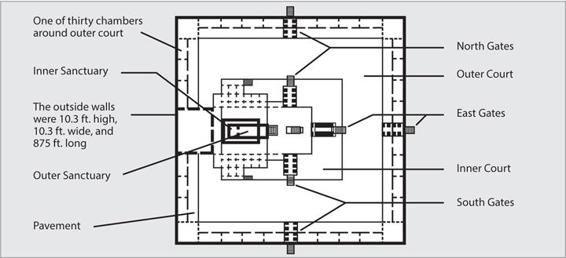
41:5-11. Surrounding the temple were side chambers built three stories high, one above another … thirty rooms in each story. These rooms got wider with each successive story. These 90 rooms were probably storerooms for the temple equipment and storage chambers for the people’s tithes and offerings (cf. Mal 3:8-10). These rooms were similar to those in Solomon’s temple (cf. 1Kg 6:5-10).
41:12-15. Ezekiel recorded the overall dimensions of the temple building. It was a hundred cubits long, and the width of the front of the temple and adjoining courtyard was 100 cubits, about 175 feet (vv. 13-14). A cubit represented the length of a forearm, from elbow to fingertips. So it varied by person and among ancient civilizations, anywhere from 17.5 to 21 inches. While 18 inches is commonly used for conversions, the context of Ezekiel uses a long cubit, “a cubit and a handbreadth,” or 21 inches (40:5; see comment there).
Immediately west of the temple was a structure described as the building that was in front of the separate area facing the temple courtyard on the west side (v. 12). It measured a width of seventy cubits (122.5 feet) and a length of ninety cubits (157.5 feet). The function of this building, however, is not explained.
41:16-20. The interior of the temple building was surrounded by latticed windows and paneled with wood. It was decorated with cherubim and palm trees carved into the wood. Each cherub had two faces … a man’s face … and a young lion’s face (cf. 1:10; 10:14). Perhaps cherubim represent the guardians of God’s dwelling place (cf. 1:4-28; 10), and the palm trees (40:16; 41:25-26; 1Kg 6:29) represent the fruitfulness and blessing provided by God.
41:21-22. The only furniture described in the temple is the altar of wood, three cubits by two cubits (5 1/4 feet by 3 ½ feet), called the table that is before the LORD. There was a large altar outside the temple proper for sacrifice (cf. 43:13-17), and this smaller one just outside the most holy place. If it served the same purpose as the furnishing in Solomon’s temple it would hold the bread of the Presence (Ex 25:30; Lv 24:5-9) or perhaps be the altar of incense (cf. Ex 25:23; 30:1-2). However, Ezekiel does not indicate the purpose of this altar … of wood.
41:23-26. The main area of the temple, the nave and the sanctuary … each had a double door that led to the outer sanctuary of the temple and to the Holy of Holies. This was something like a bifold door, made of two swinging leaves. As with the temple, the doors to the outer sanctuary had cherubim and palm trees … carved on them (cf. vv. 16-20).
e. Chambers in the Inner Court of the Temple (42:1-14)
42:1-12. Then the angelic being brought Ezekiel to the outer court to see several chamber[s] for use by the priests opposite the separate area (cf. v. 2). This complex of rooms three stories high was connected with the inner court with entrances from the outer court. There were two buildings on the north side with a common corridor 10 cubits wide (17 ½ feet). An identical group of rooms was on the temple’s south side. Similar rooms are not described in Solomon’s temple (1Kg 6).
42:13-14. The north and the south chambers were holy chambers. They were used by the priests who are near to the LORD as a room where they could eat the most holy things. According to the Mosaic law the priests received a portion of certain offerings (Lv 2:3; 6:16, 26-30; 7:7-10). This is a similar provision for the millennial priesthood. These chambers will also serve as dressing rooms and storage rooms for the holy … garments the priests wore. Mosaic law specified garments to be worn by the priests when ministering before the Lord (Ex 39:1-31; 40:12-16; Lv 8:1-13). This room will serve a similar purpose in the millennial temple.
f. Outer Walls of the Temple (42:15-20)
42:15-20. After the measuring of the inner house, the external dimensions of the temple were measured … all around. The complex was a square measuring 500 cubits (875 feet) on each side. The total area of this temple complex was 765,625 square feet—larger than 13 football fields. This is much larger than the area of Solomon’s and Zerubbabel’s temples. Around the temple on all four sides will be a wall … to divide between the holy and the profane (cf. 40:5).
g. Return of the Lord’s Glory (43:1-12)
43:1-4. Earlier Ezekiel had seen the glory of the Lord departing (11:22-23). Now, he saw the glory of the God of Israel returning by the way of the gate facing … east, to dwell once again in His temple with His people. The temple had been prepared for the Lord’s return, and the real significance of the millennial age rests on His presence. His voice was like the sound of many waters (cf. Rv 1:15; 14:2) indicating His power and majesty.
43:5. Then the Spirit lifted Ezekiel up (cf. 3:14; 8:3; 11:1, 24; 37:1) and brought him into the inner court in front of the temple and the glory of the LORD filled the house (the temple). Throughout the book it is clear the glory of the Lord was active (3:23; 9:3; 10:4, 18) but here the Lord is manifest specifically in the temple where He will reside during the millennial kingdom.
43:6-8. Now Ezekiel heard one speaking to [him] from the house (the temple). This speaker was distinct from Ezekiel’s angelic guide who was still standing beside [him]. The one speaking from the temple was the Lord Himself. He is identified by the personal pronouns: this is the place of My throne (cf. Is 6:1; Jr 3:17) and the place of the soles of My feet (cf. 1Ch 28:2; Pss 99:5; 132:7; Is 60:13), where I will dwell among the sons of Israel forever (Ezk 43:7, 9; Ps 132:13-14). Using these anthropomorphic images, the Lord declared this temple to be His earthly dwelling place among His people, until the establishment of the new heaven and the new earth (cf. Rv 21:22). Israel would never again defile His holy name (cf. Ezk 20:39; 39:7) by the harlotry of idol worship, spiritual adultery, and religious prostitution in the temple (2Kg 23:4-20).
43:9. Israel will never again defile the temple area with graves of the corpses of their kings. Some of the royal sepulchers of the 14 kings of Judah were separated from the temple by only a wall (2Kg 23:30). Although the glory of the Lord had departed from the temple in Ezekiel’s day (cf. Ezk 10:18), God promised that in the future, I will dwell among them forever.
43:10-12. The angelic being (cf. 40:3) told Ezekiel to describe the temple to the house of Israel so Israel would be ashamed of their iniquities. A clear vision of God’s future plan would remind them of the sins that had led to the destruction of the temple by Babylon. Then they would be motivated to return to God and rebuild the temple—faithfully according to His exact measure, plan, and whole design.
The entire area on the top of the mountain … shall be most holy; the whole area of the temple was sacred (cf. 41:4; 45:3; 48:12). The law of the house, the temple, included all of the details of the design given in chaps. 40–42.
h. Altar of Burnt Offering (43:13-27)
Daily services will begin when the millennial temple is built and the glory of the Lord returns there. Just as the building had specific measurements, Ezekiel was given a specific description of the altar (vv. 13-17) and regulations for consecrating it (vv. 18-27).
43:13-17. The altar will be in front of the temple (40:47), and the measurements of the altar in long cubits (cf. 40:4) are larger (17 1/2 feet) than those of the altar in the Solomonic temple, which was about 15 feet using the standard cubit (2Ch 3:3; 4:1). The altar was to be twelve cubits square (about 21 feet) with four horns, which was typical of Israel’s altars (cf. Ex 29:12; Ps 118:27). It would be reached by a flight of steps that face the east. Although such steps were forbidden in the Levitical temple (Ex 20:26), they are required in the millennial altar because of the height of the altar. This altar is for animal sacrifice (cf. comments regarding millennial animal sacrifice on Ezk 40:38-43).
43:18-26. The consecration of this altar will take place in a ceremony lasting seven days, and must be performed by the Levitical priest from the family of Zadok (cf. 40:46; comments on 44:15-19). This consecration service will be similar in some ways to the services followed by Moses (Ex 40:10, 29) and Solomon (2Ch 7:8-9) to sanctify the tabernacle and the temple. There will be seven days of offering sacrificial animals without blemish—of bulls, goats, and rams as burnt offerings (Ex 29:18) and sin offerings (Lv 4) to make atonement for the altar and purify it, and thus consecrate it. The priests shall throw salt on them (Lv 2:13) as a sign of the covenant of God.
43:27. From the eighth day and onward the priests will present the people’s burnt offerings … and … peace offerings on the altar. This process will mark the full resumption of God’s fellowship with His people, as then God will accept them. These sacrifices will remind the Israelites of the atonement Messiah Jesus provided to give access to the Father (Heb 10:19-25).
Many questions arise related to the efficacy of these millennial sacrifices in the face of Jesus’ atoning death. Critics of the view espoused in this commentary argue that a return to such sacrifices would be needless or blasphemous, and would detract from the work of Christ (see comments introducing chaps. 40-48). Of the various offerings in chaps. 40–48 (the burnt offering, 45:15, 17, 20; the grain offering, 42:14; 44:29; the peace offering, 43:27; the sin offering, 40:39; 42:13; and the reparation offering, 40:39; 44:29), only the burnt offerings were said to atone for the sins of people (see 45:15, 20). The altar could be “atoned” for as well (vv. 20, 26), but there the sense of the verb “atone” carries the common nuance of “wiping” or “cleansing,” and refers to the purification of the altar so it is fit for use before God. For the relationship between animal sacrifices in the law of Moses and salvation in the OT, see comments on Heb 10:1-18.
Some of those who assert that there will be a millennial temple maintain that the sacrifices that take place there will be largely commemorative of the perfect work of Jesus, much as the celebration of the Lord’s Table is today (see comments on 1Co 11:23-26; and for more on the efficacy of the millennial sacrifices, see comments on Ezk 43:13-17). The early Christians apparently had no problem with going to, worshiping in, and sacrificing at the temple for years following the death and resurrection of the Lord (see Lk 24:53; Ac 3:1; 21:26). They could hardly be accused of distracting or detracting from Jesus’ work. This view is possibly the correct one, but nowhere does Ezekiel make it explicit that the atoning sacrifices in Ezk 45:15 are memorial sacrifices. Instead it appears that they have some level of atoning significance (see 45:15).
Several observations may help in getting at Ezekiel’s meaning in its canonical context. The obvious differences between Ezekiel’s description and the Mosaic covenant indicate that this is not simply a return to the Mosaic covenant. Some of these differences include: The priests were to wear splendid clothes, including dyed cloth of some sort and fine linen with gold threads (Ex 28), while the priests in Ezekiel’s temple were to wear plain linen (Ezr 44:17-19). In the Mosaic covenant, the tabernacle (and later the temple) contained the ark of the covenant, the lampstand, the anointing oil, and the table of the bread of the Presence (see Ex 25), but all of these are missing from the future temple. According to Nm 28:11, the new moon offerings included two bulls, one ram, and seven male lambs, but the book of Ezekiel records one bull, six sheep, and one ram (Ezk 46:6-7). Plainly, Ezekiel is not recording a mere revival of the law of Moses.
Perhaps the best explanation of the sacrifices in chap. 45 is to be found in its parallels with the animal sacrifices for atonement in the law. There are several items to consider.
First, sacrifices, and any deed prescribed by the law, were repugnant to God without the proper attitude. These sacrifices did not save the individual, even if he or she were sincere, since the ceremonial aspects of the law saved no one (see Rm 3:20). But when one trusted in the God of Israel as Abraham did (Gn 15:6), that believer was counted righteous. The offerings of sacrifices were to flow from the life of one rightly related to God by faith, but were not the means of that saving relationship. God said that He would cleanse the believing offerer from his sin when he brought the required sacrifices. Yet, without the heart attitude of trust and repentance (see “humbling one’s soul”—or better “afflicting one’s soul”—in Lv 16:29, 31), the sacrifices meant nothing at best, and at worst were repugnant to God (see Pss 40:6-10; 51:10-18; Is 1:11-15; Mc 6:6-8). The one who offered the sacrifice did not thereby earn God’s favor.
Second, the saved OT believer needed periodic cleansing from sin, just as a NT believer does, and God determined in the OT that the means for this cleansing was through the believer making animal sacrifices. Those sacrifices offered by one who believed resulted in forgiveness by God (see Lv 1:4; 4:26-31; 16:20-22; 17:11; see also, for the general idea of forgiveness without the explicit mention of sacrifices, Pss 25, 32, 51, 103, 130; Is 1:18; Ezk 18:22).
Third, Heb 10 indicates that sacrifices “can never … make perfect” (Heb 10:1), do not cleanse from the consciousness of sin (Heb 10:2), and can never “take away sins” (Heb 10:4, 11). Only the sacrificial death of the Messiah can do this (Heb 10:10-12). Yet Lv 1:4; 4:26-31; 16:20-22, and other passages assign an “atoning” result to sacrifices. How can this be? The answer comes by recognizing that atonement functioned on two levels—the subjective human level and the objective divine level. The OT believer who offered sacrifices or celebrated the Day of Atonement had every reason to feel forgiven subjectively. His sins were “covered,” but they were not exactly “expiated.” However, on the objective, Godward side of it, full forgiveness was not objectively obtained until the death of Jesus.
Fourth, for the OT believer, the outworking of faith included the offering of sacrifices in reliance upon God, who said that the believing offerer would be forgiven. John S. Feinberg writes,
“Performing substitutionary and expiatory sacrifices seems to be more involved with cleansing the sin of a believer than with bringing a person to salvation. Job, when he offered a sacrifice for cleansing (Job 42:7-9), was obviously saved at the time he gave the sacrifice…. A comparison of sanctification in the Old and New Testaments would show that when the NT believer sins, in order to restore fellowship with the Lord [note, restore fellowship, not salvation] he must receive cleansing from the sin. In order to continue to grow, he must confess his sin in faith, believing that on the basis of Christ’s sacrifice God will cleanse him from sin (1Jn 1:9). The OT believer also confessed his sin, but in addition, he brought in faith a sacrifice, believing that God had revealed that sin would be handled in that way. Before Christ’s sacrifice, the public offering had to accompany the repentance of the believer. Once the all-sufficient sacrifice of Christ had been made, the repentant believer need not give another sacrifice to have cleansing” (John S. Feinberger, “Salvation in the Old Testament,” in Tradition and Testament: Essays in Honor of Charles Lee Feinberg, ed. John S. Feinberg and Paul D. Feinberg [Chicago: Moody, 1981], 69–70).
Rather than the act of offering a sacrifice saving an OT believer, it functioned to impress upon him his profound need for something (or Someone) else to atone for his sin.
Fifth, another prominent feature of animal sacrifices in both the OT and NT was the ritual and physical purification they brought (see Heb 9:13, they “sanctify for the cleansing of the flesh,” i.e., one’s body, not one’s fallen nature). Specifically, being cleansed by water mixed with the ashes of the red heifer would ceremonially cleanse one’s physical body if he had contacted a corpse (see Nm 19:13, 20). Otherwise the physical filth remained, one was excluded from the company of his fellow Jews and could not participate in worship, and its corrupting effect continued. But this was a ceremonial cleansing only, not a saving one (see Rm 3:20—no one is saved by the works of the law).
Finally, in attempting to apply this to Ezk 45:15, it would be difficult to assign a different meaning to the word “atonement” from what is implied in other OT uses (see Lv 1:4; 4:26-31; 16:20-22; 17:11) and in light of Heb 9:13 and 10:4, 11. Namely, for the Jewish believer alive during the millennial kingdom, salvation is by faith in the finished work of Christ. The sacrifices performed in faith at that time will provide a subjective experience of forgiveness for sins, a forgiveness ultimately purchased by the death of Christ, and will provide cleansing, whereby fellowship—not salvation—with God is restored, much as the OT sacrifices did for one who had the faith of Abraham.
2. A New Service of Worship (44:1–46:24)
Following the descriptions of the millennial temple and the altar, the Lord described the holy standards in Israel’s future worship and He challenged the people in exile to reevaluate their present worship practices (chap. 44). He described the millennial allotment of land (45:1-12) and gave details about the millennial offerings (45:13–46:24).
a. The Temple Ministers (44:1-31)
44:1-2. Ezekiel was led out of the inner court to the gate … which faces east; and it was shut. This outer gate of the sanctuary opened toward the Kidron Valley and the Mount of Olives. Ezekiel had just seen the Lord enter it on His return to His temple from this direction (43:1-4). God’s presence had sanctified the gate. Therefore, This gate shall be shut; it shall not be opened, and no one shall enter by it, for the LORD God of Israel has entered by it; therefore it shall be shut (declared twice for emphases). No one will be allowed to tread through the gate which God Himself had entered.
Some mystery and superstition have arisen from this passage. The “Golden Gate” of the present walls of Jerusalem has been identified as this gate. However, this sealed eastern gate is not Ezekiel’s gate because it is a much later gate. The current wall was built in the seventh century AD on ancient foundations and then repaired by the sultan, Suleiman (AD 1520–1566). Based on this Ezekiel text, there is a Jewish tradition that Messiah will enter Jerusalem via the eastern gate, so Suleiman sealed this gate and built a Muslim cemetery in front of it to keep Messiah out of Jerusalem. Furthermore, the dimensions of the present “Golden Gate” do not correspond with Ezekiel’s gate. This gate in Jerusalem’s ancient walls is a beautiful gate, and a good reminder that Messiah will return. It is just not the gate spoken of by Ezekiel.
44:3. Only the prince … shall sit in the gate and be allowed to enter by way of the porch of the gate and … go out … the same way. Although the gate will be shut, the area of the gate will be used by the prince (Hb. word nasi would be best translated “leader” cf. 34:23-24). This leader will sit in the gate, a place of rendering judgments or settling affairs (cf. Jos 20:4; Ru 4:1). Some suggest this prince is the Messiah. However, evidence is to the contrary. This prince/leader is not the Messiah because this leader made a sin offering for himself (cf. Ezk 45:22), an act that would be unnecessary for the sinless Messiah (cf. Heb 4:15). Further, this prince/leader has natural children (Ezk 46:16), another impossibility for the God-Man, Messiah Jesus. He will have a special portion of the land allotted to him (cf. 45:7-8; 46:18; 48:21-22), whereas all the land belongs to King Messiah. Although some have suggested this prince is a resurrected David, there is little in the text to corroborate this idea. More likely, this prince will be Messiah’s representative in a unique sense, and will have the privilege to eat bread before the LORD, possibly referring to the fellowship offerings that the worshipers will eat after offering them to the Lord (cf. Lv 7:15-21).
44:4-5. Ezekiel was brought back … by way of the north gate, the gate most often used by Ezekiel in this vision and the one designated for use by the priests who have charge of the temple (40:44-45), to the front of the house, the temple.
Here Ezekiel saw the glory of the LORD as it filled the house of the LORD (cf. comments on 1:28) and his response was the response of everyone who sees the Lord: he fell on his face in worship and awe. The LORD said to Ezekiel to pay careful attention, mark well (lit., “set your heart on” used twice) His instruction concerning all (used three times) the statutes … laws … entrance … and exits of the sanctuary.
44:6. In the past Israel failed to take the worship and service of the Lord seriously. The Lord gave specific instructions to correct rebellious ones of the house of Israel (cf. 2:5-6, 8; 3:9, 26-27; 12:3, 9, 25; 17:12; 24:3). The Lord GOD (cf. comments on the significance 2:3-4) declared, Enough of all your abominations, thus highlighting the sins involving His temple, and demanded holiness from His people and respect for His sanctuary.
44:7-9. One of Israel’s sins regarding the temple was allowing pagans, foreigners, uncircumcised in heart and uncircumcised in flesh into My sanctuary. This does not mean non-Jews were excluded from sincerely worshiping the God of Israel with the people of Israel (Nm 9:14; 15:14-16; Is 56:7). Israel’s abominations included bringing pagans who did not worship the God of Israel into the temple and even giving them charge of the sanctuary. When the Jewish people returned from Babylonian captivity the leadership was vigilant not to allow pagans to participate in temple worship (cf. Ezr 4:1-3; Neh 13:1-9; Ac 21:27-32).
44:10. The Levites were the descendants of Levi, one of Jacob’s 12 sons (Gn 29:34). Moses and Aaron were Levites, (cf. Ex 2:1–4:14). After the exodus, the Levites were responsible for caring for, and service in, the sanctuary (Nm 3:1-28; 1Ch 23:24-32). Aaron and his sons were given the duty of priests (Ex 28:1). All priests were Levites, but not all Levites were priests. During the monarchy, especially in the decades prior to the fall of Jerusalem, the Levites … went far from the Lord, went astray with Israel worshiping idols (e.g., 1Kg 18; Jr 2:8; 5:3; Ezk 22:26), and led the nation away from God. They deserved punishment for their iniquity.
44:11-14. The Levites should have been spiritual leaders for the house of Israel, but instead they became a stumbling block of iniquity. So in the future not all of them will serve as a priest … nor come near to any of God’s holy things. Yet, in the kingdom they will be allowed to serve as gatekeepers, to keep charge of the house, the temple buildings, and do all its service, such as slayers of the sacrifices, and assisting worshipers.
44:15-16. The Levitical priests, the sons of Zadok, remained faithful to the Lord, when many of the Levites went astray. Zadok was appointed chief priest during Solomon’s reign (cf. 1Kg 1:32-35; 2:26-27, 35) and His sons became one branch of the Levitical priesthood. So in the kingdom, they are to offer sacrifices, and they alone shall enter My sanctuary, and minister there.
44:17-19. Several regulations and functions of the Zadokite priests were similar to the Mosaic laws governing the priests. The priestly garments were to be made of linen, the primary clothing of the priests (cf. Ex 28:39-41), rather than the more common fabric made of wool. Linen is lighter than wool, and the priests were not allowed to wear anything which makes them sweat. Before the priests could go out … into the outer court to the people, they needed to change from the garments they wore while ministering. The Levitical concept of transmitting holiness was that contact with holy objects temporarily set that person apart to be subject to its restriction and disqualified from the ordinary tasks of life (cf. Ex 29:37; 30:29; Lv 6:11, 27). However, Haggai demonstrated that such holy objects only consecrate that which they have touched and nothing else (Hg 2:12). Thus holiness could not be transferred to the third party (although defilement could be spread). The Zadokites’ clothing change demonstrated to the people the distinction between the holy and the ordinary (common or profane) and would keep the common people from the responsibilities of the priesthood.
44:20-23. Every aspect of life was specified for these priests. They must not shave their heads or let their locks grow long. Completely shaving one’s head or letting one’s hair go unkempt were signs of mourning (cf. Lv 10:6; 21:5, 10). They were not allowed to drink wine when they enter[ed] the inner court, that is, when ministering, lest they become drunk and not perform their duties properly (cf. Lv 10:8-9). Also restrictions were placed on whom they could marry (cf. Lv 21:7, 13-15). These restrictions and actions were designed to teach My people the difference between the holy and the profane … to discern between the unclean and the clean.
44:24. The priests were to settle a dispute and to judge it according to God’s ordinances (cf. 2Ch 19:8-11). They were to be examples in keeping God’s laws … statutes … and all of His appointed feasts and sanctify My sabbaths. In the Kingdom everyone who follows the Lord will keep these appointed feasts (Lv 23:2, 4, 44).
44:25-27. The priests were to avoid ritual defilement by not going near a dead person (cf. Lv 21:1-4), unless a close relative, but then the priest would have to wait seven days and then offer a sin offering for himself before reentering the temple service. Although death will be uncommon during the millennium (cf. Is 65:20), provision was made for those instances when it will occur.
44:28. The Lord Himself is the inheritance of the priests (cf. Nm 18:20; Dt 10:9), so they would not be given land in Israel except the allotment surrounding the temple (cf. Ezk 45:4). They would have no other possession in Israel—because the Lord is their possession (Jos 13:14, 33; 18:7).
44:29-31. God will take care of those who minister before Him (cf. Dt 18:1-5). Their food will come from the grain and meat from the sin and guilt offerings, along with the first fruits and dough offered by the people in temple sacrifice. This would be a provision for the priests who received it as their allotment, and a blessing for the people. The reasons they will be blessed are manifold: in giving, they are being obedient to the Lord, they are being sacrificial, and they are providing for those who minister to relieve the ministers of concern for earning their own food. This blessing of provision is available today as believers support those who serve the Lord vocationally.
b. Land Allotment for the Temple and Priests (45:1-8)
45:1-4. The Lord gave specific instruction about the division of the land in Israel. There is to be a land allotment to the LORD, a holy portion of the land. This sacred district is 25,000 cubits (about 8.3 miles) long and 20,000 cubits (about 6.6miles) wide (cf. 40:5 concerning cubits). Within this area will be the sanctuary (temple) complex described in chaps. 40–43.
This rectangle of land will be divided into two equal portions, each about 8.3 miles long and about 3.3 miles wide. The first portion will be allotted to the priests … for their houses and a holy place for the sanctuary.
45:5-6. Another portion will be allotted to the Levites who serve in the temple as their possession cities to dwell in. Instead of being scattered throughout Israel, as they were in the biblical period of Joshua (Jos 21:1-42), the priests and Levites will reside near their place of ministry.
Jerusalem, the city, will be 5,000 cubits wide (about 1.7 miles) and 25,000 cubits long (about 8.5 miles), adjoining the holy portion. This area will include the urban area, grazing land, and farmland (cf. Ezk 48:15-18).
The entire square of land, about 8.5 miles on each side, will be located at the present site of Jerusalem. A band of land will extend from Jerusalem to the east and west. The holy city will be for the whole house of Israel, all the Jewish people, whether they live there or not. Although all Israel will not necessarily live there, Jerusalem will be their undisputed capital and their central area of worship.
45:7-8. The prince (cf. comments on 44:1-3) will have the land adjacent to the holy allotment and the property of the city. This strip of land will extend on the east to the Jordan River and on the west to the Mediterranean Sea, an area easily visualized in modern Israel. Thus, the prince will have easy access to the future sanctuary.
c. Warning to Jewish Leaders Living in Babylon (45:9-12)
45:9-12. This section shifts back to the Lord’s admonition to the captives living in Babylon. These princes (leaders, cf. 44:3) of Israel, living in Babylonian exile, were admonished to repent: Enough … put away violence and destruction (cf. 44:6). They must not disregard the rights of those they were to protect (cf. 19:1-9; 22:25; 34:1-10). They must practice justice and righteousness, as exemplified by interpersonal relationships and just commerce. The passage is a detailed description of accurate weights and measures: correct balances for weight, an accurate ephah (bushel) for dry goods, and bath (six gallons) for liquid measurements. From the standard of the large homer (fifty gallons or six bushels) down to the tiny gerahs (Israel’s smallest unit of weight, just sixteen barley grains), God always demands honesty at every level (Lv 19:35-37; Dt 25:13-16; Pr 11:1; 16:11; 20:10; Mc 6:10-12).
d. Offerings in the Temple (45:13–46:24)
After the admonishment of the Jewish leaders in Babylon to be honest in weights and measures, the focus returns to the millennial temple, where the future prince will use just weights to receive and offer gifts to God (45:13-17). This mention of offerings includes a brief description of the future sacrificial system (45:18–46:24), then a return to the subject of the division of the land.
45:13-17. The prescribed portion to be given for an offering is to be proportionate to each individual’s financial circumstance, as it was in the law (cf. Lv 5). They are each to give a sixth of an ephah from a homer of wheat … and barley, and a portion of (olive) oil (cf. vv. 9-12). They are also to offer one sheep from each flock of two hundred. The grains and animals were to be used for a grain offering, for a burnt offering and for peace offerings, to make atonement for them. This tithe or tax will be required of all the people for use by the prince in Israel (see comments on 44:1-3). As the people’s representative, he will collect their gifts and use them to maintain the temple sacrifices, including burnt offerings, the grain offerings and the drink offerings, at the feasts, on the new moons and on the sabbaths, at all the appointed feasts of the house of Israel (cf. comments on 40:38-43).
45:18-25. There are several calendars of Israel’s annual festivals (Ex 23:14-17; 34:18-24; Lv 23:1-44; Nm 28:11-31; 29:1-39; Dt 16:1-17), however, Ezekiel’s list of festivals does not exactly parallel any of them. The millennial festivals will include sacrifices to cleanse the sanctuary on the first day of the first of the month (vv. 18-20), as well as sacrifices for the Passover, feast of … unleavened bread (vv. 21-24), and the seven days of the feast of Booths on the seventh month, on the fifteenth day (v. 25). If someone sins unintentionally, goes astray or is naive, a second purification will be offered on the seventh day of the month (v. 20). This offering and ceremonial cleansing possibly will replace the Day of Atonement on the seventh month (Lv 23:26-32). The prince will provide for himself and all the people … a bull for a sin offering, indicating he is an important person, but he is not the sinless Messiah (Ezk 45:22-24).
Ezekiel’s omission of Israel’s other national feasts, the Feast of Pentecost, the Feast of Trumpets, and the Day of Atonement, is a puzzle. There are two possible explanations for the differences.
First, perhaps the omissions signaled a change in God’s program for Israel. The inauguration of the new covenant and the fulfillment of Israel’s kingdom promises may render those three feasts (Pentecost, Trumpets and Day of Atonement) unnecessary. Thus only three of the six annual feasts under the Levitical system (cf. Lv 23:4-44) will be followed, two feasts celebrating national redemption (Passover and Unleavened Bread combined as one feast, as was the custom by the NT period), which will point back to Messiah’s death, and the Feast of Booths (Tabernacles), which will symbolize the Lord dwelling with His people (see comments at Zch 14:16-19).
Second, and perhaps more likely, Ezekiel’s list is a merism, a literary structure that mentions the first and the last in a sequence to include everything in between. By naming the first of Israel’s appointed feasts (Passover and Unleavened Bread) and the last one (Booths), Ezekiel could be implying that all Israel’s feasts would be reinstituted.
46:1-11. The Lord gave specific directions about the daily worship as well. The gate of the inner court facing east will be closed the six working days of the week, but opened on the sabbath day and on the day of the new moon. The prince will be allowed to stand by the post of the gate during these days when the sacrifice he brought on behalf of the people will be offered (cf. 44:3). He will also provide the sacrifices for the people on the sabbaths and new moons as well as on the major feast days.
The worshipers at the temple are given instructions about how to assemble before the Lord at the appointed feasts. There is no entrance to the temple on the west, and the east gate will be permanently shut (cf. 44:1-2). To avoid turmoil, the worshipers will follow predesignated routes in the temple so that whoever enters by the north gate to worship is to go out the south gate, and whoever enters by the south gate is to go out the north gate. God is a God of order, and He wants orderliness to prevail in worship.
46:12-15. When the prince (see comments on 44:1-3) makes a freewill offering to the LORD … the gate facing east is to be opened for him. The regulation concerning the closing of the east gate to the inner court (cf. 44:1-2) will be suspended for this special offering. But after the prince leaves, the gate shall be shut after he goes out. The morning sacrifice is mentioned, but the evening sacrifice (cf. Ex 29:38-41; Nm 28:3-4) is not mentioned. Ezekiel was giving only the highlights of the sacrificial system and assumed that his readers would apply the same regulations to the evening sacrifice, although no explanation of the omission is given.
46:16. The prince can give a gift out of his inheritance to any of his sons, and it will be their possession by inheritance. This is another confirmation that the prince is not the Messiah since he is a human being who fathers children, and not the divine Messiah Jesus (cf. comments on 44:1-3).
46:17. The year of liberty is probably a reference to the year of Jubilee on the Levitical calendar. Every 50 years property in Israel that had been sold or given outside the family was to revert to its original owners (see comments on Lv 25:8-15). A gift made to a servant will not be permanent to future generations of his family, but it shall be his until the year of liberty; then it shall return to the prince. His inheritance shall be only his sons. The land belongs to God and He will apportion it to Israel, by tribal units, as His stewards. This regulation assures that no one individual will gain permanent control of the land, nor will it be lost to its rightful owners.
46:18. The prince will not take any land outside his allotted inheritance from the people’s inheritance. In contrast with evil princes in Ezekiel’s day (45:8-9), the godly prince will not oppress the people or take their property, so that My people will not be scattered, anyone from his possession.
46:19-24. Next, the angelic guide brought Ezekiel into holy chambers where the priests shall boil the guilt offering and the sin offering and … bake the grain offering. The food is to br prepared within the temple area and not taken out … to transmit holiness to the people (cf. comments on Hg 2:12). This is the kitchen of the temple complex, the area that faced north … at the extreme rear toward the west, where the priests will prepare food from the sacrifices. When the people offer fellowship offerings to the Lord, they will be allowed to eat part of the sacrifice in a fellowship meal (cf. Lv 7:15-18). Evidently at these four corners of the court the priests will cook the food used in the sacrifices. Thus, activities in the temple will include fellowship meals as well as sacrificial worship.
3. A New Land (47:1–48:35)
a. The River from the Temple (47:1-12)
During the millennium there will be a change in the topography of Israel when the millennial temple will be the source of life-giving “water.” There is nothing in the passage to suggest anything other than a literal river, even though many think this refers only symbolically to the blessings that flow from God’s presence. The inclusion of details such as the “fishermen” (v. 10) and the salty “swamps” and “marshes” (v. 11) indicate realism, not allegory. These details become meaningless if the passage is only symbolic of spiritual blessing. In the millennium this river will be another visible reminder of God’s presence and blessing, as the prophets foretold (cf. vv. 1-2; Jl 3:18; Zch 14:8).
47:1-2. Ezekiel was brought … back to the entrance of the door of the house (temple). There he saw water flowing from under the threshold of the house toward the east. This stream, flowing out from God’s presence, went eastward and passed south of the altar. Ezekiel left the temple complex through the north gate and saw the water … trickling out of the temple on the south side into the Kidron Valley. According to Zechariah, the water flowing from Jerusalem will divide into two branches, with half flowing east toward the Dead Sea and half flowing west toward the Mediterranean (Zch 14:8). Ezekiel followed only the branch that went toward the east.
47:3-6. The angelic man went out toward the east and measured the water. He led Ezekiel through the water and measured it becoming deeper and deeper. After a thousand cubits (1,750 feet or 1/3 mile) the water … was ankle deep; in another thousand cubits the river was knee deep. The angel measured another thousand cubits (now a mile from the temple), and the water reached Ezekiel’s loins. A fourth measurement of a thousand cubits farther to the east revealed that the water had risen and was deep enough to swim in and so deep that it was too wide to cross, it could not be forded. The trickle that flowed from the temple had now become a powerful river.
47:7-8. On the bank of this river were very many trees on both sides. This river will begin at the temple and flow toward the eastern region, continuing into the Arabah … toward the (Dead) sea. The Arabah is the Jordan Valley running south from the Sea of Galilee to the Dead Sea and ultimately to the Gulf of Aqaba at the far northern end of the Red Sea. The Dead Sea is the lowest and saltiest body of water on earth, six times saltier than the oceans, and consequently cannot sustain life, but this will be changed in the millennium. As this river enters the Dead Sea, the salt waters will become fresh, truly a miracle of God. This now-lifeless body of water will then support life.
47:9-10. Plants and fish will thrive, so everything will live where the river goes. Now the salt and mineral content of the Dead Sea is so intense no fish can survive there, but in the future fishermen will stand on its shores from En Gedi to Eneglaim, oases areas near the Dead Sea (Jos 15:62; 1Sm 23:29; Sg 1:14), spreading their fishing nets. They will catch many kinds of fish, like the fish of the Great Sea (the Mediterranean).
47:11-12. Although the Dead Sea will become fresh, the swamps and marshes around it will not become fresh; they will be left for salt to supply this essential mineral for the needs of the people and the animals in Israel.
There will be all kinds of trees on the riverbanks of this freshwater sea. Their leaves will not wither and their fruit will not fail. They will bear fruit year-round. They will be watered from the sanctuary, so the trees will provide fruit for food, and their leaves will be medicinal, providing healing. It is likely they will have divinely supernatural medicinal qualities so that people will live long in the millennium (cf. Is 65:20).
b. Boundaries of the Land (47:13-23)
47:13-14. The land of Israel was given by God to Abraham and his descendants (Gn 13:14-17; 15:17-21). During the millennial kingdom the land will be divided among the twelve tribes of Israel (cf. Nm 34; Jos 13). The Levites will not have a portion in the land, but instead be given territory in the sacred district (cf. Ezk 45:4), and Joseph shall have two portions, one for Ephraim and Manasseh (Gn 48:17-20; Ezk 48:4-5). It was given to the Jewish people as an unconditional covenant promise that will never be rescinded. Israel’s experience of blessing in the land was conditioned on her obedience to the law of Moses (Dt 28), and disobedience to the Lord had serious consequences. When Israel recognizes the Messiah and begins to experience the fullness of the blessings of the new covenant during the Messianic kingdom, she will be restored to her place of blessing in the land (cf. Ezk 36–37). For I swore to give it to your forefathers (cf. Gn 12:1; 15:9-21; 26:2-4; 28:13-15), and this land shall fall to you as an inheritance.
47:15-17. The boundary of the land on the north will run east from the Great Sea, the Mediterranean, starting somewhere north of Tyre and Sidon by the Hethlon road past Lebo-Hamath to Hazar-enan at the border of Damascus. So the northern border will stretch east from the Mediterranean Sea north to include what was then the northern border of Syria.
47:18. The east side of Israel will extend between Hauran and Damascus. The edge of Israel’s territory will arch back from Hazar-enan along the southern border of Syria till it reaches the Jordan River south of the Sea of Galilee. From there it will go along the Jordan between Gilead and the land of Israel. The eastern border here shall be the Jordan river to the eastern sea, the Dead Sea. (See the map of “The Tribes of Israel in the Millennial Kingdom” on p. 1276).
47:19. The south side will extend from Tamar to the waters of Meribath-kadesh to the brook of Egypt (Wadi el-Arish, the wadi of Egypt, Nm 34:5) toward the Great Sea (Mediterranean Sea). Kadesh-barnea is the more familiar name of Meribath-kadesh, a district about 50 miles south of Beersheba. It is the area from which the 12 spies departed to investigate the promised land after the exodus. It was the border marker into the land of Israel at that point (Nm 13:25-26; 27:14; 34:4). The brook of Egypt is not the Nile river, because the Jewish people did not enter the promised land when they crossed the Nile at the exodus, but the spies crossed this brook when they went from Kadesh-barnea to spy out the land. The brook of Egypt (“of Egypt” is not in the Hb. but has been erroneously supplied by translators) is the Wadi el-Arish, a deeply cut streambed on the northeast side of the Sinai Peninsula that flows toward the northwest into the Mediterranean. It is about 50 miles south of Gaza and marked the southernmost extremity of Solomon’s kingdom (1Kg 8:65).
The Tribes of Israel in the Millennial Kingdom
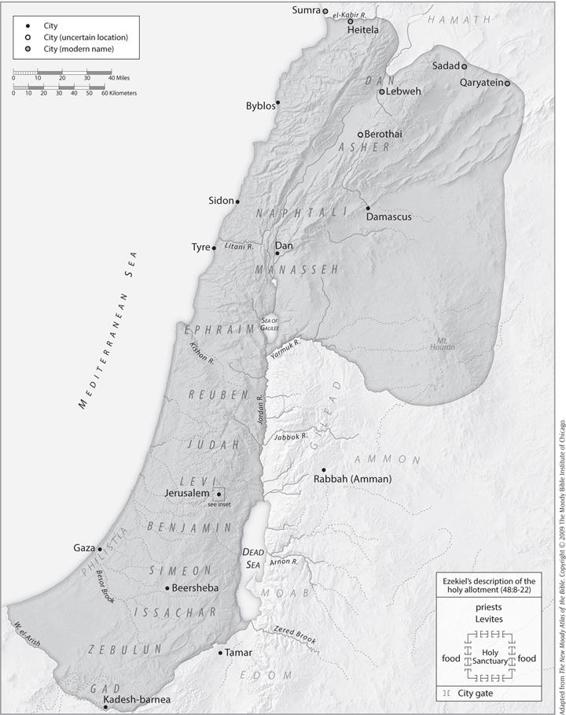
47:20. The west side boundary will be the Great Sea from the south border to Lebo-hamath. The western border of Israel is the Mediterranean, from the shoreline of the Wadi el-Arish in the south to the point opposite Lebo-hamath in the north, an ancient city in Syria, beyond Damascus (cf. vv. 15-17).
47:21-23. The land will be divided among the tribes of Israel … by lot for an inheritance. There is also a stipulation for allotting land to resident aliens who want to associate with Israel. When these resident aliens have lived in the land, stayed in your midst, and had sons as part of the community, they shall be to you as the native-born among the sons of Israel and be given an inheritance within the tribe where they lived.
Though foreigners had always been allowed to live in Israel (cf. Lv 24:22; Nm 15:29), in the millennium they will be given other privileges previously limited to Israelites (cf. Is 56:3-8). Though the millennial age will be a time of blessing for Jewish followers of Messiah, Gentile followers of Messiah will also enjoy God’s blessing (cf. Is 9:2; Lk 2:32; Mt 25:31-46).
c. Division of the Land (48:1-29)
The division of the land is not exactly the same as in Joshua’s time (Jos 13–22). In the millennium the allotments will extend across the land in parallel tracts from east to west, and there will be no tribal allotment east of the Jordan. About a fifth of the whole land, in the center, is an allotment as a sacred area designated to Jerusalem, the sanctuary, and the prince. This allotment to the Lord will cause each tribe to have only about two-thirds of the territory given them under Joshua.
48:1-7. The division of the land into portions is described from the northern extremity to south, with the tribal allotment described from east to west: Dan … Asher … Naphtali … Manasseh … Ephraim … Reuben … Judah.
48:8-10. Next to the border of Judah, in the central part of the land, will be the allotment for the LORD. This holy allotment will have the sanctuary … in the middle and the land will be for the priests. The size (cf. comments on 45:1-8) is 25,000 cubits in length by 10,000 cubits in width. Since the sacred district area is given as 20,000 cubits wide in chap. 45, this may refer to a subdivision of the allotment for the sanctuary, or perhaps it is a scribal error; the LXX reads “20,000.”
48:11-14. The priests, the sons of Zadok (cf. 44:15), and the Levites will have property in this holy district and must not sell or exchange any of it, … for it is holy to the LORD.
48:15-20. Surrounding Jerusalem will be open land for common use, an area of 4,500 cubits (7,875 feet, about 1 ½ miles) on each side. There will be open spaces of land 250 cubits (437 ½ feet) wide, and an area 10,000 cubits (3.3 miles) long that will serve as pasture and farmland to produce food for the city. These areas must be set apart alongside the holy allotment.
48:21-22. Some of the central area around the holy allotment of the land is for the prince (see comments on 44:1-3). The holy allotment and the sanctuary will be in the middle of the land (cf. vv. 8-10). There will be property of the Levites, and of Jerusalem (the city) but everything between … Judah and Benjamin will be for the prince.
48:23-29. The remainder of the land will be divided among the rest of the tribes continuing from north to south: Benjamin … Simeon … Issachar… Zebulun … Gad.
d. Gates of the City (48:30-35)
48:30-31. After describing the city, the holy allotment and the land division, the book closes with a description of the gates, the exits of the city. Millennial Jerusalem will be enclosed with a wall and have 12 gates, three on each side, each one named for one of the 12 tribes of Israel, from the 12 sons of Jacob (cf. Gn 48). These names will also appear on the gates in the new Jerusalem (cf. Rv 21:10-12). The description confirms the significant role Jewish tribal identity will have in the kingdom. Each side of Jerusalem is 4,500 cubits long (7,875 feet, about 1½ miles; Ezk 48:30, 32, 34) with three gates on each side.
The three gates toward the north are Reuben, Judah, and Levi (cf. Gn 29:31-35).
48:32. The three gates on the east side are Joseph (cf. Gn 48:1), Benjamin (cf. Gn 30:22-24; 35:16-18), and Dan (cf. Gn 30:4-6). In the division of the land under Joshua, Joseph was given tribal identity through his sons Manasseh and Ephraim (Jos 16:1–17:18). Because Levi has a gate, the tribes of Manasseh and Ephraim are represented by their father, Joseph.
48:33. The gates on the south side are Simeon, Issachar, and Zebulun (cf. Gn 29:33; 30:17-20).
48:34. The gates on the west side are Gad, Asher (cf. Gn 30:9-13), and Naphtali (cf. Gn 30:7-8).
48:35. After describing the millennial Jerusalem and the new order of worship (chaps. 40–48), Ezekiel concluded with the most important aspect of the millennial city of Jerusalem, the glorious presence of the Lord. The glory of God had departed from Jerusalem as a prelude to its judgment (cf. chaps. 10–11). In the future, all Israel will recognize Jesus as their King Messiah (Zch 12:10; Rm 11:25-27) and will enjoy the Lord’s holy presence in the Messianic Age, worshiping Him forever. Jerusalem (“City of Peace,” Gn 3:18) has many identifying names in the Scriptures (e.g., Pss 48:2; 87:2; Is 1:26; 60:14; 62:4; Jr 2:17; 33:16; Zch 8:3), but in the kingdom, it will have a new name. The Lord will return to dwell in Jerusalem with His people, and The name of the city from that day shall be, The LORD is there. The name “Yahweh-Shammah” is a Hebrew wordplay on Yerushalayim (Jerusalem). The names sound similar, but “Yahweh-Shammah” represents the true character of Jerusalem’s restored relationship of the Lord with His people.
The book of Ezekiel opened with a dazzling vision of divine glory (chaps. 1–3). In light of the holiness of the Lord, Ezekiel prophesied the necessity of judgment against Judah and Jerusalem for their disobedience (chaps. 4–24). Then he announced the judgment on the Gentile nations for their moral corruption and international intrigues against God’s chosen people (chaps. 25–32). God’s faithfulness to His unconditional covenant with Abraham and the promise of the new covenant are brought into clear focus in Ezekiel’s message of the blessings and restoration of Israel (chaps. 33–39). Finally Ezekiel presented the glory and majesty of the Lord God’s sovereign rule and His absolute holiness in the details of the millennial kingdom, the temple, and new Jerusalem (chaps. 40–48).
The eschatological emphasis of the prophet anticipates God’s future work in world events and His faithfulness to His people Israel. Moreover, it challenges every person who loves the Lord to greater personal holiness and obedience to the King Messiah, who will one day rule from His throne in Jerusalem. The city will then be known as Adonai Shammah, “The Lord Is There!”
BIBLIOGRAPHY
Alexander, Ralph. Ezekiel. Everyman’s Bible Commentary. Chicago: Moody, 1976.
____________. “Ezekiel.” In The Expositor’s Bible Commentary, vol. 7, edited by Tremper Longman III and David Garland, 641–924. Grand Rapids, MI: Zondervan, 2010.
Block, Daniel. The Book of Ezekiel, Chapters 1-24. The New International Commentary on the Old Testament. Edited by Robert L. Hubbard, Jr. Grand Rapids, MI: Eerdmans, 1997.
____________. The Book of Ezekiel, Chapters 25-48. The New International Commentary on the Old Testament. Edited by Robert L. Hubbard, Jr. Grand Rapids, MI: Eerdmans, 1997.
Carpenter, Eugene and David L. Thompson. Ezekiel, Daniel. Cornerstone Biblical Commentary. Edited by Philip W. Comfort. Carol Stream, IL: Tyndale, 2010.
Cooke, G. A. A Critical and Exegetical Commentary on the Book of Ezekiel. The International Critical Commentary. Edinburgh: T. & T. Clark, 1936.
Cooper, LaMar Eugene. Ezekiel. The New American Commentary. Edited by E. Ray Clendenen. Nashville: Broadman & Holman, 1994.
Eichrodt, Walther. Ezekiel. The Old Testament Library. Philadelphia: Westminster, 1970.
Eisemann, Moshe. Yechezkel/Ezekiel. The Artscroll Tanach Series. Brooklyn, NY: Mesorah Publications, 1988.
Feinberg, Charles Lee. The Prophecy of Ezekiel: The Glory of the Lord. Chicago: Moody, 1969.
Fisch, S. Ezekiel. London: Soncino Press, 1950.
Freeman, Hobart E. An Introduction to the Old Testament Prophets. Chicago: Moody, 1968.
Rooker, Mark F. Ezekiel. Holman Old Testament Commentary, vol. 17. Edited by Max Anders. Nashville: Broadman & Holman, 2006.
Schmitt, John W. and J. Carl Laney Messiah’s Coming Temple: Ezekiel’s Prophetic Vision of the Future Temple. Grand Rapids, MI: Kregel, 1997.
Taylor, John B. Ezekiel: An Introduction & Commentary. Tyndale Old Testament Commentaries. Edited by D. J. Wiseman. Grand Rapids, MI: Eerdmans, 1969.
Tuell, Steven. Ezekiel. New International Bible Commentary. Edited by Robert L. Hubbard, Jr. and Robert K. Johnston. Peabody, MA: Hendrickson, 2009.
Wevers, John W. Ezekiel. The Century Bible Commentary. Grand Rapids, MI: Eerdmans, 1969.
