Acts is the second volume of Luke’s two-part narrative of the origins of Christianity. In Acts, Luke has continued the exciting story of Christianity by recording what the followers of Jesus did after His death, resurrection, and ascension. Under the sovereign leading of the Holy Spirit, the church expanded from Jerusalem to Rome and advanced from a movement in Israel alone to a faith for the whole world. Though Peter was the primary agent in the growth of the Jewish faith movement, he also initiated the witness to the Gentiles. After Paul’s miraculous conversion, he successfully took the gospel to both Jewish people and Gentiles in Asia Minor and Europe.
The title Acts is the translation of the Greek term praxeis. In secular Greek, the word praxeis was used to summarize the heroic accomplishments of great individuals. In the book of Acts Luke focused on Peter and Paul, the pillars of the Jewish and Gentile church, respectively.
Author. The traditional view that Luke wrote both the third gospel and the book of Acts is supported unanimously by the external testimony of the ante-Nicene church fathers: Irenaeus (second century, c. 202), Tertullian (c. 160–c. 220), Clement of Alexandria (c. 150–c. 215), and Origen (185–254), indicating that Lukan authorship was established early in the history of the church. Plus Luke has been identified as the author in the Muratorian Canon, the earliest list of the NT books, c. AD 175) (Simon J. Kistemaker, Acts: NTC [Grand Rapids, MI: Baker, 1990], 20).
In addition to the external evidence, the internal evidence points to Luke as the author. First, the author was a traveling companion of Paul. He used the first-person plural pronoun “we” in 16:10-17; 20:5-21:18; and 27:1–28:16. Second, though another person could have written other parts of Acts, the similarity of content and style suggests that the entire book was written by the same person. Third, the mention of Theophilus in Lk 1:3 and Ac 1:1 connects both books with the same author. Both books emphasize how God is working out His divine plan of redemption, the role of the Holy Spirit in the life of Christ and the growth of the church, and the universal impact of the ministry of Christ and the message of the church. Last, the description of illnesses and the use of medical terminology point to a physician as the author (see 4:10; 28:6). From Col 4:14, we know that Luke was a doctor. It is reasonable to conclude that Luke penned both the third gospel and the book of Acts.
From the prologue to the third gospel, we know that Luke was a competent historian (Lk 1:1-4; see the comments there). His intent was to provide Theophilus with an accurate and reliable account of the life of Christ and the origin of the church. In both books, we have factual history, not fiction about Christ and the church.
Date. The last reference to Paul in Acts indicates that he was under house arrest (28:20). This suggests the earliest possible date for the writing of the book is AD 62, since that was the year Paul was released from house arrest. The latest possible date for the book is AD 70. That is the year the Romans destroyed Jerusalem (for this, see the comments introducing Mt 24). If Luke’s gospel and Acts were written afterward, then Jesus’ prediction of the destruction of Jerusalem (Lk 19–20) would be history, not prophecy. In addition, some events recorded in Acts took place in Jerusalem, making it highly improbable that Luke would not have mentioned the destruction of the city. The book does not mention Nero’s burning of Rome (AD 65), the persecution of Christians (AD 65), or Paul’s execution (c. AD 68). The evidence supports an early date c. AD 62–64.
Recipients. The third gospel and Acts are addressed or perhaps dedicated to Theophilus (1:1). In the prologue to his gospel, Luke referred to him as “most excellent Theophilus” (1:3). This title suggests that Theophilus was a government official because Luke used it with reference to Felix (23:26; 24:3) and Festus (26:25), both Roman governors.
Theophilus was probably a Gentile believer, though it is impossible to be certain of his identity or spiritual status. A considerable amount of scholarly opinion views Theophilus as Luke’s patron or sponsor, underwriting Luke’s expenses so Luke could research and write the gospel and Acts. It was written in “Theophilus’s honor,” but would be distributed to the church at large. Another possibility, with equal merit, is that Theophilus was a Gentile seeker, that the book was written to honor him but truly designed for the Greco-Roman world. What is certain is that Luke wanted to provide Theophilus with an accurate historical account of the life of Christ and the early church (Lk 1:4). Luke’s purpose was apparently to assure Theophilus, a Gentile, that it was by divine design the church was not limited to Jewish people but was indeed a faith for the whole world. The church, which began in an exclusively Jewish context, was actually the fulfillment of God’s redemptive purposes for all nations. For this purpose Luke certainly intended Acts for a larger audience.
Purpose. Luke stated his purpose for writing in the prologue to his gospel. He wrote to assure Theophilus of the truth of the teachings of Christianity (Lk 1:4). We can only speculate what Theophilus had been taught and why Luke believed he needed additional information about the life of Christ and the growth of the church. Luke was probably writing to defend the truth and integrity of the Christian faith, not for Theophilus alone, but also, the group he represented, the Greco-Roman world. From the contents of Acts, it appears that Luke masterfully wove together four purposes in writing the book.
Historical Purpose: The first followers of Jesus were Jews, and the first church was Jewish. It was, however, always God’s intention to save people from every nation. Luke explained how following Christ, which was at first exclusively Jewish, became a universal faith. After His ascension Jesus sent the Holy Spirit to empower His followers to witness in Jerusalem, Judea, and Samaria, and the entire world. In his account of the supernatural growth of the church, Luke showed how His first followers, under the sovereign direction of the Holy Spirit, courageously proclaimed the gospel from Jerusalem to Rome. He emphasized that the gospel of salvation is for all people—Jews and Gentiles, men and women, rich and poor, rulers and slaves. As John Stott put it, “Jesus is the Savior of the world; nobody is beyond the embrace of his love” (The Message of Acts, BST [Downers Grove, IL: InterVarsity, 1990], 31).
Critical scholars have questioned the historical reliability of Acts. Some claim that Luke created some of the stories in Acts, and others have charged that Luke was not a competent historian. The evidence, however, supports Luke’s accuracy as a historian and the historical reliability of Acts. In the prologue to his gospel (Lk 1:1-4), Luke stated his purpose was to give a reliable historical account. Since Luke and Acts are two volumes of a single work, we can assume Luke’s methodology would apply to Acts as well. Luke was a physician (Col 4:10), which means he was educated. The Greek in Luke and Acts reflects the style of an educated and cultured person. It is unlikely that a physician, who was trained to be careful in his practice, would be careless in writing a history of Christ and the church.
Luke was a traveling companion of Paul, as revealed by the use of “we” in the accounts of Paul’s journeys (see 16:10-17; 20:5–21:18; 27:1–28:16). This means that Luke was an eyewitness to some of the events he recorded, plus his association with Paul would have given him the opportunity to interview Paul for additional information. The similarity of writing style suggests a single author wrote the entire book.
Luke was familiar with the land of Israel, and indications are that he personally traveled in the land of Israel conducting research for both Luke and Acts. Both books indicate an intimate familiarity with geography and customs.
Apologetic (Political) Purpose: Luke was somewhat of a political apologist. Initially the new faith community was considered part of Judaism, and therefore its legal status was protected in the Roman Empire. As the church grew, Luke wanted to assure the Romans they had nothing to fear from the new movement. They were not insurrectionists stirring up anti-Roman sentiment. This may explain in part why Luke dedicated the gospel and Acts to Theophilus, who was apparently a government official. He wanted to assure Theophilus that Christianity was not a subversive movement threatening to overthrow Roman rule.
In his accounts of the verdicts of Roman administrators, Luke defended the legal status of Christianity (religio licita). When charged with violating Roman law Luke emphasized that Roman authorities concluded Christians were not guilty of civil disobedience. Gallio, the proconsul or governor of Achaia, warned some Jewish opponents that the Romans were not interested in matters of Jewish law. Since Paul and his companions had not broken Roman law, Gallio refused to hear any complaints against Paul, and threw his accusers out of court (Ac 18:12-17). Paul successfully refuted the charges of Tertullus, an attorney hired by Jewish leaders to prosecute their complaints against Paul (Ac 24:1-27). After Agrippa, a Jewish king, heard Paul’s defense he concluded Paul could have been released if he had not appealed to Caesar (Ac 26:1-32). Luke gave indirect evidence that Christianity was not a subversive movement by recording the conversion of several Roman officials. Cornelius, a centurion (Ac 10); Sergius Paulus, a proconsul/governor of Cyprus (Ac 13); and the father of Publius, the leading official on the island of Malta (Ac 27) all become believers.
Biographical Purpose: A close examination of the book reveals that Luke compared Paul to Peter to prove that Paul’s apostleship was legitimate. As did Peter, Paul healed a handicapped man (cf. 3:1-8; 14:8-10). Both men rebuked a magician (cf. 8:9-24; 13:6-12). Both raised a believer from the dead (cf. 9:36-41; 20:7-10). God directed Peter to Cornelius in a vision (10:9-23), and He led Paul to Macedonia in a vision (16:6-10). God miraculously released both men from prison (cf. 12:3-19; 16:9-34). Luke did not invent the parallels between the ministries of Peter and Paul, but he did deliberately identify them as evidence that Paul’s apostleship was by divine appointment. God supernaturally worked through Paul, the apostle to the Gentiles, in the same way he worked through Peter, the apostle to the Jewish people (see Gl 2:6-8).
Theological Purpose: Luke provided his readers with a theological explanation of how the Holy Spirit worked in the birth, and through the work, of the church. All four of these purposes work together to support the truth and integrity of the faith.
Contribution. Acts is the third longest book in the NT. Together Luke and Acts comprise almost one-third of the NT, exceeding the writings of both Paul and John in size.
The book is the second volume in a two-part work. Originally the gospel of Luke and Acts were a series, but they were separated near the end of the first century when John was placed after the Synoptic Gospels. As a sequel to the Gospel of Luke, Acts reveals how the resurrected and ascended Lord continued to advance the kingdom through Spirit-filled witnesses.
Acts introduces us to Paul, who would be almost a complete stranger if we did not have his story in the book, and provides helpful background information for locating Paul’s epistles in their historical context.
Luke also explained how a movement, which had its origins in Judaism, fulfilled the divine mandate to take the gospel to the nations, creating an ethnically diverse universal church.
Geography is a crucial element of the story of the church (1:8). In 1:1 through 6:7, Luke described the birth and growth of the church in Jerusalem. He explained the church’s witness in Judea and Samaria in 6:8 through 9:31. In 9:32 through 28:31 Luke vindicated Paul’s ministry to the Gentiles and highlighted Paul’s missionary journeys and the events that took Paul to Jerusalem, the capital of Judaism, and Rome, the capital of paganism.
In addition to geography, Luke gave numerical summaries at crucial stages of the growth of Christianity (see 2:41, 47; 6:7; 9:31; 12:24; 16:5; 19:20). The summaries emphasize that the growth of the church was nothing less than supernatural. At the beginning of Acts, the followers of Jesus in Jerusalem numbered 120 (1:15), but when Luke completed his account there were thousands of believers throughout the Roman Empire, and though Paul was a prisoner, the gospel was not chained. Paul boldly proclaimed the gospel of the kingdom in the capital of the empire (28:30-31).
An important question remains for the student of Acts: “How does one know what is perpetually normative and binding from the book of Acts for the church and Christians?” Many believers look to the book of Acts to undergird such practices as baptism by immersion for believers, but deny that other practices found in Acts are binding, such as speaking in tongues. What hermeneutical warrant is there for making such distinctions? It is difficult to answer this question to everyone’s satisfaction, but three questions can help to substantiate whether or not a practice is prescribed in Acts rather than simply described.
First, is an action taught or commanded by a major character in Acts? In the case of baptism, the answer is “Yes” (see 2:38; 22:16; and the virtual command in 10:48). In the case of speaking in tongues, the answer is “No.” Individuals are never coached or commanded to speak in tongues.
Second, is there a consistent pattern in Acts that suggests that it was Luke’s intention to prescribe an action? As it relates to baptism, the consistent pattern is that individuals believed and were baptized as believers. But there is not a clear pattern related to speaking in tongues. In Ac 2, the phenomenon included tongues of fire and the sound of a wind, but these are missing from the other occurrences of tongues in Acts. In Ac 2, there is no mention of the laying on of hands as in 8:17 or 19:6, and in 10:46 the gift of tongues came upon those at the moment they believed, while in Ac 2, 8, and 19, it came upon those who had been believers for a while. In Ac 8, the gift came upon those who had already been baptized, but in Ac 10 it came to those who had not been. There is no clear pattern associated with tongues in Acts, making it difficult (not impossible!) to defend the concept that Acts presents tongues as binding for the church.
Third, does the remainder of the NT provide justification for behavior found in Acts? For example, believer’s baptism is taught elsewhere (e.g., Rm 6:3-4; Col 2:9-12; Gl 3:27; 1Pt 3:21), but so is speaking in tongues (1Co 12-14), though 1Co 13:8-13 makes it difficult to think that tongues has not ceased (see the comments there). Another example of a practice in Acts, the elder-ruled form of church government, may be justified by Paul’s instruction to the Ephesian elders in Ac 20:17-35, but it is bolstered considerably by explicit instruction from the pastoral epistles (1Tm 3:1-7; Ti 1:5-9).
The same three questions can be applied to any practice in Acts. Does Ac 1 teach that church leaders should be chosen by drawing lots? Does Ac 4–5 teach a socialist economic model for the church? Does Ac 9 teach that a believer should expect revelatory guidance to identify his ministry for the Lord? The three questions help to determine whether a practice is intended by Luke to be normative for the church. For a helpful discussion on this question, see Walter L. Liefeld, Interpreting the Book of Acts, Guides to New Testament Exegesis (Grand Rapids, MI: Baker, 1995), 113–127, though Liefeld does not specify the three questions suggested here.
I. The Establishment of the Church: Jerusalem (1:1–6:7)
A. The Introduction to Luke’s Book about the Mission (1:1-2)
Luke introduces the major themes of the book—the resurrection as the non-negotiable message of Jesus’ witnesses, the mandate to witness to the ends of the earth, the strategy for the growth of the church under the sovereign direction and power of the Holy Spirit, and the obedience of the witnesses to the instructions of the Lord. Jesus gave the apostles the divine strategy for advancing the kingdom of God.
1:1-2. Luke’s reference to the first account I composed connects Acts with the third gospel. Like the Gospel of Luke, Acts is addressed to Theophilus (cf. Lk 1:3), whose name means “lover of God.” Some have suggested this is a spiritual title for all believers, whom Jesus called friends in the upper room discourse (see Jn 15:l4). The title “most excellent,” (Lk 1:3), however, may identify Theophilus as a government official (see Ac 23:26; 24:3; 26:25) who may have served as Luke’s patron, underwriting his expenses while he researched and wrote his gospel and its sequel. Another possibility is that he was a Roman official who had made inquiries about this new faith and therefore was the receptor of the book written to defend the faith for the Greco-Roman world. All that Jesus began to do and teach refers to Jesus’ actions and ministry recorded in Luke’s gospel. After His resurrection, Jesus continued His earthly ministry by instructing His apostles by the Holy Spirit. “By the Spirit” refers not to the delivery of the instruction by Jesus to the disciples in the power of the Holy Spirit, but anticipates Jesus’ promise of the Holy Spirit to empower His followers in their witness to the world.
B. The Means of Preparing the Disciples for the Mission (1:3-26)
1:3. Luke focused on two important truths Jesus emphasized in His teaching prior to His ascension. First, after His suffering, Jesus appeared to His disciples and gave them many convincing proofs that He was alive. Convincing proofs (tekmerion) is used only here in the NT and means “that which causes something to be confirmed or verified in a decisive way” (see BDAG, 994; L&N, 1:339). It refers to evidence that is so credible it could be used in an official trial. Over a period of forty days means that Jesus appeared on multiple occasions to His followers and not merely once or twice. Because the message of the resurrection is crucial to the “gospel,” it was absolutely essential for Jesus to convince His followers that He is alive.
Second, during His earthly life, the theme of the kingdom of God dominated Jesus’ teaching. Now, in preparation for taking the gospel to the world, Jesus again taught about the kingdom. The kingdom of God theme brackets the book of Acts. The book opens with Jesus teaching about the kingdom in the city of Jerusalem (1:3) and ends with Paul teaching about the kingdom of God in the city of Rome (28:31). For an explanation of “the kingdom of God,” see the comments on Mt 3:1-4.
Christians debate the exact time of the inauguration and fulfillment of the kingdom. The gospels, especially Mark, make it clear that Jesus inaugurated the kingdom (Mk 1:15; and see the comments on Mt 13:10-17); however, the complete establishment of the kingdom is future. If the messianic kingdom were only a spiritual kingdom equated with the church, it seems strange that Peter would continue to emphasize Israel’s hope for a future literal and geo-political kingdom in his preaching to the Jewish people (see the comments on 1:6 and 3:19-21).
1:4-6. Though Jerusalem was a place of danger, Jesus commanded His followers to stay in the city to wait for the Spirit whom God had promised (cf. Jl 2:28-32; Ezk 36:24-28) and Jesus had taught them that they would receive (Jn 14:16-17). For the phrase baptized with [better “in”] the Holy Spirit, see the comments on Mt 3:5-12; 1Co 12:12-13.
The apostles asked, Lord, is it at this time You are restoring the kingdom to Israel? The apostles naturally interpreted Jesus’ teaching as referring to the full and immediate establishment of the messianic kingdom for Israel, promised for the Jewish people in the Hebrew Scriptures (see Is 2:2-4; Jr 31:27-34; Am 9:11-15). The disciples correctly understood that the promises made to Israel about the restoration of the kingdom under the Messiah were not fulfilled in the fullest sense by the church. For the relationship of the church to the kingdom of God in the present era (before the second coming of Christ), see the comments on Mt 13:10-17.
1:7-8. Nothing in Jesus’ answer suggests that the disciples’ question was in error, other than their fixation on the time of the restoration. Israel would have a full restoration under the Messiah. But Jesus did not specify when this would happen, and instead presented the mission that must preoccupy His disciples before the kingdom is established.
Some believe that the promises in the OT to Israel about restoration to the land have been fulfilled in Christ for the church. Therefore they interpret Jesus’ words as a rebuke for the apostles for misunderstanding the nature, the extent, and the timing of the kingdom. In contrast others believe that Israel will be literally restored to the land during the future millennial (thousand-year) reign of Christ on earth. According to this interpretation, Jesus did not rebuke the apostles for anticipating a literal kingdom but rather for their desire to know times or epochs. This view is more plausible since Jesus did not actually deny that there would be a future kingdom for Israel. Rather He maintained that the disciples just could not know when it would come. Moreover, this view is supported by Peter’s continuing expectation for a future “restoration of all things” at the second coming of Christ (cf. 3:19-21).
As further clarification of their kingdom mission, Jesus promised His followers the gift of the Spirit. The promise confirmed Jesus’ previous promise in Jn 14:16, 25. Its fulfillment would provide the witnesses supernatural power for proclaiming the gospel.
Jesus enlarged the vision of His followers by removing all geographical boundaries for ministry. Instead of waiting for the nations to come to Jerusalem (see Is 2:2; 51:11; Mc 4:1-2), Jesus commissioned His followers to go to the nations. Like the ripples that widen from the place where a stone is tossed into a pond, the gospel will radiate from its origination in Jerusalem to Judea and Samaria, and ultimately to the ends of the earth. In the context of the book of Acts, the ends of the earth may be a reference to Rome, though it should not be restricted to it.
1:9-14. After commissioning the apostles, Jesus ascended to heaven enveloped in a cloud. God guided Israel in the wilderness and hovered above the tabernacle in a cloud, and when he revealed His deity at the transfiguration, Jesus was surrounded by a cloud. It was appropriate then for Jesus to return to heaven in a cloud, symbolizing the presence of God. The bewildered apostles responded like a convention of stargazers until two angels appeared and promised them that Jesus would return in the same way. This promise (v. 11) is pivotal for a proper understanding of the second coming. Preterists believe that the second coming has already taken place in AD 70. According to this view, Jesus’ return to earth was not physical but rather a return in judgment against Israel and Jerusalem (see the comments introducing Mt 24–25). In light of Ac 1:11, however, the preterist view is untenable. Jesus will descend visibly, physically, and literally to the Mount of Olives, parallel to how He ascended (see the comments on Zch 14:1-5). The ascension gives assurance of God’s approval of Christ’s life and work and the certainty of His second coming.
As the Lord had commanded (cf. 1:4), the apostles courageously and obediently returned to Jerusalem. In Jerusalem they gathered in an upper room, probably in the home of Mary (see Ac 12:12, though it is impossible to be certain). It is unlikely that this was the same room used by Jesus and the disciples on the night He was betrayed. Different words are used for that location (in Mk 14:15 and Lk 22:11-12). Both men and women prayed. Luke gave two essentials for effective prayer. These all with one mind were continually devoting themselves to prayer. They prayed with “with one mind and purpose” (homothymadon) (BDAG, 706), and they were “devoted to” (proskartereo, “to persist in some activity, to be busily engaged in” something) (see BDAG, 880) prayer. They were united and prayed constantly. This kind of devotion to prayer indicated total confidence the Lord would soon send the Spirit and they would become His witnesses.
1:15-20. Peter emerged as the leader of the early believers, who numbered 120. His short speech contained two important points. He recognized that even the tragic events surrounding Christ’s betrayal and arrest were a fulfillment of Scripture (v. 16). He affirmed the inspiration of the OT, the Scripture … which the Holy Spirit foretold by the mouth of David. He alluded to the Psalms to explain Judas’ betrayal of Christ (1:20) and the need for a replacement (vv. 21-22). Peter combined quotations from two Psalms with a change in wording to make specific application to Judas (Ps 69:25 and Ps 109:8 in v. 20). He took the curse pronounced on David’s enemies, applied it to Judas (Ps 69:25), and combined this with Psalm 109:8, a Psalm that condemns the wicked who had betrayed David. Possibly, he did not mean that these passages were direct predictions of Judas; rather, that the curses of the wicked described in these passages merely applied to Judas, a wicked man. (See Michael Rydelnik, The Messianic Hope: Is the Hebrew Bible Really Messianic? [Nashville: B&H Publishers, 2010], 95–111 for the four ways the NT uses the OT, especially pp. 104–08 for an explanation of “applicational fulfillment.”)
Luke’s account of Judas’s death (vv. 18-19) raises two apparent contradictions about how Judas died and who bought the “Field of Blood.” Matthew recorded that Judas hanged himself (Mt 27:5), and Luke wrote that Judas fell forward and his body burst open (Ac 1:18). The simplest explanation is that after Judas hanged himself, the rope or the branch broke and his body, which may have become bloated from the searing heat in the Middle East, broke open when he hit the ground. More significant is the reason for Matthew’s and Luke’s different presentations. For Matthew, writing to a Jewish audience, both committing suicide and hanging on a tree would depict Judas as someone who was accursed (Dt 21:23). In the Greco-Roman world, committing suicide would be considered an honorable way of showing remorse. Thus, Luke emphasized the mutilation of Judas’s body—something that would be considered a curse in that culture. Although the events in the two accounts can and should be harmonized, it is essential to note that both authors sought to demonstrate that Judas fell under God’s curse for his betrayal of the Messiah.
Matthew said that the chief priests bought the field (Mt 27:6-7) and Luke that Judas bought it (Ac 1:18). However, it is not a contradiction to state that Judas bought the field since it was purchased with the money that had been given to him by the chief priests. The field is called “Hakeldama” (Aramaic), “Field of Blood” (v. 19) because the chief priests purchased it with the money they had paid Judas to betray Jesus and because Judas committed suicide in the same field.
1:21-22. Because Jesus had promised the Twelve that they would rule over the twelve tribes of Israel (Mt 19:28; Lk 22:28-30), Peter recommended a replacement for Judas. In his recommendation of a replacement for Judas, Peter gave the basic qualification and work of an apostle. First, one qualification included an association with Jesus from His baptism to His ascension. Second, Peter stated that the primary work of an apostle was to witness to Christ’s resurrection (1:21-22).
1:23-26. Two candidates met the criteria—Joseph, who was also called Barsabbas (Hb.) or Justus (Lat.), and Matthias. They prayed, acknowledging that God knew their hearts (their desire to do His will), and asked Him to reveal His will. The casting of lots is an OT method for determining God’s will (cf. Ex 28:30, Dt 33:8, Ezr 2:63). The principle is stated in Pr 16:33: “The lot is cast into the lap, but its every decision is from the LORD.” The lot identified God’s choice of Matthias to replace Judas. Some have charged that the choice of Matthias was wrong because they used an OT method for determining God’s will. Those who hold this view claim that Paul is the twelfth apostle. Nothing in the text, however, suggests that God disapproved of the choice of Matthias. In fact, Luke referred to this group as the Twelve in 2:14 and 6:2. Moreover, it is likely that the Twelve were apostles to Israel and thus they would one day rule over Israel. Paul was an apostle to the uncircumcised, or Gentiles, and as such was not one of the Twelve (cf. Richard N. Longenecker, “The Acts of the Apostles,” in John, Acts, EBC, ed. Frank E.Gaebelein [Grand Rapids, MI: Zondervan, 1981], 265).
The promise of the Spirit, the commission for believers to become witnesses to all the world, and the choice of a replacement for Judas set the stage for Jesus to continue His supernatural work in the lives of those who believe in Him. Only one element was missing—the Holy Spirit.
C. The Initiation of the Mission (2:1-47)
1. The Power of Pentecost (2:1-13)
a. The Coming of the Spirit (2:1-4)
Acts 2 can be divided into four sections: (1) the gift of the Spirit (1-13), (2) Peter’s message explaining the phenomenon of the gift of the Spirit (14-36), (3) the response to Peter’s message (37-41), and (4) the description of the early church (42-47).
Approximately six weeks after His resurrection and only days after His ascension, the exalted Lord Jesus fulfilled His promise to supernaturally empower His disciples by pouring out the Holy Spirit on them.
2:1. Pentecost means “fiftieth” because the Feast was on the 50th day after the Feast of First Fruits (Lv 23:16). It was originally one of three harvest festivals, but in early (intertestamental) Judaism it was commemorated as the anniversary of the giving of the law at Mount Sinai because it was thought that God gave the law to Israel 50 days after the exodus. Pentecost would come in May or June on our calendar. It is possible that God gave the Holy Spirit on Pentecost to contrast with the law. The law was an external means of restraining Israel from sin, but in the new era of the church, the Holy Spirit would provide internal power for believers to live righteously (Jr 31:33; Ezk 36:26-27).
2:2-3. The initial giving of the Spirit was accompanied by the phenomena of powerful wind and flashes of fire. The wind symbolized the power of the Lord (cf. the appearance of the Lord to Elijah in 1Kg 19:11) and the fire His presence (cf. the appearance of the Lord to Elijah and Moses in 1Kg 19:12 and Ex 3:2). Luke’s statement that the Spirit rested on each one of them is significant: every believer (men and women) was filled with the Spirit; no one was excluded (see 1Co 12:7). Plus, in contrast to the selective and temporary giving of the Spirit in the OT era (See Samson, Jdg 14:19, 16:20; Saul, 1Sm 10:10, 16:14), in the NT era the Spirit is a permanent gift (Jn 14:16).
2:4. The internal and invisible gift of the Spirit was manifested by the external and visible phenomenon of speaking in tongues.
In the OT era, the gift of the Spirit was often corroborated by prophetic proclamations (e.g., Eldad and Medad, Nm 11:26-29; Saul, 1Sm 10:6-12), but after the ministry of Malachi, the spirit of prophecy ceased (for support, see 1 Macc 9:27; 4 Ezra 14:44; Josephus, Against Apion 1.41). The Jews expected, however, with the coming of the messianic age, God would once again give His Spirit and people would prophesy (Jl 2:28-32; Ezk 36:25-27). That hope was realized on the day of Pentecost, but the prophecy was of a special type. They began to speak with other tongues (heterais glossais).
To understand this phenomenon it is necessary to answer four questions:
First, did the disciples speak a foreign language, or did they speak in a language they knew but the hearers heard it in their own language? Judging from the infinitive to speak (lalein) in 2:4, the disciples spoke in other languages. In addition, the audience did not receive a special capacity from the Spirit to understand the language spoken by the disciples in their own languages.
Second, was it a foreign language or ecstatic speech? More than likely, it was an earthly foreign language not learned formally by the disciples. In 2:6, 8 the word “language” is the Greek word dialektos, which means “the language of a nation or region” and not an ecstatic utterance (BDAG, 232). Plus, the list of fifteen ethnic regions in vv. 7-11 suggests foreign languages.
Third, what was the purpose of the phenomenon? In Acts, speaking in tongues was a “sign” indicating the beginning of a new era in God’s program of redemption. It was not confirmation to new believers that they had received the gift of the Spirit. In v. 16, Peter said the gift fulfilled what was predicted by the prophet Joel (Jl 2:28-32). For a fuller discussion of the purpose and nature of speaking in tongues, see the comments introducing the commentary on 1Co 14:1.
Fourth, is speaking in tongues a normative experience for all believers or a unique phenomenon related to the birth and growth of the early church? The evidence supports the latter. The phenomenon is mentioned explicitly only three times in Acts (among the Jewish people in 2:4, among the Gentiles in 10:45-46, and among the disciples of John in 19:6). The Samaritans (Ac 8) and Paul (Ac 9) may have spoken in tongues after they received the Spirit, but it is not stated. In reporting dozens of other conversion experiences, Luke did not mention speaking in tongues. Furthermore, none of the major characters in Acts commanded or instructed others on how or whether they should speak in tongues (which is not the case for many practices in Acts, e.g., baptism). This fact supports the idea that Luke did not intend speaking in tongues to be understood as normative or binding upon the church perpetually. Instead, Acts simply recorded what did happen, not what should happen consistently. The phenomenon of tongues, like many of the experiences in Acts, is a unique event, signaling the beginning of the era of the Spirit who has come to empower believers to take the gospel to all nations.
b. The Reaction of the Crowd (2:5-13)
2:5-13. Some were amazed because they heard them speaking in their own language. Others, unable to grasp what has happened, concluded they were drunk. The Spirit, who had seized control of the witnesses, made them appear as if they were drunk—not in control of their own actions. Apparently when the disciples spoke in tongues they spoke known languages, but when the listeners heard them speaking a language that was not their own, they assumed wrongly that those disciples were intoxicated.
2. The Proclamation of Pentecost (2:14-47)
a. The Reference to Joel (2:14-21)
2:14-21. Starting in 2:14, Peter explained how the gift fulfilled prophecy, and then he gave evidence that Jesus is Lord and Christ.
Peter addressed his countrymen (Jews), and refuted the charge of drunkenness. The Jewish day began at 6 a.m.; the third hour was 9 a.m. Only a hard-core alcoholic could get drunk by 9 a.m.
From Peter’s perspective, the gift of the Spirit fulfilled the promise of Jl 2:28-32 (see the comments there). Though debatable, it seems best to interpret the day of Pentecost as only a partial fulfillment of Joel’s prophecy—“an already, not yet” kind of fulfillment. The division between “the already” and “not yet” comes between vv. 18 and 19. The gift of the Spirit marked the beginning of the Holy Spirit’s work, but not the complete fulfillment of the events at the day of the Lord. For an explanation of the phrase BEFORE THE GREAT AND GLORIOUS DAY OF THE LORD, see the comments on Jl 2:30-31. Peter anticipated the fulfillment of all of God’s promises to Israel when Christ returns from heaven (cf. 3:20-21). Another possibility is to recognize that Jl 2:28-32 predicts the Holy Spirit’s work in the events of the future tribulation period, while Ac 2:14-21 merely applies them to the Spirit’s work. The application would be that just as many unusual signs would follow the Holy Spirit’s powerful work at the end of days, so here at the birth of the church, the unusual and demonstrative work of the Spirit was evident in the apostles’ speaking in tongues.
b. The Reference to Christ (2:22-36)
(1) His Life of Power (2:22)
2:22. His miraculous works proved Jesus is the Messiah. Peter used three different terms to describe Jesus’ works. The word miracles identifies the supernatural element of Jesus’ works; wonders describes the effect of the miracle on the witnesses; and signs indicates the purpose of the miracle. It is significant that no one protested Peter’s statement, since many of those present had been eyewitnesses to Jesus’ miraculous works. During his earthly life, Jesus used His divine power to authenticate His messianic claims by healing the sick, restoring sight to the blind, casting out demons, and even raising the dead. If Jesus’ miracles had been suspect, someone would have challenged Peter’s claim about Jesus’ works.
(2) His Death and Resurrection (2:23-32)
2:23. The crucifixion was not an accident. Christ was put to death according to the predetermined plan and foreknowledge of God. Plan (boule) refers to God’s unchangeable purpose when used in reference to His will (BAGD, 182; see Heb 6:17). Yet Peter implicated both Jews and Gentiles in Christ’s death. Longenecker states that nowhere in the NT is the paradox of Christian history put more sharply than in the death of Jesus. Though the crucifixion was determined by God’s purpose and foreknowledge, it was executed through the instrumentality of wicked men exercising their free will (Longenecker, “Acts,” 207). The Bible teaches but does not explain the paradox of God’s sovereignty and human freedom.
2:24-28. In spite of the intentions of godless men, God raised Jesus from the dead. It was impossible for death to hold Him. Moreover, His resurrection fulfilled the prediction in David’s prophetic Word. Peter quoted Ps 16:8-11, and in particular, BECAUSE YOU WILL NOT ABANDON MY SOUL TO HADES, NOR ALLOW YOUR HOLY ONE TO UNDERGO DECAY (2:27). There David declared his confidence in his own resurrection because he knew that God would not allow His “Holy One,” the future Messiah, to decay in the grave. Psalm 16 uses first-person pronouns throughout except for Ps 16:10b, where the only non-first-person construction is found (“Holy One,” not “me”), suggesting that both David and Peter saw in Ps 16 a reference to the resurrection of someone other than David and in whom David placed the hope of his own resurrection.
2:29-32. The passage must refer to someone other than David because he is buried in Jerusalem. Peter called David a prophet because he confidently predicted God would fulfill His promise that one of his descendants would rise from the dead and also rule forever (Ps 132:11-12; cf. 2Sm 7:12-13). In addition to Scriptural evidence for the resurrection, Peter gave personal evidence. We are all witnesses, he said. In 2:31, Peter reiterated themes from 2:27, but in v. 31, Ps 16:10a is now applied to Jesus in His resurrection rather than to David’s confidence in the “Holy One” for his own resurrection. But if David’s hope of resurrection was founded upon the resurrection of the Holy One, then what can be said of David’s future resurrection can be applied to the Holy One Himself.
(3) His Exaltation (2:33-36)
2:33-36. The exaltation proved Jesus is the Messiah.
2:33. The authority for Jesus to send the promised Holy Spirit derived from the exaltation. Christ always possessed the rights of divine authority, but in His exaltation He received the right to exercise the power and authority of His deity.
2:34-35. Peter again quoted from David for scriptural support. The point from Ps 110:1 is that Jesus, not David, is the one seated at the right hand of God, a position of unique honor and authority. Some maintain that Peter’s citation of Ps 110:1 indicates that Jesus is already ruling upon the throne of David. But Peter did not cite Ps 110:2, which makes explicit the exercise of Messiah’s future lordly rule upon the earth. Peter cited the psalm to support Jesus’ exalted status as Messiah, not to express a particular function of the Messiah (such as ruling on the throne of David) during the present age.
2:36. Verse 36 is the high point of Peter’s sermon. Jesus’ miraculous works, His resurrection, and His exaltation indicate overwhelmingly that He is both Lord (a common title for God and applied to Jesus in Acts; see 4:33; 8:16; 15:11; 16:31; 21:13; 28:31) and Christ (the Messiah, the “Anointed One” who rescues Israel and all humankind). This was a shocking conclusion for his Jewish audience, who did not comprehend the triunity of God. Peter’s conclusion reflects the high Christology of the early church, which believed that Jesus was God because of the historical evidence. Their Christology was based on personal conviction of what they knew was true, not wishful thinking.
c. The Reaction of the Crowd (2:37)
2:37. It is not surprising that Peter’s audience experienced emotional trauma. The expression pierced to the heart is used figuratively for the feeling of sharp pain due to anxiety or remorse (BDAG, 415). They were not merely intellectually convinced, but spiritually convicted of their dilemma.
d. The Appeal of Peter (2:38-40)
2:38. Peter’s answer to the anguished question of his countrymen is good news, yet raises some controversial issues about the relation of repentance, forgiveness, and baptism. The Jews were familiar with John’s message emphasizing repentance and baptism (see the comments on Mt 3:5-12). On the imperative verb repent, Louw and Nida write, “Though in English a focal component of repent is the sorrow or contrition that a person experiences because of sin, the emphasis [in the Gk. words “to repent” and “repentance”] seems to be more specifically the total change, both in thought and behavior, with respect to how one should both think and act. Whether the focus is upon attitude or behavior varies somewhat in different contexts” (L&N, 509). Peter was calling the hearers to change their minds about their participation in and approval of the crucifixion of Jesus. Darrell Bock notes that repentance and faith are two sides of the same coin. One cannot turn to Christ in faith for forgiveness without also turning away from reliance upon something else. He proposes, however, that there is a distinction between faith and repentance: “Repentance stresses the starting point of the need for forgiveness, whereas faith is the resulting trust and understanding that this forgiveness comes from God, the one turned to for the gift (Acts 20:21)” (Acts, BECNT [Grand Rapids, MI: Baker, 2007], 142). Peter introduced two new elements. First, he said baptism must now be in the name of Jesus. This means a commitment to and identification with Jesus as Lord and Christ. For an explanation for why the name of the triune God is not used in the baptismal formula here, see the comments on Mt 28:18-20. Second, he promised them the gift of the Holy Spirit. This is the Spirit Himself, as in 2:33 (“the promise of the Holy Spirit” is the Spirit Himself), and not the “gifts” that the Spirit gives to believers.
Some believe that both repentance and baptism are required for the forgiveness of sins (baptismal regeneration). This view, however, is inconsistent with the overall teaching of Scripture. In addition, in Lk 24:47; Ac 3:19; 10:43; 13:38, and 26:18, forgiveness (aphesis, the same Gk. word translated with “forgiveness” in each verse) is promised without baptism to those who respond appropriately (i.e., with faith or repentance). The grammatical construction of the sentence does not support the idea that baptism is essential for salvation. The command to repent is plural (“all of you repent”) as is the word your in for the forgiveness of your sins, forging a close connection between repentance and forgiveness. On the other hand, the command be baptized is a third person singular verb, implying that baptism is not directly connected to forgiveness. As in 10:47-48 and 16:33, baptism is the appropriate response for those who have found salvation in Christ, but it is not the means effecting that salvation.
Others believe in a second work of the Spirit after conversion, usually signified by speaking in tongues. The context, however, suggests the reception of the Spirit is a one-time experience. No mention is made about the 3,000 who believed speaking in tongues (though admittedly this is an argument from silence—but sometimes the silence is deafening), nor is the laying on of hands mentioned as the means for conveying the Spirit as a gift to others, nor for enabling others to speak in tongues.
Clearly, the apostles were believers prior to their reception of the Holy Spirit at Pentecost. Nevertheless, this does not teach that all believers must receive the Holy Spirit subsequent to their salvation experience. Rather, the described events demonstrate the transition from the way the Holy Spirit worked in the OT, to the Spirit’s work in the NT church. In the OT, the Holy Spirit came upon some believers to empower them for a limited time to accomplish a specific task. In the NT, the Holy Spirit permanently indwells all believers (Jn 14:16-17). The falling of the Holy Spirit on the apostles marked the transition to the new way the Holy Spirit would work.
The three elements of the conversion experience are repentance (implying also faith), baptism, and the gift of the Spirit. If a person will turn from sin in faith and repentance (essential and internal) and be baptized (nonessential and external), God will forgive his sin and he will receive the gift of the Holy Spirit.
2:39. The expression for all who are far off could refer to either Jews of the Diaspora or Gentiles. The former seems more likely in view of Peter’s restricted understanding of God’s redemptive program prior to the vision leading him to Cornelius. But, at the time of writing, Luke may have understood it as a prediction of the proclamation of the gospel to the Gentiles without limitation to any ethnic group.
The statement, as many as the Lord our God will call to himself, refers to God’s electing purposes, whereby people are drawn to Christ for salvation. In his prophecy, Joel promised salvation to “everyone who calls on the name of the Lord” (Ac 2:21); Peter was indicating that God is sovereign over the call to salvation.
2:40. The recorded message is only a summary of what Peter said. Peter’s primary concern was the imminent judgment of the day of the Lord. If Peter’s listeners wanted to escape destruction of that perverse generation they had to acknowledge Jesus as Lord and Christ (Messiah). The description of his present generation as perverse means that they were morally and ethically corrupt (see BDAG, 930).
e. The Salvation and Fellowship of Three Thousand (2:41-47)
2:41. The response was amazing. Three thousand believed and were baptized. Those who believed did not start a new sect but were added to the 120. The growth from 120 to 3,000 was nothing less than supernatural. Baptism was not a foreign concept for Jewish people. By the first century, the prescribed ritual washings in the law (Lv 8:6; 15:31-33) had led to an elaborate system of ritual baths for Jewish people. Thus, John the Baptist’s baptism of repentance was understood and accepted by the many Jewish people who went out to the wilderness to hear John preach (Mt 4:25). Peter’s command for them to repent and be baptized would have been understood as an outward sign of their repentance from sin and commencement of following Jesus.
In 2:41-42, Luke gave a concise, vivid description of community life in the first followers of Jesus. These first believers rightly saw themselves as the faithful remnant of Israel. Unbeknownst to them at this point, they were also part of something entirely new—a supernatural community bonded together by their common faith in Jesus Christ, their unselfish love for one another, and their determination to proclaim the gospel. It would take the ministry of the apostles (Eph 3:5a), Paul (Eph 3:5b-6) and the Jerusalem Council (Ac 15) to reveal that this was the beginning of the universal church, the one new man composed of Jews and Gentiles (cf. Eph 2:11-22; 3:1-13 and comments there).
2:42. Devoting (proskartereo) means “exerting great effort to persist in doing something.” It indicates action that is continuous and habitual. Luke uses the term in 1:14 to describe the “devotion” of the 120 to prayer and in 6:4 to refer to the apostles’ devotion to prayer and ministry of the word. What were the early believers devoted to? What were their priorities?
The apostles’ teaching identifies material that the church considered authoritative because it was taught by the apostles. The content undoubtedly focused on the life and teaching of Jesus Christ, especially the redemptive aspects of His life, death, and resurrection.
Fellowship (koinonia) refers to intimate, not casual, community spirit. Christian fellowship includes a relationship with the Father, Son, and Holy Spirit, and a horizontal relationship with other believers. The latter was Luke’s focus here in Ac 2. The definite article suggests that the first believers formed a distinct and identifiable group. Their fellowship included two activities.
Breaking of bread was more than a meal to satisfy the pangs of hunger. It was an occasion for intimate fellowship. It probably included both the Lord’s Supper and a common meal (2:46, 20:7, 1Co 10:16). At the meal they celebrated their communion with one another. At the Lord’s Table they celebrated their communion with the risen Christ.
Prayer is plural and suggests corporate prayer. The early church realized their need for God’s ongoing help and the importance of praise and devoted themselves to prayer.
2:43. Wonders and signs gave evidence God was at work in the church. While miracles in Acts did provide deliverance for those who were sick, equally important was their confirmation of the gospel message given through the apostles and the other members of Christ’s body (14:3). For the most part, signs and wonders took place through the hands of the apostles (2:43; 3:16; 5:12; 15:12; 19:11-12), a fitting fact since the NT identifies performing signs and wonders as authentication of true apostle (2Co 12:12; Heb 2:3-4). The only exceptions in Acts are Stephen (6:8) and Philip (8:6), who, having had the apostles lay hands on them (6:5-6), functioned as apostolic legates (or representatives) and thereby performed signs and wonders.
2:44-45. Their spiritual unity was manifested in voluntary, compassionate sharing. This was not socialism or communism. The purpose was to meet needs and not redistribute wealth.
2:46. The early believers considered themselves part of the faithful remnant in Israel, so they continued to worship in the temple. They also met in individual homes in a more informal setting.
2:47. At this point the church was not threatened by persecution or disrupted by internal problems. Internally there was a spirit of rejoicing and generosity. Externally they enjoyed popularity and respect from the people. And the Lord was adding to their number. Their growth was supernatural and rapid. Christ had promised, “I will build my church …” (Mt 16:18), and He kept His promise. Luke concluded his description of the founding of the church on a note of triumph.
D. Difficulties for the Mission (3:1–6:7)
1. External Persecution: Arrest of Peter and John (3:1–4:31)
a. The Ministry of Healing (3:1-11)
This extended section deals with the healing of a lame beggar, and both the positive and negative responses to this miracle. Like Jesus before them, the apostles had power to work miracles to authenticate their message. There was however a significant difference. Christ healed by His own authority. Peter and others healed “in the name of Jesus.” Their power was not their own, it came from the resurrected Lord.
The pattern of events in Ac 3 is similar to Ac 2. A miraculous event captured the attention of the people; then Peter capitalized on the excitement to proclaim that Jesus is the Servant of the Lord. The result, however, was different. Instead of seeing remorse and repentance, the church came under attack because of the message of the resurrection.
3:1-3. As did all godly Jews, Peter and John went to the temple to pray. The ninth hour is 3:00 p.m. and is the second of three daily prayer times. They met a man who was physically challenged from birth. Because he was lame, he was not allowed to enter the temple area; so he sat at the entrance of the temple by the gate … called Beautiful begging for a handout. It is not easy to identify this gate. Luke may have given the name “Beautiful” to the Nicanor Gate, which provided an entrance from outside the temple complex into the Court of the Gentiles and the Court of Women. Because it was considered an act of piety to give to the poor, the disabled man had strategically located himself in direct view of those coming to the temple to worship.
3:4-7. When Peter made eye contact, the man expected to receive a coin but was initially disappointed. Peter’s response was classic: “Silver or gold have I none; but such as I have give I thee” (KJV). Peter gave him a greater gift. In the name of Jesus Christ the Nazarene he healed him. The healing was instantaneous and complete. The expression in the name of stands for more than someone acting as the representative of another person. The name of Jesus identified the person of Jesus, who healed the man. Peter was only the agent, not the source of the power. The point of the healing was primarily evidential. Jesus was not dead; He is alive.
3:8. The man’s jubilant response was normal, not excessive. His leaping and praising God provided a dramatic illustration of what Israel could experience if they would recognize Jesus as Messiah. Isaiah had predicted that with the coming of the messianic age “the lame will leap like deer” (35:6).
3:9-11. The miracle was public not private. There is no doubt about the healing, and it has the effect of attracting a large crowd of unbelieving Jews.
b. The Message of Peter (3:12-26)
In 3:12-26, Luke has provided an explanation of the source of the power exhibited in the miraculous healing. As he did on the day of Pentecost, Peter seized the opportunity to proclaim that Jesus is God’s glorified Servant. The “servant” theme brackets Peter’s message (3:13, 26). The background for the “servant” theme comes from the servant songs in Isaiah (Is 40–53). F. F. Bruce observes that no passage of OT prophecy has made a greater impact on NT thought and language than the servant passages of Isaiah (The Book of Acts, NICNT [Grand Rapids, MI: Eerdmans, 1979], 89).
3:12-15. Peter addressed his countrymen and quickly dispelled any misconceptions that the man was healed by his personal power. Peter emphasized the tragedy of Israel’s rejection of Jesus, who was the fulfillment of God’s promises to His people.
By mentioning the God of Abraham, Isaac and Jacob (v. 13), Peter identified himself with his people. That God has glorified His servant Jesus is a reference to the resurrection and ascension. The crucifixion was a travesty of justice. The Jewish leadership and their mob ruled in favor of a violent criminal and insisted on the crucifixion of the Holy and Righteous One. These two titles were used for God in the OT (Lv 11:44-45; 19:2) and also for the Messiah. David wrote in Ps 16:10, “Nor will You allow Your Holy One to undergo decay” (cf. Ac 2:27). The prophets identified the Messiah as “righteous.” Isaiah said, “By His knowledge the Righteous One, My Servant, will justify (declare righteous) the many” (Is 53:11; see also Is 32:1; Zch 9:9). In addition to these two titles from the Old Testament, Peter introduced a new title, Prince of life (cf. 5:31). The term Prince (archegos) can also mean “Author” in the sense of source of life (Heb 2:10; BDAG, 138-39). It is valid to say that Jesus is both the leader of life and the source of life.
3:16-18. Peter took no credit for the healing. After the resurrection, Jesus’ name possessed the same power as the name of God. The lame man’s spiritual condition prior to the healing is not stated in the text. His healing was not a result of his faith, and in fact he did not even expect to be healed. The primary function of miracles in Acts is Christological—to prove that Jesus was alive and thus Israel’s promised Messiah.
The primary theme of 3:17-23 is the need for repentance by the Jewish people. Peter acknowledged that the crowd and their leaders had acted in ignorance in insisting the Romans crucify Christ (3:17). This admission does not mean they were not responsible for their actions. Peter distinguished here between “sins of ignorance” and “intentional sins,” a distinction that his listeners would understand. Under the law, atonement was available for sins committed “in error” (a better translation than sins committed “unintentionally”) on the basis of human weakness (including, for example, lying, theft, and fraud; Nm 15:24, Lv 6:1-7) but not the sin of deliberate, calculated rebellion against God (Nm 15:30-36), a type of sin called “the blasphemy of the Holy Spirit” in the NT.
Though their actions fulfilled prophecy about the suffering Messiah (3:18), their ignorance was no longer excusable. Peter challenged his countrymen to “repent,” which requires a change of mind involving the intellect, emotions, and will. He was insisting that they change their mind about Jesus. Instead of dismissing him as a false prophet, they needed to believe on Him as Messiah, God’s anointed Servant.
3:19-21. Peter made two promises—personal forgiveness of sins and national restoration. Wiped away means “to remove completely.” In ancient writing ink could be removed before it dried on papyrus by wiping it off with a damp cloth. The imagery implies that when God forgives sins, He also removes the stain of sin.
Times of refreshing and restoration of all things are not found in any other NT passages and suggest that Peter was thinking of the spiritual and national restoration of Israel. Cognate verbs of the noun restoration are used in the LXX for the eschatological restoration of Israel as a national entity (Jr 15:19; 16:15; Ezk 16:55; Hs 11:11) (Longenecker, “Acts”, 297). Though Christ had taught his followers more about the kingdom of God in the 40 days between His resurrection and ascension, Peter and the apostles still anticipated a literal, geo-political messianic kingdom that would be inaugurated with the visible return of Christ to earth. Peter’s expectation favored a literal kingdom for regenerated Israel with Messiah Jesus ruling on the throne of David over them and the world. According to Peter, this offer was for Israel and will be fulfilled whenever the nation turns in faith to Jesus as their Messiah and Lord (cf. comments at Zch 12:10; Mt 23:37-39; Rm 11:25-27).
3:22-23. Peter also warned of the consequences of continued unbelief. The quote in v. 22 is from Dt 18:15, to which Peter added Lv 23:29-30. Deuteronomy contains the promise and warning of rejecting the prophet like Moses, who is identified as Jesus of Nazareth both here and in Ac 7:37. Jesus was more than the prophet foretold by Moses, but in much of His earthly ministry He functioned prophetically as Moses did, providing prophetic revelation, communing with God, and performing miracles (see Dt 34:10-12). The Leviticus passage warns that those who refuse to observe the Day of Atonement will be “completely cut off” from Israel. Like OT apostates, those who reject Israel’s Messiah will be banned from the community of God’s people.
3:24-26. Peter concluded with an appeal to Israel’s national heritage. Any movement that could not show its continuity with Israel’s prophetic heritage stood little chance of success. Thus, Peter appealed to the voice of prophecy to convince his Jewish countrymen that Jesus is God’s promised Servant. He referred first to Samuel and all the other prophets. Peter’s words, all the prophets who have spoken, from Samuel and his successors onward, also announced these days, indicate that from Samuel, the first prophet, and all the prophets onward, their focus was the revelation of the Messiah. This is similar to the later rabbinic dictum, “All the prophets prophesied only with reference to the days of Messiah” (Berakot 34b).
Next, Peter reminded his countrymen of God’s promise to bless Abraham (personal), to make him into a great nation (national), and to bring a blessing to all mankind through him (universal) (see Gn 12:1-3). The term SEED is singular, indicating that Jesus is the ultimate seed of Abraham and fulfills God’s promise to the patriarch. Peter reminded his Jewish audience that God sent His Servant first to them. Though God’s plan of redemption included Gentiles, God gave the Jewish people priority as recipients of His grace (see comments at Rm 1:16).
The healing of the lame man and the ensuing sermon is a model of the early proclamation of the gospel to the Jewish people. According to Longenecker, “Luke seems to have included it as an example of how the early congregation in Jerusalem proclaimed the message of Jesus to the people of Israel as a whole” (Longenecker, “Acts”, 296). The message emphasizes Jesus as the resurrected and exalted Lord and Messiah, and as such, He has become the direct source of divine power. The most important point in this story is not the physical healing of the lame man but the source of the power that brought the healing. Luke’s purpose was to give evidence that Jesus is Israel’s Messiah and Lord, not to provide a paradigm for a healing ministry. This view is supported in Ac 4 when the lame man was the material witness before the Sanhedrin that he was healed in the “name of Jesus,” proving that Jesus is alive, not dead, and that He is indeed God’s glorified Servant and Savior.
This emphasis on the power and authority of Jesus continues in Ac 4:1-31. While Peter and John were still speaking, the religious leaders arrived and arrested them because of their teaching about the resurrection. Though Peter and John were only fishermen, they were filled with the Holy Spirit and inspired by the certainty of the resurrection. They would not and could not be intimidated by the most powerful religious leaders in Israel. Peter answered the charges of the Sanhedrin with a message claiming Jesus is the “cornerstone/capstone” of God’s plan of redemption.
c. The Menace of the Sanhedrin (4:1-31)
4:1-3. Luke’s presentation of the formal persecution of the church in the wake of the miracle in chap. 3 begins in 4:1-4 with the arrest of Peter and John. The arresting contingent included the priests and the captain of the temple guard and the Sadducees. All were Jewish, not Roman, and had authority in matters related to the temple. The Sadducees were rationalists (see Jn 11:49), and did not believe in a resurrection. Their rejection of the hope of a resurrection was the motivation for the arrest. Peter and John were held overnight because there was not enough time for a trial before sunset.
4:4. Luke gave a numerical summary of the growth of the church at this point to emphasize its remarkable growth in spite of the hostility of the religious leaders. The 5,000 (total) included only men and not women and children (contrary to the translation of the TNIV). The total was obviously more (see Longenecker, “Acts”, 287, for a defense of the size of the church in relation to the population of Jerusalem in the first century).
4:5-6. Acts 4:5-12 presents the details of the trial of the two apostles. Peter and John were interrogated by the Sanhedrin, which was Israel’s “Supreme Court.” The membership totaled 71 (70 members plus the high priest). The Sanhedrin included “rulers” or “high priests,” “elders,” and “scribes” (teachers of the law).
Annas was not the actual high priest but the son-in-law of Caiaphas, the ruling high priest. For more on Caiaphas and Annas, see the comments on Mt 26:3-5. The identity of John and Alexander are unknown.
4:7. The authorities did not deny the healing. Their question was by whose authority the healing took place.
4:8-12. Peter’s courage was rather remarkable considering his background (fisherman) and his audience (the most intellectual and powerful in Israel). His courage came from the Holy Spirit (4:8). He made two startling points. The first was about the miracle. The man was healed in the name of Jesus Christ, who is alive, not dead. The second was his message that Jesus, “the rejected stone,” is the “cornerstone” (NASV) or “capstone” (NIV). Peter quoted Ps 118:22 because of its messianic significance. It is now recognized that the book of Psalms was collected after Israel’s exile. In the post-exilic period, the central figure of the Psalms, the Davidic king, was no longer on the throne. In light of this recognition, Brevard Childs insightfully asks, “Indeed, at the time of the final redaction, when the institution of kingship had long since been destroyed, what earthly king would have come to mind other than God’s Messiah?” (Introduction to the Old Testament as Scripture [Philadelphia: Fortress, 1979], 516). Thus, Sailhamer says of the cornerstone described in Ps 118:22, “He is the Blessed One who comes in the name of the Lord [v. 26a]. Though the psalm itself does not identify who this One is, the larger context within Psalms makes it clear that he is the Promised Seed of the house of David, the Messiah. It is for this reason that this psalm is frequently alluded to in the NT” [Mt 21:42; Mk 12:10-11; Lk 20:17; Ac 4:11; Eph 2:20; 1Pt 2:7] (John H. Sailhamer, The NIV Compact Bible Commentary [Grand Rapids, MI: Zondervan, 1994], 342). The implication is obvious; the Jewish leadership had rejected Jesus, who is the indispensable One in God’s kingdom program. It is useless to look for salvation in someone else.
4:13. In 4:13-22, Luke recorded the judicial decision of the Sanhedrin as it related to the work and message of the two apostles. The Sanhedrin were astonished by the courage of two unschooled and ordinary men. It was obvious the men were followers of Jesus, who also courageously defied their own nation’s leaders.
4:14. Three men, not two, were present at the hearing before the Sanhedrin. Because of the presence of the healed man, the religious authorities could not refute Peter and John. The people of Jerusalem knew that they had performed a miracle (4:15-22).
4:15-22. They could threaten, but not silence them. Peter and John objected to the imposed restriction for two reasons. They were ultimately accountable to God not men. They were compelled to testify about what they had witnessed.
The Sanhedrin were forced to release Peter and John because they could not deny the lame man had been healed in the name of Jesus. The people were convinced and praised God for the miraculous healing. The mention that the man was more than forty years old and had been lame all of his life highlights the power of the miracle. Miracle (v. 22) is better translated “sign.” The healing is a “sign” pointing to the awesome power of Jesus to heal physically and ultimately to save spiritually.
4:23. In 4:23-31, Luke showed how the church responded to the threats of the Sanhedrin. They prayed! In their prayer, the Jewish believers addressed God as Sovereign Lord (O Lord; despota, a word that signifies one who has complete power and authority over others under him, emphasizing God’s sovereignty). The prayer in these verses reflected their conviction of God’s sovereignty in five areas:
4:24. The Lord is sovereign over creation. He is the creator of everything that exists. He was with them and would give them the courage to overcome all opposition.
4:25-26. The Lord is sovereign over the hostility of evil men who oppose the kingdom of God. Recalling what David said in Ps 2:1, 2, they realized that throughout history whenever the kingdom of God had threatened the kingdom of man, the kings of earth had made a futile attempt to defy God. In the end God would prevail, and His kingdom would be established.
4:27-28. The Lord is sovereign over the conspiracy against Christ and His crucifixion. They understood the crucifixion of Jesus was according to the preordained plan of God. These verses are significant in that they demonstrate the falsity of the classical Christ-killer charge against the Jewish people. For centuries Christendom has alleged that only Jewish people and all Jewish people are guilty, for all time, of killing Christ. However, this prayer indicates that there was a conspiracy of guilt, including a Jewish king (Herod), a Roman governor (Pontius Pilate), some Gentiles (Roman soldiers), and some Jewish people composed of the Sanhedrin and the mob (the peoples of Israel). Moreover, these people, though fully responsible for their evil deeds, acted under the sovereign plan of God, doing what His hand and … purpose predestined to occur.
4:29-30. The Lord is sovereign over the believers’ supernatural courage and power to heal. The miraculous healings were signs to validate their message and ministry.
4:31. The Lord is sovereign over filling them with the Holy Spirit. God answered their prayer and gave them a fresh filling of the Holy Spirit. They continued to proclaim the Word of God with uncommon courage.
4:32-35. In this brief paragraph, Luke delineated one of the effects of the Holy Spirit’s power in the early church. There was not only remarkable courage to testify regarding the identity of Jesus and to perform miracles to validate what they said about Him, but the Spirit also produced a remarkable unity and love in the church that resulted in a generous sharing of their resources. The sharing was voluntary not compulsory, being compelled by love not law (note Peter’s question to Annanias, “While it remained unsold did it not remain your own? And after it was sold, was it not under your control?” (Ac 5:4). It is charity of the heart. The expression, and lay them at the apostles’ feet, means they placed their resources under the control of the apostles.
4:36-37. Luke focused on Joseph, nicknamed Barnabas, which means Son of Encouragement, and presented three characteristics of Barnabas. First, he was a Levite, the tribe that assisted the priests in their service in the temple (see Nm 3:5-14). Second, he was from Cyprus, so he was a Hellenist rather than a Jew from the land of Israel. He returned to Cyprus with Paul on the first missionary journey. Third, he was affluent enough to own property, which he sold and gave to the church.
2. Internal Corruption: Deception of Ananias and Sapphira (5:1-11)
The dishonesty and death of Ananias and Sapphira is a vivid and ugly contrast with the generosity and integrity of Barnabas. The sin of Ananias and Sapphira is similar to the sin of Achan (cf. Jos 7:25). F. F. Bruce says that in both the OT and NT narratives an act of deceit interrupts the victorious progress of the people of God (Acts, 110). Bruce also identifies the linguistic connection between the two passages. He notes that the word translated kept back (enosphisato, “to skim off the top” or “embezzle”) in 5:2 is the same word used in the LXX in Jos 7:1 where it says, “The sons of Israel … took” for their own use (enosphisanto) some of the things under the ban which had been set aside strictly for God (Bruce, Acts, 110). In the same way that Achan’s sin had disastrous implications for all Israel, so the early church’s unity and care was put in peril because of the sin of Ananias and Sapphira. Although God does not always treat dishonesty and embezzling with a death penalty (Achan) or by striking someone dead (Ananias and Sapphira), He acted thus in both of these cases at the outset of Israel’s history in the land and the beginning of the church to demonstrate the severity with which He takes these sins.
5:1-2. Perhaps motivated by the example of Barnabas, Ananias and Sapphira sold property, but instead of giving it all to the church as promised, Ananias kept back some of the money with his wife’s full knowledge.
5:3-4. The Holy Spirit made Peter aware of their dishonesty supernaturally. Though Ananias had lied to the church, in v. 3 Peter charged him with lying to the Holy Spirit, and in v. 4 to God. The theological implication of Peter’s charge is that God dwells in the corporate church through individual believers filled with the Spirit. Ananias was not filled with the Spirit but with Satan. The verb filled (eplerosen) has reference to the idea of control or influence. It is the same verb used in Eph 5:18, “be filled with the Spirit.” Ananias was influenced by Satan rather than by the Spirit. The sin of greed apparently gave Satan an opportunity to influence Ananias. Luke did hang the responsibility also upon Ananias in 5:4, and the influence of the devil did not absolve him of the culpability for this act, which was a sin against the fellowship and care of the church.
5:5-6. When his sin was exposed, Ananias collapsed and died. His death was divine judgment, not psychological trauma. The verb translated breathed his last is used only in the context where someone is struck down by divine judgment (cf. Ac 5:5, 10; see 12:23 where God struck down Herod because he accepted worship as a god) (Longenecker, “Acts,” 314). Because of the rapid decomposition in the heat, the body was removed quickly for burial.
5:7-10. A short time later Peter confronted Sapphira, who was unaware of her husband’s death. Peter asked her if what they had given was the amount they had gained. As did her husband, she lied and collapsed at Peter’s feet. Like that of her husband, her body is quickly removed for burial.
5:11. What is the impact of the divine judgment on Ananias and Sapphira? Luke said great fear came over the whole church. For the first time in Acts, Luke used the term church (ekklesia), which typically, in secular Greek, refers to an assembly of people. This early in Luke’s history it probably did not have the full-blown technical sense it would have, e.g., in 20:28. Fear is not so much an emotional response as it is awe or respect for the Lord, though an element of psychological fear is undoubtedly present in this situation. This incident stands as a frightening warning against sin in and against the body of Christ. Though this is a unique example of God dealing severely and suddenly with believers, the judgment on Ananias and Sapphira shows how seriously God takes sin. The Lord wants believers to honor and serve Him in truth and with integrity, and failure to do so can disrupt the flow of harmony and care He intends for the church (see Eph 4:25-28).
3. External Persecution: Arrest of the Apostles (5:12-42)
This passage presents the third element in the external-internal opposition cycle during the early part of the book of Acts: External Opposition (the arrest of Peter and John in the wake of the healing of the lame man in Acts 3–4)—Internal Opposition (the episode involving Ananias and Sapphira). External Opposition (persecution because of the jealousy of the Sadducees in this passage)—Internal Opposition (the problem with the neglect of the Hellenistic Jewish widows in Ac 6).
The miraculous events related to Ananias and Sapphira produced fear among those both inside and outside of the church (5:11). That fear led many to respect the apostles and others in the church (the topic of 5:12-16), but not all were so favorably impressed (the topic of 5:17). Initially, the Sadducees tried to silence Peter and John by intimidation (Ac 4). They then made a bolder move by ordering all the apostles arrested. Though they intended to execute the apostles, Gamaliel argued for a more reasonable response. The Sanhedrin did not kill the apostles, but they ordered them flogged.
5:12. God continued to confirm the ministry of the apostles by signs and wonders. The believers met at “Solomon’s portico,” an area east of the Court of the Gentiles. Because they were Jews, it was reasonable for them to continue worshipping in the temple.
5:13-14. The phrase, none of the rest, could refer to either believers or unbelievers. The contrast with “people” in the second half of the verse supports the view they were believers who were apprehensive about associating with apostles because of the judgment on Ananias and Sapphira and the warning from the Sanhedrin. Luke, however, pointed out that, although some were cautious and apprehensive, the Lord continued to grow His church as both men and women were added.
5:15-16. According to his pattern of writing, Luke moved from a general description of events to a specific example. He focused on Peter’s power to heal through the example of his shadow passing over those who were sick and demon possessed. In the ancient world, people thought that a person’s shadow was an extension of the person. If one’s shadow touched a corpse, that person would be as unclean as if he actually touched the corpse (for the details, see Craig S. Keener, The IVP Bible Background Commentary: NT [Downers Grove, IL: InterVarsity, 1993], 335). Though the people’s expectations may have been based in part on superstition, God worked through this means to authenticate Peter’s apostolic ministry. This miracle of healing through indirect contact with Peter had parallels to the miracles of healing done by touching the edge of Jesus’ cloak (Mt 9:2) and Paul’s aprons and handkerchiefs (Ac 19:11-12). This correlation is one of several intentional parallels in Acts among the ministries of Peter, Paul, and Jesus. Luke’s objective, among other things, was to authenticate both Peter and Paul as true apostles.
5:17-18. The second arrest of the apostles was inevitable because they publicly defied the Sanhedrin. Some critics have contended that this is a second account of the same historical event when the apostles were arrested and tried before the Sanhedrin (cf. 4:1-31 for the first account). More accurate is that the two arrests actually occurred, reflecting an aspect of Jewish law at that time. Jewish law required that
[I]n non-capital cases the common people—as distinguished from those with rabbinic training, who, presumably, would know the law—had to be given a legal admonition before witnesses and could only be punished for an offense when they relapsed into a crime after due warning. Acts 4:1ff., therefore, presents the Sanhedrin as judging that the apostles were ‘unschooled, ordinary men’ (v. 13) and tells how they were given a legal warning not to speak anymore in the name of Jesus (v. 17). But Acts 5:17 tells how the Sanhedrin reminded the apostles of its first warning (v. 28) and turned them over to be flogged because they had persisted in their ‘sectarian’ ways (v. 40). (Longenecker, “Acts,” 300)
Because of the emphasis on the resurrection in their preaching, it is not surprising that when the apostles won the favor of the people, the Sadducees were filled with jealously. Jealousy is “intense envy over the successes of another” more capable than one’s self, and often includes the sense of fear at being displaced by someone else in the affections or esteem of those important to a person. The apostles were popular, and the Sadducees were not.
5:19-26. Luke reported they were released by an angel of the Lord. It is ironic that God sent an angel to release the apostles since the Sadducees did not believe in angels. Also, they had been placed in a public jail. Therefore, everyone knew they had escaped.
The angel had a twofold task. First, the angel released the apostles. How the angel opened the doors without attracting the attention of the guards was part of the miracle. Second, the angel instructed them to continue to preach the whole (not just a part) message of this Life. In 4:15, Peter referred to Jesus as the “Prince (Author) of Life,” so Life here is the new and everlasting life that comes from Jesus Christ. In obedience to the divine command, the apostles returned to the temple and continued teaching (imperfect tense) new life in Christ as the people arrived for morning prayers.
It is impossible to miss the humor of this incident. When the Sanhedrin reassembled the next day for the trial of the apostles, they were shocked by the report of the guards that there had been a “breakout” at the city jail. The guards arrested the apostles again, but avoided any kind of violence because they feared a violent reaction from the people.
5:27-28. The seating arrangement of the Sanhedrin at the trial was designed to intimidate the accused. The members sat in a semicircle with the accused in the center facing them. The High Priest reminded the apostles of the previously established restriction, and leveled two charges against the apostles. First, he accused them of filling Jerusalem with your teaching. They had publicly proclaimed Christ in defiance of the strict orders of the Sanhedrin. Second, he said that they intended to bring this man’s blood upon us. In spite of the obvious facts, the Sanhedrin refused to accept responsibility for their part in the crucifixion of Christ.
5:29-32. The apostles’ determination to obey God rather than man placed the Sanhedrin in a predicament. Because the Sanhedrin claimed they were committed to obeying God (see 5:29 and 5:32b), they did not want to be perceived as opposing the Lord. Luke recorded three key points of Peter’s message to the Sanhedrin. (1) Peter implicated the leadership in the killing of Jesus by hanging Him on a cross (lit., “wood,” or perhaps “tree”; this may be a veiled allusion to Dt 21:23 and the idea Paul made explicit in Gl 3:13; see the comments there). (2) In contrast to the human opinion about Jesus, God had vindicated Him by exalting Him to His right hand (the highest place of honor). Because of His position as “Prince” or “Leader,” Jesus could grant repentance and forgiveness to Israel. Like God, the Savior of His people in the OT era, Jesus was now the Savior of Israel, but they needed to repent to receive forgiveness for their sins. As Bock says, “It is not the apostles who need to obey God, but the leadership” (Bock, Acts, 248). (3) The apostles were eyewitnesses of Christ’s death and resurrection and so was the Holy Spirit, who empowered the witnesses to testify about Christ.
5:33-39. Gamaliel was formerly a pupil of Hillel, who died in AD 20 and was leader of the Sanhedrin during the reign of Herod the Great. Gamaliel was one of the most respected Pharisaic leaders of his time. The second-century compendium of Jewish law called the Mishnah says of him, “Since Rabban Gamaliel the elder died there has been no more reverence for the law; and purity and abstinence died out at the same time” (Sotah 9:15). Paul stated in Ac 22:3 that Gamaliel was once his teacher. As was typical of the Pharisees, Gamaliel believed that God is in control of everything happening, but he also believed in free will. He cautioned the Sanhedrin against exercising their free will in opposition to God’s will. Perhaps he was thinking of a passage like 2Ch 13:12, “Do not fight against the LORD God of your fathers, for you will not succeed.”
Gamaliel summarized the story of two revolts against the Romans that ultimately had failed. The identity of Theudas is uncertain, and poses a serious historical problem. There was a Theudas who led a short-lived revolt c. AD 43–46 (Josephus, Ant. 20.97-98), but this was too late for Gamaliel’s speech, which occurred at least several years before this revolt. Luke’s Gamaliel placed Theudas before Judas, and it may be possible that a Theudas otherwise not known to us was in Luke’s mind, or that Josephus may have been wrong, or even that “Theudas” may be another form of the man’s given name (possibly “Theodotus,” “Theodorus,” or “Theodotion,” each a popular Gk. name among some of the Jewish people) (for the details, see Colin J. Hemer, The Book of Acts in the Setting of Hellenistic History [Winona Lake, IN: Eisenbrauns, 2001], 162 n. 5). If Theudas preceded Judas chronologically as Gamaliel indicated, then both of these men may have participated in revolts after the death of Herod the Great. That was a period of enormous unrest when other revolts are known to have occurred. One of them took place under Judas, who led his revolt during the days of the census (probably AD 6/7). It is obvious these revolts were not of God. Gamaliel, however, was not so certain about Christianity.
The greater question concerns Gamaliel’s advice. Was he right in stating that if Christianity was a movement of God, the Sanhedrin would not be able to stop it? And if it was not of God, then would it not succeed? Gamaliel was both right and wrong. He was certainly right in arguing that if God was with this new movement, even the Romans would not be able to control it. In addition, history shows a movement can succeed through human effort and determination without divine intervention. From Luke’s perspective, however, of the advance of the church in Acts, Gamaliel was right. The church advanced from Jerusalem to Rome. It could not be stopped because it was a movement of God.
5:40-42. The Sanhedrin ordered the disciples flogged and commanded them not to speak in Jesus’ name. Jewish flogging was done with leather whips. They gave 13 lashes on the chest and 26 on the back for a total of 39 lashes (40 minus one). Though the Sanhedrin attempted to prevent the witnesses from testifying that Jesus is Israel’s Messiah, in the end they were powerless to stop them.
4. Internal Strife: Neglect of the Hellenistic Widows (6:1-7)
The final threat Luke described in this section was apparently the result of an administrative oversight. A group of widows in the church were neglected in the daily distribution of food. No one would criticize the church if this had only been the inability of the church to keep up with explosive growth, but the cause of the problem was deeper. It was cultural discrimination, potentially dividing the church into Hellenistic Jewish and Hebraic Jewish factions.
6:1. Luke introduced the problem in 6:1. Members of the church in Jerusalem were both Hellenistic Jews and native Hebrews (Hebraic Jews). The evidence regarding the characteristics of the Hellenistic Jews is diverse and it is impossible to be dogmatic about who they were. The best indicators are that they may have been from outside of Judea, spoke and understood only Greek as their native tongue, and may have viewed the law and the temple as somewhat less central to their faith than their Hebraic counterparts. The word Hellenistic Jews is also used in 9:29, which indicates that they were zealous for Judaism in their opposition to Paul. Hebraic Jews spoke Hebrew, though many would have known Greek as the lingua franca of the day, and probably to a greater degree resisted Greek culture. The Hellenistic Jews complained their widows were being neglected in the daily distribution of food. The problem in part was the result of explosive growth: the disciples were increasing in number.
6:2-4. The twelve wisely anticipated that if they focused their attention on this problem it could distract them from their primary ministry of prayer and teaching the Word. They recommended the church select seven men to oversee the care of widows. Though this passage does not specifically establish the office of deacon in the early church, the term “deacon” is related to the noun serving (diakonia) in v. 1 and the verb to serve (diakoneo) in v. 2.
The solution was not imposed on the church by the apostles. Rather they asked all of the disciples to choose seven reputable men whose character was known by others. Though serving widows might seem like a mundane task, those chosen should be full of the Spirit and of wisdom. This means they should be obedient to the Spirit’s leading and of sufficient experience and knowledge to make decisions consistent with the will of God.
6:5-7. Judging from the names of those chosen, the proto-deacons were Hellenistic rather Hebraic Jews. Since the church had neglected the Hellenistic Jewish widows, they intentionally put Hellenistic Jews in charge of the ministry. Luke introduced Stephen, who became a key figure in proclaiming Christ to the Sanhedrin (chap. 7) and Philip, who was instrumental in taking the gospel to the Samaritans (chap. 8).
The decision by the larger group was confirmed by the apostles through prayer and the symbolic laying on of hands. Stephen and Philip were already Spirit-filled and men of wisdom. The laying on of hands indicated that the apostles commissioned them as their representatives in this ministry to the widows. Furthermore, as apostolic representatives, both Stephen and Philip functioned as apostolic legates in preaching the gospel and thereby were able to perform signs and wonders (6:8; 8:6).
From the church’s handling of this problem, three helpful principles can be discerned: (1) Rapid growth will challenge the resources of the church, and the church should be ready and willing to reorganize to meet needs. (2) Neglect of the needy for any reason is unacceptable in the church. Faith in Christ transcends all ethnic and cultural differences. (3) In ministry, church leaders should focus on the priorities of prayer and teaching the Word.
Luke summarized the first section (panel) of his story of the church by focusing on the church’s remarkable growth. The message (Word of God) continued its successful march outward from Jerusalem; God multiplied the disciples in Jerusalem; and a notable number of priests became obedient to the faith. The explanation for the amazing birth and growth of the church is that Christ is alive and that He has poured out the Holy Spirit on His followers exactly as He had promised.
II. The Extension of the Church: Judea and Samaria (6:8–9:31)
A. Stephen: Witness to the Jews (6:8–8:3)
1. The Seizure of Stephen (6:8–7:1)
a. The Context of Stephen’s Life (6:8-10)
This section (6:8–9:31) introduces a new unit (panel) in the story of the church. Luke turned the inspired spotlight on three men: Stephen, Philip, and Paul. In preparation for the universal mission of the church, each of these men witnessed to a different ethnic group of people: Stephen to Hellenistic Jews, Philip to Samaritans, and Paul was divinely chosen and commissioned to take the gospel to Gentiles.
Because the believers were determined to obey God rather than men, it was inevitable that one of Christ’s followers would pay the ultimate price for his devotion. Stephen became the first martyr of the church. To understand the rage that drove the Sanhedrin to stone Stephen, it is necessary to identify the traditional beliefs that preserved Judaism. There are three: land, law, and temple. First, the Jewish leadership correctly believed that God had promised Abraham and his descendants a country to call their own (Gn 12:1-3). The problem was thinking that God could only actively work in this land. Second, while they correctly understood God had given Israel the law through Moses, the leadership were confused about themselves being the guardians of the law. Third, they correctly believed in the sanctity of the temple as the dwelling place of God. However they were mistaken in believing that His presence in the temple guaranteed blessing and protection. In his speech, Stephen challenged their mistaken ideas about the land, the law, and the temple, and charged them with rejecting their own Messiah Jesus.
6:8. Stephen was full of grace and power. The combination seems paradoxical, yet the two are related. Grace and power are divine provisions that gave Stephen an attractiveness of character and strength of spirit. As one popular preacher has stated, Stephen was “tender yet tough.” He demonstrated his power in miracles. It is significant for the wid espread development of the church that God worked miraculously through Stephen, a Hellenistic Jew, in the same way as He did through the apostles, Hebraic Jews. He could do so because the apostles had laid their hands on him (6:5), so he functioned as an apostolic representative.
6:9-10. Yet, in spite of his gracious character and powerful ministry, Stephen faced fierce opposition from the Synagogue of the Freedmen. The Synagogue of the Freedmen consisted of Jews from foreign countries who were formerly slaves, but had gained their freedom and organized a synagogue in Jerusalem. Although it is not stated, they were most likely offended by Stephen’s outspoken faith in Jesus as Israel’s Messiah, so they challenged him publicly. However, they were frustrated by Stephen’s wisdom and the Spirit. His arguments made sense, and the Spirit convicted them that his message about the Messiah was true.
b. The Charge Brought against Stephen (6:11–7:1)
6:11-12. These Freedmen convinced some of their sympathizers to accuse Stephen, charging him with blasphemy against Moses and God, both capital offenses (Ex 22:28; Lv 24:11-16). Stephen was brought forcibly before the Sanhedrin.
6:13-14. The specific charges were somewhat of a misrepresentation of what Jesus had said about the temple and the law, though He warned about the end of both. It is impossible to know if the accusations were related to anything specific because the witnesses were persuaded to testify against Stephen.
6:15–7:1. Stephen’s face had the countenance of an angel, meaning he had the appearance of one who stands in the presence of the Lord. In response to the question of the high priest (7:1), Stephen gave a panorama of Jewish history challenging the overconfident beliefs of his countrymen on matters concerning (1) the land, (2) the law, and (3) the temple. Their overconfidence was rooted in their mistaken notion that possession of all three blessings, legitimately promised to Israel in the OT, indicated that God’s favor rested upon them at that time regardless of their sinful actions and attitudes, especially against their Messiah and His people. Stephen focused on Abraham and Joseph to refute the misconception that Israel’s presence in the promised land was evidence of God’s favor.
2. The Sermon of Stephen (7:2-53)
a. The Breadth of God’s Revelation (7:2-8)
7:2-8. God called Abraham and promised to give him the land while he was still in Mesopotamia. In his lifetime Abraham never received a foot of the promised land, yet he believed God. Abraham again demonstrated remarkable faith when he continued to believe God, who said his descendants would be slaves for 400 years before they inherited the land. God confirmed His covenant with Abraham with the rite of circumcision. Stephen’s point was that God blessed Abraham because he believed and obeyed, not because he had dwelt in the land.
b. The Rejection of God’s Messengers (7:9-53)
7:9-16. Like Abraham, Joseph was honored by God when he was in another country. Because of jealousy, Joseph’s brothers sold him into slavery, yet God blessed him in Egypt. He was elevated as a ruler over all of Egypt by Pharaoh. When a famine threatened their survival in the promised land, Jacob sent his sons to buy grain in Egypt. However, they did not learn that Joseph was their brother until their second visit. Without being dogmatic, it is possible Stephen was implying a foreshadowing of Israel’s recognition of Jesus as Messiah when He comes a second time. Like Joseph’s brothers who did not learn of his identity the first time they came to Egypt but did in their second meeting, Israel did not recognize Jesus at His first coming but will at His second coming.
Stephen’s point was that the land was not a “magical kingdom” on earth. Geography does not determine God’s blessing, but rather faith and obedience.
7:17-29. In this section Stephen responded to misunderstandings about the law and Moses. This was not a self-defense but a spiritual indictment of these leaders of his countrymen. Stephen reminded the Sanhedrin that when they were slaves in Egypt, the Lord raised up Moses to rescue them; but they rejected him as ruler and judge (7:27-29, 35). Though Moses was born in perilous times, he was no ordinary child. He was highly favored by God, who providentially made it possible for Moses to live in the palace and receive an Egyptian education.
Moses, however, was forced to flee to Midian when he killed an Egyptian who was abusing a son of Israel. He also attempted to mediate between two Israelites who were fighting with one another. Instead of thanking Moses, the one who was abusing his neighbor rejected him and asked sarcastically, WHO MADE YOU A RULER AND JUDGE OVER US? (7:27). When the man rebuked Moses by asking if Moses intended to kill him as he had killed the Egyptian, Moses realized that the people would not accept his leadership, and he fled to Midian.
7:30-35. In Midian, not the promised land, the Lord appeared to Moses. He came as a theophany (a visible manifestation of God) in a burning bush, and identified himself as the God of Israel’s patriarchs (cf. Ex 3:1-6). He ordered Moses to return to Egypt, to the same people who had rejected him as their deliverer.
Twice Stephen referred to the appearance of the Lord as an ANGEL (7:30, 35). The reference, however, was most likely to the visible appearance of the Lord in an angel-like form. The Jewish tradition that the law was mediated through angels (Bock, Acts, 295) is confirmed elsewhere in the NT in Heb 2:2 and Gl 3:19.
7:36-38. Even after God confirmed Moses as a prophet through miraculous signs, their ancestors refused to obey him. Though he did not make the point directly, Stephen quoted Dt 18:15 to imply a comparison between Moses and Jesus. Jesus was the prophet like Moses whom God promised to send to Israel; just as their ancestors rejected Moses, the current leadership rejected Jesus, the second Moses. Yet like Moses who returned from a 40-year sojourn in the wilderness to rescue his people, so Jesus will return a second time to rescue Israel. The phrase the congregation in the wilderness does not use the word ekklesia (church, congregation, assembly) in the technical sense of the church, as if the church existed in the OT. Note for example the very same word (ekklesia) is used in a non-technical sense for an unruly mob (Ac 19:32), clearly not meaning the church. In Stephen’s speech the word was merely used as a reference to the assembly of Israel when wandering in the wilderness.
7:39-43. Contrary to their opinion of themselves as the true guardians of the Torah, they actually had a history of rebellion against God. They made a golden calf and sacrificed to other gods like MOLOCH and ROMPHA. As did their forefathers who had rejected Moses, the Jewish leadership of Stephen’s day had rejected the Messiah of Israel, who was their deliverer and prophet.
7:44-50. Stephen gave a short review of events leading to the building of the temple. God gave Moses instructions for building the tabernacle (“tent of meeting,” Ex 27:21) in the wilderness. David found favor with the Lord, but he was not permitted to build a dwelling place for God. Instead, David’s son Solomon built a house for God. Though Solomon’s temple was magnificent, he knew God does not dwell in man-made houses (1Kg 8:27). Quoting Is 66:2, Stephen declared that all of creation is the temple of God. The physical structure in Jerusalem did not limit the work of God to Israel.
7:51-53. Stephen’s speech was a courageous challenge to Israel’s leaders. He accused them of being like all unregenerate people, stiff-necked, unable to turn their heads to see a different point of view, and no better than uncircumcised Gentiles. He called them uncircumcised in heart and ears (v. 51) to contrast with their physical circumcision. Literal circumcision was designed to motivate its recipients to have sincere faith or “spiritual circumcision.” This was the same challenge that Jeremiah made to Israel (Jr 4:4; 9:25). Their being uncircumcised in heart meant their relationship with God did not reflect any spiritual life. Had they been spiritually alive they would have recognized Jesus as the Messiah. Instead, as their ancestors who persecuted the prophets, they betrayed and murdered the Righteous One (v. 52). The title “Righteous One” is messianic (Is 53:11) and emphasizes Jesus’ innocence and the seriousness of their crime. This is not an affirmation of the church’s long-held Christ-killer charge against the Jewish people as a whole, but rather to identify the Sanhedrin’s role (with the Gentiles) in the conspiracy against Jesus (see comments at 4:27-28).
Stephen’s final statement was an extremely bold declaration. Contrary to the charges that he was a renegade Jew, Stephen accused the Sanhedrin of disobedience to the law, the same charge that it made against him (see 6:13).
3. The Stoning of Stephen (7:54–8:3)
a. The Sight He Saw (7:54-56)
7:54. The action of the Sanhedrin resembled a lynch mob. They became furious because Stephen’s message stabbed them in the heart. Gnashing their teeth indicates an intense rage.
7:55-56. Luke affirmed Stephen’s testimony by noting that he was full of the Holy Spirit. God vindicated Stephen by allowing him to glimpse His glory, and see Jesus standing at the right hand of God. Jesus’ position at the right hand of God placed Him in a place of divine authority, and the title Son of Man confirmed Jesus had received sovereign and eternal power over all the kingdoms of the earth (see Dn 7:13-14). So even though the Sanhedrin condemned Stephen, mostly as an angry mob rather than as an official judicial body, Jesus stood as Stephen’s divine advocate. The Sanhedrin judged Stephen guilty; Jesus, the divine judge, stood to declare him innocent and the Sanhedrin guilty. That Jesus was standing rather than seated at God’s right hand (cf. Eph 1:20) may be of some pastoral significance. Jesus was standing to welcome Stephen into heaven. Though the idea may somewhat lessen the fear of death, the judicial interpretation should be considered primary.
b. The Suffering He Experienced (7:57-58)
7:57-58. Their body language indicated the Sanhedrin were blinded and driven by uncontrollable rage. Most likely those people in the galley observing the trial intervened at this point and formed a lynch mob. They dragged Stephen outside the city and executed him by stoning, which was the penalty for blasphemy (Lv 24:14; Dt 17:5-7). Luke introduced Saul, who became a major player in the story of the early church, by noting that he was present supporting Stephen’s executioners.
c. The Steadfastness He Displayed (7:59–8:3)
7:59-60. Stephen became the first martyr of the church. Though he experienced a horrible death, Luke said that he fell asleep. “Sleep” is the common euphemism for the death of a believer and always includes the hope of resurrection (cf. 1Th 4:13-18). Though he was stoned and not crucified, the manner of Stephen’s death paralleled that of the Lord:
Words of Stephen and Jesus Compared
These parallels indicate Jesus’ ongoing work through the church (Ac 1:1), suggesting that Luke’s gospel is about what Jesus started, and Acts is about what He continued to do—and seen specifically in the martyrdom of Stephen.
8:1a. Luke again brought Saul into focus before concluding the story of Stephen. Stephen’s speech convinced him that these followers of the Messiah Jesus were a threat to traditional Judaism and needed to be stopped at all costs. Stephen’s speech enraged his hearers because it challenged the central tenets of first-century Judaism, it identified a Messiah rejected by the Sanhedrin, and it threatened the authority of Judaism’s leadership. Therefore, they attacked the Jewish followers of Jesus with zeal. The persecution scattered believers, but like seed tossed in the wind they grew and multiplied. Wherever they went, they preached the Word. The Holy Spirit led Philip to Samaria and to Gaza. The outburst of hostility prompted followers of Jesus to seek safety in remote areas.
8:1b-2. Most of the Jewish believers were forced to leave Jerusalem except the apostles. Luke did not say why the apostles were excepted. It could be that public opinion of them was so high that to drive them out would have created a bigger headache for the Jewish leadership than leaving them alone, or perhaps they stayed to care for those believers who still remained in Jerusalem. Possibly they did not leave because they were not Hellenistic Jews. Though they faced persecution by the Sanhedrin, devout men honored Stephen by burying his battered body.
8:3. Saul realized that established Judaism was threatened by this new faith so the new faith (messianic Judaism, aka Christianity) needed to be resisted. Luke portrayed him as a wild beast. The word ravaging is used of a wild beast tearing a carcass to shreds (John B. Polhill, NAC [Nashville: Broadman Press, 1992], Acts, 212). Saul was brutal and cruel. Even women did not escape his vicious assault on the church.
Philip’s ministry in Samaria marked an important advance in the church. Though largely oblivious to its responsibility for a worldwide ministry, the church was being compelled, under God’s providential hand by which the church was scattered, to fulfill the great commission.
Jews and Samarians despised one another. The hostility originated from the Assyrian conquest of Samaria in 722 BC and the Assyrian policy of relocating conquered peoples. They deported Jews from the Northern Kingdom and imported Gentiles into the area. The Samaritans were the descendants of the mixed marriages between Jews and Gentiles. The hostility between these two groups intensified through the years. The Samaritans built a rival temple on Mount Gerizim, developed their own form of worship, and even had their own slightly emended form of the Pentateuch. Thus the racial tension was compounded by a religious schism. John Hyrcranus (d. 104 BC), one of the Maccabean leaders, fueled the schism by destroying the Samaritan temple in 127 BC.
B. Philip: Witness to the Samaritans (8:4-40)
1. In the City of Samaria (8:4-25)
a. Philip’s Preaching and Power (8:4-8)
8:4-5. Luke recorded only the theme of Philip’s preaching—Messiah. The point is crucial. Philip did not change the message for the Samaritans, and he appealed for them to become followers of Jesus, not to convert to Judaism.
8:6-8. Philip, though not an apostle, had power to work miracles. This was unusual but likely possible because the apostles had laid hands on him (6:5) and now, as Stephen, he functioned as an apostolic representative. The miracles authenticated his message to the Samaritans, a new ethnic group in the story of Acts that received the gospel. The description of Philip’s ministry ended on a positive note, so there was much rejoicing. Polhill notes the importance of Luke’s statement. “The gospel is a great equalizer. In the gospel there are no ‘half-breeds,’ no physical rejects, no places for human prejudices. There is acceptance for all, joy for all, ‘great joy for all the people’ (Luke 2:10)” (Polhill, Acts, 215).
b. The Samaritan’s and Simon’s Reaction (8:9-13)
8:9-13. Men like Simon were common in the ancient world. Astrologers, soothsayers, and magicians exerted great influence on people and earned a comfortable living. Simon had impressed people with magical powers, and claimed that he was someone great. His magic was effective. The Samaritans regarded him as the Great Power of God, which meant he was the channel of divine power and not necessarily God himself. His self-promoting egotism sharply contrasted with Philip, who preached Christ. It is unclear why Luke included this episode. What purpose does it serve in his book? Perhaps the point was to emphasize the superiority of the power of Philip, or that while Simon appeared to endeavor to glorify himself, Philip’s intent was to glorify only Jesus.
The Samaritans, men and women, believed and were baptized. Simon also believed and was baptized. At this point in the account, there is no reason to think that Simon’s faith was suspect, though he did seem more interested in Philip’s power than the person of Jesus.
c. The Coming of the Apostles (8:14-25)
8:14-17. When the church in Jerusalem heard of the response of the Samaritans to the word of God, they sent Peter and John to investigate. Note that Luke identified Philip’s preaching as the word of God. Philip was not an apostle. He was a Hellenistic Jew, but his message was the word of God.
Peter and John discovered that, though many Samaritans had believed, they had not received the Spirit. They prayed and these new converts received the Spirit through the laying on of hands. There is no indication that two-stage conversion is normative or perpetually the pattern for the church throughout all time. It was a historically exceptional situation for the purpose of establishing unity between Jewish and Samaritan believers. The Samaritans received the promised Spirit at the hands of the apostles subsequent to Philip’s evangelizing and their trusting in Christ for salvation. The final blessings of conversion, however, did not come through Philip but through Peter and John. This had the effect of bringing the Samaritan believers under the apostolic umbrella and ensured the unity of the church. Otherwise the Samaritans may have remained a splinter group because of their historical animosity toward the Jewish people.
Verse 17 does not state explicitly that the Samaritans spoke in tongues, but there was some outward manifestation of the reception of the Spirit, and it is reasonable to think that tongues was the indication. Rather than establishing a post-conversion baptism of the Spirit with tongues as the proof of it, the manifestation of the Spirit in the Samaritans served to indicate to the Jewish apostolic church that the Samaritans were now included in the body of Christ.
This was the second occasion Peter was instrumental in the growth of the church (2:14-41; cf. Mt 16:16-20). As he had ministered to his Jewish countrymen on the day of Pentecost, he now opened the door of faith to the Samaritans.
8:18-25. Simon was intrigued by what had happened and made the foolish mistake of trying to buy the Spirit. The term “simony” comes from his misguided attempt to purchase the gift of the Spirit. His request revealed two major misconceptions. First, he mistakenly assumed the Holy Spirit was a gift that could be purchased. Second, he thought the Spirit was a power that could be manipulated. The Spirit is a gift God gives to true believers, and the Spirit is a person, not a power to exploit for selfish purposes.
Peter’s stern denunciation of Simon raises questions about the genuineness of Simon’s faith: May your silver perish with you. The term “perish” sometimes means “eternal destruction” (cf. Jn 3:16). Several factors suggest Simon’s faith was spurious. First, his interest in the Spirit was purely selfish. He wanted the power for profit. Second, Peter’s admonition for Simon to repent (v. 22) was usually addressed to unbelievers. Third, the description of Simon in 8:23 as being in the gall of bitterness and in the bondage of iniquity is a better description of an unbeliever than a believer. Fourth, though Luke said Simon believed, he never said Simon received the Spirit.
2. On the Chariot with the Eunuch (8:26-40)
8:26. An angel of the Lord directed Philip to go to Gaza, south of Jerusalem. The reference to an angel confirms that God was guiding Philip and the program of building the church (cf. 5:19; 10:3; 12:7, 23; 27:23).
8:27-28. Philip obeyed and met an Ethiopian eunuch, who was an official of Queen Candace. Men who supervised harems and served as treasurers were often physically altered. This raises questions about his participation in Judaism, but Is 56:3-5 says that God graciously offers salvation to all, even the eunuch. It is also possible that he was not a physical eunuch since the term came to mean “government official” even for those who were not literally eunuchs. He was probably at least a Gentile proselyte to Judaism judging from his visit to Jerusalem and reading Isaiah, so his conversion did not exactly mark an extension of the gospel to Gentiles, which Luke reserved for Cornelius in Ac 10. It does reflect the ever-widening movement of the gospel from indigenous Jewish people (Ac 2), to Hellenistic Jews in Stephen’s ministry (6:8-9), to Samaritans with Philip’s ministry (8:5), to this Gentile proselyte to Judaism. The Ethiopian official was probably returning home from the Feast of Pentecost.
8:29. The Spirit ordered Philip to join the eunuch in his chariot. Philip discovered he was reading from the prophet Isaiah but did not understand the passage. He became the official’s guide for interpreting Isaiah.
8:32-35. The passage is from Is 53:7-8, which compares the Suffering Servant to a sacrificial lamb, whose life was taken from him in unjust judgment. The passage was confusing for the eunuch. He wanted to know if Isaiah was speaking about himself or someone else. Philip explained the passage is about Jesus, and focused witness on the person of Christ. Explaining one of the most clear and compelling OT messianic predictions, Philip identified Jesus as the referent who was sacrificed for sin.
8:36-38. When they come to water, the eunuch asked if he could be baptized. Though there is a textual question about v. 37, it shows that as a proselyte to Judaism, the eunuch must have understood ritual immersion as an initiatory rite. If the verse was added, it indicates that the early church saw immersion as an initiatory rite, functioning as a confession of faith (see Bock, Acts, 345, 348).
The eunuch stopped his chariot, and both of the men entered the water for baptism, which was most likely by immersion. The baptism here would be the same as in the rest of Acts, identifying the baptized as a follower of Jesus.
8:39. The Spirit of the Lord snatched Philip away in a manner similar to the translation of Elijah (2Kg 2:16), though the text does not state the Spirit transported Philip bodily to Azotus. The eunuch did not search for Philip as the prophets searched for Elijah. Instead he continued his journey with rejoicing, because of his new relationship with God through Christ.
8:40. Philip continued preaching “the good news” from Azotus (35 miles west of Jerusalem) to Caesarea (on the coast, a distance of 55 miles).
The story of Philip and the eunuch is highly significant for Luke’s account of the growth of the church. His conversion represented a further advance of the gospel geographically and ethnically. The church was moving out from Jerusalem, south and west. Though he was originally probably a proselyte to Judaism, the eunuch continued his journey to his country as follower of Christ. Some traditions teach that the eunuch was from Ethiopia and started the church in that country.
C. Saul: Witness to the Gentiles (9:1-31)
1. His Malice against the Christians (9:1-2)
Stephen’s message had convinced Saul that the new faith was a threat to Judaism. From his perspective the followers of Christ were apostate Jews who threatened to corrupt Judaism. With the zeal of a fanatic, he devoted himself to stopping this new faith. The fervor of his religious fanaticism is seen in his request to the Sanhedrin to extradite and punish believers who had sought safety in Damascus.
9:1-2. The brutal execution of Stephen did not satisfy Saul’s hatred of Christ’s disciples. He was still on a rampage, breathing threats and murder. His goal was the execution of all Jewish believers in Jesus. Like a bounty hunter, he asked for official authority from the Sanhedrin in Jerusalem to travel to Damascus to arrest believers and bring them to Jerusalem for trial. The reason he needed permission from the Sanhedrin for actions in Damascus was related to the political control in Damascus. The city was not under the Roman empire but the Parthian. The Parthians had delegated all matters pertaining to Jews in their empire to the authority of the Sanhedrin in Jerusalem. Thus, Saul needed to receive letters from the Sanhedrin authorizing him to take action against what they perceived as a corruption of Judaism. The reference to believers in Damascus, Syria, indicates the new messianic faith had spread beyond the boundaries of the land of Israel. The designation of believers as belonging to the Way referred to a distinctive moral and spiritual way of life. Significantly, this is in contrast to Jewish “halacha,” a Hebrew term meaning “the way of walking,” used of rabbinic explanations and applications of Mosaic law. Instead of following “halacha,” these believers follow the way of the Messiah.
2. His Meeting with the Lord (9:3-7)
9:3-4. While traveling to Damascus, Saul was stopped by a blinding light and fell to the ground. According to Ac 26:13, the light was more brilliant than the sun, and its brilliance engulfed not only Saul but also those traveling with him.
Saul heard a voice asking, why are you persecuting Me? The wording of the question is surprising. Saul’s attacks were on followers of Jesus, but the Lord asked, why are you persecuting Me? To persecute Jesus-followers is to persecute Jesus. Though the idea was probably not in Paul’s mind at the time, it is possible this revelation was the origin of Paul’s favorite theological metaphor for the church, “the body of Christ” (cf. Eph 1:22-23; Col 1:18).
9:5. Saul responded, Who are You, Lord? Saul’s question indicates that he did not know to whom he was speaking. The word “Lord” both in Hebrew and Greek just means “sir.” If he knew it was the Lord Jesus, then he would not have had to ask who he was and it would have been unnecessary for the Lord to state I am Jesus whom you are persecuting. This answer must have struck like a lightning bolt in Saul’s heart. In a brief moment, he realized that everything he believed about Jesus and His followers was wrong. If Jesus was alive, and He obviously was (and is), then He must be Israel’s Messiah, and Saul himself was in the wrong, not the followers of Jesus.
9:6. Saul needed time to reflect on what had happened, so the Lord instructed him to go into Damascus where he would receive further instructions.
9:7. Luke inserted a parenthetical comment about Paul’s traveling companions (aner, men). They also heard the voice but did not understand it (cf. Ac 22:9), but they witnessed that something happened to Saul on the road to Damascus.
3. His Future Ministry for the Lord (9:8-31)
9:8-9. Saul’s companions escorted him to Damascus. He remained blinded for three days during which time he fasted and undoubtedly reflected thoughtfully on his condition. Saul’s blindness was designed to demonstrate his own spiritual condition—he was spiritually blind.
9:10-12. The Lord spoke to Ananias in a vision, a common way of communicating unusual information in Acts (cf. 10:1-3 [Cornelius]; 10:9-23 [Peter]; 16:9-10 [Paul]. In each of these situations God gave instructions that were unexpected and required courageous obedience. Ananias was specifically told to go to a house on a street called Straight where he would find Saul, who was praying and had also seen a vision about the restoration of his sight.
9:13-14. It is not surprising that Ananias protested. He had heard about Saul’s persecution of the Lord’s saints. We find here for the first time in Acts the designation of believers as saints, those who are set apart for the name of Christ (v. 13; cf. 26:10). Though the term is used only one other time in Acts, Paul used it frequently in his epistles to identify Christians (e.g. Rm 1:7).
9:15-16. The Lord assured Ananias that Saul was about to become a different man. Longenecker explains the dramatic changes that would occur in Saul: (1) instead of a persecutor he would become the Lord’s chosen instrument; (2) instead of concern for Israel alone his mission would be both to Gentiles and Jews; and (3) instead of personal prominence and glory, he would experience the same kind of suffering he had inflicted on others (see Longenecker, “Acts,” 373).
9:17-31. Ananias obeyed. God restored Saul’s sight and gave him the gift of the Spirit through the laying on of hands. This was the moment Saul became a true follower of Jesus, with the scales falling from his eyes as symbols of his new understanding and faith. Although Annanias had called him brother Saul (9:17), this was not because Saul was already a believer but because Annanias addressed him as a fellow Jew (Rm 9:3). Saul was immediately baptized and regained his strength.
The giving of the Spirit to Saul through an intermediary was not programmatic for all believers in Acts. The epistles teach the Spirit is given when a person believes (see the comments on 1Co 12:7, 13; Gl 3:2; 4:6). This was a non-normative experience to provide evidence to Ananias that Saul was a true believer because he had received the Holy Spirit. No mention was made of speaking in tongues, so even if the phenomenon was present, Luke did not consider it crucial to Saul’s conversion experience.
Saul immediately proclaimed that Jesus is the Son of God. Those who knew how viciously he had persecuted Christians were amazed that he now was arguing that Jesus is Israel’s Messiah. The expression was strengthened means more effective in his witness and not physically strong. He was so effective in proving that Jesus is the Messiah his opponents were totally perplexed.
Unable to refute his arguments, the Jewish leadership in Damascus plotted to kill him. Saul had come to Damascus as a champion and defender of Judaism; now he was forced to sneak out of the city like a fugitive. In 2Co 11:32-33, Paul listed his escape from Damascus in a basket last in a long list of hardships.
Saul returned to Jerusalem, but the church was understandably afraid and refused to accept him until Barnabas assured them of his conversion experience.
As in Damascus, Saul boldly proclaimed the name of Jesus, but again faced fanatical opposition. When the Jerusalem believers found out about the threat on Saul’s life they sent him to Tarsus where he would remain until Barnabas recruited him for help with the ministry at Antioch in Syria.
Luke concluded the account of Saul’s conversion with a positive report of the growth of the church. The church experienced peace and strength. Living in the fear of the Lord, not the fear of persecution, the church was encouraged by the Holy Spirit and continued to increase.
Luke gave three accounts of Paul’s conversion experience (chaps. 9, 22, 26), which indicates that from Luke’s perspective it was the most important event in the development of the early church. In contrast to Peter who was a Jew from Israel, Paul was a Hellenistic Jew. He was trained as a rabbi and knew the OT, but he also spoke Greek and understood the Greek culture. He was the ideal person to take the gospel to the Gentiles. On his missionary journeys Paul would later take the gospel to Jews and Gentiles throughout the Roman Empire.
But Paul was not one of the Twelve, so he was continually forced to defend his apostleship. Because of the controversy over Paul’s calling as the apostle to the Gentiles, God used Peter to initially open the door of ministry to Gentiles, which was Luke’s focus in the next phase of his story. This also fulfilled Jesus’ promise to give Peter the keys of the kingdom (Mt 16:16-18). Peter first preached to Jews (Ac 2), he welcomed the Samaritans into the church through the laying on of his hands (Ac 8:14-17), and then he would unlock the door to the Gentiles when he preached to Cornelius and his household (Ac 10).
III. The Expansion of the Church: To the Roman Empire (9:32–28:31)
A. The Mission through Peter to the Gentiles (9:32–11:18)
1. In the Miracles for Aeneas and Dorcas (9:32-43)
Luke explained how God breaks through the barrier of prejudice and prepares His witnesses to take the gospel to the world. He focused initially on Peter, who opened the door of faith to the Gentiles, and then on Paul, who became the apostle to the Gentiles. Both were ideally suited for their particular ministries. Peter was one of the Twelve and had credibility with the Jewish congregation. Thus his ministry to Gentiles would be less controversial than Paul’s. Paul, on the other hand, was a Hellenistic Jew and more open-minded and qualified for ministry to Gentiles. Peter opened the door for ministry to Gentiles and Paul walked through it. The ministry of Peter in Lydda and Joppa showed Peter’s apostolic authority to move further away from exclusive Jewish outreach and toward a proclamation to all people groups.
9:32-42. In Lydda, Peter healed Aeneas, and in Joppa he raised Tabitha (also known as “Dorcas”) from the dead. The miracles gave evidence that the power of the gospel is not in bondage to geography, and these miracles served to establish the authority of Peter as an apostle to open the door of the gospel to the Gentiles.
9:43. Luke pointed out that while Peter was in Joppa he stayed at the house of Simon, a tanner. A pious Jew would have never stayed in the house of a tanner because the handling of dead animals would have ceremonially defiled the person. It is possible that Peter’s willingness to stay with Simon showed that a change was taking place in Peter’s thinking. He was gaining freedom from long-standing Jewish ceremonial traditions, thus freeing him to respond to the call to minister to Cornelius, a Gentile. The text, however, does not make Peter’s change of heart explicit until he experienced the vision.
2. In the Salvation of Cornelius and His Family (10:1–11:18)
a. A Vision to Motivate Peter (10:1-33)
The conversion of Cornelius, who was a God-fearer and not a full proselyte to Judaism, became a new paradigm for the church. Peter’s witness to Cornelius and his family gave legitimacy to ministry directly to Gentiles, and their reception of the Holy Spirit showed that Gentiles could become followers of Jesus without first converting to Judaism.
10:1. Cornelius, a Roman centurion, was stationed at Caesarea, a massive seaport on the Mediterranean Sea. Herod the Great had built the seaport and named it after Julius Caesar. The Romans made Caesarea their administrative capital of Judea. As a centurion, Cornelius commanded a military unit of 100 men (a “century”). Centurions were carefully selected because the century was the basic combat unit in the Roman army. Cornelius would have been a man of good character and courage and capable of leading men in battle.
10:2. Though a Gentile, Cornelius was a man of God. He was called devout, which meant that both he and his family honored God. Second, he was a God-fearer. The term was used to identify someone who believed in God and accepted the moral and ethical teachings of Judaism, but was not a full proselyte. Though respected by the Jews, Cornelius would still have been considered a Gentile. That he gave many alms to the Jewish people reflects the Lukan perspective that godly Gentiles love and bless the Jewish people (cf. Lk 7:1-10, esp. v. 5; Gn 12:3). As a man of prayer, he prayed to God continually. For Luke prayer was a primary characteristic of devotion. Cornelius was not only an exceptional Roman officer, he was also an exceptional man of God. Judging from 11:14, as devout a man as he was, he was not “saved” in an OT or NT sense and needed to trust Christ to be saved.
10:3-6. During the time of the afternoon prayers, the Lord spoke to Cornelius through an angel and instructed him to send for Peter. Though surprised by the appearance of an angel, he did not question the heavenly messenger. In fact, he showed respect for the angel by calling him “Lord.”
10:7-8. Though Cornelius was more accustomed to giving orders than taking them, he obeyed the angel’s instructions and sent two of his servants to Joppa.
10:9. The scene shifted to Peter who also had a vision while praying. Noon was not the time for scheduled prayer, and we are not told why Peter was praying at noon. He climbed the staircase on the outside of the house to the housetop to pray privately.
10:10-16. Since it was about noon, he was also hungry. He slipped into a trance (Gk. ekstasis), and saw a sheet-like object descend from heaven. He heard a voice, Get up, Peter, kill and eat! Peter was hungry, but the command was both shocking and offensive. Some of the animals were clean but others were unclean according to the categories of the Mosaic law (Lv 11). Peter protested, but the Lord reprimanded him. God, who gave the law, declared all the animals in the vision clean. The command was repeated three times to confirm that Peter had not misunderstood. He was perplexed, not knowing the meaning of the vision and the divine command.
The vision was not about food laws but God’s attitude toward people. At the house of Cornelius, Peter interpreted the vision (see 10:28). It signaled the arrival of a new era in which spiritual barriers that had previously separated Jews and Gentiles were now eliminated. Without the vision it is unlikely that Peter would have met with the messengers from Cornelius and gone with them to Caesarea. In a vision that lasted only minutes Peter determined to obey God even if it was contrary to many of the biases he had held for a lifetime.
10:17-30. The meeting between Peter and Cornelius showed the extent of the ethnic barriers between Jews and Gentiles. Note the following: (1) The messengers from Cornelius stood outside the outer courtyard until Peter invited them into the house (10:17; 23). (2) Cornelius, knowing that Peter was Jewish, fell down in deference to him (10:25). (3) Peter declared that Jewish people do not normally associate with Gentiles, but that God had shown him that he should not consider any person unclean (10:28). (4) Peter explained to Cornelius why he responded to his request (10:28b-29).
10:30-33. Because of the angelic visitor, Cornelius was certain their meeting was by divine design. Gathering in the presence of the Lord with Peter the Jewish apostle speaking, Cornelius the Gentile Roman and his family were ready and eager to hear Peter’s message.
b. A Message to Reach Cornelius (10:34-42)
Peter’s message can be outlined in three sections as follows:
(1) Introduction of the Message (10:34-35)
10:34-35. Because of the vision, Peter realized that God does not discriminate against people because of their ethnicity. This is not a new revelation—God’s love for the nations is taught in the Hebrew Bible as well. The Abrahamic covenant was given to provide ultimate blessing to the nations (Gn 22:18); the prophet Jonah was sent to preach repentance to the wicked and rebellious people of Nineveh (Jnh 1:2); and God used Elisha to heal the Syrian officer Naaman (2Kg 5:14). The new discovery related to Peter’s new understanding, not God’s previous revelation.
These verses are often claimed to show that God will save people who fear Him and do what is right even if they do not believe in Jesus. If that were the case, then why was Peter directed by the Lord to preach Jesus to Cornelius? The answer is that despite his devotion, Cornelius was not yet saved. In Ac 11:13-14, the angel is said to have directed Cornelius to send for Peter that he might “speak words to you by which you will be saved.” The point of Ac 10:34-35 is not that fearing God and doing good apart from faith in Jesus is salvific. Rather that, regardless of nationality, those who seek God are welcomed by Him and so God will, in His sovereignty, extend greater light to such people.
(2) The Body of the Message (10:36-42)
The body of Peter’s message can be summarized by noting three points. In 10:36-39a, Peter rehearsed the bare facts of the life and ministry of Jesus the Messiah. In 10:39b, Peter voiced the violent reaction of the Jewish leaders against Jesus’ ministry and His crucifixion. In 10:40-43a, he emphasized the resurrection and that there were witnesses to it to whom was entrusted the proclamation of these mighty acts.
10:36-39a. By tradition, Peter was the source of Mark’s gospel—and, significantly, this sermon follows the same outline as Mark.
10:39b-42. Peter began by announcing good news to Cornelius, the preaching of peace through Jesus Christ. In this context the gospel is good news because the promise for the forgiveness of sins through faith in Jesus Christ is for everyone—both Jews and Gentiles. His message then included the baptism of John (10:37), Christ’s ministry and works (10:38), Christ’s death (10:39), Christ’s resurrection (10:40a), His appearance to His chosen witnesses (10:40a-41), and Christ’s commissioning of His witnesses (10:42). These actions by God were not a novelty, for they had their foundation in the Hebrew Scriptures (10:43a). The barrier of the law that separated Jew and Gentile was not a new development, it was anticipated by the prophets, though Peter did not refer to a specific passage.
c. The Conclusion of the Message: The Need for Faith (10:43)
10:43. Peter ended his message by saying that everyone who believes in Jesus receives forgiveness of sins. As Peter was speaking the events of the day of Pentecost were repeated, but this time served to bless Gentile people.
d. The Results of the Message (10:44–11:18)
(1) The Salvation of Cornelius’s Household (10:44-48)
10:44. Peter’s preaching was interrupted by the pouring out of the Holy Spirit on the Gentiles who heard and believed the gospel
10:45. As at Pentecost, the Jews who were present were amazed, this time not because of the falling of the Holy Spirit in power, but because the Spirit had been given to the Gentiles. The giving of the Spirit directly to Gentiles was evidence that Gentiles did not need to convert to Judaism in order to become followers of Israel’s Messiah.
10:46a. That those who received the Spirit were speaking with tongues as the Jewish people had on the day of Pentecost was evidence to Peter’s Jewish companions that God’s plan of salvation included Gentiles.
10:46b-47. As he did on the day of Pentecost, Peter took advantage of the situation to explain the unexpected pouring out of the Holy Spirit on Gentiles. He said now that the Gentiles had received the baptism of the Spirit, they could be baptized with water in the name of Jesus. For the early church the outward act of water baptism was evidence of the inner work of the Spirit in the conversion experience.
10:48. He ordered the Gentile converts to be baptized in the name of Jesus Christ. They did not convert to Judaism but became followers of Jesus Christ. At this point, Gentiles were united with Jewish believers by their faith in the Messiah.
Acts 10 is rightly called “The Gentile Pentecost.” Luke drew close parallels between the coming of the Spirit on the day of Pentecost and the conversion of Cornelius. Both groups had the Spirit “fall” on them (10:44; 11:15—mentioned in reference to the experience in Ac 2); both spoke in tongues (10:46; 2:4); both in Ac 2 and 10 the tongues were “heard” (2:6; 10:46); and both “spoke the great things of God” (10:46, “exalting God” [megalunonton ton Theon]; 2:11, “great things of God” [megaleia tou Theou). What these parallels suggest is that Luke forged a direct connection between what the Jewish people experienced on the day of Pentecost and what the Gentiles experienced in Caesarea. The experience, and Luke’s record of it, was necessary to prove to the early (Jewish) church that the Gentiles could also be included in the people of God.
(2) The Controversy among Jewish Believers (11:1-18)
11:1-3. The conversion of Cornelius and his household did not go unnoticed by the Jewish believers in Jerusalem. The circumcision group criticized Peter because he associated with Gentiles (uncircumcised men) and baptized Cornelius without having him circumcised first.
Peter gave a twofold defense of his ministry to Cornelius.
11:4-14. He recounted the vision of the sheet and insisted that meeting with Cornelius was by sovereign arrangement.
11:15-17. He said that the coming of the Holy Spirit on the Gentiles confirmed the legitimacy of his ministry. The Holy Spirit fell on the Gentiles in the same way as He did on the Jewish believers at the beginning, a reference to the beginning of the church. This demonstrated that the universal church began at Pentecost in Ac 2, not with Abraham or Adam.
11:18. The Jewish believers in Jerusalem accepted Peter’s explanation and confirmed the admission of Gentiles to the universal church apart from any allegiance to Judaism.
At an earlier time, Peter declared that Jesus is the Messiah and the Son of God. Christ predicted he would use Peter to build the church (Mt 16:17-19). As Christ predicted, Peter was instrumental in a foundational ministry to Jews (Ac 2), Samaritans (Ac 8), and now Gentiles (Ac 10). The conversion of Cornelius and his household showed how the door of faith was opened to Gentiles and became the basis for Paul’s ministry to Gentiles. God-fearers like Cornelius became the nucleus of the Christian church in the cities where Paul preached the gospel.
B. To Antioch (11:19–12:25)
1. The Mission through Barnabas and Saul at Antioch (11:19-30)
Once the Jerusalem church officially recognized the conversion of Cornelius apart from the need to become Jewish, the church was prepared for a universal mission to the Gentiles; however, two barriers still stood in the way: location and persecution. Luke described in Acts 11:19–12:25 how God helped the church to overcome both.
This passage focuses on the three events that established Antioch rather than Jerusalem as the missionary center for the early church.
2. The Fruitfulness of the Gospel in Antioch (11:19-24)
11:19-21. Luke gave a summary of the activity of the believers who were scattered by persecution after the death of Stephen. Some preached to Jews, but others took a courageous step and crossed ethnic and cultural boundaries. They preached to Greeks and established a church in Antioch.
The hand of the Lord refers to the power of God, which is the primary reason large numbers of Greeks responded in faith.
11:22-26. The Jerusalem church sent Barnabas to Antioch to investigate the Gentile church. Barnabas lived up to his name, which means “son of encouragement.” He encouraged the new converts to remain wholeheartedly devoted to the Lord. He is described as a good man, and full of the Holy Spirit and of faith (v. 24). Good means he was of wholesome character, which could be true of anyone, but Barnabas was also filled with the Spirit and a man of faith. The Spirit gave him power and the ability to overcome challenges that would defeat others. Even larger numbers were brought to the Lord (Jesus).
3. The Recruitment of Saul by Barnabas (11:25-26)
Because of the explosive growth of the church in Antioch, Barnabas needed help, but instead of returning to Jerusalem, Barnabas went to Tarsus and brought Paul to Antioch. The two taught for a year in Antioch. They undoubtedly explained how Jesus fulfilled the promises of the OT Scriptures.
Believers were first called “Christians” at Antioch (11:26). The term Christian is a combination of Christ- and the suffix -iani, which means a “follower of” or “a miniature replication of.” A Christian then is a follower of Christ or a “miniature Christ.” The word is used only three times in the NT, and in all three occasions it appears in a pejorative sense. In Ac 26:28 Agrippa mocked Paul by asking if he were trying to make him one of these lowly Christians. In 1Pt 4:16, Peter called those who were reviled for the name of Christ (1Pt 4:14) those who suffered as “Christians,” likely using the derisive term used of them. It seems that here in 11:26 the term has a similar pejorative nuance since in the book of Acts the disciples called themselves adherents of the Way (cf. 9:1-2). This slur ultimately became an honorific title. Apparently, when Christianity spread into areas that were predominately Gentile rather than Jewish, the term “disciple” was dropped because the concept of discipleship was primarily Jewish rather than Gentile.
4. The Concern for the Disadvantaged in Judea (11:27-30)
11:27. Jewish believers who were prophets came from Jerusalem to Antioch. As did OT prophets, they received and proclaimed direct revelation from God, including the prediction of upcoming events. But in this context at least, unlike OT prophets, they did not predict apocalyptic-type events related to God’s unfolding plans in the remote future. Instead here they predicted events that would occur in the near future, such as Agabus, who predicted a severe famine. The Roman historian Suetonius who died in the mid-130s AD (Lives of the Emperors: Claudius 18.2) spoke of widespread famine in the Mediterranean world due to drought throughout the reign of Claudius (AD 41–54), and Josephus (Ant. 20.5 [lines 51-52]) noted a more localized famine during the years AD 46–47. It is possible that the latter is the famine Agabus warned about (cf. the discussion by Hemer, 164–165). Periodic local famines were common in different parts of the Roman Empire. For the relationship of Agabus’s prophecy about famine with Gl 2:1-10, see the comments there. Luke’s focus, however, was not the natural disaster itself but the prophecy about the famine. The revelation was given at Antioch rather than Jerusalem and helped establish the legitimacy of the Gentile ministry at Antioch.
11:28-30. The shift from Jerusalem to Antioch received additional confirmation in the church’s response to Agabus’ prophecy. The church collected funds and appointed Barnabas and Saul to take the gifts to Jerusalem (Gl 2:1). Thus Antioch showed continued respect for the Jewish church and anticipated the request made by the pillars of the Jerusalem church that Paul, as apostle to the Gentiles, always remember “the poor” (Gl 2:10), an ancient name (Evionim, the Poor) given to the Jewish believers of Jerusalem.
5. The Persecution of Believers in Judea (12:1-25)
a. Through Prayer: Peter was Rescued (12:1-19)
Even though Antioch had become the center for the church’s universal mission, the events in this chapter confirmed that God had not abandoned the Jewish people. As Longenecker says, “Before Luke turns to his portrayal of the Christian mission to the Gentile world, he takes the opportunity of presenting two further glimpses of God’s working on behalf of the believers in Jerusalem … Luke seems desirous of making the point that, though he is about to portray the advances of the gospel within the Gentile world, it should not be assumed that God was finished with Jerusalem Christianity or that His activity in the Jewish world was finished. Divine activity on behalf of the Gentiles … does not mean divine inactivity on behalf of Jewish Christians or unconcern for Jews—which is a heresy that has often afflicted Gentile Christians and resulted in horrendous calamities” (Longenecker, “Acts,” 405–06). Therefore, in this chapter, James died as a martyr, but Peter was miraculously released from prison. Herod Agrippa I could stop the advance of the church. For a sacrilegious act of self-glorification, God took his life.
Unlike his grandfather, Herod the Great, who was despised by the Jews, Herod Agrippa I was popular and attempted to appease both the Romans and the Jews. Consistent with his policy of appeasement rather than justice, he ordered James executed and Peter arrested.
One of the great mysteries of the Christian faith is why God delivers some believers from danger and death and not others. Herod’s execution of James and the miraculous release of Peter give a vivid illustration of the “mystery of God’s sovereignty.”
12:1-2. James was the first apostle to meet a martyr’s death. He was the brother of John. They were the sons of Zebedee (Mt 4:21) and infamous for their fiery personalities (Lk 10:54). Perhaps politically rather than religiously motivated, Herod went on a rampage against the church. The literal expression reads “laid violent hands on some.” His intention was to do evil to Christians. James was put to death with a sword (beheaded).
12:3-4. Because Peter was a leader in the church, Herod knew that the Jewish leaders would savor his death. He ordered him arrested, intending to hold a public trial and execution after Passover.
12:5. The church prayed fervently. We cannot know exactly how they prayed since later in the account it was obvious the church did not expect Peter’s release (12:14-16).
12:6-16. While Peter was sleeping, an angel appeared in his cell. Peter’s chains fell off, and the angel escorted him past the guards, through locked gates, and out of the prison. At first Peter thought his experience was a vision, but once he was on the street, he realized he had actually been rescued. It has been argued that since the word “angel” literally means messenger, in this instance a human messenger and not a heavenly being led Peter to freedom. This view fails because of the supernatural light that shone at the angel’s appearance (no doubt leading Peter to believe this was a vision (v. 7), the supernatural way the chains fell from Peter (v. 7), and the miraculous opening of the gates as they left the prison (v. 10). This was a heavenly being sent to minister to Peter (Heb 1:14).
The angel departed, and Peter went to the house where the believers were praying. He knocked on the door, and Rhoda answered. She recognized Peter, but the others thought she was out of her mind. When she insisted and Peter kept knocking they answered the door and were amazed. After explaining how the Lord delivered him, Peter told them to inform James (the brother of the Lord) about his release, and left Jerusalem. Either sometime previously or at this point, James had become the leader of the Jerusalem assembly. Peter, who had functioned in this role at the birth of the church, recognized James’ leadership here. This foreshadowed the role James would play as leader of the Jerusalem council where Peter merely served as a witness (Ac 15).
12:17-19. The escape was a mystery to the guards. Herod questioned them and ordered them led away for execution. Guards were held accountable for the security of prisoners, and sometimes would commit suicide to avoid execution if a prisoner escaped (See 16:27, the Philippian jailer).
b. Through Retribution: Herod Agrippa I Was Struck Dead (12:20-25)
12:20-23. In contrast to Peter’s dramatic release, Luke described Herod’s disastrous end. The historical situation is described well by Bock (Acts, 430): “Herod is caught in a dispute with Tyre and Sidon over the provision of food. These two Phoenician cities need food and commerce from the region and have engaged in trade over a long period … Herod can control where the commerce goes, and so, if he uses another port, such as Berytus (Beirut) or Caesarea, it could hurt Tyre and Sidon financially and possibly in terms of provision as well.” Apparently Herod became infuriated with the cities, and representatives from them came to Herod at Caesarea to fix things. Once an accord was reached, perhaps in connection with Herod’s celebration of Caesar Claudius’s birthday, Herod sought to celebrate with a speech, the reactions to which both Luke and Josephus (Ant. 19.8.2 [lines 343-350]) attested. Those reactions included the people praising him as a god. This type of flattery was often heaped on rulers and dignitaries among the Gentiles; the Jews, however, reserved this honor for God. But Herod did not refuse their praise. In fact he seemed to delight in it. The Lord ordered an angel to judge him, and he died from some kind of painful and horrible intestinal disease (eaten by worms). Died is literally “breathed his last” (cf. 5:5), and was used for divine judgment.
12:24. Though Herod attempted to eliminate the church’s leaders, in the end, he was eliminated. His death made it possible for the Word of God to continue its advance.
God’s sovereignty is a mystery. James was executed, but Peter was miraculously released. Why God did not intervene to rescue James is a mystery that defies finite understanding. The mystery continues today. We still do not understand why God delivers some believers from danger and even death, but not others. Christians who suffer and die, sometimes as martyrs, are not notorious sinners. They are godly and love the Lord, yet the Lord allows the enemies of Christianity to persecute them. In many places in the world today, Christians suffer and die for their faith. Stott, however, has reminded us that the victory of tyrants is temporary. He said, “Tyrants may be permitted for a time to boast and bluster, oppressing the church and hindering the spread of the gospel but they will not last. In the end their empire will be broken and their power abased” (Acts, 213).
We do not know what would have happened to Peter if the church had not prayed. We are not even certain that they were praying for his release, since they seem to have been embarrassingly surprised when he suddenly appeared at the house where they were meeting. Like God’s sovereignty, prayer is also somewhat of a mystery. Scripture makes it clear that we ought to pray and that prayer does make a difference. God answers prayer. But contrary to what some believe and teach, we do not need to have a gigantic measure of faith, only enough to believe that God will hear us and answer according to His sovereign and unalterable purposes.
In 12:25–13:3, the church at Antioch fulfilled Jesus’ mandate to take the gospel to the world by commissioning two Jewish men, Paul and Barnabas, as the first missionaries to the Gentiles.
12:25. Luke continued the narrative from 11:30. Barnabas and Saul returned to Antioch after delivering aid to the church in Jerusalem. They brought Barnabas’ cousin, John Mark, with them. This introduction of John Mark to the narrative prepares the reader for the role he would play on the first journey.
C. To Asia Minor: The First Missionary Journey (13:1–15:35)
1. The Circuit of Proclamation (13:1–14:28)
a. The Commissioning of Saul and Barnabas (13:1-3)
The elimination of Herod’s threat freed the church for its first missionary endeavor. The reason the first Gentile mission began in Antioch and not Jerusalem had nothing to do with anti-Gentile bigotry in Jerusalem. Initially, the gospel spread from Jerusalem to Antioch, so it was Hellenistic Jews who intentionally reached out to other Hellenistic Jews of Antioch (Ac 11:19). The Antiochene church was initially composed of Hellenistic Jews (Ac 11:20-21). Additionally, the Jerusalem church heard of the ministry in Antioch, sent Barnabas to investigate, and granted their approval of the church at Antioch through Barnabas (Ac 11:22-24). Ultimately, the primary teachers at Antioch were Saul and Barnabas, both Jews (Ac 11:25-26). The reason the mission began in Antioch was that at this point Saul was ministering in Antioch and he was God’s chosen vessel to be the apostle to the uncircumcised. Therefore, God sovereignly directed the Antiochene church to send these two Jewish men, Saul and Barnabas, to reach the Gentiles. Under the direction of the Holy Spirit, the church commissioned the missionaries, and they sailed for Cyprus, the homeland of Barnabas. When they set out for Galatia, Mark left the team and returned to Jerusalem. Paul and Barnabas made a circuit in Galatia preaching the gospel in four strategic cities—Antioch in Pisidia, Iconium, Lystra, and Derbe. On their return to Antioch, they reported how God opened the door of faith to the Gentiles.
Paul’s First Missionary Journey
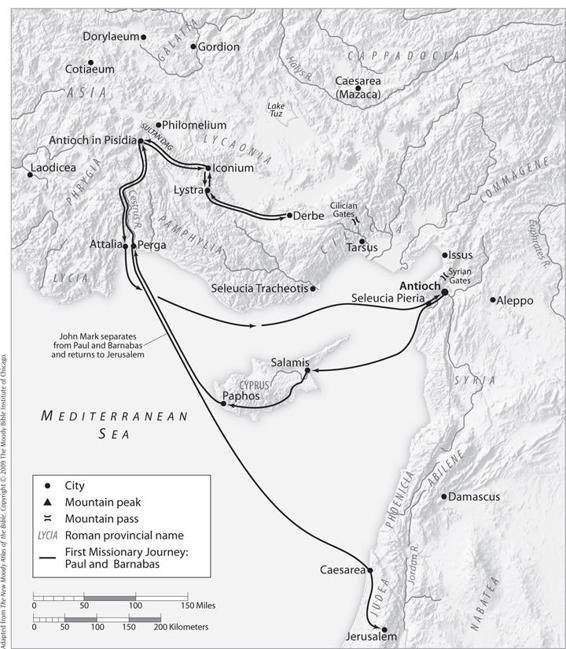
13:1. The presence of both prophets and teachers is evidence God had blessed the church at Antioch with gifted men. The text here does not suggest a distinction in the ministry of prophets and teachers, but generally in the NT, prophets carry on an itinerant ministry and the teachers instruct believers in the local church. For other features related to those who were prophets, see the comments introducing 1Co 14.
The names of the men listed show the universal impact of the gospel. Barnabas was Jewish and from Cyprus; Lucius was from Cyrene in North Africa; Simeon (Niger) was Jewish with a Roman name; Manaen was a member of the upper class with connections to Herod; and Saul was a Jew from Tarsus, who trained under the great Rabbi Gamaliel (regarding whom, see the comments on 5:33-39).
13:2-3. The commissioning of the missionaries took place while the church was worshiping and fasting. The Holy Spirit gave divine authorization for the first missionary journey by directing the church to set apart (dedicate) Barnabas and Saul for the first missionary journey.
The church recognized the divine commission of Barnabas and Saul by the “laying on of hands” (for which, see the comments on 6:5-6). After more fasting and prayer, the men were sent out under the authority of the church.
The description of the commissioning of the missionaries suggests a twofold responsibility for the church—worship and mission. Both are essential. The church should meet to worship and also to witness to the world.
b. The Journey by Saul (Paul) and Barnabas (13:4–14:28)
(1) Antioch to Seleucia to Salamis on Cyprus (13:4-12)
(a) The Opposition by Elymas (13:4-8)
In 13:4–14:28, Luke presented the circuit the missionaries travelled, starting with Paphos in 13:4-12.
13:4-5. The missionary team went first to Cyprus, the home of Barnabas (cf. Ac 4:36). They began their ministry in Salamis on the east of the island in synagogues, which were logical places for explaining how Jesus fulfilled OT messianic promises.
13:6-8. From Salamis, they traveled about 90 miles west to Paphos, the capital of Cyprus. At Paphos they encountered Bar-Jesus who was described as a Jewish magician and false prophet. His name meant “son of Jesus,” which is ironic because he opposed the servants of Jesus. It is also ironical that Sergius Paulus, who was a Gentile and proconsul (governor), summoned Barnabas and Paul so he could hear the Word of God from them (which is probably why Luke labeled him as a man of intelligence, v. 7), but Elymas (the Gk. name for Bar-Jesus) tried to keep Sergius Paulus from coming to faith. Elymas, who was the personal magician of the proconsul, realized that if Sergius Paulus trusted Christ, he would be unemployed.
(b) The Blinding of Elymas (13:9-12)
13:9-11. Luke noted Saul’s name change. Now that he was ministering in a Gentile cultural context, Saul assumed his Greek name, “Paul.” It is also significant that Paul was filled with the Holy Spirit, an indication that his ministry was divinely approved and inspired.
Paul announced judgmental blindness on Elymas, who was full of deceit and treachery. He was a son of the devil, an enemy of all righteousness, and attempted to pervert the truth. Paul announced temporary, not permanent, judicial blindness on Elymas.
13:12. In contrast to the blinding of Elymas, a Jew, Sergius Paulus, a Gentile, came to faith not because of the judgment on Elymas but because of the teaching of the Lord. The blinding of Elymas and the conversion of Sergius Paulus demonstrated the beginnings of the change that would happen in the early church—Israel would more and more reject the gospel, while Gentiles would be increasingly receptive. Paul noted later in Rm 11 that the Jewish people were hardened by God to allow time for the gospel to be taken to the Gentile world, and the Gentiles would be the ones more inclined initially to embrace Messiah Jesus (cf. the comments on Rm 11:11-24). Paul’s experience here at Paphos foreshadowed what he would experience throughout his life in ministry to Jews and Gentiles. His gospel message would largely be rejected by Jews but accepted by Gentiles. From a theological perspective this event provided the historical background for Paul’s discussion of Jewish unbelief in Rm 9–11. There Paul answered the question about Gentile responsiveness to the gospel and Jewish unbelief. Did it mean that God’s plan of redemption for the Jewish people had failed? The answer is an emphatic, “No!” Rather, Paul explained, Jewish unbelief opened the door of faith to the Gentiles. Nevertheless, the temporary blinding of Elymas cannot be cited to support the teaching that the church has replaced Israel in God’s program. See the comments on Rm 11:25-32.
This act of judgment was similar to Peter’s announcement of judgment on Simon Magus (Ac 8), a comparison that functions to confirm the legitimacy of Paul’s apostleship. Like Peter, who was one of the Twelve and an apostle to the Jews, Paul had the same apostolic authority as an apostle to the Gentiles.
(2) Paphos to Perga in Pamphylia (13:13)
13:13. When they arrived at the port town of Perga, John Mark returned to Jerusalem (cf. 11:30). Numerous reasons have been suggested for Mark’s returning to Jerusalem. Most likely he was overwhelmed with the rigors of the ministry this missionary team was involved in, rather than that some fundamental doctrinal rift developed between John Mark and his veteran colleagues.
(3) Perga to Pisidian Antioch (13:14-50)
(a) Paul’s Message in Antioch (13:14-41)
13:14-15. At Antioch, Paul established a pattern for ministry by preaching first to Jews and then to Gentiles. Paul followed this strategy in every city with a sizeable Jewish population. In Philippi, according to 16:13, it seems Paul was seeking a “place of prayer,” probably for Jewish people. So even in Philippi he sought out Jewish people first.
After reading from the Law and the Prophets, the elders of the synagogue asked Paul and Barnabas to speak. It was customary to read from two sections of the OT—the Law and the Prophets, and then give an interpretation. The elders apparently considered Paul and Barnabas qualified to explain the Scriptures, so although they were visitors, they were asked to speak. Paul seized the opportunity to explain how the promises of God to Israel were fulfilled in Christ.
Paul’s message spanned the historical preparations God had made to prepare the Jewish people for the coming of their Messiah (13:16-22), and what actually transpired when Jesus arrived (13:23-37). Paul concluded this review of the historical facts related to Jesus by challenging his listeners to trust in Jesus for the forgiveness of sins (13:38-41).
13:16. He addressed both Jews and God-fearers, Gentiles who believed in God but were not converts to Judaism. The primary theme was suggested in 13:39: justification by faith, not by keeping the Law of Moses.
13:17-41. In his message, Paul gave a brief survey of Israel’s history from the exodus (Moses) to the united kingdom (David). His main purpose in 13:17-23 was to connect Christ to David: From the descendants of this man, according to the promise, God has brought to Israel a Savior, Jesus (13:23). When David desired to build a house for God, Nathan the prophet promised David an eternal dynasty (see the comments on 2Sm 7:6-16 for the Davidic covenant). Paul identified Jesus as the promised seed of David.
Paul leaped from David to John the Baptist in 13:24-25. His main point here was to emphasize that John was not the Messiah, but that his mission was to prepare the nation for the coming of the Messiah. John was regarded favorably by most of the Jewish people, and his purpose here may have been to connect Jesus with the Baptist in an attempt to incline the listeners favorably to Him.
In 13:26-30, Paul said that though the Scriptures were read in the synagogues, Israel’s leadership did not understand the message of the prophets and they condemned the Savior though He was innocent. In contrast to how the Jewish leaders and Pilate condemned and conspired to kill Jesus, God raised Him from the dead, and His followers were witnesses of His resurrection.
In 13:31-37 Paul appealed to three OT texts to prove Christ’s resurrection. Psalm 2 is a royal Psalm, and v. 7 makes an intimate connection between the Messiah and God. He is God’s Son. Paul alluded to Is 55:3 in v. 34, and he informed his audience that the promises made to David had been given to them through Jesus who had been raised from the dead. As did Peter in his speech in Ac 2, Paul quoted Ps 16:10, and insisted that David could not have been speaking of himself since his tomb was in Jerusalem. Paul’s appeal to these texts was not arbitrary. First, as a postexilic collection, the Psalms in general, and the royal Psalms in particular, pointed forward to the future royal son of David, the Messiah. Thus, just as Paul explained, in Ps 2 God was not addressing David, but rather called the Messiah His Son. In the same way, Ps 16:10 predicts that some future individual would not experience decay in the grave, referring not to David but rather the future Davidic Messiah. This is all in accord with the Davidic covenant (2Sm 7:12-16), in which God mercifully promised David (Is 55:3) a future descendant, the Messiah, who would have an eternal house, throne, and kingdom.
Paul’s main point is in 13:38-39. Forgiveness and justification are through faith in Jesus and not by the keeping of the Law of Moses. Both forgiveness and justification have a forensic sense. Forgiveness means that the legal penalty for one’s sins is cancelled, and justification means that a person is declared right with God. Paul insisted it is only through faith in Jesus’ atoning death and resurrection that God grants complete forgiveness and declares a person totally righteous.
This text seems to fly in the face of the “New Perspective on Paul.” Proponents of the New Perspective argue that Paul’s problem with Judaism was the use of the law as a barrier to keep themselves separate from Gentiles and that Jews did not believe the law was a means to gain status with God. But it is the use of the law for justification that Paul refuted in his message. For more on the “New Perspective on Paul,” see the Introduction to the book of Romans.
Paul concluded his message in 13:40-41 with a stern warning of judgment for rejecting Christ. Using a quote from Hab 1:5, he compared his audience to the Israelites who were destroyed during the Babylonian exile. The present generation of Jewish people would also experience judgment if they refused to believe that God is working through Jesus Christ. The key idea in the comparison is God’s work. In the context of Acts, God’s work included the atoning death and resurrection of Jesus Christ and Christ’s work of building the church through Spirit-inspired witnesses.
(b) Reaction to the Message in Antioch (13:42-50)
13:42-43. In the response to Paul’s message, some begged Paul to speak again the following Sabbath, and many Jews and converts to Judaism even began spending time with Paul and Barnabas. They were urged to continue to rely on God’s grace and not revert to living by the law of Moses.
13:44-45. When Paul spoke the next Sabbath, the events of Paphos were repeated. When the Jewish leaders saw the favorable response of many in the audience they were filled with jealousy and began to slander (“blaspheme”) Paul.
13:46-48. Paul and Barnabas rebuked the opposition while saying it was necessary for the gospel to be preached to the Jewish community first because the gospel had primary relevance to the Jewish people (Jn 4:22; and comments at Rm 1:16). Nevertheless, Paul declared two consequences of their rejecting his message. One, they had judged themselves unworthy of eternal life. Here and in v. 48 are the only references in Acts where the content of SALVATION is described as the hope of eternal life. Two, Paul stated that rejection by the Jewish people justified his ministry to the Gentiles. Some have interpreted this as a transfer of Paul’s ministry and message away from the Jewish people to exclusive proclamation to Gentiles. However, in the very next city (Iconium, 14:1-2), he went to Jewish people first once again. Much earlier, the prophet Isaiah had predicted the worldwide relevance of the ministry of God’s Servant (Is 49:6; 42:6). The quote from Isaiah (v. 41) indicates that Jesus is God’s anointed Servant.
13:48-49. In contrast to the Jews, Gentiles rejoiced and those who were appointed to eternal life believed. As God chose Israel as His special people, He now sovereignly granted eternal life to Gentiles. In addition, Luke indicated that no one can save himself; people are saved only because of God’s gracious choice. Opposition could not stop the word of the Lord; the gospel made an impact upon the entire region. Luke referred to the message as the word of the Lord (vv. 48-49) not to describe the apostolic preaching as Scripture but to indicate that their message was from God. As Paul stated in Gl 1 the gospel is not a message he created but one he received from God.
13:50. The response of the Gentiles led to even greater opposition. Some Jewish people incited upper class women (probably Gentiles) and the Gentile leaders of the city to persecute Paul and Barnabas, who were forced to leave the district.
(4) Antioch to Iconium: Mixed Reactions (13:51–14:5)
13:51-52. With a symbolic act of judgment, Paul and Barnabas shook off the dust of their feet and traveled to Iconium, 90 miles southeast of Pisidian Antioch.
Like the apostles who rejoiced when flogged by the Sanhedrin (cf. Ac 5:40-42), the disciples were filled with joy and the Holy Spirit. Joy and courage to boldly proclaim the Word of God in the face of persecution were evidences of the Holy Spirit in Acts.
14:1-2. At Iconium the divided response and hostility of some Jewish people at Paphos and Pisidian Antioch were repeated. When the missionaries spoke in the synagogue, a large number of both Jews and Greeks believed. But some unbelieving Jewish people stirred up the minds of the Gentiles, turning them against Paul and Barnabas. The word translated by the NASB as embittered is literally “to cause someone to think badly about another, make angry, embitter” (BDAG, 502). Paul and Barnabas were so effective in convincing Jews and Greeks of the truth of their message that Jews sought the help of Gentiles to stop the missionaries.
14:3-7. Though the missionaries authenticated their message with signs and wonders, the people were still divided. Some believed the slander of the Jews, but others sided with the apostles. Luke called both Barnabas and Paul apostles, an extension of the ministry of an apostle beyond the Twelve.
(5) Iconium to Lystra (14:6-20a)
(a) A Case of Mistaken Identities (14:6-18)
When both Gentiles and Jews attempted to stone the missionaries, Paul and Barnabas fled further southeast to the region of Lycaonia, and the cities of Lystra and Derbe.
14:8-10. At Lystra Luke provided an example of how Paul preached to Gentiles who did not know the OT. As Peter had healed a handicapped man (Ac 3), Paul healed a man who was physically challenged from birth. Luke’s purpose was to authenticate Paul’s apostleship to the Gentiles by showing that God was working in Paul’s ministry to the Gentiles with the same power that he worked in Peter’s ministry among the Jewish people. The difference between this account and Peter’s healing of the handicapped man is that Paul saw the man had faith to be made well. Though not stated, his physical healing was a picture of spiritual salvation.
14:11-13. The superstitious Gentiles mistakenly believed that Barnabas and Paul were the gods Zeus and Hermes. According to the local legend these gods had visited the region and blessed those who extended them hospitality but destroyed the homes of those who would not welcome them. Not wanting to risk judgment, the local temple priest brought sacrifices to worship them.
14:14-15. Barnabas and Paul vehemently protested. They did not attempt to exploit the Lycaonians as itinerant sages might have done. Instead Paul seized the opportunity to tell the Lycaonians about God. Luke gave only a summary of Paul’s message. Paul took a different tack in preaching to Gentiles from what he did in preaching to Jews. He contextualized his message, but he did not change the essential content of his gospel message.
Paul called his message the gospel, the announcement of good news. The message of the pagan world was “bad news.” People lived in fear of fate and the fickleness of their gods. No one could know for sure what his or her eternal destiny would be, or even if there was life after death. Men and women were powerless to deliver themselves from the sinful tendencies of their fallen humanity. To helpless and hopeless pagans, the gospel is “good news.”
Because God is the creator of everything, Paul appealed for Lycaonians to repent, “to turn” from idolatry to faith in the only living God (cf. 1Th 1:19). Paul’s argument was from nature. It was not theological (Romans) or scriptural (Antioch) or philosophical (Athens).
14:16-17. Paul attempted to present a plan of salvation based on progressive revelation. The statement that in the past He permitted all nations to go their own ways does not mean that after God made the heavens and earth He abandoned His creation, or that He did not constantly exercise His providential and sovereign control. Paul’s point seems to indicate that God had not previously provided direct revelation of Himself to nations other than Israel, and had not called them to live under a specially revealed law similar to the law of Moses. He did, however, provide for them “general revelation,” proof of Himself in creation, as demonstrated by His provisions specified in v. 17. God has consistently provided evidence of His existence through His providential goodness by sustaining life. He gives to all men rains, fruitful seasons, and food. For a similar argument see Rm 1:18-32 and the comments there.
14:18. Paul’s message did not dissuade the Lycaonians from worshipping the missionaries as gods.
Paul made it clear that the people of Lystra had to choose. His presentation did not contain a hint of relativism. There is only one living God who is the creator of everything. To worship any other god is idolatry; the Lycaonians needed to repent. Had Paul been able to continue, he undoubtedly would have stated that Jesus Christ is the culmination of redemptive history, though he would have arrived at that conclusion differently from how he did at Antioch preaching to Jews.
(b) Opponents from Iconium and Antioch (14:19-20a)