Author. The Gospel of John is greatly beloved—probably because the author presents so clearly Jesus’ promise of eternal life for those who simply believe in Him.
Internal Evidence. The unnamed author was an eyewitness of Christ (1:14; 19:35; 21:24) and has identified himself as “the disciple whom Jesus loved” (13:23; 21:7, 20). He was also one of the 12 apostles (Mt 10:2). On several occasions, the author is shown closely associated with Peter (20:2-8; 21:7), as the apostle John is in the Synoptics and Acts (Mt 17:1; Ac 3:1-4). In addition, the similarities with Revelation, written by John, reinforce the strong case made for the traditional view that the apostle John wrote the book.
External Evidence. The early church father Irenaeus (d. AD 200) claimed that John wrote the Fourth Gospel after he was released from prison on the island of Patmos (Rv 1:9) and lived in Ephesus. Irenaeus also wrote that he personally learned this information from the aged Polycarp, bishop of Smyrna (d. AD 155), who in turn was discipled by the apostle John.
Date. A first-century date for the writing of John has been confirmed by the 1920 discovery of the Greek ms fragment of John known as P 52, written c. AD 125. The original must have been penned much earlier, perhaps c. AD 80–90. This date is strongly supported by patristic testimony. However, Jn 5:2 states, “By the Sheep Gate in Jerusalem there is [present tense] a pool” (HCSB, italics added). This may point to a date even before the Roman destruction of Jerusalem (AD 70).
Recipients. The readers were likely non-Christians whom John hoped to win to faith (20:31). Many Semitic (Hebrew) expressions are given a Greek equivalent (e.g., Jn 1:38, 41), suggesting the readers were Greek-speaking. Sometimes Jewish concepts are left unexplained (e.g., “the Lamb of God,” 1:29). The natural conclusion is that John was writing to Greek-speaking, Jewish non-Christians living outside Israel, perhaps in Ephesus.
Purpose and Theme. Faith in Christ for eternal life is central to John’s gospel, as his purpose statement reflects (20:30-31). The verb “believe” (pisteuo) is used about 100 times, with numerous synonyms of and symbols for “believe” such as “receive” (1:11), “know” (4:42; 6:69), “come to” (5:40; 6:35), “behold” (6:40), and “eat” and “drink” (6:54). Various other synonymous constructions include “believe in” (pisteuo eis) and “believe that” (pisteuo hoti). In the NT, the Fourth Gospel also presents the most extensive testimony that Jesus is the divine Son of God and prophesied Messiah.
While the Synoptic Gospels (Matthew, Mark, Luke) contain much parallel material, over 90 percent of John is unique. Unlike the Synoptics’, John’s unique content (e.g., woman at the well, Nicodemus) was designed primarily for evangelism (20:30-31). In the OT, God demonstrated perfection and completeness by mentioning a number plus one (Ps 62:11; Pr 6:16; Dn 3:24-25; Mc 5:5). Three Synoptic Gospels plus one (John) implies a complete but not exhaustive revelation of Christ. See also the sidebar, “A Comparison of the Synoptics and John.”
A Few Facts about the Apostle John
• John’s father was Zebedee, and his older brother was James (Mt 4:21).
• Because of their fiery tempers, Jesus named John and James, “sons of thunder” (Mk 3:17).
• John worked in his father’s fishing business (Mk 1:19–20) and had Peter as a partner (Lk 5:10).
• John was the only disciple to witness the death of Jesus (Jn 19:26).
• While on the cross, Jesus told John to care for His mother after His death (Jn 19:26).
• John was the first of the disciples to see the empty tomb (Jn 20:1-3).
• John was a leader with Peter in the early church (Ac 3–4; 8:14-17, 25; Gl 2:9).
• His long life was prophesied by Jesus (Jn 21:20-23).
• John lived into his 90s, wrote the book of Revelation, and was the last apostle to die.
Background. The discovery of the Dead Sea Scrolls in 1948 proved that most of John’s concepts derive from Judaism, not Hellenism. Characteristics of John include stark contrasts (e.g., light/darkness, life/death), symbolism, and irony (see commentary throughout).
The term “the Jews” is recurrent in John and refers to (1) the Jewish people in general (e.g., 18:33); (2) the hostile Jewish people in Jerusalem (e.g., 11:54); or (3) the hostile Jewish leaders in Jerusalem (most references). The negative references have sometimes resulted in a charge of anti-Semitism. However, some passages use the term in a positive (8:31; 11:45; 12:11) or neutral way (3:1). Even when John presented the Jews negatively, the viewpoint is no more severe than similar denunciations of Israel by the OT prophets, who like John, were themselves Jewish.
After the prologue (chap. 1), chaps. 2–12 feature seven major signs that prove Jesus’ messianic identity (see comment on 2:11). After describing Christ’s farewell instructions to His disciples (chaps. 13–17) and His crucifixion (chaps. 18–19), John presented the climactic eighth sign (a number + 1; see above)—Christ’s resurrection (20:1-29; cf. 2:18-22). This account is immediately followed by John’s purpose statement (20:30-31). A final epilogue balances the prologue and completes the book (21:1-25).
A Comparison of the Synoptics and John
Synoptics | John |
Focus on Galilee | Focus on Judea |
Numerous parables | Few parables |
Theme of “the kingdom of God” | Only one use of “kingdom of God” |
Genealogies of Jesus | No genealogy but the eternal origin of Jesus |
Few “I am” claims | Seven “I am” claims |
No uses of “truly, truly …” | Twenty-five uses of “truly, truly …” |
Sixteen references to “the Jews” | Seventy-one references to “the Jews” |
Mentions only the Feast of Passover at Christ’s death | Mentions three or four Passovers, the Feasts of Booths (7:2) and Dedication (10:22) |
COMMENTARY ON JOHN
I. Prologue (1:1-18)
The prologue introduces the Fourth Gospel by demonstrating the supremacy of Jesus as the unique One who should be believed. He is the Word (vv. 1, 14), true Light (v. 9), One and Only Son (vv. 14, 18, HCSB), Lamb of God (vv. 29, 36), Rabbi or Teacher (vv. 38, 49), Messiah (vv. 20, 25, 41), Son of God (vv. 34, 49), King of Israel (v. 49), and Son of Man (v. 51).
1:1. In the beginning (cf. Gn 1:1) was the Word (logos) already in existence in eternity past. John took the OT concepts of God’s spoken word and applied them to Jesus. The parallels between Gn 1 and Jn 1 demonstrate that the concept behind the “Word” in Jn 1 is drawn from the OT. God’s Word creates all life (Gn 1:11, 20, 26), and Jesus has the right to give eternal life (Jn 6:27; 10:28). God sends out His word, and it always accomplishes His will (Is 55:11), just as Jesus was sent out and accomplished the Father’s will (Jn 4:34; 6:38). God’s word in the OT is His divine self-expression (Ps 138:2). So Jesus is the divine self-expression of God. Since the Word was with God before all else existed, He had intimate companionship with the Father. This points to separate persons in the Godhead (the Trinity). Yet, since the Word was God, everything that God was in essence, the Word was also. This indicates the deity of Christ—a major theme of the Fourth Gospel.
1:2. Verse 2 subtly repeats v. 1. The Greek phrase was … with [pros] God places a stress on the loving companionship that has always existed between Jesus and the Father (another theme in John). As v. 3 implies, before what happened in the beginning, God was all that there was—and the Word was there personally with God.
1:3-4. The Word created all things—material and immaterial (e.g., angels). While the Father initiated creation, through Him confirms that Jesus was the direct agent of creation (cf. Rm 11:36; Col 1:16; Heb 1:2). John rephrased the thought of v. 3a in 3b to confirm the all-inclusive nature of Christ’s creative work. Since in Him was life (v. 4; cf. 14:6), all life derived from and is given by Jesus (5:21; 10:28; 17:2). The life that was in Jesus was to be a Light for people. In Scripture, light (a thematic word in this gospel) is the place of security and deliverance (Ps 27:1; Ac 13:47), and a figure for holiness, revelation, and truth (1Jn 1:5).
1:5. John stressed the ongoing reality that the Light shines [pres. tense] in the darkness. A spiritual battle exists between good and evil, God and Satan. All darkness (e.g., Satan, Judas, the unbelieving Jews) opposed Jesus. In His sacrificial death for sin, He gained the victory over darkness (cf. 19:30). Therefore, the darkness did not comprehend the light. Since the Greek word “comprehend” (katalambano) means “overtake” in a similar statement in 12:35 (“so that darkness will not overtake you”), it is best taken that way in 1:5 (i.e., the darkness “did not overcome” the light; NET, ESV).
1:6-8. The great forerunner to the Messiah is now introduced. As was the case with OT prophets, John was sent from God. That God “sent” John the Baptist begins the missionary outlook of the book. Witness, which appears for the first time (v. 7), fits into this theme of mission. John’s witness, like the testimony of the book itself (20:31-32), existed so that all might believe in Christ. This marks the first of nearly 100 uses of “believe” (pisteuo) in the book. To “believe” (pisteuo) means “to have confidence in” or “be fully persuaded about” (Ac 28:24; Rm 4:20-21). Even though John the Baptist never did any miracles (10:41), the fact that he came to testify about the Light (v. 8) gives the explanation for his greatness.
1:9-10. Coming into the world refers to Christ’s incarnation (cf. 6:14; 9:39; 11:27; 12:46; 16:28). This phrase does not describe when or in what sense Jesus enlightens every man. The primary point of the phrase is to describe who Jesus is. “The true light that gives light to every man was coming into the world” (NIV; cf. ESV, NET). Since Jesus is Creator (vv. 3-4), He has given a measure of light to everyone through general revelation and an inner moral law (Rm 1:18-32; 2:14-15; Leon Morris, The Gospel of John, NICNT [Grand Rapids, MI: Eerdmans, 1995], 84). Alternately, He may bring objective revelation to all, forcing people to accept or reject Him (D. A. Carson, The Gospel According to John, PNC [Grand Rapids, MI: Eerdmans, 1991], 124). The world was made through Him (v. 10), including plants and animals. However, in John “world” (kosmos, a thematic word, used 78 times in John, 15 times in the Synoptics) primarily refers to people (e.g., Jn 3:16-17, 19), and the world did not know Him means that most people did not believe in Christ (17:3). The first two references to kosmos in this verse are neutral (cf. 17:24; 21:25), but more often kosmos carries negative overtones (third reference). The “world” is in need of forgiveness (1:29), a Savior (4:42), and eternal life (6:33; 8:12). It hates God (17:25) and Jesus (7:7) as well as believers (15:18, 19), and is ruled by Satan (14:30; 16:11). While believers are in the physical world (13:1; 17:11), they are separated out of the evil world system by their faith in Christ (17:6, 17).
1:11-13. Through the incarnation, Jesus came to His own nation and land (in Gk. “own” is neuter pl.). Ironically, the Jewish people, who were His own (Gk. masculine pl.) people, refused to accept their own Messiah. As many as (v. 12) stipulates a universal promise extending beyond the Jewish people. The promise is to all who have received [lambano, “welcome, take”] Him. “Receive Him” is parallel to believe in His name, showing the terms “receive” and “believe” are essentially synonymous (cf. 12:48; 13:20; 17:8). This is the first of over 35 uses of the phrase “believe in” (pisteuo eis)—a special Johannine construction that always means genuine faith (3:16, 18, 36; 6:40; 11:25). Becoming a child of God results in a spiritual “birth” produced by God’s Spirit (cf. 3:3-8; 1Pt 1:3, 23; 1Jn 5:1, 4) unlike human birth (v. 13). Spiritual birth is not of blood, i.e., it is not the result of human descent. Neither is it of the will of the flesh, as if human desires can bring it about. Nor is spiritual birth of the will of man (Gk. “male, husband”), negating any pride of males in producing children as was common in Jewish culture (and in most cultures). Contrary to anything innate, spiritual birth is an act of God.
1:14. John 1:1-13 and v. 18 focus on the deity of Christ; vv. 14-17 outline the humanity of Christ. The Word became flesh, i.e., He became fully human. The Word dwelt or “tabernacled” (skenoo) on earth. God’s glory, resident in the OT tabernacle, now became resident in Jesus as God’s NT temple (cf. 2:19-21). This begins John’s theme that Jesus has fulfilled the OT system of worship (cf. 4:21). Glory draws on the images of the OT when God manifested Himself to Israel (Ex 16:10; 24:15-17; 33:22), but also encompasses Christ’s incarnation, miracles (Jn 2:11; 11:4, 40), and death, resurrection, and ascension (12:16; 13:31-32; 17:1). The phrase only begotten (monogene) is used for the first of four times in John (1:18; 3:16, 18). NIV, NET, and HCSB translate this word, “one and only,” because it looks at the uniqueness of the Son, not at a “birth.” Isaac is called Abraham’s “only begotten son” (Heb 11:17), but was neither Abraham’s only nor first-born son, though he was certainly Abraham’s “one-of-a-kind” or unique son. Full of grace and truth is to be understood in light of the incarnation (“the Word became flesh”). See v. 17.
1:15-16. Next to Jesus, John the Baptist as the forerunner of the Messiah is the apostle’s chief example of one who boldly testified to the truth (see comment on 2:23). Like an OT prophet, John cried out in giving his message. Jesus was born after John the Baptist (He who comes after me). But Christ was superior to John (has a higher rank than I) on the grounds that He is eternally preexistent (for He existed before me). In light of the words His fullness (v. 16), the phrase grace upon grace means a maximized grace or “one gracious gift after another” (NET).
1:17. As did Paul (Rm 5:20; 6:14), John made a contrast between the law and Moses (not Judaism), and grace and Jesus Christ. Grace (used in John only in vv. 14, 16, 17) and truth may recall the OT concept of “lovingkindness [Hb. chesed] and truth [Hb. emet]” (Ex 34:6; 33:13, 18-19) and point to God’s covenant faithfulness to Israel. Moses was the indirect source of law; Jesus was the source of all grace, even God’s grace shown to Israel (cf. Ex. 34:6-7). (Note the preexistence of Christ in Jn 1:15). So ultimately, grace and truth were mediated (were realized, lit., “came”) through Jesus Christ in both the OT and NT.
1:18. No one has seen God at any time (cf. 1Tm 6:16), though people have received partial revelations of Him in the person of the preincarnate Christ (e.g., Abraham, Gn 18:1; Moses, Ex 33:18-23). The only begotten God, “the only God” (ESV), or “the only one, himself God” (NET) reads a different set of Greek mss as opposed to “the One and Only Son” (HSCB, TNIV). The latter is more Johannine (cf. 3:16, 18), though many scholars think the antiquity of the manuscripts and the difficulty of the reading (a scribe probably would not have changed “Son” to “God”) support the NASB translation. In the bosom of the Father is an idiom denoting the extreme intimacy that Jesus had with God the Father (cf. 13:23). Other versions translate the phrase “in closest relationship/fellowship with” (TNIV, NET), or “near/close to the Father’s heart” (NLTse, NJB, NRSV).
II. Public Ministry: Miraculous Signs of Jesus’ Identity (1:19–12:50)
The first major unit of John centers on the public ministry of Jesus with seven sign-miracles performed by Him (eight signs including Jesus’ resurrection; see chart at 2:1) that identify Him as the Christ. Verses 19-51 offer four witnesses (John the Baptist, Andrew, Philip, Nathaniel) to the truth presented in the Prologue: Jesus is the Messiah, the Son of God who is fully God come in human form.
A. Preliminary Events to Jesus’ Ministry (1:19-51)
1. Testimony of John the Baptist (1:19-34)
1:19-20. The Jews sent to John the Baptist priests and Levites from Jerusalem to ask him about his identity. The “Jews” refers here to the Jewish authorities (cf. v. 24). Behind the question Who are you? is the thought that John the Baptist might be the coming Messiah (cf. Lk 3:15). The forerunner vigorously denied it (v. 20). Christ is the Greek term corresponding to the Hebrew and Aramaic word “Messiah.” Both terms mean “anointed one.”
1:21-23. Judaism had diverse opinions about what great leaders were promised in the OT to deliver Israel. Elijah was prophesied to return in the end times (Mal 4:5; Mt 17:11; Lk 1:17). Also, there was an eschatological Prophet (cf. Jn 1:45; 6:14; 7:40) predicted to be like Moses (Dt 18:15, 18). Peter and Stephen claimed this prophet was Jesus (Ac 3:22; 7:37), and while He certainly functioned in a way befitting a prophet, He was also much more.
1:23. John the Baptist (v. 23) literally preached IN THE WILDERNESS as Is 40:3 indicated (cf. Mt 3:2-3; Mk 1:3-4; Lk 3:3-4). By calling for repentance, he was preparing the people’s hearts (MAKE STRAIGHT THE WAY) to receive Christ by faith (cf. Ac 19:4). Of the four Gospels, only John’s does not mention the word “repent” or “repentance.”
1:24-25. That these men had been sent from the Pharisees contrasts radically with those sent from God, i.e., John the Baptist and Jesus Himself (cf. vv. 6, 19, 22, 33). The Pharisees (about 6,000 at the time) were laymen (not priests) who zealously followed the Mosaic law but added many extrabiblical traditions to it. As the largest Jewish religious-political party, they exercised considerable influence. While the Jewish people highly esteemed them, Jesus often unmasked their hypocrisy (cf. Mt 23:1-36). This is not surprising since even later rabbinic authorities, having sprung from Pharisaism, also criticize their hypocrisy (Babylonian Talmud Sotah 22b). John’s baptizing ministry (v. 25) grew out of the OT emphasis on symbolic cleansing with water (Lv 13–17; Nm 19; Ps 51:2, 7; Is 4:4). The form of the question presupposes that the Jewish leaders thought of baptism as a mark of the coming Messiah.
1:26-28. Among you stands One whom you do not know implies the Messiah could be easily overlooked (Is 53:2) and potentially rejected (v. 10). John acknowledged his unworthiness to serve Christ even as a slave who loosens the straps of another’s sandal. The location of Bethany beyond the Jordan (3:26; 10:40) is uncertain, though it may be the area northwest of the Sea of Galilee where there was a considerable amount of water that served as the headwaters of the Jordan River. The Latinized form of the name of this region was “Batanaea.” At any rate, it is to be distinguished from the Bethany near Jerusalem (11:1). “Beyond the Jordan” recalls the time when Israel was positioned to conquer the promised land (Nm 22:1; Dt 3:20; Jos 1:14-15; 22). Israel is now positioned to be led by Jesus, the new Joshua.
1:29. Chronologically, the next day sets up a sequence of an entire week (cf. vv. 29, 35, 43; and “the third day” in 2:1). By referring to Jesus as the Lamb of God (cf. v. 36), John the Baptist alluded to the fulfillment of OT sacrificial imagery (Gn 22:8; Is 53:7, 12; 1Pt 1:19; Rv 5:12), especially the Passover lamb (Jn 19:36; Ex 12:1-13; 1Co 5:7). The substitutionary death of Christ takes away the sin of the whole world, including all Gentiles—a shocking revelation to the Jewish readers.
1:30. For the third time (cf. vv. 15, 27), the Baptizer confirmed that the Messiah would appear after him. The reason He has a higher rank than the forerunner is that He existed before John. Since John the Baptist was born before Jesus (Lk 1:26-31), this can only refer to the eternality (and therefore the deity) of Jesus—a theme in harmony with the purpose of chap. 1.
1:31. Unlike the Synoptics’, the Fourth Gospel’s record of John the Baptist downplays the role of his baptism (see comment on v. 22). Instead, the focus is on the forerunner’s testimony to Jesus’ true identity. As everyone else, John did not recognize Jesus as the Messiah at first. In the dialogues with the Jewish interviewers (vv. 19-27), he had offered very little information about his own identity. John’s role was that Jesus might be manifested to Israel as their Messiah.
1:32-33. The Spirit’s descent on Christ took place at the baptism of Jesus (not mentioned in John). The significance of the event was that the Spirit remained upon Christ. The wording recalls Isaiah’s prophecies where the Spirit rests on the Messiah (11:1-2; 42:1; 61:1). The Messiah had to be revealed to John (v. 33) from the Father (He who sent me) by means of the Spirit descending and remaining upon Jesus. This Jesus would be the One who baptizes in the Holy Spirit (see the comments on 1Co 12:13). This is the only mention in John of the baptism of the Holy Spirit (Mt 3:11; Mk 1:8; Lk 3:16).
1:34. The title Son of God is reserved in the Fourth Gospel for Jesus alone, implies His deity, and is roughly synonymous to “Christ” (11:27; 20:30-31). It finds its background in the Davidic covenant (2Sm 7:14; Ps 2:7; see the comments there) where God promised an unending reign for His chosen King-Son (cf. v. 49). Jewish people rightly understood Jesus’ claim to being the Son of God as a claim to be being equal with God (5:18).
2. First Disciples (1:35-51)
1:35-37. For the next day, see v. 29. Jesus’ first disciples were originally disciples of John the Baptist. As such they had faith in the One true God of Israel. They now understood that Jesus is the Messiah they had believed would come to Israel (cf. 6:37). That John was standing (v. 36) while Jesus walked intimates that the movement of God was shifting to Jesus (Edwin A. Blum, “John,” BKCNT [Wheaton: Victor, 1983], 275). For Lamb of God, see v. 29. Two of the forerunner’s disciples … followed Jesus (v. 37). In the Jewish culture, discipleship entailed physically following one’s teacher or rabbi to receive training.
1:38. Since Jesus turned and saw the two disciples following Him, they could not follow Him secretly (see the theme of the secret disciple at 2:24-25). Jesus asked them What do you seek? Jesus’ question was designed to draw out their commitment. What were they hoping to gain in life by following Christ? They asked, Where are You staying? The thought of “staying” (meno, “abide”) with Jesus prepares the reader for the intimate relationship of abiding in Jesus, the True Vine (15:1-17).
1:39. Come, and you will see invited the disciples to investigate Jesus further, a pattern of evangelism and discipleship that should be imitated. Although it is often assumed, the text does not directly state that they stayed overnight. A debate exists over whether John used Roman or Jewish reckoning of time (the Synoptics use the Jewish system). By Roman reckoning, the tenth hour would be 10:00 a.m. (HCSB). The time indications in 4:6 and 19:14 best fit the Jewish system, making the “tenth hour” 4:00 p.m. (NET, TNIV, NLTse, TEV).
1:40-42. Only one of the two who followed Jesus is mentioned (cf. v. 37), Andrew, Simon Peter’s brother. The other is unnamed, but is likely the apostle John (see Introduction: Author). Andrew, who found first his own brother (v. 41), became one who brought others to Christ (cf. 6:8-9; 12:22). Andrew’s confession (We have found the Messiah, v. 41) is the first direct declaration in John that Jesus is the Christ. For Messiah and Christ, see 1:20. In the OT, God changed the name of an individual to mark out his divine calling (e.g., Abraham, Gn 17:5; Jacob, Gn 32:28). Jesus renamed Peter as Cephas (v. 42), an Aramaic word meaning “stone.” Peter would become a solid leader in the early church, despite his denials at the trials of Jesus.
1:43-44. On the next day, see v. 29. Since Jesus purposed to go into Galilee, He found another disciple originally from Galilee. Philip, the fourth disciple to follow Jesus, was from Bethsaida (cf. 12:21), a village on the northeast shore of the Sea of Galilee. Andrew and Peter (v. 44) were also from Bethsaida. Bethsaida (meaning “house of fish”) was the scene of the feeding of the 5,000 (Lk 9:10-17) and the healing of a blind man (Mk 8:22-26). By this time, however, all three had taken up residence in Capernaum (Mk 1:21, 29).
1:45-46. Philip found Nathanael (21:2), probably the disciple named Bartholomew in other accounts (Mt 10:3; Mk 3:18; Lk 6:14; Ac 1:13). We have found Him begins Philip’s personal testimony. Personal witness brings people to Christ. Philip mentioned Him of whom Moses in the Law and also the Prophets wrote, i.e., the Messiah (see comment on 1:22). The “Law and the Prophets” was a common title for the whole OT (Mt 7:12; 22:40; Lk 16:16). Nathanael questioned whether any good thing could come out of Nazareth, so insignificant it was not even mentioned in the OT (cf. 7:52). Philip responded simply, Come and see, imitating Jesus’ own methods (v. 39; cf. 4:29).
1:47. Nathanael was a regenerate man of OT faith. Otherwise, Jesus could not have said of him that he was an Israelite indeed (cf. Rm 2:29) and that no deceit could be found in him. This faith would soon include a belief in Jesus as the Messiah (v. 49). Jesus made a wordplay on the name “Israel,” the new name given to Jacob, the patriarch of the Jews (Gn 27:35; 31:26). Nathanael exemplified Jacob’s faith rather than his deceit (Heb 11:21).
1:48. Nathaniel’s question How do You know me? begins the Johannine theme of the Lord’s supernatural knowledge of people and events (2:24-25; 5:42; 6:15, 64; 13:1, 3, 11; 18:4; 19:28; 21:17). Before Philip called Nathanael and without being physically present, Jesus miraculously saw Nathanael under the fig tree. Jesus’ divine awareness of Nathanael’s heart brought about immediate faith in Jesus as Israel’s Messiah. In the OT, the fig tree symbolized peace and safety brought by the messianic kingdom (Mc 4:4; Zch 3:10). In addition, “being under the fig tree” is a rabbinic figure of speech for studying the Torah (Bab Talmud Erubin 54a, also Midrash Ecclesiastes 5:11 and Midrash Song 6:2; cf. Jerome H. Neyrey, The Gospel of John, NCBC [Cambridge: Cambridge University Press, 2006], 58). Perhaps Nathanael was busy studying his Torah when Jesus saw him.
1:49. Nathanael addressed Jesus first as Rabbi or teacher, then as the Son of God (see v. 34), and third as King of Israel. As King of Israel, Jesus will sit on the throne of David in the coming millennial kingdom (2Sm 7:12-16; Ezk 37:21-28). In contrast to Nathanael’s sincere confession, the Jewish people will falsely claim Jesus as King during the last week of His life (Jn 12:13), and the Romans will crucify Him for claiming to be King of the Jews (19:3, 14-21).
1:50. Jesus praised the simplicity of Nathanael’s faith. The new disciple believed merely because Jesus, without being present, saw him under the fig tree. The phrase You will see greater things is both a prophecy and a promise, and refers to Jesus’ sign-miracles (2:1–12:50), especially the resurrection (2:18-22). The fulfillment began at the wedding of Cana (2:1-11).
1:51. Truly, truly (“I tell all of you the solemn truth,” NET) is found 25 times in John, never in the Synoptics. It is always spoken by Christ and introduces an earnest announcement that stresses His unique authority. The Greek word for “truly” is amen, from which we get the English word “amen” (cf. Jesus as the authoritative “Amen” in Rv 3:14). The Greek for you in v. 51 now becomes plural, addressing the group. The disciples will see “previews” of the coming kingdom (cf. Mt 16:28–17:8). See comment on 2:11. The heavens opened refers to a new phase in revelation (e.g., Is 64:1; Ezk 1:1; Mt 3:16; Rv 4:1; 19:11). Like Jacob’s ladder that mediated between heaven and earth (see the comments on Gn 28:12, 16), Jesus will be humanity’s access to God and God’s communication with humanity (Jn 14:6; 10:9). Son of Man is a messianic title of One (Jesus) who exhibits both human and divine characteristics and receives an eternal, earthly kingdom (Ps 8:4-5; Dn 7:13-14).
B. Premature Reception of Jesus’ Ministry (2:1–4:54)
1. Wedding at Cana (2:1-11)
Jesus traveled to Cana of Galilee with Mary, His mother, and His disciples. Jewish weddings were filled with festivity and occasionally lasted a week.
2:1-2. The third day is marked from the time Jesus found Philip (1:43; see comment on 1:29). Cana was about eight miles north of Nazareth, the home of Jesus and Mary. For the first time, Jesus is said to have disciples (never called “apostles” in John). Mary, the mother of Jesus (never identified by name in John), was fully aware by faith that her Son was the Messiah (Lk 1:26-56; 2:1-51). Apparently Mary thought the time for Jesus to reveal His identity had come. Since she gave directions to the servants (v. 5), she must have had some official responsibilities.
2:3. Mary told Jesus, They have no [more] wine. A failure of this kind was a serious offense against Jewish standards of hospitality. Mary’s request implied that she anticipated a miracle.
2:4-5. In the Jewish culture, woman was a respectful address (cf. 4:21; 19:26). Yet by asking, What does that have to do with us? Jesus distanced Himself from His earthly mother (cf. Mk 1:24; 5:7). The reference to Jesus’ hour or “time” (see also comment on 4:21) is not found in the Synoptics but is frequent in John. At first, His hour had not yet come (2:4; 7:6, 8, 30; 8:20), but later it had come (12:23; 13:1; 16:32; 17:1). The term refers to the glory displayed in Jesus’ death and resurrection. Since in v. 4 it had not yet come, the Lord was fully aware of its divine timing. This timing was set by the sovereign plan of the Father (12:27). Mary instructed the servants, Whatever He says to you, do it. This must also be our response to His will.
2:6-7. Symbolically, six may well represent the imperfection or insufficiency of Judaism (Andrew T. Lincoln, The Gospel According to Saint John, [Peabody, MA: Hendrickson, 2005], 129; Andreas J. Köstenberger, John, BECNT [Grand Rapids, MI: Baker, 2004], 96) and characterizes the Jewish legalistic custom of purification (cf. Mt. 15:1-2). Yet it is impossible to be certain that John intended such a symbolic use of the number “six.” Such washings were for religious, not hygienic, purposes. The six stone waterpots holding twenty or thirty gallons each totaled 120 to 180 gallons. At Jesus’ directions, the servants were to fill the large waterpots with water. That the servants filled them up to the brim expresses the overabundance of joy (wine) that comes through the Messiah (cf. 1:17).
The Eight Signs in John
1. Turning water to wine
(2:1-11)
2. Healing of the nobleman’s son (4:46-54)
3. Healing of the lame man (5:1-15)
4. Feeding of the 5,000 (6:1-15)
5. Walking on water (6:16-21)
6. Healing of the blind man (9:1-41)
7. Raising of Lazarus (11:1-44)
8. Christ’s resurrection (2:18-22; 20:1-29)
2:8-10. In obedience to Mary’s advice and Jesus’ instructions, the servants were to draw from the waterpots some water-turned-to-wine and take it to the headwaiter. Culturally, the poorer wine was served last when the sensibilities of the guests had become dull. To the headwaiter’s surprise (v. 9), he now tasted a wine that was far better than the bridegroom had been serving to this point. Jesus contradicted what every man does (v. 10) and corrected a conventional but unethical social custom.
2:11. This was the very first of the signs or miracles Jesus did and it manifested His glory (an attribute of God). The divine glory and presence that first dwelt in the OT tabernacle (1:14) was now residing in the person of Jesus. But the greatest display of glory, ironically, was yet to come in the humiliation and suffering of the cross (7:39; 12:16; 13:31, 32; 17:1). A “sign” (semeion), a special word in John (the Synoptics use dynamis, “power,” for Jesus’ miracles), is a miracle designed to attest to the authority of a messenger and the validity of His message. The Evangelist recorded these signs to bring about faith in Christ (20:31-32). The words His disciples believed in Him show that at the earliest contacts with Jesus (cf. 3:24 with Mt 4:12, 17; Mk 1:14-15), His disciples (excluding Judas, Jn 6:70-71) had saving faith. A Jewish wedding symbolized the messianic kingdom (Is 54:1-8; 62:1-5; Mt 8:11; 22:2; Rv 19:7, 9), and the wine symbolized the joy and blessings of that kingdom (Is 25:6; Jr 31:12; Jl 2:19; 3:18; Mt 26:29). The water-to-wine miracle also revealed Jesus as the Creator (Jn 1:3, 10) and the Giver of Life (1:4; 4:14), and that He would be the One to provide the abundant fertility that would yield much wine (joy and celebration) in the millennial kingdom (see Am 9:13-15).
2. Temple Cleansing (2:12-25)
The temple cleansing reveals that Jesus is the “temple” of the New Era. The miracle of the new wine (2:1-11) was semiprivate; the cleansing of the temple was the first public presentation to Israel that Jesus is the Messiah.
2:12. Jesus went down from the mountains of Cana to Capernaum, some 16 miles NE of Cana. The author’s comment is brief since the Fourth Gospel is more interested in Jesus’ activities in Jerusalem. His mother and His brothers are mentioned (cf. Mt 13:55; Mk 6:3), but not Joseph, who apparently died before Christ’s public ministry. Although His brothers witnessed this miracle, they did not believe (cf. Jn 7:5). Since the Passover was near (cf. v. 13), they stayed only a few days in Capernaum.
2:13-14. This is the first of three explicit references to the Passover in John (though the feast mentioned in 5:1 is probably also a Passover), marking perhaps as many as three-and-one-half years of Jesus’ ministry (see comments on 5:1). The Synoptics refer to a second cleansing of the temple during the last week of Jesus’ life (Mt 21:12-13; Mk 11:15-17; Lk 19:45-46). The Greek for temple (hieron) designates the temple complex that included the large Court of the Gentiles where the money changers were seated. Money changers exacted a fee to exchange Roman and Galilean coins for acceptable temple coinage. Jewish worshipers could then pay the temple tax and purchase animals for sacrifice.
2:15. Jesus viewed this commerce inside the temple complex as a sacrilege since it exploited the poor to gain funds to beautify the temple, and it disrupted Gentile worship in the court of the Gentiles, their only place to worship (Köstenberger, John, 106). So He drove the merchants all out of the temple, including the animals. He also overturned the tables of the money changers, symbolically cleansing the temple. This act fulfilled Malachi’s prophecy of the sudden entrance of the Messiah into the temple to purify the nation (Mal 3:1-3). It also may have served as a symbolic act of judgment against the leaders who had allowed the corruption to go so far (see the comments on Mt 21:12).
2:16-18. Jesus’ command stop making My Father’s house a place of business alluded to Zch 14:20-21. Zechariah described the messianic kingdom as one in which there would be no “merchants” in the temple (see NASB footnote at Zch 14:21). “My Father’s house” set forth a clear messianic claim, as the quote (v. 17) from Ps 69:9 proves. For His disciples remembered, see v. 22. In Ps 69, David’s passion for the temple typifies the greater ZEAL that the Messiah would have for protecting the sanctity of God’s house. Jesus’ actions invoked the anger of the Jews (v. 18)—the first note of antagonism toward Jesus in John. The Jews (the religious leaders of the temple) demanded an attesting sign (see comment on 2:11) by which He could validate His authority in having committed such a subversive act. Their question was understandable. No Jewish man would dare to do what Jesus did. But He was not simply a man.
2:19-22. As God’s foremost Prophet, Jesus predicted His own death (Destroy this temple) and the precise timing of His resurrection (in three days). The words I will raise it up present Jesus as the divine agent of His own resurrection. The temple (naos, “sanctuary,” vv. 19, 20, 21) refers to the Most Holy place where God’s presence lived in the OT, not the entire temple complex. The sanctuary (naos) construction was completed in 18/17 BC. It took forty-six years to build this temple (v. 20) means “this sanctuary has been built (completed) for forty-six years” (i.e., AD 20–30). This helps date the crucifixion of Christ three years later in AD 33. Because Jesus was speaking of the temple (naos) that was His body (v. 21), the glory that resided in the OT sanctuary now resided in Jesus (cf. 1:14). Prompted by His resurrection to reflect on OT messianic prophecy, His disciples remembered (v. 22) these prophecies in Zch 14 and Ps 69 (see 2:16-18 above) and linked them to the word which Jesus had spoken about His death and resurrection (raising the “temple” in three days).
2:23-25. The Passover included the Passover itself (one day) followed by seven days for the Feast of Unleavened Bread. Some understand many believed in His name to be inauthentic faith because (1) faith based on miracles (the signs which He was doing) is insufficient, and (2) Jesus was not entrusting Himself to them (v. 24). But John declared that Jesus’ signs were intended to bring about faith (20:31-32). Also, the apostle used a Greek phrase (believed in His name) that clearly speaks of genuine faith (cf. Jn 1:12; 3:18; cf. 20:31). That Jesus was not entrusting Himself to them means that Jesus considered these new believers not yet prepared for further disclosures of spiritual truth. This begins John’s theme of the “secret disciple” (cf. 19:38-39). John’s declaration that He Himself knew what was in man (v. 25) underlines the Lord’s divine knowledge of people (see comments on 1:48). To demonstrate that knowledge of humanity, three interviews follow, with Nicodemus, a Jewish leader, the Samaritan woman, and a Gentile nobleman. In each one, Jesus demonstrated His supernatural understanding of their inner thoughts and needs. With Nicodemus, a scholar, Jesus saw his need for a faith that was not merely intellectual. With the woman, He saw a need for moral transformation. With the nobleman, He perceived the man’s need for a physical healing of his son.
3. Dialogue with Nicodemus (3:1-21)
Believers are fond of the encounter of Jesus with Nicodemus because it reveals the wonderful truth of being “born again” (or better, “born from above”).
3:1. There was a man ties directly to chap. 2. Jesus “knew what was in man” (2:25), so He knew what was in Nicodemus. On the Pharisees, see comment on 1:24. As a ruler of the Jews, Nicodemus was a member of the Sanhedrin (on the Sanhedrin, see comments on 11:47). Joseph of Arimathea, Nicodemus’s friend (cf. 19:38-39), was also on this council (Mk 15:43).
3:2. Although Nicodemus had not yet believed in Christ, he was moving toward faith. His remark We know that You have come from God reflects the growing conviction of sincere seekers among the Jews. Many eventually came to faith (12:42). Jesus’ role as a teacher contrasted with Nicodemus’s limitations as a teacher among the Jewish people (v. 10).
3:3-4. For truly, truly, see comments on 1:51. One needed more than the recognition that God was with Jesus (v. 2). The Pharisee needed a spiritual birth—to be “born from above.” The word translated “again” (anothen) can also mean “from above,” and this is the preferable understanding here. Jesus spoke of a spiritual birth “from above,” but Nicodemus misunderstood this to be a physical rebirth (“born again”). The gospel of John records numerous misunderstandings of Jesus.
3:5. In the phrase born of water and the Spirit, “water” cannot refer to Christian baptism, as this would have been meaningless to Nicodemus at this point in salvation history. It also does not mean that baptism is necessary for eternal life since this would contradict the single requirement of faith for eternal life in John (1:12; 3:16, 36; 8:24; 20:31; see the comments on 1Pt 3:21). Water (v. 5) probably does not refer to human birth, being born through the amniotic fluids associated with birth, for there is no indication that the ancient world thought of birth in such terms. The better understanding is that Jesus alludes to Ezk 36:25-27, a passage that refers to God providing spiritual cleansing (“I will sprinkle clean water on you”) and giving His Spirit. And this is a “new covenant” passage, one with which Nicodemus should have been familiar (hence Jesus’ reproof in Jn 3:10). To see [or enter, v. 5] the kingdom of God means to live in the future millennial kingdom on earth (Rv 20:1-6), and afterward, to live the eternal life that was received in this earthly life. For kingdom of God, see v. 3 and the comments on Mt 3:1-4.
3:6-8. Like original creation that can only bear after its kind (Gn 1:11-12, 24-25), whatever is born of the flesh is flesh. So only the Spirit can produce a spiritual birth. Jesus illustrated this concept with the wind. We do not doubt the reality of the wind (you hear the sound of it) even though it is invisible and mysterious. The Spirit’s work of new birth is also invisible and mysterious but must be readily accepted like the wind.
3:9-10. Since Nicodemus became a disciple who at first failed to verbally testify of Christ (see comment on 19:38-40), his last words with Jesus are recorded in v. 9. John did not include his response. Jesus rebuked Nicodemus for not knowing the OT Scriptures that teach the necessity of a new birth by the Spirit (e.g., 1Sm 10:9; Ezk 11:9; 36:25-27; Jr 31:33).
3:11-12. We speak could refer to (1) Jesus only (the editorial “we”); (2) Jesus and the OT prophets; or (3) the Trinity (best option). All of the persons of the Trinity know and testify of what they have seen. But the Jewish leaders did not accept this testimony. Jesus had explained spiritual events (new birth, the Spirit’s work) that take place on earth (earthly things) and Nicodemus did not believe them. If Jesus spoke of unseen things in heaven (heavenly things), this would not change.
3:13-14. To speak to people about things in heaven (v. 12), one would need to have ascended into heaven, or be from there and have descended from heaven. The Son of Man (see comment on 1:51) has done the latter. Moses lifted up (v. 14) a bronze snake on a pole when God judged Israel in the wilderness with venomous snakes (Nm 21:4-9). God healed instantly anyone who simply looked at the snake (Nm 21:9). The instrument of judgment and death (the snake) became the means of life. So it is with the Christ lifted up on the cross, the instrument of His death. One “look” of faith in Christ immediately heals and brings eternal life. This is the first of three lifted up sayings in John (8:28; 12:32). Jesus being “lifted up” refers both physically to the cross, and spiritually to His exaltation/glorification through His death (cf. 8:28; 12:32-34).
3:15. The phrase eternal life appears here for the first time of 17 times in John—four times more often than any other NT book. But the word “life” appears frequently by itself when it means “eternal” life. Some interpreters understand Jesus’ words to stop at v. 15 (cf. NET, NIV, NABRE), with 3:16 being comments provided by John and not Jesus. It is true that in 3:16ff. the third person, not the first person, predominates. But Jesus referred to Himself in the third person in 3:13-15. Why would this not continue in 3:16-18? Elsewhere in John, Jesus referred to Himself in the third person within a first-person discourse (5:19-30). A more natural break starts at v. 22, not v. 16 (cf. ESV, HCSB, NIV, CEB).
3:16. John 3:16 is perhaps the most well-known verse in the NT. God so loved the world includes all people, not just believers. God’s love is not sentimentality. “Loved” is an aorist tense, and traditionally is viewed as referring to the cross. It also anticipates the next phrase, that He gave His only begotten Son. God’s love is linked to His giving of Christ to die for sins (Gl 2:20; Eph 5:2, 25). For only begotten Son, see comment on 1:14. For believes in, see comment on 1:12. Whoever believes in Him is better translated “all who believe” or “everyone who believes,” so that the death of Christ is for the purpose of providing escape from destruction and eternal life for believers. Perish contrasts with “eternal life” and involves an eternal conscious punishment (cf. Mk 9:42-48; Rv 14:9-11). Those who believe in Christ have (present tense) eternal life now, even while on earth.
3:17. The words God did not send the Son into the world to judge the world repeat v. 16 negatively: the Father’s heart is not predisposed initially to condemnation (cf. 1Jn 4:14; 2Co 5:19). The Son was “sent” by the Father (Jn 5:36; 6:57; 17:21; 20:21), a concept found about 40 times in John. Being sent by the Father marks out mission as a central focus of Christ. Saved or “salvation” is not a common term in John (used seven times).
3:18. One’s eternal destiny is determined on earth, not in heaven. Anyone who believes in Jesus is not judged or condemned in the future judgment. Anyone who does not believe has been judged already, here and now. The future judgment confirms but does not determine one’s eternal destiny. For only begotten, see comment on 1:14.
3:19-21. Jesus is the Light that has come into the world (cf. 1:4-9). Darkness is the place of hiding where evil deeds are done, either by non-Christians or disobedient Christians. Light is the place of openness and exposure. The unbeliever certainly hates the Light and totally avoids it. But even sinning Christians must see that they are, from God’s perspective, hating the light (cf. Jms 4:4) when they persist in their sins. They, too, do not come to the Light [a different concept from “coming” to or believing in Christ for eternal life] for fear that their deeds will be exposed and reproved (cf. 1Jn 1:6). For some time, King David hid his sins after he committed adultery and murder (see comments on Pss 32 and 51). Once a non-Christian comes to faith, he or she can be instead one who practices the truth and then comes to the Light (i.e., openly identifies with the truth) for fellowship with Christ (1Jn 1:7, 9). Only an obedient Christian can have his deeds become evident or manifested as having been wrought [produced] in God.
4. Additional Testimony of John (3:22-36)
Nicodemus who never told us of his response to Jesus’ message (see comments on 2:23-25; 3:9-10) was now contrasted with John the Baptist, the bold witness.
3:22-24. The time reference, after these things, is nonspecific, but the events took place before John’s imprisonment (cf. v. 24). John was imprisoned before Jesus began His public (Galilean) ministry (Mt 4:12-13,17; Mk 1:14-15). Part of making disciples is spending time with them, as Jesus did. Jesus and the forerunner carried on parallel baptizing ministries (cf. 4:2), giving rise to the issue of vv. 25-26. Only John’s gospel mentions that Jesus was baptizing. The exact locations of Aenon and Salim are not known, despite the clue that there was much water there. They may have been located on the Jordan River forming the eastern boundary of Samaria. It is possible that Jesus’ effective ministry in John 4 in Sychar, a Samaritan city, may be because of the precursory work of John in the same vicinity. Christian baptism is distinct from John’s baptism (Ac 19:3-5) since it was not given until after the resurrection (Mt 28:18-20). Christian water baptism is designed to be a symbolic representation of what God has done for the believer in uniting him with Christ (see the comments on Rm 6:3-4; 1Co 12:13), but John’s baptism is a symbol indicating repentance and spiritual cleansing in preparation for the coming of the kingdom of God.
3:25-26. A debate between John’s disciples and an unidentified Jew regarding purification brought the group to the Baptist. Whether their motives (they came) were pure or tainted by jealousy or other sins, the resulting remark to John the Baptist was an enticement to compare his ministry with Jesus’: He … to whom you have testified … all are coming to Him. Comparisons with others are unwise (2Co 10:12).
3:27-28. The Baptizer’s answer to his disciples (v. 26) generalizes a truth applicable to all, particularly to ministry: A man can receive nothing unless it has been given him from heaven. Most directly, it applies to Christ’s gathering of disciples (6:37, 39). John’s own disciples could testify to his avowal that he was only the predecessor to the Messiah (see 1:15, 20, 23). For Christ, see comment on 1:20.
3:29-30. John likened Jesus to a bridegroom (cf. Mk 2:19; Mt 25:6) at a wedding. John’s role was like the friend of the bridegroom (the “best man”). He stands next to the groom and rejoices greatly on hearing the groom’s voice as he pledges his commitment to the bride (cf. 2Co 11:2; Rv 21:9). Recognizing his God-given role, John humbly remarked of Jesus, He must increase. John also realized that his ministry would not continue the same; he must actually decrease.
3:31-33. The NASB (contra HCSB, ESV) rightly continues the quotation of the forerunner through v. 36. Because Jesus comes from above, He is therefore above all other teachers of truth. Other religious leaders are of the earth and are earthly (imperfect, limited) in their teaching. Since He has been in the presence of the Father (1:1), Christ can testify of what He has seen and heard (v. 32). The words has set his seal to this (v. 33) mean “has confirmed clearly” (NET) that God is true.
3:34-36. Since God gives the Spirit without measure to the Son, Jesus will fulfill all of God’s intentions for the Messiah. The Father’s love-gift of all things (v. 35) to the Son gives Christ the right to grant eternal life. Eternal life begins now, as is evident in the present tense, has eternal life (v. 36; cf. v. 16). Does not obey the Son contrasts with “believe,” and refers to disobeying the command to believe in Christ (12:36, 50; Ac 16:31). The wrath of God is presently on the unbeliever (Rm 1:18) and abides on (remains on) him as long as he refuses to believe.
5. Samaritan Woman (4:1-42)
Like the story of Nicodemus (3:1-21), the narrative of Jesus’ conversation with the woman at the well is treasured as a wonderful example of an evangelistic encounter.
4:1-3. The narrative begins by describing the historical circumstances that led Jesus to leave Judea. The Lord knew that the Pharisees had received reports that He was making and baptizing more disciples than John. The forerunner’s words were being fulfilled (cf. 3:30). The Fourth Gospel downplays water baptism (cf. 1:6, 31) by noting that Jesus Himself was not baptizing, but His disciples were (v. 2). Since the precise occasion for His death had not yet come (cf. 2:4), Jesus chose to avoid controversy with the Pharisees in Jerusalem. So He went away again into Galilee (v. 3).
4:4-6. The historic tensions between Jewish people and Samaritans usually (but not always) caused Jewish people to avoid traveling straight north through Samaria to Galilee. Instead they would circle around Samaria to the east, into Perea and the Decapolis east of the Jordan. Jews and Samaritans despised each other (cf. 4:9; 8:48). The reason for this hatred, from the Jewish perspective, was manifold. First, Samaritans were of mixed heritage with Gentiles, yet they claimed to be the “true” recipients of the Abrahamic promises. Second, they had violently opposed Cyrus’s restoration of the Jewish people to the land of Israel. Third, the Samaritans had built their own counterfeit temple on Mt. Gerizim and adopted their own priesthood and sacrificial system, all independent of the Jewish people. Fourth, during the Seleucid king Antiochus IV’s religious persecution of the Jewish people (167 BC), the Samaritans allied with the pagan attack on Judaism. In retaliation, Jewish leader John Hyrcanus (reigned 134–104 BC) destroyed the Samaritan temple. Clearly, the hatred ran both ways between these two people groups.
But Jesus had to [edei, “it was necessary”] pass through Samaria. By divine obligation, Jesus violated social, cultural, and religious conventions to demonstrate God’s love for an outcast people. Jesus stopped at Sychar (v. 5), where Jacob’s well was located (v. 6). Now after 1,800 years, Jacob’s well was still productive. Jesus was wearied from His journey (showing He was fully human) and sat down by the well at the sixth hour (noontime; see comment on 1:39).
4:7-8. It was customary in Jewish culture for women to draw water (Ex 2:16) and do it in the evening (Gn 24:11). That this immoral woman of Samaria came to draw water at noon by herself may suggest her intention to maintain anonymity. Jesus, now without His disciples (v. 8), initiated the conversation, opening with a question. Believers must take the initiative in evangelistic conversations, and questions are often the place to begin. The disciples were to buy food (v. 8; cf. the cost of discipleship in Lk 14:26-33), in contrast to the woman who will be offered the free gift of “living water” (eternal life, v. 10).
4:9. The Samaritan woman was amazed that Jesus spoke to her since (1) in that culture men did not talk to women, especially unknown women; and (2) Jews have no dealings with Samaritans (a comment by John and not the woman). Tradition taught that taking a drink from a vessel handled by a Samaritan woman would make Jesus ceremonially unclean. In reality, the water Jesus wanted to give the woman would make her spiritually and eternally clean.
4:10. Jesus gave the woman three conditions for gaining “living water”: she needed to (1) know the free gift of eternal life that God gives; (2) know the identity of Jesus, the One who gives this gift on behalf of God; and (3) to ask Jesus for it (i.e., to believe in him). That Jesus claims to be the source of living water indicates that he viewed Himself as the God of the OT and the Messiah (Ps 36:9; Jr 2:13; 17:13).
4:11-12. Nicodemus and the woman both confused spiritual truths with physical realities. How could this unknown Jewish man be greater than their patriarch Jacob (v. 12)? And how could the water-gift He gives be greater than the well Jacob gave that watered even his cattle? The woman’s questions reflect her skepticism (the Greek construction of the question You are not greater than our father Jacob, are you? anticipates a negative response). Like so many others, the woman did not recognize who Jesus was (1:10, 26, 31, 33).
4:13-14. Jesus contrasted the temporal satisfaction of physical water that needs to be drunk repeatedly with the permanent, eternal satisfaction of the water He will give (v. 14). The one who drinks just once of the water (i.e., believes) Jesus gives will never thirst again because it will become in him a perpetual well (pege, an active “spring”) of water springing up to eternal life. The Greek word, “springing up” (hallomai), is used of the lame “leaping” after being healed (Ac 3:8; 14:10).
4:15-16. The woman asked for this water, so that she would not be thirsty nor come all the way to the well to draw water again. The woman’s request was more to gain earthly contentment and convenience than eternal life (cf. 6:34). She had knowledge of the coming Messiah (vv. 25, 29). Jesus’ response (v. 16), Go, call your husband, is designed ultimately to lead her to identify Him as the Messiah (cf. v. 39).
4:17-18. The woman’s reply I have no husband both revealed and concealed truth. Jesus complimented the woman for telling the truth, but at the same time uncovered her immorality. Over her adult life, she was married to and divorced from five different husbands (v. 18). Presently, she was committing adultery with a sixth man not her husband. Little more is made of her sin in the narrative.
4:19-20. I perceive that You are a prophet marks an advance in the woman’s perception of Jesus. His knowledge of her marital status illustrated His prophetic abilities. It also suggests that what follows is not an attempt to change the subject. Instead, the woman wondered if this newly discovered prophet could solve an age-long dispute between Samaritans and Jews on the place of worship (v. 20). Was it this mountain, Mt. Gerizim, or was it Jerusalem?
4:21-22. On woman, see 2:4. If the woman considered Jesus a prophet (v. 19), she must have also believe[d] His prophecy about future worship. The phrase an hour is coming is used seven times in John (4:21, 23; 5:25, 28; 16:2, 25, 32) and here refers to the time beginning with His death and resurrection. For similar expressions, “My hour,” see comments on 2:4; for “His hour,” see comments on 7:30; 8:20; and 13:1. Soon the Father would be worshiped in any location, not just Jerusalem. The Samaritans (you is pl. in Gk., v. 22) worshiped in ignorance. The true message (as found in the Scriptures) and Provider (Messiah) of salvation comes from the Jews, not the Samaritans. Nevertheless, the provision of salvation would encompass all people who had faith in the Jewish Messiah, including the Samaritans.
4:23-24. Jesus, the Prophet, also predicted that the time for this transformation of worship was now. True worshipers are defined as those who will worship the Father in spirit and truth. In spirit does not mean “with enthusiasm” or “with spiritual gifts.” In v. 24, Jesus explained that God is spirit. To worship in spirit and truth means, among other things, to worship with God in one’s life, to worship as one in whom God, who is a spirit, dwells. In truth indicates the full revelation now given through Christ (1:14, 17). The Father seeks (cf. v. 27) this kind of worshiper. Our worship (v. 24) must correspond to the nature of God: God is spirit and we must worship in spirit and truth.
4:25-26. The woman believed in a coming Messiah or Christ (see comment on 1:20) who would declare all things to them. Since Jesus had already exposed her past (v. 29) and had prophesied a radical change in worship (v. 23), her hopes ran high that He might be the Messiah. I who speak to you am He (v. 26) means, lit., “I am—the one who speaks to you” (there is no predicate or “He” in the Gk.). The statement is similar to Jesus’ “I am” claims in John. See comments on 6:35, 8:24, and 8:58. “I am” recalls the name of the self-existent God of the OT (Ex. 3:14-15; Is 41:4; 43:10, 13) and implies Jesus’ deity.
4:27. The disciples, influenced by the attitudes toward women in first-century Judaism, were amazed that He had been speaking with a woman. Their surprise might have been eliminated if they had not refused to communicate with Him (no one said). The answer to What do You seek? was that Jesus was seeking exactly what the Father was seeking (v. 23): true worshipers.
4:28-30. In the joy of her discovery, she left her waterpot to go into the city. That Jesus told her all the things that she had done (v. 29) was for the Samaritans the supernatural knowledge of the coming Messiah (v. 25). Her hesitancy (this is not the Christ, is it?) was because she needed to be cautious as a woman “teaching” men. By her testimony, the Samaritans started coming to Him (v. 30), both physically and spiritually.
4:31-33. The disciples were focused on physical needs (Rabbi, eat), while Jesus was concerned for spiritual needs. I have food to eat that you do not know about exposed their ignorance of His true inner sustenance (Mt 4:4). That is not to say that Jesus did not need to eat. Jesus was willing to forgo food for a time to engage in what truly energized and strengthened Him, namely ministry. The disciples still did not know the Lord intimately (cf. Jn 14:9). They again misunderstood Jesus’ attempt to communicate spiritual truth by means of physical analogies.
4:34-35. The disciples’ confusion presented the opportunity for Jesus to teach them. His spiritual food was to do the will of the One who sent Him (5:30; 6:38-40; 8:29) and to accomplish His work (9:4; 17:4). There are yet four months may be a proverb or used literally of the time of the year (December, before the harvest of winter crops in April). His followers must look at the masses of people (viz., the Samaritans coming, v. 30) as fields that are white (ripe) for harvest.
4:36-38. Even now (already), ahead of time, on earth, the disciple who leads others to faith in Christ is receiving wages, rewards, or blessings. “Wages” (misthos) is the same word translated as (future) “reward” (Mt 5:12; 6:1-2; 10:41-42). Paul’s identical teaching on future rewards (1Co 3:6-15) originated with the Lord. Sowing and reaping are both necessary for a spiritual harvest. So the planter and the harvester can rejoice together without jealousy and competition. Others have labored may refer to the OT prophets and John the Baptist, who ministered in Samaria previously (cf. 3:23).
4:39-40. From that city (Sychar, v. 5) specifies many of the Samaritans who believed in Him. When Philip later visited the area (Ac 8), many more Samaritans believed, likely because of the impact made by John the Baptist and Jesus before him. When a pastor enjoys great success, he and his congregation need to recognize that much of the credit is due to those who came before him and prayed and worked.
In contrast to Nicodemus (see comment on 3:9), the Samaritan woman boldly testified about Christ. With divine omniscience, Jesus had described all the things that the woman had done. At the request of the Samaritans (v. 40), Jesus stayed two days in Sychar. Perhaps He stayed at the Samaritan woman’s home (cf. Ac 16:14-15).
4:41-42. The wisdom of Jesus’ decision to stay in Sychar became evident: Many more believed because of His word. God’s Word is the stimulus to faith (Rm 10:17; Gl 3:2, 5). The woman’s reward (cf. v. 36) was to hear from those to whom she witnessed, now witnesses of their own faith. To believe in Christ is to know that this One is indeed the Savior of the world. The words “Savior of the world” include Gentiles.
6. Official’s Son Healed (4:43-54)
4:43-45. After Jesus’ successful two-day ministry among the Samaritans, He continued on to His original destination (v. 3), Galilee, about a three-day walk from Sychar. In contrast to the response of Samaria (v. 44), Jesus testified that a prophet (cf. v. 19) has no honor in his own country, in His case Galilee and Judea (cf. 1:11, 46). The Galileans received Him (v. 45) as a wonderful healer (but not with saving faith; a Greek word for “receive” is used here that is different from what is used in 1:12) because they had personally seen all the things (the miracles, 2:23) that He did in Jerusalem at the Passover feast.
4:46. Jesus went again to Cana. By this time, the townspeople would have learned how He had made the water into wine (2:1-11). The royal official was probably a high-ranking civil or military officer (he had slaves, v. 51) under Herod Antipas (4 BC–AD 39), tetrarch over Galilee. The healing of the centurion’s servant in Mt 8:5-13 and its parallels represents a different incident. Since the officer was likely a Gentile, John presented the movement of Jesus’ message to a Jew (chap. 3), then to a Samaritan (chap. 4), and finally to a Gentile (cf. Acts 1:8), signifying the relevance of the message and ministry of Jesus for all people groups. His son was sick at Capernaum with a severe fever (v. 52), so the official traveled 20 miles to Cana to seek Jesus’ help.
4:47-48. The official implored Jesus to come down and heal his son; for he was near death. While signs are designed to lead to faith (2:11, 23; 7:31; 20:31-32), requiring that God provide signs before one believes is reprehensible. It makes God into one’s slave, rather than making God into one’s Lord. Unless you people [Gk. pl.] see signs and wonders, you simply will not believe (v. 48) confronted the reluctance on the part of the official (Jesus said to him) and the Galilean Jews to believe that He was the Christ.
4:49-50. The official was not dissuaded by Jesus’ challenge but repeated his request for help. His petition was answered in a way that demanded faith. Go; your son lives (v. 50) was both a prophecy (vv. 19, 44) and a healing. “Your son lives” is reminiscent of the prophet Elijah, who pronounced the healing of the son of the woman from Zarephath (1Kg 17:23). But Jesus, as the greater prophet, healed the official’s son without even being personally present. The essence of faith is to believe the word that Jesus spoke—the very thing the official did. His faith was evident in that he started off to Capernaum.
4:51-53. The father did not have to reach Capernaum (about 18 to 20 miles from Cana) to learn the news of his son’s health. On his way down from Cana (a drop of 1,300 ft.), his slaves met him, saying that his son was living. To confirm that this was not mere coincidence (v. 52), he inquired of them the hour when his son began to get better. He learned that it was the previous day at 1:00 p.m. (the seventh hour) that the fever left him. For “the seventh hour,” see comment on 1:39. Convinced (v. 53) that Jesus had healed his son at that precise time, he himself believed and his whole household, which included the now healed son. It was common in the NT era for whole households to come to faith together (cf. Ac 11:14; 16:31; 18:8). Since the word “life” appears three times in the narrative (vv. 50, 51, 53), the miracle points to Jesus as the messianic source of all life (1:4).
4:54. The healing of the official’s son was not the second sign Jesus did (cf. 2:23; 3:2; 4:45) but the second sign when He had come out of Judea into Galilee. The narrative brings the reader full circle back to Cana (2:11; 4:46).
C. Progressive Rejection of Jesus’ Ministry (5:1–12:50)
In chaps. 5–12, John described how Jesus as Messiah is Lord of the Sabbath and fulfills the imagery of the Jewish feasts such as Passover and Booths. With opposition growing against Him (cf. 5:16, 18), it was as if Jesus was being put on trial and needed to produce witnesses in His defense (5:31-36; 8:13-17). The signs provided that testimony. Ironically, it was His opponents who were put on trial by Jesus.
1. Events at the Unnamed Feast (Healing of the Lame Man) (5:1-47)
5:1. The feast to which John alludes is not identified except that it fell on a Sabbath (v. 9). It is impossible to be sure, but more than likely it was a Passover. Since all males were commanded to attend three feasts at the temple each year—Passover, Pentecost, and Booths (Ex 24:13-17; Dt 16:16)—Jesus went up to Jerusalem.
5:2-3a. The present tense in the phrase there is in Jerusalem helps identify the date of writing before AD 70 and the destruction of Jerusalem (see Introduction: Date). If the composition of the Fourth Gospel was after that date, the sheep gate would have been destroyed and the author would have used the past tense (“there was in Jerusalem a sheep gate”). The sheep gate (cf. “door of the sheep,” 10:7) and Bethesda (“house of mercy”) probably have spiritual, symbolic significance. The pool was on the northeast side of Jerusalem. It consisted of two trapezoid-shaped pools surrounded by covered walkways (porticoes) on four sides and a fifth separating the pools.
5:3b-4. Verses 3b-4 are not found in some important, early mss. Yet Morris writes (John, 267-68), “there is no reason for doubting that it explains the presence of the people (cf. v. 7),” i.e., why a multitude of the sick and crippled came regularly to the pool. Against including these verses, the external evidence clearly supports the omission. Much from these verses is repeated in v. 7, which does not need vv. 3b-4. And the omission is the harder reading, for it is unlikely that a scribe would remove these verses if they were originally in the text. Surely they were added to explain why people gathered there.
On the other hand, in support of including vv. 3b-4, first, Tertullian (AD 200) gives evidence of having known the verse. This means its inclusion in the mss can be dated just as early as P66 and P75 (around AD 200 and 400, respectively). Second, v. 7 cannot be understood easily if vv. 3b-4 are absent. Much is left unexplained. Third, it is highly likely that the verses were deleted because a scribe thought it reflected a pagan superstition. In the first century, the Greek god of healing, Asclepius, became associated with this place, and a scribe after this date may have removed the verses to avoid confusion or syncretism. Raymond Brown notes, “This ancient gloss, however, may well reflect with accuracy a popular tradition about the pool” (John, 207). On the balance, vv. 3b-4 were probably not written by John. In the OT, the angel of the Lord (v. 4) was the preincarnate Christ. Apparently on rare occasions, the angel of the Lord stirred up the water to heal graciously the first one who entered. John has already contrasted the role of angels with that of Jesus (1:51). Now the Angel of the Lord (Jesus) was personally present to heal just one.
5:5-7. Out of a multitude of ill people (v. 3), Jesus chose one who was ill for thirty-eight years. The number recalls Israel’s wanderings in the wilderness for 38 years (Dt 2:14). Jesus knew (v. 6) by His supernatural knowledge (cf. 1:47; 2:25; 4:39) that he had already been a long time in that condition. Jesus’ question Do you wish to get well? reveals the complete inability of the man to be healed. The question was also intended to prepare the man’s heart for faith; instead he complained. Since he was paralyzed, the sick man could not move quickly enough to get into the pool himself (v. 7), and had no one to put him in when the water was stirred up.
5:8-9. The healing was completed with the words Get up (rise up, egeiro) a term used of resurrection. In the following dialogue, Jesus will use this word of His life-giving power in the last day (v. 21). But the Lord also commanded, pick up your pallet and walk. Though no faith was expressed (the man did not even know who it was who healed him), the healing was instantaneous (v. 9). In the Synoptics, faith led to one’s healing (e.g., Mt 8:5-13; 9:2-7, 20-22, 27-29; 15:22-28; Mk 9:17-27). But Jesus’ three miraculous healings recorded in John (here; 4:46-54; 9:1-38) were noted by John to lead his readers to faith (cf. 21:30-31). The current narrative demonstrates that not all miracles will bring about faith in their recipients. It also indicates that the Son shows grace to those who do not deserve it. The comment, Now it was the Sabbath on that day, prepares the readers for the following controversy.
5:10-11. Since the paralytic was also Jewish, the term Jews must refer to the Jewish leaders (see Introduction). Carrying items such as a bedroll was not permissible on the Sabbath because it violated Jewish traditions added to the Mosaic law. Thirty-nine types of work are described in the Mishnah that violated the Sabbath, such as tying and untying a knot (cf. m. Sabb. 7:2). When questioned, the healed man replied (v. 11) that the One who had made him well was the same one who said to him, Pick up your pallet and walk. It appears that the man was seeking to shift the blame for his supposed violation of the Sabbath from himself to Jesus, so that his comment in v. 11 was designed to get Jesus in trouble and sidestep their reproof.
5:12-14. When questioned further, the healed man could not identify Jesus by name (v. 13). The man was so focused on his new condition, and apparently so devoid of gratitude, that he was not aware that Jesus had slipped away through the crowd to avoid publicity (cf. 6:15). But later, Jesus found him in the temple complex (cf. 9:35) just south of the pool of Bethesda. Do not sin anymore indicates that the man’s illness may have been the result of some unidentified sin 38 years before (cf. 9:2-3). Jesus knew his past life (cf. 4:39). Another worse physical disease or even physical death (cf. Pr 2:18; 11:19) might result if he engaged in a life of sin.
5:15-16. The man … told the Jews that it was Jesus. When these verses are taken with v. 11, it appears that the healed man continued his attempt to alleviate himself of the guilt of violating the Sabbath and place it fully upon Jesus. It is unlikely that the healed man came to faith (cf. 11:45-46). As a result of his report, the Jewish leaders were persecuting Jesus [i.e., slandering Him as a law-breaker], not because He did this healing on the Sabbath but because He was doing these things (pl.) repeatedly on the Sabbath.
5:17-18. The Sabbath commemorated God’s work in creation (Gn 2:2-3; Ex 20:8-11) and in redemption (Dt 5:15). For Jesus to say that My Father is working until now [e.g., babies are born on the Sabbath; He sustains the universe on the Sabbath], and I Myself am working implied that He, like His Father who is the Creator-Redeemer, is the source of all life and salvation. The words were seeking all the more (v. 18) show that the Jewish authorities were plotting to kill Him even before this attempt (cf. Mk 3:6). The plots to kill Jesus are frequently mentioned in John (7:1, 19, 25, 30; 8:37, 40; 10:39; 11:8). The charge was not only Sabbath violation. Jesus was calling God His own Father, making Himself equal with God—one of the clearest claims to deity in John.
5:19. John began a long response by Jesus, divided into two sections: Jesus’ equality with but subordination to the Father (vv. 19-30), and Jesus’ witnesses that testify to His authority. Although Jesus is equal in essence to the Father, nothing He does is independent of the Father’s initiative. For Jesus to do something He sees the Father doing affirms their unique, intimate relationship (1:1; 17:5). Whatever the Father does, these things the Son also does in like manner, accurately imitating the Father’s will and working in perfect unity. John’s purpose is to present a high Christology here. Some understand this section as a model for the Christian life—that one should see where God is at work and then join Him there in it. But John’s purpose is clearly Christological—to prove that the Son shares the Father’s divine authority (vv. 22-23).
5:20-21. The Father loves the Son. In 3:35 (“the Father loves the Son”), “loves” is the Greek verb agapao, but in 5:20 (“the Father loves the Son”), “loves” is a different verb, phileo. The two words in John’s gospel are essentially synonyms (though phileo can mean “to kiss” in Koine Greek), and neither here nor elsewhere can be pressed to show a distinction in meaning—a fact that has considerable implications for Peter’s interaction regarding his love for Jesus in 21:15-17. Elsewhere in John, the love of the Father for the Son is always the Greek word agapao (cf. 3:35; 10:17; 15:9; 17:24). The Father’s love causes Him to show Christ all things that He Himself is doing. The greater works are the right given to the Son to raise the dead (v. 21) and give life to whom He wishes, i.e., to those who believe.
5:22-23. As in the OT, the Father gives life and raises the dead. So He has the right to judge. Since the Father has given to the Son the right to raise the dead, He has also given all judgment to the Son. This shows the persons of the Trinity are distinct while perfectly united. All people must honor (v. 23) or worship the Son even as they honor the Father, substantiating Christ’s divine authority along with God the Father’s.
5:24-25. To have eternal life, one must believe in the God who sent Christ. Islam rejects this God, and Judaism’s view of Him is culpably insufficient. Has eternal life and has passed out of death into life communicate the immediacy of this divine transaction (see comment on 3:36). For does not come into judgment, see comments on 3:18. For an hour is coming and now is (v. 25), see comments on 4:21, 23. The dead who hear the voice of the Son of God and live are spiritually dead nonbelievers (Eph 2:1, 5; Col 2:13) who come to faith (hear, v. 25) and receive eternal life now. They, and those who have believed and who have died, will participate in the future resurrection (see the comments on v. 28).
5:26-27. Just as the Father has life in Himself begins another comparison in which Jesus claims to be the source of life (cf. 1:3-4; 14:6). Even so completes the comparison. Like the Father, Jesus has authority over life as well as over the Sabbath (cf. vv. 17-18). For all eternity past, the Father gave to the Son also to have life in Himself. Jesus’ authority to execute judgment is because He is the Son of Man (v. 27). Man will be equitably judged by Jesus not primarily as the Son of God but as the Son of Man (cf. 1:51; Dn 7:13-14).
5:28-29. An hour is coming refers to the future resurrection (all who are in the tombs … will come forth). In this passage, all Christians are considered to be those who did the good deeds (v. 29), namely, they exercised faith in Jesus (see the contrast between believing and disobeying in 3:36), and they will go to a resurrection of life. But all who fail to believe are also viewed from the perspective of eternity. Even though those who reject Christ may do many commendable things, those deeds are not oriented toward the glory of God and are not done in the power of the Holy Spirit. Those who do not embrace Christ are viewed as those who committed the evil deeds and go to a resurrection of judgment.
5:30-32. For I can do nothing on My own initiative, see v. 19. If Jesus judges only on what He hears from the Father, His judgment will be just (righteous) since God is just. The Son does not seek His own will (4:34; 6:38; 7:28; 8:29). He knows perfectly and seeks continually the Father’s will. In the Mosaic law, proper court procedure required two or more witnesses (Dt 17:6; 19:15; Nm 35:30). In submission to the law, Jesus agreed that His testimony alone (v. 31) could not be verified as true in a human court. But He was trusting another, the Father, to bring testimony to Him (v. 32).
5:33-34. For You have sent to John, see comments on 1:19-28. Jesus acknowledged that John the Baptist had testified to the truth of His identity as the Messiah. But the authoritative testimony He received was not a human testimony (v. 34). Christ needed to say these things about the Father’s true testimony (v. 32) so that those listening to Jesus (and the readers of John) may be saved.
5:35-36. John was a lamp, fulfilling the prophecy of the “lamp” that was to prepare for the Messiah (Ps. 132:17). While he was preaching (shining), the Jewish people were willing to rejoice for a while, hoping he would bring in a messianic ruler who would establish the kingdom and overthrow Rome. But the greater testimony to which Jesus appealed was the very works (pl., His teachings, miracles, and later His death and resurrection), which the Father had given Him to accomplish (cf. 4:34; 17:4).
Five Witnesses to Jesus in John 5
• John the Baptist (v. 33)
• Jesus’ own works (v. 36)
• the Father (v. 37)
• the Scriptures (v. 39)
• Moses (v. 46)
5:37-38. The Father had testified in the OT Scriptures (cf. v. 39), by a voice from heaven at the baptism of Jesus (Mt 3:17; Mk 1:11), and by the descent of the Spirit like a dove on Christ (Jn 1:32-33). Yet these Jewish leaders (vv. 16, 18) had neither heard His voice spiritually at any time nor seen His form (i.e., nature) by faith, as proven in their failure to believe in the Son (v. 38).
5:39-40. The Pharisees held that those ignorant of the law were accursed (7:49). So they searched the Scriptures because they thought that in the mere knowledge of Scripture they had eternal life. Blinded by their self-righteousness, they missed the true Messiah about whom the Scriptures prophesied. This failure meant they were unwilling to come to Christ for eternal life, not merely that they were ignorant of the truth.
5:41-42. I do not receive glory from men corrects the opponents’ assumption that Jesus was disappointed that they did not give Him honor. Christ abandoned all self-righteousness and sought glory (see comments on 1:14; 2:11) from God, not from people. “Glory” carries slightly different emphases in John. Here, “glory” means “praise,” “honor,” or “recognition.” The Pharisees sought admiration from their contemporaries by their knowledge of Torah. At the incarnation, Jesus willingly set aside His divine glory (17:5; see comment on Php 2:7). Now on earth, Jesus sought honor from God by His complete humiliation and obedience to the Father’s will (Jn 17:4). Contrary to sincere faith in Christ, religious systems surreptitiously promote seeking honor from contemporaries (cf. v. 44; Mt 6:5, 16; 23:5). Seeking honor from people and love for God (v. 42) are mutually exclusive.
5:43-44. In My Father’s name means Jesus was God’s supreme representative. The foremost act of love for God (v. 42) is to receive the representative He sent. If another comes in his own name, you will receive him may refer to the future Jewish reception of the beast (Dn 9:27; Rv 13:1-8) or the False Prophet (Rv 13:11-17), or even Simon bar Kokhba, who led the second revolt against Rome in AD 132–135. Seeking glory from one another seriously hinders faith in Christ (cf. Jn 12:42-43). For faith in Christ, one needs to seek after the glory [i.e., glorification/resurrection; cf. Rm 5:2; 8:21] that is from the one and only God.
5:45-47. In the future judgment, Christ does not need to bring a judgment against the Jewish leaders. Moses (i.e., the first five books of Scripture that he wrote) in whom they had set their hope for eternal life (v. 39) would testify to their guilt in failing to recognize Jesus as the Messiah he predicted. Moses frequently prophesied of the Messiah (cf. Gn 3:15; 49:10; Ex 12:21; Nm 24:17; Dt 18:15; cf. also Jn 1:45; 3:14; 8:56). Anyone who believed in the Scriptures Moses wrote (and therefore believed in the Lord) would have believed in Jesus as the Messiah (v. 46; see comment on 6:37).
2. Events Near the Passover (6:1-71)
In Jn 6, Jesus fed the 5,000, calmed the storm on the Sea of Galilee, and in Capernaum explained the meaning of the feeding miracle. The feeding of the 5,000 is the only miracle recorded in all four Gospels. The events took place about half a year after those of chap. 5, in spring, just before the Passover (v. 4). Jesus had just claimed that Moses spoke of Him (5:39, 46-47). In the following events, John showed how Jesus illustrated this claim. As in chap. 5, where a healing led to a discourse by Jesus on His true identity as the life-giver, (5:21, 24, 26), so the feeding miracle of chap. 6 led to a discourse on Jesus’ identity as the bread of life.
a. Feeding of the 5,000 (6:1-14)
6:1-2. The time reference, after these things, is vague but provides for Jesus’ unidentified movement from Jerusalem (chap. 5) to Galilee. The other side of the Sea of Galilee refers to the eastern shore. Only John identified the Sea of Galilee as also the Sea of Tiberias (cf. 21:1) after the major town on the southwestern shore. Jesus went to the eastern side to get some rest (Mk 6:30-32) and to avoid Herod Antipas, who had just killed John the Baptist (Lk 9:7-10). The miraculous signs (v. 2) that Jesus did for those who were sick drew a large, curious crowd of followers.
6:3-4. Mountain may refer to the sloping hills (cf. “went down” in v. 16) of the Golan Heights. As was common for rabbis, Jesus sat down with His disciples, probably to teach (Mt 5:1; 13:2; Mk 4:1; 9:35), the common rabbinic posture for instruction. This Passover (v. 4) would have been one year before Jesus’ crucifixion. The Passover commemorated the deliverance of Israel from the Egyptians through Moses (cf. v. 32), and messianic hopes ran high during this festival.
6:5-7. Jesus addressed Philip concerning where to buy bread since he was originally a local resident (1:44). The question was designed as a test (v. 6). Since God had provided manna for His people in the wilderness, Philip should have known that the Messiah would do the same for the multitude. Jesus did not feed the 5,000 based on a last-minute expedient, but He Himself knew ahead of time what He was intending to do. A denarius (a silver coin) was worth a day’s pay, and 200 denarii (v. 7) were worth about eight months of wages. Philip’s answer established the fact that a human solution was impossible.
6:8-9. According to Mk 6:38, Jesus had instructed the disciples to determine how many loaves were available. Andrew, Simon Peter’s brother (like Philip, both were from Bethsaida, 1:44), mentioned a lad there (v. 9) who has five barley loaves and two fish. While Jesus could have supplied food from nothing, He chose to multiply the barley loaves of the young boy (the loaves are identified as barley only in John), purposefully replicating a miracle done by the prophet Elisha (2Kg 4:42-44). The prophet Elisha fed 100 men with 10 barley loaves and verified he was sent by God. Jesus demonstrated by the feeding miracle that He is the Prophet sent from God (see the comments on Dt 34:10-12).
6:10-11. The springtime of the Passover season (v. 4) produced plenty of grass in the place. As the Good Shepherd, Jesus led His Jewish lost sheep (cf. 10:1-16; Mt 10:6) to lush pasture. The number, about five thousand (the number is rounded off), was the count of the adult men (Mt 14:21 mentions women and children). The total number of people may have been 15,000 or even 20,000. Before distributing the bread and fish (v. 11), Jesus gave thanks for the food (cf. v. 23).
6:12-13. Christ always supplies an overabundance for our needs. The people were all filled and there were many leftover pieces. “Leftover” is the Greek word perisseuo, lit., “abundance” (cf. v. 13; 10:10). Since John favors symbolism, the twelve baskets (v. 13) may symbolize the Messiah’s sufficiency for the twelve tribes of Israel. Only the leftover bread is mentioned since that alone relates to the bread of life teaching that follows (vv. 32-58).
6:14-15. Moses fed the Israelites in the wilderness with manna from heaven. When the people saw the sign (see comment on 2:11), which Jesus had performed, it reminded them of Dt 18:18, “I will raise up for them a prophet like you [Moses].” In disregard for the spiritual, they sought a political solution, deciding to take Christ by force to make Him king (v. 15)—a point not mentioned in the Synoptic parallels. Resisting the temptation for recognition and power, Jesus withdrew again to the mountain by Himself alone.
b. Walking on Water (6:15-21)
6:16-17. Although John did not specifically call Jesus’ walking on water a sign, there is little doubt he presented it as such. According to the Synoptics, Jesus had instructed the disciples to sail ahead of Him to Capernaum while He spent time praying (Mt 14:22-23; Mk 6:45-46). So when evening came, the disciples set out on their trip (four to five miles). It had already become dark (v. 17) pictures the physical environment. But with the added phrase, and Jesus had not yet come to them, the clause “may also be symbol-laden: as in 3:2; 13:30, the darkness of night and the absence of Jesus are powerfully linked” (Carson, John, 274).
6:18-19. The Sea of Galilee is well known for its sudden storms. Cooler Mediterranean winds from the west get funneled through several valleys that descend to the lake, often colliding with hotter inland air, resulting in strong winds. As the winds increased, the disciples found that they had only rowed about three or four miles (v. 19), to the middle of the lake (Mk 6:47). The storm did not terrify them. But they saw Jesus walking on the sea and drawing near to the boat; and they were frightened, thinking they were seeing a ghost (Mk 6:49). John did not call Jesus’ walking on the water a “sign” (see comment on 2:11). Instead, it was a private manifestation of His messianic glory to His disciples.
6:20-21. Jesus’ walking on water is united with His unique claim to deity, It is I (lit., “I am”). See comments on v. 35 and 8:58. In the OT, the sea often represented anarchy and disorder. It was God who brought it under control (cf. Jnh 1:4-15; Pss 65:5-7; 93:1-4). Since they were in the middle of the lake, the words immediately the boat was at the land to which they were going carry a supernatural sense.
c. Bread of Life Message (6:22-71)
6:22-24. The disciples’ willing reception of Jesus (v. 21; cf. 1:11-12) contrasted with the response of the crowd that stood on the other [eastern] side of the sea (cf. vv. 26, 36, 41-42, 52), across the lake from Tiberias. They eventually discovered the disciples had left for Capernaum (on the northwest shore of the lake) without Jesus. But they also determined that Jesus was not in the area. The crowd had dwindled enough by now (Jesus had dismissed them; Mt 14:22; Mk 6:45) that they could all fit in the small boats that came from Tiberias on the southwest shore of the lake (vv. 23-24). They came to Capernaum seeking Jesus, and apparently all crowded into the synagogue at Capernaum (v. 59). The archaeological discovery in 1976 of a contemporary synagogue at Gamla (10 miles east of Capernaum) indicates it held about 300 people. The synagogue at Capernaum may have been a similar size.
6:25-27. Since Jesus had not taken a boat and could not have traveled on foot to Capernaum that quickly, the people knew something unusual had happened. Their question when did You get here? expressed their confusion. Jesus did not explain when He arrived but addressed their motive in seeking Him (v. 26). It was not because they saw signs, which could lead them to faith (20:31-32), but because they ate food and were filled. Two kinds of food must be distinguished (v. 27): food which perishes and food which endures to eternal life. Jews would recall that the manna given by Moses in the wilderness lasted only a day (Ex 16:19-21). For set His seal, see comment on 3:33. God’s seal on Christ is the Spirit (Jn 1:32-33; 3:34; Ac 10:38).
6:28-29. The command to “work” for eternal food (v. 27) prompted the question What shall we do, so that we may work the works of God? Jesus redefined the “works of God” (pl.) as the work of God (sg.): to believe in the Son (v. 29). By this wordplay on “work,” Christ declared that eternal life is really not gained by works (Eph 2:8-9; Rm 4:4; Ti 3:5). Even the manna that Moses gave the Israelites was so that they might learn not to live by physical bread alone but also spiritual bread (Dt 8:3).
6:30-31. The crowd at Capernaum consisted of skeptics who had seen Jesus’ previous signs (v. 2) and the feeding miracle, and others who had not seen the feeding miracle (cf. those in the boats from Tiberias, vv. 23-24). Together they asked, What then do You do for a sign so that we may … believe You? In their thinking, if Jesus were the Prophet like Moses, then His miracles would be superior. Jesus provided one meal for 5,000 on a grassy hillside; Moses fed a nation manna (v. 31) in the wilderness for forty years. Jesus used earthly fish and bread, but Moses GAVE THEM BREAD OUT OF HEAVEN TO EAT (a quote from Ps 78:24). Later rabbis also saw a link between Moses feeding Israel manna in the wilderness with the future Messiah, as seen in the Midrash (the ancient rabbinic exposition of the Bible). “As the first redeemer (Moses) was, so shall the latter Redeemer (Messiah) be…. As the former redeemer caused manna to descend … so will the latter Redeemer cause manna to descend” (Ecclesiastes Rabbah 1:9).
6:32-33. The bread given by Moses in the wilderness was temporal. In that sense, it was not the bread out of heaven. Instead, it was My Father, Jesus said, who was giving them the true heavenly bread. “True” means spiritual and eternal as opposed to temporal and physical. The feeding miracle pointed to Jesus, the true bread of God (v. 33). This Bread is far superior because it gives eternal life to the world, not just temporal life to the Jews.
6:34-36. The woman from Sychar mistakenly asked for a continual supply of physical water (4:15). Similarly, these listeners requested never-ending physical bread (always give us this bread). Verse 35 (I am the bread of life) contains the first of seven “I am” statements in John (but cf. v. 20; 4:26). Will not hunger and will never thirst are emphatic in Greek and demonstrate that eternal life is a permanent possession. In v. 30, the Jews told Jesus that if they saw a sign, they would believe. Jesus contradicted this (v. 36), explaining that they had seen Him and His signs but still did not believe.
6:37. All that the Father gives to the Son will come to Him (i.e., believe). Similar statements are mentioned frequently in John (6:39; 10:29; 17:2, 6, 9, 24; 18:9). The “giving” could refer to a divine election that precedes the “coming” (cf. Eph 1:3-6) or to the certain reception of Jesus by those who genuinely seek the One True God (cf. “if you believed Moses, you would believe Me,” Jn 5:46; cf. also 1:35-51; 5:24, 38; 10:27-29). Will certainly not cast out is clarified in the following verses. Cast out (two words in Greek, the first from the verb ekballo, “I throw out,” and the second an adverb ekso, “outside”) does not refer to how Jesus will receive people, but how He will keep people who have believed in Him. Though the blind man was cast out of the synagogue (ekballo and ekso also, 9:34), he will always be “in” Christ.
Jesus’ Seven “I Am” Claims
“I am the bread of life” (6:35, 48, 51).
“I am the light of the world” (8:12; 9:5).
“I am the door” (10:7, 9).
“I am the good shepherd” (10:11, 14).
“I am the resurrection and the life” (11:25).
“I am the way, the truth, and the life” (14:6).
“I am the true vine” (15:1).
6:38-40. Christ’s purpose in coming to earth was to do the will of the Father who sent Him (4:34; 5:30; 8:29). On the basis of His perfect obedience to the Father, Jesus promised (v. 39) that all that He has given Me I lose nothing, but raise it up on the last day. The “last day” refers to the resurrection and final judgment. Verse 40 emphatically repeats v. 39. No clearer verses can be found that affirm the ultimate safekeeping of the believer. Our eternal security depends on Jesus fulfilling the will of the Father, which He will never fail to do.
6:41-42. Grumbling is reminiscent of Israel’s rebellion in the wilderness (Ex 16:2, 7-9, 12). The Jews stumbled over Jesus’ claim to be the bread that came down out of heaven. “Came down” is the language of incarnation (Jn 1:14; Gl 4:4; Php 2:7-8). Their familiarity with Jesus’ human lineage like His father and mother (cf. Mk 6:3; Lk 4:22) prevented them from seeing His true nature as God come in human flesh (cf. 1:14).
6:43-44. The crowd of skeptics grumbled against the assertion that Jesus had come down from heaven and that people were coming to Him because the Father “gave them to” Jesus (v. 37). Jesus both rebuked their complaining and corrected their ignorance. No one could come to Him unless the Father who sent Christ draws that person. Left to oneself, no one would ever seek God or Christ (see the comments on Rm 1:18-23 and 3:9-18). God provided that everyone who hears the message of Christ should be drawn (12:32), but that drawing does not last forever (cf. 12:40).
6:45-46. Jesus confirmed the universal drawing of God (cf. 12:32) by a quote from the writing of the prophets. Isaiah 54:13 declared that in the millennial kingdom, people will ALL BE TAUGHT by GOD (Is 2:3; Mc 4:2). “Taught” clarifies how God “draws” people (v. 44). But it is not enough to be drawn or taught by God. Everyone who has heard and has actually learned from the Father comes to or believes in Jesus. Those who have “learned from the Father” will be given to the Son (v. 37). Because of a switch from the first person to the third person, v. 46 is regarded by the NET as a parenthetical note by John. But Jesus may use the third person of Himself (cf. Jn 5:19; 10:11; 17:1-2) here to explain that He is the only One who has learned from the Father by actually seeing Him.
6:47-48. Truly, truly alerts the listener to the significance of what follows. The one who does nothing more than believes has eternal life. In radical contrast, every other religion requires some works to gain eternal life or reach the “ultimate,” whatever it might be. Christ’s claim I am the bread of life (v. 48; cf. vv. 35, 51) uses one of the most basic sources of nourishment to express metaphorically His role in sustaining everlasting life.
6:49-51. By referring to your fathers, Jesus identified His opponents with the rebellious Israelites who ate the manna in the wilderness, and died. For the first time of several in the chapter (vv. 50-54, 56-58), Jesus mentioned directly that one must eat of this bread (v. 50). To eat this bread is a metaphor for believing in Christ, since this thought is the central concern in the chapter (vv. 29-30, 35-36, 40, 47, 64, 69). Just as one takes in bread for physical life, one must “take in” Christ by faith for eternal life. One who eats living bread (v. 51) will live forever. The bread is now defined as His “flesh” or body that He will voluntarily offer (I will give) on the cross to bring salvation for everyone (for the life of the world). Since neither wine nor the cup is mentioned (Mt 26:27; 1Co 10:16; 11:26-28), there is no clear allusion to the Lord’s Supper.
6:52-53. Jesus’ analogy of eating His flesh was purposeful. Eating someone’s flesh is abhorrent. Likewise, sinful humanity is repulsed by the need to believe in Christ. Misunderstanding Jesus again (cf. v. 34), the unbelieving Jews question, How can this man give us His flesh to eat? To the need to eat the flesh of the Son of Man (v. 53), Jesus added an additional revolting image, the command to drink His blood. With the imagery of “eating” and “drinking,” Christ helped communicate the need to assimilate by faith Christ’s death for one’s self.
6:54-56. The phrase He who eats My flesh and drinks My blood cannot refer to the Eucharist or the Lord’s Supper since John (1) paid very little attention to sacraments (the Lord’s Supper is never mentioned in the book); (2) made faith alone the means by which one has eternal life; and (3) showed that interpreting Jesus literally and physically (as in a sacramental view) is a misunderstanding (a common literary feature in John). For true, see v. 32. As with food that our body completely absorbs, one who by faith eats Christ’s flesh and drinks His blood abides in Christ, and Christ abides in him. “Abiding” in Christ in v. 56 involves an ongoing fellowship with Jesus that begins at the moment of faith. But as 15:1-11 will show, “abiding” in Christ requires ongoing obedience (15:10). So 15:4 will give the command to remain or continue in this fellowship with Christ.
6:57-59. This is the only place in the Bible that God is called the living Father. The Son draws His life from the Father (I live because of the Father). Similarly, the believer’s eternal life is dependent on the Son (so he who eats Me, he also will live because of Me). Verse 58 restates v. 49. Not as the fathers ate and died contrasts with Jesus’ reference to the “living Father.” John informed us (v. 59) that Jesus’ message on the Bread of Life took place in the synagogue at Capernaum. Adult men competent in the OT Scriptures could speak in the synagogue service (Lk 4:16; Ac 13:15, 42; 17:2).
6:60-61. Many of Christ’s disciples found it difficult to accept the teaching that one needed to eat Jesus’ flesh and drink His blood (i.e., believe in Christ) to gain eternal life. “Listen” (Who can listen to it?) is better rendered “accept” (NIV, HCSB). Jesus (v. 61) was supernaturally conscious (Gk. “knew within Himself”) that many of His disciples grumbled at His claims. Stumble (skandalizo) means “that which causes an obstacle” to faith, “that which shocks or causes anger.” The cross (cf. v. 51) is the primary offense to man’s persistence in self-righteousness (1Co 1:23; Gl 5:11).
6:62-63. What then if you see the Son of Man ascending implies the crucifixion (cf. v. 61) and resurrection through which the ascension is accomplished will be more difficult to believe. Where He was before is part of the offense since it teaches Christ’s preexistence (cf. 1:1). The Spirit is the One who gives eternal life. The flesh (human nature associated with sin and self-righteousness) profits nothing as it relates to the attainment of eternal life, or even in evaluating who Jesus is. The truth about Jesus’ death by crucifixion seems unthinkable from a human perspective (“the flesh”). But the Spirit works through Jesus’ words, not fleshly reasoning.
6:64-65. Without pointing out individuals, Jesus told His disciples, There are some of you who do not believe. In His omniscience (cf. v. 61; also 1:47; 2:24-25; 6:15), Jesus knew the ones who did not believe. The parallel words and who it was that would betray Him identify Judas as an unbeliever (cf. 6:71; 13:11). The words no one can come to Me unless it has been granted him (v. 65) show again the divine side of human faith. Unless God brings about faith in the heart of a person, he or she will not believe. In salvation, God is the “prime mover” (i.e., “drawing,” v. 44).
6:66-67. Many of Christ’s disciples withdrew and stopped following Him as their Teacher/Rabbi (i.e., stopped traveling with Him and learning His teachings). Jesus’ total disciples may not have been a large group (for an estimate of the total crowd, see 6:22-24). These followers were not rejecting the conditions of discipleship but the condition of eternal life as found exclusively in Christ (vv. 30, 35-36, 40, 47, 64, 69). But Judas continued as a disciple (vv. 70-71), yet also never believed. Although Jesus questioned (v. 67) the twelve (including Judas), this does not imply that all His other disciples left. His question called for a confession of faith from His closest followers.
6:68-69. Peter’s spontaneity results in testimony. Lord, to whom shall we go? rightly assesses the exclusive role of Christ in receiving eternal life (cf. 14:6). You alone (“alone” is implied in the context) have words that lead to eternal life. Peter announced as the representative for the others (v. 69), We have believed and have come to know that You are the Holy One of God. For “know” as a synonym for “believe,” see 4:42. Faith in Christ for these eleven disciples began at least as early as 2:11.
6:70-71. Peter thought that all twelve disciples had believed (“we have believed,” v. 69). Jesus corrected him, Did I Myself not choose you, the twelve, and yet one of you is a devil [or just possibly “the Devil”]? Jesus stated that among the twelve (not among the disciples who left), there was one controlled by the Devil, or Satan. This is the first mention of Judas (v. 71), identified as the son of Simon Iscariot, and thereby distinguished from another apostle (Lk 16:16) and Jesus’ half brother (Mt 13:55). Since both Judas and his father, Simon, are called Iscariot, “Judas” may be a Greek transliteration of the Hebrew for “man of Kerioth” (Jos 15:25), the town from which they came (Carson, John, 304).
3. Events at the Feast of Booths (7:1–8:59)
a. Preparation and Teachings at the Feast (7:1-44)
7:1-2. After these things marks about six months since the Passover (6:4). Jesus stayed in Galilee because in Judea the Jewish authorities were seeking to kill Him (cf. vv. 19-20, 25, 30, 32, 44). The Jewish Feast of Booths (v. 2), also called the Feast of Tabernacles, Tents, or Ingathering, was celebrated by building leafy tents in which Jewish families camped out in fields or on rooftops. It was an eight-day celebration in the autumn after harvest (Sept. or Oct.) in remembrance of when Israel lived in tents during their wanderings in the wilderness (Lv 23:33-43).
7:3-5. Jesus had four half-brothers (Mt 13:55; Mk 6:3). Some or all of His brothers (Jn 2:12) instructed Him to go into Judea, so that His disciples also might see the works He was doing. Their worldly suggestion (v. 4) placed before Jesus the temptation to seek to be known publicly for personal gain—a temptation He overcame (v. 10). If He claimed to be the Messiah, in their opinion He should now show Himself to the world. John’s explanatory comment (v. 5) reveals that not even His own brothers were believing in Him (cf. 1:11). His brothers did not come to faith until after the resurrection (Ac 1:14).
7:6-7. Jesus was conscious of right timing. His words My time is not yet here (and v. 8; see comment on 2:4) reflect His concern as to when and how He will present Himself as Messiah. It was to lead to His death, not His fame. Your time is always opportune means Jesus’ brothers could go to the feast anytime without threats on their lives. The unbelievers of the world practice evil, and love others who do the same. But the world hates Jesus because He testifies that its deeds are evil.
7:8-9. Although debated, the better mss contain “yet” (omitted in the NASB) and read, I do not yet go up to this feast (v. 8; NKJV, HCSB, NIV). Jewish men were required by the Mosaic law to attend the feast (Ex 23:17; 34:23; Dt 16:16). Jesus would not have left the impression of violating the law. “Go up” has a double sense in that the same Greek word is used of Jesus’ ascension (Jn 3:13; 6:62; 20:17). It was not Jesus’ time to go up (i.e., “to ascend”—Jerusalem is 2,500 feet above sea level, and one went topographically “up” to get to it) to the feast; but it also was not the time for His death, resurrection, and ascension (7:30). For a few more days, Jesus stayed in Galilee to avoid a premature death.
7:10-11. Jesus waited until His brothers had gone up to the feast. Afterward, He Himself also went up … in secret, successfully triumphing over the satanic temptation to seek human glory (cf. v. 4). The wisdom of choosing initially to remain obscure is confirmed by the fact that the Jewish authorities (v. 11) were seeking Him at the feast so they might kill Him (cf. v. 1).
7:12-13. The reference to much grumbling indicates that unbelief had divided the people (cf. 6:41, 61) and recalls the feast’s theme of Israel’s wilderness wandering during which the people also grumbled because of their lack of faith (Ex 15:24; 16:2; Nm 14:2; see comments on 7:1-2). Some were judging Him to be a good man, though not necessarily the Messiah. Others were saying that He leads the people astray—a charge punishable by death (Dt 13:9-10). No one was speaking openly of Him for fear of the Jews (v. 13). As this statement implies, “grumbling” (v. 12) also carries overtones of suppressed conversation. Any favorable opinions about Jesus expressed openly might bring reprisal.
7:14-15. Jesus chose the midst of the feast to be the opportune time (cf. v. 6) to go into the temple, and to begin to teach. The Jewish leaders were astonished that Jesus had such a thorough grasp of Scripture (How has this man become learned … ?), since He had not been educated formally under a rabbi according to tradition (cf. Ac 4:13).
7:16-17. The Jews reasoned that Jesus’ teaching must be His own. Jesus countered, My teaching is not Mine, but His who sent Me. This fact could be confirmed. If anyone is willing to do the Father’s will (v. 17), i.e., believe in Christ for eternal life (6:40a), he will know of the teaching, whether it is of God or whether I speak from Myself. Faith authenticates and internalizes God’s testimony (1Jn 5:10). The Word, when it is believed, is a life-giving seed (1Pt 1:23), bringing assurance through the Holy Spirit that God’s promises are true (cf. Heb 11:1).
7:18-20. He who speaks from himself (such as a false messiah) seeks his own honor. He who is seeking the glory of the One who sent Him refers to Jesus Himself and His heaven-to-earth mission. He is true, and there is no unrighteousness in Him is a claim by Jesus to sinlessness in character and motive. In contrast to Jesus’ righteousness, none of the Jewish authorities kept the Law (v. 19). But neither does anyone (Rm 3:19-20). The attempt to kill (murder) Jesus (cf. v. 1) was in actuality a violation of the sixth Commandment (Ex 20:13). Instead of recognizing the Father speaking through His Son, the crowd (v. 20) absurdly accused Jesus of demon possession (cf. Jn 8:48; 10:20; Mt 12:24).
7:21-22. I did one deed (lit., “work,” a synonym for “miracle,” cf. 10:25, 32, 37-38) refers to the Sabbath healing of the paralytic (5:1-9). Jesus did other miracles (2:23; 3:2; 7:31). But this healing was thought to violate the law against work on the Sabbath. Yet to fulfill the law, the Jews themselves “worked” on the Sabbath whenever they circumcised (mostly male children on the eighth day, Lv 12:3). Hence if they were consistent, they would not have condemned Jesus for “working” on the Sabbath.
7:23-24. Jesus reasoned that it was contradictory to show concern on the Sabbath for one part of the body (circumcision) but show no concern for the whole body of one in need (I made an entire man well). Blinded by their traditions, Christ’s opponents were judging Him (v. 24) by what “appeared” to them as right (according to appearance), but was not a righteous judgment.
7:25-27. The residents of Jerusalem knew the authorities planned to kill Jesus (cf. vv. 1, 20) but were confused. Jesus was speaking publicly (v. 26), but the rulers did not confront Him. Could it be that they had changed their minds and now secretly thought that He was the Christ? Little did they know that some rulers like Nicodemus and Joseph of Arimathea (cf. 12:42; 19:38-39) really did know that Jesus was the Christ. But the crowds reasoned self-assuredly, We know where this man is from; but whenever the Christ may come, no one knows where He is from. See v. 42 for another view of the Messiah’s origin.
7:28-29. The Lord’s reply may be sarcastic as if to say, “So you think that you both know Me and know where I am from?” Jesus repeated previously mentioned descriptions of His identity: (1) He did not come of Himself but by the Father’s authority; (2) the One who sent Jesus is true, but they did not know Him; and (3) Jesus knew the Father, because He was from the Father (1:1, 18), and He sent Him.
7:30-31. Most of the crowd joined with the rulers in seeking to seize the Lord, yet they could not. John described both human (6:15; 10:39) and divine means (7:30, 44; 8:20) that prevented Jesus from being arrested. For His hour, see comments on 2:4 and 4:21. The same phrase “His hour had not yet come” appears in 8:20; in 13:1, the phrase “His hour had come” makes a thematic transition to the “hour” of Jesus’ death. The people expected the Messiah to work miracles like Moses (cf. Ex 4:21 with Dt 18:15, 18). Therefore, because of the signs (Jn 20:31-32), many of the crowd believed in Him. John used his special phrase, “believe in (Him),” to designate their saving faith (see comment on 1:12).
7:32. The chief priests (almost all from the party of the Sadducees) mentioned with the Pharisees implies that a meeting of the Sanhedrin had taken place (for “Sanhedrin,” see comment on 11:47). The chief priests took on a more prominent role at the crucifixion (18:3, 35; 19:6, 15, 21). For “Pharisees,” see comment on 1:24. The officers who were sent were temple police.
7:33-34. The new believers had reasoned, “When the Christ [Messiah] comes, He will not perform more signs than those which this man has, will He?” (v. 31). But they were wrong! The greatest miracle—His death and resurrection—was yet to come (then I go to Him who sent Me). After the resurrection, the Son would return to His Father. You will seek Me (v. 34; cf. 7:36; 8:21; 13:33) and will not find Me refers either to (1) the empty tomb, or (2) the constant search of Israel for the Messiah after rejecting Jesus.
7:35-36. Christ’s opponents misconstrued His words (vv. 34, 36) as His intent to go on a mission to the Greek-speaking Jewish people throughout the Roman Empire (the Dispersion among the Greeks). While they thought this was improbable, Jesus indeed had such a mission in mind. After His resurrection (v. 33), His message would go to both Jews and Gentiles throughout the Roman Empire.
7:37. According to the Talmud, (Sukk. 4.9), each day during the Feast of Booths (v. 2), a priest would carry water from the spring-fed Pool of Siloam to the temple and pour it out on the altar in expectation of the coming Messiah (cf. Zch 14:16-19). Jesus proclaimed, If anyone is thirsty, let him come to Me and drink, i.e., a figurative expression for “let him believe in Me” (v. 38). Jesus was declaring that He was the true springwater in the temple, which brings eternal life (cf. Is 12:3; 55:1). Also, Booths (Tabernacles) celebrated the supply of water given through the rock Moses struck in the wilderness. Jesus fulfilled the imagery of this Rock that provided life-giving water (1Co 10:4). In essence, Jesus claimed to fulfill what the Feast of Booths signified.
7:38-39. The Feast of Booths was the most joyous of Israel’s festivals. The citation from Scripture summarizes several messianic verses (e.g., Is 44:3; 55:1; 58:11; Zch 14:8). He who believes in Me may be taken with the preceding verse (cf. NET, NLT, TEV), leading to a Christological interpretation of the phrase from his [i.e., His] innermost being will flow rivers of living water. Christ is the overflowing source of joyous, living water (eternal life). More likely, the verse teaches that the believer will experience great joy internally in receiving eternal life and the Spirit (v. 39). This matches Jesus’ earlier remark to the Samaritan woman, “the water that I will give him will become in him a well of water springing up to eternal life” (4:14). For “living water,” cf. 4:10.
7:40-42. John recorded the mixed viewpoints concerning the Messiah. (1) Some thought that Jesus was the Prophet (Dt 18:15) but not the Messiah (see comment on 1:21; 6:14). (2) Others were saying, “This is the Christ” (v. 41). These were believers (cf. 11:27; 20:32). (3) Some felt that the birthplace of the Messiah could not be known (cf. v. 27). (4) While others (v. 42) held that He would be from Bethlehem, since David was from Bethlehem.
7:43-44. It is not surprising that a division occurred in the crowd because of Christ. Jesus still divides people today. On the desire of the Jewish leaders to seize Jesus (v. 44), see vv. 30, 32.
b. The Pharisees’ Council (7:45-52)
7:45-46. The officers or temple guards sent by the chief priests and Pharisees returned empty-handed to the council meeting (the Sanhedrin, v. 32). An explanation was in order. Why did you not bring Him?, the Jewish leaders asked. The temple guards replied (v. 46), Never has a man spoken the way this man speaks. Their response acknowledged that Jesus was a man, but also someone greater than other men (cf. 1:1, 18).
7:47-49. The Pharisees criticized the officers. You have not also been led astray, have you? The irony is that the Pharisees are the ones who are the most led astray. No one of the rulers or Pharisees has believed in Him, has he? Nicodemus’s reaction (cf. v. 50) suggests that he was one of the rulers who had believed in Christ, and others soon would (12:42). But as an intimidated disciple at this point, he did not confess his faith outright (cf. 3:9; 19:38). With a prideful superiority and lack of compassion, the Pharisees condemned the crowd as ignorant and accursed.
7:50-51. John used Nicodemus, not mentioned since 3:1-9, as an example of growing faith. Previously, he had visited Jesus secretly, at night. Now he was mildly defending Jesus publicly by questioning the legal procedures the Jewish leaders were taking. Our Law does not judge a man unless it first hears from him and knows what he is doing, does it? The question implied his companions were not thoroughly investigating the situation as the law required (Dt 1:16-17; 17:2-5; 19:15-19). The Pharisees had just judged the crowds as ignorant of the law. Ironically, Nicodemus called them to account for missing one of its elementary requirements: fairness (“judges shall investigate thoroughly,” Dt 19:18).
7:52. The Pharisees resorted to ridicule. You are not also from Galilee, are you? exposes their prejudice. They thought that no prophet came from despised Galilee. But Jonah (2Kg 14:25) and Nahum (Nah 1:1) came from Galilee. Even more ironic, the prophecy of Is 9:1-2 (quoted in Mt 4:12-16) prophesied that the Messiah would arise in Galilee and “bring light to the Gentiles.”
c. Woman Caught in Adultery (7:53–8:11)
7:53-8:2. Based on what is thought to be the most reliable mss, the majority of scholars, including evangelicals, believe that the adulterous woman narrative (7:53–8:11) is not part of the original text. Support for its inclusion includes the following. First, about 1,350 continuous-text mss of John contain the narrative. Second, the story fits the context well. A woman was brought to Jesus in the temple. The only appropriate location for this event would be the Court of Women, the location described in 8:20. Since the Feast of Booths was now over (7:37, 53), everyone went from living in tents (see comment on 7:1-2) to his home [lit., “house”], supporting the legitimacy of 7:53 as part of this episode. In characteristic irony over against the Council’s claim that no prophet comes from Galilee (v. 52), John noted that Jesus went to the Mount of Olives (8:1). It was at the Mount of Olives that Jesus, the greatest prophet of all, would soon give the greatest prophecy of the NT apart from the book of Revelation (Mt 24–25; Mk 13; Lk 21). Early in the morning (v. 2; orthros, “at dawn, daybreak”) symbolically (cf. 21:4) depicts the breaking in of moral light in the person of Jesus (see comment on 7:52) who, in 8:12, is the “light of the world.” This carries on the light/darkness theme of John. In contrast to “everyone [who] went to his house” (7:53), Jesus went into the temple, His Father’s house (cf. 2:16, where Jesus called the temple His Father’s house).
Against the inclusion of this episode are several factors. First, it does not fit as well in the context as it is often argued. In 7:52, the Pharisees disputed His claim to be a prophet because of His Galilean origins, and Jesus’ statement in 8:12 serves as a response to their argument. In this case the episode is an unnecessary intrusion into the text. Second, the symbolic connection between Jesus coming “at dawn” into the temple (8:2) with Him dawning as “the light of the world” (8:12) is not clearly borne out in the text. Third, the style and vocabulary are atypical of John’s writing (for the details, see Daniel B. Wallace, “Reconsidering ‘The Story of the Woman Taken in Adultery’ Reconsidered,” NTS 39 [1993]: 290-296). Fourth, at this time, the Jewish people did not have the autonomy to execute people on their own authority. Rome was the final arbiter and probably would not have permitted this. Stephen’s stoning was mob action, not judicial, but this episode does not have the “mob action” feel associated with Stephen’s murder. This makes it unlikely that the episode is historically accurate. Fifth, Jesus words in 8:12 about being the Light of the world are more likely to have been said on the last day of the Feast of Booths (7:37). On that day, there was always a huge torch ceremony on the Temple Mount, as a symbol of the Messiah being the One who would bring light to the world.
Finally, the external ms evidence is strongly in favor of the omission of the episode. Virtually all Alexandrian mss, considered by the majority of scholars to be the oldest and least corrupt mss, omit it, and virtually all Byzantine mss, viewed by the majority of scholars as much later and generally more corrupt, include it. But even when they include it, the episode also “floats around” in various locations in the various mss. This indicates great doubt about its inclusion even among the mss that contain it.
While the preponderance of evidence is against its inclusion, the evidence is not airtight, and since this episode is loved by those who cherish John’s gospel, a commentary on it is provided here.
8:3-5. Since Jesus was being contested as a teacher of the law, scribes who were interpreters of the law came with the Pharisees. Together they brought to Jesus a woman caught in adultery … in the very act (v. 4). In light of the fact that the man involved was not brought, the Jewish leaders revealed their malicious intent and their disregard for fairness required by the law (cf. 7:50-51). According to the Law of Moses (v. 5), all adulterers (male or female) were to be put to death by stoning (Lv 20:10; Dt 22:22), not just such women.
8:6-7. The scribes and Pharisees were testing Jesus. If Jesus called for her stoning as an adulteress, this would put Him in defiance of the Roman government’s sole authority to try capital cases and carry out executions. (cf. 18:31). If He chose to free her, He would be disobeying the Mosaic law. After Jesus stooped down and with His finger wrote something on the ground, He straightened up (v. 7) to say, “Let the witness who is without sin … be the first to throw a stone at her,” as the law commanded (Dt 17:7). But the law also required that any witness guilty of malicious intent was to be stoned to death instead (Dt 19:16-19).
8:8-9. What Jesus wrote is not identified. More important is that Jesus stooped down and wrote with His finger (v. 6) and that He wrote twice (v. 8). God came down at Mt. Sinai (Ex 19:11, 20) and wrote the Ten Commandments twice with His finger (Ex 31:18; 34:1, 4; Dt 9:10). Jesus, by writing twice with His finger, was revealing symbolically that He was here fulfilling the same role God the Father fulfilled for Israel as the giver of the law (Jn 1:1; 5:18; 8:58; 20:28). Then they began to leave (v. 9), beginning with the older ones, the ones whose conscience weighed on them longer.
8:10-11. According to the law, a person could be put to death only with two or more witnesses (8:17; Dt 17:6; 19:15). But now there were no witnesses to condemn her to be stoned to death. Jesus could fully obey the Mosaic law in releasing the woman since there were no witnesses (v. 11): I do not condemn you, either. As in this case, forgiveness always precedes the command to sin no more, and forms its greatest motivation.
d. Light of the World Message (8:12-59)
8:12. Jesus again spoke to them refers to the Pharisees (8:3, 7). During the Feast of Booths, large menorahs lit up the temple complex, commemorating the fire that guided the Israelites during the wilderness wanderings (Nm 9:15-23) and anticipating the Messiah who would bring light to nations. After seven days of dramatic illumination in the temple, Jesus declared, I am the Light of the world (1:4-5, 9; cf. “Jesus’ Seven ‘I Am’ Claims” at 6:35). If one believes in Christ and then follows Him (cf. 8:31), he or she will not walk in the darkness (1Jn 1:5-10).
8:13-14. The law called for multiple witnesses to the truth (v. 17). But a single testimony was not necessarily false. So Jesus claimed (v. 14), My testimony is true, for I know where I came from and where I am going. His heavenly origin, mission in the world, and return to the Father validated His testimony. But the Pharisees did not acknowledge His glorious origin or ultimate destiny.
8:15-16. Jesus criticized the Pharisees for evaluating His claims according to the flesh, i.e., according to human values. His response, I am not judging anyone, seems to contradict other statements He made (5:22, 27; 9:39). But here He meant that judgment was not the primary purpose of His first coming (3:16-17). Yet rejecting His claims invited His and His Father’s judgment (I am not alone in it, v. 16). Like the law (v. 17), two Witnesses—Jesus and the Father—will testify and execute the final judgment.
8:17-18. In saying your law (cf. 10:34; 18:31), Jesus was distancing Himself from the law since He would replace the Mosaic law (cf. 1:17; 7:19) with the new covenant (Mt 26:28; Mk 14:24; Lk 22:20). The Pharisees agreed that the testimony of two men was true (Dt 17:6; 19:15; Nm 35:30). So Jesus offered two Witnesses (v. 18), Himself and the Father—far greater than any human witnesses.
8:19-20. The question of the Jewish leaders, “Where is Your Father?” exposed a serious spiritual problem: they did not know the Father. “If you knew Me, you would know My Father also” asserts that a true knowledge of God comes through a personal knowledge of the Son. According to v. 20, Jesus’ “Light of the world” message (v. 12) took place in or near (NIV, NET) the treasury (cf. Mk 12:41-42; Lk 21:1-2), where the Court of Women was located. (See chart, “The Temple Area.”) The Court of Women was the temple area in which all Jews including women (but no Gentiles) could gather. It was also called the treasury because in this court there were 13 offerings boxes, each shaped like a trumpet (m. Seqal. 6.5). For His hour had not yet come, see 7:30.
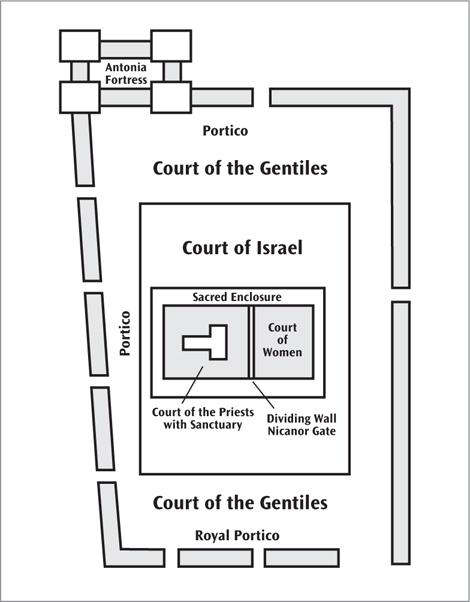
8:21. For the third time in John, Jesus explained He was going away (7:33; 8:14, 21). After Jesus’ death, these same Jewish leaders will seek for Him (see comment on 7:34). But they will die in their sin and come into eternal judgment. One has only until death to believe in Christ for eternal life (Heb 9:27).
8:22-23. The Jewish questioners rightly understood Jesus to be alluding to His death, but thought that He might kill Himself. Ironically, Jesus would not commit suicide but would willingly give up His life (10:11, 15, 18). Their origin explained their discrepancies with Jesus (v. 23): from below versus from above, and of this world (the natural, sinful, human realm) versus not of this world, but sent from the Father.
8:24. Twice in this verse, the Lord stated that those who remain in unbelief will die in their sins. For the unbeliever, nothing changes when he dies; he remains a sinner for eternity. The words I am He (ego eimi; “I Am”) contain terms peculiar to the Fourth Gospel and significant to Jesus’ explicit self-declaration of deity (see comments on vv. 28, 58). Some have objected that the phrase ego eimi is not referring to deity but has an implicit completion, such as, “if you do not believe I am who I claim to be” or “if you do not believe that I am not of this world but from above” you are still in your sins. However, these translations are unlikely since the sentence does not include a grammatical object. The alternative possibility, that Jesus was declaring his own deity, is far more likely.
The phrase ego eimi is probably not a reference to Ex 3:14 (I AM WHO I AM) because the LXX translates the phrase “I Am has sent me” with the Greek words ho on (“the Existing One has sent me”) rather than using ego eimi. More likely it is taken from the LXX’s consistent usage of ego eimi as the translation of ani hu (“I am He”), a phrase used for God’s self-disclosure in Isaiah (cf. Is 41:4; 43:10, 13, 25; 46:4; 48:12). For example in Is 43:10, the Lord says, “So that you may know and believe Me, and understand that I am He (ani hu).” Jesus applied the words of God’s self-identification in the OT to Himself.
8:25-26. Earlier His opponents asked, “Where is Your Father?” (v. 19). Now they ask, Who are You? Jesus answered, What have I been saying to you from the beginning? Other versions (NIV, ESV, HCSB) translate this as a declaration: “Just what I have been claiming all along.” The phrase to speak and to judge (v. 26) is best translated as a hendiadys, “I have many things to speak in judgment concerning you.”
8:27-28. While Jesus’ claims were enigmatic, the Jewish leaders should have comprehended them. Instead, they did not realize that He had been speaking to them about the Father who sent Him (v. 26). When you lift up the Son of Man (v. 28) presents another prophecy of His death on the cross. For “lifted up,” see comment on 3:14. Again, Jesus made an I am statement without a predicate (He is not in the Gk.). See comment on 4:26; 8:24. For I do nothing on My own initiative, see comment on 5:19, 30.
8:29-30. God never left Jesus alone because Jesus always did the things that were pleasing to the Father (4:34; 5:30; 6:38-40). Once again, Christ’s sinlessness is implied (vv. 7, 46; cf. 2Co 5:21; Heb 4:15). The words of Jesus (As He spoke these things) led many Jewish people (v. 30) to believe in Him (pisteuo eis, John’s unique phrase for genuine faith; 1:12; 3:16, 18, 36; 6:40; 11:25, 26).
8:31-32. Because of vv. 33-59, some think that the ones who believed (vv. 30-31) did not have true faith. But one must distinguish between the new believers and the crowd at large. John interjected that Jesus’ words were spoken only to those Jews who had believed Him (v. 31), not the resistant crowd in vv. 33-59. Eternal life is by faith alone, but being true disciples requires Christians to continue or “abide” in Christ’s teachings (see comments on 6:66; 15:1-5). As believers obey (v. 32), they will know the truth experientially, and this truth will make them free. This freedom concerns sanctification, not justification (cf. 17:17, 19). This liberation is not an intellectual accomplishment but a God-empowered freedom from sin, realized through an ongoing faith relationship with Jesus (v. 36).
8:33. They does not find its antecedent in vv. 30-32 but in the “they” of the preceding passage (vv. 19, 25, 27), the wider audience of unbelieving Jews (vv. 13, 22). Many Jews relied on their physical descent from Abraham. Despite the nation’s domination by Babylon, Persia, Greece, and Rome, the Jewish people thought of themselves as a free people, both politically and spiritually. But Jesus was speaking spiritually of freedom from sin.
8:34-36. Since everyone, apart from Christ, commits sin (Rm 3:10-19, 23), everyone is a slave of sin (2Pt 2:19; Rm 6:16, 20). Jesus illustrated this idea with an example from real life. Since a slave can be sold by his owner to another family, he does not remain in the household forever (v. 35). But a son does. Since Jesus is the Son of God, He can make one free (v. 36) in its true spiritual sense (free indeed), both from sin’s penalty (justification) and sin’s power (sanctification).
8:37-38. Jesus agreed to their claim that they were Abraham’s physical descendants. But they lacked Abraham’s faith (cf. Rm 4:12, 16). Instead, they were seeking to kill Jesus (see comment on 5:18). Christ’s word [had] no place in their spiritually rebellious hearts. He spoke the things which He had heard, but also had seen (v. 38) while with the Father (before His incarnation). Correspondingly, they did the things which they heard from their father (the devil, v. 44).
8:39-40. In light of Jesus’ reference to “your father” (v. 38), the Jewish leaders replied, Abraham is our father. In Jewish tradition, a “child” was considered metaphorically to be anyone who imitated another (cf. 1Pt 3:6). Jesus argued that Abraham’s true spiritual children would not be seeking to kill Him (v. 40; cf. v. 37). Jesus’ point appears to be that when Abraham heard truth from God, he embraced it. But the religious leaders, who heard God’s truth through Jesus, rejected it, even to the point of seeking to kill the Son.
8:41. Again (cf. v. 38), Christ spoke of your father without clarification (which awaits v. 44). That we were not born of fornication may be (1) a denial that they were illegitimate children of Abraham, or (2) a defamatory remark about Jesus’ birth. The “we” is emphatic in Greek and favors the second option (see comment on v. 48).
8:42-43. Since Jesus was the revelation of God, if God were their Father, they would love Jesus, the One who had come from God. Christ gave a further motive for loving Him: I have not even come on My own initiative, but He sent Me. To love Jesus was to love the Father who sent Him. Like these Jewish leaders, if people do not respond to Christ, they cannot hear and spiritually understand His word (v. 43).
8:44. Spiritually, one has either God or the devil as a Father. The devil was a murderer from the beginning of history. Satan incited Cain to kill his brother (Gn 4:8; 1Jn 3:12). More to the point, in the garden of Eden his lie (Gn 3:4-5) brought death to the whole human race (Rm 5:12). So Satan is the father (creator) of lies.
8:45-47. The minds of these Jewish leaders were so deceived that the truth was impossible for them to believe. Jesus spoke only the truth. Which one of you convicts Me of sin? He asked (v. 46). No sin or falsehood can be found in Christ. Since the one who is of God hears the words of God (v. 47), the resistance of the Jewish leaders proved they had failed as the leaders of Israel and were not of God. As Paul wrote, “a natural man [non-Christian] does not accept the things of the Spirit of God … he cannot understand them” (1Co 2:14).
8:48. Rather than answering Jesus’ questions, Jesus’ opponents responded again with disparagement, calling Jesus a Samaritan and declaring He had a demon (i.e., was insane, 10:20; cf. also 7:20; 8:52). The Jewish leaders associated Jesus with the Samaritans, who were regarded as illegitimate Jews (cf. v. 41). For “Samaritan,” see comment on 4:4. In their opinion, Jesus should be put to death for blasphemy against God (10:33, 36; Mt 9:3; 26:65). But in claiming Jesus had a demon, the Jewish leaders ironically committed blasphemy against the Holy Spirit (Mt 12:31; Mk 3:28-29).
8:49-51. After denying the charge of being demon-possessed, Jesus explained that He gave honor to His Father. But they were actually dishonoring the One (Jesus) who gave honor to the Father. Was this not contradictory? Christ was not seeking glory for Himself (v. 50). Yet, there is One who seeks Christ’s glory, and He judges on Christ’s behalf. With strong emotion (truly, truly), Jesus asserted (v. 51) that anyone who keeps His word (i.e., believes) will never see eternal death.
8:52-53. Misunderstanding Christ again, the Jewish opponents reasoned that Abraham and the prophets had died. So how could Jesus promise anyone he will never taste of [or experience] death? Jesus could not be greater than Abraham or the prophets, they reasoned (v. 53). Here another Johannine irony surfaces (cf. 4:12). Jesus was not just greater than Abraham and the prophets. He was their God!
8:54-55. Jesus denied that His claims were self-glorifying and pointed out their hypocrisy. It is My Father who glorifies Me, of whom you say, ‘He is our God.’ The clause (v. 55) you have not come to know [ginosko] Him, but I know [oida] Him uses two different Greek words for “know.” The first typically implies acquired knowledge; the second refers to knowledge without detailing how it was acquired. They had failed to gain true knowledge of the Father, but Christ already and always knew Him, probably because of His intimate fellowship with Him (cf. 1:18).
8:56-57. Abraham rejoiced at God’s promise that he would see the day of the Messiah. This took place when Abraham received the promise that through his offspring (i.e., the Messiah, Gl 3:16) “all the families of the earth will be blessed” (Gn 12:3; 17:17; 22:18). Then when Isaac was born 25 years later, Abraham saw Messiah, in that he anticipated the fulfillment of covenantal promise and looked for the coming of the Messiah and was glad. Abraham also witnessed, through the binding of Isaac, a foreshadowing of the death and resurrection of Christ (Heb 11:19).
8:58-59. The remark before Abraham was born, I am (not “I was”; ego eimi) makes a claim to deity and eternality (see comments on 4:26 and 8:24). The reaction of the Jewish leaders verifies that Jesus made a claim to deity. They picked up stones to throw at Him (v. 59), but Jesus hid Himself. Spiritually, the Jewish leadership was blind, and His departure from the temple pictured God’s OT glory departing from the temple (Ezk 10–11).
4. Healing of the Blind Man (9:1-40)
The preceding claim of Jesus to be the “light of the world” (8:12) is elaborated symbolically in the narrative of the blind man (cf. v. 5). Although the blind man had lived in darkness, his healing by Jesus made him able to see the light.
9:1-2. Jesus left the temple (8:59) and as He passed by, He saw a man blind from birth (cf. v. 12). Healing the blind was a characteristic sign of the Messiah (Mt 11:5; Lk 7:22). The disciples’ question (v. 2) who sinned, this man or his parents … ? shows they had adopted the mistaken theology that all illness was the result of personal sin or parental sin. A similar erroneous concept is found in the law of karma as taught in many Eastern religions. Nevertheless, the man’s physical blindness did picture every person’s spiritual blindness from birth (2Co 4:4).
9:3-5. The Lord corrected the disciples, establishing the truth that many disabilities are not the result of sin. In the sovereign plan of God, the man’s blindness allowed for the works of God to be displayed in him. This display of God’s works has been multiplied as millions have read this story through the centuries. Night is coming when no one can work (v. 4) refers to the time of the crucifixion, when the disciples will be scattered and Christ will neither teach nor do miracles. This is supported by Jesus’ remark While I am in the world, I am the Light of the world (v. 5).
9:6-7. In preparation for the healing, Jesus spat on the ground, and made clay of the spittle, and applied the clay to the blind man’s eyes. The making of clay (pelos) is central to the narrative (vv. 6, 11, 14-15). By putting the clay on his eyes, Christ symbolically claimed to be God the Potter (cf. Rm 9:21; cf. Jb 10:9; 33:6) who makes the seeing and the blind (Ex 4:11). Jesus previously presented Himself as the life-giving waters symbolized in the pool of Siloam (v. 7; see comment on 7:37). In addition, just as the man would cleanse his eyes in the Pool of Siloam (which means “Sent”), so also people will find spiritual cleansing and “sight” in the One who was sent (4:34; 5:23, 37; 7:28; 8:26). This miracle was an enacted symbol of Jesus’ saving mission.
9:8-9. The confusion over the identity of the blind beggar parallels the confusion of the crowds over the identity of Jesus. To identify himself (v. 9), the blind man kept saying, I am the one [ego eimi], the exact Greek phrase Jesus used (8:58) to identify Himself. If the listeners correctly recognized the blind man, they would open the door to see accurately the “I Am” who heals spiritual blindness.
9:10-12. If this was the former blind man, his sight demanded an explanation. The facts were straightforward (v. 11). The blind man knew the person who healed him was called Jesus, and that He made clay, and anointed his eyes. Then Jesus told him, Go to Siloam and wash. When he obeyed and washed, he received his sight. Few things are more convincing than a simple testimony of our personal encounter with Christ. Since he was blind at the time, the former blind man when questioned (v. 12) did not know where Jesus had gone.
9:13-14. Because of the unusual nature of the case, those acquainted with the beggar (v. 9) led him to the Pharisees (for Pharisees, see comment on 1:24). First, the blind man appeared before the Pharisees (vv. 13-17). Then his parents were interviewed (vv. 18-23). Finally, the blind man was questioned a second time (vv. 24-34). As in 5:9, John reported that the healing was done on the Sabbath (v. 14). In Jewish tradition, both healing one whose life was not threatened (m. Yoma 8:6) and kneading dough (m. Sabb. 7:2), and by analogy making clay were forbidden on the Sabbath.
9:15-17. Although the Pharisees would have been told the situation, they personally questioned the former blind man themselves, asking him again how he received his sight. They used the information gained from him to judge Jesus (v. 16): This man is not from God, because He does not keep the Sabbath. Like the people’s split over the healed man (cf. vv. 8-9), there was a division among the Pharisees over Jesus (7:12, 40-44; 10:20-21). But the debate served to advance the blind man’s understanding of his Healer. When asked (v. 17), he became convinced that Jesus was a prophet.
9:18-19. Rather than believe that Jesus was from God and had healed the blind man, the Pharisees doubted that the man had been blind at all and had received his sight. This was the case only until they called in his parents and questioned them. The questions (v. 19) reflected a hope on the part of the Pharisees that the situation was a case of mistaken identity. To discredit the healing was to discredit the character and identity of Jesus.