14:19-20a. Resembling a lynch mob, some Jewish people came from both Antioch and Iconium and stoned Paul. The wording of the text suggests that Paul was only unconscious and not killed, though the mob thought he was dead.
(6) Lystra to Derbe: A Favorable Reaction (14:20b-21a)
14:20b. Paul was no coward. After he regained consciousness, he went back into the city for the night. The next day he and Barnabas left for Derbe, which was about 60 miles away. Paul was not only courageous, he was also tough.
14:21. Luke gave only a capsule summary of Paul’s ministry in Derbe. He preached “the good news” and won a large number of disciples.
(7) Backtracking: Derbe Back through Lystra, Iconium, and Pisidian Antioch to Perga (14:21b-23)
The missionaries retraced their steps going to Lystra, Iconium, and Antioch in Pisidia.
14:22-23. Paul and Barnabas were strengthening and encouraging the new converts. Paul was brutally honest. He warned that following Christ would not be easy. Believers should expect verbal abuse and physical persecution (tribulations), but he encouraged them to be faithful. In 2Tm 3:12 Paul wrote, “In fact, everyone who wants to live a godly life in Christ Jesus will be persecuted.”
They appointed elders, the spiritual leaders in the early church. 1 Timothy 3 and Ti 1 give their qualifications. After committing the new believers to the Lord by prayer and fasting, they traveled through Pisidia, preached the word in Perga, and sailed from Attalia to Antioch in Syria.
(8) Perga to Attalia to Syrian Antioch: The Conclusion of the First Missionary Journey (14:24-28)
14:24-28. Their work was complete because independent churches had been established. They gave God the credit for what they accomplished and were particularly surprised at how God had opened a door of faith to the Gentiles.
Some of the more significant features of the first missionary journey encompassed the inclusion of Gentiles in the people of God. Almost by accident, the missionaries discovered God’s plan of redemption included Gentiles as well as Jews. Because the Holy Spirit directed the church to commission Paul and Barnabas, it was God himself who authorized the new missionary strategy of preaching the gospel to Gentiles, enabling them to come to Christ independent of Judaism—a policy that would be challenged and resolved at the Jerusalem Council.
2. The Council of Confirmation (15:1-35)
a. The Issue at Stake (15:1-6)
15:1-4. As a result of the first missionary journey, the conversion of Gentiles alarmed a group of Jewish traditionalists who insisted on circumcision as an essential part of maintaining one’s salvation experience. The issue was not about Gentile participation in the covenant people of God.
When a group of these traditionalists came from Judea to Antioch teaching that circumcision was essential for salvation, Paul and Barnabas correctly viewed this as a threat to God’s grace. After a heated debate with the protestors, Paul and Barnabas traveled to Jerusalem and requested that the church resolve the issue. The meeting on this issue was called “the Jerusalem Council.” Luke’s account of this extremely important council explains how the early church resolved the issue of the law for Gentile believers. There is an enormous debate regarding the relationship of the Jerusalem Council with the timing of the writing of Paul’s letter to the Galatians. It is not clear if Galatians was written before or after the Council. For these issues, see “Date” in the Introduction to Galatians. It is most likely that Galatians was written just prior to the Jerusalem council because Paul would likely have cited the decision of the council had it already happened.
15:5-6. Some men refers to those who belonged to “the party of the Pharisees” (cf. 15:5). It is not clear who these people from Judea were. They were Jewish people who may have been believing emissaries from the Jerusalem church who misrepresented the opinion of the apostles and the elders (vv. 5, 6), or they may have been false teachers with a Jewish background. However they are identified, they insisted that Gentile believers be circumcised and keep the other aspects of the law as befitting a member of God’s covenant people. They insisted that every Gentile become a Jew in order to be right with God. Because circumcision was the physical sign for identifying a person as a member of Israel (see Gn 17), the practice became the linchpin for adherence to the law of Moses. These Jews who advocated Gentile conversion to Judaism and obedience to the law were later rebuked as legalists in the epistle to the Galatians. Dissension and debate (v. 2) indicate that this was an enormously controversial issue, especially in light of Paul and Barnabas’s practice of not requiring circumcision and law-keeping for those Gentiles already won to Christ. Paul’s opponents understood Paul to be bringing a message that seemed to tell new followers of the Jewish Messiah that they need not obey God’s laws.
Paul’s concern was not primarily pragmatic, that adding circumcision to the gospel would hinder the success of the gospel. Rather, his concern was theological, that adding circumcision as a requiremen t would be adding works to the message of grace. Forcing Gentiles to submit to the law would distort the gospel of God’s grace into a message of grace mixed with works. Paul and Barnabas protested this teaching and were appointed with a delegation to go to Jerusalem to resolve the controversy. The controversy broached in 15:1 is expanded in v. 5 and addressed beginning in v. 7. Some of the sect of the Pharisees (v. 5) are identified as believers.
b. The Speeches (15:7-21)
(1) Peter: Declaration of the Facts (15:7-11)
15:7-11. In the report on his ministry to Cornelius (vv. 7-11), Peter identified the heart of the issue. Salvation is by grace made available through the work of the Lord Jesus, not through the works of the law (v. 11). Even the Gentiles, as seen in the case of Cornelius, received the Lord by faith, received the Spirit, spoke in tongues, and were baptized. How could anyone think that they were not genuinely right with God, even apart from the works required by the law of Moses?
(2) Barnabas and Paul: Authentication of the Facts (15:12)
15:12. Barnabas and Paul reported on their ministry to Gentiles, giving a supernatural perspective. God confirmed their ministry among the Gentiles with miraculous signs and wonders, just as He had through Peter with Cornelius’s household. See v. 8, which implies the miraculous manifestation of the giving of the Spirit to the Gentiles “just as He also did to us” (in Ac 2).
(3) James: Correlation with the Prophets (15:13-21)
15:13-21. James related the issue to God’s comprehensive plan of redemption with a quotation from Am 9:11-15. James did, however, refer to the Prophets (v.15), and while he cited only Am 9, other passages from the prophets forecast the inclusion of Gentiles as Gentiles (not “as Jews”) among God’s people (e.g., Is 2:2; 45:20-23; Jr 12:15-16; Hs 3:4-5; Zch 2:11; 8:22; and see Paul’s citations of other texts on the theme of the inclusion of Gentiles in Rm 15:8-13; see the comments there). The rebuilding of David’s dynasty refers to the promises God made to David (2Sm 7) and to Abraham (Gn 12:1-3), promises that had an initial, partial fulfillment in the wake of the death, resurrection, and ascension of Jesus, and the spread of the gospel, all of which signaled the presence of “messianic days.” James’s citation of Amos is primarily about the inclusion of Gentiles among the people of God without their having to become Jewish, not about the restoration of David’s kingdom in and through the church (as covenant theologians argue). Robert L. Saucy (The Case for Progressive Dispensationalism: The Interface Between Dispensational and Non-Dispensational Theology [Grand Rapids, MI: Zondervan, 1993], 79) writes, “Amos looked forward to the times of the Messiah, which included the salvation of Gentiles without their becoming part of Israel. These times have arrived with Jesus, and the new work of God indicates that salvation is going out to the gentiles apart from keeping the law.” Amos had prophesied the future salvation of Gentiles as part of God’s program of redemption. God’s plan is for THE REST OF MANKIND to SEEK, not only for Jews.
James’s perspective drew less upon the practical experiences reported by Peter, Paul, and Barnabas and more upon the teaching of the OT prophets. If God’s redemptive purposes included Gentiles, then the Jewish believers should not have erected barriers to their inclusion among God’s covenant people. He recommended that the council reject the view of the legalists and not impose the law on Gentiles.
c. The Letter to Gentile Churches (15:22-35)
15:22-35. James also recommended the council send a letter to the Gentiles asking them to refrain from practices especially offensive to Jews (15:2-21). The council asked Gentiles to abstain from (1) things sacrificed to idols; (2) fornication; and (3) eating meat that has been strangled or has large amounts of blood in it.
The request for Gentile abstinence raises questions about the nature of these restrictions. Were the restrictions essentially a reiteration of the ceremonial aspects of the law of Moses? If they were, then the council was contradicting its decision not to impose the law on Gentiles. The best solution is to relate the restrictions to the cultic worship in pagan temples where worshipers would strangle animals, cut their jugular veins to drink their blood, eat the meat that had been offered to idols and conclude with temple prostitution. This interpretation is consistent with Paul’s teaching to the Corinthians about participating in idol worship (1 Co 10:14-22). The intent was to prevent the syncretism of paganism and the new faith. Although Gentiles did not need to convert to Judaism, they were required to leave pagan idol worship (cf. 1Th 1:9). This would preserve the testimony of the church among Jewish people, where the Torah and its strict prescriptions against idolatry are “read in the synagogues every Sabbath” (15:21).
The decision was important for three reasons. First, by not requiring Gentiles to convert to Judaism it protected the doctrine of salvation by grace through faith alone. Second, it preserved the purity of the church so that paganism would not be blended with the true faith. Third, the messianic faith, by not tolerating idolatry, set an important precedent of maintaining the messianic faith’s testimony before Jewish people.
The wisdom of the decision was reflected in the response of the Gentile church at Antioch. When Paul and Barnabas, along with two respected men from the Jerusalem church, Judas and Silas, read the letter to the church at Antioch, the believers rejoiced. The potentially divisive issue of the law had been officially resolved and unity was preserved.
Judas and Silas ministered to the Gentile church with a message that strengthened them in their faith, and then they returned to Jerusalem (v. 34 is omitted in many manuscripts). Paul and Barnabas remained in Antioch teaching the word of the Lord. The two continued their ministry among Gentiles unhindered by the dispute over the law of Moses.
D. To the Aegean Area: The Second Missionary Journey (15:36–18:22)
1. The Selection of the Team (15:36–16:3)
15:36-16:3. Paul and Barnabas decided to revisit the churches started on the first journey, but they disagreed on whether or not to take John Mark. Perhaps, because they were cousins, Barnabas wanted to take him. This is perfectly in keeping with Barnabas’s nature as “the son of encouragement,” that he would want to afford John Mark another opportunity. But Paul objected. The mention that Mark had deserted them on the first journey supports Paul’s view. This was a serious disagreement and not merely a difference of opinion. The expression sharp disagreement (paroxysmos) means “a state of irritation expressed in argument” (BDAG, 780). Both men vigorously defended their positions, leading to a separation of Paul and Barnabas. As promised in Rm 8:28, God brought good out of this disagreement. There were now two strong missionary teams instead of one!
Though Barnabas and Mark are not mentioned again in the book of Acts, Paul later spoke positively of Barnabas (1Co 9:6, Col 4:10), and also of Mark (2Tm 4:11).
The circumcision of Timothy (16:1-3) showed that the decision of the Jerusalem council was limited to Gentiles not being circumcised, not Jews. Timothy’s mother was Jewish, so Timothy should have been circumcised as an outward sign of the Abrahamic covenant (Gn 17:9-14). By requiring Timothy to submit to circumcision, Paul avoided offending Jews for the purpose of ministry and recognized the continuation of the Abrahamic covenant for Jewish believers.
Paul’s action here seems to contradict his position in Gl 2:3-5. He adamantly refused to allow for the circumcision of Titus; however, these two situations are different. Timothy was a Jew, but Gl 2:3 describes Titus as a Greek. So he was a Gentile, for whom circumcision would have been inappropriate and brought into question justification by faith alone. Paul had Timothy circumcised not as a precondition for salvation but as an outward sign of the Abrahamic covenant. Paul would never compromise the gospel, but he did compromise on lifestyle issues for the sake of effectiveness in ministry. Paul was willing to become all things to all men in order that he might win some (1Co 9:9-23). Moreover, Paul would have expected a Jewish believer like Timothy to maintain the outward sign of God’s covenant relationship with Israel.
Paul continued his ministry of strengthening the churches by informing believers in Derbe and Lystra of the decision of the Jerusalem council. The wisdom of the council’s decision about the law of Moses and Paul’s decision to circumcise Timothy were reinforced in the positive response of the churches and their growth.
2. The Leading into Europe (16:4-10)
16:4-5. In the first journey, Luke focused on the Lord’s sovereignty in opening the door of faith to a new group of people—the Gentiles. In his account of the second (AD 51–52) and third (AD 53–56) missionary journeys, Luke showed the sovereignty of the Spirit in directing Paul and his companions into new geographical locations. Note that Luke did not make a sharp distinction between the second and third journeys. He began his account of the third journey almost incidentally in 18:23.
Paul’s Second Missionary Journey
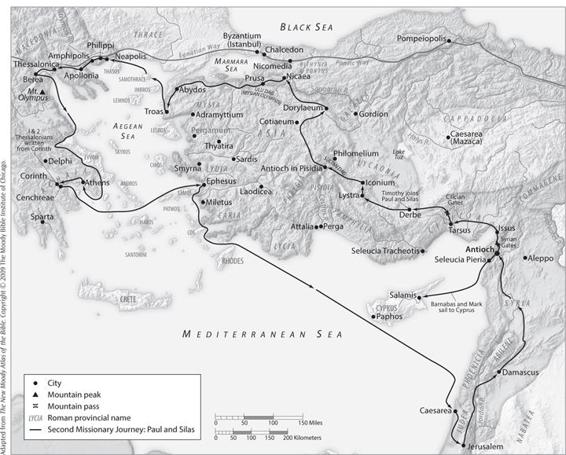
Acts 16:6-10 explains how Paul and his companions decided to preach the gospel in Macedonia. This was one of Paul’s most strategic decisions because it resulted in the spread of the church westward to the continent of Europe.
16:6. Paul intended to minister in Asia, probably Ephesus after he revisited the churches planted on the first journey in Phrygia and Galatia, but the Holy Spirit prevented Paul and his companions from entering Asia. Luke did not tell us how, but it is obvious that He had a different plan for the missionaries.
16:7-8. Instead of turning back, Paul turned north, but again the Spirit of Jesus prevented him from entering Bithynia. Paul turned west and traveled through Mysia to Troas. The change from Holy Spirit to the Spirit of Jesus reflects the early church’s understanding of the deity of Jesus. Troas was located on the northwestern coast of Asia Minor or what is now part of Turkey. It was a coastal city and a departure point for Greece.
16:9-10. At Troas, in a vision, Paul saw a man of Macedonia summoning him to come to Macedonia. Paul could not have anticipated the importance of his response to the Macedonian vision. The vision marked a major turning point in the history of the church. Paul’s obedient response to God’s call caused the gospel to move westward and so to bridge two continents, Asia and Europe, positioning the new faith to become universal.
Longenecker reminds that the believer’s response to the call of God is never a trivial matter. “Indeed as in this instance, great issues and untold blessings may depend on it” (“Acts,” 458). It may be to go across the street, across the country, or around the world. The eternal destinies of men and women may depend on our openness and willingness to obey the Spirit’s promptings and move out of our comfort zones.
3. The Witness at Philippi (16:11-40)
In 16:11-40, Luke recorded that Paul began his Aegean campaign in Philippi, a strategic city on Egnatian Way (a major east-west road in the Roman Empire).
16:11-15. The missionaries sailed from Troas to Samothrace (an island approximately halfway to Neapolis) and then to Neapolis (a seaport 10 miles from Philippi). At some point, Luke joined Paul and Silas, which is indicated by the plural pronoun we.
Philippi was named after Philip II, father of Alexander the Great, in about 356 BC, and had developed into a major city in the province of Macedonia. Under Roman rule it was a senatorial rather than imperial province, so the city had elected magistrates (see vv. 20, 22, 35-38).
On the Sabbath, the missionaries went to a place of prayer. Apparently the Jewish community was small, and there was only a place of prayer rather than a synagogue (some think the place of prayer was in a synagogue). Women were present for prayer. Though participation in worship was limited, women were permitted to pray. While Paul was speaking to the women, the Lord opened the heart of Lydia to respond to the gospel. Lydia is identified as a businesswoman from Thyatira who sold purple fabrics, which was the color of royalty and the rich. Purple cloth was extremely expensive because of the difficulty of producing the dye, which was made from mollusks (shellfish). Her name indicates she was a Gentile, so she was most likely a God-fearer (a Gentile who believed in God and followed the moral and ethical teachings of Judaism but was not a full convert). She was apparently single, perhaps a widow, since she was the head of her household, and they followed her lead in responding to the gospel. The evidence that Lydia’s conversion was genuine was her offer of hospitality to the apostolic band. As did Peter (see 10:48), Paul and his companions stayed in the home of a Gentile convert.
16:16-18. On a subsequent Sabbath, Paul was confronted by a slave girl with a spirit of divination. A spirit of divination (lit., a “spirit of python,” pythona) means “demon possessed.” The “python” was a mythical serpent or dragon that guarded the Delphic oracle. The “python” was supposedly killed by Apollo, but according to the legend “the spirit of the python” lived on, enabling those it possessed the ability to predict the future. The girl was not only demon possessed, she was a slave and exploited by her owners for profit.
Following Paul and his companions she repeatedly identified them as bond-servants of the Most High God. Paul objected for two reasons. First, though her statement was true, in a polytheistic culture it did not mean she recognized them as messengers of the only true God. Second, Paul did not want anyone to think that he was complicit in her magical or demonic powers.
Her constant tirade annoyed Paul, so he used his apostolic authority to deliver the girl from demon possession. He did this in the name of Jesus, giving evidence of the superiority of Jesus over demonic powers. She was delivered from the demonization, but her conversion was implied though not explicitly mentioned in the text.
16:19-24. Her owners were not happy about her conversion because it meant a loss of income. They seized Paul and Silas and accused them of disturbing the peace. The meaning of the charge about the violation of Roman customs (v. 21) is not clear. It was undoubtedly related to the loss of income and probably the fact that the religion of Rome was inclusive in contrast to Christianity, which is exclusive. If Paul and Silas were allowed to continue their ministry, it could affect the economy of Philippi and Rome’s policy of religious toleration.
The magistrates arrested and punished Paul and Silas without a fair trial. They were flogged with rods (not the harsher whips with pieces of bone or metal) and imprisoned. The punishment would have involved being publicly stripped and caned. Under Roman law, however, Roman citizens were not to be beaten or whipped (see Cicero, In Verrem 5.62). It is unclear why Paul did not here invoke this privilege since he was a Roman citizen by birth, but it is possible that he may not have been given the chance.
16:25-26. In the middle of the night (about midnight) while Paul and Silas were praying and singing, they were miraculously set free. Instead of sending an angel as He did to free Peter, God used an earthquake. Though an earthquake is a natural phenomenon, God was the efficient cause behind the event.
16:27-30. The earthquake woke the jailer; and when he saw the prison doors were open, he assumed the prisoners had escaped. Since he was responsible for the security of the prisoners, he prepared to take his own life rather than risk execution. It was Roman law to execute the guard who allowed a prisoner to escape.
The jailer could not have been more surprised by what he discovered. Instead of escaping as the apostles did in Ac 5 and 12, Paul, Silas, and all the other prisoners stayed put. Seeing that the jailer was about to take his life, Paul cried out with a loud voice, saying, “Do not harm yourself for we are all here!”
The jailer fell on his knees before Paul and Silas in fear, not worship. He called them Sirs (lit., “lords”), concluding they were undoubtedly divine men. The question he asked was not to save his life, Sirs, what must I do to be saved? He already knew the prisoners had not escaped. Most likely he heard enough of the gospel message from the disruptive but accurate words of the slave girl (Longenecker, “Acts,” 465), or perhaps from the missionaries following their incarceration, to recognize his spiritual need.
16:31. His cry for salvation (16:30) and Paul’s quick and concise answer captured the essence of the proper response to the gospel: Believe in the Lord Jesus, and you will be saved, you and your household. Paul urged the jailer to place his complete dependence upon the Lord Jesus for deliverance from the consequences of his sin. And your household does not mean that when he gets saved his household is automatically saved. The statement means that if he believed, and if his whole household believed, they would all be saved.
16:32-34. The jailer’s household was saved because they also believed, suggesting that his household consisted of those who were of sufficient age to exercise faith in Christ, and that infants were not among those baptized. All were immediately baptized after they believed. Though baptism does not save, it symbolizes cleansing from sin and is a further step of submission to the Lord. Luke presented twofold evidence of the authenticity of their faith. One, they opened their home to Paul and Silas. Two, they experienced the gift of joy; they rejoiced greatly.
16:35-40. The officials wanted to get Paul and Silas out of town quickly and quietly since the officials themselves had violated Roman law by arresting and punishing them without a trial. Paul, however, was not willing to allow these administrators to simply dismiss the issue. Since they had been publicly punished, Paul used the leverage of his Roman citizenship to force the officials to admit publicly that they had misused their authority.
Paul did not use his citizenship to “get even.” He forced the officials to admit their error to protect the new faith from becoming an unauthorized or unfavorable religious movement. Paul also met with the believers at Lydia’s house to encourage them before leaving. He probably assured them that the officials would not punish them because of their faith in Christ.
The converts at Philippi were all completely different. Lydia was a successful businesswoman. The demon-possessed girl was a slave being exploited for profit. The Philippian jailer was a cog in the Roman machinery, afraid of losing his life. The conversion of these three individuals from culturally and economically diverse backgrounds is a testimony to the universal appeal and power of the gospel.
In this current time of social and ethnic diversity, believers also need to set an example of the power of Christ to unite rather than divide people by proclaiming the gospel to all people.
Luke, in 17:1-9, has given us only a brief summary of Paul’s ministry in Thessalonica. Paul attempted to minister in the synagogue, but was forced to flee to Berea because of Jewish opposition. The courage Paul and his team showed was remarkable. After enduring the abuse in Philippi, they then walked about 70 miles to Thessalonica to continue their missionary endeavors, but with the wounds on their bodies not yet healed from the beating.
4. The Witness at Thessalonica (17:1-9)
17:1. From Philippi, Paul traveled along the Egnatian Way to Thessalonica. It was a free city with its own elected officials (v. 6) and the capital of Macedonia. The city was founded by Cassander, one of the rulers of Macedon after Alexander the Great’s death, in 315 BC and named after his wife, daughter of Philip II and half-sister of Alexander the Great. At the time of Paul’s visit, the population may have been as high as 100,000.
Paul considered Thessalonica a strategic location for preaching the gospel. The “good news” could spread east and west on the Egnatian Way, plus the synagogue in the city provided a point of contact for explaining how Christ’s life, death, and resurrection fulfilled Scripture.
17:2-3. Paul followed his personal strategy (custom) for ministry by going first to the synagogue. Though he had faced opposition from his Jewish countrymen on the first missionary journey, Paul remained committed to the strategy of proclaiming the gospel first to the Jews and then to the Gentiles (cf. comments at 13:46-48 and Rm 1:16). It was a wise strategy. His most effective ministry would have come from sharing the gospel with those whose backgrounds included knowledge of the Hebrew Scriptures and the concept of the Messiah, namely Jewish people and Gentile God-fearers.
Paul appealed to the OT to support his message that Jesus is the Messiah. It is not clear whether the reference to three Sabbaths means that Paul was only in Thessalonica for three weeks or that his ministry in the synagogue was for three consecutive weeks. The fruit of his ministry suggests the latter, so that he conducted his outreach even after the three weeks in the synagogue ceased. In either case he was obviously in the city long enough to organize a church.
Luke did not explain how Paul made his case, but his summary of Paul’s preaching gives us the core message of the early church. First, Jesus’ suffering and death was not a tragic and unexpected turn of events. The OT predicted both the suffering and resurrection of the Messiah. Second, this Jesus who rose from the dead is Israel’s promised Messiah.
17:4. Though some Jews believed, Paul’s greatest success was with Gentiles. Among the converts were a number of the leading women, most likely the wives of some of the city officials.
17:5-7. Some Jewish leaders became jealous. They resented that Paul persuaded Jewish people, Gentiles, and even women to become believers. They incited a mob that went to Jason’s house in search of Paul and his companions. Unable to find Paul, they dragged Jason and other new believers before the city officials.
The charges were serious. One, they accused them of political agitation. Upsetting the world is hyperbole, but it does suggest that this new faith made a significant impact on the Roman Empire. Perhaps they had heard reports about Paul’s arrest at Philippi. Two, they were defying Caesar’s decrees by claiming that Christ is a king. Claiming that Jesus is an emperor rivaling Caesar was a capital offense. If the apostles had proclaimed Christ as king, they were talking about a different kind of kingdom. We know from the epistles to the Thessalonians that Paul emphasized Jesus’ second coming. Perhaps he had spoken about the future messianic kingdom. The charges were civil and political rather than religious because the Jewish leaders knew that the Romans would ignore religious issues but take strong action against anyone causing a civil disturbance or advocating a revolt.
17:8-9. The agitators were successful. The city officials required Jason and the others to post bail (pledge). Jason was apparently a leader in the Thessalonian synagogue who trusted Christ under Paul’s ministry. He was probably affluent since his house was substantial enough to host the congregation and house Paul and his team, and Jason more than likely became the leader of the church after Paul left. The traditional view is that “the bond” was collateral guaranteeing Paul would not return to Thessalonica during the administration of the current officials, but it is equally possible that Jason and the other members of the newly founded congregation (they, indicating others than strictly Paul) were also implicated in the unrest and posted a bond for themselves. The bail bond may have been the satanic barrier that Paul said prevented from him from returning to Thessalonica (see 1Th 2:17-18).
Paul’s ministry at Thessalonica emphasized that Paul based his message that Jesus was the Messiah on the OT and presented the evidence in a logical and persuasive format. He did not attempt to manipulate or trick people to become believers, as he explained in 1Th 2:1-4.
5. The Witness at Berea (17:10-15)
17:10. To avoid further trouble, the believers sent Paul and Silas to Berea under the cover of darkness. When Paul arrived in Berea, which was about 45 miles southwest of Thessalonica, he went immediately to the synagogue.
17:11. Paul could not have known that the Bereans would become a model for how to study the Bible. Luke gave a threefold description of the Bereans’ response to Paul’s preaching. First, they approached Paul’s teaching with some open-mindedness. The expression more noble-minded than the Thessalonians means that the Bereans were objective in their evaluation of Paul’s message. They judged his message by the standard of Scripture rather than their preconceived prejudices. Second, they also received the Scriptures with great eagerness. They had an appetite to learn. Finally, they examined the Scriptures daily, to see whether these things were so. They carefully evaluated Paul’s message to determine for themselves if it was true.
17:12-15. The response was similar to what happened in Thessalonica. Many, including, women and men of high social and political standing, believed.
But not everyone was pleased about Paul’s preaching the gospel. When the same Jewish leaders from Thessalonica discovered that Paul was preaching the word of God in Berea, they took action to stop him. Luke’s reference to the Scriptures (v. 11) and to Paul’s message as the word of God confirmed that the gospel had a divine origin (cf. 13:5; 15:35; 16:32). Paul made the same claim in defending his gospel to the Galatians. The gospel was not his own creation; he received it directly from the Lord (Gl 1:11-17).
The Jewish opponents from Thessalonica incited opposition, forcing Paul to go to Athens, leaving Silas and Timothy behind in Berea. It is not clear whether Paul took a ship to Athens, which was the normal means of travel in and out of that city, or went overland.
6. The Witness at Athens (17:16-34)
At Athens Paul faced the blind wisdom of pagan philosophers. Paul was alone but not intimidated because he was zealous for the honor of God and confident of the power of his gospel message.
17:16. Paul’s first observation was distressing. Being provoked is the verb paroxuno, “greatly disturbed,” suggests that Paul was incited to jealousy for the Lord because of the pervasiveness of idolatry. Instead of worshiping the Lord as the only true God, the Athenians were bowing down to lifeless idols. It was this inward anger that motivated Paul to proclaim Christ.
17:17. He preached in the synagogue and the marketplace to anyone who would listen. It is obvious that Paul believed that Jesus Christ was unique and that those who worshiped other gods needed to turn to the living God.
17:18. Paul confronted two of the more popular philosophies in the Roman Empire, Epicureanism and Stoicism. The Epicureans believed in pursuing a life free from pain. They held to the existence of the gods, but thought that the gods were completely detached from humanity, as any interaction with people would disturb them and, true to Epicurean doctrine, the gods had a blessed and undisturbed existence. Epicureans believed the soul was material, though composed of finer atoms than the body, and would deteriorate upon death. There was thus no room for the theory of an afterlife. Because they prized an imperturbable life, they rejected the idea that one could anger the gods or face punishment or judgment from them since those concepts would disturb one’s thoughts and disrupt life—which explains their strong reaction to Paul’s mention of the resurrection and future judgment. It is misleading to call them hedonists in the modern sense. Their concept of pleasure involved avoidance of disturbances in life rather than crass self-indulgence. The pursuits of wanton amusements could be counterproductive to a happy life (for a summary of Epicureanism as it intersected with Ac 17, see N. Clayton Croy, “Hellenistic Philosophies and the Preaching of the Resurrection [Acts 17:18, 32],” Novum Testamentum 39 [1997], 21–39). The founder of Stoicism was Zeno (342–270 B.C., from Cyprus). Stoics believed that God permeated all things, and that what was rational in humankind was the manifestation of God. Theologically they would be considered pantheists. According to Stoics, Reason or the Logos controlled the universe, but people were responsible for their voluntary actions. They rejected the Epicurean philosophy of pleasure and instead stressed virtue.
17:18. After conversing with Paul, the Epicureans and Stoics concluded he was a babbler and proclaimer of strange deities. Babbler refers to someone who picks up bits and pieces of information and then proclaims them as if he were an expert on the topic (Bock, Acts, 561–62). The charge Paul was a teacher of strange deities meant he was talking about gods they did not understand.
17:19-21. They took Paul to the Areopagus, the place where the Athenians discussed ideas of mutual interest. He was not arrested, but given the opportunity to give them more information about what he believed. Luke did not specify what caught their interest. He said only that from their perspective it was a new teaching and strange things. Luke’s editorial comment in v. 21 implies the Athenians wasted a lot of time in useless discussions about irrelevant issues.
17:22-23. Paul’s introductory comment that the Athenians were very religious was a commendation rather than a criticism, since he hoped to convince his audience to listen to his message. He connected with the Athenians by referring to an altar erected TO AN UNKNOWN GOD. It is probable there was more than one altar to an unknown god in Athens, but Paul influenced his audience with this comment to have them focus on one God by referring to only one altar (Bock, Acts, 565). Paul proceeded to make known the god they worshiped but by their own admission did not know.
17:24-26. Paul began with creation. God is the creator of everything that exists and is transcendent (17:24-25). He does not dwell in man-made temples and is independent. He is the source and sustainer of life (17:26-29). Paul alluded to Adam as the single source of humanity in the statement, He made from one man every nation of mankind. Because He is creator, God is sovereign. He controls history (or possibly seasons) and national boundaries (appointed times, and the boundaries of their habitation). Genesis 10–11 may have been the OT background for Paul’s comment, but he did not explicitly cite it since it would have minimal significance for Greek philosophers.
17:27-31. In v. 27 Paul revealed the point of his observations about God in vv. 23-26. As the sovereign creator, God intends for men and women to seek him. The verbs grope and find are in the optative mood, which suggests finding God through human effort is only a remote possibility. The word picture suggested by grope is a blind man fumbling around to find his way (Bock, Acts, 567). This implies that, though God is near, it is highly unlikely the Athenians would find Him because their strategy was flawed. While a considerable amount about God can be apprehended from an objective consideration of creation (cf. the comments on Rm 1:18-32), Paul would make it clear that full comprehension of God requires the augmenting truth of the gospel, the proper response of repentance, and recognition of the validity of the resurrection and authority of Jesus Christ (cf. Paul’s concluding words in vv. 30-31). Without these additional elements, God will not be found.
The statement in Him (God) we live and move and exist (v. 28) probably comes from the Greek poet Epimenides (philosopher, poet, and seer from Crete, c. 600 BC), in a poem entitled Cretica. The same poem is quoted in Ti 1:12. The reference to children of God is an allusion to a statement by another Stoic poet, Aratus. This is not pantheism. Paul argued that if men and women are living beings made in the image of God, then God is a living being. He is not a man-made object of wood or stone (v. 29). These two references to Greek poets do not mean Paul endorsed their view of God, but he had no qualms about using pagan poets to support his argument if some of what they had written coincided with revealed truth.
Having established common ground with the Athenians, Paul stressed the need for them to repent in view of coming judgment. Therefore having overlooked the times of ignorance (v. 30) does not mean ignorance is excusable. God’s mercy was the reason that in the past He did not usually pass judgment in this life on mankind even though they deserved it. In other words, He did not always bring temporal destruction upon an idolatrous people as an act of judgment for their sin. Now, however, because they knew about God, they could plead ignorance. If they refused to repent, they would suffer eternal punishment. In speaking to Gentiles, the call to repent means to turn from lifeless idols to faith in the living God (1Th 1:9). Polhill writes, “The times of forbearance had now ended because their ignorance had now ended. Now they knew the one true God through Paul’s proclamation. He was no longer an ‘unknown God’; and should they continue in their false worship and fail to acknowledge his sole lordship of heaven and earth, their sin would no longer be a sin of ignorance but a high-handed sin” (Acts, 376).
Paul did not mention Jesus Christ by name, but declared the resurrection proved He has the authority to judge. Though Paul did not give the exact time of judgment, it is on a fixed day, meaning it is certain. That Jesus will judge the world in righteousness means that his judgment will be just.
17:32-34. The response was divided. Most ridiculed the idea of resurrection, but a few became believers. The prevailing view of death among the Greeks was either the complete extinction of the body and soul or a temporal survival of the soul after death. Neither the Epicureans nor the Stoics believed in immortality, thus they not only rejected Paul’s message but also mocked (sneer) him. For more on the common Greco-Roman view of death, see the comments at 1Co 15:12.
Paul’s ministry, however, was not a complete failure—some men joined him and believed (v. 34). Luke identified two of the believers by name, Dionysius the Aeropagite and a woman named Damaris. Nothing for certain is known about these two individuals. Providing the names of two individuals gives credibility to Luke’s account and is consistent with Luke’s emphasis on the place of women in the life of Jesus and the early church.
Some have criticized Paul for his ministry at Athens. They appeal to 1Co 1:18-25 and claim Paul confessed he made a mistake. He focused on natural theology and Greek philosophy, not special revelation and the cross. This evaluation is too harsh. Some did become believers. Those who refused to believe rejected Paul and his statement about the resurrection not because he erred in attempting to contextualize his message.
Two truths emerge from Paul’s ministry at Athens. First, Paul believed in the uniqueness of Christ and the gospel. People will not find Christ by following their felt needs. They will “grope” in darkness. People will find Christ only in the “gospel.” Second, not only here but also in other locations where Luke has given us a summary of Paul’s preaching, it is plain that he contextualized his message to reach his audience. Paul did not water down or corrupt the gospel, but he did attempt to proclaim the good news in the cultural and historical context of the people he wanted to bring to Christ. His refusal to dilute his message is seen in vv. 30-31. Paul must have known that his words would be a direct affront to the Epicureans who denied eternal life and future judgment, and to the Stoics who denied the transcendence of God. Contextualization is important in spreading the gospel, but doctrinal truth must not be sacrificed upon the altar of cultural relevance.
When he left Athens, Paul went to Corinth, 40 miles west of Athens. Corinth’s location on the narrow isthmus that connected the mainland with the south caused it to be “the marketplace of Greece.” Paul’s ministry in Corinth extended from the spring of 50 AD to the fall of 52, and the mention of Gallio in 18:12-17 helps to provide one of the clearest and most unassailable historical markers for the whole book of Acts (see the comments below).
7. The Witness at Corinth (18:1-17)
18:1. Corinth was infamous for more than its commerce. It was a city of great wickedness. The Acropolis, a high hill about a mile from the city center, dominated Corinth, and the temple of Aphrodite had been built on the Acrocorinth. At one time a thousand cultic priestesses served in the temple as sacred prostitutes and came into the city in the evening to sell sexual services. This was not the case of “New Corinth,” Corinth as it existed in Paul’s day, though it was morally corrupt for numerous other reasons during the first century (see the Introduction to the commentary on 1 Corinthians). Barclay quotes a Greek proverb that reads, “Not every man can afford a journey to Corinth” (William Barclay, The Acts of the Apostles [Daily Study Bible], Philadelphia: Westminster, 1955, 145). Yet in Corinth, Paul witnessesd the triumph of God’s grace over greed and lust. For more on the background and location of Corinth, see the “The City of Corinth” in the Introduction to the commentary on 1 Corinthians.
18:2-3. Paul sometimes worked as a tent-maker to support himself (1Th 2:9), so it is not surprising that he met Aquila and Priscilla, who were also Jewish and tent-makers. They had been forced to leave Rome because of the edict of Claudius, issued in AD 49, expelling all Jews (whether believers or not) from Rome for causing a civil disturbance because of their dispute about Jesus.
18:4-6. Paul began his ministry in the synagogue proclaiming the gospel first to his own people. When Silas and Timothy arrived with support from the Macedonian churches Paul was able to devot[e] himself full time to ministry. Paul also wrote 1 Thessalonians in response to the report Timothy brought about the new church (see the Introduction to 1 Thessalonians, and the comments on 1Th 3:6).
Intense opposition forced Paul to abandon his ministry in the synagogue. In a symbolic gesture, Paul shook the dust off his clothes. This was a common practice among the Jews who, when returning to their home from a journey, would often knock dust off their sandals and clothes. They did this to remove any “unclean” substances that might have been picked up in Gentile lands so as to avoid rendering their homes or villages ritually impure. Paul declared the Jews were responsible for their own fate: Your blood be upon your own heads! (cf. Ezk 3:14-21). Their opposition justified his ministry to Gentiles (but see the comments on Rm 11:13-14).
18:7-8. Instead of leaving Corinth, Paul relocated his ministry to the house of Titius Justus, a god-fearer. He made his home available for Paul to continue his ministry. God honored Paul’s courage and persistence. Crispus, the synagogue ruler, and his household were among many of the Corinthians who believed and were baptized.
18:9-11. Paul was human, not a superhero. In Corinth, he was almost overcome with fear. In his Epistle to the Corinthians, Paul wrote, “I was with you in a weakness and in fear and in much trembling” (1Co 2:3). The Lord spoke to Paul in a vision and made two promises. He promised him divine protection: I am with you. Paul would not be beaten as he was at Philippi. I have many people in this city is a promise that Christ would bring people to salvation. Paul obeyed. He preached the Word of God in Corinth for 18 months, longer than in any other city on his second journey.
18:12-13. Some Jewish opponents from the synagogue attempted to disrupt Paul’s ministry by charging that he was violating the law. He was arraigned before the proconsul Gallio and brought before the judgment seat (bema) for a hearing. The Gallio episode provides one of the strongest chronological markers for students of Acts, and lends credibility to Luke’s accuracy as an historian. Gallio, born in southern Spain, was governor of Achaia for about 18 months around AD 51–52. He was the brother of the famous statesman and philosopher Seneca, and was in his own right a highly respected legal expert. His decision was both enormously important for the spread of Christianity and respected in secular political realms. The judgment seat was an elevated platform in the market at Corinth used for public hearings. It was where a political or judicial leader would sit to render a verdict in a case he had overseen.
The charge was apparently religious in nature. In the statement, this man persuades [better “seduces,” “misleads,” LSJ, 115] men to worship God contrary to the law, the word law probably refers to the law of Moses, since, if Paul were accused or guilty of violating Roman law, Gallio would not have refused to act on the accusation as he did here.
18:14-15. Gallio’s decision was extremely significant. He concluded the complaint was religious and not political, and ruled the charges were unwarranted. What Paul was doing was not a wrong (“a felony”) or a vicious crime (“a political misdemeanor”; for these definitions, see Bruce W. Winter, After Paul Left Corinth: The Influence of Secular Ethics and Social Change [Grand Rapids, MI: Eerdmans, 2001], 279).
Though Judaism enjoyed legal status under Roman law, Rome had not made a decision about this new faith that was springing from Judaism. The Roman policy toward Judaism was to afford the Jewish people considerable autonomy, something the Jews insisted upon to avoid Roman interference. Gallio acted on the basis of this policy in this situation. Gallio’s decision emphasized that he, and thus Rome, would view nascent Christianity as a subset of Judaism. Consequently, any disputes between Jewish unbelievers and Jewish or Gentile believers should be handled as an internal dispute between the two factions; Rome would not become involved.
18:16-17. He ordered the crowd to disperse. Angered by Gallio’s decision, the Jewish opposition resorted to violence. They assaulted Sosthenes. He may have been the believing Sosthenes in 1Co 1:1, but it was a common name so it may not have been the same man. It is impossible to say exactly who beat him and why. If this Sosthenes was a believer, then he could have recently become a believer in Jesus, and the Jewish opponents were taking out on him their frustration. Or, it could be that Sosthenes, the new leader of the synagogue who took the place of Crispus following his faith in Christ (cf. v. 8), was spearheading the case against Paul and failed so miserably that his Jewish fellows roughed him up in frustration. Or it could be that he was beaten by Gentiles who, emboldened by Gallio’s anti-Jewish act, took advantage of the opportunity to vent their hatred. That Gallio was hateful of Jews is known from secular history, and it is possible that this motivated him to ignore the beating of Sosthenes, perhaps by Gentiles. But certainty is impossible. Gallio ignored the violence, which is somewhat surprising since the Romans were concerned about maintaining peace.
Christ said in Jn 10:16 that he had other sheep. Paul’s strategy confirmed God’s sovereign plan to use the unbelief of Israel for the salvation of Gentiles.
Longenecker says that Gallio’s decision was profound (“Acts,” 486). It is additional evidence that this new faith in Jesus was not a subversive movement, and his judicial decision set an important precedent for the church to freely proclaim the gospel and expand without fearing Roman opposition.
Ephesus was the sixth major city that Paul visited in the area surrounding the Aegean Sea. But before he began an extended ministry in Ephesus, Paul returned to Antioch, and while he was in Antioch, Luke shifted his account back to Ephesus. Apollos came to Ephesus and preached in the synagogue, but he was deficient in his understanding of the gift and ministry of the Spirit. After further instruction by Priscilla and Aquila, Apollos left Ephesus for ministry in Achaia. Apollos’s lack of knowledge of the Spirit linked this account with Paul’s encounter with the disciples of John (19:1-7).
8. The Return to Antioch (18:18-22)
18:18. While it is impossible to be certain regarding the details and motivation, Paul had apparently taken a temporary vow, possibly a Nazirite vow (see Nm 6:1-21) as a symbolic act of his ongoing service to God and for Israel, even while he evangelized in predominantly Gentile regions. Usually the Nazirite vow was taken within the city of Jerusalem, but was allowed elsewhere if the individual subsequently went to Jerusalem (see m. Nazir 1:1–9:5). For the period of the vow, he did not cut his hair, did not drink wine or anything made from the fruit of the vine, and did not touch anything that was dead (cf. Nm 6:1-21). Now that he was at the end of the vow, he got his hair cut at Cenchrea, close to Athens, before leaving for Jerusalem to offer his hair and the prescribed sacrifices on the altar in the temple. Making the sacrifices would also be a way of thanking God for the spiritual victories of God’s grace while at Corinth. Though now a follower of Christ, Paul did not see this as contradicting his Jewish identity, and he never abandoned his Jewish cultural and religious practices (cf. Ac 28:17).
18:19-22. On the way to Jerusalem, Paul stopped briefly in Ephesus. After making his case for Christianity in the synagogue, he left for Antioch via Caesarea and Jerusalem, but he promised to return if God wills. Luke’s account of Paul’s travels demonstrates that he was a Spirit-filled man who made his plans but always submitted his plans and their timing to God’s will.
E. To Asia and Greece: The Third Missionary Journey (18:23–21:16)
1. Witness through Paul at Galatia and Phrygia (18:23)
18:23. Without much fanfare, Ac 18:23 marks the beginning of Paul’s third missionary journey, a journey of over 1,500 miles and about four years. Paul took a route through the regions of Galatia and Phyrgia to strengthen those who had become disciples on the first missionary journey. While Paul was ministering to believers in those regions, God used Apollos to prepare for Paul’s work in Ephesus.
2. Witness through Apollos in Ephesus and Corinth (18:24-28)
18:24-25. Apollos was from Alexandria, a city that was highly regarded as an educational center. That helps explain why he was well educated (eloquent), including a strong biblical background (mighty in the Scriptures). The expression fervent in spirit (v. 25) is ambiguous. If the phrase being acquainted only with the baptism of John means that Apollos was ignorant of the coming and baptism of the Spirit (not a certainty given the contents of the passage), then it is unlikely that fervent in spirit refers to the Holy Spirit. More than likely, it describes Apollos’s heartfelt enthusiasm about his work. He was not guilty of teaching error but was merely lacking in knowledge of the full details of the events associated with Pentecost. Since he taught accurately the things concerning Jesus and spoke out “boldly in the synagogue” (v. 26), it is unlikely that he was an unbeliever. It seems reasonable to think that he was saved in an OT sense, or more precisely, a “pre-Pentecost” sense, and that Luke included the episode about him, and about the 12 disciples of John in chap. 19, to indicate that believers caught up in this transitional matrix between the era of law and the age of grace would embrace their Messiah Jesus when they heard of Him and then receive the full new covenant blessings promised to those who had faith in the Messiah. His knowledge appears to have been deficient in matters related to the coming of the Spirit at Pentecost and the baptism of the Spirit associated with it, not the details of Jesus’ ministry and death. After all, he had been instructed in the way of the Lord and was speaking and teaching accurately the things concerning Jesus. What happened with Apollos and the disciples of John may have been replicated in numerous other settings, though there are no other indications of this in Acts.
18:26-28. After hearing him speak, Priscilla and Aquila recognized his deficiency but also his potential. Not wanting to embarrass him, they privately informed him of the way of God more accurately, providing him with the complete story of the Messiah, which undoubtedly included the gift of the Spirit. Luke again took the opportunity to emphasize the role of women in the early church by listing Priscilla first. She may have been the primary instructor of Apollos. But even if she were, there is no clear indication that Luke was using her as a paradigm for women having the freedom to teach men in a corporate church setting. The instruction to Apollos was not conducted in a church setting, and the word explained (ektithemi, “to convey information by careful elaboration” [BDAG, 310], “to lay out something”), used also in 11:4 and 28:23, does not carry an authoritative or exhortational sense befitting the kind of teaching that was to typify church settings (see the comments on 1Tm 2:12).
Once he had a complete grasp of all that Jesus had done, Apollos became an even more effective apologist. The “brothers” encouraged him to go to Achaia, where he instilled greater confidence in believers and was even more effective in convincing Jewish people that Jesus is Israel’s Messiah. It was probably on this occasion that Apollos spent time in Corinth, in the region of Achaia (see the comments on 1Co 3:5ff.).
3. Witness through Paul in Ephesus and En Route to Jerusalem (19:1–21:16)
a. In Ephesus (19:1-41)
(1) Witness to the Disciples of John (19:1-7)
As Luke often did in Acts, he gave a general or introductory account and then a specific situation to develop the same theme. So instead of continuing with the story of Apollos, Luke returned to his main character, the apostle Paul, and his encounter with a group of John’s disciples. As was likely the case with Apollos, they had not received the gift of the Spirit, so Paul used his apostolic authority to baptize them in the name of Jesus and to give them the gift of the Spirit.
19:1-3. When Paul met John’s disciples, he asked them if they received the Holy Spirit when they believed. Here the aorist participle when you believed (pisteusantes) indicates action simultaneous with the aorist main verb did you receive. Usually an aorist participle, when the word order situates it before the main verb of the sentence, refers to action before the action of the main verb. But when it comes after the main verb, it usually indicates action simultaneous to the action of the main verb (as in Eph 1:20; 5:26; Col 2:13; 1Tm 1:12; see Stanley E. Porter, Verbal Aspect in the Greek of the New Testament, with Reference to Tense and Mood, vol. 2 of SBG [New York: Lang, 1989], 381–384). The manner in which Paul phrased his question implies that he understood that the Spirit is normally given at the time of faith in Jesus and not subsequent to it. These men had apparently responded to John’s call for repentance and baptism to prepare for the coming of the Messiah, but they were unaware that the gift of the Spirit had been given. Like Apollos, they were transitional believers (see the comments on 18:24-28).
Were these disciples believers? Some say “No,” and base this upon the absence of the article before the word “disciples” in v. 1. Yet the word “some” does not indicate “some unsaved disciples,” but is used to distinguish true disciples from other true disciples (cf. 9:10; 12:1; 16:1, 9, 14, 16; 18:24; and Mt 16:28). These 12 had undergone John’s baptism, which was “in reference to forgiveness” (see the comments on Mt 3:5-12), suggesting that they were saved at that point in an OT sense, or, more precisely, in a “John the Baptist” sense. They apparently were deficient in the details related to the ministry, death, and resurrection of Jesus, as well as those related to Pentecost, all of which happened after John’s ministry ceased. They apparently did not know that the Messiah had come, that He was Jesus of Nazareth. Furthermore, the phrase we have not even heard whether there is a Holy Spirit probably refers to their ignorance of the events of Pentecost and the outpouring of the Spirit (even John had taught about the Spirit in Mt 3:11, and the Jewish people in the OT knew about the Holy Spirit; cf. e.g., Zch 4:6). It is impossible to be certain, but these, like Apollos, were probably believers in an OT sense, and by relating their story, Luke indicated that there were pockets of people who were saved as OT believers but who had not yet heard of the full facts and blessings of salvation in Messiah Jesus. They too embraced Jesus by faith and received all the benefits of the new covenant.
19:4-7. Paul acted to complete their faith by baptizing them in the name of Jesus, and God gave them the gift of the Spirit when Paul laid his hands on them. The men prophesied and spoke in tongues as evidence they had received the Holy Spirit. There did seem to be a short period of time between their reception of Jesus and their reception of the Holy Spirit. This unusual event (cf. 1Co 12:13) likely occurred to prevent a schism within the faith. Had an apostle not laid hands on them to receive the Spirit, they may have considered themselves an even more ancient body of believers than the church. They might have formed a separate community of faith and failed to come under the authority of the apostles and to recognize that they were part of the universal body of Messiah.
The phenomenon parallels the experience of the Jews who believed at Pentecost, the Samaritans, and the Gentiles in the house of Cornelius. This group of disciples served as an exemplar of yet another group, those saved in an OT sense but who had not heard the full story of Jesus. Now that all of these representative groups had received the Spirit, there was no further reference to speaking in tongues in Acts. It is reasonable to conclude that speaking in tongues was designed in part as a means to prove to the early church that the gospel had made inroads into these distinct and diverse groups (for other aspects of tongues, see the comments introducing 1Co 14). Since this had been established, there was little need for tongues to continue as a normative experience for the church.
The account was also another affirmation of Paul’s apostleship. Like Peter, who was instrumental in mediating the Spirit to the Samaritans, Paul had apostolic authority to mediate the Spirit to John’s disciples.
(2) Witness to a Larger Audience (19:8-41)
Paul’s ministry in Ephesus involved more than the ministry to the disciples of John who were favorably inclined to his message. As God had given Paul victory at Corinth, the center of Gentile immorality, He gave him victory at Ephesus, the center of Gentile idolatry. Luke told the story in two contrasting scenes: (1) Paul’s ministry in the synagogue and the lecture hall of Tyrannus (vv. 8-10); and (2) the power of Paul and the powerlessness of the Jewish exorcists (vv. 11-20).
19:8-9a. True to his strategy of going first to the Jews and then to the Gentiles, Paul began his ministry in the synagogue. He argued and attempted to persuade the Jewish people about the kingdom of God for three months. The message about the kingdom was the primary theme of Jesus’ preaching (see the comments on Mt 3:1-4). Ministry in the synagogue, however, became impossible because some were becoming hardened and disobedient. Hardened (skleryno) carries the idea of “unyielding in resisting information” (BDAG, 930). This group of Jewish people was resistant to the gospel. They maligned Paul’s message, speaking evil of the Way. The word Way describes the new way of following Jesus for Jewish people and the world (cf. comments at 9:1-2). Instead of leaving Ephesus, Paul relocated to the lecture hall of Tyrannus.
19:9b-10. The name Tyrannus may have come from a nickname for a philosopher who was a tyrant (an extremely hard teacher). Paul may have taught from the fifth to the tenth hour (11 a.m. until 4 p.m.) according to one Greek manuscript. If accurate, this was “siesta” time when all work stopped and people would be free to join Paul for his teaching. Luke was giving a picture of Paul, who was so devoted to Christ that he worked in the morning and preached in the afternoon.
God honored Paul’s tireless effort. Luke said that in a two-year period all who lived in Asia heard the word of the Lord, both Jews Greeks. As a result of Paul’s ministry in Ephesus, the churches at Colossae and Laodicea were started, and perhaps the other churches to which John referred in the book of Revelation.
19:11. The Lord confirmed Paul’s ministry by empowering him to work extraordinary miracles. By using extraordinary (tychousas) to describe Paul’s miracles Luke implied that they were exceptional in comparison even to the other miracles recorded in Acts. As an apostle of the Lord Jesus Christ, Paul was given power that was greater than the cultic magic connected with the worship of the goddess Artemis.
19:12. Like those who were healed indirectly by Peter’s shadow (Ac 5:15), people were healed indirectly by contact with Paul’s handkerchiefs or aprons. These were items Paul used in his work as a tentmaker. Handkerchiefs may refer to a sweatband worn around the head, and aprons to some kind of belt around the waist. Luke also made a clear distinction between diseases and exorcisms.
19:13-16. Impressed with Paul’s power, a group of Jewish magicians attempted to use the name of the “Lord Jesus” as a magical formula. But they did not know the person of Christ, so they did not have the power of Christ. When they attempted to exorcise demons from a man, one of the demons rebuked them and the possessed man assaulted them. Not only were they badly beaten, but they were also humiliated, fleeing the house naked and wounded.
The incident contrasted Paul’s power and apostleship with the impotent attempt of Jewish magicians to exploit the power of the resurrected Jesus. Paul was not another first-century itinerant charlatan; he was an apostle of the Lord Jesus Christ. Even the demon knew this: I recognize Jesus, and I know about Paul, but who are you? asked the demon.
19:17-20. The result of this abortive attempt to misuse the power of Jesus’ name was similar to the story of Ananias and Sapphira, who were judged because of their “botched” attempt to commit fraud. When the news of what had happened became known to both Jews and Greeks, the superstitious pagans of Ephesus reacted as expected. They were overcome with fear and magnified the name of Jesus. This does not mean that they become believers, but merely that they held in awe a power that they did not understand.
Some, however, did become believers, and they gave tangible evidence of their faith by burning their books on magic. The 50,000 pieces of silver was a large sum of money—a “piece of silver” was approximately one day’s wages. The burning of books on magic was costly and a powerful public statement of their conversion.
Luke’s statement in v. 20 is crucial. Unlike the seven sons of Sceva, other first-century itinerant speakers, and unscrupulous ministers today who claim pseudo-miracles to fleece the gullible, God’s power (kratos) at work in Paul to produce miracles was genuine. It was for the purpose of promoting the Word of God and not for financial gain to fund an extravagant lifestyle.
With the description of Paul’s ministry in Ephesus, Luke concluded his account of the church’s growth in strategic cities around the Aegean Sea. He has given a factual and graphic account of the entrance of the gospel into new regions. Though faced with opposition and persecution, the gospel was preached, people won to the faith, and churches established. Through providential circumstances and supernatural revelation, the Holy Spirit led and empowered Paul. Though much remained to be done, the evidence was overwhelming—the Lord Jesus was working through the church and especially through Paul, the apostle of God’s grace and ambassador of Christ to the Gentiles.
The worship of idols is not new. The cult of Artemis flourished in the city of Ephesus, and the residents of Ephesus had built a magnificent temple to the goddess Artemis. According to legend, the image of Artemis fell from heaven on the location of the temple. In reality, the object that fell from the sky was most likely a meteorite that resembled a multi-breasted woman, but the superstitious Ephesians built a temple on the location to honor the goddess. It was believed that worshiping Artemis, the goddess of fertility, would bring good fortune, and pilgrims came to Ephesus from all parts of the vast Roman Empire.
As is often the case, religion became a guise for economic exploitation. A guild of silversmiths made small images of Artemis and sold the idols to pilgrims who came to worship the goddess.
Paul’s ministry was so powerful that the gospel became a threat to the economic interests of the silversmiths. Demetrius, one of the silversmiths, organized a protest under the pretense of defending the honor of Artemis. When the protest escalated to a riot, the town clerk intervened, warning the protesters that they needed to follow the proper legal procedures if they wished to make charges against Paul and that they were the ones who risked committing a crime. His speech was persuasive, and he dismissed the crowd without further violence.
19:21. This verse reveals Paul’s dream of reaching the world for Christ. Jerusalem was the capital of Judaism and Rome the capital of paganism. But preaching the gospel in these two strategic cities was not only Paul’s plan, it was his divine destiny. Spirit (pneuma) is best interpreted as a reference to the Holy Spirit (see ESV; RSV; HCSB) rather than Paul’s spirit (NET; NIV; TNIV). Paul made his plans but submitted them to confirmation by the Spirit. The word must suggests that Paul saw it as a moral necessity, as part of his fulfillment of God’s choosing him for his apostolic office, to go to Rome (v. 21) and then continue on to Spain (cf. the Introduction to Romans, “Date” and “Recipients,” and the comments on Rm 15:24-28).
19:22. In preparation for his return to Jerusalem, Paul sent Timothy and Erastus to Macedonia. They were apparently responsible for collecting the offering that Paul planned to take to Jerusalem (see the comments on 2Co 8:4; 9:1).
19:23. This theme of v. 23 suggests that the primary issue was not about Paul but rather the gospel, which Luke identified again as the Way, the “way of following Jesus” (cf. comments at 9:1-2), who is the way the truth and the life (cf. Jn 14:6).
19:24-27. Demetrius, who may have been a leader of the silversmiths, organized a protest (vv. 24-25). He and the other silversmiths made their living by selling small silver images of the temple (naos) of Artemis to pagan pilgrims (v. 24). Artemis (the Roman goddess Diana) was the goddess of fertility. The temple, one of the seven wonders of the ancient world, was first built in the sixth century BC. It was burned down by a young man, Herostratus, on the night Alexander the Great was born in 356 BC. With gifts received from all over the world, the temple was rebuilt with great glory and splendor, finally measuring 425 feet long, 220 feet wide, over 60 feet high and adorned with 127 marble columns. This temple also functioned as a bank. Merchants, kings, and whole cities would deposit their gold and silver there because its safety was guaranteed by the goddess Artemis herself. It was the largest building in the Greek world at that time. Today a lone pillar marks the location of this formerly magnificent structure. The temple attracted worshippers from all parts of the empire. Devotees of Artemis called her a god (he Thea; ho Theos was the typical Gk. word used by Christians for God), “savior,” “lord.” Extant prayers to her survive, calling upon her to give victory in athletic contests and to heal loved ones from their diseases. Worshipers bought the silver images, believing that the goddess would prosper them.
Demetrius made three charges that were all related to Christianity’s threat to the economic interests of the silversmiths but cloaked in the pretext of defending the worship of Artemis. First, Christianity was a threat to their livelihood (v. 25). Their income depended on selling idols. Second, this man Paul had persuaded many, not only in Ephesus but also in all of Asia, that man-made gods were not gods at all (v. 26). Though not stated, Paul undoubtedly preached that they should turn from idols to worship the one true God. Third, not only was his preaching endangering the income of the silversmiths, but also Artemis might be dethroned (v. 27). The verb dethroned (kathaireo) means “to tear down” or “to conquer, destroy” (BDAG, 488). Christianity was a major, not a minor, threat to the worship of Artemis in Ephesus and the world.
19:28-29. The silversmiths erupted with rage and shouted out praise for Artemis. What was a small crowd grew to a large unruly mob that rushed into the amphitheater forcibly taking two of Paul’s traveling companions with them. The amphitheater was huge, with a capacity of about 25,000, larger than most of the professional basketball arenas in America.
19:30-31. Unconcerned about his safety, Paul wanted to address the mob, but he was restrained by his disciples, and some of the Asiarchs. They were the leading men from the wealthy class who served one-year terms presiding over the affairs of the imperial cult and its temples. Their sympathy for Paul is surprising; perhaps as better-educated people, they were more broad-minded and did not see his message as a serious threat. The Asiarchs had authority over the theater, but could not control the mob. Instead, they tried to prevent Paul from endangering his life. Their concern for him indicates that Paul had been effective in influencing some of the higher social classes.
19:32-34. The mob became so fanatical and chaotic that many of them did not know why they were rioting (v. 32). Alexander (v. 33) is impossible to identify. The Jews had put him forward, perhaps as a new Jewish believer, to force him to tell the chaotic crowd what the meeting was about. More likely, he was probably a Jewish unbeliever who wanted to distinguish between Paul’s messianism and their Judaism. Since Jewish people did not worship Artemis either, and since Paul was a Jew, Alexander may have been enlisted to try to distance the Jewish populace from Paul so the unbelieving Jewish people would not be persecuted by the Ephesian Gentiles when the Gentiles persecuted the Christians. It is impossible to say. But when the crowd realized that Alexander was Jewish, they exploded again in fervently shouting Great is Artemis of the Ephesians!
19:35-37. After about two hours of total confusion, the town clerk pleaded for law and order. The town clerk was the keeper of records, registrar, and accountant for temple funds. He was the highest civic official in the city, operating like a powerful city manager, and was the liaison to the Roman authorities. As a locally elected official, he would have been acutely aware of what was happening in the city as it related to the detrimental influence of Paul’s work on the prosperity and popularity of Artemis’s temple. His speech contained two important points. First, he reminded the Ephesians of the legend that they were guardians of the temple where Artemis’ image fell from heaven. His argument was not based on evidence but the experience, faith, and devotion of the Ephesians. He emphasized that Paul and his companions had not committed a chargeable crime, and they had not actually robbed the temple or directly blasphemed the goddess.
19:38-41. Second, he charged that the action of Demetrius and the other silversmiths was illegal and that they could make charges in the courts if they wanted to pursue the matter (vv. 38-39). His plea to follow a legal course of action was motivated by fear of Roman intervention (v. 40) not because he was sympathetic with the Way (cf. comments at 9:1-2). Ephesus’s status as a “free city” depended solely on the favor of Rome, and the clerk wanted to prevent the revoking of the city’s privileges. His speech was persuasive, and he dismissed the assembly.
The riot at Ephesus focused on the powerful impact of the gospel on paganism. The transformation of believers was so radical that they abandoned their idolatrous lifestyle, without directly attacking the culture of idolatry. The speech of the town clerk exonerated the gospel, showing it as a legal movement within the Roman Empire. The new faith was not a violent movement attempting to overthrow Roman rule. In contrast to Jewish opposition, which was usually motivated by issues about the law, Gentile opposition was due to the threat to idolatry and economic interests.
b. In Macedonia, Greece, and Asia (20:1-5)
20:1-3. Paul traveled through Macedonia and Greece strengthening the Gentile churches, but he was forced to alter his traveling plans because of a threat to his life. Instead of sailing from Cenchrea for Syria, Paul went back through Macedonia and sailed from Philippi to Troas. In addition to danger from the Jews, Paul was carrying an offering for the churches in Judea (cf. Rm 15:25-27 and comments there), and the seaport at Cenchrea would have an easy place for Jews or thieves to attack Paul. Luke did not specify where Paul spent three months (v. 3), but it was probably Corinth, and it was probably during this time that he wrote his epistle to the Romans (see the “Introduction: Date and Recipients” for the commentary on Romans).
20:4-5. From the names of Paul’s traveling companions, we can identify them as Greeks. They represented the Gentile churches that had contributed to the gift that Paul was taking to the Jewish believers in Jerusalem. Paul’s traveling companions were representatives from the outlying, and principally Gentile, churches. Sopater (probably the same as Sosipater in Rm 16:21), Aristarchus (see Ac 19:29; 27:2; Col 4:10), and Secundus were from the churches in Macedonia. The churches in Asia were represented by Tychicus (Eph 6:21-22; Cl 4:7-8; 2Tm 4:12; Ti 3:12) and Trophimus (Ac 21:29; 2Tm 4:20). The Galatian churches sent along Gaius, who was probably from Derbe (Ac 14:20-21) (for these points, see F. F. Bruce, The Book of Acts, 382 and notes 16-20). They accompanied Paul probably to help protect him and to safeguard the delivery of this sizeable gift.
c. In Troas (20:6-12)
Paul’s team went by ship to Troas, and Paul traveled by land to Philippi where Luke met him, and then they sailed to Troas. At Troas Paul celebrated the Feast of Unleavened Bread, where there was a small group of believers who may have needed encouragement (see Ac 16:40). Paul did not consider his faith in Jesus as contradicting his Jewish identity, and so he continued to observe Jewish practices.
20:6-12. In Acts 2:42-47 Luke had described the Jewish believers; here he described a Gentile congregation. Many see this as establishing a paradigm for Sunday worship (the first day of the week, v. 7). But Luke always used Jewish time, making it more likely that this meeting took place on the evening of the first day (note the message lasted until midnight [v. 7] and that there were many lamps in the room [v. 8]. Thus, they met on Saturday night (when the first day of the Jewish week began). They met in the evening because believers who were common laborers or slaves would not have had a day off and would have been required to work during the day. They shared a meal together, which included the celebration of the Lord’s Table. The services were not regulated by time, so Paul preached until midnight because he planned to leave the next day. The church gathered in the upper room of a private home, and the lamps, used for lightening (v. 8), probably made the air stuffy and oppressive. As a result, Eutychus fell asleep and fell out of the third floor window and died (v. 9). The name “Eutychus” means “lucky one,” and he was indeed fortunate. Paul’s statement that his life (“soul,” psyche) is still in him means that though the fall killed him, after Paul embraced him his life was restored (v. 10). In much the same way that God used Peter to raise Tabitha from the dead (9:36-43), God enabled Paul to restore the life of Eutychus. Paul extended his visit until daylight (v. 11) and left the church on an encouraging note: They took the boy away alive, and were greatly comforted (v. 12). The contrast is vivid. In many instances, both Jews and Gentiles were infuriated by Paul’s ministry. At Lystra he was stoned. But to believers, especially Gentiles, Paul was welcomed and loved.
It is difficult to propose why Luke included this brief episode at the conclusion of his report of the third missionary journey. Bock proposes that this episode put Paul in good company, with Jesus who raised people from the dead (Lk 7:11-15; 8:49-56; Jn 11:38-44), with Elijah and Elisha (1Kg 17:19-22; 2Kg 4:34-35) (Acts, 620), and maybe Luke was trying to show that Paul, like them, had God’s blessing. Perhaps Luke also included this to show that even though Paul was about to be arrested in Jerusalem, he was no criminal. On the contrary, God clearly used and approved of him.
d. In Miletus (20:13-38)
20:13-16. Luke and Paul’s other traveling companions boarded a ship for Assos; Paul traveled by land. Luke did not explain why Paul chose to walk; it was perhaps for safety and time to reflect on what would lie ahead in his journey to Jerusalem and Rome. At Assos Paul rejoined his companions, and together they sailed for Mitylene and then to Chios and Samos. Each segment of the journey took a day, which was typical of ancient sea trips (Bock, Acts, 621). Paul took the ship from Chios to Samos, which did not stop at Ephesus, because he wanted to get to Jerusalem in time for the day of Pentecost. For these locations, see the map of the second and third missionary journeys.
Paul was a church planter with the heart of a pastor. He wanted people to come to saving faith in Christ, but he also wanted to develop believers who were biblically informed and fully devoted to Christ. For this task Paul was willing to sacrifice comfort and even risk his life teaching the Word of God and strengthening new converts.
From Miletus Paul summoned the elders from the church at Ephesus for his final message to them (Ac 20:17-38). His message to the Ephesian elders was unique because it was the only recorded speech in Acts directed to believers. His purpose was to prepare the church leadership for ministry in his absence. Paul was aware of the danger that lay ahead, but he was more concerned about the future of the church than his own personal safety. In his speech Paul reviewed the nature of his ministry at Ephesus and encouraged the elders to follow his example. They were to teach the word and protect the church from false teachers. He concluded with an emotional farewell informing the elders they would never see him again.
20:17-18a. After he arrived in Miletus, about 30 miles south of Ephesus, Paul summoned the elders to meet him at Miletus. It would take them about a day and a half to get to Miletus after they received the message from Paul.
The overall theme of Paul’s instructions emphasized the need for elders to proclaim the whole counsel of God, to protect the church from false teachers and false doctrine, and to provide an example of humble service. Paul used himself and the ministry he provided in the past as an example of diligence and humility as he taught them the truth (20:18b-21). He also provided an example for them based upon his present motivation, which was to discharge every facet of his ministry no matter what the cost might be (20:22-24). Finally, in 20:28-31, he warned them about the need to be on the alert (v. 31) in the future to protect the flock, and he reminded them that he had warned them about the need to do this.
20:18b-19. In ministering to the Ephesians, Paul was transparent, setting an example for them to follow. He served humbly like a bondservant. The word humility (v. 19) means “an attitude of deference, submission, and servility.” Those who lead the church must be willing to sacrifice their reputations and agendas, and be willing regularly to get their hands dirty when serving their people. Augustine captured the greatness of humility when he said:
For those who would learn God’s ways, humility is the first thing, humility is the second thing, humility is the third thing (Quoted in Kistemaker, Acts, 725).
Paul was both sensitive and compassionate. He shed tears when persecuted by his enemies (20:19) and when he agonized over the Ephesian converts (20:31).
20:20-21. Paul preached and taught boldly. With great courage and unwavering devotion, Paul proclaimed the gospel message publicly and privately (from house to house). His message was the same for both Jews and Greeks. He called on both to repent and put their faith in the Lord Jesus Christ. For Jews, this meant turning from seeking God’s favor by keeping the law to recognizing Jesus as Messiah, and for Gentiles, it meant turning from the worship of idols to Christ for forgiveness of sins.
In 20:22-24, Paul also provided an example for them based on his present motivation, which was to discharge every facet of his ministry no matter what the cost might be (20:22-24). Paul’s ministry was Spirit-directed and motivated by the grace of God.
20:22-23. He was bound in spirit to go to Jerusalem. Spirit could be either Paul’s human spirit (an inner compulsion) or the Holy Spirit. The reference to the Holy Spirit in v. 23 favors Holy Spirit rather than Paul’s spirit. Paul was not unaware of what he was about to experience. The Holy Spirit had warned him of imprisonment (bonds) and suffering (afflictions).
20:24. Self-preservation was not a high priority for Paul. He considered his life of little value in comparison to his responsibility to preach the gospel. Paul compared his ministry to a “race” (NASB course, dromon). Like an athlete focused on finishing the race, Paul was determined to finish his task (diakonia, ministry)—the proclamation of the “good news” of God’s grace.
20:25-27. Paul turned his attention explicitly to the elders and gave them their marching orders as to how they should execute their ministry. Because Paul did not know exactly what would happen in the future, he told the elders they would never see him again. Paul did see the Ephesians again after he spent two years in Rome under house arrest; but at this point he did not know he would return to the area, so his concern was to prepare the elders for ministry in his absence.
Drawing on OT imagery of a watchman, Paul declared that he was innocent of the blood of all men (see Ezk 3:16-27). Because Paul had courageously proclaimed “the whole counsel of God,” he did not bear any guilt for those who rejected or distorted the gospel. He had faithfully fulfilled his obligation.
In vv. 28-31, Paul compared the ministry of the elders to a shepherd responsible for protecting his flock. Sheep need shepherds. They need a shepherd to help them find water and pasture. Wolves were a constant threat to sheep, and because sheep are defenseless, they need a shepherd for protection.
20:28. Paul gave three reasons that the elders must be vigilant. First, they were appointed by the Holy Spirit. Paul did not explain how the Spirit revealed their appointment. Second, the church was God’s. It did not belong to Paul or any other individual. Third, God purchased the church with His own blood, or better, “the blood of His own [Son].” Here “His own” refers to Jesus, not God the Father. It is possible that Jesus here was called God. He was called by the title Theos elsewhere in the NT (e.g., Jn 1:1, 18; Rm 9:5), but the NT writers were careful to avoid blending these unqualified statements of Jesus’ deity with strictly human attributes (such as blood). One never finds, for example, statements like “the cross of God” or “God was crucified at Calvary,” or “God died and rose again” (for a detailed discussion of this text, and for this understanding, see Murray J. Harris, Jesus as God: The New Testament Use of Theos in Reference to Jesus [Grand Rapids, MI: Baker, 1992], 137–141). And it is unlikely that the reference is to the blood of God the Father, who, as a spirit, does not have blood. Paul’s point in making this statement may implicitly have reminded these elders that the church they oversaw belonged to God, not to them.
The word overseers (episkopoi) in secular Greek meant “[those who have] the responsibility of safeguarding or seeing to it that something is done in the correct way” and was adopted for use in the church to describe those who provided supervision and leadership (BDAG, 379). It is a virtual synonym for elders (presbyteroi, v. 17), which is literally “an older man,” but had a specialized meaning that designated a church leader by his physical and spiritual maturity. These terms both signify the same office, namely that of “pastor.” Though “pastor” (poimen) is not used in Ac 20, the related verb poimaino (“to shepherd”) is found in v. 28. This suggests that those who are pastors are also elders and overseers in the church, and that pastor is not an office that differs from elder or overseer.
20:29-30. The elders have a twofold responsibility. They are to feed the sheep by teaching them the Word of God, and they are to protect the sheep from false teaching. The warning about false teachers is prophetic. The epistles reveal that false teachers were not always outsiders; often they were insiders (See 2Pt 2:1-3). False teachers are ruthless and pose a twofold danger. They will attempt to pervert the truth and persuade believers to follow them.
20:31. Paul’s final exhortation was for vigilance (be on the alert). He reminded them of his example. Paul was both their teacher and pastor. For three years, he had constantly watched (night and day) over the flock at Ephesus, even shedding tears for them.
In the conclusion of his instructions to these men, Paul commited them to God and illustrated the nature of a servant’s ministry from his own life once again (20:32-35).
20:32. Paul committed the elders to God’s care. Though Paul would no longer be with them, they would not be alone. God would be with them, and by His grace they would receive their promised inheritance. Inheritance (kleronomian) is their eternal salvation that is safeguarded in heaven for believers (1Pt 1:4).
20:33-35. Paul was no greedy charlatan. He was a man of integrity with pure motives. Paul did not covet anyone’s money (silver and gold) or possessions (clothes); rather while at Ephesus Paul supported himself. At times, though not all the time, Paul worked as a tentmaker (Ac 18:2-3), and at other times Paul received support from the churches and devoted himself full time to ministry (Ac 18:5).
Paul was a model for helping the needy. In contrast to many of the itinerant speakers in the first century and televangelists in the 21st century, Paul’s primary concern was for others, not himself. In caring for others Paul was following the instruction of the Lord Jesus who said, It is more blessed to give than to receive. This statement is not recorded in the Gospels, but is consistent with Jesus’ teaching and ministry to the poor.
20:36-38. Before he departed, Paul knelt with the elders for prayer. The traditional posture for Jews was to stand with their hands lifted toward heaven (See 1Tm 2:8). Kneeling in this instance suggests a more personal and emotional farewell. Paul’s announcement that they would never see him again brought tears and kisses. Obviously the elders loved Paul as a person and did not think of him as merely an austere apostle with divine authority. Kissing in this kind of situation was culturally appropriate and a sign of respect and regret they would never see the beloved apostle again. Though heartbroken, the elders escorted Paul to the ship.
Ministry is a serious responsibility. The church is God’s flock, and leaders are called as shepherds. This role demands humility, integrity, devotion to teaching the Word of God, and protecting the sheep from false teachers (wolves). All of this would be impossible if it were not for the grace of God. Because of the Father’s love and grace, God’s Son shed His own blood for the church, and by His grace He will sustain those who faithfully shepherd the sheep.
e. In Tyre and Caesarea (21:1-14)
(1) Tyre (21:1-6)
In Ac 21, Luke continued his account of Paul’s journey to Jerusalem and Rome (see 19:21). On the way, Paul visited believers at Tyre and Caesarea by the Sea. On both occasions, he was warned about the danger of going to Jerusalem, and his disciples attempted to dissuade him. But Paul was an apostle with a divine mission. He was ready to suffer and even to die for the Lord Jesus Christ.
21:1-3. Paul was not alone. We included Luke and others who were traveling with Paul. We had parted from them does not convey the emotional distress of leaving the Ephesian believers. The verb parted (apospasthentas) indicates it was a painful farewell. They sailed along the coast, stopping at Cos, Rhodes, and Patara. At Patara, Paul and his companions transferred to a larger ship that was sailing for Phoenicia. The ship made port at Tyre to unload cargo. See map on the opposite page.
21:4-6. Paul and his companions went ashore and spent seven days at Tyre. Through the Spirit the disciples warned Paul not to go to Jerusalem. The expression through the Spirit may refer either to the human spirit or the Holy Spirit. The latter is preferred because the knowledge of what awaited Paul required knowledge of the future. Also Agabus, who warned Paul in vv. 10-11, was called a prophet, suggesting he received revelation of Paul’s future from the Spirit.
Some scholars maintain, on the basis of the two warnings “by the Spirit” that Paul received and ignored, that Paul viewed some prophecies as being of a lower level of authority than the message of OT prophets, and that some prophecies could be disregarded. But the text does not actually say, “Paul, the Spirit Himself says that you should not go to Jerusalem.” They kept telling Paul through the Spirit could just as easily mean that through prophetic revelation they knew what awaited Paul, and because of their own love for him pled with him not to go—without the plea being part of the revelatory message. It is also argued that the prophecy of Agabus in Ac 21:11—that Jewish people would bind Paul—contained an error since it was the Romans who bound Paul instead (Ac 21:31-33). However, the Jews were the ones who initially seized Paul (Ac 21:30; note the shout, “Away with him!” in Ac 21:36, suggesting the Jewish people turned control of him over to the Romans), and when Paul recounted the episode in Ac 26:21, he said it was Jewish people who apprehended him. These points suggest that NT prophecy is every bit as potent as that of the OT, and that there is not some sort of second-tier type of prophecy resident in the church today that may be disregarded or fallible. Paul rightly did not regard 21:4, 10-13 as a prohibition from the Spirit but as a prediction, based upon the revelatory work of the Spirit, of what awaited him in Jerusalem. After prayer with the disciples and their families, Paul continued his journey to Jerusalem.
(2) In Caesarea and to Jerusalem (21:7-16)
21:7-14. On the trip to Caesarea, Paul stopped for a day at Ptolemais and greeted the believers (v. 7). Luke did not explain how the church was established, but it probably came about through the preaching of the gospel by those scattered during the persecution after the martyrdom of Stephen (cf. 11:19-20). Paul stayed with Philip the evangelist and one of the seven chosen to supervise the distribution of food to the Hellenistic widows (cf. 6:1-7). Luke mentioned without comment that Philip had four virgin daughters who prophesy. His intention was perhaps to confirm that the gift of the Spirit had been given to both Jews and Gentiles and to men and women. Agabus, however, was the one who symbolically prophesied that Paul would be arrested and handed over to Gentiles in Jerusalem (vv. 10-14).
Again, Paul’s companions responded according to human nature. They begged Paul not to go to Jerusalem. Paul understood Agabus’s prophecy differently. He saw it as a prediction of what would happen and not as a prohibition (on Agabus, see also the comments above at 21:4-6). In fact Paul said that their pleading was breaking his heart, a vivid statement of an assault on Paul’s determination to fulfill his mission. His friends resigned themselves to the will of God (the will of the Lord be done). Though they desired a different outcome, they recognized that Paul had to pursue God’s will.
Was Paul acting in disobedience to the will of God by going to Jerusalem? Several points suggest that he was not. First, Paul himself sincerely believed that he was in God’s will (see 20:22-24). Second, he was under the impression for a long time that he should go to Jerusalem (19:21; 20:3), so this was not a rash or sinful decision. Third, Paul was told that he would suffer greatly as he bore witness (9:15-16), so that suffering in Jerusalem would not be contrary to God’s will for him. Fourth, God never told Paul not to go there, but rather warned him about what to expect (20:23). Finally, 23:11 implies that Paul had God’s stamp of approval on what he did and said in Jerusalem. It is hard to conceive of the mighty apostle consciously disobeying the leading of the Spirit if He did not want him in Jerusalem.
Paul’s Third Missionary Journey
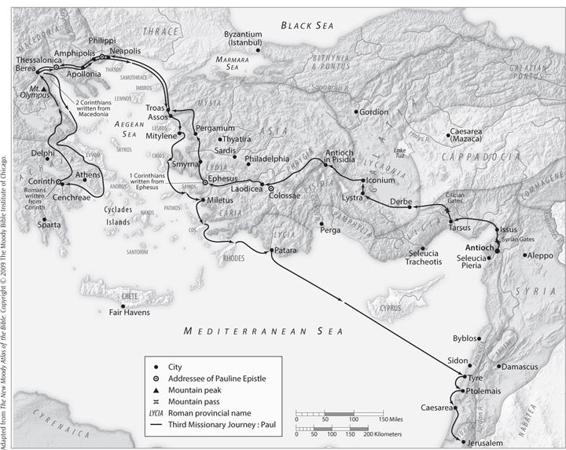
21:15-16. Some of the believers from Caesarea joined Paul and his companions for the overland trip to Jerusalem. They stayed at the house of Mnason, a Gentile convert from Cyprus, who would not object to hosting a group that included Gentiles.
Nothing could have been more definite than these two warnings, but like Christ on his final journey to Jerusalem, Paul knew what was ahead. Yet he did not allow the prospect of danger and suffering to prevent him from pursuing God’s will. Sometimes in obedience to the will of God, believers may find it necessary to refuse the reasonable counsel of friends who mean well, but do not understand the compelling leading of God’s Spirit.
When Paul arrived in Jerusalem, he reported to the Jewish congregation how God had blessed his ministry to the Gentiles. Though thankful for what God had done, the leaders informed Paul that his ministry among the Gentiles had raised suspicions about his loyalty to the law of Moses. Although many Christians today find Paul’s agreement to participate in a Jewish ritual to prove his loyalty to the law surprising, in the context of the book of Acts, it makes perfect sense. He never considered faith in Jesus the Jewish Messiah as contrary to being Jewish, and so he consistently kept Jewish practices. He circumcised Timothy (Ac 16:3), took Jewish vows (Ac 18:18), kept Passover (Ac 20:6), observed Yom Kippur (Ac 27:9), and declared his absolute faithfulness to Jewish law (Ac 28:8) and customs (Ac 28:17). When on trial he never described himself as a Christian—only a Jew (Ac 21:39; 22:3) and a Pharisee (23:6; 26:5-6). His actions were unfortunately misinterpreted and ignited a riot. The Romans arrested Paul, thinking that he was a Jewish terrorist, but placed him under protective custody when they discovered that he was a Roman citizen.
F. To Rome: Paul a Prisoner (21:17–28:31)
1. His Witness in Jerusalem (21:17–23:30)
a. Before Imprisonment (21:17-30)
(1) Paul’s Meeting with Jewish Believers and Their Proposal (21:17-25)
21:17-20. Paul reported on the remarkable success of his ministry among Gentiles. What God had done confirmed Paul’s divine appointment as an apostle to the Gentiles. The Jewish elders, in turn, told Paul how many thousands of Jews had believed and were zealous for the law. Verse 17 says, the brethren received us gladly. It is likely that on this occasion Paul delivered the proceeds of the multichurch offering gathered from the predominantly Gentile congregations scattered throughout the Mediterranean world (see the comments on 1Co 16:1-3; Rm 15:26-27; 2Co 8-9; cf. also Ac 24:17). He arrived with an enormous relief fund for the poor and persecuted believers in Judea. No wonder he was received gladly!
21:21. Not everyone was enthusiastic about Paul’s ministry among the Gentiles. Some spread rumors that he was teaching Jews to abandon the law of Moses. The charge was twofold. One, he was telling Jews they did not need to circumcise their children. God established circumcision as the physical sign of His covenant with Abraham (Gn 17). Two, he was saying that Jews did not need to walk according to the customs. In the book of Acts, Paul stated that he always observed Jewish customs. He only refused to impose these practices on Gentile believers, a decision confirmed by the Jerusalem Council (Ac 15).
21:22-24. In view of Paul’s willingness to become all things to all people (see the comments on 1Co 9:19-23), the leaders indicated they believed that the charges were not true. Yet in order to dispel doubts, the elders suggested that Paul participate in a Nazirite vow (see Nm 6:1-21) to show his respect for the law. A temporary Nazirite vow lasted for 30 days, but Paul probably participated only in the final days of the vow. Since Paul had been ministering in Gentile areas, he was asked to purify himself in addition to paying the expenses for the required offerings of the four men who were completing the vow.
21:25. James made it clear that Paul’s participation did not void the decision of the Jerusalem Council on law versus grace and the request for Gentiles to abandon their previous pagan practices.
(2) The Jewish Leaders’ Charge against and Seizure of Paul (21:26-30)
21:26. Though Paul has been criticized for participating in this vow, his actions were consistent with his philosophy of ministry. When the gospel was not the issue, Paul was willing to become all things to all men (cf. 1Co 9:20-21). This kind of accommodation is an indication of strength, not weakness. It is a wise concession, not a foolish compromise.
Though Paul had hoped to avoid unnecessary controversy over his ministry to Gentiles by participating in a Nazirite vow, when he attempted to complete the vow his actions ignited a riot. The angry mob seized Paul and beat him. He would have been killed if the Romans had not intervened. After order was restored, Paul asked for permission to address his countrymen.
21:27-30. Jews from the province of Asia made two accusations against Paul. First, they claimed that he was teaching all men everywhere against the Jewish people, the law, and the temple. This was obviously an exaggeration and false. It was similar to the charge against Stephen, who was also accused of speaking against the law and the holy place. The law and the temple were the cultural and spiritual pillars of Judaism. Luke did not record the exact charges, but Paul’s teaching was seen as a direct threat to traditional Judaism.
The second charge was also serious. They claimed Paul brought Trophimus, a Gentile, into the temple area. Gentiles were allowed only into the outer area that surrounded the inner courts of the temple. Inscriptions in Latin and Greek warned of the death penalty for any Gentile who trespassed. It is highly unlikely that Paul would have deliberately violated the sanctity of the temple, so the charge was a lie.
The irony of this turn of events was that Paul believed he was a faithful Jew and was attempting to convince his countrymen that Jesus is the fulfillment of their messianic hopes. For his effort he was falsely accused and his life threatened.
b. After Imprisonment (21:31–23:30)
(1) His Arrest and Request to Address the Jews (21:31-40)
21:31-33. It was reported to the Roman commander of the cohort (an officer in charge of a thousand soldiers) that a riot was taking place. Paul had been violently seized by some Jewish people in the temple area (21:30), and a mob scene was quickly forming. The commander acted quickly to restore order. He arrested Paul and ordered him bound with two chains because he thought Paul had instigated the riot. As Agabus had predicted, Jewish hostility led to the binding of Paul by Gentiles (21:11).
21:34-36. When the commander attempted to find out the cause of the riot, the Jewish opponents were so emotionally agitated that their answers were confusing. He ordered his soldiers to take Paul to the barracks for protection. The situation was again ironic. The Jewish people attempted to kill Paul, but he was rescued by the Romans. Paul’s experience was somewhat similar to Christ’s arrest and trials 30 years earlier when some Jewish people also shouted, “Away with him” (see Lk 23:18; Jn 19:15).
Paul’s courage and commitment to Christ were evident in his defense. Instead of merely protesting his innocence, Paul seized the opportunity to give a testimony of his transformation by Jesus and his calling to the Gentiles.
21:37-40. When Paul asked, in Greek, for permission to speak, the commander was surprised, and concluded that Paul must be an Egyptian insurrectionist since Greek was commonly spoken in Egypt.
Though surprising, the tribune granted Paul’s request, and Paul addressed the crowd in Hebrew. Many commentators think Luke used the word “Hebrew” to refer to Aramaic, the language in which Paul actually spoke, the common language of first-century Jewish people.
(2) His Address before the Crowd (22:1-21)
22:1-2. When Paul addressed the crowd in the Hebrew language, they become silent, seeing that he was one of them and not a Gentile.
22:3-5. Paul focused on his Jewish heritage, his transformation by the Messiah Jesus, and his calling as an apostle to the Gentiles. First, Paul referred to his heritage. He was born and raised in Tarsus, and was trained as a Pharisee by Gamaliel, one of the most renowned teachers of the school of Hillel (on Hillel’s background, see the comments on Mt 19:3; for Gamaliel, see the comments on Ac 5:33-39). Paul was zealous for God, and had received official permission to arrest Jewish believers in Damascus and bring them back to Jerusalem for trial. Paul’s point was that he was zealous for the law and had persecuted Jewish believers much as his countrymen were now persecuting him.
22:6-11. Paul also referred to his transformation by Jesus the Messiah. On the journey to Damascus, he was blinded by a brilliant light. He heard a voice saying, Saul, Saul why are you persecuting me? He discovered the heavenly messenger was Jesus the Nazarene, one of the common titles used by Jewish people to emphasize Jesus’ human origin. Paul’s use of the title here is evidence that the human Jesus is now the resurrected Lord and Messiah. The Lord informed Paul that he would find out what he had been appointed to do in Damascus. Those traveling with Paul knew something unusual had happened but did not understand the meaning of Paul’s experience. They led Paul into the city.
22:12-16. Paul referred to his calling. He recounted how Ananias, a devout Jew who respected the law, was used by God to help restore his sight and informed him of his divine calling as a witness to all men. As one who personally saw the resurrected Lord, Paul met the qualifications for an apostle (cf. Ac 1:22, 1Co 9:1).
Because Paul expressed his faith by calling on the name of Jesus, he was instructed to submit to baptism as an outward sign of inward spiritual cleansing. In the early church baptism was symbolic and indispensable testimony of the conversion experience (see the comments on Rm 6:1-4; 1Pt 3:18-20); however, it is faith in Jesus and not baptism that saves (cf. Ac 16:31; Eph 2:8-9).
22:17-22. Paul provided new information about what happened when he returned to Jerusalem. As a faithful Jew, he went into the temple to pray (v. 17) and received divine guidance through a trance (ekstasis, from which the word “ecstasy” is derived). Paul’s experience would resonate with Jews, who knew that God had sometimes spoken to the prophets through visions (cf. Is 6:1-13). His experience was also somewhat parallel to Peter’s vision (Ac 10:10; 11:5, where ekstasis is also used).
Like those who were now Paul’s accusers, Paul had once been an enemy of believers, but he had been wrong. The Lord warned Paul to leave Jerusalem (v. 18) because his own people would reject his testimony, though everyone knew of Paul’s reputation as a persecutor of Jewish followers of Jesus (v. 19), and especially his role as a witness to the stoning of Stephen (v. 20). Witness, used here in reference to Stephen, may be the first use of the word martus in the full sense of a “martyr” in the Greek language—a witness who dies for his faith.
Instead the Lord dramatically reversed Paul’s life and mission. He was commanded to go to the Gentiles (v. 21). This climactic point of Paul’s testimony was more than his Jewish audience could tolerate. They exploded in anger and shouted that he did not deserve to live. Paul’s statement infuriated them because they understood this as the reason that Paul had brought a Gentile into a forbidden area of the temple—the false charge they had brought against Paul.
(3) His Claim of Roman Citizenship (22:22-29)
22:22-24. Thinking that Paul had intentionally inflamed the crowd, the commander took measures to have Paul flogged with a whip, probably the flagellum, with pieces of bone and metal attached to the leather thongs (see the comments on Mt 27:24-26). This kind of flogging was used only on noncitizens since it could cripple or even kill the victim. It was thus completely improper to use it on Paul as a Roman citizen.
22:25-29. Rather than endure unnecessary punishment, Paul claimed his right as a Roman citizen. This shocked the commander, who revealed that he had to purchase his citizenship for a large sum of money. At various periods during the Roman Empire, it was possible to purchase citizenship, but it was very expensive and out of the question for most people. Paul, on the other hand, was born a Roman citizen. His status as a citizen immediately changed Paul’s circumstances. The Romans now faced a serious problem, “How do we treat a Roman citizen who has been unjustly arrested?” Paul’s appeal to his citizenship was not inconsistent with his willingness to suffer and die for his faith. In this particular situation, Paul saw the advantage of using his citizenship to proclaim the gospel and advance the kingdom. Paul probably did not realize that his citizenship would take him to Rome, but he at least knew that in his present circumstances it would give him an opportunity to witness to his own people.
Paul’s defense emphasized several points. First, he was a faithful Jew, not an apostate. Second, the circumstances surrounding his faith in Jesus as Messiah were supernatural and were consistent with God’s promises to Israel (cf. the comments on Rm 11:1-2). Third, his commission to the Gentiles was legitimatized by the Jewish rejection of the gospel and divine revelation.
As did his Lord and Stephen, Paul showed exceptional courage before the Sanhedrin, but instead of his being executed, the outcome was ironic. Paul was rescued by the Romans.
(4) His Appearance before the Sanhedrin (22:30–23:9)
(a) His Incident with the High Priest (22:30–23:5)
22:30. The commander was persistent because he was committed to upholding Roman law. He wanted to know for certain (the facts) why the Jews were violently opposed to Paul. The next day he ordered the Sanhedrin to convene and brought Paul before the chief priests and council (Sanhedrin).
23:1-2. Paul did not attempt to answer specific charges; instead he based his defense on his relationship with God. He had a perfectly good conscience before God. Paul was more concerned about how God would judge him than the Sanhedrin. Though he was a Jew who followed Jesus, he had done nothing to dishonor God.
His claim was inflammatory. The high priest thought Paul had committed blasphemy. He ordered him struck on the mouth.
23:3. Paul’s response was surprising. He insulted the high priest calling him a whitewashed wall. The imagery comes from coating a decaying, crumbling wall (Ezk 13:10-16) with a veneer of whitewash to hide its true condition. Paul’s implication could not have been clearer. The high priest dressed in priestly robes was a hypocrite. Jesus referred to Israel’s religious leaders as whitewashed tombs (Mt 23:27).
23:4-5. It was against the law to curse God or the leader of God’s people (Ex 22:28) as one of the bystanders reminded Paul. Paul’s response was cryptic, I was not aware, brethren, that he was high priest. Paul even quoted Ex 22:28. This suggests Paul knew he was speaking to the high priest and the insult was intentional and ironic. Some have suggested Paul did not recognize the high priest for various reasons, but these seem improbable. Ananias, who was the high priest, was notorious as a glutton, thief, and conspirator with the Romans. Paul was sarcastically saying, “I did not realize such a man could become the high priest of Israel.”
(b) His Incitement of Pharisees and Sadducees (23:6-9)
23:6-9. Paul did not wait for the high priest to respond. He went on the offensive. Realizing (perceiving) that both Pharisees and Sadducees were present, he instigated a volatile debate on the resurrection. Paul was a Pharisee and appealed to his hope for a resurrection. The Sadducees denied the resurrection. Luke also said the Sadducees denied angels and spirits (v. 8). This is somewhat of a problem since there is no other evidence the Sadducees did not believe in angels or spirits (see Bock, Acts, 671–72 for a discussion of the options).
The two Jewish sects became engaged in a bitter and violent argument. The Pharisees became Paul’s advocates. Although they did not accept his claims that Jesus is alive, they said, We find nothing wrong with this man.
(5) The Conspiracy to Take His Life (23:10-30)
23:10. The commander rescued Paul for a third time. When the debate degenerated into physical violence, he ordered his men to take Paul to the barracks for safety. The mob was so violent it was apparently necessary for the soldiers to carry Paul to the safety of the barracks.
Proverbs 16:9 reads, “In his heart a man plans his course, the LORD determines his steps” (NIV 1984). Paul’s situation was bleak. His fellow Jews wanted to kill him. The Romans thought he was a revolutionary and arrested him. He was the victim of lies and violence. His life was in jeopardy. There seemed hardly any chance that Paul’s dream to witness in Rome would come true, yet the Lord remained sovereign.
23:11. In a theophany (a physical manifestation of God), the Lord reassured Paul that he made the right decision in coming to Jerusalem. He would have the opportunity to proclaim the gospel in Rome, the capital of the empire. He came to Paul at night. He stood by his side to assure him. He did not confront him face to face. Though Paul had every reason to be afraid, he was not a coward. The Lord told him to be courageous and confirmed that Paul’s desire to proclaim the gospel in Jerusalem and in Rome (see 19:21) was His will and that it would come about. The promise in 23:11 dominates the narrative from this point on in Acts. Luke emphasized how the Lord worked providentially and supernaturally to protect Paul, His chosen servant, on his way to Rome.
23:12-15. A group of 40 Jews conspired to assassinate Paul. They made a suicidal oath vowing, essentially, “May God curse me if I fail to do this.” Their plot was to ambush Paul in the narrow streets of Jerusalem. God, however, can and sometimes does frustrate the plans of evil men, and in this situation he providentially intervened through Paul’s nephew.
23:16-22. Paul’s nephew discovered the plot and told Paul. Though his discovery of the plot might seem as if it were “a stroke of good luck,” it was the providence of the sovereign Lord in protecting Paul. Luke did not explain how Paul’s nephew learned of the assassination plot, but he warned Paul, who asksed one of the centurions to take his nephew to the commander. Paul’s nephew informed the commander of the plot, and the commander cautioned Paul’s nephew to keep their meeting a secret.
Paul’s Journey to Rome
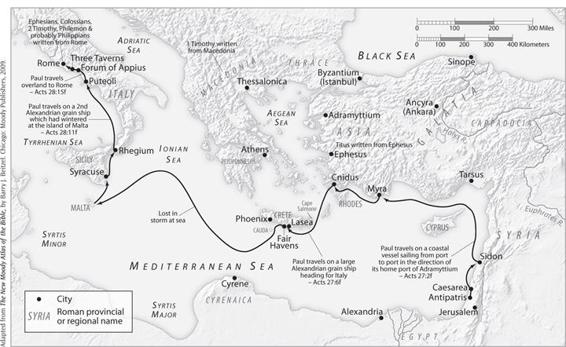
The contrast here is unbelievably ironic. Paul was threatened by his own people but protected by the Gentiles. These Jewish opponents were blinded and driven by fanatical zeal. The Roman commander, who was an unbeliever, was controlled and rational. This was high drama. The stakes could not have been higher. Paul’s life was in danger. If Paul died, the new faith would receive a severe blow. If his enemies prevailed, Paul could be executed and Christianity declared an illegal religion by the Romans. But the Lord assured Paul of a different outcome (see 23:11).
After Paul’s nephew informed the commander of the plot to assassinate Paul, the Romans took action to protect him. They organized a detachment of soldiers to transfer Paul to Caesarea, the center for Roman rule in Judea, where there was better security.
23:23-24. Because of the possibility of an ambush during the transfer from Jerusalem to Caesarea, a distance of 60 miles, the commander ordered a detachment of infantry, cavalry, and spearmen to escort Paul. He also ordered the transfer to take place at night for additional secrecy.
23:25. It is not known how Luke obtained his information, but he recorded a copy of the letter or at least part of it.
23:26. Claudius, the commander, wrote to Felix, who was the Roman military governor of Judea from AD 52 to 60. Antonius Felix (born probably before AD 10) was born as a slave, the son of Antonia Minor, who was the daughter of Marc Antony, and later received his freedom, probably from Emperor Claudius. He was a social outcast and obtained his position as procurator around AD 52, but only with considerable help from his influential older brother, Pallas, and a fair amount of underhandedness to oust his predecessor, Ventidius Cumanus. Felix was morally vile and cruel. The letter from Claudius the commander was to explain the reason he was transferring Paul to Caesarea rather than resolve the problem himself in Jerusalem.
23:27-30. Though the purpose was to explain the transfer of Paul, the letter was remarkably self-serving. Claudius was brazen in his attempt to make himself look good. The English text contains eight uses of the personal pronoun “I.” The other important feature of the letter is that it exonerated Paul, a Roman citizen, of civil disobedience. The charges involved issues about Jewish, not Roman, law.
2. His Witness in Caesarea by the Sea (23:31–26:32)
a. Paul’s Arrival and Assignment of Quarters (23:31-35)
23:31-35. The entire contingent of soldiers accompanied Paul to Antipatris, 25 miles southeast from Caesarea. The journey to Antipatris was the most dangerous part of the journey because the terrain was semi-mountainous and suited for an ambush. After Antipatris, the country was open and flat and less dangerous, so when they reached Antipatris, the infantry returned to Jerusalem. The soldiers delivered their prisoner to Felix, who decided to try the case even though Paul was from the province of Cilicia. This was somewhat unusual since cases were typically tried in the province of the accused. Plus, instead of receiving harsh confinement, Paul was basically under house arrest in Felix’s official residence, the palace (Praetorium, the official abode of a governor) built by Herod the Great for himself about 75 years earlier. These developments were more than circumstantial. They revealed God’s sovereign providence in fulfilling his promise to Paul that he would testify in Rome (cf. Ac 23:11).
At the time of Paul’s hearing, Felix had been governor of Judea for five years. Though responsible to uphold Roman law, Felix was notorious as an inept and brutal ruler. Yet in his defense Paul boldly challenged Felix with the ethical demands of faith in Jesus Christ.
b. Paul’s Defense before Felix the Governor (24:1-21)
(1) The Accusation by the Jewish Leaders (24:1-9)
24:1a. Chapter 24:1-8 continues Luke’s narrative by summarizing the situation under which the charges against Paul were formed. The intensity of the opposition to Paul is reflected in the coming of the high priest, Ananias, to Caesarea and the hiring of a high-powered advocate to present the case against Paul.
24:1b-3. Tertullus’s opening remarks were loaded with patronizing flattery. He praised Felix for his peaceful rule and reforms, hoping to influence the governor for a favorable decision. Civil unrest had actually become worse under Felix’s rule.
24:4-6. Tertullus presented three charges against Paul. First, knowing that the Romans did not tolerate civil disorder, he said that Paul was a troublemaker, a pest or public nuisance. Second, he was the leader of a sect of the Nazarenes. Since the Romans had not yet distinguished Christianity from Judaism, which was a legal religion, Tertullus gave a cryptic description of this new faith in Jesus to raise Felix’s suspicions about a new sect. Jesus was from Nazareth, so the description was accurate, but not one that would have been familiar to Felix, plus Paul was the ringleader of this seditious movement. Third, he accused Paul of defiling the temple. The Sadducees, who were collaborators with the Romans, were responsible for maintaining order in the temple. This is why they seized Paul—they were trying to keep peace, but Paul had ignited a riot. The charge was false but one that Tertullus hoped the Romans would act on. All three of these charges were cleverly designed. Under Gallio faith in Jesus was officially and legally viewed as a subset of Judaism, and as such Rome would not view it as illegal. But anything that disturbed the pax Romana (“peace established by Rome”) was not going to be tolerated, and even a whiff of insurrection would arouse Rome’s fury. Tertullus’s charges minimized the religious dispute the Jewish leaders had with Paul, and emphasized the points about which the Romans would be most concerned.
24:7-9. Though Tertullus tried to frame the case to make it appear that Paul violated Roman law, he did not provide any solid evidence. This is perhaps the reason that he encouraged Felix to question Paul further and that all the Jewish opponents present joined in a verbal attack on Paul.
In his defense, Paul denied the charges, and claimed to be a Jew, whose hope was in God’s promises to Israel. Though Felix knew that Paul was innocent, he ordered him held as a prisoner for two years but with limited freedom. Felix hoped that Paul would pay him a bribe, but he also talked with Paul about faith in Jesus. Paul used the opportunity to challenge Felix with the moral demands of following Christ.
(2) The Answer by Paul (24:10-21)
24:10-13. Paul claimed that the truth was that he had gone to Jerusalem to worship God, that he was not involved in civil disobedience, and that the Jews could not prove the charges against him.
24:14-16. He said he worshiped the same God as his accusers but according to the Way (cf. comments at 9:1-2), which his Jewish opponents claimed was a heretical sect. Paul contended that his new messianic Judaism, with Jesus at its core, was consistent with God’s promises for Israel. Paul’s point was that the dispute was religious and not political, and by emphasizing this he reflected Gallio’s decision years before. As did his accusers, Paul believed in the law of Moses and the prophets and had the same hope in a resurrection of both the just and the unjust. He had done his best to keep a clear conscience before God and men. Paul was not a renegade Jew, and he was not the ringleader of a subversive movement.
24:17-18. After his defense of the gospel, Paul defended himself. He had come to Jerusalem with an offering for the poor. Though a follower of Christ, Paul had not abandoned his Jewish heritage. He identified himself with the Jewish people by calling them my nation. He honored God by ritually purifying himself when he went into the temple.
24:19-21. Paul discredited his accusers by noting that they were not even present to defend their charges against him. The Jewish leaders had come from Jerusalem according to 24:1, but the actual Jews from Asia (v. 18), who had instigated the riot against Paul by accusing him of bringing a Gentile into the temple (21:27-28), were absent. Paul’s only crime was that he believed in the resurrection. Such a belief was religious and not illegal according to Roman law or heretical according to Jewish hopes.
c. Paul’s Later Experience with Felix the Governor (24:22-27)
24:22-23. Though Felix understood the basic facts about the Way (cf. comments at 9:1-2), he postponed his decision until Claudius Lysias, the commander who arrested Paul, came from Jerusalem. He ordered Paul placed under guard but with the privilege for his friends to visit and provide for his needs.
24:24. Because Felix’s wife, Drusilla (born around AD 38), was nominally Jewish, Felix thought that perhaps she would be interested in what Paul had to say or at least she could give a more objective opinion about the controversy concerning the Way. She was the youngest daughter of Herod Agrippa I (the “Herod” of Ac 12 who killed James), and as a member of Herod’s family probably knew more about this new movement than Felix.
24:25-26. Aware of Felix’s reputation for immorality and corruption, Paul emphasized righteousness, self-control, and the judgment to come in his witness to the governor. These three terms focused on personal morality and not matters related to Felix’s governorship. It is obvious from Felix’s response that he was troubled by what Paul said. Frightened (v. 25) is the word emphobos rather than the more common phobos, and indicates a more intense emotional response. Instead of repenting, Felix dismissed Paul with the intent of meeting with him in the future. He was not, however, interested in more information but a bribe. Though illegal, Roman officials often accepted bribes from political prisoners.
24:27. Felix ignored justice and kept Paul confined for two years because he hoped to gain the support of the Jews. At the end of the two years of Paul’s imprisonment, Festus replaced Felix as governor of Judea (c. AD 58). Felix was recalled to Rome to answer for his incompetent administration of the Region, but he was rescued from severe punishment by his brother Pallas. Nothing more is known of him following this point. Festus had the reputation of a more effective and just administrator; Luke, however, portrayed him as more interested in appeasing the Jewish leadership than administering justice. At first he resisted the Jewish leadership’s request to return Paul to Jerusalem, but in the end he opted for patronizing expediency rather than political justice. He decided to return Paul to Jerusalem for a hearing before the Sanhedrin.
Paul knew that there were still plans to assassinate him, so he appealed to Caesar. This sort of appeal was a benefit of Roman citizenship. Any Roman citizen accused of a crime could appeal to be tried before Caesar himself. In appealing to Caesar, Paul’s concern was about more than his personal fate; he was concerned about the freedom of the church to proclaim the gospel. If Paul would be exonerated, then the church would be exonerated.
d. Paul’s Defense before Festus the Governor (25:1-12)
Though undoubtedly in circumstances different from what he had expected, Paul was now in a position to fulfill the second part of his dream—to preach the gospel in Rome. But before being transferred to Rome, Paul seized the opportunity to give his testimony to both Festus and Agrippa.
25:1-3. Luke recorded Paul’s hearing before governor Festus in 25:1-12. When Festus, the new governor, traveled to Jerusalem, the foremost complaint of the religious leaders was about Paul. They asked Festus to transfer Paul to Jerusalem. Luke, however, revealed that their real motive was to ambush Paul.
25:4-5. Festus refused. He required the Jewish religious leaders to follow proper legal procedures and go to Caesarea to plead their case there against Paul.
25:6. As soon as Festus returned to Caesarea, he summoned Paul for a hearing. For the hearing he sat on a bema, a raised judgment seat where one in a position of judicial authority would sit to render his verdict in a court case he had overseen.
25:7-8. Paul’s accusers surrounded him making numerous serious charges, which they could not prove. Paul denied that he had committed a crime against the law, the temple, or Caesar. He was an honorable Jew and Roman citizen. The charge about his loyalty to Caesar was perhaps the most serious. If Festus decided that Paul was a troublemaker, then he would move to prosecute him.
25:9. Instead of making a civil decision, Festus made a political one. He attempted to patronize the religious leadership by returning Paul to Jerusalem.
25:10-11. Paul protested. He claimed that he had not committed any crimes against the Jews. If he were a criminal, Paul was willing to accept even the death penalty, but if he were innocent, then he had the right to appeal to Caesar.
25:12. After conferring with his legal advisors, Festus honored Paul’s request. More was at stake than Paul’s well-being. Paul was concerned about protecting the legal status of the new movement, but his appeal was also motivated by his desire to proclaim the gospel in Rome. This latter motive is supported by the conclusion of Acts, which depicts Paul teaching about the kingdom of God unhindered (cf. 28:31).
e. Paul’s Defense before Herod Agrippa II the King (25:13–26:32)
(1) Prelude to the Defense (25:13-27)
When Herod Agrippa II arrived with his sister Bernice to pay their respects to the new governor, Festus saw an opportunity to get his advice about Paul from two people who were more knowledgeable about Judaism. Agrippa II was the son of Herod Agrippa I (see Ac 12:1-23), and great grandson of Herod the Great. He ruled as tetrarch in Chalcis (modern northern Syria) beginning around AD 50, but eventually acquired Galilee and Jerusalem as well. He was well acquainted with Jewish customs so was occasionally consulted by the Romans, as was probably the case with Festus. Bernice was his sister, widowed when her second husband died in AD 48. After that she lived with Agrippa II, and though she denied an incestuous relationship, one probably existed.
25:13-16. Festus explained the problem that he inherited from Felix. When he was in Jerusalem, the Jewish leaders wanted Paul executed, but Roman law permitted the accused to meet face to face with his accusers.
25:17-19. Festus omitted details about the transfer of Paul to Caesarea. When Paul’s accusers presented their case against Paul, Festus was surprised by the accusations. The dispute was about Judaism and a dead man named Jesus, whom Paul claimed is alive. The complaint was obviously religious and not civil in nature, charges that Festus could not judge.
25:20-22. When Festus decided to return Paul to Jerusalem for trial, Paul appealed to Caesar. Festus was now holding him in custody until he could be sent to Caesar. Agrippa was intrigued. He asked to hear the case, and the hearing was set for the next day.
25:23. The scene was one of contrast. Agrippa and Bernice came adorned in their purple robes of royalty and gold accompanied by a host of attendants. The military commanders were present, perhaps in full dress uniforms, and the prominent men of the city in their finest robes. The prisoner was brought in, perhaps in chains. Early descriptions of Paul portray him as short, coarse, and physically unimpressive.
25:24-27. Festus explained to Agrippa and the others present the reasons he needed their opinion about Paul’s case. The Jewish religious leadership in Jerusalem and Caesarea had charged that Paul should be put to death, but Festus had not found sufficient evidence to support their accusation. Plus, Paul had made an appeal to Caesar, and Festus did not know what charges he should make against him. Festus admitted that Paul’s case was absurd. He had already determined that the accusations were religious and not civil (cf. 25:19). Festus was probably concerned about his reputation. If he sent Paul to Caesar without credible charges, he would appear foolish.
(2) Particulars of the Defense (26:1-29)
26:1. Since Festus had asked for Agrippa’s opinion, Agrippa was the one who granted Paul permission to speak. Paul stretched out his hand in respect for the king (Bruce, Acts, 496) as he began his defense (apologeomai, from which the word “apology” is derived).
26:2-3. Paul began by saying that he considered it a privilege to make his defense before Herod Agrippa II. Paul was not patronizing the king. The statement, especially because you are an expert in all customs and questions among the Jews is accurate because Agrippa was well informed about Jewish customs, and certainly more objective than the Sanhedrin to evaluate Paul’s case.
Paul’s defense followed a typical rhetorical form of prologue (vv. 2-3), narration (vv. 4-18), confirmation (vv. 19-20), refutation (v. 21), and concluding appeal (vv. 22-23) (Bock, Acts, 713). Though giving a formal defense, Paul focused his account on the resurrection (cf. v. 8 and v. 23).
26:4-8. Paul had been a Jew all of his life and was even a Pharisee, who lived according to the strictest demands of the law. Twice Paul identified himself with the Jews, our fathers (v. 6) and our twelve tribes (v. 7). Paul maintained he was thoroughly Jewish, and his hope in the resurrection was identical to the promise that God made to His chosen people.
26:9-11. Since he considered himself a faithful Jew, Paul formerly had felt obligated to oppose the name of Jesus of Nazareth. Paul referred to Jesus from the perspective of an unbelieving Jew. Before the Damascus road experience, Paul believed that Jesus was not Lord or Messiah; he was from the insignificant town of Nazareth. In Jerusalem, Paul had received authority from the chief priests to imprison Jewish believers, and he had voted for the death penalty for them. He had tried to force Jewish believers to blasphem[y] by apparently denying Jesus. He was so enraged against believers that he pursued them to cities outside of Israel.
26:12-15. But while on a mission to Damascus, he had an encounter that changed his life. He saw a light that was brighter than the sun and heard a voice that asked in Hebrew, Saul, Saul, why are you persecuting me? The goads are spikes on a pole or plank that is used to train and control an ox or horse to pull a cart. The imagery implies that resistance against Jesus is painful and useless. When Saul asked who was speaking to him, the Lord identified himself as Jesus whom you are persecuting. The implication could not be clearer. If Jesus were the one speaking to Saul, then Jesus must be alive, and if He were alive then what he claimed was obviously true. He is the Messiah.
26:16-18. Paul then explained his commission to be a witness to the Gentiles. Paul’s mission was threefold: (1) to open the eyes of unbelievers, (2) to turn them from darkness to light, from Satan to God, and (3) to witness so that they could receive forgiveness of sins and an inheritance among those who had been sanctified. Sometimes the verb sanctified means “to be consecrated,” “to be dedicated” to a certain task, “to be set apart for God,” and can have the practical sense of growth in personal purity as a Christian set apart for God (see Jn 17:17; 2Tm 2:21). But often it is essentially synonymous with “being saved” (as in Ac 20:32; 1Co 1:2; 6:11), and this is the sense here. The effective cause of this supernatural transforming experience was faith. Of course, in describing his conversion experience in this manner, Paul hoped that both Festus and Agrippa would become convicted and repent.
26:19-21. Paul said that his Jewish opponents had tried to kill him because he was obedient to the heavenly vision. Paul gave a concise summary of his preaching. He challenged people to repent (lit., to change one’s mind, and in the context of Acts, to specifically change one’s mind about Jesus, cf. 3:13-19, especially, 3:19), and turn to God (based on the Heb. concept of repentance, meaning “to turn around toward God”), and perform deeds appropriate to repentance (the fruit of repentance being changed lives and accompanying good deeds). This is not salvation by works but a practical truth that a changed life is the inevitable result of genuine faith.
26:22-23. Paul insisted that his message was consistent with the promises of the prophets and Moses. There is little evidence that early (intertestamental) Judaism believed that the Messiah would suffer, die, and conquer death. Paul, however, though he did not cite specific texts, claimed that the OT predicted the concept of a suffering Messiah and the resurrection. Likely Paul had passages such as Is 52:13–53:12 and Ps 16:10 in mind. Jesus’ correction of the thinking of the two men on the road to Emmaus supports Paul’s understanding of the OT (cf. Lk 24:25-27).
26:24. Festus charged that Paul was so advanced in his training in Judaism that his thinking was ridiculous. The practical and rationalistic Romans did not believe in life after death. Longenecker has this insight about the timeless truth of Festus’s charge: “Down through the ages Festus’s response has been echoed by men and women too trapped by the natural to open to the supernatural, too confined by the ‘practical’ to care about life everlasting” (Longenecker, “Acts,” 554).
26:25-27. Paul denied the charge of insanity, and appealed to Agrippa for support. He was sure that Agrippa had heard about the death and resurrection of Jesus. Plus, Agrippa must certainly have believed in the prophets. By asking Agrippa a direct question, Paul the prisoner, became Paul the persuader.
26:28. Paul’s direct question upset Agrippa. Agrippa’s response has been interpreted in a way that implies he was close to a decision: “Almost thou persuadest me to be a Christian” (KJV). His response was actually somewhat cynical: “Are you trying to convince me to become a Christian?” Agrippa was ridiculing Paul for thinking that he could convince him to become a Christian with such a brief argument (see comments about the word “Christian” at 11:26).
26:29. Paul’s answer contained a bit of irony. He wished that all who were present would become like him, that is spiritually free but not a prisoner in chains.
(3) Result of the Defense: A Declaration of Paul’s Innocence (26:30-32)
26:30-32. Agrippa, Festus, Bernice, and the others who were present left the room to discuss the case. All agreed that Paul had not committed a capital offense. Luke recorded the words of Agrippa to vindicate both Paul and Christianity of sedition.
Paul was God’s attested servant (apostle). In his account of Paul’s journey to Rome, Luke showed how the sovereign Lord providentially protected his chosen servant and those who were with Paul.
3. His Witness En Route to Rome (27:1–28:15)
a. Aboard Ship (27:1-44)
After the hearing before Festus and Agrippa, Paul was placed in the custody of a centurion and put on a ship sailing for Rome. The journey was uneventful until they attempted to sail from Fair Havens for a safer harbor for the winter; then the ship was caught in a powerful storm. When the crew gave up hope, Paul emerged as a courageous Christian and assured the crew no one would be lost. The ship foundered on a reef, but all on board made it safely to land on the island of Malta.
27:1-3. Under circumstances Paul could not have anticipated, he began his journey to Rome. When he was turned over to a centurion for transfer to Rome, God used two men to assure Paul of His sovereign control over the situation. The pronoun we indicates that Luke was with him.
Aristarchus, a believer from Thessalonica, also made the trip with Paul. In Col 4:10, Paul referred to Aristarchus as his “fellow prisoner,” so he apparently traveled all the way to Rome with Paul. Neither Luke nor Aristarchus was given free passage, so they probably paid their own expenses. Plus, it was risky to associate with a prisoner, so both men were obviously dedicated to the Lord and to Paul.
Paul and other prisoners were placed in the custody of Julius, a centurion, who belonged to the Augustan (Imperial) Regiment, which was a special corps of men who acted as liaison officers between the Emperor and the provinces.
They sailed on a ship from Adramyttium, a seaport on the northeast shore of the Aegean Sea, near Troas. Instead of sailing directly across the Mediterranean Sea, they sailed north to Sidon to perhaps unload cargo and pick up supplies.
In the providence of God, the centurion charged with the security of the prisoners was gracious and not brutal. He allowed Paul to visit his friends who provided him with supplies for the voyage. Passengers and prisoners were responsible for their own supplies.
27:4-6. When they left Sidon the voyage became difficult. The strong winter winds made progress difficult, so they sailed north of Cyprus for protection from northwestern winds. After they passed Cilicia and Pamphylia, they sailed for Myra. When they reached Myra, the centurion transferred the prisoners to a ship from Alexandria that was sailing to Rome. The ship was probably carrying grain. Egypt was the breadbasket for Rome.
27:7-8. The voyage became increasingly difficult as they sailed west, but they finally reached Fair Havens on the island of Crete. Here there was debate and indecision.
27:9-12. Since so much time had been lost on the voyage to Fair Havens, sailing had become dangerous. The reference to the fast identified the time of the year. The fast was part of the Day of Atonement, so it was late September or October. Winter was approaching. Most sailing was discontinued from November to March.
Paul was an experienced traveler. He began to admonish the captain and the crew, “strongly recommending” they stay put for the winter and not attempt to reach another port. His counsel was ignored. The captain of the ship persuaded the centurion they should sail for another harbor for the winter. He recommended Phoenix, which has a protected harbor facing southwest and northwest. Its location would provide the ship with better protection than the harbor at Fair Havens.
27:13. When a light wind came up from the south, they weighed anchor to sail for Phoenix, keeping as close to the shoreline as possible.
27:14-15. The decision to leave port was a mistake. They had not sailed far when the ship was hit broadside with a violent wind, called Euraquilo. The wind was a dreaded “northeastern.” Luke described it as violent (typhonikos, “typhonic”) in force. It was so powerful, the sailors lost control of the ship and were driven along by the wind.
27:16-17. The wind drove the ship 25 miles south to the island of Clauda. On the southern side of the island they found enough shelter from the wind to secure the lifeboat that was towed behind the ship. The use of “we” suggests some of the passengers may have assisted the crew.
They also used rope cables to secure the hull of the ship. Polhill lists the four possible ways they may have used the cables to make the timbers of the ship more secure (Acts, 521, n. 23). One, they could have passed width-wise under the ship on the outside of the hull. Two, they could have run the cables length-wise around the length of the ship on the outside. Three, the cables could have run width-wise across the inside of the ship. Four, the cables could have run length-wise inside the hull from bow to stern.
The crew was working frantically to keep the ship from running aground on the shallows of Syrtis. The shallows were a series of deadly sandbars off the coast of North Africa infamous as a graveyard for vessels. The ship was about 400 miles from where they started (Bock, Acts, 735–36).
27:18-20. On the second day of the storm, they began to jettison cargo (probably some of the grain; cf. 27:38). When the storm continued into the third day, the crew became so desperate they threw tackle overboard. Luke did not specify what equipment was jettisoned. The purpose was to make the ship lighter, so it would ride higher and take on less water from the waves that were apparently crashing over the sides of the ship.
None of their efforts were successful. The storm continued its relentless assault on the ship. After several days without seeing the sun or stars, they lost all hope and resigned themselves to death at sea.
27:21-26. In this hopeless situation, Paul emerged as man of courage and common sense. Because the ship had been tossed around on the sea for several days, all on board had lost their appetite. No one appreciates someone who says, “I told you so,” but that is exactly what Paul said, Men, you ought to have followed my advice …
He assured them no one would drown at sea. Paul was not a divine man who could control nature. The ship would be lost, but there would be no loss of life. How did Paul know this? An angelic messenger of God appeared to him. The angel assured Paul he would stand before Caesar, and because it was God’s intention to protect Paul, He would also protect all of those who were with Paul. The angel’s reassurance served as a promise to Paul that God would fulfill what He had previously revealed to Paul about testifying in both Jerusalem and Rome.
Paul urged the men to keep up their courage. That would take faith, the kind of faith Paul had in God and his Word. We do not know if any of the sailors or soldiers became believers, but it is reasonable to assume that some did.
Paul’s speech of salvation ended with a second warning about the loss of the ship. He revealed exactly how the ship would wreck. It would run aground on a certain island. That was a remarkable prediction since in their present location hitting the island of Malta would be “like finding a needle in a haystack” (Bock, Acts, 738).
27:27-29. On the fourteenth night, the storm had driven the ship into the Adriatic Sea (sea of Adria—the body of water that forms the east coast of Italy). Polhill identifies this area as the Ionian sea and the north central Mediterranean sea between Greece and Italy, extending south to Crete and Malta (Acts, 524–25). The storm had driven the ship 475 miles from Clauda to Malta.
About midnight, the sailors sensed they were near land and began taking soundings. This would involve throwing a rope overboard with some kind of a weight on it. The depth of the first sounding was twenty fathoms (120 feet) and the second fifteen fathoms (90 feet). They were obviously nearing land. To keep the ship pointed in the direction of land, they dropped four anchors from the stern (the back of the boat) and wished for daybreak. They hoped that by the light of day they could determine their location.
27:30-32. The sailors had had enough. They decided to abandon ship in the lifeboat but under the pretense of putting out anchors from the bow (front) of the ship. Paul knew what they were doing and warned the centurion: Unless these men remain in the ship, you yourselves cannot be saved. Paul had been right so far, so the sailors cut the ropes to the lifeboat, allowing it to drift away from the ship.
27:33-34. Paul was not only a man of incredible faith but also of common sense. The men who had been struggling to save the ship had not eaten full meals, or meals at regular times, for 14 days. He urged all on board to take some food and assured them they would survive. The expression, not a hair from the head of any of you will perish, is a Hebrew idiom for being preserved without harm (see 1Sm 14:45).
Stott says that Paul’s counsel shows him as a well-rounded Christian. “Here then are aspects of Paul’s character which endear him to us as an integrated Christian, who combined spirituality with sanity, faith and works. He believed that God would keep his promises and had the courage to say grace in the presence of a crowd of hard-bitten pagans … What a man! He was a man of God and of action, a man of the Spirit and of common sense” (Acts, 392).
27:35-38. Paul encouraged the others to eat by first giving thanks to God and eating bread. This was not a communion meal. That would not give those on board the nourishment needed to survive the ship wreck. All 276 followed Paul’s advice and ate. Ships like this could hold up to 600 people, so 276 was not a representative number (Bock, Acts, 740). Confident they would not perish, they lightened the ship even more by throwing the remaining grain overboard.
27:39-44. At first light the sailors spotted land and decided to beach the ship if possible. They cut the lines to the anchors, freed the rudders (most ships had a dual-paddle mechanism connected by a crossbar operated by a sailor for piloting a ship—but this was dismantled in the hope of the wind driving them shoreward), and hoisted the foresail (a small sail on the front of the boat) to guide the ship to land. But before they hit land, they hit a reef. The bow stuck on the reef, and the ship was pounded by the surf. Realizing that if the ship broke up, the prisoners might escape, the soldiers planned to kill them since they would be held accountable if they escaped.
The centurion intervened in order to save Paul. He ordered those who could to swim for shore and the rest to float to shore on planks and other debris from the ship. All made it safely to land.
b. At Malta and Again En Route to Rome (28:1-15)
After Paul’s long interlude from the ministry, God resumed the powerful works through Paul that the apostle previously experienced, but which were put on hold during Paul’s imprisonment in Caesarea by the Sea. These proved to be an enormous blessing to the people of Malta, and though the text does not say it, the miracles no doubt served to add great effectiveness to Paul’s witness. An added effect was the aid received by the castaways that enabled them to continue their journey.
28:1. Once the crew and passengers reached shore, they discovered they were on the island of Malta, about 50 miles south of Sicily. Malta, 18 miles long and 8 miles wide, was first colonized by the Phoenicians around 1000 BC but captured by the Romans in 2l8 BC. The islanders, however, enjoyed a measure of local autonomy with their own elected governor.
28:2-3. Luke identified the islanders as natives (barbaroi, an onomatopoeic word from which is transliterated the Eng. word “barbarians”). This term does not mean they were savages. It means they could not speak Greek, and the language they did speak sounded like “bar-bar-bar-bar” to those who spoke Greek. They were, however, thoughtful and helpful. They built a fire for the waterlogged survivors, and Paul helped by gathering wood for fuel. However, as he was adding wood to the fire, the heat drove a viper out of the wood, and it struck Paul on the hand. The term (echidna) does not identify the species but usually refers to a poisonous viper (BDAG, 419). The observation that there are no poisonous snakes on Malta today does not undermine the integrity of Luke’s account. There could have been poisonous snakes on Malta in the first century.
28:4-5. Thinking Paul would surely die, the islanders concluded he must have been a murderer and though he survived the shipwreck, he was now getting what he deserved. This is divine justice. The reference to justice (Greek, dike) is a reference to the Greek goddess “Justice,” often depicted in Roman times as holding balanced scales, and is not the theoretical concept of justice, though that is a related idea. Paul, however, did not die. God had a plan for Paul, and the sovereign Lord protected his chosen servant.
28:6. When Paul did not die after a reasonable amount of time, the islanders changed their minds and foolishly decided Paul must be a god. Actually, he was under God’s protection, miraculously keeping him from the deadly effects of the venom of the viper.
28:7-10. The leading (protos) man of the island was Publius. He extended hospitality to Paul and his companions (probably Luke and the other believers) for three days. Publius’s father was sick with a fever and dysentery. “Malta fever” was a common disorder not limited to Malta alone and was caused by drinking the unsterilized milk of diseased goats (Longenecker, “Acts,” 565). Paul cured Publius’ father by praying for him and placing his hands on him. This is the only instance in Acts where healing is brought about by both prayer and the laying on of hands. As in numerous other instances in Acts, the miracle provided Paul an opportunity for greater ministry. It appears that Luke began to assist Paul by establishing a clinic for medical care rather than an extensive healing ministry. This is suggested in three ways: First, Luke used two different verbs to describe their work—iasato (from iaomai, “healed,” v. 8) and etherapeuonto (from therapeuo, “to heal,” or here in the passive, “getting cured,” v. 9). In the first case the word would refer to miraculous healing and the second to curing by medical means. Second, the people expressed their gratitude to both Paul and Luke (they also honored us, v. 10). Third, they honored them with many marks of respect, a phrase used of payment of professional fees, such as to a physician, just as Luke was.
After two years of the apostle’s imprisonment, this was a reaffirmation that God was still with Paul. It is possible that the miracles gave Paul confirmation that he had made the right decision in appealing to Caesar. The islanders expressed their appreciation with gifts and adequate supplies for the final leg of the journey to Rome.
28:11. After three months on Malta, Paul and his companions were put on an Alexandrian ship, registered in Alexandria, Egypt. The ship’s figurehead was twin gods. The Twin Brothers, Castor and Pollux, were thought to be the protectors of seamen (Polhill, Acts, 535). These two were the mythical sons of Zeus and a woman named Leda who was raped by Zeus. In Latin, they were called “the Gemini,” and they came to be viewed as a philanthropic pair, especially favorably inclined to travelers and sailors.
28:12-13. They sailed from Malta to Syracuse on the island of Sicily and stayed there for three days. From Syracuse they sailed to Rhegium (on the far south “toe” of the “boot” of Italy) and then to Puteoli, both on the mainland of Italy.
28:14-15. Before going on to Rome, Paul was invited to stay with believers at Puteoli, 130 miles south of Rome. Paul and his companions accepted the invitation and stayed for seven days. The presence of a church in Puteoli shows the extent of the gospel impact. Paul had never been to Italy, so the church there was not started by him. Luke does not give the reason they stayed in Puteoli, but it was most likely for rest. The sea journey was over; they would walk the rest of the way to Rome.
After Paul left Puteoli, believers came from Rome and met him at the Market [Forum] of Appius and Three Inns. The Forum of Appius was 43 miles south of Rome and on the Appian Way, a major road leading straight to Rome. Three Inns was ten miles north of the Forum of Appius and 33 miles from Rome (Polhill, Acts, 537).
Paul was Luke’s hero, yet he was still only a man. Even Paul must have been apprehensive as he neared Rome. What would happen to a Jewish tentmaker in the citadel of Roman imperial power? Luke said he thanked God and took courage. Something happened to encourage Paul’s heart. What was it? It was the believers in Rome walking miles to meet Paul before he ever set foot in the city. Barclay says that Paul was encouraged because he realized he was not alone (Acts, 209).
4. His Witness in Rome (28:16-31)
a. The Setting for It (28:16-22)
God was with Paul when he arrived in Rome. Though a prisoner, he was treated with respect and granted limited freedom. Paul used his privileges to meet with his Jewish countrymen two times. The response was disappointing. In the first meeting they were neutral. They had not received any reports, either positive or negative, about Paul. They wanted to hear more about what he believed. In a second meeting, though some were persuaded that Jesus is the fulfillment of Israel’s hopes, most refused to believe. Paul recognized their unbelief as the fulfillment of prophecy and justification for his mission to Gentiles. Acts ends as it began with the proclamation of the kingdom of God; however, the messenger was different. Instead of Jesus teaching His followers about the kingdom of God, Paul taught about the kingdom of God and the Lord Jesus Christ.
28:16. When Paul and his companions entered Rome, Paul was not brutalized by Roman guards. He was chained to a guard but allowed to live in his private quarters. Paul had accomplished part of his mission. He was not treated like a revolutionary or considered a threat to Rome, nor was the Christian faith that Paul represented. The “we” sections end in v. 16 indicating that Luke likely left Paul at this point to serve as the apostle’s emissary someplace (Col 4:10-15, esp. v. 14), not that he had abandoned him.
28:17-22. Paul did not wait long to summon his countrymen. After only three days he requested a meeting with the leading men of the Jews. Leading men refers to Jews of high social and religious standing. He began by assuring them he was not a criminal. Jews in Jerusalem had charged that Paul was opposed to the law of Moses, but he assured his countrymen he was not an enemy of his own people, and he was not against Jewish customs. From Paul’s perspective, though he was a believer in Jesus as the Messiah of Israel, this certainly did not mean that he was no longer Jewish. However, because of the complaints of the Jewish religious leaders, Paul had been turned over to the Romans.
Paul recounted his interaction with the Roman authorities (Felix, Ac 24, and Festus and Herod Agrippa II, Ac 25). Those rulers wanted to release Paul after a hearing. They had not heard any evidence that convinced them Paul had violated Roman law. When Paul said there was no ground for putting me to death (v. 18), he revealed that Jerusalem’s religious leaders wanted him executed, not merely punished or imprisoned. Paul was forced to appeal to Caesar because of their protests.
Paul assured the leaders he had nothing against his own people (v. 19). The Romans had nothing against Paul, and he had done nothing against his own people. He had no disagreement with his own people other than about their need to embrace Jesus as their Messiah (Stott, Acts, 398). Paul’s purpose for calling the meeting was to get acquainted with the leaders and explain why he was a prisoner. He was bound with a chain because he believed the hope of Israel. This phrase refers to the hope that the Messiah would come and fulfill God’s promises to Israel. Paul’s point was that this hope for the Messiah had already been fulfilled with the coming of Jesus of Nazareth. Thus, he was imprisoned only for believing that Israel’s hope had already come and not because he denied any essential tenet of Judaism.
Though they had not heard anything specifically about Paul, they had heard about the new faith, so they requested a second meeting to hear Paul’s opinion on this sect. The use of the term sect (hairesis, from which “heresies” derives) means “a group that holds tenets distinctive to it, sect, party, school faction” (BDAG, 27). It is the Greek equivalent of the Hebrew word minim, minut (kind, species, heretic, heresy), which came to be used in Rabbinic literature for Jewish followers of Jesus. It implies they considered this new faith a movement within Judaism, but a movement that was dangerous and potentially promulgated error.
b. The Substance of It (28:23)
28:23. On the day of the scheduled meeting, an even greater number of Jews came to Paul’s rented house. Paul explained how Jesus fulfilled Israel’s hopes for the kingdom of God. He appealed to both the Law of Moses and from the Prophets. If he were to persuade Jews that Jesus was the fulfillment of Israel’s messianic and kingdom expectations, it was essential for him to connect Jesus to the Hebrew Scriptures. It was an extended meeting. He spoke from morning until evening.
c. The Sequel to It (28:24-31)
(1) In Regard to the Need for a Decision (28:24-27)
Some were convinced, but most refuseed to believe. The divided response is typical of the Jewish response to the Christian message throughout the book of Acts (cf. 13:42-45; 17:1-5, 11-14; 19:8-10).
28:24-27. The Jews of Rome disagreed not only with Paul; they did not agree with one another, and begin leaving after Paul warned them of making the same mistake as their closed-minded ancestors. He quoted from Is 6:9-10 (vv. 26-27) where the inspired prophet warned his generation of divine retribution for rejecting his message. The context of the warning was the call of Isaiah to his prophetic ministry, when the Lord forewarned the prophet he would face stubborn resistance. Israel rejected the prophet’s message because their heart HAS BECOME DULL. The word DULL (epachynthe) literally means “to make fat, well-nourished.” The figurative meaning is “to make impervious or to make gross, dull” (BDAG, 790). The result was they could not HEAR WITH THEIR EARS or SEE WITH THEIR EYES. Paul told his countrymen they risked becoming like the Jewish people of Isaiah’s generation who came under divine retribution for their deliberate rejection of God’s message through the prophet. As did Isaiah, Paul had faithfully proclaimed the Word of the Lord; if they rejected it, they would come under the judgment of God. This meant they would pass a point where they would never be able to return to the Lord and be spiritually restored (“healed,” v. 27).
(2) In Regard to Paul’s Audience (28:28)
28:28-29. Paul said the refusal of the Jews to accept Paul’s messages justified his turning to the Gentiles (v. 28). God’s gracious plan of redemption cannot be frustrated even by the unbelief of His chosen people. Their unbelief gave Paul the opportunity to offer salvation to Gentiles. Paul developed the wisdom of God’s plan of salvation further in Rm 11 (see the comments there). He said the response of the Gentiles to the gospel would make Israel jealous and lead eventually to the salvation of God’s chosen people (Rm 11:11, 25-27). As Bock points out, Ac 28:28 does not state that God has permanently abandoned the Jewish nation, only that the gospel will be preached to the Gentiles and the Gentiles will respond, which means at the very least Gentiles will be more responsive initially than the Jewish people (Acts, 756–57). (The ms evidence does not favor including v. 29 in the original text. The information has already been given in v. 25, so nothing is lost by excluding the verse from the original text.)
(3) In Regard to Time (28:30)
28:30. That the Lord fulfilled His promise to protect Paul is seen in the unusual freedom he was granted as a prisoner. He was not restrained in a prison cell. For two years, he lived in his own rented quarters and was able to receive visitors. All included Jews and Gentiles. Luke did not explain how Paul could afford his own quarters. Most likely he paid the rent from the gifts of Christians, such as the Philippians. While a prisoner, Paul wrote to the Philippians and thanked them for their generous support (Php 4:15-20).
(4) In Regard to Emphasis (28:31)
28:31. Acts ends on a note of triumph. The Word of God was being proclaimed with all openness (boldness), unhindered in Rome, the capital of the empire. As Paul testified during his second imprisonment, the messenger may be chained but not the message (2Tm 2:9).
The book of Acts also ends as it began, with the proclamation of the kingdom of God. In Ac 1, the resurrected Lord taught His followers about the kingdom of God. The setting was Jerusalem. Thirty years later, Paul taught about the kingdom of God and the Lord Jesus Christ. The setting was different. Now, it was Rome. Jesus’ witnesses did as He commanded. Filled with the Holy Spirit, they proclaimed the gospel in Jerusalem, Judea, and Samaria, and to the entire world.
Luke did not reveal what happened to Paul, indicating that the book was likely written before Paul’s release. The circumstances of his imprisonment suggest he was innocent of the charges of sedition. He was not a zealous revolutionary. He was a devoted and courageous follower of the Lord Jesus Christ. Paul was Luke’s personal hero but only because God was with him. Bock is correct. In reality “God is the hero of Acts …” (Acts, 760). The Lord Jesus Christ is building His church, and all the forces of hell cannot overpower it.
BIBLIOGRAPHY
Bock, Darrell L. Acts. Baker Exegetical Commentary on the New Testament. Grand Rapids, MI: Baker, 2007.
Bruce, F. F. The Book of Acts. The New International Commentary on the New Testament. Grand Rapids, MI: Eerdmans, 1979.
Hemer, Colin. The Book of Acts in the Setting of Hellenistic History. Winona Lake, IN: Eisenbraun’s, 1990.
Kistemaker, Simon J. Acts. The New Testament Commentary. Grand Rapids, MI: Baker, 1990.
Liefeld, Walter L. Interpreting the Book of Acts. Guides to New Testament Exegesis. Grand Rapids, MI: Baker, 1995.
Longenecker, Richard N. “The Acts of the Apostles.” In John, Acts. Vol. 9 of The Expositor’s Bible Commentary. Edited by Frank E. Gaebelein. Grand Rapids, MI: Zondervan, 1981.
Polhill, John B. Acts. The New American Commentary. Nashville: Broadman Press, 1992.
Stott, John R. W. The Message of Acts. Edited by John R. W. Stott and J. A. Motyer. Downers Grove, IL: InterVarsity, 1990.
Witherington III, Ben. The Acts of the Apostles: A Socio-Rhetorical Commentary. Grand Rapids, MI: Eerdmans, 1998.
