Original Meaning
Words for John’s Children (2:12 , 13c)
IT WAS COMMONPLACE among early Christians to address their followers with family terms. John does this frequently (see on 2:1).4 Here the first term, teknia, likely is a general title denoting a parent/child relationship. The second term, paidia, is probably synonymous, although some think that it implies the subordination of the child. No doubt the two words merged since Jesus in the Fourth Gospel uses each for his disciples (13:33; 21:5).
Two themes reassure John’s followers of their place in God’s household, each of which has been heard before in the controversy and debate of previous verses. (1) Their sins “have been forgiven” (perfect tense) on account of Jesus’ name (see 2:1–2). There is nothing insecure about this; it is a completed fact because Christ has died and satisfied the requirements of salvation. (2) They “have known the Father” (perfect tense again). This is the natural result of their redemption and renewal (see 2:3–8). Freed from sin, they have been given a new consciousness of God’s intimate fatherhood over them. This, of course, is precisely what gives the title of “child” its poignancy. Christians are children of God because they know the fatherhood of God as no other can. Thus the unique Christian response to God is “Abba! Father!” (Rom. 8:15), a privilege shared by no one else.
Bridging Contexts
THIS IS JOHN’S third exhortation in a series that began in 1:8. He is continuing a dualistic outlook by building within his congregation a sense that there are two fronts, two dimensions, about which his followers need to be concerned. There is initially “the world” outside the church, an environment intrinsically opposed to God though loved by him. Christians should be aware of the temptations and threats of this world and equip themselves so that they do not fall prey to them. Then there is a group within the church itself who hold an “unworldly” array of convictions. People within the Christian community need to develop the strength of their fellowship and be alert to those who might compromise the faith and diminish the quality of life together.
Each exhortation increases the sense of “boundary” between the spheres of the world and the church. Subtle theological distortions give way to genuine perversions of doctrine. A world that seems indifferent to God is now disclosed as being utterly inimical to him. People that seemed to be sitting on the border—worldly Christians, we might say—are identified as threatening. Teachers of error suddenly become instruments of the devil.
Through these exhortations John is building an ecclesiology that is nothing short of separatist. A separatist worldview is one that draws a sharp line between us and the non-Christian world. It calls us apart radically, demanding that we sever most links with a hostile environment. John reassures those within the fellowship and severely condemns life outside of it. In the fourth exhortation (2:18–27), those within the fellowship who have succumbed to the world’s allure are given the harshest rebuke. John paints a portrait of a community under siege, a community infiltrated by saboteurs with hostile opposition at every turn. Is separatism good? Is it wrong? Its moral value is hinged directly to the character of the environment surrounding the church. If the church is threatened by a hostile, aggressive society, separatism might be a valid strategy for survival.
Such an outlook might look like this:
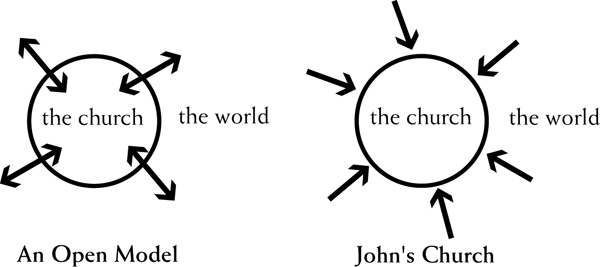
How do I bridge this worldview with my own? How do I convince my Christian community that severe boundaries might be appropriate? In fact, I suspect that many in the church are convinced that the mere notion of boundary is inappropriate. They live with a cosmology that innocently sees the world as benign. Many evangelicals do not see the world as hostile. They do not see that its values, its politics, its educational systems, and even its social life are opposed to the church. As I write, ABC national news has carried the remarkable Dallas story of the Christian conversion of Norma McCorvey, otherwise known as Jane Roe, the original plaintiff for abortion rights in the landmark 1973 case Roe versus Wade. Once an abortion leader, she has been baptized, confessed to the fraud of the 1973 Supreme Court case, and now speaks of early abortions as sin.14 Norma McCorvey is now prolife—as a Christian—and the ABC interviewer’s hostility on TV was tangible. The nation was told that this woman was now emotionally troubled and that this was no conversion but a political ploy of the Christian “right.” We must not be fooled. The world is seriously hostile to the growth of the kingdom. Yet we do not want to be separatist; we sometimes want to be inclusive lest any accuse us of being self-righteous, even cultlike.
Therefore John’s ecclesiology—his doctrine of the church—requires that we forge a new worldview. Unless this view of the world changes, John’s warnings about the dangers inherent in the world—its offensiveness, its aggressiveness, its rejection of the truth—will seem irrelevant. When I take an ecclesiology such as this into the twentieth century, it forces me to ask difficult questions about how we live in our communities. How do I view the threat of the world? What warnings do I give to equip my people without making them fearful? What strategies do I use to forge a strong community that is not vulnerable to the spiritual dangers and threats of the world? This discussion may begin with these verses but must continue for many sections to come. Some might urge that this question of managing the boundary between church and world is John’s consuming interest throughout this letter.
Contemporary Significance
MANY OF US fail to discuss the boundary between the church and the world. As a result, we fail to think of strategies to equip our people to manage a life lived in both spheres. Five fields of inquiry open up some of John’s principal concerns. Three strategies and two warnings are given to equip and strengthen the church.
(1) Does assurance reduce vulnerability? In verses 12–13 John writes to his “children” that their sins have been forgiven and that they have known the Father. As a pastor John is discerning something important. The first threat to faith, the fissure in an otherwise rock-solid Christian life, comes when I doubt the validity or the certainty of my convictions. When someone comes along and suggests that more complete knowledge of God or genuine certainty of salvation is available elsewhere, I am forced to rethink the basis of my faith. If I am assured of my convictions and confident in the truth I embrace, such questions cannot make me vulnerable.
I am often intrigued by stories of men and women who are swept up into a new religious movement. It may be the authoritative teachings of some new evangelist or perhaps a new church promoting a new experience or teaching. On closer inspection I find there is something lacking, some absence of confidence in this person, doubting that what he or she had received in Christ was exhaustive and complete. John writes in these verses not simply to make his followers feel better, but to help them know more completely that their Christian experience is true, authoritative, and complete. If the strength of our Christian resolve is firm, external religious pollutants have only limited influence.
What does this imply for the conduct of ministry and preaching? Preaching should not simply explain, it should equip. Instruction should not simply reiterate the tenets of faith, but do so with reference to those who might undo faith. Assurance limits vulnerability. The degree to which we are sure of ourselves before God will determine the degree of our vulnerability.
(2) Senior believers are anchors of the faith. Recently in one of my classes we were discussing how Jesus worked miracles and cast out demons in the Gospels. In order to launch a discussion of the contemporary relevance of these passages, I showed an unusually powerful video of Catholic priests and laypersons conducting an exorcism. It described their spiritual preparation and the remarkably difficult task of such ministry. After the film, I asked my students (whose average age was about twenty) to comment on it. One of the first respondents stunned me: “These people look so old that I can’t imagine how they can do something like this.” The bulk of the team was made up of men and women in their fifties and sixties who had vast experience in this work.
The response stunned me because it unveiled a complete disregard for the contribution of senior members of the Christian community, people whose experiences and maturity gave them a savvy about the Christian life that could be found nowhere else. In other less dramatic ways, the church similarly disregards the resources of its senior members. John’s reference to “fathers” is not an appeal to give respect to those who are simply older (though such is appropriate). Age does not give a person intrinsic spiritual authority in the church. But John is indicating that senior believers—who often are older but who may not be elderly—provide an unparalleled service: Their faith is anchored “from the beginning.”
I noted earlier that “from the beginning” is an important phrase in this letter. It suggests that those whose faith reaches far back, who understand the genesis of Christian belief, who recognize the importance of Jesus’ life and work, and who know the Scriptures after long study—that these women and men are anchors of stability and wisdom. When such strength is set aside in favor of the exuberant zeal of youth, the church becomes vulnerable to those who would redirect it from its historic and biblical moorings.
(3) Young believers can be exemplars of the faith. John does not fail to include the contributions of those who are young in the faith. These are believers—sometimes school children, sometimes adults—who have not lost the freshness and vitality of their “first love” for Christ (cf. Rev. 2:4). They are transparent, vocal, and passionate. They are another form of strength for the church.
This is perhaps why I enjoy teaching at an undergraduate college. College students exhibit a thorough-going zeal and abandon for God that can be found in few other places. And this strengthens me and challenges me. John writes that such believers are “strong,” are rooted in God’s Word, and are succeeding in battle with “the evil one.” This brings to mind soldiers—Marines maybe!—who know how to handle the front lines and are eager to be there. One only has to visit InterVarsity’s national mission’s conference called Urbana to see what I mean. The passion of these men and women for the Scriptures is undiminished. They are eager to make new discoveries as they study. They listen for God’s voice, and when they hear it, they are likely to leave their nets and follow Jesus. They are exemplars of faith.
But life in a congregation does not always see things this way. Those who hold leadership, who broker influence and power, often look at the impulsiveness and recklessness of this sort of faith and distrust it. They do not oppose it; they simply ignore it, and since they often control the decision-making bodies of the church, they can marginalize it. John knows that youth bring virtues that have been lost with the passing of years. When these virtues are absent, the church is vulnerable.
(4) The theological problem of the world. John’s ecclesiology is difficult for many of us. We are not to love the world or anything in it. Of course, we can redefine this by saying John really has in mind those things that are abhorrent to the godly life: sinful cravings, lust, and pride (v. 16). But this does not sweep away the problem. John believes that the world outside of Christ is a treacherous place that can do irreparable harm to believers.
If we take this view seriously, we will have to change the tone of our preaching. We must be candid about the threat of the world. We must be forthright that a boundary does exist between our lives in Christ and the life promoted in the world. Unfortunately, for many of us such preaching is difficult, if not embarrassing, because our lives are so utterly enmeshed with the world. And because we fail to warn believers in our churches about the character of the world, they become vulnerable to its influences. Paul had no difficulty with this sort of candor. He drew strict boundaries between the world and the church. The Ephesians were told to arm themselves for this battle (Eph. 6:10–18). The Corinthians were told to discern worldly wisdom from godly wisdom (1 Cor. 1:20–31) and to exhibit a conduct that is unlike the world’s (2 Cor. 10:3). John encourages this sort of speech. He speaks of “overcoming” the world because of its inherent hostility to us (1 John 5:4–12).
It is not difficult for most of us to generate examples of how the world has lost its moral compass. Any perusal of print, television, or film media will render examples in abundance. Just sample HBO or the USA network for a month. But it is the more subtle incursion of hostile values that concerns me. For example, when Disney movies are no longer safe fare for children, something has changed. I recently watched Rin Tin Tin K9 Cop on the Family Channel with my youngest daughter and was astounded at the violence. The opening scene showed a captured Rin Tin Tin tied to the trigger of a huge shotgun (if he moved, his head would disappear), while the criminal poured gasoline around the dog and lit it. Fortunately the police came and filled the crook with bullets. All this in less than five minutes! Is this family fare today? Two hours later a slight move to another channel will produce even more amazing adult fare. Must I be tolerant?
No doubt examples from the media are only symptomatic of a deeper, more tragic catastrophe that is at work in our society. In 1975 Jacques Ellul published an influential book called The New Demons, in which he outlined the forces at work in the secular world.15 We have witnessed the erosion of a Christian consensus undergirding society, and this has been joined with a “sacred” devotion to science and materialism, which now give us our cosmology. Yet while this is going on, new modern myths—new pagan religious forms—are erupting everywhere.
More recently Carl Henry announced the same judgment on the severity of the world’s fall in Twilight of a Great Civilization.16 He offers a penetrating critique of the moral and intellectual downfall of our society and calls on the church not only to erect boundaries, lines of demarcation separating church and world, but also to take the offensive, to attack the neo-paganism on our doorstep. The world is now a theological problem. When will we draw a “line in the sand”?
(5) To what extent have worldly values invaded the church? The allure of the world is strong. To cite a minor example, the allure of wealth, and of power in particular, has invaded our ranks. John is explicit in verse 16 that worldly desires and a boasting in our lifestyle should find no home among Christians. The world, he remarks, is going to disappear (cf. 1 Cor. 7:31), and therefore we should invest in places where “moth and rust” cannot enter (Matt. 6:19–20). Jesus tells a disturbing story about a man who fills barn after barn—mutual fund after mutual fund—and then one evening the Lord says, “This very night your life will be demanded from you” (Luke 12:16–21; cf. Matt. 16:26–27).
And yet how often do we defer leadership in the church to those who have been successful by worldly standards? Possessing wealth, having a successful business, wielding influence in the world—these things do not in themselves mean that one should have spiritual authority in the church. I recall on two separate occasions watching the leadership of a major Christian organization and a large, successful church defer completely to Christian laypersons in power because they had enjoyed secular success. “Why is he in charge?” I asked someone. “Because so many people work for him here—or would like to,” came the answer. John is clear: When secular, worldly power forms the basis for Christian leadership, new demons have entered the church, and once more the church is vulnerable.
But the problem of the world’s influence over the church’s life runs far deeper than cosmetic examples of secular success running church boards. David Wells has written a brilliant study that not only outlines the ongoing intellectual, religious, and cultural corruption of the world, but how these post-Christian values are shaping the church’s witness and thought. He shows that Western culture is being upended and the church is awash with change. Modernity has rearranged the reality of God in such a manner that he no longer makes a real difference in the church of today. Wells calls this a “silent revolution” that is barely noticed by its victims. As a result, the church is producing a “weightless God,” who is of no consequence to those who believe. Listen to his comments in this regard:
It is one of the defining marks of Our Time that God is now weightless. I do not mean by this that he is ethereal but rather that he has become unimportant. He rests upon the world as inconsequentially as not to be noticeable. He has lost his saliency for human life. Those who assure the pollsters of their belief in God’s existence may nonetheless consider him less interesting than television, his commands less authoritative than their appetites for affluence and influence, his judgments no more awe-inspiring than the evening news, and his truth less compelling than the advertisers’ sweet fog of flattery and lies.17
According to Wells, the church is in trouble (but barely knows it) because it has failed to discern the corrupting influences of the world, erect formidable boundaries, and make potent and compelling claims for the truth.
Original Meaning
Words for Elders (2:13a , 14a)
IT IS UNPARALLELED to find in the New Testament Christians referred to as “fathers,” since it generally serves as a metaphor for ancestors who have died (2 Peter 3:4). In Acts 22:1 we may have an instance of senior or elder Christians being given this title, but this is rare. Its general meaning here likely refers to those who are mature in the faith (if we disregard the use of the word “elder” for a church office). Above all, we must not think that John has in mind the men of this congregation exclusively. Paul’s Jewish custom is to address adults widely with such titles as “brothers,” all along implying that he has the entire Christian church in mind, women included.
Like the children in 2:14, fathers too “have known” God. Everyone, mature and immature alike, shares this same privilege. But there is a difference, for fathers have known “him who is from the beginning.” This may refer to God exclusively—or it may refer to Jesus, whose preexistence is important to John.5 We have seen thus far that “from the beginning” is an important phrase in this church. It has been used in reference to the message that was passed on about Jesus (2:24; 3:11) or even about Jesus himself (1:1). Even the command to love is “since the beginning” (2:7). This suggests that those who are mature in the faith, whose spiritual maturity and experience reach back many years, have a knowledge of God that is anchored securely in the things of the past. It is their seasoned wisdom that makes for steadfast faith in the present circumstances.
Bridging Contexts
THIS IS JOHN’S third exhortation in a series that began in 1:8. He is continuing a dualistic outlook by building within his congregation a sense that there are two fronts, two dimensions, about which his followers need to be concerned. There is initially “the world” outside the church, an environment intrinsically opposed to God though loved by him. Christians should be aware of the temptations and threats of this world and equip themselves so that they do not fall prey to them. Then there is a group within the church itself who hold an “unworldly” array of convictions. People within the Christian community need to develop the strength of their fellowship and be alert to those who might compromise the faith and diminish the quality of life together.
Each exhortation increases the sense of “boundary” between the spheres of the world and the church. Subtle theological distortions give way to genuine perversions of doctrine. A world that seems indifferent to God is now disclosed as being utterly inimical to him. People that seemed to be sitting on the border—worldly Christians, we might say—are identified as threatening. Teachers of error suddenly become instruments of the devil.
Through these exhortations John is building an ecclesiology that is nothing short of separatist. A separatist worldview is one that draws a sharp line between us and the non-Christian world. It calls us apart radically, demanding that we sever most links with a hostile environment. John reassures those within the fellowship and severely condemns life outside of it. In the fourth exhortation (2:18–27), those within the fellowship who have succumbed to the world’s allure are given the harshest rebuke. John paints a portrait of a community under siege, a community infiltrated by saboteurs with hostile opposition at every turn. Is separatism good? Is it wrong? Its moral value is hinged directly to the character of the environment surrounding the church. If the church is threatened by a hostile, aggressive society, separatism might be a valid strategy for survival.
Such an outlook might look like this:
How do I bridge this worldview with my own? How do I convince my Christian community that severe boundaries might be appropriate? In fact, I suspect that many in the church are convinced that the mere notion of boundary is inappropriate. They live with a cosmology that innocently sees the world as benign. Many evangelicals do not see the world as hostile. They do not see that its values, its politics, its educational systems, and even its social life are opposed to the church. As I write, ABC national news has carried the remarkable Dallas story of the Christian conversion of Norma McCorvey, otherwise known as Jane Roe, the original plaintiff for abortion rights in the landmark 1973 case Roe versus Wade. Once an abortion leader, she has been baptized, confessed to the fraud of the 1973 Supreme Court case, and now speaks of early abortions as sin.14 Norma McCorvey is now prolife—as a Christian—and the ABC interviewer’s hostility on TV was tangible. The nation was told that this woman was now emotionally troubled and that this was no conversion but a political ploy of the Christian “right.” We must not be fooled. The world is seriously hostile to the growth of the kingdom. Yet we do not want to be separatist; we sometimes want to be inclusive lest any accuse us of being self-righteous, even cultlike.
Therefore John’s ecclesiology—his doctrine of the church—requires that we forge a new worldview. Unless this view of the world changes, John’s warnings about the dangers inherent in the world—its offensiveness, its aggressiveness, its rejection of the truth—will seem irrelevant. When I take an ecclesiology such as this into the twentieth century, it forces me to ask difficult questions about how we live in our communities. How do I view the threat of the world? What warnings do I give to equip my people without making them fearful? What strategies do I use to forge a strong community that is not vulnerable to the spiritual dangers and threats of the world? This discussion may begin with these verses but must continue for many sections to come. Some might urge that this question of managing the boundary between church and world is John’s consuming interest throughout this letter.
Contemporary Significance
MANY OF US fail to discuss the boundary between the church and the world. As a result, we fail to think of strategies to equip our people to manage a life lived in both spheres. Five fields of inquiry open up some of John’s principal concerns. Three strategies and two warnings are given to equip and strengthen the church.
(1) Does assurance reduce vulnerability? In verses 12–13 John writes to his “children” that their sins have been forgiven and that they have known the Father. As a pastor John is discerning something important. The first threat to faith, the fissure in an otherwise rock-solid Christian life, comes when I doubt the validity or the certainty of my convictions. When someone comes along and suggests that more complete knowledge of God or genuine certainty of salvation is available elsewhere, I am forced to rethink the basis of my faith. If I am assured of my convictions and confident in the truth I embrace, such questions cannot make me vulnerable.
I am often intrigued by stories of men and women who are swept up into a new religious movement. It may be the authoritative teachings of some new evangelist or perhaps a new church promoting a new experience or teaching. On closer inspection I find there is something lacking, some absence of confidence in this person, doubting that what he or she had received in Christ was exhaustive and complete. John writes in these verses not simply to make his followers feel better, but to help them know more completely that their Christian experience is true, authoritative, and complete. If the strength of our Christian resolve is firm, external religious pollutants have only limited influence.
What does this imply for the conduct of ministry and preaching? Preaching should not simply explain, it should equip. Instruction should not simply reiterate the tenets of faith, but do so with reference to those who might undo faith. Assurance limits vulnerability. The degree to which we are sure of ourselves before God will determine the degree of our vulnerability.
(2) Senior believers are anchors of the faith. Recently in one of my classes we were discussing how Jesus worked miracles and cast out demons in the Gospels. In order to launch a discussion of the contemporary relevance of these passages, I showed an unusually powerful video of Catholic priests and laypersons conducting an exorcism. It described their spiritual preparation and the remarkably difficult task of such ministry. After the film, I asked my students (whose average age was about twenty) to comment on it. One of the first respondents stunned me: “These people look so old that I can’t imagine how they can do something like this.” The bulk of the team was made up of men and women in their fifties and sixties who had vast experience in this work.
The response stunned me because it unveiled a complete disregard for the contribution of senior members of the Christian community, people whose experiences and maturity gave them a savvy about the Christian life that could be found nowhere else. In other less dramatic ways, the church similarly disregards the resources of its senior members. John’s reference to “fathers” is not an appeal to give respect to those who are simply older (though such is appropriate). Age does not give a person intrinsic spiritual authority in the church. But John is indicating that senior believers—who often are older but who may not be elderly—provide an unparalleled service: Their faith is anchored “from the beginning.”
I noted earlier that “from the beginning” is an important phrase in this letter. It suggests that those whose faith reaches far back, who understand the genesis of Christian belief, who recognize the importance of Jesus’ life and work, and who know the Scriptures after long study—that these women and men are anchors of stability and wisdom. When such strength is set aside in favor of the exuberant zeal of youth, the church becomes vulnerable to those who would redirect it from its historic and biblical moorings.
(3) Young believers can be exemplars of the faith. John does not fail to include the contributions of those who are young in the faith. These are believers—sometimes school children, sometimes adults—who have not lost the freshness and vitality of their “first love” for Christ (cf. Rev. 2:4). They are transparent, vocal, and passionate. They are another form of strength for the church.
This is perhaps why I enjoy teaching at an undergraduate college. College students exhibit a thorough-going zeal and abandon for God that can be found in few other places. And this strengthens me and challenges me. John writes that such believers are “strong,” are rooted in God’s Word, and are succeeding in battle with “the evil one.” This brings to mind soldiers—Marines maybe!—who know how to handle the front lines and are eager to be there. One only has to visit InterVarsity’s national mission’s conference called Urbana to see what I mean. The passion of these men and women for the Scriptures is undiminished. They are eager to make new discoveries as they study. They listen for God’s voice, and when they hear it, they are likely to leave their nets and follow Jesus. They are exemplars of faith.
But life in a congregation does not always see things this way. Those who hold leadership, who broker influence and power, often look at the impulsiveness and recklessness of this sort of faith and distrust it. They do not oppose it; they simply ignore it, and since they often control the decision-making bodies of the church, they can marginalize it. John knows that youth bring virtues that have been lost with the passing of years. When these virtues are absent, the church is vulnerable.
(4) The theological problem of the world. John’s ecclesiology is difficult for many of us. We are not to love the world or anything in it. Of course, we can redefine this by saying John really has in mind those things that are abhorrent to the godly life: sinful cravings, lust, and pride (v. 16). But this does not sweep away the problem. John believes that the world outside of Christ is a treacherous place that can do irreparable harm to believers.
If we take this view seriously, we will have to change the tone of our preaching. We must be candid about the threat of the world. We must be forthright that a boundary does exist between our lives in Christ and the life promoted in the world. Unfortunately, for many of us such preaching is difficult, if not embarrassing, because our lives are so utterly enmeshed with the world. And because we fail to warn believers in our churches about the character of the world, they become vulnerable to its influences. Paul had no difficulty with this sort of candor. He drew strict boundaries between the world and the church. The Ephesians were told to arm themselves for this battle (Eph. 6:10–18). The Corinthians were told to discern worldly wisdom from godly wisdom (1 Cor. 1:20–31) and to exhibit a conduct that is unlike the world’s (2 Cor. 10:3). John encourages this sort of speech. He speaks of “overcoming” the world because of its inherent hostility to us (1 John 5:4–12).
It is not difficult for most of us to generate examples of how the world has lost its moral compass. Any perusal of print, television, or film media will render examples in abundance. Just sample HBO or the USA network for a month. But it is the more subtle incursion of hostile values that concerns me. For example, when Disney movies are no longer safe fare for children, something has changed. I recently watched Rin Tin Tin K9 Cop on the Family Channel with my youngest daughter and was astounded at the violence. The opening scene showed a captured Rin Tin Tin tied to the trigger of a huge shotgun (if he moved, his head would disappear), while the criminal poured gasoline around the dog and lit it. Fortunately the police came and filled the crook with bullets. All this in less than five minutes! Is this family fare today? Two hours later a slight move to another channel will produce even more amazing adult fare. Must I be tolerant?
No doubt examples from the media are only symptomatic of a deeper, more tragic catastrophe that is at work in our society. In 1975 Jacques Ellul published an influential book called The New Demons, in which he outlined the forces at work in the secular world.15 We have witnessed the erosion of a Christian consensus undergirding society, and this has been joined with a “sacred” devotion to science and materialism, which now give us our cosmology. Yet while this is going on, new modern myths—new pagan religious forms—are erupting everywhere.
More recently Carl Henry announced the same judgment on the severity of the world’s fall in Twilight of a Great Civilization.16 He offers a penetrating critique of the moral and intellectual downfall of our society and calls on the church not only to erect boundaries, lines of demarcation separating church and world, but also to take the offensive, to attack the neo-paganism on our doorstep. The world is now a theological problem. When will we draw a “line in the sand”?
(5) To what extent have worldly values invaded the church? The allure of the world is strong. To cite a minor example, the allure of wealth, and of power in particular, has invaded our ranks. John is explicit in verse 16 that worldly desires and a boasting in our lifestyle should find no home among Christians. The world, he remarks, is going to disappear (cf. 1 Cor. 7:31), and therefore we should invest in places where “moth and rust” cannot enter (Matt. 6:19–20). Jesus tells a disturbing story about a man who fills barn after barn—mutual fund after mutual fund—and then one evening the Lord says, “This very night your life will be demanded from you” (Luke 12:16–21; cf. Matt. 16:26–27).
And yet how often do we defer leadership in the church to those who have been successful by worldly standards? Possessing wealth, having a successful business, wielding influence in the world—these things do not in themselves mean that one should have spiritual authority in the church. I recall on two separate occasions watching the leadership of a major Christian organization and a large, successful church defer completely to Christian laypersons in power because they had enjoyed secular success. “Why is he in charge?” I asked someone. “Because so many people work for him here—or would like to,” came the answer. John is clear: When secular, worldly power forms the basis for Christian leadership, new demons have entered the church, and once more the church is vulnerable.
But the problem of the world’s influence over the church’s life runs far deeper than cosmetic examples of secular success running church boards. David Wells has written a brilliant study that not only outlines the ongoing intellectual, religious, and cultural corruption of the world, but how these post-Christian values are shaping the church’s witness and thought. He shows that Western culture is being upended and the church is awash with change. Modernity has rearranged the reality of God in such a manner that he no longer makes a real difference in the church of today. Wells calls this a “silent revolution” that is barely noticed by its victims. As a result, the church is producing a “weightless God,” who is of no consequence to those who believe. Listen to his comments in this regard:
It is one of the defining marks of Our Time that God is now weightless. I do not mean by this that he is ethereal but rather that he has become unimportant. He rests upon the world as inconsequentially as not to be noticeable. He has lost his saliency for human life. Those who assure the pollsters of their belief in God’s existence may nonetheless consider him less interesting than television, his commands less authoritative than their appetites for affluence and influence, his judgments no more awe-inspiring than the evening news, and his truth less compelling than the advertisers’ sweet fog of flattery and lies.17
According to Wells, the church is in trouble (but barely knows it) because it has failed to discern the corrupting influences of the world, erect formidable boundaries, and make potent and compelling claims for the truth.
Original Meaning
The Love of the World (2:15–17)
JOHN NOW TURNS to the principal exhortation of this section. Smalley suggests a symmetry connects this unit with the foregoing.7
15 | Love of the world | Love of the Father |
16 | comes from the world | comes from the Father |
17 | the world passes away | the one who obeys God remains forever |
It is a warning. Two choices stand before everyone—even in the church: Either we love the Father or we love the world. Affirmations for John’s loyal followers (vv. 12–14) now become warnings that they do not fall away into spiritual duplicity—parading spiritual things while the heart is possessed by the world.
It is crucial to maintain a firm understanding of vocabulary in this section. Key words such as “world,” “love,” and “life” must be read with their original meaning in mind. When John uses the word “world” (Gk. kosmos), he can mean either the created material universe, which is good (2:2; 3:17; cf. John 1:10), or the world of sin that stands in aggressive opposition to God (1 John 4:3–5; 5:19). This latter idea operates here, for kosmos represents the unredeemed world, a world under the control of Satan (5:19; John 12:31; 14:30); it lives in darkness (John 1:5; 12:46) and lies under God’s judgment (9:39). This is again John’s dualism at work, but here we see it as an ethical dualism rather than a cosmological dualism.8 To John, the material world is good and will find renewal someday. Yet there are those within it who follow evil impulses and reject God; they deserve criticism.
There is a further difficulty when John says that we should not love this world. This is different from the command to love in 2:10, where the object of love is a fellow believer. Nevertheless, there is a tension with John 3:16, where we learn that God loves the world. Even though the world is a place of disbelief, God’s love for it does not cease (1 John 2:2; 4:14). He actually set out to save and repair the world he had made. Should we not then love the world too?
John has in mind that Christians are to avoid an infatuation with worldly godlessness, with the realm of darkness that brings base pleasures. Such affection is incompatible with the true love of the Father (v. 15b). In verses 16–17 John lists the three characteristics of such affections; these verses shape the meaning of verse 15.
(1) The desire of the flesh (NIV, “the cravings of sinful man”). The Greek word sarx (lit., “flesh”) possesses various nuances. Some commentators take it to mean sensual or sexual desires, and certainly this may be suggested. On the other hand, the LXX never uses sarx with reference to sensuality but often uses it to refer to humanity in general, particularly as it stands in contrast to God. In other words, John has in mind any desire, any sinful interest, that draws us away from God or at least makes continuing fellowship with him impossible.
(2) The desire of the eyes (NIV, “the lust of his eyes”). The same noun as is used in the first phrase, epithymia (“desire”), is repeated here. This develops further the arena of “sinful desires” against which John is warning us. This word may, of course, refer to a sinful interest in what can be seen. On the other hand, the eye is often a metaphor for sinful passion that corrupts (cf. Matt. 5:28). Examples include Eve’s looking at the forbidden tree, which was “pleasing to the eye” (Gen. 3:6), or David’s lustful looking at Bathsheba as she bathed (2 Sam. 11:2).9
(3) Boasting in one’s lifestyle (NIV, “boasting of what he has and does”). The third description now moves from two forms of inappropriate interest and passion to an unholy pride in what one has. The “boaster” (Gk. alazon) is someone who pretentiously “promises more than he can perform” and, in antiquity, “often describes orators, philosophers, doctors, cooks and officials.”10 It is used in Romans 1:30 and 2 Timothy 3:2, two of Paul’s vice catalogues. The object of this boasting is life.11 The Greek term here is unusual. Bios (as distinguished from zoe) describes the basic stuff of living—the materials of living—and appears in 1 John 3:17 in an unusual phrase that makes the meaning explicit: “the life of the world,” which the NIV rightly translates “material possessions.” Thus, John has in mind an attitude of pretentious arrogance or subtle elitism that comes from one’s view of wealth, rank, or stature in society. It is an overconfidence that makes us lose any notion that we are dependent on God.12
These three characteristics are frequently compared with the temptations of Eve in the Garden of Eden or of Jesus in the desert (wrong interest, wrong passion, and pride), but the parallels seem weak. John is rather sketching a sweeping portrait of what it means to be seduced by worldliness and the allure of sin.
In 2:16b–17 two reasons are given why these interests are wrongheaded. (1) They do not spring from the Father and therefore will ultimately destroy a relationship with him. (2) As an eschatological reason, “the present age is doomed.”13 Christ has brought a completely new value system to history. And practically speaking, those who are utterly invested in the world and its passions will see it vanish. Only those whose passions rest in the Father will continue forever.
Bridging Contexts
THIS IS JOHN’S third exhortation in a series that began in 1:8. He is continuing a dualistic outlook by building within his congregation a sense that there are two fronts, two dimensions, about which his followers need to be concerned. There is initially “the world” outside the church, an environment intrinsically opposed to God though loved by him. Christians should be aware of the temptations and threats of this world and equip themselves so that they do not fall prey to them. Then there is a group within the church itself who hold an “unworldly” array of convictions. People within the Christian community need to develop the strength of their fellowship and be alert to those who might compromise the faith and diminish the quality of life together.
Each exhortation increases the sense of “boundary” between the spheres of the world and the church. Subtle theological distortions give way to genuine perversions of doctrine. A world that seems indifferent to God is now disclosed as being utterly inimical to him. People that seemed to be sitting on the border—worldly Christians, we might say—are identified as threatening. Teachers of error suddenly become instruments of the devil.
Through these exhortations John is building an ecclesiology that is nothing short of separatist. A separatist worldview is one that draws a sharp line between us and the non-Christian world. It calls us apart radically, demanding that we sever most links with a hostile environment. John reassures those within the fellowship and severely condemns life outside of it. In the fourth exhortation (2:18–27), those within the fellowship who have succumbed to the world’s allure are given the harshest rebuke. John paints a portrait of a community under siege, a community infiltrated by saboteurs with hostile opposition at every turn. Is separatism good? Is it wrong? Its moral value is hinged directly to the character of the environment surrounding the church. If the church is threatened by a hostile, aggressive society, separatism might be a valid strategy for survival.
Such an outlook might look like this:
How do I bridge this worldview with my own? How do I convince my Christian community that severe boundaries might be appropriate? In fact, I suspect that many in the church are convinced that the mere notion of boundary is inappropriate. They live with a cosmology that innocently sees the world as benign. Many evangelicals do not see the world as hostile. They do not see that its values, its politics, its educational systems, and even its social life are opposed to the church. As I write, ABC national news has carried the remarkable Dallas story of the Christian conversion of Norma McCorvey, otherwise known as Jane Roe, the original plaintiff for abortion rights in the landmark 1973 case Roe versus Wade. Once an abortion leader, she has been baptized, confessed to the fraud of the 1973 Supreme Court case, and now speaks of early abortions as sin.14 Norma McCorvey is now prolife—as a Christian—and the ABC interviewer’s hostility on TV was tangible. The nation was told that this woman was now emotionally troubled and that this was no conversion but a political ploy of the Christian “right.” We must not be fooled. The world is seriously hostile to the growth of the kingdom. Yet we do not want to be separatist; we sometimes want to be inclusive lest any accuse us of being self-righteous, even cultlike.
Therefore John’s ecclesiology—his doctrine of the church—requires that we forge a new worldview. Unless this view of the world changes, John’s warnings about the dangers inherent in the world—its offensiveness, its aggressiveness, its rejection of the truth—will seem irrelevant. When I take an ecclesiology such as this into the twentieth century, it forces me to ask difficult questions about how we live in our communities. How do I view the threat of the world? What warnings do I give to equip my people without making them fearful? What strategies do I use to forge a strong community that is not vulnerable to the spiritual dangers and threats of the world? This discussion may begin with these verses but must continue for many sections to come. Some might urge that this question of managing the boundary between church and world is John’s consuming interest throughout this letter.
Contemporary Significance
MANY OF US fail to discuss the boundary between the church and the world. As a result, we fail to think of strategies to equip our people to manage a life lived in both spheres. Five fields of inquiry open up some of John’s principal concerns. Three strategies and two warnings are given to equip and strengthen the church.
(1) Does assurance reduce vulnerability? In verses 12–13 John writes to his “children” that their sins have been forgiven and that they have known the Father. As a pastor John is discerning something important. The first threat to faith, the fissure in an otherwise rock-solid Christian life, comes when I doubt the validity or the certainty of my convictions. When someone comes along and suggests that more complete knowledge of God or genuine certainty of salvation is available elsewhere, I am forced to rethink the basis of my faith. If I am assured of my convictions and confident in the truth I embrace, such questions cannot make me vulnerable.
I am often intrigued by stories of men and women who are swept up into a new religious movement. It may be the authoritative teachings of some new evangelist or perhaps a new church promoting a new experience or teaching. On closer inspection I find there is something lacking, some absence of confidence in this person, doubting that what he or she had received in Christ was exhaustive and complete. John writes in these verses not simply to make his followers feel better, but to help them know more completely that their Christian experience is true, authoritative, and complete. If the strength of our Christian resolve is firm, external religious pollutants have only limited influence.
What does this imply for the conduct of ministry and preaching? Preaching should not simply explain, it should equip. Instruction should not simply reiterate the tenets of faith, but do so with reference to those who might undo faith. Assurance limits vulnerability. The degree to which we are sure of ourselves before God will determine the degree of our vulnerability.
(2) Senior believers are anchors of the faith. Recently in one of my classes we were discussing how Jesus worked miracles and cast out demons in the Gospels. In order to launch a discussion of the contemporary relevance of these passages, I showed an unusually powerful video of Catholic priests and laypersons conducting an exorcism. It described their spiritual preparation and the remarkably difficult task of such ministry. After the film, I asked my students (whose average age was about twenty) to comment on it. One of the first respondents stunned me: “These people look so old that I can’t imagine how they can do something like this.” The bulk of the team was made up of men and women in their fifties and sixties who had vast experience in this work.
The response stunned me because it unveiled a complete disregard for the contribution of senior members of the Christian community, people whose experiences and maturity gave them a savvy about the Christian life that could be found nowhere else. In other less dramatic ways, the church similarly disregards the resources of its senior members. John’s reference to “fathers” is not an appeal to give respect to those who are simply older (though such is appropriate). Age does not give a person intrinsic spiritual authority in the church. But John is indicating that senior believers—who often are older but who may not be elderly—provide an unparalleled service: Their faith is anchored “from the beginning.”
I noted earlier that “from the beginning” is an important phrase in this letter. It suggests that those whose faith reaches far back, who understand the genesis of Christian belief, who recognize the importance of Jesus’ life and work, and who know the Scriptures after long study—that these women and men are anchors of stability and wisdom. When such strength is set aside in favor of the exuberant zeal of youth, the church becomes vulnerable to those who would redirect it from its historic and biblical moorings.
(3) Young believers can be exemplars of the faith. John does not fail to include the contributions of those who are young in the faith. These are believers—sometimes school children, sometimes adults—who have not lost the freshness and vitality of their “first love” for Christ (cf. Rev. 2:4). They are transparent, vocal, and passionate. They are another form of strength for the church.
This is perhaps why I enjoy teaching at an undergraduate college. College students exhibit a thorough-going zeal and abandon for God that can be found in few other places. And this strengthens me and challenges me. John writes that such believers are “strong,” are rooted in God’s Word, and are succeeding in battle with “the evil one.” This brings to mind soldiers—Marines maybe!—who know how to handle the front lines and are eager to be there. One only has to visit InterVarsity’s national mission’s conference called Urbana to see what I mean. The passion of these men and women for the Scriptures is undiminished. They are eager to make new discoveries as they study. They listen for God’s voice, and when they hear it, they are likely to leave their nets and follow Jesus. They are exemplars of faith.
But life in a congregation does not always see things this way. Those who hold leadership, who broker influence and power, often look at the impulsiveness and recklessness of this sort of faith and distrust it. They do not oppose it; they simply ignore it, and since they often control the decision-making bodies of the church, they can marginalize it. John knows that youth bring virtues that have been lost with the passing of years. When these virtues are absent, the church is vulnerable.
(4) The theological problem of the world. John’s ecclesiology is difficult for many of us. We are not to love the world or anything in it. Of course, we can redefine this by saying John really has in mind those things that are abhorrent to the godly life: sinful cravings, lust, and pride (v. 16). But this does not sweep away the problem. John believes that the world outside of Christ is a treacherous place that can do irreparable harm to believers.
If we take this view seriously, we will have to change the tone of our preaching. We must be candid about the threat of the world. We must be forthright that a boundary does exist between our lives in Christ and the life promoted in the world. Unfortunately, for many of us such preaching is difficult, if not embarrassing, because our lives are so utterly enmeshed with the world. And because we fail to warn believers in our churches about the character of the world, they become vulnerable to its influences. Paul had no difficulty with this sort of candor. He drew strict boundaries between the world and the church. The Ephesians were told to arm themselves for this battle (Eph. 6:10–18). The Corinthians were told to discern worldly wisdom from godly wisdom (1 Cor. 1:20–31) and to exhibit a conduct that is unlike the world’s (2 Cor. 10:3). John encourages this sort of speech. He speaks of “overcoming” the world because of its inherent hostility to us (1 John 5:4–12).
It is not difficult for most of us to generate examples of how the world has lost its moral compass. Any perusal of print, television, or film media will render examples in abundance. Just sample HBO or the USA network for a month. But it is the more subtle incursion of hostile values that concerns me. For example, when Disney movies are no longer safe fare for children, something has changed. I recently watched Rin Tin Tin K9 Cop on the Family Channel with my youngest daughter and was astounded at the violence. The opening scene showed a captured Rin Tin Tin tied to the trigger of a huge shotgun (if he moved, his head would disappear), while the criminal poured gasoline around the dog and lit it. Fortunately the police came and filled the crook with bullets. All this in less than five minutes! Is this family fare today? Two hours later a slight move to another channel will produce even more amazing adult fare. Must I be tolerant?
No doubt examples from the media are only symptomatic of a deeper, more tragic catastrophe that is at work in our society. In 1975 Jacques Ellul published an influential book called The New Demons, in which he outlined the forces at work in the secular world.15 We have witnessed the erosion of a Christian consensus undergirding society, and this has been joined with a “sacred” devotion to science and materialism, which now give us our cosmology. Yet while this is going on, new modern myths—new pagan religious forms—are erupting everywhere.
More recently Carl Henry announced the same judgment on the severity of the world’s fall in Twilight of a Great Civilization.16 He offers a penetrating critique of the moral and intellectual downfall of our society and calls on the church not only to erect boundaries, lines of demarcation separating church and world, but also to take the offensive, to attack the neo-paganism on our doorstep. The world is now a theological problem. When will we draw a “line in the sand”?
(5) To what extent have worldly values invaded the church? The allure of the world is strong. To cite a minor example, the allure of wealth, and of power in particular, has invaded our ranks. John is explicit in verse 16 that worldly desires and a boasting in our lifestyle should find no home among Christians. The world, he remarks, is going to disappear (cf. 1 Cor. 7:31), and therefore we should invest in places where “moth and rust” cannot enter (Matt. 6:19–20). Jesus tells a disturbing story about a man who fills barn after barn—mutual fund after mutual fund—and then one evening the Lord says, “This very night your life will be demanded from you” (Luke 12:16–21; cf. Matt. 16:26–27).
And yet how often do we defer leadership in the church to those who have been successful by worldly standards? Possessing wealth, having a successful business, wielding influence in the world—these things do not in themselves mean that one should have spiritual authority in the church. I recall on two separate occasions watching the leadership of a major Christian organization and a large, successful church defer completely to Christian laypersons in power because they had enjoyed secular success. “Why is he in charge?” I asked someone. “Because so many people work for him here—or would like to,” came the answer. John is clear: When secular, worldly power forms the basis for Christian leadership, new demons have entered the church, and once more the church is vulnerable.
But the problem of the world’s influence over the church’s life runs far deeper than cosmetic examples of secular success running church boards. David Wells has written a brilliant study that not only outlines the ongoing intellectual, religious, and cultural corruption of the world, but how these post-Christian values are shaping the church’s witness and thought. He shows that Western culture is being upended and the church is awash with change. Modernity has rearranged the reality of God in such a manner that he no longer makes a real difference in the church of today. Wells calls this a “silent revolution” that is barely noticed by its victims. As a result, the church is producing a “weightless God,” who is of no consequence to those who believe. Listen to his comments in this regard:
It is one of the defining marks of Our Time that God is now weightless. I do not mean by this that he is ethereal but rather that he has become unimportant. He rests upon the world as inconsequentially as not to be noticeable. He has lost his saliency for human life. Those who assure the pollsters of their belief in God’s existence may nonetheless consider him less interesting than television, his commands less authoritative than their appetites for affluence and influence, his judgments no more awe-inspiring than the evening news, and his truth less compelling than the advertisers’ sweet fog of flattery and lies.17
According to Wells, the church is in trouble (but barely knows it) because it has failed to discern the corrupting influences of the world, erect formidable boundaries, and make potent and compelling claims for the truth.