Original Meaning
The Problem: Dissolution and Controversy (2:18–19)
THE URGENCY AND passion of John comes through not simply in his form of address (“dear children,” Gk. paidia; cf. 2:13) but in his announcement that it is now “the last hour.” Two things signal to John the arrival of this hour. (1) The appearance of “antichrist,” technically, anyone who opposes Christ, represents a focused hostility toward the gospel.1 (2) The dissolution of his own congregation (seen in the departure of some Christians) indicates that the antichrist has now laid siege to John’s church.
The first of these signals presents a difficult problem. In what sense is it “the last hour”? How can John be right since, to put it frankly, quite a few “hours” have passed since this letter was written and the end has still not come? Some scholars have been critical, arguing that for New Testament writers like John the phrase “the last hour” implied the period of time just before the end and therefore, logically, John was wrong. This view suggests that the early Christians believed in the imminent arrival of Christ in power (his second coming) and that his delay brought a major crisis on the church. Peter, for instance, acknowledges that people were scoffing at the church because Christ’s announced second coming had not happened (see 2 Peter 3:3–7).2
However, another view is more helpful. John may be speaking theologically rather than chronologically. The early Christians understood that the first coming of Christ brought a change of eons, an unparalleled period when the knowledge of God, the presence of his Holy Spirit, and the defeat of Satan were at work. They were fond of speaking about this era eschatologically, for it encompassed elements of the “world to come.” Christians were experiencing the last days or the last times, as if to say, all that was left for history to culminate was for Jesus to return a second time; that coming would complete what this era had begun (see Acts 2:17; 1 Cor. 10:11; Heb. 1:2; 1 Peter 1:20; cf. Joel 2:28; Mic. 4:1).
In this framework, the last times formed a last hour in which the struggle with evil and the unveiling of God’s power would intensify (1 Tim. 4:1; Jude 18), though the exact knowledge of when the eschatological era was being culminated remained unknown. Jesus was clear that speculation about the end of the world was inappropriate (see Mark 13:32, Acts 1:7). Yet he still gave an outline of those things that would characterize this era (Mark 13:28–37). There would be a cascade of falsehood and evil putting the church on the extreme defense. False christs and false prophets would be one feature (Matt. 24:24; Mark 13:22; cf. Rev. 13; 19:20). Paul even tells the Thessalonians to watch for “the man of lawlessness,” who is the antichrist, a powerful broker of evil forces (2 Thess. 2:1–12). Consequently, John is reminding his readers that the concentration of evil they are now experiencing fits perfectly the formula announced by Jesus and his apostles for the end of time.
The most helpful image to explain this view of history comes from J. H. Newman, a nineteenth-century pastor.3 History has changed its direction, says Newman. It runs “not towards the end, but along it, and on the brink of it; and is at all times near that great event, which, did it run towards it, it would at once run into. Christ then is ever at our doors.” Since the coming of Jesus, history has a new urgency, a sense that its end is at hand and the powers of the future are impinging upon it. Marshall cites Newman and illustrates his views thus:4

Thus, at any moment history could lapse over the line and bring about the end. And history’s proximity to the line (The End) will be signaled by the devastating events described here and elsewhere in the New Testament.
How long will this time take? Sometimes the “last hour” refers to a short period (John 4:23); sometimes its length is longer (16:2). Peter warns that God’s measuring of time is not like ours, for to the Lord a thousand years is like a day (2 Peter 3:8–10). God is above time. But when the end does come—and here the New Testament writers are in one accord—it will surprise everyone, including Christians. It will be seen by unbelievers as an unexpected catastrophe (Matt. 24:36–44; 25:1–13, 14–30; Mark 13:32–36; 1 Thess. 5:2; 2 Peter 3:10).
But what has prompted John’s interest in the end times? John sees in the personal catastrophe of his congregation echoes of the eschatological evil that waits on the world’s horizon. The work of antichrist has been successful in his own church. Verse 19 gives us our first explicit description of the secessionists. These are men and women who once lived as a part of John’s community but have now departed. And no doubt, since he mentioned antichrists in the previous verse, John views these people and their teachers/leaders as bearing the spirit of antichrist. They stand opposed to correct teaching and deny essential tenets of the faith (2:22; 4:3–6). In fact, they have broken a cardinal rule of the Johannine community by failing to love or failing to remain in community when disagreements were intense.
Their departure is evidence, says John, that they were never a part of the church in the first place. Their falsehood has been unveiled. This judgment presents us with a number of serious theological problems that we should discuss in our application. Were these people ever Christians? Does this mean that the church is made up of believers and unbelievers today? And if they were and are not now Christians, what does this imply for our understanding of the perseverance of the saints?
Bridging Contexts
ALTHOUGH THE CHURCH today is not frequently assailed by the sort of theological heresy outlined here, nevertheless there are substantial parallels between John’s experience with schism and his attempt to equip his congregation. The denial of Jesus’ humanity has come up in certain quarters of the church, and no doubt it should not be overlooked.
But the Johannine context described in these verses introduces a larger topic, a topic germane to church life today: What do we do when schism puts us in its grip? What do we do when members of the congregation feel that they are being led under the direction of the Holy Spirit into new areas of belief and experience? And worse still, what do we do when pastoral authority is rejected because (it is claimed) such authority is not in touch with the power of God to speak today?
John’s response is crucial for my understanding. First, John has an eschatological outlook that puts such erroneous teachings and church ruptures in their proper context. They are characteristic of the last days, characteristic of the tenor of the time when Christ will return and the end will break upon us all. He is not so much announcing “the end” as he is describing the present as bearing features that betray those of the end.
This is an important distinction. John is not apocalyptic, saying that the end is coming tomorrow; he is writing and living within an eschatological schema that says there are features present in his day that go along with the end times, and when these features begin to accumulate in history, two things are true: The end may break upon us and we must therefore be ready.
While certain themes may be difficult to bridge to our era, I am convinced that men and women today live with an eschatology. That is, the cumulative crises of recent decades have shaped a worldview that knows a terminus. This is perhaps one of the distinguishing marks of the so-called “Generation X,” people born after 1960. They bear little confidence that the world can improve, and they often live out a pessimistic eschatology.
The popular recent book Thirteenth Generation: Abort, Retry, Ignore, Fail, by Neil Howe and Bill Strauss, describes in breathtaking detail the pessimistic outlook of these young people. Listen to one college graduate:
I think we are all in a sense doomed. [I’m talking about] downward social mobility. We hear a lot about the great social mobility in America—with the focus on the comparative ease of moving upwards. What’s less discussed is how easy it is to go down. And I think that’s the direction we’re all heading in. And I think the downward fall is going to be very fast….”7
It is here that Christians can interpret that despair. John’s community despaired as well—just consider the odds against them in their pagan world. But John gives hope through his Christian explanation of things: Disintegration is an expected result in history and God is watching history unfold. This is an important “bridge point” that will connect powerfully today. Jill Nelson, a high school student in Washington, D.C., believes, “The way society presents it, I’ll either be strung out on drugs, a manager at McDonalds or a lawyer.”8 Christian ministry to Jill has high potential when it addresses her desperate view of history.
Second, John also has a strategy for equipping his people so that they will not fall prey again. He understands that they must be armed to confront the many prophets and inspired leaders who come along. This too connects vitally in our day because the same problems exist. Religious movements continue to flourish, and all promise to deliver compelling answers and experiences. Remarkably, young people who are sharply critical of the church and “religion” are easily swayed by these new prophets. Furthermore, within healthy, growing congregations voices of authority—voices claiming to be empowered by the Spirit—challenge the course of life as usual. John says there must be a strategy. Christians must be equipped to discern new voices that claim to be from God.
Finally, John is unashamed to use an assertive, aggressive tone to fight for the well-being of his flock. Here we have the universal pastoral dilemma that turns on two cherished values in the church: our commitment to unity and our commitment to the truth. Every church in every age has wrestled with this theme, and John’s wrestling is a struggle from which we can benefit. But the problem also has practical and personal dimensions. Does this mean that friendships should dissolve for the sake of the truth? Does this mean that the church should chastise—or even expel—some who deny what is true? Each of these dimensions within the passage beg for attention in our modern churches today.
Contemporary Significance
DEALING WITH CONFLICT paralyzes most of us. It is painful because if we are honest and confront people with their misbehavior, relationships may be ruined and in some cases whole communities fractured. In a church context, the paralysis is the same. There are occasionally those who step forward with alluring influence and erroneous teaching, and they gain a following. Our impulse is to correct them gently and heal what divisions may have occurred so that the community will remain intact. The unity of the body of Christ is often foremost on our minds.
These verses are interesting because John has experienced precisely this sort of conflict. His church has been ruptured by members who have departed—members who have split the congregation—because they saw things differently. But although the situation is painful, John is not paralyzed by it. He interprets it and tells the remaining members of his congregation how to address it.
(1) Building an eschatological climate. Throughout history the church has often suffered the assaults of heresy and persecution and tried to interpret them eschatologically. That is, when the Christian life begins to bear the weight of these troubles, when signs of tribulation increase, life is approximating the climate that characterizes the end of time, and therefore the church takes hope and is warned. We can graph the church’s life as an irregular line that moves between eras of comfort and eras of persecution. This cycle has repeated itself for centuries, and in some cases Christians have misunderstood their histories, urging an apocalyptic message that the end is at hand.
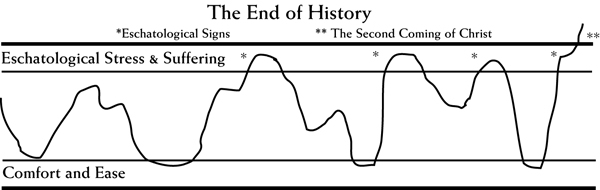
John would have us build a climate in the church that heightens eschatological awareness so that when troubles overwhelm us, instead of predicting confidently the arrival of the end, we will say that we are in a period that hallmarks features of the end and that in this instance may actually carry us over the threshold that ends human history. The above chart illustrates the cycles of life the church has known. Times of ease are followed by times of struggle. When struggle occurs, such experiences begin to sound like the sufferings listed in, for example, Mark 13. This does not necessarily mean that the end is here, but that the end will be characterized by suffering such as this. And one day such suffering will be greeted by the return of the Lord.
All of this serves one purpose: to equip Christians so that they are not discouraged when severe difficulties and turmoil erupt. Eschatological readiness, in other words, has a pastoral function. It interprets struggle and dispels the despair that accompanies it. It teaches us to watch for changes in history, to watch for “antichrists,” and to be alert for times when history betrays elements of the end.
Of course, one problem that accompanies this outlook is the irresponsible predictions of the end offered by each generation’s apocalyptic prophets. In 1991, during the height of the Gulf War, I happened to visit a Christian family bookstore and scanned the “prophecy shelf.” And there it was: Saddam Hussein of Iraq was boldly being introduced as the Antichrist. Curiously, I also found an older book still in print, saying the same thing about Mikhail Gorbachev, the leader of the former Soviet Union. Writers like Dr. John Walvoord (former president of Dallas Seminary) were making confident predictions:
The rise of military action in the Middle East is an important prophetic development. While wars in Korea, Viet Nam, and Europe were not necessarily prophetically significant, all end-time prophecy pictures the Middle East as the center of political, financial, and military power at the end time.”9
The New Testament communities were not unaware of the problem of unrestrained apocalyptic voices. In Mark 13:5 Jesus describes those who exploit apocalyptic passions, and in 2 Peter 3:3–7 Peter describes cynics who jeered at Christian predictions of the end.
Nevertheless, the New Testament does not warn us about eschatological zeal as much as it does about the prospect of losing an eschatological vision. Be ready, Jesus and Peter urge, for the coming of the end will be like a thief in the night (Matt. 24:43–44; 2 Peter 3:8–10). The challenge of Christian leadership is discerning how to promote an eschatological worldview without inspiring doomsday apocalypticism.
(2) The problem of errant believers. John never tells us explicitly the history or the character of the people who have left the church. Were they faithful Christians once but had now moved into the darkness? Were they lapsed Christians? Or were they never really a part of the community in the first place? First John 2:19b seems to deny their membership: “Their going showed that none of them belonged to us.” By belonging does John mean that they were never a genuine part of his community? Or more severe still, does he mean that they were never Christians in the first place?
This opens a veritable host of theological questions. Is it possible for believers to step into wrong doctrine and thereby jeopardize their entire standing before God? Does this error make impotent God’s grace in their lives? If such errors are possible, where is this doctrinal threshold, this line that may be crossed? How do I avoid inflicting fellow Christians with fear and anxiety, or how do I avoid the temptation of using this threat as inappropriate power over my people? While there may be a number of critical theological or spiritual issues that, if denied, place our lives in jeopardy, John’s letter places significant emphasis on one issue: the doctrine of Jesus Christ. Whenever the exclusive place of Jesus Christ is jettisoned, when his lordship is lost, serious consequences follow.
It is interesting to me that these people left the church voluntarily. Is this John’s pastoral strategy? Compare this with Paul’s expulsion of a notorious sinner in 1 Corinthians 5:1–5! John stood firm and would not compromise on the essentials of belief and experience and permitted the secessionists to discover their own discomfort alone. And after a while, they departed.
But of course, we cannot be naive. It is not simply that these people were wrongheaded in their beliefs. They were in error and were aggressively teaching others to join their ranks and to abandon the traditional teaching of the leadership. In that sort of pastoral setting, the stakes are high. I cannot imagine that John was simply passive, gently coaxing everyone to find a middle ground theologically. He no doubt moved to the offense (his tone in this letter makes it everywhere evident) and kept up the pressure, urging conformity with what had been taught from the beginning.
(3) Struggling with authority in a charismatic setting. Today while mainline denominations are experiencing breathtaking declines, charismatic/Pentecostal churches are witnessing strong growth. In fact, the explosion of Christian life in Africa, Asia, and Latin America is chiefly charismatic in nature. A friend who is a pastoral leader in West Africa put it to me succinctly once: “Our churches seek power—your American churches seek reasonable faith. We are pursuing the more biblical model!” In Evanston, on the north side of Chicago, and in Wheaton near our college, the Vineyard Fellowship, a charismatic denomination, is growing at rates other Protestant churches can only envy. Another rapidly growing church is the Episcopal Church—now with dance, banners, healing services, charismatic worship, and record growth.
What does a pastor do when a faithful believer, newly filled by the Holy Spirit, challenges pastoral authority on the basis of that Spirit? I once attended the Society of Pentecostal Studies, a national fellowship of charismatic and Pentecostal scholars, and remember hearing pastors confide how authority issues in their congregations were some of their most difficult problems. If the Spirit plays a prominent role in congregational life and if speech gifts and teaching gifts are commonplace, pastoral authority has difficulty appealing to intellect or office.
John realizes this and does not attack his opponents on the basis of such institutional or academic authority. He makes two appeals. First, he assures his followers that every Christian bears the Spirit and therefore, by implication, the average believer does not need to be led about as if uninitiated: 2:20, “you have an anointing … and all of you know!” 2:27, “the anointing you received from him remains in you, and you do not need any one to teach you!”
When Christians are not given a theological system that incorporates pneumatology, they are vulnerable to spiritual sabotage. I recall when I was in college going to my pastor and asking about baptism in the Holy Spirit. Someone had told me that without it, I was an incomplete Christian. I have two painful memories. At first my pastor appeared stumped and speechless. Then he reached for an old thick concordance to see where the Bible talked about such things. He barely knew where to look. My confidence in him evaporated in minutes. My charismatic friend had even said, “Perhaps even this pastor does not have the Spirit.” As I look back, I do not think that this was the case. The Spirit fills our lives and works among us in ways we cannot begin to measure. Nevertheless, this pastor had not learned—and therefore could not teach his people—about the things of the Spirit (or spiritual warfare). He could not interpret the growing charismatic context. As a result his people were ill-equipped to address authoritative charismatic leaders. At the age of twenty I knew that in my heart I was leaving this pastor’s fold.
Therefore, it is crucial that we equip our laity with a complete understanding of Christian discipleship as intimately linked to the Holy Spirit. That is, when we talk about receiving Jesus Christ, we need to express this in terms that incorporate the Holy Spirit. The Spirit is not separated from Jesus; the Spirit is Jesus himself returned to us in power. He is Jesus-in-Spirit. John makes this clear in the Farewell Discourse of his Gospel (John 14–16). The coming Spirit is portrayed as the returning Jesus; the promised Spirit-experience is also a Jesus-experience.10 We need to cultivate a Christocentric pneumatology that at once joins our view of Christ as Lord and our experience of Spirit as his powerful presence. Once Christians cultivate the powerful presence of Christ-in-Spirit, once they view their discipleship through their anointing, they will rarely be frustrated by such teachings.
John’s second appeal is found in verse 24. In this charismatic setting, he reaches for a teaching authority but cannot appeal to his own role or position. He does not say, “Look, I’m an apostle and I know what Jesus said.” His opponents would simply say that Jesus is in them as well. Consequently, John appeals to the Scriptures as the plumb line against which all teaching must be measured. A pastor with such a strategy is thus not pointing to himself/herself as having theological jurisdiction. Rather, the Scriptures, what was taught “from the beginning,” bear all authority. The Bible thus brokers theological disputes. In John’s situation, he no doubt appealed to the Fourth Gospel and little else (since the New Testament as we have it was unavailable). But we have the full armor of God and must appeal to the full breadth of our Scriptures.
Few books explain this unity of Christ as Spirit as effectively as Thomas Smail’s Reflected Glory: The Spirit in Christ and Christians.11 Following academic study in Glasgow and Basel (under Karl Barth), Smail began his ministry as a parish pastor in his native Scotland. But then he had a profound, overwhelming experience in the Holy Spirit in the 1960s, which brought him into leadership in the charismatic renewal in the United Kingdom. This book is Smail’s attempt to give a theological explanation to the lost role of the Spirit in the church. To my mind this often overlooked book should be on every pastor’s shelf.
Smail explains the centrality of the Spirit for every dimension of our faith—from our understanding of the Gospels to the sacraments. But his chief concern is to argue that Christian experience is an experience of Jesus-in-Spirit. Christian life is not merely a cognitive embrace of Christ; it is an engagement, an encounter with Christ in the Spirit. Are these two blessings—Christ and the Spirit—or one? Smail remarks:
[If we ask,] “How many blessings are there?” the NT answer is “essentially one.” God has given us his one gift of himself in his Son, and everything else is contained in him. “Blessed be the God and Father of our Lord Jesus Christ, who has blessed us in Christ with every spiritual blessing in the heavenly places” (Eph 1:3). However many and varied our spiritual experiences, they all have their unity and significance in the fact that they all proceed from him, reflect him, and glorify him. He is the center and unity of all that comes to us from God, and anything that does not derive ultimately from that center, whatever its experiential quality, is without Christian value or content.12
Therefore, experiencing the Spirit must be an experience of Jesus, and experiencing Jesus must be an experience of the Spirit. Smail warns that the charismatic/Pentecostal error is to make the Spirit’s blessing separate from Jesus. On the other hand, noncharismatics explain the Christian experience of Christ without reference to the Spirit. In his view both approaches are wrong.
(4) Is division the ultimate pastoral catastrophe? When a congregation suffers a severe division in its fellowship and splits, pastors experience anxiety, shame, and loss. Certainly, they wonder, more could have been done. Perhaps they should have been more gentle or worked harder at compromise. They feel blame if their church loses numbers. No matter what the explanation for the schism, most people on the outside will infer that there has been some pastoral deficiency, some failing in leadership, insofar as unity could not be maintained.
John’s letter impresses me with the number of times he speaks about the love of the community. First John 2:10–11 is a clarion call to fidelity and unity in the body of Christ. Unity, therefore, is seriously valued by John.
However, one awkward thought comes through these verses: There comes a time when leadership must sacrifice unity for the sake of the truth. Sometimes right belief is more important than cohesion and oneness. Unity is not the ultimate virtue in the Christian faith. John here is a coconspirator in the splitting of his church because he has stood firm in the truth. Certainly he mourned for these people, but he did not regret his decision (2:18–19).
This, of course, leads us to a question of pastoral leadership that we cannot answer. At what point is it appropriate to sacrifice unity? At what point is the communion of believers secondary to the truth? What truths bear such importance? As I write, evangelicals such as myself serving in mainline denominations struggle with just these questions. Unity that does not regard the truth we know in Jesus Christ may be a unity not worth cherishing.
Original Meaning
The Protection: Anointing (2:20–21)
JOHN WORKS TO equip his faithful followers regarding the deceitful teachings of these secessionists. There is a play on words here in Greek. If the secessionists represent the antichrist (antichristos), now we learn that John’s Christians bear an anointing (chrisma) that can aid and protect them. Antichristos and chrisma originate from the same Greek verb, chrio, “to anoint.”
But what is this anointing? The Greek word simply means “what is rubbed on,” whether it is ointment or paint or medicine. In the New Testament (and Judaism) it took on a specialized use, referring to the gift of the Holy Spirit that would hallmark the reign of a king (2 Sam. 2:7), the authority of a prophet (Isa. 61:1), and the Messiah (11:1). “Christ” thus means “Anointed One,” since by definition the Messiah is filled with God’s Spirit in an unparalleled way.
Thus when John speaks of the Christian’s anointing, he likely has in mind their endowment with the Holy Spirit, a gift that is able to give all knowledge.5 Some interpreters see this instead as a body of teaching that empowers the believer against heresy.6 I disagree. John’s Gospel again and again refers to believers as recipients of the Spirit (14:17, 26; 15:26; 16:13). John’s community defined its membership with reference to the Spirit. In 1 John 4:13 certain knowledge of life with God is discerned pneumatically. Men and women in this congregation received the Holy Spirit and through this mystical experience gained a new knowledge of life.
If this was the character of teaching in John’s church, then it is also likely that the secessionists justified their teachings with the same pneumatic, or spiritual, authority. John 16:13 says clearly that the Spirit would have more to say than Jesus had spoken. It is not difficult to speculate that the secessionists took up this promise as fuel for their own inspiration; their words completed a theological picture that Christian tradition did not know.
Curiously, John does not confront the secessionists with his own apostolic authority as Paul did the Judaizers in Galatia. He realizes that in such a context, this sort of authority is useless. Instead, he must give tools from within the pneumatic setting that will strengthen his followers’ faith. No longer must they be victimized by others claiming a unique, prophetic endowment. John therefore tells his followers that they too have the Spirit; they have an endowment of equal power and must discern the truth spiritually—through the vehicle of the Spirit within them. John does not deny the power of the Spirit (as many pastors might). Instead, he wants his people to test the spirits (4:1–6).
In the Johannine literature the Spirit is called “the Spirit of truth” for good reason (John 4:17; 15:26; 16:13; 1 John 4:6). Here in verse 21 John writes that one by-product of having the Spirit of God is knowing the truth. That is, no teaching from the Spirit will ever diverge from what has been revealed to us in Jesus Christ. In John 14:26 the Spirit will recall what Jesus said in history. In 16:13 the Spirit will not speak on his own but “will speak only what he hears.” Therefore, the work of the Spirit must always submit to the revelation we have in Jesus Christ. If anyone comes along with a claim to have the Spirit and contradicts what we know of Jesus in history, that is, as recorded in the Gospels, his or her anointing is fraudulent. This is one meaning of John’s repeated phrase to hold on to “what you have heard from the beginning” (v. 24). These “beginning things” are the events and words in Jesus’ life, especially as recorded in the Fourth Gospel. For the Johannine community, they form the bedrock of the church.
Bridging Contexts
ALTHOUGH THE CHURCH today is not frequently assailed by the sort of theological heresy outlined here, nevertheless there are substantial parallels between John’s experience with schism and his attempt to equip his congregation. The denial of Jesus’ humanity has come up in certain quarters of the church, and no doubt it should not be overlooked.
But the Johannine context described in these verses introduces a larger topic, a topic germane to church life today: What do we do when schism puts us in its grip? What do we do when members of the congregation feel that they are being led under the direction of the Holy Spirit into new areas of belief and experience? And worse still, what do we do when pastoral authority is rejected because (it is claimed) such authority is not in touch with the power of God to speak today?
John’s response is crucial for my understanding. First, John has an eschatological outlook that puts such erroneous teachings and church ruptures in their proper context. They are characteristic of the last days, characteristic of the tenor of the time when Christ will return and the end will break upon us all. He is not so much announcing “the end” as he is describing the present as bearing features that betray those of the end.
This is an important distinction. John is not apocalyptic, saying that the end is coming tomorrow; he is writing and living within an eschatological schema that says there are features present in his day that go along with the end times, and when these features begin to accumulate in history, two things are true: The end may break upon us and we must therefore be ready.
While certain themes may be difficult to bridge to our era, I am convinced that men and women today live with an eschatology. That is, the cumulative crises of recent decades have shaped a worldview that knows a terminus. This is perhaps one of the distinguishing marks of the so-called “Generation X,” people born after 1960. They bear little confidence that the world can improve, and they often live out a pessimistic eschatology.
The popular recent book Thirteenth Generation: Abort, Retry, Ignore, Fail, by Neil Howe and Bill Strauss, describes in breathtaking detail the pessimistic outlook of these young people. Listen to one college graduate:
I think we are all in a sense doomed. [I’m talking about] downward social mobility. We hear a lot about the great social mobility in America—with the focus on the comparative ease of moving upwards. What’s less discussed is how easy it is to go down. And I think that’s the direction we’re all heading in. And I think the downward fall is going to be very fast….”7
It is here that Christians can interpret that despair. John’s community despaired as well—just consider the odds against them in their pagan world. But John gives hope through his Christian explanation of things: Disintegration is an expected result in history and God is watching history unfold. This is an important “bridge point” that will connect powerfully today. Jill Nelson, a high school student in Washington, D.C., believes, “The way society presents it, I’ll either be strung out on drugs, a manager at McDonalds or a lawyer.”8 Christian ministry to Jill has high potential when it addresses her desperate view of history.
Second, John also has a strategy for equipping his people so that they will not fall prey again. He understands that they must be armed to confront the many prophets and inspired leaders who come along. This too connects vitally in our day because the same problems exist. Religious movements continue to flourish, and all promise to deliver compelling answers and experiences. Remarkably, young people who are sharply critical of the church and “religion” are easily swayed by these new prophets. Furthermore, within healthy, growing congregations voices of authority—voices claiming to be empowered by the Spirit—challenge the course of life as usual. John says there must be a strategy. Christians must be equipped to discern new voices that claim to be from God.
Finally, John is unashamed to use an assertive, aggressive tone to fight for the well-being of his flock. Here we have the universal pastoral dilemma that turns on two cherished values in the church: our commitment to unity and our commitment to the truth. Every church in every age has wrestled with this theme, and John’s wrestling is a struggle from which we can benefit. But the problem also has practical and personal dimensions. Does this mean that friendships should dissolve for the sake of the truth? Does this mean that the church should chastise—or even expel—some who deny what is true? Each of these dimensions within the passage beg for attention in our modern churches today.
Contemporary Significance
DEALING WITH CONFLICT paralyzes most of us. It is painful because if we are honest and confront people with their misbehavior, relationships may be ruined and in some cases whole communities fractured. In a church context, the paralysis is the same. There are occasionally those who step forward with alluring influence and erroneous teaching, and they gain a following. Our impulse is to correct them gently and heal what divisions may have occurred so that the community will remain intact. The unity of the body of Christ is often foremost on our minds.
These verses are interesting because John has experienced precisely this sort of conflict. His church has been ruptured by members who have departed—members who have split the congregation—because they saw things differently. But although the situation is painful, John is not paralyzed by it. He interprets it and tells the remaining members of his congregation how to address it.
(1) Building an eschatological climate. Throughout history the church has often suffered the assaults of heresy and persecution and tried to interpret them eschatologically. That is, when the Christian life begins to bear the weight of these troubles, when signs of tribulation increase, life is approximating the climate that characterizes the end of time, and therefore the church takes hope and is warned. We can graph the church’s life as an irregular line that moves between eras of comfort and eras of persecution. This cycle has repeated itself for centuries, and in some cases Christians have misunderstood their histories, urging an apocalyptic message that the end is at hand.
John would have us build a climate in the church that heightens eschatological awareness so that when troubles overwhelm us, instead of predicting confidently the arrival of the end, we will say that we are in a period that hallmarks features of the end and that in this instance may actually carry us over the threshold that ends human history. The above chart illustrates the cycles of life the church has known. Times of ease are followed by times of struggle. When struggle occurs, such experiences begin to sound like the sufferings listed in, for example, Mark 13. This does not necessarily mean that the end is here, but that the end will be characterized by suffering such as this. And one day such suffering will be greeted by the return of the Lord.
All of this serves one purpose: to equip Christians so that they are not discouraged when severe difficulties and turmoil erupt. Eschatological readiness, in other words, has a pastoral function. It interprets struggle and dispels the despair that accompanies it. It teaches us to watch for changes in history, to watch for “antichrists,” and to be alert for times when history betrays elements of the end.
Of course, one problem that accompanies this outlook is the irresponsible predictions of the end offered by each generation’s apocalyptic prophets. In 1991, during the height of the Gulf War, I happened to visit a Christian family bookstore and scanned the “prophecy shelf.” And there it was: Saddam Hussein of Iraq was boldly being introduced as the Antichrist. Curiously, I also found an older book still in print, saying the same thing about Mikhail Gorbachev, the leader of the former Soviet Union. Writers like Dr. John Walvoord (former president of Dallas Seminary) were making confident predictions:
The rise of military action in the Middle East is an important prophetic development. While wars in Korea, Viet Nam, and Europe were not necessarily prophetically significant, all end-time prophecy pictures the Middle East as the center of political, financial, and military power at the end time.”9
The New Testament communities were not unaware of the problem of unrestrained apocalyptic voices. In Mark 13:5 Jesus describes those who exploit apocalyptic passions, and in 2 Peter 3:3–7 Peter describes cynics who jeered at Christian predictions of the end.
Nevertheless, the New Testament does not warn us about eschatological zeal as much as it does about the prospect of losing an eschatological vision. Be ready, Jesus and Peter urge, for the coming of the end will be like a thief in the night (Matt. 24:43–44; 2 Peter 3:8–10). The challenge of Christian leadership is discerning how to promote an eschatological worldview without inspiring doomsday apocalypticism.
(2) The problem of errant believers. John never tells us explicitly the history or the character of the people who have left the church. Were they faithful Christians once but had now moved into the darkness? Were they lapsed Christians? Or were they never really a part of the community in the first place? First John 2:19b seems to deny their membership: “Their going showed that none of them belonged to us.” By belonging does John mean that they were never a genuine part of his community? Or more severe still, does he mean that they were never Christians in the first place?
This opens a veritable host of theological questions. Is it possible for believers to step into wrong doctrine and thereby jeopardize their entire standing before God? Does this error make impotent God’s grace in their lives? If such errors are possible, where is this doctrinal threshold, this line that may be crossed? How do I avoid inflicting fellow Christians with fear and anxiety, or how do I avoid the temptation of using this threat as inappropriate power over my people? While there may be a number of critical theological or spiritual issues that, if denied, place our lives in jeopardy, John’s letter places significant emphasis on one issue: the doctrine of Jesus Christ. Whenever the exclusive place of Jesus Christ is jettisoned, when his lordship is lost, serious consequences follow.
It is interesting to me that these people left the church voluntarily. Is this John’s pastoral strategy? Compare this with Paul’s expulsion of a notorious sinner in 1 Corinthians 5:1–5! John stood firm and would not compromise on the essentials of belief and experience and permitted the secessionists to discover their own discomfort alone. And after a while, they departed.
But of course, we cannot be naive. It is not simply that these people were wrongheaded in their beliefs. They were in error and were aggressively teaching others to join their ranks and to abandon the traditional teaching of the leadership. In that sort of pastoral setting, the stakes are high. I cannot imagine that John was simply passive, gently coaxing everyone to find a middle ground theologically. He no doubt moved to the offense (his tone in this letter makes it everywhere evident) and kept up the pressure, urging conformity with what had been taught from the beginning.
(3) Struggling with authority in a charismatic setting. Today while mainline denominations are experiencing breathtaking declines, charismatic/Pentecostal churches are witnessing strong growth. In fact, the explosion of Christian life in Africa, Asia, and Latin America is chiefly charismatic in nature. A friend who is a pastoral leader in West Africa put it to me succinctly once: “Our churches seek power—your American churches seek reasonable faith. We are pursuing the more biblical model!” In Evanston, on the north side of Chicago, and in Wheaton near our college, the Vineyard Fellowship, a charismatic denomination, is growing at rates other Protestant churches can only envy. Another rapidly growing church is the Episcopal Church—now with dance, banners, healing services, charismatic worship, and record growth.
What does a pastor do when a faithful believer, newly filled by the Holy Spirit, challenges pastoral authority on the basis of that Spirit? I once attended the Society of Pentecostal Studies, a national fellowship of charismatic and Pentecostal scholars, and remember hearing pastors confide how authority issues in their congregations were some of their most difficult problems. If the Spirit plays a prominent role in congregational life and if speech gifts and teaching gifts are commonplace, pastoral authority has difficulty appealing to intellect or office.
John realizes this and does not attack his opponents on the basis of such institutional or academic authority. He makes two appeals. First, he assures his followers that every Christian bears the Spirit and therefore, by implication, the average believer does not need to be led about as if uninitiated: 2:20, “you have an anointing … and all of you know!” 2:27, “the anointing you received from him remains in you, and you do not need any one to teach you!”
When Christians are not given a theological system that incorporates pneumatology, they are vulnerable to spiritual sabotage. I recall when I was in college going to my pastor and asking about baptism in the Holy Spirit. Someone had told me that without it, I was an incomplete Christian. I have two painful memories. At first my pastor appeared stumped and speechless. Then he reached for an old thick concordance to see where the Bible talked about such things. He barely knew where to look. My confidence in him evaporated in minutes. My charismatic friend had even said, “Perhaps even this pastor does not have the Spirit.” As I look back, I do not think that this was the case. The Spirit fills our lives and works among us in ways we cannot begin to measure. Nevertheless, this pastor had not learned—and therefore could not teach his people—about the things of the Spirit (or spiritual warfare). He could not interpret the growing charismatic context. As a result his people were ill-equipped to address authoritative charismatic leaders. At the age of twenty I knew that in my heart I was leaving this pastor’s fold.
Therefore, it is crucial that we equip our laity with a complete understanding of Christian discipleship as intimately linked to the Holy Spirit. That is, when we talk about receiving Jesus Christ, we need to express this in terms that incorporate the Holy Spirit. The Spirit is not separated from Jesus; the Spirit is Jesus himself returned to us in power. He is Jesus-in-Spirit. John makes this clear in the Farewell Discourse of his Gospel (John 14–16). The coming Spirit is portrayed as the returning Jesus; the promised Spirit-experience is also a Jesus-experience.10 We need to cultivate a Christocentric pneumatology that at once joins our view of Christ as Lord and our experience of Spirit as his powerful presence. Once Christians cultivate the powerful presence of Christ-in-Spirit, once they view their discipleship through their anointing, they will rarely be frustrated by such teachings.
John’s second appeal is found in verse 24. In this charismatic setting, he reaches for a teaching authority but cannot appeal to his own role or position. He does not say, “Look, I’m an apostle and I know what Jesus said.” His opponents would simply say that Jesus is in them as well. Consequently, John appeals to the Scriptures as the plumb line against which all teaching must be measured. A pastor with such a strategy is thus not pointing to himself/herself as having theological jurisdiction. Rather, the Scriptures, what was taught “from the beginning,” bear all authority. The Bible thus brokers theological disputes. In John’s situation, he no doubt appealed to the Fourth Gospel and little else (since the New Testament as we have it was unavailable). But we have the full armor of God and must appeal to the full breadth of our Scriptures.
Few books explain this unity of Christ as Spirit as effectively as Thomas Smail’s Reflected Glory: The Spirit in Christ and Christians.11 Following academic study in Glasgow and Basel (under Karl Barth), Smail began his ministry as a parish pastor in his native Scotland. But then he had a profound, overwhelming experience in the Holy Spirit in the 1960s, which brought him into leadership in the charismatic renewal in the United Kingdom. This book is Smail’s attempt to give a theological explanation to the lost role of the Spirit in the church. To my mind this often overlooked book should be on every pastor’s shelf.
Smail explains the centrality of the Spirit for every dimension of our faith—from our understanding of the Gospels to the sacraments. But his chief concern is to argue that Christian experience is an experience of Jesus-in-Spirit. Christian life is not merely a cognitive embrace of Christ; it is an engagement, an encounter with Christ in the Spirit. Are these two blessings—Christ and the Spirit—or one? Smail remarks:
[If we ask,] “How many blessings are there?” the NT answer is “essentially one.” God has given us his one gift of himself in his Son, and everything else is contained in him. “Blessed be the God and Father of our Lord Jesus Christ, who has blessed us in Christ with every spiritual blessing in the heavenly places” (Eph 1:3). However many and varied our spiritual experiences, they all have their unity and significance in the fact that they all proceed from him, reflect him, and glorify him. He is the center and unity of all that comes to us from God, and anything that does not derive ultimately from that center, whatever its experiential quality, is without Christian value or content.12
Therefore, experiencing the Spirit must be an experience of Jesus, and experiencing Jesus must be an experience of the Spirit. Smail warns that the charismatic/Pentecostal error is to make the Spirit’s blessing separate from Jesus. On the other hand, noncharismatics explain the Christian experience of Christ without reference to the Spirit. In his view both approaches are wrong.
(4) Is division the ultimate pastoral catastrophe? When a congregation suffers a severe division in its fellowship and splits, pastors experience anxiety, shame, and loss. Certainly, they wonder, more could have been done. Perhaps they should have been more gentle or worked harder at compromise. They feel blame if their church loses numbers. No matter what the explanation for the schism, most people on the outside will infer that there has been some pastoral deficiency, some failing in leadership, insofar as unity could not be maintained.
John’s letter impresses me with the number of times he speaks about the love of the community. First John 2:10–11 is a clarion call to fidelity and unity in the body of Christ. Unity, therefore, is seriously valued by John.
However, one awkward thought comes through these verses: There comes a time when leadership must sacrifice unity for the sake of the truth. Sometimes right belief is more important than cohesion and oneness. Unity is not the ultimate virtue in the Christian faith. John here is a coconspirator in the splitting of his church because he has stood firm in the truth. Certainly he mourned for these people, but he did not regret his decision (2:18–19).
This, of course, leads us to a question of pastoral leadership that we cannot answer. At what point is it appropriate to sacrifice unity? At what point is the communion of believers secondary to the truth? What truths bear such importance? As I write, evangelicals such as myself serving in mainline denominations struggle with just these questions. Unity that does not regard the truth we know in Jesus Christ may be a unity not worth cherishing.
Original Meaning
The Heresy: Incarnational Christology (2:22–23)
JUST AS THE opponents of John have been explicitly identified, so now the false teaching they have been promoting is outlined for us. At first reading it sounds as if these people are denying the messiahship of Jesus. But this is unlikely since they were once members of John’s church and understood the gospel story. The crux is where we put our emphasis in the statement in verse 22. They are not disputing Christ’s messianic credentials; rather, they disputed that Jesus—the man of Nazareth—qualified as this messianic figure. The liar is the one who denies that “Jesus is the Christ.”
This denial is clearer if we look ahead in this letter. John’s opponents struggled with the notion of incarnational Christology, namely, the notion that God could become human—fully flesh—when he sent his Son as the Christ. “This is how you can recognize the Spirit of God,” John writes in 4:2–3: “Every spirit that acknowledges that Jesus Christ has come in the flesh is from God, but every spirit that does not acknowledge Jesus is not from God. This is the spirit of the antichrist, which you have heard is coming and even now is already in the world.” Second John 7 is similarly explicit: “Many deceivers, who do not acknowledge Jesus Christ as coming in the flesh, have gone out into the world. Any such person is the deceiver and the antichrist.”
We learned earlier the propensity among Hellenistic Christians to entertain some forms of dualism in which the realms of God and humanity were kept strictly apart. The Christian religious system was agreeable everywhere with the exception of this one point. Greeks argued that God’s divinity could not be compromised with the things of this earth (see above on 1:1–4). Spirit and flesh were utterly separate, and those who truly had the Spirit, who were initiated into secret wisdom and knowledge, realized the utter enmity between these two spheres. John’s response is unequivocal. People who teach like this are “liars” (v. 22) and have nothing to do anymore with either the Son or the Father (vv. 23–24). In a word, they are no longer Christians.
It is interesting to reflect on why John finds this one theological point so important and why any compromise is unacceptable. In a word, to deny incarnational Christology is to deny important theological interests in revelation and soteriology. (1) Incarnation—that is, historic enfleshment in time and space—means that God has genuinely penetrated our world and made himself known. Truth is not a matter of experience but a matter of history. Our vision of God is anchored in what has happened objectively, not in our perception of who he may be. Incarnation makes revelation possible because God has signaled once again his love for this world and his desire to show himself to it. The Fourth Gospel urges again and again that Jesus is the human display of the Father (John 1:18; 14:1–14). This is an important point that still needs to be underscored, for we live in a world that denies the objectivity of truth and the possibility of revelation.
(2) Incarnational theology is essential to our understanding of salvation. It is the true union of God and flesh, the complete fusion of divinity and humanity, that makes Christ’s sacrificial death potent. He represented our humanity on the cross by truly bearing our humanity to Golgotha. And he now represents our humanity before the Father by truly bearing our transformed humanity before him in the resurrection/ascension. John rightly saw that the loss of this one doctrine was critical for the intellectual survival of the church. Without it, the center would be removed from the Christian faith.
Bridging Contexts
ALTHOUGH THE CHURCH today is not frequently assailed by the sort of theological heresy outlined here, nevertheless there are substantial parallels between John’s experience with schism and his attempt to equip his congregation. The denial of Jesus’ humanity has come up in certain quarters of the church, and no doubt it should not be overlooked.
But the Johannine context described in these verses introduces a larger topic, a topic germane to church life today: What do we do when schism puts us in its grip? What do we do when members of the congregation feel that they are being led under the direction of the Holy Spirit into new areas of belief and experience? And worse still, what do we do when pastoral authority is rejected because (it is claimed) such authority is not in touch with the power of God to speak today?
John’s response is crucial for my understanding. First, John has an eschatological outlook that puts such erroneous teachings and church ruptures in their proper context. They are characteristic of the last days, characteristic of the tenor of the time when Christ will return and the end will break upon us all. He is not so much announcing “the end” as he is describing the present as bearing features that betray those of the end.
This is an important distinction. John is not apocalyptic, saying that the end is coming tomorrow; he is writing and living within an eschatological schema that says there are features present in his day that go along with the end times, and when these features begin to accumulate in history, two things are true: The end may break upon us and we must therefore be ready.
While certain themes may be difficult to bridge to our era, I am convinced that men and women today live with an eschatology. That is, the cumulative crises of recent decades have shaped a worldview that knows a terminus. This is perhaps one of the distinguishing marks of the so-called “Generation X,” people born after 1960. They bear little confidence that the world can improve, and they often live out a pessimistic eschatology.
The popular recent book Thirteenth Generation: Abort, Retry, Ignore, Fail, by Neil Howe and Bill Strauss, describes in breathtaking detail the pessimistic outlook of these young people. Listen to one college graduate:
I think we are all in a sense doomed. [I’m talking about] downward social mobility. We hear a lot about the great social mobility in America—with the focus on the comparative ease of moving upwards. What’s less discussed is how easy it is to go down. And I think that’s the direction we’re all heading in. And I think the downward fall is going to be very fast….”7
It is here that Christians can interpret that despair. John’s community despaired as well—just consider the odds against them in their pagan world. But John gives hope through his Christian explanation of things: Disintegration is an expected result in history and God is watching history unfold. This is an important “bridge point” that will connect powerfully today. Jill Nelson, a high school student in Washington, D.C., believes, “The way society presents it, I’ll either be strung out on drugs, a manager at McDonalds or a lawyer.”8 Christian ministry to Jill has high potential when it addresses her desperate view of history.
Second, John also has a strategy for equipping his people so that they will not fall prey again. He understands that they must be armed to confront the many prophets and inspired leaders who come along. This too connects vitally in our day because the same problems exist. Religious movements continue to flourish, and all promise to deliver compelling answers and experiences. Remarkably, young people who are sharply critical of the church and “religion” are easily swayed by these new prophets. Furthermore, within healthy, growing congregations voices of authority—voices claiming to be empowered by the Spirit—challenge the course of life as usual. John says there must be a strategy. Christians must be equipped to discern new voices that claim to be from God.
Finally, John is unashamed to use an assertive, aggressive tone to fight for the well-being of his flock. Here we have the universal pastoral dilemma that turns on two cherished values in the church: our commitment to unity and our commitment to the truth. Every church in every age has wrestled with this theme, and John’s wrestling is a struggle from which we can benefit. But the problem also has practical and personal dimensions. Does this mean that friendships should dissolve for the sake of the truth? Does this mean that the church should chastise—or even expel—some who deny what is true? Each of these dimensions within the passage beg for attention in our modern churches today.
Contemporary Significance
DEALING WITH CONFLICT paralyzes most of us. It is painful because if we are honest and confront people with their misbehavior, relationships may be ruined and in some cases whole communities fractured. In a church context, the paralysis is the same. There are occasionally those who step forward with alluring influence and erroneous teaching, and they gain a following. Our impulse is to correct them gently and heal what divisions may have occurred so that the community will remain intact. The unity of the body of Christ is often foremost on our minds.
These verses are interesting because John has experienced precisely this sort of conflict. His church has been ruptured by members who have departed—members who have split the congregation—because they saw things differently. But although the situation is painful, John is not paralyzed by it. He interprets it and tells the remaining members of his congregation how to address it.
(1) Building an eschatological climate. Throughout history the church has often suffered the assaults of heresy and persecution and tried to interpret them eschatologically. That is, when the Christian life begins to bear the weight of these troubles, when signs of tribulation increase, life is approximating the climate that characterizes the end of time, and therefore the church takes hope and is warned. We can graph the church’s life as an irregular line that moves between eras of comfort and eras of persecution. This cycle has repeated itself for centuries, and in some cases Christians have misunderstood their histories, urging an apocalyptic message that the end is at hand.
John would have us build a climate in the church that heightens eschatological awareness so that when troubles overwhelm us, instead of predicting confidently the arrival of the end, we will say that we are in a period that hallmarks features of the end and that in this instance may actually carry us over the threshold that ends human history. The above chart illustrates the cycles of life the church has known. Times of ease are followed by times of struggle. When struggle occurs, such experiences begin to sound like the sufferings listed in, for example, Mark 13. This does not necessarily mean that the end is here, but that the end will be characterized by suffering such as this. And one day such suffering will be greeted by the return of the Lord.
All of this serves one purpose: to equip Christians so that they are not discouraged when severe difficulties and turmoil erupt. Eschatological readiness, in other words, has a pastoral function. It interprets struggle and dispels the despair that accompanies it. It teaches us to watch for changes in history, to watch for “antichrists,” and to be alert for times when history betrays elements of the end.
Of course, one problem that accompanies this outlook is the irresponsible predictions of the end offered by each generation’s apocalyptic prophets. In 1991, during the height of the Gulf War, I happened to visit a Christian family bookstore and scanned the “prophecy shelf.” And there it was: Saddam Hussein of Iraq was boldly being introduced as the Antichrist. Curiously, I also found an older book still in print, saying the same thing about Mikhail Gorbachev, the leader of the former Soviet Union. Writers like Dr. John Walvoord (former president of Dallas Seminary) were making confident predictions:
The rise of military action in the Middle East is an important prophetic development. While wars in Korea, Viet Nam, and Europe were not necessarily prophetically significant, all end-time prophecy pictures the Middle East as the center of political, financial, and military power at the end time.”9
The New Testament communities were not unaware of the problem of unrestrained apocalyptic voices. In Mark 13:5 Jesus describes those who exploit apocalyptic passions, and in 2 Peter 3:3–7 Peter describes cynics who jeered at Christian predictions of the end.
Nevertheless, the New Testament does not warn us about eschatological zeal as much as it does about the prospect of losing an eschatological vision. Be ready, Jesus and Peter urge, for the coming of the end will be like a thief in the night (Matt. 24:43–44; 2 Peter 3:8–10). The challenge of Christian leadership is discerning how to promote an eschatological worldview without inspiring doomsday apocalypticism.
(2) The problem of errant believers. John never tells us explicitly the history or the character of the people who have left the church. Were they faithful Christians once but had now moved into the darkness? Were they lapsed Christians? Or were they never really a part of the community in the first place? First John 2:19b seems to deny their membership: “Their going showed that none of them belonged to us.” By belonging does John mean that they were never a genuine part of his community? Or more severe still, does he mean that they were never Christians in the first place?
This opens a veritable host of theological questions. Is it possible for believers to step into wrong doctrine and thereby jeopardize their entire standing before God? Does this error make impotent God’s grace in their lives? If such errors are possible, where is this doctrinal threshold, this line that may be crossed? How do I avoid inflicting fellow Christians with fear and anxiety, or how do I avoid the temptation of using this threat as inappropriate power over my people? While there may be a number of critical theological or spiritual issues that, if denied, place our lives in jeopardy, John’s letter places significant emphasis on one issue: the doctrine of Jesus Christ. Whenever the exclusive place of Jesus Christ is jettisoned, when his lordship is lost, serious consequences follow.
It is interesting to me that these people left the church voluntarily. Is this John’s pastoral strategy? Compare this with Paul’s expulsion of a notorious sinner in 1 Corinthians 5:1–5! John stood firm and would not compromise on the essentials of belief and experience and permitted the secessionists to discover their own discomfort alone. And after a while, they departed.
But of course, we cannot be naive. It is not simply that these people were wrongheaded in their beliefs. They were in error and were aggressively teaching others to join their ranks and to abandon the traditional teaching of the leadership. In that sort of pastoral setting, the stakes are high. I cannot imagine that John was simply passive, gently coaxing everyone to find a middle ground theologically. He no doubt moved to the offense (his tone in this letter makes it everywhere evident) and kept up the pressure, urging conformity with what had been taught from the beginning.
(3) Struggling with authority in a charismatic setting. Today while mainline denominations are experiencing breathtaking declines, charismatic/Pentecostal churches are witnessing strong growth. In fact, the explosion of Christian life in Africa, Asia, and Latin America is chiefly charismatic in nature. A friend who is a pastoral leader in West Africa put it to me succinctly once: “Our churches seek power—your American churches seek reasonable faith. We are pursuing the more biblical model!” In Evanston, on the north side of Chicago, and in Wheaton near our college, the Vineyard Fellowship, a charismatic denomination, is growing at rates other Protestant churches can only envy. Another rapidly growing church is the Episcopal Church—now with dance, banners, healing services, charismatic worship, and record growth.
What does a pastor do when a faithful believer, newly filled by the Holy Spirit, challenges pastoral authority on the basis of that Spirit? I once attended the Society of Pentecostal Studies, a national fellowship of charismatic and Pentecostal scholars, and remember hearing pastors confide how authority issues in their congregations were some of their most difficult problems. If the Spirit plays a prominent role in congregational life and if speech gifts and teaching gifts are commonplace, pastoral authority has difficulty appealing to intellect or office.
John realizes this and does not attack his opponents on the basis of such institutional or academic authority. He makes two appeals. First, he assures his followers that every Christian bears the Spirit and therefore, by implication, the average believer does not need to be led about as if uninitiated: 2:20, “you have an anointing … and all of you know!” 2:27, “the anointing you received from him remains in you, and you do not need any one to teach you!”
When Christians are not given a theological system that incorporates pneumatology, they are vulnerable to spiritual sabotage. I recall when I was in college going to my pastor and asking about baptism in the Holy Spirit. Someone had told me that without it, I was an incomplete Christian. I have two painful memories. At first my pastor appeared stumped and speechless. Then he reached for an old thick concordance to see where the Bible talked about such things. He barely knew where to look. My confidence in him evaporated in minutes. My charismatic friend had even said, “Perhaps even this pastor does not have the Spirit.” As I look back, I do not think that this was the case. The Spirit fills our lives and works among us in ways we cannot begin to measure. Nevertheless, this pastor had not learned—and therefore could not teach his people—about the things of the Spirit (or spiritual warfare). He could not interpret the growing charismatic context. As a result his people were ill-equipped to address authoritative charismatic leaders. At the age of twenty I knew that in my heart I was leaving this pastor’s fold.
Therefore, it is crucial that we equip our laity with a complete understanding of Christian discipleship as intimately linked to the Holy Spirit. That is, when we talk about receiving Jesus Christ, we need to express this in terms that incorporate the Holy Spirit. The Spirit is not separated from Jesus; the Spirit is Jesus himself returned to us in power. He is Jesus-in-Spirit. John makes this clear in the Farewell Discourse of his Gospel (John 14–16). The coming Spirit is portrayed as the returning Jesus; the promised Spirit-experience is also a Jesus-experience.10 We need to cultivate a Christocentric pneumatology that at once joins our view of Christ as Lord and our experience of Spirit as his powerful presence. Once Christians cultivate the powerful presence of Christ-in-Spirit, once they view their discipleship through their anointing, they will rarely be frustrated by such teachings.
John’s second appeal is found in verse 24. In this charismatic setting, he reaches for a teaching authority but cannot appeal to his own role or position. He does not say, “Look, I’m an apostle and I know what Jesus said.” His opponents would simply say that Jesus is in them as well. Consequently, John appeals to the Scriptures as the plumb line against which all teaching must be measured. A pastor with such a strategy is thus not pointing to himself/herself as having theological jurisdiction. Rather, the Scriptures, what was taught “from the beginning,” bear all authority. The Bible thus brokers theological disputes. In John’s situation, he no doubt appealed to the Fourth Gospel and little else (since the New Testament as we have it was unavailable). But we have the full armor of God and must appeal to the full breadth of our Scriptures.
Few books explain this unity of Christ as Spirit as effectively as Thomas Smail’s Reflected Glory: The Spirit in Christ and Christians.11 Following academic study in Glasgow and Basel (under Karl Barth), Smail began his ministry as a parish pastor in his native Scotland. But then he had a profound, overwhelming experience in the Holy Spirit in the 1960s, which brought him into leadership in the charismatic renewal in the United Kingdom. This book is Smail’s attempt to give a theological explanation to the lost role of the Spirit in the church. To my mind this often overlooked book should be on every pastor’s shelf.
Smail explains the centrality of the Spirit for every dimension of our faith—from our understanding of the Gospels to the sacraments. But his chief concern is to argue that Christian experience is an experience of Jesus-in-Spirit. Christian life is not merely a cognitive embrace of Christ; it is an engagement, an encounter with Christ in the Spirit. Are these two blessings—Christ and the Spirit—or one? Smail remarks:
[If we ask,] “How many blessings are there?” the NT answer is “essentially one.” God has given us his one gift of himself in his Son, and everything else is contained in him. “Blessed be the God and Father of our Lord Jesus Christ, who has blessed us in Christ with every spiritual blessing in the heavenly places” (Eph 1:3). However many and varied our spiritual experiences, they all have their unity and significance in the fact that they all proceed from him, reflect him, and glorify him. He is the center and unity of all that comes to us from God, and anything that does not derive ultimately from that center, whatever its experiential quality, is without Christian value or content.12
Therefore, experiencing the Spirit must be an experience of Jesus, and experiencing Jesus must be an experience of the Spirit. Smail warns that the charismatic/Pentecostal error is to make the Spirit’s blessing separate from Jesus. On the other hand, noncharismatics explain the Christian experience of Christ without reference to the Spirit. In his view both approaches are wrong.
(4) Is division the ultimate pastoral catastrophe? When a congregation suffers a severe division in its fellowship and splits, pastors experience anxiety, shame, and loss. Certainly, they wonder, more could have been done. Perhaps they should have been more gentle or worked harder at compromise. They feel blame if their church loses numbers. No matter what the explanation for the schism, most people on the outside will infer that there has been some pastoral deficiency, some failing in leadership, insofar as unity could not be maintained.
John’s letter impresses me with the number of times he speaks about the love of the community. First John 2:10–11 is a clarion call to fidelity and unity in the body of Christ. Unity, therefore, is seriously valued by John.
However, one awkward thought comes through these verses: There comes a time when leadership must sacrifice unity for the sake of the truth. Sometimes right belief is more important than cohesion and oneness. Unity is not the ultimate virtue in the Christian faith. John here is a coconspirator in the splitting of his church because he has stood firm in the truth. Certainly he mourned for these people, but he did not regret his decision (2:18–19).
This, of course, leads us to a question of pastoral leadership that we cannot answer. At what point is it appropriate to sacrifice unity? At what point is the communion of believers secondary to the truth? What truths bear such importance? As I write, evangelicals such as myself serving in mainline denominations struggle with just these questions. Unity that does not regard the truth we know in Jesus Christ may be a unity not worth cherishing.
Original Meaning
Objective and Subjective Safeguards (2:24–27)
JOHN’S ANTIDOTE TO this problem is interesting. He suggests two weapons that should always be available and ready in the Christian’s arsenal. Objectively, John believes that right belief is rooted in our recitation of the historic facts about our faith. Subjectively, we need to hone our skills of spiritual discernment so that those who come bearing some spiritually compelling doctrine can be weighed by the Spirit of God within us.
In 2:24–25 John seeks to anchor orthodoxy in “what you have heard from the beginning.” This is a phrase we have already heard several times (1:1; 2:7, 13, 14) and will hear again (3:8, 11; 2 John 5, 6). The earliest objective teachings, the things grounded in Jesus’ historical ministry, serve as anchors when theological storms sweep across the church’s deck. This is the assured avenue for knowing the truth about the Father and the Son and the eternal life that comes from them. No doubt John has in mind the Fourth Gospel, which bore a firm witness to Jesus’ historical ministry. Its pages were quickly becoming the standard by which theology would be judged. As we mentioned in the introduction, some scholars think that in this period not only did the Fourth Gospel discover a new value, but an early edition of it may have enjoyed a fresh editing by the Evangelist. Critical passages such as John 1:1–18 may have been penned at this time, including especially 1:14, with its crystal-clear affirmation of Jesus’ incarnation.
But John goes further. More safeguards are needed for his people. When false teachers with charismatic authority are leading people astray (v. 26), men and women need to be equipped to confront them spiritually as well as intellectually. That is, subjective safeguards are needed too. Therefore, in verses 27–28 John echoes what he said in verse 20 and once again affirms the qualitative importance of the average Christian’s anointing in the Spirit. No impostors can come along and say that their anointing is superior or that they have more of Jesus than someone else. On the contrary, the gift of the Spirit is the same for all.
We should be careful, however, not to think of this objective and subjective preparation as entirely separate. Intellectual readiness is not distinct from spiritual readiness. To John, the Spirit’s work encompasses both: It is the Spirit who enlivens our thinking and gives discernment to our reflection; it is the same Spirit who likewise awakens our spiritual faculties, giving us gifts of wisdom, discernment, and knowledge.
The aim of all this is preparation (v. 27). John writes that “you do not need anyone to teach you,” though not as a denial of the teaching office in the church! He is not setting aside the authority of pastors trying to instruct their congregations. Rather, John is invalidating the authority of the false teachers. If they were validating their new theological insights through the authority of the Spirit, as I suspect they were doing, and if John’s congregation likewise shares in this Spirit equally, this self-promoting authority diminishes.
John goes on to make a final suggestion. There are true and false anointings, true and false spiritual experiences. An anointing that leads to error, that misrepresents Christ—an anointing that detracts from “what was from the beginning”—may be no anointing at all. It may in fact be a falsehood. Thus John will not permit anyone to say that the Spirit inspires rival theological points of view. Only one inspiration comes from the Spirit of God—the anointing that affirms the church’s historic beliefs in Jesus Christ. Again, as in verse 24, inspiration must forever be judged at the bar of historical revelation. Any that cannot pass must be deemed untrue.
Bridging Contexts
ALTHOUGH THE CHURCH today is not frequently assailed by the sort of theological heresy outlined here, nevertheless there are substantial parallels between John’s experience with schism and his attempt to equip his congregation. The denial of Jesus’ humanity has come up in certain quarters of the church, and no doubt it should not be overlooked.
But the Johannine context described in these verses introduces a larger topic, a topic germane to church life today: What do we do when schism puts us in its grip? What do we do when members of the congregation feel that they are being led under the direction of the Holy Spirit into new areas of belief and experience? And worse still, what do we do when pastoral authority is rejected because (it is claimed) such authority is not in touch with the power of God to speak today?
John’s response is crucial for my understanding. First, John has an eschatological outlook that puts such erroneous teachings and church ruptures in their proper context. They are characteristic of the last days, characteristic of the tenor of the time when Christ will return and the end will break upon us all. He is not so much announcing “the end” as he is describing the present as bearing features that betray those of the end.
This is an important distinction. John is not apocalyptic, saying that the end is coming tomorrow; he is writing and living within an eschatological schema that says there are features present in his day that go along with the end times, and when these features begin to accumulate in history, two things are true: The end may break upon us and we must therefore be ready.
While certain themes may be difficult to bridge to our era, I am convinced that men and women today live with an eschatology. That is, the cumulative crises of recent decades have shaped a worldview that knows a terminus. This is perhaps one of the distinguishing marks of the so-called “Generation X,” people born after 1960. They bear little confidence that the world can improve, and they often live out a pessimistic eschatology.
The popular recent book Thirteenth Generation: Abort, Retry, Ignore, Fail, by Neil Howe and Bill Strauss, describes in breathtaking detail the pessimistic outlook of these young people. Listen to one college graduate:
I think we are all in a sense doomed. [I’m talking about] downward social mobility. We hear a lot about the great social mobility in America—with the focus on the comparative ease of moving upwards. What’s less discussed is how easy it is to go down. And I think that’s the direction we’re all heading in. And I think the downward fall is going to be very fast….”7
It is here that Christians can interpret that despair. John’s community despaired as well—just consider the odds against them in their pagan world. But John gives hope through his Christian explanation of things: Disintegration is an expected result in history and God is watching history unfold. This is an important “bridge point” that will connect powerfully today. Jill Nelson, a high school student in Washington, D.C., believes, “The way society presents it, I’ll either be strung out on drugs, a manager at McDonalds or a lawyer.”8 Christian ministry to Jill has high potential when it addresses her desperate view of history.
Second, John also has a strategy for equipping his people so that they will not fall prey again. He understands that they must be armed to confront the many prophets and inspired leaders who come along. This too connects vitally in our day because the same problems exist. Religious movements continue to flourish, and all promise to deliver compelling answers and experiences. Remarkably, young people who are sharply critical of the church and “religion” are easily swayed by these new prophets. Furthermore, within healthy, growing congregations voices of authority—voices claiming to be empowered by the Spirit—challenge the course of life as usual. John says there must be a strategy. Christians must be equipped to discern new voices that claim to be from God.
Finally, John is unashamed to use an assertive, aggressive tone to fight for the well-being of his flock. Here we have the universal pastoral dilemma that turns on two cherished values in the church: our commitment to unity and our commitment to the truth. Every church in every age has wrestled with this theme, and John’s wrestling is a struggle from which we can benefit. But the problem also has practical and personal dimensions. Does this mean that friendships should dissolve for the sake of the truth? Does this mean that the church should chastise—or even expel—some who deny what is true? Each of these dimensions within the passage beg for attention in our modern churches today.
Contemporary Significance
DEALING WITH CONFLICT paralyzes most of us. It is painful because if we are honest and confront people with their misbehavior, relationships may be ruined and in some cases whole communities fractured. In a church context, the paralysis is the same. There are occasionally those who step forward with alluring influence and erroneous teaching, and they gain a following. Our impulse is to correct them gently and heal what divisions may have occurred so that the community will remain intact. The unity of the body of Christ is often foremost on our minds.
These verses are interesting because John has experienced precisely this sort of conflict. His church has been ruptured by members who have departed—members who have split the congregation—because they saw things differently. But although the situation is painful, John is not paralyzed by it. He interprets it and tells the remaining members of his congregation how to address it.
(1) Building an eschatological climate. Throughout history the church has often suffered the assaults of heresy and persecution and tried to interpret them eschatologically. That is, when the Christian life begins to bear the weight of these troubles, when signs of tribulation increase, life is approximating the climate that characterizes the end of time, and therefore the church takes hope and is warned. We can graph the church’s life as an irregular line that moves between eras of comfort and eras of persecution. This cycle has repeated itself for centuries, and in some cases Christians have misunderstood their histories, urging an apocalyptic message that the end is at hand.
John would have us build a climate in the church that heightens eschatological awareness so that when troubles overwhelm us, instead of predicting confidently the arrival of the end, we will say that we are in a period that hallmarks features of the end and that in this instance may actually carry us over the threshold that ends human history. The above chart illustrates the cycles of life the church has known. Times of ease are followed by times of struggle. When struggle occurs, such experiences begin to sound like the sufferings listed in, for example, Mark 13. This does not necessarily mean that the end is here, but that the end will be characterized by suffering such as this. And one day such suffering will be greeted by the return of the Lord.
All of this serves one purpose: to equip Christians so that they are not discouraged when severe difficulties and turmoil erupt. Eschatological readiness, in other words, has a pastoral function. It interprets struggle and dispels the despair that accompanies it. It teaches us to watch for changes in history, to watch for “antichrists,” and to be alert for times when history betrays elements of the end.
Of course, one problem that accompanies this outlook is the irresponsible predictions of the end offered by each generation’s apocalyptic prophets. In 1991, during the height of the Gulf War, I happened to visit a Christian family bookstore and scanned the “prophecy shelf.” And there it was: Saddam Hussein of Iraq was boldly being introduced as the Antichrist. Curiously, I also found an older book still in print, saying the same thing about Mikhail Gorbachev, the leader of the former Soviet Union. Writers like Dr. John Walvoord (former president of Dallas Seminary) were making confident predictions:
The rise of military action in the Middle East is an important prophetic development. While wars in Korea, Viet Nam, and Europe were not necessarily prophetically significant, all end-time prophecy pictures the Middle East as the center of political, financial, and military power at the end time.”9
The New Testament communities were not unaware of the problem of unrestrained apocalyptic voices. In Mark 13:5 Jesus describes those who exploit apocalyptic passions, and in 2 Peter 3:3–7 Peter describes cynics who jeered at Christian predictions of the end.
Nevertheless, the New Testament does not warn us about eschatological zeal as much as it does about the prospect of losing an eschatological vision. Be ready, Jesus and Peter urge, for the coming of the end will be like a thief in the night (Matt. 24:43–44; 2 Peter 3:8–10). The challenge of Christian leadership is discerning how to promote an eschatological worldview without inspiring doomsday apocalypticism.
(2) The problem of errant believers. John never tells us explicitly the history or the character of the people who have left the church. Were they faithful Christians once but had now moved into the darkness? Were they lapsed Christians? Or were they never really a part of the community in the first place? First John 2:19b seems to deny their membership: “Their going showed that none of them belonged to us.” By belonging does John mean that they were never a genuine part of his community? Or more severe still, does he mean that they were never Christians in the first place?
This opens a veritable host of theological questions. Is it possible for believers to step into wrong doctrine and thereby jeopardize their entire standing before God? Does this error make impotent God’s grace in their lives? If such errors are possible, where is this doctrinal threshold, this line that may be crossed? How do I avoid inflicting fellow Christians with fear and anxiety, or how do I avoid the temptation of using this threat as inappropriate power over my people? While there may be a number of critical theological or spiritual issues that, if denied, place our lives in jeopardy, John’s letter places significant emphasis on one issue: the doctrine of Jesus Christ. Whenever the exclusive place of Jesus Christ is jettisoned, when his lordship is lost, serious consequences follow.
It is interesting to me that these people left the church voluntarily. Is this John’s pastoral strategy? Compare this with Paul’s expulsion of a notorious sinner in 1 Corinthians 5:1–5! John stood firm and would not compromise on the essentials of belief and experience and permitted the secessionists to discover their own discomfort alone. And after a while, they departed.
But of course, we cannot be naive. It is not simply that these people were wrongheaded in their beliefs. They were in error and were aggressively teaching others to join their ranks and to abandon the traditional teaching of the leadership. In that sort of pastoral setting, the stakes are high. I cannot imagine that John was simply passive, gently coaxing everyone to find a middle ground theologically. He no doubt moved to the offense (his tone in this letter makes it everywhere evident) and kept up the pressure, urging conformity with what had been taught from the beginning.
(3) Struggling with authority in a charismatic setting. Today while mainline denominations are experiencing breathtaking declines, charismatic/Pentecostal churches are witnessing strong growth. In fact, the explosion of Christian life in Africa, Asia, and Latin America is chiefly charismatic in nature. A friend who is a pastoral leader in West Africa put it to me succinctly once: “Our churches seek power—your American churches seek reasonable faith. We are pursuing the more biblical model!” In Evanston, on the north side of Chicago, and in Wheaton near our college, the Vineyard Fellowship, a charismatic denomination, is growing at rates other Protestant churches can only envy. Another rapidly growing church is the Episcopal Church—now with dance, banners, healing services, charismatic worship, and record growth.
What does a pastor do when a faithful believer, newly filled by the Holy Spirit, challenges pastoral authority on the basis of that Spirit? I once attended the Society of Pentecostal Studies, a national fellowship of charismatic and Pentecostal scholars, and remember hearing pastors confide how authority issues in their congregations were some of their most difficult problems. If the Spirit plays a prominent role in congregational life and if speech gifts and teaching gifts are commonplace, pastoral authority has difficulty appealing to intellect or office.
John realizes this and does not attack his opponents on the basis of such institutional or academic authority. He makes two appeals. First, he assures his followers that every Christian bears the Spirit and therefore, by implication, the average believer does not need to be led about as if uninitiated: 2:20, “you have an anointing … and all of you know!” 2:27, “the anointing you received from him remains in you, and you do not need any one to teach you!”
When Christians are not given a theological system that incorporates pneumatology, they are vulnerable to spiritual sabotage. I recall when I was in college going to my pastor and asking about baptism in the Holy Spirit. Someone had told me that without it, I was an incomplete Christian. I have two painful memories. At first my pastor appeared stumped and speechless. Then he reached for an old thick concordance to see where the Bible talked about such things. He barely knew where to look. My confidence in him evaporated in minutes. My charismatic friend had even said, “Perhaps even this pastor does not have the Spirit.” As I look back, I do not think that this was the case. The Spirit fills our lives and works among us in ways we cannot begin to measure. Nevertheless, this pastor had not learned—and therefore could not teach his people—about the things of the Spirit (or spiritual warfare). He could not interpret the growing charismatic context. As a result his people were ill-equipped to address authoritative charismatic leaders. At the age of twenty I knew that in my heart I was leaving this pastor’s fold.
Therefore, it is crucial that we equip our laity with a complete understanding of Christian discipleship as intimately linked to the Holy Spirit. That is, when we talk about receiving Jesus Christ, we need to express this in terms that incorporate the Holy Spirit. The Spirit is not separated from Jesus; the Spirit is Jesus himself returned to us in power. He is Jesus-in-Spirit. John makes this clear in the Farewell Discourse of his Gospel (John 14–16). The coming Spirit is portrayed as the returning Jesus; the promised Spirit-experience is also a Jesus-experience.10 We need to cultivate a Christocentric pneumatology that at once joins our view of Christ as Lord and our experience of Spirit as his powerful presence. Once Christians cultivate the powerful presence of Christ-in-Spirit, once they view their discipleship through their anointing, they will rarely be frustrated by such teachings.
John’s second appeal is found in verse 24. In this charismatic setting, he reaches for a teaching authority but cannot appeal to his own role or position. He does not say, “Look, I’m an apostle and I know what Jesus said.” His opponents would simply say that Jesus is in them as well. Consequently, John appeals to the Scriptures as the plumb line against which all teaching must be measured. A pastor with such a strategy is thus not pointing to himself/herself as having theological jurisdiction. Rather, the Scriptures, what was taught “from the beginning,” bear all authority. The Bible thus brokers theological disputes. In John’s situation, he no doubt appealed to the Fourth Gospel and little else (since the New Testament as we have it was unavailable). But we have the full armor of God and must appeal to the full breadth of our Scriptures.
Few books explain this unity of Christ as Spirit as effectively as Thomas Smail’s Reflected Glory: The Spirit in Christ and Christians.11 Following academic study in Glasgow and Basel (under Karl Barth), Smail began his ministry as a parish pastor in his native Scotland. But then he had a profound, overwhelming experience in the Holy Spirit in the 1960s, which brought him into leadership in the charismatic renewal in the United Kingdom. This book is Smail’s attempt to give a theological explanation to the lost role of the Spirit in the church. To my mind this often overlooked book should be on every pastor’s shelf.
Smail explains the centrality of the Spirit for every dimension of our faith—from our understanding of the Gospels to the sacraments. But his chief concern is to argue that Christian experience is an experience of Jesus-in-Spirit. Christian life is not merely a cognitive embrace of Christ; it is an engagement, an encounter with Christ in the Spirit. Are these two blessings—Christ and the Spirit—or one? Smail remarks:
[If we ask,] “How many blessings are there?” the NT answer is “essentially one.” God has given us his one gift of himself in his Son, and everything else is contained in him. “Blessed be the God and Father of our Lord Jesus Christ, who has blessed us in Christ with every spiritual blessing in the heavenly places” (Eph 1:3). However many and varied our spiritual experiences, they all have their unity and significance in the fact that they all proceed from him, reflect him, and glorify him. He is the center and unity of all that comes to us from God, and anything that does not derive ultimately from that center, whatever its experiential quality, is without Christian value or content.12
Therefore, experiencing the Spirit must be an experience of Jesus, and experiencing Jesus must be an experience of the Spirit. Smail warns that the charismatic/Pentecostal error is to make the Spirit’s blessing separate from Jesus. On the other hand, noncharismatics explain the Christian experience of Christ without reference to the Spirit. In his view both approaches are wrong.
(4) Is division the ultimate pastoral catastrophe? When a congregation suffers a severe division in its fellowship and splits, pastors experience anxiety, shame, and loss. Certainly, they wonder, more could have been done. Perhaps they should have been more gentle or worked harder at compromise. They feel blame if their church loses numbers. No matter what the explanation for the schism, most people on the outside will infer that there has been some pastoral deficiency, some failing in leadership, insofar as unity could not be maintained.
John’s letter impresses me with the number of times he speaks about the love of the community. First John 2:10–11 is a clarion call to fidelity and unity in the body of Christ. Unity, therefore, is seriously valued by John.
However, one awkward thought comes through these verses: There comes a time when leadership must sacrifice unity for the sake of the truth. Sometimes right belief is more important than cohesion and oneness. Unity is not the ultimate virtue in the Christian faith. John here is a coconspirator in the splitting of his church because he has stood firm in the truth. Certainly he mourned for these people, but he did not regret his decision (2:18–19).
This, of course, leads us to a question of pastoral leadership that we cannot answer. At what point is it appropriate to sacrifice unity? At what point is the communion of believers secondary to the truth? What truths bear such importance? As I write, evangelicals such as myself serving in mainline denominations struggle with just these questions. Unity that does not regard the truth we know in Jesus Christ may be a unity not worth cherishing.