Original Meaning
The Foil for the Promise of a Prophet Like Moses (18:9–14)
THE THEME OF RIGHTEOUSNESS is particularly evident in this first paragraph, which presents hearer and reader with two contrasting ways: the abominable way of the nations (v. 9b) and the way of perfection with Yahweh (v. 13). The word “abominations” (vv. 9b, 12a, 12b) functions as the key word of this entire paragraph, a conclusion reinforced by the grammatically awkward comment at the end (in v. 14). Two lexically similar but substantively contrasting statements serve as boundaries of this subunit (vv. 9, 14). The first affirms Yahweh’s gift of land; the second denies his gift of divinatory revelation.
The opening clause of verse 9 describes the circumstances in which the following instructions will apply. The paragraph displays numerous links with 12:29–31. (1) It opens with a reference to the nations. (2) It sets the stage for the promise of a prophet like Moses by describing a potential problem that the nations will pose. (3) It characterizes the conduct of the nations as “detestable.” (4) The cryptic reference to the sacrifice of children abbreviates a fuller and more explicit statement in 12:31. (5) The concluding comment in 18:14 answers to “You must not worship the LORD your God in their way” in 12:31a. It seems that Moses’ promise of a prophet in verses 15–18 has intentionally picked up on 12:29–31.
The last clause of verse 9 functions as a theme statement for verses 9–14: “Do not learn to imitate the detestable ways of the nations there.” This sets the stage for Moses’ description of the way the nations communicate with their gods, or more precisely, manipulate the gods to communicate with them. He prefaces the list of abominable practices with the statement “There shall not be found among you . . .” (pers. trans.; cf. 17:2). Verses 10–11 are not exhaustive,2 but they provide the fullest catalogue of divinatory expressions in the Old Testament.3 The distinctions between these expressions are not entirely clear, but each makes a specific contribution to the understanding of divination in the ancient Near East.4
(1) Passing children through the fire (v. 10; cf. NIV text note). The expression refers to the sacrifice of children and is often associated with the worship of Molech (Lev. 20:2–5).5 Such offerings were presented as pious fulfillments of vows made to the deity or as expressions of thanksgiving for answered prayers (cf. Judg. 11:34–40).6 Leviticus 20:2–5 characterizes child sacrifice as utterly abhorrent. To use this means to manipulate the deity intensifies evil.
(2) Divination (qesāmîm). The expression “diviners of divinations” (lit. trans.) involves the most general term for augury.7 The Old Testament applies the expression to a variety of techniques employed to determine the mind of the gods.8
(3) Sorcery (meʿônēn). The meaning of this word is uncertain. While it may be related to “cloud” (ʿānān), we should probably associate it with the root ʿnn, which in the Piel means “to cause to become visible.”9 This suggests some sort of necromantic activity.10 Elsewhere the expression is associated with witchcraft (Lev. 19:26; Mic. 5:12[11]).11
(4) Omens (menaḥēš). This expression probably refers to an interpreter of omens. Although an etymological link with the word nâḥâš (“snake”) has long been advocated, this seems unlikely in view of the reference to Joseph’s “divining” cup in Genesis 44:5, 16.12
(5) Witchcraft (mekaššēp). Since Exodus 22:18[17] prohibits whatever is meant by this word as a capital crime, it seems to refer to some form of black magic associated with magicians and at least one other class of divinatory expert.13
(6) Casting spells (ḥôbēr ḥāber). This word appears to be derived from a root “to bind,” suggesting one who has the ability to bind someone with a spell.14
(7) Mediums (to consult ghosts: šāʾal ʾôb). The verb “to ask, consult” is clear, but the etymology of ʾôb is not. The term probably refers to the spirit of someone deceased,15 suggesting the person who asks is a medium able to communicate with the spirit of the dead (cf. 1 Sam. 28:3, 8; Isa. 8:19).
(8) Spiritists (yiddeʿônî). The word derives from the root yâdaʿ (“to know”). It occurs only in association with ʾôb and may represent an alternative expression for one who can communicate with the spirit of a deceased acquaintance.16
(9) Calling up the dead (dôrēš ʾel hammētîm). “Those who inquire of the dead” clearly speaks of necromancy, consulting the dead. The practice is based on the assumption that the deceased continue to have an influence on the affairs of the living.17
The practices in this list are all intended to manipulate deities, supernatural forces, and the spirits of the deceased to act in the worshiper’s favor. They are grounded on several fundamental assumptions. (1) There is a link between the natural and supernatural world that makes cooperation between these spheres possible. (2) There is a world of supernatural forces that constantly threaten human beings or that may be harnessed for personal benefit. (3) The wills and operations of supernatural forces may be deciphered in natural phenomena through unsolicited omens (e.g., solar eclipses, birth anomalies) and solicited omens (examining entrails, dropping arrows). (4) By invoking the gods or manipulating other supernatural forces, a person may affect the outcome of events. (5) Since magic is a science, these skills can be taught and learned.18
The biblical response to divination, magic, and necromancy presupposes that these practices actually worked.19 While in certain cases Yahweh overrode fundamentally pagan practices and used them to achieve his own ends, in his eyes divination, magic, and necromancy were as abominable as idolatry itself. The present categorical repudiation of these practices is also grounded on several fundamental convictions. (1) Just as idolatry represents the perverted worship of objects made by human hands (Deut. 4:15–18, 28), so divination, magic, and necromancy represent humanly designed techniques for communicating with the deity that substitute for the gracious communication that Yahweh himself has offered. (2) These divinatory procedures were designed to manipulate deity to fulfill human agendas. This reflects the antithesis of faith and circumvents the means by which Yahweh has promised to speak unambiguously and directly. It also upsets the divine order, which calls on humans to fulfill the divine agenda rather than vice versa. (3) Most significantly, these techniques assume faulty views of the relationship between the natural and supernatural world.
Moses’ restates his hostility toward these practices in verses 12–13. Not only are the practices detestable, but “anyone who does these things” is an abomination of Yahweh (v. 12a). Here actor and action are identified. To reinforce the notion, Moses declares that although the Israelites’ possession of the land had nothing to do with their own righteousness, the wickedness of the nations living there was a factor in Yahweh’s driving them out (cf. 9:4–5).
Verses 13–14 establish the bar of conduct: the nations may listen to fortunetellers and diviners, but Israelites may not. They must be “blameless” (tâmîm) in their relationship with Yahweh. This word carries a moral sense expressing the totality of a person’s commitment to Yahweh as expressed in the second half of the Shema (6:5; cf. 32:4; Gen. 6:9; 17:1; Job 1:2).20 This appeal to be blameless reiterates the call for “righteousness, only righteousness,” with which this larger section began (see 16:20 and comments).
Verse 14 concludes with an awkward but emphatic note, “But you not thus [i.e., listening to fortunetellers and diviners] did Yahweh your God grant [permission]” (pers. trans.). This may be interpreted as understatement for what Yahweh has prohibited (cf. 17:3), but in light of 4:19, Moses seems to rein in an earlier comment—that Yahweh allotted the astral objects to all the peoples—as authorization for their worship. Moses rejects any appeal to divine revelation to justify pagan forms of communication with Yahweh.
Bridging Contexts
TRUE AND FALSE PROPHECY. This passage is critical for understanding the differences between true and false prophecy, and the significance of the source and authority of the prophecy. The possibilities envisioned by Moses may be represented diagrammatically:
True and False Prophecy in Israel
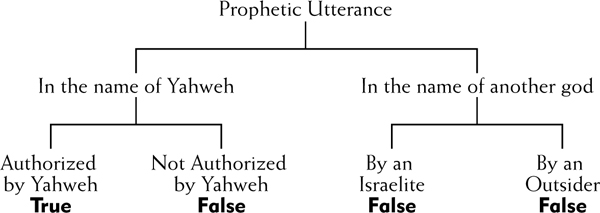
The problem of true versus false prophecy was widely recognized in the ancient Near East. Outside Israel, those seeking a prophetic word often consulted more than one prophetic source to confirm the veracity of an utterance. In Assyria, prophets were considered false if their utterances contradicted the interests of the king or his crown prince.34 The account of Ahab and Micaiah ben Imlah in 1 Kings 22 suggests that occasionally in Israel this criterion was also followed. Ahab had four hundred prophetic lackeys to support his policies (v. 6), but his ally Jehoshaphat requested professional opinion from a prophet of Yahweh to confirm the unanimous utterance of the four hundred (v. 7).35 Ironically, from the perspective of biblical authors, true prophets tended to oppose the kings, especially when their character and actions were perfidious. A true prophet is one who is true to the divine King, Yahweh himself.
By combining the information provided here with chapter 13, a series of criteria for testing the veracity of a prophet emerge. (1) A true prophet never undermines loyalty to Yahweh or encourages allegiance to any other god (13:1–5[2–6]). (2) A true prophet functions within the Mosaic paradigm, being commissioned by Yahweh and receiving messages from him. Therefore, true prophetic utterances will always be in accordance with and not contrary to the Torah of Moses. (3) True prophecies come to the prophet at God’s initiative rather than through professional manipulation of humanly devised means. (4) True prophets speak only in the name of Yahweh. Just as all other claimants to the status of deity are false (cf. 4:28), so all who claim to speak on the authority of another god are deluded and their utterances are lies. (5) The utterances of true prophets are always fulfilled; the nonfulfillment of a prediction confirms the inauthenticity of the predictor.
Based on Exodus 4:1–9, to these we may add a sixth criterion: True prophets may accompany their verbal utterances with authenticating signs. However, since false prophets were able sometimes to do the same (Deut. 13:1–2[2–3]; cf. Ex. 7:10), by itself this criterion is not always reliable. Jeremiah 29:22–23 suggests that the character of the prophet may also serve as a criterion of authenticity.
Later prophets built on Yahweh’s comment that he puts his words in prophets’ mouths by imagining that prophetic orders were given to prophets just as kings gave orders to their courtiers. Jeremiah denounced false prophets like Zedekiah, who prophesied falsely in Yahweh’s name but had never been commissioned by him (Jer. 27:15) and had never stood in his council to receive a message from him (23:16–18). Prophets who typically “tickled the people’s ears” with messages of peace are false, in contrast to Jeremiah himself, who found it extremely difficult to convince religious leaders (priests and prophets) that with his messages of doom, he was actually speaking in the name of Yahweh (Jer. 26:1–19).
Ezekiel encountered the same sort of “auto-inspired” prophets, who presumptuously used all the prophetic formulas. They called people to attention with “Hear the word of the LORD!” (Ezek. 13:2), began their speeches with the citation formula, “This is what the Sovereign LORD says” (13:3), and then stamped their address with the oral signatory formula, “the declaration of the Sovereign LORD” (pers. trans. 13:6, 7).36 While accounts of the execution of false prophets are rare, the fates of the prophets of Baal (1 Kings 18:19–40; 2 Kings 10:19; cf. Jer. 2:8; 23:13) and Asherah (1 Kings 18:19) demonstrate the seriousness of Yahweh’s threats.
Within Deuteronomy, Moses himself functions as the prophet par excellence; his influence in Israel was unmatched (34:10–12). Although scholars debate who “the prophet like Moses” might have been,37 later texts create the impression that true prophets did indeed function within the Mosaic paradigm. The triad of divine speeches in Judges 2:1–3; 6:7–10; and 10:11–14 are thoroughly Mosaic in tone, vocabulary, and substance; Yahweh did not let one word of Samuel fail, confirming him as prophet in Israel (1 Sam. 3:19–21); David recognized the oracle of Nathan as “this Torah for all humanity” (2 Sam. 7:19, pers. trans.); Yahweh sent Elijah back to Horeb for a fresh revelation of himself and a recommissioning to prophetic service (1 Kings 19:1–21); Yahweh placed his words in Jeremiah’s mouth (Jer. 1:9); and Yahweh called on Ezekiel to stand so he could speak with him (Ezek. 1:28–2:1).
Common to these and many more prophetic appearances is the notion that the Mosaic Torah was not the final revelation from God. Mercifully, it seems that every generation was visited by “his servants the prophets.”38 These prophets did not come with radically new messages; their mission was to call the people back to Yahweh and to apply the Torah to new and ever-changing situations.39 If the people rejected their messages, the prophets pronounced judgment on them, but these pronouncements were rooted in the covenant curses of Leviticus 26 and Deuteronomy 28.
I have suggested above that in this context “a prophet like Moses” refers to a succession of prophets whom Yahweh would raise up, keeping open the lines of communication with every generation. However, this did not prevent later interpreters from seeing in this “prophet like Moses” an eschatological messianic figure. Although neither this text nor the rest of the Old Testament provides warrant for or evidence of this interpretation, its roots can be traced to the intertestamental period.
Association of Deuteronomy 18:15–18 with an eschatological prophetic Messiah is attested in the apocryphal writings,40 the Qumran texts,41 the New Testament,42 and Samaritan writings.43 However, this interpretation required a twofold adjustment to the original meaning: the replacement of the distributive meaning of “a prophet like me” with an individual meaning, and the transformation of a text with historical significance into an eschatological statement.44 This reading does not arise naturally from the text; rather, it imposes on the text a meaning one hopes to find or one needs to have in order to buttress a questionable doctrine.45 On the one hand, Jesus is to be identified with Yahweh (incarnate in flesh), who raises up the prophets; on the other, he is the subject of the prophets’ proclamation.
Contemporary Significance
GOD SPEAKS TODAY. THIS text offers important lessons for those who would establish a biblical theology of ministry in our own day. Within that theology of ministry we may note the following features. (1) This text reminds us that God speaks to his people graciously in his own time and by his own means. Divination, magic, and efforts to contact the spirits of the netherworld continued into the New Testament era. The disposition of the New Testament toward these practices is precisely that of Moses. The book of Acts recounts several incidents involving magicians, but these characters are viewed as tools of Satan. In each case the power of God triumphed over the powers of darkness.46
In his lengthy catalogue of vices in Galatians 5:19–21, Paul lists “witchcraft” (pharmakeia) after “idolatry” as a work of the flesh contrary to the Spirit and grounds for exclusion from the kingdom of God. Second Timothy 3:13 speaks of evil men and imposters who deceive (i.e., charlatans), against whose influence the sacred Scriptures are a sure antidote. Elsewhere Paul is keenly aware of the existence of “principalities and powers,” which function as minions of Satan. However, through the work of Christ on the cross they have all been defeated (Col. 2:15). Because these powers are hostile to the church, Christians are not to invoke or seek to manipulate them; rather, we must resist them through the power of God (Eph. 6:10–20).47
The book of Revelation contains the harshest polemic against divination and magic. With distinct echoes of Deuteronomy (cf. 4:28), Revelation 9:20–21 places “magic arts” in a class with a series of capital crimes. Revelation 21:8 consigns the cowardly, the unbelieving, vile people, murderers, sexually immoral people, “those who practice magic arts,” idolaters, and all liars to “the fiery lake of burning sulfur. This is the second death.” Based on the disposition of the New Testament, Christians should share Moses’ antipathy toward these means of communicating with the supernatural.
(2) In accordance with Yahweh’s promise to Israel, the Lord continues to raise up prophetic voices as gifts, ensuring his people of his presence and his desire to communicate with them. Not only does the New Testament attest to the ministry of specific prophetic voices,48 but in two contexts Paul also explicitly acknowledges prophets as divine appointments for the benefit of the church. In his catalogue of offices appointed by God in the church in 1 Corinthians 12:28–29, he lists “prophets” second, between “apostles” and “teachers.” Similarly in Ephesians 4:11–14, he lists “prophets” after apostles and before evangelists and pastor teachers.
(3) An authentic prophet of God speaks in God’s name, on his behalf, and at his command. Paul serves as a model, regularly opening his letters with affirmations of his apostleship49 and his status as servant of Jesus Christ.50 As he declares so emphatically to the Galatian Christians (Gal. 1–2), this means that the word he preaches and teaches is not his own or anyone else’s invention, but the message revealed to him by God himself. In fact, the curse he invokes on himself and those (including angels) who would preach any other gospel recalls the death sentence that Yahweh declares on false prophets in Deuteronomy 18:20.
(4) Finally, this passage reminds readers in all ages and contexts to be vigilant in testing the validity of all who preach and teach in God’s name. Sounding more like Moses than many realize, 1 John 4:1 warns Christians not to believe every spirit, “but test the spirits to see whether they are from God, because many false prophets have gone out into the world.” Similarly, Paul encourages the believers at Thessalonica that even as they welcome prophetic utterances, they must be vigilant in testing all messages, holding fast to what is good and rejecting all that is evil (1 Thess. 5:20–22). In Paul’s letter to young Timothy we hear the most explicit warning to reject presumptuous persons who oppose the truth and are corrupted in their minds (2 Tim. 3:1–8).
Original Meaning
The Nature of the Promise of a Prophet Like Moses (18:15–20)
BECAUSE YAHWEH PROMISES TO provide Israel with prophets, there is no need to resort to divination, magic, and necromancy to determine his will.21 Moses contrasts the multiplicity of techniques the nations use with the singular provision of Yahweh by frontloading the subject in verse 15: “[Instead] a prophet from your midst from among your brothers like me Yahweh your God will raise up for you; to him you must listen” (pers. trans.). Impulses that drive others to abhorrent magical practices22 will be satisfied in Yahweh’s provision of the prophetic institution.
Verse 15 introduces several important features of Israelite prophecy in general and of true prophets in particular. (1) The medium of divine revelation is called a nābîʾ (“one called [by God]”; see also comments on 13:1).
(2) As the designation implies, a true prophet of Yahweh is raised up by Yahweh himself.23 Here the verb hēqîm (“to raise up)” bears a distributive sense, referring not to a single appointment but to a series, from time to time as needed (cf. Judg. 2:18).
(3) True prophets are native Israelites, raised up from “among the brothers” of Israel.
(4) This prophet will be like Moses.24 While the text does not yet explain what this means, presumably it includes (a) his mediatorial role; (b) access to the presence of Yahweh and membership in his council (Num. 12:7; cf. Jer. 23:16–22); (c) participation in clear, unambiguous, and direct conversation with God (Num. 12:8); and (d) his divine endowment with the spirit of prophecy (cf. Num. 11:25–26). This paradigm of prophecy contrasts starkly to indirect, obscure, and ambiguous divination.
In verses 16–20 Moses takes the Israelites back to Horeb to provide an illustration of the kind of prophecy he has in mind. In his typical narrative style, Moses casts this section in dialogue form. In verse 16b he quotes the people’s verbal response to the frightening theophany at Horeb (sixteen words); in verses 17–20 he provides a verbatim report of Yahweh’s response (fifty words). The framing narrative illustrates the Mosaic paradigm of prophecy: the people make a request of Yahweh, and Yahweh answers to Moses.
In verse 16, Moses summarizes what he recounted in 4:10–13 and 5:22–26, though the tone and perspective differ. With most translations, the NIV renders the first two statements as cohortatives, but the verbs are indicatives25 and should be rendered something like: “I cannot continue to hear the voice of Yahweh my God, and as for this great fire, I cannot watch it any more, or I will die.”26 Moses introduced the speech as a request, but his citation omits the petition, noting only the intolerable nature of what the people had witnessed at Horeb.
The opening line in Yahweh’s response (v. 17) provides a direct link with the end of 5:28, while 18:18 corresponds roughly to 5:31 and 18:19 to 5:32–33a. Otherwise this speech goes its own way. Since Moses’ purpose in chapter 5 was to highlight his role as mediator of revelation in the present, there was no need to cite Yahweh’s comments on Moses’ significance for the future. As he so often does, oriented to Israel’s life in the land, Moses draws out the implications of a past event for their future. In God’s mind Moses’ prophetic assignment at Horeb both solved a present issue and became paradigmatic for a future succession of prophets. The following discussion follows the threefold structure of Yahweh’s speech.
(1) The promise of future prophets like Moses (v. 18a). Except for adjustments in word order and the shift from third to first person, Yahweh’s words in verse 18a largely repeat what Moses had said in verse 15 (cf. 5:31a).
(2) The nature of future prophetic activity (v. 18b). This portrayal of prophetic activity is more concrete than in 5:31. Whereas Yahweh had previously told Moses the statutes and laws, in the future he will put his words in prophets’ mouths.27 For Moses this meant passing on the revelation he had received at Sinai, and now the contents of the speeches of Deuteronomy. Whereas 5:31 had characterized Moses’ speech as teaching, here prophetic utterance is described as “speaking” all that Yahweh commands him to say.
Moses hereby assures his people that Yahweh will not leave them without authorized teachers when he is gone and they have crossed into the land, nor will they need to go to the nations to learn their ways of communicating with deity (cf. v. 9). Other people consult unreliable mediums, diviners, and magicians, but Yahweh will install his own authorized spokespersons. Others receive only vague and ambiguous messages, but the Israelites will hear the clear and unambiguous word of Yahweh.28 Moses illustrates his point by speaking in the divine first person. Yahweh had indeed put the words on his mouth.
(3) The gravitas of future prophetic activity (vv. 19–20). Moses concludes the citation with Yahweh’s appeal to take his prophets’ messages seriously. Like the Levitical priests (10:8; 18:5), for the prophet to “speak in my name” (v. 19) is to speak with Yahweh’s authority and on his behalf.29 Yahweh describes the consequence of rejecting his words delivered by the prophet vaguely as “I myself will call him to account.” Whoever disobeys the prophet will have to answer to Yahweh, who sent him. To spurn the messenger is to spurn Yahweh.
Yahweh reinforces the gravitas of the prophetic ministry with an impassioned word to those who will abuse the office by prophesying falsely. Yahweh identifies two characteristics of false prophets. (a) Presumptuously (see comments on 1:43; 7:13) they may claim to make pronouncements in Yahweh’s name when Yahweh has never authorized them to do so. (b) They may speak in the name of other gods (v. 20b). The fate pronounced on such prophets is severe; like those who lead Israelites into the worship of other gods, they must die. While Yahweh does not specify the form of execution, the analogy of chapter 13 and 17:2–7 suggests stoning as the likely means.
Bridging Contexts
TRUE AND FALSE PROPHECY. This passage is critical for understanding the differences between true and false prophecy, and the significance of the source and authority of the prophecy. The possibilities envisioned by Moses may be represented diagrammatically:
True and False Prophecy in Israel
The problem of true versus false prophecy was widely recognized in the ancient Near East. Outside Israel, those seeking a prophetic word often consulted more than one prophetic source to confirm the veracity of an utterance. In Assyria, prophets were considered false if their utterances contradicted the interests of the king or his crown prince.34 The account of Ahab and Micaiah ben Imlah in 1 Kings 22 suggests that occasionally in Israel this criterion was also followed. Ahab had four hundred prophetic lackeys to support his policies (v. 6), but his ally Jehoshaphat requested professional opinion from a prophet of Yahweh to confirm the unanimous utterance of the four hundred (v. 7).35 Ironically, from the perspective of biblical authors, true prophets tended to oppose the kings, especially when their character and actions were perfidious. A true prophet is one who is true to the divine King, Yahweh himself.
By combining the information provided here with chapter 13, a series of criteria for testing the veracity of a prophet emerge. (1) A true prophet never undermines loyalty to Yahweh or encourages allegiance to any other god (13:1–5[2–6]). (2) A true prophet functions within the Mosaic paradigm, being commissioned by Yahweh and receiving messages from him. Therefore, true prophetic utterances will always be in accordance with and not contrary to the Torah of Moses. (3) True prophecies come to the prophet at God’s initiative rather than through professional manipulation of humanly devised means. (4) True prophets speak only in the name of Yahweh. Just as all other claimants to the status of deity are false (cf. 4:28), so all who claim to speak on the authority of another god are deluded and their utterances are lies. (5) The utterances of true prophets are always fulfilled; the nonfulfillment of a prediction confirms the inauthenticity of the predictor.
Based on Exodus 4:1–9, to these we may add a sixth criterion: True prophets may accompany their verbal utterances with authenticating signs. However, since false prophets were able sometimes to do the same (Deut. 13:1–2[2–3]; cf. Ex. 7:10), by itself this criterion is not always reliable. Jeremiah 29:22–23 suggests that the character of the prophet may also serve as a criterion of authenticity.
Later prophets built on Yahweh’s comment that he puts his words in prophets’ mouths by imagining that prophetic orders were given to prophets just as kings gave orders to their courtiers. Jeremiah denounced false prophets like Zedekiah, who prophesied falsely in Yahweh’s name but had never been commissioned by him (Jer. 27:15) and had never stood in his council to receive a message from him (23:16–18). Prophets who typically “tickled the people’s ears” with messages of peace are false, in contrast to Jeremiah himself, who found it extremely difficult to convince religious leaders (priests and prophets) that with his messages of doom, he was actually speaking in the name of Yahweh (Jer. 26:1–19).
Ezekiel encountered the same sort of “auto-inspired” prophets, who presumptuously used all the prophetic formulas. They called people to attention with “Hear the word of the LORD!” (Ezek. 13:2), began their speeches with the citation formula, “This is what the Sovereign LORD says” (13:3), and then stamped their address with the oral signatory formula, “the declaration of the Sovereign LORD” (pers. trans. 13:6, 7).36 While accounts of the execution of false prophets are rare, the fates of the prophets of Baal (1 Kings 18:19–40; 2 Kings 10:19; cf. Jer. 2:8; 23:13) and Asherah (1 Kings 18:19) demonstrate the seriousness of Yahweh’s threats.
Within Deuteronomy, Moses himself functions as the prophet par excellence; his influence in Israel was unmatched (34:10–12). Although scholars debate who “the prophet like Moses” might have been,37 later texts create the impression that true prophets did indeed function within the Mosaic paradigm. The triad of divine speeches in Judges 2:1–3; 6:7–10; and 10:11–14 are thoroughly Mosaic in tone, vocabulary, and substance; Yahweh did not let one word of Samuel fail, confirming him as prophet in Israel (1 Sam. 3:19–21); David recognized the oracle of Nathan as “this Torah for all humanity” (2 Sam. 7:19, pers. trans.); Yahweh sent Elijah back to Horeb for a fresh revelation of himself and a recommissioning to prophetic service (1 Kings 19:1–21); Yahweh placed his words in Jeremiah’s mouth (Jer. 1:9); and Yahweh called on Ezekiel to stand so he could speak with him (Ezek. 1:28–2:1).
Common to these and many more prophetic appearances is the notion that the Mosaic Torah was not the final revelation from God. Mercifully, it seems that every generation was visited by “his servants the prophets.”38 These prophets did not come with radically new messages; their mission was to call the people back to Yahweh and to apply the Torah to new and ever-changing situations.39 If the people rejected their messages, the prophets pronounced judgment on them, but these pronouncements were rooted in the covenant curses of Leviticus 26 and Deuteronomy 28.
I have suggested above that in this context “a prophet like Moses” refers to a succession of prophets whom Yahweh would raise up, keeping open the lines of communication with every generation. However, this did not prevent later interpreters from seeing in this “prophet like Moses” an eschatological messianic figure. Although neither this text nor the rest of the Old Testament provides warrant for or evidence of this interpretation, its roots can be traced to the intertestamental period.
Association of Deuteronomy 18:15–18 with an eschatological prophetic Messiah is attested in the apocryphal writings,40 the Qumran texts,41 the New Testament,42 and Samaritan writings.43 However, this interpretation required a twofold adjustment to the original meaning: the replacement of the distributive meaning of “a prophet like me” with an individual meaning, and the transformation of a text with historical significance into an eschatological statement.44 This reading does not arise naturally from the text; rather, it imposes on the text a meaning one hopes to find or one needs to have in order to buttress a questionable doctrine.45 On the one hand, Jesus is to be identified with Yahweh (incarnate in flesh), who raises up the prophets; on the other, he is the subject of the prophets’ proclamation.
Contemporary Significance
GOD SPEAKS TODAY. THIS text offers important lessons for those who would establish a biblical theology of ministry in our own day. Within that theology of ministry we may note the following features. (1) This text reminds us that God speaks to his people graciously in his own time and by his own means. Divination, magic, and efforts to contact the spirits of the netherworld continued into the New Testament era. The disposition of the New Testament toward these practices is precisely that of Moses. The book of Acts recounts several incidents involving magicians, but these characters are viewed as tools of Satan. In each case the power of God triumphed over the powers of darkness.46
In his lengthy catalogue of vices in Galatians 5:19–21, Paul lists “witchcraft” (pharmakeia) after “idolatry” as a work of the flesh contrary to the Spirit and grounds for exclusion from the kingdom of God. Second Timothy 3:13 speaks of evil men and imposters who deceive (i.e., charlatans), against whose influence the sacred Scriptures are a sure antidote. Elsewhere Paul is keenly aware of the existence of “principalities and powers,” which function as minions of Satan. However, through the work of Christ on the cross they have all been defeated (Col. 2:15). Because these powers are hostile to the church, Christians are not to invoke or seek to manipulate them; rather, we must resist them through the power of God (Eph. 6:10–20).47
The book of Revelation contains the harshest polemic against divination and magic. With distinct echoes of Deuteronomy (cf. 4:28), Revelation 9:20–21 places “magic arts” in a class with a series of capital crimes. Revelation 21:8 consigns the cowardly, the unbelieving, vile people, murderers, sexually immoral people, “those who practice magic arts,” idolaters, and all liars to “the fiery lake of burning sulfur. This is the second death.” Based on the disposition of the New Testament, Christians should share Moses’ antipathy toward these means of communicating with the supernatural.
(2) In accordance with Yahweh’s promise to Israel, the Lord continues to raise up prophetic voices as gifts, ensuring his people of his presence and his desire to communicate with them. Not only does the New Testament attest to the ministry of specific prophetic voices,48 but in two contexts Paul also explicitly acknowledges prophets as divine appointments for the benefit of the church. In his catalogue of offices appointed by God in the church in 1 Corinthians 12:28–29, he lists “prophets” second, between “apostles” and “teachers.” Similarly in Ephesians 4:11–14, he lists “prophets” after apostles and before evangelists and pastor teachers.
(3) An authentic prophet of God speaks in God’s name, on his behalf, and at his command. Paul serves as a model, regularly opening his letters with affirmations of his apostleship49 and his status as servant of Jesus Christ.50 As he declares so emphatically to the Galatian Christians (Gal. 1–2), this means that the word he preaches and teaches is not his own or anyone else’s invention, but the message revealed to him by God himself. In fact, the curse he invokes on himself and those (including angels) who would preach any other gospel recalls the death sentence that Yahweh declares on false prophets in Deuteronomy 18:20.
(4) Finally, this passage reminds readers in all ages and contexts to be vigilant in testing the validity of all who preach and teach in God’s name. Sounding more like Moses than many realize, 1 John 4:1 warns Christians not to believe every spirit, “but test the spirits to see whether they are from God, because many false prophets have gone out into the world.” Similarly, Paul encourages the believers at Thessalonica that even as they welcome prophetic utterances, they must be vigilant in testing all messages, holding fast to what is good and rejecting all that is evil (1 Thess. 5:20–22). In Paul’s letter to young Timothy we hear the most explicit warning to reject presumptuous persons who oppose the truth and are corrupted in their minds (2 Tim. 3:1–8).
Original Meaning
The Challenge to the Promise of a Prophet Like Moses (18:21–22).
THE SHIFT TO THE second person of direct address and references to Yahweh in the third person in verse 21 signals a return to the voice of Moses. As elsewhere, Moses introduces a hypothetical interlocutor,30 who sets the stage for his own comments with a question: How may we recognize a prophetic message that does not come from Yahweh? Whereas Yahweh focused on the marks of a false prophet (v. 20), Moses focuses on the marks of false prophecy. If one can identify a false prophecy, one may identify a false prophet, who should be executed.
On the surface, Moses’ answer is not helpful. If utterances that a prophet claims to speak in the name of Yahweh are not fulfilled,31 the prophecy is false, and the prophet is a charlatan. Since what Yahweh predicts happens by definition, the pronouncement has not come from him.32 However, if a prophecy concerns the distant future, the veracity of a statement and the proof of a genuine prophet will be delayed and the prophet may not live to witness his vindication.33 Moses does not answer this dilemma but concludes this discussion with counsel regarding the proper disposition toward prophets whose words do not come true. This is a sign that such prophets have spoken presumptuously (v. 22), and they should not be feared. The words of false prophets are powerless, and by executing them the people will be standing up for righteousness.
Bridging Contexts
TRUE AND FALSE PROPHECY. This passage is critical for understanding the differences between true and false prophecy, and the significance of the source and authority of the prophecy. The possibilities envisioned by Moses may be represented diagrammatically:
True and False Prophecy in Israel
The problem of true versus false prophecy was widely recognized in the ancient Near East. Outside Israel, those seeking a prophetic word often consulted more than one prophetic source to confirm the veracity of an utterance. In Assyria, prophets were considered false if their utterances contradicted the interests of the king or his crown prince.34 The account of Ahab and Micaiah ben Imlah in 1 Kings 22 suggests that occasionally in Israel this criterion was also followed. Ahab had four hundred prophetic lackeys to support his policies (v. 6), but his ally Jehoshaphat requested professional opinion from a prophet of Yahweh to confirm the unanimous utterance of the four hundred (v. 7).35 Ironically, from the perspective of biblical authors, true prophets tended to oppose the kings, especially when their character and actions were perfidious. A true prophet is one who is true to the divine King, Yahweh himself.
By combining the information provided here with chapter 13, a series of criteria for testing the veracity of a prophet emerge. (1) A true prophet never undermines loyalty to Yahweh or encourages allegiance to any other god (13:1–5[2–6]). (2) A true prophet functions within the Mosaic paradigm, being commissioned by Yahweh and receiving messages from him. Therefore, true prophetic utterances will always be in accordance with and not contrary to the Torah of Moses. (3) True prophecies come to the prophet at God’s initiative rather than through professional manipulation of humanly devised means. (4) True prophets speak only in the name of Yahweh. Just as all other claimants to the status of deity are false (cf. 4:28), so all who claim to speak on the authority of another god are deluded and their utterances are lies. (5) The utterances of true prophets are always fulfilled; the nonfulfillment of a prediction confirms the inauthenticity of the predictor.
Based on Exodus 4:1–9, to these we may add a sixth criterion: True prophets may accompany their verbal utterances with authenticating signs. However, since false prophets were able sometimes to do the same (Deut. 13:1–2[2–3]; cf. Ex. 7:10), by itself this criterion is not always reliable. Jeremiah 29:22–23 suggests that the character of the prophet may also serve as a criterion of authenticity.
Later prophets built on Yahweh’s comment that he puts his words in prophets’ mouths by imagining that prophetic orders were given to prophets just as kings gave orders to their courtiers. Jeremiah denounced false prophets like Zedekiah, who prophesied falsely in Yahweh’s name but had never been commissioned by him (Jer. 27:15) and had never stood in his council to receive a message from him (23:16–18). Prophets who typically “tickled the people’s ears” with messages of peace are false, in contrast to Jeremiah himself, who found it extremely difficult to convince religious leaders (priests and prophets) that with his messages of doom, he was actually speaking in the name of Yahweh (Jer. 26:1–19).
Ezekiel encountered the same sort of “auto-inspired” prophets, who presumptuously used all the prophetic formulas. They called people to attention with “Hear the word of the LORD!” (Ezek. 13:2), began their speeches with the citation formula, “This is what the Sovereign LORD says” (13:3), and then stamped their address with the oral signatory formula, “the declaration of the Sovereign LORD” (pers. trans. 13:6, 7).36 While accounts of the execution of false prophets are rare, the fates of the prophets of Baal (1 Kings 18:19–40; 2 Kings 10:19; cf. Jer. 2:8; 23:13) and Asherah (1 Kings 18:19) demonstrate the seriousness of Yahweh’s threats.
Within Deuteronomy, Moses himself functions as the prophet par excellence; his influence in Israel was unmatched (34:10–12). Although scholars debate who “the prophet like Moses” might have been,37 later texts create the impression that true prophets did indeed function within the Mosaic paradigm. The triad of divine speeches in Judges 2:1–3; 6:7–10; and 10:11–14 are thoroughly Mosaic in tone, vocabulary, and substance; Yahweh did not let one word of Samuel fail, confirming him as prophet in Israel (1 Sam. 3:19–21); David recognized the oracle of Nathan as “this Torah for all humanity” (2 Sam. 7:19, pers. trans.); Yahweh sent Elijah back to Horeb for a fresh revelation of himself and a recommissioning to prophetic service (1 Kings 19:1–21); Yahweh placed his words in Jeremiah’s mouth (Jer. 1:9); and Yahweh called on Ezekiel to stand so he could speak with him (Ezek. 1:28–2:1).
Common to these and many more prophetic appearances is the notion that the Mosaic Torah was not the final revelation from God. Mercifully, it seems that every generation was visited by “his servants the prophets.”38 These prophets did not come with radically new messages; their mission was to call the people back to Yahweh and to apply the Torah to new and ever-changing situations.39 If the people rejected their messages, the prophets pronounced judgment on them, but these pronouncements were rooted in the covenant curses of Leviticus 26 and Deuteronomy 28.
I have suggested above that in this context “a prophet like Moses” refers to a succession of prophets whom Yahweh would raise up, keeping open the lines of communication with every generation. However, this did not prevent later interpreters from seeing in this “prophet like Moses” an eschatological messianic figure. Although neither this text nor the rest of the Old Testament provides warrant for or evidence of this interpretation, its roots can be traced to the intertestamental period.
Association of Deuteronomy 18:15–18 with an eschatological prophetic Messiah is attested in the apocryphal writings,40 the Qumran texts,41 the New Testament,42 and Samaritan writings.43 However, this interpretation required a twofold adjustment to the original meaning: the replacement of the distributive meaning of “a prophet like me” with an individual meaning, and the transformation of a text with historical significance into an eschatological statement.44 This reading does not arise naturally from the text; rather, it imposes on the text a meaning one hopes to find or one needs to have in order to buttress a questionable doctrine.45 On the one hand, Jesus is to be identified with Yahweh (incarnate in flesh), who raises up the prophets; on the other, he is the subject of the prophets’ proclamation.
Contemporary Significance
GOD SPEAKS TODAY. THIS text offers important lessons for those who would establish a biblical theology of ministry in our own day. Within that theology of ministry we may note the following features. (1) This text reminds us that God speaks to his people graciously in his own time and by his own means. Divination, magic, and efforts to contact the spirits of the netherworld continued into the New Testament era. The disposition of the New Testament toward these practices is precisely that of Moses. The book of Acts recounts several incidents involving magicians, but these characters are viewed as tools of Satan. In each case the power of God triumphed over the powers of darkness.46
In his lengthy catalogue of vices in Galatians 5:19–21, Paul lists “witchcraft” (pharmakeia) after “idolatry” as a work of the flesh contrary to the Spirit and grounds for exclusion from the kingdom of God. Second Timothy 3:13 speaks of evil men and imposters who deceive (i.e., charlatans), against whose influence the sacred Scriptures are a sure antidote. Elsewhere Paul is keenly aware of the existence of “principalities and powers,” which function as minions of Satan. However, through the work of Christ on the cross they have all been defeated (Col. 2:15). Because these powers are hostile to the church, Christians are not to invoke or seek to manipulate them; rather, we must resist them through the power of God (Eph. 6:10–20).47
The book of Revelation contains the harshest polemic against divination and magic. With distinct echoes of Deuteronomy (cf. 4:28), Revelation 9:20–21 places “magic arts” in a class with a series of capital crimes. Revelation 21:8 consigns the cowardly, the unbelieving, vile people, murderers, sexually immoral people, “those who practice magic arts,” idolaters, and all liars to “the fiery lake of burning sulfur. This is the second death.” Based on the disposition of the New Testament, Christians should share Moses’ antipathy toward these means of communicating with the supernatural.
(2) In accordance with Yahweh’s promise to Israel, the Lord continues to raise up prophetic voices as gifts, ensuring his people of his presence and his desire to communicate with them. Not only does the New Testament attest to the ministry of specific prophetic voices,48 but in two contexts Paul also explicitly acknowledges prophets as divine appointments for the benefit of the church. In his catalogue of offices appointed by God in the church in 1 Corinthians 12:28–29, he lists “prophets” second, between “apostles” and “teachers.” Similarly in Ephesians 4:11–14, he lists “prophets” after apostles and before evangelists and pastor teachers.
(3) An authentic prophet of God speaks in God’s name, on his behalf, and at his command. Paul serves as a model, regularly opening his letters with affirmations of his apostleship49 and his status as servant of Jesus Christ.50 As he declares so emphatically to the Galatian Christians (Gal. 1–2), this means that the word he preaches and teaches is not his own or anyone else’s invention, but the message revealed to him by God himself. In fact, the curse he invokes on himself and those (including angels) who would preach any other gospel recalls the death sentence that Yahweh declares on false prophets in Deuteronomy 18:20.
(4) Finally, this passage reminds readers in all ages and contexts to be vigilant in testing the validity of all who preach and teach in God’s name. Sounding more like Moses than many realize, 1 John 4:1 warns Christians not to believe every spirit, “but test the spirits to see whether they are from God, because many false prophets have gone out into the world.” Similarly, Paul encourages the believers at Thessalonica that even as they welcome prophetic utterances, they must be vigilant in testing all messages, holding fast to what is good and rejecting all that is evil (1 Thess. 5:20–22). In Paul’s letter to young Timothy we hear the most explicit warning to reject presumptuous persons who oppose the truth and are corrupted in their minds (2 Tim. 3:1–8).