Original Meaning
Act I: Celebrating the Grace of Covenant Today (29:2–13)
THE NARRATIVE INTRODUCTION (V. 2) signals the beginning of a formal speech in a formal context.9 Moses situates his final address in the present (vv. 4, 10, 12), but he begins by calling on the people to recall Yahweh’s past grace (vv. 2–9) and to commit themselves to the one who has been so gracious to them (vv. 10–13).
Remembering Yahweh’s past grace today (vv. 2–9). The opening paragraph consists of a collage of words, phrases, and clauses found elsewhere in Deuteronomy. The significant new elements involve references to the deprivations (v. 4; i.e., no heart to know, eyes to see, ears to hear; v. 6, not consuming bread and wine), and the purpose clause in verse 9, which employs the expression “to prosper” (which occurs only here in Deuteronomy). This section reviews Israel’s experiences with Yahweh leading to the present moment (vv. 2c–8), followed by a brief call for response (v. 9). The historical summary focuses on Yahweh’s redemptive actions and providential care on Israel’s behalf (vv. 2b–6), as well as Israel’s response to the Transjordanian kings (vv. 6–7). Each of these subdivides further into a remembrance of Yahweh’s actions (vv. 2b–3, 5), followed by a statement of deprivation (vv. 4, 6).
Since most in the assembly were born during the forty years in the desert and did not witness the nation’s rescue from Egypt, Moses draws all of them into Yahweh’s past actions by speaking as if they were eyewitnesses to those events.10 Through their renewal of the covenant that Yahweh made with Israel at Sinai, the present generation may identify with their predecessors, who saw the amazing signs and wonders that Yahweh performed in Egypt.
Verse 4 is difficult, but retaining the word order of the Hebrew may help: “But the LORD has not given you a mind that understands or eyes that see or ears that hear, until this day.”11 Following the reference to the understanding “mind,” “eyes” and “ears” denote mental capacities of perception and understanding.12 Whereas the exodus generation as a whole did not grasp the revelatory, redemptive, and covenantal significance of Yahweh’s actions (9:1–24; cf. 1:19–46), this generation knows; through Moses’ final pastoral addresses Yahweh has given Israel a heart to know, eyes to see, and ears to hear.13 The covenant renewal ceremony that follows and Moses’ statements in 30:11–14 assume this knowledge.
In Moses’ recollection of Yahweh’s actions during the desert wanderings, he speaks in first person with Yahweh’s voice. While this recollection is comparable to 8:2–4, the focus changes slightly here. (1) Whereas Moses had previously observed that throughout their travels the Israelites’ feet had never been sore, now Yahweh declares that their sandals did not wear out. (2) Whereas Moses had previously highlighted the deprivation of food and the provision of manna as a test, now he declares that the test served a revelatory purpose as well. Like the great acts of the exodus (4:32–40) it proved that he is Yahweh, their God. Instead of bread, wine, and other alcoholic beverages (staple products of agricultural effort), Yahweh had sustained them with manna and water.14 Apparently the desert deprivations were to accomplish in the exodus generation what Yahweh’s miraculous saving actions had failed to achieve.
The second part of this historical review focuses on the present generation’s response to Sihon of Heshbon and Og of Bashan. Whereas the refusal to enter Canaan from Kadesh Barnea (1:1–40) had proved the previous generation’s faithlessness, this generation’s attacks on the Amorite kings demonstrated their trust in Yahweh. The allocation of the Transjordanian land to the Reubenites, Gadites, and the half-tribe of Manasseh concretized and testified to that faith.
Within the chapter as a whole, verse 9 is a hinge. Here Moses challenges his audience to continue to prove their faith in Yahweh, keeping the words of this covenant by doing them. The covenant ceremonies Moses is about to supervise involve a reaffirmation of the commitments made earlier by the exodus generation and by the people gathered here in the presence of Moses (26:16–19). The clause “so that you may prosper in everything you do” highlights the future importance of maintaining the commitment the Israelites had shown in their victory over the Amorite kings. The dimensions of this prosperity are summarized in the blessings of 28:1–14.
Claiming Yahweh’s grace today (vv. 10–13). Although most scholars extend the paragraph through verse 15, the syntax requires the division reflected here. Verses 10–13 comprise one complex sentence, whose core is represented by a principal clause followed by two purpose clauses, both of which subdivide into two parts:
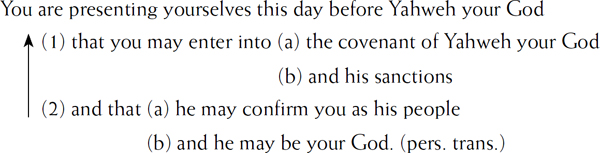
| You are presenting yourselves this day before Yahweh your God | |
| (1) that you may enter into (a) the covenant of Yahweh your God(b) and his sanctions |
| (2) and that (a) he may confirm you as his people(b) and he may be your God. (pers. trans.) |
The remainder is commentary, with the syntactical construction, choice of vocabulary, and threefold reference to “today” combining to portray a formal ceremonial event.
The nature of the event. The opening clause sets the agenda. The Niphal form of nāṣab (“present oneself”) means “to take one’s stand” and captures with one word what Moses had expressed with two in 4:10. The phrase “before Yahweh your God” reinforces this interpretation, linking what is about to transpire with the covenantal ritual of the exodus generation at Sinai/Horeb.
The participants in the event. In the remainder of verses 10–11 Moses lists the participants in the covenantal proceedings. Beginning with a comprehensive expression “all of you,” he provides the longest catalogue of participants in a formal religious event in the entire Old Testament. The eight entries seem to be arranged from greatest to least, but they divide into two groups on the basis of content (the first four involve titular and administrative designations) and syntax (the last member of each set of four begins with the conjunction). Three of the administrative designations have been encountered earlier in the book.15 Although elsewhere in the book, the fourth designation (šibṭêkem) always means “your tribes” (1:15; 5:23; 12:5; 31:28), this does not suit the present context. Since the word šebeṭ derives from a root meaning “rod, staff,” it seems best to interpret the word as “tribal staff-holder”—hence a tribal official.16
The second quartette of participants includes common people: men, children, wives, aliens. Moses highlights the inclusive nature of the event by expanding on the last entry. The reference to outsiders as those “who chop your wood and carry your water” involves a stereotypical pair, which is shorthand for aliens engaged in all kinds of menial labor.17
The purpose of the event. This assembly had two purposes. (1) Through these rituals the people “enter into the covenant of Yahweh your God and his oath” (v. 12, pers. trans.). The idiom used here, “to pass over [ʿābar] into a covenant,”18 may derive from a ritual in which the parties to a covenant cut an animal in two and then bind themselves to its terms by passing between the parts.19 Consistent with the biblical testimony elsewhere, Moses refers to this covenant as Yahweh’s covenant, not Israel’s, and the oath as “his oath.”
Although the idiom “to cut [krt] a covenant” (NIV “make”) often involves a new covenant,20 this interpretation does not suit the present case.21 The word “oath” derives from ʾlh, a root meaning “to swear, to curse, to take an oath” (cf. Ezek. 16:59; 17:19). The pair of expressions, “the covenant of Yahweh and his oath,” is a hendiadys, “his sworn covenant”—that is, a treaty that concludes with a curse. In the ritual of covenant making, the oath involved a conditional imprecation, calling for the curses if the party taking the oath fails to keep the terms of the treaty.
(2) Through these rituals Yahweh confirms Israel as his people and himself as their God. Moses’ adaptation of the covenant formula in verse 13 recalls not only commitments expressed in 26:17–18, but also the event at Sinai by which Yahweh had bound himself to the exodus generation (Ex. 29:45; Lev. 26:11–12). Moses declares expressly that the present ritual represents a fulfillment of earlier promises to this people.22 With this statement Moses seems to recall Yahweh’s address to him in Exodus 6:2–8, but he also casts his gaze far beyond Yahweh’s promises to the exodus generation, to his oath to the ancestors (Gen 17:7).23 The covenant that he promised to “establish” with Abraham and his descendants is the covenant he established with Abraham’s descendants at Sinai (Ex. 19–24), and he now confirms on the Plains of Moab with the generation about to move in and take the Promised Land.24 Although the people had already engaged in some sort of covenant renewal ritual on the Plains of Moab (26:16–19), Moses seems to have deemed it necessary to supervise a ratification ritual one more time.
Bridging Contexts
ISRAEL’S SUBSEQUENT HISTORY. Most of the themes addressed in this chapter have been heard before. Perhaps more than anything, here Moses reinforces the notion that a covenant relationship with Yahweh is an incredible privilege. Of all the nations on earth Yahweh picked Israel for a special role. Since Israel owed her very existence to her gracious divine Suzerain, Yahweh’s demand for complete and undivided devotion was reasonable. In the first half of his final address Moses reminds his people of the awful consequences of abandoning the covenant. Even in this reminder we see the grace of God, for he takes no pleasure in the death of the wicked but in their life (Ezek. 33:11).
But Moses’ vision of the nation’s future proves true. According to Judges 2:10–11, the spiritual recidivism anticipated here set in within decades of this speech. Seven times the narrator declares that the descendants of Israel did evil in the eyes of Yahweh,57 and twice that they did right in their own eyes (17:6; 21:25). In Judges 17–18 the family of Micah illustrates the role of individuals in the apostasy. While the idea to craft an idol originated with Micah’s mother (17:3–4), the narrator attributes responsibility for the cult shrine and its administration to Micah (17:5, 9–13; 18:14–26). Rather than denouncing this evil, the shiftless Levite became a priest in this apostate establishment (17:7–13). And when the Danites came along and confiscated the idols and the artifacts related to the cult, the sins of an individual became the sins of a tribe and a clan (18:19). Not until the very end (18:30) does the narrator let the reader in on the horrific secret: the apostate priest was Moses’ own grandson Jonathan!
The books of Kings describe how the sins of individuals in Judges become the sins of the nation, as one king after another led them down the infuriating path of idolatry. Finally, in 722 BC the curses envisioned in this text fell on the northern kingdom, and in 586 BC Jerusalem and Judah fell, leaving the nations to puzzle over the role of Yahweh in the fate of his people. Their perplexity is expressed with the question, “Where is their God?”58 In an oracle to Solomon after the dedication of the temple, Yahweh warns the king and all his successors not to forget Moses’ final address:
As for you, if you walk before me in integrity of heart and uprightness, as David your father did, and do all I command and observe my decrees and laws, I will establish your royal throne over Israel forever, as I promised David your father when I said, “You shall never fail to have a man on the throne of Israel.”
But if you or your sons turn away from me and do not observe the commands and decrees I have given you and go off to serve other gods and worship them, then I will cut off Israel from the land I have given them and will reject this temple I have consecrated for my Name. Israel will then become a byword and an object of ridicule among all peoples. And though this temple is now imposing, all who pass by will be appalled and will scoff and say, “Why has the LORD done such a thing to this land and to this temple?” People will answer, “Because they have forsaken the LORD their God, who brought their fathers out of Egypt, and have embraced other gods, worshiping and serving them—that is why the LORD brought all this disaster on them.” (1 Kings 9:4–9)
Centuries later, as the doom of Judah approached, the prophet Jeremiah warned his people with echoes of this text:
For this is what the LORD says about the palace of the king of Judah:
“Though you are like Gilead to me,
like the summit of Lebanon,
I will surely make you like a desert,
like towns not inhabited.
I will send destroyers against you,
each man with his weapons,
and they will cut up your fine cedar beams
and throw them into the fire.
“People from many nations will pass by this city and will ask one another, ‘Why has the LORD done such a thing to this great city?’ And the answer will be: ‘Because they have forsaken the covenant of the LORD their God and have worshiped and served other gods.’ ” (Jer. 22:6–9).59
In a bizarre caricature of Deuteronomy 29:4, Isaiah 6:9–10 appropriated Moses’ declaration that in the past Yahweh had not given to Israel a mind to know, eyes to see, or ears to hear, to the hardened dispositions of his own time. Isaiah’s prophetic ministry would have the opposite effect on his audience; their hearts will be rendered even more insensitive, their eyes more blind, and their ears more deaf, which reflects Yahweh’s determination to carry out “all the curses written in this book of the Torah,” in fulfillment of 29:18–28.60 In Ezekiel 12:2 the exiled prophet applies Deuteronomy 29:4 to Judah’s immediate situation, presenting the unseeing eyes and unhearing ears as evidence of the nation’s rebellion against Yahweh.
More than a millennium later, in Romans 11:8 Paul picked up on Deuteronomy 29:4 and applied it to his own generation of Jews. His opening comment, “as it is written,” suggests that he was consciously quoting Moses. The correspondence between his citation and the LXX Greek rendering of the Hebrew is evident when translations of the two texts are juxtaposed:
Deuteronomy 29:4 | Romans 11:8 |
But Yahweh has not given you a heart to understand or eyes to see or ears to hear, to this day, | As it is written, “God gave them a spirit of stupor, eyes so that they could not see and ears so that they could not hear, to this very day.” |
But Paul’s application of Moses’ final address to the Jews of his day does not end with a comparison between their hardened condition and the anticipated rebellion of Israel in Deuteronomy 29:18–28. On the contrary, anticipating chapter 30, Paul bases his hope for the Jews as ethnic Israel on Moses’ word that judgment cannot be the last word. As Talstra observes,
Paul, the Jew, may, like the prophet Elijah, have felt alone, but that feeling is not allowed to dominate. The situation is comparable to that in 1 Kings 19: the relationship between God and Israel has not ended. The teaching of Jesus and his disciples by no means implies an end to the covenant of God and Israel, but fits into it.61
Contemporary Significance
INDIVIDUAL RESPONSIBILITY WITHIN THE covenantal relationship. What are Christians today to make of this chapter and its horrific images of divine fury and earthly devastation? We may summarize several significant lessons that every generation of believers needs to hear. For one thing, this chapter highlights the motif of individual responsibility within the covenantal relationship. It is not only nations or communities as groups that relate to God—positively or negatively. Individuals who trample underfoot his grace render themselves the particular targets of divine wrath (vv. 20–21) and may not seek cover under the national umbrella as they pursue their rebellious ways. If humanly designed weapons can single out precise targets in a larger space, Yahweh’s aim is even deadlier.
The tragic missiological consequences of infidelity. This chapter also highlights for readers of the book the tragic missiological consequences of infidelity. Yahweh did not establish his covenant with Israel in a corner, nor did he intend for her to be insular in her enjoyment of his blessing. He chose Israel in the first place that she might be a kingdom of priests, a holy people among the nations, intervening on their behalf before him and serving as his agents of revelation and blessing. Moses’ second address ended with repeated references to Yahweh’s design for his people: to raise them high above the nations for his praise, fame, and honor (26:19; 28:9–10). This chapter emphasizes that if the prosperity of Israel redounds to the glory of God among the nations, the opposite is also true when they observe the horrendous consequences of infidelity.
Outsiders. Finally, verses 22–28 in particular remind us that sometimes outsiders are more sensitive to divine truth than those who claim to be God’s people. Despite the Israelites’ experience of deliverance from Egypt, their acceptance of covenant relationship, and their reception of the revelation in the form of statutes and ordinances at Sinai and beyond, Moses’ generation took these privileges for granted and failed to grasp the significance of all that their eyes had seen and their ears had heard.
Things were not markedly different in Paul’s day. In Romans 9:4–5 Paul speaks of his kinsmen after the flesh possessing the privileges of adoption as sons, the glory (glorious revelation?), the covenants, the Torah, the divinely revealed and effective system of cultic rituals, the promises, and the traditions, but they do not grasp the significance of the climactic revelation of God in Jesus Christ. He is the fulfillment of all the promises and the goal of all revelation (Rom. 10:4). Whoever calls on his name will be saved (10:13). As outsiders, those who were previously mere observers of all that God has done for and to his chosen people have, by faith in Christ, been grafted into the olive tree (Rom. 11:17–24). This is not a cause for pride, but for humbly rejoicing in God’s grace toward us.
In the meantime, with Paul our heart’s desire and prayer to God for his chosen people is that their minds will know, their eyes will see, and their ears will hear the glorious gospel of salvation in Jesus Christ—who is over all, God blessed forever. Amen (Rom. 9:5).
Original Meaning
Act II: Despising the Grace of Covenant Tomorrow (29:14–28)
IN VERSES 14–21, Moses addresses the consequences of despising the grace that Yahweh offered to Israel in receiving them as his covenant people. Moses sets the stage with an opening declaration of intent (vv. 14–15) and a recollective digression (vv. 16–17). The remainder of the chapter deals successively with an individual as a representative of the Israelite community who betrays the covenant and the covenant Lord (vv. 18–21), and with the effects of Israel’s collective rebellion on the territorial apex of the covenantal triangle (vv. 22–28). Structurally and conceptually verses 14–21 build on 4:25–28. Both texts anticipate future apostasy and subdivide into similar parts: (1) the context of the apostasy (4:25a; 29:14–15); (2) the nature of the apostasy (4:25b; 29:16–18); (3) the geographic consequences of the apostasy (4:26–28; 29:19–21).
Setting the stage (vv. 14–17). Moses begins by extending his vision beyond the present ritual to Israel’s future performance. However, he immediately interrupts himself with a parenthetical reminder of Israel’s past experience with idolatry (vv. 16–17), to be followed by the completion of the thought in verses 18–21 with two negative purpose clauses.
The construction of verses 14–15 is emphatic, both by a second reference to “this covenant with its oath” (referring to the privileges and warnings built into the covenant) and by its word order. In verse 15 Moses reiterates that all who presently stand before Yahweh are indeed bound to the privileges and responsibilities that attend covenantal relationship with Yahweh, but then he complicates matters by including “those who are not here today.” Although technically this could refer to absentees or non-Israelites, verses 10–11 exclude the former, and verse 13 excludes the latter, identifying the parties to this covenant as those whom Yahweh had claimed as his people. Moses does not clarify the enigma until the beginning of the next subsection (v. 22). Despite the vagueness of this statement, the commitments made here by Israel and Yahweh were binding for future generations.
As if his mind is running ahead of him, in verses 16–17 Moses digresses with reflections on the Israelites’ life in Egypt and their crossing through the territory of other nations on their journey to the present location. However, the journey itself is not his concern. Rather, it is the shocking sight of the idolatry of the nations through whose lands they passed. Moses may have had in mind the Moabites in particular (cf. 4:3; also Num. 25:1–3), but the reference to Egypt suggests that Israel’s encounter with idolatry began there. Although Yahweh’s signs and wonders represented attacks on the gods of Egypt (Deut. 4:32–40; cf. Ex. 12:12; 18:11), the Exodus narratives are silent on Israelite idolatry before the golden calf incident at Sinai.25
Moses’ epithets for idols reflect his disposition toward idolatry. The word šiqqûṣîm (NIV “detestable images”) derives from a root meaning “abhorrent, disgusting.” Moses borrows the second expression (gillûlîm, NIV “idols”) from Leviticus 26:30.26 Meaning “round things” and having reference primarily to sheep feces, the epithet itself is a caustic comment on idolatry.27 Although these designations for idols emphasize their worthlessness and repugnancy, Moses’ list of the materials from which idols were made (v. 17) seems to treat them as valuable objects. However, according to 4:28, these are pathetic lifeless creations of human hands.
The personal consequences of infidelity (vv. 18–21). Having digressed momentarily, Moses returns to the issue that preoccupies him. He fears that despite having bound themselves to the covenant, for some individuals the temptation of idolatry may prove too strong. Adopting a tone and style reminiscent of chapter 13, Moses warns the present and future generations that, unlike the gods of the nations, Yahweh will brook no rivals (29:18). His warning consists of two clauses. (1) He warns against tolerating an individual in their midst who should turn away from Yahweh to serve other gods. With the idiom “whose heart turns” (cf. 30:17),28 Moses returns to one of the key words in this speech (lēb, “heart/mind”),29 a term that identifies the seat of thought as well as of the will, emotion, and passion. Whereas verse 4 suggested that Yahweh had not given the previous generation a heart to know, here the heart knows what it wants to do: to abandon Yahweh and submit to other gods.
Continuing his propensity in this address to group subjects in fours, Moses identifies four potential apostates: a man, a woman, a clan, a tribe. Because verses 19–21 focus on the apostasy and arrogant response of an individual, some argue that this paragraph concerns primarily individual infidelity.30 However, the quartette of subjects in verse 18 suggests a corporate interest as well. Furthermore, the sequel (vv. 22–28) portrays the effects of corporate and national rebellion. While interest in the individual is obvious, this person is singled out as a representative of the nation. The actions he performs, the disposition he expresses, and the fate he experiences represent the actions, disposition, and fate of the apostate nation as a whole.
(2) Moses warns against the poisonous nature of idolatry. Rendered literally, the last clause in verse 18 reads literally: “Lest there be among you a root bearing the fruit of poison and wormwood.” Since roots do not actually bear fruit, the word used here probably represents “stock” from which branches grow (cf. 2 Kings 19:30; Job 14:17).31 Here poison and wormwood function metaphorically for the unsavory and lethal effects of idolatry. If the idolatry itself will not kill, then the curse will—as described in verses 19–21.32
Verse 19 introduces the idolater himself, summarizing his anticipated response to hearing “the words of this oath.” Once again Moses concretizes the scenario by casting the apostate’s reaction in the form of direct but internal speech (“in his heart/mind”; NIV “thinks”). Rendered literally, “And he will bless himself” here probably means something like, “And he will congratulate himself.”33 Lacking the heart/mind spoken of in verse 4, this man pays no heed to the sanctions to which he and all Israelites have bound themselves and imagines himself secure.
The opening line of the idolater’s utterance is clear (v. 19b), reflecting the smugness of a man who imagines that the blessings listed in 28:1–14 are guaranteed for him unconditionally. However, what follows is extremely obscure. NIV’s “even though” interprets the introductory particle kî concessively, though a conditional (“if”) or causal (“because”), or even an emphatic “indeed,” are also possible. The answer depends on the meaning of the remainder of the clause.34 Although the idiom used here is usually rendered “stubbornness of heart,” since few would congratulate themselves for being stubborn, we should probably interpret it more positively: “I will be resolute.” But about what? Based on its usage elsewhere, the relatively rare verb sâpâ means something like “to eliminate, to sweep away.” Apparently “watered and dry” functions as a merism, in which case this statement speaks of sweeping everything away.
But to what does this refer?35 Interpreted within the broader context, the idolater’s comment in verse 19b represents his response to a reminder of “the words of this oath.” If “oath” refers to sanctions accompanying the covenant, then Moses seems to have in mind all of chapter 28, with hârâwâ (“the watered environment”) referring to the blessings (28:1–14) and haṣṣemēʾâ (“the parched environment”) referring to the curses (28:15–68). More specifically, in context it seems to refer to the written document the person reads before the idolater.36 To reconstruct the scene, an Israelite who has previously bound himself on oath to Yahweh’s covenant reneges on his commitment and pursues an idolatrous course. Upon discovering this, someone warns him of the error and danger of his way by reading to him from the written copy of the Torah the curses associated with the covenant. But the idolater responds defiantly, claiming all will be well for him. Seizing the document from the person who read the curses, he destroys the whole thing—both the blessings and the curses—thinking he can get away with it.
In verses 20–21 Moses predicts Yahweh’s reaction, with the opening line serving as a theme statement. Though Moses might have declared Yahweh as unwilling to spare that man, he speaks of refusing forgiveness. Nothing will change Yahweh’s disposition: not the idolater’s own pleas for indulgence,37 nor the mediatory atonement ritual of a priest,38 nor the intervention of a responsible family member,39 nor the intercession of a godly mediator.40 By his idolatry and highhanded response to the warnings, the idolater has sealed his own fate.
Moses describes the actual fate of the idolater in the remainder of verses 20–21. (1) Employing an obvious anthropomorphism, he declares that Yahweh’s anger and passion will “smoke” against that man.41 (2) Every sanction recorded in this document will settle down on the idolater. (3) Yahweh will wipe out the idolater’s name from under the heavens. With this idiom Moses asserts that Israelites who turn to idols will be subject to the same fate he had earlier prescribed for Canaanites (7:24) and Amalekites (25:19).42 (4) Yahweh will single out the idolater from all the tribes of Israel as a particular target of disaster. Whereas Yahweh had earlier separated Israel from the Egyptians to spare them from calamity, now he will do the opposite. Here Moses declares that an idolatrous man may not find security in the group. Whatever the fate or fortune of the rest of the tribes, this person’s doom is sealed; he will be struck with all the sanctions of the covenant recorded in the Torah document.
The geographic consequences of collective infidelity (vv. 22–28). The segment begun in verse 14 reaches its climax as Moses moves from the personal consequences of infidelity to the horrific collective consequences. Meanwhile his focus shifts from the people who have rebelled against Yahweh to the land he had given to them. With this shift comes a change in style and genre. Ninety of these 117 words are cast as direct speech,43 involving three different voices: (1) of descendants of the present generation of Israelites and foreign visitors to the land of Israel, who set the stage (vv. 22–23); (2) of all the nations, who raise the theological question posed by what the first voice describes (v. 23); (3) of a hypothetical respondent, who offers a theological explanation for the sight (vv. 25–28).
The first speech (vv. 22–23). Verse 22 is taken up with identifying the speakers in the first address. Moses begins with a general designation, “the later generations,” which in context and in the light of the links with 4:25–31 suggests a distant future.44 He qualifies the phrase with two types of people who will observe the devastation of the land: “your children who follow you” and “foreigners who come from distant lands.” The singular form (lit., “foreigner”) answers to the singular idolater in verses 18–20 and functions as a representative of visitors from distant lands. According to verse 23 the speech is precipitated by the sight that greets these observers: “the calamities that have fallen on the land,” and “the diseases with which the LORD has afflicted it.” These expressions are shorthand for all the curses in 28:20–68, though they bear closest links with 28:59. Remarkably Moses ascribes to the land afflictions normally experienced by humans.
The speech itself begins tersely with three nouns, “sulphur, salt, burning,”45 followed by a triad of negative expressions of the visible effects. (1) The first word denotes a yellow crystalline substance found in regions of volcanic activity that ignites readily in air, giving off suffocating fumes.46 While this chemical may be used either as a fungicide or for reducing alkalinity in the soil, excessive amounts sterilize the soil.
(2) The substance represented by the word “salt” is used both as a seasoning (Job 6:6) and as a sterilizing agent. However, Judges 9:45 and several extrabiblical references to spreading salt on conquered territory suggest this gesture also served to render the land infertile and to invoke a horrendous curse on the land.47
(3) The third word derives from a root meaning “to burn” (śrp) and is expressly associated with fire in Numbers 16:37. Here the expression refers to the sight of a landscape that has been torched, presumably by fire and sulfur from heaven.
The triad of expressions following these three words describes the devastating effects of the sulfur, salt, and fire on the landscape: “nothing planted, nothing sprouting, no vegetation growing on it.” The sight reminds observers of the utter devastation of Sodom, Gomorrah, Admah, and Zeboiim.48 Indeed the noun mahpēkâ (“destruction”) appears to have become part of the stock vocabulary used in recounting that event.49
The second speech (v. 24). The introduction of new speakers highlights the irony of the situation. Whereas Yahweh’s design was that the nations should witness Israel’s privileged status (26:19; cf. 28:1), here “all the nations” witness her demise. However, technically the nations’ questions are not about the people of Israel; they concern their land: “Why has Yahweh treated this land like this? Why this extreme outburst of his fury?” (pers. trans.). These are the questions any ancient Near Easterner would have asked;50 the sight of such devastation would naturally be interpreted as evidence of divine fury.
The third speech (vv. 25–28). Moses does not identify the speakers behind the third speech. Since they speak of Israelites in third person, they must be outsiders, though they seem well aware of Israel’s special relationship with Yahweh and the covenant he had made with them. The speech itself divides into two virtually equal parts, the first (vv. 25–26) dealing with human causation behind Israel’s fate, and the second (vv. 26–27) with Yahweh’s response.
(1) Israel’s treachery is the ultimate cause of their fate (vv. 25–26). Here the speakers realize that Israel’s destruction is the result of rebellion against their divine Lord. They recognize four dimensions of Israel’s treachery. (a) They have abandoned the covenant of Yahweh, the God of their ancestors.51 One’s first impulse is to interpret this as the covenant made with the patriarchs, by which Yahweh swore to give the land of Canaan to them and their descendants as an eternal possession.52 However, echoing Leviticus 26:45, Moses specifies the time when this covenant was made: “when he brought them out of the land of Egypt.” This clause points unequivocally to the covenant he made with Israel at Horeb (cf. 29:1 [28:69]). (b) The Israelites have gone after other gods. The prohibition against worship of other deities is fundamental to Yahweh’s covenant with Israel, as expressed in the preamble to the Decalogue and the Supreme Command (5:6–10) and in the Shema (6:4–5). (c) They submitted to other gods. As elsewhere in the book, to “serve [Heb. ʿâbad; NIV ‘worship’] other gods” involves accepting the status of vassal before the deity. (d) They prostrated themselves before strange gods. Moses refers to them as “gods they did not know, gods he had not given them,” in contrast to Yahweh, who had called Israel to an intimate covenant relationship with himself and had claimed Israel as his special allotment (32:9).
(2) Yahweh’s fury is the immediate cause of Israel’s fate (vv. 27–28). In the observers’ description of Yahweh’s response to Israel’s treachery, the attention returns to the land. Intensifying the picture of divine fury begun in verses 20 and 24, the hypothetical interlocutor heaps up a series of expressions unparalleled in the Old Testament: Yahweh fumes at the nose (v. 27)53 and acts in rage (v. 28), fury, and great wrath (v. 28). The observers’ speech concludes by summarizing how Yahweh had expressed his anger. They acknowledge that Yahweh has imposed on the land “all the curses written in this book” (v. 27), uprooted54 the population from the land, and tossed them away to a different land (v. 28).55
This speech is filled with irony. Like those who had come out of Egypt (cf. v. 4), the future generation of Israelites envisioned here seems clueless about spiritual realities, apparently having forgotten Yahweh their God,56 his covenant (4:23; cf. 29:25), and the event at which they formally became the people of Yahweh (cf. 4:9–14). Furthermore, they abandoned the one who had revealed himself so dramatically in their rescue from Egypt and at Sinai in favor of other gods that they did not know (v. 26; cf. 11:28; 13:2[3], 13[14]). By contrast, the anonymous speaker is keenly aware of the special covenant relationship that existed between Yahweh and Israel: of Israel’s origins in Egypt and Yahweh’s gracious acts of redemption, of Yahweh’s passion for his people, of his personal involvement in their demise, and of the written Torah and every curse written in it. The concluding note, “as it is now,” does not refer to the immediate rhetorical situation, but reflects the context and perspective of the interlocutor. “Now” is the day of Israel’s judgment.
Bridging Contexts
ISRAEL’S SUBSEQUENT HISTORY. Most of the themes addressed in this chapter have been heard before. Perhaps more than anything, here Moses reinforces the notion that a covenant relationship with Yahweh is an incredible privilege. Of all the nations on earth Yahweh picked Israel for a special role. Since Israel owed her very existence to her gracious divine Suzerain, Yahweh’s demand for complete and undivided devotion was reasonable. In the first half of his final address Moses reminds his people of the awful consequences of abandoning the covenant. Even in this reminder we see the grace of God, for he takes no pleasure in the death of the wicked but in their life (Ezek. 33:11).
But Moses’ vision of the nation’s future proves true. According to Judges 2:10–11, the spiritual recidivism anticipated here set in within decades of this speech. Seven times the narrator declares that the descendants of Israel did evil in the eyes of Yahweh,57 and twice that they did right in their own eyes (17:6; 21:25). In Judges 17–18 the family of Micah illustrates the role of individuals in the apostasy. While the idea to craft an idol originated with Micah’s mother (17:3–4), the narrator attributes responsibility for the cult shrine and its administration to Micah (17:5, 9–13; 18:14–26). Rather than denouncing this evil, the shiftless Levite became a priest in this apostate establishment (17:7–13). And when the Danites came along and confiscated the idols and the artifacts related to the cult, the sins of an individual became the sins of a tribe and a clan (18:19). Not until the very end (18:30) does the narrator let the reader in on the horrific secret: the apostate priest was Moses’ own grandson Jonathan!
The books of Kings describe how the sins of individuals in Judges become the sins of the nation, as one king after another led them down the infuriating path of idolatry. Finally, in 722 BC the curses envisioned in this text fell on the northern kingdom, and in 586 BC Jerusalem and Judah fell, leaving the nations to puzzle over the role of Yahweh in the fate of his people. Their perplexity is expressed with the question, “Where is their God?”58 In an oracle to Solomon after the dedication of the temple, Yahweh warns the king and all his successors not to forget Moses’ final address:
As for you, if you walk before me in integrity of heart and uprightness, as David your father did, and do all I command and observe my decrees and laws, I will establish your royal throne over Israel forever, as I promised David your father when I said, “You shall never fail to have a man on the throne of Israel.”
But if you or your sons turn away from me and do not observe the commands and decrees I have given you and go off to serve other gods and worship them, then I will cut off Israel from the land I have given them and will reject this temple I have consecrated for my Name. Israel will then become a byword and an object of ridicule among all peoples. And though this temple is now imposing, all who pass by will be appalled and will scoff and say, “Why has the LORD done such a thing to this land and to this temple?” People will answer, “Because they have forsaken the LORD their God, who brought their fathers out of Egypt, and have embraced other gods, worshiping and serving them—that is why the LORD brought all this disaster on them.” (1 Kings 9:4–9)
Centuries later, as the doom of Judah approached, the prophet Jeremiah warned his people with echoes of this text:
For this is what the LORD says about the palace of the king of Judah:
“Though you are like Gilead to me,
like the summit of Lebanon,
I will surely make you like a desert,
like towns not inhabited.
I will send destroyers against you,
each man with his weapons,
and they will cut up your fine cedar beams
and throw them into the fire.
“People from many nations will pass by this city and will ask one another, ‘Why has the LORD done such a thing to this great city?’ And the answer will be: ‘Because they have forsaken the covenant of the LORD their God and have worshiped and served other gods.’ ” (Jer. 22:6–9).59
In a bizarre caricature of Deuteronomy 29:4, Isaiah 6:9–10 appropriated Moses’ declaration that in the past Yahweh had not given to Israel a mind to know, eyes to see, or ears to hear, to the hardened dispositions of his own time. Isaiah’s prophetic ministry would have the opposite effect on his audience; their hearts will be rendered even more insensitive, their eyes more blind, and their ears more deaf, which reflects Yahweh’s determination to carry out “all the curses written in this book of the Torah,” in fulfillment of 29:18–28.60 In Ezekiel 12:2 the exiled prophet applies Deuteronomy 29:4 to Judah’s immediate situation, presenting the unseeing eyes and unhearing ears as evidence of the nation’s rebellion against Yahweh.
More than a millennium later, in Romans 11:8 Paul picked up on Deuteronomy 29:4 and applied it to his own generation of Jews. His opening comment, “as it is written,” suggests that he was consciously quoting Moses. The correspondence between his citation and the LXX Greek rendering of the Hebrew is evident when translations of the two texts are juxtaposed:
Deuteronomy 29:4 | Romans 11:8 |
But Yahweh has not given you a heart to understand or eyes to see or ears to hear, to this day, | As it is written, “God gave them a spirit of stupor, eyes so that they could not see and ears so that they could not hear, to this very day.” |
But Paul’s application of Moses’ final address to the Jews of his day does not end with a comparison between their hardened condition and the anticipated rebellion of Israel in Deuteronomy 29:18–28. On the contrary, anticipating chapter 30, Paul bases his hope for the Jews as ethnic Israel on Moses’ word that judgment cannot be the last word. As Talstra observes,
Paul, the Jew, may, like the prophet Elijah, have felt alone, but that feeling is not allowed to dominate. The situation is comparable to that in 1 Kings 19: the relationship between God and Israel has not ended. The teaching of Jesus and his disciples by no means implies an end to the covenant of God and Israel, but fits into it.61
Contemporary Significance
INDIVIDUAL RESPONSIBILITY WITHIN THE covenantal relationship. What are Christians today to make of this chapter and its horrific images of divine fury and earthly devastation? We may summarize several significant lessons that every generation of believers needs to hear. For one thing, this chapter highlights the motif of individual responsibility within the covenantal relationship. It is not only nations or communities as groups that relate to God—positively or negatively. Individuals who trample underfoot his grace render themselves the particular targets of divine wrath (vv. 20–21) and may not seek cover under the national umbrella as they pursue their rebellious ways. If humanly designed weapons can single out precise targets in a larger space, Yahweh’s aim is even deadlier.
The tragic missiological consequences of infidelity. This chapter also highlights for readers of the book the tragic missiological consequences of infidelity. Yahweh did not establish his covenant with Israel in a corner, nor did he intend for her to be insular in her enjoyment of his blessing. He chose Israel in the first place that she might be a kingdom of priests, a holy people among the nations, intervening on their behalf before him and serving as his agents of revelation and blessing. Moses’ second address ended with repeated references to Yahweh’s design for his people: to raise them high above the nations for his praise, fame, and honor (26:19; 28:9–10). This chapter emphasizes that if the prosperity of Israel redounds to the glory of God among the nations, the opposite is also true when they observe the horrendous consequences of infidelity.
Outsiders. Finally, verses 22–28 in particular remind us that sometimes outsiders are more sensitive to divine truth than those who claim to be God’s people. Despite the Israelites’ experience of deliverance from Egypt, their acceptance of covenant relationship, and their reception of the revelation in the form of statutes and ordinances at Sinai and beyond, Moses’ generation took these privileges for granted and failed to grasp the significance of all that their eyes had seen and their ears had heard.
Things were not markedly different in Paul’s day. In Romans 9:4–5 Paul speaks of his kinsmen after the flesh possessing the privileges of adoption as sons, the glory (glorious revelation?), the covenants, the Torah, the divinely revealed and effective system of cultic rituals, the promises, and the traditions, but they do not grasp the significance of the climactic revelation of God in Jesus Christ. He is the fulfillment of all the promises and the goal of all revelation (Rom. 10:4). Whoever calls on his name will be saved (10:13). As outsiders, those who were previously mere observers of all that God has done for and to his chosen people have, by faith in Christ, been grafted into the olive tree (Rom. 11:17–24). This is not a cause for pride, but for humbly rejoicing in God’s grace toward us.
In the meantime, with Paul our heart’s desire and prayer to God for his chosen people is that their minds will know, their eyes will see, and their ears will hear the glorious gospel of salvation in Jesus Christ—who is over all, God blessed forever. Amen (Rom. 9:5).