Original Meaning
Act III: Trusting in the Grace of Covenant Tomorrow (30:1–10)
UNLIKE LEVITICUS 26:40–45, the blessings and curses in Deuteronomy 28 do not anticipate renewal after the judgment. However, this lack is more than made up for by 30:1–10. Indeed, with this arrangement Moses has heightened the significance of the renewal spoken of in Leviticus 26,7 and the links between Deuteronomy 30:1–10 and chapter 28 suggest this entire address should be read in the light of the covenant curses presented there.8
When the curtain rises after 29:29, the tone has changed completely, though the mysteries of divine providence remain and leave the reader asking a host of questions. After the flagrant spurning of his grace described in chapter 29, how could Yahweh receive his people again? What is the relationship between Israel’s return to Yahweh and Yahweh’s return to them? Does Yahweh return to Israel because she has made the first move in returning to him, or is the process reversed?9 While the issues involved in the debate are important, theological agendas from outside should not interfere with a natural reading of the text.
Deuteronomy 30 represents the climax of the gospel according to Moses as he has proclaimed it in this book. Employing the second person of direct address, Moses brings his present audience into these future events. Much of the theological freight of this section is carried by key words. The most important of these is the root šûb (“to return, turn back”), which occurs seven times, with some variation in meaning.10 Since four of the seven involve Israel as the subject (vv. 1, 2, 8, 10) and three involve Yahweh (vv. 3a, 3b, 9), Israel’s future restoration obviously requires a change in the disposition of both parties. These along with other repeated elements function as glue holding this literary unit together. The subthemes interwoven throughout this passage exhibit an exquisite chiastic arrangement (pers. trans.):11,12
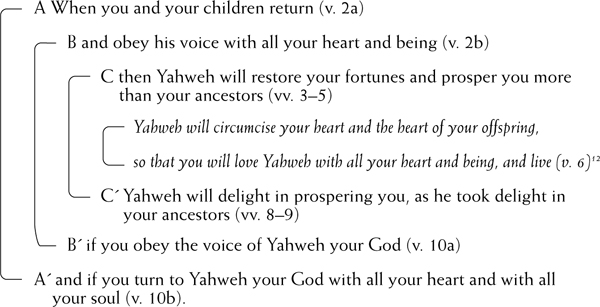
This is a gloriously holistic text, announcing the full restoration of the triadic covenantal relationship. Based on syntactical and conceptual markers, the text breaks down into the following segments: (1) the restoration of the bilateral relationship between Yahweh and Israel (vv. 1–3); (2) the divine restoration of the trilateral covenant relationship (vv. 4–7); (3) the human proof of the restoration (v. 8); (4) the environmental proof of the restoration (vv. 9–10).
The Restoration of the Bilateral Relationship between Yahweh and Israel (vv. 1–3)
THE OPENING “WHEN” CLAUSE identifies the context in which the restoration of the bilateral relationship will transpire. The verse begins with “When all these haddebârîm.” While many translate haddebârîm simply as “things” (and the NIV omits translating it), in Deuteronomy and the Pentateuch as a whole the expression always means “all these words.”13 Moses clarifies the phrase with “the blessing and the curse” (pers. trans.), which points back to chapter 28. The modifying clause, “[which] I have set before you,” reinforces this interpretation. Moses has been doing things with words—trying to inspire fidelity with promises as rewards for obedience and with warnings as the consequences of disobedience. When his predictions have been fulfilled, the events foreseen in verses 1b–3 will occur (cf. 4:30).
Moses begins his description of Israel’s restoration by summarizing the changes in the relationship between the people and Yahweh. (1) Concerning the people (vv. 1b–2), the Israelites will experience a change in disposition. Among all the nations where Yahweh their God has banished them, they will come to their senses. In the clause rendered by the NIV as “you take them to heart,” the verb hēšîb (“to turn x back”) actually lacks an object. If we assume “all these words” (v. 1b) to be the object, then in exile the Israelites will reverse their hardened disposition (cf. 29:19[18]) and in effect recast as a confession what Moses had presented as a third person interpretation in 29:25–28[24–27].
(2) The Israelites will then experience a change in orientation: they “will return to the LORD your God,” a verbatim quotation from 4:30. This signifies a reversal of past patterns of behavior characterized as “abandoning” Yahweh (28:20) or his covenant (29:25[24]), and turning aside from his way (9:12) or from him to serve other gods (11:16), to name a few.
(3) The Israelites will experience a change in receptiveness: they will finally listen to the voice of Yahweh (NIV “obey”; cf. 4:30).14 The coordinate expression “with all your heart and with all your being” (NIV “soul”; vv. 2, 6, 10) picks up a refrain heard often in the book15 and highlights the completeness of the people’s “repentance.”
Additional echoes of 4:29–31 occur in verse 3 as Moses shifts his attention to Yahweh’s new disposition and actions. (1) Yahweh’s intentions concerning Israel will change; he will restore their fortunes.16 Here the reversal involves lifting the judgment and restoring the relationship between the people of Israel and their land. (2) Yahweh’s disposition toward Israel will change; he will show compassion to them (cf. 4:31). As in 13:17[18], the change seems contingent on Israel’s listening to his voice and doing what is right in his sight. (3) Yahweh’s orientation regarding Israel will change; he will “turn around.” The verb here expresses Yahweh’s fundamental reorientation. Instead of turning from Israel and operating as their enemy, he will turn toward them and act on their behalf. (4) Yahweh’s treatment of Israel will change. Whereas previously he had scattered them among the nations, now he will gather them (cf. 4:27; 28:64). While we hear nothing yet of the restoration of the people to the land, this divine action represents a necessary first step in reversing their uprooting (29:28[27]).
Bridging Contexts
MOSES, JEREMIAH, AND PAUL. In this portrait of Israel’s inevitable restoration Moses has planted numerous seeds that will sprout and grow in later texts.26 Jeremiah paints his picture of Israel’s restoration climaxing in the establishment of a new covenant (Jer. 31:27–37) with this passage in the background. In the prophet’s declaration of his thesis in Jeremiah 30:3 we hear clear lexical and conceptual echoes of Deuteronomy 30:1–10. Although Jeremiah does not refer to the circumcision of the heart, his understanding of the divine inscription of the Torah on the hearts of the people and his vision for all Israel participating in the new order fall within the same theological field.
Like Moses, Jeremiah is fully aware that there are two Israels. On the one hand, there is the Israel that claims status before God and before the nations by virtue of descent from Abraham, their identification with the exodus from Egypt through the annual celebration of the Passover, and their possession of the Torah; this is Paul’s “Israel after the flesh.”27 On the other hand, there is true spiritual Israel, for whom the Shema (Deut. 6:4–5) is the watchword. Like Josiah centuries later, they turn to Yahweh with all their inner beings, their persons, and their resources (2 Kings 23:25); like Caleb and Rahab and Ruth (who were Gentiles by blood), they have a different Spirit and follow Yahweh fully (cf. Num. 14:24; Deut. 1:36; Josh. 14:8); and like David, they trust Yahweh fully (2 Sam. 22:2–51). Historically, times when the boundaries of these two Israel’s coalesced were rare. The contrast between the two may be portrayed graphically as follows:

But the image envisioned here is different. As pictured on the right, Moses looks forward to a time when the boundaries of physical and spiritual Israel will be coterminous. All Israel will be circumcised of heart; all will love Yahweh; all will listen to his voice and live according to the Torah of Moses; and all will participate in Yahweh’s favor.
This is the ideal that Jeremiah has in mind. Taking a page out of Moses’ notebook, he castigates his people for being uncircumcised of heart (4:4; 6:10; 9:25–26), but in Jeremiah 31:31–34 he looks beyond the judgment to the day when “all Israel” will (1) have the Torah inscribed on their hearts, (2) be related to Yahweh by covenant, (3) know him, and (4) will have experienced the forgiveness of their sins. None of these four features is absolutely new; from the beginning there has been a remnant who enjoyed these gifts of grace. The only new feature of the “new covenant” is its scope. Speaking with Yahweh’s voice the prophet looks forward to a day when all Israel will embrace him (cf. v. 22) and the boundaries of spiritual Israel will match the boundaries of physical Israel.
Affirmed from both sides, the bond of commitment will be indissoluble. In the new covenant there is no freedom from the law, nor is there any adjustment in God’s standards of righteousness. Jeremiah envisions a future28 when the original Torah of Yahweh will be internalized in the hearts of all Israel and all Israel will be freed to walk in the ways of Yahweh. The so-called “new covenant” is not actually new; it means the fulfillment and realization of the ideals represented in God’s covenant with Abraham, which were transferred to the entire nation at Sinai and renewed with this generation on the Plains of Moab.29
The return of the Jews from Babylon in 538 BC demonstrated that Yahweh had not forgotten his people or his word through Moses. Weaned of idolatry, the returnees rebuilt Jerusalem as the spiritually renewed covenant people of Yahweh. However, neither Moses nor later biblical interpreters would have envisioned this as the complete fulfillment of Deuteronomy 30:1–10, for this event was a renewal only “in small measure” (cf. Ezek 11:16). The pillars on which their hope was based were only partially reconstructed:
1. They occupied only a small portion of the land originally promised to the ancestors.
2. Although ca. 50,000 returned (Ezra 2:64–65), these were primarily Judahites and Levites and represented only a small portion of Israelites scattered throughout the ancient Near East.
3. Zerubbabel, a descendant of David, was back, but the kingship was not restored; he was merely a governor of a province under the control of Persia (Hag. 1:12–15; 2:23).
4. The temple was rebuilt, but it was a pathetic version of the glorious original; in any case, the glory of Yahweh apparently never returned (cf. Hag. 2:1–9).
This picture obviously does not match the ideal set by Moses, but it was a deposit of Yahweh’s continued commitment to his people.
Deuteronomy 30:1–10 also provides the roots of Pauline thought. In response to Judaizers, who argued that Gentiles needed to be circumcised physically to have access to Yahweh’s covenant, Paul argued that the covenant people of God are not identified by physical circumcision but by internal circumcision of the heart by the Spirit. Punning on the name Judah (“praise”), he declared that true Israel (Jews) receive their praise from God and not from humans (Rom. 2:25–29). Refracted through Jeremiah’s vision of the future, Paul looked forward to the fulfillment of the Mosaic ideal when “all Israel will be saved” (Rom. 11:26).
This prospect of hope for a renewal of the relationship between Yahweh and his estranged subjects contrasts sharply with realities assumed in ancient Near Eastern suzerainty treaties. While these political documents present the relationship between suzerain and vassal with familial language like “father” and “son,” respectively, human suzerains tended to be concerned primarily to protect their own interests; treaty curses are never followed by expressions of hope for renewal of the relationship after the curses have been inflicted by the gods. Moreover, whereas political suzerains invoked the deities as third parties to reward or punish traitors in the subjunctive mood, Yahweh declares the consequences of obedience and disobedience in the declarative mood and poses as guarantor of both the sanctions and ultimate restoration in the first person.30
Although Yahweh performs the legislative, executive, and judicial functions, he also exercises complete freedom to renew the relationship after the curses have been imposed. His original election of the ancestors was driven by broader missiological concerns, but in his relationship with Israel he always operated in his people’s interests. Yahweh’s power and status were never jeopardized by their rebellion; driven by his compassionate heart and his irrevocable commitment to his people (4:30–31), he was free to declare the judgment ended and to offer them a new start. Deuteronomy 30:1–10 offers powerful testimony to Yahweh’s eternal commitment to his people.31
Contemporary Significance
THE PRESENT STATE OF Israel. Deuteronomy 30:1–10 bears profound significance for Christians today at three levels. First, it offers guidance for a Christian perspective on the present state of Israel. On the one hand, the existence of a homeland for the Jewish people in the land of Israel cannot be dismissed merely as an accident of history. After two thousand years in the diaspora, the descendants of Abraham from all over the world have recreated a state in the land promised to his descendants. This is evidence of a most remarkable providence.
Even so, we recognize that the present state of Israel is not the fulfillment of Moses’ vision or of the vision of the prophets who succeeded him. The preconditions established for the renewal of the covenantal triangle have not been fulfilled. While some Jews scrupulously follow ritual and kosher laws of Judaism, Israel today is essentially a secular state; furthermore, their treatment of Palestinians and other aliens in their midst exhibits little evidence of a national movement characterized by a circumcised heart and the moral vision summarized in Deuteronomy 10:12–22. Apart from the faith and the fear of God demonstrated in actions that seek the well-being of the next person ahead of one’s own, there is no divine right to the land.
We pray for the peace of Jerusalem, but we also pray for the peace of the region. Israel’s calling is to serve as a microcosm of a world that longs for shalom; this involves fidelity to God and the concomitant blessing of God. Applying Joel 2:32[3:5] directly to Christ, Paul declared that true devotion to Yahweh is demonstrated by faith in Jesus Christ, for “everyone who calls on the name of the Lord will be saved” (Rom. 10:13).32
God and the covenant relationship. As Paul emphasizes in Romans 2, Deuteronomy 30:1–10 provides a paradigm for the way God establishes a covenant relationship with those who earnestly seek him. On the one hand, a positive relationship with God calls for a change in our disposition as we come to our senses and recognize the rebellion of our ways; a change in orientation as we move away from the path of evil and rebellion; and a willingness to hear the voice of God, calling us to faith and establishing the course on which we must go (Acts 3:19; 8:22).33 The message of Scripture is consistent: The human preconditions for relationship with God include faith and repentance, which Paul speaks of as putting off the old corrupt self and putting on the new self (Col. 3:9–10).
On the other hand, this spiritual renewal is effected by a gracious divine act. When God withdraws his hand of judgment from us who deserve it—for all fall short of God’s glorious standard (Rom. 3:23)—when his disposition and orientation changes from wrath to compassion, and when he circumcises human hearts by a gracious and undeserved act of transformation, a relationship with him is established. All whose hearts are circumcised will love him wholeheartedly and will demonstrate that love in joyful obedience to his will.
The new covenant. From the perspective of this side of the cross, the conceptual links between this text and the new covenant forces us to ask about the role of Christ, who makes this new covenant relationship possible. When Jesus instituted the Lord’s Supper, of the fruit of the vine, he said, “This cup is the new covenant in my blood, which is poured out for you” (Luke 22:20). Through the work of Christ we are brought near to God to enjoy covenant relationship with him; through Christ we come to know the Father; through the sacrifice of Christ our sins are forgiven; and through Christ and his Spirit our minds are renewed and his Torah is inscribed on our hearts. The work of Christ, whose mission was established before the foundation of the world (1 Peter 1:18–21), provides the basis for all God’s covenants. Through Christ’s work the holiness of God is satisfied and his wrath toward us is lifted and replaced with mercy.
Original Meaning
Act III: Trusting in the Grace of Covenant Tomorrow (30:1–10)
UNLIKE LEVITICUS 26:40–45, the blessings and curses in Deuteronomy 28 do not anticipate renewal after the judgment. However, this lack is more than made up for by 30:1–10. Indeed, with this arrangement Moses has heightened the significance of the renewal spoken of in Leviticus 26,7 and the links between Deuteronomy 30:1–10 and chapter 28 suggest this entire address should be read in the light of the covenant curses presented there.8
When the curtain rises after 29:29, the tone has changed completely, though the mysteries of divine providence remain and leave the reader asking a host of questions. After the flagrant spurning of his grace described in chapter 29, how could Yahweh receive his people again? What is the relationship between Israel’s return to Yahweh and Yahweh’s return to them? Does Yahweh return to Israel because she has made the first move in returning to him, or is the process reversed?9 While the issues involved in the debate are important, theological agendas from outside should not interfere with a natural reading of the text.
Deuteronomy 30 represents the climax of the gospel according to Moses as he has proclaimed it in this book. Employing the second person of direct address, Moses brings his present audience into these future events. Much of the theological freight of this section is carried by key words. The most important of these is the root šûb (“to return, turn back”), which occurs seven times, with some variation in meaning.10 Since four of the seven involve Israel as the subject (vv. 1, 2, 8, 10) and three involve Yahweh (vv. 3a, 3b, 9), Israel’s future restoration obviously requires a change in the disposition of both parties. These along with other repeated elements function as glue holding this literary unit together. The subthemes interwoven throughout this passage exhibit an exquisite chiastic arrangement (pers. trans.):11,12
This is a gloriously holistic text, announcing the full restoration of the triadic covenantal relationship. Based on syntactical and conceptual markers, the text breaks down into the following segments: (1) the restoration of the bilateral relationship between Yahweh and Israel (vv. 1–3); (2) the divine restoration of the trilateral covenant relationship (vv. 4–7); (3) the human proof of the restoration (v. 8); (4) the environmental proof of the restoration (vv. 9–10).
The Restoration of the Bilateral Relationship between Yahweh and Israel (vv. 1–3)
THE OPENING “WHEN” CLAUSE identifies the context in which the restoration of the bilateral relationship will transpire. The verse begins with “When all these haddebârîm.” While many translate haddebârîm simply as “things” (and the NIV omits translating it), in Deuteronomy and the Pentateuch as a whole the expression always means “all these words.”13 Moses clarifies the phrase with “the blessing and the curse” (pers. trans.), which points back to chapter 28. The modifying clause, “[which] I have set before you,” reinforces this interpretation. Moses has been doing things with words—trying to inspire fidelity with promises as rewards for obedience and with warnings as the consequences of disobedience. When his predictions have been fulfilled, the events foreseen in verses 1b–3 will occur (cf. 4:30).
Moses begins his description of Israel’s restoration by summarizing the changes in the relationship between the people and Yahweh. (1) Concerning the people (vv. 1b–2), the Israelites will experience a change in disposition. Among all the nations where Yahweh their God has banished them, they will come to their senses. In the clause rendered by the NIV as “you take them to heart,” the verb hēšîb (“to turn x back”) actually lacks an object. If we assume “all these words” (v. 1b) to be the object, then in exile the Israelites will reverse their hardened disposition (cf. 29:19[18]) and in effect recast as a confession what Moses had presented as a third person interpretation in 29:25–28[24–27].
(2) The Israelites will then experience a change in orientation: they “will return to the LORD your God,” a verbatim quotation from 4:30. This signifies a reversal of past patterns of behavior characterized as “abandoning” Yahweh (28:20) or his covenant (29:25[24]), and turning aside from his way (9:12) or from him to serve other gods (11:16), to name a few.
(3) The Israelites will experience a change in receptiveness: they will finally listen to the voice of Yahweh (NIV “obey”; cf. 4:30).14 The coordinate expression “with all your heart and with all your being” (NIV “soul”; vv. 2, 6, 10) picks up a refrain heard often in the book15 and highlights the completeness of the people’s “repentance.”
Additional echoes of 4:29–31 occur in verse 3 as Moses shifts his attention to Yahweh’s new disposition and actions. (1) Yahweh’s intentions concerning Israel will change; he will restore their fortunes.16 Here the reversal involves lifting the judgment and restoring the relationship between the people of Israel and their land. (2) Yahweh’s disposition toward Israel will change; he will show compassion to them (cf. 4:31). As in 13:17[18], the change seems contingent on Israel’s listening to his voice and doing what is right in his sight. (3) Yahweh’s orientation regarding Israel will change; he will “turn around.” The verb here expresses Yahweh’s fundamental reorientation. Instead of turning from Israel and operating as their enemy, he will turn toward them and act on their behalf. (4) Yahweh’s treatment of Israel will change. Whereas previously he had scattered them among the nations, now he will gather them (cf. 4:27; 28:64). While we hear nothing yet of the restoration of the people to the land, this divine action represents a necessary first step in reversing their uprooting (29:28[27]).
Bridging Contexts
MOSES, JEREMIAH, AND PAUL. In this portrait of Israel’s inevitable restoration Moses has planted numerous seeds that will sprout and grow in later texts.26 Jeremiah paints his picture of Israel’s restoration climaxing in the establishment of a new covenant (Jer. 31:27–37) with this passage in the background. In the prophet’s declaration of his thesis in Jeremiah 30:3 we hear clear lexical and conceptual echoes of Deuteronomy 30:1–10. Although Jeremiah does not refer to the circumcision of the heart, his understanding of the divine inscription of the Torah on the hearts of the people and his vision for all Israel participating in the new order fall within the same theological field.
Like Moses, Jeremiah is fully aware that there are two Israels. On the one hand, there is the Israel that claims status before God and before the nations by virtue of descent from Abraham, their identification with the exodus from Egypt through the annual celebration of the Passover, and their possession of the Torah; this is Paul’s “Israel after the flesh.”27 On the other hand, there is true spiritual Israel, for whom the Shema (Deut. 6:4–5) is the watchword. Like Josiah centuries later, they turn to Yahweh with all their inner beings, their persons, and their resources (2 Kings 23:25); like Caleb and Rahab and Ruth (who were Gentiles by blood), they have a different Spirit and follow Yahweh fully (cf. Num. 14:24; Deut. 1:36; Josh. 14:8); and like David, they trust Yahweh fully (2 Sam. 22:2–51). Historically, times when the boundaries of these two Israel’s coalesced were rare. The contrast between the two may be portrayed graphically as follows:
But the image envisioned here is different. As pictured on the right, Moses looks forward to a time when the boundaries of physical and spiritual Israel will be coterminous. All Israel will be circumcised of heart; all will love Yahweh; all will listen to his voice and live according to the Torah of Moses; and all will participate in Yahweh’s favor.
This is the ideal that Jeremiah has in mind. Taking a page out of Moses’ notebook, he castigates his people for being uncircumcised of heart (4:4; 6:10; 9:25–26), but in Jeremiah 31:31–34 he looks beyond the judgment to the day when “all Israel” will (1) have the Torah inscribed on their hearts, (2) be related to Yahweh by covenant, (3) know him, and (4) will have experienced the forgiveness of their sins. None of these four features is absolutely new; from the beginning there has been a remnant who enjoyed these gifts of grace. The only new feature of the “new covenant” is its scope. Speaking with Yahweh’s voice the prophet looks forward to a day when all Israel will embrace him (cf. v. 22) and the boundaries of spiritual Israel will match the boundaries of physical Israel.
Affirmed from both sides, the bond of commitment will be indissoluble. In the new covenant there is no freedom from the law, nor is there any adjustment in God’s standards of righteousness. Jeremiah envisions a future28 when the original Torah of Yahweh will be internalized in the hearts of all Israel and all Israel will be freed to walk in the ways of Yahweh. The so-called “new covenant” is not actually new; it means the fulfillment and realization of the ideals represented in God’s covenant with Abraham, which were transferred to the entire nation at Sinai and renewed with this generation on the Plains of Moab.29
The return of the Jews from Babylon in 538 BC demonstrated that Yahweh had not forgotten his people or his word through Moses. Weaned of idolatry, the returnees rebuilt Jerusalem as the spiritually renewed covenant people of Yahweh. However, neither Moses nor later biblical interpreters would have envisioned this as the complete fulfillment of Deuteronomy 30:1–10, for this event was a renewal only “in small measure” (cf. Ezek 11:16). The pillars on which their hope was based were only partially reconstructed:
1. They occupied only a small portion of the land originally promised to the ancestors.
2. Although ca. 50,000 returned (Ezra 2:64–65), these were primarily Judahites and Levites and represented only a small portion of Israelites scattered throughout the ancient Near East.
3. Zerubbabel, a descendant of David, was back, but the kingship was not restored; he was merely a governor of a province under the control of Persia (Hag. 1:12–15; 2:23).
4. The temple was rebuilt, but it was a pathetic version of the glorious original; in any case, the glory of Yahweh apparently never returned (cf. Hag. 2:1–9).
This picture obviously does not match the ideal set by Moses, but it was a deposit of Yahweh’s continued commitment to his people.
Deuteronomy 30:1–10 also provides the roots of Pauline thought. In response to Judaizers, who argued that Gentiles needed to be circumcised physically to have access to Yahweh’s covenant, Paul argued that the covenant people of God are not identified by physical circumcision but by internal circumcision of the heart by the Spirit. Punning on the name Judah (“praise”), he declared that true Israel (Jews) receive their praise from God and not from humans (Rom. 2:25–29). Refracted through Jeremiah’s vision of the future, Paul looked forward to the fulfillment of the Mosaic ideal when “all Israel will be saved” (Rom. 11:26).
This prospect of hope for a renewal of the relationship between Yahweh and his estranged subjects contrasts sharply with realities assumed in ancient Near Eastern suzerainty treaties. While these political documents present the relationship between suzerain and vassal with familial language like “father” and “son,” respectively, human suzerains tended to be concerned primarily to protect their own interests; treaty curses are never followed by expressions of hope for renewal of the relationship after the curses have been inflicted by the gods. Moreover, whereas political suzerains invoked the deities as third parties to reward or punish traitors in the subjunctive mood, Yahweh declares the consequences of obedience and disobedience in the declarative mood and poses as guarantor of both the sanctions and ultimate restoration in the first person.30
Although Yahweh performs the legislative, executive, and judicial functions, he also exercises complete freedom to renew the relationship after the curses have been imposed. His original election of the ancestors was driven by broader missiological concerns, but in his relationship with Israel he always operated in his people’s interests. Yahweh’s power and status were never jeopardized by their rebellion; driven by his compassionate heart and his irrevocable commitment to his people (4:30–31), he was free to declare the judgment ended and to offer them a new start. Deuteronomy 30:1–10 offers powerful testimony to Yahweh’s eternal commitment to his people.31
Contemporary Significance
THE PRESENT STATE OF Israel. Deuteronomy 30:1–10 bears profound significance for Christians today at three levels. First, it offers guidance for a Christian perspective on the present state of Israel. On the one hand, the existence of a homeland for the Jewish people in the land of Israel cannot be dismissed merely as an accident of history. After two thousand years in the diaspora, the descendants of Abraham from all over the world have recreated a state in the land promised to his descendants. This is evidence of a most remarkable providence.
Even so, we recognize that the present state of Israel is not the fulfillment of Moses’ vision or of the vision of the prophets who succeeded him. The preconditions established for the renewal of the covenantal triangle have not been fulfilled. While some Jews scrupulously follow ritual and kosher laws of Judaism, Israel today is essentially a secular state; furthermore, their treatment of Palestinians and other aliens in their midst exhibits little evidence of a national movement characterized by a circumcised heart and the moral vision summarized in Deuteronomy 10:12–22. Apart from the faith and the fear of God demonstrated in actions that seek the well-being of the next person ahead of one’s own, there is no divine right to the land.
We pray for the peace of Jerusalem, but we also pray for the peace of the region. Israel’s calling is to serve as a microcosm of a world that longs for shalom; this involves fidelity to God and the concomitant blessing of God. Applying Joel 2:32[3:5] directly to Christ, Paul declared that true devotion to Yahweh is demonstrated by faith in Jesus Christ, for “everyone who calls on the name of the Lord will be saved” (Rom. 10:13).32
God and the covenant relationship. As Paul emphasizes in Romans 2, Deuteronomy 30:1–10 provides a paradigm for the way God establishes a covenant relationship with those who earnestly seek him. On the one hand, a positive relationship with God calls for a change in our disposition as we come to our senses and recognize the rebellion of our ways; a change in orientation as we move away from the path of evil and rebellion; and a willingness to hear the voice of God, calling us to faith and establishing the course on which we must go (Acts 3:19; 8:22).33 The message of Scripture is consistent: The human preconditions for relationship with God include faith and repentance, which Paul speaks of as putting off the old corrupt self and putting on the new self (Col. 3:9–10).
On the other hand, this spiritual renewal is effected by a gracious divine act. When God withdraws his hand of judgment from us who deserve it—for all fall short of God’s glorious standard (Rom. 3:23)—when his disposition and orientation changes from wrath to compassion, and when he circumcises human hearts by a gracious and undeserved act of transformation, a relationship with him is established. All whose hearts are circumcised will love him wholeheartedly and will demonstrate that love in joyful obedience to his will.
The new covenant. From the perspective of this side of the cross, the conceptual links between this text and the new covenant forces us to ask about the role of Christ, who makes this new covenant relationship possible. When Jesus instituted the Lord’s Supper, of the fruit of the vine, he said, “This cup is the new covenant in my blood, which is poured out for you” (Luke 22:20). Through the work of Christ we are brought near to God to enjoy covenant relationship with him; through Christ we come to know the Father; through the sacrifice of Christ our sins are forgiven; and through Christ and his Spirit our minds are renewed and his Torah is inscribed on our hearts. The work of Christ, whose mission was established before the foundation of the world (1 Peter 1:18–21), provides the basis for all God’s covenants. Through Christ’s work the holiness of God is satisfied and his wrath toward us is lifted and replaced with mercy.
Original Meaning
Act III: Trusting in the Grace of Covenant Tomorrow (30:1–10)
UNLIKE LEVITICUS 26:40–45, the blessings and curses in Deuteronomy 28 do not anticipate renewal after the judgment. However, this lack is more than made up for by 30:1–10. Indeed, with this arrangement Moses has heightened the significance of the renewal spoken of in Leviticus 26,7 and the links between Deuteronomy 30:1–10 and chapter 28 suggest this entire address should be read in the light of the covenant curses presented there.8
When the curtain rises after 29:29, the tone has changed completely, though the mysteries of divine providence remain and leave the reader asking a host of questions. After the flagrant spurning of his grace described in chapter 29, how could Yahweh receive his people again? What is the relationship between Israel’s return to Yahweh and Yahweh’s return to them? Does Yahweh return to Israel because she has made the first move in returning to him, or is the process reversed?9 While the issues involved in the debate are important, theological agendas from outside should not interfere with a natural reading of the text.
Deuteronomy 30 represents the climax of the gospel according to Moses as he has proclaimed it in this book. Employing the second person of direct address, Moses brings his present audience into these future events. Much of the theological freight of this section is carried by key words. The most important of these is the root šûb (“to return, turn back”), which occurs seven times, with some variation in meaning.10 Since four of the seven involve Israel as the subject (vv. 1, 2, 8, 10) and three involve Yahweh (vv. 3a, 3b, 9), Israel’s future restoration obviously requires a change in the disposition of both parties. These along with other repeated elements function as glue holding this literary unit together. The subthemes interwoven throughout this passage exhibit an exquisite chiastic arrangement (pers. trans.):11,12
This is a gloriously holistic text, announcing the full restoration of the triadic covenantal relationship. Based on syntactical and conceptual markers, the text breaks down into the following segments: (1) the restoration of the bilateral relationship between Yahweh and Israel (vv. 1–3); (2) the divine restoration of the trilateral covenant relationship (vv. 4–7); (3) the human proof of the restoration (v. 8); (4) the environmental proof of the restoration (vv. 9–10).
The Restoration of the Bilateral Relationship between Yahweh and Israel (vv. 1–3)
THE OPENING “WHEN” CLAUSE identifies the context in which the restoration of the bilateral relationship will transpire. The verse begins with “When all these haddebârîm.” While many translate haddebârîm simply as “things” (and the NIV omits translating it), in Deuteronomy and the Pentateuch as a whole the expression always means “all these words.”13 Moses clarifies the phrase with “the blessing and the curse” (pers. trans.), which points back to chapter 28. The modifying clause, “[which] I have set before you,” reinforces this interpretation. Moses has been doing things with words—trying to inspire fidelity with promises as rewards for obedience and with warnings as the consequences of disobedience. When his predictions have been fulfilled, the events foreseen in verses 1b–3 will occur (cf. 4:30).
Moses begins his description of Israel’s restoration by summarizing the changes in the relationship between the people and Yahweh. (1) Concerning the people (vv. 1b–2), the Israelites will experience a change in disposition. Among all the nations where Yahweh their God has banished them, they will come to their senses. In the clause rendered by the NIV as “you take them to heart,” the verb hēšîb (“to turn x back”) actually lacks an object. If we assume “all these words” (v. 1b) to be the object, then in exile the Israelites will reverse their hardened disposition (cf. 29:19[18]) and in effect recast as a confession what Moses had presented as a third person interpretation in 29:25–28[24–27].
(2) The Israelites will then experience a change in orientation: they “will return to the LORD your God,” a verbatim quotation from 4:30. This signifies a reversal of past patterns of behavior characterized as “abandoning” Yahweh (28:20) or his covenant (29:25[24]), and turning aside from his way (9:12) or from him to serve other gods (11:16), to name a few.
(3) The Israelites will experience a change in receptiveness: they will finally listen to the voice of Yahweh (NIV “obey”; cf. 4:30).14 The coordinate expression “with all your heart and with all your being” (NIV “soul”; vv. 2, 6, 10) picks up a refrain heard often in the book15 and highlights the completeness of the people’s “repentance.”
Additional echoes of 4:29–31 occur in verse 3 as Moses shifts his attention to Yahweh’s new disposition and actions. (1) Yahweh’s intentions concerning Israel will change; he will restore their fortunes.16 Here the reversal involves lifting the judgment and restoring the relationship between the people of Israel and their land. (2) Yahweh’s disposition toward Israel will change; he will show compassion to them (cf. 4:31). As in 13:17[18], the change seems contingent on Israel’s listening to his voice and doing what is right in his sight. (3) Yahweh’s orientation regarding Israel will change; he will “turn around.” The verb here expresses Yahweh’s fundamental reorientation. Instead of turning from Israel and operating as their enemy, he will turn toward them and act on their behalf. (4) Yahweh’s treatment of Israel will change. Whereas previously he had scattered them among the nations, now he will gather them (cf. 4:27; 28:64). While we hear nothing yet of the restoration of the people to the land, this divine action represents a necessary first step in reversing their uprooting (29:28[27]).
Bridging Contexts
MOSES, JEREMIAH, AND PAUL. In this portrait of Israel’s inevitable restoration Moses has planted numerous seeds that will sprout and grow in later texts.26 Jeremiah paints his picture of Israel’s restoration climaxing in the establishment of a new covenant (Jer. 31:27–37) with this passage in the background. In the prophet’s declaration of his thesis in Jeremiah 30:3 we hear clear lexical and conceptual echoes of Deuteronomy 30:1–10. Although Jeremiah does not refer to the circumcision of the heart, his understanding of the divine inscription of the Torah on the hearts of the people and his vision for all Israel participating in the new order fall within the same theological field.
Like Moses, Jeremiah is fully aware that there are two Israels. On the one hand, there is the Israel that claims status before God and before the nations by virtue of descent from Abraham, their identification with the exodus from Egypt through the annual celebration of the Passover, and their possession of the Torah; this is Paul’s “Israel after the flesh.”27 On the other hand, there is true spiritual Israel, for whom the Shema (Deut. 6:4–5) is the watchword. Like Josiah centuries later, they turn to Yahweh with all their inner beings, their persons, and their resources (2 Kings 23:25); like Caleb and Rahab and Ruth (who were Gentiles by blood), they have a different Spirit and follow Yahweh fully (cf. Num. 14:24; Deut. 1:36; Josh. 14:8); and like David, they trust Yahweh fully (2 Sam. 22:2–51). Historically, times when the boundaries of these two Israel’s coalesced were rare. The contrast between the two may be portrayed graphically as follows:
But the image envisioned here is different. As pictured on the right, Moses looks forward to a time when the boundaries of physical and spiritual Israel will be coterminous. All Israel will be circumcised of heart; all will love Yahweh; all will listen to his voice and live according to the Torah of Moses; and all will participate in Yahweh’s favor.
This is the ideal that Jeremiah has in mind. Taking a page out of Moses’ notebook, he castigates his people for being uncircumcised of heart (4:4; 6:10; 9:25–26), but in Jeremiah 31:31–34 he looks beyond the judgment to the day when “all Israel” will (1) have the Torah inscribed on their hearts, (2) be related to Yahweh by covenant, (3) know him, and (4) will have experienced the forgiveness of their sins. None of these four features is absolutely new; from the beginning there has been a remnant who enjoyed these gifts of grace. The only new feature of the “new covenant” is its scope. Speaking with Yahweh’s voice the prophet looks forward to a day when all Israel will embrace him (cf. v. 22) and the boundaries of spiritual Israel will match the boundaries of physical Israel.
Affirmed from both sides, the bond of commitment will be indissoluble. In the new covenant there is no freedom from the law, nor is there any adjustment in God’s standards of righteousness. Jeremiah envisions a future28 when the original Torah of Yahweh will be internalized in the hearts of all Israel and all Israel will be freed to walk in the ways of Yahweh. The so-called “new covenant” is not actually new; it means the fulfillment and realization of the ideals represented in God’s covenant with Abraham, which were transferred to the entire nation at Sinai and renewed with this generation on the Plains of Moab.29
The return of the Jews from Babylon in 538 BC demonstrated that Yahweh had not forgotten his people or his word through Moses. Weaned of idolatry, the returnees rebuilt Jerusalem as the spiritually renewed covenant people of Yahweh. However, neither Moses nor later biblical interpreters would have envisioned this as the complete fulfillment of Deuteronomy 30:1–10, for this event was a renewal only “in small measure” (cf. Ezek 11:16). The pillars on which their hope was based were only partially reconstructed:
1. They occupied only a small portion of the land originally promised to the ancestors.
2. Although ca. 50,000 returned (Ezra 2:64–65), these were primarily Judahites and Levites and represented only a small portion of Israelites scattered throughout the ancient Near East.
3. Zerubbabel, a descendant of David, was back, but the kingship was not restored; he was merely a governor of a province under the control of Persia (Hag. 1:12–15; 2:23).
4. The temple was rebuilt, but it was a pathetic version of the glorious original; in any case, the glory of Yahweh apparently never returned (cf. Hag. 2:1–9).
This picture obviously does not match the ideal set by Moses, but it was a deposit of Yahweh’s continued commitment to his people.
Deuteronomy 30:1–10 also provides the roots of Pauline thought. In response to Judaizers, who argued that Gentiles needed to be circumcised physically to have access to Yahweh’s covenant, Paul argued that the covenant people of God are not identified by physical circumcision but by internal circumcision of the heart by the Spirit. Punning on the name Judah (“praise”), he declared that true Israel (Jews) receive their praise from God and not from humans (Rom. 2:25–29). Refracted through Jeremiah’s vision of the future, Paul looked forward to the fulfillment of the Mosaic ideal when “all Israel will be saved” (Rom. 11:26).
This prospect of hope for a renewal of the relationship between Yahweh and his estranged subjects contrasts sharply with realities assumed in ancient Near Eastern suzerainty treaties. While these political documents present the relationship between suzerain and vassal with familial language like “father” and “son,” respectively, human suzerains tended to be concerned primarily to protect their own interests; treaty curses are never followed by expressions of hope for renewal of the relationship after the curses have been inflicted by the gods. Moreover, whereas political suzerains invoked the deities as third parties to reward or punish traitors in the subjunctive mood, Yahweh declares the consequences of obedience and disobedience in the declarative mood and poses as guarantor of both the sanctions and ultimate restoration in the first person.30
Although Yahweh performs the legislative, executive, and judicial functions, he also exercises complete freedom to renew the relationship after the curses have been imposed. His original election of the ancestors was driven by broader missiological concerns, but in his relationship with Israel he always operated in his people’s interests. Yahweh’s power and status were never jeopardized by their rebellion; driven by his compassionate heart and his irrevocable commitment to his people (4:30–31), he was free to declare the judgment ended and to offer them a new start. Deuteronomy 30:1–10 offers powerful testimony to Yahweh’s eternal commitment to his people.31
Contemporary Significance
THE PRESENT STATE OF Israel. Deuteronomy 30:1–10 bears profound significance for Christians today at three levels. First, it offers guidance for a Christian perspective on the present state of Israel. On the one hand, the existence of a homeland for the Jewish people in the land of Israel cannot be dismissed merely as an accident of history. After two thousand years in the diaspora, the descendants of Abraham from all over the world have recreated a state in the land promised to his descendants. This is evidence of a most remarkable providence.
Even so, we recognize that the present state of Israel is not the fulfillment of Moses’ vision or of the vision of the prophets who succeeded him. The preconditions established for the renewal of the covenantal triangle have not been fulfilled. While some Jews scrupulously follow ritual and kosher laws of Judaism, Israel today is essentially a secular state; furthermore, their treatment of Palestinians and other aliens in their midst exhibits little evidence of a national movement characterized by a circumcised heart and the moral vision summarized in Deuteronomy 10:12–22. Apart from the faith and the fear of God demonstrated in actions that seek the well-being of the next person ahead of one’s own, there is no divine right to the land.
We pray for the peace of Jerusalem, but we also pray for the peace of the region. Israel’s calling is to serve as a microcosm of a world that longs for shalom; this involves fidelity to God and the concomitant blessing of God. Applying Joel 2:32[3:5] directly to Christ, Paul declared that true devotion to Yahweh is demonstrated by faith in Jesus Christ, for “everyone who calls on the name of the Lord will be saved” (Rom. 10:13).32
God and the covenant relationship. As Paul emphasizes in Romans 2, Deuteronomy 30:1–10 provides a paradigm for the way God establishes a covenant relationship with those who earnestly seek him. On the one hand, a positive relationship with God calls for a change in our disposition as we come to our senses and recognize the rebellion of our ways; a change in orientation as we move away from the path of evil and rebellion; and a willingness to hear the voice of God, calling us to faith and establishing the course on which we must go (Acts 3:19; 8:22).33 The message of Scripture is consistent: The human preconditions for relationship with God include faith and repentance, which Paul speaks of as putting off the old corrupt self and putting on the new self (Col. 3:9–10).
On the other hand, this spiritual renewal is effected by a gracious divine act. When God withdraws his hand of judgment from us who deserve it—for all fall short of God’s glorious standard (Rom. 3:23)—when his disposition and orientation changes from wrath to compassion, and when he circumcises human hearts by a gracious and undeserved act of transformation, a relationship with him is established. All whose hearts are circumcised will love him wholeheartedly and will demonstrate that love in joyful obedience to his will.
The new covenant. From the perspective of this side of the cross, the conceptual links between this text and the new covenant forces us to ask about the role of Christ, who makes this new covenant relationship possible. When Jesus instituted the Lord’s Supper, of the fruit of the vine, he said, “This cup is the new covenant in my blood, which is poured out for you” (Luke 22:20). Through the work of Christ we are brought near to God to enjoy covenant relationship with him; through Christ we come to know the Father; through the sacrifice of Christ our sins are forgiven; and through Christ and his Spirit our minds are renewed and his Torah is inscribed on our hearts. The work of Christ, whose mission was established before the foundation of the world (1 Peter 1:18–21), provides the basis for all God’s covenants. Through Christ’s work the holiness of God is satisfied and his wrath toward us is lifted and replaced with mercy.
Original Meaning
Act III: Trusting in the Grace of Covenant Tomorrow (30:1–10)
UNLIKE LEVITICUS 26:40–45, the blessings and curses in Deuteronomy 28 do not anticipate renewal after the judgment. However, this lack is more than made up for by 30:1–10. Indeed, with this arrangement Moses has heightened the significance of the renewal spoken of in Leviticus 26,7 and the links between Deuteronomy 30:1–10 and chapter 28 suggest this entire address should be read in the light of the covenant curses presented there.8
When the curtain rises after 29:29, the tone has changed completely, though the mysteries of divine providence remain and leave the reader asking a host of questions. After the flagrant spurning of his grace described in chapter 29, how could Yahweh receive his people again? What is the relationship between Israel’s return to Yahweh and Yahweh’s return to them? Does Yahweh return to Israel because she has made the first move in returning to him, or is the process reversed?9 While the issues involved in the debate are important, theological agendas from outside should not interfere with a natural reading of the text.
Deuteronomy 30 represents the climax of the gospel according to Moses as he has proclaimed it in this book. Employing the second person of direct address, Moses brings his present audience into these future events. Much of the theological freight of this section is carried by key words. The most important of these is the root šûb (“to return, turn back”), which occurs seven times, with some variation in meaning.10 Since four of the seven involve Israel as the subject (vv. 1, 2, 8, 10) and three involve Yahweh (vv. 3a, 3b, 9), Israel’s future restoration obviously requires a change in the disposition of both parties. These along with other repeated elements function as glue holding this literary unit together. The subthemes interwoven throughout this passage exhibit an exquisite chiastic arrangement (pers. trans.):11,12
This is a gloriously holistic text, announcing the full restoration of the triadic covenantal relationship. Based on syntactical and conceptual markers, the text breaks down into the following segments: (1) the restoration of the bilateral relationship between Yahweh and Israel (vv. 1–3); (2) the divine restoration of the trilateral covenant relationship (vv. 4–7); (3) the human proof of the restoration (v. 8); (4) the environmental proof of the restoration (vv. 9–10).
The Restoration of the Bilateral Relationship between Yahweh and Israel (vv. 1–3)
THE OPENING “WHEN” CLAUSE identifies the context in which the restoration of the bilateral relationship will transpire. The verse begins with “When all these haddebârîm.” While many translate haddebârîm simply as “things” (and the NIV omits translating it), in Deuteronomy and the Pentateuch as a whole the expression always means “all these words.”13 Moses clarifies the phrase with “the blessing and the curse” (pers. trans.), which points back to chapter 28. The modifying clause, “[which] I have set before you,” reinforces this interpretation. Moses has been doing things with words—trying to inspire fidelity with promises as rewards for obedience and with warnings as the consequences of disobedience. When his predictions have been fulfilled, the events foreseen in verses 1b–3 will occur (cf. 4:30).
Moses begins his description of Israel’s restoration by summarizing the changes in the relationship between the people and Yahweh. (1) Concerning the people (vv. 1b–2), the Israelites will experience a change in disposition. Among all the nations where Yahweh their God has banished them, they will come to their senses. In the clause rendered by the NIV as “you take them to heart,” the verb hēšîb (“to turn x back”) actually lacks an object. If we assume “all these words” (v. 1b) to be the object, then in exile the Israelites will reverse their hardened disposition (cf. 29:19[18]) and in effect recast as a confession what Moses had presented as a third person interpretation in 29:25–28[24–27].
(2) The Israelites will then experience a change in orientation: they “will return to the LORD your God,” a verbatim quotation from 4:30. This signifies a reversal of past patterns of behavior characterized as “abandoning” Yahweh (28:20) or his covenant (29:25[24]), and turning aside from his way (9:12) or from him to serve other gods (11:16), to name a few.
(3) The Israelites will experience a change in receptiveness: they will finally listen to the voice of Yahweh (NIV “obey”; cf. 4:30).14 The coordinate expression “with all your heart and with all your being” (NIV “soul”; vv. 2, 6, 10) picks up a refrain heard often in the book15 and highlights the completeness of the people’s “repentance.”
Additional echoes of 4:29–31 occur in verse 3 as Moses shifts his attention to Yahweh’s new disposition and actions. (1) Yahweh’s intentions concerning Israel will change; he will restore their fortunes.16 Here the reversal involves lifting the judgment and restoring the relationship between the people of Israel and their land. (2) Yahweh’s disposition toward Israel will change; he will show compassion to them (cf. 4:31). As in 13:17[18], the change seems contingent on Israel’s listening to his voice and doing what is right in his sight. (3) Yahweh’s orientation regarding Israel will change; he will “turn around.” The verb here expresses Yahweh’s fundamental reorientation. Instead of turning from Israel and operating as their enemy, he will turn toward them and act on their behalf. (4) Yahweh’s treatment of Israel will change. Whereas previously he had scattered them among the nations, now he will gather them (cf. 4:27; 28:64). While we hear nothing yet of the restoration of the people to the land, this divine action represents a necessary first step in reversing their uprooting (29:28[27]).
Bridging Contexts
MOSES, JEREMIAH, AND PAUL. In this portrait of Israel’s inevitable restoration Moses has planted numerous seeds that will sprout and grow in later texts.26 Jeremiah paints his picture of Israel’s restoration climaxing in the establishment of a new covenant (Jer. 31:27–37) with this passage in the background. In the prophet’s declaration of his thesis in Jeremiah 30:3 we hear clear lexical and conceptual echoes of Deuteronomy 30:1–10. Although Jeremiah does not refer to the circumcision of the heart, his understanding of the divine inscription of the Torah on the hearts of the people and his vision for all Israel participating in the new order fall within the same theological field.
Like Moses, Jeremiah is fully aware that there are two Israels. On the one hand, there is the Israel that claims status before God and before the nations by virtue of descent from Abraham, their identification with the exodus from Egypt through the annual celebration of the Passover, and their possession of the Torah; this is Paul’s “Israel after the flesh.”27 On the other hand, there is true spiritual Israel, for whom the Shema (Deut. 6:4–5) is the watchword. Like Josiah centuries later, they turn to Yahweh with all their inner beings, their persons, and their resources (2 Kings 23:25); like Caleb and Rahab and Ruth (who were Gentiles by blood), they have a different Spirit and follow Yahweh fully (cf. Num. 14:24; Deut. 1:36; Josh. 14:8); and like David, they trust Yahweh fully (2 Sam. 22:2–51). Historically, times when the boundaries of these two Israel’s coalesced were rare. The contrast between the two may be portrayed graphically as follows:
But the image envisioned here is different. As pictured on the right, Moses looks forward to a time when the boundaries of physical and spiritual Israel will be coterminous. All Israel will be circumcised of heart; all will love Yahweh; all will listen to his voice and live according to the Torah of Moses; and all will participate in Yahweh’s favor.
This is the ideal that Jeremiah has in mind. Taking a page out of Moses’ notebook, he castigates his people for being uncircumcised of heart (4:4; 6:10; 9:25–26), but in Jeremiah 31:31–34 he looks beyond the judgment to the day when “all Israel” will (1) have the Torah inscribed on their hearts, (2) be related to Yahweh by covenant, (3) know him, and (4) will have experienced the forgiveness of their sins. None of these four features is absolutely new; from the beginning there has been a remnant who enjoyed these gifts of grace. The only new feature of the “new covenant” is its scope. Speaking with Yahweh’s voice the prophet looks forward to a day when all Israel will embrace him (cf. v. 22) and the boundaries of spiritual Israel will match the boundaries of physical Israel.
Affirmed from both sides, the bond of commitment will be indissoluble. In the new covenant there is no freedom from the law, nor is there any adjustment in God’s standards of righteousness. Jeremiah envisions a future28 when the original Torah of Yahweh will be internalized in the hearts of all Israel and all Israel will be freed to walk in the ways of Yahweh. The so-called “new covenant” is not actually new; it means the fulfillment and realization of the ideals represented in God’s covenant with Abraham, which were transferred to the entire nation at Sinai and renewed with this generation on the Plains of Moab.29
The return of the Jews from Babylon in 538 BC demonstrated that Yahweh had not forgotten his people or his word through Moses. Weaned of idolatry, the returnees rebuilt Jerusalem as the spiritually renewed covenant people of Yahweh. However, neither Moses nor later biblical interpreters would have envisioned this as the complete fulfillment of Deuteronomy 30:1–10, for this event was a renewal only “in small measure” (cf. Ezek 11:16). The pillars on which their hope was based were only partially reconstructed:
1. They occupied only a small portion of the land originally promised to the ancestors.
2. Although ca. 50,000 returned (Ezra 2:64–65), these were primarily Judahites and Levites and represented only a small portion of Israelites scattered throughout the ancient Near East.
3. Zerubbabel, a descendant of David, was back, but the kingship was not restored; he was merely a governor of a province under the control of Persia (Hag. 1:12–15; 2:23).
4. The temple was rebuilt, but it was a pathetic version of the glorious original; in any case, the glory of Yahweh apparently never returned (cf. Hag. 2:1–9).
This picture obviously does not match the ideal set by Moses, but it was a deposit of Yahweh’s continued commitment to his people.
Deuteronomy 30:1–10 also provides the roots of Pauline thought. In response to Judaizers, who argued that Gentiles needed to be circumcised physically to have access to Yahweh’s covenant, Paul argued that the covenant people of God are not identified by physical circumcision but by internal circumcision of the heart by the Spirit. Punning on the name Judah (“praise”), he declared that true Israel (Jews) receive their praise from God and not from humans (Rom. 2:25–29). Refracted through Jeremiah’s vision of the future, Paul looked forward to the fulfillment of the Mosaic ideal when “all Israel will be saved” (Rom. 11:26).
This prospect of hope for a renewal of the relationship between Yahweh and his estranged subjects contrasts sharply with realities assumed in ancient Near Eastern suzerainty treaties. While these political documents present the relationship between suzerain and vassal with familial language like “father” and “son,” respectively, human suzerains tended to be concerned primarily to protect their own interests; treaty curses are never followed by expressions of hope for renewal of the relationship after the curses have been inflicted by the gods. Moreover, whereas political suzerains invoked the deities as third parties to reward or punish traitors in the subjunctive mood, Yahweh declares the consequences of obedience and disobedience in the declarative mood and poses as guarantor of both the sanctions and ultimate restoration in the first person.30
Although Yahweh performs the legislative, executive, and judicial functions, he also exercises complete freedom to renew the relationship after the curses have been imposed. His original election of the ancestors was driven by broader missiological concerns, but in his relationship with Israel he always operated in his people’s interests. Yahweh’s power and status were never jeopardized by their rebellion; driven by his compassionate heart and his irrevocable commitment to his people (4:30–31), he was free to declare the judgment ended and to offer them a new start. Deuteronomy 30:1–10 offers powerful testimony to Yahweh’s eternal commitment to his people.31
Contemporary Significance
THE PRESENT STATE OF Israel. Deuteronomy 30:1–10 bears profound significance for Christians today at three levels. First, it offers guidance for a Christian perspective on the present state of Israel. On the one hand, the existence of a homeland for the Jewish people in the land of Israel cannot be dismissed merely as an accident of history. After two thousand years in the diaspora, the descendants of Abraham from all over the world have recreated a state in the land promised to his descendants. This is evidence of a most remarkable providence.
Even so, we recognize that the present state of Israel is not the fulfillment of Moses’ vision or of the vision of the prophets who succeeded him. The preconditions established for the renewal of the covenantal triangle have not been fulfilled. While some Jews scrupulously follow ritual and kosher laws of Judaism, Israel today is essentially a secular state; furthermore, their treatment of Palestinians and other aliens in their midst exhibits little evidence of a national movement characterized by a circumcised heart and the moral vision summarized in Deuteronomy 10:12–22. Apart from the faith and the fear of God demonstrated in actions that seek the well-being of the next person ahead of one’s own, there is no divine right to the land.
We pray for the peace of Jerusalem, but we also pray for the peace of the region. Israel’s calling is to serve as a microcosm of a world that longs for shalom; this involves fidelity to God and the concomitant blessing of God. Applying Joel 2:32[3:5] directly to Christ, Paul declared that true devotion to Yahweh is demonstrated by faith in Jesus Christ, for “everyone who calls on the name of the Lord will be saved” (Rom. 10:13).32
God and the covenant relationship. As Paul emphasizes in Romans 2, Deuteronomy 30:1–10 provides a paradigm for the way God establishes a covenant relationship with those who earnestly seek him. On the one hand, a positive relationship with God calls for a change in our disposition as we come to our senses and recognize the rebellion of our ways; a change in orientation as we move away from the path of evil and rebellion; and a willingness to hear the voice of God, calling us to faith and establishing the course on which we must go (Acts 3:19; 8:22).33 The message of Scripture is consistent: The human preconditions for relationship with God include faith and repentance, which Paul speaks of as putting off the old corrupt self and putting on the new self (Col. 3:9–10).
On the other hand, this spiritual renewal is effected by a gracious divine act. When God withdraws his hand of judgment from us who deserve it—for all fall short of God’s glorious standard (Rom. 3:23)—when his disposition and orientation changes from wrath to compassion, and when he circumcises human hearts by a gracious and undeserved act of transformation, a relationship with him is established. All whose hearts are circumcised will love him wholeheartedly and will demonstrate that love in joyful obedience to his will.
The new covenant. From the perspective of this side of the cross, the conceptual links between this text and the new covenant forces us to ask about the role of Christ, who makes this new covenant relationship possible. When Jesus instituted the Lord’s Supper, of the fruit of the vine, he said, “This cup is the new covenant in my blood, which is poured out for you” (Luke 22:20). Through the work of Christ we are brought near to God to enjoy covenant relationship with him; through Christ we come to know the Father; through the sacrifice of Christ our sins are forgiven; and through Christ and his Spirit our minds are renewed and his Torah is inscribed on our hearts. The work of Christ, whose mission was established before the foundation of the world (1 Peter 1:18–21), provides the basis for all God’s covenants. Through Christ’s work the holiness of God is satisfied and his wrath toward us is lifted and replaced with mercy.
Original Meaning
Today: Wondering about Covenant Grace (29:29)
BRINGING HIS HEARERS BACK to the present, Moses contrasts “secret things” belonging to Yahweh with “things revealed” belonging to the audience and to their descendants in perpetuity. The meaning of the latter is clarified by the last clause—the Torah that Moses has been expounding for the past twenty-five chapters.1 Whereas the previous generation lacked the disposition to receive the revelation (v. 4), Moses’ present audience has been given a clear understanding of the will of Yahweh and the nature of covenant relationship.
Commentators have interpreted the “secret things” reserved by/for Yahweh variously as hidden sins,2 the oral Torah,3 wisdom,4 or the mystery of divine providence.5 The last suggestion offers the most promise. Similar to 4:28–31, this statement serves as a transition from judgment to restoration in the distant future. However, in contrast to 4:28–31, which attributes the shift to Yahweh’s compassionate character and his irrevocable commitment to his covenant with the ancestors, the change in divine disposition becomes more pressing in this text. How could the gracious Redeemer who had been abandoned in favor of other gods even contemplate ultimate renewal of the covenant? This is the mystery of divine providence.6
Whatever the significance of the “secret things,” Moses’ insertion of this statement provides a psychological buffer between the darkness of chapter 29 and the brilliance of chapter 30. Like the intermission between acts in a theatrical performance, this esoteric reflection on wisdom prepares for the change in tone and direction. Without this literary pause, the shift from 29:28[27] to 30:1 would be intolerably abrupt.
Bridging Contexts
MOSES, JEREMIAH, AND PAUL. In this portrait of Israel’s inevitable restoration Moses has planted numerous seeds that will sprout and grow in later texts.26 Jeremiah paints his picture of Israel’s restoration climaxing in the establishment of a new covenant (Jer. 31:27–37) with this passage in the background. In the prophet’s declaration of his thesis in Jeremiah 30:3 we hear clear lexical and conceptual echoes of Deuteronomy 30:1–10. Although Jeremiah does not refer to the circumcision of the heart, his understanding of the divine inscription of the Torah on the hearts of the people and his vision for all Israel participating in the new order fall within the same theological field.
Like Moses, Jeremiah is fully aware that there are two Israels. On the one hand, there is the Israel that claims status before God and before the nations by virtue of descent from Abraham, their identification with the exodus from Egypt through the annual celebration of the Passover, and their possession of the Torah; this is Paul’s “Israel after the flesh.”27 On the other hand, there is true spiritual Israel, for whom the Shema (Deut. 6:4–5) is the watchword. Like Josiah centuries later, they turn to Yahweh with all their inner beings, their persons, and their resources (2 Kings 23:25); like Caleb and Rahab and Ruth (who were Gentiles by blood), they have a different Spirit and follow Yahweh fully (cf. Num. 14:24; Deut. 1:36; Josh. 14:8); and like David, they trust Yahweh fully (2 Sam. 22:2–51). Historically, times when the boundaries of these two Israel’s coalesced were rare. The contrast between the two may be portrayed graphically as follows:
But the image envisioned here is different. As pictured on the right, Moses looks forward to a time when the boundaries of physical and spiritual Israel will be coterminous. All Israel will be circumcised of heart; all will love Yahweh; all will listen to his voice and live according to the Torah of Moses; and all will participate in Yahweh’s favor.
This is the ideal that Jeremiah has in mind. Taking a page out of Moses’ notebook, he castigates his people for being uncircumcised of heart (4:4; 6:10; 9:25–26), but in Jeremiah 31:31–34 he looks beyond the judgment to the day when “all Israel” will (1) have the Torah inscribed on their hearts, (2) be related to Yahweh by covenant, (3) know him, and (4) will have experienced the forgiveness of their sins. None of these four features is absolutely new; from the beginning there has been a remnant who enjoyed these gifts of grace. The only new feature of the “new covenant” is its scope. Speaking with Yahweh’s voice the prophet looks forward to a day when all Israel will embrace him (cf. v. 22) and the boundaries of spiritual Israel will match the boundaries of physical Israel.
Affirmed from both sides, the bond of commitment will be indissoluble. In the new covenant there is no freedom from the law, nor is there any adjustment in God’s standards of righteousness. Jeremiah envisions a future28 when the original Torah of Yahweh will be internalized in the hearts of all Israel and all Israel will be freed to walk in the ways of Yahweh. The so-called “new covenant” is not actually new; it means the fulfillment and realization of the ideals represented in God’s covenant with Abraham, which were transferred to the entire nation at Sinai and renewed with this generation on the Plains of Moab.29
The return of the Jews from Babylon in 538 BC demonstrated that Yahweh had not forgotten his people or his word through Moses. Weaned of idolatry, the returnees rebuilt Jerusalem as the spiritually renewed covenant people of Yahweh. However, neither Moses nor later biblical interpreters would have envisioned this as the complete fulfillment of Deuteronomy 30:1–10, for this event was a renewal only “in small measure” (cf. Ezek 11:16). The pillars on which their hope was based were only partially reconstructed:
1. They occupied only a small portion of the land originally promised to the ancestors.
2. Although ca. 50,000 returned (Ezra 2:64–65), these were primarily Judahites and Levites and represented only a small portion of Israelites scattered throughout the ancient Near East.
3. Zerubbabel, a descendant of David, was back, but the kingship was not restored; he was merely a governor of a province under the control of Persia (Hag. 1:12–15; 2:23).
4. The temple was rebuilt, but it was a pathetic version of the glorious original; in any case, the glory of Yahweh apparently never returned (cf. Hag. 2:1–9).
This picture obviously does not match the ideal set by Moses, but it was a deposit of Yahweh’s continued commitment to his people.
Deuteronomy 30:1–10 also provides the roots of Pauline thought. In response to Judaizers, who argued that Gentiles needed to be circumcised physically to have access to Yahweh’s covenant, Paul argued that the covenant people of God are not identified by physical circumcision but by internal circumcision of the heart by the Spirit. Punning on the name Judah (“praise”), he declared that true Israel (Jews) receive their praise from God and not from humans (Rom. 2:25–29). Refracted through Jeremiah’s vision of the future, Paul looked forward to the fulfillment of the Mosaic ideal when “all Israel will be saved” (Rom. 11:26).
This prospect of hope for a renewal of the relationship between Yahweh and his estranged subjects contrasts sharply with realities assumed in ancient Near Eastern suzerainty treaties. While these political documents present the relationship between suzerain and vassal with familial language like “father” and “son,” respectively, human suzerains tended to be concerned primarily to protect their own interests; treaty curses are never followed by expressions of hope for renewal of the relationship after the curses have been inflicted by the gods. Moreover, whereas political suzerains invoked the deities as third parties to reward or punish traitors in the subjunctive mood, Yahweh declares the consequences of obedience and disobedience in the declarative mood and poses as guarantor of both the sanctions and ultimate restoration in the first person.30
Although Yahweh performs the legislative, executive, and judicial functions, he also exercises complete freedom to renew the relationship after the curses have been imposed. His original election of the ancestors was driven by broader missiological concerns, but in his relationship with Israel he always operated in his people’s interests. Yahweh’s power and status were never jeopardized by their rebellion; driven by his compassionate heart and his irrevocable commitment to his people (4:30–31), he was free to declare the judgment ended and to offer them a new start. Deuteronomy 30:1–10 offers powerful testimony to Yahweh’s eternal commitment to his people.31
Contemporary Significance
THE PRESENT STATE OF Israel. Deuteronomy 30:1–10 bears profound significance for Christians today at three levels. First, it offers guidance for a Christian perspective on the present state of Israel. On the one hand, the existence of a homeland for the Jewish people in the land of Israel cannot be dismissed merely as an accident of history. After two thousand years in the diaspora, the descendants of Abraham from all over the world have recreated a state in the land promised to his descendants. This is evidence of a most remarkable providence.
Even so, we recognize that the present state of Israel is not the fulfillment of Moses’ vision or of the vision of the prophets who succeeded him. The preconditions established for the renewal of the covenantal triangle have not been fulfilled. While some Jews scrupulously follow ritual and kosher laws of Judaism, Israel today is essentially a secular state; furthermore, their treatment of Palestinians and other aliens in their midst exhibits little evidence of a national movement characterized by a circumcised heart and the moral vision summarized in Deuteronomy 10:12–22. Apart from the faith and the fear of God demonstrated in actions that seek the well-being of the next person ahead of one’s own, there is no divine right to the land.
We pray for the peace of Jerusalem, but we also pray for the peace of the region. Israel’s calling is to serve as a microcosm of a world that longs for shalom; this involves fidelity to God and the concomitant blessing of God. Applying Joel 2:32[3:5] directly to Christ, Paul declared that true devotion to Yahweh is demonstrated by faith in Jesus Christ, for “everyone who calls on the name of the Lord will be saved” (Rom. 10:13).32
God and the covenant relationship. As Paul emphasizes in Romans 2, Deuteronomy 30:1–10 provides a paradigm for the way God establishes a covenant relationship with those who earnestly seek him. On the one hand, a positive relationship with God calls for a change in our disposition as we come to our senses and recognize the rebellion of our ways; a change in orientation as we move away from the path of evil and rebellion; and a willingness to hear the voice of God, calling us to faith and establishing the course on which we must go (Acts 3:19; 8:22).33 The message of Scripture is consistent: The human preconditions for relationship with God include faith and repentance, which Paul speaks of as putting off the old corrupt self and putting on the new self (Col. 3:9–10).
On the other hand, this spiritual renewal is effected by a gracious divine act. When God withdraws his hand of judgment from us who deserve it—for all fall short of God’s glorious standard (Rom. 3:23)—when his disposition and orientation changes from wrath to compassion, and when he circumcises human hearts by a gracious and undeserved act of transformation, a relationship with him is established. All whose hearts are circumcised will love him wholeheartedly and will demonstrate that love in joyful obedience to his will.
The new covenant. From the perspective of this side of the cross, the conceptual links between this text and the new covenant forces us to ask about the role of Christ, who makes this new covenant relationship possible. When Jesus instituted the Lord’s Supper, of the fruit of the vine, he said, “This cup is the new covenant in my blood, which is poured out for you” (Luke 22:20). Through the work of Christ we are brought near to God to enjoy covenant relationship with him; through Christ we come to know the Father; through the sacrifice of Christ our sins are forgiven; and through Christ and his Spirit our minds are renewed and his Torah is inscribed on our hearts. The work of Christ, whose mission was established before the foundation of the world (1 Peter 1:18–21), provides the basis for all God’s covenants. Through Christ’s work the holiness of God is satisfied and his wrath toward us is lifted and replaced with mercy.