THE THEOLOGICAL SIGNIFICANCE OF Deuteronomy can scarcely be overestimated. Inasmuch as this book offers the most systematic presentation of theological truth in the entire Old Testament, we may compare its place to that of Romans in the New Testament. Moreover, since Deuteronomy reviews so much of Israel’s historical experience of God’s grace as recounted in Genesis through Numbers, a comparison with the gospel of John may be even more appropriate. Just as John wrote his gospel after several decades of reflection on the death and resurrection of Jesus, so Moses preached the sermons in Deuteronomy after almost four decades of reflection on the significance of the Exodus and God’s covenant with Israel. Thus, like the gospel of John, the book of Deuteronomy functions as a theological manifesto, calling on Israel to respond to God’s grace with unreserved loyalty and love.
History of Interpretation
DEUTERONOMY IS THE FIFTH and final book of what Jewish tradition knows as the Torah, and Christians refer to as the Pentateuch. In popular Hebrew tradition the book is sēfer debārîm (“book of words”), which is an adaptation of the official Hebrew name ʾēlleh haddebārîm (“These are the words”), taken from the first two words of the book. In the third to second centuries BC the translators of the LXX set the course for the history of interpretation of Deuteronomy when, instead of translating the Hebrew title to biblion tôn logôn (“the book of words”) or more simply logoi (words”), they designated the book deuteronomium (“second law”).1 This Greek heading probably became determinative because the book does indeed reiterate many of the laws found in Exodus through Numbers, and in chapter 5 it cites the Decalogue of Exodus 20 almost verbatim. But the name “Deuteronomy” overlooks the true nature of the book: It presents itself as a series of sermons that review events described in the narratives of earlier books and challenges the people to faithful living in the future. Where laws are dealt with (e.g., the central sanctuary regulation in Deut. 12), the presentation is often in the form of exposition rather than a recital of the laws themselves.
Prior to the rise of the source-critical method, both Jewish and Christian readers assumed Mosaic authorship of the book, a fact reflected in the common designation of the Pentateuchal books outside the English world as the Five Books of Moses. During the time in which Jesus ministered and spoke, some looked on him as the eschatological prophet like Moses whom Yahweh promised to raise up (Deut. 18:15; cf. Matt. 11:9; John 1:21, 25; 6:14; 7:40). While Jesus himself rejected this interpretation (John 1:21), judging by the number of quotations from Deuteronomy, this was Jesus’ favorite book. This impression is reinforced by his distillation of the entire law into the simple command to love Yahweh with one’s whole being and to love one’s neighbor as oneself (Matt. 22:37; Mark 12:30; Luke 10:27). This form of the command is thoroughly deuteronomic. While appeals for love for one’s neighbor and the stranger occur earlier in the Pentateuch (Lev. 19:18, 34), the command to love God occurs only in Deuteronomy (Deut. 6:5; 11:1, 13; 13:3[4]; 30:6).
Paul repeatedly cites texts from Deuteronomy to buttress his positions (Rom. 10:19; 11:8; 12:19; 1 Cor. 5:13; 9:9; Eph. 6:2–3; etc.). However, it is clear that Paul interpreted not only the entire history of God’s revelation, but also Deuteronomy in particular in the light of Christ and the cross (Rom. 10:6–8; 1 Cor. 8:6; Gal. 3:13). In so doing, Paul functioned as a second Moses, not only in providing a profoundly theological interpretation of God’s saving actions in Christ, but also in reminding his readers that salvation comes by grace alone. In Romans and Galatians Paul’s argumentation is addressed to those who would pervert the “law” (a narrow legalistic interpretation of Hebrew Torah) into a means of salvation, rather than treating it as a response to salvation as Moses perceived it. In his own disposition toward the “law” Paul was in perfect step with Moses: obedience to the law was not a means for gaining salvation but a willing and grateful response to salvation already received. There is nothing revolutionary in Paul’s definition of a true Jew as one who receives the praise of God because he is circumcised in the heart (Rom. 2:28–29; cf. Deut. 10:16–21; 30:6), nor in his praise of the law as holy, righteous, and good (Rom. 7:12; cf. Deut. 6:20–25), nor in his distillation of the whole law into the law of love (Rom. 13:8–10; cf. Deut. 10:12–21).
The early church fathers tended to follow Paul’s lead in interpreting Deuteronomy christologically, but in their application of the laws they often resorted to spiritualizing the details. For example, by marshaling the Shema (Deut. 6:4–5) to defend the doctrine of the Trinity, they obscured the original contextual meaning of the statement.2 Of the Reformers Luther tended to read Deuteronomy through the lenses of Paul’s rhetorical seemingly antinomian statements (Rom. 7:4–9; 2 Cor. 3:6; Gal. 3:10–25). His own debilitating experience of works-righteousness within the Roman Catholic Church contributed significantly to his view of a radical contrast between the law (which kills) and the gospel (which gives life). His emphasis on the dual function of the law (civic—to maintain external order on earth; theological—to convict people of sin and drive them to Christ)3 completely missed the point of Deuteronomy, which presents the law as a gift of grace to the redeemed to guide them in the way of righteousness and lead to life (cf. Deut. 4:6–8; 6:20–25). Like Luther, Calvin insisted that no one can be justified by keeping the law, but he also emphasized that through the gift of the law, Israel was instructed on how to express their gratitude for their redemption and bring glory and delight to God.4
These approaches tended to dominate the disposition of interpreters of Deuteronomy until the Enlightenment, when the attention of critical scholars shifted from the theological value of Deuteronomy to hypotheses concerning the origin of the book. By the second half of the nineteenth century the documentary approach to Pentateuchal studies was firmly entrenched, and Deuteronomy had been isolated as a source separate from J (Yahwist), E (Elohist), and P (Priestly). Critical scholars generally agree that on the one hand, Deuteronomy either provides the occasion or is the result of the Josianic reform, and on the other hand that the speeches in Deuteronomy are pseudepigraphic, being fictionally attributed to Moses to lend weight to the voice of the parties whose interests are represented in the book.5 Whether they attribute the bulk of Deuteronomy to country Levites writing shortly before 701 BC,6 prophetic circles of northern Israel,7 or sages in the Jerusalem court,8 many interpret the book as a sort of manifesto, written in support of Josiah’s efforts to centralize the religion of Israel in Jerusalem. Weinfeld views Deuteronomy not only as a remarkable literary achievement, but also as a profound monument to the theological revolution advocated by the Josianic circles. This revolution attempted to eliminate other shrines and to centralize all worship of Yahweh in Jerusalem, as well as to “secularize,” “demythologize,” and “spiritualize” the religion.9
These interpretations go back to Julius Wellhausen, who proposed that Deuteronomy 12–26 represents the original core of the book, which was written by a prophet (some suggest Jeremiah) ca. 622 BC (cf. 2 Kings 22–23) to promote the reform of Israel’s religious practices (2 Chron. 34–35) and centralize the cult in Jerusalem. Whereas previously all had recognized Deuteronomy as the last book of the Pentateuch, Martin Noth argued that the book serves as a theological prologue to the Deuteronomistic history (Joshua–Kings), whose purpose was to demonstrate that the demises of Israel and Judah in 722 BC and 586 BC respectively were the direct result of Israel’s worship of strange gods and her failure to obey Yahweh’s demands.10
More recently some have proposed that Deuteronomy was originally produced by a coalition of dissidents (scribes, priests, sages, and aristocrats). According to Richard D. Nelson, the book has its roots in a time of crisis (seventh century), when loyalty to Yahweh was being undermined by the veneration of other gods, the well-being of many was being jeopardized by exploitative royal policies, and the prophetic institution was out of control.11 The inconsistencies and ambiguities in the Deuteronomic legislation reflect the varying interests of the dissident groups.12
While many scholars admit that some of the ideas in the book may derive from earlier times, in their minds the Moses we hear in Deuteronomy is a legendary figure and the speeches in the book are pseudepigraphic. Like many ancient writers, the author of the book expresses his ideology by putting programmatic speeches into the mouth of this figure, who towers above all others in Israelite history as the epitome of wisdom and spirituality.13
But this reconstruction of the origins and provenance of Deuteronomy is diametrically opposed to the internal evidence of the book. Nothing about the book of Deuteronomy or the speeches embedded therein points to a pseudepigraphic work. On the contrary, the image of Moses reflected in the addresses, particularly in the first speech, is hardly the stuff of idealized legend. Moses is keenly aware of his honorific role as the mediator of divine revelation (cf. 5:4–5) and the mouthpiece for God (1:42; 2:2, 31; 3:2; 6:1), but his transparently sour disposition toward the people, and even toward God because he cannot enter the land of Canaan, is anything but laudatory. The first speech in particular creates the impression of a tired and bitter old man, disillusioned with his people, frustrated with God, and discouraged with his task (1:37; 3:26; 4:21). This is not the normal stuff of pseudepigraphy and argues strongly for the integrity of the speeches as authentic records of Mosaic speeches.
Not all are willing to date Deuteronomy late. Some argue that the religious and political vision of the book does not fit the Josianic period as described in 2 Kings. On the contrary, according to McConville, “Deuteronomy, or at least a form of it, is the document of a real political and religious constitution of Israel from the pre-monarchical period.”14 As such it challenges prevailing ancient Near Eastern royal-cultic ideology, replacing this with a prophetic vision of Yahweh in direct covenant relationship with his people and a people governed by Torah. Through the Torah the prophetic authority of Moses, the spokesperson for Yahweh, extends to the community. The “Book of the Torah,” deposited next to the ark and formally read before the assembly, provides a constant reminder of the will of the covenant Lord and a guide for expressing its loyalty to him.15
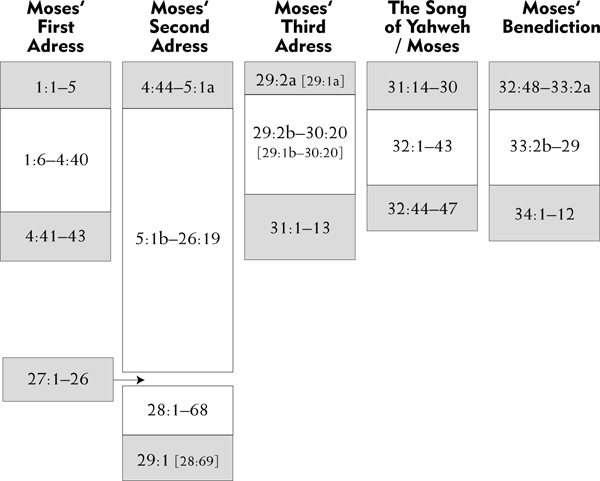
Taken at face value, Deuteronomy tells us more about its composition than any other book in the Old Testament. Inside the book we find many references to the written Torah (6:6–9; 11:18–21; 17:18–20; 27:1–8; 28:58–61; 29:14–29[13–28]; 30:8–11), which point to an early transcription of the Torah that Moses delivered in oral form. Deuteronomy 31:9–13 specifically declares that Moses wrote down this Torah and placed it in the custody of the priests who carried the ark of the covenant. We may infer that this applied to all the addresses recorded in the book: the first address (1:6–4:40), the second address (5:1b–26:19; 28:1–29:1[28:69]), and the third address (29:2[1]–30:20). Deuteronomy 31:22 also indicates that Moses wrote down the song that Yahweh dictated to him and Joshua that same day (32:1–43), and there is every reason to believe that he did the same with the fragments that now constitute the blessing of the tribes (33:2–29).
It seems likely that when Joshua and the Israelites crossed the Jordan River after Moses’ death, they had in their possession a written copy of all this material. The book identifies the individual addresses as Torah. Eventually, the scope of this term was expanded to include the added narrative sections (1:1–5; 27:1–10; 34:1–12; etc)—and finally, when the book of Deuteronomy was combined with the preceding books (Genesis–Numbers), to the Pentateuch as a whole.
The book of Deuteronomy presents itself as the record of a series of addresses delivered orally by Moses to his countrymen on the verge of crossing over into the Promised Land, and immediately committed to writing (31:9).16 However, in accordance with ancient Near Eastern literary conventions, strictly speaking the book as we have it is anonymous. We may speculate when the individual speeches of Moses were combined, arranged, and linked with their present narrative stitching. Within the book we observe a series of features that suggest Moses was not responsible for the final form of the book: (1) references to Moses in third person in the narrative stitching at the boundaries of the respective speeches,17 and in the formulaic introductions to the blessing fragments in chapter 33;18 (2) details that reflect a context later than the speeches themselves (post-Mosaica);19 (3) the language of Deuteronomy.20 Nevertheless, several features within the book point to much earlier context: (1) archaic or at least archaizing features in the language,21 which occur both in Moses’ speeches (as might be expected: 4:6; 10:10; 20:20; 24:4; 30:11, 12, 13) and in the narrative comments (3:11); (2) the literary style of Deuteronomy;22 (3) the names used to identify the original inhabitants of the Transjordanian territories of Moab and Ammon in Moses’ first address;23 (4) the anecdotal reference to Og’s huge bed of iron in 3:11, which invites ancient readers to check the narrator’s veracity and confirm the magnitude of Israel’s victory; and (5) the structure of Deuteronomy, which bears a closer resemblance to late second millennium Hittite treaties than to neo-Assyrian structures.24
Taking these features into account, it seems that although the speeches of Deuteronomy derive from Moses himself, the book as we have it was produced later. A reasonable terminus a quo (earliest possible date) would be during the tenure of Joshua after the Israelites had crossed the Jordan; a terminus ad quem (latest possible date) would be the ninth century, prior to the ministries of Elijah and Elisha, after which the style of prophetic preaching seems to have changed dramatically. The Torah referred to in texts like Joshua 1:8; 8:31–34; and 23:6 may have consisted minimally of the written versions of Moses’ second address (including the covenant curses and the Song of Yahweh), and maximally of Moses’ three major speeches and the songs now preserved in Deuteronomy. However, it is reasonable to suppose that by David’s time Deuteronomy more or less as we have it existed as the last scroll of the Pentateuch.
While critical scholars tend to assume that the Pentateuch arose in response to the crisis of the exile,25 it remains equally possible that Israel’s canonical Scriptures were produced in the context of peace and heightened religious fervor. In an earlier time, God’s self-revelation and his entry into covenant relation with Israel at Sinai represented a climactic spiritual experience whose significance is documented in writing in the Decalogue and the statutes, ordinances, and laws preserved in the books of Exodus, Leviticus, and Numbers. One can imagine that David’s transfer of the ark to Jerusalem, the choice of Zion as the permanent residence of Yahweh, the receipt of the blueprint for the temple, the organization of the cult personnel, and the gathering of the materials for the construction of the temple sparked a new enthusiasm for the worship of Yahweh throughout the land (1 Chron. 22–29).
One may also imagine that David’s religious reforms called for a canonical Scripture to be used in worship and to serve as a guide for daily living as Israel looked forward to a new social and religious order under monarchic rule. David’s organization of the temple worship provides a logical context for the production of a canonical Scripture.26 Exercising their role as gatekeepers of Israel’s theological ideas,27 the priests and Levites would use these Scriptures in worship and in instructing the citizenry in the life of covenantal fidelity. The conjunction of this energized religious climate with the peace and security that David had won for the nation set the stage for the high point of Israel’s cultural achievements, which could reasonably have included the literary masterpiece we know as the Pentateuch as a whole and the book of Deuteronomy in particular.
Whether Deuteronomy, more or less as we have it, was produced by Samuel or under the auspices of David, this was probably the document according to which David charged Solomon to rule in 1 Kings 2:2–4. Unfortunately, as already anticipated by Moses, the periods when Israel as a whole and her kings in particular would live by the Torah were few and far between. During the reign of Manasseh in the seventh century, the book was suppressed altogether, and thoroughly pagan forms replaced its injunctions (2 Kings 21; 2 Chron. 33), which accounts for the response of Josiah when he heard the Torah read by Shaphan (2 Kings 22). The narrative suggests that the Torah had long been recognized as canonical; it was not some recent literary composition.
Later expressions like “Book of Moses” and “Torah of Moses” do not demand that Moses’ own hand produced the book in its final form. We do not doubt the historicity of Moses, nor the authenticity of his speeches, nor the fundamentally Mosaic authority behind the entire Pentateuch, any more than we question the authenticity of the speeches of Jesus in the Gospels. The editor of Moses’ final speeches and the biographer who preserved for us the account of Moses’ final days was himself a prophet in the Mosaic tradition. The book he produced is the Torah, which the priests were to teach and model,28 which psalmists praised,29 to which the prophets appealed,30 and by which faithful kings ruled31 and righteous citizens lived (Ps. 1). In short, the book of Deuteronomy provides the theological base for virtually the entire Old (and New) Testament and the paradigm for much of its literary style.
Deuteronomy and the Canon
THE WRITTEN COPIES OF Moses’ last addresses to Israel were to be recognized as authoritative and canonical from the beginning. Not only did Moses prohibit adding to or deleting from his words (4:2; 12:32), but he also commanded the Levites to place the written copy of the Torah beside the ark of the covenant (31:9–13). That this written Torah was placed beside the ark rather than in it does not suggest a lesser authority than the Decalogue inside the ark but a different significance and use. Whereas the tablets with the Decalogue symbolized the covenant (4:13; 10:1–4) and were placed in the ark as a reminder to God of his covenant with Israel, the Torah was Moses’ inspired commentary on the covenant for the people (1:3).
The theological stamp of Deuteronomy is evident throughout the Old Testament and into the New Testament. If in Deuteronomy the term Torah applies expressly to the speeches of Moses, eventually it was applied to the entire Pentateuch, for which Deuteronomy represents the conclusion. The stamp of Deuteronomy on the so-called “Deuteronomistic History” (Joshua–Kings) is evident not only in the style of these books,32 but especially in its theology.33 Specifically Solomon’s emphasis on the temple as a place for the “name” of Yahweh to dwell in 1 Kings 8 harks back to Deuteronomy 12 et passim. More generally, when the nation of Israel was destroyed and the Davidic monarchy dismantled, it was because they failed in their covenant relationship with Yahweh as outlined in Deuteronomy.
The influence of Deuteronomy is less obvious on Chronicles and Ezra-Nehemiah, but in the Latter Prophets one hears echoes of Moses’ orations throughout. Particularly in Hosea and Jeremiah, the links are so direct that scholars often debate which came first, Deuteronomy or the prophet. Prophetic pronouncements of judgment and restoration appear often to be based on the covenant curses of Deuteronomy 28 and promises of renewal in chapter 30. Indeed, the canonical collection of prophets as a whole and the book of Malachi specifically end with a call to return to the “law of my servant Moses” (Mal. 4:4–6[Heb. 3:22–24]), which, while having its base in the revelation at Sinai, refers fundamentally to Moses’ exposition of that law. In the Psalms Deuteronomic influence is most evident in the so-called “Torah” Psalms (1; 19; 119), which highlight the life-giving purpose of the law, but also in the “wisdom” psalms, with their emphasis on the fear of Yahweh (111:10; cf. 34:8–12[9–13]). The Psalms are so rooted in Deuteronomy that unless Christians accept this book as authoritative, they have no right to find inspiration in the Psalms.34
New Testament texts like Luke 24:44 suggest that by the time of Christ, the expression “Law of Moses” served as the standard designation of the first part of the Jewish canon (alongside “the Prophets” and “the Psalms”). As noted earlier, the Pentateuchal location of Deuteronomy, which provides theological exposition of the events narrated in the previous books, may have influenced the canonical location of John, the most overtly theological of the Gospels. While many Christian interpreters see in Jesus a second Moses, this actually reflects a low Christology, for the New Testament presents Jesus as Yahweh incarnate. If there is a second Moses in the New Testament, that person is Paul. Like Moses, this apostle of liberty was specially called not only to lead the community of faith in the mission to which God had called it, but especially to draw out the theological and soteriological significance of God’s saving actions and to instruct God’s people in the life of covenant faith. In so doing Paul responded sharply to those who insisted that adherence to the law of Moses was a prerequisite to salvation, and he called his hearers to salvation by faith in the redeeming work of Christ. Like the book of Deuteronomy, Paul’s letters (such as Romans) often divide into two parts, the first being devoted to theological exposition (e.g., Rom. 1–11; cf. Deut. 1–11), and the second to drawing out the practical and communal implications of the theology (e.g., Rom. 12:16; cf. Deut. 12–26).
Hearing the Message of Deuteronomy
BECAUSE OF A PERVASIVE if latent Marcionism and adherence to theological systems that are fundamentally dismissive of the Old Testament in general and the book of Deuteronomy in particular, its message has been largely lost to the church. This is a tragedy because few books in the Old or New Testament proclaim such a relevant word of grace and gospel to the church today. But how can readers today rediscover the message of the book? The following hermeneutical steps should help.
(1) It is important to “hear” the word of Deuteronomy. At significant junctures Moses appeals to his people to “hear” the word he is proclaiming (5:1; 6:3–4; 9:1; 20:3). In 31:9–13 he charges the Levitical priests to read the Torah that he has just transcribed (i.e., his speeches) before the people every seven years at the Feast of Booths. This statement highlights the critical connection between hearing the Torah in the future and the life of God’s people. This link may be represented schematically as follows:
Reading → Hearing → Learning → Fear → Obedience → Life
A similar relationship between reading/hearing the words of “this Torah” and one’s future well-being is expressed in 17:19, where Moses charges future kings to read the Torah for themselves so they may embody the covenant fidelity he has espoused in his addresses to the people.
(2) To hear the message of Deuteronomy we must recognize its genre and form. At one level, Deuteronomy represents the final major segment of the biography of Moses that began in the first chapter of Exodus.35 Accordingly, Deuteronomy may be interpreted as narrative with a series of lengthy embedded speeches. At another level, the manner in which the first two speeches have been arranged is strikingly reminiscent of ancient Near Eastern treaty forms, especially second millennium Hittite suzerainty treaties. Recognition of the fundamentally covenantal character of Deuteronomy has significant implications for the message we hear in the book. Yahweh is the divine suzerain, who graciously chose the patriarchs and their descendants as his covenant partner (4:37; 7:6–8), and he demonstrated his covenant commitment (,âhab, “love”) by rescuing them from Egypt (4:32–40), entering into an eternal covenant relationship with them at Sinai (4:9–31), revealing to them his will (4:1–8), and providentially caring for them in the desert (1:9–3:29), and he is now about to deliver the Promised Land into their hands (1:6–8; 7:1–26).
As a true prophet of Yahweh, Moses challenges the Israelites to respond by declaring that Yahweh alone is their God (6:4) and by demonstrating unwavering loyalty and total love for him through acts of obedience to him (6:5–19; 10:12–11:1; etc.). Although Moses realistically anticipates Israel’s future rebellion against her suzerain, leading ultimately to her banishment from the land promised on oath to Abraham, Yahweh’s compassion toward his people and the irrevocable nature of his covenant mean that exile from the land and dispersion among the nations cannot be the last word; Yahweh will bring them back to himself and the land (4:26–31; 30:1–10; 32:26–43). Moses perceives the covenant being renewed with Yahweh as an extension of the covenant made with Israel at Sinai (29:1[28:69]), and ultimately this is an extension of the covenant made with their ancestors (29:10–13[9–12]).
(3) At a third level the book of Deuteronomy presents itself as a series of addresses by Moses to Israel immediately prior to their entrance into the land of Canaan and prior to his own decease. The narrative preamble to the book (1:1–5) should be determinative for how we hear the message of the book. The preamble identifies Moses’ words as hattôrâ hazzōʾt (“this Torah”). The Hebrew term tôrâ means “instruction,” being derived from the verb hôrâ (“to teach”), and the sēper hattôrâ (e.g., Deut. 29:21[20]; Josh. 1:8; etc.) means “the book of the instruction” rather than “the book of the law.” Although tôrâ was applied to specific instructions earlier (e.g., Ex. 12:49; 24:12; Lev. 7:1; Num. 19:14; etc.), here the word identifies Moses’ sermons in Deuteronomy.36 Both the book and the word itself are represented much more accurately by the Greek didaskalia and didachē as used in the New Testament37 than by the word nomos.
Moses’ role in Deuteronomy is not that of a lawgiver38 but a pastor (Num. 27:17; Isa. 63:11).39 Knowing that his death is imminent, like Jacob in Genesis 49, Joshua in Joshua 24, and Jesus in John 13–16, Moses gathers his congregation and delivers his final homily, pleading with the Israelites to remain faithful to Yahweh. The texts he has left us are not to be read primarily as law, but as discourses on the implications of the Israelite covenant for a people about to enter the land promised under the Abrahamic covenant (cf. Gen. 15:7–21; 26:3; Ex. 6:2–8).
How, then, are Christians to interpret and apply the book today? The following represent a few guiding principles.40 (1) Rather than beginning with what the New Testament has to say about Deuteronomy, we should read the book as an ancient Near Eastern document that addresses issues current well over a thousand years before Christ in idioms derived from that cultural world. Although the New Testament church accepted this book, along with the rest of the Old Testament, as its authoritative Scripture, the book seeks primarily to govern the faith and life of the nation of Israel composed largely of ethnic descendants of the patriarchs.
(2) We should recognize the book as a written deposit of eternal truth. Some of these verities are cast in explicit declarative form (4:35, 39), while others are couched in distinctive Israelite cultural dress, for which we need to identify the underlying theological principle (22:8). Unless the New Testament explicitly declares a Deuteronomic ordinance to be passé, we should assume minimally that the principle underlying each command remains valid.
(3) Having established the meaning of a specific Deuteronomic passage in its original context, we must reflect on the significance of the passage in the light of the later revelation, the incarnation, the cross, and the resurrection of Christ. Christ has indeed fulfilled the law (and the prophets, Matt. 5:17), which means not only that he is the perfect embodiment of all that the law demands and the perfect interpreter of its meaning, but also that he represents the climax of the narrative that includes Yahweh’s gracious self-disclosure at Sinai and his mediated self-disclosure through Moses on the plains of Moab. We need to abandon the low Christology that sees Moses as a type of Christ, or Christ as a second Moses in the Gospels, particularly in Matthew 5–7. The message of the New Testament is that Yahweh, the One who spoke directly at Sinai and indirectly through Moses, is none other than Jesus Christ, Yahweh incarnate in human form, and that Moses was his prophet.
Deuteronomy and Theology
THE FUNCTION OF THE BOOK of Deuteronomy is to call every generation of Israelites to faithful covenant love for Yahweh in response to his gracious salvation and his revelation of himself (cf. 6:20–25) and in acceptance of the missional role to which he has called them (26:19). In developing this theme Moses presents a theology that is remarkable, both for its profundity and its scope.
(1) Israel’s history begins and ends with God. Deuteronomy instructs Israel and all subsequent readers on Yahweh’s absolute uniqueness (4:32–39; 6:4; 10:17; 32:39; 33:26), eternality (33:27), transcendence (7:21; 10:17; 32:3), holiness (32:51), justice and righteousness (32:4; cf. 10:18), passion (jealousy) for his covenant and his relationship with his people (4:24; 5:9; 6:15; 9:3; 32:21), faithfulness (7:9), presence (1:41; 4:7; 6:15; 7:21; 31:17), compassion (4:31), and especially his covenant love (4:37; 7:7, 8, 13; 10:15, 18; 23:5[6]). But in this book none of these is a mere abstraction. Yahweh lives in relationship with human beings, which explains why Moses never tired of speaking of God’s grace. This grace was expressed in many different concrete actions toward Israel: his election of Abraham and his descendants (4:37; 7:6), his rescue of Israel from the bondage of Egypt (4:32–36), his establishment of Israel as his covenant people (4:9–31; 5:1–22; 26:16–19), his providential care (1:30–33; 8:15–16), his provision of a homeland (6:10–15; 8:7–14), his provision of leadership (16:18–18:22), and his provision of victory over their enemies (7:17–24).
(2) Deuteronomy offers a comprehensive picture of the community of faith, the chosen people of Yahweh. In this book the doctrine of divine election plays a prominent role. The book speaks of the divine election (bâḥar) of the place for Yahweh’s name (12:5, 11; 14:23–24; 16:6–7; etc.), of Israel’s king (17:15), and of the Levitical priests (18:5; 21:5). However, Yahweh’s election of Israel to be his covenant people receives special attention. Deuteronomy 4:32–40 places Yahweh’s rescue of the nation of Israel within the framework of cosmic history, declaring this event to be unprecedented and unparalleled in human experience. Elsewhere Moses emphasizes that Yahweh’s election of Israel had nothing to do with physical or spiritual superiority (7:6–8; 9:1–23), but was an act of sheer grace, grounded in his love for the ancestors (4:32–38) and their descendants (7:6–8). In so doing the book of Deuteronomy presents the nation of Israel as an incredibly privileged people. As the objects of Yahweh’s gracious redemption and covenantal love, they are a holy people belonging to him (7:6; 14:2; 26:19; 28:9), his adopted children (14:1) and his treasured possession (segullâ, 7:6; 14:2; 26:18).
Although Yahweh had called the nation as a whole to covenant relationship with himself, the true community of faith consists of persons who love their God with their entire being and who demonstrate that love through ethical conduct characterized by righteousness (ṣedâqâ, 6:25; ṣedeq, 16:20), which includes the repudiation of all other gods and the compassionate pursuit of justice and righteousness toward others (10:16–20). The frequent alternation of singular and plural forms of direct address in the book suggest the existence of two Israels. Physical Israel consisted of the descendants of Abraham, while spiritual Israel only included those persons who, like Caleb and Joshua, demonstrated unqualified devotion to Yahweh by walking in his ways.
(3) No other book in the Old Testament presents as thorough a treatment of covenant relationship as Deuteronomy. The covenant Yahweh made with Israel at Sinai/Horeb represents the fulfillment of the covenant he had made with Abraham and an extension of his commitment to his descendants (cf. Gen. 17:7). And the covenant ceremonies that underlie the book of Deuteronomy represent the present generation’s own commitment to that covenant (26:16–19). It is within this covenantal context that we may understand the nature and role of the law in ancient Israel. According to Deuteronomy, within that relationship obedience to the law is:
• not a burden but a response to the supreme and unique privilege of knowing God’s will (Deut. 4:6–8)
• not a precondition to salvation but the grateful response of those who had already been saved (6:20–25)
• not primarily a duty imposed by one party on another but an expression of covenant love (26:16–19)
• not merely an external act but evidence of the circumcision of one’s heart and the internal disposition of fear of and love for God (10:12–11:1; 30:6–9)
• not a pressured response to a tyrant but a willing subordination of one’s entire being to the gracious divine suzerain (6:4–9; 10:12–13)
In short, obedience to the law offers visible proof of righteousness, which is a precondition to Israel’s fulfillment of the mission to which she had been called and to her own blessing (4:24–25; chs. 11; 28). This obedience is both reasonable and achievable (30:11–20).
(4) Deuteronomy presents a highly developed theology of land. Moses’ cosmic awareness is expressed by his appeal to heaven and earth to witness Israel’s renewal of the covenant (4:26; 30:19; 31:28). But in 11:12 Moses declares that the land set aside for Israel is the special object of his perpetual care (dāraš). He is delivering this land into the hands of the Israelites as their special grant (naḥalâ, 4:21, et passim), as an act of grace and in fulfillment of his oath to the ancestors (1:8, et passim). The Deuteronomic vision of the nation’s relationship to the land within the context of the tripartite association of deity–land–people may be illustrated diagrammatically as follows:
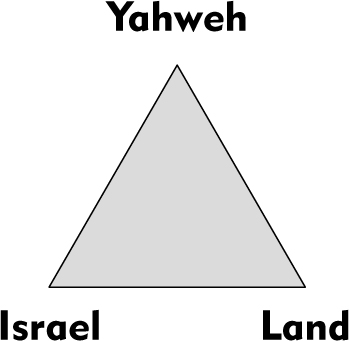
At Sinai Yahweh had formalized his covenant relationship with Israel. On the Plains of Moab Moses led this generation of Israelites in a covenant renewal ceremony by which their relationship with Yahweh was cemented prior to their entrance into the land. Once the Israelites had crossed the Jordan, their first order of business would be to bring the land into this relationship by means of a special ceremony at Mounts Gerizim and Ebal (27:1–26).
The relationships involving Yahweh, the people, and the land were perceived as dynamic relationships, which meant that the response of the land to Israel’s occupation would depend entirely on the people’s fidelity to Yahweh. If they will be faithful to him, the land will yield bountiful produce (7:11–16; 11:8–15; 28:1–14); but if they prove unfaithful and go after other gods, the land will stop yielding its bounty, and Yahweh will sever his ties with it (4:25–28; 8:17–20; 11:16–17; 28:15–26). However, although the nation’s infidelity seems inevitable, in the distant future, when the population would be removed from the land because of their sin, this would not represent a cancellation or repudiation of the covenant but the application of its fine print (cf. Dan. 9:4–16). Because of Yahweh’s immutable covenant commitment to Abraham and his descendants (4:31), he must and would bring Israel back to the land and to himself (30:1–10). Accordingly, the “new covenant” of which Jeremiah speaks in Jeremiah 31:31–34 and the eternal covenant of which Ezekiel writes in Ezekiel 16:60 (cf. Ezek. 34:25–31) anticipate the full realization of God’s original covenant made with Abraham, ratified and fleshed out at Horeb and renewed on the Plains of Moab, when the boundaries of physical and spiritual Israel would finally be coterminous.
(5) The book of Deuteronomy presents a remarkable approach to administration of the covenant community. From beginning to end, it is clear that Israel is a theocracy, with Yahweh as her divine suzerain (though the kingship of Yahweh receives scant explicit attention; cf. 33:5). The Torah provides for judicial officials appointed by the people (1:9–15; 16:18), and kings, priests, and prophets appointed and/or raised up by Yahweh (17:14–18:22). However, in seating responsibility for the administration of justice with the people, it envisions a covenant community under the authority of Torah and governed by “righteousness” (ṣedāqâ/ṣedeq).
Conclusion
FOR MODERN READERS PLAGUED by a negative view of the Old Testament in general and Old Testament law in particular, the book of Deuteronomy offers a healthy antidote. Through the work of Christ not only is Israel’s relationship made possible, but also the church, the new Israel of God, is grafted into God’s covenant promises. As with Israel, access to these promises remains by grace alone, through faith alone. However, having been chosen, redeemed, and granted covenant relationship, Yahweh’s people will gladly and without reservation demonstrate their allegiance to him wholeheartedly and with full-bodied obedience (Rom. 12:1–12).
For Christians today Deuteronomy remains an invaluable resource for a biblical understanding (1) of God, especially his grace in redeeming those bound in sin; (2) of the appropriate response to God, entailing love for God and for our fellow human beings; and (3) of the sure destiny of the redeemed. More than any other book in the Old Testament (if not the Bible as a whole), Deuteronomy concretizes the life of faith in real life. In the New Testament Jesus Christ, the incarnate God of Israel’s redemption, summarizes the spiritual, moral, and ethical pronouncements of Deuteronomy with the Supreme Command: to demonstrate covenant commitment to God with one’s entire being (love) and covenant commitment to one’s fellow human beings (Matt. 22:34–40). Christians who live by this “law of Christ” (Gal. 6:2) will have their feet firmly on the ground and will resist the temptation to retreat into interior and subjective understandings of the life of faith so common in Western Christianity.
Structure and Design
AS NOTED ABOVE, THE book of Deuteronomy is dominated by the speeches of Moses—speeches he delivered to his congregation on the Plains of Moab and then committed to writing. Some time later these addresses were assembled, and narrative frameworks were composed for each speech. The pattern of addresses and narrative frames may be illustrated generally as follows (the proportions are not exact).
Hearing the Words of Moses