On Reading Numbers
FLORENCE LITTAUER SAYS, “After a wedding, there’s a marriage.” That’s obvious, but it is also profound. After the romance and celebration of a new, permanently binding relationship, with its vows of mutual fidelity, there’s the rest of life. After “forsaking all others . . . to have and to hold . . . for better or for worse . . . in sickness and in health . . . until death do us part,” we find out what these words mean through the joys, sorrows, mistakes, and successes of faulty human beings living together in an imperfect and sometimes brutally challenging world.
So it was with Israel and God. After the wedding at Sinai, where God proclaimed the covenant vows (Ten Commandments) with awesome splendor, Israel said “I do,” and they built a house (sanctuary) together, there was a journey through the wilderness of real life. Whatever happened, they were in it together. The vows he had given were not only for Israel to keep; they were his vows too. When he had said, “You shall have no other gods before me” (Ex. 20:3)—the equivalent of “forsaking all others”—he not only forbade polytheism, but he also pledged himself to be Israel’s God.
What happened after that was profoundly disturbing. While the divine Groom lavished care on his bride, bringing her breakfast in bed (manna), protecting her from danger (e.g., poisonous snakes in the Sinai peninsula), and literally hovering over her (in the Shekinah cloud), she grumbled about the food, blamed his appointed representative (Moses) when anything went wrong, and kept saying she would rather return to the abusive home she had left (Egypt) to find a different husband. Is it any wonder that Israel’s new Husband was nonplussed?
Now the book of Numbers makes more sense. As the fourth book of the Torah/Pentateuch, it is like the second book (Exodus) in recounting a journey of the Israelites. Numbers picks up the travel story where Exodus leaves off, moving from the Sinai Desert to the steppes of Moab by the Jordan River at the eastern border of Canaan. Between Exodus and Numbers is Leviticus, the legislation of which continues the “wedding” begun in the latter part of Exodus.1 If that sounds like a long wedding, we are reminded of the fact that the Groom was a deity and the Bride was a human nation.
The fact that the covenant “wedding” comes after the journey of Exodus and before its continuation in Numbers explains an important difference between these two books. In Exodus, God does not punish the Israelites for faithless complaining with regard to food and other problems (Ex. 16–17), but in Numbers he does because they have now committed themselves to faithfully following him.2
H. H. Guthrie points out the effectiveness of doing theology, as Numbers does, by telling God’s story:
. . . since Yahweh was the living God and not the symbol of some abstract truth, theology had to be done by recounting the course of events in which Yahweh had been involved and not by producing abstractions of which Yahweh was symbolic. The process was analogous to the way in which, in order finally to convey the reality of who a living someone is, we have to tell that person’s story and not engage in racial or sexual or social or psychological or statistical abstractions.3
Thus far we have found that our modern experience, in this case marriage, sheds light on the relational dynamics running through the biblical story. What makes the book of Numbers part of Scripture is the fact that its story turns around and illuminates our story.
Because the story is open-ended and because a member of the community of faith in any period may identify his or her own time with the new generation which arises in the second half of Numbers, the story is designed to make a claim upon the reader. The reader is asked to include himself or herself as a participant in the promise and challenge of this new generation of God’s people.4
If we believe in the God of Abraham, Isaac, and Israel, we can learn about him and how to interact with him not only from what he said at his “wedding,” but also from the way he has dealt with other faulty people like us. If we have entered into a covenant with him, we are in the same position as the Israelites were during the book of Numbers. The divine party to the covenant is the same.
Everything that happened in the small area of Canaan or Israel over a wide expanse of time, almost two thousand years, is being relived now somewhere across the wide geographical expanse of planet earth in each small moment of our existence. Old Testament time was expansive (2,000 years) and its space minuscule (only 6,000 square miles of land); in the mission of biblical religion today time is minuscule (each moment), and space is as expansive as the earth. Somewhere today a family, tribe, or country is reliving the secular culture and religious response of each age and person in the Bible.5
Do you have struggles of faith as you seek to survive, and your “daily bread” isn’t always obvious? Do you have difficulty leading those whom God has entrusted to your care or following those whom he has chosen to coordinate your efforts with those of others? Are you tempted to balk at “giant” obstacles that stand between you and the destiny to which God is calling you? Then the book of Numbers is the right place to be.
It is unfortunate that, after the glorious “wedding,” God’s “marriage” with Israel was not “happily ever after.” We would hardly regard a marriage in which the wife repeatedly rebelled and threatened to stone the husband’s representatives, and in which the husband disciplined his wife with fire, plagues, a bottomless pit, and venomous vipers (Num. 11; 16; 21), as happy. This makes for some of the most dramatic and gut-wrenching reading in the Bible. Were the Israelites right that life under Pharaoh was the lesser of two evils?
The point is that God provided the only way for Israel to survive as a nation. Egypt would have ultimately destroyed their identity, they could not penetrate Canaan by themselves, and there was not enough food and water in the desert. It was either trust and follow God or be annihilated. With those kinds of stakes, it is not so surprising that God strongly enforced the covenant and made what should have been a trip of a few weeks into a forty-year journey of biblical proportions. Many died, but not without repeated warnings of increasing severity. By rebelling against God, they had chosen the fate that would have met the entire nation if he allowed it to wander from the oasis of his grace.
It is humbling to admit that we are ultimately as dependent on God as the Israelites were and that we have some of the same faults. It is also sobering to realize that there is only one road to eternal survival.
Numbers has what appears to be a bipolar personality. It presents extremes of divine glory and community harmony with God on the one hand, and rebellion and retributive justice on the other. These contrasts emphasize the choice between the way of life and the way of death, almost to the point of overkill.
It is amazing that the omnipotent deity allows faulty people to have any choice at all. Obviously our faculty of choice and wise exercise of it are high priorities to him. “Personhood is formed through making decisions. We learn to think and weigh options, we discover what we truly value, we take responsibility for our choices. God wants us to be people, not robots, and that means we must make decisions.”6 This explains why covenant “marriages” between God and human beings are so messy: He allows us to grow by making our own decisions and enjoying or suffering the consequences.
When the situation in Numbers gravitates to the drastically negative side, the book becomes downright depressing. If we step back from the story and reflect on its relationship to our own adventure, the ironic truth dawns: By showing how God not only could, but did bring his people out of desperate situations and took them to their promised home, the Bible encourages us that he can handle any crises we will ever face. So the more depressing the biblical story, the more powerful its hope for our modern story—provided we stand with Moses, Aaron, Caleb, and Joshua rather than Korah, Dathan, and Abiram.
Numbers is for real people with problems, who live in the real world. It is not for sanitized life in a vacuum, which some talk about, but which we do not experience because it doesn’t really exist.
Modern churches tend to feature testimonies of spiritual successes, never failures, which only makes the strugglers in the pew feel worse. . . . Yet delve a bit deeper into church history and you will find a different story of those who strain to swim upstream like spawning salmon.7
The encouragement of Numbers reminds me of a boat that my wife and I discovered in a small maritime museum in Haifa, Israel. The largest item on exhibit looked like an old ferry. As we went into it to look around, we noticed that its name was “— (ʾAf ʿAl Pi Še), which is modern Hebrew for “In Spite of the Fact That . . .” What a strange name! Then we learned that it had been used for the dangerous job of transporting refugees who were fleeing from Europe to Israel during the horrible 1930s and 1940s. In spite of the fact that there were all kinds of obstacles, the vessel took them safely to their new homeland. Yes! “Michael, row your boat ashore!”
AS WITH LEVITICUS and the other Pentateuchal books, Numbers is an anonymous work but is ascribed by tradition to Moses, who served as the intermediary between God and Israel within its narrative framework. The New Testament (including Jesus) accepts the idea that the entire Pentateuch is basically Mosaic (e.g., Luke 16:29; 24:27; John 1:17; 5:46; 2 Cor. 3:15). This does not rule out participation of others in the writing/editing process.8 For example, it has long been recognized that the affirmation of Moses’ unparalleled humility in Numbers 12:3 was likely penned by someone else.
In its final form, the book of Numbers shows evidence that it draws on a variety of materials, such as administrative lists, legal records, the story of Balaam (chs. 22–24), and written historical accounts, including the explicitly cited “Book of the Wars of the LORD” (21:14).9 Critical scholars have spent a great deal of energy attempting to isolate and date individual strands of authorship with varying perspectives, reconstructing the composition process by dissassembling the “sources” of Numbers and then reassembling them in chronological sequence.10 Even though they have often drawn conclusions that go beyond the surviving evidence, they have contributed to our understanding of the book by highlighting interdependence between Pentateuchal books and the remarkable diversity of literary genres and styles that have been combined to provide a rich portrayal of Israel’s life with God.11
The generic variety that characterizes Numbers surpasses that of any other book of the Bible. Note these examples: narrative (4:1–3), poetry (21:17–18), prophecy (24:3–9), victory song (21:27–30, pre-Israelite), prayer (12:13), blessing (6:24–26), lampoon (22:22–35), diplomatic letter (21:14–19), civil law (27:1–11), cultic law (15:17–21), oracular decision (15:32–36), census list (26:1–51), temple archive (7:10–88), itinerary (33:1–49).12
Structure and Themes of Numbers
NUMBERS IS NOT PRIMARILY about numbers. This name of the book, assigned by the Septuagint, reflects the prominence of census accounts (chs. 1 and 26) in its basic literary structure. However, the censuses were simply part of the overall organization in preparation for taking the Promised Land. The present Hebrew title is Bemidbar (“in the desert”), the fifth word of the first verse. This captures the setting of the whole book between Egypt and Canaan.13
These two titles already reflect important structural factors: censuses and geography. The second census (ch. 26), which counted the younger generation of Israelites after their rebellious parents died in the desert, established a new beginning. After decades of wandering, the nation was back to where it had been in chapter 1, except that it consisted of a different group of people.
Following the view of D. Olson that the census lists of chapters 1 and 26 form the basic unifying framework of Numbers, we can divide the book into chapters 1–25 and 26–36.14 Within the latter segment, chapters 27 and 36—both of which concern land inheritance by the daughters of Zelophehad—form a frame/inclusio that binds together the miscellaneous materials of the intervening chapters under the heading of preparation to occupy the Promised Land. Notice that chapters 26 and 27 are linked by the notices in 26:33 that Zelophehad had only daughters and “the land is to be allotted to them as an inheritance based on the number of names” (26:53).15
In addition to the two census lists, D. Olson has found an impressive series of other connections between chapters 1–25 and 26–36, which “strengthen the argument for a cohesive editorial construction of the book into two major parts that both echo and contrast with each other.”16
Numbers 1–25 The Old Generation of Rebellion | Numbers 26–36 The New Generation of Hope |
1—census of twelve tribes | 26—census of twelve tribes |
3—census of Levites | 26—census of Levites |
5—legal discourse involving women | 27—legal discourse involving women |
6—laws concerning vows | 30—laws concerning vows |
7, 15—lists and laws concerning offerings | 28, 29—lists and laws concerning offerings |
9—celebration of Passover | 28:16–25—instructions for future celebrations of Passover |
10:8–9—law concerning priests blowing trumpets to sound alarm for holy war | 31:6—priests blow trumpets to sound alarm for holy war against Midian |
13—list of spies from twelve tribes chosen to spy out the Promised Land | 34—list of tribal leaders from twelve tribes chosen to divide the Promised Land |
13–14—spy story and Israel’s rebellion that led to death of old generation | 32:6–15—spy story of Num. 13–14 recalled as lesson for new generation |
10–25—scattered geographical notations about places Israel journeyed in the desert | 33—summary of places Israel journeyed in the desert |
18:21–32—provisions for Levites | 35—provisions for Levitical cities |
21:21–35—victory over Kings Sihon and Og and capture of land east of Jordan | 32—assignment of land captured from Sihon and Og east of Jordan to Reuben, Gad, and Manasseh |
25—Midianites cause Israel to sin and God’s command to Israel to punish Midianites | 31—holy war against Midianites to punish them for what they did in ch. 25 |
The narrative progression of Numbers can be viewed as related to phases of geographical movement as the Israelites prepare to leave the Sinai Desert (1:1–10:10); journey from Sinai to Kadesh, where they are condemned to wander in the desert (10:11–19:22); start moving toward Canaan again from Kadesh at the end of forty years (20:1–25:18); and make preparations for occupying Canaan while they are encamped by the Jordan River (26:1–36:13). These phases form the major divisions in my detailed outline of the book (see below).17
Within chapters 1–21, preceding the Balaam story (chs. 22–24), apostasy at the Jordan (ch. 25), and the new beginning containing no more rebellion or apostasy (chs. 26–36), it is possible to discern an introverted structure centered at the legislation of chapter 15:
a Organization for conquest (chs. 1–10)
b Corpses at Kibroth-Hattaavah (“Graves of Craving”) (ch. 11)
c Moses’ leadership, prelude to rebellion (chs. 12–13)
d. Rebellion (ch. 14)
e Loyalty: inadvertent versus defiant sin (ch. 15)
d′ Rebellion (ch. 16)
c′ Aftermath of rebellion, Aaron’s leadership (chs. 17–18)
b′ Corpse contamination (ch. 19)
a′ Conquests (chs. 20–21)
Surrounded as chapter 15 is by extravagant illustrations of defiant/rebellious sin (see also 15:32–36), it is here in 15:22–31 that the Lord lays out the crucial contrast between inadvertent sin, which can be expiated by a purification offering (15:22–27), and defiant (“high-handed”) sin, for which there is no remedy (15:30–31). Strikingly, there is a close thematic relationship between this passage regarding loyalty to God and Leviticus 16. Here at one of the centers of Leviticus (see the introduction to Leviticus), special purification offerings purge the Israelite sanctuary and camp of evils that include inadvertent and rebellious sins, but those who committed the latter receive no benefit (see Bridging Contexts section of Lev. 16).
Notice that the introversion presented above18 provides one answer to a question that has long puzzled scholars: Since Leviticus 21 and 22 and Numbers 5, 6, and 9 already speak of corpse contamination, why wasn’t the ritual law of Numbers 19 regarding purification from this kind of bodily ritual impurity placed earlier? The answer is that putting this law where it is provides a structural counterpart to the narrative in chapter 11 regarding “Graves of Craving.”
As she does with Leviticus (see the introduction to Leviticus), Mary Douglas proposes that the book of Numbers is arranged in a ring composition pattern:19
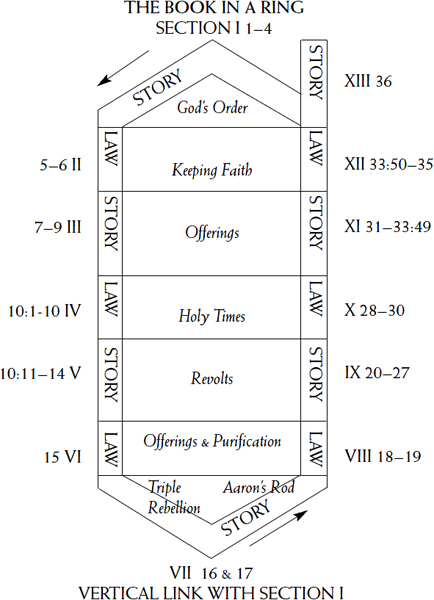
In her analysis, Douglas has highlighted the striking alternation between narrative and law that underlines the close relationship between these two elements in the persuasive rhetorical strategy of the book that develops its theme.20 Law and story reinforce and respond to each other in an ongoing process of elaboration and development. The result is an overpowering sense of accountability to God, whose way works best.
So why didn’t the Lord give all his laws at once and get it over with? Emily Dickinson explains why not:
Tell all the Truth but tell it slant—
Success in Circuit lies
Too bright for our infirm Delight
The Truth’s superb surprise
As Lightning to the Children eased
With explanation kind
The Truth must dazzle gradually
Or every man be blind—21