
Author: Moses
Audience: God’s chosen people, the Israelites
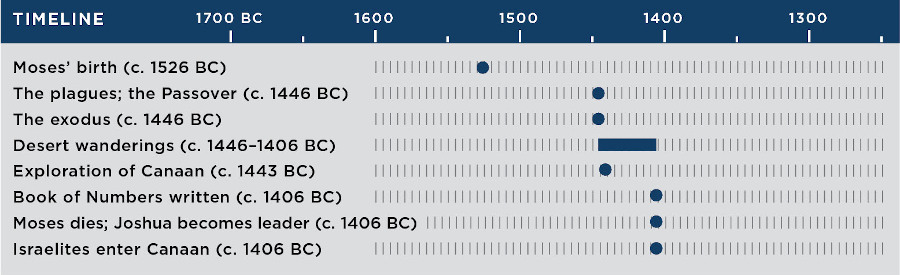
Date: Probably between 1446 and 1406 bc
Theme: God judges his rebellious people but reaffirms his intent to bring them into the promised land.
Introduction
Title
The English name of the book comes from the Septuagint (the pre-Christian Greek translation of the OT) and is based on the census lists found in chs. 1; 26. The Hebrew title of the book (bemidbar, “in the Desert,” 1:1) is more descriptive of its content. Numbers presents an account of the 38-year period of Israel’s wandering in the desert (or wilderness) following the establishment of the Sinaitic covenant (compare 1:1 with Dt 1:1).
Author and Date
The book has traditionally been ascribed to Moses. This conclusion is based on (1) statements concerning Moses’ writing activity (e.g., 33:1–2; Ex 17:14; 24:4; 34:27) and (2) the assumption that the first five books of the Bible, the Pentateuch, are a unit and come from one author. See Introduction to Genesis: Author and Date of Writing. It is not necessary, however, to claim that Numbers came from Moses’ hand complete and in final form. Portions of the book were probably added by scribes or editors from later periods of Israel’s history. For example, the mention of the humility of Moses (12:3) would hardly be convincing if it came from his own mouth. But it seems reasonable to assume that Moses wrote the essential contents of the book.
Contents
 Numbers relates the story of Israel’s journey from Mount Sinai to the plains of Moab on the border of Canaan. Much of its legislation for people and priests is similar to that in Exodus, Leviticus and Deuteronomy. The book tells of the murmuring and rebellion of God’s people and of their subsequent judgment. Those whom God had redeemed from slavery in Egypt and with whom he had made a covenant at Mount Sinai responded not with faith, gratitude and obedience but with unbelief, ingratitude and repeated acts of rebellion, which came to extreme expression in their refusal to undertake the conquest of Canaan (ch. 14). The community of the redeemed would not immediately possess the promised land. The Israelites were condemned to live out their lives in the wilderness; only their children would enjoy the fulfillment of the promise that had originally been theirs (cf. Heb 3:7—4:11 and note on 3:16–19).
Theological Teaching
The book of Numbers begins where the story of Exodus ends. Exodus recounts Israel’s deliverance from Egypt. The nation then entered into covenant with the Lord at Sinai to be the people of his kingdom, among whom he pitched his royal tent (the tabernacle; see photo of a “reconstruction” of that “tent”). As the account of Numbers begins, the Lord organizes the Israelites into a military camp. Leaving Sinai, they march forth as his conquering army, with the Lord at the head, to establish his kingdom in the promised land in the midst of the nations. The book graphically portrays Israel’s identity as the Lord’s redeemed covenant people and their vocation as the servant people of God, charged with establishing his kingdom on earth. God’s purpose in history is implicitly disclosed: to invade the arena of fallen humanity and effect the redemption of his creation—the mission in which his people are also to be totally engaged.
 Numbers also presents the chastening wrath of God against his disobedient people. Because of their rebellion (and especially the nation’s refusal to undertake the conquest of Canaan), Israel was in breach of the covenant. The fourth book of the Pentateuch presents a sobering reality: The God who had entered into a covenant relationship with Abraham (Ge 15; 17), who had delivered his people from bondage in the exodus (Ex 14–15), who had brought Israel into a covenant relationship with himself as his “treasured possession” (Ex 19; see especially Ex 19:5) and who had revealed his holiness and the gracious means of approaching him (Lev 1–7) was also a God who punished disobedience. His wrath against disobedience extended to his errant children, as well as to the enemy nations of Egypt and Canaan.
Even Moses, the great prophet and servant of the Lord, was not exempt from God’s wrath when he disobeyed God. Ch. 20, which records his error, begins with the notice of Miriam’s death (20:1) and concludes with the record of Aaron’s death (20:22–29). Here is the passing of the old guard. Those whom God has used to establish the nation are dying before the nation has come into its own.
The questions arise: Is God finished with the nation as a whole (cf. Ro 11:1)? Are his promises a thing of the past? In one of the most remarkable sections of the Bible—the account of Balaam, the pagan diviner (chs. 22–24)—the reply is given. The Lord, working in a providential and direct way, proclaims his continued faithfulness to his purpose for his people despite their unfaithfulness to him.
Balaam is Moab’s answer to Moses, the man of God. He is an internationally known prophet who shares the pagan belief that the God of Israel is like any other deity who might be manipulated by acts of magic or sorcery (see note on 22:5). But Balaam begins to learn that dealing with the true God is fundamentally different from anything he has ever known (ch. 22). When he attempts to curse Israel at the instigation of Balak, king of Moab, Balaam finds his mouth unable to express the curse he desires to pronounce. Instead, from his lips come blessings on Israel and curses on their enemies (chs. 23–24).
In his seven prophetic messages, Balaam proclaims God’s great blessing for his people (23:20). Though the immediate enjoyment of this blessing will always depend on the faithfulness of his people, the ultimate realization of God’s blessing is sure—because of the character of God (23:19). Thus Numbers reaffirms the ongoing purposes of God. Despite his judgment on his rebellious people, God is still determined to bring Israel into the land of promise. His blessing to Israel rests in his sovereign will. See note on Ro 9:1—11:36.
The teaching of the book has lasting significance for Israel and for the church (cf. Ro 15:4; 1Co 10:6,11). God rightly judges his errant people, but his grace is renewed as surely as is the dawn, and his redemptive purpose will not be thwarted.
The book of Numbers graphically portrays Israel’s identity as the Lord’s redeemed covenant people and their vocation as the servant people of God, charged with establishing his kingdom on earth.
Outline
I. Israel at Sinai, Preparing to Depart for the Promised Land (1:1—10:10)
A. The Commands for the First Census (chs. 1–4)
1. The numbers of men from each tribe gathered and equipped for war (ch. 1)
2. The placement of the tribes around the tabernacle and their order for march (ch. 2)
3. The placement of the Levites around the tabernacle, and the numbers of the Levites and the firstborn of Israel (ch. 3)
4. The numbers of the Levites in their tabernacle service to the Lord (ch. 4)
B. The Commands for Purity of the People (5:1—10:10)
1. The test for purity in the law of jealousy (ch. 5)
2. The Nazirite vow and the Aaronic benediction (ch. 6)
3. The offerings of the 12 leaders at the dedication of the tabernacle (ch. 7)
4. The setting up of the lamps and the separation of the Levites (ch. 8)
5. The observance of the Passover (9:1–14)
6. The covering cloud and the silver trumpets (9:15—10:10)
II. The Journey From Sinai to Kadesh (10:11—12:16)
A. The Beginning of the Journey (10:11–36)
B. The Beginning of the Sorrows: Fire and Quail (ch. 11)
C. The Opposition of Miriam and Aaron (ch. 12)
III. Israel at Kadesh, the Delay Resulting From Rebellion (13:1—20:13)
A. The 12 Spies and Their Mixed Report of the Good Land (ch. 13)
B. The People’s Rebellion Against God’s Commission, and Their Defeat (ch. 14)
C. A Collection of Laws on Offerings, the Sabbath and Tassels on Garments (ch. 15)
D. The Rebellion of Korah and His Allies (ch. 16)
E. The Budding of Aaron’s Staff: A Sign for Rebels (ch. 17)
F. Concerning Priests, Their Duties and Their Support (ch. 18)
G. The Red Heifer and the Cleansing Water (ch. 19)
H. The Sin of Moses (20:1–13)
IV. The Journey From Kadesh to the Plains of Moab (20:14—22:1)
A. The Resistance of Edom (20:14–21)
B. The Death of Aaron (20:22–29)
C. The Destruction of Arad (21:1–3)
D. The Bronze Snake (21:4–9)
E. The Song of the Well and the Journey to Moab (21:10–20)
F. The Defeat of Sihon and Og (21:21–35)
G. Israel Returns to Moab (22:1)
V. Anticipation of Taking the Promised Land (22:2—25:18)
A. Balak of Moab Hires Balaam to Curse Israel (22:2–41)
B. Balaam Blesses Israel in Seven Messages (chs. 23–24)
C. The Baal of Peor and Israel’s Apostasy (ch. 25)
VI. Preparation for the New Generation (chs. 26–36)
A. The Command for the Second Census (ch. 26)
B. The Inheritance for Women (27:1–11)
C. The Successor to Moses (27:12–23)
D. Commands Regarding Offerings (28:1–15)
E. Commands Regarding Festivals (28:16—29:40)
F. Commands Regarding Vows (ch. 30)
G. The War Against Midian (ch. 31)
H. The Settlement of the Transjordan Tribes (ch. 32)
I. Life in the Land (chs. 33–36)
1. The stages of the journey (ch. 33)
2. The land of inheritance (chs. 34–35)
3. The inheritance for women (ch. 36)

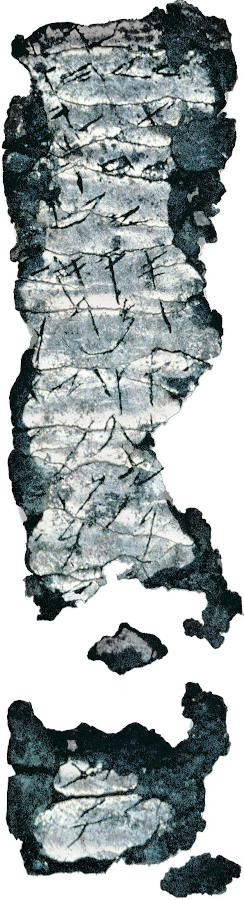
Fragments of a silver amulet from the 6th century bc found in Jerusalem containing the “Priestly (Aaronic) Benediction” from Nu 6:24–26.
Z. Radovan/www.BibleLandPictures.com
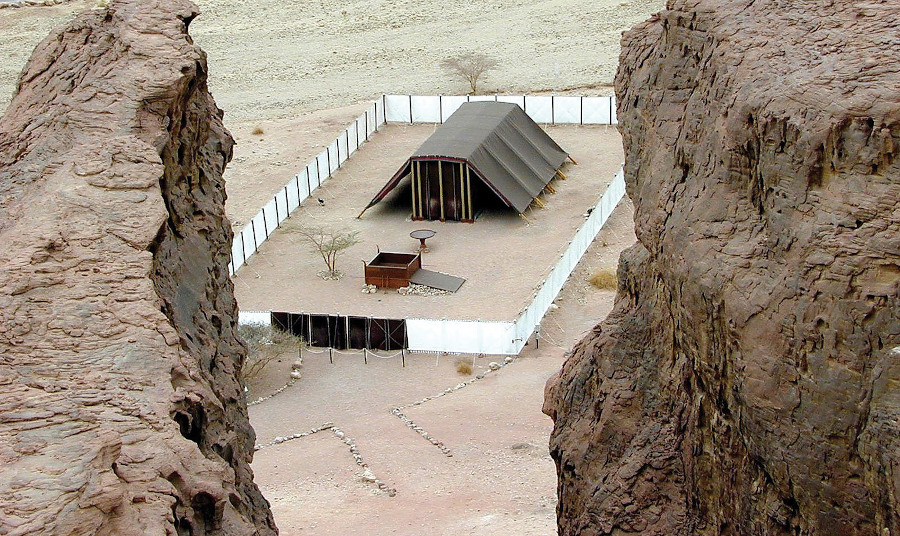
A view of a reconstruction of the tabernacle
Becky Weolongo Booto/BiblePlaces.com
Numbers in Numbers
The large numbers of men conscripted into Israel’s army (see, e.g., the figures in 1:46; 26:51) have puzzled many interpreters. The numbers of men gathered for warfare seem to demand a total population in excess of two million. Such figures appear to be exceedingly large for the times, for the locale, for the wilderness wanderings, and when compared with the inhabitants of Canaan (see note on 3:43).
Various possibilities have been suggested to address this issue. While some interpreters have thought that the numbers may have been corrupted in transmission, the present text betrays no textual difficulties with the numbers. Others have suggested that the Hebrew word for “thousand” might have a different meaning here from its usual numerical connotation. In some passages, e.g., the word is a technical term for a company of men that may or may not equal 1,000 (e.g., Jos 22:14, “family division”; 1Sa 23:23, “clans”). Further, some have postulated that this Hebrew word means “chief” (as in Ge 36:15). If so, the figure 53,400 (26:47) would mean “53 chiefs plus 400 men.” Such a procedure would yield a greatly reduced total, but it would be at variance with the fact that the Hebrew text adds the “thousands” in the same way it adds the “hundreds” for a large total. Also, this proposal would make the proportion of chiefs to fighting men top-heavy (59 chiefs for 300 men in Simeon).
Another option is to read the Hebrew word for “thousand” with a dual meaning of “chief” and “1,000,” with the chiefs numbering one less than the stated figure. For example, the 46,500 of Reuben (1:20) is read as 45 chiefs and 1,500 fighting men, the 59,300 of Simeon (1:23) is read as 58 chiefs and 1,300 fighting men, etc. But in this case, as in the former, the totals in 1:46 and 2:32 must then be regarded as errors of understanding (perhaps by later scribes).
Still another approach regards the numbers as symbolic figures rather than as strictly mathematical. The numerical value of the Hebrew letters in the expression bene yisra’el (“the whole Israelite community,” 1:2) equals 603 (the number of the thousands of the fighting men, 1:46). The remaining 550 (plus 1 for Moses) might come from the numerical equivalent of the Hebrew letters in the expression “all the men . . . who are . . . able to serve in the army” (1:3). This symbolic use of numbers (called “gematria”) is used elsewhere in the Bible (e.g., Mt 1:17; Rev 13:18), though it is less likely in Numbers, where there are few literary clues pointing in that direction. Finally, the large numbers could possibly be an example of hyperbole to emphasize God’s protection of Israel in the wilderness (see note on 1Ch 12:23–37).
While the problem of the large numbers has not been satisfactorily solved, the Bible does portray a remarkable increase of Jacob’s descendants during the four centuries of their sojourn in Egypt (Ex 1:7–12). With all their difficulties, these large numbers also would point to the great role of providence and miracles in God’s dealings with his people during their life in the wilderness (see note on 1:46).
Go to the Articles Index.