

Author: Unknown
Audience: The people of Judah who had returned from exile in Babylonia
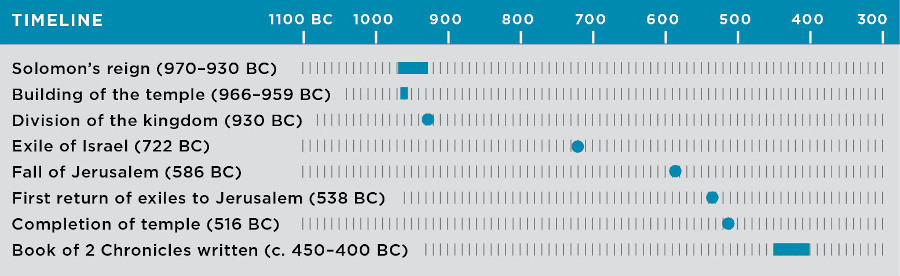
Date: Between 450 and 400 bc
Theme: Chronicles encourages post-exilic Israel with an account focusing on God’s promises to faithful Davidic kings (especially David and Solomon), ensuring Israel’s future.
Introduction
See Introduction to 1 Chronicles.
The Building of the Temple in 2 Chronicles
The Chronicler has used the Pentateuchal history as a model for his account of the reigns of David and Solomon. Similarly, the Pentateuchal record of the building of the tabernacle affects his account of the building of the temple:
(1) The building of the tabernacle was entrusted to Bezalel and Oholiab (Ex 35:30—36:7), and they provide the Chronicler’s model for the relationship of Solomon and Huram-Abi (2Ch 2:13). It is significant that the only references to Bezalel outside the book of Exodus are in Chronicles (1Ch 2:20; 2Ch 1:5).
There are many parallels between Solomon and Bezalel: (a) Both Solomon and Bezalel are designated by name for their tasks by God; they are the only workers on their projects to be chosen by name (Ex 31:2; 35:30—36:2; 38:22–23; 1Ch 28:6). (b) Both are from the tribe of Judah (Ex 31:2; 35:30; 1Ch 2:20; 3:10). (c) Both receive the Spirit to endow them with wisdom (Ex 31:3; 35:30–31; 2Ch 1:1–13), and Solomon’s vision at Gibeon (2Ch 1:3–13) dominates the preface to the account of the temple construction (2Ch 2–7). (d) Both build a bronze altar for the sanctuary (2Ch 1:5; 4:1; 7:7)—significantly, the bronze altar is not mentioned in the summary list of Huram-Abi’s work (4:12–16). (e) Both make the sanctuary furnishings (Ex 31:1–10; 37:10–29; 2Ch 4:19–22).
Similarly, there are parallels between Huram-Abi and Oholiab: (a) In the account of the temple building in Kings, Huram-Abi is not mentioned until after the story of the main construction of temple and palace has been told (1Ki 7:13–45); in Chronicles he is introduced as being involved in the building work from the beginning (2Ch 2:13), just as Oholiab worked on the tabernacle from the beginning (Ex 31:6). (b) Kings speaks only of Huram-Abi’s skill in casting bronze (1Ki 7:14); in Chronicles, however, his list of skills is the same as Oholiab’s (Ex 31:1–6; 35:30—36:2; 38:22–23; 2Ch 2:14). (c) Kings reports that the mother of Huram-Abi was a widow from the tribe of Naphtali (1Ki 7:14); Chronicles, however, states that she was a widow from the tribe of Dan (2Ch 2:14), thus giving Huram-Abi the same ancestry as Oholiab (Ex 31:6; 35:34; 38:23). (See note on 2Ch 2:13 for possible explanations for this difference.)
(2) The plans for both tabernacle and temple are given by God (Ex 25:1—30:37; see Ex 25:9, 40; 27:8; see also 1Ch 28:11–19—not mentioned in Samuel and Kings).
(3) The spoils of war are used as building materials for both tabernacle and temple (Ex 3:21–22; 12:35–36; see 1Ch 18:6–11—not mentioned in Samuel and Kings).
(4) The people contribute willingly and generously for both structures (Ex 25:1–7; 36:3–7; see 1Ch 29:1–9—not mentioned in Samuel and Kings).
(5) The cloud of God’s glory appears at the dedication of both structures (Ex 40:34–35; 2Ch 7:1–3).
Below is an outline of 2 Chronicles as a continuation of 1 Chronicles. For a complete outline of both 1,2 Chronicles, see Introduction to 1 Chronicles: Outline.
Outline
III. The Reign of Solomon (2Ch 1–9)
A. The Gift of Wisdom (ch. 1)
B. Building the Temple (2:1—5:1)
1. Preparations (ch. 2)
2. Description of the building structure (ch. 3)
3. Description of the temple furnishings (4:1—5:1)
C. Dedication of the Temple (5:2—7:22)
1. The procession of the ark to the temple (5:2–14)
2. The importance of building the temple (6:1–11)
3. Solomon’s prayer of dedication (6:12–42)
4. The temple’s dedication (7:1–10)
5. God’s promise and warning to Solomon (7:11–22)
D. Solomon’s Other Activities (ch. 8)
E. Solomon’s Wisdom, Splendor and Death (ch. 9)
IV. The Schism, and the History of the Kings of Judah (2Ch 10–36)
A. Rehoboam (chs. 10–12)
1. Israel’s rejection of his kingship (ch. 10)
2. His reign established (ch. 11)
3. Shishak’s invasion and Rehoboam’s humbling (ch. 12)
B. Abijah (13:1—14:1)
C. Asa (14:2—16:14)
1. His early reign (ch. 14)
2. His reform (ch. 15)
3. His later reign (ch. 15)
D. Jehoshaphat (17:1—21:3)
1. Early reign and obedience (ch. 17)
2. Collusion with Israel (ch. 18)
3. Reformation in response to prophetic warning (ch. 19)
4. Victory over Moab and Ammon (20:1–30)
5. Summary of Jehoshaphat’s reign (20:31—21:3)
E. Jehoram (21:4–20)
F. Ahaziah (22:1–9)
G. Joash (22:10—24:27)
1. The coup to bring Joash to the throne (chs. 22–23)
2. His repairing of the temple (24:1–16)
3. His abandonment of the temple (24:17–27)
H. Amaziah (ch. 25)
I. Uzziah (ch. 26)
J. Jotham (ch. 27)
K. Ahaz (ch. 28)
L. Hezekiah (chs. 29–32)
1. His restoration of the temple (ch. 29)
2. His celebration of Passover (30:1—31:1)
3. Continued temple reform (31:2–21)
4. Deliverance from enemies and from illness (ch. 32)
M. Manasseh (33:1–20)
N. Amon (33:21–25)
O. Josiah (34:1—36:1)
1. His reforms (34:1–13)
2. The discovery of the book of the law in the temple (34:14–33)
3. His celebration of Passover (35:1–19)
4. His death (35:20–26)
P. Josiah’s Successors (36:2–14)
Q. Exile and Restoration (36:15–23)

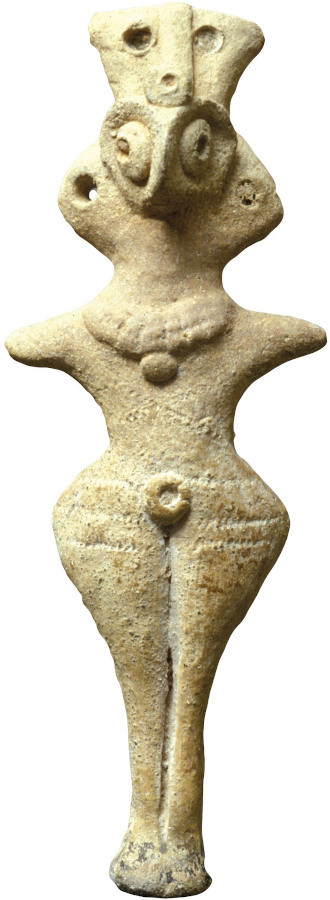
Clay figurine of Asherah (10th–7th c. bc), a Canaanite goddess. King Asa of Judah commanded that such figurines, as well as foreign altars, high places, and sacred stones be destroyed (2Ch 14:3–5).
Z. Radovan/www.BibleLandPictures.com