40:18 iron. See note on 19:24.
40:19 first among the works of God. Similar Hebrew wording is used for the creation of wisdom in Pr 8:22 (see note there). Here the descriptive phrase stresses the importance of Behemoth as an example of a huge animal under the control of a sovereign God.
40:21–23 reeds in the marsh . . . poplars . . . Jordan. The area described is probably the Huleh region, north of the Sea of Galilee.
40:24 The proposal to capture Behemoth forms a transition to the similar proposal concerning Leviathan in 41:1.
41:1–34 The second of two poems in the Lord’s final discourse (see note on 40:15–24).
41:1 Leviathan. See 3:8 and note. Its description in this chapter indicates that it is even more terrifying than Behemoth in ch. 40. Some think it is a crocodile (see article).
41:10 Leviathan is mighty, but God is infinitely more powerful.
41:11 Alluded to by Paul in Ro 11:35.
41:14–15 doors of its mouth . . . fearsome teeth . . . back has rows of shields. Similar to those of a crocodile.
41:18–21 Exaggerated poetic imagery (hyperbole).
41:27 Iron. See note on 19:24.
41:30 jagged potsherds. Broken pottery fragments.
41:34 king over all that are proud. The Lord alone can humble such creatures. Job cannot be expected to do so, though God challenges him to attempt it—if he so desires (see 40:11–12 and note).
42:1–6 Job’s last words are his response to the Lord’s second discourse.
 42:2 Job finally sees that God and his purposes are supreme.
42:3 You asked. Job quotes the Lord’s words in 38:2.
42:4 You said. Job quotes the Lord’s words in 38:3; 40:7.
42:5 Job—and his three friends and Elihu—had only heard about God, but now Job has seen God (Isa 6:5) with the eyes of faith and spiritual understanding. He can therefore accept God’s ways with him (v. 2)—which include suffering. my eyes have seen you. A down payment on the hope expressed in 19:26 (see note there).
 42:6 I despise myself. See note on 9:21. To his humility (40:4–5) Job adds repentance for the presumptuous words he had spoken to God. dust and ashes. See 30:19 and note.
42:7–9 Despite Job’s mistakes in word and attitude while he suffered, he is now commended and the counselors are rebuked. Why? Because even in his rage, even when he challenged God, he was determined to speak honestly before him. Also, based on his limited knowledge, oblivious to the conversations between God and Satan that spawned all his suffering, Job did speak truthfully about God. His suffering was not commensurate with his sin. Moreover, he never cursed God, as Satan said he would (see 1:11 and note). The counselors, on the other hand, mouthed many correct theological statements, but without a living knowledge of the God they claimed to honor. Job spoke to God; they only spoke about God. Even worse, their spiritual arrogance caused them to claim knowledge they did not possess. They presumed to know why Job was suffering.
42:7–8 my servant Job. The phrase is used four times in these two verses (see note on 1:8).
42:10 Job’s prayer for those who had abused him is a touching OT illustration of the stellar NT virtue our Lord taught in Mt 5:44 (see note on Ps 35:13–14). Job’s prayer marked the turning point back to prosperity for him. restored his fortunes. See Ps 14:7.
42:11 Contrast this with 16:2, where Job refers to his friends as “miserable comforters,” and 19:13–19, where his family members shun him. piece of silver. The Hebrew for this phrase (see NIV text note) is found elsewhere in the OT only in Ge 33:19 (see note there); Jos 24:32. gold ring. See photo.

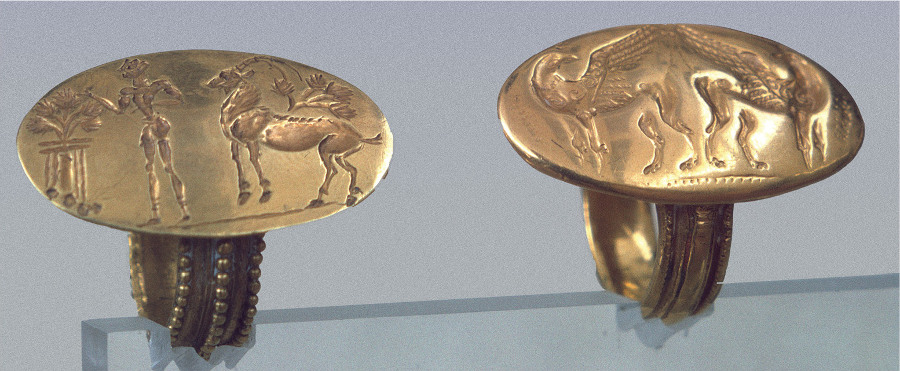
Two gold rings from Mycenae (1500 bc). After Job’s trials, God restored his wealth. “All his brothers and sisters and everyone who had known him before came and ate with him in his house. They comforted and consoled him over all the trouble the LORD had brought on him, and each one gave him a piece of silver and a gold ring” (Job 42:11).
National Archaeological Museum, Athens, Greece/Bernard Cox/The Bridgeman Art Library
Return to the main text.
42:12–16 The cosmic contest with Satan, the accuser, is now over, and Job is restored. No longer is there a reason for Job to experience suffering—unless he was sinful and deserved it, which is not the case. God does not allow us to suffer for no reason, and even though the reason may be hidden in the mystery of his divine purpose (Isa 55:8–9)—never for us to know in this life—we must trust in him as the God who does only what is right (see Ge 18:25; Ps 119:121; Eze 18:5 and notes).
42:12 The number of animals is in each case twice as many (v. 10) as Job had owned before (see 1:3; see also photo).
42:13 seven sons and three daughters. To fill the void left by the children he had lost earlier (1:2,18–19).
42:14 It is striking in that patriarchal culture that only the names of the daughters are given. Jemimah. Means “dove.” Keziah. Means “cinnamon.” Keren-Happuch. Means “container of antimony,” a highly prized eyeshadow (see note on Jer 4:30).
42:15 granted them an inheritance along with their brothers. Job’s action was countercultural and highlights the equal value of both his daughters and sons from his perspective. This fits Job’s remarkably progressive appeals elsewhere for justice and equity (ch. 31). Cf. Zelophehad’s daughters (Nu 27:1–11; ch. 36; see notes there), though in that case there were no sons.
42:16 lived a hundred and forty years. The longevity of a true patriarch (see note on Ex 6:16). he saw . . . to the fourth generation. See Ge 50:23 and note.
42:17 an old man and full of years. See 5:26; Ge 25:8 and notes.