

Author: Habakkuk
Audience: The people of Judah, struggling to comprehend the ways of God
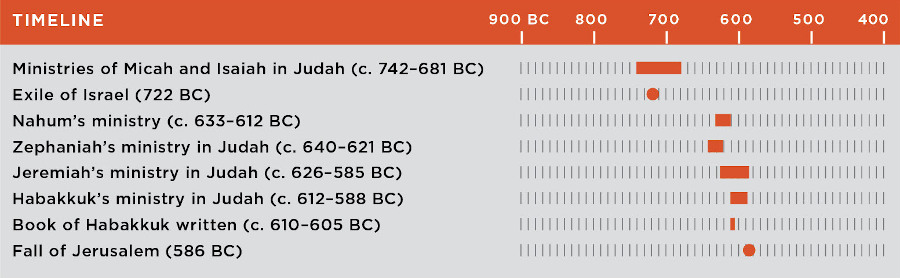
Date: About 605 bc
Theme: In response to Habakkuk’s questioning God, God shows Habakkuk that in the midst of the evil that exists within both Judah and their enemies, Habakkuk’s strength and joy are found in God alone.
Introduction
Author
 Little is known about Habakkuk except that he was a contemporary of Jeremiah and a man of vigorous faith rooted deeply in the religious traditions of Israel. The account of his ministering to the needs of Daniel in the lions’ den in the Apocryphal book Bel and the Dragon is legendary rather than historical.
Date
The prediction of the coming Babylonian invasion (1:6) indicates that Habakkuk lived in Judah toward the end of Josiah’s reign (640–609 bc) or at the beginning of Jehoiakim’s (609–598). The prophecy is generally dated a little before or after the battle of Carchemish (605), when Egyptian forces, which had earlier gone to the aid of the last Assyrian king, were routed by the Babylonians under Nabopolassar and Nebuchadnezzar and were pursued as far as the Egyptian border (Jer 46). Habakkuk, like Jeremiah, probably lived to see the initial fulfillment of his prophecy when Jerusalem was attacked by the Babylonians in 597.
Theological Message
Among the prophetic writings, Habakkuk is somewhat unique in that it includes no messages addressed to Israel. It contains, rather, a dialogue between the prophet and God (see Outline). (The book of Jonah, while narrative, presents an account of conflict between the Lord and one of his prophets.) In the first two chapters, Habakkuk argues with God over God’s ways, which appear to him unfathomable, if not unjust. Having received the divine replies, he responds with a beautiful confession of faith (ch. 3).
This account of wrestling with God is, however, not just a fragment from a private journal that has somehow entered the public domain. It was composed for Israel. No doubt it represented the voice of the godly in Judah, struggling to comprehend the ways of God. God’s answers therefore spoke to all who shared Habakkuk’s troubled doubts. And Habakkuk’s confession became a public expression—as indicated by its liturgical notations (see note on 3:1).
Habakkuk was perplexed that wickedness, strife and oppression were rampant in Judah but that God seemingly did nothing. When told that the Lord was preparing to do something about it through the “ruthless” Babylonians (1:6), his perplexity only intensified: How could God, who is “too pure to look on evil” (1:13), appoint such a nation “to execute judgment” (1:12) on a people “more righteous than themselves” (1:13)?
God makes it clear, however, that eventually the corrupt destroyer will itself be destroyed. In the end, Habakkuk learns to rest in God’s sovereign appointments and await his working in a spirit of worship. He learns to wait patiently in faith (2:3–4) for God’s kingdom to be expressed universally (2:14). See note on 3:18–19.
Literary Features
The author wrote clearly and with great feeling, and he penned many memorable phrases (2:2,4,14,20; 3:2,17–19). The book was popular during the intertestamental period; a complete commentary on its first two chapters has been found among the Dead Sea Scrolls (see article; see also photo).
Habakkuk was perplexed that wickedness, strife and oppression were rampant in Judah but that God seemingly did nothing. In the end, Habakkuk learns to rest in God’s sovereign appointments and await his working in a spirit of worship.
Outline
I. Title (1:1)
II. Habakkuk’s First Complaint: Why Does the Evil in Judah Go Unpunished? (1:2–4)
III. God’s Answer: The Babylonians Will Punish Judah (1:5–11)
IV. Habakkuk’s Second Complaint: How Can a Just God Use the Wicked Babylonians to Punish a People More Righteous Than Themselves? (1:12—2:1)
V. God’s Answer: Babylonia Will Also Be Punished, and Faith Will Be Rewarded (2:2–20)
VI. Habakkuk’s Prayer of Response (ch. 3)
A. Calling on God to Judge Wickedness and Show Mercy to His People (3:1–15)
B. Confessing Trust and Joy in God (3:16–19)

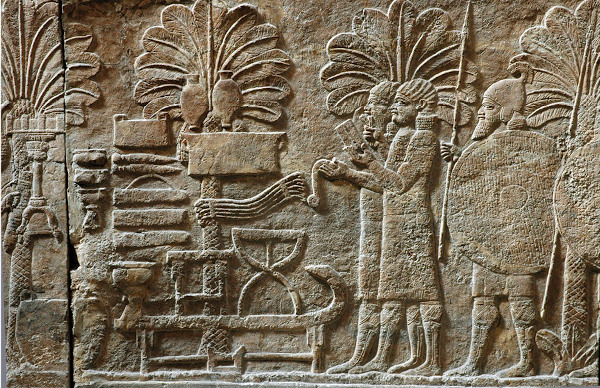
Assyrian officials recording the plunder taken from a conquered city. Habakkuk warns the Babylonian armies, which have plundered goods from the people of Judah, that the tables will soon turn (Hab 2:6–8).
Z. Radovan/www.BibleLandPictures.com