Study Notes
 1:1 Paul. See note on Ro 1:1. Silas. See note on Ac 15:22. He replaced Barnabas after Paul and Barnabas separated prior to Paul’s second missionary journey (Ac 15:39—18:22). Timothy. See Introduction to 1 Timothy: Recipient. He joined Paul and Silas in Lystra on Paul’s second missionary journey. Both he and Silas helped Paul found the Thessalonian church (Ac 17:1–14). in God the Father and the Lord Jesus Christ. Indicates the vital union and living relationship that Christians have with the Father and the Son (see Jn 14:23; 17:21; Eph 1:1 and note). The close connection between the Father and the Son points to the Trinitarian relationship (for the Spirit, see vv. 5–6; see also 3:11; 2Th 1:2, 8,12; 2:16; 3:5 and note on Mt 28:19). Lord Jesus Christ. Occurs also at the end of this letter (5:28). For the meanings of “Lord,” “Jesus” and “Christ,” see NIV text notes on Mt 1:1,21; see also notes on Lk 2:11; Ro 10:9; 1Co 12:3; Php 2:9–11. Grace and peace. See note on Ro 1:7.
1:2 thank. See note on Php 1:3–4.
 1:3 The triad of faith, hope and love is found often in the NT (5:8; Ro 5:2–5; 1Co 13:13; Gal 5:5–6; Col 1:4–5; Heb 6:10–12; 10:22–24; 1Pe 1:3–8,21–22). work produced by faith. Faith produces action (see Ro 1:5; 16:26; Gal 5:6 and note; 2Th 1:11; Jas 2:14–26 and note). labor prompted by love. See Heb 6:10. hope. Not unfounded wishful thinking but firm confidence in our Lord Jesus Christ and his return (v. 10). See Heb 6:18–20 and notes on Ro 5:5; Col 1:5.
1:4 know. The reasons for Paul’s conviction regarding their election are stated in vv. 5–10. brothers and sisters. United to each other through union with Christ (see NIV text note). This Greek for this phrase (including its singular form) is used 28 times in the two letters to the Thessalonians, the highest frequency in the NT. loved . . . chosen. These words together speak of God’s electing love (see Col 3:12 and note; 2Th 2:13; see also note on Eph 1:4).
1:5 our gospel. The gospel preached by Paul, Silas and Timothy (see Ro 16:25 and note). It is first of all God the Father’s (2:8), because he originated it, and Christ’s (3:2), because it springs from his atoning death. power. The power that delivered them from spiritual bondage. That power is from the Holy Spirit (Ro 15:13, 18–19; 1Co 2:4–5), but it also resides in the gospel itself (Ro 1:16). deep conviction. Such conviction, on the part of both the preachers and the Thessalonians, was also from the Holy Spirit.
1:6 imitators. The order in Christian imitation: (1) Believers in Macedonia and Achaia imitated the Thessalonians (v. 7), just as the Thessalonians imitated the churches in Judea (2:14); (2) the Thessalonians imitated Paul, just as the Corinthians did (1Co 4:6; 11:1) and just as all believers were to imitate their leaders (2Th 3:7, 9; 1Ti 4:12; Titus 2:7; 1Pe 5:3); (3) Paul imitated Christ (1Co 11:1), as did the Thessalonians (here); (4) all were to imitate God (Eph 5:1). severe suffering. Such as recorded in Ac 17:5–14 (see also 1Th 2:14).
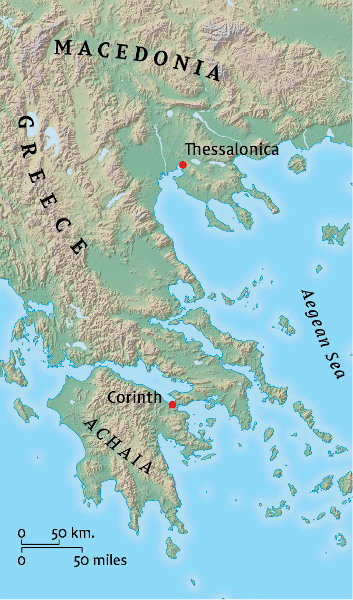
1:7 Macedonia and Achaia. The two Roman provinces into which Greece was then divided (see Ac 19:21; Ro 15:26; see also map). Macedonia. See note on Php 4:15.
1:8 everywhere. In every place they visited or knew about (see Ro 1:8 and note; 1Co 1:2; 2Co 2:14; 1Ti 2:8). The news spread because of Thessalonica’s strategic location (see Introduction: Thessalonica: The City and the Church).
1:9–10 Three marks of true conversion: (1) turning from idols, (2) serving God and (3) waiting for Christ to return. In his two short letters to the Thessalonians, Paul speaks much about the second coming of Christ (v. 10; 2:19; 3:13; 4:13—5:4; 2Th 1:7–10; 2:1–12).
1:10 wrath. See note on Ro 1:18. Some see a reference here to the final judgment (see 2:16; Ro 2:5 and notes), while others think it refers to a future period of persecution (described in Rev 6–18; see 1Th 5:9; Rev 6:16; and article).
2:1–12 A manual for ministers: (1) Their message is God’s good news (“gospel,” v. 2). (2) Their motive is not impurity (v. 3), pleasing people (v. 4), greed (v. 5) or seeking praise from people (v. 6), but pleasing God (v. 4). (3) Their manner is not one of trickery (v. 3), flattery (v. 5) or a cover-up (v. 5), but of courage (v. 2), gentleness (v. 7), love (vv. 8,11), toil (v. 9) and holiness (v. 10).
2:1 You know. The local church could refute the accusation of insincerity that evidently had been leveled against Paul (v. 3).

2:2 treated outrageously. This incident is described in Ac 16:19–40.
2:3 impure motives. See Php 1:15–18 and notes on 1:17–18. trick. The Greek for this word was originally used of bait for catching fish; it came to refer to any sort of cunning used for profit.
2:4 our hearts. Not simply our emotions, but also our intellects and wills (see note on Ps 4:7).
2:5 mask to cover up greed. Personal profit was never Paul’s aim (see Ac 20:33; 2Co 2:17 and note). Paul’s apparent defensiveness (vv. 3–5) very likely arose from personal attacks on his character that came from his opponents after he was forced to leave Thessalonica under persecution. Paul asserts that he acted with absolute integrity.
2:6 apostles. See note on Mk 6:30. our authority. Apostles were entitled to be supported by the church (1Co 9:3–14; 2Co 11:7–11). Paul did not always take advantage of the right but insisted that he had it.
2:7 as a nursing mother. Communicating the tenderness with which Paul cared for the Thessalonians. See v. 11, where Paul also applies the metaphor of a father to himself.
2:9 toil and hardship. Greeks despised manual labor and viewed it as fit only for slaves, but Paul was not ashamed of doing any sort of work that would help further the gospel. He did not want to be unduly dependent on others (2Th 3:8). In a culture of patronage and reciprocity, those who supported him financially might well give their donations “with strings attached.”
2:11 as a father. Communicating Paul’s giving of encouragement and guidance to the Thessalonians. See note on v. 7.
2:12 live lives worthy of God. See Eph 4:1. calls. See notes on 1:4; Ro 8:28. kingdom. The chief subject of Jesus’ teaching (see notes on Mt 3:2; Lk 4:43). Paul did not use this term often but could use it to sum up the message of his preaching (Ac 20:25; cf. Ac 28:31). glory. God’s splendor and majesty revealed to us fully at the consummation of his kingdom (see Mk 8:38; Ro 5:2; 8:18; cf. Eze 43:2 and note; 1Jn 3:2), though some of his glory is revealed to us fully now (e.g., in creation, Ro 1:20; in the old covenant: 2Co 3:10–11; in the gospel: 2Co 4:4).
2:13 not as a human word. Not tailored to fit the popular knowledge of the day.
2:14 imitators. See note on 1:6. You suffered from your own people. At the time of Paul’s initial visit to Thessalonica, persecution instigated by the Jews apparently was carried out by Gentiles (Ac 17:5–9). Jews. Although Paul had great love and deep concern for the salvation of those of his own people (Ro 9:1–3; 10:1), he did not fail to rebuke harshly Jews who persecuted the church.
2:15 who killed the Lord Jesus. Although Gentiles also bear the guilt for this heinous crime, here Paul focuses on Jewish involvement in his list of the efforts of certain Jews to oppose the gospel and its messengers. prophets. Throughout OT history, Israelites had persecuted their prophets (cf. Ac 7:52). drove us out. See Ac 9:23–25, 29–30; 13:50–51; 14:5–6,19; 17:10,13–14.
2:16 wrath of God has come. The eschatological wrath, the final outpouring of God’s anger upon sinful humanity (see 1:10 and note). It is spoken of as already present, either because it had been partially experienced by the Jews or because of its absolute certainty (but see NIV text note). Paul probably has either the crucifixion of Christ, the coming destruction of Jerusalem, or both in mind.
2:17 orphaned. Paul is like a young child (v. 7a), a mother (v. 7b), a father (v. 11) and now an orphan.
2:18 Satan blocked our way. Cf. Introduction to Job: Theme and Message; cf. also note on Eph 1:3.
2:19 crown. Not a royal crown, but a wreath used on festive occasions or as the prize in the Greek games (see 2Ti 4:8 and note; Jas 1:12; 1Pe 5:4; Rev 2:10 and note). when he comes. See 3:13; 4:15; 5:23; 2Th 2:1,8. The expression was used regarding the arrival of a great person, as on a royal visit.
2:20 you are our glory and joy. True both now (cf. Php 4:1) and when Christ returns.
3:1–2 Paul first went to Athens alone, then sent to Berea for Silas and Timothy (Ac 17:14–15). It is not clear whether Silas, as instructed (Ac 17:15), came to Athens with Timothy. However, when Timothy later returned from Thessalonica to Paul, who was now at Corinth, Silas came with him (Ac 18:5). See Introduction: Background of the Thessalonian Letters.
3:1 we. An editorial “we,” referring to Paul alone.
3:2 co-worker in God’s service. A striking way of viewing Christian service, found also in 1Co 3:9. gospel of Christ. See notes on 1:5; Mk 1:1. strengthen. In Greek classical literature the word was generally used in the literal sense of putting a buttress on a building. In the NT it is mainly used figuratively, as here.
3:3 trials. The opposition and persecution suffered by the Thessalonian converts. we are destined for them. Christians must expect troubles (see Mk 4:17; Jn 16:33; Ac 14:22; Php 1:29; 2Ti 3:12; cf. 1Pe 2:21 and note), but these are not disasters, for they advance God’s purposes (see Ac 11:19; Ro 5:3; 2Co 1:4; 4:17 and note).
3:5 I. Paul uses the Greek emphatic pronoun (elsewhere used only in 2:18) to bring out his deep concern. tempter. Satan is spoken of in every major division of the NT. He is supreme among evil spirits (Jn 12:31; 16:11; Eph 2:2). His activities can affect the physical (2Co 12:7) and the spiritual (see Mt 13:39; Mk 4:15; 2Co 4:4 and note). He tempted Jesus (Mt 4:1–11) and continues to tempt Jesus’ servants (Lk 22:3; 1Co 7:5). He hinders missionary work (2:18). But he has already been defeated (see Mt 12:29; Col 2:15 and note), and Christians need not be overwhelmed by him (Eph 6:16). His final overthrow is certain (Rev 20:10).
3:6 brought good news. The only place where the Greek for this phrase is used by Paul for anything other than the gospel. Three things gave him joy: (1) “your faith”—a right attitude toward God; (2) “your . . . love”—a right attitude toward others; (3) “you long to see us”—a right attitude toward Paul.
3:9 thank God. The preceding shows that Paul’s work of evangelism had been effective. He might have congratulated himself on work well done, but instead he thanked God for the joy he had from what God had done.
3:10 Night and day. Not prayer at two set times, but frequent prayer (1:2–3). what is lacking. Some of the things lacking were of a practical nature, such as moral (4:1–12) and disciplinary matters (5:12–24). Others were doctrinal, such as confusion over Christ’s return (4:13—5:11). your faith. The fifth time in the chapter that Paul speaks of their faith (vv. 2,5–7).
3:11 In the middle of a letter Paul frequently breaks into prayer (e.g., Eph 1:15–23; 3:14–21; Php 1:9–11; Col 1:9–12). For the link between Father and Son, see note on 1:1.
3:12 Lord. In Paul’s writings this usually means Jesus rather than the Father.
3:13 strengthen. See note on v. 2. holy. Set apart for God (see notes on Ex 3:5; Lev 11:44; Ro 6:22; Eph 1:1). Here it refers to the completed process of sanctification (see note on 1Co 1:2). holy ones. Used of the saints (Christians) in many NT passages (see note on Ro 1:7). Here it may mean the departed saints who will return with Jesus, the angels (Mk 8:38) or, most probably, both.
4:1 live. Or “walk.” Paul uses this metaphor often of the Christian way (see Ro 6:4; 2Co 5:7; Eph 4:1; 5:15; Col 1:10, “live a life”; 2:6; 4:5, “act”). It points to steady progress. we ask you and urge you. Paul is not arrogant, but he does speak with authority in the Lord Jesus. He has the “mind of Christ” (1Co 2:16).
4:2 instructions. Used of authoritative commands (“orders,” Ac 5:28; 16:24).
4:3 sanctified. See note on 3:13. sexual immorality. In the first century Greco-Roman world, moral standards were generally very low, and chastity was regarded as an unreasonable restriction. Paul, however, would not compromise God’s clear and demanding standards. The warning was needed, for Christians were not immune to the temptation (1Co 5:1).
4:5 like the pagans. See Ro 1:24–27. The Christian is to be different. who do not know God. See 2Th 1:8 and note; Gal 4:8; cf. Ps 79:6–7 and note.
4:6 wrong . . . a brother or sister. Sexual sin harms others besides those who engage in it. In adultery, e.g., the spouse is always wronged. Premarital sex wrongs the future partner by robbing him or her of the virginity that ought to be brought to marriage. The Lord will punish. A motive for chastity.
4:7 Another reason for chastity is God’s call to holiness (see Heb 12:14; 1Pe 1:6 and notes).
4:8 God who gives you his Holy Spirit. Still another reason for chastity is that sexual sin is against God (see Ge 39:9 and note), who gives the Holy Spirit to believers for their sanctification. To live in sexual immorality is to reject God, specifically in regard to the Holy Spirit (cf. 1Co 6:12–20 and notes).
4:9 love for one another. Translates philadelphia, a Greek word that outside the NT regularly denoted the mutual love of siblings. In the NT it always means love of fellow believers in Christ, all of whom have the same heavenly Father. taught by God. Cf. Isa 54:13; Jn 6:45; 1Co 2:13.
4:11 mind your own business. Some Thessalonians, probably because of idleness, were taking undue interest in other people’s affairs (see 2Th 3:11 and note). work with your hands. The Greek elites thought manual labor degrading and fit only for slaves. Christians took seriously the need for earning their own living, but some of the Thessalonians, perhaps as a result of their belief in the imminent return of Christ or because they were taking advantage of their patrons (2Th 3:11), were neglecting work and relying on others to support them.
4:12 not be dependent on anybody. Or “have need of nothing.” Both meanings are true and significant. Christians in need because of their idleness are not obedient Christians (cf. Titus 3:14).
 4:13 those who sleep in death. For the Christian, sleep is a particularly apt metaphor for death, since death’s finality and horror are removed by the assurance of resurrection. Some of the Thessalonians seem to have misunderstood Paul and thought all believers would live until Christ returns. When some died, the question arose, “Will those who have died take part in that great day?” See note on v. 15. who have no hope. Inscriptions on tombs and references in literature show that many first-century pagans viewed death with horror, as the end of everything. The Christian attitude was in strong contrast (1Co 15:55–57; Php 1:20–23).
4:14 died. Paul does not say that Christ “slept,” perhaps to underscore the fact that he bore the full horror of death so that those who believe in him would not have to. rose again. For the importance of the resurrection, see 1Co 15, especially vv. 14,17–22. those who have fallen asleep in him. Believers who have died trusting in Jesus.
4:15 According to the Lord’s word. The doctrine mentioned here is not explicitly recorded in the Gospels and was either a direct revelation to Paul, something Jesus said that Christians passed on orally, or a summary of Jesus’ teaching about the end times (Mt 24; Mk 13; Lk 21:5–36; Jn 14:1–3; cf. Jn 6:39–40). we who are still alive. Those believers who will be alive when Christ returns. “We” does not necessarily mean that Paul thought that he would be alive then. He often identified himself with those he wrote to or about. Elsewhere he says that God will raise “us” at that time (1Co 6:14; 2Co 4:14). will certainly not precede. The Thessalonians had evidently been concerned that those among them who had died would miss their place in the great events when the Lord comes, and Paul assures them this will not be the case.
4:16 the Lord himself. See Ac 1:11. with a loud command, with the voice of the archangel and with the trumpet call of God. The Lord’s return will be a public event that is not secret or silent. It cannot be ignored or overlooked. archangel. The only named archangel in the Bible is Michael (Jude 9; see Da 10:13). In Scripture, Gabriel is simply called an angel (Lk 1:19,26). will rise first. Before the ascension of believers mentioned in the next verse.
4:17 we who are still alive. See note on v. 15. caught up. This is the only place in the NT where believers’ meeting with Christ at his return is described. The event is often referred to as “the rapture” (from the Latin raptus, meaning “caught up”). Christians debate whether this meeting of believers and Christ will take place before, after or in the middle of a future period of tribulation (see article). in the clouds. Cf. Ac 1:9 and note. to meet. Or, more formally, “for a meeting with.” The Greek word for “meeting” was often used for a welcoming party that left the city gates to meet an arriving military, political dignitary or other special guest and escort them back to the city with celebration (cf. Mt 25:6, Ac 28:15). with the Lord. The chief hope of the believer (5:10; Jn 14:3; 2Co 5:8; Php 1:23; Col 3:4).
4:18 encourage one another. The primary purpose of vv. 13–18 is not to give a chronology of future events, though that is involved, but to urge mutual encouragement, as shown here and in v. 13.
5:1 times and dates. See Ac 1:6–7. There have always been some Christians who try to fix the date of our Lord’s return, but apparently the Thessalonians were not among them.
5:2 day of the Lord. See 1Co 5:5. The expression goes back to Am 5:18 (see note there). In the OT it is a time when God will come and intervene with judgment and/or blessing (see note on Joel 1:15). In the NT the thought of judgment continues (see Ro 2:5; 2Pe 2:9), but it is also the “day of redemption” (Eph 4:30); the “day of God” (2Pe 3:12) or of Christ (1Co 1:8; Php 1:6); and the “last day” (Jn 6:39), the “great Day” (Jude 6) or simply “the day” (2Th 1:10). It is the consummation of all things. There will be limited preliminary signs (e.g., 2Th 2:3), but the coming will be as unexpected as that of a thief in the night (cf. Mt 24:43–44; Lk 12:39–40; 2Pe 3:10; Rev 3:3; 16:15).
5:3 destruction. Not annihilation, but exclusion from the Lord’s presence (see 2Th 1:9 and note); thus the ruin of life and all its proud accomplishments. suddenly. Paul stresses the surprise of unbelievers. He uses a word found elsewhere in the NT only in Lk 21:34, also in the context of Christ’s return. labor pains. Here the idea is not the pain of childbirth so much as the suddenness and inevitability of such pains. not. An emphatic double negative in the Greek, a construction Paul uses only four times in all his writings.
5:4 darkness. Believers no longer live in darkness, nor are they of the darkness (v. 5). See Ac 26:18; 2Co 6:14; see also 1Jn 1:5–7 and notes. thief. See note on v. 2.
5:5 children of . . . children of. Echoes Hebrew idiom, in which to be the “children of” a quality meant to be characterized by that quality. Christians do not simply live in the light; they are characterized by light.
5:6 asleep. Unbelievers are spiritually insensitive, but this kind of sleep is not for “children of the light” (v. 5). be awake. In keeping with the emphasis Paul is placing on Christ’s coming (cf. Mt 24:42–43; 25:13; Mk 13:34–37). sober. A contrast with the conduct mentioned in v. 7.
5:8 the day. A reference to the light that characterizes Christians; perhaps it refers also to the coming of Christ (see v. 2 and note). breastplate . . . helmet. Paul also uses the metaphor of armor in Ro 13:12; 2Co 6:7; 10:4; Eph 6:13–17 (see notes on Eph 6:14,17). He does not consistently attach a particular virtue to each piece of armor; it is the general idea of equipment for battle that is pictured. For the triad of faith, hope and love, see 1:3 and note.
5:9 appoint. Believers can be encouraged (v. 11) by the fact that God himself has determined that they will “live together with him” (v. 10) forever. wrath. See note on 1:10. salvation. Our final, completed salvation.
5:10 are awake or asleep. That is, live or die; or, if the sense is moral, are alert or in a spiritual stupor (v. 6). with him. To be Christ’s is to have entered a relationship that nothing can destroy.
5:11 build . . . up. The verb can be applied to building houses, but Paul frequently used it for Christians being edified.
5:12 those who work hard among you. Not much is known about the organization and leadership of the church at this period, but the reference is possibly to elders (cf. Heb 13:7,17 and notes).
5:13 because of their work. Not merely because of personal attachment or respect for their high position, but in appreciation for their work. Live in peace. The words apply to Christian relationships in general, but here they probably refer especially to right relations between leaders and those under them (v. 12; cf. Ro 14:17,19).
5:14 those who are idle. Some Thessalonians may have been so sure the second coming was close that they had given up their jobs in order to prepare for it, or else they were unduly relying on the support of their patrons because they considered one another family in Christ. Paul insists that everyone must be willing to work (see 2Th 3:10–11 and notes). the disheartened . . . the weak. These are to be helped, not rejected, by the strong (cf. Ro 14:1–15; 1Co 8:13 and note).
5:15 pays back. Retaliation is never a Christian option (cf. Dt 32:35; Ro 12:17 and notes). Christians are called to forgive (see Mt 5:38–42; 18:21–35; Eph 4:32 and note).
5:17 For the practice of continual (or regular) prayer, see 1:3; 2:13; Ro 1:9–10; Eph 6:18; Col 1:3; 2Ti 1:3.
5:18 give thanks. See Eph 5:20 and note.
5:19 quench the Spirit. That is, attempt to discourage expressions of the gifts of the Spirit (especially prophecy, v. 20) in the church.
5:20 prophecies. For the gift of prophecy, see Ro 12:6; 1Co 12:10,28 and note on 12:10; 13:2; 14; Eph 4:11. For the function of prophecies, see 1Co 14:3.
5:21 test them all. The approval of prophecy (v. 20) does not mean that anyone who claims to speak in the name of the Lord is to be accepted without question. Paul does not say what specific tests are to be applied, but he is clear that every teaching must be tested. It must be instructive and encouraging for the church (cf. 1Co 14:29–33 and notes). It must also be in agreement with the teaching of the apostles (cf 1Jn 4:1–3 and notes).
5:23 God of peace. A fitting reference to God in view of vv. 12–15. But Paul often refers to God in this way near the end of his letters (see Ro 1:7 and note; 15:33; 16:20; 1Co 14:33; 2Co 13:11; Php 4:9; cf. 2Th 3:16). See also Heb 13:20–21. sanctify. See 1Co 1:2 and note. your whole spirit, soul and body. Paul emphasizes the whole person without attempting to differentiate various parts (see Heb 4:12 and note).
5:24 Paul’s confidence rests in the nature of God (cf. Ge 18:25 and note), who can be relied on to complete what he begins (see Nu 23:19; Php 1:6 and notes).
5:26 all. Paul sent a warm greeting to everyone, even those he had corrected. holy kiss. A kiss was a normal greeting of that day, similar to our modern handshake (see Ro 16:16; 1Co 16:20; 2Co 13:12 and notes; cf. “kiss of love,” 1Pe 5:14).
5:27 I charge you. Surprisingly strong language, meaning “I put you on oath”—used only here in the NT. Paul clearly wanted every member of the church to read or hear his letter and to know of his concern and advice for them.
5:28 Paul always ended his letters with a benediction of grace for his readers, sometimes adding other blessings, as in 2Co 13:14. grace. See note on Ro 1:7. Lord Jesus Christ. See note on 1:1. with you. See note on 2Co 13:14.