

Author: James, a leader of the Jerusalem church
Audience: Likely Syrian Jewish-Christian agricultural workers
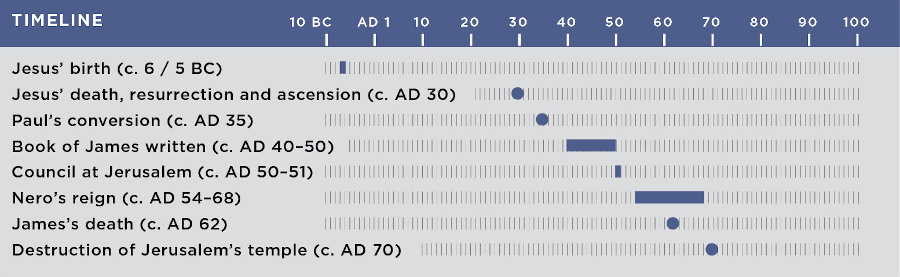
Date: Perhaps before ad 50 and certainly before ad 62
Theme: James emphasizes that God enables a life of faith that works itself out in action, especially with mercy for those most vulnerable.
Introduction
Author
 Some view the letter as pseudonymous, but the author identifies himself as James (1:1); he was probably the brother of Jesus and the leader of the Jerusalem council (Ac 15). Four men in the NT have this name. The author of this letter could not have been the apostle James, who died too early (ad 44) to have written it. The other two men named James had neither the stature nor the influence that the writer of this letter had.
James was one of several (half-)brothers of Jesus, probably the oldest since he heads the list in Mt 13:55. At first he did not believe in Jesus and even challenged him and misunderstood his mission (Jn 7:2–5). After Jesus’ resurrection, James became very prominent in the Jerusalem church:
(1) James was one of the select individuals Paul mentions by name to whom Christ appeared after his resurrection (see 1Co 15:7 and note).
(2) Paul called him a “pillar” of the church (Gal 2:9).
(3) Paul, on his first postconversion visit to Jerusalem, saw James (Gal 1:19).
(4) Paul did the same on his last visit (Ac 21:18).
(5) When Peter was rescued from prison, he told his friends to tell James, presumably because James was a key leader in the church (Ac 12:17).
(6) James was a leader in the important council of Jerusalem (Ac 15:13).
(7) So well-known was James that Jude could identify himself simply as “a brother of James” (Jude 1:1).
(8) James was martyred c. ad 62, an event recorded by the Jewish historian Josephus (Antiquities, 20.9.1).
Date
Those who find James pseudonymous usually date the letter to the ad 80s or 90s, but some suggest even a second-century date. If James, the Lord’s brother, wrote it, then it could come from a period just before his death, after the letters of Paul were well known and possibly misunderstood by some. This would lead to a date in the early 60s before the death of James in 62. There are indications, however, that it was written just prior to ad 50:
(1) Its distinctively Jewish nature suggests that it was composed when the church was still predominantly Jewish.
(2) It reflects a simple church order—officers of the church are called “elders” (5:14) and “teachers” (3:1).
(3) No reference is made to the controversy over Gentile circumcision or to Gentiles at all.
(4) The Greek term synagoge (“synagogue” or “meeting”) is used to designate the meeting or meeting place of the church (2:2).
(5) The language formally appears to be in tension with Paul, even though materially it is not. But it is less likely James would have phrased things as he does if Paul had begun writing his letters and James knew his theology (as in Gal 1:18–19).
If this early dating is correct, this letter is the earliest of all the NT writings—with the possible exception of Galatians (see Introduction to Galatians: Date and Destination).
Recipients
The recipients are identified explicitly only in 1:1: “the twelve tribes scattered among the nations.” Some hold that this expression refers to Christians in general, but the term “twelve tribes” would more naturally apply to Jewish Christians. Furthermore, a Jewish audience would be more in keeping with the obviously Jewish nature of the letter (e.g., the use of the Hebrew title for God, kyrios sabaoth, “Lord Almighty,” 5:4). That the recipients were Christians is clear from 2:1; 5:7–8. It has been plausibly suggested that these were believers from the early Jerusalem church who, after Stephen’s death, were scattered as far as Phoenicia, Cyprus and Syrian Antioch (see Ac 8:1; 11:19 and notes). This would account for James’s references to trials and oppression, his intimate knowledge of the readers and the authoritative nature of the letter. Alternatively, the trials are those described in 5:1–6 concerning the oppression of field workers. Anywhere in the eastern Mediterranean basin could have the autumn and spring rains (5:7), and a significant Jewish population lived in and around Syrian Antioch. In any case, as leader of the Jerusalem church, James wrote as pastor to instruct and encourage his dispersed people in the face of their difficulties (see article).
Theme
The central theme of James is “faith that works.” The letter is concerned primarily with practical matters related to the Christian’s way of life. How does faith work itself out in a Christian’s life? “Faith without deeds is dead,” James says (2:26). There is no such thing as true faith that does not express itself in a life of godliness, defined by James especially as acts of mercy for those most vulnerable; e.g., the poor, orphans and widows (1:27; 2:14–17). Key areas of focus include life’s trials and temptations, speech-ethics and wisdom, and money matters. Running like a unifying thread through all these topics is also the problem of human duplicity vs. God’s single-mindedness.
Distinctive Characteristics
Characteristics that make the letter distinctive are: (1) its unmistakably Jewish nature; (2) its emphasis on vital Christianity, characterized by good deeds and a faith that works (genuine faith must and will be accompanied by a consistent lifestyle); (3) repetition of key ideas in a way that makes it hard to outline; (4) its familiarity with Jesus’ teachings preserved in the Sermon on the Mount (compare 2:5 with Mt 5:3; 3:10–12 with Mt 7:15–20; 3:18 with Mt 5:9; 5:2–3 with Mt 6:19–20; 5:12 with Mt 5:33–37); (5) its similarity to OT wisdom writings such as Proverbs (see article); (6) its excellent Greek.
The central theme of James is “faith that works.” The letter is concerned primarily with practical matters related to the Christian’s way of life. How does faith work itself out in a Christian’s life?
Outline
I. Greetings (1:1)
II. Statement of Three Key Themes (1:2–11)
A. Trials in the Christian Life (1:2–4)
B. Wisdom (1:5–8)
C. Riches and Poverty (1:9–11)
III. Restatement of the Three Themes (1:12–27)
A. Trials / Temptations in Relation to God (1:12–18)
B. Wisdom in the Areas of Speech and Obedience (1:19–26)
C. The “Have-Nots” and the Responsibility of the “Haves” (1:27)
IV. The Three Themes Expanded (2:1—5:18)
A. Riches and Poverty (2:1–26)
1. Favoritism condemned (2:1–13)
2. The problem of faith without works (2:14–26)
B. Wisdom and Speech (3:1—4:12)
1. The power of the tongue (3:1–12)
2. Wisdom from above and wisdom from below (3:13–18)
3. The misuse of speech in quarrels and slander (4:1–12)
C. Trials and Temptations (4:13—5:18)
1. Planning apart from God’s will (4:13–17)
2. Responding to oppression (5:1–12)
3. Anointing prayer for serious illness (5:13–18)
V. Closing (5:19–20)

The General Letters
The seven letters following Hebrews—James; 1,2 Peter; 1,2,3 John; Jude—have often been designated as the General Letters (Hebrews is sometimes also identified within this category). This term “general” goes back to the early church historian Eusebius (c. ad 265–340), who in his Ecclesiastical History (2:23–25) first referred to these seven letters as the Catholic Letters, using the word “catholic” in the sense of “universal” or “general.”
The letters so designated may be said to be, for the most part, addressed to general audiences rather than to specific persons or localized groups. This is certainly true of James, written “to the twelve tribes scattered among the nations” (Jas 1:1), 1 Peter, written to believers scattered throughout five Roman provinces (1Pe 1:1), and 2 Peter and Jude, addressed to believers in general (2Pe 1:1; Jude 1). Yet the term does not apply as well to Hebrews or 1 John, which were written to specific groups of believers or house churches (1Jn 2:18–19; Heb 10:32–35; 13:23), 2 John, written to a specific church (2Jn 1), or 3 John, written to an individual (3Jn 1).
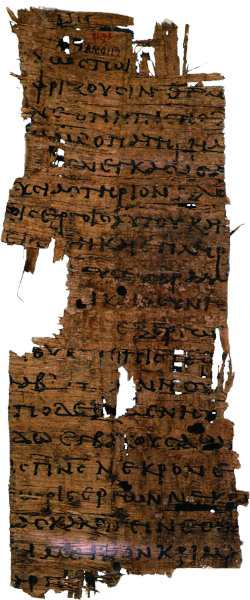
Recto side of P.Oxy. IX 1171. This earliest manuscript containing the letter of James dates to the 3rd century.
Princeton Papyri Collections (C0401); Manuscripts Division, Department of Rare Books and Special Collection, Princeton University Library
Go to the Articles Index.

Rough waves on the Sea of Galilee. “One who doubts is like a wave of the sea, blown and tossed by the wind” (Jas 1:6).
makarenko7/Shutterstock
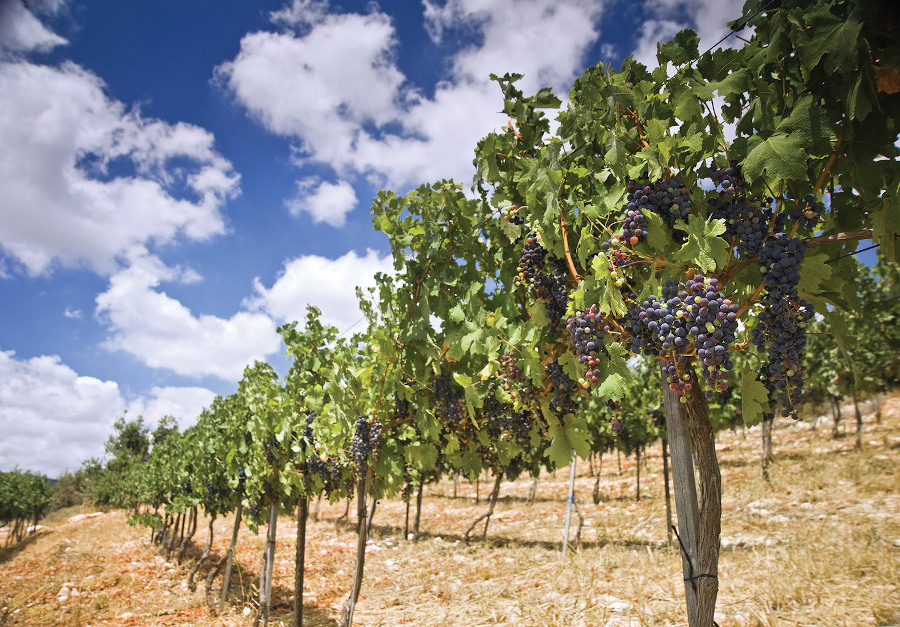
Vineyard in Galilee. James uses common images such as grapevines to illustrate spiritual truths (Jas 3:12).
© Noam Armonn/www.BigStockPhoto.com