

Author: The apostle Peter
Audience: Primarily Gentile believers in Pontus, Galatia, Cappadocia, western Asia Minor and Bithynia
Date: ad 60 to 64
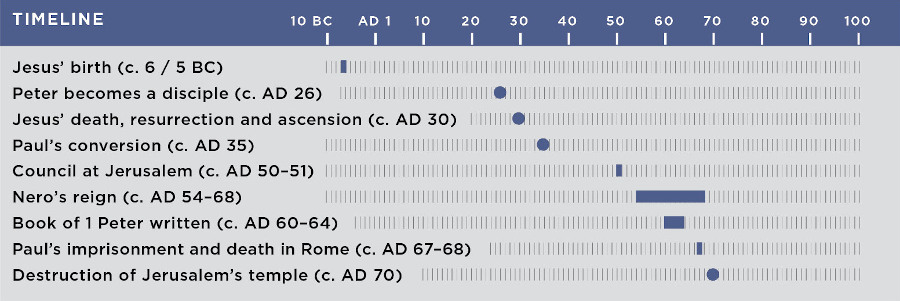
Theme: Peter gives God’s encouragement to those suffering persecution for their allegiance to Jesus to live exemplary lives within their culture.
Introduction
Author and Date
 The author identifies himself as the apostle Peter (1:1), and the contents and character of the letter support his authorship (see notes on 1:12; 4:13; 5:1–2,5,13). Moreover, the letter reflects the history and terminology of the Gospels and Acts (notably Peter’s speeches). Its themes and concepts reflect Peter’s experiences and his associations in the period of the Lord’s earthly ministry and in the apostolic age. That he was acquainted, e.g., with Paul and his letters is made clear in 2Pe 3:15–16 (see notes there); Gal 1:18; 2:1–21 and elsewhere. Coincidences in thought and expression with Paul’s writings are therefore not surprising.
From the beginning, 1 Peter was recognized as authoritative and as the work of the apostle Peter. The earliest reference to it may be 2Pe 3:1 (see note there), where Peter himself refers to a former letter he had written. 1 Clement (ad 95) seems to indicate acquaintance with 1 Peter. Polycarp, a disciple of the apostle John, makes use of 1 Peter in his letter to the Philippians. The author of the Gnostic Gospel of Truth (140–150) was acquainted with 1 Peter. Eusebius (fourth century) indicated that its authorship by Peter was universally received.
The letter was explicitly ascribed to Peter by that group of church fathers whose testimonies appear in the attestation of so many of the genuine NT writings, namely, Irenaeus (ad 140–203), Tertullian (150–222), Clement of Alexandria (155–215) and Origen (185–253). Peter’s authorship of the book has early and strong support.
Nevertheless, some claim that the idiomatic Greek of this letter is beyond Peter’s competence. But in his time Aramaic, Hebrew and Greek were used in the Holy Land, and he may well have been acquainted with more than one language. That he was not a professionally trained scribe (Ac 4:13) does not mean that he was unacquainted with Greek; in fact, as a Galilean fisherman he in all likelihood did use it. Even if he had not known it in the earliest days of the church, he may have acquired it as an important aid to his apostolic ministry in the decades that intervened between that time and the writing of 1 Peter.
It is true, however, that the Greek of 1 Peter is good, literary Greek, and even though Peter could no doubt speak Greek, as so many in the Mediterranean world could, it is unlikely that he would write such polished Greek. It is precisely at this point that Peter’s remark in 5:12 (see note there) concerning Silas may be significant. Here the apostle claims that he wrote “with the help of” Silas. This could mean that Silas was Peter’s secretary, or more likely that he was the letter carrier. In any event, a scribe could have accounted for the polished Greek style in 1 Peter. Silas or someone else could easily have played this role. Thus in 1 Peter it is possible that the Greek of Peter’s scribe may be seen, while in 2 Peter it may be Peter’s rough Greek that appears (see 2 Peter: Introduction: Author).
The book can be satisfactorily dated in the early 60s. It is unlikely to be before 60 because historians cannot confidently place Peter in Rome before then. It cannot be dated later than 67 / 68, since Peter was martyred during Nero’s reign. And the uncertainty about Christians suffering for doing good in 3:15 suggests that Nero’s pogrom in ad 64 had not yet begun.
Place of Writing
In 5:13 Peter indicates that he was “in Babylon” when he wrote 1 Peter. Although a number of other possibilities have been proposed (e.g., an Egyptian “Babylon,” which was then a Roman military post; a Mesopotamian Babylon, still occupied, but not by many Jews, according to Josephus; and Jerusalem, symbolically called “Babylon”), the long-held tradition that Peter was referring to Rome (cf. Rev 14:8; 17:9–10 and notes) is still the most likely, and most widely held, view (see map). As the heart of the prevailing empire in Peter’s day, Rome functioned as Babylon had at the height of its power in OT times.
Recipients
Although there is some debate on the question, most interpreters understand the audience of 1 Peter to be primarily Gentiles. Peter’s description of their former way of life as “empty” (1:18) and especially his reference to their past engagement in idolatry (along with activities commonly associated with pagan temples; 4:3–4) point in this direction.
Occasion
The letter itself makes it clear that its recipients are experiencing some kind of persecution. The internal clues paint a picture of people who have placed their allegiance in Jesus (3:15) and are being questioned and even slandered about their new way of life (2:12; 3:16). Unbelievers, some of them in the same households as these Christians (2:18; 3:1), are surprised and disturbed that these new believers no longer join in religious and social activities of pagan worship (4:3–4). This turning away from socially acceptable behavior would have been viewed as undermining civic life, so that the civic conduct of Christians is being questioned. This explains why Peter includes a traditional Greco-Roman household code in his letter (2:13—3:7; see article), even as he gives it a theological foundation (2:11–12; 3:8–12) and adapts it in distinctively Christian ways (see notes on 2:17, 18; 3:1,7). Peter’s exhortations to these beleaguered Christians focus on living as much as possible in line with cultural expectations (e.g., related to the household), while never compromising their loyalty to Jesus (3:15).
Themes
Many theological themes are woven throughout the letter, including hope (1:3,13,21; 3:5,15) and living as exiles and foreigners (1:1,17; 2:11), a motif clearly drawn from the Old Testament (e.g., Ps 39:12). The central theme, and one that the author repeatedly returns to, is the exhortation to stand firm in the faith in the face of suffering and persecution. Every chapter refers to suffering: 1:6–9; 2:19–25; 3:8–22; 4:1–2,12–19; 5:1,10. The ultimate example of righteous suffering is Christ himself (2:21–25; 3:18; 4:1,13; 5:1).
Peter summarizes his letter by indicating that he has written “encouraging you and testifying that this is the true grace of God” (5:12). The letter includes a series of exhortations to honorable, exemplary living that run from 1:13 to 5:11.
The central theme of 1 Peter, and one that the author repeatedly returns to, is the exhortation to stand firm in the faith in the face of suffering and persecution.
Outline
I. Greetings (1:1–2)
II. Praise to God for Salvation (1:3–12)
III. First Response to Suffering: Creating a Holy Community (1:13—2:10)
A. Call to Holiness and Love (1:13—2:3)
B. Creation of a Vibrant Community (2:4–10)
IV. Second Response to Suffering: Winsome Witness in Society (2:11—4:19)
A. Navigating Authorities in State and Household (2:11—3:12)
1. Introduction: identity as foreigners and exiles (2:11–12)
2. Submission of all to rulers (2:13–17)
3. Submission of slaves to masters (2:18–25)
4. Wives and husbands (3:1–7)
a. Submission of wives to husbands (3:1–6)
b. Warning to husbands to respect wives (3:7)
5. Conclusion: Seek good, not evil (3:8–12)
B. Suffering for Christ and as Christ Did (3:13—4:19)
1. Good conduct despite possible persecution (3:13–17)
2. Christ’s example of suffering and exaltation (3:18–22)
3. Distinctive living among unbelievers (4:1–6)
4. Exhortation summary: Love one another (4:7–11)
5. Doctrinal summary: Suffer for Christ (4:12–19)
V. Living Together in Christian Community (5:1–11)
A. Shepherding Role of Elders (5:1–5)
B. Exhortation for All to Be Humble and Alert (5:5–11)
VI. Final Greetings and Benediction (5:12–14)


1 Peter was written to the churches in Asia Minor (see 1:1), including Cappadocia, seen here. Cappadocia is known for these strange rock formations, into which local peoples carved subterranean towns, seeking shelter from the conquerors.
© Jaroslaw Grudzinski/www.BigStockPhoto.com
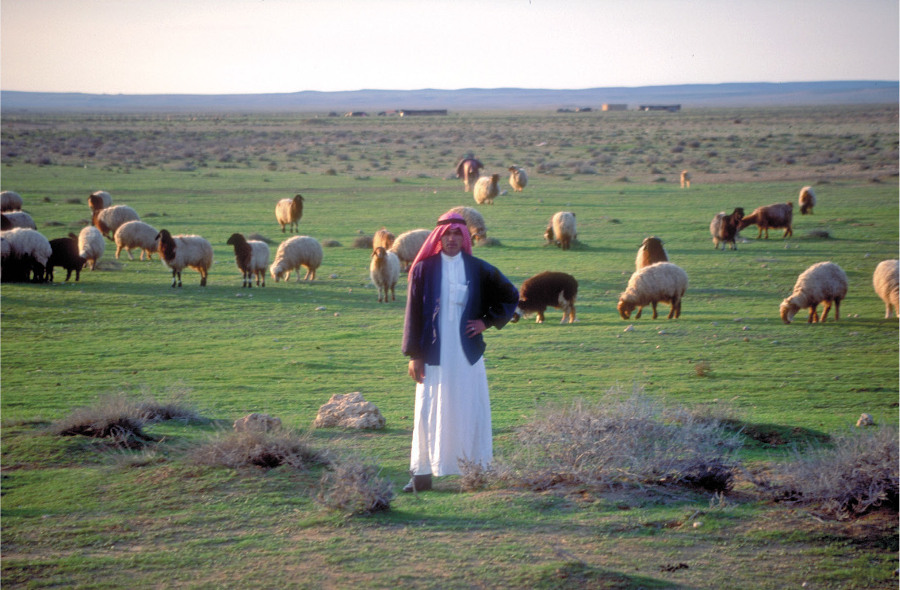
A modern Syrian shepherd with his sheep. Jesus is referred to as the “Chief Shepherd” in 1 Pe 5:4 (see note there).
© Phoenix Data Systems