Isaiah
1. Prophecies against Judah (1:1–12:6)
A. Judgment and Comfort: Part One (1:1–2:5)
B. Judgment and Comfort: Part Two (2:6–4:6)
E. Crisis in Perspective (7:1–8:22)
G. The Wrath of God (9:8–10:34)
H. The Branch from Jesse (11:1–16)
2. Oracles against the Nations (13:1–23:18)
E. Damascus and Israel (17:1–14)
H. Babylon, Edom, and Arabia (21:1–17)
3. The Apocalypse of Isaiah (24:1–27:13)
B. The Redemption of God’s People (25:1–26:6)
C. A Prayer for God’s People (26:7–21)
D. Deliverance of Israel (27:1–13)
4. Oracles of Woe (28:1–33:24)
C. Foreign Alliances (30:1–33)
D. Judgment and Hope (31:1–32:20)
E. Distress and Help (33:1–24)
5. Cataclysmic Judgment (34:1–17)
6. The Day of God’s Glory (35:1–10)
A. Challenge and Deliverance (36:1–37:38)
B. Hezekiah’s Illness (38:1–22)
C. Envoys from Babylon (39:1–8)
8. The Beginning of Restoration (40:1–48:22)
D. Yahweh’s Sovereignty (44:24–47:15)
E. Proclamation of Restoration (48:1–22)
9. Reconciliation and Restoration (49:1–55:13)
A. The Servant of the Lord (49:1–13)
C. Israel’s Restoration (49:22–26)
D. Sin and Obedience (50:1–11)
E. Everlasting Salvation (51:1–52:12)
F. The Suffering Servant (52:13–53:12)
10. The Glory and Responsibility of Zion (56:1–66:24)
A. Response to Redemption (56:1–8)
B. Unfaithful Leaders (56:9–57:2)
C. Unfaithful People (57:3–13a)
D. The Future of God’s People (57:13b–21)
G. The Glory of Zion (60:1–62:12)
H. The Day of Vengeance (63:1–6)
I. A Prayer for God’s People (63:7–64:12)
K. Judgment and Restoration (66:1–24)
Introduction
Isaiah the Prophet
Little is known about the prophet Isaiah other than that he loved Jerusalem, freely associated with Judah’s kings, was married, and had two children. The name Isaiah means “Yahweh is salvation.” His name and the names of his sons—Shear-Jashub (“a remnant will return”; see NIV note for 7:3) and Maher-Shalal-Hash-Baz (“quickly to the plunder, swift to the spoil”; see NIV note for 8:1)—were symbolic to the nation (8:18). These three names capture the essence of the book: (1) Yahweh is the source of salvation; (2) Yahweh will spare a remnant for himself; and (3) Yahweh’s judgment is certain to come.
The prophet’s relationship to the royal house of David has been a subject of speculation. The prophet moved easily into and out of the palace and had access to the king. He was respected by Ahaz and Hezekiah. Though this relationship does not prove that Isaiah was of royal lineage, it is clear that he held a respected position in the court. The tradition of Isaiah’s royal lineage cannot, however, be demonstrated. Isaiah was, nevertheless, very familiar with court protocol and life in Jerusalem. He was respected in the court of Jerusalem even when he criticized the ruling classes.
Isaiah’s father, Amoz, is not to be identified with the prophet Amos, who ministered a generation earlier in the northern kingdom. The spelling of these two names is different both in Hebrew and in English. Isaiah was a highly educated man who lived mainly in Jerusalem. He ministered to God’s people roughly from 742 to 700 BC in an era of great political tumult.
What little is known about Isaiah’s death is derived from extrabiblical sources. There are several traditions that, when taken together, strongly suggest Isaiah may have suffered martyrdom under Manasseh, who succeeded Hezekiah.
Isaiah was a “son of Jerusalem.” The book is full of Isaiah’s love and concern for the city. He believed the city was representative of the people as a whole.
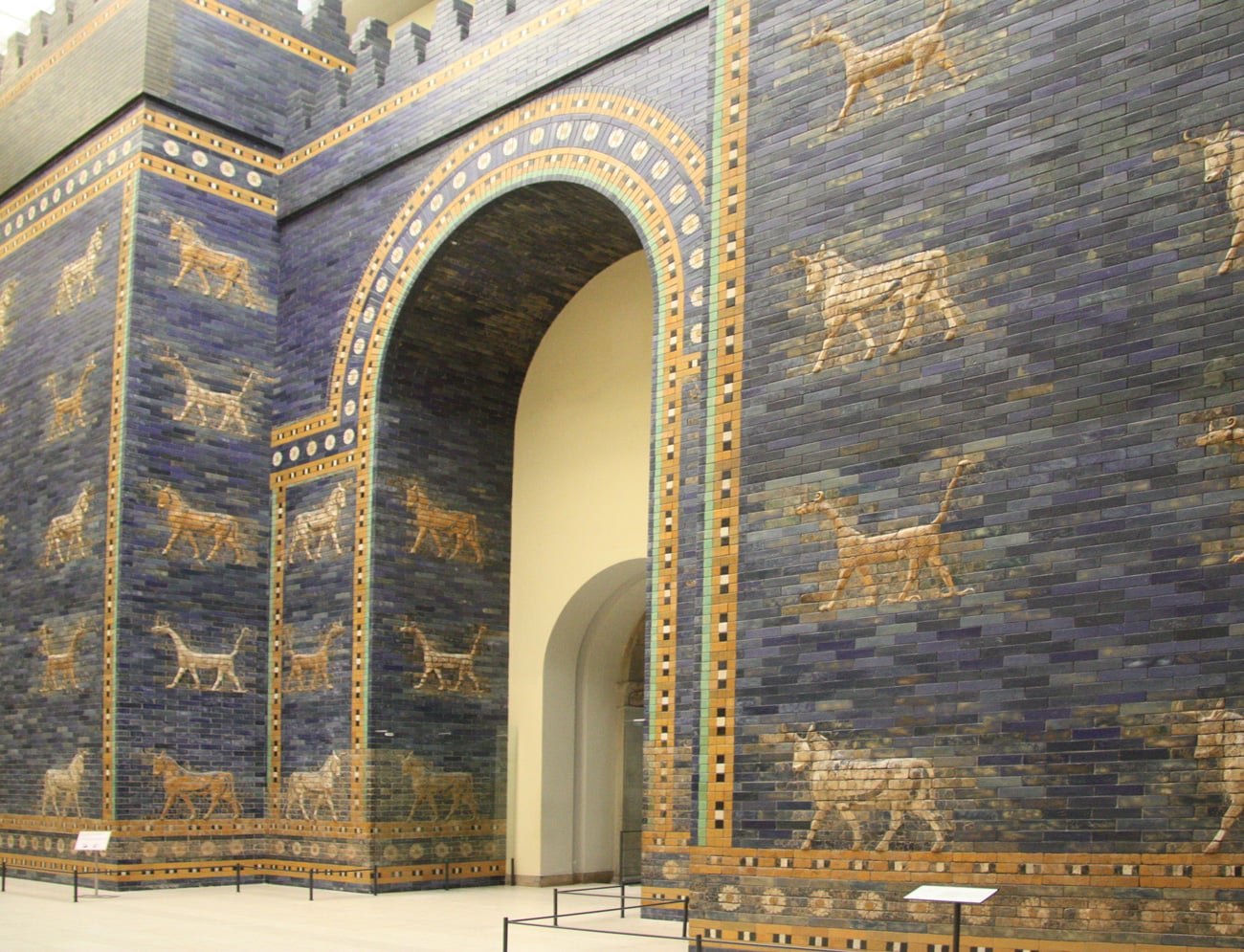
Clearly Isaiah was well acquainted with the city of Jerusalem, the temple (1:11–15), the ways of the rich, and the suffering of the poor. Because of his love for Jerusalem, he never delights in the messages of doom to the city and her inhabitants. He pictures the city as a “shelter” in a vineyard (1:8), and he gratefully speaks about God’s mercy and desire to call a remnant who will return to Jerusalem after the exile and share in the joy God has prepared for the city and her population:
But be glad and rejoice forever
in what I will create,
for I will create Jerusalem to be a delight
and its people a joy. (65:18)
Even though it is nowhere clearly stated where Isaiah was born and raised, all indications point to a man who knew the city of Jerusalem, walked in it, and loved it as the city God had chosen in which to establish his name and glory.
Historical Context
The beginning of Isaiah’s ministry can be dated by the reference to Uzziah’s death (ca. 740 BC) in 6:1. Under Uzziah, Judah gained remarkable economic achievements (2 Chron. 26:6–15) and made an attempt to reassert herself as a political power. Following Uzziah’s death, Judah would be cast into the midst of a stream of international developments that would leave her a vassal state of the Assyrian Empire. During his ministry, Isaiah witnessed the fall of Aram (Syria) and Israel as well as the desolation of Judah by the Assyrians.
Succeeding Uzziah, Jotham (750–732 BC) ruled a nation that was materially strong but corrupt in her values and apostate in her adherence to Yahweh. Hosea and Amos had condemned the excesses of wealth and injustice in the north, and Isaiah brought the same condemnation against the southern kingdom. Jotham died in peace while the Assyrian fist was being raised toward Aram, Israel, and Judah. Tiglath-Pileser III (“Pul” in 2 Kings 15:19) subjugated cities lying on the route from Nineveh to Damascus. When Jotham died, the handwriting was on the wall.
A king who plays a more prominent role in the book of Isaiah is Ahaz. He ruled over Judah from 732 to 716 BC. Though Ahaz was not the kind of man to seek a prophet’s counsel, God sent him a word of encouragement through Isaiah (chap. 7).
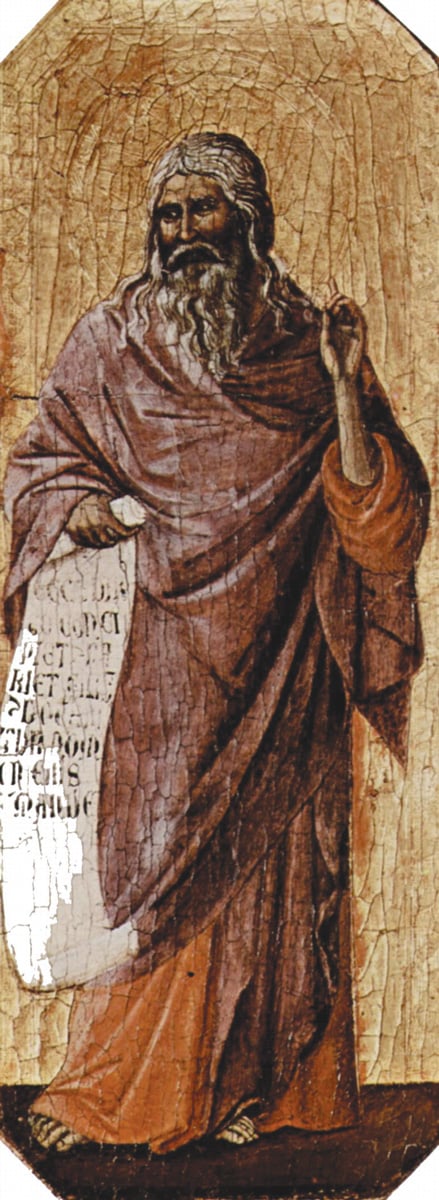
A painting of the prophet Isaiah by Duccio di Buoninsegna (AD 1308–11)
Second Chronicles enumerates a list of objectionable practices instituted by Ahaz and explains the idolatrous practices and the reason for Ahaz’s international troubles (28:2–8). The book of Isaiah presents Ahaz as a man imprudent in political affairs. The alliance of Rezin, king of Aram, and Pekah, king of Israel, was intended to create a buffer against the expansionist drive of Assyria. In order to accomplish this, the allied kings needed Ahaz to join their confederacy. When he refused, Rezin and Pekah marched against Ahaz, intending to dethrone him and to set up a king in Ahaz’s place who would be sympathetic to their political scheming (2 Kings 16:5; Isa. 7:6). Ahaz was greatly disturbed about the Syro-Ephraimite alliance. Into this context, Isaiah brought God’s word. Isaiah challenged Ahaz not to fear their power, and instead to look to God’s presence in Jerusalem as the strength of Judah. Ignoring God’s word, Ahaz looked for a political solution and asked Tiglath-Pileser of Assyria to help him (2 Kings 16:7). Tiglath-Pileser swiftly reacted to the threat on the western front. In 734 BC he marched through Phoenicia as far as Philistia, conquering as he went. In the following years he invaded Judah, which was reduced to a vassal state. Ahaz went to Damascus to celebrate Assyria’s victories, and while there he saw an altar, a replica of which he constructed and set up in the temple court (2 Kings 16:10–16).
Ahaz’s son Hezekiah was a godly king who sought counsel from the prophet Isaiah in times of national and personal tragedy. He ruled from 715 BC until his death, in 686 BC. During his rule he instituted many reforms (2 Kings 18:4, 22), including the celebration of the Passover (2 Chronicles 30). He witnessed the fall of Israel, which was overrun by the Assyrians when Hoshea refused to pay tribute to them. Shalmaneser IV began the campaign, and his successor, Sargon II, destroyed Samaria and exiled her population in 722 BC. Assyria’s hegemony in the Syro-Palestinian region grew. In 711 BC, Sargon descended on Ashdod in Philistia because it was thought Ashdod had conspired against Assyria (Isa. 20:1). At Sargon’s death (705 BC), Sennacherib took over. He faced an immediate coalition of Egypt, Philistia (except for Ekron), Babylon, and Judah (2 Kings 18:7), organized by Hezekiah. The southern king had hoped that the time had come to throw off the hegemony of Assyria, believing that Judah had the power to lead the conspiracy. This rebellion was quick to spark the anger of Sennacherib. On his way to Judah, he put down various rebellions in Mesopotamia, Phoenicia, and Philistia. His forces moved through Judah and may have taken as many as forty-six cities (some of which may be listed in Isa. 10:28–32 and Mic. 1:10–16). As Sennacherib approached Jerusalem, Hezekiah attempted to pacify Sennacherib’s anger by sending him an abundance of tribute (2 Kings 18:13–16). Despite Hezekiah’s attempt to divert the Assyrian forces, Sennacherib’s march toward Jerusalem continued.
Finally, Sennacherib besieged Jerusalem. Hezekiah was locked in Jerusalem, surrounded by Assyrian forces. He had prepared well for the siege, but the Assyrians had the fortitude to wait for the surrender of Jerusalem. However, as Hezekiah and Jerusalem trustfully waited, the Lord intervened miraculously to deliver Jerusalem from the grasp of the Assyrian forces (2 Kings 19:35–36).
Literary Features
As far as literary style, the prophet Isaiah is a master of the Hebrew language. He knows how to express himself well and has a distinctive literary quality in his writing.
First, Isaiah uses rich vocabulary. Many of Isaiah’s words are unique, occurring only once or just a few times in the whole Hebrew Bible. Both Isaiah’s extensive vocabulary and choice of expression show his ability to use the Hebrew language in a highly poetic style with a variety of parallel forms.
In addition to variety in vocabulary, the book’s brilliant and imaginative descriptions of war and of social and rural life, such as the parable of the vineyard in chapter 5, demonstrate Isaiah’s familiarity with these areas of Israelite society. Isaiah is an extremely gifted preacher who knows exactly how to use the right illustration as he communicates God’s revelation.
Many literary devices were available to him in the Hebrew literary tradition: personification, metaphor, simile, wordplay, alliteration, song, and satire. If one compares Isaiah with a book like 1 Samuel, both of them being nevertheless inspired, the difference in style becomes apparent. Isaiah captures the imagination with his use of various images, his sentences flowing one into the other, the tightly knit imagery demonstrating Isaiah’s intimate familiarity with the world in which he lived.
Critical commentaries on Isaiah divide the material into three major divisions: chapters 1–39 are thought to have come from the eighth-century prophet Isaiah; chapters 40–55 from a sixth-century prophet known as Deutero- (or Second) Isaiah; chapters 56–66 from a fifth-century source known as Trito- (or Third) Isaiah. However, three arguments may be advanced in support of the unity of Isaiah.
First, Jesus and the apostles held to the unity of Isaiah. Whenever they quoted from the book of Isaiah, whether from the beginning or the end, they always referred to the prophet Isaiah. The Gospel of John has an interesting passage that combines two quotations from Isaiah, and each comes from a different section. John comments on the unbelief of the people at Jesus’s time by referring to Isaiah 53:1 and on the effect of their unbelief by appealing to Isaiah 6:10. In this instance, one quotation comes from Isaiah 1–39 and another from Isaiah 40–66, yet both of them are introduced as the words of Isaiah: “This was to fulfill the word of Isaiah the prophet” (John 12:38) and “as Isaiah says elsewhere” (John 12:39). So whether in the first or second part of Isaiah, the whole of the prophecy is seen as being the work of one author: Isaiah.
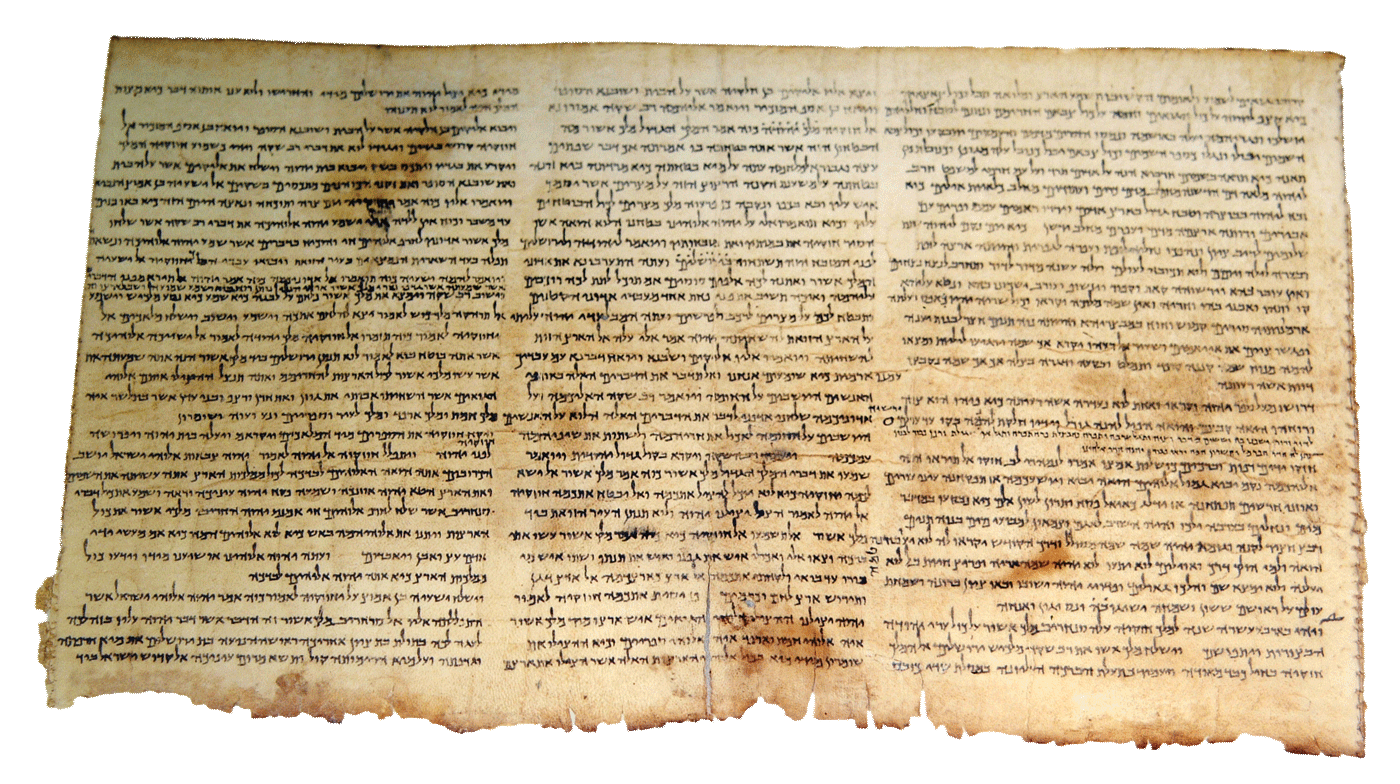
A portion of the Isaiah Scroll (ca. 100 BC), part of the Dead Sea Scrolls from Qumran
Second, many of the dissimilarities between the critical divisions of Isaiah can be explained by a change in subject matter. The first division emphasizes the Lord’s coming judgment on all flesh, whereas the latter part of the book of Isaiah emphasizes the comfort and consolation given to the remnant, for whom God still has a future. In fact, the second section begins with these words: “Comfort, comfort my people, says your God” (40:1). The theme of comfort is characteristic of most of the chapters in the second division. Though there may be some indication of judgment, the main message is one of comfort.
Moreover, even though the emphasis in the first part is on judgment, there is also a message of restoration. A brief comparison of two sections on the restoration (35:7–10 and 43:19–21) reveals a number of common elements: water, the road, animals, and the statement that the people of God do not have to be afraid. The shift in emphases also serves as an explanation for the dissimilarities in vocabulary and theme.
Third, despite some dissimilarities between the three divisions, there is wide recognition of similarities linking the three. The “blindness” and “deafness” terminology (6:9–10; 32:3; 35:5; 42:18–20; 43:9), the Jerusalem theme (1:27; 36:2; 40:2; 66:13), the expression “Holy One of Israel” (1:4; 41:14; 60:14), and the “highway” theme (35:8; 40:3) are examples of common links recognized between the three sections.
Theological Themes
The scope of the book takes us beyond Isaiah’s days to the new heavens and the new earth. The prophecy spans the preexilic, exilic, and postexilic eras, the coming of the Messiah, the messianic age, the church, and the final consummation. The book unfolds God’s plan for the redemption of his people. The meaning of Isaiah’s name, “Yahweh is salvation”—also translated as “salvation is of the Lord” or “salvation of Yahweh”—reveals the purpose of the book.
The message of the gospel is found throughout the prophecy, and as a matter of fact the prophet concludes with it.
“As the new heavens and the new earth that I make will endure before me,” declares the Lord, “so will your name and descendants endure. From one New Moon to another and from one Sabbath to another, all mankind will come and bow down before me,” says the Lord. (Isa. 66:22–23)
Salvation is not to be limited to Israel only, for Isaiah as the “evangelical” prophet speaks also to Gentiles.
Commentary
1. Prophecies against Judah (1:1–12:6)
The first twelve chapters of Isaiah may be compared to a painting with three panels (a triptych). Isaiah’s call to be a prophet (chap. 6) is at the center, while the other two parts of the triptych concern judgment and hope. The first section (chaps. 1–5) is in the form of a covenantal lawsuit, and the third section (chaps. 7–12) presents God’s word of judgment and hope in the historical situation of the growing Assyrian Empire. A holistic approach to these chapters presents the reader with Yahweh’s holiness (6:3), Isaiah’s prophetic calling (6:8), the finality of God’s judgment (6:11–13a), and the hope for the remnant (6:13b). Each motif is developed throughout the triptych. The prophet begins with Yahweh’s charges against Judah and Jerusalem (1:2–31) and concludes with the new song of the remnant who have discovered that the Holy One of Israel is still in the midst of his people (12:6). The focus, then, of all twelve chapters is on the Holy One of Israel, who cleanses Isaiah (6:7), and who, through the process of judgment, cleanses his people from all their sins and defilement (4:3–4).
A. Judgment and comfort: Part one (1:1–2:5). Isaiah calls on heaven and earth to witness against God’s people in language reminiscent of Moses’s Song of Witness (Deut. 30:19; 32:1; cf. Mic. 6:1–2). God’s people have severed their relationship with Yahweh, their Father (1:1–4). Though Yahweh has treated them as sons, and Judah has received great benefits, the people foolishly abandon their heritage. They have become fools, who do not “know” and “do not understand” (1:3). Their folly has led to open rebellion against their suzerain (covenant) Lord. They have forsaken their loyalty to Yahweh and replaced it with hatred and apostasy. They are not children of God but “a brood of evildoers” (1:4). They have rejected “the Holy One of Israel,” the God who not only sovereignly rules over his people but also has promised to dwell in their midst so as to sanctify them.
Yet the Lord has severely judged Judah not to destroy her but in order to get her attention (1:5–9). Her wounds symbolize the extent to which God has patiently dealt with his people. He has used wars, oppression, desolation, and famine in order to bring his people to their senses and to himself. The desolation may very well reflect the situation in 701 BC, when Sennacherib despoiled the land, destroyed the cities, and nearly took the city of Jerusalem. Were it not for the grace of God, Judah would have been destroyed like Sodom and Gomorrah. The leaders were at fault for bringing judgment on Judah. Clearly God did not intend to destroy her from under the face of the sun. The “Daughter Zion” (Jerusalem, remnant) is spared like “a shelter” (1:8). The intent of God’s judgment is purification, and to that end Yahweh is patient and merciful.
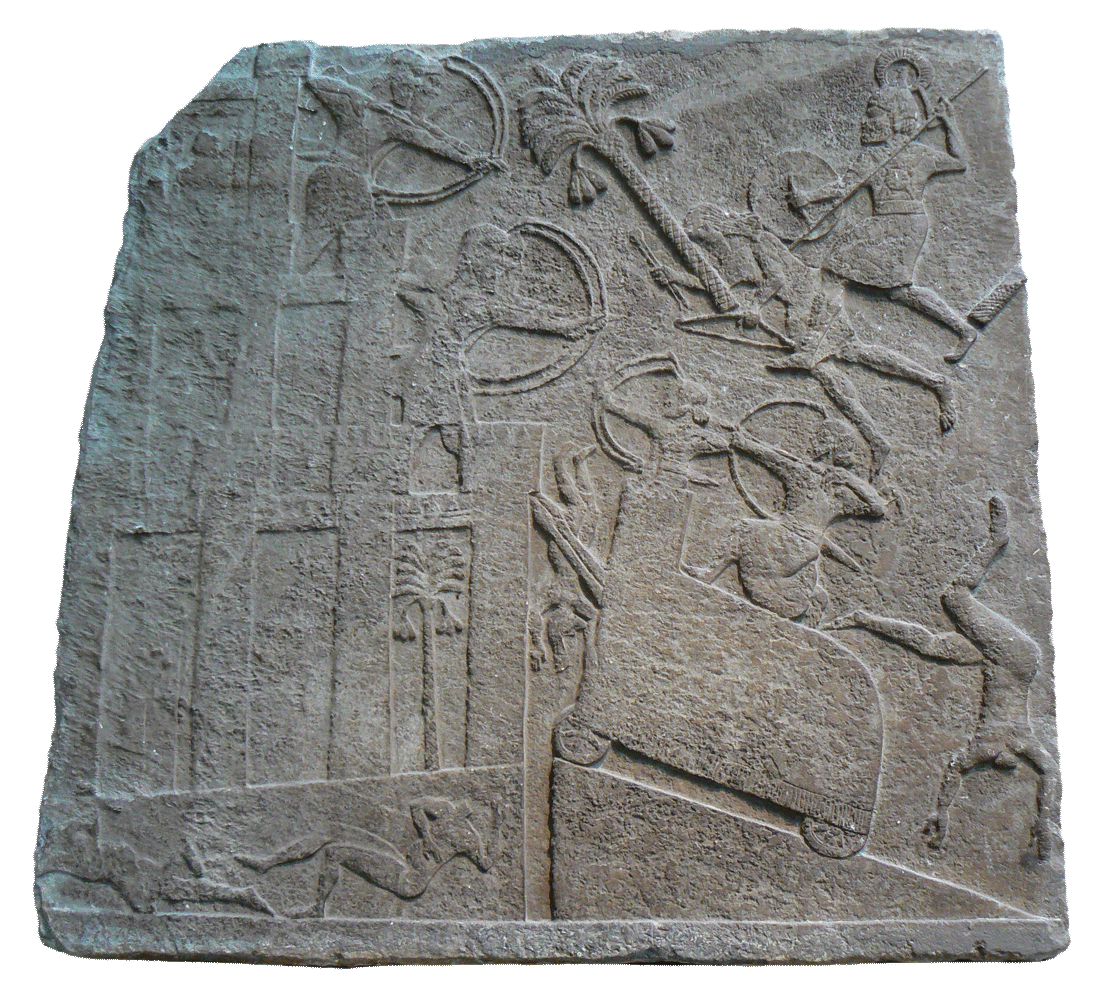
Isaiah 1:8 describes Jerusalem “like a city under siege,” similar to the attack against a city portrayed in this Assyrian relief (728 BC).
The leaders are corrupt, like the people of Sodom and Gomorrah (1:10–17; Gen. 18:20). They are reminded of God’s law, which requires righteousness as a prerequisite for bringing offerings and sacrifices (Deut. 33:19). The prophet is not antagonistic to offerings and sacrifices, feasts and festivals, and prayer; but he knows that God rejects any act of worship at any time, even in the holy court of his temple, when it is little more than an empty ritual. Worship must be pure. The requirements of ritual purity must be kept, and sacrifices are to be offered from a pure heart. The intensity of God’s hatred of their worship affects sacrifices, convocations, and individuals. In their rebellion against God, they have maintained “religion,” but in their practices they are corrupt. They cannot merit God’s grace by their “pious” activities. Their “hands are full of blood” (1:15), because they have disregarded the rights of the needy. It is impossible to pray for relief from the enemy as long as no compassion is shown to the oppressed.
The proper response, then, to the grace of Yahweh is obedient faith (1:18–20). Obedient faith entails the willingness to remove and cleanse oneself from the evil of one’s generation, to love one’s neighbor, and to receive divine cleansing and forgiveness. True repentance results in faithful obedience, as an expression of gratitude and the willingness to obey God. The remnant that has survived the ordeal may again be restored to enjoy God’s blessings. God has graciously opened up a future for them, but for those who rebel, judgment is sure to come.
In a lament, the prophet speaks about the filth of Jerusalem (1:21–26). Rather than resembling pure silver in the practice of justice, righteousness, and faithfulness, the city’s silver has become dross (1:21–22). Isaiah reflects on the era of David and Solomon as one in which Israel was characterized by justice, righteousness, and loyalty to the Lord, because these leaders upheld God’s law. But Jerusalem has become faithless, like a harlot. She is as worthless as wine diluted with water. People and leaders are all alike: each one is out for him- or herself. Yahweh, the great and merciful king, has seen their insensitivities and will come to the defense of the poor. He will bring them through another judgment in order to remove the “foes.” God’s “enemies” are all those who do not do his will, and it is significant that he addresses the covenant community. One is reminded of Jesus’s words that whoever is not for him is against him (Matt. 12:30; Luke 11:23).
God will certainly distinguish between the righteous and the wicked (1:27–31). The future belongs to the remnant, which repents by doing righteousness, but judgment will make an end of rebels and idolaters. Isaiah then compares the people as a whole to the effects of a drought in which the leaves of an oak fall off and the garden is burned up (1:30). However, the oak still stands and the garden is still there. Hard times may come upon the godly, but they will persevere. The wicked, however, will be utterly consumed as by fire.
In four verses (2:1–4) Isaiah describes the nature of God’s kingdom: its glory, its extent, and its effect. The glory of God’s kingdom is so great that it will be recognized by the nations. God’s kingdom will not be limited to the Jews in Jerusalem or Judea but will extend to the nations, who will desire to be instructed by the people of God. The language is centripetal; the people are coming to one center to be instructed. The knowledge of God will be among the nations; and the nations, having been disciplined in the ways of God, will live in accordance with God’s word. The universal knowledge of God is the precondition for the rule of God, which brings peace to the earth. The promises of verse 4 are especially reassuring in an age marred by terrorism and nuclear warfare. However, we must keep in mind that as long as nations make decisions for themselves without respect to God, there is little possibility for peace. The prophet envisions a time when Yahweh himself will rule the nations and will make decisions for them; then and only then will there be a state of shalom, when weaponry can be changed into implements of peace. Before this glorious vision may be realized, there is one precondition: men must respond in full submission to the Lord (2:5). It is possible to be inspired by the vision of the messianic age, but inspiration should lead to obedient faith.
B. Judgment and comfort: Part two (2:6–4:6). Isaiah now focuses on how God’s people have rebelled (2:6–22). First, he singles out their rampant materialism, idolatry, and acceptance of pagan practices. He includes all pagan cultures by referring to the superstitions from the east and west (diviners of the Philistines). Judah, though isolated geographically, has opened herself to foreign cultures. This fits well with the period of Uzziah, when Judah made alliances with nations so as to maintain commercial and military relations. Their strength was in negotiation, and not in Yahweh. The people possessed silver and gold, horses and chariots, and idols. Judah was no different from other nations. God’s judgment would show that idols would provide no help, that gold and silver could not save his people in the hour of disaster, and that the nations would be impotent in the hour of need. God’s judgment comes against any and every monument of human pride. Yahweh alone will be exalted. The “day” of God’s judgment (2:12) is a reference to an era in which God reveals his wrath. The emphasis on arrogance in this passage fits well with the imagery of the cedars of Lebanon, the oaks of Bashan, the mountains and hills, the high towers and fortified walls, and the stately ships (literally “ships of Tarshish”), which sailed the seas and brought crafts and products from other nations into the finest homes of Jerusalem. All these objects symbolize human pride and autonomous accomplishments. Humanity will have to face God, who comes to quell the rebellion of his subjects. Yahweh’s day is the day of his self-exaltation, which excludes humanity and any reasons for pride.
Isaiah now charges the people with open rebellion (3:1–15). Their leaders are particularly responsible. He charges the leaders with irresponsibility and injustice, which have caused the poor to become poorer. This charge is also to be understood in the light of the previous charge of rebellion (2:8–9). The combination of corrupt leadership and widespread, open rebellion has resulted in social and moral upheaval. The Lord’s judgment, however, will result in an even more catastrophic disruption of life in Judah. He will take away their food and water. He will remove the divinely ordained officers and will instead put over the people corrupt leaders who are immature and lacking in experience, like “youths” and “children” (3:4), and who will contribute to further social and moral decay in Judah. In addition, judgment comes in the form of the collapse of the economy and political structures. The ruins and the absence of qualified leaders reflect the situation in Judah after the ravages of Nebuchadnezzar (586 BC). Though God’s judgment will result in terrible lawlessness, the righteous remnant must take heart, knowing that they will be rewarded. The Lord brings a suit against the corrupt leaders who have taken advantage of their office.
Yahweh charges the daughters of Jerusalem with pride and seduction (3:16–4:1). The men of Jerusalem are selfish, materialistic, and oppressive, but they have partners in their wives and lovers, who have an insatiable desire to beautify themselves, enrich themselves, and compete with each other. The brief description of the “fine” women is followed by the effects of the day of Yahweh: all their pretty things will be removed, they will go around filled with mourning, and their men will fall in battle. Their glory will turn to shame. The severity of their loneliness will be so great that these women will fight over a man in order to remove the disgrace of their childlessness.
The prophet’s theme now changes abruptly, for in 4:2–6 Isaiah speaks about the new messianic era. While human pride is gone, there is a future for the remnant who have humbled themselves in the presence of the Lord. Isaiah develops the theme of the messianic kingdom, begun in 2:1–5, by speaking about the people as “the Branch of the Lord.” This “Branch” is not the branch of a tree but a new shoot out of the ground; it refers to the survivors of the day of judgment. “Branch” may also signify the Messiah of David, as in Jeremiah 23:5; 33:15 and Zechariah 3:8; 6:12, but the more general designation of messianic “people” fits the context best. The “fruit of the land” (4:2) describes the blessedness of the land, as the people are restored to God’s blessings.
The messianic era is characterized here as an era of restoration. The remnant, the people of God, has survived God’s judgment. The day of the Lord has been a day of terror but also one of purification. The filth of corruption, the fires of rebellion, and the folly of God’s people have been removed; those who are left are now described as holy; and their names are recorded in the book of life. Having consecrated for himself a new people who will be responsive to him, God assures them of his glorious presence. The glory of the Lord, revealed to Israel in the wilderness, will protect only those who are holy and over whom his judgment has passed.
C. Judgment (5:1–30). Isaiah may have sung his parabolic poem about the vineyard (5:1–7) at a wine festival, surprising his listeners with the application. He sings about a “friend” (NIV “loved one”) who gives himself with exacting care to the preparation of a vineyard. The vineyard, however, produces only sour grapes. Isaiah asks what else this “friend” could have done for the vineyard. The rhetorical question must be answered! The prophet then explains that the vineyard represents the people of Israel and Judah and that the Lord is the keeper of the vineyard. He deeply cared for his people and lavished on them his grace and love, expecting justice and righteousness as the appropriate fruits. Instead of justice and righteousness, the people have responded with bloodshed, which has elicited a cry of distress from the downtrodden.
Six woes (5:8–24) explaining the nature of oppression, bloodshed, and the cry for justice (5:7) are directly related to the parable of the vineyard. In these six woes Isaiah has painted for us a portrait of God’s people near the end of the eighth century. The portrait is that of social elites who have perverted justice, morality, religious values, and the wisdom that flows out of the fear of the Lord. In his description of the rich, Isaiah gives us a candid glimpse, not only of the Judean society of his day, but of the besetting sins of human society at any time and place. The first woe (5:8–10) is against economic opportunists who amass more and more material wealth. They flaunt the inalienable relationship of the people to “God’s land” (Lev. 25:13–16). They accumulate houses and fields at the expense of the economically disadvantaged. Their houses will be in ruins, and their vineyards and fields will not produce enough to make a living. The picture in these verses is one of loneliness: houses that were once full of parties will be no more. A ten-acre vineyard will produce only one bath (6 gallons) of wine; a homer of seed (6.4 bushels) will yield only a little over half a bushel.
The second woe (5:11–17) pertains to drunkards who spend all their time feasting and drinking. They cannot wait to begin their day with a drink and prepare banquets in order to attract others who enjoy drinking. Isaiah does not say much about the source of the money with which their wine and strong drink are purchased, but it may be deduced from the context that the wine has been obtained with the money and labors of the poor. In their drunken stupor, they are ignorant of the ways of God. They will go into exile as fools who did not know that the day of the Lord was coming on all. Death will inevitably overtake those who know nothing but the joys of life.
The third woe (5:18–19) pertains to those who corrupt justice. They have no sense of the holiness of God and even scoff at the thought of the coming judgment.
The fourth woe (5:20) is pronounced against those who corrupt religious values. They do not know the difference between good and evil, darkness and light, bitter and sweet. They confound their own conscience and the consciences of others. The revelation of God is no longer a light for their path because their standards have confused the clarity of God’s revelation.
The fifth woe (5:21) is to those who have exchanged the wisdom of God for the folly of man.
The sixth woe (5:22–23) also applies to drunkards. Here Isaiah describes the drunkard as a man who feels strong in his drinking. He enjoys power. While he feasts, he is getting rich at the expense of others.
While there are hints at the coming judgment of God throughout the woes, the prophet provides greater detail toward the end (5:25–30). Clearly social position does not deter judgment, because the ultimate polarity is between sinful people and a holy God (5:16). When God enters into judgment, he comes as the great king (Lord Almighty) and the Holy One of Israel. Because they have spurned his law and his covenant, the anger of the God of Mount Sinai will burn against his own people. He will mercilessly strike his people with blow upon blow. Fierce and untiring enemies will come at God’s command. With rapidity and catastrophic power they will destroy and exile God’s people. The day of the Lord is not a day of restoration and light, but full of darkness, anxiety, and gloom.
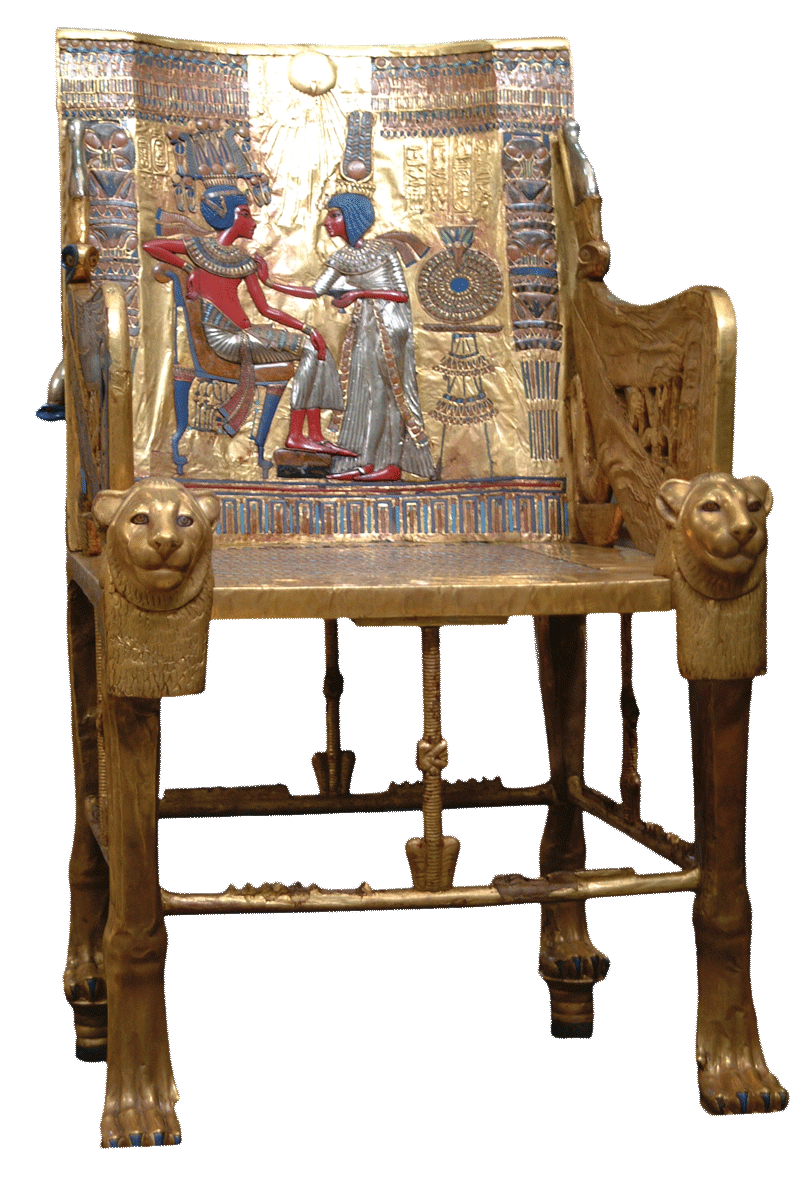
On this ancient throne, from Pharaoh Tutankhamun, winged serpents form the armrests and would flank the king as he sat (fourteenth century BC).
D. Isaiah’s call (6:1–13). The prophet dates his vision of God’s glory (6:1–4) to the year in which King Uzziah died. Scholars have tried to understand the significance of this dating, but it is enough to recognize that this is one way of connecting chapter 6 to the context of the Syro-Ephraimite War (see Isa. 7:1). A vision of the Lord appears to the prophet. He sees Yahweh sitting on the throne, exalted in the temple. The prophet concentrates not on the throne or on the Lord seated on it but on “the train of his robe” as it fills the temple, which is filled with the glorious presence of the Lord. He touches the earth in his power and glory, and yet the earth and the earthly temple cannot contain him. The appearance of the Lord, transcendent in his majesty and yet immanent in his presence, is represented in the language of a theophany. It affects all things on earth: the doorposts and thresholds of the temple, for instance, shake as in an earthquake. When the Lord appeared on Mount Sinai, his revelation was preceded by an earthquake, lightning, and darkness (Exod. 19:16). Isaiah finds himself gazing at a ceremony in which the seraphim announce the glorious presence of the Holy One of Israel. The seraphim are like men in appearance, with faces and feet; however, they are unlike men in that they have six wings, with which they cover themselves in the presence of the Lord. As they hover in his presence, they call out, “Holy, holy, holy.”
The holiness of the Lord is a most important doctrine in the teaching of Isaiah. Yahweh’s holiness is an expression of his separateness from the corruption of his people. He is the Holy One of Israel, and in this sense he is the “wholly other” one. Israel and Judah will not be able to experience the loving-kindness of the Lord until they have been cleansed and sanctified; only then can they experience the presence of the Holy One of Israel. The seraphim ascribe holiness to “the Lord Almighty” (“the Lord of Hosts”). He is the great King over “the host” of heaven (Deut. 4:19; 1 Kings 22:19; Isa. 40:26) and over the earth, which as part of his kingdom “is full of his glory” (6:3). The word “glory” is also important to the message of Isaiah. It signifies the majesty and splendor of the presence of Yahweh. Over against all the wealth of the rich and the royal courts of earthly kings is the king of glory, whose judgment will destroy human kingdoms and frustrate human plans. When the king of glory establishes his kingdom and extends it from shore to shore, the fullness of his glory will become evident. The seraphim already see the whole earth full of his glory.
In an appropriate response to the impact of the vision of God’s holiness, presence, and glory, Isaiah calls out, “Woe to me!” (6:5). The prophet fears for his life, as he is particularly aware of his uncleanness—he represents the sinful nation (6:5–7). In response, one of the seraphs takes with special tongs a burning coal from the altar and touches Isaiah’s mouth. The ceremony is reminiscent of the incense altar (Exod. 30:1–10), which was lit by a burning coal taken from the altar (Lev. 16:12–13). Before Isaiah is able to speak to the Lord, he must be forgiven. This forgiveness is personal. Once Isaiah has been purified, he is permitted to speak in the heavenly council and receives his commissioning.
In his heavenly council Yahweh asks the question, “Who will go for us?” (6:8). Isaiah volunteers, and Yahweh immediately commissions him (6:8–13). The commission consists of a declaration that Isaiah’s ministry is going to be hard and long. His message will prick the conscience of people, but they will harden themselves against God and his word. Isaiah is shown the desolation of the land and the exile of the population. The emphasis is on judgment, devastation, and desolation. But there is hope, for the “holy seed” will remain. Isaiah begins chapter 1 with the “brood of evildoers” (literally “seed of . . .”) and concludes chapter 6 with a ray of hope (“holy seed”).
The messages of the first part of the triptych (chaps. 1–5—Judah’s sin, God’s judgment, the remnant, and the messianic kingdom; see beginning of commentary on 1:1–12:6) are not set in historical context. This changes with the historical reference to the year of Uzziah’s death (6:1), and the third part of the triptych (chaps. 7–12) begins with events associated with Ahaz. When Ahaz came to the throne, the Aramean (Syrian) power was about to be eclipsed. The Arameans were already feeling mounting pressure from the east, as the Assyrians were moving westward. God’s word comes to Israel, Aram, Assyria, and Judah. Everything that happens on earth results from God’s sovereign rule.
E. Crisis in perspective (7:1–8:22). The Arameans have made an alliance with the Israelites in order to create a united front against Assyria. In order to further their goals, they plan to dethrone Ahaz and place their own man (“the son of Tabeel,” 7:6) on the throne in Jerusalem.
The prophet and his son Shear-Jashub (whose name signifies the hope that “a remnant will return”) meet Ahaz at the upper pool. Ahaz is shaken by the alliance and needs counsel (7:1–9).
Isaiah calls on Ahaz to face the crisis from God’s perspective. These two mighty kingdoms, Israel and Aram, are nothing more than “two smoldering stubs of firewood” (7:4) who will soon come to an end. The challenge (7:9) is a pun created by the assonance of the Hebrew words translated “stand firm” and “stand”; the NIV makes an attempt to reflect this. Aram came to an end in 732 BC, and Assyria exiled Israel in 722 BC.
The emphasis on God’s presence in this crisis receives special significance in the naming of a child: Immanuel (7:10–17). Isaiah challenges Ahaz to ask for a sign, so that he might “stand firm in [his] faith” (7:9). The king piously refuses. Knowing that Ahaz has set his heart on a political solution, Isaiah rebukes him (7:13). Ahaz is impatient with the solution of faith and looks toward Assyria for a novel approach. The Lord, however, has a sign for Ahaz, the house of David, and all who would hear it. The sign is the “Immanuel” (7:14).
Much controversy has surrounded the meaning of the sign: what is the meaning of “virgin,” and who is the child? The validity of the sign lies in a miracle or event and must be of significance to Ahaz. The birth of Christ was a miracle but would have been of little relevance to Ahaz in his time. If the sign was to strengthen the word of God in Ahaz’s time, it may have been that Isaiah spoke of a woman in the royal court or of his own wife (8:1–4, 18). The child could not be Hezekiah, however, since he was already born by this time. Though Isaiah’s son is not the Immanuel, he is a sign of the Immanuel, in that Judah is spared. Through Isaiah, God assures Judah that his promises to David (2 Sam. 7:11–16) will come to pass. The Lord has not abandoned the house of David! He marshals the Assyrians to remedy this crisis situation.
As problematic as the interpretation of this passage is, the quotation in Matthew is authoritative. It focuses on Jesus the Messiah as the Immanuel, the Savior sent by the Father. Ahaz may have looked for a fulfillment and witnessed the desolation of Aram, but he did not understand the fullness of the prophetic witness.
Ahaz’s policy pushes him into direct contact with Assyria (7:18–25). He appeals to Tiglath-Pileser (the “razor hired”). Others have looked to Egypt. The clash for power in the Mediterranean Basin will result in great devastation. Assyria is God’s appointed means and will “shave” Judah; that is, he will exact tribute (7:20). Judah will be impoverished and will only survive on “curds and honey” because its luxuriant vineyards and cultivated fields will become grazing land for cows and sheep.
The birth of Isaiah’s second son is significant (8:1–4). To properly emphasize its significance, he writes on a large scroll the name “quick to the plunder, swift to the spoil.” This he does in the presence of two witnesses: Uriah the high priest and Zechariah. Then he has relations with his wife, “the prophetess,” and out of that union a child is born. The child’s name signifies judgment on Israel and Aram and a contemporary fulfillment of 7:14. Thus, in a short time the Assyrian forces will carry off the “plunder” of Damascus and Samaria.
The people have rejected the Lord and his promises to David (symbolized by the waters of Shiloah; 8:6). They have lost heart over the Israelite-Aramean alliance, not trusting in God. Yet God is sovereign over the nations (8:5–10). He permits the Assyrians to “flood” the Mediterranean Basin with their forces. The Euphrates River (8:7) symbolizes Assyrian strength. It will overpower the nations but will not destroy Judah, because of the Immanuel-presence of the Lord. The “outspread wings” in 8:8 are a figure of God’s protection of his people (cf. Ps. 91:4). God has set the bounds of Assyria’s power.
The prophet calls on the nations to recognize that they are pawns in the hands of God. The Lord effectively works out all his plans. The nations cannot stand up against the God who has promised to protect his people. He is Immanuel! There also seems to be an eschatological dimension here, as it foreshadows the end of human resistance to God’s plans. God’s plan will be done on earth, as it is in heaven.
Isaiah is warned not to identify with the secular values of his contemporaries (8:11–15). Those who follow the Lord are not to give in to the prevailing political and economic winds of their age. As secularism and humanism grow stronger and the believing community is increasingly pressured in a world without God, Isaiah reminds us to look at the world from God’s perspective: the world is under his judgment, and the Lord himself should be the object of our fear. The name of the Lord is a “stone of stumbling” (8:14–15 KJV) to those who keep their political options open. The people do not listen to his message because they are hardened. Rather than enjoying God’s protection, they plot their own course with self-reliance. He is the Lord of Hosts and the Holy One, who offers sanctuary to those who fear him alone.
As the “stone,” he evokes a response of either faith or rejection, causing an offense that will snare the people of Jerusalem.
Isaiah leads the godly remnant to find shelter in the Lord (8:16–22). The Lord has instructed Judah through Isaiah, whose teachings are consonant with the testimony and law of Moses. His teaching of judgment and hope is summarized in the names Maher-Shalal-Hash-Baz, Shear-Jashub, and Isaiah (8:18).
As for the rest of the people, God’s judgment will find them out if they continue to reject the prophetic call to repentance. The judgment is described as desolation, devastation, famine, and despair from which there is no escape. It is a time without hope for the future, because God appears to be at a great distance from his people. In their abandonment they will even consult the dead. Isaiah calls on them to seek the light of the Lord’s testimony and law as revealed in his own message (8:20). Otherwise, they will come to realize the futility of reliance on kings and nationhood.
F. The Messiah (9:1–7). In 733 BC, Tiglath-Pileser III besieged Damascus, invaded the region of Galilee, including Zebulun and Naphtali, and incorporated it into his kingdom (2 Kings 15:29) in fulfillment of God’s word. “Gloom” and “distress” result from oppression and separation from Yahweh’s covenantal love. But the Lord will graciously turn humiliation into glory. How? By the coming of the Messiah of David (9:1–7). Although the northern tribes have rejected David’s dynasty in favor of Jeroboam (1 Kings 12:1–20), their salvation will come from the very one whom they rejected. The new era will be characterized by great joy. The Messiah will free his people from their enemies and bring the actualization of the Davidic ideal.
The child (9:6) is the Immanuel (7:14). He is God’s gift to humanity’s predicament. He is fully human (“child,” “born,” “son”), but he is also divine, with all the perfections of kingship in himself: supernatural wisdom, might, paternal beneficence, and peace. This son will reign forever in justice, righteousness, and peace. The certainty of his kingdom is guaranteed by “the zeal of the Lord” (9:7).
G. The wrath of God (9:8–10:34). The Lord’s mercy is demonstrated in his patience with the corrupt northern kingdom. However, they are not responsive. The shadow of God’s outstretched hand hangs over Samaria (9:12, 17, 21; 10:4; cf. 5:25; Amos 4:6–12). His judgment is relentless in view of the stubborn persistence of evil in Israel.
The attack of the Arameans and Philistines (ca. 737 BC) weakens Israel, but Israel does not view this military defeat as an expression of the Lord’s discipline. Instead, the leaders seize it as a political opportunity. Foolish Israel cannot see that the Lord has raised up the Assyrians to chasten her (9:8–12)!
This era is marked by civil wars and coups d’état (9:13–21; 2 Kings 15:8–30). All classes of people (“head and tail,” “branch and reed”) will ultimately suffer at the hands of the Lord: young and old, rich and poor, political and religious leaders alike. All Israel is characterized by perversity (“ungodly”), evil, and impiety (NIV 1984 “vileness”; the Hebrew Masoretic Text and NIV have “folly”).
Godlessness and chaos are twins. Anarchy destroys the fiber of Israel’s life like a fire (9:20–21). It spreads first through the underbrush and finally destroys everything. The Lord permits the anarchy, but he is still in control. The destructive forces of civil war and anarchy are also described metaphorically as a ferocious and uncontrollable appetite.
At the root of Israel’s troubles is its resistance to God’s just laws (10:1–4). Injustice prevails at the expense of the oppressed. In time, all Israel will be oppressed, but there will be no help forthcoming from the Lord. His anger will see to the righteous execution of his decree against Israel.
The Lord has granted Assyria’s rise to power (10:5–19). He permitted Assyria to enrich herself as he sent her on his holy mission to reduce those nations that had provoked his wrath. Assyria’s lust for power, however, is unbridled. She is a tyrant who boasts of her victories over cities and nations. The boast displays an attitude of autonomy and evidences no fear of God. Since Samaria has fallen (722 BC) and the Lord did not rescue it, how can Jerusalem expect to be rescued? The Assyrian advance has swept from Carchemish on the Euphrates to Jerusalem, and who can stop it? The Lord. Isaiah interrupts his sarcastic poem about Assyria’s pride with a brief prose section (10:12), containing the Lord’s response to Assyria’s taunt. He will punish Assyria. Assyria is nothing more than God’s instrument.
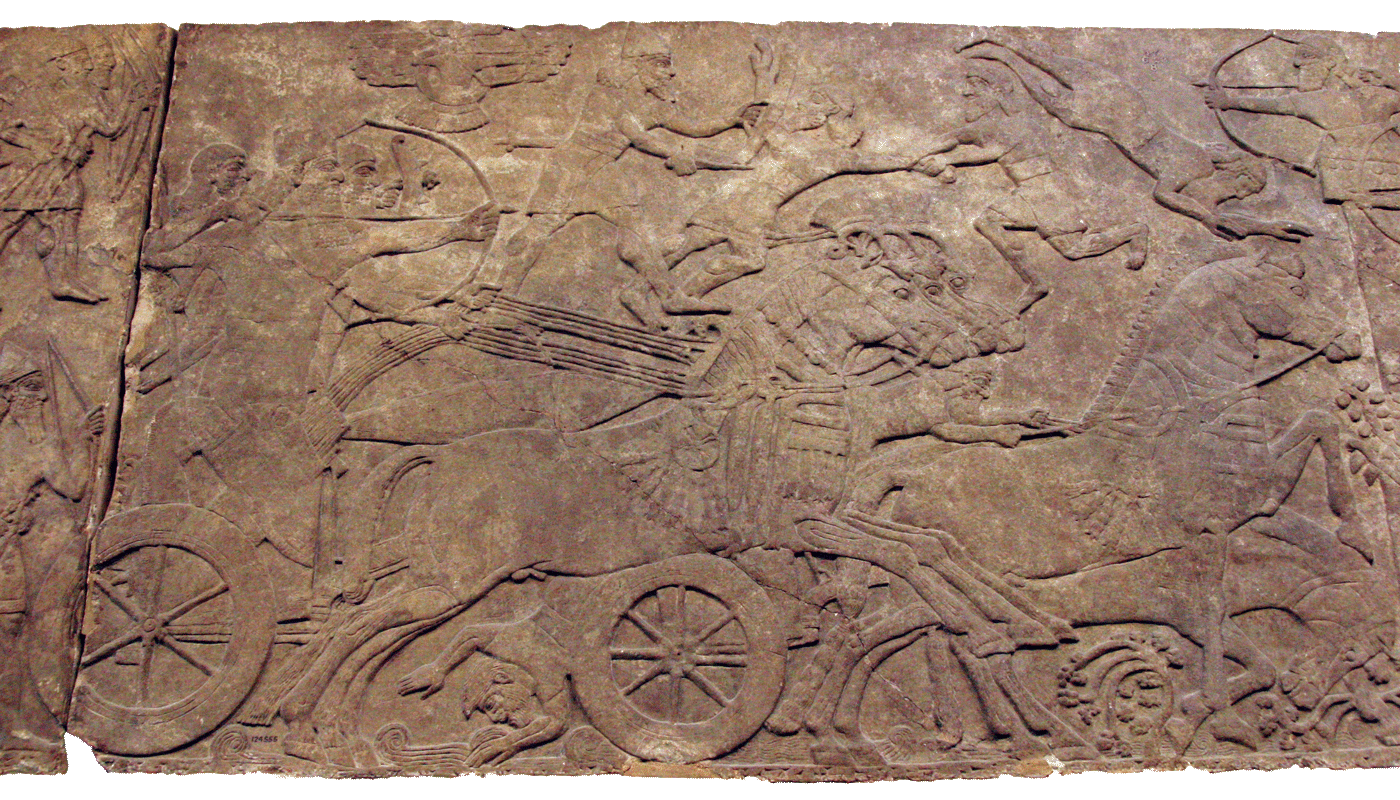
The mighty warrior king trampling his enemies (see Isa. 10:6) is seen in many reliefs from the ancient Near East. Here the Assyrian king Ashurnasirpal tramples over an enemy soldier as he leads the chariot charge (865–860 BC).
The nature of the judgment is then given in poetic form (10:13–19) and is likened to a fire and a wasting disease. Assyria claimed that her wealth and strength came by clever strategy and irresistible power. Nations were despoiled, being impotent to resist the might of Assyria, but the God of Israel was witness and will judge Assyria. When he is through with Assyria, her power will be at an end. Assyria’s warriors will be rendered powerless by a “wasting disease” (10:16), and Assyria’s pomp will be easily reduced, even as a fire destroys a forest. Nonetheless, the Lord’s “Light,” which assures Judah of a future, will bring Assyria to an end.
The Lord’s mercy is for the remnant’s sake (10:20–23). Jerusalem was besieged in 701 BC, and the country was desolated. Yet after the siege was lifted, even this remnant did not return to the Lord. Therefore, destruction has been decreed and will ultimately bring down both Judah and Jerusalem. Through the ministry of the prophets, a true remnant is sensitized. They will return and rely on the Lord. The expectation of repentance and restoration is symbolized in Isaiah’s son Shear-Jashub (“a remnant will return,” 7:3).
The Lord, who dealt graciously with his people in Egypt and rescued them from the Midianites in the days of the judges, will come to the rescue of his people once more (10:24–27). The victory belongs to the Lord. The promise of his wrath passing from Judah to the enemy has eschatological overtones. The prophet looks forward to the period of restoration as the end of the Lord’s wrath and the beginning of deliverance from the oppressors. In a real sense, believers in Jesus are the remnant, who have been rescued from the wrath of God (1 Thess. 1:10), but who still await full deliverance from the enemies of God (2 Thess. 1:6–10).
The picture of the Assyrian advance from 10:9–11 is continued in 10:28–34. The Assyrians are closing in on Jerusalem, devastating city after city. The Assyrian march need not be construed as historical. The poetic imagery permits Isaiah to project the advance on Jerusalem from the direction of Samaria, as if it has just been conquered. The period between Samaria’s fall (722 BC) and Jerusalem’s siege (701 BC) is not his concern. He brings out a sense of panic. What will happen now? Will the Lord be faithful to his promise to remain with Judah? The answer is yes. God will first “lop off the boughs” by stopping Assyria’s advance, and later he will cut down the might of Assyria. In less than a hundred years, Assyria will not be reckoned among the nations. God’s word is true.
H. The Branch from Jesse (11:1–16). The threat to the Davidic dynasty (Isaiah 7) has passed. Ahaz has survived the attack, and Aram and Israel have been conquered by Assyria. In chapter 9 the prophet speaks about “a son” to whom the everlasting government will be given and whose throne will be established with justice, righteousness, and peace. In chapter 11 Isaiah again takes up the theme of the messianic rule.
Assyria and all world powers will fall like “lofty trees” (10:33), but the Lord will raise up his Messiah as a “shoot” (11:1–9). This shoot does not spring from one of the branches of a tree; its origin is the roots. The Messiah is a shoot from the roots of David’s dynasty. The new leadership over God’s people must come from David’s dynasty, but it is also separate from the old dynastic interests. Kingship may cease in Judah, but God’s promise to David will be kept. The messianic shoot does not conform to the old way. He introduces God’s rule on earth, symbolized by the presence of the “Spirit of the Lord” (11:2).
The new stage in God’s kingdom will combine the old (the Davidic covenant) and the new (the era of the Spirit). The presence of God’s Spirit on the Messiah will be evident in his rule of wisdom, justice, righteousness, faithfulness, and peace, complete with the absence of evil and the universal knowledge of God. The messianic era is an idealization of the period of David and Solomon’s rule over Israel. The qualities of the Messiah make him fit to protect his people. His relationship with God is beyond criticism, as he fears God and delights to do his will. He will protect the needy and execute judgment on the wicked without mercy. He favors his subjects with a rule of righteousness and faithfulness and will establish a paradisal renewal of the earth in which his peace extends even to nature; all people will know God.
The Messiah of the root of Jesse will be a “banner for the peoples” (11:10–16). He gathers the scattered remnant of Israel and Judah from the nations in a “second” exodus. They will freely come from Egypt (Upper = Pathros and Lower), Cush (Nubia/Ethiopia, the Upper Nile region), Elam (east of Babylonia), Shinar (Babylonia), Hamath (region north of Damascus), and the Mediterranean coastlands. He will join together the twelve tribes and rule over a restored Israel. Nothing can stand in the way of God’s purpose. He will even dry up the Red Sea (“Egyptian” sea), make the Euphrates passable, and make a highway from Assyria and Egypt to Israel. The restoration from exile will be more glorious and more extensive than the first exodus. The fulfillment of this prophecy began in the restoration from exile and extends to the fullness of time, when Christ came to gather both Jews and Gentiles into his flock (John 10:16).
I. Songs of praise (12:1–6). Two brief hymns (12:1, 4–6) and an oracle of promise (12:2–3) make a fitting conclusion to the first division of Isaiah (chaps. 1–12). The prophet renews the promise of full and free salvation and calls on the godly to join him in confident trust in God. As the “strength” of his people, Yahweh is able to accomplish all that Isaiah has predicted: universal peace, the presence of God, the restoration of the remnant, the Messiah’s rule, and the universal knowledge and fear of God.
The hymns focus on two aspects of deliverance: God’s comfort of his people (12:1) and the proclamation of his acts of salvation to the nations (12:4–6). The day of judgment is against all flesh, and God alone will be “exalted.” The righteous have been delivered from the finality of judgment and know the Lord as the “exalted,” Holy One of Israel. The era of restoration is marked by redemption, proclamation, rejoicing, and the renewal of God’s presence among his people.
Isaiah calls on the nations to exalt Yahweh’s name because of what he does on behalf of his own. This expression of hope by God’s own will result in responses of faith and praise by the nations. The expression of hope takes the form of thanks and songs of praise. Therefore, Isaiah calls on the remnant to drown out their sorrows in songs of joy in and expectation of their deliverance by the Holy One of Israel. If God’s own people can live in joyful expectation of the final redemption, the world will take notice.
The people who were restored to the land of Judah after the exile had reason to celebrate and give thanks to God for the redemption they had experienced. The fullness of that redemption, however, was not yet theirs. The day to which the prophet refers in verse 1 extends from the restoration after the exile all the way to the return of the Lord Jesus Christ.
Chapter 12 forms a transition between chapters 1–11 (Yahweh’s judgment on Judah) and chapters 13–23 (Yahweh’s judgment on the world). The focus of chapter 12 grants us an insight into the plan of God by revealing that, while God is angry with this world (including the Jews), he still holds out his arms to all who will exalt his name, whether they are Jews or Gentiles.
2. Oracles against the Nations (13:1–23:18)
These messages are called “oracles.” The word “oracle” (literally “burden”) is a technical term and occurs in the heading of Isaiah’s speech against each nation (13:1—Babylon; 17:1—Damascus; 19:1—Egypt; 23:1—Tyre; cf. also 21:1, 11, 13; 22:1; 30:6). Similar collections are found in Jeremiah 46–51 and Ezekiel 25–32. This collection of oracles forms the second major division of Isaiah and prepares the reader for the “Apocalypse of Isaiah” (chaps. 24–27).
A. Babylon (13:1–14:23). Isaiah views the Lord’s judgment on Babylon as an expression of his rule over the earth (13:1–16). He commands the armed forces of the nations. The “holy ones” are the warriors mustered and consecrated for battle (13:3 NIV 1984). The Lord sovereignly rules over the nations, who serve him without knowledge of their being the instruments of the establishment of his kingdom. The descriptions of the ensuing battle and the day of the Lord take on universal proportions. The nations of the earth are involved. The day of the Lord as a time of great destruction on earth is near. Humanity is totally helpless. Heaven and earth heave when God expresses his anger with sinful man. Few survive, and even those who escape will come to a painful end.
The cosmic description of the day of the Lord is applied to Babylon’s fall (13:17–22). As an expression of his sovereignty, God will also turn against mighty Babylon. The fall of Babylon will be great. In colorful language Isaiah portrays the devastation caused by her enemies. The enemies are the Medes (13:17), who together with the Persians conquered Babylon under the leadership of Cyrus the Persian (539 BC). They will have no pity. Her doom is that of a deserted city. The desolation of Babylon is graphically portrayed by its becoming the haunt of wild animals, like Sodom and Gomorrah. This prophecy was not completely fulfilled when Cyrus entered Babylon; the transfer of power was rather quiet. It seems that the prophet extends the perimeter of application to all world kingdoms and empires. Babylon is symbolic of all evil, pride, oppression, or power that exalts itself against the Lord. This power will be broken (cf. Rev. 18:2–24). Thus Yahweh deals with any kingdom that exalts itself against him and his anointed people.
In the midst of a description of the world in flames, Isaiah encourages God’s people with a message of comfort (14:1–4a). When Babylon comes to its end, the Lord will restore the exiled people to the land. There is a hint of the cosmic effect of Israel’s restoration in that the nations, too, will join in Israel’s future either as converts (14:1) or as servants (14:2). The era of restoration marks the freedom of God’s people. As an expression of joy, God’s people take up a dirge (a traditional funerary song) mocking the end of the oppressors. It is a taunt (14:4)—not to be taken literally, but as a hyperbolic statement of the end of the aggressor. This explains the mythological allusions, as Isaiah portrays the end of Babylon in its own religious language.
The king of Babylon typifies world power. When the aggression of the oppressor comes to an end, the whole earth is at rest (14:4b–8). The nations, likened to trees, rejoice that Babylon no longer cuts down nations and kingdoms like a woodsman.
The mortality of Babylon is poetically set forth in the mythological language of Babylon’s own religious conceptions (14:9–10). Babylon considered itself ruler over life and death. Kings, leaders, and people died in the many campaigns and battles waged by the Babylonians. They found rest in the netherworld. But with the end of Babylon, spirits in the netherworld stir themselves up as the king of Babylon knocks and desires to enter. There is a sudden commotion, as the news of Babylon’s fall is announced. Babylon the great has fallen. It too is subject to powers greater than itself.
Babylon’s fall is great (14:11–15). The king is compared to the “morning star, son of the dawn” (14:12). As the morning star is not the sun, which distinguishes day from night, the king of Babylon is not God. However, in Babylon’s drive to rule the world, its pride was unlimited (Dan. 4:30), and it acted as God on earth. In its imperial ambitions it acted no differently than the ancient people who built a city to make a name for themselves (Gen. 11:1–9). Likewise, Babylon’s goal was to reach into heaven and to take the place of the Most High. But it too will be cast down. The greater the aspirations, the worse the fall. Isaiah uses this dramatic interlude to build up suspense. Will the spirits of the netherworld welcome the king of Babylon?
The spirits first gaze with amazement at the beggarly and weak king, covered with maggots. They respond with unbelief, mocking the mortality of Babylon. At this, they cast him out of the netherworld (14:16–20a). There will never be any rest for the king of Babylon and his offspring. He does not get the burial of a hero but is like a soldier missing in action. The spirit of Babylon is doomed to roam.
God has reserved a time of judgment for all evildoers (14:20b–21). They may flourish and thrive, but then they are suddenly cut off. In Old Testament language the king and his sons, representative of the spirit of Babylon, will be cut off forever. Their memory will be forgotten. Thus the Lord will do to all evildoers. In the biblical conception of Babylon, as we have seen, Babylon represents the spirit of humanity without God, the spirit of autonomy, the spirit of secularization, and the spirit of antichrist. For God’s kingdom to be established, the Lord must deal with any manifestation of evil.
The application is clear. Babylon must fall by the will of the Lord (14:22–23). Its judgment is sealed, and in its final state it is likened to a swamp, good only for animals (14:23).
B. Assyria (14:24–27). Yahweh is angry not only with Babylon but also with Assyria (cf. 10:5–34). Regardless of the question of which nation is guilty of the greater sin, all nations are under God’s condemnation. The counsel of the nations will be frustrated, but his counsel will stand. These words are Yahweh’s solemn assurance to his people that he will establish his kingdom on earth.
C. Philistia (14:28–32). The oracle against Philistia is dated by the year in which Ahaz died. The historical background is far from certain. It may be that Philistia made an effort to lead Judah, Edom, and Moab in an insurrection against Assyria (ca. 715 BC) that was put down by Sargon II in 711 BC. The Philistines have hoped for the end of Assyria’s dominance, but Isaiah warns them that they will be put down several times (711, 701, 586 BC) until they are finally no more. The metaphors of the snake, viper, and a venomous serpent (14:29) have been variously interpreted. They possibly refer to the several Assyrian and Babylonian campaigns, each one growing in severity. The word “root” (14:29) denotes the offspring of the serpent. The Philistines are thus assured that the danger is far from over. Their own offspring (literally “root”) will come to an end by famine and subsequently by the sword. The enemy from the north (14:31) is Assyria and Babylonia. Philistia, the archenemy of God’s people, will also come to an end. The Lord, however, has established his kingdom on earth, and only the humble who seek him will find refuge in it. Regardless of the political changes and the message of the emissaries of the nations, God’s people must seek the Lord and his kingdom.
D. Moab (15:1–16:14). The oracle concerning Moab is largely in the form of a lament and is partially repeated in Jeremiah 48:29–38. The judgment on Moab is marked by severity and utter frustration.
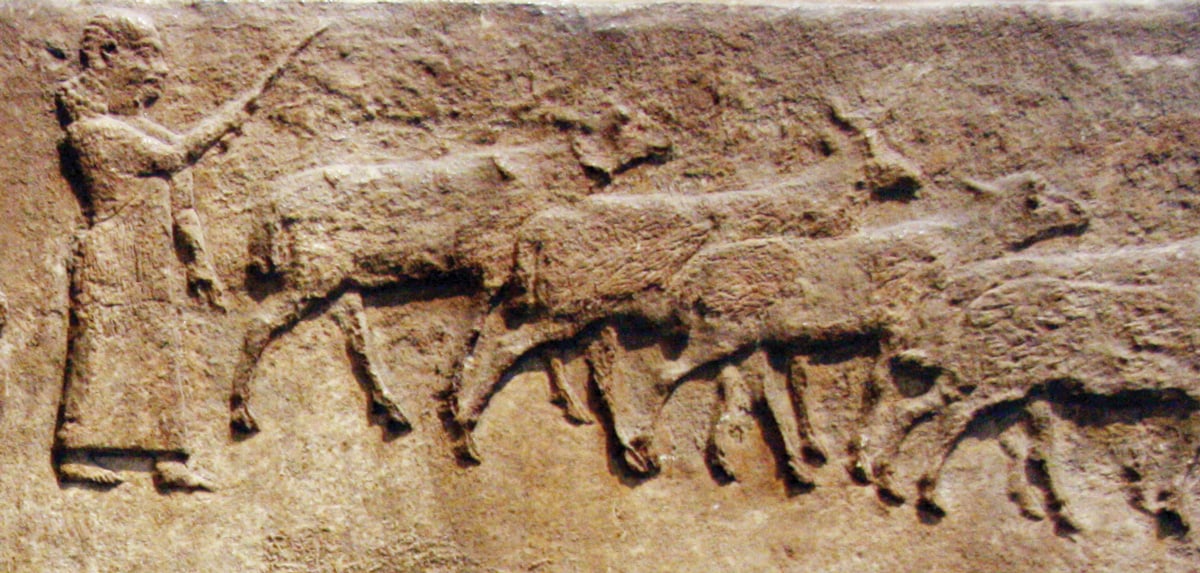
Isaiah 16:1 says to “send lambs as tribute.” In this Assyrian relief, sheep and goats are being led away from a captured town (palace at Nimrud, 728 BC).
An enemy will come from the north and free the refugees to migrate southward along the King’s Highway into Edom (15:1–9). Isaiah movingly and sympathetically pictures the fall of Moab’s cities: Kir, Dibon, Nebo, Medeba, Heshbon, Elealeh, and Jahaz. With the fall of these cities, ranging from the far north to the south, Moab has come to an end. The refugees clutch in their hands whatever they can carry and move southward, wailing over their misfortunes. Isaiah joins in the lament and evokes sympathy for the Moabites. They were, after all, Israel’s relatives through Lot (Gen. 19:36–37), and David was a descendant of Ruth the Moabitess (Ruth 4:17). The brooks have dried up, and the waters of Dimon (Dibon?) are filled with blood (15:6, 9). Thus, they cross the “Ravine of the Poplars” (Wadi Zered) into Edom.
From Edom (Sela; cf. 2 Kings 14:7) the Moabites send emissaries requesting asylum (16:1–5). They come with lambs as “tribute,” thus recognizing Judah’s supremacy. The prophet explains why it is important to seek sanctuary in Judah. First, oppression will cease from the world. Second, the messianic kingdom will be established, when a king will rule on David’s throne with faithfulness, justice, and righteousness.
Moab is insincere in her request for sanctuary with God’s people. They desire refuge from the enemy but not in the Lord and his Messiah. The heart of pride, conceit, and empty boasts has not changed. Therefore, judgment has overtaken them. Still, Isaiah laments the fall of Moab (16:6–12). He grieves over the ruined vineyards, fields, and orchards. The songs of joy at harvest time have been changed into songs of mourning. The produce once exported to other nations has ceased. Moab’s gods are unable to rescue her.
The date of Moab’s doom is given: “within three years” (16:13–14; literally “the years of a hireling”). The beginning of Moab’s disasters may have come in the Assyrian campaigns. Moab came to an end.
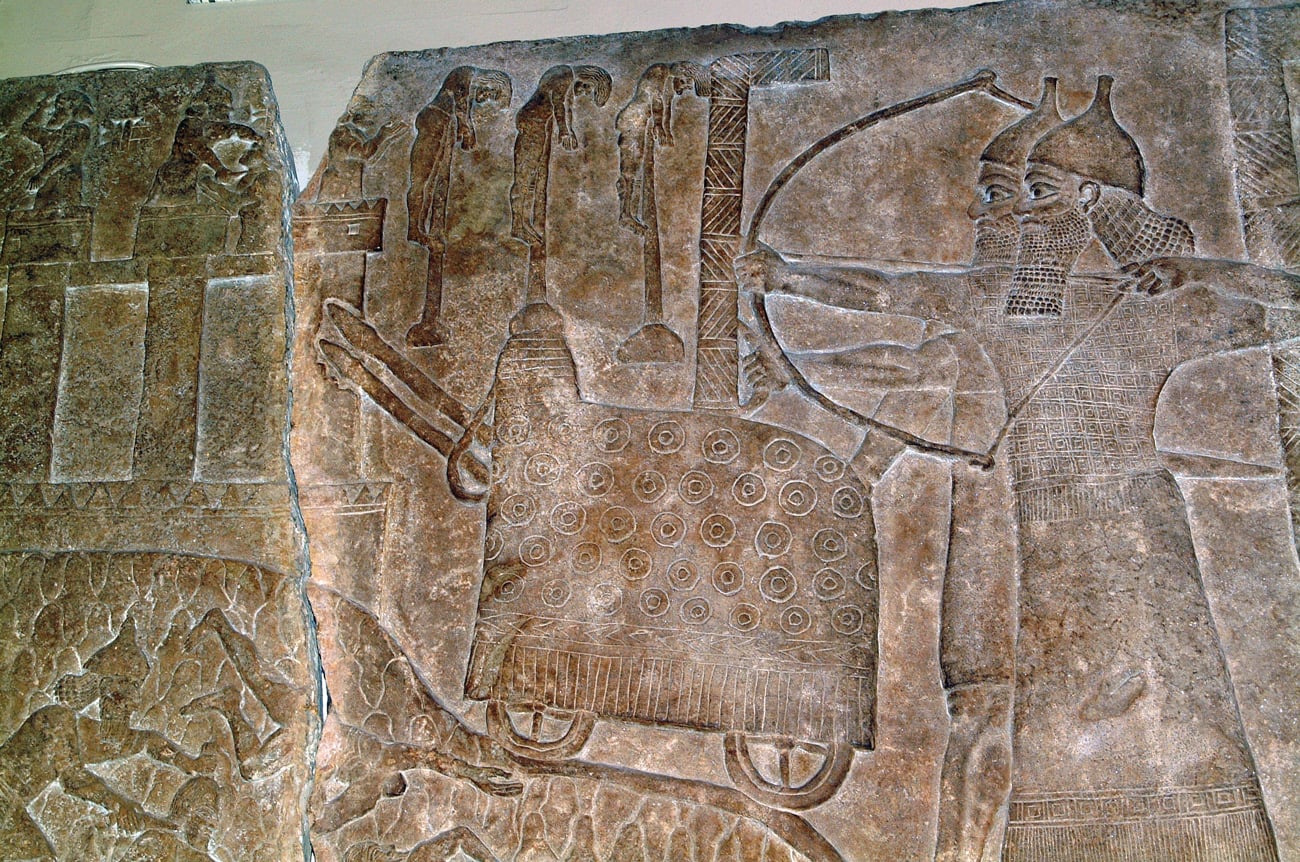
A scene featuring Assyrian archers and a battering ram, from one of Tiglath-Pileser III’s campaigns (738–737 BC) prior to his defeat of Damascus in 732
E. Damascus and Israel (17:1–14). The oracle against Damascus (a major city in Syria) is brief in comparison to the other oracles. It seems that this oracle is intimately connected with the judgment of Israel and the judgment on the nations. The structure of the chapter is far from simple. After the declaration of the oracle against Damascus, the prophet three times employs the introductory formula “in that day” (17:4, 7, 9), and the last section is introduced with the word “woe” (17:12). But if we look at the chapter from a literary perspective, we observe two major motifs in verses 1–3: destruction and the disappearance of glory. These motifs recur in verses 4–6, but in the reverse order, thus forming a chiastic structure. Verses 7 and 8 contain an invitation to repent, whereas verses 9–11 explain the reason for the destruction of the northern kingdom.
Finally, the last three verses give God’s judgment on the nations who have been involved in the judgment of Israel and Damascus. The historical background of the oracle against Damascus can best be understood in the context of the Syro-Ephraimite alliance (ca. 734 BC). Ephraim and Damascus thought they could free themselves from the yoke of Tiglath-Pileser III. As we have seen in our analysis of chapter 7, the prophet has forewarned the nations that their alliance will not undo the Davidic dynasty in Judah, nor will they succeed in destabilizing Assyria. Instead, both nations will shortly come to an end, which happened to Damascus in 732, when it was taken by Tiglath-Pileser III, and to Samaria in 722, when it was taken by Shalmaneser V and Sargon II.
The oracle against Damascus is addressed to the Aramean nation, against which the prophet has already spoken (chaps. 7–8). He portrays the city of Damascus in ruins and utter desolation (17:1–3). The flourishing city traces its ancestry back to a desert oasis. It developed from a caravansary to a major commercial center. The judgment reverses the progress of Damascus; it will again be a place where flocks are pastured (17:2). Since Ephraim and Aram have consolidated their strength, both nations will come to an end and their glory will be wasted.
Isaiah compares Israel’s future to a grain harvest in the Valley of Rephaim (17:4–6). Twice David fought there and defeated the Philistines (2 Sam. 5:17–25). The valley was important for the cultivation of grain needed for Jerusalem. The law of gleaning allowed for the poor to pick any ears of grain left after a harvest (Lev. 19:9–10; 23:22; Deut. 24:20–22). The future of Israel is likened to the scanty remains left to the poor for gleaning. Israel is also likened to the few olives left in an olive tree that has been shaken thoroughly during the harvest (17:6).
Verses 7–8 constitute a beautiful interlude in which Isaiah describes the future conversion of the remnant. The verb for their conversion is not the usual verb (“to repent” / “to return”) but rather it is “to look.” The people must recognize that Yahweh is “their Maker” and “the Holy One of Israel” (17:7). Therefore, they must refrain from looking to their illegitimate altars as the source of deliverance.
The fall of Israel results in exile so that the countryside will be characterized by depopulation (17:9–11). The reason for the judgment is given in verse 10. The people have forgotten the God of their salvation, their Rock, who could provide a refuge. Instead of committing themselves fully to Yahweh they have given themselves to pagan nature cults. The character of these cults is not clear; they may have been the cults of Adonis. It may very well be that at these sites there were also gardens symbolic of the powers of the deities. However, these people who do everything to appease the deities by cultivating the ceremonial gardens are assured that they will not be able to reap the benefits of their worship; rather, they will reap sickness and pain.
Isaiah uses alliterative devices to impress on his hearers that God’s judgment will affect a great multitude of the nations (17:12–14), which are described in terms of the raging sea and “the roaring of great waters” (17:12). It is as if the nations are going beyond the bounds set by God as they storm and foam, but God comes with a rebuke set in the language of a theophany. Yahweh’s coming is associated with a wind and a whirlwind. The power of Yahweh is so great that the nations suddenly appear like chaff or tumbleweeds. Thus it will be with the nations: one moment they are terrifying but the next moment they are no more. Isaiah adds one final phrase to encourage the godly remnant that God will deal justly with those who have oppressed his own.
F. Cush (18:1–7). Whereas 17:12 began with the Hebrew word for “woe” to introduce a general prophecy to the nations, this chapter begins with “woe” in verse 1 and focuses its prophecy on a more specific geographic region. As far as the time reference is concerned, it may be that the prophecy against Cush (Ethiopia) came some twenty years after the prophecy against Damascus (ca. 734 BC). In chapters 29–30 the prophet charges the people of Judah with independence from God and reliance on Ethiopia. In 705 BC Hezekiah sought an alliance with Ethiopia. This was because the Ethiopian king Shabaka controlled Upper Egypt as far as the Nile Delta. Apparently the Ethiopians had taken Egypt (715 BC) and negotiated an alliance with Hezekiah. From Isaiah’s description of the Ethiopians, it would seem that the Judeans stood in amazement of them because they were able to subdue the great power of Egypt. However, chapter 18 brings out God’s judgment on this powerful people while intimating that God has a place reserved for them in his overall kingdom purposes.
The literary imagery is very artistic, creating a mental picture of this distant nation (18:1–2). The land of Ethiopia was known as a place from whence the locusts came; and therefore, Isaiah describes it as “the land of whirring wings” (18:1). The reference also depicts the Ethiopians as being able to cover and dominate an area very rapidly. The Ethiopians are described as people who send their ambassadors across the water by means of papyrus vessels (18:2). “The water” probably is a reference to the Nile River, but it is unlikely that the papyrus vessels were used on as grand a scale as is suggested in verse 2. If we keep in mind Isaiah’s artistic purposes, however, we have before us a picture of a people who hasten to send their emissaries in light vessels to wherever their mission takes them. There is a certain ironic twist because the Lord has his own mission to the Ethiopians (18:3–6). He calls on his “swift messengers” to declare his word to the Ethiopians, who are further described as tall and “smooth-skinned”—an awe-inspiring people who have been able to expand their territory by trampling down their adversaries. Isaiah keeps us in suspense as to the nature of God’s message, by turning his attention to the inhabitants of the world. They must wait for the “banner” to be raised and the trumpet to be blown. God also waits, withholding judgment, as he looks at the plotting of the nations. He hovers over them from his dwelling place like the shimmering heat or an isolated cloud. Suddenly, the Lord seizes the moment and cuts down the nations like the branches of a grapevine (18:5). A vinedresser prunes the vines over the summer for cosmetic purposes and to increase the grape harvest. Once pollinated, the flower bears fruit, but the fruit takes three to four months to mature. God is likened to a vinedresser who, instead of waiting for the fruit to mature, comes in the heat of the summer to his vineyard and cuts off the shoots and the spreading branches, leaving these for the animals or for the birds of the air (18:5–6).
The people so carefully described in verse 2 are described in the same way in verse 7. They are still tall and awe-inspiring, but this time they are coming not as messengers of war but as worshipers of Yahweh. They are bringing gifts to Yahweh in Jerusalem. Instead of Judah bringing gifts to Ethiopia to placate her king and to join in her cause of rebellion against the Assyrians, the Ethiopians come to Mount Zion to placate the king of Judah. In this way Isaiah moves from the historical circumstances and context in which the prophecy has been written to an eschatological description. The eschatological hope of the psalms is that the people of Ethiopia might also experience the salvation of the Lord and that they too might be inhabitants of the New Jerusalem.
G. Egypt (19:1–20:6). Yahweh comes on a cloud in judgment on Egypt, especially on her religious system (19:1–4). With the collapse of her religion, Egypt’s social order falls apart. Egyptian will turn against Egyptian, city against city, and province against province. The hegemony of Pharaoh’s rule will be impotent in the face of these forces, and he must submit. The religious and political establishment thus abdicates to foreign rule and religious expressions.
In the second stanza (19:5–10), Isaiah portrays the end of Egypt’s economy. The Nile River and its many canals form the essential system of economic support in Egypt. Because of lack of water, the reeds, flax, and fish languish, and agriculture becomes impossible. Reeds were used for the production of papyrus, baskets, and simple artifacts. Flax was the raw product used in Egypt’s extensive production of linen. Egypt exported both her papyrus and linen and was economically dependent on these products. Another basis of her economic support came from the fish industry, but that too is devastated by drought. All people will mourn over the great depression.
The third stanza (19:11–15) points out the folly of Egypt’s counselors and princes. The intellectual elite are unable to avert the disaster. All are affected by God’s judgment. The one who caused all Egypt to cry out on the night of the tenth plague (Exod. 12:29) will bring Egypt to her knees again.
In 19:16–25, the prophet repeats the phrase “in that day” six times (19:16, 18, 19, 21, 23, 24). He speaks about the day in which great “terror” will overtake the Egyptians. The terror will be similar to the time when Israel came out of Egypt after Yahweh demonstrated his power in the ten plagues.
In Egypt itself five cities will speak the language of Judah (19:18). Because Jews settled in Egypt during the exile, Isaiah may be referring to the great Jewish centers in Migdol, Tahpanhes, Noph (Memphis), Pathros, and Alexandria. It is not clear what is meant by the “City of the Sun” (the NIV note explains that most Hebrew manuscripts read “City of Destruction,” 19:18), which commentators identify with Heliopolis. The Greek Septuagint suggests the reading “The City of Righteousness.” The issue also remains whether one can be certain about the identification of these five cities. To a large extent, the identification rests on our knowledge of Jewish communities in Egypt. Perhaps we should see “five” as symbolic for “many.”
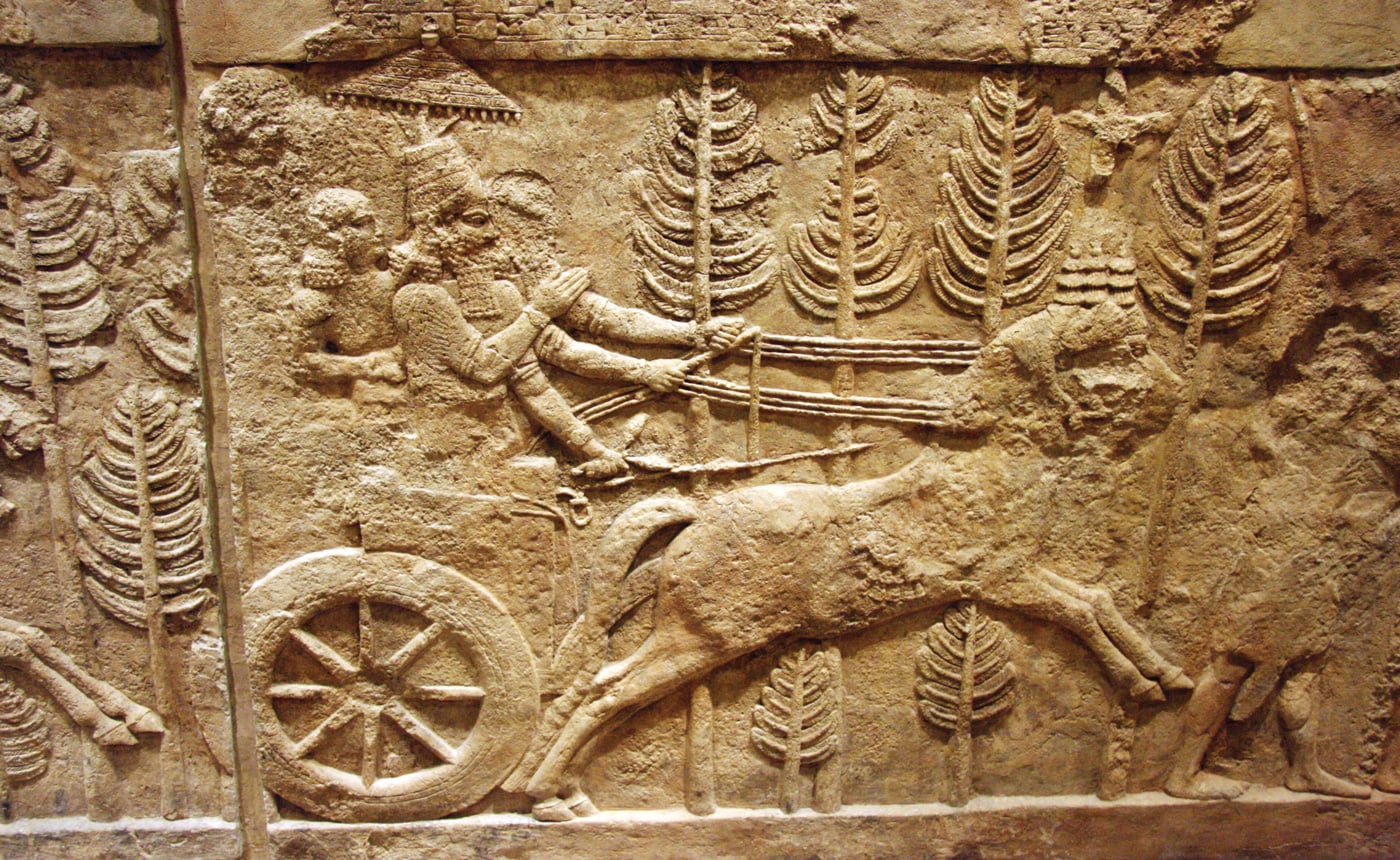
“Sargon king of Assyria” (Isa. 20:1) is depicted in his chariot in this Neo-Assyrian relief (721–705 BC).
In addition to cultural assimilation, the Egyptians will also assimilate religiously with the people of Judah. There will be an “altar” dedicated to Yahweh in the midst of Egypt and a “monument” (19:19) as a memorial to his redemptive power. The Egyptians will come with voluntary sacrifices in order to keep the vows that they have made to Yahweh, the God of Israel. They were struck with plagues in the past, but now they will experience healing from Yahweh himself.
The last verses speak about a highway extending from Egypt to Assyria, following the Fertile Crescent. The highway is symbolic of universal salvation, as it extends from west to east. The nations will join Israel in the worship of the Lord, and Israel and the nations together will be known as the blessed of the Lord.
The occasion of the prophecy of Egypt’s fall (20:1–6) is the conquest of the city of Ashdod by Tartan, the supreme commander of the forces of Sargon II. At this time the Lord commands Isaiah to walk about “stripped and barefoot” for three years (20:2). The period of three years need not be exactly thirty-six months, because in oriental fashion, any portion of a year is considered a year. The behavior of the prophet has a calculated effect. The Lord requires this of his servant because it will be “a sign and portent” against Egypt and Ethiopia to symbolize the way in which they will be carried off as exiles by the Assyrians. This prophetic word was partially fulfilled in 671 BC, when Esarhaddon conquered Lower Egypt, including the city of Memphis, and in 665 BC, when Ashurbanipal conquered Thebes, in Upper Egypt. Apparently Judah and Philistia continued to look to Egypt for help both in the rebellion of 705–701 BC and during the last days of Judah, when Zedekiah was looking for Egypt to help the weak state of Judah against the rising power of Nebuchadnezzar.
H. Babylon, Edom, and Arabia (21:1–17). These oracles are linked by the theme of the prophet’s office of watchman (21:6, 8, 11–12). Isaiah is waiting to see what the Lord is doing and proclaims what he sees as an oracle.
In the oracle concerning Babylon (21:1–10), the meaning of “Desert by the Sea” (21:1) is not exactly clear. It may possibly be the territory of Babylon north of the Persian Gulf. Isaiah compares the attack of Elam and Media on Babylon to whirlwinds coming from the desert. The prophet experiences great anguish when he understands the dire vision. He feels like a woman in labor and like a man who staggers. Anguish and fear fill his heart and incapacitate him. He sees the prepared tables, the banquets, and the drinking of the Babylonians, but he cannot reach the officers to warn them. They are unprepared; their shields have not even been oiled for battle (21:5). The prophet dramatizes his empathy to portray the sudden fall of Babylon. The picture fits in well with the feast of Belshazzar in Daniel 5. Though Isaiah expresses a longing for the “twilight” of deliverance from Babylon, his empathy keeps him from rejoicing. It is a day full of horror.
Next, the Lord commands him to serve as a watchman and to report on any movement. A man in a chariot gives him the awaited report: “Babylon has fallen” (21:9; cf. Rev. 18:2). This is God’s word of deliverance to his people.
The meaning of “Dumah” (21:11–12) is uncertain. It may be a corruption of the word “Edom.” This fits well with the reference to Seir (21:11), where the Edomites settled. Twice an Edomite calls on the watchman (Isaiah) to predict the end of “the night” of distress. Isaiah responds that the morning of “hope” will come but can say no more.
The Dedanites (21:13–15) were an Arabian tribe of caravanners and traders located close to Edom. The caravanners are not coming to Tema for commercial purposes, but to hide away in the “thickets” (desert shrubs) of Arabia as refugees from slaughter. They come south to Tema for food and water. They have encountered a strong enemy (Assyrians?), who has put them to flight with sword and bow.
The people of Kedar (21:16–17) were also known as caravanners and were respected for their prowess with bows and arrows. These warlike archers were able to protect the caravans as they migrated across the Arabian desert, but they are not able to defend themselves. In a prosaic statement, the prophet concludes the oracles by saying that disaster will also come on Kedar.
I. Jerusalem (22:1–25). “The Valley of Vision” (22:1, 5) is an obscure reference to Jerusalem. The context of this oracle (22:1–14) is best set in the events of 701 BC, when Sennacherib’s siege of Jerusalem was lifted. Judah lay in ruins and Jerusalem had paid a dear price for freedom. The leaders had not been loyal, and the soldiers were butchered without honor. While the people rejoice in their freedom, Isaiah is disconcerted. He must weep bitterly over what has happened to his people. The prophet speaks of another day, a day determined for the destruction of Jerusalem. The recent events, catastrophic as they were, are a picture of the Valley of Vision that God is preparing for all those who do not respond appropriately.
Isaiah looks out at “the Valley of Vision,” which was occupied shortly before by foreign troops (represented here by Elam and Kir, 22:5–7). The ravages of war are all around. Isaiah reminds the people of their anguish and nervous industry as they set out to repair the walls with stones taken from their houses and to store water for the long siege. But they have not looked to the Lord for help. They respond to crisis situations but do not respond to their sovereign God.
With the lifting of the siege, the people care even less for God. They are filled with a self-congratulatory spirit as they celebrate mock victory. The Lord will not forgive their callousness. His judgment on Jerusalem stands firm.
The arrogance of Jerusalem is symbolized in Shebna’s desire for power and recognition (22:15). The precise circumstances of Isaiah’s outburst against Shebna (22:15–19) are not stated, but Isaiah characterizes him as too ambitious (22:16). He will be disgraced, and Eliakim will take over his office with suitable honor. Eliakim did succeed Shebna in office (see Isa. 36:3; 37:2), while Shebna maintained a prominent position as secretary (36:3). However, even Eliakim’s position was not permanent (22:20–25). In a sense, Shebna and Eliakim represent the attitude of the people of Judah: arrogant and filled with selfish ambition. The fall of these men symbolizes, therefore, the ultimate fall of Jerusalem.
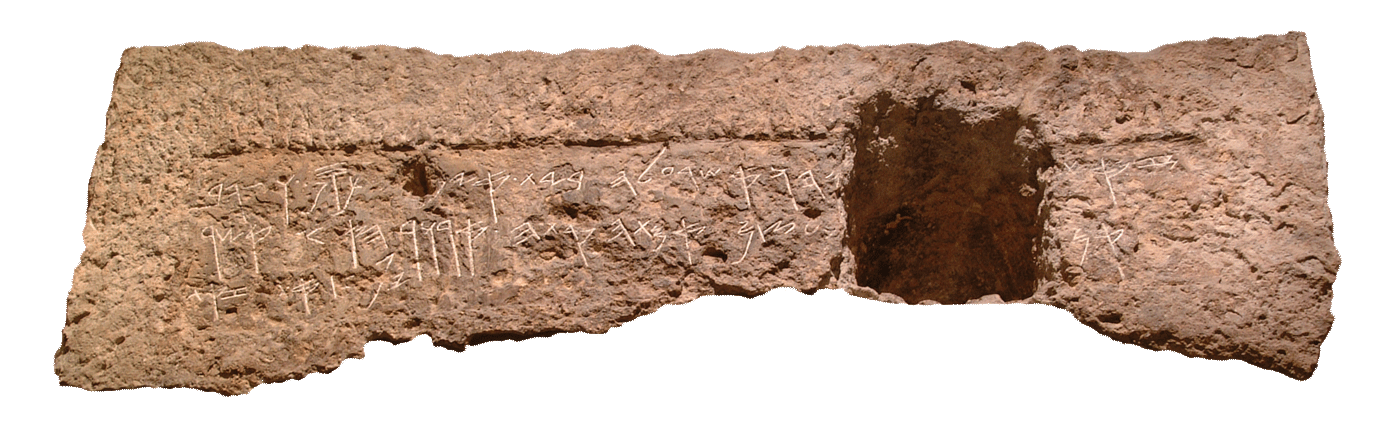
The inscription on this lintel from a seventh-century-BC tomb indicates that it belonged to a “royal steward,” whom many identify as the Shebna mentioned in Isaiah 22:15.
J. Tyre (23:1–18). The prophetic word against Tyre is singularly difficult. There are three main difficulties: the change of addressees (Sidon, 23:2–4, 12; Tyre, 23:1, 6–9, 15–18; Phoenicia, 23:10–12), textual problems, and the historical fulfillment of the prophetic word. The cities of Phoenicia were subjugated by Assyria (701 BC), Nebuchadnezzar, and Alexander the Great (332 BC).
The prophet begins the oracle with an indirect reference to the ships of Tarshish, the large vessels that plied the seas (23:1–5). The rumor of Tyre’s destruction is spread all around the Mediterranean area. From Larnaka, the port of Cyprus, to the ports around the Mediterranean, it is known that “the marketplace of the nations” (23:3) has ceased doing business. Egypt too will hear. Its reaction is anguished.
Isaiah calls on the people of Tyre to flee to Tarshish on the Atlantic coast southwest of Spain (23:6–9). Even though the prophet may not have the exact region of Tarshish in mind, he is at least calling on the people to flee the catastrophe that will befall Tyre. The city had enjoyed great prosperity. It was an ancient commercial center where tycoons ruled like princes. From Tyre these “princes” ruled over colonies and commercial empires. Because of its natural harbor, the history of Tyre goes back well into the third millennium BC.
The exultation of Tyre, however, has turned to lamentation. The ancient city has come to an end, and the glory of Tyre has been defiled. The prophet assures the people of God that whatever happens to the great cities of Phoenicia (Tyre and Sidon) is the Lord’s doing.
The people of Phoenicia can no longer depend on the trade advantages of Tyre (23:10–14). They will have to build up their own land. The Lord will judge Tyre, and his judgment is inescapable. The Babylonians/Assyrians (23:13—the text is difficult) are the instruments of his judgment. The ruin of Tyre, Sidon, and Phoenicia affects all maritime trade.
Tyre is compared to an old prostitute unable to attract interest (23:15–18). Its abandonment will last “seventy years” (cf. Jer. 25:12; 29:10). The round number is symbolic of judgment and restoration. After a period of time the people will be restored, but they must also recognize that a portion of their income must be set apart for the Lord of Hosts (cf. Isa. 60:4–14). “Set apart” is related to the word “holy,” and the prophet purposely uses this phraseology to indicate that the silver and the gold once used for secular purposes would be consecrated for God’s kingdom.
The prophecy, while it reflects historical events, has eschatological overtones. It is difficult to find a precise fulfillment for the restoration of Tyre except that in the middle of the third century BC Tyre again became a trading city. However, Tyre did not send a portion of its revenues to support the temple worship in Jerusalem. Tyre, representing all of the port cities and trading capitals of the world, is symbolic of God’s judgment on national wealth if that wealth is not used for the kingdom of God.
3. The Apocalypse of Isaiah (24:1–27:13)
These four chapters are known as Isaiah’s “apocalypse” because in them the prophet Isaiah introduces God’s universal judgment, the renewal of the earth, the removal of death and the effects of sin, the deliverance of his people, and the victorious and universal rule of God. The chapters do not possess the usual characteristics of apocalyptic literature (visions, symbolic numbers, animals), but Isaiah gives a glimpse of the future deliverance of God’s people and the establishment of his kingdom on earth after the judgment. The revelation is a witness to the power of God to keep his people, even in the face of all the turmoil they may experience on this earth. Likewise, Isaiah 24–27 stands as a witness of God’s power to judge this present world order and to create a new people for himself.
A. God’s judgment (24:1–23). In a couple of brief strokes Isaiah presents the extent of devastation effected by God’s judgment on the earth (24:1–13). The whole earth lies contorted or twisted, as by an earthquake (NIV “he will ruin its face,” 24:1). The devastation is nondiscriminatory and complete, in accordance with the word of the Lord. This destruction is the result of humanity’s grievous sin against God and his covenant of preservation (Gen. 9:9–17). His curse rests on all of creation. Humanity has transgressed against God’s holy ordinances governing the family, morality, preservation of life, and true worship. Therefore, God’s judgment must come upon all. All have sinned; all are covenant breakers, without exception. Yet God is faithful to his promises in the Noahic and Abrahamic covenants by preserving a remnant.
The earth is compared to a city after the ravages of fire, war, and earthquake. It lies in ruins. The people left in it are the survivors of the “gaiety” (NIV 1984) and “joy” of the past (24:11), which are symbolized by wine (24:7, 9). The songs of the revelers have come to an abrupt end, but a new song is being raised.
The joy of the redeemed remnant (24:14–16a) is like that of redeemed Israel, just as they joined Moses in a song celebrating the glory of Yahweh as king over his people (Exod. 15:1–18). From one end of the earth to the other, the redeemed of Israel praise the Righteous One. Jews and Gentiles together constitute the blessed remnant.
Isaiah returns again to the theme of universal judgment (24:16b–23). “I waste away” in verse 16b is variously translated as “woe to me” (NASB) or “I pine away” (RSV). The prophet represents all God’s children, yearning for the day of redemption and yet fearing the momentary expression of God’s great wrath on earth. It is a day full of “terror and pit and snare” (24:17), from which no one can escape. It is like a violent earthquake and a universal flood similar to Noah’s flood. All powers, spirits, demons, and forces of evil will be cast out of heaven and imprisoned in a “dungeon” (24:21–22; cf. 2 Pet. 2:4; Rev. 19:20–21; 20:10). Then the kingdom of God will be established with great triumph. The ultimate purpose of the judgment is that Yahweh alone may reign over this earth. The picture of Yahweh, the Lord of Hosts, reigning from Mount Zion and sharing his glory with all of his elders is a beautiful picture that anticipates the visions of the apostle John, as he describes the glory of the Lamb on his throne, surrounded by the elders (Rev. 4:10; 5:8–14).
B. The redemption of God’s people (25:1–26:6). The prophet’s song of thanksgiving (25:1–5) celebrates God’s victory over the enemies of his people as if it has already taken place. He is a refuge for his needy people in any age. Regardless of the exigencies of the present and the uncertainty of the future, the godly hold fast to their faithful God. The righteous are exhorted to look forward to the downfall of the capitals of the kingdoms of this world, namely, the centers of political and economic power, where ruthless tyrants rule. Isaiah provides a glimpse into God’s perspective of history as an assurance to the godly that Yahweh protects his people regardless of the intensity of their adversities. He will bring down evil and provoke their enemies to jealousy.
The Lord invites all obedient nations (24:14–16; 25:3) together with the Jews to a banquet on Mount Zion (25:6–8; cf. 24:23). Yahweh himself has prepared a rich banquet of the finest food and drink in order to celebrate his goodness. Since it is the godly who have been the helpless and needy (25:4), the eschatological banquet is described in the language of comfort and assurance. The Lord will take care of his people by providing for all their needs, a fact symbolized by the choice food and drink. He will also remove “the shroud” (“sheet”) of mourning, as he deals with “death” and its causes. The heavenly Father himself will comfort his children by wiping away their tears (25:8; cf. Rev. 7:17; 21:4). He will “remove [their] disgrace” and share his honor with them.
Then God’s children will respond with thanksgiving and confidence in God’s saving power (25:9–10a). True to character, Isaiah suddenly bursts out in hymns as he reflects on the great salvation and permanent establishment of God’s kingdom (24:21–23; 25:6–8; 26:1–6). God’s children wait (NIV “trusted”) for divine deliverance (25:9).
Moab is symbolic of all of the nations (25:10b–12). This may be inferred from the connection between this section and the section that described the ruthless nations and the palaces of the strangers (25:1–5). Though Moab has not been Israel’s greatest enemy, it too will be brought down. It will be trampled like straw being trampled down in manure (25:10). Though its inhabitants will try to save themselves, they will fail. God has purposed to bring down Moab’s pride.
The song of the redeemed (26:1–6) is not merely a song of thanksgiving but a celebration of trust in God, whose “city” of salvation will be glorious (cf. Psalm 46). The godly community awaits the moment of their redemption. In this section Isaiah addresses those who trust in Yahweh, encouraging them to wait in hiding for a little while until the Lord completes his judgment on the wicked.
The new song on the lips of the godly is a song of trust in the Lord, who protects his people as if they were in “a strong city” surrounded by “walls and ramparts” (26:1). God saves the inhabitants of his city, and Isaiah here describes those inhabitants as “righteous” (26:2) and faithful (26:2–3). The humble will be raised, while the proud and the oppressors will be brought low. The “old” people had a history of faithlessness and apostasy; the inhabitants of the “strong city” must be a people of integrity and loyalty. God will reward these people with his peace.
C. A prayer for God’s people (26:7–21). Isaiah further describes the nature of the people of God. He is aware that it may be a long time before God’s purposes are fully realized on earth. In order to encourage the godly community to persevere in righteousness and faithfulness, he offers a prayer of wisdom, confidence, and petition.
He prays that God’s people may be wise (26:7–10). Wisdom is the mark of godliness in the Old Testament, as it expresses dependency on Yahweh and his word. At the same time, however, it is not a slavish dependency in which the godly wait for Yahweh to approve every decision they make. They walk in accordance with his judgments (“laws,” 26:8) with a constant desire for God and with the hope that the nations will do God’s will on earth. Isaiah prays that godly wisdom may triumph over evildoers (26:7–11).
He also expresses confidence in the Lord, who will show his zeal for his people when he establishes peace for them (26:12–15). He will punish the wicked, who have no share in God’s redemption, but will “enlarge” his people and extend their borders (26:14–15). He raises up his own people and will rule over them exclusively.
Isaiah prays that the time of distress will soon pass and that, out of the suffering, the Lord may raise up a new people (26:16–19). God alone can initiate the era of restoration, and those who share in it will “wake up and shout for joy” (26:19).
The Lord responds to the prayer with the assurance that he will avenge Israel’s enemies because of their sins (26:20–21). Even though the bloodshed has seemingly been covered up, justice will prevail. The Lord will reveal everything that has been hidden. He encourages the godly to wait until his purposes for this present world have been fulfilled.
D. Deliverance of Israel (27:1–13). God will finally give a death blow to “Leviathan” (27:1), symbolic of the rebellious heavenly host (27:1–13; cf. 24:21). The descriptions “gliding” and “coiling” are also used to describe Leviathan in Ugaritic (Canaanite) literature. The Old Testament uses the language of Canaanite mythology in order to express God’s control over evil, chaos, and rebellion. The New Testament also employs this symbolic language (Rev. 12:7–10). Leviathan is the master of the sea, whose punishment marks the end of rebellion in heaven and on earth.
Isaiah develops his vineyard poems (5:1–7) into an eschatological picture (27:2–6). Though the vineyard has been destroyed because of its utter worthlessness, God remains faithful to his people. Because the leaders were responsible for the ruined vineyard (3:14), the Lord himself assumes responsibility for its care. He watches, waters, and protects it. He will make war against anyone (“briers and thorns,” 27:4) who opposes his people. He prevents those conditions he has previously permitted to ruin the vineyard (5:6). He is not angry but desires reconciliation with even hostile opponents.
His purpose for the vineyard is success on a grand scale. The root must be well established before the blossoms will produce their fruit in “all the world” (27:6). The kingdom of God gradually extends as God’s new people are grafted in. These new people are expected to conform to God’s justice and righteousness.
Isaiah 27:7–11 is obscure and intrusive. These verses are best regarded as a reflection on suffering. The Lord cleanses his people by exile and judgment (27:8; NIV “by warfare and exile”; literally “measure by measure”). They must abandon idolatry and return to the Lord. Even so, God does not kill off his people as he did his opponents, whose “fortified city stands desolate” (27:10). Outside the walls, their farms are so devastated by drought that tree branches are used to kindle fires.
Nothing can hinder the return of the tribes of Israel from Egypt and Assyria, because the Lord himself has ordained it (27:12–13). This is his harvest (27:12; cf. Rev. 14:15). The “great trumpet” (ram’s horn) ushers in the eschatological kingdom, when the restoration takes place. The prophet uses the language of inclusion and welcome as he refers to the borders from the Euphrates to the Wadi of Egypt (Wadi El Arish, fifty miles southwest of Gaza), from where people will come to worship the Lord on Mount Zion. This word found partial fulfillment in the restoration from exile (539 BC). The New Testament extends the symbolism to God’s worldwide harvest, when Jesus returns (Matt. 24:31; 1 Cor. 15:52; 1 Thess. 4:16). The trumpet blast marks the end of humanity’s rule and the introduction of the full reign of God on earth.
4. Oracles of Woe (28:1–33:24)
The material in these chapters is loosely connected by the repetition of “woe” (28:1; 29:1, 15; 30:1; 31:1; 33:1) and seems to date to the period of Judah’s troubles with Assyria, during the reign of Hezekiah.
A. Ephraim (28:1–29). This section comes from a time before the fall of Samaria when the enemy of Israel was already on the horizon. Assyria is likened to “a hailstorm and a destructive wind” and “a driving rain and a flooding downpour” (28:2). Imagery of overflowing water is also found in Isaiah 8, where the prophet describes the coming judgment on Israel and Aram. The northern kingdom is likened to a “fading flower” (28:1) because the beautiful and fertile valleys characteristic of Ephraim would soon be overrun by Assyrian troops. The agricultural advantages of the northern kingdom were significant. It had excellent soil, large valleys, and finely terraced hills on which the people were able to farm and enjoy their olive groves. With all of the advantages of the northern kingdom, the people had become independent and proud. Even as the wind and rain had given economic prosperity to the northern kingdom, God’s judgment, likened to wind and rain, would destroy Ephraim. The freely given covenant blessings did not elicit an appropriate response from Ephraim. The beauty of Ephraim, like a ripe fig, will be enjoyed by foreigners (28:4).
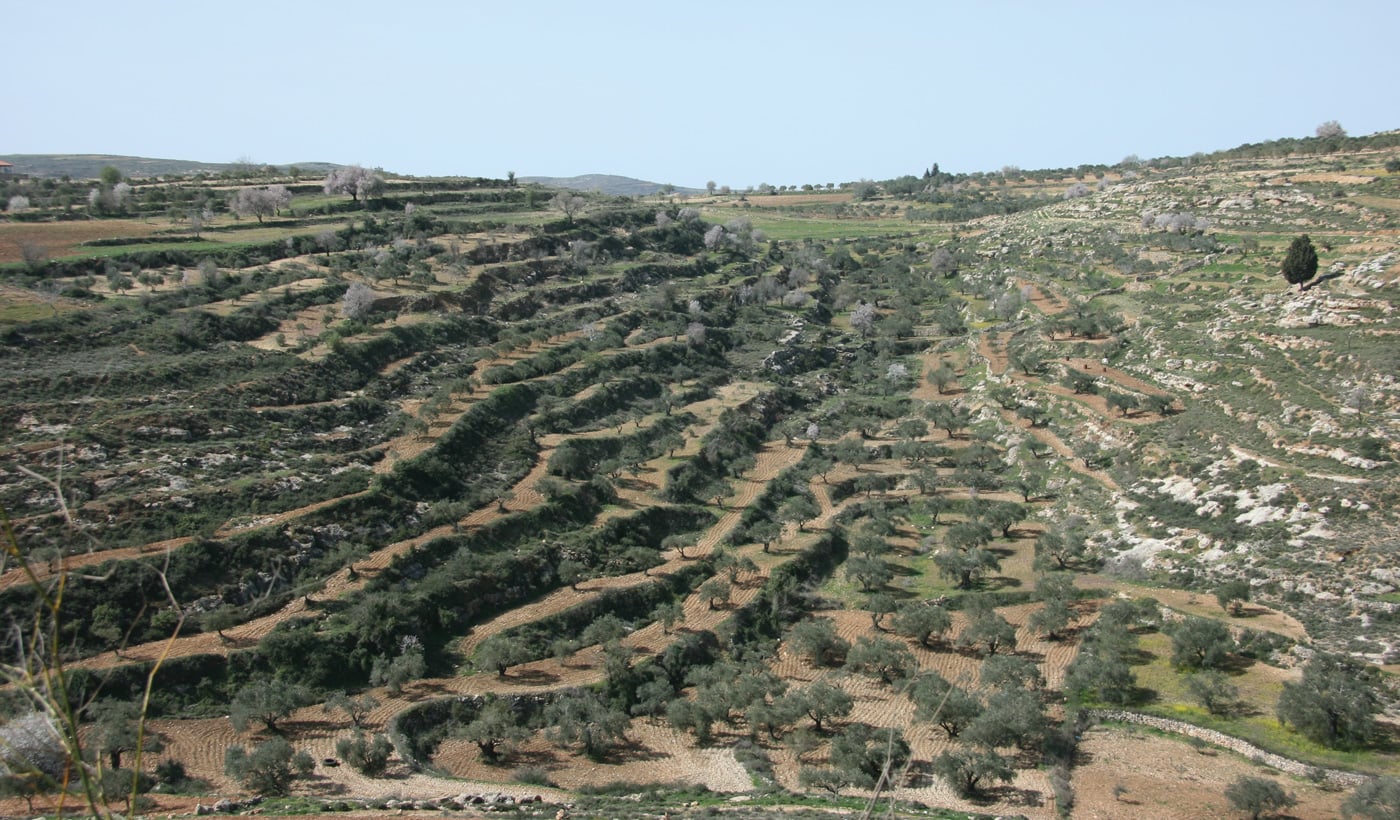
Terraced hillsides in Israel
In contrast to the self-exalting pride of Ephraim, the Lord will establish his glorious kingdom of justice and strength (28:5–6). The nobles of Ephraim cannot protect the people because of their drunken stupor, but the Lord will protect and strengthen the remnant that survives in Judah. The enemy will be stopped, and kingship and theocracy will continue there by divine decree.
Judah’s status was no better than Ephraim’s. Even though Judah existed another 150 years after the fall of Samaria, the situation in the southern kingdom was generally no better than that in the northern kingdom (28:7–13). For this reason Isaiah strongly condemns Judah. In fact, his language is stronger against the southern kingdom than against the northern kingdom. He accuses Judah’s leaders of drunkenness, an unteachable spirit, scoffing, and self-confidence.
Though the Lord is gracious in sparing Judah, its religious leaders are incapable of rendering decisions and of proclaiming the visions of God because of their drunken stupor. While sitting by their filth (28:8), they mock Isaiah, speaking like a babbler who is explaining his message to babes and infants or like a kindergarten teacher who begins by teaching sounds: “tsav latsav tsav latsav / qav laqav qav laqav” (28:10). By mimicking the sounds, the religious leaders express the intensity of their hatred for God’s word.
To this mockery, Isaiah responds with God’s word of judgment. Whereas the Lord has given the land to Israel as a place in which they might receive his blessings, foreign invaders will come and speak like babblers. The people who have rejected the warnings of approaching judgment as unintelligible and irrelevant will hear the same message from these foreign invaders. Then, however, it will be too late, because they will be taken captive. The prophets of whom Isaiah speaks are the false prophets called to share visions and give judgments but unable to do so because they are prostrate in their own vomit.
The leaders of God’s people are unteachable, and for this reason they have little to teach others. They mock the prophet by asking the rhetorical question, “Who is it he is trying to teach?” (28:9). They think he is nothing more than a repetitious schoolteacher.
These four characterizations (drunkenness, unteachable spirit, scoffing, and self-confidence) portray Jerusalem’s leaders as completely insensitive to Yahweh’s law and to the covenant. They have broken away from Yahweh and are unable to lead his people back to righteousness. Yahweh’s words of response are directly related to chief accusations the prophet has made. First, foreign enemies will come into the country and take it. As the foreign forces will be using foreign languages (28:11), the people themselves will feel like uncomprehending children. Whereas God has encouraged the people to find rest and repose for their souls (28:12), they instead will be taken into exile by the enemy. In addition to this, the confidence and scoffing of the people will turn to terror. The people thought they were invincible. They put their confidence in the security of Jerusalem, their leaders, the temple of Yahweh, and the priests. However, on the day of God’s judgment, they will not be able to stand because Jerusalem will be trampled down. The people themselves will go from terror by day to terror by night. That day will bring no peace or comfort. The prophet likens this to a time when the bed is too short and the blanket too small (28:20). Isaiah further exhorts the people to cease their scoffing lest the judgment of God be intensified.
The political leaders also scoffed at the prophet. They did not believe that trust in the Lord (“a tested stone,” 28:16) was the answer to Judah’s political woes. Instead, they had relied on a covenant with Egypt. The prophet facetiously calls this treaty “a covenant with death” and the guaranteed protection a “lie” and a “falsehood” (28:14–22). They firmly believed that they had power to avert the judgment, which is likened to a flood.
Set over against the false security of political alliances is Yahweh, the “tested stone,” a “cornerstone” who provides a solid foundation for all who trust in him (28:16) and order their lives in accordance with his absolute standards of justice and righteousness. He, however, will not provide any refuge to those who have made foreign alliances. Death will overtake them, and Yahweh will execute his judgment. Then their self-made remedies, like a short bed and a narrow blanket, will not work. The Lord will do a work, not to save, as he did at Mount Perazim in David’s day (2 Sam. 5:20–25), but to destroy. The decree has gone forth from the Lord Almighty.
The wise farmer does not plow continuously but organizes his operation so as to have a time and place for plowing, sowing, and harvesting (28:23–29). Even in the process of harvesting, the farmer knows exactly which tools will obtain the desired harvest. So it is with God. He sovereignly and wisely administers his rule.
B. Ariel (29:1–24). The background of the prophecy against Ariel may best be found in the years preceding 701 BC. A power struggle had taken place between Sennacherib and the eastern nations, making it possible for the western nations to rebel. During these years, Hezekiah turned to Egypt for help (30:1–2; 31:1). This political option was reasonable; Sennacherib was busy on the eastern front. The alliance between Aram, Phoenicia, Judah, and Egypt made it imperative for Sennacherib to deal quickly and decisively with his eastern problems and then turn his attention to the west. During the intervening years, the psychological mood in Judah was very positive. The people felt less threatened and were hoping for a strong political and economic resurgence. Yet Isaiah had already prophesied that Assyria was to be the instrument of God’s judgment—even on Judah (8:7–8; 10:5).
With the possibility of an independent Judah on the horizon, the people viewed the prophet’s words with skepticism. After all, it had seemed that the prophet spoke about a doom greater than could be realized. The future of Judah would be determined by the people and their political skills rather than by the word of God.
The prophet preaches the word of the Lord in these optimistic times (29:1–4). He addresses Jerusalem as “Ariel” (Lion of God), though it is uncertain why; there is no scholarly consensus on the meaning of the term. Some have proposed that this may be an ancient Canaanite name for Jerusalem; others have suggested that the gates of Jerusalem may have had lions as a part of their decoration.
Isaiah first brings a woe on Jerusalem, the city where David lived and where the temple stands. In spite of its ties with the temple and David’s dynasty, Yahweh plans to bring down Jerusalem. The future of Jerusalem will be filled with distress, lament, and mourning, because Yahweh has turned against the people and surrounded them like an enemy surrounds a city. Isaiah describes Jerusalem in a state of humiliation, likening it to a conquered city whose inhabitants are pushed down into the dust begging for mercy from their conquerors (29:4). The voices of the dead also cry out from the dust.
Jerusalem will be covered by the multitude of her enemies, which are compared to fine dust or chaff (29:5–8). The future of Jerusalem looks bleak because Yahweh himself comes against his people, who have been enjoying security but are relying on Egypt for their survival.
The devastation, compared to thunder, loud noise, winds, tempest, and fire, is reminiscent of Yahweh’s revelation on Mount Sinai (Exod. 19:16–19). This is a prophetic proclamation of the judgment to come on the day of the Lord.
Though Yahweh has given up Ariel to the nations, he protects the remnant of his people. The nations who rise against Judah and Jerusalem will leave empty. The prophet likens the reaction of the nations to that of a hungry or thirsty man who has dreamed of being satisfied but in the morning wakens to find he has not actually eaten or drunk (29:7–8).
This will be the experience of any nation that fights against the people of God. They will have a measure of victory, but it will not last. Yahweh is still with his people. How comforting these words are to the people of God living at any time and in any place! Regardless of how God’s people may fail, he has a plan to redeem a people for himself and will continue to work out the goals that he has decreed from eternity.
There are some who believe that the prophet’s words are not meant for them but possibly for others in another time. They are blind to the revelation of God (29:9–14) and are like those who stagger in a drunken stupor (29:9) and those who have fallen into a deep sleep that renders them unable to hear and respond to the warning of imminent judgment. There is a real danger in not applying the word of God to one’s own time or in lacking interest in how the word of God may be applied.
Assyria’s siege of Jerusalem was imminent. In 701 BC they surrounded Jerusalem after devastating the countryside of Judah and leveling her fortified cities. It was only then that the people began to see; it was too late, however; they had not responded appropriately to the prophetic message.
Isaiah concludes with a warning to the people at large (29:13–14). He again accuses them of hypocrisy (cf. chap. 1). The people come into the courts of the temple to pray and sacrifice, but their real love is not for Yahweh. Their wisdom is the wisdom of this world, and at that time the wisdom of the world dictated that Jerusalem ally herself with Egypt. The wisdom of that time perished, as subsequent events have shown. God, however, calls his people to a wisdom that comes from on high. He will stun them with his wonders of judgment and devastation. The future of the people lies, therefore, not in their own scheming and planning, nor in self-confidence, but in Yahweh himself.
The prophet renews his proclamation of “woe” on the people who plan and scheme as if Yahweh does not know or see (29:15–24). The people are the clay and the Lord is the potter, but the clay is skeptical and critical of the potter’s abilities (29:16).
Thus far Isaiah has portrayed a number of the people’s reactions: apathy (29:9–10), disbelief in the relevance of the prophetic word for their time (29:11–12), formalism and hypocrisy (29:13–14), and dependence on human scheming and planning apart from God (29:15–16). Yet, however dark the day may be, God still has a message of salvation for his people. Isaiah now calls to spiritually sensitive people—those known as deaf, blind, poor, afflicted, and needy. The deaf and the blind are those who have suffered the judgment of God and now respond to his revelation. The afflicted and the needy are those who have experienced God’s judgment and whose hearts search for the living God. The spiritual remnant will hear the word of God, see the salvation of the Lord, and rejoice in Yahweh himself.
The focus of this section is on the work of the Lord in history. The Holy One of Israel, who destroys cruel people and oppressors, gives cause for joy to people who have faith in him. The promise is to the “redeemed” children of Abraham, his spiritual seed (29:22). The promises concern the work of final restoration begun in history. The Lord will transform them into a holy people who will serve him from the heart.
C. Foreign alliances (30:1–33). The background of chapters 30 and 31 lies in the diplomatic mission to the Ethiopian ruler Shabaka, who extended his rule as far as the Nile Delta. Because of the increase in Shabaka’s power, the Judean aristocracy considered the possibility of an alliance between Shabaka, Hezekiah, the Philistines, and the Phoenicians against the Assyrian king Sennacherib (705–701 BC).
The leadership of Judah relied on political solutions to political problems (30:1–7). They made every attempt to solve their problems creatively, without consulting the Lord. Instead of finding “protection” and “refuge” (30:2) in the Lord, they looked to Egypt for help against Assyria. Ultimately, however, their plan failed; Egypt used Judah to its own advantage, and Judah was disgraced.
The stubbornness and folly of Judah’s leaders are highlighted by the description of the desert and the caravans that traverse the desert from Judah through the Negev and the Sinai to Egypt. Isaiah describes the desert as a place filled with anguish and loneliness, a desolate area to travel. Apparently the Via Maris (or Way of the Sea), which was the usual route between Judah and Egypt, was not open because the delta was controlled by the Egyptian Saite dynasty. Thus, the best road was not available for the Judean caravans, and they had to take the more difficult desert route to Egypt.
The desert is filled with dangers. The purpose of the reference to the animals is to make it clear that the people of Judah sent their emissaries through a torturous terrain filled with difficulties in order to get absolutely nowhere! The leaders of Judah go to great pains to have a caravan laden with precious objects sent to Egypt to obtain the favor of the Egyptians for their own political purposes. But Egypt is not able to help.
The last part of verse 7 is somewhat difficult in its description of the situation in Egypt. It is possible to read this as a question: “Is this the mighty one (Rahab) sitting still?” Apparently, the efforts of the Judeans to buy security would be futile because their fine treasures could not guarantee that Egypt would be in any position to help. As it turned out, the Egyptians were defeated by Sennacherib at Eltekeh. The areas of Phoenicia, Philistia, and Judah were taken, and Jerusalem was surrounded by Sennacherib in 701 BC.
In 30:8–17 Isaiah returns to the theme of rebelliousness. Judah has been rebellious against Yahweh for some time, rejecting both his law and his prophet. In order to remind the future generations, Isaiah is commanded to write on a tablet the testimony (or witness) of God against Israel and Judah. The language of the witness is reminiscent of Moses’s Song of Witness (Deuteronomy 32) and of Joshua’s stone of witness (Josh. 24:26–27). The history of Israel and Judah is incriminating evidence against the people. They have been called to be Yahweh’s people, but in essence they are false sons who have not responded appropriately.
Isaiah’s words are a testimony to those who hate the word of God and thereby the Holy One of Israel. God’s word becomes for them a word of judgment. If they persist in their self-reliance, they will suffer a sudden fall. They are like a wall that has been standing for a long time but already shows evidence of weakness by a protrusion. The wall may stand for many years but will suddenly cave in; so will Judah (30:13–14).
Israel is also like a piece of pottery. A potter’s jar may be beautiful and may function very well. When shattered, however, it is of no use. One cannot even use the sherds to take coals of fire from the hearth or to dip water from a pool (30:14).
Before destruction comes upon Judah, Isaiah calls on the people to return to the Holy One of Israel. Salvation does not lie in heroic acts but rather in repentance and trust in Yahweh. Faith and repentance are requisites for true salvation. Instead of turning to Yahweh, Judah has shown a history of unwillingness to return, responding instead by relying on horses and military power. Since they are intent on rejecting Yahweh’s gracious invitation, Yahweh deals with the people accordingly. They rely on horses; in their haste they will have to flee as though they are on horses. Instead of experiencing God’s blessing, whereby a thousand enemy troops are routed by one Israelite (30:17a), they will experience the opposite—the entire nation fleeing from a handful of enemy troops (30:17b).
The grace of God is still evident in the remnant that will remain. They will be like a small military outpost—a flagstaff on a mountaintop or a banner on a hill. Few will be left, but there will still be some to whom the Lord will continue to show his grace.
The first effect of God’s grace is that the sorrow of the people will be removed (30:18–26). Those who have been weeping and crying because of their great distress are assured that Yahweh will answer their prayers and will heal all their hurts. Yahweh comes to heal the wounds of his people and to assure their well-being—physical as well as spiritual. Another way in which Isaiah describes the grace of Yahweh on his people is by delineating his blessings. The grace of God is free. How different is God’s guidance; he leads his people into the way that leads to blessing! Isaiah poetically describes the blessings of rain and sun. This combination makes it possible for crops to grow and produce abundantly, for animals to roam and be satisfied, and for people to have plenty of bread and water. In the land Yahweh blesses, there will no longer be any evidence of idolatry.
Isaiah returns to the theme of Yahweh’s justice with respect to his enemies (30:27–33). The enemies of whom he is speaking are the Assyrians in particular (30:31), but Isaiah’s words may be applied to all the enemies of God’s people.
First, Isaiah describes the greatness of Yahweh’s wrath. He comes in burning anger, symbolized by smoke and fire, in order to completely wipe out the enemy. Fire, wind, and flood (30:27–28, 30–31) are the prophet’s favorite metaphors for the wrath of the Lord. The nations are put into a sieve and shaken back and forth so that the wicked might be removed. Isaiah also likens Yahweh’s judgment to “a bit” that leads the people to their destiny (30:28). None of the wicked will remain. The destiny of the nations is also described as the destruction of the wicked in the Valley of Topheth, south of Jerusalem (30:33). Here Yahweh will set up piles of wood on which the bodies of the enemies of his people will be placed, and with the breath of his mouth he will set these stacks of wood aflame.
The destruction of the wicked is cause for joy among the people of God, who have been suffering under the ruthless power of their enemies. They are portrayed as singing in the night as during the days of a festival. They will be glad, and not afraid, because their faith is in the Rock of Israel (30:29). There will be ritual rejoicing as they make music with their tambourines, lyres, and other instruments. They cannot help Yahweh in his war against the enemies; it is Yahweh’s war. Instead, they must wait quietly with assurance that, when Yahweh is finished with his enemies, the victory will also belong to them.
D. Judgment and hope (31:1–32:20). Isaiah charges Judah’s leaders with seeking autonomy by depending on Egypt’s military superiority (31:1–9). In the ancient world, superiority generally belonged to those kings who had a great number of horses and chariots. In order to fight military power with military power, Judah relied on the force Egypt would be able to provide against the great power of Assyria. It became proverbial in Judah that the opposite of reliance on Yahweh was the reliance on horses and chariots (cf. Ps. 20:7).
Isaiah calls on the people to look to the Holy One of Israel for wisdom and help. If they do not, his wisdom will turn against them, and his hand will destroy both his enemies and all who do not lean on him. The people must remember that all who do not look to Yahweh for their protection have abandoned the Holy One of Israel, who is powerful to put down human inventiveness and all the powers that oppose him.
Yahweh can protect his people! The prophet likens him to a lion, intent on getting his prey even when many shepherds make a loud noise to scare him off, and to fluttering birds, intent on scaring away a would-be intruder to protect their young in the nest. The Lord is strong like a lion as he destroys the enemies and caring like a bird as he protects Judah (31:4–5).
In order to assure themselves of Yahweh’s protection, the people must respond with willing submission and repentance. The future belongs to those who repent by returning to the Lord in faith and turning from paganism.
Isaiah describes the effect of Yahweh’s anger on the Assyrians. They will fall by God’s decree and not by the sword of man, and the young men will become forced laborers. The Lord’s wrath, symbolized by “fire” and “furnace” (31:9), is in Jerusalem. He has a purpose for Jerusalem and will not permit it to fall.
The future age will be characterized by righteousness and justice (32:1–8). The king, leaders, and people will be concerned with the pursuit of wisdom from above. The wise man is blessed in that he represents God’s blessedness; he is “a shelter,” “a refuge,” “streams of water in the desert,” and shade (32:2). No longer will God’s people be characterized by deafness and blindness, but all will hear, see, and act in accordance with the word of God. They will hasten to do his will on the earth in contrast to the past, when they hastened to do their own will. In their pursuit of godly wisdom, they will hate folly and wickedness. The wise person pursues what is noble (i.e., godly wisdom). The wise people of God will no longer take their counsel in accordance with earthly standards and be primarily concerned with earthly matters, but rather they will have new standards and concern about the things that pertain to God himself.
The “women” finding rest are characterized by having confidence in the future (32:9–14). These women are described as women of ease and complacency (32:9), not wanting to be troubled. They seem to be happy with the way things are, when they should be beating their breasts (32:12), trembling (32:11), dressed in sackcloth (32:11), and troubled (32:11) because of the thorns and briers that rob the land of productivity. The women of Jerusalem are sitting back in ease while sin destroys the fruit of righteousness and bankrupts the city, leaving her abandoned and forsaken.
Isaiah now returns to the description of the era of righteousness (32:15–20). The only way in which folly will change to wisdom and the devastation of the land to blessedness is by a divinely ordered transformation. Restoration is the work of the Spirit, bringing about a return of the blessings of God on his people and on the earth. The creation will be renewed, wisdom enthroned, righteousness established, and peace restored to the people of God. The wise will experience the blessings of God in every area of their lives.
Reliance on Yahweh is one of the major emphases in these chapters. In response, God’s people wait for the fullness of redemption. As Christians, we believe the day of redemption is closer since the coming of the Lord Jesus. Yet, along with the saints of the Old Testament, we must have a real sense of hope and longing for the fullness of redemption to which the prophet bears witness.
E. Distress and help (33:1–24). God’s judgment (“woe”) rests on those who have enjoyed absolute power in this world (33:1–6). Because they have caused great devastation on this earth, they must answer to the Lord. When he comes he will sound a loud battle cry (33:3) to avenge himself on the nations.
This judgment on the ungodly is in response to the prayer of the godly. The godly have been asking for Yahweh’s grace to appear to them because they have been suffering while ruthless hordes were controlling the world. Their hope has been that Yahweh’s strength might be revealed to them in salvation. Yahweh comes as King (33:5), seated on his throne of judgment to dispense justice and righteousness. The benefits of Yahweh’s rule for his people are many: salvation, a firm foundation, and wisdom. The godly experience salvation and practice wisdom and knowledge in the fear (“awe”) of the Lord.
Isaiah shows that the benefits of the messianic kingdom will be limited to the godly (33:7–16). The enemies of the kingdom from both within and without will be destroyed. For this reason, the prophet addresses the men of Ariel (33:7). Scholars are in general agreement that the phrase “brave men” (NIV) may be understood as a reference to Ariel (cf. Isa. 29:1).
The proud cry because their plots have been frustrated. They have not been able to avert the very thing that they feared. The highways will become desolate, the judicial processes will be interrupted, and the land will be devastated by enemies.
Yahweh will arise in judgment. The works of the godless will consist of little more than “chaff” and “straw” (33:11). All their selfish efforts within the covenant community will be burned up. Who, then, can come through the consuming fire? Only those who have walked righteously and have spoken uprightly and have hated bribery and oppression (33:15; cf. Ps. 15:1–5; 24:3–5). The godly will receive protection and provision from the Lord.
The godly will see not only Yahweh’s coming in great vengeance and fury to judge the wicked but also the glory of Yahweh in its full and radiant beauty (33:17–24). The realm of Yahweh’s rule will be extended, but there will be no place for the wicked in his kingdom. Zion, the city of God, will be full of peace like a river where no hostile ships can sail (33:21).
Yahweh the majestic one will be for his people and will provide for them a river of life (33:21; Rev. 22:1). The songs of Zion celebrate the glory, beauty, and rivers (or springs) found in the city of Zion. Yahweh will be present as the king, judge, and lawgiver of his people. He will rule, guide, and teach his people so they will know how to live in his presence. The new age will bring renewal and a deep awareness of forgiveness.
5. Cataclysmic Judgment (34:1–17)
Again Isaiah returns to the theme of God’s anger against the world. God’s judgment will effect complete destruction, leaving the world uninhabited.
In powerful language Isaiah calls on all nations, who are the object of the Lord’s anger, to hear the word of God (34:1–4). The judgment is likened to a great slaughter or sacrifice (34:1–2). On the earth, the slain will be everywhere; corpses will stink and blood will cover the mountains. In the heavens, constellations will disappear.
Isaiah focuses on Edom as representative of the nations (34:5–17). Yahweh’s judgment on Edom will be similar to what he will do to the whole world. Edom is under the “ban” of the Lord (34:5). The term “ban” (Hebrew herem) expresses Yahweh’s decree to destroy a people for his own purposes. The sword will pierce Edom and fill the country with blood, as though a great sacrifice has taken place. The day of God’s judgment is the day of vengeance on his enemies and of the vindication (“retribution”) of his people.
After the destruction of its people and animals, the land itself will become worthless and desolate forever because of the brimstone and pitch that will cover it (34:10). It will revert to a wilderness with thorns and nettles, a place fit only for wild animals.
All things will be subject to God’s judgment. When Yahweh comes in judgment, there will be no way of escaping. Yet there is the promise that those who belong to Yahweh are heirs of the new age.

Isaiah 35:2 describes the “splendor of Carmel and Sharon.” This aerial view shows the fertile Sharon plain, located between Joppa and Mount Carmel.
6. The Day of God’s Glory (35:1–10)
The discussion in Isaiah 35 complements that of the day of the Lord’s vengeance (34:8; 35:4). Here the prophet portrays the glories that await the people of God (35:1–7). Whereas the “day of vengeance” (34:8) is characterized by the sword and desolation, the day of the Lord’s deliverance is characterized by his glory and sustenance. Isaiah brings out the nature of the glorious kingdom, which will affect all creation—people as well as nature itself. Although the country has been laid desolate like the wilderness because of Yahweh’s judgment, the desolation will give way to the glory of Lebanon and the majesty of Carmel and Sharon. There will be rejoicing, gladness, blossoming, and shouts of joy. The people will see the glory of their God reflected in the restoration of nature. They will also experience a sense of renewal, as he assures them that their “salvation” includes a salvation from their enemies and restoration. There is no place for fear in God’s kingdom.
Restoration comes to those who are in need: the blind, the deaf, the lame, and the mute (35:5–6). The people who rejected God’s way and suffered the consequences in judgment and alienation will again be the objects of his unmerited favor. They, like Israel of old, will see God’s glory, experience his presence, protection, and guidance, and taste of his provisions in the wilderness.
The word of promise pertains to the postexilic community following the Jews’ return to Palestine from Babylon and Persia (35:8–10). Yet the language of these verses transcends the experience of any ordinary road. The highway is characterized by two qualities: holiness and joy. Its use is limited to those who are holy and have been cleansed from defilement. The people who walk in it are described as “the redeemed” (35:9–10), who are in right relationship with God. The highway is the place where God brings full deliverance to his people and where he supplies their physical and spiritual needs. Hence, those who walk on the highway will be full of joy as they march toward “Zion” (35:10). The redemption of which the prophet speaks will culminate in that day when Jesus comes to restore the present earth to himself.
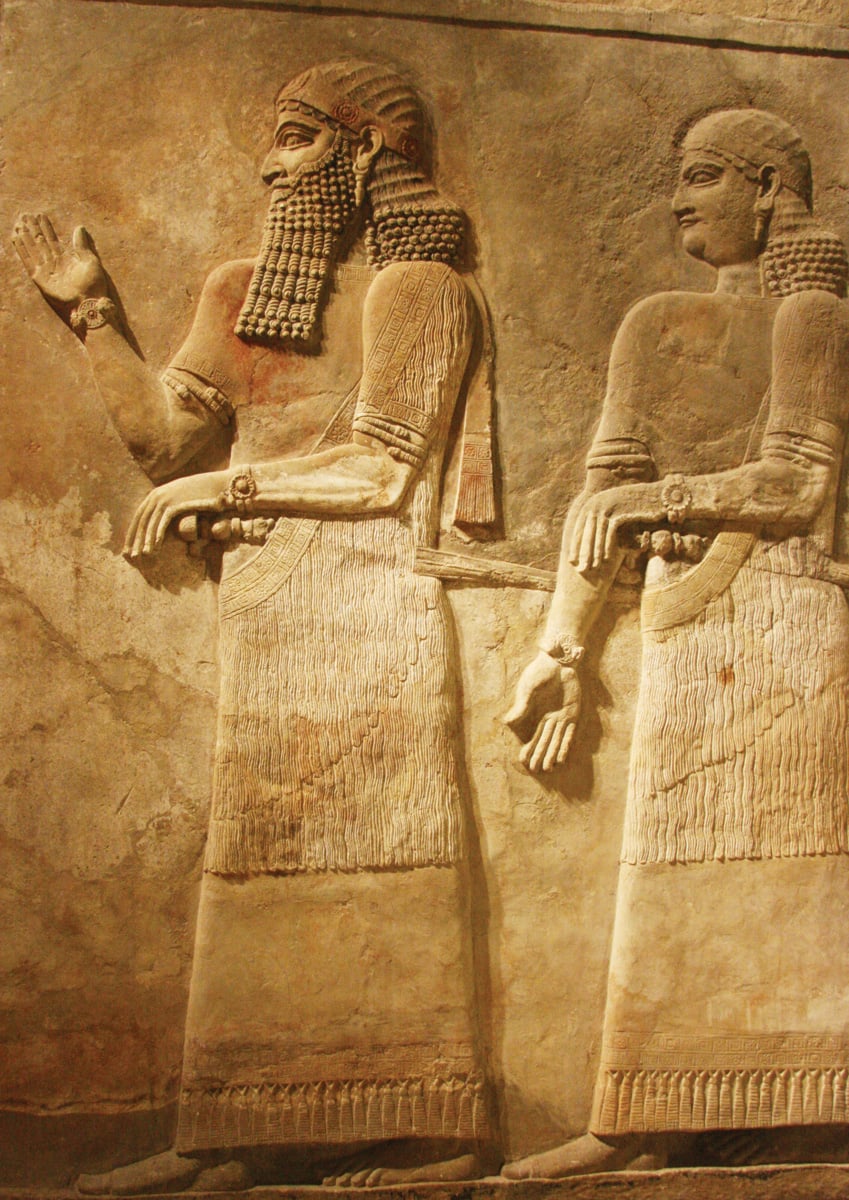
Assyrian relief of Sennacherib from the throneroom at Khorsabad (721–705 BC)
These chapters are virtually identical to the account recorded in 2 Kings 18:13–20:19. The historical background of Isaiah 36 and 37 lies in the events of 701 BC, when the forces of Sennacherib devastated Judah and her fortified cities. Several years prior to this (705–702 BC), Hezekiah became sick. His illness and prayer are recorded in chapter 38, while his foolish act of revealing the royal treasures to the Babylonian envoys is found in chapter 39.
A. Challenge and deliverance (36:1–37:38). The pious response of Hezekiah to the intimidation of the Assyrian field commander is also recorded in 2 Kings 18:13–19:37. Isaiah omits the account of Hezekiah’s submission and payment of tribute (2 Kings 18:14–16). Apparently the canonical emphasis in Isaiah is on the Assyrian pride, the godly response of Hezekiah, and God’s miraculous deliverance.
Sennacherib’s field commander accuses Hezekiah of overtly rebelling by forming an alliance with Egypt (36:1–22). He attempts to undermine confidence in the Lord by playing down Hezekiah’s reforms, threatening the people with intimidation, falsely arguing that the Lord is not able to deliver them, and claiming that the Lord is on his side. Hezekiah’s officers report the threats to Hezekiah with their clothes torn as a token of mourning. They themselves have not answered the challenges in accordance with the royal command.
The historical reconstruction of the international events that led to Jerusalem’s deliverance is a complex problem (37:1–38). The trust of the king, Isaiah’s restraint from saying “I told you so,” the prayer of Hezekiah, and the word of the Lord through Isaiah reveal remarkable wisdom on the part of Hezekiah and Isaiah and the great concern of the Lord for the Davidic kingship and Jerusalem. This is fully consistent with Isaiah’s emphases on Zion and God’s protection of his people against foreign invaders (chaps. 28–33).
B. Hezekiah’s illness (38:1–22). Hezekiah’s psalm of lament and thanksgiving has no parallel in 2 Kings. The superscription “a writing” (Hebrew miktab, 38:9) may be a corrupt form of the musical term miktam, a heading found in Psalms 16; 56–60. The text of the psalm contains several serious difficulties and is similar in content to Jonah’s prayer (Jonah 2) and Job’s speeches (e.g., Job 7).
In lamenting his early death, Hezekiah compares it to pulling down a tent and to material taken off the loom before being completed (38:12). Like a bird, he made a noise in his anguish, but it seemed as if the Lord, like a lion, was intent on mauling him to pieces.
In the restoration from sickness, he experiences the joy of health and God’s never-failing love. In response to God’s kindness, he vows to walk humbly before God, to praise him, and to declare to the next generation the “faithfulness” of the Lord.
C. Envoys from Babylon (39:1–8). The account of the Babylonian messengers sent by Marduk-Baladan parallels that of 2 Kings 20:12–19. It functions here as a transition to the oracles of comfort (chaps. 40–48), which presuppose the exilic situation of Judah in Babylon. Because of Hezekiah’s pride in his possessions, Isaiah proclaims God’s judgment of exile into Babylon on another generation. Hezekiah’s generation will escape that judgment, but the exile of Judah is inevitable.
8. The Beginning of Restoration (40:1–48:22)
A. Prologue (40:1–11). Isaiah 40:1–11 gives the context for reading chapters 40–48. The people of God have gone into exile because of their sins, but Isaiah affirms that the exile will end. The exile is therefore an expression of God’s judgment. It is first a just judgment; second, it is a form of restitution for damages. Israel and Judah not only have abandoned Yahweh but also have detracted from Yahweh’s glory by giving it to idols. The exile was a time in which God’s people could reflect on what they had done; this period of reflection was a way of paying the damages in order to be restored to fellowship with Yahweh. The statement “she has received from the Lord’s hand double for all her sins” (40:2) is an allusion to the Old Testament laws of restitution (Exod. 22:4, 7, 9).
At God’s appointed time a proclamation of “comfort” comes to his people (40:1–5). Yahweh will come to help his own. In the Hebrew text the verb “comfort” is in the plural, but it is not clear who the comforters are. The prophet and those who follow him are charged with giving comfort to God’s people. The message of comfort was also proclaimed by Jesus and is continued by all faithful ministers of the word of God. The content of the message pertains to the coming era of the renewed relationship between Yahweh and his people, an era in which forgiveness is proclaimed and experienced. The fulfillment of this word takes us from the time of the restoration from exile all the way to the return of Jesus and the establishment of the new heavens and earth. It is for this reason that Isaiah 40–66 is so important for the church of Jesus Christ; we too are the beneficiaries of the fulfillment of the promises of God’s word.
The announcement of the coming salvation takes place in the desert (40:3), representative of the experience of alienation. Precisely where the people of God are in need of deliverance comes the announcement to them that the Lord is coming. All of nature prepares for his theophany, making a giant road through valleys and across mountains. The promise is given that all “people” (literally “flesh”) will see the “glory of the Lord” (40:5).
The prophet again hears a voice commanding him to speak of what he has seen (40:6–8). He explains the vision in terms of blessing and judgment. The judgment of the Lord will come upon all flesh, because they are nothing but grass and like the flowers of the field—here today and gone tomorrow. When the sovereign Lord comes in power to rule, the nations will be like nothing in his presence.
The emphasis on promise is more obvious. The “word of our God endures forever” (40:8)—this is the word of promise pertaining to the coming era of restoration. “Good news” must be proclaimed to Zion so that everyone may hear. The good news is focused in the presence of the Lord: “Here is your God!” (40:9). He comes with power against the adversaries and with a reward for his own. The divine warrior delivers and leads his own people like “lambs.” What a Savior! What a gospel!
B. Disputations (40:12–31). The prophet raises five questions in the context of the proclamation of the establishment of Yahweh’s kingship. These five questions, rhetorical to a large extent, are a literary device to remove any doubt from the minds of the godly as to the certainty of the establishment of the kingdom and to instill a sense of awe for Yahweh himself.
By means of the questions introduced by the word “who” (40:12–17; cf. Job 3:8–22), Isaiah affirms that Yahweh alone is the Creator God. He needs no counselors. His sovereignty extends to all of creation, and especially over the nations, which are like a “drop” in the bucket or like a piece of “dust” on the scales (40:15).
Yahweh is unique in that no one can compare him with anything the human mind may imagine (40:18–20). He is not to be likened to idols, which are powerless and fully dependent on human craftsmanship.
The God of Israel is seated “above” the earth (40:21–24). He is the great king, the sovereign judge over all the world. Yahweh himself oversees all that the nations do. At his time he will bring the nations to judgment. Even as grass is scorched and dried up, so Yahweh will bring the nations to nothing.
Yahweh is the Creator God whose might is revealed in the stars of the sky (40:25–26). The Babylonians deified the stars and constellations, but they too are the work of the Creator God.
The people are disheartened. They wonder whether God is truly able to establish his kingship (40:27–31). Yahweh may be the Creator of heaven and earth, know all of his creation by name, and hold the judges and rulers of this earth accountable for their actions, but does he still have concern for his people? The prophet affirms Yahweh’s concern for their situation by focusing their attention on God’s nature. He is the everlasting God, Yahweh, the covenant God, the Creator of heaven and earth. He tirelessly works out his plan of salvation for his people. Their restoration is based on his nature. He will renew the strength of his people, but this is contingent on their willingness to submit themselves to him.
C. Deliverance (41:1–44:23). 41:1–29. The message of consolation (41:8–20) is enclosed by two arguments against the nations (41:1–7, 21–29). These arguments are addressed particularly to Israel to assure her that the nations are subject to God’s power.
The nations are called to come before God’s tribunal (41:1–7). Through a series of questions and answers, Yahweh announces the imminence of the judgment for the rebellious nations who are foolishly hoping that their idols will protect them. The instrument of God’s judgment here (“one from the east”) is ambiguous (41:2; cf. 41:21).
He answers his own question with the declaration, “I, the Lord—with the first of them and with the last—I am he” (41:4). The nations respond foolishly to the sovereignty of Israel’s God. They renew their commitment to idols. The prophet mocks those involved in the manufacture of idols. They take the raw materials, beat them smooth with a hammer, and then solder them together. The irony in this passage highlights the folly of dependence on objects made by humans for protection against the power of the nations and especially against the power of Yahweh, the God of Israel.
Israel will be restored to her former status because, as Redeemer, Yahweh will be loyal to his “servant” (41:8–20). Therefore, God’s people need not fear the nations.
Though Israel has been guilty of many offenses and has consequently gone into exile, she is still God’s servant because of Abraham and Jacob. The election and calling of God are freely given, and his love extends to “the ends of the earth” (41:9). The depth of his care and the strength of his might comfort his disheartened people. He gives strength and will remove any obstacle or opposition. He is Yahweh, the Redeemer, the Holy One of Israel. Although his people are as insignificant as a “worm” by themselves (41:14), they will become like a “threshing sledge,” pulverizing and crushing any obstacle (41:15–16). Their fear will turn to great joy in the Holy One of Israel.
Yahweh the Redeemer is able to meet all the needs of his people, whether spiritual or physical. Yahweh will extend his comfort to those who are poor in spirit. He will do everything in order to restore his people to himself. The verbs (“I will make . . . I will turn . . . I will put . . . I will set”) express some of the many ways in which Yahweh shows concrete concern for his people. He will not forsake them in their need. Instead, he will provide the thirsty with water and will change conditions so that his people will see the evidences of his love.
The argument of 41:21–29 is a continuation of the first section of the chapter (41:1–7). The deities of the nations are unable to do what God does. He can declare from the beginning what is going to happen. He can give signs. He has power over all nations. He can bring adversity as well as prosperity. By contrast, the gods of the nations are powerless. They cannot respond. Therefore, the nations must know that as long as they depend on their gods they are actually without protection. As in 41:2, one who is unnamed will be raised up by Yahweh, the God of Israel, to bring about God’s plan. His victories are the outworking of his plans. The Lord, who knows the future, reveals the good news of his accomplishments in history according to his plan for his own people. The idols are mere vanity.
The identity of the servant of the Lord has long been a subject for discussion. In this context several arguments favor identifying the servant first with Israel (see 41:8–9) and then in a greater way with the Messiah, in whom the perfection of servanthood is found. The language about the election, calling, and particular tasks of the servant fits in very well with the Old Testament language about Israel. The Servant Songs (42:1–9; 49:1–13; 50:4–9; 52:13–53:12) clearly reveal God’s expectations of Israel and also how the Messiah, the faithful Servant-Son, alone fulfilled all God’s expectations, especially in his vicarious suffering.
42:1–17. The servant is described as one in whom Yahweh has delight and whom he has elected (42:1–4). The language of election is an affirmation of the servant’s continued existence and takes us back to the Abrahamic covenant, where God himself swore that he would be faithful to his covenant with Abraham’s descendants.
The description of the Holy Spirit being “on” the servant is an Old Testament expression signifying a renewal of God’s presence, by which God’s servant is better equipped to serve him. The servant’s task is to bring “justice” to the nations (42:1, 4), which is identical to the purpose of the coming messianic king (Isa. 9:7; 11:4). “Justice” here signifies neither religious nor legal practices, but the rule of Yahweh on earth. The servant is tender, gentle, and faithful—characteristics embodied also by Jesus Christ. The nations are waiting for their inclusion in the kingdom. The ministry of the servant will last until the fullness of the kingdom has been established.
Yahweh the Creator God has called the servant to be a light to the nations (42:5–9). He will make the servant’s mission a success by extending the covenant to the Gentiles. The messianic nature of Israel is to so affect the earth that all nations will be blessed through her and will join with her in expressing their faith in Yahweh.
Yahweh’s jealousy for his glory ensures his continued presence with his people. He will open the eyes of the blind, free the prisoners, and do whatever is necessary to establish his kingdom on earth, in fulfillment of his word to the patriarchs (Gen. 12:1–3) and through the prophets. The restoration of the Jews and the inclusion of the Gentiles express the new age planned and revealed beforehand.
Isaiah leads the godly community, including the Gentiles, to praise Yahweh, the victorious king (42:10–13; cf. 44:23; 49:13; 52:9). The nations are called on to join together with the godly of Judah to sing “a new song” (42:10). The prophet gives two reasons for praising Yahweh. First, Yahweh has created a new era. He has opened up a new perspective by redeeming his people to be “a light to the nations” (42:6 RSV, NASB). Even the people in the wilderness of Kedar and in the Edomite city of Sela are invited to join in praise of the God of Israel (42:11). Second, his people praise him because the Lord rouses himself for battle like a mighty warrior (Exod. 15:3, 16). Zealous for his kingdom, he will not allow enemy nations to trample his rights.
Yahweh has been patient with the nations for a long time (42:14–17). Now he is ready to act on behalf of his people. When he comes, nothing can stop him. He is like a woman in labor who must give birth. He has the power to destroy and to make things desolate, yet he also has the power to redeem his people. His people are the blind who need light and guidance. Yahweh will build his kingdom while judging the nations and demolishing paganism.
42:18–43:28. Israel is a blind and deaf servant (42:18–43:7). Because of her unwillingness to respond to Yahweh, she was oppressed and exiled as an expression of Yahweh’s anger. Israel’s exile was evidence of God’s rejection, but her redemption is an expression of his love.
Israel’s formation was not a mistake. God elected (“created,” “formed”) Israel. He made them to be his people by calling them to be his. He loves his people and will do anything to redeem them. Regardless of how difficult the circumstances or how far he has to bring his people, he is with them. He is their God by covenant, the Holy One who has consecrated them, their Redeemer. He will give up nations such as Egypt, Cush (Ethiopia), and Seba (a region south of Ethiopia) in exchange for the remnant of his people, his “sons” and “daughters,” who are called by his name (43:6–7). Thus, both the experience of rejection and the affirmation of redemption are the outworking of God’s will and are expressions of his fatherly concern for his children.
Over against the magnificent portrayal of the future of God’s people is present reality: Israel is still blind and deaf (43:8–13). In spite of this condition, however, God still has a future for them. They will be witnesses to his majesty and authority over the nations. He cannot use the nations for this purpose because they have given themselves over to idolatry. God’s people should know only Yahweh, having experienced his deliverance.
The phrases “I am he” (43:10) and “I am God” (43:12) signify that only Yahweh, the God of Israel, is God. He is also the powerful Redeemer who has already shown his ability to his people. Yahweh as the God of his people has revealed himself by words as well as deeds so that all might know that he is the only true God.
In their need Yahweh reminds his people repeatedly that he is their Redeemer, the Holy One of Israel, “the Lord” (Yahweh), their king (43:14–21). In their self-doubt, they must never doubt him. The God who redeemed his people from Egypt will bring down Babylon and deliver his people from exile. The old, old story of the Passover and the miraculous journey through the Red Sea is dwarfed in comparison with the “new thing” (43:19). This “new thing” refers to the new era of forgiveness, restoration, and God’s presence. The servant of Yahweh, the people whom he has chosen, will be refreshed. The rivers of water speak not only of the spiritual refreshment but also about the manner in which Yahweh will take care of the physical needs of his people in bringing them out of exile and into the promised land. The very purpose of the deliverance is that the people may praise Yahweh upon experiencing the blessings of redemption and restoration.
The postexilic Jewish community enjoyed the benefits of restoration from exile, resettlement in the land of Canaan, and the physical and spiritual blessings of God’s presence. This progressive restoration was intensified in the coming of the Messiah, who gives the water of life (John 4:14). Yet the final restoration of all things will bring with it the climactic fulfillment of these words.
God’s people do not deserve his love (43:22–28). They have failed to honor him as God by neglecting to present offerings and sacrifices. But the nature of God does not change. He is compassionate and gracious and ready to forgive his people (Exod. 34:6–7; Ps. 103:3, 11–14). Because of God’s unchanging love, the prophet calls on the people to turn from their state of sin and return to Yahweh.
From its beginnings, Israel has been a nation of sinners. Kings, priests, and false prophets rebelled against the Lord. Israel can in no way claim innocence in a case against God. Therefore, Israel has been destroyed and disgraced. God is vindicated in his judgment.
44:1–23. Regardless of Israel’s past, she is still the servant of Yahweh (44:1–5). Her future lies in her election. Israel is transformed by God’s grace into a new creation, the nature of which is described in a threefold way. First, the Spirit of the Lord is poured on the people (44:3). The presence of the Spirit is an expression of God’s intent to use the people as his servants and to equip them for his service. Second, the blessing of God will rest more markedly on the people’s offspring (44:3–5). The very process of internal renewal affects generations to come. In contrast to the past generations of faithlessness (43:27), there will now be generations of faithful people, blessed by the Lord. Third, the covenant will be renewed not only with Israel but also with Gentiles who will call on the Lord and join in Israel’s heritage (44:5).
The certainty of the future of God’s people is guaranteed by Yahweh’s kingship (44:6–23). He is Yahweh, king of Israel, Redeemer, and Lord of Hosts. There is no god like him, because he foretells what is to come. Since the God of Israel knows and controls the future, his people need not fear. God’s purpose for them will stand; they will be his witnesses.
How different are idols from the “Rock” of Israel! The prophet depicts the folly of idolatry in the form of a satire. Idols are, after all, the work of humans and are characterized by several human limitations. First, even the best artisans have human limitations. Second, idols are nothing more than creations fashioned by the best of human instruments. Third, idols are also limited by the materials from which they are made. They are made from wood, a material hardly appropriate for the production of precious objects. How can one distinguish which piece of wood is more appropriate for worship and which is to be used to kindle a fire? Clearly the whole idol industry is the work of humans and is characterized by the physical limitations of human weaknesses, the instruments, and the material itself. The pursuit of idolatry is irrational and leads to irrationality. Idolatrous people will not be able to respond appropriately to Yahweh because their eyes are shut and their hearts are hardened (44:20). They are given to immorality and idolatry and have no way of turning back.
This section closes with a restatement of the uniqueness of Israel’s God (44:21–22). The Lord has elected, called, and forgiven his people. He calls them to repent by returning to him, their Redeemer. The greatness of God’s forgiveness and love is brought out in a hymn in which nature is called on to rejoice in the outworking of God’s plan of redemption. Nature itself awaits the fulfillment of this plan and the revelation of the glory of God’s people.
D. Yahweh’s sovereignty (44:24–47:15). 44:24–45:25. Yahweh is the Redeemer and has the power to renew his people (44:24–28). Within Yahweh are two creative forces: the force to create (re-create) and the force to redeem. Yahweh is the Creator of the heavens and the earth. However, he also re-creates everything in accordance with his purpose. This restoration (re-creation) makes the earth habitable for his people—an integral part of their redemption. Every act in the progression of redemption confirms his word. While in exile, Israel needed the reassurance that Jerusalem would be repopulated and rebuilt and that the temple would be restored. The power of Yahweh in creation, renewal, and redemption stands in stark contrast to the impotence of the practitioners of magic and divination. Yahweh overturns the signs of the diviners and negates the wisdom of the sages. In spite of all the Babylonian claims to wisdom and magical powers, he will raise up a foreign king, Cyrus the Persian, to initiate a new stage in the history of redemption. The postexilic era of reconstruction is a resumption of his redemptive activities, which will culminate in the new heavens and earth and in the New Jerusalem.
Isaiah 45:1–8 develops the role of Cyrus in God’s redemptive plan. Cyrus has been raised up and empowered by Yahweh to accomplish God’s kingdom purposes. He has been anointed for the particular purpose of accomplishing God’s work on earth. Therefore, it is even possible to call him “the anointed one,” a designation generally limited to the kings of Israel and Judah.
God’s purpose in raising up Cyrus is twofold. First, he will be raised up for the sake of Israel in order to be an instrument of redemption (45:4). Second, he will cause the nations to recognize that Yahweh, the God of Israel, is the only true God. He alone has power to change light into darkness, adversity into prosperity, and vice versa (45:7). The very designations “I am the Lord” and “I, the Lord, do all these things” (45:6–7) express the authority of the God of Israel in fulfilling his covenantal obligations and general governance of the earth. This indirect encouragement to Israel is to assure those living in darkness and those experiencing adversity that Yahweh has the power to reverse their situation.
In another hymn (45:8), the prophet rejoices in the salvation of the Lord, which is expressed in a temporal extension of his righteous rule. Cyrus is the instrument, but the Lord is the author of it all.
Isaiah then calls on the nations to present their argument in the very presence of God (45:9–13). Since they do not have confidence in the God of Israel, they have questioned what Yahweh is doing. Yahweh is the potter and humankind is nothing but clay in his hands. Yahweh’s particular concern with the earth extends to humanity at large.
The Creator God is the Redeemer God who will establish righteousness on earth, beginning with the restoration from exile and the rebuilding of Judah.
The nations—represented by Egypt, Cush, and Seba (45:14)—will seek the favor of God’s people, having witnessed in the events of history that God is present with them (45:14–17). It is likely that verse 15 continues their confession, as the nations have not known the God of Israel and express a desire to know the Savior of Israel. Israel’s salvation is of the Lord and is therefore lasting; idolatry brings only disgrace and ruin.
Yahweh, the Creator of heaven and earth, shows his peculiar interest in mankind by revealing that he created the earth to be inhabited (45:18–19). He will never destroy it. Therefore, he chose the seed of Jacob and revealed himself to them. His word is open (“not . . . in secret”), righteous (NIV “the truth”), and “right” (45:19). He has revealed his decrees, and their fulfillment confirms that he is victorious and faithful.
The survivors of God’s judgment are invited to judge for themselves (45:20–25). Idols cannot foretell or control the future. Only Yahweh, the God of Israel, is able to execute his righteous plans for redeeming his people. The nations must turn to Yahweh and join freely in God’s salvation—or else under compulsion at the great judgment of the nations.
At the final judgment of God, all nations will be “put to shame” (45:24). “Shame” is that state in which one is without help, without escape, without God, and thus completely disgraced. The righteous will rejoice in the victory, glory, and praise that Yahweh will extend to them. They will find that Yahweh is truly righteous in that he brings about all his promises. Not only will they rejoice in Yahweh’s victories, but they will also be assured that their descendants will be the beneficiaries of God’s goodness.
46:1–47:15. The fall of Babylon is first portrayed by the carrying off of her gods (46:1–13). The exile of Babylon’s gods is symbolic of God’s intervention on behalf of Israel. The inability of Babylon’s gods to save her stands in stark contrast to the power of Yahweh. Therefore, the prophet concludes by calling on Israel to listen and respond to God because his salvation is near.
As their gods are being carried off, the people of Babylon make every effort to save them, but to no avail. Bel is the title given to Marduk, god of the capital city of Babylon. His title is related to the Hebrew word baal (“Lord,” “Master”). The god of the city of Borsippa was Nebo, Marduk’s son, to whom belonged wisdom and learning. The political power represented by Bel and the wisdom represented by Nebo will be unable to deliver the idols of Babylon, much less the people.
In contrast, God has taken pains to carry and care for Israel, like a mother, and purposes to remain faithful. His signature affixed to this promise is “I am God” (46:9).
The Babylonian gods are incapable of hearing or delivering those who depend on them. Not so with Yahweh, who answers his people when they call on him in their distress.
Yahweh has revealed that he alone is God, the Creator, the planner and executor of everything that has taken place on earth. His plan includes Cyrus, who is compared to a “bird of prey” (46:11). Though stubborn Israel does not deserve it, God’s salvation is very near. The future of God’s people is based on God’s full and free salvation. The Lord will be victorious (“righteous”).
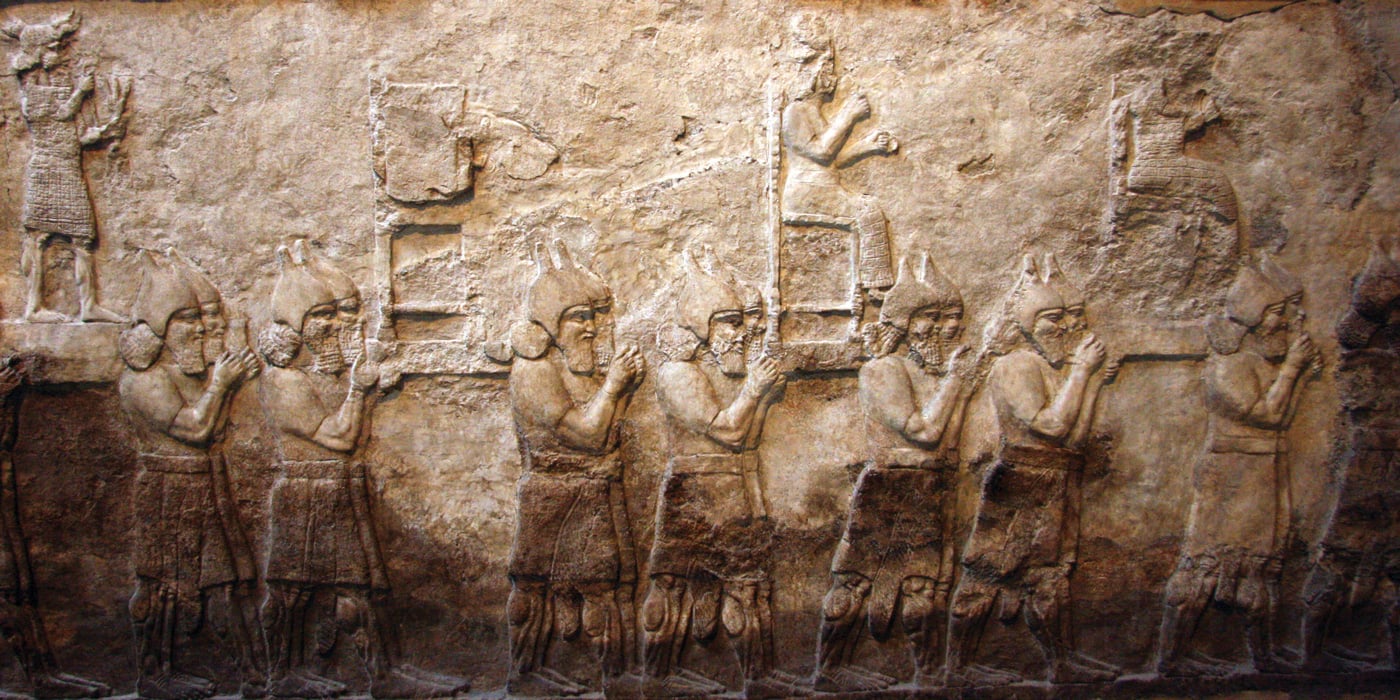
Isaiah 46:1–2 describes the gods of Babylon being carried off into captivity. Such a scene is portrayed in this Assyrian relief, which shows soldiers carrying away the gods of the enemy they have just defeated (palace at Nimrud, 728 BC).
Babylon is portrayed as a “virgin” who will lose her genteel, cultured life (47:1–4). Her status will be reduced to that of a slave girl who, scantily dressed, works with the millstones and grinds flour. The virgin daughter of Babylon is symbolic of the whole empire. The judgment on Babylon is an expression of the vindication of the Redeemer and Holy One of Israel, who delivers his people from their oppressors.
Babylon is also portrayed as “the eternal queen” (47:5–7). She ruled over the nations like a queen mother, but showed no mercy to the subject nations. She showed no accountability to God as she ruled.
The fame of Babylon is a claim to autonomy, but also to deity (47:8–11). The language “I am” and “there is none besides me” (47:8) is the language usually reserved for Yahweh and his claim that he alone is God.
Although the Babylonians have used all kinds of magic spells to secure their future, sudden disaster will overtake them. Though Babylon has used her wisdom to plot military strategies and avert political and economic disasters, she cannot match the wisdom and power of God. A disaster has been planned, and there is no way Babylon can ward off the purposes and plan of God. Whereas Babylon prided herself on her ability to predict and prevent, the God of Israel suddenly overwhelms her in his judgment.
The prophet sarcastically urges the people to devote themselves a little more to their magic and sorceries: there may still be some answers forthcoming from the established Babylonian systems of divination (47:12–15). However, these systems will prove ineffective against the God of Israel. The prophet moves on to another well-developed area of Babylonian religion: astrology. With strong irony, he calls on Babylon to turn to the astrologers and the many counselors, that they may be able to save Babylon from her fall. The counselors and astrologers are compared to stubble, which is quickly burned and of little use.
The prophet began by portraying Babylon’s gods being carried into exile (46:1–2) and concludes with the inability of her wise men, astrologers, and diviners to help the nation out of her great trouble. Her religious, political, and intellectual systems will completely break down.
Human political, religious, and intellectual systems may work for a long time, as did the system in Babylon. They may be revitalized and altered to meet changing conditions; however, any system that works for its own glory and for human autonomy, whether national or individual, cannot deliver people at the time when deliverance is most needed. By means of this solemn statement, the prophet has contrasted the failure of human systems over against a God who is able to deliver and establish his eternal kingdom.
E. Proclamation of restoration (48:1–22). Yahweh has planned everything that has happened and will happen on this planet. However, the events themselves are directed toward the creation of a new era. Though God’s people may fail, Yahweh himself remains faithful to introduce and bring in that new era. The new era is not eschatological in the sense that it is far off. Instead, like the judgment, it is always near. The restoration of the Jewish people from exile introduced this era in a grand way. Its future lies hidden in the revelation of God’s name, which will be manifested in the glory, righteousness, and salvation of his people.
Though God’s people claim to lean on Yahweh, swear by Yahweh, and point to Jerusalem as the holy city, they do not show their covenant relationship in their daily lives (48:1–8). They are faithless, without any righteous deeds, and stubborn. Though they claim to belong to Yahweh’s “city,” the city of the great king (48:2), their lifestyle is in direct rebellion against him. Though Yahweh has revealed that all rebellious people will be exiled, they receive the good news of a “new” beginning. It is the new era in which Yahweh begins the restoration of Israel, which will eventually include a re-creation of the heavens and the earth. It will be a time especially characterized by fulfillment of the promises of God.
By means of repetition the prophet calls attention to the ground of salvation (48:9–11). He repeats the expression “for my own name’s sake” three times (48:9, 11). The reason for the future salvation does not lie in Israel but in God himself. For the sake of his own honor he restrains his anger. The restraint of God is a loving restraint; he does not unleash the fullness of his anger on his people. Yahweh is intent on purifying a people unto himself through adversity.
The name Yahweh signifies that God keeps covenant by fulfilling all of the promises he has made (48:12–16). He is the first and the last (48:12). By “the first,” the prophet signifies the God who has been involved in the work of creation and with his people in exile. By “the last,” Isaiah signifies the new era, which is to be introduced at the fall of Babylon and the decree of Cyrus, also designated the era of “new things” (48:6). Yahweh himself directs the history of redemption from beginning to end. He has not spoken or dealt secretly but rather has made it clear that he has planned everything that comes to pass, including the mission of the servant (48:16). The identity of the servant is not made clear, and opinions vary (Cyrus, the prophet himself, the messianic servant).
Yahweh is the Redeemer of his people, their covenant God and teacher (48:17–19). The Teacher God instructs his people so that they might succeed. However, Israel has been unresponsive and, as such, has missed the fullness of the covenantal blessings. Instead of seeing their population explode to the point of being like the sand of the seashore, they have seen their number reduced. Instead of experiencing the peace that comes from Yahweh’s victories over the enemies, they have been subjugated. Israel has lost God’s great blessings because of its stubbornness.
The prophet calls the people to leave Babylon (48:20–22). The coming out of Babylon marks the beginning of the era of restoration. For that reason it is important to begin seeing that all of the blessings of restoration, beginning with the return from exile and extending to the coming of Jesus Christ, are expressions of the new covenant. Though Jesus would come more than five hundred years later, the benefits of Israel in the land are benefits based on and in anticipation of the finished work of Christ. Though in one sense they are still under the old covenant, in a greater sense they are already under the new covenant. The people respond to Yahweh and his word. The Spirit of God is present in a greater way after the exile than before. There is a real joy among the people of God because they have experienced the return from exile as a token of God’s redemption and kingship.
For this reason the people are to joyfully proclaim what God has done on their behalf. All the nations must hear that Yahweh has restored his people to be his servants. Yahweh has been faithful to his promises by providing water out of the rock. The God of the exodus will continue to redeem his people. However, the effect of redemption is limited to those who have the spiritual marks of Abraham.
9. Reconciliation and Restoration (49:1–55:13)
A. The servant of the Lord (49:1–13). These verses portray the various characteristics of the servant of God and call on the nations to pay attention to the servant even though he is despised by them.
The servant of God is not to be judged by his present or past status but rather by his election (49:1–6). Yahweh himself has called and named his servant. The prophet intimates that there is a twofold purpose in the servant’s calling. On the one hand, he is to proclaim the word, which the prophet likens to a “sharpened sword.” On the other hand, he is to be like a “polished arrow” (49:2). The sword speaks of the prophetic ministry in which the servant, filled by the word of the Lord, speaks that word, which is able to penetrate the hearts and souls of people. The arrow, as an instrument of warfare, symbolizes God’s judgment on those who do not respond. Yahweh himself will be glorified by his servant. He will continue to use his servant to speak to Israel as well as to the nations. Yahweh’s word will not return to him void, so the servant is guaranteed that his prophetic mission will be successful.
The servant responds by looking at his own condition. He realizes that he has not been successful and asks why he must continue to labor. God’s response is that he will shortly reward the servant with success. The tribes of Jacob will be restored as a part of God’s mission, that they might be a “light” to the nations.
Who is the “servant”? According to 41:8–9; 44:2; and 49:3, “servant” is a prophetic designation for the restored people of God, Israel. Yet, according to 49:1–6, the servant has a mission to the nation and to the Gentiles. These words are applicable to the restored community of Jews in Judea and the Diaspora, but in a greater sense they apply to the mission of our Lord (see Luke 2:32; Acts 26:23). Since that time the mission of the servant has become the mission of the church, the new people of God.
The success of the servant’s mission depends on Yahweh (49:7). He, “the Redeemer” and “the Holy One of Israel” (two times), is faithful to his election. Though the servant may be ridiculed, impoverished, persecuted, and oppressed, the kingdom of God will be established on earth, and all the sons of the great king will receive glory. The nations and kingdoms outside of the kingdom of God will be put down. Isaiah 49:7 contains an allusion to the nature of the mission of Jesus Christ. He suffered, and through his suffering obtained glory. Jesus, after his resurrection and glorification in heaven, is the great judge, who will put down all unsubmissive nations and is the one before whom all the nations must eventually lie prostrate.
The phrase “the time of my favor” signifies the era of Yahweh’s gracious acceptance of his people (49:8–13), denoting an era of proclamation of freedom. It marks the renewal of the covenant and the fulfillment of God’s promises. The renewal of the covenant finds expression in God’s redemption, protection, provision, and guidance. He will remove obstacles and gather his people from all over the Diaspora.
The prophet then bursts into another hymn of praise. Nature observes and participates in the care, comfort, and relief of the afflicted children of God (49:13).
B. Zion’s surprise (49:14–21). “Zion” here is a metaphor for the people of God who lament, asking whether the Lord has completely forgotten them. Yahweh, like a mother, can never forget his children.
Zion is also likened to a mother bereft of her children and abandoned in the ruins. The Lord assures her that he will never forget her because she is “engraved . . . on the palms of my hands” (49:16). The scattered will return and be so numerous that the land will be too small. The land and its cities will be restored, and its enemies will be kept away. The fulfillment of these words applies to postexilic Judaism and extends until the renewal of this earth.
C. Israel’s restoration (49:22–26). The nations themselves will become instruments of the redemption of God’s people. They will cooperate with God’s plans so that the people of God may draw comfort and not be disappointed. The Lord will bring down the nations that seek to harm his people and will not submit to him. “The Mighty One of Jacob” will fight the battle for them, that the nations may know that he is Yahweh, the Deliverer and Redeemer of his people.
D. Sin and obedience (50:1–11). Because of the great guilt of the people of God and their lack of responsiveness, Yahweh has justly exiled them (50:1–3). In the past he called them tenderly, but there was no response. He has the power to avert the exile, as seen in the plagues on Egypt, but he acts freely, deciding to let it happen. Yet, even though he sent them away, he has not divorced or sold Israel to the creditors.
Who is this obedient and suffering servant (50:4–9)? Since his suffering is not unto death and he seems to be untouched by the rejection of humanity, the servant is probably the prophet himself. The prophet, in pursuit of his prophetic mission, directs himself to the people of God in the hope of being heard and understood. Instead, he is reviled. If 50:4–9 is a restatement of 49:1–6, it is also possible to identify the servant with faithful Israel as a good disciple of the Lord.
The servant has a mission to encourage the “weary”—the dejected Jews in exile and all who long for God’s redemption. The authenticity of the message is guaranteed by the Lord himself, who teaches and opens the ear of the servant. The servant is a responsive disciple who executes and speaks whatever has been taught. Even in the face of unbelief and opposition he does not hesitate, because of his unique relationship with God and because of his conviction that the Lord will contend for him. No one can bring a charge against him. Over against the victorious outworking of God’s plans are the unbelievers, who will perish.
The response to the ministry of this servant may be one of faith or further obstinacy (50:10–11). He calls for a wise response rather than a continuation in folly and dark ways. If people continue to insist on walking by their own light, the judgment of God will overtake them, and there will be no escape. These verses also form an appropriate transition from chapters 49–50 to 51:1–52:12.
E. Everlasting salvation (51:1–52:12). The theme of the restoration of the people of God is developed in nine strophes (verse units) (51:1–3, 4–6, 7–8, 9–11, 12–16, 17–23; 52:1–2, 3–6, 7–12). These strophes are connected by the repetition of imperatives (“listen,” 51:1, 4, 7, 21; 52:8; “look,” 51:1–2; “awake,” 51:9, 17; 52:1; and “depart,” 52:11), promises of comfort, and references to creation and redemption.
God’s words of comfort (51:1–3) are addressed to those who still fear the nations among whom they are dwelling. They believe but have not yet come to the point where their faith is a conquering faith. There are many lingering questions. Will Yahweh restore his people to the land? Will he multiply his people again? Will their enemies prevail once more?
The pursuit of righteousness focuses on God’s ordering of all things in accord with his promises. The prophet encourages all who long for the fulfillment of God’s word by pointing to God’s work in the past. He promised to multiply Abraham and Sarah’s descendants and to bless them (Gen. 17:2, 5–6, 16), and so he did (51:1–2). Their solidarity with Abraham, as they come from the same “rock” and “quarry” (51:1), should be comforting because God is the same and his promises do not change. Since the people are looking for God’s grace, he will comfort Zion. The Lord will restore the land and the people, so that the work of restoration points back to the Garden of Eden. His people will again experience his presence, as in Eden, and will rejoice in the beginning of God’s restoration.
Only the godly constitute the “new people of God,” with whom he renews his covenant (51:4–6). They receive the words of assurance that God’s rule (“instruction,” “my justice,” 51:4) will extend beyond Israel to the nations. They will also see the light. The present heaven and earth must be made into a new creation, characterized by God’s triumphant and everlasting rule. Israel and the nations join together in eager expectation of the new heaven and earth.
The comfort of God is limited to those who have appropriated for themselves the knowledge of his righteous rule and salvation (51:7–8). They do not wait passively; they are God’s agents in establishing the new age. They firmly believe in God’s plan for them and for the world. Yet in their weakness they need encouragement. These verses essentially repeat the previously given words of comfort: God will judge the wicked and restore all things to his divinely purposed order.
In a most urgent way, reminiscent of the psalms of lamentation (cf. Ps. 44:23), the prophet calls on the Lord to act on a scale grander than the exodus from Egypt (51:9–11). Then, God revealed his strong arm by redeeming his people and inflicting plagues and death on the Egyptians (Exod. 7:14–12:23). When God acts in history, the redeemed will experience his deliverance. Their sorrow and sighing will be turned into an everlasting life of great joy.
The Creator God is the Redeemer God. He is the maker of heaven and earth and Zion. He comforts his people like no one else (51:12–16). His own need not be afraid of people who by their very nature are mortal. He shall free them so magnificently that the oppressors will be unable to oppose his power. He is the Lord, the great warrior whose name is Yahweh of Hosts (“Lord Almighty,” 51:15). The word of the Lord is true, and he will protect his own until he has accomplished the restoration of all things.
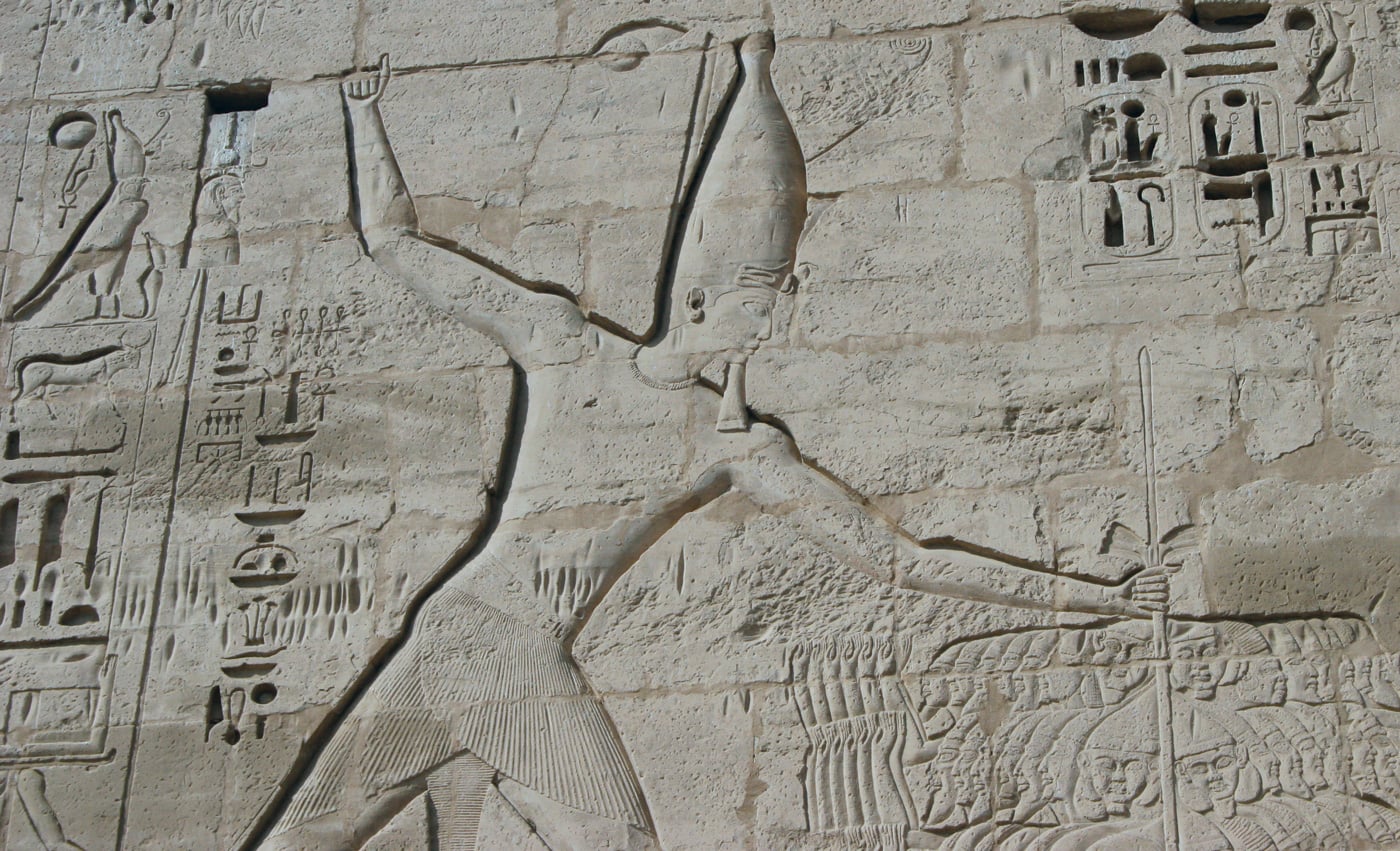
God’s strength is symbolized through the mighty or outstretched “arm of the Lord” (Isa. 51:9; cf. Ps. 77:10–15). In Egyptian reliefs, the pharaoh’s strength is often portrayed in a similar way, with his “mighty arm” ready to strike. Here, Rameses III has one arm raised and the other grasping the hair of his enemies (Medinet Habu, twelfth century BC).
The prophet brings the people back to their own situation (51:17–23). When God’s judgment came on them, there was no word of comfort. The suffering of judgment is metaphorically described as a “cup” (51:17). The “cup” is an expression of the fullness of the anger of the Lord: “ruin and destruction, famine and sword” (51:19). Now, he graciously rouses them from their drunken stupor. The Lord who judged them will again defend his people. He removes the cup of judgment from them. He encourages them in that their lot will fall on their oppressors.
In response to their prayer (“awake, awake,” 51:9), the Lord calls his people to wake up from their stupor (52:1–2). He has sovereignly and graciously exchanged the shame of their exile and alienation for the glory of his presence. Jerusalem, the “mother city,” will again be a glorious queen. Her reproach will be removed when the ungodly desist from oppressing. Only a holy people will inhabit the holy city.
Israel’s bondage in Egypt and her exile in Babylon were not due to God’s inability to deliver them. He freely handed them over, and freely he will deliver them (52:3–6). His purpose was that they might witness that he is Yahweh, who is constant and faithful to his people.
The good news of God’s kingship is freely proclaimed in Zion (52:7–12). The anger of God has subsided. He has cleansed his people and returns to dwell again in their midst. Only those who are “pure,” untouched by the defilements of this world, may experience his presence as in the days of the exodus. However, the new exodus is unlike the exodus under Moses in two ways. First, they need not hasten (52:12) because God will protect them. He will “bare his holy arm” (52:10) so that all the nations will submit to him in fear. Second, he himself will go before them, instead of merely showing his presence symbolically in the cloud of glory or the ark of the covenant. God’s people, the recipients of his fatherly comfort, will be led home triumphantly.
F. The Suffering Servant (52:13–53:12). The servant of the Lord will share the throne with God himself, as he will be “lifted up and highly exalted” (52:13–15). He will succeed in his mission, for which reason he is described as acting “wisely” (52:13). He does what is right and pleases God. The Lord will raise him up to glory. The nations who marvel at his appearance, because the servant was greatly humiliated in his suffering, will witness his glory.
The kings and nations were amazed when they heard about the suffering servant, and so are the godly in Israel (53:1–3). Therefore, the question “Who has believed?” is raised. The question is meant not only to draw attention to the servant but also to introduce the servant as the means of redemption. Yahweh has chosen to reveal his “arm” through the servant. The “arm of the Lord” is a symbol of the Lord’s judgment as well as of his deliverance (cf. Ps. 98:1). In this context it is the means of deliverance for those who trust in the suffering servant.
The servant was characterized by humility. Isaiah compares him to a “tender shoot” coming forth out of “dry ground” (53:2). He was an ordinary human being and not a king or potentate. The servant was unimpressive and readily rejected by humans.
The suffering servant was one who knew sorrows and fully identified with humankind. Not only was he born with little chance of success; he was also extremely vulnerable. He lived as a man among humans. The rejection of the servant is graphically described: he was “punished,” “stricken,” and “afflicted” (53:4–6). He took upon himself the very curse of God. Since God’s curse comes on any who break his covenant, the servant either was a great sinner or carried the sins of others. In addition, he is described as one who was “pierced” (wounded), “crushed,” and “punished” (53:5). He suffered in order that he might bring restoration (“peace” and “healing”) between God and humanity.
His experience of suffering is characterized by people’s violence, by his own innocence and patience, and most importantly by God’s acceptance. The servant himself did nothing wrong (53:7–9). He did no violence, nor did he speak in a deceptive way. Why then did Yahweh lay such suffering on him? The reason for the suffering must be found in the nature of the judgment of God. The Lord brought him through torture, judgment, death, and finally burial. In these verses Isaiah describes how the servant was oppressed and afflicted, how he did not receive a just sentence. He was put to death and buried like a criminal. Even though his suffering was unjust, the servant accepted his humiliation quietly, patiently, and obediently. He is compared to a lamb led to the slaughter or to a sheep being sheared (53:7). Quietly he received the judgment from God because he bore that judgment for others.
The servant suffered not for himself but rather to bear “our suffering,” “our transgressions,” and “our iniquities” (53:4–5). The benefits of the vicarious suffering of the servant include reconciliation to God and forgiveness. He carried the sins and guilt of the people; therefore, he was able to bring the people of God back into fellowship with their heavenly Father. All humankind has gone astray, but through the suffering of the servant there is still the possibility for peace and healing.
The servant’s death was not in vain (53:10–12). He had done the Lord’s will, even when he was crushed. He suffered as a human “offering for sin” and as a rebel against God for the sake of rebels. Because God was pleased not only to crush him but also to accept his life as an offering, the effects of his death are many: life, “offspring” (53:10), success, and honor. Through him many may be justified. The servant suffered on behalf of others. They share in his benefits if they turn to him as the means of forgiveness by reconciliation with the heavenly Father.
Of whom is the prophet speaking? It is tempting to read the New Testament association of the Suffering Servant with the Lord Jesus. But would Isaiah have understood it this way? Isaiah’s own testimony does not provide the clues for the identification of the servant. It could be Israel’s suffering on behalf of Israel, or the suffering of the prophet himself or any prophet, or that of a Moses-like figure. The apostolic interpretation of the text opens and closes with the identification of the servant. On the one hand, the apostles encourage God’s people to suffer with patience and endurance for the sake of the kingdom. They modeled this vicarious lifestyle. On the other hand, they also point to Jesus Christ as the paradigm. Instead of seeing a one-to-one correspondence between the Suffering Servant and Jesus, the apostles showed that the relationship between Jesus and the members of his church is such that the suffering continues. The suffering of Jesus Christ is analogical to that of the church throughout her history.
G. The new covenant (54:1–17). The prophet calls on the covenant people to rejoice because of the change in their condition (54:1–10). The sufferings of the past and present will give way to a new era. The people are compared to a “barren woman” (54:1), a widow (54:4), and a woman separated from her husband (54:6).
The blessedness of the reversal from barrenness and desolation is the reward of the servant. The new age will resemble God’s graciousness to Sarah, who was barren (Gen. 11:30) but who by God’s promise became the mother of nations and kings (Gen. 17:16). The mother’s “tent” will be full (54:2), and the land will be repopulated.
The description of the new condition serves to encourage the people of God not to be afraid or ashamed. In the past they have been ashamed because of the disgrace they carried. However, the Lord assures them that their shame will be removed. The hope for the future lies in the Lord himself. He will again take his people to himself, because he is their maker and husband. He is their great king (“the Lord of Hosts”; NIV “Lord Almighty), their Redeemer, the Holy One of Israel, who desires to sanctify his people; he is God of the whole world.
This is a description of the covenant God, who graciously renews the covenant with his people. He has abandoned them for a short time only to renew his love with great compassion—forever. The length and intensity of the love of God cannot be compared with the shortness of his wrath. The Lord assures his people by oath that he will never be angry with them again. He will never again use exile as an expression of his animosity toward his people. The certainty of the covenant lies in Yahweh himself. The Lord swears that he will never remove his covenantal blessings of peace, mercy, and kindness from his people. The ground for the restoration of the Jewish people lies in the Lord’s oath to be gracious to all those who call on him. This covenant blessing has been extended by Jesus Christ to all who call on him.
The prophet contrasts the situation of the desolate Jerusalem with its glorious future (54:11–17). It has been attacked and disgraced and received no pity or compassion, but the glory of the mother city will be great. She will be completely rebuilt as the New Jerusalem.
Within the city itself the people are blessed, with a blessedness limited to the righteous. Their children will know the Lord and will be blessed by him. They will experience the presence and protection of God. They will not fear because Yahweh will destroy every enemy. Nothing can separate them from him. They enter into their heritage from the Lord.
After the exile the Jews experienced some of the benefits of Yahweh’s blessing as they were restored to the land and lived in the city of Jerusalem and in Judea. But the people of God are still looking forward to the revelation of their glorious city, the New Jerusalem, which will come from above (Rev. 21:2). While on this earth, we rejoice in the love God has shown for his church, we rejoice in having children who know the Lord, and we rejoice in his presence and protection. However, our hope still lies in the day in which our Lord Jesus Christ will reveal his glory.
H. Assurance (55:1–13). Yahweh’s invitation to the people is not an esoteric one (55:1–5). His call is like the cry of a vendor selling his wares in the marketplace. The Lord calls on anyone and everyone to turn to him as the one who is able to provide for their needs. The open proclamation of the Lord assures that whoever desires may come, including Gentiles. He promises to take care of all humanity’s needs. This redemption is gracious and free.
The gift of God is an everlasting covenant, such as the Lord made with David (2 Sam. 7:8–16). The people of God will join with the Davidic Messiah in leading nations into the covenant fellowship. The nations will submit to the witness-bearing role of God’s people.
The prophet joins the invitation of Yahweh with a call to the people to have faith in him and to openly show their faith by repentance from their evil works (55:6–9). There is still the possibility of reconciliation and forgiveness. Yahweh is greater than man; as such, his thoughts cannot be likened to man’s thoughts. Man’s thoughts are evil for evil, but Yahweh can be gracious even when he has been hurt, dishonored, and disobeyed. Now is the day for the people to come to Yahweh in faith. The prophet calls on the people to respond by signing the contract and seeking him in the present moment.
The certainty of free redemption and the free offer of the gospel lie in Yahweh himself (55:10–13). As long as the moment of grace is here, Yahweh’s invitation will not return to him void. He has planned to call out a people to himself, and in this he will succeed. The prophet likens the power of the word to the rain and the snow, which are useful in germinating the seed and permitting it to develop. The word of the Lord concerns the redemption and restoration of all things.
Redemption begins with the postexilic developments. Yahweh calls on the people to depart from Babylon and assures them that they will be restored to the land; indeed, the land itself will be restored so that, instead of briars and thorns, cypress and myrtle will grow up. Even nature joins with the people of God in the restoration and now awaits further restoration. The redemption of God’s people from exile is a sign to all the godly that Yahweh is the Redeemer. He calls on his people to have faith in him for their free redemption. The one who led Israel from Egypt and provided for them in the wilderness with manna, meat, and drink again proves himself faithful by redeeming his people from Babylon. Redemption is the sign of the covenant. From the moment of the restoration from exile, all the godly are assured that the new heavens and the new earth and the New Jerusalem will be established, because God is the Redeemer.
10. The Glory and Responsibility of Zion (56:1–66:24)
A. Response to redemption (56:1–8). Salvation is the act of God in which he gathers his people, both Jew and Gentile, and unites them with himself and with one another (56:1–2). To these he extends the privilege of being subjects under his righteous rule along with all its benefits.
The proper response of the people of God is that of covenant loyalty. The Lord expects his people to act like him. He expects that the people who have been justified and thereby have entered into a relationship with him will act in accordance with his own standards. There is a blessing for all who keep the covenant.
The Sabbath is singled out as the sign of the covenant and is representative of all the commandments (56:3–8). How one relates to the Sabbath is an indication of how one relates to the other commandments. The Sabbath commandment, therefore, is a barometer of one’s spiritual condition.
The Gentile (“foreigner”) and the eunuch both show their commitment to the covenant Lord by keeping the Sabbath. In the past the eunuch could not be a part of the covenant community; there were also limitations on foreigners (Deut. 23:1–8). However, the renewed covenant is extended to those who were previously unfit.
The Lord responds to the needs of those who join his covenant. The eunuch is assured that he will have a remembrance among the people of God. His name will be remembered forever. Foreigners who have been kept away from the worship of the Lord in Jerusalem are assured that they too will be able to bring sacrifices and worship the Lord.
The temple will be known as the “house of prayer” for all nations (56:7). The prophet looks forward to the new era in which Jews and Gentiles will worship God together. Our Lord Jesus Christ brought together the two folds—the Jews and the Gentiles (Eph. 2:14).
The prophet proclaims the word of God to the people of his time and at the same time issues a warning to future generations. Since the prophet warns God’s people against the dangers of apostasy, faithlessness, and formalism, the exhortation of the prophet still speaks to issues that the people of God face today.
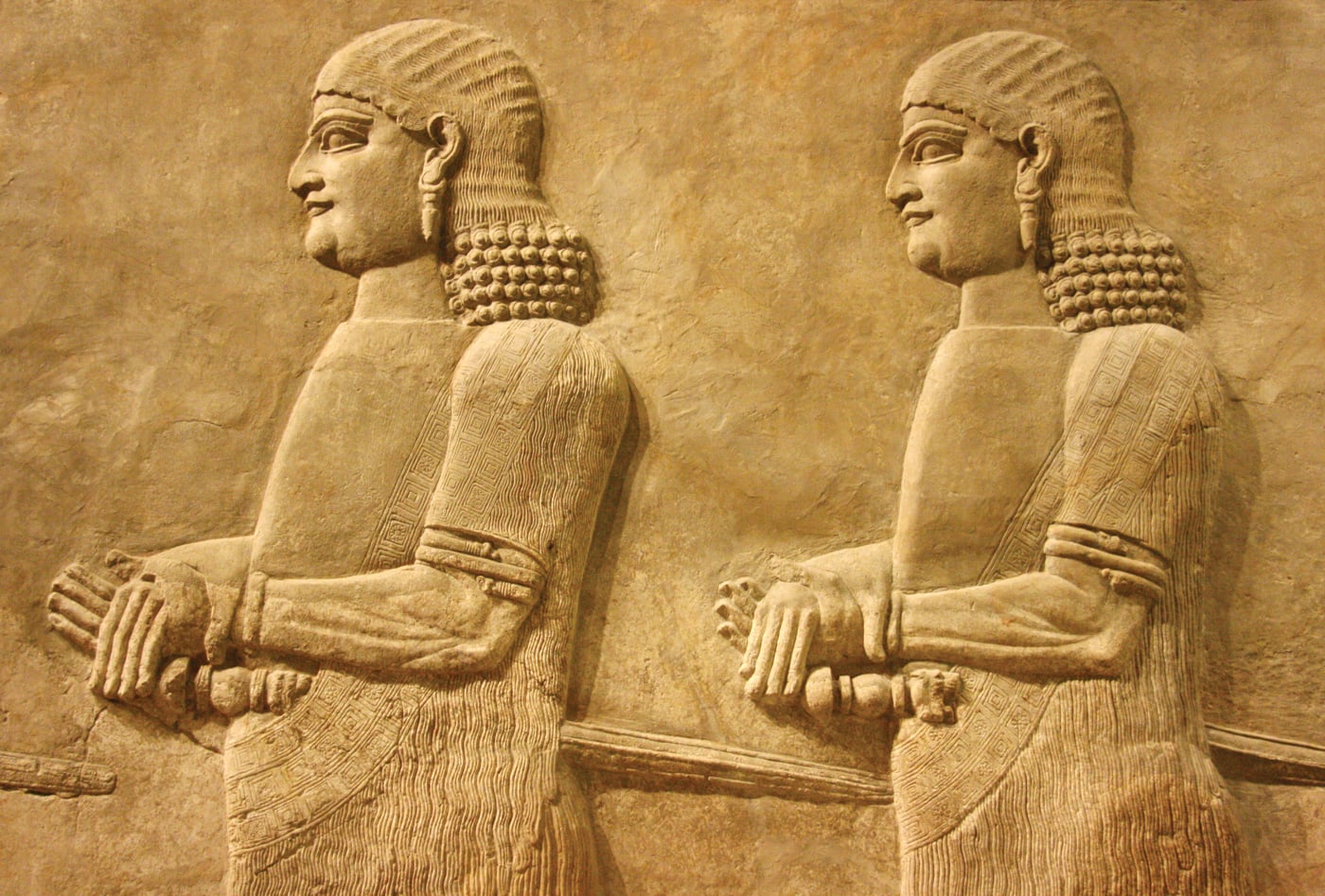
The beardless faces on these men shown in the throneroom scene of Sargon II likely indicate that they are eunuchs (Khorsabad, 721–705 BC).
B. Unfaithful leaders (56:9–57:2). The leaders are called “watchmen” (56:10; cf. Isa. 52:8; Ezek. 3:17; 33:7). Leaders, whether civil or religious, charged with responsibility for the people of God are likened to “mute” and greedy dogs (56:10–11)—irresponsible in discharging their responsibility for instructing God’s people and greedy for material gain.
The struggle between righteousness and wickedness extends even to Zion. The wicked are those who enjoy the benefits of the covenant community without committing themselves fully to God and to his righteous purposes. As long as evil is in the world, its dark power seems to overshadow the glory of Zion.
C. Unfaithful people (57:3–13a). Isaiah goes on to compare the people of God to bad “seed” (NIV “offspring,” 57:3). They are nothing but rebels because they love idolatry in all its forms. They have given themselves over to idolatry and immorality.
Isaiah describes the extent of Judah’s apostasy. Wherever they are, the people are corrupt, whether they go to the ravines (57:6) or to the hills (57:7), whether they stay at home (57:8) or go to Sheol (57:9).
The wicked will be left to themselves. The Lord has been patient in not destroying them thus far. Because they have shown no sign of repentance or fear of him, however, they will not stand in the judgment of God. They will fall with the rest of humanity.
D. The future of God’s people (57:13b–21). In contrast to the greedy and idolatrous ways of the wicked, the righteous and devout, who walk uprightly and commit their way to the Lord, will have a future. What a contrast between verses 1–2 and 13b! The perishing will have a glorious future, because they have made the Lord their refuge.
The Lord himself initiates the full redemption of his children. All obstacles will be removed for his coming. He is the exalted king, “the high and exalted One,” who lives “in a high and holy place” (57:15). He reaches down to save, revive, and even dwell with the devout, “who [are] contrite and lowly in spirit” (57:15). The holy God will allow the humble to dwell with him on his “holy mountain.”
If God were to be continually angry, the righteous would also lose heart. Therefore, he revives the spirit of his people by words of comfort. He assures the humble that they will receive all they need for this life and the life to come. In healing his people, the Lord gives them rest and consolation, guidance and protection, and joy. They will be at peace with God. The wicked are compared to a “tossing sea” (57:20). They will never have a lasting peace.
Thus, the prophet assures the godly that the Lord is intent on providing restoration for his people, though it may take a long time. While on earth, the righteous experience some rest and peace. However, these are but tokens of the grace of God. The fullness of rest and peace will come when the Lord has fully restored the heavens and the earth and when the wicked are no more.
E. True religion (58:1–14). The prophet again calls on the people to look on themselves in terms of their commitment. The people did indeed practice fasts and the Sabbath, which were derived from the law. However, just as syncretism and paganism are abominable to God, so is religious formalism. It is not enough for people to conform to the law of God if in one or more ways they continue to sin against it. The prophet emphasizes true religion and the rewards of true godliness.
The prophet shows what true religion is not (58:1–9a). True religion includes obedience to the law of God and a delight in the presence of God; but when sought for a reward, it degenerates into formalism or pharisaism. The love of God must show itself in love of one’s neighbor. Godliness is shown not by appearing outwardly pious but by being sensitive to the suffering of people.
The Lord regards those who fast in humility. To fast in humility is to have regard for God and for others. This regard for others is expressed by giving people a sense of importance and freedom, by giving people food, and by speaking and acting in a way that brings honor to the people of God. Fasting as an act of humility and contrition can be acceptable to God only if it is an expression of love for God and neighbor.
True godliness shows itself in concern for justice and a love of the Sabbath (58:9b–14). Justice is God’s concern and therefore cannot be limited to the Jewish people under the law. God is concerned with oppression, slander, and unrighteous acts. The glorious presence of God will dawn on the righteous. The godly are likened to a well-irrigated garden (58:11). They are God’s appointed instruments of restoration. Such is the ministry of healing and reconciliation God has given to his people—then as well as now.
This understanding of God’s desire for justice informed what keeping the Sabbath should entail. The Sabbath was a day in which the people were to give themselves to the worship of the Lord. While doing so, they were also to think about ways of enriching themselves. The prophet calls the people to look on the Sabbath as a day that the Lord has given to them on which to rest. To rest from one’s labors is, first, not to think about personal gain, and second, to do what is right. To call the day a delight is to think about ways in which other people, too, may delight in the day. The Sabbath day is most appropriate as a day on which to do works of mercy in order to give an experience of light and joy to the oppressed and distressed.
F. Responsibility (59:1–21). The postexilic experience was marked by disillusionment; God’s promises pertaining to the new era were not completely fulfilled. The early church also had to adjust to delay (see 2 Pet. 3:3–10). Isaiah explains that the delay is not because God cannot deliver. Instead of charging God with injustice or unfairness, the community of believers must look at its own sins and shortcomings (59:1–8). It is guilty of murder, untruth, and injustice, and is buried in all kinds of evil. Israel looks like the nations instead of God’s people. The people are like mothers of evil who hatch vipers and cover sin with a veneer as thin as cobwebs.
The community lament contains a moving confession of sin and an expression of Israel’s longing for the day of redemption (59:9–15a). It will be a day of “light” and rejoicing; darkness and mourning will be dispelled. In the confession, the community expresses sorrow for its shortcomings. The people have sinned against their neighbors. They have scorned justice, fidelity, and integrity and crushed the honest man. The dawning of God’s kingdom is related to, but not dependent on, God’s people ordering their lives in harmony with his purposes.
Because of the absolute moral bankruptcy of the people, no one is able to deliver them. Only the Lord, whose arm is strong to deliver, can deal with his people (59:15b–21). Isaiah describes the Lord as a warrior readying himself to aid the godly. He puts on the breastplate, representative of “righteousness,” the helmet, representative of “salvation,” and the garments, signifying his “vengeance” and “zeal” (59:17; cf. Eph. 6:14–17). God is concerned about the remnant, and he expresses his concern by coming to judge the wicked, who will be punished according to their deeds. The Lord may delay his judgment, but he sees everything, including the affliction of his people and the evil done to those who call on his name.
The Redeemer God will reveal his glory to the ends of the earth, singling out Zion for his kingdom. The covenant will be renewed by the pouring of his Spirit on them and their children forever, so that all God’s people will be inspired to know, do, and speak according to his word. Paul cites these words in his argument that God will redeem apostate Israel, which has rejected the Messiah (Rom. 11:27).
G. The glory of Zion (60:1–62:12). 60:1–22. The delay in the revelation of God’s victorious kingdom concerns God’s people, but God still expects them to live in accordance with his rule by practicing justice, righteousness, love, and peace. The word of the Lord (59:21) will be fulfilled.
The revelation of God extends his glory and light—characteristics of the Lord himself—to his people (60:1–9). Glory and light will surround them, enabling the nations to see God through restored Israel. The repetition of the words “light,” “brightness,” “shining,” and “glory” creates a poetic effect.
The light in combination with “thick darkness” sets the background of a theophany. The response of the nations will be twofold. First, they will desire inclusion in the new era that will dawn on Zion (60:3). Second, they will cooperate by contributing to the welfare of Zion (60:4–9). The resources of the nations will be used to “honor . . . the Lord . . . the Holy One of Israel.” Riches, herds, flocks, and ships of Tarshish will all be submitted to God.
The tribute and labor of the nations will be used to rebuild Zion as an expression of God’s compassion and justice (60:10–14). The enemies and oppressors of Zion will receive their just deserts. The walls and gates symbolizing God’s kingdom are not for protection; the gates will always be open (60:11). The Lord will share the spoils of his victory with his people. Furthermore, he will reestablish his glorious presence in their midst. Zion will be called the “City of the Lord” and “Zion of the Holy One of Israel” (60:14; cf. Ps. 48:1–14).
The Redeemer God will restore the fortunes of Zion (60:15–18). They have been forsaken but will become “the everlasting pride” and “the joy of all generations” (60:15). They will know that he is their Redeemer. His governance will be not only just but glorious as well. He will prosper his people greatly with a kingdom of peace and righteousness, in which his victorious rule brings lasting salvation and joy.
The glory of the New Jerusalem is in the experience of God’s presence (60:19–22; cf. Rev. 21:23; 22:5). The people will all be “righteous”; that is, they will enjoy the benefits of his kingdom: the new creation. The certainty of fulfillment is guaranteed by his signature: “I am the Lord.” He will restore everything, especially the New Jerusalem.
61:1–62:12. Judah and Jerusalem have been assured that Yahweh has a plan for a remnant of the people. They will return from exile. The Lord has promised to restore heaven and earth, to restore the people to himself, and to hasten the day of redemption. The announcement of the year of the Lord’s favor means that the Lord is reconciled to humanity and that humanity may obtain forgiveness from God. In chapter 61 the Lord himself, together with the prophet, confirms the eternal covenant, which cannot be broken.
The person of whom the prophet speaks in 61:1–7 is a servant of God. (Technically this is not a Servant Song.) The presence of the Spirit of God (61:1) and the anointing and proclamation suggest the servant’s purpose. The servant of the Lord, who has been called to proclaim the good news, can be none other than the prophet himself. He has been called to proclaim the acceptable year of the Lord to those in exile, but in a fuller sense the proclamation of the servant applies to the ministry of our Lord (Luke 4:18–19).
The messages of comfort begin with a call to loudly proclaim the good news of the Lord’s forgiveness and restoration of his people. The prophetic proclamation consists particularly of the preaching of “the year of the Lord’s favor” (61:2). In the restoration from exile, the prophets were instrumental in bringing the good news to the captives. Jesus further proclaimed the good news and focused on himself as the one bringing in the era of restoration. He also promised that he would accomplish all when he returns. The year of restoration is not limited to one particular day or year, but extends from the postexilic restoration to the full restoration of heaven and earth.
The proclamation of the acceptable year of the Lord is directly connected to the proclamation of the day of vengeance. The one focuses on God’s kindness to his people, whereas the other focuses on God’s judgment on the wicked.
“The year of the Lord’s favor” is also a prophetic reference to God’s administration of grace, which culminates in the restoration of all things. This restoration includes the promises of forgiveness and full fellowship with God and the removal of physical problems, obstacles, and mourning. It is the year of Jubilee, the year of liberation (Lev. 25:10). Jesus applied this word to his healing of the blind, deaf, and lame as a token that God is concerned about our whole being, including our physical welfare.
Finally, the acceptable year of the Lord proclaims comfort to all the people of God. The prophet calls the new people of God “oaks of righteousness” and the “planting of the Lord” (61:3). Instead of being rejected, the people of God will be accepted and prepared for a great and glorious future.
This redemption, however, is not to be limited to the eschatological future. The prophet quickly moves from the restoration of the people to the restoration of the land. God is also concerned with the ruins and assures his people that the cities will be rebuilt and that this will be funded by the wealth of the nations. The new position of the people of God is expressed by the word “priests” (61:6). They will be priests of the living God, while others take care of menial tasks.
Spiritual benefits are mixed with God’s concern for physical well-being. The people have been disgraced in exile, but they are assured that they will have a double portion in the land. The Lord knows that his people have suffered double for all of their sins (Isa. 40:2), and he gives back what they have missed during the exile. The purpose of the acceptable year of the Lord is to prepare the Lord’s people for the fullness of redemption. While they are on earth they receive the first fruits of redemption. The Jews after the exile experienced restoration of the cities, help from the nations, and productivity of the land. They were comforted by God’s grace physically as well as spiritually. Since the coming of our Lord Jesus Christ the people of God are now made up of Gentiles as well as Jews. Our heavenly Father has assured us that he is concerned about our physical well-being. Moreover we are the recipients of the grace, comfort, and forgiveness of God. Yet this message speaks of a greater era in which our heavenly Father will restore heaven and earth through the ministry of Jesus Christ.
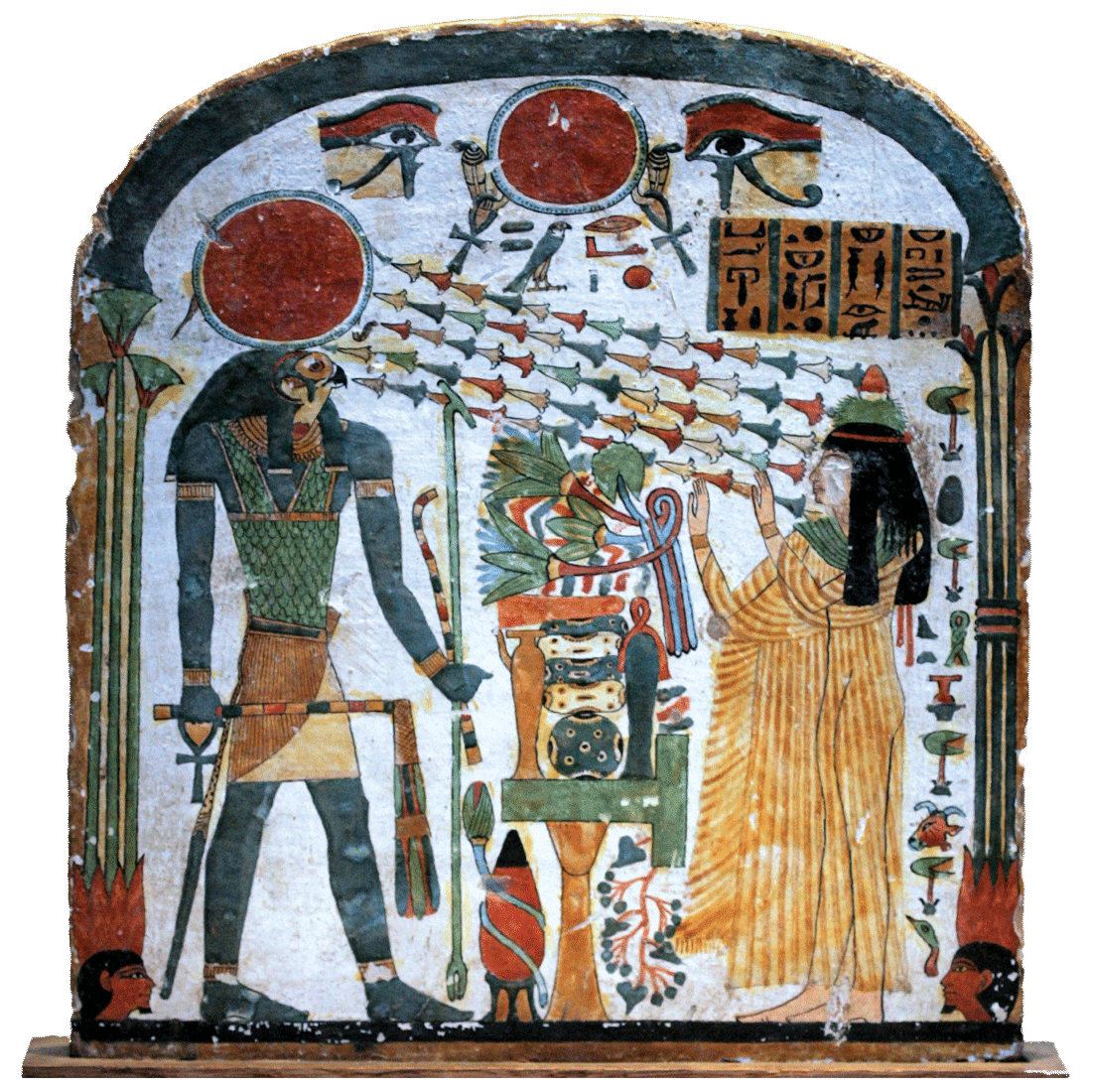
Isaiah 61:3 describes God’s people adorned with “oil of joy” and a “garment of praise.” In this painted wood stele from Egypt, the Lady Taperet (right) is depicted similarly, dressed elegantly with a perfume cone in her hair (tenth or ninth century BC).
The new era is forever, because the covenant is forever (61:8–9). God knows how his people can be unpredictable and faithless; therefore, the outworking of the covenant is not dependent on them. He is faithful. His covenant will accomplish the purpose for which he has made it: that his people may be blessed.
The prophet likens the glory prepared for God’s people to the adornments of a bride, bridegroom, and priest (61:10–11). She will serve the Lord in the presence of the nations as a priest, adorned with “a crown of beauty” (61:3), anointed with the “oil of gladness” (61:3), and clothed in “a garment of praise” (61:3). The new era of the priesthood of all believers will introduce a renewal of God’s kingdom.
The prophet prays that the era of God’s victorious kingship, bringing full “salvation” to his people, may come soon (62:1–5). Then the nations will recognize the glory of Zion, which was trampled down by the enemies of God. The new names given are descriptive of the new era: “Hephzibah” (“my delight is in her”) instead of “Deserted,” and “Beulah” (“married”) instead of “Desolate” (62:3–4). The Lord will rejoice over his people.
Out of concern for his people, the Lord has appointed watchmen (62:6–12). The watchmen are not needed for the protection of the city, for Yahweh makes his people secure. The watchmen pray day and night for the full restoration of the people of God. The Lord responds to the prayer by an oath of assurance that he will never again do what he has done to his people. Redemption is certain to come, and the prophet calls the people to prepare themselves for the Savior’s coming.
The people receive a new name. God sets them apart as a holy people and the redeemed of the Lord: “The Holy People,” “The Redeemed of the Lord,” “Sought After,” “The City No Longer Deserted” (62:12; see also 60:14, 18; 62:4). These names for the new people of God signify the new relationship, the glory, and the purpose of the people of God.
H. The day of vengeance (63:1–6). Since the Lord is righteous and speaks righteously, the day of vengeance is the day of redemption of God’s people (63:4). In his verdict as the great judge, he assures the people that he truly is able to save them. Because of his righteousness, his concern for his people, and his great anger, the Lord comes to this world as the great warrior (63:1). The portrayal of the judgment of Edom is a picture of God’s judgment on the whole earth.
The day of the vindication of the Lord is an expression of the day of the Lord, an eschatological event in which God brings his cataclysmic judgment upon all the earth.
I. A prayer for God’s people (63:7–64:12). Isaiah publicly proclaims the acts of the Lord’s love (Hebrew hesed) for his people, whom he adopted as his sons and daughters (63:7–14). He redeemed them in the expectation that they would be loyal to him. However, they were unfaithful and opposed his will (“grieved his Holy Spirit,” 63:10).
The past era of grace and compassion is over. The godly look back over the history of redemption with a renewed longing to be included. In the past God raised up Moses, and no one could oppose his will. God showed the power of “his glorious arm” (63:12). He brought the people through the Red Sea and safely into the promised land by his divine will. The past reveals that nothing stands in the way of God’s will and presence.
The prophet leads God’s people in a prayer for redemption (63:15–64:12). He grounds the petition on God’s promise to establish his sanctuary as a footstool among his people (63:15, 18), on the father-son relationship (63:16), and on the covenantal relationship with the tribes (63:17–19). Now it seems that they have never been called by his covenant name.
The prayer also focuses on the revelation of God. As the people pray that the Lord might descend to shake the mountains and show himself in his glorious fire, they call on him to come to their aid by taking vengeance on their enemies and by redeeming his faithful people. The people confess that they are not ready for him because they are sinners, unclean, hopeless, and objects of wrath. But they pray that the Lord may forgive and forget their sins. They call on the Lord as their Father and wait for his compassion. They confess his authority and their helplessness and need of forgiveness, restoration, and fellowship. They remind him that the land, the cities, Jerusalem, and the temple are in ruins.
J. God’s response (65:1–25). The Lord is ready to respond in a most self-giving way (65:1–7). But the people are still too engrossed in sin. They show themselves to be idolaters and have little concern for spiritual purity, as they keep vigils among the graves and eat pork—against God’s explicit commandment. They are like Gentiles. They respond with a self-made holiness. The Lord in turn will respond in judgment. Even as the Lord has promised not to be silent until he has accomplished the redemption of his people, so he will not be silent until the enemies of his kingdom have been put down.
God assures his own that he knows them and will separate the ungodly from the godly (65:8–16). On one hand, God promises his grace to the remnant. On the other, he makes it clear that his judgment will rest on the ungodly until they are no more.
The prophet likens the covenant community to a cluster of grapes. Not all the grapes in a cluster are good; some are spoiled and others are unripe. However, some may still produce wine and obtain a “blessing” on the cluster. For the sake of the whole, God will be patient with the community; his judgment will be selective. Yahweh will reward those who seek him, whereas he will judge the wicked.
The ungodly have forgotten the Lord and have given themselves over to idolatrous practices. They are unresponsive and rebellious toward him. They will mourn their disgrace, whereas the righteous will rejoice in the Lord because of the many benefits he has extended to them. The Lord assures his own that they will be satisfied both with food and drink and with their new name, which represents their restored status. Instead of the troubles associated with the “old era,” they will experience the fullness of the restoration God has promised to all his people: the new heavens, the new earth, and the New Jerusalem.
It is tempting to think of the state of restoration (65:17–25) as the eschatological, everlasting state of the new heavens and the new earth. Even though the prophet portrays the blessings of the people of God in a final way, he is addressing those in exile, assuring them that they will have a future. The Lord will again rejoice in his people. Because the Lord has blessed them, their former troubles are forgotten. The “former” era is the experience of judgment and exile. The Lord will create a “new era”—“new heavens” and a “new earth” (65:17). The new era is characterized by the joy of the people of God because Yahweh himself rejoices over his people. The sorrow of past sufferings will cease because of the comfort of the Lord. The new era is described in terms of physical health and longevity, the enjoyment of God’s benefits in physical ways, answers to prayer, and peace and the absence of malice and corruption. Even their children will know the Lord and will be blessed by him.
Those who returned from exile experienced these blessings to some extent; however, many of them were only partially realized. Jesus reaffirmed that it is the Father’s will to restore the heavens and the earth. He showed his concern for the physical and spiritual needs of people. Jesus has also pointed us to the great future that awaits all who have faith in him. He will bring in the new era in an even greater way. Then Christians will enjoy the fullness of God’s benefits, spiritual as well as physical. Isaiah 65:17–25 is thus a continual reminder of the Christian’s heritage in Jesus Christ.
K. Judgment and restoration (66:1–24). The last chapter of Isaiah provides a complementary answer to that of chapter 65. The Lord affirms the certainty of his judgment on idolatry and religious hypocrisy among his people and the blessings of the new age on faithful Jews and Gentiles. The extension of the new age to the Gentiles is a further development beyond chapter 65 and is in full harmony with the prophet’s teaching on the universal nature of God’s kingdom.
It was tempting for Old Testament believers to localize God’s kingship. They knew that God ruled over the whole earth and that his throne was in heaven. They had also been taught that the earth, and especially the temple in Jerusalem, was his footstool. To approach the temple was to approach God. For that reason, it was important to approach the Lord with gifts befitting his sovereignty and royal splendor. But rather than being the place of true worship, the temple had become a place where people came to pacify their own consciences; they were trying to atone for their own misdeeds without exhibiting a spirit of true contrition. In their corruption, injustice, and hatred, they were presenting sacrifices offensive to the Lord.
The prophecy of Isaiah concludes with God’s concern for true worship (66:1–6). God desires to have fellowship with those who show sensitivity to his word by acts of obedience, love, and justice. The love of God is evident in those who are humble and contrite in spirit. They may suffer in an unjust world, but he promises to vindicate them. On the other hand, he will avenge himself on those within the community of faith who worship in their own ways, not having a heartfelt love for God and for their brothers and sisters in the faith.
The judgment of God clearly comes against all those who have opposed his kingdom (66:7–9). The noise coming from the temple (66:5–6) is the sound of the Lord himself, who has come to defend his children by bringing retribution on the wicked.
The Lord invites all to rejoice with Mother Jerusalem. Those who love her in adversity and prosperity will be rewarded with joy, fullness of life, peace, and comfort (66:10–14). These benefits are further guaranteed to all who love the Lord Jesus Christ.
As God’s people are encouraged that the Lord is going to be with his children, he also assures the enemies that his vengeance will come upon them (66:15–17). His coming is depicted in prophetic imagery: fire, chariots, whirlwinds, and swords. The effect of Yahweh’s judgment is that the wicked will be slain. The prophet gives the scene of God’s judgment on the wicked in order to assure the ungodly who have been members of the covenant community that they too will be under God’s judgment. Those who have made their own rules of sanctification and defilement will be consumed together with the wicked.
In quick strokes the prophet describes how many nations will be instrumental in bringing together the people of God (66:18–23). They will be instrumental in restoring the Jews to full participation in the kingdom of God. But in the very process, they too will see the glory of the Lord. The Lord himself will set a sign among the nations by sending messengers who will proclaim the glorious acts of God. The restoration of the Jews to the land, God’s continued care for the Jewish people, and God’s acts of redemption (including the finished work of our Lord Jesus Christ and the work of missionaries and evangelists) will result in many nations (including the Jews) bringing sacrifices to the Lord and serving as priests and Levites in God’s presence. They will gather together from festival to festival and enjoy covenant fellowship from generation to generation.
The prophet introduced the coming judgment and its effects in verses 15 and 16. He returns to this motif in the last verse of the prophecy (66:24), a perpetual reminder that God’s judgment on the wicked is everlasting and that those who have been condemned to separation from him in life will suffer eternal separation in death.
Select Bibliography
Childs, Brevard S. Isaiah. Old Testament Library. Louisville: Westminster John Knox, 2001.
Grogan, G. “Isaiah.” In The Expositor’s Bible Commentary. Edited by Frank E. Gaebelein. Vol. 6. Grand Rapids: Zondervan, 1986.
Motyer, J. Alec. The Prophecy of Isaiah. Downers Grove, IL: InterVarsity, 1993.
Oswalt, John N. Isaiah. NIV Application Commentary. Grand Rapids: Zondervan, 2003.
———. Isaiah 1–39. New International Commentary on the Old Testament. Grand Rapids: Eerdmans, 1986.
———. Isaiah 40–66. New International Commentary on the Old Testament. Grand Rapids: Eerdmans, 1998.
Ridderbos, Jan. Isaiah. Bible Student’s Commentary. Grand Rapids: Zondervan, 1985.
Webb, Barry G. The Message of Isaiah: On Eagles’ Wings. The Bible Speaks Today. Downers Grove, IL: InterVarsity, 1996.
Young, Edward J. The Book of Isaiah. 3 vols. Grand Rapids: Eerdmans, 1965–72.